Feeds:
Posts
Comments

Posts Tagged ‘peace’

Photo: Joseph Eid / Agence France-Presse
Painting the word “Peace” in Arabic over 85 rooftops on a Tripoli street for a project led by twin Lebanese street artists over a three-year period.

Nearly everyone wants peace. Nearly everyone expresses that over and over. You would think we would have peace by now. One large-scale expression of the world’s fervent wish in a city badly damaged by conflict took three years to accomplish.

Agence France-Presse reports, “From the street below it’s easy to miss the workers daubing rooftops as part of an ambitious art project in two battle-scarred neighbourhoods of Lebanon’s Tripoli.

“But the Ashekman street art duo behind the project say that once they’re done, the pistachio-green rooftops they are painting will spell out the word ‘Salam’ — Arabic for ‘peace’ — on a scale visible from space.

“The project, three years in the making, is the brainchild of 34-year-old twins Mohammed and Omar Kabbani. …

“They chose a site spanning the Bab Al Tebbaneh and Jabal Mohsen neighbourhoods, which have fought successive rounds of armed clashes in recent years. …

“Peace has been elusive in Sunni-majority Bab Al Tebbaneh and the adjacent Alawite-majority Jabal Mohsen. Fighters from the two areas have battled each other periodically for decades, and the war in neighbouring Syria, pitting a Sunni-dominated uprising against Alawite president Bashar Al Assad, has further stirred existing enmities. …

“Ashekman’s project runs on either side of the infamous Syria Street separating the two neighbourhoods. The duo hired workers from across the divide to help them complete the project.

” ‘All of the workers live here in the neighbourhood, they lived the conflict, some of them got shot,’ Omar Kabbani said.

” ‘Two years ago they were hiding from bullets … now they’re painting their rooftops proudly.’

“The brothers are sensitive to the observation that their project does little to address the most obvious scars of fighting or the area’s desperate poverty, often identified as a catalyst of the violence.

“They say they chose paint that will seal rooftops against rain and reflect ultra-violet rays, cooling the homes below.

“And in order to paint the rooftops, they had to negotiate with residents and often had to clear large amounts of trash and debris. …

“Walid Abu Heit, 29, joined the project as a painter after hearing about it from March, a Lebanese NGO that has worked on reconciliation and rehabilitation in the rival neighbourhoods. …

“He and other workers lugged heavy tubs of paint up seven floors and began plastering a roof with the fluorescent green, which flecked his hands and boots.

” ‘It’s an amazing project,’ he said, smiling and shading his eyes from the blazing sun.

” ‘The word peace, it’s a great word … we haven’t seen it for a long time, now we’re seeing it again.’

Read more here; also at National Public Radio, here.

And ponder the power of artistic twins here, at one of my posts on street artists Os Gemeos. The Greenway’s first giant mural, which they painted, is still my favorite. It makes you think about “The Other” as a sweet little kid.

Read Full Post »

For better or worse, no movement ever dies out completely. The hippies and Rainbow Children of the 1960s seem to have morphed into something called the Rainbow Family of Living Light, a “disorganization” that has annual, playful camp-outs in the wild. (The Wikipedia editors say the entry on the group, here, needs work, but I think it gives you an idea.)

Jessica Rinaldi at the Boston Globe took a lot of photos at the July 2016 gathering in Vermont.

Here’s what she says about the event: “Each year, for a few weeks in summer, a loose confederation of like-minded souls called the Rainbow Family of Living Light quietly converts a site in a public forest somewhere in the United States into a communal living space for thousands.

“Campsites are established, latrines are dug, and an elaborate water filtration system is erected to bring water from nearby streams. While the group’s origin is a bit cloudy, it’s generally accepted that the first ‘official’ gathering of the Rainbow Family was in Colorado in 1972. For the summer of 2016, they gathered in Mt. Tabor.”

Is this the escape you’ve been looking for?

Rinaldi’s photos are available at the Boston Globe, here.

Photo: Jessica Rinaldi/Globe Staff
The Rainbow Family gathering draws free spirits from across the country, including this man dressed as a tree-like Ent from “The Lord of the Rings” at the 2016 event, held on public land near Mount Tabor, Vermont. Great array of photos to be found here.

Read Full Post »

As some readers know, I used to be quite energetic about Esperanto, an invented international language that I’ve blogged about a few times.

Even though Esperanto never took the world by storm, it’s still in use, and the goal to create a widely accepted bridge between languages and cultures is still a worthy goal.

At the New Yorker recently, Joan Acocella wrote about Esperanto’s founder, Ludwig Zamenhoff, a Jew living in Poland at a time of fierce enmity among people of different ethnicities. Convinced that a shared language could promote peace, Zamenhoff decided to do something about it.

The usefulness of a common, intermediary language was not a new idea, writes Acocella. “Ambitious organizations such as the Roman Empire and the Roman Catholic Church made sure that their members, whatever their mother tongue, learned a second, common language. …

“Esperanto’s creator, Ludovik Lazarus Zamenhof (1859-1917), a short, sparkly-eyed, chain-smoking ophthalmologist, was a Jew, and, as he wrote to a friend, this made all the difference: ‘My Jewishness has been the main reason why, from earliest childhood, I gave myself completely to one crucial idea . . . the dream of the unity of humankind.’

“By this he may have meant that Jews were broader in outlook. In any case, he felt that they needed to be. In the town where Zamenhof grew up — Białystok, now in Poland but at that time part of the Russian Empire — the population, he wrote, ‘consisted of four diverse elements: Russians, Poles, Germans, and Jews; each spoke a different language and was hostile to the other elements.’

“He went on, ‘I was brought up as an idealist; I was taught that all men were brothers, and, meanwhile, in the street, in the square, everything at every step made me feel that men did not exist, only Russians, Poles, Germans, Jews.’ …

“[At one time a Zionist], Zamenhof became disillusioned with Zionism. … He wanted Judaism purged of all narrowness. Let the Jews keep some of their nice things, their High Holidays and the stories and the poetry in their Bible. But, as for theology and ethics, they should confine themselves to the teachings of Rabbi Hillel (first century B.C.), which, according to Zamenhof, consisted of just three principles: that God exists and rules the world; that He resides within us as our conscience; and that the fundamental dictate of conscience is that we should do unto others as we would have them do unto us. …

“At his nineteenth-birthday party, in 1878, he surprised his guests by giving each of them a small dictionary and a grammar of a new language he had invented.” It was the beginning of an international movement.

More here. The New Yorker article is a review of Esther Schor’s book Bridge of Words: Esperanto and the Dream of a Universal Language.

There’s a lot more to the story of Zamenhoff and the rise of Esperanto, which today is spoken in surprising places all over the world. (When I was first learning it, for example, China was publishing propaganda stories in the language.) To learn more, start with the New Yorker book review — and then maybe the book itself.

Photo: Loyal Books
Ludwig L. Zamenhoff (1859-1917), the eye doctor who invented Esperanto as a language to bridge disparate cultures. The word Esperanto means “one who is hoping.”

Read Full Post »

We have no idea what Wednesday will bring, but let’s do this. Let’s commit to focusing on what we once shared with that friend whose life path led him to a different decision. Let’s honor his or her life path if not the most recent destination. We’ve had different life experiences.

Let’s focus on what we both like: the funny things small children say, lazy days at the beach, imaginative Halloween costumes, the blended aromas of a Thanksgiving kitchen, Peter Pan.

There’s no need to bring Abe Lincoln into this, but well, you know: A house divided against itself cannot stand.

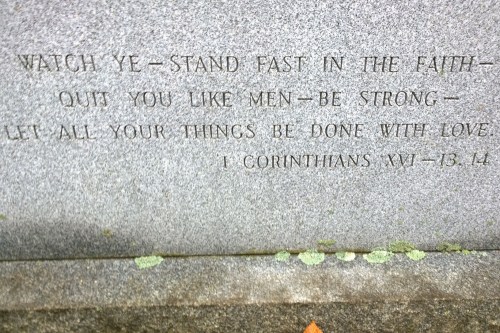
As I passed by on my walk last Thursday, this engraving with its old-fashioned wording spoke to me.

110316-let-all-your-things-be-done-with-love

Read Full Post »

Photo: Boston Globe
Al Filipov died on Sept. 11. He was on the plane from Boston.

After September 11, 2001, good works sprouted around the country, launched by people from all walks of life who were determined that goodness should have the last say.  The Huffington Post collected a bunch of these initiatives for one anniversary of the tragedy, here, but you can find examples in nearly every community.

In Concord, Al Filipov, who was on one of the planes, is honored in several ways, including by the Filipov Peace and Justice Forum.

Al’s son, Boston Globe reporter David Filipov, once recalled his father as “engineer, inventor, sailor, deacon, coach, husband, dad, raconteur.” The Filipov forum website adds that he was a painter and a human rights activist, noting,

“He sought out the best in people and cared passionately about the world in its beauty and pain. He earnestly believed in the power of an individual to make a difference in the world.”

The 2016 Al Filipov Peace & Justice Forum will take place on September 25 at the Trinity Congregational Church on Walden Street in Concord. Representatives from the Parents Circle-Families Forum are the featured guests. The Parents Circle is made up of bereaved Palestinian and Israeli families that have come together to support “peace, reconciliation and tolerance.”

As one member says in the video below, people from different sides of a conflict need to get to know one another as individuals and share commonalities in order to let go of “being right” all the time instead of creating peace. Otherwise any future agreement is just a cease fire.

The presentation will be from 4 p.m. to 6 p.m.

Read Full Post »

John-E-tughole

An article by Gretchen Reynolds at the New York Times “Well” blog details new research on the stress-reducing effects of walking in nature.

Reynolds writes, “City dwellers [have] a higher risk for anxiety, depression and other mental illnesses than people living outside urban centers …

“Various studies have found that urban dwellers with little access to green spaces have a higher incidence of psychological problems than people living near parks and that city dwellers who visit natural environments have lower levels of stress hormones immediately afterward than people who have not recently been outside.

“But just how a visit to a park or other green space might alter mood has been unclear. Does experiencing nature actually change our brains in some way that affects our emotional health? That possibility intrigued Gregory Bratman, a graduate student at the Emmett Interdisciplinary Program in Environment and Resources at Stanford University.

In his “new study, which was published last week in Proceedings of the National Academy of Sciences, Mr. Bratman and his collaborators decided to closely scrutinize what effect a walk might have on a person’s tendency to brood. … Such rumination [is] strongly associated with increased activity in a portion of the brain known as the subgenual prefrontal cortex.”

The results: “As might have been expected, walking along the highway had not soothed people’s minds. Blood flow to their subgenual prefrontal cortex was still high and their broodiness scores were unchanged. But the volunteers who had strolled along the quiet, tree-lined paths showed slight but meaningful improvements in their mental health, according to their scores on the questionnaire. They were not dwelling on the negative aspects of their lives as much as they had been before the walk.” More here.

As we used to chant to our overexcited dog when we picked her up after a grooming, “I’m calm, you’re calm.”

Try out this Derek Wolcott poem for your walk in the woods. It is read on SoundCloud by my husband’s college classmate, Jon Kabat-Zinn.

Read Full Post »

Once again, the Christian Science Monitor comes up with a story about a person creating positive change in the world.

Jessica Mendoza writes, “Behind a low, unobtrusive brick building [in Boston’s inner city] is a lush, green forest. Brown and silver-gray trees cover the building’s wall, their leafy canopies blocking the sky. Sun-dappled stones sit on tangles of grass. A boy perches on the largest rock, gazing at a distant meadow.

“On the wall’s lower left corner, the word ‘Love’ appears in bright green; opposite is the word in Spanish, ‘Amor,’ in vibrant red.

“The forest is a mural, and even in the dead of winter the 18-by-85-foot painting gives a sense of beauty, warmth, and life – qualities that artist Alex Cook tries to convey in all his work.

“ ‘Art was always a deeply spiritual thing, the most real thing in my life,’ Mr. Cook says. ‘You want to share that kind of feeling.’ …

“An artist for most of his life, Cook has painted on walls all over the United States and has even packed his brushes to travel to and paint in Kenya, Nigeria, and most recently Panajachel, Guatemala. …

“The project began in the fall of 2013 when Cook was performing in New Orleans. There he met Amy Hoyle, then a principal at a local elementary school. Ms. Hoyle was looking for new ways to engage her students and invited Cook to paint a mural on campus, based on the motto of Woodland West Elementary School: ‘Stay curious.’

“Cook delivered, painting two huge faces side by side in a strange, beautiful picture that prompted more questions than answers.

“But he did more than that. Touched by the students, many of whom were poor and had difficult home lives, Cook decided to paint something that would remind them every day of how special they were. The result was a hallway filled with a palette of colors and messages telling all who passed by that they were beautiful, needed, important, and loved. “It’s like walking through a warm hug,” Hoyle says.

Read how Cook made his projects increasingly collaborative, inspiring people from all walks of life (here).

Photo: Ann Hermes
Alex Cook stands in front of one of his large murals, an 18-by-85-foot depiction of a forest in Boston.

Read Full Post »

I was so happy to get this hopeful update on Kids4Peace Boston today.

“For a while last summer, as violence escalated in Israel/Palestine, the possibility of Israeli, Palestinian and US youth coming together for a Kids4Peace camp seemed pretty unlikely.

“But despite countless barriers and uncertainties, all 25 young leaders — Muslims, Christians and Jews from Jerusalem, the West Bank, and Boston — did make it to be together on that beautiful mountaintop in New Hampshire. …

“Being in the presence of one another and listening, really listening, to each other’s stories is the crucial first step in the Kids4Peace experience.

” ‘I came to Kids4Peace to try and understand the different viewpoints that each kid has. Some people don’t understand that someone with a different opinion than you can be right without making you wrong.’
~Participant from Boston

“In the midst of violence, in the midst of despair, there are people who turn towards each other rather than away. This summer 25 peace leaders and their families proved that they are the kind of people who choose to turn towards. These young leaders walked away from camp feeling empowered by and connected to others who believe, as they do, that together peace is possible.

” ‘To be a peacemaker is to hold our hands together, and to help each other not killing each other, to treat each other as humans.’ 
~Participant from Jerusalem”

Read Full Post »

Last night I went to a jazz benefit for the nonprofit Kids4Peace Boston, which sponsors a summer camp and other events for children of three faiths — Christian, Muslim, and Jewish. The children are from both the United States and Jerusalem and are 11 to 12. Read more about the program here.

The fundraising event was held in the Grand Circle Gallery in Boston, which features magnificent travel posters and travel photography from the 1930s and 1940s. The entertainment was provided by Indian vocalist Annette Philip and her jazz quartet. Very impressive.

Read Full Post »

Happy International Peace Day!

A woman from the public works department placed flags of all nations in special sidewalk holes in Concord at 5:30 this morning and will take them down tomorrow. I told her I always liked seeing them, and she agreed they are “festive.”

According to the International Day of Peace website, Peace Day “provides an opportunity for individuals, organizations and nations to create practical acts of peace on a shared date. It was established by a United Nations resolution in 1981 to coincide with the opening of the General Assembly. The first Peace Day was celebrated in September 1982.”

There is also a United Nations Day, in October, and Concord’s collection of flags will come back for that.

During her years heading up a local group of U.N. supporters, Charmaine’s mother made sure that Concord had flags. But the town seems to have fully embraced the idea of displaying them, so up they go and down they come two times a year. I often wonder if they get updated, given that nations reinvent themselves so often these days.

Here’s a word from Ban Ki-moon, secretary general of the United Nations.

Read Full Post »

When you have a doctor’s appointment in the morning and go to work late, you see a whole different crowd riding the subway. In the summer after rush hour, there are a lot of families on outings. A woman and a boy of about 11 got on and sat near me. The boy began to tell his mother that he had been reading about a made-up language called Esperanto. She said she had heard of it and thought it had been popular a long time ago but hadn’t worked out. An older kid they didn’t know chimed in to confirm the woman’s view. Esperanto was intended to be used as an international language, but nobody spoke it anymore.

That was too much for me. “Well,” I said, “hundreds of thousands of people speak it. I speak it.” If I may say so, the boy and his mother were delighted. Could I speak a few words, they asked?

“Mi parolas Esperanto,” I said. The boy repeated the “I Speak Esperanto” phrase several times. He then wanted to know “hello.” “Saluton,” I said. I told him and his mother why Ludwig Zamenhoff had felt a need for such a language more than 100 years ago in a war-torn part of Eastern Europe.

When the woman and the boy were leaving the train, they asked how to say “good-bye” and told me good-bye in Esperanto.

Now get this. Here is William Shatner, long before “Star Trek,” in a spooky black and white movie called “Incubus” — filmed in Esperanto!

That is so bizarre, I thought at first it must be a hoax. Maybe some Esperantists dubbed it for a joke on YouTube, I thought. But Wikipedia is very careful about such things, and it confirms that William Shatner performed in a movie in Esperanto that was thought to be lost. The recently rediscovered print had subtitles in French, which have now been converted to English. Read Wikipedia here. (Read my previous post on invented languages here.)

And just in case you are now inspired to learn the language, this little clip offers a pretty good lesson.

I hope the boy on the subway finds it. A terrifically curious and open-minded young man.

Read Full Post »

« Newer Posts