Feeds:
Posts
Comments

Posts Tagged ‘poor’

Photo: Ogar Monday.
Two students sit outside an experimental Nigerian school’s computer lab, donated by the Irish Embassy.

Today’s article is about an educational experiment in Africa that makes it possible for the “poorest of the poor” to get an education. The experiment is focused on keeping payments low and teaching kids to become “problem solvers.”

Ogar Monday writes at the Christian Science Monitor, “Groups of students, deep in discussion, are huddled under a large schoolyard canopy on a sweltering morning. Flanked by two teachers, Kingsley Bangwell strolls among the students. He stops beside one group and asks, What problem are you solving?’

“Two students rise. Faridat Bakare, a girl with paper in hand, responds. ‘Our work is on the lack of proper business strategy among female-owned small businesses in Kuje,’ she says.

“She explains that many women in that Nigerian city unintentionally limit the growth of businesses they start by overlooking the four P’s of marketing: product, price, place, and promotion. The students’ solution is to start a mentorship cycle connecting established businesswomen with local budding entrepreneurs. Mr. Bangwell nods his approval and moves on to another group.

“Mr. Bangwell is a co-founder of the Knowledge, Solutions, Skills, and Kreativity (Knosk) school in Kuje, on the outskirts of Nigeria’s capital, Abuja. For 100 naira (6 cents) a day, the school provides six years of learning for students who would otherwise be unable to afford it.

“The exercise that Mr. Bangwell is observing is part of a solutions ‘hackathon.’ Over four days, students engage with small-business owners in their communities to identify real-world challenges and develop solutions.

“ ‘The goal is to help them think critically and work collaboratively,’ Mr. Bangwell says. Winning teams receive prizes, but the biggest takeaway, he insists, is that the students realize ‘they, too, can provide answers to questions around them.’

“In 2018, while she was at a hospital in Abuja, Irene Bangwell overheard a cleaner talking about her teenage daughter, who had dropped out of school to work alongside her. The cleaner explained that she couldn’t afford the $19-per-term school fees for the girl. She believed that it was better for her daughter to work and save money than to attend an underfunded public school with little promise of quality education.

“Mrs. Bangwell, who had spent years working with young people, understood the mother’s concerns. Although public schools in Nigeria are mostly free, they are chronically underfunded, which has led to crumbling infrastructure, teacher shortages, and frequent strikes. Private schools provide better alternatives, but with nearly 39% of Nigerians living below the poverty line, many families find such schools out of their reach.

“Mrs. Bangwell shared the cleaner’s story with her husband, who has a background in youth development. They started Knosk in September 2019 after reaching out to community leaders, churches, mosques, and public primary schools, asking them to refer students who couldn’t afford secondary education. …

“Parents contribute $4 per term.

“ ‘We cater to the poorest of the poor,’ Mrs. Bangwell says. ‘If we don’t take the child in, they have no other chance at an education.’

“The school provides a curriculum that integrates computer and vocational skills, daily lunch, menstrual supplies for female students, and a boarding facility for a few students. …

“Victoria Simon, one of Knosk’s pioneer students, was 6 months old when she lost her father. By age 9, she had also lost her mother, leaving her in the care of her older sister. After Victoria completed primary school in 2018, her family had no means to send her for further education.

“ ‘We were ready to give up when my sister heard about Knosk,’ Victoria recalls.

“The school sounded too good to be true. But two weeks later, Victoria took Knosk’s entrance exam and wrote a 300-word essay about her aspirations. ‘I wrote about creating a free six-month training program for women and giving them tools to start their businesses,’ she says. …

“For some families, even the small fees that Knosk charges are a struggle. And according to Mrs. Bangwell, those fees are not enough to sustain the school. ‘Between paying teachers, uniforms, feeding the kids, and providing learning materials, we need more support,’ she says. Yet no child is ever turned away for unpaid fees.

“The school, which started with 30 students and now has 170, relies heavily on what it calls ‘education angels.’ These are individuals and organizations that sponsor students, for $156 per year.

“Knosk’s impact hasn’t gone unnoticed. ‘The quality of teaching and learning there is comparable to any private school in this area,’ says Daudu Shedrach, an education inspector with the Federal Capital Development Authority. …

“At Knosk, every student is called ‘solver,’ a title that reflects expectations. ‘A solver sees problems and takes action,’ Mrs. Bangwell explains. ‘We build their capacity to see beyond their challenges and to think like contributors to society, not victims.’

“For solvers like Mustapha Ibrahim, who joined Knosk in 2019 after losing his father two years earlier, the title has become a compass for how he approaches life. ‘There is no problem that I cannot solve,’ he says. ‘I just have to think hard about it.’

“Mustapha recalls how he once struggled with self-doubt and anger, believing that his life had ended when his father died. … Today, Mustapha dreams of becoming an aeronautical engineer. ‘I’m always fascinated by how airplanes stay in the sky despite their weight,’ he says.

“He also hopes to give back to the school that changed his life.

“ ‘I want to make it,’ he says, ‘and then come back to help other kids like me. Because I honestly don’t know who I would have become without this place.’ ”

More at the Monitor, here. No firewall. Subscriptions are reasonable.
Read Full Post »

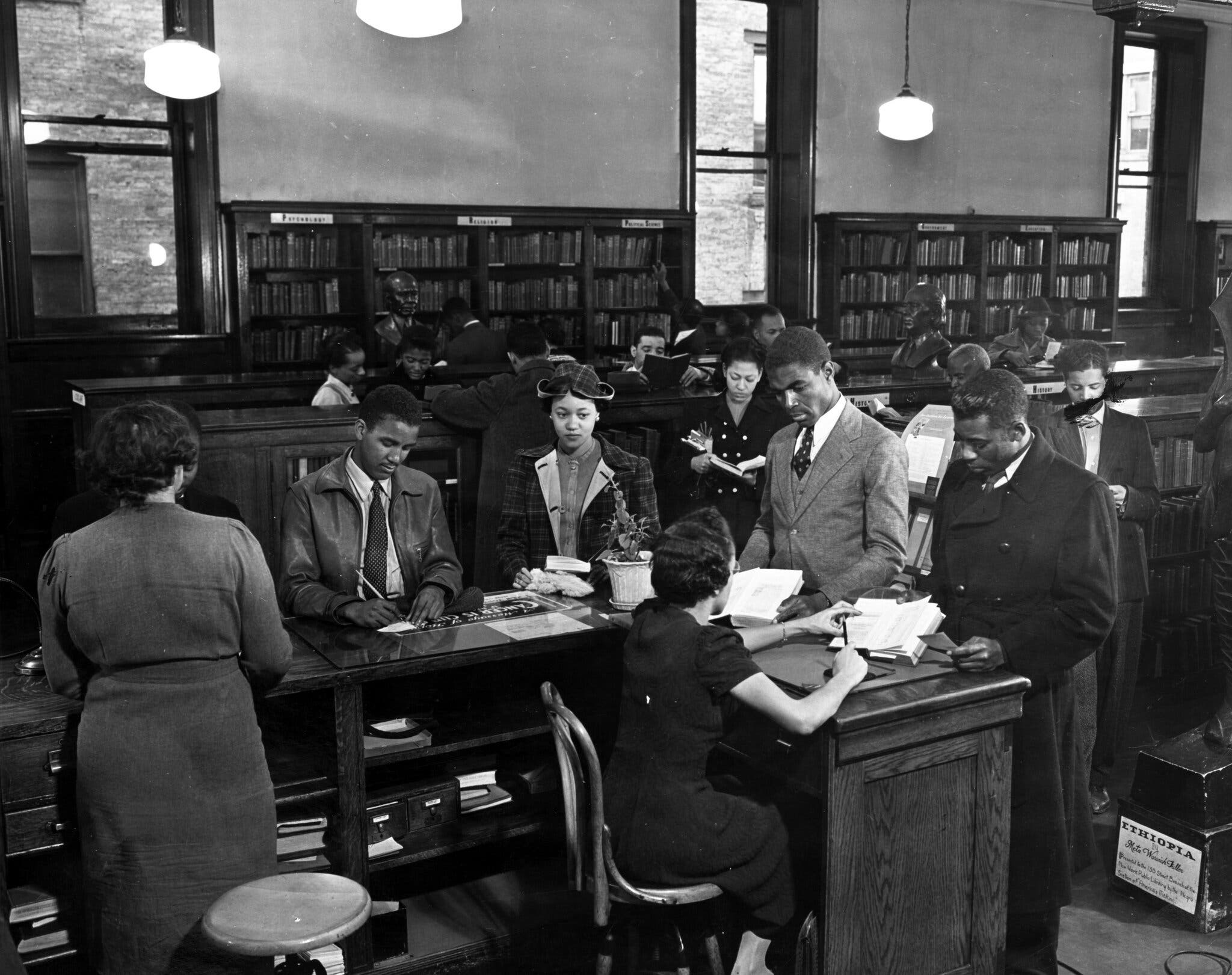
Photo: New York Public Library.
In 1925, the New York Public Library system established the first public collection dedicated to Black materials at its 135th Street branch in Harlem, now known as the Schomburg Center for Research in Black Culture.

I have read numerous accounts of what a public library has meant to poor children with insatiable curiosity. The most recent was the autobiography Up Home by future intellectual and university president Ruth J. Simmons. She grew up in a desperately poor Black sharecropper’s family in Texas. Books and encouragement from Black teachers meant everything.

Meanwhile in Harlem, Black librarians meant everything to generations of Northern children.

Jennifer Schuessler reports at the New York Times, “It was a banner day in the history of American libraries — and in Black history. On May 25, 1926, the New York Public Library announced that it had acquired the celebrated Afro-Latino bibliophile Arturo Schomburg’s collection of more than 4,000 books, manuscripts and other artifacts.

“A year earlier, the library had established the first public collection dedicated to Black materials, at its 135th Street branch in Harlem. Now, the branch would be home to a trove of rare items, from some of the earliest books by and about Black people to then-new works of the brewing Harlem Renaissance.

“Schomburg was the most famous of the Black bibliophiles who, starting in the late 19th century, had amassed impressive ‘parlor libraries’ in their homes. Such libraries became important gathering places for Black writers and thinkers at a time when newly created public libraries — which exploded in number in the decades after 1870 — were uninterested in Black materials, and often unwelcoming to Black patrons.

“Schomburg summed up his credo in a famous 1925 essay, writing, ‘The American Negro must remake his past in order to make his future.’ In a 1913 letter, he had put it less decorously: The items in his library were ‘powder with which to fight our enemies. …

“Today, figures like Schomburg and the historian and activist W.E.B. Du Bois (another collector and compiler of Black books) are hailed as the founders of the 20th-century Black intellectual tradition. But increasingly, scholars are also uncovering the important role of the women who often ran the libraries, where they built collections and — just as important — communities of readers.

“ ‘Mr. Schomburg’s collection is really the seed,’ said Joy Bivins, the current director of the Schomburg Center for Research in Black Culture, as the 135th Street library, currently home to more than 11 million items, is now known. ‘But in many ways, it is these women who were the institution builders.’

“Many were among the first Black women to attend library school, where they learned the tools and the systems of the rapidly professionalizing field.

On the job, they learned these tools weren’t always suited to Black books and ideas, so they invented their own.

“At times, they battled overt and covert censorship. … But whether they worked in world-famous research collections or modest public branch libraries, these pioneers saw their role as not just about tending old books but also about making room for new people and new ideas.

“ ‘These librarians were very tuned in and understood that a cultural movement also needs a space,’ said Laura E. Helton, a historian at the University of Delaware and author of the recent book Scattered and Fugitive Things: How Black Collectors Created Archives and Remade History. …

“In the 1920 census, only 69 of the 15,297 Americans who listed their profession as librarian were Black. Many cities in the segregated South had no library services at all for Black citizens. And even in the North, those branches that did serve them often had few books geared to their interests, and sometimes no card catalogs or reference collections at all.

“That started to change, if slowly. In 1924, in Chicago, Vivian Harsh became the first Black librarian to lead a public library branch there. [But] no place captures the transformations of the era more than Harlem, where, starting in 1920, a white librarian named Ernestine Rose hired four young Black librarians at the 135th Street library. …

“The poet Arna Bontemps (who himself later became a librarian) recalled visiting the 135th Street library after his arrival in Harlem in 1924. ‘There were a couple of very nice-looking girls sitting at the desk, colored girls,’ he said. ‘I had never seen that before.’ …

“Other ‘girls’ at the branch fostered the neighborhood’s artistic ferment in different ways. Among them was Regina Andrews, a young librarian from Chicago (where she was mentored by Harsh) who came to New York City on vacation in 1922 and decided to stay. She … soon settled into an apartment at 580 St. Nicholas Avenue with two friends who worked at Opportunity, a new magazine that aimed to capture the creative ferment bubbling up in Harlem. Nicknamed Dream Haven, the apartment quickly became a salon and crash pad for some of the most celebrated figures of the period.

“It was there that Alain Locke held some planning meetings for the special issue of the Survey Graphic magazine that later grew into his landmark 1925 anthology The New Negro. And it was there that many Black artists and writers who attended the 1924 Civic Club dinner now recognized as an opening bell of the Harlem Renaissance gathered.”

Read more at the Times, here.

Read Full Post »

Permission to Stay Warm

Photo: Henry Nicholls/Reuters.
Residents take shelter inside London’s Roehampton Library, Dec. 14, 2022. The library is being used as a “warm bank,” according to CSM, welcoming members of the community to spend time there in the winter months as an alternative to heating their homes amid increased energy costs.

After Russia invaded Ukraine a year ago, oil prices and heating costs went up for everyone. And rather than help people out, oil companies gave their windfall profits back to themselves. In the long run, that can only help to spur alternative energy development. But meanwhile, folks are just trying to keep warm.

Natasha Khullar Relph writes at the Christian Science Monitor, “String lights, boxes full of postcards to share a story, or a sign on the door that lists the top five David Bowie songs with the message, ‘Come in and argue’: There are many ways to make people happy to come out of the cold and into a public warm space, says Maff Potts. The key, he adds, is to make sure they feel welcome and not judged.

“ ‘What gets people in is that it’s not a church. It’s not a charity,’ says Mr. Potts, who founded Camerados, a social movement that’s been opening public living rooms in communities across the United Kingdom since 2015. ‘There’s no fixing, no answer. There’s just permission.’ …

“While the U.K. Health Security Agency is encouraging people to warm their homes to at least 18 degrees Celsius (64.4 F), more than 3 million low-income households cannot afford to heed this advice.

According to analysis by the Joseph Rowntree Foundation, around 710,000 households across the U.K. cannot pay for warm clothing, heating, and food, with approximately 2.5 million households – a fifth of all low-income households – going without both food and heating.

“And with power prices hitting record levels and energy costs double what they were last year, warm spaces have popped up all over the country. To avoid any potential stigma, they’re being presented as communal spaces where people can come to chat rather than charitable offerings of heat or food. While the main reason someone would go to a warm space or public living room is most likely to be warmth, it’s the camaraderie and conversation that keeps people there. …

“Britain’s poor people face the worst winter in living memory, tweeted former Prime Minister Gordon Brown in December. ‘A year ago we talked about people having to choose between heating and eating, now many can’t afford either,’ he wrote. Two-thirds of the country will be in fuel poverty come April, which includes 70% of pensioners [retirees] and 96% of single-parent families with two or more kids, he noted. …

“If you’re struggling to pay to heat your home, you only really have three options, says Matt Copeland, NEA’s head of policy: You could rack up debt with your energy supplier, ration your energy and use less than you need to stay warm, or simply turn off the heating, the impact of which can be significant. Research shows that more people die from cold homes than they do from alcohol’s short- and long-term effects, Parkinson’s disease, or traffic accidents.

“ ‘We know of households with prepayment meters who just can’t afford to top them up at all,’ says Mr. Copeland. ‘They’re going days, weeks, and sometimes months without access to energy.’ …

“Where the government is failing, communities are stepping up. ‘It is completely absurd that one of the 10 richest countries in the world can’t put a sufficient priority on things and make the right choices so that we have somewhere to keep people warm,’ says Mr. Potts of Camerados, whose public living rooms are now being used as templates for warm spaces around the country. After almost 30 years of working with people at the margins, Mr. Potts says he doesn’t have faith that the solution lies in the civil service. …

“An LGBTQ+ community space in Brighton. A bakery in North Yorkshire. A gaming cafe and ‘geek culture’ store in Ipswich. A vegetarian restaurant in Tunbridge Wells. A brewery in Devon. A former shoe store in Worcestershire. Warm spaces are popping up all around the country, in all manner of ways, in a community effort that started organically, from the grassroots, without a central organizer.

“In addition to community halls and churches, hotels, hairdressers, and cricket clubs are opening up their doors for anyone who needs some warmth, some company, and perhaps even a drink. Even legendary soccer club Manchester United has gotten in on the action and is offering Old Trafford, the club’s stadium, as a free warm hub, with its restaurant, the Red Café, opening its doors on Monday and Wednesday evenings ‘to help those facing difficult months ahead.’

“The Warm Welcome campaign, an organization that has encouraged thousands of faith groups, charities, and businesses to provide such public spaces, said they’d seen 80,000 people use their facilities during December’s cold snap. The campaign notes that there are now warm spaces in every town and city in the country, and lists over 3,200 venues on their website, which include spaces run by local authorities, charities, and businesses. …

“ ‘What we have in Brighton and Hove is a tremendous community-mindedness among residents. Despite the stark reality facing residents this winter, people have stuck together and they’ve really helped each other through some of the starkest problems,’ says Brighton and Hove City Council Leader Phélim Mac Cafferty, who notes there are more than 40 warm spaces available to the public across the city. …

“This nationwide response to the energy crisis is unique in how much of a community effort it is. The effort to create warm spaces was neither government- nor council-led, nor the work of any one particular organization. As the need became obvious, first volunteers, then organizations, and later local councils jumped in feet first.”

More at the Monitor, here. No firewall.

Read Full Post »

Photo: Sierra Sullivan via KCRA.
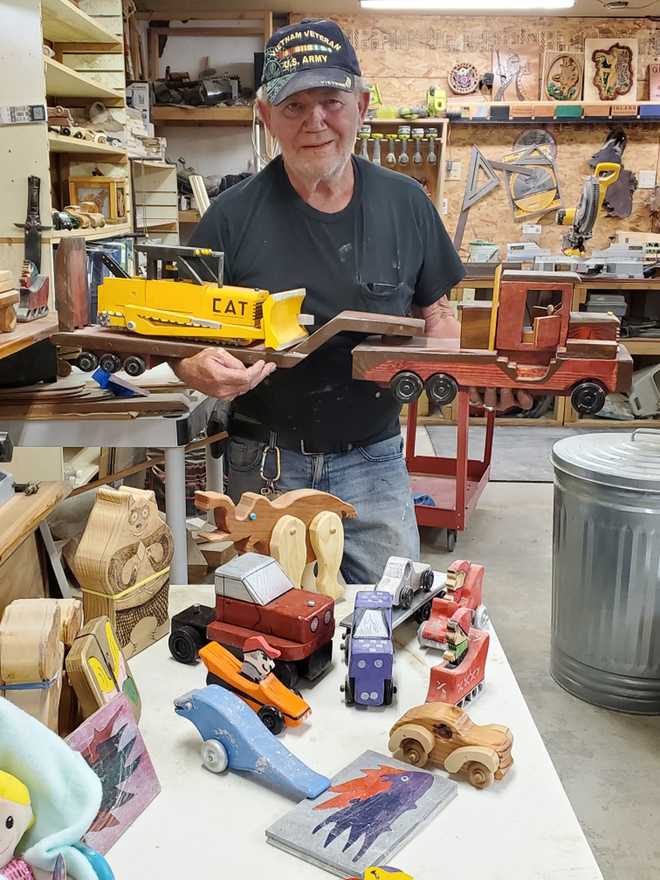
Mike Sullivan, 72, says his two older brothers were carpenters who made him toys when he was a child.

I saw this story of good works several places online and saved it for Christmas Day.

CNN’s Amy Chillag wrote, “A real-life Santa’s workshop is churning out toys in Desert Hot Springs, California. A 26-year Army veteran and his wife have spent most of the last decade making toys in a woodshop behind their house. It’s a labor of love that started as a hobby.

” ‘After retirement, I got bored and needed something to do,’ 72-year-old Mike Sullivan told CNN.

“The couple joined a woodworking club and one of their projects was to build toys for kids.

” ‘Christmas time, we had a chance to see the kids get the toys and see how much joy it was,’ said Sullivan.

“They were hooked. … Mike and Judy Sullivan spend nearly every day in the shop.

” ‘We’re both in good health and are able to be out here six to seven days a week for eight to 10 hours,’ Sullivan said. ‘It’s so much fun.’ …

“Mike buys the lumber, the drill bits and saws and makes the patterns — cutting and sanding away. Judy is quality control and decorator.

” ‘I run my hands over all the toys and feel for something that’s not supposed to be there — a loose wheel or splinter,’ said Judy. She also spray paints and decorates. …

“This year, their toys were especially needed with so many parents out of work due to the impact of the coronavirus pandemic on the economy.

“The Sullivans … are extra careful scheduling folks at intervals to come check out the toys. ‘We try to enforce safe distancing and masking,’ said Mike.

“This week, they’re delivering hundreds of toys to a kindergarten class, the Coachella Valley Rescue Mission and a church food pantry. They’ve mailed toys as far away as Indiana and Texas. Not only are the toys free, but the couple pays for the shipping although, they admit, that’s getting tough.

” ‘As long as I can afford it, I can send them where I can,’ he said. …

“The Sullivans’ toys will also be distributed to children during a drive-thru giveaway with social distancing, ‘making sure everyone is safe and happy and healthy.’ …

“The couple makes trains, cars, trucks, pull and push toys (little alligators, elephants), ducks you put on a string and pull along behind you. They also make educational toys: alphabet puzzles, jigsaw puzzles, stackers with different size blocks on a pole. …

“Judy Sullivan said they watch [their grandchildren and great-grandchildren] play with the toys and see what they like and don’t like about them. ‘If they drop a toy on the floor and break the head of a duck, we better reinforce that.’ …

“Mike says while he’s full of shrapnel from his service, that doesn’t slow him down in the toy factory. ‘You have to adapt and overcome.’

He refuses to charge for his toys. Maybe it’s because he knows what it’s like not to have much money.

” ‘My dad was a miner, we were considerably poor,’ said the retired Army first sergeant, who grew up in Montana.

“His older brothers were both carpenters and made toys for him when he was a child. ‘Most of the things I got were handmade toys. They were wonderful toys, I know how much I enjoyed them.’ … Those memories stick with him and he inherited their love of wood. ‘We do it for those who are less fortunate than we are now.’

“Their daughter says her parents spent $19,000 out of pocket last year on supplies (she does their taxes). …

“The hundreds of wheels and axles for the cars, trucks and trains are especially costly. With their kids’ encouragement, they started a GoFundMe to help.

“Mike hopes anyone who wants a Christmas present next year will reach out to him, and he’ll do his best to get it to them, wherever they are.”

More at CNN, here, and at the Washington Post, here.

Read Full Post »

Photo: Louisiana Bucket Brigade.
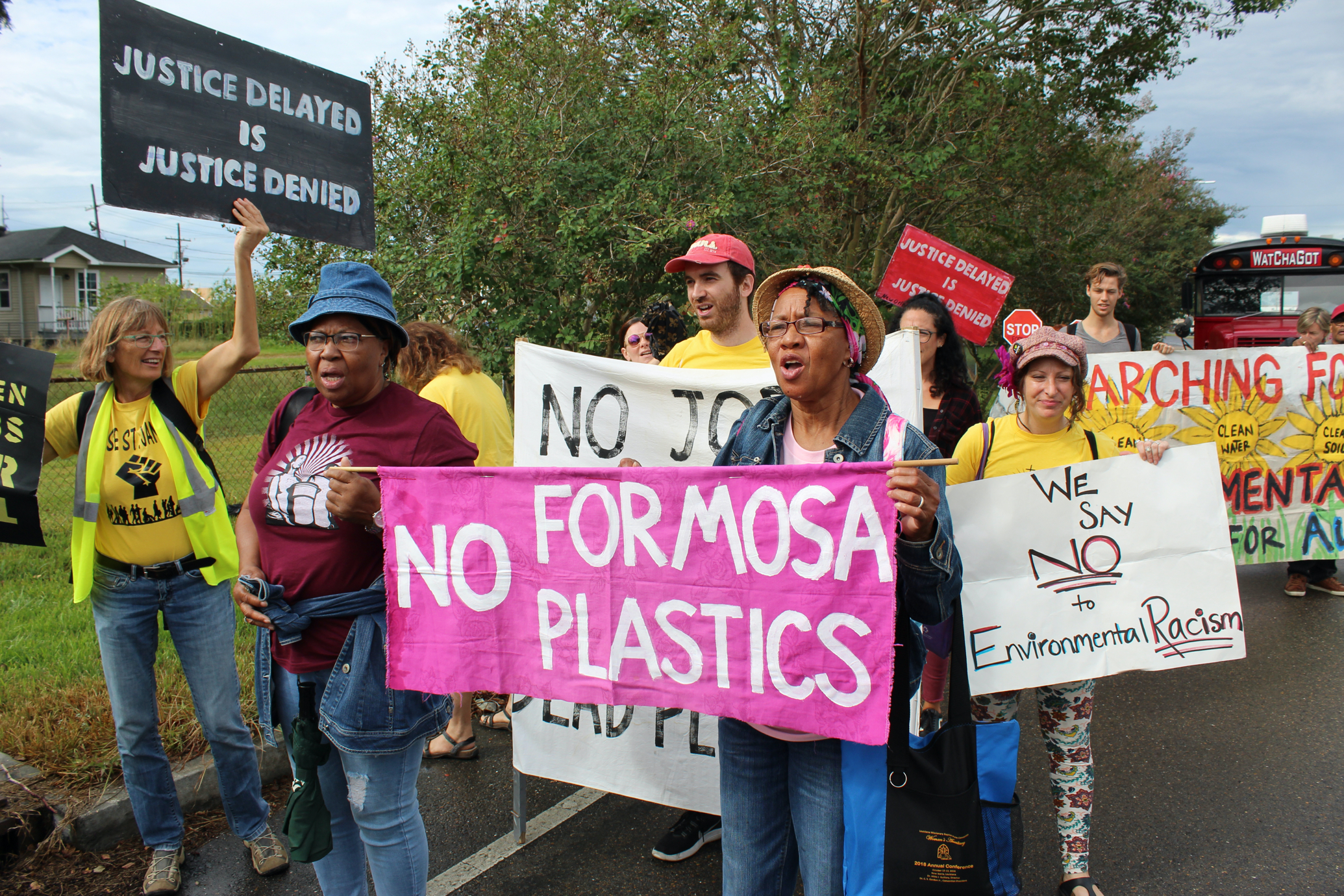
One of the most effective grassroots groups fighting pollution in poor neighborhoods is the Louisiana Bucket Brigade, ordinary folks who got fed up with being endangered by Cancer Alley.

It’s no secret that some of the most polluting companies are located in poor or Black communities. I once had a boss who insisted that was not done on purpose, but still, decision makers often count on poor communities not fighting back.

I’m glad to say that’s changing. I’ve learned so much just from following the grassroots Louisiana Bucket Brigade, which has been fighting back effectively against Formosa Plastics.

In another example of fighting back, Michael Laris writes at the Washington Post about “how an outdoorsy engineer is working to cut transportation pollution around disadvantaged communities.”

Laris reports, “As a clean air and innovation manager at the Environmental Defense Fund, [Harold] Rickenbacker works with companies and communities to monitor and reduce pollution from transportation, which contributes to climate change and harms health, particularly in disadvantaged areas.

“While working on his engineering doctorate at the University of Pittsburgh several years ago, he worked with families hurt by the city’s air pollution, both outdoors and seeping into their homes. ‘My will to succeed when I wake up in the morning is impacted by … the air that I’m breathing,’ said Rickenbacker, who has taken up these issues in Maryland, Virginia, Delaware and other states. …

Q: The Environmental Defense Fund has developed a mapping tool to help understand how truck pollution near warehouses and fulfillment centers affects low-income communities and people of color. How does that work?

A: Medium- and heavy-duty trucks spew nitrogen oxides, black carbon, particulate matter, smog — you name it — which has had a clear impact on upper-respiratory health, things like asthma, lung cancer and even hypertension in some of the work we’ve done out in West Oakland. We use our GIS-based tool to calculate the population that lives within a half-mile radius of the predefined distribution centers and warehouses. It calculates the demographic and socioeconomic variables around those facilities. You can pinpoint X percentage of people of color that live near this facility and X amount of people with health issues who live near these facilities. Then you can prioritize things like green infrastructure, electric vehicles, workforce development, renewable energy. We’re using health- and equity-based tools to identify where the distribution of those infrastructure benefits should take place first.

Q: What has the Environmental Defense Fund found in Oakland through its air monitoring work?

A: Hyperlocal air pollution monitoring can occur every 30 to 60 meters, and every minute, every second, down to the hour or daily averages. Why is this significant? Well, conventional air pollution monitoring networks are spaced miles apart or away from cities.

We’ve had a partnership with Google Earth Outreach for many years, where we’re installing monitors on vehicles and getting a much more complete picture of air pollution at that neighborhood level.

“In West Oakland, the data really highlighted impact zones where residents lived among elevated levels of pollution. The highest concentrations of nitrogen dioxide in that community created a 40 percent greater risk of cardiovascular disease events among those who were 65 years of age or older. …

Q: Big trucks drive a lot and they pollute a lot, as they move so much of the economy. Yet electric trucks, which have no emissions, are still comparatively costly. How can that problem be tackled?

A: We have to lean on large corporations to move the needle. There are tons of different incentive programs out there, where there are opportunities to purchase commercial EVs and deploy them in communities. But that’s often not enough. For some of our corporate giants, if you have the bandwidth, you have the resources, you can really drive the demand and drive the market. If there’s a clear need for electric trucks, manufacturers will understand that and then you essentially have this revolving market where prices go down.

Q: Unlike with power plants and other big polluters causing climate change, transportation emissions stem from huge numbers of individuals making individual decisions. How do you address such a sprawling problem?

A: Part of it is really this idea of coalition-building. You have groups like EV100 that has dozens of corporations that have carbon-neutrality goals for 2030, or transportation-emission reduction goals. It’s not really an individual discussion or decision. It has to be more of a collective. [Justice40 initiative, which] means investments in climate, clean energy, clean transportation, you name it. Low-income communities that have been subjected to racial segregation — those same communities that have the health burdens — should see clean transportation and other environmental benefits in their communities first.

Q: But it’s still this vast swath of society that’s making decisions about what kind of cars to buy and how much to drive them — and creating those emissions.

A: Under the infrastructure funding and reconciliation packages, there are going to be tons of opportunities to beef up infrastructure, including public transit. Most of the communities that are impacted by transportation emissions are the same communities that are using public transit. More affluent communities can also understand you can lower your carbon footprint by riding a bus and not driving your vehicle. So at that point, it does turn into more of an individual decision.”

Alas, last-minute lobbying by the gas industry and a Pennsylvania Senator means the infrastructure bill actually has a huge fund for building more polluting buses. Man, you just cannot win! If you live in Pennsylvania, please give Sen. Patrick J. Toomey what-for!

More at the Post, here.

Read Full Post »

Image: York Notes.
York Notes, a literature guide, says, “Bob Crachit is Scrooge’s clerk and represents the lower classes. He has to accept poor wages and working conditions because he has a family to support.”

I was thinking about Labor Day and remembering that in many of my favorite novels Dickens wrote with passion about the working conditions of the poor. He had himself worked in a blacking factory as a child when his father was in debt, and few topics were more likely to spark his outrage.

John Broich, an associate professor at Case Western Reserve University, wrote at Time that Dickens decided Scrooge, his hard-working clerk Bob Crachit, and the half-starved Tiny Tim would have more impact on the big issue of the day than the political pamphlet he’d been planning.

“Published 173 years ago this month,” Broich writes, “Charles Dickens’ A Christmas Carol was an instant bestseller, followed by countless print, stage and screen productions. … But A Christmas Carol’s seemingly timeless transcendence hides the fact that it was very much the product of a particular moment in history, its author meaning to weigh in on specific issues of the day.

Dickens first conceived of his project as a pamphlet, which he planned on calling, ‘An Appeal to the People of England on behalf of the Poor Man’s Child.’

“But in less than a week of thinking about it, he decided instead to embody his arguments in a story. … So what might have been a polemic to harangue, instead became a story for which audiences hungered.

“Dickens set out to write his pamphlet-turned-book in spring 1843, having just read a government report on child labor in the United Kingdom. The report took the form of a compilation of interviews with children — compiled by a journalist friend of Dickens — that detailed their crushing labors.

“Dickens read the testimony of girls who sewed dresses for the expanding market of middle class consumers; they regularly worked 16 hours a day, six days a week, rooming — like Martha Cratchit — above the factory floor. He read of 8-year-old children who dragged coal carts through tiny subterranean passages over a standard 11-hour workday. These were not exceptional stories, but ordinary. Dickens wrote to one of the government investigators that the descriptions left him ‘stricken.’

“This new, brutal reality of child labor was the result of revolutionary changes in British society. The population of England had grown 64% between Dickens’ birth in 1812 and the year of the child labor report. Workers were leaving the countryside to crowd into new manufacturing centers and cities. Meanwhile, there was a revolution in the way goods were manufactured: cottage industry was upended by a trend towards workers serving as unskilled cogs laboring in the pre-cursor of the assembly line, hammering the same nail or gluing the same piece — as an 11-year-old Dickens had to do — hour after hour, day after day.

“More and more, employers thought of their workers as tools as interchangeable as any nail or gluepot. Workers were becoming like commodities: not individual humans, but mere resources, their value measured to the ha-penny by how many nails they could hammer in an hour. But in a time of dearth — the 1840s earned the nickname ‘The Hungry ‘40s’ — the poor took what work they could arrange. And who worked for the lowest wages? Children.

“Popular theories about how — or whether — to help the poor often made things worse. The first was the widespread sense that poor people tended to be so because they were lazy and immoral, and that helping them would only encourage their malingering. If they were to be helped, it should be under conditions so awful as to discouraged people from seeking that help. The new workhouses were seen as the perfect solution — where families were split up, food was minimal and work painful. ‘Those who are badly off,’ says the unreformed Scrooge, ‘must go there.’

“Associated with this concept were the ideas of Rev. Thomas Malthus, who cautioned against intervening when people were hungry because it would only lead to an untenable population size. Better that the poor should starve and thus ‘decrease the surplus population.’ …

“Friedrich Engels read the same report on child labor that Dickens did and, with his collaborator Karl Marx, envisioned an eventual revolution. Dickens was very much an anti-revolutionary. In fact, he implied that [revolution] was the fearsome consequence of not solving the problem some other way.

“ ‘This boy is Ignorance. This girl is Want. Beware them both, and all of their degree, but most of all beware this boy, for on his brow I see that written which is Doom, unless the writing be erased.’ …

“Dickens wasn’t a ‘systems’ thinker, nor was he proto-socialist. Yet what Dickens did propose in A Christmas Carol … was that employers are responsible for the well-being of their employees. Their workers are not of value only to the extent to which they contribute to a product for the cheapest possible labor cost. They are of value as ‘fellow-passengers to the grave,’ in the words of Scrooge’s nephew, ‘and not another race of creatures bound on other journeys.’ Employers owe their employees as human beings — no better, but no worse, than themselves.

“And, yes, that might mean ‘a prize Turkey’ at Christmas … but the real salvation that Scrooge gives to the Cratchit family is a raise.

“As Scrooge and the Ghost of Christmas Past watch Tim, his father holding his [hand], the miser pleads, ‘say he will be spared.’ The ghost reminds readers of Scrooge’s Malthusian quote. ‘If he be like to die, he had better do it, and decrease the surplus population.’ ” More at Time.

Today we know that most of the labor benefits we have today, including the Monday holiday in America, were not handed down by benevolent company owners but were wrested from them by workers and unions.

You can read that history at Wikipedia, here. Even so, I do think stories help prepare a population to accept change — to recognize that the way things are is not always the best way.

Read Full Post »

Photo: Erin Clark/Globe Staff
Note that they are wearing gloves! Members of Chelsea Collaborative in Massachusetts pray before opening the doors to a pop-up food pantry. Covid-19 food distribution has been operating for about a month with food donated by local businesses and food pantries.

A sad but hardly surprising aspect of the Covid-19 plague is that the poor, minorities, and immigrants are often the most affected. A community in the Greater Boston area has been learning that the hard way. But in Chelsea there is a spirit of helping your neighbor that is a lesson for us all

Boston Globe columnist Adrian Walker writes, “Gladys Vega’s office at the Chelsea Collaborative does not normally resemble a food pantry. But normal times ended in Chelsea roughly six weeks ago.

“’We probably have 2,000 people lined up, and I’m giving out food in an hour,’ she said when I talked to her Thursday afternoon.

“In a state that has become a hot spot of the coronavirus, hard-hit Chelsea might be its white-hot center. But the frightening prevalence of COVID-19 is only part of the reason her nonprofit has become such a popular spot.

“The city’s status as home to a large population of undocumented immigrants has taken on new meaning in recent weeks. The people Vega advocates for are being shut out of other means of assistance, such as stimulus checks — one more way the pandemic has deepened the divide between haves and have-nots.

“ ‘They don’t have income,’ Vega said. ‘And now they are not able to pay bills or buy food.’

“Vega is giving out not just donated food, but diapers and other supplies as well. For this, she has relied upon a network of donors cultivated over many years.

“That’s where her friend Bob Hildreth came in. Hildreth is a wealthy philanthropist, having made many millions in finance. After walking away from that he founded a nonprofit in Lynn to help poor families, especially immigrant families, save up to send their children to college by matching their savings. …

“Hildreth told me he thinks this is a critical time for philanthropists to do as much as possible to help those the federal government won’t.

“ ‘I don’t think my fellow philanthropists are acting fast enough,’ Hildreth said. “’When you need food and drink you need it within a week. I think this requires an extraordinary effort to get money to grass-roots organizations.” …

“The tragedy in Chelsea has mobilized donors large and small, Vega said. A produce collaborative has contributed food. A group of women in Cambridge have made regular deliveries of diapers and baby formula. Local bodegas that may not survive the lockdown are donating to the food supply.

“ ‘I’ve been so blessed,’ Vega said. ‘Two weeks ago I was crying because I had no food and I had a list of 200 people looking for food. Today we delivered 65 boxes of 25 pounds of food for people with COVID who can’t come out of the house. We call ahead and leave it outside.’

Especially striking has been the philanthropy of Chelsea residents with relatively little to give. ‘A man on Social Security gave me $10,’ Vega said. ‘A woman I don’t know gave me her stimulus check. She said, “You don’t know me, but I want to help.” It’s been the most beautiful show of poor people helping poor people.’

“By Vega’s reckoning, Chelsea’s recovery will be a long haul. The city had been turning around, but that’s been stopped in its tracks. As of last week, Chelsea had the highest per capita number of coronavirus cases in Massachusetts.

“ ‘The coronavirus in one month has taken five years of progress,’ she said. ‘This is a war zone right now.’

“Still, she and her staff keep performing their daily triage operation, with no plans to slow down. She said she’s getting about two to three hours of sleep a night. For now, that’s enough.

“ ‘You see the line and it gives you energy,’ she said. ‘You don’t have time to think about pain. You just continue to go.’ ”

I crossed paths with philanthropist Hildreth in my last job, and I can attest that he is sets an example for philanthropy. But what touches me the most is that people who don’t have much are giving such a big chunk of what they have.

More at the Globe, here, and at the Chelsea Collaborative, here.

Read Full Post »

el-jefes-taqueria-850x478large

Photo: Suzanne Kreiter/Globe Staff
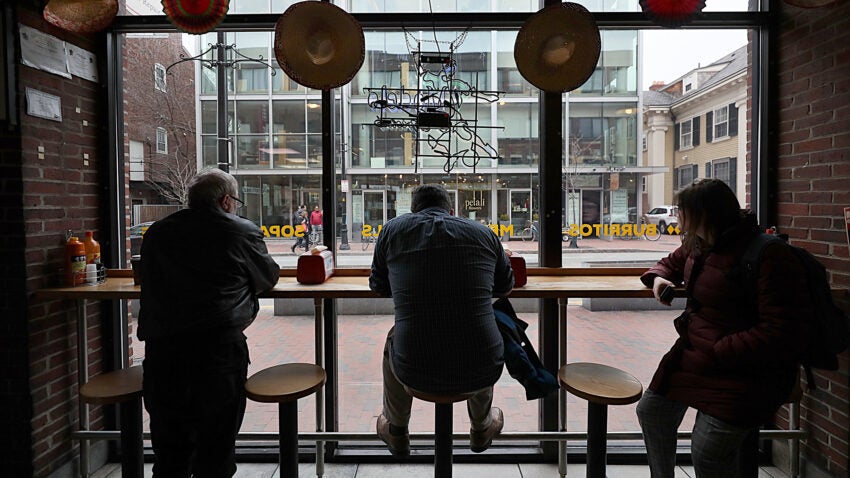
El Jefe’s Taqueria is among the restaurants Cambridge is paying to serve hot and cold meals to homeless shelters.

One of the many interesting aspects of the Situation has been the way leaders in states and municipalities have taken matters into their own hands.

We know that individuals and both for-profit and nonprofit organizations are stepping up, but some government entities are, too. Across-the-board federal efforts would be better, especially if we don’t want to see New York suing Rhode Island and other such anomalies, but we’ll take what we can get.

Here’s a story about Cambridge, Mass., a city that some have called Moscow on the Charles mainly because it tries to help the poor.

Erin Kuschner, writes at the Globe‘s Boston.com, “With restaurants facing a sudden loss of revenue due to Gov. Baker’s mandated dine-in ban, and homeless shelters seeing a drop in volunteers helping to deliver and prepare food, the City of Cambridge came up with a solution to benefit both parties: Paying restaurants to make and deliver food to homeless shelters.

“The program launched Monday after the city reached out to both the Harvard Square Business Association and the Central Square Business Improvement District to help organize the initiative, with a goal of distributing roughly 1,800 to 2,000 meals to various shelters by the end of the week. …

“Denise Jillson, executive director of the Harvard Square Business Association, said that it has already brought roughly 15 restaurants on board to make meals for local shelters like the Harvard Square Homeless Shelter and Y2Y, a youth homeless shelter that has seen many of its student volunteers leave following Harvard’s closure.

“ ‘It just made so much sense,’ Jillson said. ‘We were on board immediately.’ …

“Among the restaurants serving Harvard Square’s homeless shelters are Black Sheep Bagel, Cardullo’s, El Jefe’s Taqueria, Orinoco, Subway, and Veggie Grill. Jillson said that they have tried to provide a range of healthy meal options for breakfast, lunch, and dinner.

“The Central Square Business Improvement District partnered with PAGU to deliver meals to Bay Cove Human Services and the Cambridge YMCA.

‘We made our first delivery [Monday],’ said Michael Monestime, executive director at the Central Square Business Improvement District. ‘It was pretty humbling and sad at the same time. It’s hard enough being homeless on any given day, and then under these circumstances it’s even more difficult.’ …

“In addition to providing hot and cold meals to those experiencing homelessness, the city has set up a Cambridge Community Food Line, available to any resident who is a high risk for food insecurity.

“The delivery service provides a weekly bag of produce and shelf-stable food items to individuals and families who have experienced the following: The food pantry or meal program you used has closed until further notice; you have lost your job or part of your income and cannot afford groceries at this time; you are homebound due to illness, disability, or quarantine and do not have friends or family that can bring you food; you are at high risk for COVID-19 (coronavirus) and do not have access to a regular food source.”

More at the Boston Globe, here. Local readers, try to remember these restaurants and thank them with your business when we come out of the tunnel to the other side of this plague.

Read Full Post »

69e5c57b-13a8-4f7b-90ca-5ec55c34bad9-768x675-1

Photo: Parklands Primary School
Children from Parklands Primary School in the UK enjoyed a Christmas extravaganza at the ice rink of Leeds East Academy. And Parklands staff volunteered their time to serve a hot Christmas meal.

Here’s a Christmas dinner story from the UK, one that would be perfect if it weren’t so necessary.

Alex Evans writes at the Yorkshire Evening Post, “Staff at Parklands Primary School volunteered their time to serve up a hot meal for the school’s 328 pupils and their families [Monday] at its ‘Christmas Eve Eve’ party.

“Youngsters were able to meet Santa Claus at the party which was set up by headteacher Chris Dyson. He says he was left ‘heartbroken’ when he discovered some of his pupils had never met Father Christmas and many wouldn’t receive gifts. …

“Each child received a Christmas present to unwrap — likely to be the only one they will receive this year, Mr Dyson said.

“The school, in Leeds, West Yorkshire, serves one of the largest council estates in Europe and an area in the top 1 percent in England for deprivation.

“Only a third of working-age adults have jobs and three-quarters of pupils qualify for the pupil premium, extra money given to schools from the Government to support the poorest children.

“Headteacher Chris Dyson, hailed ‘an inspirational leader’ by Ofsted inspectors said: ‘It broke my heart when I started at the school five years ago and found out that some families don’t even go to visit Santa, which is something we all just take for granted. …

” ‘So I said I would bring Santa to Parklands and get every child at least one present to open.’ …

“Mr Dyson’s initiative saw 150 people attend the school’s first party six years ago. The number doubled the following year and continued to grow. [Today] 800 people benefited from the headteacher’s generosity, which has been helped by donations from local business who have given cash and gifts, as well as Leeds City Council who have provided food.

“Mr Dyson added: ‘We are in the middle of one of the biggest council estates in Europe, a lot of our families don’t even go off the estate. …

” ‘Christmas is a vulnerable time for families, its cold and for some people it is the only hot meal they will get this week. I’m blessed that I have had so many presents donated that those with a birthday coming up will get a birthday present as well.’

“Mr Dyson took over at the school in 2014, after it went through five headteachers in just one year and was rated inadequate by Ofsted, the government’s education watchdog. It had the country’s highest number of annual exclusions and a padded cell was used as a form of punishment. Mr Dyson said he wanted to bring ‘love and smiles’ back to the school and has extended that to the wider community. …

” ‘It’s for the entire community, anyone can come and they all do. Our first year we had a lot of kids who didn’t come to our school come round, and I said Santa doesn’t turn people away. So we just welcomed everyone. … It’s a vulnerable time, food isn’t as plentiful here as where I live. It’s important they get a hot meal.

‘These kids will ask why doesn’t Santa answer my letters like he does to people in those middle class areas. I want to make sure they feel Santa hasn’t forgotten about them.’

More.

Just a reminder about the miracle of great teachers.

Hat tip: @HertsLearning on twitter.


Read Full Post »

ns_ke_20170418_givedirectly17-69_custom-786e5ac5bc5d1399b39a1e3335cc377aff73ff1a-s600-c85

Photo: Nichole Sobecki for NPR
The cypress sapling above was purchased with money received from the charity GiveDirectly in 2017. More recently, the charity teamed up with researchers to study the impact of cash grants on a wider Kenyan community.

Here’s a new way to look at “trickle down.” Unlike the wealthy, who are more likely to put extra cash into savings, poor people who receive cash actually spread the wealth around. Read about the results of a new study in Kenya.

Nurith Aizenman reports at National Public Radio [NPR], “Over the past decade there has been a surge of interest in a novel approach to helping the world’s poor: Instead of giving them goods like food or services like job training, just hand out cash — with no strings attached. Now a major new study suggests that people who get the aid aren’t the only ones who benefit.

“Edward Miguel, an economist at the University of California, Berkeley, and a co-author of the study, says that until now, research on cash aid has almost exclusively focused on the impact on those receiving the aid. And a wealth of research suggests that when families are given the power to decide how to spend it, they manage the money in ways that improve their overall well-being: Kids get more schooling; the family’s nutrition and health improves.

“But Miguel says that ‘as nonprofits and governments are ramping up cash aid, it becomes more and more important to understand the broader economy-wide consequences.’

“In particular, there has been rising concern about the potential impact on the wider community — the people who are not getting the aid. …

“Miguel and his collaborators teamed up to conduct an experiment with one of the biggest advocates of cash aid. It’s a charity called GiveDirectly that, since 2009, has given out more than $140 million to impoverished families in various African countries.

“The researchers identified about 65,000 households across an impoverished, rural area of Kenya and then randomly assigned them to various groups: those who got no help from GiveDirectly and a ‘treatment group’ of about 10,500 families who got a one-time cash grant of about $1,000. …

“Eighteen months on, the researchers found that, as expected, the families who got the money used it to buy lots more food and other essentials. But that was just the beginning.

” ‘That money goes to local businesses,’ says Miguel. ‘They sell more. They generate more revenue. And then eventually that gets passed on into labor earnings for their workers.’

The net effect: Every dollar in cash aid increased total economic activity in the area by $2.60.

“But were those income gains simply washed out by a corresponding rise in inflation?

” ‘We actually find there’s a little bit of price inflation, but it’s really small,’ says Miguel. ‘It’s much less than 1%.’

“The study — recently released through the website of the National Bureau of Economic Research — also uncovered some evidence for why prices didn’t go up: A lot of local businesses reported that before the cash infusion they weren’t that busy.

“So when they suddenly get more customers, they don’t have to take extra steps like hiring more workers that would drive up their costs — and their prices. In economic parlance, there was enough ‘slack’ in the local economy to absorb the injection of cash.

“Eeshani Kandpal is an economist with the World Bank who has done research of her own on cash transfers — including a study that found that a cash aid program in the Philippines did drive up the cost of certain perishable food items. …

“The new study has a far broader scope, says Kandpal — encompassing not just a much larger number of participants but a vast range of goods and businesses whose pricing practices the researchers meticulously monitored.

” ‘It’s a super credible, interesting study,’ says Kandpal. ‘And very carefully done. … I’d be curious to see if they persist in the longer run,’ she says. ‘Eighteen months is certainly not short. But it’s not terribly long either.’ …

“Michael Faye, co-founder and president of GiveDirectly, says even if it turns out that a one-time cash infusion provides only a temporary boost, ‘I don’t think that’s necessarily a bad thing.’ ”

And wouldn’t you rather see poor folks getting more money than wealthy people and corporations? I myself am doing OK and would really like to experience a more equitable world in my lifetime. More here.

Read Full Post »

Photo: Melanie Stetson Freeman/Christian Science Monitor
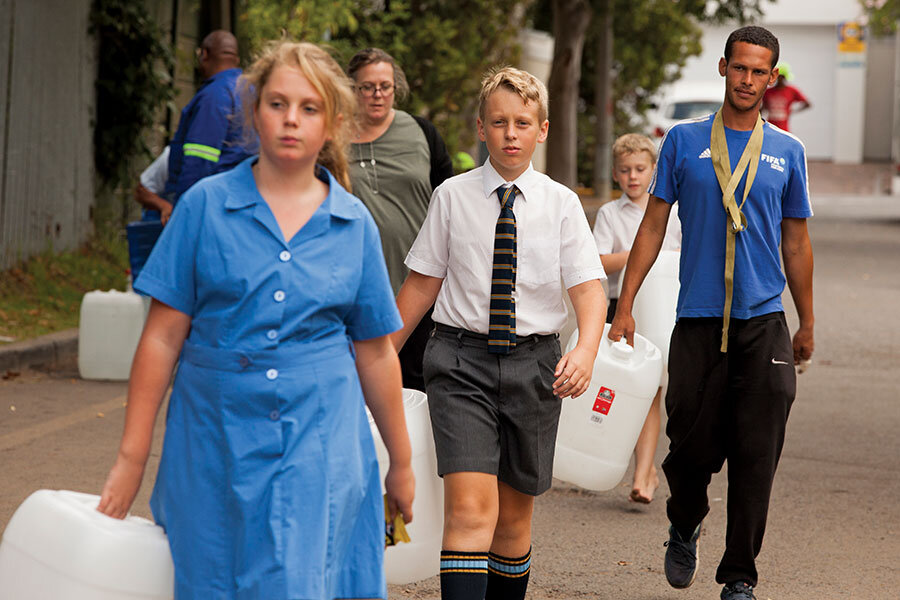
People come with plastic bottles and jugs to collect free water in Cape Town, South Africa, where a dire shortage spurred residents to cut water usage in half.

You may have read about the dire water scarcity in Cape Town, South Africa, a situation resulting from lack of public funds to do the work that would have protected the supply.

But this story shows how much people can accomplish when faced with a life or death challenge.

Ryan Lenora Brown reports at the Christian Science Monitor, “A year ago, [Musa] Baba and [Helen] Moffett had almost nothing in common, and in many ways, they still live in two different universes. Moffett lives in a manicured gated community flanked by mountains. Baba’s house is two tin rooms she built herself that grip the side of a hill cluttered with other small shacks.

“But these days, the two women, along with millions of others here, share a common preoccupation: how to save water. For Baba and many others, that’s been a lifelong project of necessity. But for another population of Cape Town residents, including Moffett, it’s part of a massive lifestyle pivot that has helped bring the city on the southwestern tip of South Africa back from the brink of the unthinkable.

“As recently as March, Cape Town’s government was instructing residents to prepare for an imminent ‘Day Zero,’ when taps across most of the city would be shut off indefinitely. …

“Newspaper headlines across the world blared [Cape Town] was about to become the first developed city in the world to completely run out of water.

“But behind the scenes, a tectonic shift was under way. As the city bartered for water with local farmers and hustled to build desalination plants, its residents simply started using less water. A lot less.

“And it has worked – at least for now. … Using a combination of sticks and carrots to coax residents on board, the city has cut its water use by half. Its biggest customers now use 80 percent less. Today, every Capetonian is allowed just 13 gallons of municipal water per day – a little less than the amount it takes to flush a toilet four times. Use more, and the city reduces your pressure to a trickle, and your water bill can turn into a mortgage payment. …

“Here in Cape Town, suburban residents have become connoisseurs of taking 90-second showers and then flushing their toilets with the water they collected while doing it.

“On popular water-saving Facebook groups, city residents debate the best way to wash their dog ‘off the grid’ (bottled water, one woman suggests. Scrub him down with used bath water, offers another.) They swap the names of local companies that will sink a personal well in your backyard. Local police, meanwhile, receive a steady stream of tips from concerned residents who’ve seen their neighbors committing the ultimate middle-class drought crime: watering their lawns. …

“Says Kirsty Carden, an engineer at the University of Cape Town’s Urban Water Management Research Unit, ‘Yes, it’s been a crisis, but it’s also good to learn these lessons now. Cape Town isn’t the only city in the world that’s going to need them for the future.’ …

“Water restrictions have had another, less obvious effect: They have given the rich a small but rare experience of how the poor have always gotten by.

“ ‘It’s humbling, learning to think about water the way most South Africans have been doing for a long time,’ Moffett says, arranging two gallon jugs of water from another local spring in the trunk of her car. ‘Every household chore takes three times as much thought, and three times as long.’ …

” ‘We have always lived like this – nothing has changed because of the drought,’ says Baba, sloshing a T-shirt in a sudsy bucket outside her house. ‘If now rich people can understand better what that’s like, I think that’s a good thing.’ ”

More at the Christian Science Monitor, here.

Read Full Post »

Photo: Evensi

My husband and I alternate between our two sets of grandchildren on Halloween. Last year we got a kick out of seeing John perform the role of MC for the costume fashion show at the park on his street. Although we won’t be there this year, I’m glad I got to see my oldest grandson in this year’s Yoda costume and his sister as a mermaid. Her puzzlement about the way the bottom of her costume was cut led to explanations of mermaid anatomy and collaboration on mermaid drawings.

This year we join the Providence grandkids (one gentleman fire chief, one lady construction worker) for the gathering at Brown Street Park and the annual parade through blocked-off Providence streets.

Brown Street Park has many Friends (changed to “Fiends” for the holiday). It’s in an upscale neighborhood near the university and flourishes because of people who both care about it and know how to raise money. If only all Providence neighborhoods were like that (which I say because behind one place where I volunteer, there’s a filthy campsite where drugs are sold. I am told the city cleaned it up once, but the vacant lot reverted to its current sorry state. How I wish the city would try again and neighbors would feel that they could go in and plant a garden or something!) But I digress.

If you go to the Friends of Brown Street Park website, here, you will find a well-organized group of volunteers soliciting help from other potential volunteers for initiatives such as the Hallloween party and parade, the summer concert series and the Earth Day clean-up.

In poor communities, good things can happen, too, but no outsider can come in and decree what those good things should be. First come efforts to build trust among all neighbors, as suggested here, then come deliberations about what neighbors actually want. I am going to look into getting the city to deal with that no-longer-vacant lot. It’s so disturbing for children who attend nearby activities. All neighborhoods should be safe for children.

Read Full Post »

Laura Bliss at the Atlantic‘s City Lab has a story on young people you may have seen performing in a New York subway car. She reports that in the film We Live This, the teens’ hopes seem hemmed in by poverty.

“ ‘Showtime’ dancing is a hallmark of the New York City transit scene,” writes Bliss. “Hoping for donations, crews of young black and Latino men perform exuberant choreographies for subway passengers, twisting and leaping from pole to pole with artful ‘lite-feet‘ dancing in between—and never before shouting, ‘It’s showtime!’

“Who are these dancers scraping by on their earnings? A new, short cinéma vérité documentary, We Live This, shines a light on the world of one crew, whose four young members perform on the J train. They are talented, hardworking, committed, and full of dreams, the film shows. But for some, the obstacles are high, and the alternatives slim. …

“Forty, is homeless.

‘As I’m dancing on the train, I’m thinking about where am I sleeping at night,’ he says. ‘Who should I call? Who is going to pick up? What if they don’t answer?’

“Showtime is the best way he he knows to a better life, a way into a community, he says. …

“Of course, the subway is no simple launchpad to success. While some passengers love the dancing, many others avoid eye contact, and some even yell at crews to switch cars. …

“ ‘I hope people will watch this and look at these young men as human beings,’ the film’s director, James Burns, tells CityLab. ‘And see the last vestiges of a culture that may be dying out.’ ”

More.

WE LIVE THIS – OFFICIAL TRAILER from HAYDEN 5 on Vimeo.

Read Full Post »

Some initiatives that are costly up front have benefits that far outweigh those costs but don’t show up for years. Even then, people may disagree about what caused the outcomes.

One such initiative sends nurses to new mothers who are young, poor and often friendless to help ensure that their babies get a leg up in life.

At the Washington Post

“A high school senior learns that she’s pregnant — and she’s terrified. But a registered nurse comes to visit her in her home for about an hour each week during pregnancy, and every other week after birth, until the baby turns 2. The nurse advises her what to eat and not to smoke; looks around the house to advise her of any safety concerns; encourages her to read and talk to her baby; and counsels her on nutrition for herself and her baby.

“This kind of support, with trained nurses coaching low-income, first-time mothers, is among the most effective interventions ever studied. Researchers have accumulated decades of evidence from randomized controlled trials — the gold standard in social science research — following participants for up to 15 years. They have consistently found that nurse coaches reduce pregnancy complications, pre-term births, infant deaths, child abuse and injury, violent crimes and substance abuse. What’s more, nurse coaches improve language development, and over the long term, cognitive and educational outcomes.

“Nurse coaching is a vital tool that addresses both the liberal concern about income inequality and the conservative concern about inequality of opportunity. …

“Still, nurse coaching reaches only 2 to 3 percent of eligible families. Which raises the question: if it’s so successful — and people on both sides of the aisle support it — why can’t it be scaled to reach every eligible family?”

There are two stumbling blocks according to the reporters: First, funding must be cobbled together from numerous unpredictable sources; second, the costs are up front, whereas the benefits to government and society appear over time.

“If nurse coaching were fully scaled to reach every eligible family, the costs to state and federal governments would outweigh the savings for the first five years. But then the savings would start to outweigh the costs. Over 10 years, the net savings would be $2.4 billion for state governments and $816 million for the federal government.”

So the question becomes: do we have the patience? More here.

A similar initiative that Suzanne started supporting when she lived in San Francisco focuses on homeless mothers. Read about the great results of the Homeless Prenatal Program here.

Photo: iStock
When nurses coach low-income moms, their babies benefit.

Read Full Post »

A certain community organization that believes in the importance of affordable housing also believes in the importance of community. That is why it fosters numerous community-building initiatives, including the new Sankofa farm and market.

Leigh Vincola at ecoRI reports from Providence.

“If you have traveled around the city’s West End this winter, you may have noticed a number of buildings going up rather quickly. Wondering what they are and who they belong to?

“The answer is Sankofa, a Ghanaian word meaning to go back, get what is yours and make positive progress in the future. The Sankofa Initiative of the West Elmwood Housing Development Corporation (WEHDC) is doing just this.

“The initiative was born in 2011, when the WEHDC completed an extensive survey of West End residents that determined their primary concerns centered around health and food. In a predominately low-income neighborhood — 32.5 percent of households live below the poverty level — the survey determined that for many the West End is a food-insecure neighborhood. There isn’t enough access to fresh food, and particularly food that is culturally relevant to the immigrant populations that make up the community, primarily Central American, West African and Southeast Asian. …

“Sankofa is a response to these needs, and has three main elements: an affordable housing development, a large-scale community garden and a weekly World Market. The $15 million project is funded by Rhode Island Housing and work is underway on all aspects.” Read up on the amazing range of positive efforts here.

According to the market’s Facebook page, things will get going for spring with a “pop-up market May 7th, from 12pm to 4pm at Knight Memorial Library on Elmwood Ave. There will be art, bath and hair products, handmade jewelry, homemade candles, fresh food, FREE seeds, henna, giant bubbles and much more.”

Photo: Sankofa Initiative
The Sankofa World Market is a local farmers market with international flavor.

Read Full Post »

Older Posts »