Feeds:
Posts
Comments

Posts Tagged ‘postaday’

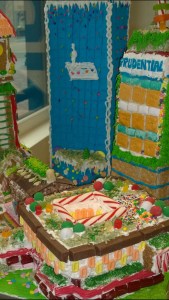
You have until Jan. 3 to see beloved Boston landmarks in the form of  gingerbread, gumdrops, frosting, and pretzels. The annual competition is put on at the Boston Society of Architects, which has a public exhibit area on Congress Street between Atlantic and Dorchester avenues.

The public is invited to a reception on Monday.

“Please join the Community Design Resource Center (CDRC) for the Gingerbread Reception, where we will view more than 20 gingerbread designs from teams of architecture and landscape architecture firms on exhibit, enjoy light refreshments, announce the winners, celebrate the incredible bakers, and launch CDRC’s first Open Call for Projects.

“Vote for your favorite gingerbread house now!

“At the Gingerbread Reception we will launch our first Open Call for Projects — an open invitation to neighborhood groups and community nonprofits in the greater Boston area to apply for a design assistance grant. Underserved audiences are especially encouraged to apply, as well as projects that otherwise fall between traditional funding cracks but that somehow serve to make communities better. …

“While challenging designers to explore a new medium, this sweet event also raises funds for the CDRC. A special thank you to the Boston Society of Landscape Architects and the BSLA ‘gingerscapes’ for joining us this year!” More here.

The BSA’s photos are on instagram. Look for bsaaia. It’s fun to guess what you are seeing.

121815-BSA-gingerbread-1

121815-BSA-gingerbread-2.


121815-BSA-gingerbread-3.


Read Full Post »

Imaginative storm drains are delivering a friendly message about protecting a river to residents who might like to enjoy more recreational river activities. The effort is one of many to improve water quality in Rhode Island.

Frank Carini of EcoRI has the story. “The health of southern New England’s coastal waters and its various, and vital, watersheds is improving, but major challenges remain, most notably stormwater runoff from urbanized areas. …

“Janet Coit, director of the Rhode Island Department of Environmental Management (DEM), recently told ecoRI News that stormwater runoff is one of the greatest challenges when it comes to protecting the region’s waters.

“ ‘It’s going to require a lot of small actions,’ she said. ‘We can’t deal with stormwater with just big tunnels.’ …

“Urban development has led to increased flooding, beach closures and limited access to waterways, with climate change serving to exacerbate these impacts, including those affecting marine life in Narragansett Bay, Buzzards Bay and Long Island Sound.

“In many urban areas, however, site-specific efforts to address stormwater runoff are marking progress, according to the fifth annual Watershed Counts Report.

“ ‘The urban projects featured in this yearly report can and should help drive more, broader and integrated initiatives,’ said Tom Borden, program director of the Narragansett Bay Estuary Program, which coordinates the annual report along with the Coastal Institute at the University of Rhode Island. ‘The benefits are not only environmental and societal, but have a direct link to enhancing the region’s economy.’ ”

More at ecoRI, here.

By the way, if you live near Rhode Island and are interested in doing part-time work as an investigative environmental journalist, they have an open position. See http://www.ecori.org/job-listings.

Photo: Brent Bachelder
The Woonasquatucket River Watershed Council is working with artist and educator Brent Bachelder and The Met School to create storm-drain murals, such as this one in front of Donigian Park on Valley Street, along the Fred Lippitt Woonasquatucket River Greenway in Providence.

Read Full Post »

Heifer Project is a charity founded by Dan West, “a farmer from the American Midwest and member of the Church of the Brethren who went to the front lines of the Spanish Civil War as an aid worker. His mission was to provide relief, but he soon discovered the meager single cup of milk rationed to the weary refugees once a day was not enough. And then he had a thought: What if they had not a cup, but a cow?”

Recipients of Heifer Project’s cows, chickens, pigs, and other assistance commit to giving the offspring of the donated animals to others in need. That way the giving grows and spreads.

Recently, Heifer Project has been helping poor farmers in Guatemala make enough from their cardamon crops to live on.

Editor Jason Woods, has the story in the nonprofit’s magazine, World Ark.

“Miguel Xo Pop farms his own plot of land. Everyone in the Sierra de las Minas depends on two crops, cardamom and coffee, to survive. Xo and his family are no different. Traditionally, the cloud forest’s climate helps the two plants thrive, but in the past few years a pair of plagues cut cardamom prices in half and reduced coffee income to nothing.

“Recently, Xo joined a Heifer International Guatemala project that will help him keep the pests away from his cardamom while adding more crops to his farm, but the project is still in its initial stages, gaining momentum. So for now, Xo spends a quarter of a year away from his wife and five kids to earn money.”

More on the lives of the farm families, here.

The reporter also describes how an altruistic businessman moved to a “double bottom line,” one that includes charity.

“A couple of years ago, McKinley Thomason was searching for a way to use his Nashville-based spice business to make a positive impact. After hearing about Heifer International’s burgeoning work with cardamom, he knew he had found his organization.

“Shortly after contacting Heifer, Thomason’s company, The Doug Jeffords Co., started donating 10 cents to Heifer Guatemala for every seasoning blend sold from their J.M. Thomason line. But Thomason’s passion for Heifer’s work in Guatemala moved him to do even more.

“Thomason has been acting as a project adviser to Guatemalan farmers, sharing his market knowledge and technical expertise in the world of cardamom. He is also making connections and introducing Heifer Guatemala to other like-minded spice companies that could support this or other projects.”

More at Heifer Project, here.

Photo: Dave Anderson

Read Full Post »

If you were a toy, would you want to be in the toy hall of fame, or would you be afraid success would go to your head? I remember seeing room after room after room of dolls at the Strong Museum in Rochester, New York, so perhaps a toy just feels like one of many there.

In November, James Barron of the NY Times wrote about a big hall of fame event at the Strong. “The museum announced that just three toys — the puppet, another generic finalist; the Super Soaker squirt gun; and the game Twister — will join past inductees like the Barbie doll (1998), Mr. Potato Head (2000), Silly Putty (2001) and Lionel electric trains (2006). …

“Christopher Bensch, the museum’s vice president for collections and its chief curator, said the three new inductees easily met the basic criteria for admission. All three long ago achieved ‘icon status’ as playthings that are ‘recognized, respected and remembered.’ They also ‘profoundly changed play or toy design.’ …

“Mr. Bensch said that among the judges, the puppet was the big winner this year. ‘It was one of those “why hasn’t it happened before?” ones, which was like the ball,’ he said, ‘and Jon Stewart gave us hell for that.’ Mr. Stewart, in a segment on ‘The Daily Show’ in 2009, complained that not inducting the ball sooner was like having a ‘heat source hall of fame’ and not inducting fire. …

“[Curator Patricia] Hogan, who specializes in toys and dolls, said she had lobbied for the puppet. After all, she said, ‘Howdy Doody had his own show.’

“But what about Buffalo Bob Smith, the human host who bantered with the puppet that was the namesake of that 1950s children’s program?

“ ‘It was called “Howdy Doody,” ‘ she said. ‘Get over it, Bob. You’re just a puppet to Howdy.’ ” More here.

Photo: Heather Ainsworth/The New York Times
John Neidrauer, left, and Andrea Whitmarsh used Kinect motion control to play with classic toys at the Strong National Museum of Play in Rochester. 

Read Full Post »

121115-ICA


Until January 24, you can see at the ICA in Boston an exhibition on the artistic legacy of one of the most interesting colleges ever. It couldn’t last, but while it did, it burned with a bright flame.

Let me drop a few names of people who worked and studied there: Robert Rauschenberg, Josef Albers, Robert Motherwell, Cy Twombly, Jacob Lawrence, Willem de Koonig (painters); Buckminster Fuller (architect); Merce Cunningham (choreographer); John Cage (music); and Robert Creeley (poetry). I am leaving out too many, including the women, whose names are not as well known.

I went on my lunch hour and so swept through the exhibition too fast. I confess I am not crazy about much of the art from this period. My favorites here are Motherwell, Lawrence, Cunningham, and Creeley. But how amazing that they all gathered North Carolina’s Blue Ridge Mountains, energizing one another across disciplines and making the school their life for a while, even pitching in with the chores.

Surprisingly, the things I took away with me were two ideas I’d like to apply to art with grandchildren.

I’ve done photographic paper before (you put objects like leaves or shells on the paper, leave it in the sun a few minutes, then run in the house and rinse it in water), but someone in the show did a full body. I might try a hand or a face. I also loved the textures of one piece of art I saw. Not quite a collage, it used string and bumpy surfaces in imaginative ways that reminded me of a project I watched Earl Gordon do when I was a child. He sliced the seed pod of a flower and used it as a stamp. Got to try more of that.

You can read about the school and the exhibit here.

Photo: Craig F. Walker/Globe
I liked “Female Figure” on sun-exposed photographic paper, by Susan Weil and Robert Rauschenberg, left.

Read Full Post »

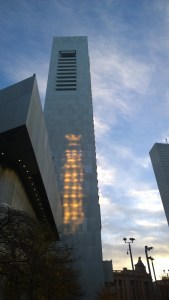
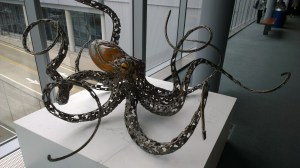
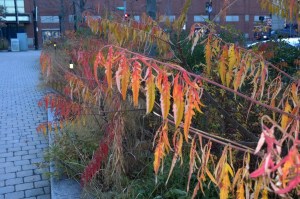
These photos are from my rambles in downtown Boston, which I will be leaving at the end of the year for a new commute to Providence.

The first picture shows strange reflections on an iconic piece of local architecture. Then we have musicians in South Station, an octopus sculpture at the convention center, a lovely floral display by the landscape genius where I currently work, fall color in the Greenway, and more color along Fort Point Channel in front of the Children’s Museum.

What a neighborhood!

120715-Fed

120115-South-Station-musicians


121015-Boston-convention-center-art

120315-lobby-flowers


120715-fall-color-in-Greenway

121115-childrens-museum-colors

Read Full Post »

outing-to-cut-a-tree

Here is Suzanne the one year we cut our own tree. I think she had the most fun of the four of us. The thermos had hot chocolate.

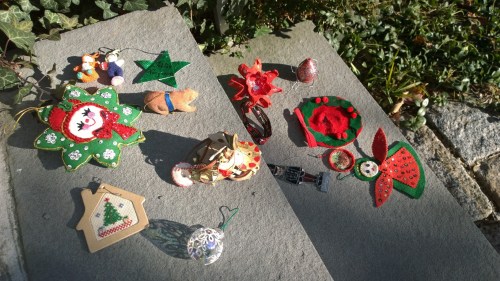
We set our sights on smaller trees nowadays, and my husband just put this year’s in the stand. I’ve been gearing up to decorate, first looking through the ornaments. It’s like greeting old friends after a year. Some of them are very familiar and beloved, but I can’t remember their stories. Here are a few whose stories I do remember.

The big red one on the lower step: from the Crafts for Christmas class I took the year we were married. Amazing what you can do cutting up egg cartons!

The sparkly tear-drop shape and the doorknob cover: from the church’s craft workshop when John and Suzanne were young. The angel with sequins: made by Aunt Mae in her 90s. She also made the smiling snowman backed by a green star and many other items — in secret, to surprise everyone. The round milk-bottle-cap ornament: don’t get me started now on highly educated women with no occupation spending their time on that. But I like to think of the woman who made it, with sympathy.

The soldier with John’s name on it: that was a gift from Aunt Peggy.

The Esperanto green star: from a friend in my Esperanto group. The two crocheted Chinese dolls: from a trip to the Shaw Festival at Niagara-on-the-Lake when Suzanne was about 1. My husband went to see a Shaw play while I babysat. I went to see hilarious concert comedienne Anna Russell while he babysat.

The bear: John was 3, and I was spending considerable time in graduate classes. John insisted my husband make a bear ornament just like that one out of cardboard. We have that too, somewhere. It doesn’t look just like that one, but we love it.

The Clymers brought the saddle from a trip to South America. John stitched the cross-stitch tree at a ridiculously young age (3? 4?).

The see-through snowball: a gift at DeAnna’s December wedding to Mairtin at the Peabody-Essex Museum.

121215-christmas-memories


Read Full Post »

Photo: David Wells

A wonderful organization, the Providence Granola Project, has just received some well-deserved attention in the food magazine Edible Rhody. In fact the magazine has prepared a short video that says it all, here.

Nancy Kirsch writes, “Established in 2008, Providence Granola, now part of Beautiful Day (a nonprofit organization founded in 2012), has a three-fold mission, says Providence Granola co-founder Keith Cooper: Provide job training for immigrants in Rhode Island who are unlikely to otherwise find gainful employment, and educate community members about refugees and refugee resettlement, all by making and selling delicious artisanal granola.

“Cooper and his lean professional staff, including Anne Dombrofski, director of strategic partnerships, work out of the Social Enterprise Greenhouse, a co-working space in Davol Square in Providence. …

“Hand labor is done by a small team at Amos House, a soup kitchen and comprehensive social service agency in Providence. …

“The trainees are immigrants—often, but not always, refugees—who have come recently to the United States. They attend classes at the Dorcas International Institute of Rhode Island (Dorcas) and, through its assessment process, have been identified as less likely to find employment within the next year, given their lack of first-language literacy and absence of English skills.

“ ‘If we can speed up someone’s entry into the job market from a year or more to between three and six months … there’s a huge benefit,’ says Cooper.”

Read Full Post »

Maria Popova at Brain Pickings finds the most wonderful books to blog about. In a recent post she extolled the wonders of fairy tale illustrations by Kay Rasmus Nielsen.

I was surprised to learn that’s a man’s name in Denmark. Wikipedia says, “Kay Nielsen was born in Copenhagen into an artistic family; both of his parents were actors – Nielsen’s father, Martinus Nielsen, was the director of Dagmarteater and his mother, Oda Nielsen, was one of the most celebrated actresses of her time, both at the Royal Danish Theater and at the Dagmarteater.

“Kay … received his first English commission from Hodder and Stoughton to illustrate a collection of fairy tales, providing 24 colour plates and more than 15 monotone illustrations for In Powder and Crinoline, Fairy Tales Retold by Sir Arthur Quiller-Couch in 1913. In the same year, Nielsen was also commissioned by The Illustrated London News to produce a set of four illustrations to accompany the tales of Charles Perrault; Nielsen’s illustrations for ‘Sleeping Beauty’, ‘Puss in Boots’, ‘Cinderella’ and ‘Bluebeard’ were published in the 1913 Christmas Edition.”

This is from Maria Popova: “As a lover of illustrated fairy tales and having just returned from Sweden, I was delighted to discover, thanks to the relentlessly wonderful 50 Watts, East of the Sun and West of the Moon: Old Tales from the North … illustrated by Danish artist Kay Rasmus Nielsen (1886-1957), whose work you might recall from [my list of] the all-time greatest illustrations of Brothers Grimm and the fantastic visual history of Arabian Nights. Originally published in 1914, this magnificent tome of 15 stories was recently reissued by Calla Editions, the same Dover imprint that revived Harry Clarke’s magnificent illustrations for Edgar Allan Poe, and features 25 color illustrations, along with a slew of black-and-white ones, in Nielsen’s singular style of haunting whimsy.”

There are more than 20 amazing Nielson illustrations here, at Brain Pickings.

Art: Kay Rasmus Nielsen
The North Wind went over the sea.

Read Full Post »

I wouldn’t call them role models, but they have done things in their older years that have given me food for thought.

This week, we heard that Diane Rehm, who has hosted a popular talk show for 37 years despite a speaking disability, will be retiring after the presidential election. She is currently 79.

Jimmy Carter’s mother (remember Miss Lillian?) joined the Peace Corps around the time he became president. She went to India.

My mother ran for Congress in her early 70s.

My friend Dorothy kept going to her editing job in her late 70s. In her late 80s,  she was asked by her former boss to edit a book. (This time she declined politely, reminding him he now knew how to identify a dangling participle.)

Just putting it out there.

Photo: National Endowment for the Humanities
Diane Rehm, popular talk show host for 37 years, plans to retire after the election.

Read Full Post »

How lovable is this? Sheepdogs that protect a tiny species of penguin from predators.

Austin Ramzey writes at the NY Times about an effort to counteract “Australia’s long history of imported species’ decimating native wildlife. … The toll on Middle Island, off Victoria State in southern Australia, kept rising. By 2005, the small island’s penguin population, which had once numbered 800, was below 10.

“Today, their numbers are back in the triple digits, and much of the credit has gone to a local chicken farmer known as Swampy Marsh and his strong-willed sheepdogs.

“ ‘The powers that be wouldn’t listen to me until it got down to six penguins,’ said Mr. Marsh, whose long-unused birth name is Allan. ‘They were desperate.’

“The farmer’s simple solution — deploy a particularly territorial breed of sheepdog to scare the foxes away — became local legend and, in September, the subject of an Australian film, ‘Oddball,’ which fictionalized the story and made a lovable hero of one of the dogs. The strategy is now being tried elsewhere in Victoria, in hopes of protecting other indigenous species from non-native predators. …

“Maremma dogs are self-reliant; they can be left to defend a patch of land for long periods of time with a supply of food and water that they know not to wolf down right away. During the summer, when foxes pose the greatest danger to Middle Island’s penguins because of tidal patterns that form sandbars, the dogs can stay on the island for several days in a row, watching over the birds from a raised walkway.

“Training them for the job involves introducing them to the penguin’s distinct odor. ‘Penguins don’t smell particularly nice,’ said Peter Abbott, manager of tourism services for the Warrnambool City Council. ‘They look cute and cuddly, but they smell like dead fish.’ Gradually, the dogs are taught to treat the penguins like any other kind of livestock, to be defended and not harmed.’ ”

The article explains that “when red foxes were imported for sport hunting in the 19th century, they found the tiny, flightless birds to be easy prey.” More here.

Photo: David Maurice Smith/NYT
A little penguin, the name of the smallest penguin species. Middle Island’s penguin population, protected by sheepdogs, has rebounded to 150. 

Read Full Post »

And speaking of bike lanes, look what Calgary did.

Chris & Melissa Bruntlett write at Calgary Buzz, “Calgary’s network wasn’t the product of a ‘top down’ approach from a single political entity. Rather, it was the result of a non-partisan, grassroots campaign (paired with a strategic measure of brokering and championing by Mayor Nenshi) that captured an entire city’s imagination, and demonstrated the undeniable demand for safer cycling facilities. …

“ ‘Putting in cycle tracks is not rocket science,’ says Thomas Thivener, the City of Calgary’s Cycling Coordinator, ‘we just had to be sure to keep it cheap and temporary.’ This meant that instead of using a lot of concrete, they opted for flexible delineators, planter boxes, and parking curbs where possible. Also, instead of hardwiring traffic signals, posts were placed on floating pedestals, with wiring attached overhead.

“This approach worked in favour of the project, which was completed two months early at a cost just over $5 million – a whopping $2 million under the approved budget. Not only is this a win for the project, but should the cycle track network become a permanent piece of the downtown transportation system, it establishes a recipe that can be replicated throughout the city.”

Get the nitty-gritty here.

Photo: Thomas Thivener, City of Calgary

Read Full Post »

It seems to take a long time to make streets safer for bicyclists. Nicole Freedman made a great start in Boston in 2011, but riders are still being hit in 2015. At the Atlantic magazine’s “City Lab” blog, Sarah Goodyear writes about the latest techniques of vigilantes working to make New York City’s streets safer.

“They showed up on the street on the morning of October 7 — 25 orange traffic cones marking the bike lane that runs northbound on Chrystie Street in lower Manhattan. Several had sunflowers poking up out of their necks.

“The cones were the work of an anonymous group that announced its intentions on Twitter, calling itself the ‘Transformation Department.’ …

“The Chrystie Street bike lanes — one on the northbound side of the street and one on the southbound — are one of the city’s main commuter routes, providing key access to and from the Manhattan Bridge, which connects Brooklyn and Manhattan. Thousands of people ride the route everyday …

“But the infrastructure remains painfully inadequate in the eyes of many advocates for safer streets. …

“Installing flexible bollards to keep cars out of the bike lane would be one example of an improvement that would not require a street redesign and that could be implemented relatively quickly, says [activist David ‘Paco’] Abraham. Instead, even maintaining the status quo has proven difficult.

“An NYC DOT spokesperson said in an email that a proposal for a two-way bike lane [is] under review. …

“The makeshift safety cone installations are the most visible manifestation of the frustration that advocates and bike commuters like Abraham feel over the disconnect between the city’s stated policies and its actions on the street. ‘We’re tired of seeing people injured,’ says Abraham. …

“The Department of Transformation has clearly captured the imagination of some New Yorkers with its efforts. This week they set up a GoFundMe page to pay for more cones and raised $1,000 in a single day. Abraham says the ever-growing community of people who ride bikes — and more broadly, of New Yorkers who want the streets to be safe for all users — no longer will be satisfied with a minimalist approach to bike infrastructure.”

More here.

Photo: Streetfilms
A cyclist uses the Chrystie Street bike lane in lower Manhattan. 

Read Full Post »

island-scene-on-Painted-Rock


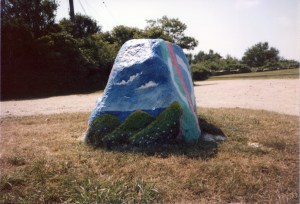
Feeling the cold setting in?  Well here’s a summery scene on New Shoreham’s famed Painted Rock, one of my favorite pictures of the island’s constantly changing bulletin board. Wish I knew who the artist was.

John is behind the new tumblr blog featuring the Painted Rock in as many iterations as folks can dig out of the albums and send along.

Here’s what John had to say about it on the island e-board:

“Thanks for the kind comments and great pics submitted to paintedrockbi.tumblr.com The ‘mini cooper rock’ and the ‘hamburger rock’ are especially cool.

“There was also a question about me and the reason for the blog, so here goes.

“About 20 years ago my mother painted the rock early one morning to celebrate my sister turning 16 and my turning 21. Our summer home is a only short walk down Mohegan Trail from the rock, but if you took careful note of our ages, you might guess that my sister and I were not really morning people.

“So by the time we had rolled out of bed and made it down the street to look, it was already painted over. No photos were taken, but I know it’s there buried under all the layers. Now I am a parent, and it kind of reminds me of the many things we do for our children that no one ever really sees, but we keep doing anyhow.

“For many years I’ve been thinking about how best to document the many cool rock paintings. And last week I finally got around to doing something about it; hopefully the page will continue to get submissions and we can save the many small memories behind each coat of paint.”

Check it out: http://paintedrockbi.tumblr.com/

Read Full Post »

I liked a recent story by Steve Annear at the Boston Globe. It was about a student who was planning to run the New York Marathon — while knitting — to raise money for medical research.

“At first,” writes Annear, “the idea of knitting a scarf while running the length of the New York City Marathon was merely a joke shared between Meredith Parmalee and her former employer, We Are Knitters.

“But as the Northeastern University senior continued to ponder the concept, she realized she could use the attention-grabbing feat to bring awareness to, and raise funds for, the Leukemia and Lymphoma Society. …

“ ‘It helps distract me from thinking about running . . . and my legs hurting and my arms hurting. It helps me keep my mind off of it.’

“Parmalee, 22, is being sponsored by We Are Knitters, where she did a co-op job for school, to run with the charity group Team in Training. … As she jaunts through New York Sunday, Parmalee will use a technique called ‘finger knitting,’ rather than two long needles, to weave a long scarf.

“To finger knit, Parmalee starts by making a slipknot around her index finger, and then loops the yarn around each of her three other fingers, skipping the thumb. She then brings the ‘yarn tail’ back around each finger, so there are two loops on each, and slips the second loop off each finger, starting with the index finger.

“She repeats the process, slowly binding the yarn together in tight knots. Making sure she threads the yarn correctly between each appendage requires a certain level of hand-eye coordination, but it also helps Parmalee keep a steady rhythm while she runs. …

“Parmalee said the plan is to have supporters at designated mile markers along the race route so that she can replenish her yarn supply.”

More about Parmalee at the Boston Globe, here. More about about We Are Knitters, here.

Photo: We Are Knitters
Meredith Parmalee plans to use a finger-knitting technique while making a scarf during the New York City Marathon.

Read Full Post »

« Newer Posts - Older Posts »