Feeds:
Posts
Comments

Posts Tagged ‘postaday’

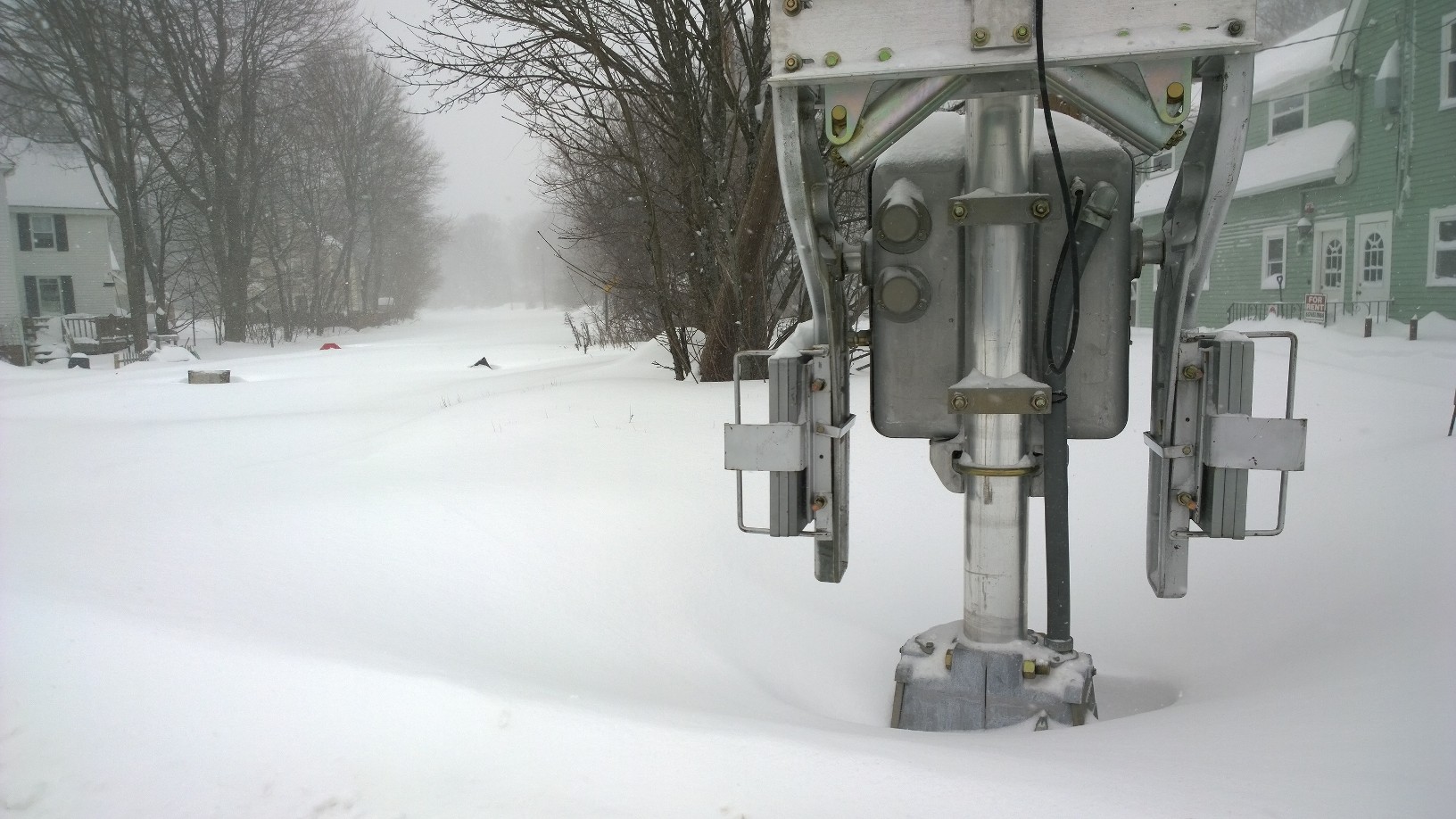
Always recognizing that people in Finland, Minnesota, and Buffalo, New York, deal with this sort of thing all the time, I’m going to give it as my opinion that the storm of January 27, 2015, in New England was a pretty big storm. We were told to work at home for two days.

I went out at lunch to see what I could see. I saw one truck and one stand-up snowplow, a few workers trying to clear the commuter rail platform, three walkers, and one neighbor.

The trees and bushes in the yard were bent over. The car’s window wipers were reaching out for help. My husband had shoveled the front walk, but the gate was blocked by a snow bank. A mailbox was barely visible. My neighbor was hard at work with a shovel.

The picture that intrigues me the most, given that I take the train to work, is the picture of the buried train track. I don’t see how a train can get through there. And where will the commuters park? I can walk from my house. Not everyone has it that easy.

012715-snowy-bushes

012715-family-car-in-snow


012715-snow-bank-blocks-gate012715-mailbox-in-snow


012715-neighbor-shovels-snow

012715-train-track-in-snow

Read Full Post »

I got an unusual number of hits from readers this morning. I never know why. Is it because we are having a big snow in New England?

Let me give you a couple preliminary snow pics just in case. I hope to do a regular post this evening.

012515-a-taster-for-more-snow-to-come

012715-snow-Concord-MA-stil-coming-down

Read Full Post »

Photo: Milla Kontkanen

Lynley Beckbridge — whose tweets I have been following since a Harvard conference on aging and design — recently tweeted this BBC story about baby boxes in Finland.

Helena Lee writes, “It’s a tradition that dates back to the 1930s and it’s designed to give all children in Finland, no matter what background they’re from, an equal start in life. The maternity package — a gift from the government — is available to all expectant mothers.

“It contains bodysuits, a sleeping bag, outdoor gear, bathing products for the baby, as well as nappies, bedding and a small mattress. With the mattress in the bottom, the box becomes a baby’s first bed. Many children, from all social backgrounds, have their first naps within the safety of the box’s four cardboard walls. …

“At 75 years old, the box is now an established part of the Finnish rite of passage towards motherhood, uniting generations of women.

“Reija Klemetti, a 49-year-old from Helsinki, remembers going to the post office to collect a box for one of her six children. …

“Her mother-in-law, aged 78, relied heavily on the box when she had the first of her four children in the 60s. At that point she had little idea what she would need, but it was all provided.

“More recently, Klemetti’s daughter Solja, aged 23, shared the sense of excitement that her mother had once experienced. …

” ‘There was a recent report saying that Finnish mums are the happiest in the world, and the box was one thing that came to my mind. We are very well taken care of,’ says [Titta Vayrynen, a 35-year-old mother with two young boys].

More here. And be sure to see this related story on customs in Nordic countries, “The babies who nap in sub-zero temperatures.”

Read Full Post »

On Saturday, I made Valentines with the two-year-old grandchildren (two families). It’s so pleasant. “Relaxing,” adds Suzanne.

A couple weeks ago, I learned about something a little more advanced that we can try making — paper-strip hearts to hang in a window or on a tree or anywhere.

I saw a few of these ornaments in the window of the 5 and 10, and I said to myself, “Cool! I can do that!”

I looked at the samples very carefully. But when I got home and tried to replicate what I had seen, the heart came out as a bubble.

Naturally, I turned to the Internet, and Sugar Bee Crafts came to my rescue. The secret is the second staple. I thought Mandy Beyeler did a fine job of photographing exactly where you have to put that staple. And she even pulled it off with two preschoolers helping.  Check her tutorial here for the details. And look at the pictures. Mandy’s hearts are much fancier than mine.

paper-heart


Read Full Post »

KerryCan is a frequent commenter on Suzanne’s Mom’s Blog and, as I keep learning, a woman of varied talents. She has been a college English professor, she blogs regularly, and she pursues numerous traditional crafts in a deep way

But what you need to know now is that she make chocolates and sells them at Etsy in time for Valentine’s Day.

Here’s what KerryCan says on her blog about a day in the life of a chocolatier, “I don’t make candy to make a living. I make candy because I like to make candy, just as I like to quilt and I like to weave. But, unlike quilting and weaving, candy piles up fast and that can cause its own dilemmas. I sell candy so I can justify making more, to experiment and try new things, without having to eat it all myself. …

“Almost every candy I make is a multi-stage process so, when I’m making a lot of candies, my days will be organized around the steps. Some days will be focused on making the ‘innards,’ as I think of them, and other days will focus on enrobing, or dipping, the candy innards in chocolate. When I make the innards, I work in small batches, and usually produce 50 to 200 candies at a time. …

“Making any of the innards depends on paying careful attention to temperature, so using a candy thermometer is essential. And, since I’ve never met a candy thermometer that I felt I could really, really trust, I also use the old tried-and-true cold-water test. …

“Once the candy is cooked and has cooled, I have to cut it. … The next step is the critical one that makes me a chocolatier—tempering chocolate. … Anyone who wants to make really good candy learns to temper chocolate. … Tempering chocolate means melting quality, real chocolate and then cooling it in a controlled way to bring about a transformation of the chocolate. …

“I spend a lot of time tempering chocolate by hand. I may temper 3 pounds at a time. I melt the chocolate to specific temperatures, depending on whether it’s dark, milk, or white chocolate, and then bring those temperatures down again. It takes about 30 minutes of constant stirring to temper chocolate, and it can’t be rushed.” More here.

I think you could learn to make chocolate yourself just from KerryCan’s one post. She concludes, “I weigh out the candies, then I put them in little candy paper cups. I arrange them in the glossy white box and make sure they look pretty. I label the box. I seal the box with my little ‘KerryCan’ sticker. I move on to the next box. The boxes pile up in a most satisfying way.”

The chocolates and other candies may be found at Etsy, here.

Photo: KerryCan

Read Full Post »

Years ago, there was a nose-warmer knitting fad at Bryn Mawr College (even before my time, so you can imagine). Students knitted nose warmers for themselves, their relatives, their friends. They put nose warmers on statues of goddesses around the campus.

The one my mother bought me at a fund-raiser looked silly, and the fad died out.

Now medical science could bring the nose warmer back.

Adam Wernick writes at Public Radio International, “As it turns out, your immune system turns sluggish in the cold, and the cold virus grows better in the slightly chillier environment of your nose than at the body’s normal core temperature. That’s the conclusion of a mouse study published this week in the Proceedings of the National Academy of Sciences.

“ ‘The optimal temperature for the cold virus to replicate is around 33 degrees Celsius (91.4 degrees Fahrenheit), which is found in the nose of most people living in normal conditions,’ says Akiko Iwasaki, a professor of immunology at Yale University and one of the authors on the paper.

“As temperatures drop outside, humans breathe in colder air that chills their upper airways just enough to allow cold viruses to flourish, says Ellen Foxman, Iwasaki’s colleague. The recent study suggests that if you can keep your nose warmer, the virus won’t replicate as easily.”

Ah-HA!

Read all about it here,. The story was based on a PRI Science Friday interview with Ira Flatow.

Photo: Aunty Marty Made It (on Etsy)

Read Full Post »

My friend Bob says there is no bad weather, only bad clothing. So I headed out at lunch yesterday all bundled up to take some pictures.

The following is to be sung to the tune of “When You Walk through a Storm.”

When you walk in the cold
Hold your head up high
And don’t be afraid
You will freeze.

At the end of your walk
There’s a golden …

I think I’m stuck. Maybe songwriter Will McM will dig me out.

While I’m on the subject, here’s a 1980s attempt at a song about cold, to be sung to the tune of “I’m Looking Over a Four-Leaf Clover.” Suzanne’s elementary school music teacher actually used it in class.

What is the reason
That we’re all freezin’
And the birdbath is filled with ice?
Why does my Omni
Go sideways down the street?
Why do my children wear
Baggies on their feet?
What normal fellow
Whose brains aren’t Jello
Would keep fighting this cold war?
What is the reason
That we’re all freezin’
And what did we move here for?

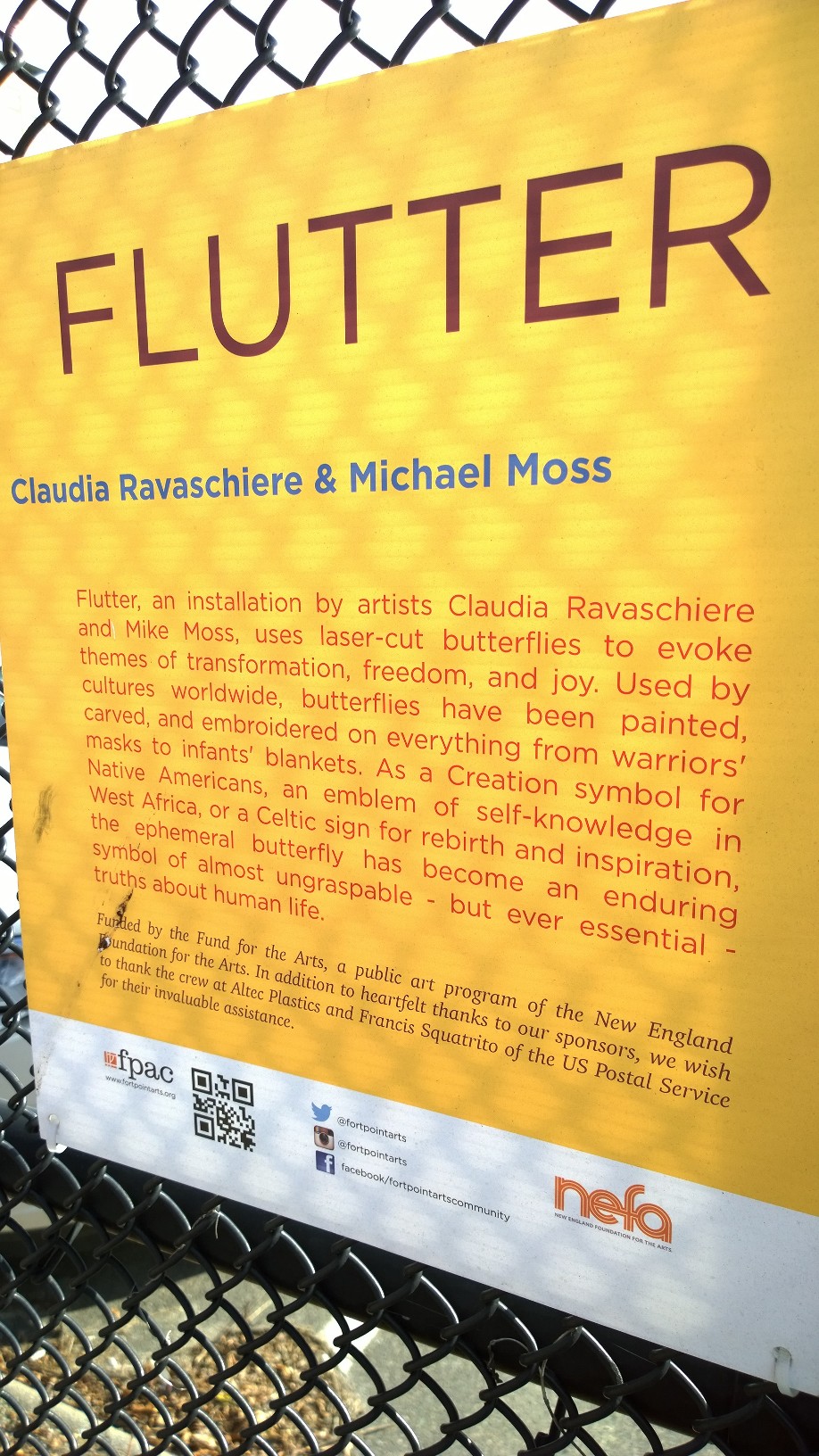
Believe it or not, I kind of like the cold. And I love getting out and taking pictures. Yesterday I noticed a yellow Fort Point Arts sign on an old chain link fence. Then I noticed the butterflies.

Read about Claudia Ravaschiere and Mike Moss’s installation, Flutter, here.

butterfly-art-fort-point

public-art-fort-point

Read Full Post »

National Public Radio’s Eleanor Beardsley reported recently on a borrowing trend.

Nothing to do with Mary Norton’s Borrowers, who gather up all the buttons and safety pins you’ve lost and store them in their home somewhere under your floorboards. No, this is about you needing a rarefied plumber’s tool to replace the kitchen faucet and deciding to borrow one for a day. (Maybe two days if a two-year-old I know offers to help.) All you need is an app called Peerby.

“It isn’t surprising that the idea for the borrowing platform Peerby [peer nearby] originated in one of the world’s most densely populated countries — The Netherlands,” says Beardsley.

“Founder Daan Weddepohl says he had the idea for the startup after his house burned down, and he had to borrow everything. At first, he says, he felt dependent, but then realized people generally like helping each other because it creates a bond. …

“In June, Peerby was selected best urban app in the AppMyCity! competition, held as part of the New Cities Summit in Dallas. Peerby hooks up 100,000 borrowers and lenders each month in the Netherlands. Since its launch in 2012, the company has expanded to Belgium, Berlin and London. …

“Cindy Bakum, an Amsterdam native, is a regular Peerby user.

” ‘Last time I had a friend over, and we were watching a movie on his laptop, but he forgot his adapter, and my adapter didn’t fit,’ she says. ‘So I put out a request, and it was actually my neighbor. He really lived on my block, and he had an adapter, so we could finish watching the movie. So that worked very well.’ ”

It’s all about the sharing economy. Read up on it at the All Things Considered blog, here.

Photo: Merriam-Webster

Read Full Post »

Looking through a pile of magazines recently, I found a 2011 newspaper article I had cut out about Hardwick, Vermont. It’s about reinventing the local culture around food and food-related businesses.

Dirk Van Susteren wrote at the Boston Globe, “If there were a ‘Locavore Capital of America’ one would expect it to be in sunny California or perhaps somewhere in the heartland … But, surprisingly, in rocky northern New England, just 45 miles from the Canadian border, is a place that could contend for that honor: Hardwick, a former quarrying town that until recently knew more pain than promise.

“In recent years Hardwick, population 3,200, located along a tumbling stretch of the Lamoille River, has seen a half-dozen innovative agricultural enterprises crop up, many with mission statements including such words as ‘community-based,’ ‘sustainable,’ and ‘organic.’

“The town, always a bit scruffy, and with a high jobless rate, might be on a green trajectory. And people are taking notice.

“Among the new operations here or in nearby towns: Jasper Hill Farm, which makes artisanal cheeses and provides aging, distribution, and marketing services to local cheesemakers; High Mowing Seed Co., an organic seed business, whose owner likes traveling around the country to tell the Hardwick farm and food story; Highfields Center for Composting, a soil-making business that collects its raw materials from restaurants, farms, and schools; Pete’s Greens, a CSA (community-support ed agriculture) farm that grows organic vegetables in gardens and greenhouses; and, finally, Vermont Soy, a tofu and soymilk producer.

“The area also has dozens of small-scale producers, from orchardists to maple sugarmakers. Their products sell at farm stands, at the summer farmers’ market, and at Buffalo Mountain Food Co-op and Cafe, a landmark in its 36th year. …

“Monty Fischer, the executive director of the Center for an Agricultural Economy, the nonprofit organization that helped spur these farm efforts, has kept count. ‘People from 40 states and 40 countries have come to ask about our agricultural cluster,’ he reports, from his downtown office.”

Read about the 2011 federal grant for the Vermont Food Venture Center, an incubator facility, the organic North Hardwick Dairy, where sunflowers are grown as a value-added crop, mead maker Caledonia Spirits, and more here.

And if anyone has been up there recently, I sure would love to know if the food culture is still going strong.

Photo: Wikipedia
North Main St., Hardwick, Vermont

Read Full Post »

I love listening to Worcester-based WICN (jazz radio). Bonnie Johnson had an especially good show yesterday, opening with Cynthia Scott and 3rd, 4th & 5th graders of PS32 in Brooklyn, NY, singing “Dream for One Bright World.”

“There is a new day dawning
“The time is now
“The world is ready for a change …

“Let’s teach out children to care
“To help one another
“And mend broken hearts
“So many children in the world
“Have never had a chance
“Their time has come …

(More lyrics here.)

You can listen to WICN online at wicn.org. Bonnie Johnson’s program is described at Colors of Jazz. “Bonnie Johnson is host of Colors of Jazz on Sunday afternoon from noon-4 pm. If you asked the Worcester native how she found jazz, she would tell you that jazz found her. As an undergraduate student at Howard University in Washington, DC, Ms. Johnson became a fan of the Quiet Storm featured on the college station WHUR-FM. …

“Ms. Johnson appreciates the diversity and the evolution of music. As a self-taught electric bassist, she has enjoyed many years of playing various types of music with her daughter and close friends in a family band. Growing up, she sang in the St. Cecilia Girl Choir at All Saints Worcester. …

“Ms. Johnson holds B.A. in Liberal Studies and M.S. in Communications and Information Management degrees from Bay Path College. She believes the future of jazz is in our children, stating, ‘Music and the arts is one area that gives young people an outlet and release of creative energy. While there are many children exposed to music through lessons and attending live performances, there are too many more that are not.’ One of Johnson’s primary goals as host at WICN is to reach youth in creative ways through community engagement.”

That’s something to think about on Martin Luther King’s birthday — and maybe to act on, too.

Bonnie Johnson, host of WICN radio’s Colors of Jazz 

Read Full Post »

Saturday was a day for hawks. I saw one on the highway as I drove home from John’s and then another one just a little farther along. Each was perched on a high limb, scanning the road and the verge for lunch. A third hawk, in the center of town, dove after a small bird, but being intercepted and stunned by a fast-moving car, wheeled back to land on a parked vehicle, catch his breath, and pose for photos.

I wondered why the hawk was hunting in such a heavily populated area. It must be hard to find food in this weather.

Fortunately, I had bought my camera, having decided that I don’t get enough pictures for the blog if I give in to the cold and take my daily walk indoors. There aren’t many photo ops when you go ’round and ’round from the hall to the living room to the dining room to the kitchen … .

If any reader knows what type of hawk this is, I’d appreciate being enlightened.

downtown-hawk

Read Full Post »

At Christmas, Yuriko sent a translated Japan News article about the business she runs with her husband, who retired rather young. She told me the newspaper, called Yomiuri Shinbun in Japan, “has the largest distribution nationwide. We were really busy after that.”

The article mentioned that Japanese retirees starting small businesses or finding work at a reduced rate is a growing phenomenon, so I Googled around to see if I could learn more.

Kanoko Matsuyama writes at Bloomberg Businessweek, “When he retired three years ago, Hirofumi Mishima got right back to work. After aging out of a $77,000-a-year job as an industrial gas analyst, he spent six months trawling the vacancy boards at a Tokyo employment center.

“Fifteen days each month, Mishima, 69, rises at 4 a.m. for an eight-and-a-half-hour shift overseeing the supply of hydrogen gas to buses. His daily commute has risen from three hours to four even as his earnings have dropped by more than a third. ‘Keeping a regular job is the most stimulating thing for me,’ he says. ‘Now, I work for my health. I’m very happy my job gives me mobility and helps me stay active.’

“Though Japan’s retirement age stands at 60, more than 5.7 million Japanese have continued to work past 65, either because they can’t afford to stop working or they’re looking to get out of the house. The nation’s private companies can force employees to retire at 60 if they wish, so workers often accept slashed wages to stay on, sometimes in a reduced capacity as they start collecting public pension benefits. …

“Under the current system, Japanese men exit the labor market on average at 70, and women at 67, according to a 2011 report from the Organization for Economic Cooperation and Development. ‘The pension isn’t enough to live comfortably,’ says Kazuyoshi Hirota, 69, who works 24 hours a week as an apartment building manager and janitor in central Tokyo. Hirota retired seven years ago from his full-time security job at Asahi Group Holdings. His wife, 70, works as a cleaner. It’s not just about the money, though: ‘Life is boring without work,’ he says.”

More here.

My friend Yuriko runs a consignment shop. Her husband does financial consulting in the same storefront, which gives Yuriko flexibility to run out and look after her 90-something mother-in-law.

Photo: Jeremy Sutton-Hibbert

Read Full Post »

In high school, I had a small part in Thorton Wilder’s play The Skin of Our Teeth. As arch and self-conscious as it is, there are phrases that stick with you for your whole life. Even my sister remembers phrases, and she wasn’t in it. One of my brothers had a small role in a different production and remembers the ad-libbing part where a key actor supposedly has fallen ill, and the stage manager and all the cast and crew come out on the stage, and one of the ad-libbers says, “It must have been the chocolate matzohs.”

Among the phrases that stick for a lifetime are: “We came through the Depression by the skin of our teeth. One more tight squeeze like that, and where would we be?” and “Pray God nothing happened to the Master crossing the Hudson River!” and “Sabina, you let the fire go out!” and “The dogs are sticking to the sidewalks!”

The dogs were sticking to the sidewalks because there was an Ice Age going on, complete with woolly mammoths. … I know.

Anyway, there are those of us who to this day express how cold it is by exclaiming, “The dogs are sticking to the sidewalks!” It’s that kind of weather in New England lately. Suzanne’s family went skiing in New Hampshire near Mt Washington when I saw on twitter that the temperature at the top of the mountain was minus 81 degrees. That’s what my husband calls Type 2 Fun, the kind of fun that is only fun in retrospect, when you can tell the story.For more on The Skin of Our Teeth, click here. And here is one of my more recent wintry photos. Sunny but bitterly cold.011114-tree-branch-Concord

Read Full Post »

I asked around whether any local nonprofits were providing a service opportunity in honor of Martin Luther King Jr. on the Monday holiday. Here is what I learned.

Rhode Island

The Rhode Island Black Heritage Society told me it published a 12-page booklet to honor Dr. Martin Luther King, Jr and celebrate the 50th Anniversary of the Selma-to-Montgomery March. The Dr. King Booklet is free. Postage is $3 for one booklet or $4 for two or more copies.  To have one mailed, send a $3 check to RIBHS at 123 North Main Street, Providence, RI 02903 or call 401-421-0606.

“Let Freedom Ring: 50 Years Later …” Woonsocket, RI. Memorial Service, King Memorial Sculpture Garden, South Main Street, across from St. James Baptist Church, 10 a.m., January 19, 2015. Youth Service Learning Project, St. James Baptist Church, 340 South Main St., 11 a.m.-2 p.m. Participants will help collect basic-needs items and snack food for the homeless. Contact nofokansi@neighborworksbrv.org or call 762-0993, ext. 234.

Providence College MLK Jr. Day of Service (2nd annual). Open Mic Night and Potluck, PC/Smith Hill Annex, 231 Douglas Ave., Providence. 2-5:30 p.m. Click here for info.

Special programs are being held to celebrate Martin Luther King Day at Audubon’s Environmental Education Center in Bristol, January 19, 10 – 2. Click here to volunteer to do crafts with children on Monday.

RI School of Design (RISD) has planned MLK Jr. events in Providence. Day of Service, Martin Luther King Jr. Elementary School, 35 Camp St., RISD and the Mt. Hope Learning Center partner to celebrate King’s teaching by inspiring children to reach their full potential through the arts, crafts and special activities. 8:30 a.m.-2:30 p.m. Click here for details.

Greater Boston

I also wanted to check on what Kids4Peace Boston was doing because I know they are into service. Youth from the interfaith organization are volunteering on MLK Jr. Day at Solutions at Work. Matt says, “Approximately 12 of our teens will be helping to revitalize the space at Solutions at Work, which works to end homelessness in the Boston area.” Click here for some of the nonprofit’s other MLK Jr. service options.

Next year I hope to reach more nonprofits to give them — and the idea of a service day — publicity.

Photo: http://commons.wikimedia.org/wiki
Martin Luther King Jr., Washington DC

Read Full Post »

Babson College in Wellesley, Mass., is well known as a hub for entrepreneurship. So the school was the logical place to help start-ups offering farmers distribution services, marketing, and the like learn how to grow their business. A training was held at Babson at the end of December, and the New York Times covered it.

Stephanie Strom writes, “In spite of the surging demand for locally and regionally grown foods over the last few years, there is a chasm separating small and midsize farmers from their local markets.

“But a growing number of small businesses are springing up to provide local farmers and their customers with marketing, transportation, logistics and other services, like the Fresh Connection, a trucking business providing services to help farms around New York City make deliveries. …

“The Fair Food Network, a nonprofit organized to improve access to better food, recently held a second ‘business boot camp’ in Wellesley, Mass., for tiny companies working to increase ties between communities and local farmers, which culminated in a contest to win some $10,000. …

“For farmers selling products to a number of customers, there are so-called food hubs like Red Tomato, which connects its network of farms to existing wholesale distribution systems to make deliveries of locally grown fruits and vegetables to groceries, produce distributors, restaurants and schools in the Northeast. …

“Not all ways of improving consumer access to local and regional farm production involve distribution, however. Blue Ox Malthouse, for instance, is making malt from barley grown in Maine as a cover crop. Normally, farmers plow barley under or sell it cheaply for animal feed.  Blue Ox has given them a new and more lucrative market, though, buying up barley and turning it into malt in hopes of selling it to Maine’s thriving craft beer businesses. …

“It’s good for the farmers, who get a better price for a product they often just plowed under, and it’s good for the craft beer business, where brewers are always looking for points of distinction,” [founder Joel] Alex said.”

Read about some other great services for small farms here.

Photo: Michael Appleton for The New York Times
Mark Jaffe of the Fresh Connection picks up fresh eggs from a farmer’s stand in Union Square, Manhattan. He will make deliveries to restaurants and groceries.

Read Full Post »

« Newer Posts - Older Posts »