Feeds:
Posts
Comments

Posts Tagged ‘poverty’

Photo: Boston Globe.
A headline in the Boston Globe from 1924.

I didn’t get to post this story about a charitable Gothenburg-born Boston immigrant last year, but I think you’ll agree that it’s a bit of Christmas history that will always be fresh.

Jenny Ashcroft wrote about it at Fishwrap, the official blog of Newspapers.com.

“On Christmas Day in 1921, a Swedish immigrant quietly wheeled his hot dog stand to a street corner in Boston’s North End and distributed 500 free hot dogs to hungry children. Axel Bjorklund was no stranger to poverty. He barely made ends meet himself, but he wanted to give back. His cart was soon swamped with hundreds of shivering children wearing tattered clothing that did little to stave off the cold. Their hungry faces beamed when Axel handed them a steaming hot dog. Eventually, the food was gone, but Axel’s determination to repeat the event wasn’t. The Hot Dog Santa tradition was born. Over the next eight years, Axel gave away some 10,000 hot dogs before he died in 1930.

“Born in Gothenburg, Sweden, on August 6, 1869, Axel Bjorklund emigrated to America in 1889, eventually settling in Boston’s North End neighborhood. The area had become a melting pot of immigrants, most of whom were impoverished as they struggled to establish lives in a new country. The Spanish Flu Pandemic hit the North End particularly hard, leaving families even more destitute and many children orphaned.

“The first Christmas hot dog giveaway in 1921 was so successful that Axel decided to expand in 1922 and doubled the number of hot dogs to 1,000. His hot dog giveaway grew with each year until he distributed 3,000 annually. The children loved Axel and nicknamed him ‘Hot Dog Santa.’ …

“Axel’s annual Christmas Day hot dog giveaway eventually moved to New Year’s Day, but it was an event the children anticipated all year. As Axel’s generosity expanded, so did his health challenges. He was plagued with rheumatism, which led to frequent hospitalizations. His finances struggled, too, and he could no longer pay his rent. Not wanting to end the hot dog giveaway, he appealed to the public to help him continue the tradition.

“In December 1928, just before the annual hot dog giveaway, Axel’s landlady kicked him out because he hadn’t paid rent. The Salvation Army stepped in to help, but Axel was broke. The next two years saw Axel skipping between the poor house, the Cambridge Home for the Aged, or obtaining temporary lodging from generous benefactors. Despite his circumstances, in 1929, he participated in his final hot dog giveaway.

“On November 10, 1930, Axel Bjorklund passed away, penniless and alone at a Massachusetts hospital. He had no relatives and was set to be buried in a potter’s field when newspapers published word of his death. Citizens stepped forward, offering to contribute to a fund to give Axel a proper burial. The Swedish Charitable Society coordinated, and Axel was laid to rest in the Cambridge Cemetery.

“If you would like to learn more about the Hot Dog Santa or discover other heartwarming Christmas stories, search Newspapers.com.”

It hurts to think that today there are still plenty of shivering, hungry American children who could use this 1920s Good King Wenceslas.

Read Full Post »

Photo: John Okot.
A volunteer for The Mango Project places mango slices in a solar dryer for preservation in Midigo, Uganda, where malnutrition is a serious issue.

One of my grandsons has had an interest in Uganda for several years — first, through learning about endangered mountain gorillas, then through helping support a start-up water business in the country. As a result, I pay extra attention to Ugandan news.

John Okot reports at the Christian Science Monitor about two brothers in Uganda who launched a mango initiative to help their neighbors.

“Francis Asiku’s plan to fight hunger in his village began, quite naturally, under a bountiful mango tree. It was 2011, and he had just landed his first nursing job at Midigo Health Centre IV in Yumbe district in northern Uganda. He was excited and joyful. But in his first month at work, Mr. Asiku was surprised to learn that what many infants and expectant mothers seeking care needed wasn’t necessarily medicine. It was nutritious food.

“He recalls one hot afternoon, in particular, when a young mother rushed into the health center with a 4-year-old child in her arms. Mr. Asiku hurried to help. He quickly diagnosed poor feeding as the root of the child’s problem. …

“He headed home on a dirt road in the inky-dark evening. When he spotted birds feasting on rotting mangoes along his path, a question struck him: Why were so many people in his community malnourished when it experienced two plentiful mango seasons a year?

“He raised the issue later that night with his younger brother, farmer Emmanuel Mao. Soon afterward, the brothers met with village elders under the huge mango tree where community meetings were held. That was the start of their nonprofit, The Mango Project, which distributes glass jars full of mangoes to schools, to health centers, and directly to hungry individuals.

“The toll of hunger in Uganda is staggering, according to the Global Hunger Index, a report published by several global nonprofits. Almost 37% of the population is undernourished, and about one-quarter of children have stunting, a condition that is associated with malnutrition.

“When Mr. Asiku and Mr. Mao met with the Midigo elders, [they said] the brothers needed to figure out a way to preserve Midigo’s abundant mangoes throughout dry periods, when they are scarce. …

“Mr. Asiku and Mr. Mao embarked on researching a simple way to preserve food. They began ‘jarrying’ – cutting fruit pulp into thin slices and putting them in a glass container of boiling-hot water and sugar. While canning is practiced throughout the world, many Midigo villagers can’t afford sugar, not to mention glass jars with secure lids. The relatively easy preservation method – and the brothers’ fundraising efforts to obtain the necessary supplies – delighted village elders. …

“The brothers initially collected mangoes that were scattered throughout the village, but have since expanded their initiative to preserve the fruit from their family’s ancestral land. The jarred fruit is safe to eat for up to a year.

“Mr. Asiku knows that the mangoes alone will not end malnutrition in the community, since humans need a balanced diet. But the initiative, he says, is a great start to breaking the hunger cycle in Midigo. …

“Irene Andruzu, who supervises one of the Midigo Health Centre’s facilities, says she receives at least 50 jars of mangoes monthly to help malnourished patients. During the pandemic alone, more than 12,000 jars of mangoes were distributed to health clinics and refugee settlements.

“Scovia Anderu, a social worker for Calvary Chapel Midigo, lauds The Mango Project for instructing villagers. She says that most villagers lack knowledge about nutrition and that there are few qualified personnel who can educate them on the subject at the grassroots.

“Zuberi Ojjo, the district health officer for Yumbe, [says] The Mango Project ‘reminds people of the importance of nutrition to our well-being.’ …

“One obstacle for The Mango Project is that charcoal, which is needed to heat the water used to sterilize jars, can be difficult to obtain. Since 2023, the government has banned commercial charcoal production in the northern region over concerns about the alarming depletion of trees there. Nevertheless, illegal, large-scale tree-cutting has disrupted weather patterns in the region, where communities rely mainly on agriculture amid erratic, unpredictable rainfall. …

“Mr. Asiku has found one alternate form of fuel. Over the years, he has been scrimping and saving, and last year he purchased a solar-powered dryer worth $600. Besides mangoes, he dries vegetables such as okra and eggplant to give to villagers.

“He hopes to distribute the food more widely as he acquires a license from the government to do so – and more dryers. He also has an orchard with 310 hybrid mango trees. This is meant to supplement the seasonal mangoes in case there is low supply because of damage caused by fruit flies.

“ ‘It’s fulfilling to see my people smiling at the end of the day,’ Mr. Asiku says.”

More at the Monitor, here.

Read Full Post »

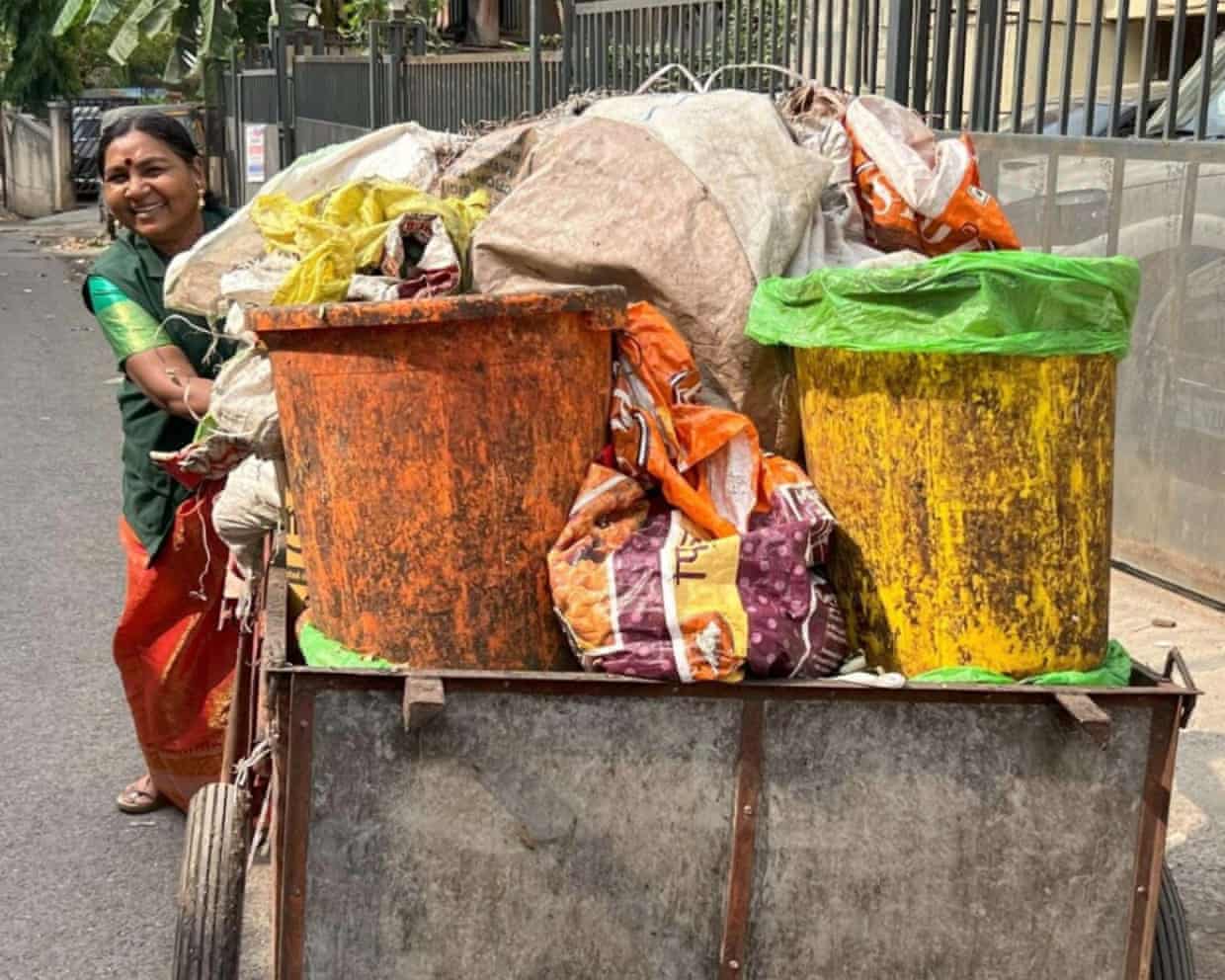
Photo: Swach Cooperative, Pune.
More than 70% of Swach waste collectors in Pune, India, are women.

I like stories about win-win-wins. Today Shatakshi Gawade writes at the Guardian about a cooperative in Pune, India, that is diverting waste from the landfill and cleaning a city while also alleviating poverty. Trash collection is a job the mostly female workforce fought hard to retain when the city failed to renew the contract.

“Three decades ago, Rajabai Sawant used to pick and sort waste on the streets of Pune with a sack on her back. The plastic she collected from a public waste site would be sold for some money that saved her children from begging.

“Today, dressed in a dark green jacket monogrammed with the acronym Swach (solid waste collection and handling) over a colourful sari, the 53-year-old is one among an organized group of waste collectors and climate educators who teach residents in urban Pune how to segregate and manage waste, based on a PPPP – a pro-poor private public partnership.

“ ‘Even though we were earning money and running our homes by collecting and selling recyclable waste in the past, our job was not valued and we were not respected for the work we did,’ Sawant says as she pushes a loaded four-wheeled metal cart up a gentle slope. …

“Swach was set up in 2005 by a trade union of waste pickers, Kagad Kach Patra Kashtakari Panchayat (KKPKP), which was not in favor of contractor-run private models and envisioned a scheme that enhanced waste collectors’ work instead of displacing them.

“Lakshmi Narayan, one of the co-founders of Swach and KKPKP, says: ‘Contractor models typically end up hiring males and displacing the people who traditionally did the work. We strongly felt that a person who has been doing the work for so long brings in the knowledge, experience and intelligence to handle the material in a particular way, and should be the first claimant of that work.’ …

“Rehabilitating the waste workers by teaching them a new skill such as embroidery, and taking them away from their work of waste collection, segregation and sale was not the long-term solution, Narayan says. ‘The waste sector generates a large number of jobs not just in Pune but across the world.’ …

“Through detailed discussions with waste pickers, KKPKP realized that they were diverting a significant amount of waste from the landfill. Segregation at source, plus recycling material recovered from the waste, was contributing to climate change mitigation by minimizing landfill waste, reducing greenhouse gas (particularly methane) emissions, lowering the demand for scarce raw materials and saving taxpayers money by reducing solid waste management costs. …

“The waste sector is the third-largest source of anthropogenic methane emissions, one of the most potent of greenhouse gases, and Swach calculates that its work saves 100,000 tons of CO2 every year.

“In negotiations over a global plastics treaty in Busan, South Korea, last year, the chair’s text highlighted that countries should take measures to ‘promote a just transition for plastic waste management workers, especially waste pickers and other informal workers.’

“Narayan says: ‘We have argued that waste collection itself is green work but it’s not necessarily decent work. And there has to be a way to make it decent.’ Narayan says the Swach model helped transition the work of waste collectors from the informal sector, in which they spent their whole day at public bins and roadsides in tattered clothes, to a more formalized setup, where they began wearing a uniform and started speaking directly to residents.

“Rani Shivsharan, a waste picker and board member of Swach, says: ‘We did not know how to talk to people, since we had never been included in society. We wouldn’t have dared to talk in front of even two people, but now we can fearlessly articulate our demands and thoughts with conviction in front of an audience of 500.’ “

Read at the Guardian, here, about current threats to employment of the traditional waste picker. This story is an abridged version of a piece originally published by Mongabay.

Read Full Post »

Photo: Malin Fezehai for the Washington Post.
Steve Otieno (described below) rehearsing with the Ghetto Classics orchestra in Kenya.

Charitable work is complicated. It is not always possible to do the good for people that you intend. But if you are making a meaningful difference in some lives, that may be enough.

In Kenya, an orchestra called Ghetto Classics aims to help poor children achieve something fine and eventually move away from the dangers of their extreme poverty.

Katharine Houreld writes at the Washington Post about both the successes and failures of the orchestra.

“The violin’s quaver steadied and swelled through the gloomy concrete staircase, escaped through the wire mesh and soared over the packed-dirt playground before dissipating in the acrid smoke drifting in from the smoldering dump site next door.

“It was the last day of class before Ghetto Classics broke up for Christmas, and 14-year-old Steve Otieno was practicing his Christmas carols for his final performance of 2024. Undeterred by the demolition of his home last month, the floods that devastated his neighborhood in Nairobi this year, or the eye-watering stink of burning plastic all around him, he stroked the strings to coax forth each note of ‘Joy to the World.’

“ ‘Music makes me feel calm when I’m stressed,’ he said shyly. ‘Some people have drugs. For me, it is music.’

“Steve is one of thousands of children from the poorest neighborhoods of the Kenyan capital who have been introduced to classical music by Ghetto Classics. The organization was set up in 2008 by Elizabeth Njoroge, a classically trained singer who studied pharmacology at her parents’ urging but longed to return to music. A chance encounter with a priest trying to fund a basketball court at a Catholic school in the Nairobi slum of Korogocho inspired her to raise money for the first class of musicians there. …

“Now Ghetto Classics provides lessons to about 1,000 students, who feed three orchestras, a choir and a dance group. Njoroge raises funds to support its expanding programs.

“Ghetto Classics works in schools and community centers in Nairobi and Mombasa, but its headquarters is in the St. John compound in Korogocho, where a church, school and community all share space. A tarmacked basketball court and a dirt field for soccer are enclosed by a sagging chain-link fence and scraggly trees; on one side of the compound, the children have planted a garden to try to filter out the choking smoke.

“Ghetto Classics has performed for former president Barack Obama, first lady Jill Biden and Pope Francis. Alumni are studying in the United States, Britain and Poland.

They include one determined pianist who learned to play by watching videos and repeating the motions on a piece of cardboard on which he’d drawn keys.

“The lessons provide a refugee for students suffering from hunger, domestic violence and crime, said violin instructor David Otieno, who is not related to Steve. He joined the program a decade ago as a student; now he’s one of 45 graduates working as paid instructors.

“The tall, dreadlocked 29-year-old credits Ghetto Classics with saving him from the neighborhood gangs. He witnessed his first homicide when he was still in primary school, and as he grew up, the gangs sucked in friend after friend. His teachers became so worried he’d be killed, he said, that they collected money to move his mother and six siblings to a safer neighborhood where he could continue his music.

“Back then, he said, the group shared 10 violins among 30 students. Now he has his own instrument. Once shy and fearful, he has played in Poland, in the United States and at State House, the Kenyan president’s home in Nairobi.

“ ‘The violin gives you a voice,’ he said. ‘It makes you talk to people you’d never otherwise talk to.’ His students filed into the compound bumping fists.

“Thousands of kids enroll in Ghetto Classics, but most fall away. The discipline is demanding. … About a dozen young musicians who spoke to the Washington Post said their parents had never seen them perform. Some were single parents too busy working, some weren’t interested and some were actively opposed. …

“When opera singer David Mwenje started with Ghetto Classics, his father was skeptical, he said, but he came to see him perform and was won over — a bittersweet memory to which Mwenje clings now that his father has died.

“Mwenje sang for six years, including for Pope Francis at the Vatican, before turning professional in 2021. His first audition landed him the role of Okoth — a messenger who must tell a village medicine man that his daughter has taken up with foreign missionaries — in Nyanga: Runaway Grandmother with Baraka Opera Kenya at the Kenya National Theatre. It was the first ray of hope in years darkened by his father’s death and the covid pandemic that shuttered his school, he said.

“ ‘Through this opera, I could control all my pain,’ he said. ‘I also love to sing “Bring Him Home,” from Les Misérables, because the song reminds me of my dad and I feel like I’m pleading with God to bring him home.’ ”

More at the Post, here.

Read Full Post »

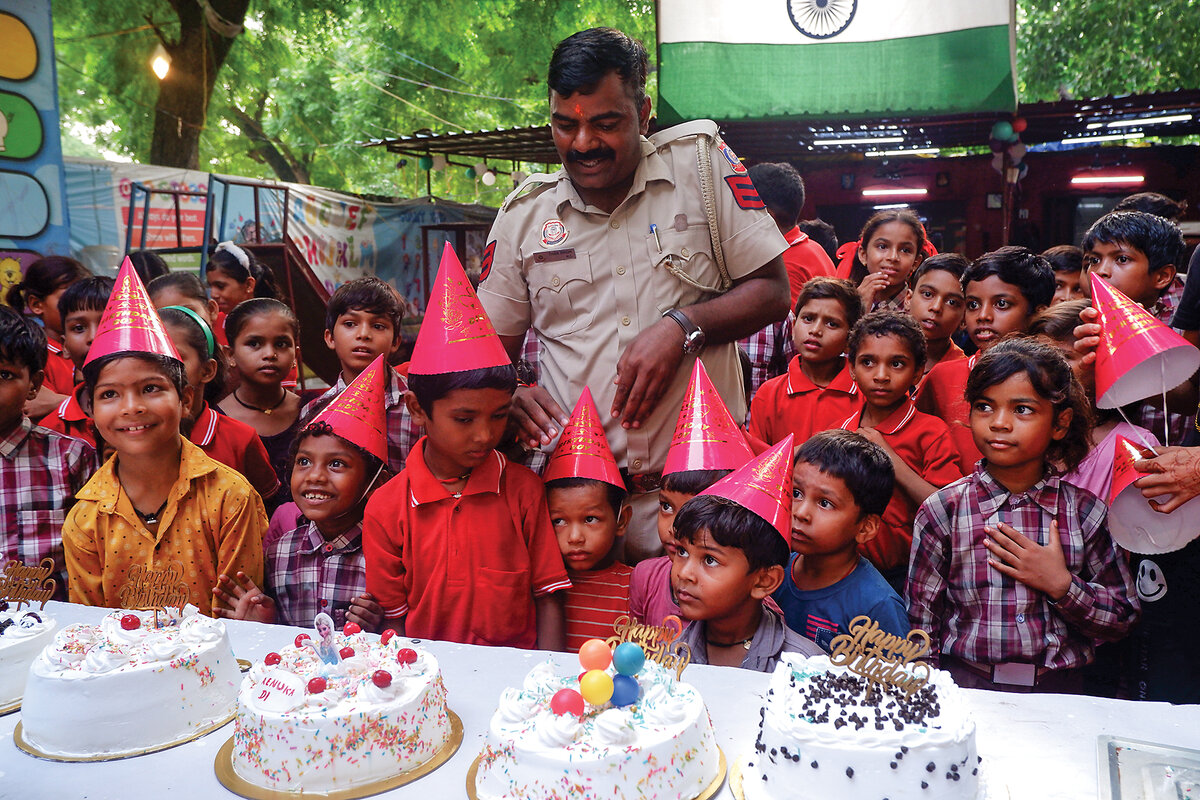
Photo: Shefali Rafiq.
Students celebrate a classmate’s birthday at an informal school, or
pathshala, set up by police officer Than Singh (center), in a Delhi, India.

Today’s story is about one compassionate person in India who wanted to make a difference in children’s lives. Shefali Rafiq and Saqib Mugloo wrote the photo essay for the Christian Science Monitor.

“It wasn’t until Than Singh came along that learning became a favorite pastime for the children who typically roam Delhi’s streets begging, rifling through garbage, or engaging in petty crimes.

“In 2015, the Delhi police officer started a pathshala, or place of learning, where he teaches 80 students a day in a temple set up near the Red Fort. ‘It was heartbreaking to see children scavenging for plastic bottles in the trash,’ he recalls. ‘That’s when I decided to do something.’

“More than half of India’s children are malnourished, and about 30% of those ages 6 to 18 do not attend school. Mr. Singh, who grew up poor in northwestern Rajasthan state, is determined to change these statistics. ‘My dream is to see every underprivileged child in school,’ he says with a broad, charming smile, adding that he is confident that, with God’s help, he will make it happen.

“He starts his day early, patrolling the busy lanes of Old Delhi, the capital’s historic heart, as part of his duties. But every day after work, he holds classes at his pathshala, where students eagerly await him. Among them are Ajay Ahirwar and Neelu Ahirwar (no relation).

“Ajay says he aspires to become a high-ranking officer in the government so that he can improve the conditions of his family and those living like him. Neelu is fond of her teacher and the pathshala. ‘I would rather be here, even on holidays, than at home,’ says the young girl, who aspires to become an officer in the Indian Police Service.

“Initially, only four children attended Mr. Singh’s pathshala. He contributed money from his salary to buy books, notebooks, pencils, and schoolbags. Nine years down the line, he has now taught hundreds of children.

“ ‘Beyond basic lessons, I try to instill manners and discipline in these students,’ Mr. Singh says. ‘Even if they come to this school just for a meal, I’ll be happy because, seeing others, they may also want to study.’

“Mr. Singh organizes extracurricular activities, too, including cricket. For those children who do attend school in the city, he celebrates good exam results at his pathshala. ‘I just want these children to stay away from all the bad influences they’re vulnerable to,’ he says, referring to the crimes that affect Delhi.

“ ‘Our aim in the world is to spread goodness and happiness.’ ”

More at the Monitor, here. Wonderful photos. No firewall.

Read Full Post »

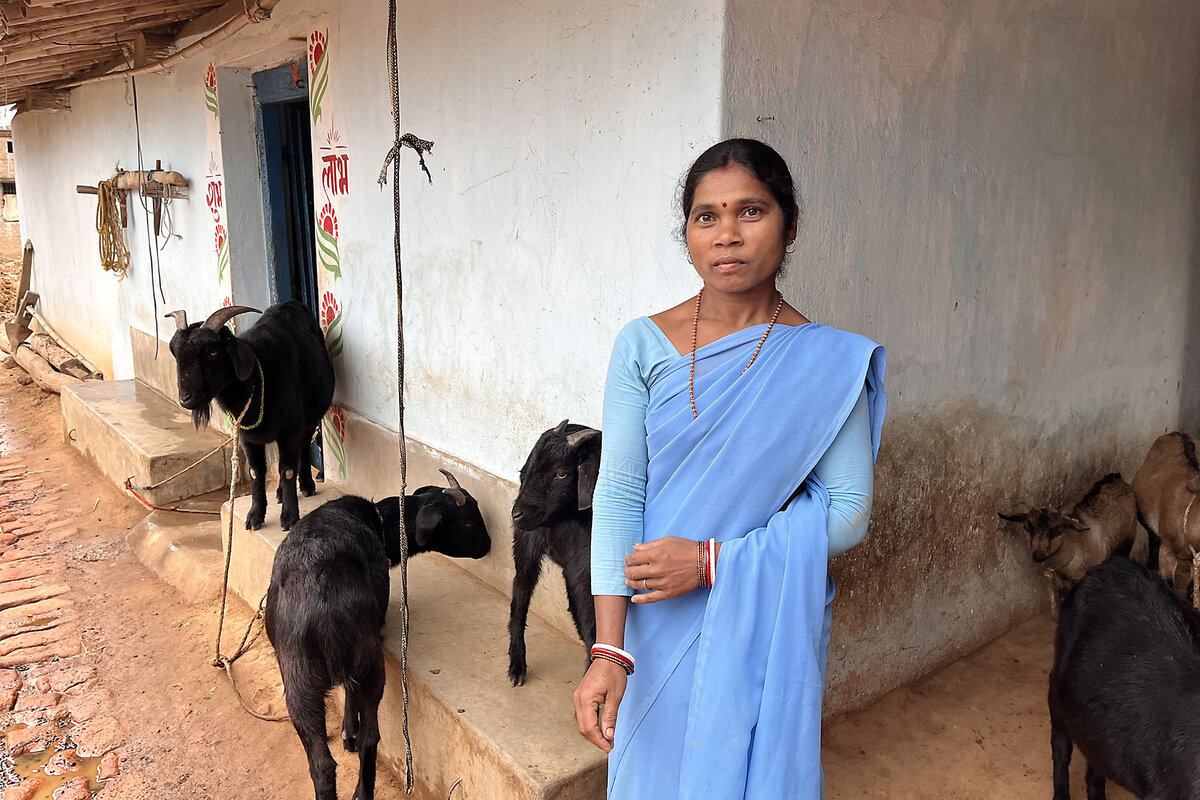
Photo: Sushmita Pathak.
Ritmani Devi, one of roughly 60,000 women in India trained as goat nurses under the Pashu Sakhi initiative, stands with her herd in Angara, India, March 19, 2024.

It seems wrong somehow that there should ever be a need to “empower” women, anymore than there is a need to empower men.

But such is the case, whether women live in rich countries or in the most impoverished villages of India.

Still, it’s better to have empowerment initiatives for women than to do nothing about the imbalance.

At the Christian Science Monitor, Sushmita Pathak reports from India about one such initiative, “Dressed in a light-blue sari, Ritmani Devi cradles two black baby goats as she guides a flock of ducks toward its coop. …

“A few years ago, this muddy yard was much less lively. Ritmani Devi’s goats would often die, she says, and the ones that survived weren’t very healthy. This was common here in the east Indian state of Jharkhand and throughout the country.

“India is home to one-sixth of the world’s goat population. A goat is a valuable asset for a low-income family, ready to be sold at a moment’s notice in case of emergencies. But with owners lacking basic animal health knowledge, that’s all they were – a one-time, last-ditch safety net, rather than an alternative stream of income. Plus, poor access to veterinary services led to high mortality and morbidity rates among goats.

“Now, results from one novel initiative that began a decade ago indicate the tide may be turning. The Pashu Sakhi, or ‘friend of the animal,’ program works to fill gaps in veterinary care by transforming rural, semiliterate women into community animal health care workers, or ‘goat nurses.’ With support from the Indian government, the World Bank, the Gates Foundation, and others, around 60,000 women across India have been trained to provide services like vaccination and deworming, leading to a spurt in goat populations in several states. They are paid for the care they provide, and gain a sense of pride and independence. …

“At the community hall near Ritmani Devi’s home in Getalsud village, the walls are painted with training material, including illustrations of common symptoms to look out for, like swelling under the animal’s mouth or pale eyes, and tips on how to negotiate better rates for goats in the market. 

“Jharkhand was one of the first states in India to adopt the Pashu Sakhi model. Having women at the forefront of the initiative was a natural choice, says Swadesh Singh, a livestock specialist at the Jharkhand State Livelihood Promotion Society, the government agency that runs the program.

“In rural India, the responsibility of managing small ruminants and poultry usually falls on women. Meanwhile, veterinary doctors – who sometimes serve multiple village clusters alone – focus on larger, more valuable animals like cows and buffalo. Before the program, goat mortality in Jharkhand was 50%, says Dr. Singh. Authorities say that figure is now below 15% – thanks in large part to the state’s goat nurses.

“The typical Pashu Sakhi candidate has at least eight years of schooling. After being selected by the state’s livestock department, they’re taught how to administer vaccines, what type of fodder is best for the animals, and how to give preventative care. More advanced nurses also get trained in managing disease, performing castration, goat breeding and marketing, and more. 

“Goat nurses are often the first responders in any livestock-related medical emergency, in addition to conducting regular check-ups and advising others on goat rearing. Their proximity is a huge advantage. Hailing from the same community that they serve makes it easier to build trust, and the women can take on as much work as they like. 

“Livestock owners pay a fixed sum for each service – about 12 cents for every vaccination, for example – and goat nurses also receive a small stipend from the government. Ahilya Devi says she makes anywhere from $25 to $85 a month. That money goes toward her children’s school fees, groceries, and other household expenses – and, occasionally, a personal treat like makeup. 

“ ‘Earlier, I had to consult my husband for every expense,’ she says. …

“To be sure, the work comes with challenges. Farmers are often reluctant to pay for services, says Dr. Singh, and there’s the risk that goat nurses may be threatened or harmed if an animal dies under their care. …

“Still, the initiative has paid rich dividends. In some districts of Bihar, Maharashtra, and Haryana, goat mortality fell to single digits. Between 2012 and 2019, Jharkhand’s goat population – which had become stagnant – grew by nearly 40%, and another livestock census is expected to take place this year. Spurred by the program’s success, goat nurses in some parts of Jharkhand are also being trained to cater to larger animals like cattle, says Dr. Singh. …

“The initiative has contributed to ‘the building of social capital and self esteem’ among urban women, wrote [Observer Research Foundation senior fellow Arundhatie Biswas Kundal]. People often refer to the goat nurses as ‘doctor didi,’ meaning an elder sister or person you think highly of. …

“But none of this happens overnight. When Ahilya Devi first started as a goat nurse, people would look at her with some suspicion. ‘Even those from my own village did not recognize me, because I did not step out of the house much,’ she says.

“Now, nearly a decade later, they welcome her into their homes with respect.”

More at the Monitor, here.

Read Full Post »

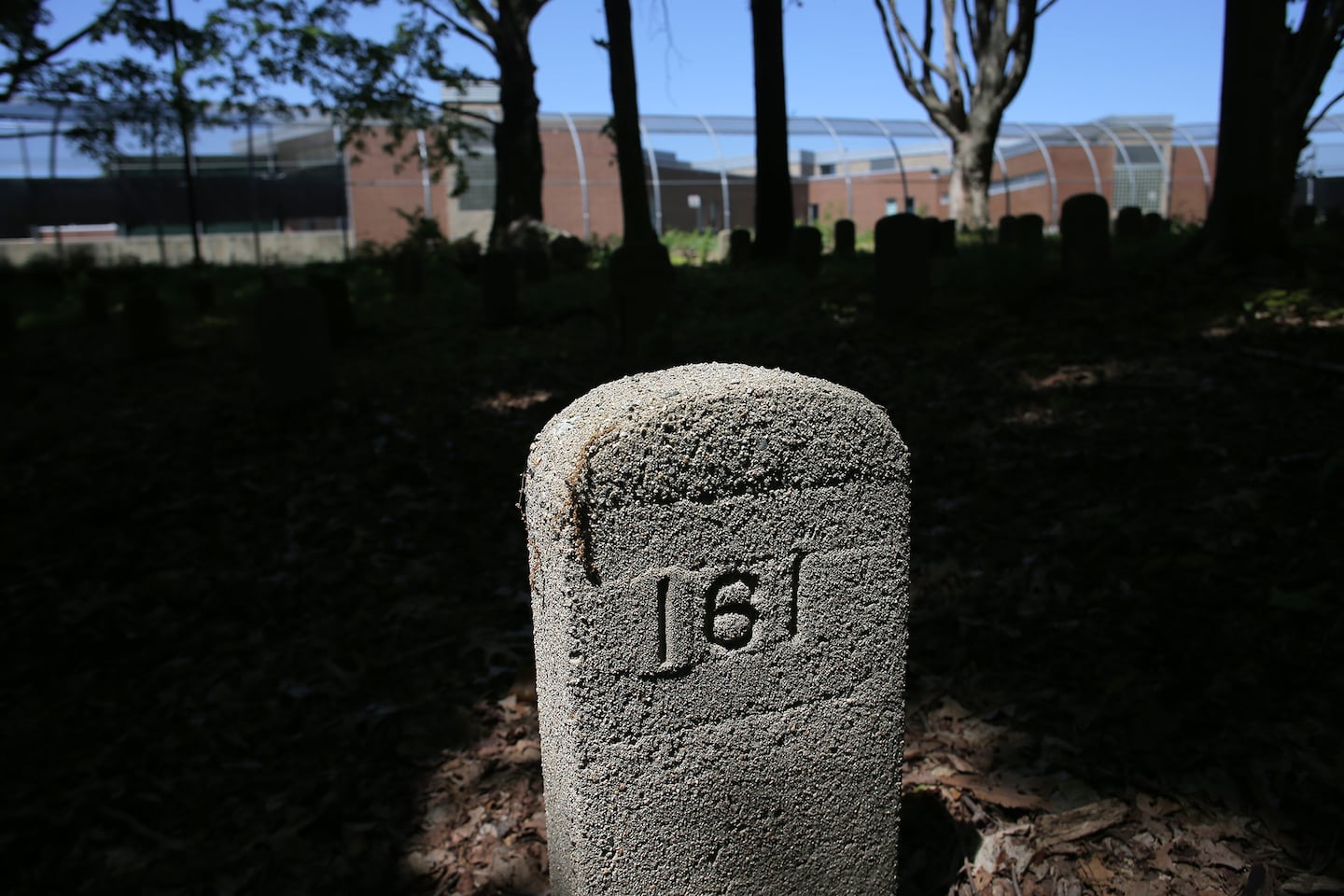
Photo: Lane Turner/Boston Globe.
A numbered grave just outside the Rhode Island Training School Thomas C. Slater Youth Development Center in Cranston, Rhode Island. Teens incarcerated at the facility helped bring the paupers’ graveyard to light, writing obituaries for the forgotten.

Recently, I read a Victorian novel (The Three Clerks, Anthony Trollope) in which the notorious Dickens villain Bill Sykes was favorably compared to a villain who was born with every opportunity to live an upright life. Trollope’s point was that for a pauper raised in poverty with no access to education or higher things it might be considered understandable that he went bad and died in ignominy.

I’m thinking about this in connection with today’s story about how paupers’ graves raised the consciousness of some youths in trouble with the law today.

Amanda Milkovits wrote at the Boston Globe, “Sometimes, as they played basketball outside at the Rhode Island Training School, the teens would glance through the security fence to the woods and brush that shrouded rows of small stones.

“ ‘What are they?’ A 16-year-old boy incarcerated at the Training School remembered asking one of the staff members.

“Graves, he was told. The plain, numbered concrete headstones marked the burial sites of 1,049 people who died a century ago.

“Some had been residents of the state asylum. Some were teenagers who lived at the former Sockanosset Boys Training School. Some had spent their last years in the state poorhouse. Some were stillborn infants who were never given names, factory workers who fell on hard times, immigrants who sought a better life, only to die far from home.

“What they all had in common was poverty and no one to claim their bodies. From around 1915 until 1933, the state gave them a simple burial in this place, known as the State Farm Cemetery Annex, or Cranston Historical Cemetery No. 107. Prisoners made the concrete headstones, which were engraved with numbers instead of the names of those buried 6 feet below.

“ ‘I thought it was just a regular grave site, but I’d never seen a grave with a number before,’ another boy told the Globe. … ‘It’s sad. No one should just be a number.’

“For decades, the cemetery has been a lonely, quiet place, cut off from public access because it’s bordered by the state’s maximum security prison, Route 37, and the Training School. …

“John Scott, a senior community development training specialist at the Training School, had been interested in the cemetery since he first caught a glimpse of it in the 1990s. The teens’ curiosity made him wonder whether those on probation or who needed to perform community service could help restore the cemetery, even if only by clearing some of the brush.

“But Theresa Moore, president of T-Time Productions, saw potential for more. Her company designs educational curriculums with the goal of shining light on untold or little-known stories, and was already working with the Training School on its educational programs for incarcerated youths. …

“ ‘I’ve always looked for projects to enhance their lives,’ Moore said, ‘so when John mentioned it, I thought, “Why don’t we make it happen?” ‘

She called the project: ‘They Were More Than A Number.’

“Moore reached out to the leaders of the Rhode Island and Cranston historical cemeteries commissions, who were delighted to share their knowledge — they’d wanted to restore that cemetery for years, but could never get access. She contacted Secretary of State Gregg Amore, who assisted with resources at the state archives, giving the teens access to records from the state infirmary that include doctors’ notes, reports from the state institutions … and burial records. …

“The students started their research. Records and documents from the state archives, the drone footage, and other resources were used to help them put the history into context. Some materials, such as a video of Lorén Spears, executive director of the Tomaquag Museum, explaining the ‘pencil genocide’ of Indigenous people, were scanned into a Google drive for about 50 students and their teachers. …

” ‘At first, I didn’t really care,’ admitted one 16-year-old boy, ‘but I wouldn’t like it if I was just a number.’ …

“A 16-year-old boy said he chose No. 500, and learned it was the grave of a man named John Holland, who died in 1915. When he wrote Holland’s obituary, ‘It made me feel bad that they didn’t have names,’ he said. …

“One day in late May, the teens and the adults involved with the cemetery project met in person along the security fence at the Training School. The view through the fence was clear now. Brush and saplings and debris had been hauled away, and there were two new signs, marking the site as a state and city historical cemetery. The cemetery was serene, shaded by the old silver maples.

“As the teens in their dark blue uniforms listened, accompanied by their teachers, Scott, Moore, and volunteers from the Cranston Historical Cemeteries Commission thanked them for their work and told them it had meaning.

“John Hill, chairman of the Cranston Historical Cemeteries Commission, had read some of the obituaries written by the students.

“ ‘You’re giving them their names back,’ Hill told them. ‘You are making them human beings again.’ …

“Scott knew why the teens incarcerated at the Training School could relate. ‘If anyone can understand what it means to be a number,’ he said, ‘it’s our students.’”

Read this long, beautiful article at the Globe, here.

Read Full Post »

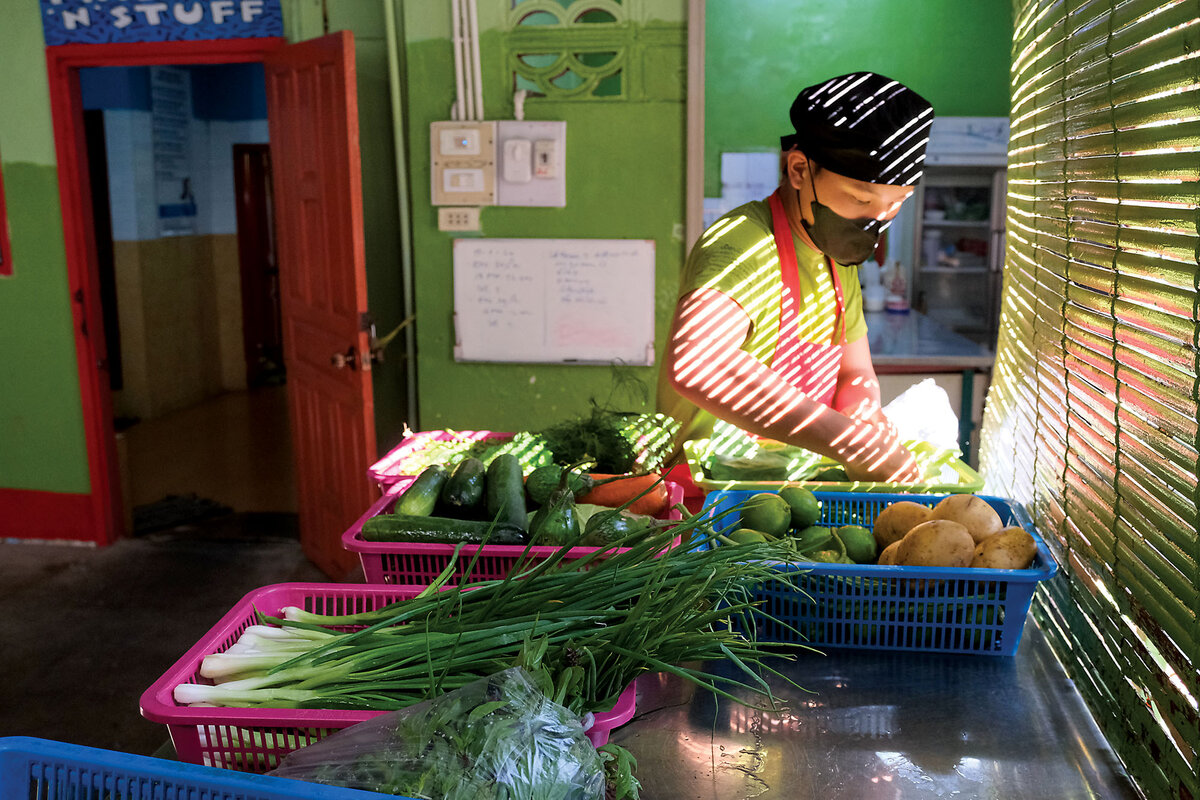
Photo: Zinara Rathnayake.
A student prepares vegetables before lunch begins at Mini-Makphet, a vocational restaurant in Vientiane, Laos.

I can’t read anything about Laos without thinking of the mystery series that Colin Cotterill wrote, which includes a plea for the poor of that country and for removing the explosive mines left by the US. Since today’s article is about training young restaurant workers in Laos, I’m particularly remembering the noodle shop in the mystery series, run by Daeng, the wife of investigator Dr. Siri Paiboun.

Zinara Rathnayake wrote the following story for the internationally focused Christian Science Monitor.

“Until about a year ago, Xue Xiong had never seen a town,” wrote Rathnayake. “She lived in a small village with a dirt road that turns muddy when it rains, making travel difficult. She dropped out of school early to help her parents farm rice and breed cattle to feed her 10-member family. 

“It was at Khaiphaen, a charming restaurant two hours away in Luang Prabang, that Ms. Xiong learned to dream. The Laotian fusion eatery trained her to prepare and serve food for the tourists who flock every day to the bustling city. 

“ ‘I want to save money and open my little Lao food stall, because tourists love Lao food,’ says Ms. Xiong, who is Hmong, one of Laos’ marginalized ethnic minorities. ‘Because I feel like I can do anything now.’

“Khaiphaen was opened by the Cambodia-based organization Friends-International and collaborates with the Lao government and other nonprofits to aid young people interested in culinary education as a path to more prosperous futures.

“Laos is one of Asia’s least-developed countries, and poor education and the lack of economic opportunities often force children and young people there to work in lower-paid, menial jobs under exploitative conditions. Many others are trafficked into factories or prostitution.

“At almost 10 a.m. on a chilly January morning, an hour before Khaiphaen opens for the day with plates of laab (spicy minced-meat salad) and beer-battered Mekong River fish, Ms. Xiong laughs as she watches her friend, another young woman, slice carrots. Ms. Xiong shows off her yellow T-shirt from Le Petit Prince, a nearby Korean cafe where she started working after Khaiphaen. She thinks the cafe’s owner is nice, her English is improving, and soon she will play the piano at the cafe, Ms. Xiong tells her friend.

“ ‘I see children tremble the first time they come to serve,’ says Khaiphaen’s restaurant manager, Anousin Phanthachith, ‘and then in a few years, you see them grow into entrepreneurs.’ He joined the team at Friends-International in 2014 when Khaiphaen was just a concept with a few dining tables, and he has never thought of leaving. ‘You feel fulfilled because you help many young people – especially children who come from remote, underprivileged communities, some of them with traumatic childhoods.’ 

“Nearly a third of Laos’ population lives in poverty, subsisting on less than $4 a day, according to 2022 figures from the World Bank. Children bear the brunt of it. Although Laos has made progress on child mortality, 43 out of every 1,000 children die before reaching age 5 – one of the highest child mortality rates in Southeast Asia (down from 154 in 1990). The government is pushing for primary education for all children, but the number of dropouts is high. 

“More than 130 students have graduated from Khaiphaen. Yet it is not a traditional cooking school, says Friends-International social worker Ae Thongkham. Besides waiting tables, students gain experience making noodle bowls with their teachers from scratch in the kitchen as well as preparing beverages. Mr. Thongkham adds that when students arrive from minority ethnic groups, many of them don’t speak Lao, the country’s official language. So at the social work center upstairs, students learn basic Lao and English, in addition to life skills such as managing their finances. 

“Students aren’t salaried but receive free training, accommodations, meals, transportation, and health care. After graduation, they are placed in hotels, cafes, and restaurants across Luang Prabang’s flourishing tourism industry.

“For Mr. Phanthachith, who left his village at age 18 and studied at a temple before working at the city’s restaurants, looking after his young students has always been the priority. ‘We always talk to our students even after they leave the program to make sure that they are in a safe workplace that benefits them and treats them well,’ he says.

“Khaiphaen is part of a series of vocational restaurants that Friends-International operates across Southeast Asia. Although some of the eateries shuttered during the coronavirus pandemic, Khaiphaen began delivering food to locals to stay afloat. In the capital, Vientiane, Khaiphaen’s sister restaurant Mini-Makphet turned into a soup kitchen, feeding underprivileged children and their mothers. Housed in a tin-roofed space with varnished wooden tables and chairs, Mini-Makphet is much more modest and mainly serves Vientiane residents.

“Ketsone Philaphandet, Friends-International’s country program director for Laos, is quick to highlight that Vientiane receives far fewer tourists compared with Luang Prabang. The quiet, industrial Lao capital serves only as a pit stop for many foreign travelers exploring the country’s far-flung karst mountain towns and vibrant cultural hubs. ‘So we keep our prices lower and food spicier,’ Ms. Philaphandet says, smiling.

“For many young people, Mini-Makphet is a social lifeline. Mala Thoj has worked at the restaurant for only two months but can already pour a latte with a little foam heart on top. ‘I feel happy here, because I have friends who support me,’ she says. She used to live with abusive relatives and was compelled to toil at a rubber estate. …

“Emi Weir, founder of the social enterprise Ma Té Sai, which sells handmade products crafted by Laotian women [notes] that although Khaiphaen lacks marketing to reach tourists who are ‘ready to spend more for a good cause,’ its program has excellent social work, training, and outreach initiatives.”

More at the Monitor, here. No firewall. You can learn a lot more about our world from the Monitor or The World, on radio, than you can from the Washington Post or the New York Times. Check them out.

Read Full Post »

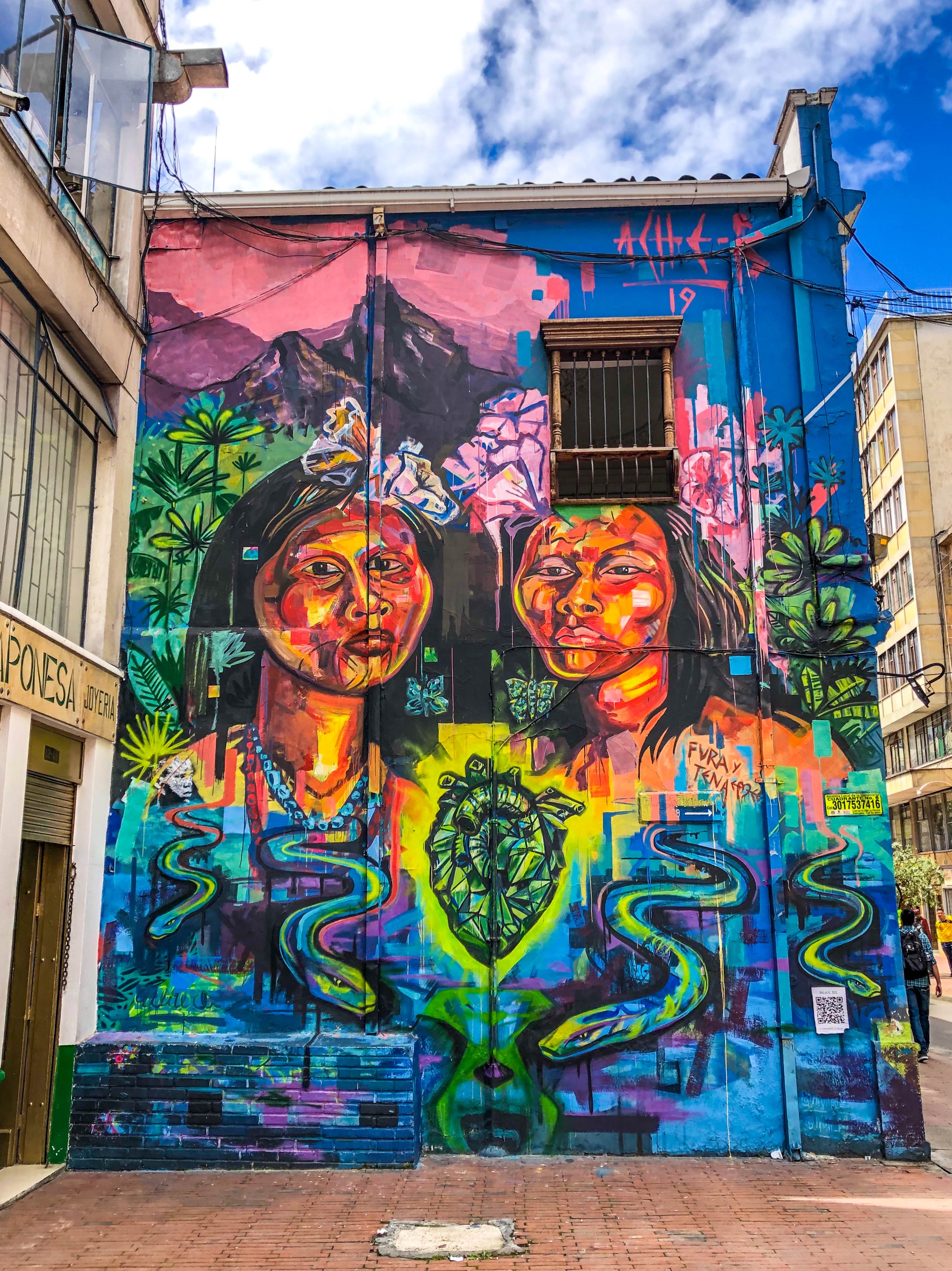
Photo: Jorge Gardner via Unsplash.
Street art in Bogotá, Columbia.

We who have so much reason to be thankful at Thanksgiving can spare a thought today for those who have little — and are grateful for that little. An experiment in Bogotá is offering hope to some of the poorest women in Columbia.

In an opinion piece at the Washington Post, Bina Venkataraman writes, “One day in the distant future, caregiving could be as celebrated as carrying a football into an end zone. Rather than toil in the shadows, people who juggle children and aging parents might be applauded for their skills — or stopped on the street by admirers. Family caregivers could get paid for the hours they put in minding the young, the sick, the disabled and the old. Men would be as proud as women to care for their children. Governments would fund more services to relieve at-home caregiving, recognizing its physical and psychological toll. …

“For now, consider a small experiment hatched in Ciudad Bolívar, the second-poorest district of Colombia’s capital city, where settlements of makeshift houses sprawl up a steep mountainside, emblazoned with colorful street murals. This district has long been a hotbed of political resistance, home to diverse Indigenous peoples as well as Venezuelan refugees. …

“Since 2020, it has become the site of Bogotá’s first manzana delcuidado, or ‘care block,’ in a city where caregivers — mostly women, mostly poor — ordinarily labor in obscurity without compensation or formal recognition. More than 30 percent of Bogotá’s female population, some 1.2 million women, provide unpaid care full time, some for as much as 10 hours a day.

“Most lack formal education beyond some years of high school, and the city estimates that 1 of every 5 of these women has a diagnosed illness, ranging from arthritis from long hours spent hand-washing clothes to sexually transmitted diseases and untreated cancers. And many of them, says Nathalia Poveda, who manages the Manitas care block in Ciudad Bolívar, don’t recognize that when their husbands hit them, it is domestic abuse.

“A care block is a modest attempt to shift the way caregivers are viewed and supported, and the way they view themselves. It’s a community-scale solution — something that’s needed if poor women are to benefit from global progress in gender equality.

“In Ciudad Bolívar, women can drop off dirty clothes and bedding each week to a city-funded laundromat. Demand is so high in the district, and given only four washing machines and dryers, the women have to rotate out of using the program every three months.

“A community center offers free courses to help women earn high school diplomas and practice yoga while city employees mind the children, elderly or people with disabilities in their care. Caregivers and their spouses can learn to use a computer or cellphone and get STD testing, psychological counseling and legal aid — all under one roof. In the same building, a child can get a strep test and his mom can get a Pap smear, rather than having to shuffle to clinics around the city.

‘It gives me a breath, a break,’ said Lisbeth Diaz.

“This isn’t rocket science, but it is innovation. ‘We need to care for the people who care for us,’ says Diana Rodríguez Franco, Bogotá’s secretary for women’s affairs, who came up with the idea. The city now has 20 care blocks, as well as a program to send relief caregivers directly to people’s homes. The city funds the program with an annual budget of $800,000, and it has attracted grants from global organizations for pilot projects such as caregiving classes for men.

“I spoke with several women using services at various care blocks in the city. ‘It gives me a breath, a break,’ said Lisbeth Diaz, who was taking a class that would certify her skills as a caregiver at the Manitas care block in Ciudad Bolívar. The idea behind certification, said Poveda, is to help women recognize that the work they do in the home is valuable.

“ ‘You have to take care of yourself to take care of everyone else,’ said Sandra Quevedo, who was glad to learn yoga, lifting her chin and chest with pride as she spoke. At a care block within a high-altitude ecological park called Entrenubes, a group of middle-aged women in a program called Las Mujeres Que Reverdecen — ‘the women who regreen’ — giggled and flexed their muscles when I asked what it was like to get paid to learn to plant trees and care for city parks part time. …

“The manzanas are one of several initiatives that Bogotá’s first female and openly gay mayor, Claudia López, has launched to try to shift the balance of power between men and women. … The López government also brought in an all-electric fleet of city buses, called La Rolita, and has been hiring and training women to drive and maintain them.

“ ‘There’s been huge pushback,’ says Rodríguez Franco, noting that the city was sued in 2021 by a man who objected to the care blocks’ focus on women. (La Rolita also inspired a lawsuit.) But Rodríguez Franco is heartened to see some men now coming to the care blocks with their female partners to finish high school or to learn to use computers. …

“International development experts have long argued that, along with fostering social progress, educating girls and women and putting more income in their hands can break cycles of intergenerational poverty and moderate population growth. Helping caregivers finish school and find jobs has been an often overlooked but critical piece of this puzzle.

“In recent decades, Colombia has made strides toward recognizing the rights of women — especially caregivers. In 2010, it became the first country to require that women’s contributions to the care economy be documented. …

“Much change is needed to lift the burden on caregivers worldwide and to give women greater access to education and jobs. As political leaders in rich nations debate policies that can put more women into the halls of power, Bogotá’s efforts are a reminder that the world’s poorest caregivers also need innovative measures — if we are one day to inhabit a world in which the average woman’s economic and political power is equal to that of the average man.”

More at the Post, here.

Read Full Post »

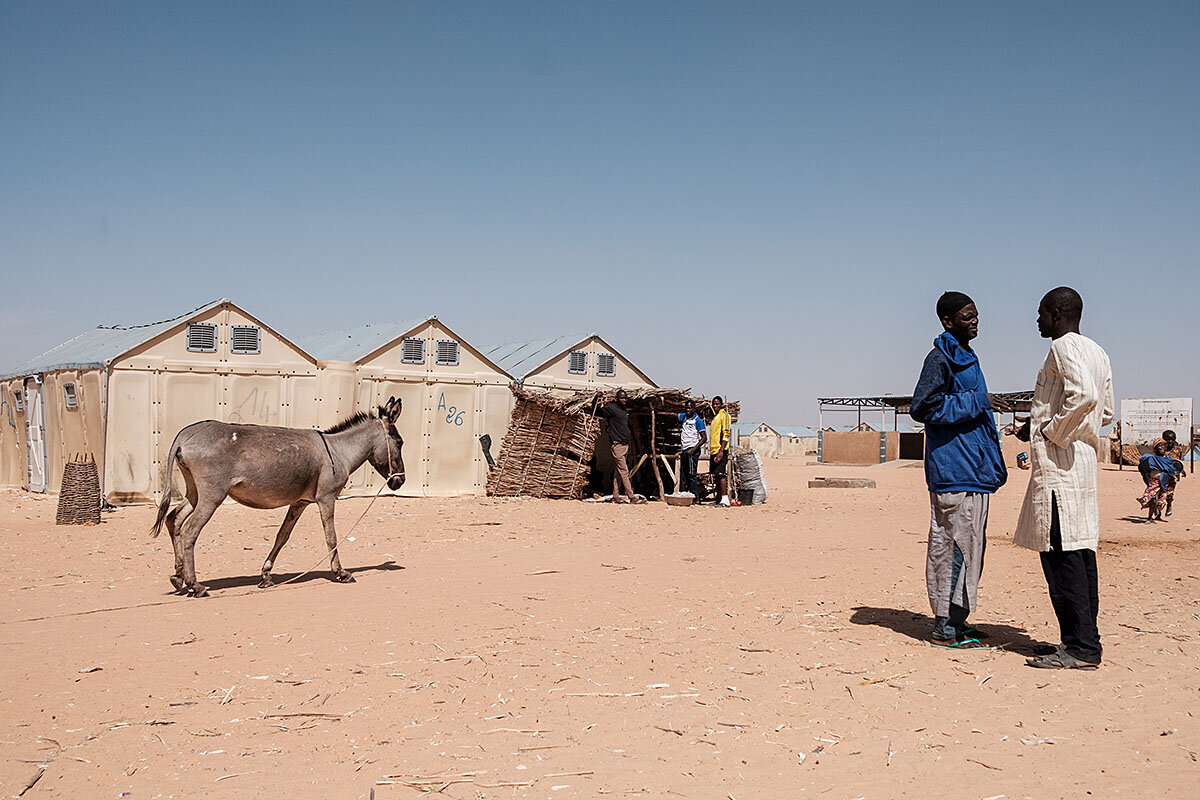
Photo: Guy Peterson/Special to the Christian Science Monitor.
In Niger, the poorest of the poor are protecting refugees on the run.

When I was chatting with blogger Will McMillan after one of his recent concerts, he said he noticed that at my blog, I seemed to seek out stories to cheer people up. I said, “To cheer me up, too.”

A great source for such stories is the internationally focused Christian Science Monitor (CSM). The news site is not unrealistic about the world’s challenges, but it looks for the good people and positive developments it knows are out there.

Here’s a CSM story by Nick Roll set in an impoverished part of Africa.

“Yacouba Aboubacar has an unusual way to measure the welcome he received as a refugee in Niger. 

“His razor blade.

“It takes a certain amount of trust, after all, to let a stranger cut your hair – and a good deal more to allow him to circumcise your baby. But since Mr. Aboubacar fled here from neighboring Nigeria in December, he has found his services as a barber and circumciser constantly in demand.

“Some of that work comes from other refugees, with whom he lives in a sea of white tents huddled on the edge of this small village. But much of it comes from the locals who inhabit the mud-brick houses in town. …

“Mr. Aboubacar is one of some 200,000 Nigerians who have fled rising violence in recent years to seek refuge in neighboring Niger. Chadakori’s population has doubled to 16,000 since 2020 – a refugee intake on a scale almost unimaginable in the West. Yet the response from Chadakori and other villages like it has largely not been one of resentment or rejection. Instead, in one of the world’s poorest countries – beset by its own problems with violent extremism – locals have made visitors feel welcome, even when there is little to share. 

‘Your guest is your god,’ says Laouan Magagi, Niger’s minister of humanitarian action and catastrophe management, reciting a popular local proverb.

“Mr. Magagi, whose grandfather was an immigrant from Nigeria, responds with a firm ‘non‘ when asked if Niger would ever impose a cap on the number of refugees it receives. Despite conflicts in some areas of neighboring Nigeria and Mali stretching back more than a decade, ‘Niger is an open country,’ he says. ‘Niger stands for humanity.’

“Niger and Nigeria have long been deeply interlinked. They share a 1,000-mile border – much of it porous. Trade, languages, and culture straddle this colonial-era divide. Still, Niger is not an obvious place to host refugees, no matter how much they share in common with locals. 

“At $590, Niger’s GDP per capita ranks the 10th lowest in the world. On the United Nations Human Development Index, Niger has long jostled for last place, and now it sits only above Chad and South Sudan. Meanwhile, climate change has made farming in the semiarid country even more unpredictable, and some 3 million people are expected to face hunger in the next six months, according to the nonprofit Save the Children.

“But in welcoming refugees, Niger is not an outlier. About 86% of the world’s refugees live in low- and middle-income countries, and nearly 70% are in a country that neighbors the one they fled from.

“ ‘A lot of people disagreed’ at first, saying ‘we should not accept them,’ says Achirour Arzika, Chadakori’s traditional chief, recalling the day three years ago when a government delegation came to ask the residents if refugees could be resettled here. But he held firm, and others soon warmed to the idea. ‘It could happen to us also,’ he says. ‘So we agreed, and we gave a place where we could host them.’ 

“Besides, he adds matter-of-factly, ‘this is … international law,’ referencing Niger’s adherence to the 1951 United Nations Refugee Convention.

“Conflict between armed groups and the military have also displaced more than 350,000 Nigerians. … In northwest Nigeria, where Mr. Aboubacar is from, criminal groups stage regular armed robberies and kidnappings. It’s a campaign of terror born of poverty, joblessness, poor governance, and fights over the region’s dwindling land. 

“One evening last December, he was sitting outside with friends drinking tea in his village in Sokoto state, near Nigeria’s northern border. … After the attack, Mr. Aboubacar and the rest of his village fled north, over the border. He soon found himself in Chadakori, where ‘we were really received well,’ he says. 

“Integration isn’t always so smooth. Different official languages – French in Niger, English in Nigeria – are used in government as well as education. Refugee students must now make the switch to French, and government forms need translation.

“ ‘It’s a very welcoming country. … It’s just that the resources are very limited,’ says Ilaria Manunza, Niger country director for Save the Children, which runs child protection and other youth services in the country’s refugee camps. And the population of refugees, she notes, is constantly in flux. ‘They tend to go back when the situation is a little bit calmer, and they flee [again] when attacks increase.’ …

“Four years ago, Anas Habibou led a group of about 350 Nigerian refugees trekking through Niger, seeking somewhere to settle. Some villages offered help, but ‘many villages refused,’ says Mr. Habibou. Today, he is the traditional chief for 5,500 Nigerian refugees who have settled next to the town of Dan Daji Makaou, 22 miles away from Chadakori, where they outnumber the local population by a factor of four or five. ‘We are safe here,’ he says. ‘Even before NGOs brought anything, the head of the village and his people contributed personally.’

“Yacouba Saidou, a prominent Dan Dadji Makaou elder, says that other village leaders in the region warned him that trouble stalked refugees. They told him that the violence that caused Nigerians to flee could strike next on their doorstep. But his town’s experience, he says, has been the opposite. Refugees have been a boon to the local economy, working as farm laborers and brick makers, and spending their earnings in local markets. ‘It has turned into something beneficial to us,’ he says.”

More at the Monitor, here. No firewall.

Read Full Post »

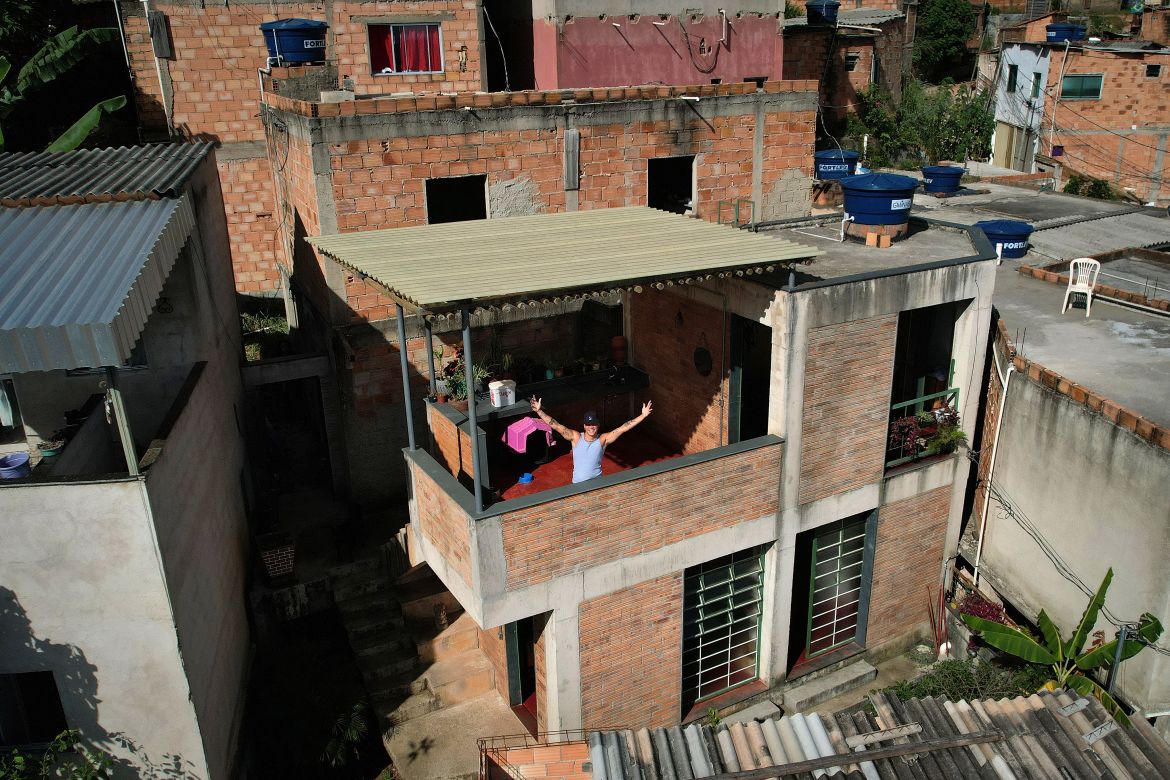
Photo: Douglas Magno/AFP.
An aerial view shows Kdu dos Anjos’s house in Aglomerado da Serra, a favela complex on the outskirts of Belo Horizonte, Minas Gerais State, Brazil. The home, in an area of deep poverty, has won an architecture award.

I have mixed reactions to today’s story about upgrading a home in a Brazilian favela, or slum. On the one hand, the results are joyful. On the other hand, couldn’t our world also try to eliminate slums and poverty? (Read about a poverty-abolition movement in Matthew Desmond’s Poverty, by America.)

Al Jazeera reports on the award-winning favela home, “At first glance, it is a house like dozens of others in the crowded favelas of Brazil. But this seemingly modest dwelling of 66 square metres (710 square feet), with its exposed brick walls, has just been recognized as the ‘house of the year’ in an international architecture competition.

“The house honored by specialized website ArchDaily belongs to Kdu dos Anjos, a 32-year-old artist living in the bustling Aglomerado da Serra favela at the bottom of a hill on the edge of the southeastern city of Belo Horizonte.

“The two-story structure defeated some more imposing contest entries from India, Mexico, Vietnam and Germany.

‘I’m very proud that my house won this prize, because most of the news about the favelas talks of violence and homes destroyed by landslides,’ said dos Anjos. ‘Today, my home is on top of the world!’

“The house, built on a small lot dos Anjos purchased in 2017, is well ventilated and enjoys abundant natural light; it features horizontal casement windows and a large terrace.

“ ‘The design of the house represents a constructive model that uses common materials in the slums, with an adequate implementation and attention to lighting and ventilation, resulting in a space with great environmental quality,’ ArchDaily wrote on its website.

“For dos Anjos, who founded a cultural centre in his community, the prize carries special significance. ‘I know my house isn’t the most chic in the world, but it’s a well-built shack,’ he says with a grin. … ‘What the architects did is pure magic,’ he added. ‘We barely have [710 square feet], but I’ve had parties here with close to 200 people.’

“The design was the work of the Levante architecture collective, which does pro bono or low-cost work in the favelas. From the outside, the house resembles its neighbors, but it incorporates several features that make it both sturdier and more respectful of the environment, particularly in its ‘attention to lighting and ventilation,’ said architect Fernando Maculan, the project leader.

“One apparent difference with nearby houses is in the arrangement of the bricks, laid horizontally — not vertically — and in staggered rows, which adds solidity and improves insulation. …

“ ‘The masons were angry because they thought laying bricks this way was very time-consuming,’ Maculan said. ‘And we had a lot of trouble getting the materials up the stairs — it’s the last house on the alley, and I had to pay the workers who carried it a lot,’ he said. …

“The entire job cost 150,000 Brazilian reais ($29,000), and the investment paid off in more ways than one: Not only did the architecture prize bring international recognition, the house has helped dos Anjos realize a childhood dream.

“ ‘When I was a boy, I lived in a very modest, poorly insulated room. I even got stung by a scorpion — my sister did too,’ he said. ‘Winning this prize after having suffered from architecture-related problems represents a great victory for me.’ ”

More at Al Jazeera, here. There’s a wonderful array of pictures and no firewall.

Read Full Post »

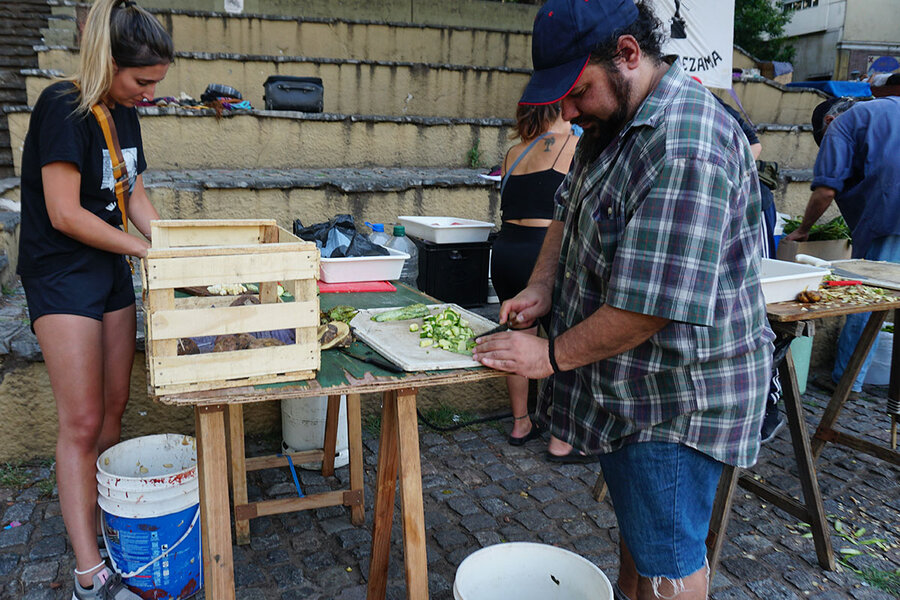
Photo: Natalie Alcoba.
Gerardo Romero and Flor Yciz donate the gift of time to the nonprofit Parque Lezama Olla Popular, preparing
a meal they serve each week to those in need in Buenos Aires, Feb. 6, 2023.

One thing that struck my husband when he returned from over a year of working in China was that Americans do a lot of volunteering. His perception of China at that time was that the government did everything and that citizens didn’t often take it on themselves to help others less fortunate.

Christian Science Monitor reporter Erika Page notes that Argentinians, too, aren’t known for helping strangers, but that young people are leading the way in tough inflationary times.

“Every Tuesday evening,” she writes, “as streetlights flicker on in downtown Buenos Aires, a man named Charlie tidies a section of sidewalk, preparing for his visitors.

“Charlie lives on the street. The volunteers who regularly check in on him as part of their recorrida nocturna, or night route, are an emotional lifeline.

“The team of six sit with Charlie in a semi-circle on the pavement, offering juice, yerba mate, and conversation. They chat about the weather, current events, the neighbors, and when the laughter lulls, they ask Charlie about more immediate concerns, like his health, upcoming medical appointments, and how the police have been treating him.

“There are thousands of people like Charlie living on the streets across the capital, and 43% of the country’s population lives in poverty. It’s a reflection of the unrelenting economic crisis and sky-high inflation that’s enveloping this South American nation. Some 600 volunteers take part in these nightly visits organized by the nonprofit Fundación Sí, underscoring a growing movement of volunteers, fueled by young people, who are working to fill the void where government services and the labor market are falling short. 

“These volunteers may not be well off – or even interested in staying in Argentina long-term – but they offer whatever they can to lift their neighbors up: a hand, an ear, a meal, or simply some of their time. Argentina isn’t known for high rates of volunteerism, but recent data shows that’s changing.

A study published by Voices! Consultancy found that a record 36% of Argentines volunteered last year, including nearly 60% of people between 18 and 24 years old.

“Generosity of time and affection is generally reserved for family and close friends in Argentina, says Constanza Cilley, executive director of Voices! Consultancy. But, ‘there are significant increases [in volunteering] in times of greatest crisis,’ she says. …

“Last year, annual inflation reached 94.8%, sending food prices soaring, and making saving nearly impossible. Most young people no longer expect a higher standard of living than their parents in a country whose social mobility was once a point of national pride. That can cause internal conflict for those who want to do good here. …

“Emilia Maguire, a therapist, has considered emigrating for years, tired of the poverty she can no longer ignore – and which she sees as a reflection of distorted political and economic priorities. She recently joined Fundación Sí’s night routes.

“ ‘Sometimes I get home tired and distressed,’ says Ms. Maguire. ‘But when you connect with things like this that are gratifying, it’s easier to get by, because your focus shifts.’ …

“The Voices! study found a correlation between volunteering and general satisfaction. Some 23% of respondents who said they volunteered last year indicated Argentina as the best place for them to live, compared to only 14% of non-volunteers.

“The group got their start in 2018 with close to nothing, as the value of the Argentine peso began to plummet once again. They’ve since acquired a gas stove and donations from businesses and farmer’s collectives. They invite those who come to eat to help cook as part of the team. …

“ ‘The crisis itself pushes people together, uniting in empathy,’ says Carmela Pavesi, an organizer in her mid-20s. ‘You don’t need a lot of money or a lot of things,’ she says. ‘With the people you have nearby, wherever you are, you can do something with what you have.’ …

“ ‘Today there are more people living on the streets, more people in need, more people begging for money or help,’ says Eduardo Donza, a researcher with the Social Debt Observatory at the Universidad Católica de Argentina.

“The country’s poverty is structural and historic, says Mr. Donza, in large part due to a precarious labor market. Only 35% of the population works in the formal private sector, another 15% in the public sector, leaving half the population doing informal work. …

“ ‘If we don’t generate more wealth, if we can’t create more good jobs, we’re never going to come out of this,’ he says. Volunteering can’t solve these wider issues on its own. ‘But it seems to me like solidarity has increased. That willingness to help matters.’ “

More at the Monitor, here. No firewall.

Read Full Post »

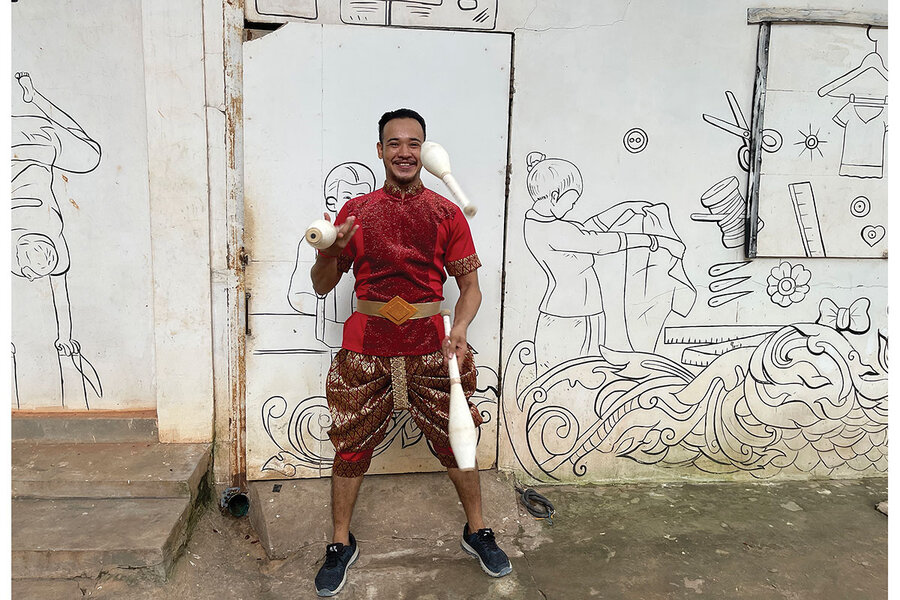
Photo: Charukesi Ramadurai.
A juggler welcomes visitors as they start arriving for the evening show at Phare Circus. Like other performers, he is a student of the Phare Ponleu Selpak school in Battambang, Cambodia.

I don’t belong to the religion, but I’ve always liked Christian Science Monitor articles, and now I know why. The other day, one of the editors wrote that finding positive angles on painful realities is intentional.

The story today acknowledges the horror of the Khmer Rouge genocide and its impoverished aftermath but focuses on one of the ways people are healing.

Charukesi Ramadurai writes, “A short drive away from the famed Angkor Wat temple ruins in Siem Reap, Cambodia, another spectacle has been quietly attracting visitors for years. Every evening, under the big top at the Phare Circus, audiences watch mesmerized as acrobats and artists jump and somersault, dance and paint, execute midair flips and twist into pretzels. …

“Watching them smile under the spotlight, it is difficult to imagine that these confident young men and women come from impoverished or troubled families. Celebrating its 10th anniversary on Feb. 8, Phare Circus simultaneously provides young Cambodians with a livelihood and showcases the talents of students at Phare Ponleu Selpak, a not-for-profit arts school located in Battambang, Cambodia.

“Phare Ponleu Selpak – meaning ‘The Brightness of the Arts’ – was set up in 1994 by French art teacher Véronique Decrop, who practiced art therapy at refugee camps, and a small group of refugees who returned home from Thailand after the brutal Khmer Rouge regime ended in 1979. Apart from giving children a safe space away from crowded homes and dangerous streets, the school aims to revive arts that were decimated during the Cambodian genocide. …

“ ‘The Khmer Rouge left us with zero – 1,000 years of history of the Cambodian empire reduced to ash. More than 90% of the masters were killed or just disappeared,’ says musician and genocide survivor Arn Chorn-Pond, who founded Cambodian Living Arts, an organization that provides arts education scholarships.

“Preserving the arts ‘gives young Cambodians something to hold on to from their past,’ he says. ‘It also gives them an identity; it gives them confidence; it gives them the voice to tell their own stories to the world.’

“Tor Vutha, one of the co-founders, says the school was their way of paying it forward, or as he puts it, ‘transfer the knowledge from our heart to the community.’ He says that the organization started small and evolved along with the needs of locals. 

“ ‘Many children were suffering from war trauma and needed help,’ he recalls. ‘We had received art in the refugee camp and embodied its benefits, so we wanted to share the same with the children and youth to help them overcome their traumas and help the community rebuild.’ …

“Today, the school offers training in graphic design, animation, music, and other arts, and students are free to explore their interests. It takes in more than 1,000 children annually, many of whom have gone on to perform at Phare Circus.  …

“[Craig Dodge, director of sales and marketing at Phare Circus], who has been with Phare Circus from the beginning, remembers it starting back in 2013 with an ‘outdoor stage, plastic chairs, rain.’ It has since come a long way.

“In addition to the main circus tent, the Phare campus in Siem Reap hosts local musicians, food stalls, and a small crafts shop. Families are welcomed at the main gate by jugglers and acrobats, who give them a taste of what awaits inside. Phare Circus has produced 23 different shows over the past decade, with more than 5,000 performances in front of over a million spectators, including foreign tours in countries such as the United States, Australia, Japan, France, Italy, and Singapore.

“All shows are strongly rooted in Cambodian culture, from dances depicting rural life, to a juggling act that pokes fun at tourists, to acrobatic routines inspired by Cambodian mythology and folklore. …

“Wendell Johnson, an American retiree in Siem Reap, has been a regular visitor to Phare Circus since its first year of production. He says what keeps him coming back are ‘the smiles, the incredible athletic abilities, and the storylines’ that vividly connect Cambodia’s past to the present. He also praises the artists’ grit and determination, noting that he’s seen performers immediately redo failed stunts and succeed. 

“The Phare Circus performers train for several years at the school, building both their skills and self-esteem, before they’re eligible to work at the circus. Almost all come from large families with limited resources, and being at school keeps them away from hunger, drugs, abuse, and trafficking. The circus is also an opportunity to travel the world, and pays well. 

“The steady work has been particularly transformative for the handful of female performers, whom young girls back in Battambang look up to as inspirations. 

“Srey Chanrachana started training at Phare Ponleu Selpak in 2007 at the age of 11. Back then, her family of five depended on the irregular income of her taxi driver father.

“ ‘We used to live in a very small house where we would all sleep together, and our roof would always leak whenever there was rain,’ she recalls. Now they live in a larger, more comfortable home. 

“With her earnings, she has also enrolled in English and computer classes to further her education, and she says working at the circus has made her more confident.”

More at the Monitor, here. No firewall.

Read Full Post »

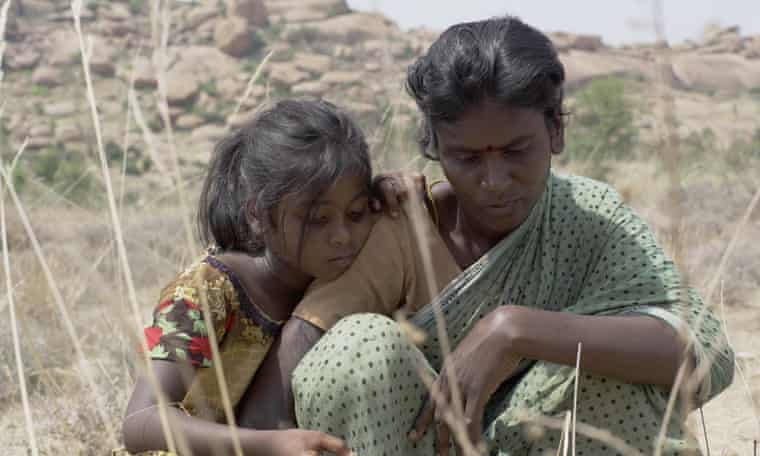
Photo: Pebbles.
India’s entry for the Oscars,
Pebbles, focuses on the inequalities that life inflicts on women in Tamil Nadu.

This year’s Oscars are scheduled March 27, and although I haven’t stayed up to watch the whole awards ceremony for years, I like reading about the winners later. I especially like getting ideas for foreign films my husband and I might eventually be able to order from our retro Netflix DVD service.

Hannah Ellis-Petersen, South Asia correspondent for the Guardian, describes one film that looks promising. The story of grinding poverty might be too painful for some potential viewers if they didn’t know that the director himself had lived that life and risen to be a filmmaker.

“As a child laborer working in the flower markets of Madurai, there was nothing more exciting for PS Vinothraj than when the film crews would descend. He would put down his sacks of petals and look up in awe at the camera operators who sat atop cranes to get dramatic sweeping shots. It was, to his nine-year-old mind, intoxicating. ‘I knew that’s what I wanted to do with my life,’ he said. …

“The odds were stacked heavily against him. Vinothraj was born into a poverty-stricken family of daily wage laborers in Tamil Nadu. He left school, aged nine, to support his family after his father died and by 14 was working in the sweatshops of Tiruppur.

“This month, his debut film Pebbles [Koozhangal] a Tamil-language movie made on a shoestring budget and set in the arid landscape where he grew up, was unanimously selected as India’s entry to the Oscars. In February this year, it had won the Tiger award for best film at the 50th International Film Festival Rotterdam. In a New Yorker review, Vinothraj was described as an ‘extraordinary observational filmmaker’ whose film presents ‘a gendered vision of rage.’

Pebbles is, as Vinothraj describes it, a ‘snapshot of a life.’ It depicts the journey of an abusive, alcoholic father and his son as they walk back home through the barren, overwhelmingly hot landscape of rural Tamil Nadu, after the father has dragged the boy out of school and taken him to a village where he wants to force his estranged wife to return home.

“It was inspired by true events; as Vinothraj says, ‘the story chose me.’ When his sister married a man from a neighboring village, the family were unable to provide a dowry. In a humiliating march, his sister was sent back to the family home by her new husband through the parched landscape. It was this walk of shame, that so many women are still forced to endure, that Vinothraj wanted to capture.

“ ‘But I wanted to make it so it was the husband who had to make the walk, not the woman,’ he said. ‘It was my small way of taking revenge for this humiliation of my sister.’

He also chose to portray the journey through the eye of a child, the son, to inject ‘hope and humanity’ into their journey.

“The film focuses on the small but devastating tragedies and inequalities that life in rural Tamil Nadu inflicts on women. … Women forced to get off buses in blazing heat when their babies, awoken by men aggressively coming to blows, need to be breast fed. Women forced to patiently scoop water from the ground and into jars as the merciless sun beats down.

“Tamil Nadu’s oppressive environment is omnipresent in Pebbles. ‘The landscape is the third main character in the film,’ Vinothraj said. ‘I wanted to explore it in detail, the role it plays in the plight of the people.’ For authenticity, he filmed during the hottest days of the year in May. Temperatures got so high during the 27-day shoot that cameras began to malfunction.

“Vinothraj’s determination to make films never wavered. While working in garment factories at 14, he enrolled into college between 6am and 10am before back-to-back shifts, realizing he would need education to go into cinema.

“Small things would bring glimmers of joy. In Pebbles a girl, whose family are depicted in such abject poverty that they hunt for rats to eat, is pictured momentarily euphoric as she collects helicopter seeds in her dress and then scatters them into the air. ‘This was how I used to feel when I was a child,’ said Vinothraj. ‘The conditions of my life were bad, but I could still find moments to be happy. I did not feel like I was suffering because I did not know anything else.’

“At 19, after his bosses tried to marry him off – a tactic used to keep child laborers working in factories once they grow up – he decided it was time to leave. He had heard that Chennai, the bustling main metropolis of Tamil Nadu, was where films were made and movie people mingled.

“ ‘I had no idea how I would survive; my only thought was that I had to pursue my passion for cinema,’ he said. On arriving in Chennai he slept in the streets until he convinced a DVD shop to hire him.

“ ‘In the DVD shop, I used to watch three films a day,’ he said. “English films, Korean films, Japanese films, Latin American films.’ … The DVD shop also gave Vinothraj access to film directors, who would borrow or buy films, often on his recommendation. After almost three years, he was hired as an assistant on a short film and began to work his way up. …

“The success of the film has left Vinothraj in a state of disbelief. He thought its only audience would be the villagers whose lives inspired the story.” More at the Guardian, here.

Click here to see 10 other foreign films submitted for this year. Several look like my cup of tea, maybe yours, too.

Read Full Post »

Photo: TBC via Flipboard.
Phyllis Ali and her grandson are both involved in a retired Baltimore cop’s inspiring youth initiative.

In Baltimore, a former cop saw that, for poor children, a lack of options can create desperation. So she created a foundation to help kids envision a world of possibility — and to give them the tools to make dreams come true.

Theresa Vargas writes at the Washington Post, “During a drive earlier this week, Phyllis Ali asked the children in the car with her what they wanted to be when they grew up.

” ‘An astronaut,’ said one.

“ ‘A schoolteacher,’ said another.

“A boy replied that he hoped to be the owner of ‘a nice house.’

“ ‘I’m just glad they want to be something,’ Ali said, reflecting on that drive. ‘I’m just glad that none of them said, “I don’t know.” ‘ …

“The 68-year-old Baltimore native has spent much of her adult life working with the city’s children, and she has seen how people too often write off those who live on blocks with boarded-up buildings. She has also seen what is lost when they do.

“ ‘We can’t cast them away because of their environment,’ she said. ‘Don’t take their hope away. They are somebody. Just because they are here doesn’t mean they don’t have talents and hopes and futures. They are somebody.’

” ‘In the car with Ali that day were her 12-year-old grandson, whom she calls Scooter, and his younger siblings, ages 6, 7 and 8. They were headed to the Baltimore offices of the advertising agency TBC to join other children in the filming of a commercial.

“For hours on Monday, those children would wait for their names to be called, and then step under bright lights, look into a camera and offer an answer to that same question Ali had asked. …

“The children are participants in a program that is based in a Baltimore neighborhood where many families live below the poverty line. It’s also a place that people across the nation saw burn six years ago after a CVS was looted and torched during the uprising that followed Freddie Gray’s police-custody death.

“Debbie Ramsey, a former Baltimore police detective and the founder of the nonprofit Unified Efforts, said that about a week before that fire, she and others — with the blessing of community leaders — had picked the Penn-North neighborhood as the site for a program that would aim to help children thrive.

“ ‘When the uprising began, that did not scare us away,’ Ramsey told [me]. ‘I said, “Okay, that’s a confirmation. This is where we have to be.” ‘

“In the six years that have followed, Unified Efforts has worked in the neighborhood with more than 120 young people between the ages of 5 and 24. Initially, the organization planned to stop working with teenagers once they graduated high school, but the staff continued to hear from participants even after they got their diplomas. A college student in New York recently reached out to say that if she had a bike she could get to her classes more easily. The staff helped her get one. …

“It takes only spending a day in some of the city’s most impoverished neighborhoods to see that the organization is up against a mix of painful and complex challenges. In the year that followed Gray’s death, I spent months profiling a teenager who attended a Baltimore high school that was located next to a public-housing project. …

“The teenager I wrote about had spent three weeks alone in his home without hot water, a working stove or lights, after his mother was hospitalized. His school records showed he had struggled, ending one year with a 1.64 GPA, but I also witnessed him be the only student in his class to complete an assignment. It called for him to write a poem using a simile or metaphor.

‘The sun is the smile behind the night,’ his began.

“That tug-of-war between struggle and potential is something Ramsey knows well. She saw it as a police officer and she sees it now as the executive director of Unified Efforts. [The program] aims to ‘reduce summer and vital learning loss’ … offering children a safe haven to learn and exposing them to experiences they might not have otherwise. …

“Participants not only spent days learning from a violinist; they were handed their own violins to take home. They not only spent a summer with staff who made sure they were fed (and given clean clothes if they showed up in ones that were soiled in a way that would draw insults from their peers); they were given laptops to continue working at home. High school students are sent every year to a college prep writing workshop and given the chance to work with professionals to produce a magazine filled with their stories.

“ ‘I have something I call “the crayon model” and that is what really forms our foundation,’ Ramsey said. ‘When our kids are at a table and creating, we put no less than 300 crayons on the table. We do that to show what abundance looks like.’ “

More at the Post, here.

Read Full Post »

Older Posts »