Feeds:
Posts
Comments

Posts Tagged ‘public art’

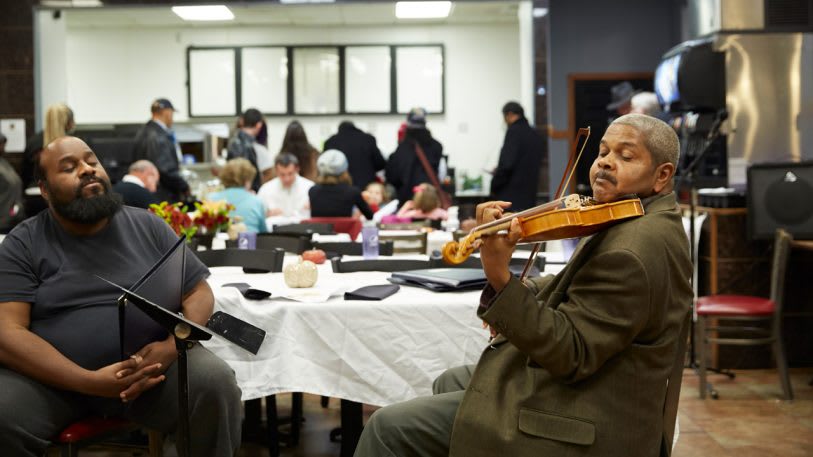
Photo: Elliott Jerome Brown Jr. for the New York Times.
Recently, the New York City subway system featured an audio-based public art project by Chloë Bass. Composer Jeremy Toussaint-Baptiste created the distinctive sound that starts each announcement. His shirt says, “If you see something, free something.”

In September and October, the New York City subway system, the MTA, had some fun with an art installation that involved the public address system. If you’ve ever traveled underground in New York, you know that there is art everywhere, some of it permanent, like mosaics, others ephemeral like this one.

Aruna D’Souza announced it at the New York Times: “Through Oct. 5, commuters making their way through the crowds at 14 subway stations throughout New York may notice a new type of announcement on the public address system. ‘What we hear changes how we feel. How we feel changes what we do. And what we do changes the world around us, even if just for a moment,’ one says.

“Some sound like snippets of overheard conversations: ‘Remember when Aretha Franklin died and people were singing her songs together on crowded train cars?’

“Each will end with the words ‘If you hear something, free something,’ which is also the title of this ambitious public art project by the conceptual artist Chloë Bass. …

“Bass turns around the instruction to be ever-vigilant in the face of threat, coaxing us instead ‘to return to ourselves in public space, and to experience it as a place where we engage with others instead of only being suspicious of others.’

“The project is a collaboration among Bass, the public art organization Creative Time and the Metropolitan Transportation Authority’s Arts & Design department. The M.T.A. has had a robust public art program over the years … but this is the first time they’ve allowed an artist to broadcast over the M.T.A.’s public address system.

“The 10- to 45-second announcements, 24 in all, will be aired in English, Spanish, Arabic, Bangla, Haitian Kreyòl, and Mandarin — six of the top 10 commonly spoken languages in New York City. (ASL translations will also be available on the Creative Time website.)

They are voiced by a range of vocalists, assembled in part through an on-the-street casting of regular New Yorkers. …

“Bass, 41, conceived the project over the course of her long train and bus commutes between Brooklyn and Queens College, where she taught in the visual arts program for more than eight years. [She says] ‘after 2016, there were more and more announcements, and they were really wrecking my emotional landscape.’

While broadcasts conveying basic information or emergency instructions were understandable and necessary, she said the constant reminders of police presence and increasingly frequent attempts to shape people’s behavior disrupted her thoughts. ‘We’re constantly being asked to internalize the idea that we are supposed to be watchful over each other, not in a supportive or caring way, but to report things to someone else,’ she said. …

“Diya Vij, curator at Creative Time, said that when she and Bass started thinking about what the project could achieve, they realized ‘it could help people see themselves and each other again and think about being neighbors and community differently in a space that might feel more tense than it should.’ …

“In addition to voices, the messages include sonic elements made in collaboration with the musician Jeremy Toussaint-Baptiste, who created the musical tone that opens each. (It draws in part from Bass’s research into the healing qualities of certain frequencies.)

“Before writing the scripts, Bass convened a series of focus groups composed of commuters, M.T.A. employees, transportation advocates and teenagers. (‘Large groups of teens are everybody’s subway nightmare, but they’re New Yorkers, too,’ she said.)

“Maggie Murtha, part of the project team at the M.T.A., said one of her takeaways from the focus groups was that ‘there was a longing to feel connected to the people around you.’ ”

More at the Times, here.
Read Full Post »

Photos: John and Suzanne’s Mom.
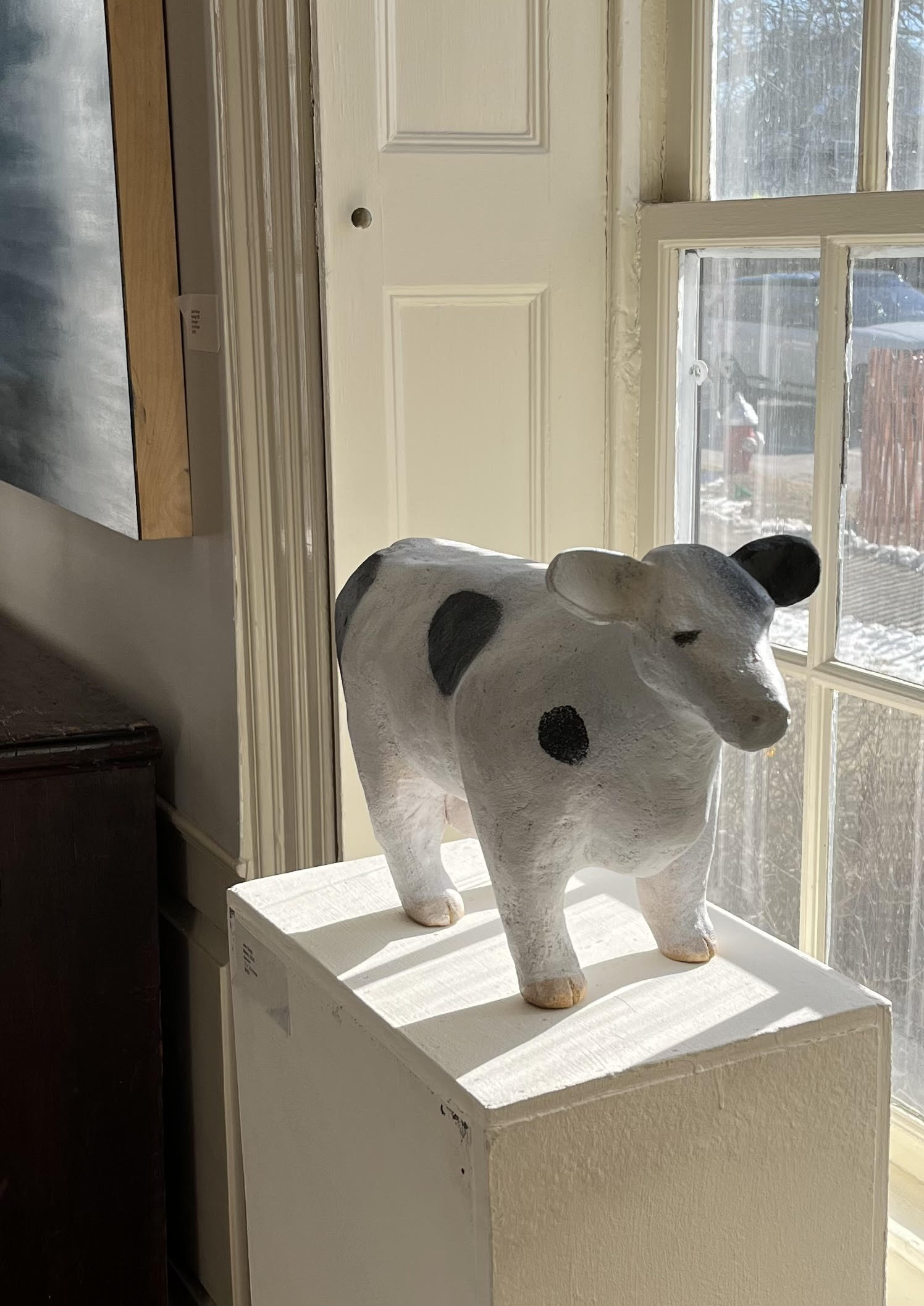
A gourd-body bull by Dave Smyth is being shown at Concord Art’s juried member show, 2025. Don’t you love how artists see potential that so many of us miss?

Today’s pictures are mostly from art exhibits I attended this month. The show at Concord Art, above, was in the process of being set up when Meredith and I went. She aims to submit work for the next show and has appeared in several earlier ones.

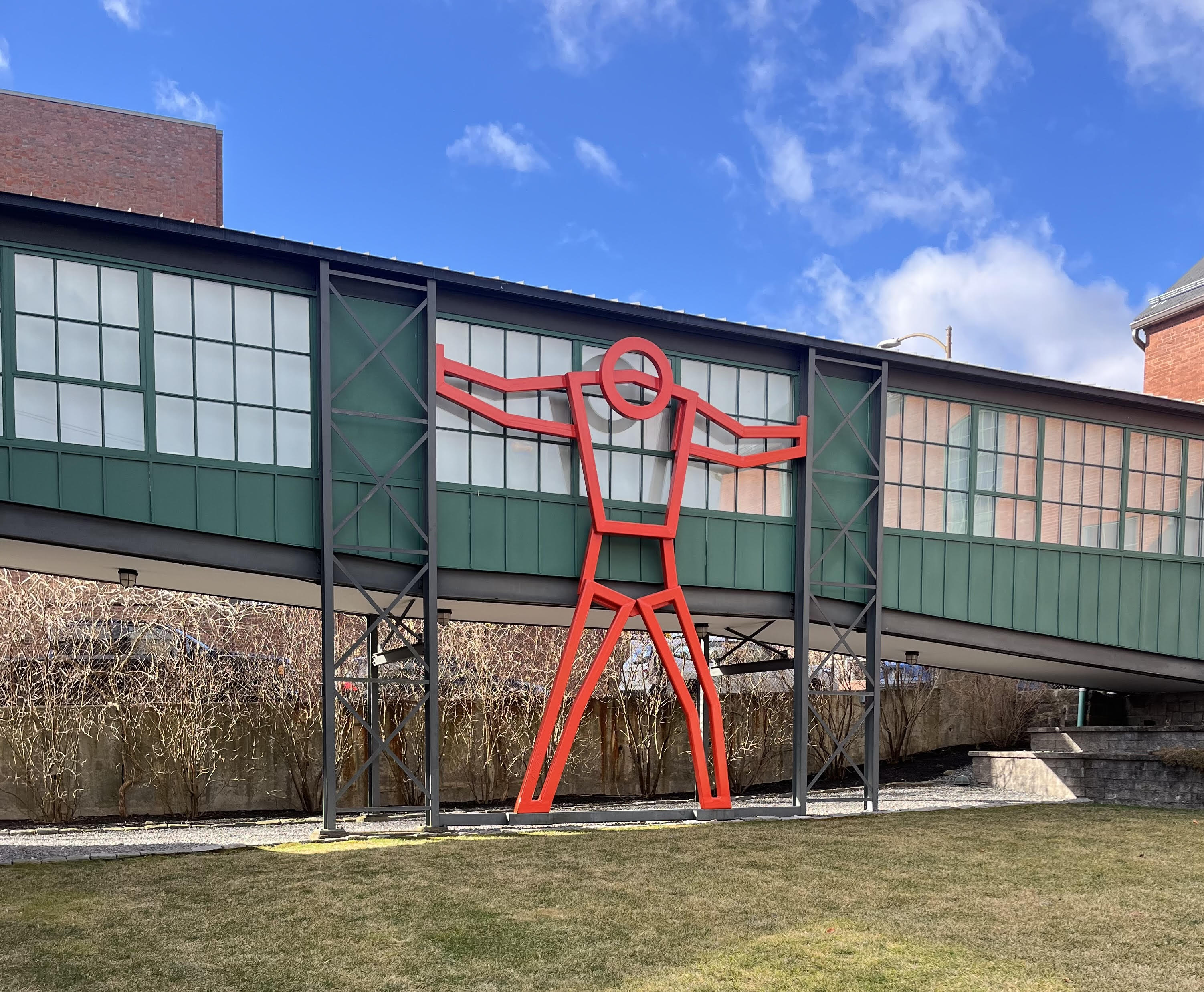
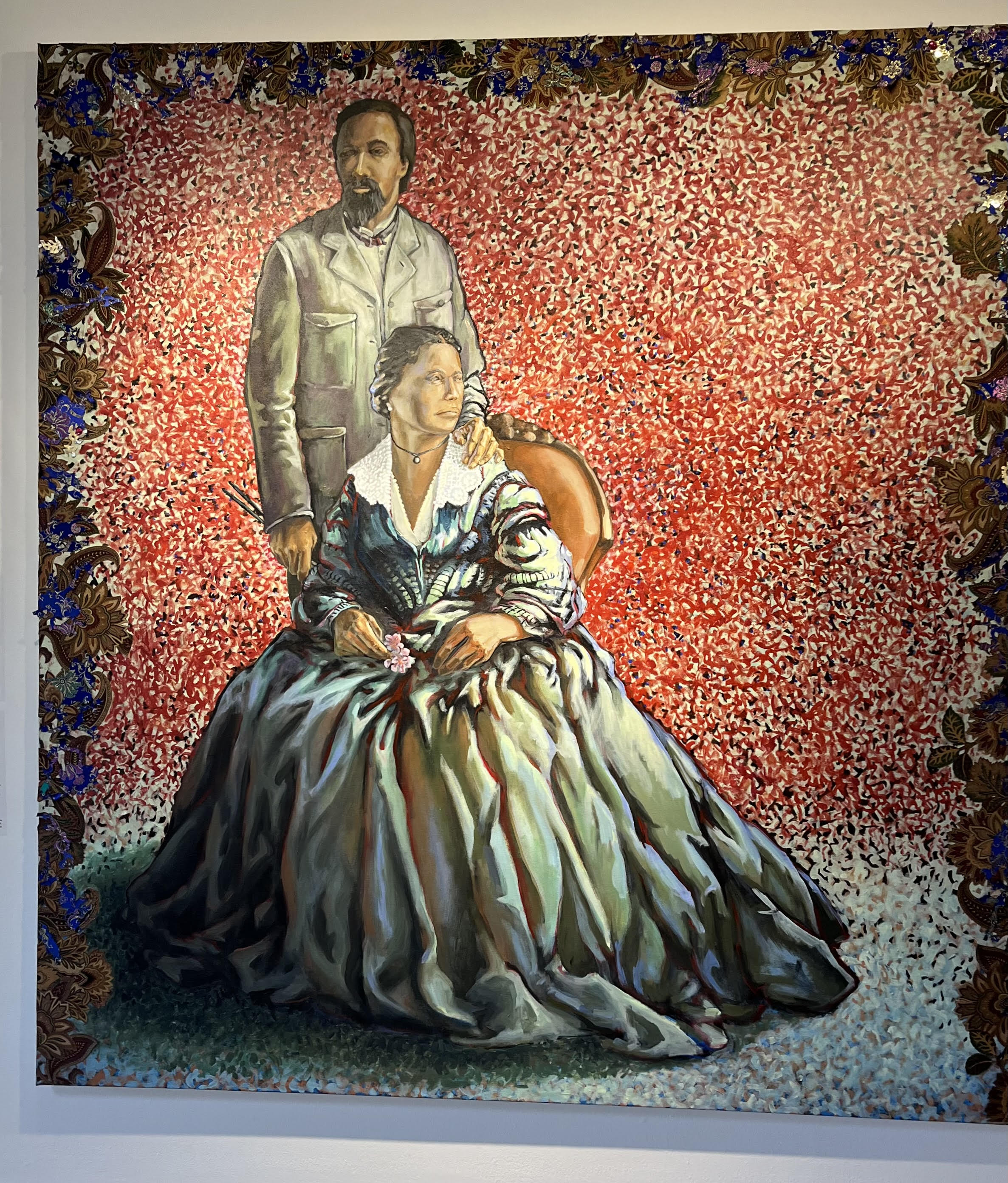
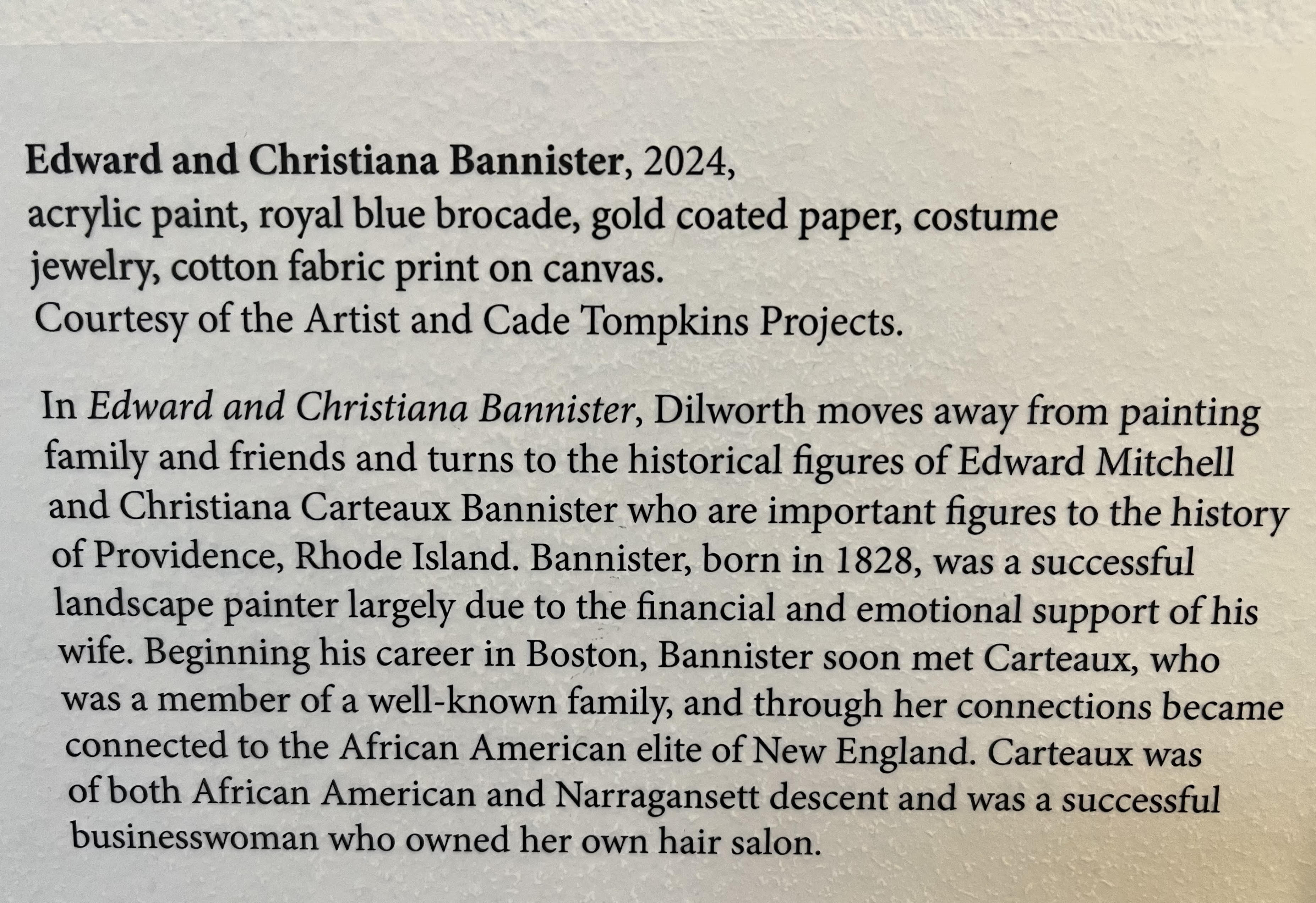
The orange giant who is holding up the world is at the Fitchburg Art Museum, where Ann and I took in several exhibits — in particular the Bob Dilworth. Born in Virginia, Dilworth taught art for many years in Rhode Island. I liked learning more about noted 19th century Black landscape painter Edward Bannister, seen in the portrait with his wife. Dilworth’s paintings, which he often worked on for years, feature a collage-like effect from the layering of textiles, stenciling, more.

I knew about Bannister before, but was glad to read something about his wife here.

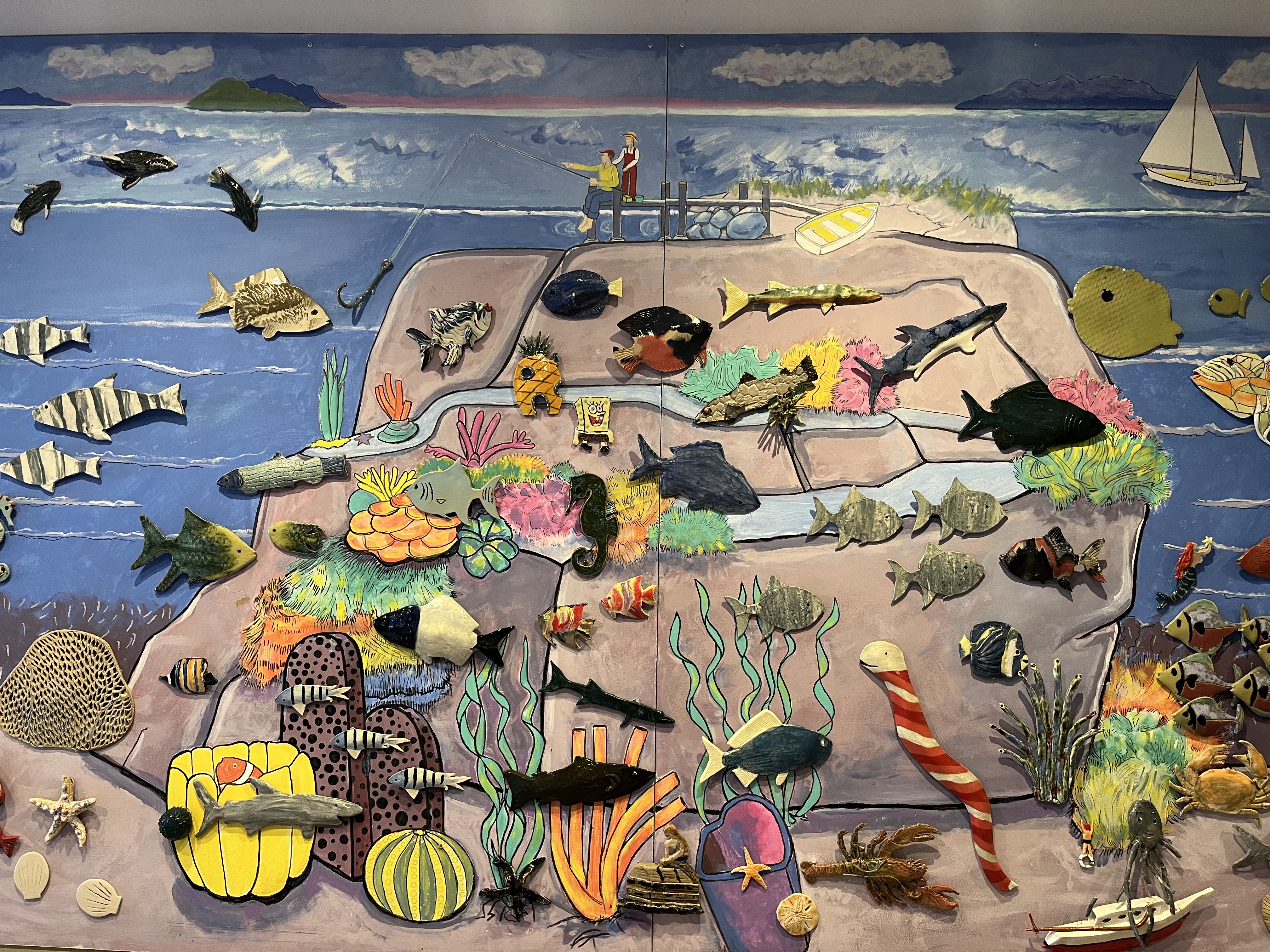
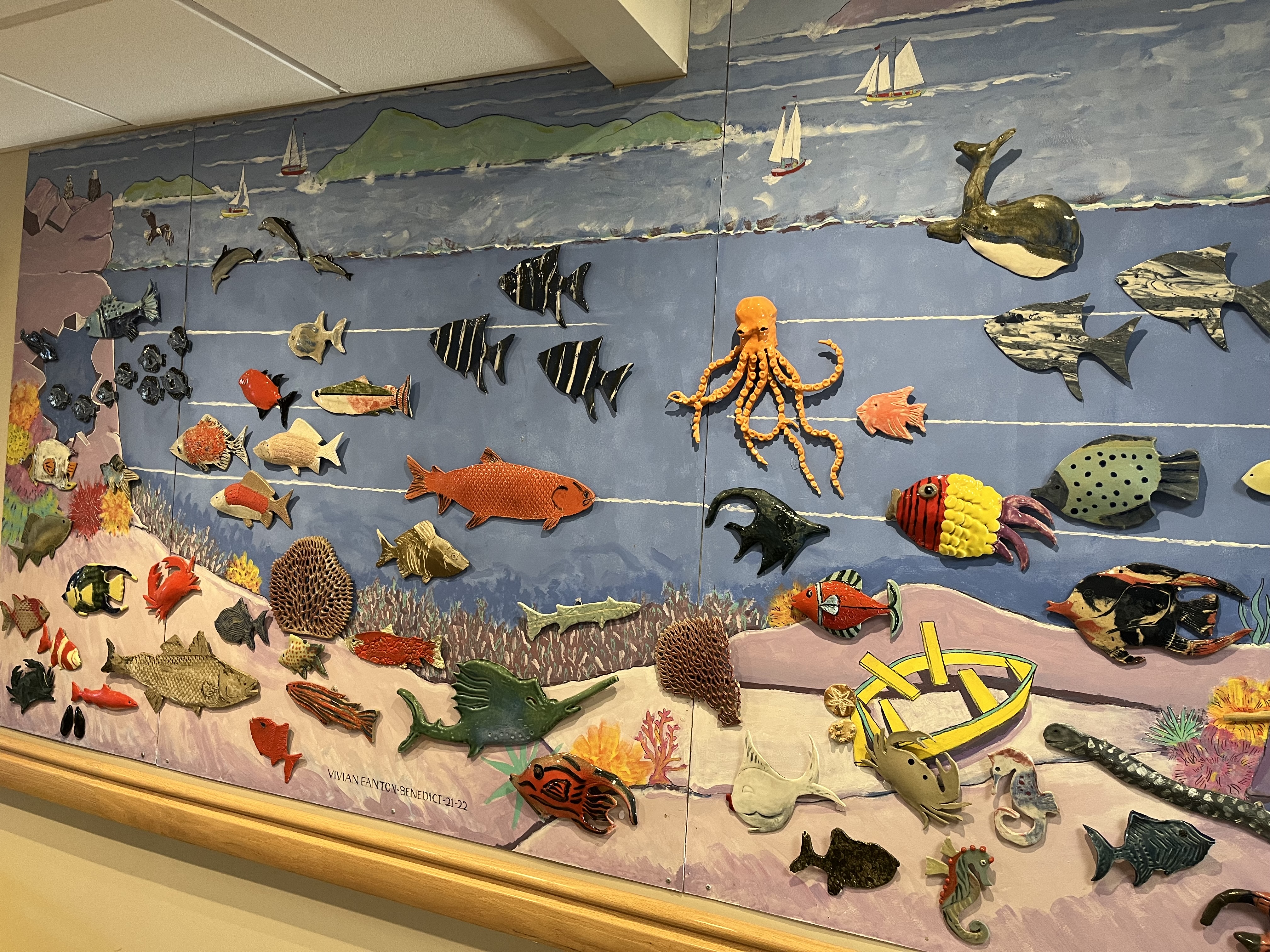
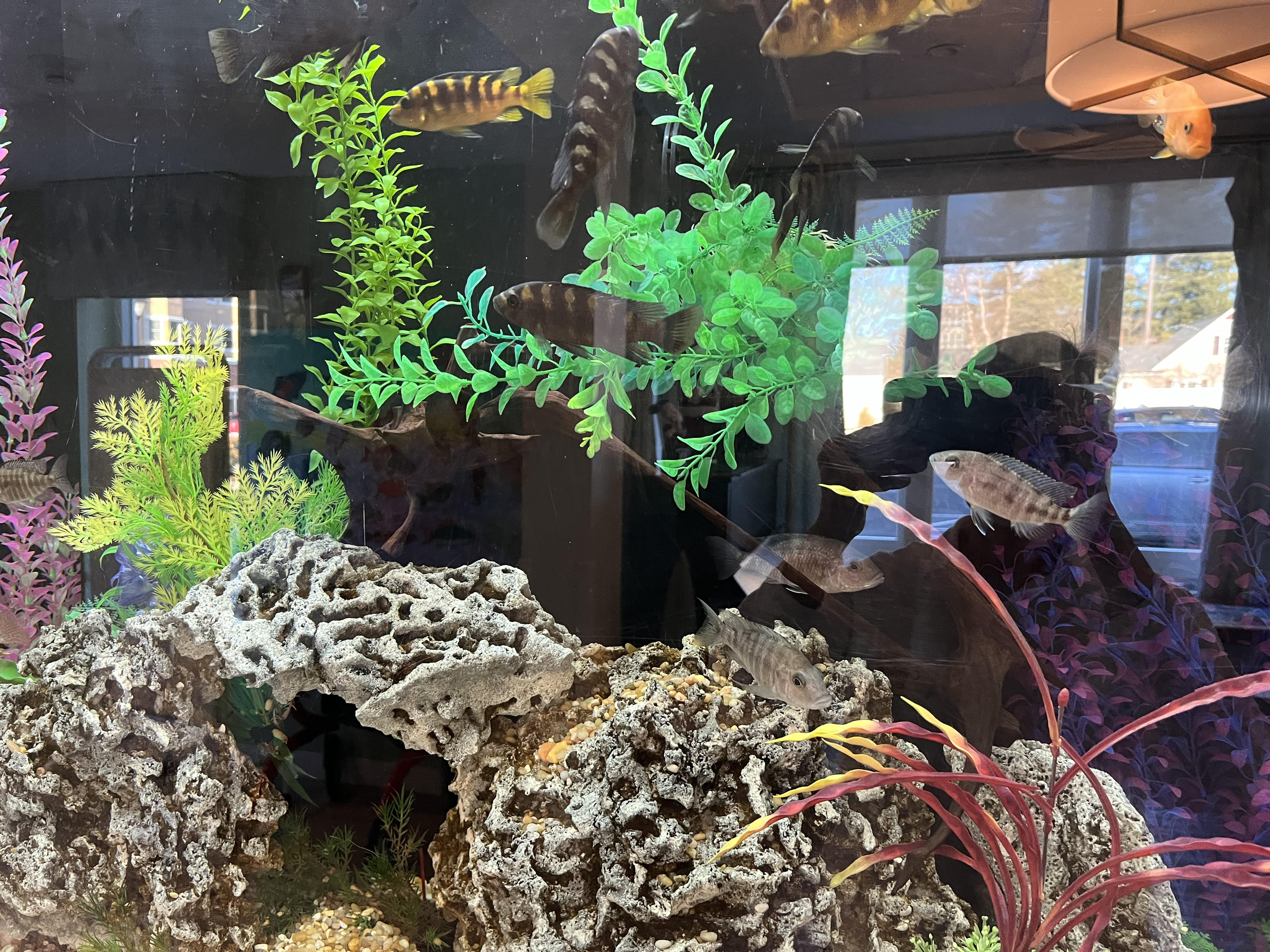
The next two photos do not show such professional work but rather are ceramics created by people of many skill levels who live in my retirement community. They made sea creatures for display in the nursing building. There’s a marine theme throughout that section, including a big salt water fish tank. I visited a friend there, and now I visit her in the memory-care building.

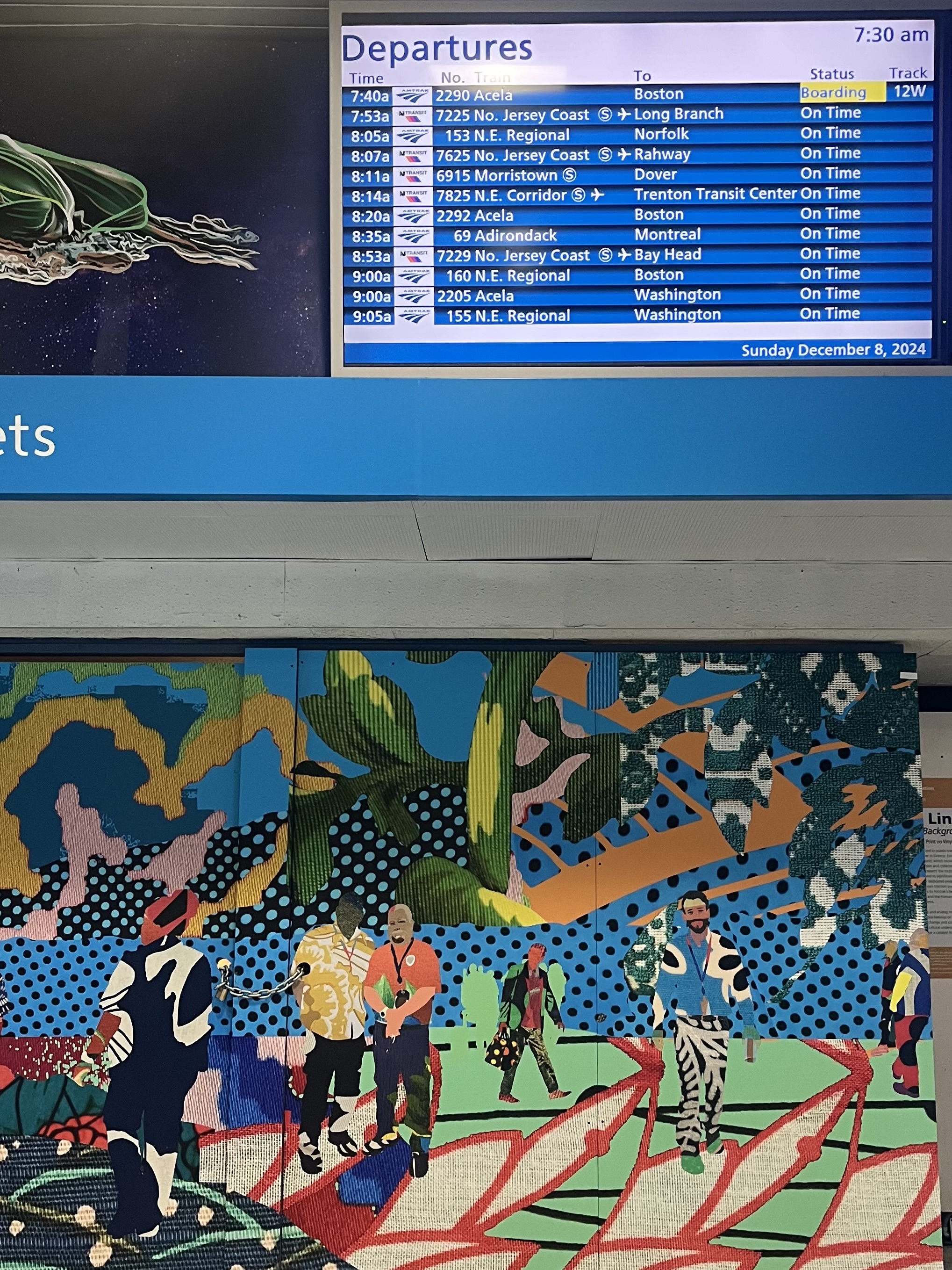
The final photo is actually from my December trip to New York City. There is loads of public art in Penn Station. Nice to have something to look at if your are too early for your train!

Read Full Post »

Photo: Michael Blackshire/Los Angeles Times.
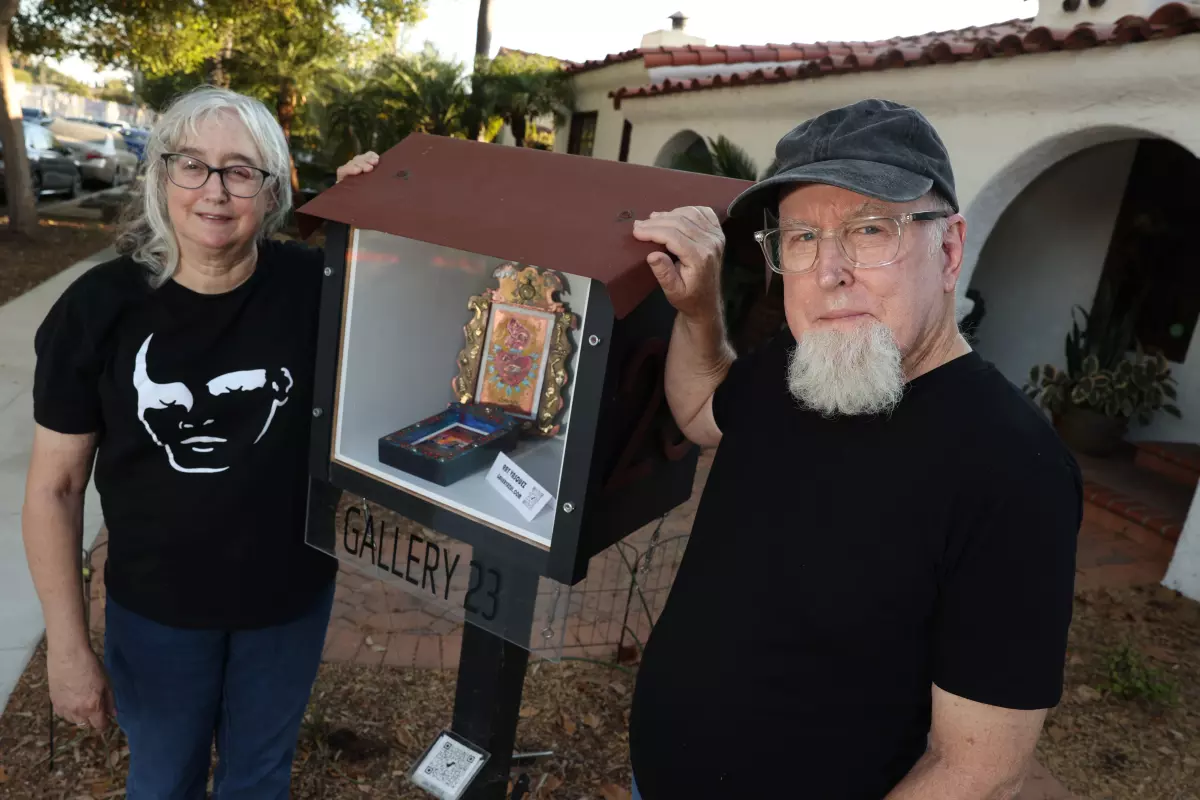
Carol and Dave Clark in front of artist Ray Vasquez’s works exhibited in one of the micro-galleries they built. 

I wrote about Stacy Milrany’s mini art gallery a while back and have been following her work ever since via Instagram. Her idea was to create an art gallery similar to what most of us know as the Little Free Library, a box to hold free books, set up like a mailbox in residential neighborhoods.

Now a couple in California have taken the idea a step farther.

Stacy Perman wrote at the Los Angeles Times, “Two years ago, Long Beach artist Dave Clark exhibited a small sculpture of his called ‘Together. Forever. Maybe. Regret’ at the local Mantel Gallery — itself a small, repurposed Little Free Library that does double duty: When it’s not filled with books, it displays the works of artists like Clark.

“At the time, Clark and his wife, Carol, were struck by the concept. ‘That’s cool,’ he said. ‘But what if I had something bigger? You can put more art in there, and it becomes more of a real functional art gallery.’ While his neighborhood had many artists, he noted, it did not have any galleries.

“Inspired, he designed and built a micro-gallery measuring about 16 inches wide and 14 inches tall. It has movable walls, a floor and a ceiling that could be adapted for rotating artworks; a solar panel powers the little ceiling light. He installed it on the front yard of their house in the Wrigley neighborhood. They named it Gallery 17, the sum of the numbers on their Eucalyptus Avenue address.

“Last summer, the couple organized an exhibit by local artist Cody Lusby. About 40 people showed up. One of their neighbors saw it and wanted a Clark micro-gallery too. Soon, others began commissioning Clark to build micro-galleries on their front lawns. And then, artists from around Los Angeles and as far away as Ecuador began asking to show their works in them.

“An archipelago of 10 micro-galleries stretches around neighborhoods in Long Beach as well as in San Pedro and Lomita. Two more, also in Long Beach, are set to be built in the coming weeks. …

“ ‘It’s important that art become a part of everyday life,’ said Linda Grimes, executive director of the San Pedro Waterfront Arts District, who’s husband commissioned a micro-gallery for her birthday in April. ‘Not everybody feels welcome going into an art gallery or a museum. We started painting those traffic signal boxes so that people could see art and appreciate it outside, on the street every day. And then we painted large scale murals.’ …

“ ‘I thought what a great idea Dave had,’ [said Eric Almanza, a classically trained oil painter]. ‘Instead of books, this has little masterpieces that can brighten someone’s day. There’s been many times I’ve headed outside the house to run an errand and encounter someone at the box looking inside.’ …

“Almanza, whose own photo realistic paintings examine the nexus between politics, culture and identity with a focus on the border wall and immigration, initially made scaled down prints to show in the box and sold them for $50. …

“ ‘I like the idea of being able to bring art to the masses in the community,’ he said. ‘I think nowadays we don’t see much public art. I feel like art in general is not as appreciated as in the past. This felt like a good way for artists to show their work and to put public art in my neighborhood.’ ”

More at the LA Times, here.

Read Full Post »

Photo: Dan Plaster/CBC News/Creative City Centre.
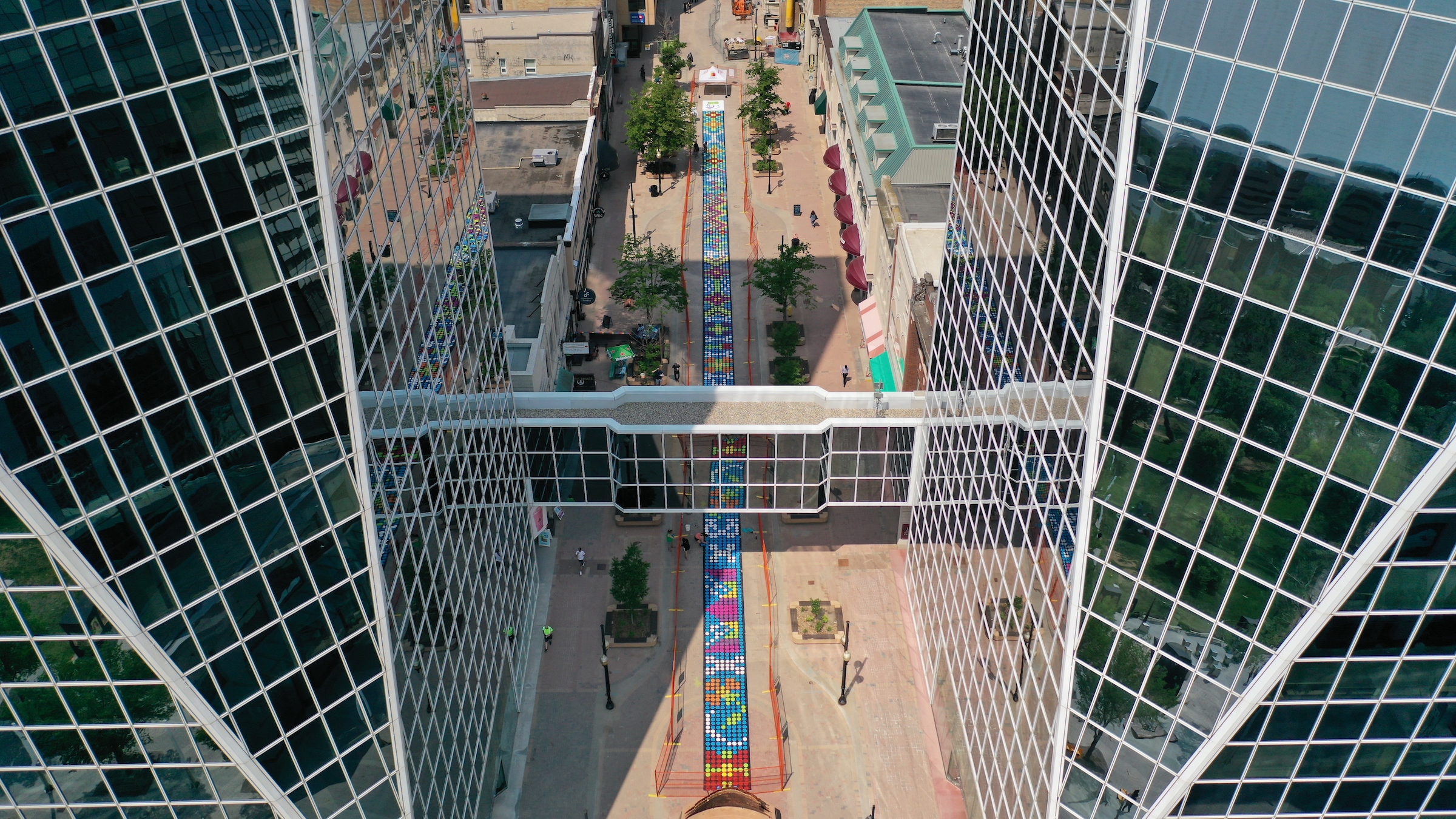
An aerial view of “The Path to Reconciliation” (2023) in downtown Regina, Saskatchewan.

There’s a new effort in Canada to make the art of indigenous people more visible to all. At Hyperallergic, Rhea Nayyar reports on one public project, “The Path to Reconciliation,” a pavement mural painted in the style of traditional beadwork.

“Hundreds gathered in downtown Regina, the capital city of the Canadian province of Saskatchewan,” writes Fayyar, “for the unveiling of a new public artwork on National Indigenous Peoples’ Day last Wednesday, June 21. Cree-Métis artist Geanna Dunbar and Inuvialuit-Gwich’in artist Brandy Jones designed ‘The Path to Reconciliation’ (2023), a 300-foot-long and eight-foot-wide footpath mural on pavement rendered in the style of traditional First Nations beadwork. The piece featured over 2,600 painted circular ‘beads,’ also referencing the significance of the circle as a broader Indigenous symbol rooted in healing, community gatherings, and mutual support without hierarchies.

“The mural occupies a stretch of a downtown pedestrian-only city block at the F.W. Hills Mall on Scarth Street. Dunbar and Jones incorporated motifs such as flowers for their ubiquitous representation in every culture; bison bones to honor how First Nations peoples use every part of an animal for sustenance and survival and in acknowledgment of their near extinction due to colonial overhunting; and the colors of the aurora borealis that represent late ancestors looking down and offering guidance to those still on Earth. The path begins in front of late artist Joe Fafard’s buffalo sculpture, ‘oskana ka-asasteki’ (1998), and is marked by a painting of a white buffalo, which signifies the sacred loop of life for several Indigenous cultures. …

“ ‘Reconciliation begins with starting these conversations and improving education around these subjects,’ Jones said, reflecting on her community work on top of this project. ‘There’s so much interest in wanting to learn more and help out.’ …

“Dunbar and Jones sought guidance and knowledge from Muscowpetung First Nation Elder and residential school survivor Brenda Dubois as well as Indigenous cultural art advisor Audrey Dreaver for this endeavor.

“ ‘Dubois told us a very powerful story about how river water and ocean water pass through obstacles to meet each other, and that really resonated with us so we made blue background beads to represent the journey of water along the path,’ Dunbar noted. Jones mentioned that Dubois had a grounding presence that helped the artists tone down their perfectionistic tendencies for this project and that Dreaver was a great resource for historical knowledge about the ubiquity of beadwork as a post-colonial impact on First Nations cultures across North America.

“The artists joined forces on this project through the Creative City Centre (CCC), an artist-run community space in Regina that provides employment opportunities and professional development assistance to independent creative workers, and the Regina Downtown Business Improvement District.

“ ‘It was interesting to see a bunch of people coming together from different places, financial classes, cities, and so on really endure the harsh weather of an extreme heat wave for this,’ Dunbar said of the public turnout. ‘We were all uncomfortable, and that also represents the path of reconciliation — to feel what it’s like to be uncomfortable in situations and work together as a team.’ She stated that reconciliation for non-Indigenous people to foster and maintain respectful relationships with First Nations people means knowing where your money is going, and ‘putting in the work and creating jobs.’

“ ‘You can wear an orange shirt for Every Child Matters Day (September 30), or you can come out on Indigenous Peoples’ Day (June 21), but where did you get your orange shirt?’ Dunbar asked. ‘Did you buy your shirt at Walmart, or did you purchase it from an Indigenous artist?’ “

We do not seem to have enough colors for all the serious issues dyed T-shirts represent nowadays. Today I am learning about orange for indigenous children, but I know orange is also used in MS ribbons and, separately, for ending gun violence.

More at Hyperallergic, here. Nice pictures. Subscriptions welcome.

Read Full Post »

Photo: Brittainy Newman/Bloomberg Philanthropies.
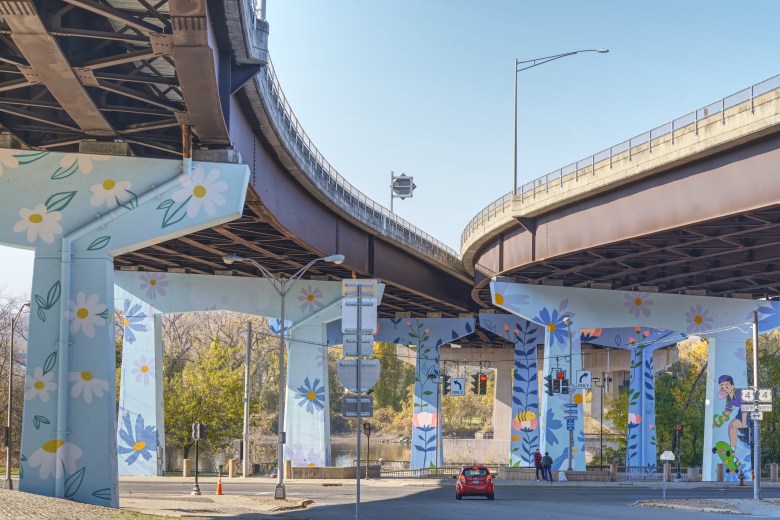
Art painted by Jade Warrick in Troy, New York.

Today’s post features a new study showing that public art, in addition to its numerous other benefits, can sometimes increase traffic safety.

Elaine Velie writes at Hyperallergic, “A study conducted by Bloomberg Philanthropies examined 17 sites over two years, before and after they were painted with ‘asphalt art’ (art on surfaces such as roads, sidewalks, and underpasses). It found a 17% decrease in total crashes and a decrease in severity of the crashes that did occur: There were 37% fewer crashes that resulted in injury and 50% fewer crashes involving pedestrians and cyclists.

“ ‘The art itself is often also intended to improve safety by increasing visibility of pedestrian spaces and crosswalks, promoting a more walkable public realm, and encouraging drivers to slow down and be more alert for pedestrians and cyclists, the most vulnerable users of the road,’ the study reads.

“The sites, spread across five states, were intersections or mid-block crosswalks. Around half of the sites were considered ‘urban core,’ defined as areas with a high population density (including two in New York City), a quarter were neighborhood zones, and the last quarter were suburban.

“In addition to reporting the actual crash rate for these sites, the study also tracked the behavior of drivers and pedestrians, noting that both groups performed less risky behavior in areas with artworks — such as pedestrians crossing without the ‘walk’ sign and drivers not yielding to pedestrians until the last moment. …

“As of now, asphalt art is not allowed under the Federal Highway Association’s rules on road signs and signals, a lengthy set of guidelines that dictate the colors required for painting crosswalks, curbs, and lines. The decision to install asphalt art requires local officials to make exceptions.”

The New York Times has more: ” ‘We want to try and help cities do wonderful things to their public realm,’ said Kate D. Levin, who oversees arts programs for Bloomberg Philanthropies and was commissioner of the New York City Department of Cultural Affairs. And especially now, as cities reopen, ‘there’s a social cohesion goal that I think has only gotten more urgent,’ she said. ‘Why not use projects like this to actually let people be involved, create a sense that public space belongs to everyone?’

“The goals are to support local working artists, community groups, businesses and government on collaborative infrastructure projects to make streets safer; to activate public space in ways that are ‘as robust and reflective of local identity and aspirations as possible,’ Ms. Levin said; and to promote community engagement, ‘because a streetscape isn’t theoretical, it runs through people’s lives.’ …

“ ‘When we closed Broadway to cars and opened it to pedestrians in 2009, we saw the potential hidden in 2.5 acres of gray asphalt,’ said Janette Sadik-Khan, a former commissioner of the New York City Department of Transportation and now transportation principal at Bloomberg Associates … ‘Streets make up more than 80 percent of a city’s public space, so they’re really the front yards for millions of Americans.’

“Three cities began or completed installations in late 2020: Kansas City, Mo; Saginaw, Mich.; and Norfolk, Va. The remaining 13 are expected to finish their projects this year. … Themes range from unity and improving police and community relations to diversity. Sioux Falls, S.D., plans to feature minority artists who will design vinyl wraps for 25 utility boxes throughout downtown. Troy, N.Y. intends to beautify an underpass. …

Teal Thibaud, director of the Glass House Collective, a nonprofit that works in an underserved neighborhood in East Chattanooga, Tenn., said even small improvements could help spawn others, especially in an area that had received limited infrastructure investment in recent years.

“The Bloomberg-funded mural, completed in April, helped beautify the area. … A new street park next to the asphalt mural that created a safe gathering space, fence art to slow traffic near the elementary school, and painted stencils on sidewalks to encourage school children and other residents to follow the safest local routes were among the projects, said Ms. Thibaud. …

“Last fall, Kansas City, Mo., redesigned a busy, dangerous four-way intersection where cars rarely stopped for pedestrians, said DuRon Netsell, founder and principal of Street Smarts Design + Build, an urban design firm that focuses on walkable communities. ‘People were just flying through the intersection, significantly over the speed limit.’

“Stop signs and traffic-calming measures like bollards and planters to extend the curbs and narrow the driving lanes, and the community-painted mural ‘blended into a unique project that is not only beautiful, but also drastically improved safety,’ said Mr. Netsell.”

More at Hyperallergic, here, and at the New York Times, here.

Read Full Post »

Photo: Gavin Sheridan
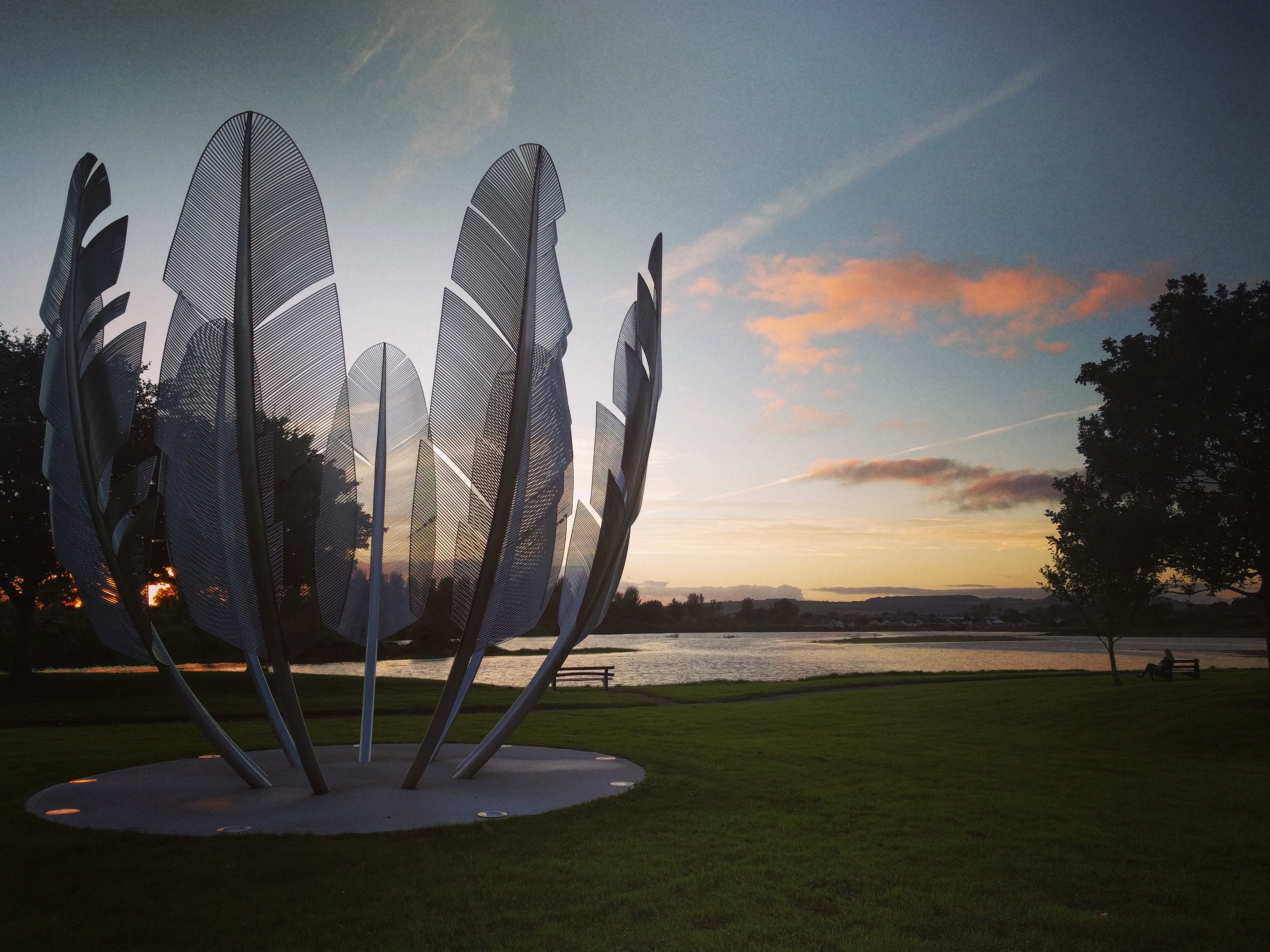
Built in Midleton, County Cork, Ireland, this sculpture memorializes the aid given by the Chocktaw Nation during the Great Famine.

Whether you say Columbus Day or Indigenous Peoples Day, the Monday holiday is a good time to address our current problem with statues.

Are the ones getting removed all equally troubling? Take Columbus. Many Italians honor him as an explorer from their homeland. But to indigenous people, the history of his violence against their ancestors and of the diseases and exploitation that contact with Europeans brought is as painful to contemplate as Confederate statues are for the descendants of slaves.

That’s why in Boston, a frequently defaced Columbus statue is being moved to the private property of the fraternal order called Knights of Columbus.

Lately I’ve been wondering if our statue problem derives from honoring an individual. Individuals — and contemporaneous attitudes toward individuals — are more likely to be flawed than, say, a concept. Even Boston’s Abraham Lincoln statue is being removed because of the grovelling way the slave he’s freeing is depicted.

Conceptual monuments like the one to the seagulls that saved the Mormon crops from locusts could be better. Or how about the monument Ireland put up in gratitude to the Choctaw Nation for assistance in the potato famine?

But concepts can be offensive, too. Consider the Spirit of the Confederacy statue. The interesting thing about that one is that the Houston Museum of African American Culture, having decided to preserve it for teaching purposes, has actually given it a home, according to an article at Hyperallergic.

I guess my idea about avoiding monuments to individuals doesn’t really solve anything. As scientists say, “More study is needed.” Fortunately, there’s a group that’s on the case.

Philip Kennicott at the Washington Post reports, “The Mellon Foundation has announced that it will make rethinking this country’s landscape of monuments and memorials a major institutional priority, with a $250 million ‘Monuments Project’ over the next five years. …

“Says Elizabeth Alexander, president of the foundation … ‘This is not a Confederate monuments project; it is a monuments project.’ …

“That means addressing the larger issue of what values and ideas about identity are embedded in this country’s public architecture of history and memory. What is preserved, what is forgotten and what is suppressed?” So there’s that.

What do you think? Is the problem too many militaristic statues? Should public monuments focus on traits we want to encourage, like kindness, generosity, service to others? I invite you to ponder.

Photo: David McConeghy/ Flickr
The Seagull Monument located in front of the Salt Lake Assembly Hall on Temple Square, Salt Lake City, Utah.

Read Full Post »

Photo: Terry Smith/ AthensNews.com
“The American Woman,” a sculpture by the late David Hostetler in the Wolfe Garden on Ohio University’s College Green, is part of the 144-mile Ohio Art Corridor.

How encouraging to see communities embrace initiatives that lift people’s spirits and to read that towns are actually spending money on those things! It’s true that parks, trees, and art in a municipality offer economic benefits, but things are also worth doing just because they’re good.

I bet that Ohio’s 144-mile arts corridor, which is meant to lure tourism dollars to an area that has been struggling in recent years, is pretty successful at making the locals feel happy. Nothing wrong with happiness. Nothing wrong with a sense of pride and well-being.

Nancy Trejos writes at USA Today, “Southeastern Ohio is trying to attract visitors by giving them something unique to look at. … The founders believe The Ohio Art Corridor is the largest outdoor gallery in the world, surpassing one in Stockholm that covers 70 miles.

“ ‘Our desire is to draw people out of the big cities, to take a drive through the beautiful Appalachian country of Ohio, to learn, grow, and have experiences that they otherwise would not have,’ says Rebekah Griesmyer, executive director of The Ohio Art Corridor.”

Reporter Fred Kight from Athens News has more.

“The corridor extends 144 miles through Athens, Morgan, Fairfield, Muskingum and Pickaway counties. It currently consists of eight sculptures and two large murals, and organizers hope to add new works.

“ ‘I love the idea. … Public art is wonderful,’ said Athens Mayor Steve Patterson. …

“Griesmyer said, ‘We are attempting to draw people to small cities and towns with outdoor art. It is a huge project, and we couldn’t be more excited to see it implemented and adopted by cities like Athens.’ …

“In order to be included on a Corridor map, the art must [now] meet three criteria. It must be outdoors and free; it must be large; and if the art is not large (over 12 feet) as one piece, it must consist of three sculptures in one place.”

The idea’s originator is Griesmyer’s brother-in-law, David Griesmyer. He “operates a metal fabrication business in Malta, across the Muskingum River from McConnelsville. Creation of the Corridor combines his love of art with a desire to bring new life to the region.

“ ‘This part of Ohio is so rich with beauty, talent and creativity,’ he said. ‘I see southeast Ohio as a large stone ready to be carved, only to reveal a masterpiece hidden within.’ ”

More at the Athens News, here, and at USA Today, here.

Photo: WGRZ-TV
This section of the Ohio Art Corridor is located on the Muskingum Parkway across from the Morgan County Fairgrounds.

Read Full Post »

Photo: Bloomberg Philanthropies
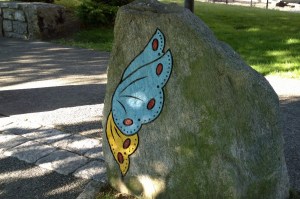
Theaster Gates, an artist and activist, was a leader of the project called “Arthouse: A Social Kitchen,” which won a million dollars for Gary, Indiana.

Bloomberg Philanthropies have seen that public art can revitalize communities, so the nonprofit is renewing its Public Art Challenge.
Ben Paynter writes at Fast Company, “Several years ago, Bloomberg Philanthropies launched a competition to award struggling cities $1 million each for trying a novel approach at revitalization. It was called the Public Art Challenge, with the goal being that each place should think up some big, unifying, and life-improving masterpiece.
“That effort has paid off beautifully. According to Bloomberg’s math, the four winning projects … generated $13 million for those four places, both in terms of new jobs, related neighborhood investments, and visitor spending. More than 10 million people are estimated to have viewed those works. …

“Bloomberg Philanthropies head Mike Bloomberg liked the idea so much that he green-lit another round. Any city with a population of 30,000 or more may apply for the 2018 Public Art Challenge. …
“At least three winning metros will earn another $1 million a piece for a concept tackling some critical issue inside city limits. Bloomberg has pledged to cover ‘project-related expenditures including development, execution, and marketing,’ although cities will be expected to share some of the other costs, according to a press release. …

“The initial wave of exhibitions was ambitious. In Los Angeles, artists created a series of installations related to the theme of water conservation amid concerns of drought and storm water waste. In Gary, the community founded ArtHouse, a ‘social kitchen’ to bring people downtown for art displays and culinary classes that work like job training.

“In Spartanburg, police and neighborhood groups helped build fun light displays that also created more safety in public places. In Albany, Schenectady, and Troy, officials and volunteers mapped out and then lit up stacks of vacant buildings — places that were otherwise hidden in plain sight — as ripe for revitalization. The project both spruced up the surrounding neighborhoods and clearly illuminated for officials and investors where future civic bright spots might be.” Fast Company has more here.

In the process of of posting this piece, I learned something about the artist behind the winning project in Gary, Indiana, and I thought you’d be interested.

According to his website, “Theaster Gates was born in Chicago in 1973. He first encountered creativity in the music of Black churches on his journey to becoming an urban planner, potter, and artist.

“Gates creates sculptures with clay, tar, and renovated buildings, transforming the raw material of urban neighborhoods into radically reimagined vessels of opportunity for the community.

“Establishing a virtuous circle between fine art and social progress, Gates strips dilapidated buildings of their components, transforming those elements into sculptures that act as bonds or investments, the proceeds of which are used to finance the rehabilitation of entire city blocks.”

Pretty great, huh?

Read Full Post »

2017-Nancy-Whelan-cat-sculpture-Catskill-NY

Sculpture: Nancy Whelan
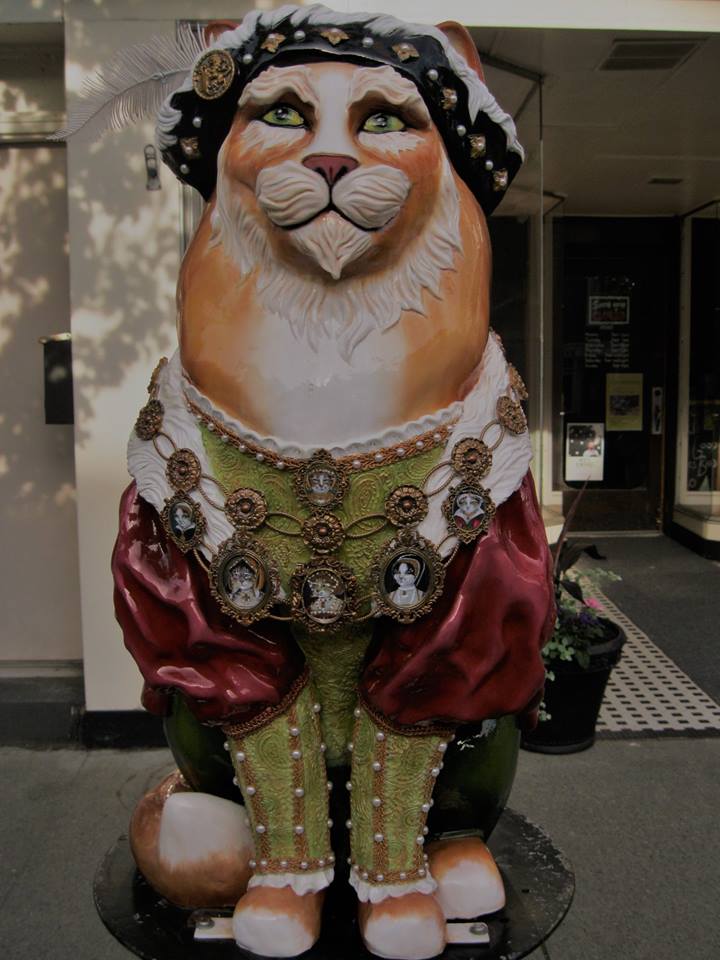
Cat sculpture “Henry VIII — Six Wives, Nine Lives,” Catskill, New York.  See and hear the artist’s description, here.

Sandy and Pat attended a family wedding at Lettterbox Farm in upstate New York recently and took a little time to check out the local sights. They loved the cat sculptures in the town of Catskill and the owl sculptures in Coxsackie, whose name is thought to come from an Indian word for “owl.”

Ariél Zangla wrote at the Daily Freeman, ” ‘Cat’n Around Catskill’ is celebrating its 10th anniversary. …

“Visitors come from local communities, but also from out of state. [Catskill Association President Tina Annese] said she knows of at least one family that has visited the cats each year as part of their summer vacation. She said people come to see the cats, get their pictures taken with them, and then visit area businesses.

“ ‘It brings tourism into the area, without a doubt,’ Annese said. She added that with neighboring communities doing their own art displays, visitors can stop in multiple areas. Annese said she loves that — and the more public art displays, the merrier.

“Locally, Saugerties once again has its decorated horse statues on display, while Greenville will have its ducks for the second year.”

More about the cats at the Daily Freeman, here. And if you are on Facebook, you will want to check the Cat’n Around Catskill page, here.

As for owls, it was last September that Coxsackie decided to get into the act.

Melanie Lekocevic of Columbia-Greene Media wrote about the effort at the Daily Mail: “Catskill has its cats, Cairo has bears, and Ravena had trains. Now, it’s Coxsackie’s turn.

“A volunteer committee has been working for several months to get a new project off the ground – ‘Hoot of the Owl,’ a public art exhibit that will bring sculptures of creatively decorated owls to the community.

“Owls have long been the symbol of Coxsackie; indeed, some translations of the name ‘Coxsackie’ – said to be of Native American extraction – are thought to reference owls, according to an article by Coxsackie Town Historian Michael Rausch on the town website. …

“Like the Catskill cats, once completed each owl will be posted at locations around the village for several months, and later auctioned off at an extravagant gala.

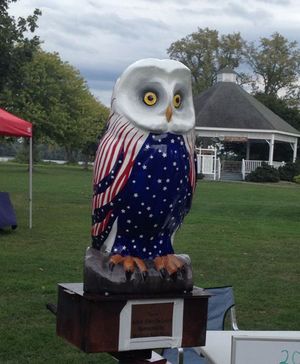
“Visitors to [the early September] Coxsackie Farmers Market got a taste of what is possible in creating an owl when local artist Ellen DeLucia put on display an owl she created just to get the creative juices flowing around town.

“ ‘When we started, we decided to buy one owl prototype and have Ellen DeLucia paint it to give people an idea of what it would look like,’ said Committee Chair Joseph Ellis, also a village trustee.” More at the Daily Mail, here.

Horses, ducks, owls, bears, cats. Dragons, Anyone? I’d definitely go out of my way to see dragons.

Photo: Melanie Lekocevic/Columbia-Greene Media
Artist Ellen DeLucia created the owl “Freedom” to give artists an idea of what a finished owl can look like.

57e6ccd1dfdb3-image


Read Full Post »

Christo is known for making impossible-seeming public art, and just recently, he made some again. Margaret Rhodes reported the story at Wired magazine.

“It takes serious engineering to let 640,000 people walk on water. Luckily, that’s exactly the kind of technical and creative challenge that Christo — the artist who wrapped the Reichstag and dotted Central Park with 7,503 orange panels of fabric—excels at. …

“The new project, the ‘Floating Piers,’ comprises two miles of marigold-yellow walkways gently bobbing on top of Lake Iseo, a small lake in northern Italy, connecting the waterside town of Sulzano with two small islands. …

“Making them work was tricky. Marinas often use temporary, floating piers; a common technique involves propping them atop styrofoam cubes. ‘We discovered very soon that this cube system was perfect for us,’ says Wolfgang Volz, Christo’s project manager. So in the fall of 2014, Christo’s team ran a secret simulation of the Floating Piers in Germany. But the styrofoam blocks were too small and too dense.

“So they built their own blocks—220,000 in total. They’re about 20 percent bigger than the ones marinas use, and more buoyant. A Bulgarian company supplied the materials, and Christo hired four different manufacturing companies to ensure they’d have enough.

“Once Christo had his blocks, he, Volz, and a few dozen workers started connecting the cubes into 50- by 330-foot sections. They attached the cubes with giant screws, right on the water, in a corralled section of Lake Iseo.

“One by one, workers pushed the white styrofoam rafts out into the lake and anchored them to 5.5-ton concrete slabs arranged on the lake floor in a configuration conceived by Christo. ‘Very tedious work,’ Volz says. ‘Every day the same.’

“It took four months, with workers doing shifts of two weeks on, two weeks off the job. ‘The same as an oil rig schedule,’ Volz says.’ ” More here.

Temporary, like most of Christo’s work, the walkway was scheduled to come down early this month and get recycled. But it lives on in photographs — and the memories of those who visited and got a chance to walk on water.

Photo: Wolfgang Volz
Christo’s project the “Floating Piers” comprised two miles of marigold-yellow walkways on Lake Iseo in northern Italy. Visitors walked the path without handrails.

Read Full Post »

I find so many more photo ops in summer than in winter, although that may mean I am not paying enough attention when it’s cold out. Surely there are great shadows everywhere.

Here are a few pictures from the last two weeks.

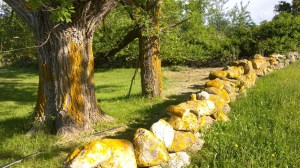
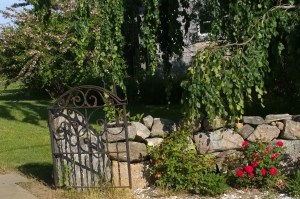
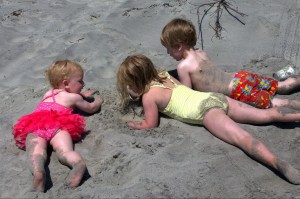
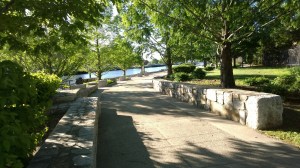
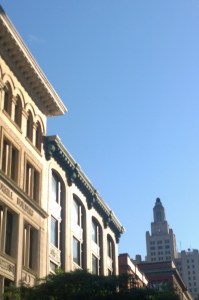
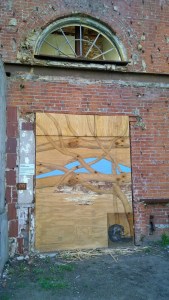
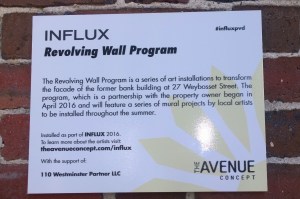
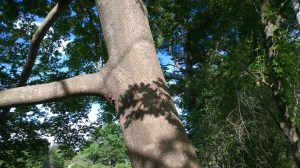
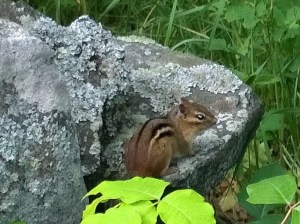
From New Shoreham: a field with Fresh Pond in the upper left corner, yellow lichen taking over a stone wall and trees, roses growing by a gate, children warming up in the dark sand. In Providence: a shady walk on the west side of the Providence River, a painted butterfly on the path, a swan preening, a distant view of the so-called Superman Building, public art with a muskrat fishing (?), a poster explaining the art project. In Massachusetts: shadows on a tree, a chipmunk on a lichen-covered rock.

061116-Fresh-Pond

061116-yellow-lichen


061116-stone-wall-roses

061216-warm-dark-sand


061416-riverwalk-Providence

061416-butterfly-art-Providence


0615`6-swan-Providence

061516-distant-Superman-bldg-Providence


061516-is-it-a-muskrat

061516-streetart-explanation


061016-shadow-on-tree-trunk

061616-chipmunk-and-lichen

Read Full Post »

111315-Lawrence-Weiner-artistLawrence Weiner discusses art in Dewey Square.

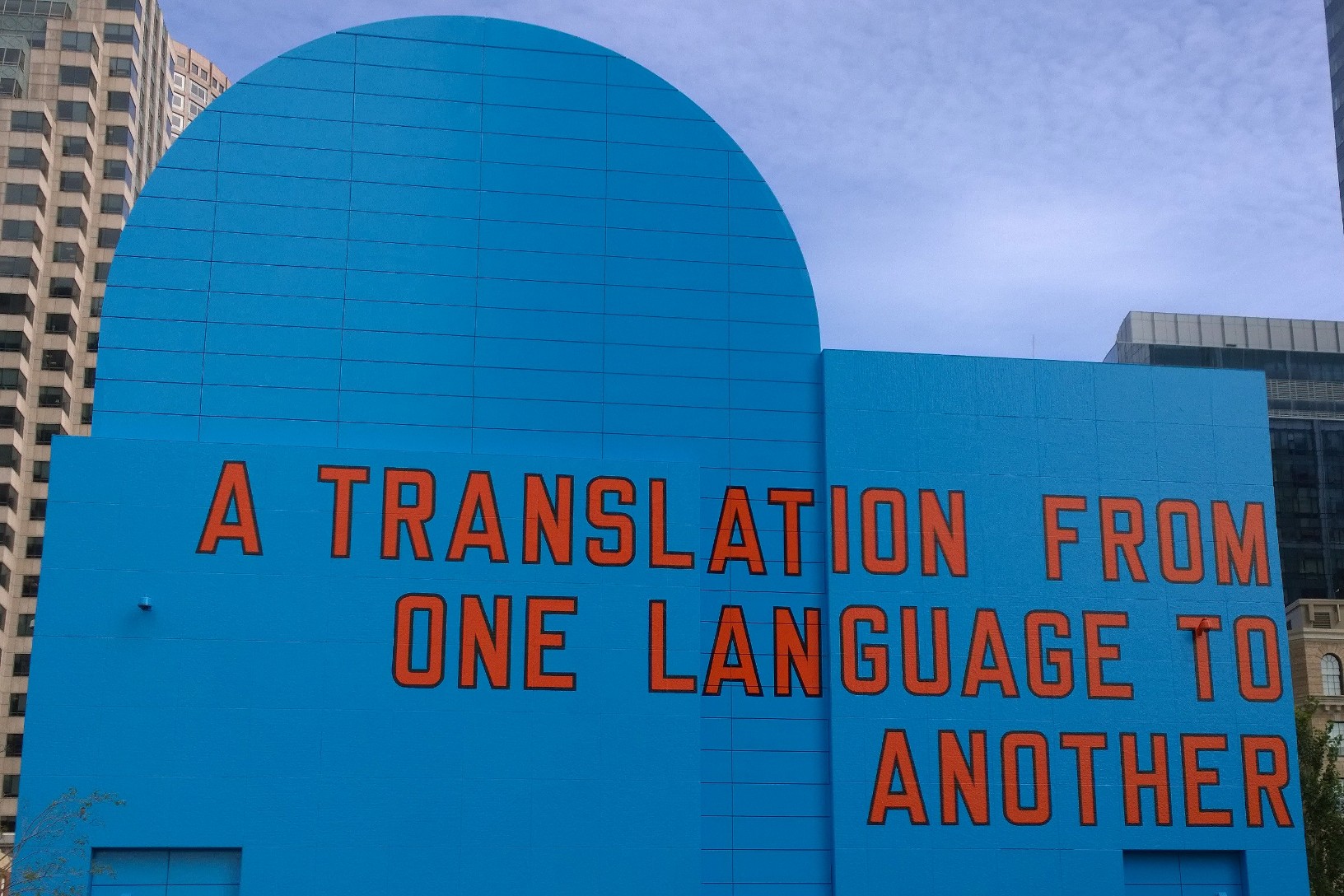
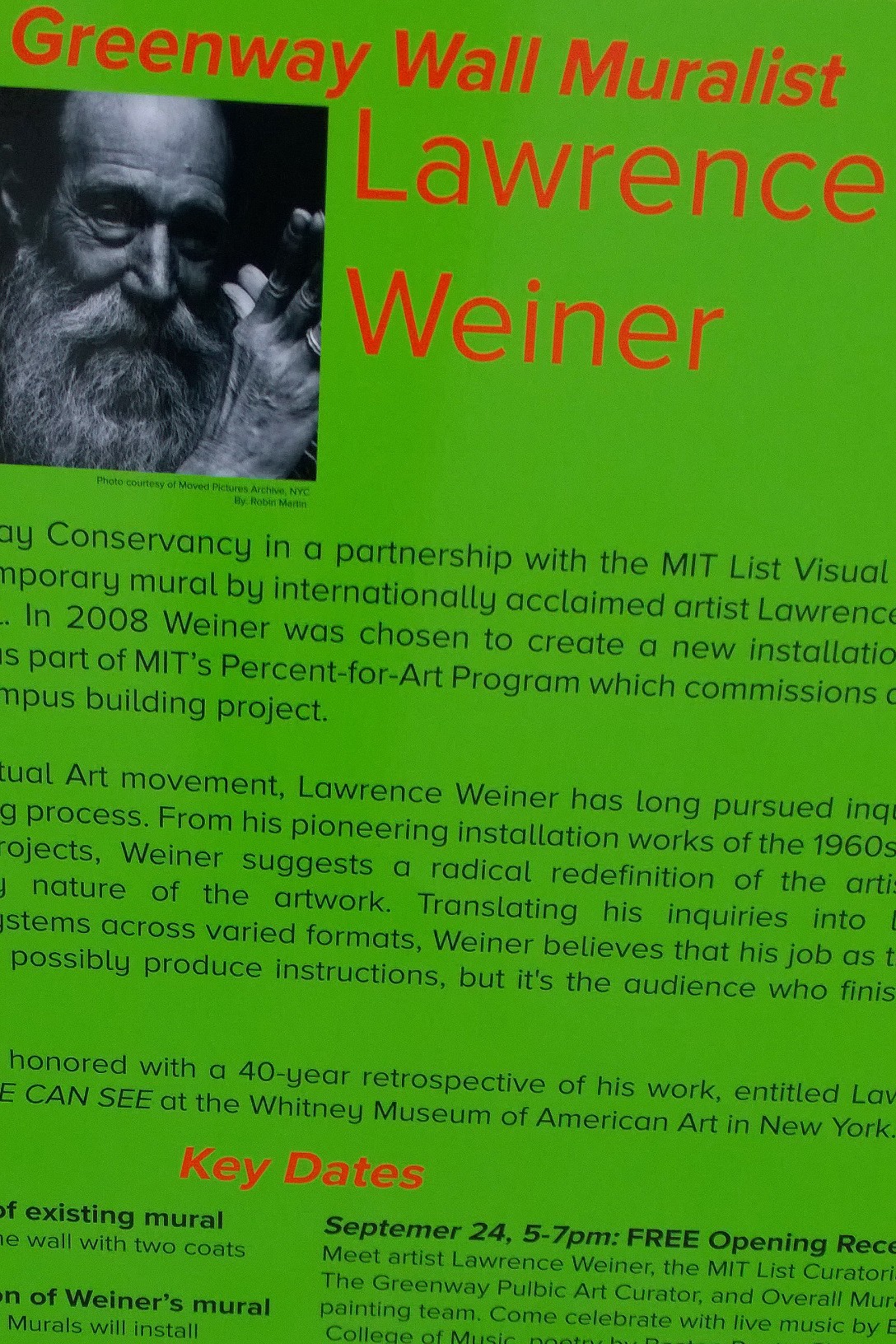
The latest Greenway mural in Dewey Square comes courtesy of MIT’s List gallery and is the work of Lawrence Weiner.  I admit to liking it even though it seems to be nothing more than bright orange letters on a blue background, with words saying, “A translation from one language to another.”

I am letting it sink in. Perhaps it’s about the translation from the artist’s idea to a work that others see. Perhaps something is lost in the translation. Perhaps it’s about how differently we understand one another, even without so-called language barriers.

Here’s what the Greenway writes, “Lawrence Weiner is considered a key figure in the Conceptual Art movement, which includes artists like Douglas Huebler, Robert Barry, Joseph Kosuth, and Sol LeWitt.

“A primary motivating factor behind Weiner’s work is the desire to make it accessible, without needing to purchase a ticket or understand a secret visual language. He contended that language reaches a broader audience, and situating language in contexts outside traditional art-viewing settings, such as art museums, furthers that reach.

“Thus, he began creating works consisting of words and sentences or sentence fragments that he displayed in public spaces, books, films, and other accessible media, as opposed to the cultural institutions that might deter broad and diverse viewership. Click here for an interview with Lawrence Weiner.” More at the Greenway site.

Malcolm Gay at the Boston Globe adds, “For Weiner, the work is less about art historical knowledge, outrage, or relating to other people. It’s about a viewer’s individual response to an object in the world — an object that’s been created by another person.

“ ‘Our job is not to throw things at people,’ he said. ‘The work doesn’t exist unless somebody decides to deal with it. You can pass it on your way work, and it’s not going to screw up your day. But if you pay attention to it, it might screw up your life.’ ”

092515-dewey-sq-list-gallery-mural

092515-Lawrence-Weiner

Read Full Post »

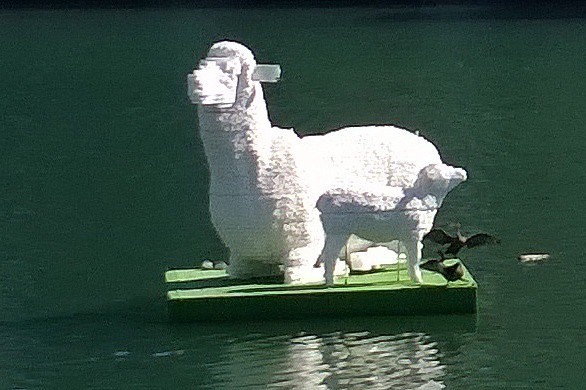
Today I sat on a shady bench next to Fort Point Channel and ate my Vietnamese noodles from the food truck. In front of me, floating on a green platform visited by cormorants, were two sheep — a big one and a small one. As the breeze and the tide nudged the platform, it turned slowly, showing the sculptures with different shadings and from different angles.

Steve Annear at the Boston Globe says, “The installation, called ‘Who Wears Wool,’ was created by artist Hilary Zelson, and pays homage to the Fort Point area’s former wool trade. … Earlier this year, FPAC [Fort Point Arts Community] put out a request for proposals seeking an artist who could weave together a prominent display connecting the neighborhood’s arts community with residents and visitors.  …

“For the project, Zelson said she layered EPS foam — or expanded polystyrene — to create the bodies of the sheep. The layers are held together with a spray adhesive, and the sheep are bolted to the dock with an armature of steel rods. Once built, the sheep were covered in packing peanuts to create the look of wool, before the entire thing was covered with a white acrylic latex coating …

“Zelson started working on the project in August. The first six weeks alone were dedicated to planning, she said.

“ ‘Once I was able to get the foam to my studio, I was working seven days a week,’ she said. ‘It was probably a 300-hour project.’ … The project — from the 3D renderings to the welding to the stacking of foam — was documented on Zelson’s Instagram account”

More here.

What I see in my photo are a ewe and a lamb — and cormorants.
100715-sheep-sculpture-ft-pt-channe;l

Read Full Post »

In 2007, conceptual artist Yoko Ono established the John Lennon Peace Tower in Iceland, a beam of multiple, heaven-directed lights that is intended to appear every year from John Lennon’s birthday, Oct. 9, to Dec. 8. It was most recently relit in 2014.

Wikipedia says, “The Imagine Peace Tower (Icelandic: Friðarsúlan, meaning ‘the peace column’) is a memorial to John Lennon from his widow, Yoko Ono, located on Viðey Island in Kollafjörður Bay near Reykjavík, Iceland.

“It consists of a tall tower of light, projected from a white stone monument that has the words ‘Imagine Peace’ carved into it in 24 languages. These words, and the name of the tower, are a reference to Lennon’s peace anthem ‘Imagine.’

“The Tower consists of 15 searchlights with prisms that act as mirrors, reflecting the column of light vertically into the sky from a 10-metre wide wishing well. … The power for the lights is provided by Iceland’s unique geothermal energy grid. It uses approximately 75 killowatts of power.

“Buried underneath the light tower are over 1 million written wishes that Ono gathered over the years in another project, called Wish Trees. … Iceland was selected for the project because of its beauty and its ecofriendly use of geothermal energy.” More at Wikipedia.

Says the Peace Tower website: “One of the mesmerising features of the Imagine Peace  Tower is that the strength, intensity and brilliance of its light continually changes with the prevailing weather and atmospheric conditions unique to Iceland – creating a clear pillar of light on a cloudless night, beams irridescing with rainbow refractions in rain or snowfall, and brilliantly reflecting off and through any moving layers of cloud.” More.

Photo: McKay Savage
“Imagine Peace” Tower

Read Full Post »

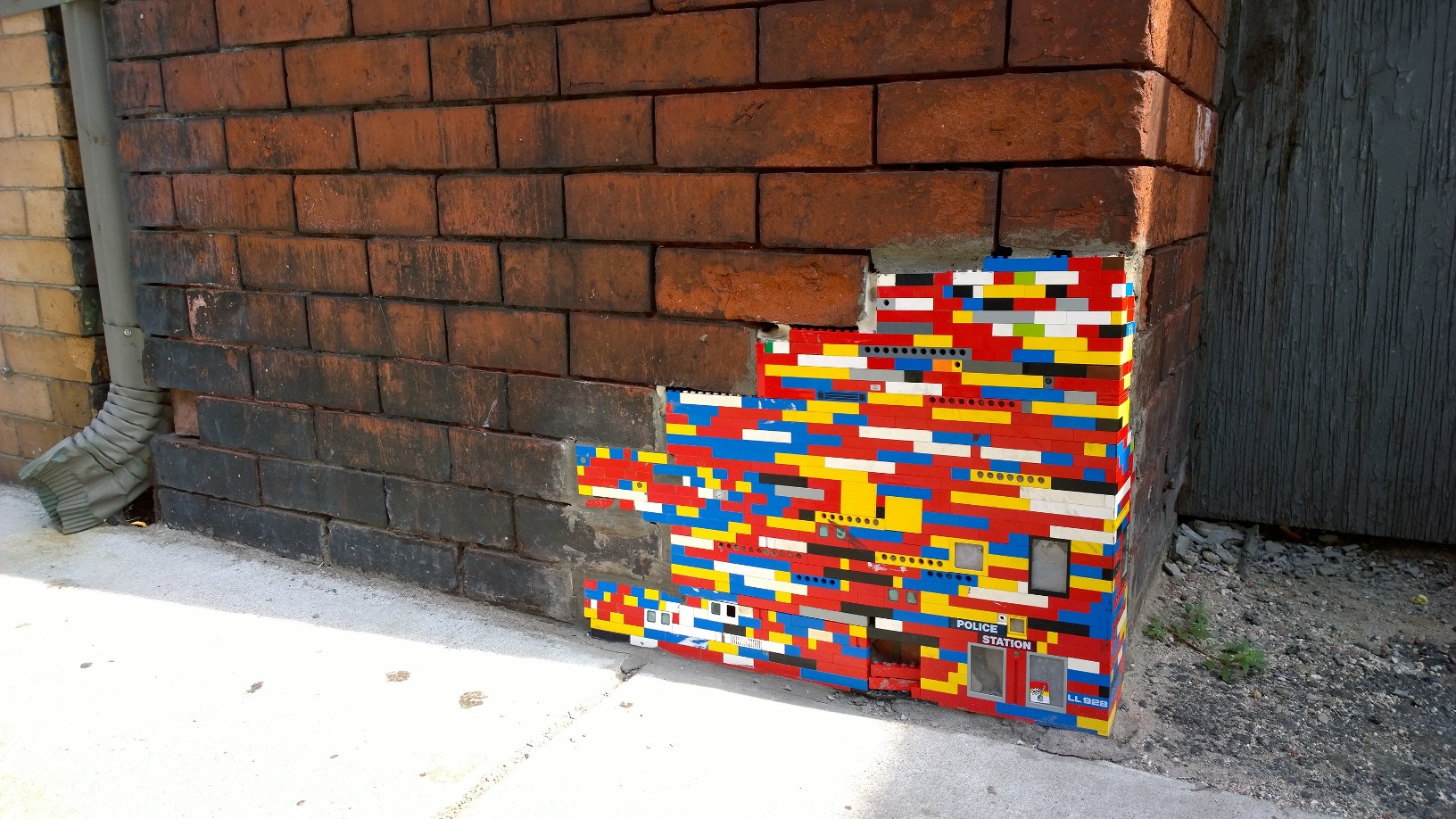
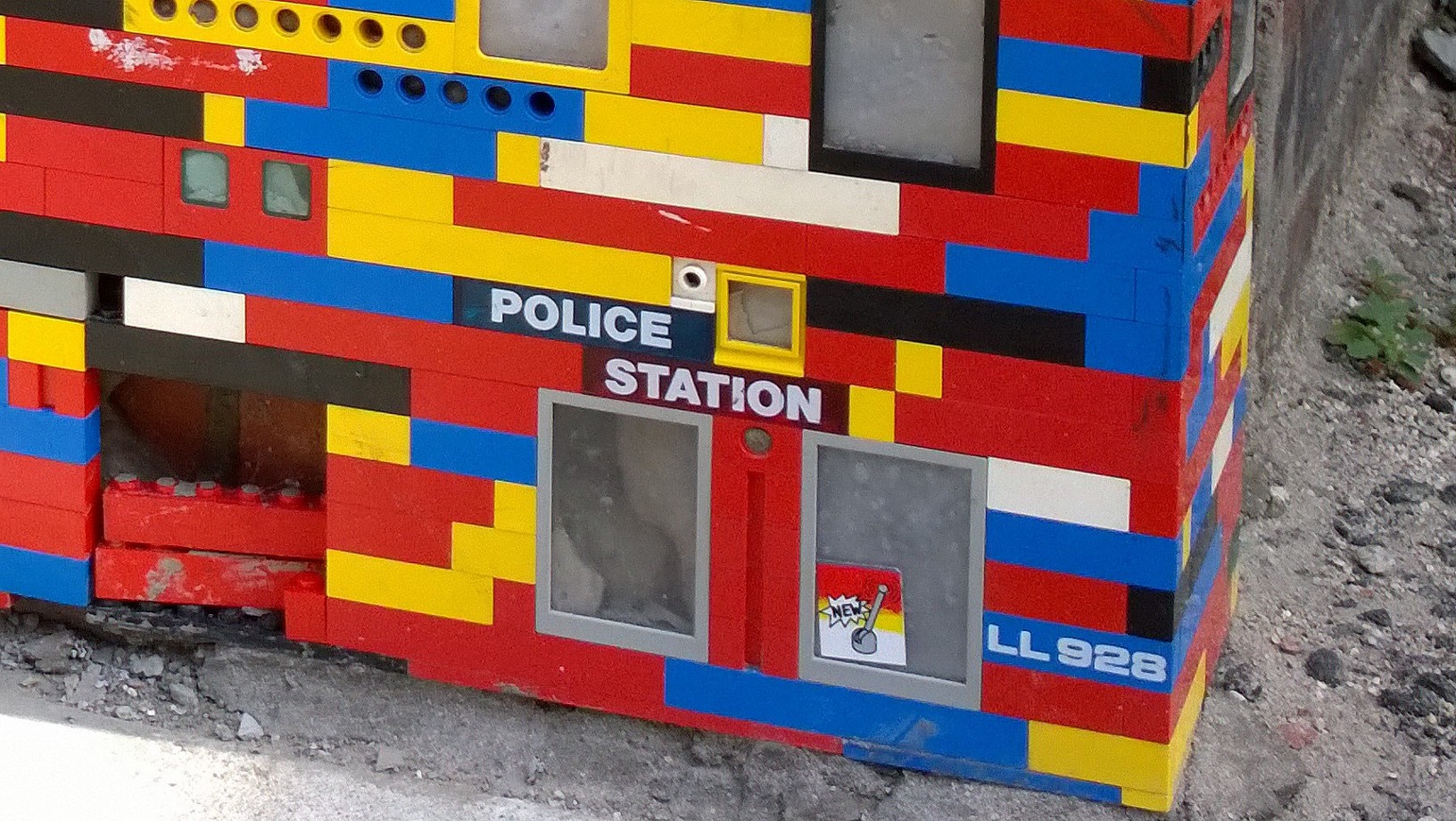
On the corner of Congress and Farnsworth, there is a parking lot, and on the Fort Point Channel side of the parking lot, there is a Lego-size police station. In case you are ever lost around there and need to ask for directions. If LL Bean is more your thing, there’s one by the parking lot, too. I took two pictures.

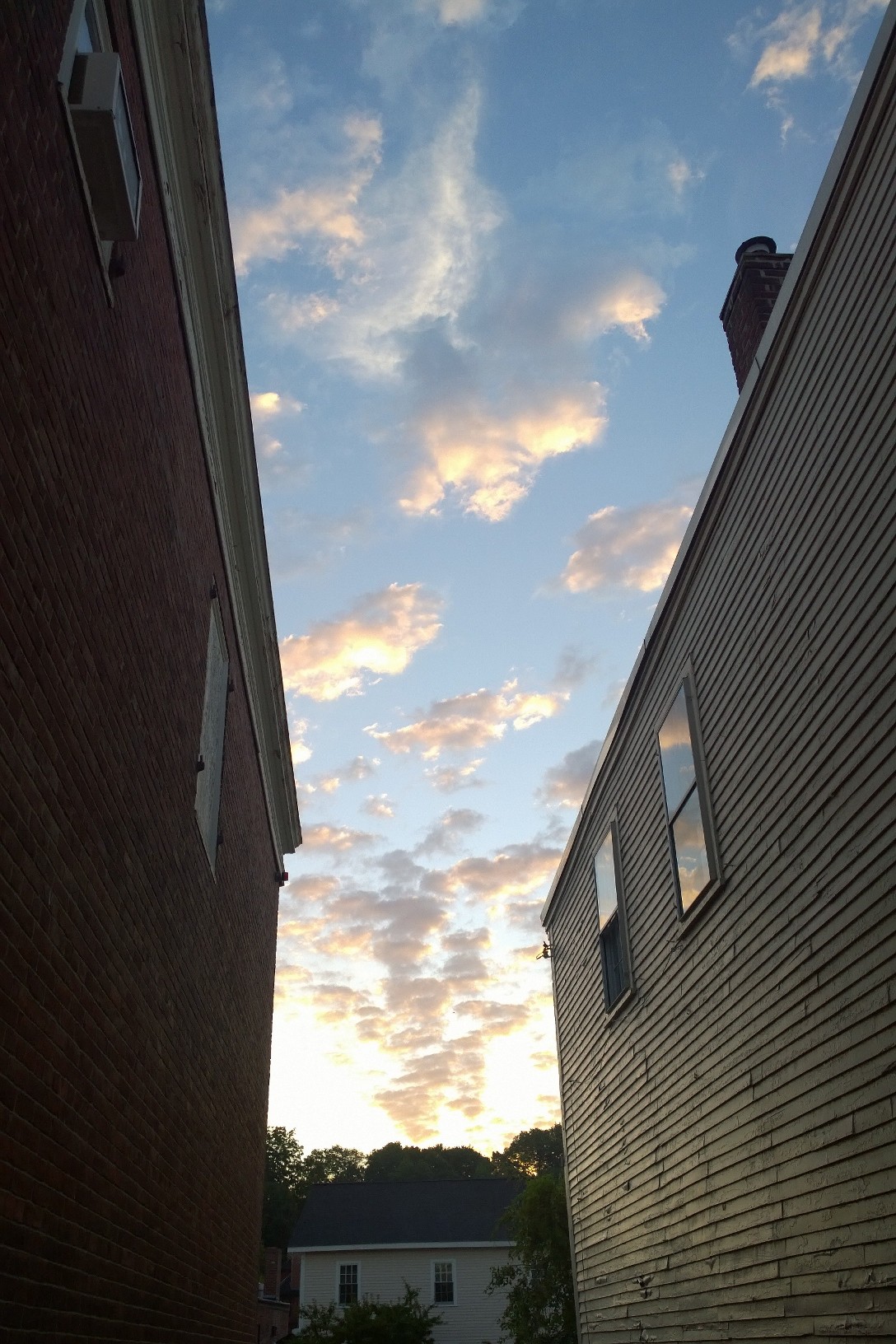
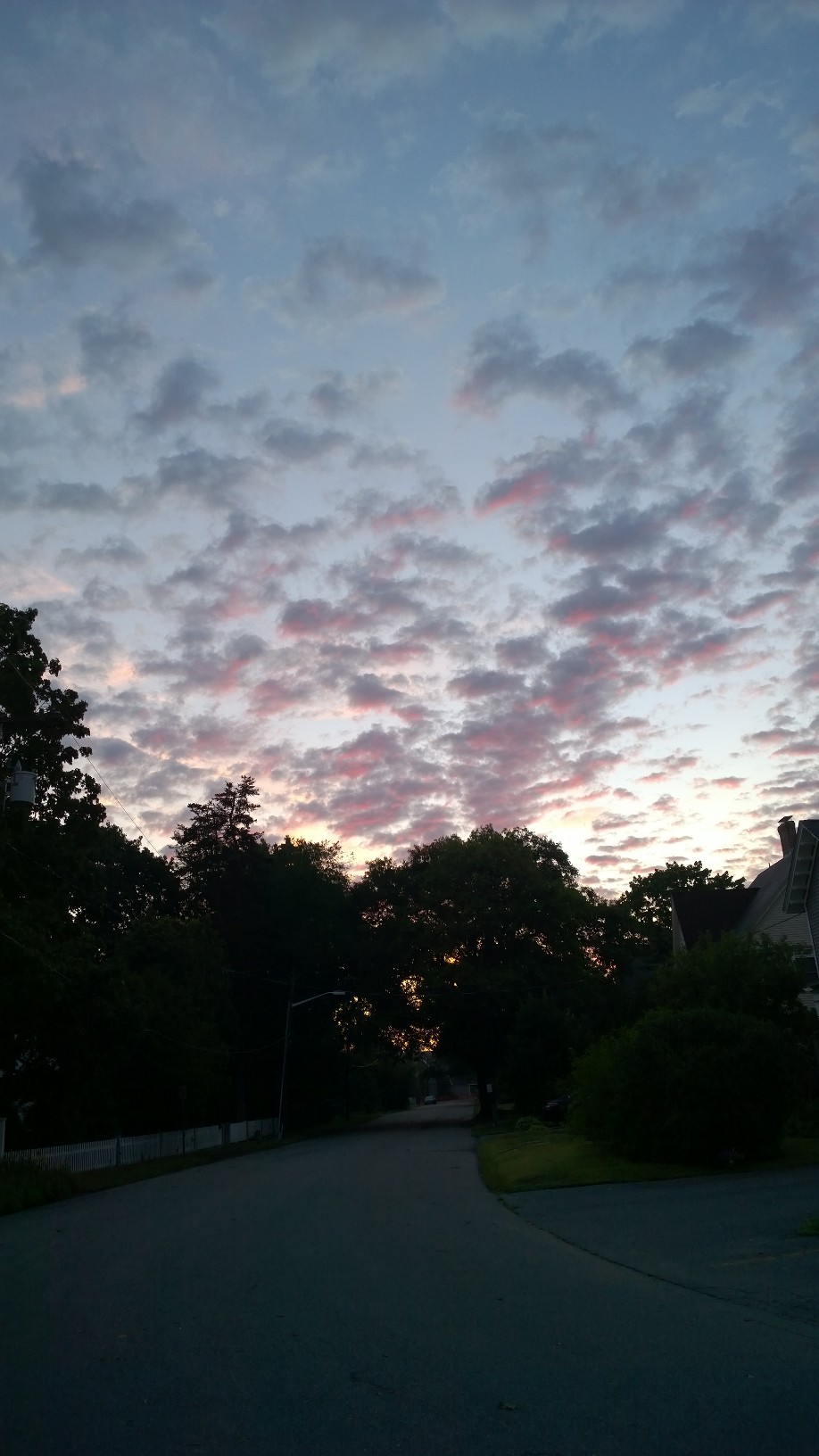
The clouds at dawn have been especially good lately. I include two shots in case you are not up early. Roses need no elaboration, but I am quite proud of how the yellow mullein turned out the second time I tried to capture it. A granddaughter was with me at the time, in the stroller.

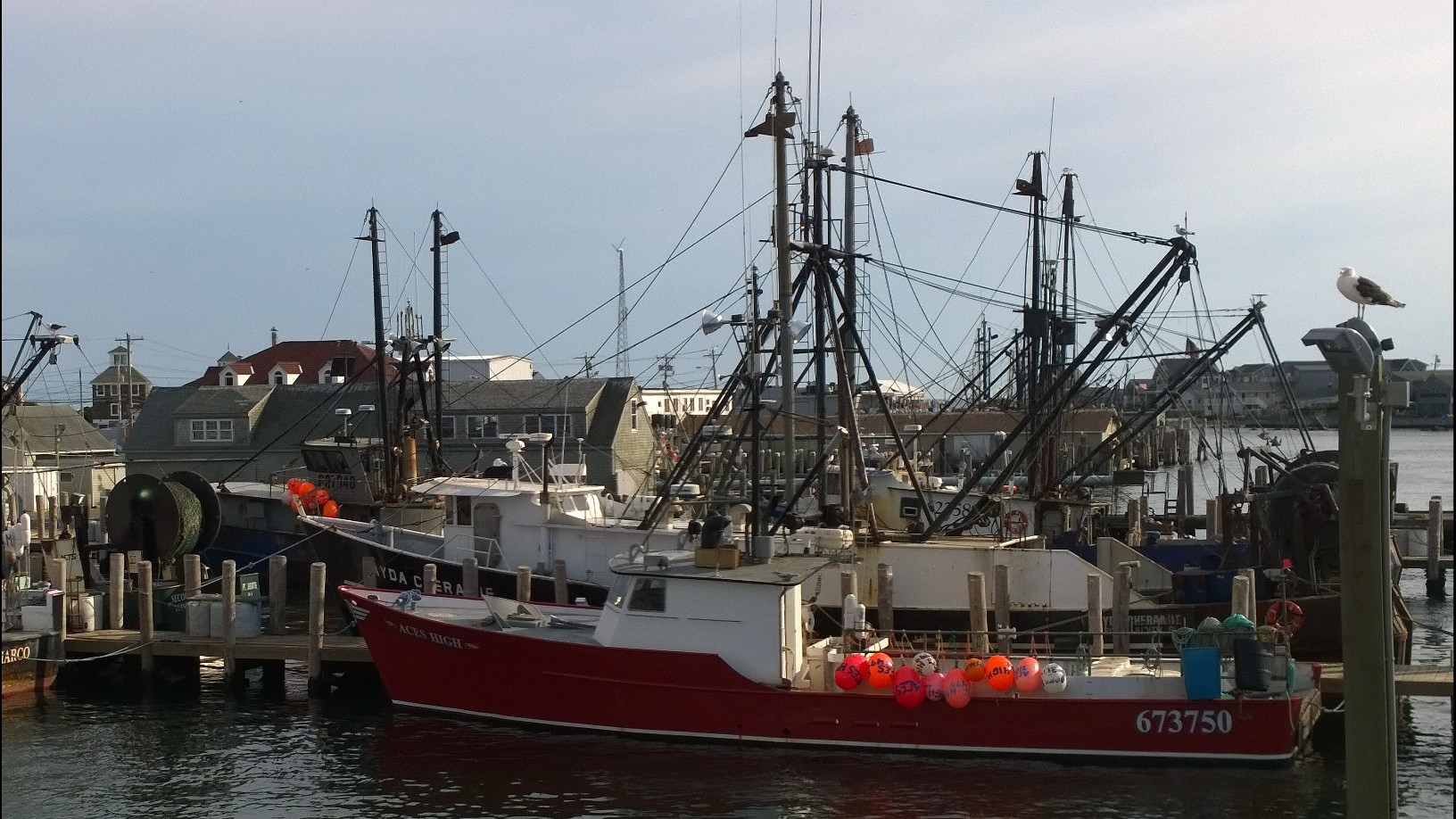
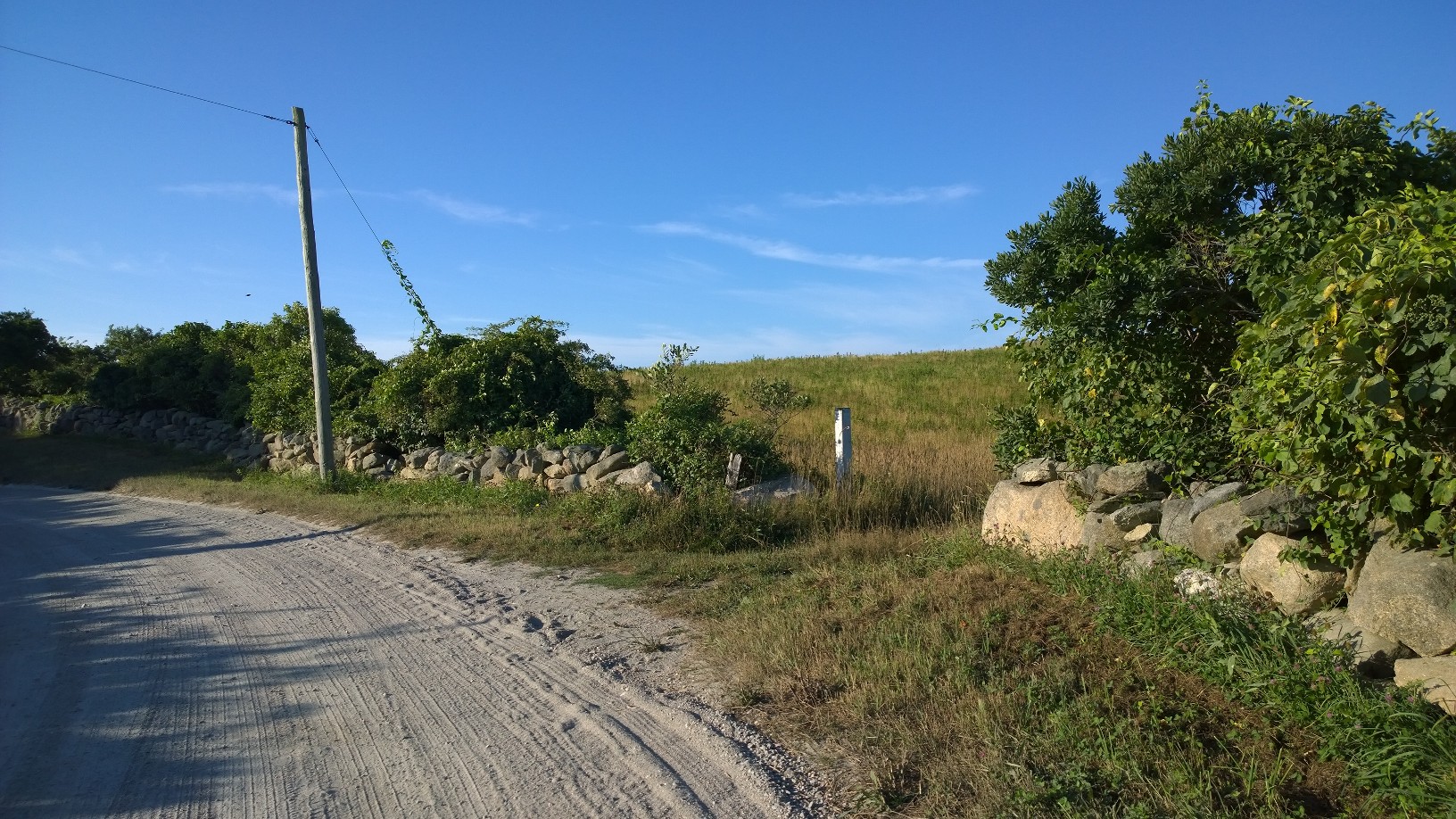
Moving right along, there is a shot of the fishing fleet in Rhode Island. The country road photo was supposed to show you a goldfinch, but even when I zoom in, it is too tiny to see. The still pond is called John E’s Tughole. A tughole is a place where peat is harvested, but I don’t think it happens much anymore. Maybe in Ireland. I know James used to harvest peat. And burn it, too.

080415-legos-built-into-corner

080415-Congress-St-nr-Farnsworth


080515-clouds-between-bldgs

080515-clouds-Concord-dawn


080815-rose-and-hydrangea

080315-mullein


080715-Point-Judith-boats

080815-dirt-road-RI


080815-John-E-Tug-Hole


Read Full Post »

Older Posts »