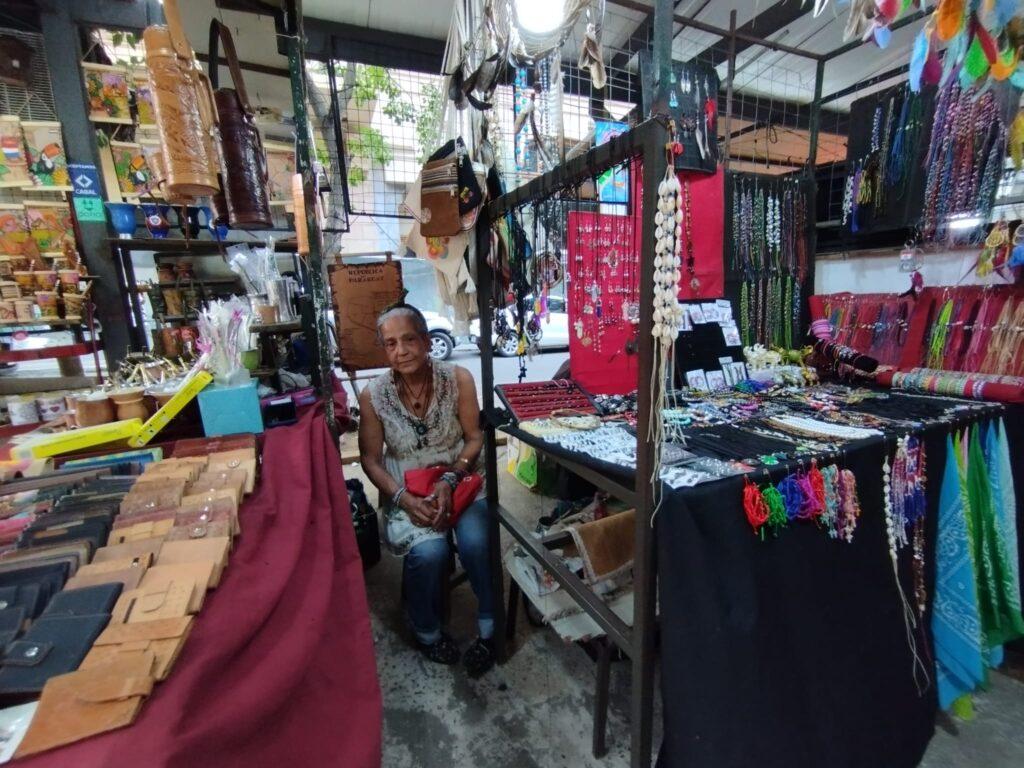
Photo: Michael Fox/The World. Rita Álvarez has been selling handicrafts and homemade jewelry on the streets of Asunción, Paraguay, for more than 40 years. She said that most of her customers in the city speak a combination of Guaraní with Spanish.
Most of our stories on indigenous languages are about struggles in the face of looming extinction.
It’s different for an indigenous language called Guaraní in Paraguay. Michael Fox reports on the phenomenon at Public Radio International’s The World.
“Tomas Zayas, who lives in the Paraguayan countryside, spoke only the Indigenous Guaraní language until he was 22 years old.
“Later, he started to speak Spanish to be better prepared as a community leader. But Guaraní has remained his main language.
“ ‘For me, Guaraní is identity,’ said Zayas, a longtime campesino leader with the Alto Parana Small Farmers Association. ‘It’s happiness. It’s beauty. Because a joke in Spanish isn’t funny at all.’
“The Guaraní language, along with its many dialects, comes from the Indigenous Guaraní people who have lived in this region since long before the Spanish conquest.
“Today, nearly 300,000 Indigenous Guaraní still live in Paraguay, Brazil, Bolivia and Argentina. In some of these countries, their language has influenced Portuguese and Spanish.
“But in Paraguay, Guaraní is spoken as an official language alongside Spanish. Most Paraguayans speak Guaraní or a mixture of Spanish and Guaraní as their first language, whether they are of Indigenous descent or not.
“Although there are several theories about how Paraguayans have been able to preserve their Indigenous language, one that stands out focuses on the Triple Alliance War of the 1860s.
“Most of Paraguay’s male population was killed after Brazil, Argentina and Uruguay invaded the country. ‘As a question of survival, the women who were left would only speak Guaraní,’ Zayas said. ‘They passed it on to their children.’ …
“But many Paraguayans say that Guaraní is a language of metaphor and beauty.
“Rita Álvarez has been selling handicrafts and homemade jewelry on the streets of Asunción, Paraguay’s capital, for more than 40 years. ‘For me, it’s the sweetest language,’ she said. ‘Because you can say with one word in Guaraní what you would need 10 to say in Spanish.’
“She said that most of her customers in the city speak a combination of Guaraní with Spanish, or jopara, which means ‘mixture’ in Guaraní. …
“Blanca Estela González is a retired elementary schoolteacher who now teaches Guaraní at IDIPAR Language School in Asunción.
“Gonzalez said that foreigners often pick up Guaraní rather quickly, because, unlike Spanish, there are only three types of verb conjugations: past, present and future. And Gonzalez said the language has received a boost in recent decades.
“ ‘Now, it’s an official language,’ she said. ‘And half of the lessons at the public schools are taught in Guaraní.’ ” More at The World, here.
Happy New Year to all blog friends, whatever language you speak. Any plans for celebrating?
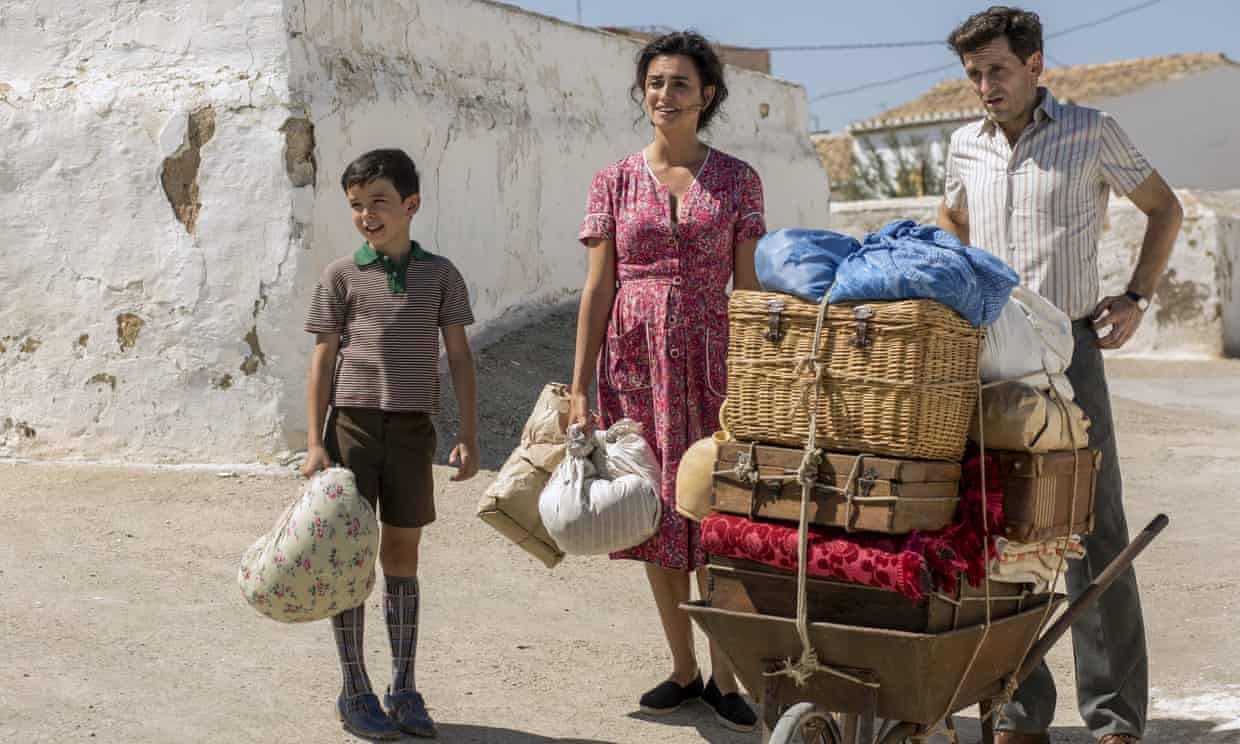
Photo: Sony Pictures Classics/Manolo Pavon/Allstar. From left: Asier Flores, Penélope Cruz, and Raúl Arévalo in a scene from Pain and Glory (2019), a film by Pedro Almodovar.
Today’s story is about how Spanish film director Pedro Almodóvar wrote a collection of short stories as a kind of memoir. And it zeroes in on his mother’s influence on his life’s work.
Sam Jones writes at the Guardian, “One day when he was nine years old and living in a small Extremaduran town of makeshift adobe houses, steep slate streets and dusty, meagre horizons, Pedro Almodóvar caught his mother out in a lie.
“The family had recently moved south from La Mancha and Francisca Caballero was making ends meet by reading and writing letters for her illiterate neighbors. As he read over his mother’s shoulder, Almodóvar realized the words on the page did not correspond to the words on her lips.
“ ‘She was improvising and saying things that weren’t in the letters,’ he says. ‘My mum knew all the neighbors – she knew the grandmother and the granddaughter and how they got along. And so she made stuff up. For example, if she noticed that no one had asked after the grandmother, she’d say, “I hope Granny is very well and knows that I think about her a lot.” That wasn’t in the letter.’
“When they got home, he asked why she had made up the reference to the grandmother. His mother looked at him and replied: ‘Did you see how happy it made her?’
“At the time, Almodóvar was most struck by the fact of the lie. But, as the years passed and he began writing stories on the Olivetti typewriter his mother gave him when he was 10, he came to understand the meaning of her actions. ‘I realized just what a huge lesson she’d taught me: that life needs fiction to make it bearable. We need fiction so that we can live a bit better.’
“The truth his mother imparted that day lies at the heart of El último sueño, the short-story collection-cum-memoir now published in English as The Last Dream. Almodóvar, 74, has travelled an almost unfathomable distance from the house in Orellana La Vieja whose bare earth floors would turn to mud under his mother’s mop. The smart central Madrid offices of his production company, which sit near a yoga studio and a short walk from the neo-Moorish splendor of the city’s Las Ventas bullring, are lined with film posters – Tie Me Up! Tie Me Down!, High Heels,Live Flesh, All About My Mother, Volver – that describe a singular director now in the sixth decade of his career.
“Just as those films have become time capsules of his life and his era, so the dozen stories that make up The Last Dream, which has been translated by Frank Wynne, are snapshots of his development as a person, a writer and a filmmaker. … There are fictional tales of misfits, outsiders, actors and the odd supernatural entity.
“One tells of a writer whose life is lived backwards, beginning with his burial … another of a wounded soul out for revenge on the priest who abused them as a child; another of a world-weary vampire seeking solace in a monastery. There is a cult film director in the throes of a crisis … and, at the book’s conclusion, a melancholic sense of the director’s retreat from the hedonism and delightful chaos of the 1970s, 80s and early 90s, as chronicled in his early films. …
“A mix of fiction, observation and autobiography, the collection exists largely thanks to the care and efficiency of Almodóvar’s long-serving assistant Lola García, who assiduously grabbed and filed the pieces over the decades, preserving them from house move to house move. Some were written in his late teens and early 20s, others during his first years in Madrid, and some as recently as last year. …
“As the collection progresses, you can almost see the artist develop: the kitsch, riotous and transgressive early work giving way to something calmer, sadder and increasingly self-reflective. Over the course of 211 pages, the exuberant, coal-haired enfant terrible of Spanish cinema becomes the salt-and-pepper-haired auteur of the late 90s and then, finally, the thoughtful, white-haired sage who sits on the other side of the desk on a merciless Madrid summer afternoon and explains, over bottled water, why the 12 tales tell a more honest story than would a straightforward memoir.
“ ‘There’s a biographical line that runs through them, even though some of them are pure fiction,’ he says. ‘It’s a way of looking back at something I found interesting, because I recognized myself in all those stories: even if some were written when I was 17 or 18, I’m still the same person. Yes, things change, time passes and biology changes – there’s nothing you can do about that – but I’m exactly the same person now as I was when I came to Madrid forty something years ago.’ …
“Although Almodóvar is modest about his literary abilities, writing was his initial vocation and one that he has pursued from the early days of tapping away on his Olivetti ‘under a grapevine with a skinned rabbit hanging from a string, like one of those revolting flycatchers,’ to the scripts he wrote on the sly while working for Telefónica in Madrid.
“ ‘I’ve wanted to write from the very beginning, and I thought about devoting myself to literature, but from the time I was about 18 or 19 – when I’d bought a Super 8 camera – I immediately turned all those literary ideas into images,’ he says. ‘I also discovered that I was better at telling stories with images than with words. Very often, I’d start writing a story but it would end up as a film script.’
“Cinema had long been an escape from the claustrophobic confines of his provincial upbringing. ‘I’d already learned from living in small communities that I was different,’ he says. ‘People made me see that I was different. Life there horrified me. I started going to the cinema when we lived in Orellana and I continued going when we moved to a nearby village. From the moment I discovered cinema, I discovered a parallel reality that interested me far more than daily reality.’ …
“ ‘My references still come from outside – from a book I read, or a conversation I overhear, or something I see on TV – but over the past few years, I’ve been resorting much more to myself as inspiration,’ he says. ‘Well, perhaps not for inspiration, but as a document store.’ …
“That autumnal, autobiographical approach is most apparent in the collection’s titular story, which sees Almodóvar seeking to make sense of his mother’s life, death, and the epiphany contained in her embellished letter readings. The Last Dream is also a letter of love, gratitude and a belated effort to settle an old debt.
“ ‘My mother always used to get very worked up when people talked about Pedro Almodóvar or just Almodóvar,’ he remembers. ‘She used to say, “You’re Pedro Almodóvar Caballero because I’m the one who gave birth to you!” She wanted me to use my full name in my films.’ …
“Better late than never – the six pages that make up ‘The Last Dream’ are signed: Pedro Almodóvar Caballero.”
Former Minnesota Twin Brian Dozier’s trading card on eBay.
Both Asakiyume and I work with Spanish-speaking students who are learning English, but she has gone above and beyond in her efforts. She learned Spanish on Duolingo and began listening to Spanish songs in order to connect better with high school students.
I know that Tina, who’s in one of the classes where I volunteer, is getting impatient with me for not doing the same after four years, but if I decide to learn a language, it’s going to be Swedish. So I can understand what Erik is saying to my grandchildren.
Barry Svrluga reports at the Washington Post about a baseball player who was more like Asakiyume in this regard.
“Brian Dozier had 4,900 major league plate appearances, and only 482 of them came with the Washington Nationals. When he retired from baseball last month, he did so as a Minnesota Twin, the team that drafted him, developed him, brought him to the big leagues and made him an all-star.
‘I think we, as Americans, need to take it upon ourselves to say, “Hey, these guys are going to be playing for a championship just like us, and you need real camaraderie to make that happen, and in order to have that, we need to take it upon ourselves to learn Spanish,” ‘ Dozier said. …
“[Baseball is] a team sport, and in some ways — ways as undeniable as they are difficult to pin down — team dynamics matter deeply. Baseball players spend ungodly amounts of time with one another, from early in the afternoon until late at night, on buses and planes, in hotels and restaurants (at least when there’s not, um, a pandemic), for eight months of the year. They come from backgrounds both affluent and poor. They are Black and White, American and Asian and Latino.
“That last part, it’s important. According to data released by Major League Baseball, nearly one in four players on 2020 Opening Day rosters or injured lists came from a Spanish-speaking country. That would affect any company trying to get its employees to work together, so it has to affect baseball teams.
“ ‘There’s so many times where things have gotten lost in translation,’ Dozier said. ‘Just small stuff, on the field, off the field, in the dugout, in the clubhouse. And all you need — it could be one word. An expression. It could be anything.’ …
“ ‘There were so many great guys that I became friends with, but I really couldn’t break that real true friendship barrier,’ Dozier said by phone last week, ‘because you couldn’t really communicate in the way that you need to communicate in to have that real bond.’
“Dozier had no experience with Spanish, but he took up Rosetta Stone, the language immersion software, and began teaching himself after ballgames and on bus rides. He learned the basics, but there were issues.
” ‘Rosetta Stone kind of taught you the proper way to speak Spanish,’ Dozier said, ‘but not the slang you use in the clubhouse.’
“During one of his offseasons in the minors, he played winter ball in Venezuela. Around that same time, he met Eduardo Escobar, who was new to the Twins organization. They didn’t know they would play seven years together. Still, they made a decision: make each other better.
” ‘I taught him English,’ Dozier said. ‘He taught me a lot of Spanish, just how to communicate day in and day out and stuff like that. I took it upon myself to start reading books on planes and bus rides just to kind of teach myself more. And then obviously the best way to learn it is being around it every day and actually using it.’
“A funny thing then happened for Dozier: He became friends — close friends — with many of his Latin teammates. Go figure. Escobar, now with the Arizona Diamondbacks, missed the beginning of a team meeting last week to call into Dozier’s retirement ceremony. ‘I call him one of my best friends to this day,’ Dozier said.
“[Major League Baseball] has come miles and miles in fostering a more welcoming culture for its Latin players. Most clubs offer some sort of Spanish instruction, and MLB has mandated that each team designate an interpreter so players who aren’t comfortable speaking English can conduct interviews and therefore convey their thoughts and personalities to largely English-speaking fan bases.
“But Dozier’s approach is the right one. Why not meet teammates where they are, making them comfortable rather than demanding they conform — or at least allow them time to develop? …
“Dozier took the time. And now, even though he was in Washington for just one season, his imprint remains here. Not because of much that he did with his bat or glove. But because when the Nationals celebrated their postseason victories, there was Dozier — bare-chested, in the center of a group of Latin players — crooning the song ‘Calma’ by Puerto Rican star Pedro Capó, which became the Nats’ anthem.”
Photo: American Theatre A scene from “Mentiras Piadosas,” by the troupe Los ImproDucktivos. That’s the audience watching from behind the Venetian blinds.
Now from Spain comes micro theater, 10-minute plays that allow you to stand in the same room with the actors.
Felicity Hughes writes at American Theatre, “On a rainy Thursday night in Madrid the bar of Micro Teatro Por Dinero is packed with a young crowd of theatregoers waiting to catch a short performance in one of the five tiny rooms in the venue’s basement. When our number is called, we’re led into a small dark room where the audience sits pressed up against each other sardine fashion on tiny stools.
A door is flung open, immediately breaking the fourth wall as a distressed young man stumbles in and sits down on my knee in floods of tears.
“ ‘Never before has there been a theatre so close, so intimate, and so open — there are no preconceptions, no limits, no censure,’ says Miguel Alcantud, the inventor of micro teatro, an abbreviated form of theatre. …
“The concept has since become so popular that the Micro Teatro Por Dinero franchise has been sold to venues in 15 different cities around the globe, including Buenos Aires, Mexico City, Lima, Lebanon, even Miami. …
“ ‘The cost of putting on a show is very small, and we change the program every month,’ Alcantud continues. ‘We don’t mind if the piece works or doesn’t work, because we’re always putting something new on. The commercial success of a single show doesn’t matter so much.’ …
“ ‘You feel as if you’re breathing alongside the public and they’re breathing with you,’ says [Juan Carlos Pabón, a Venezuelan actor]. ‘We’re dealing with a lot of emotion inside a scene and a lot of attention. There’s not as much artifice, so it’s a tough discipline; the public are really concentrating on you, and notice the good along with the not so good.’ ” More here.
The director in Miami says audiences seem to prefer comedies to dramas. I can see why. If you are going to be that up close and personal with strangers, you probably want keep things light.
John is a great source for articles on cutting-edge technologies. He sent me this one Thursday about using plants to make electricity. The students in Spain who designed the technology are nothing if not ambitious. Their goal is to have the whole world covered in trees making electricity. You can watch their video, below, or bear with me as I channel Google Translate’s English rendition of a Spanish blog post.
Angela Bernardo, at Blog Think Big, says, “Thanks to Bioo system, created by the students of the Autonomous University of Barcelona and Ramón Llull University with the startup Arkyne Technologies, families could cover their basic electricity needs through 10 × 10 meters of vegetation panels. But how?
“The prototype initially created by the students of the UAB is a plant in a pot that lets you charge a mobile phone. … According to the explanation for the 4YFN space last Mobile World Congress in Barcelona, the system ‘generates power 3-40 watts per square meter from some vegetable panels and a biological battery that takes energy waste (matter organic) that plants need not despise.’ [Oops: that has to be Google. Shall we change it to ‘plants don’t need’?]
“Thus, the device is able to steadily produce electricity through a self-supply system. In addition, according to the engineers, the operation does not affect the plants and is economical. …
“Students are betting on a ‘smart city’ concept that allows people using Bioo buy or sell electricity. The goal, in addition to developing these systems in homes, [is to extend them to] agriculture or green roofs of public buildings.”
Maybe you better watch the video. But there’s more here, if you read Spanish.
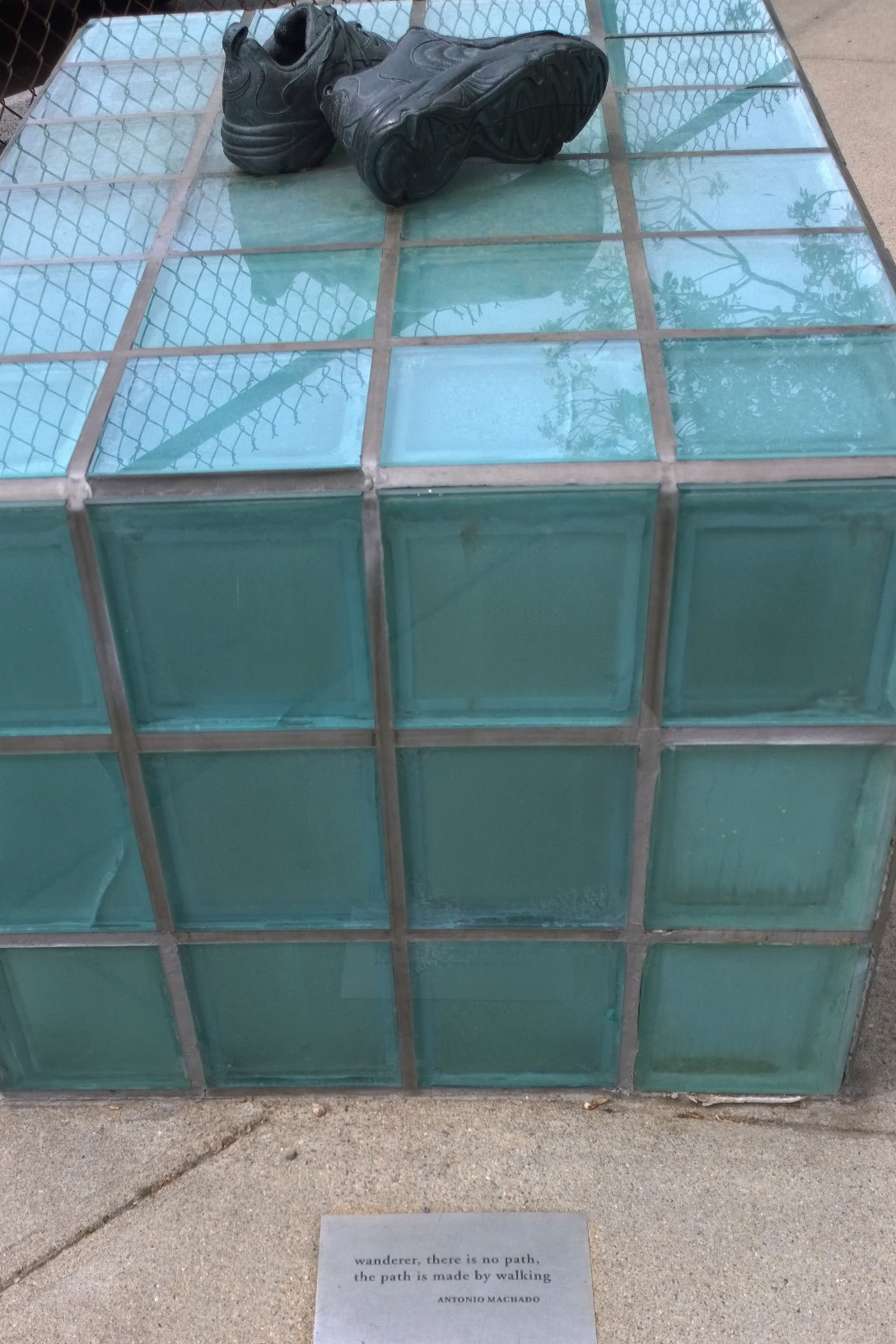
The plaque quotes the Spanish poet Antonio Machado, 1875-1939: “Wanderer, there is no path. the path is made by walking.” (The shoes are part of the sculpture.)
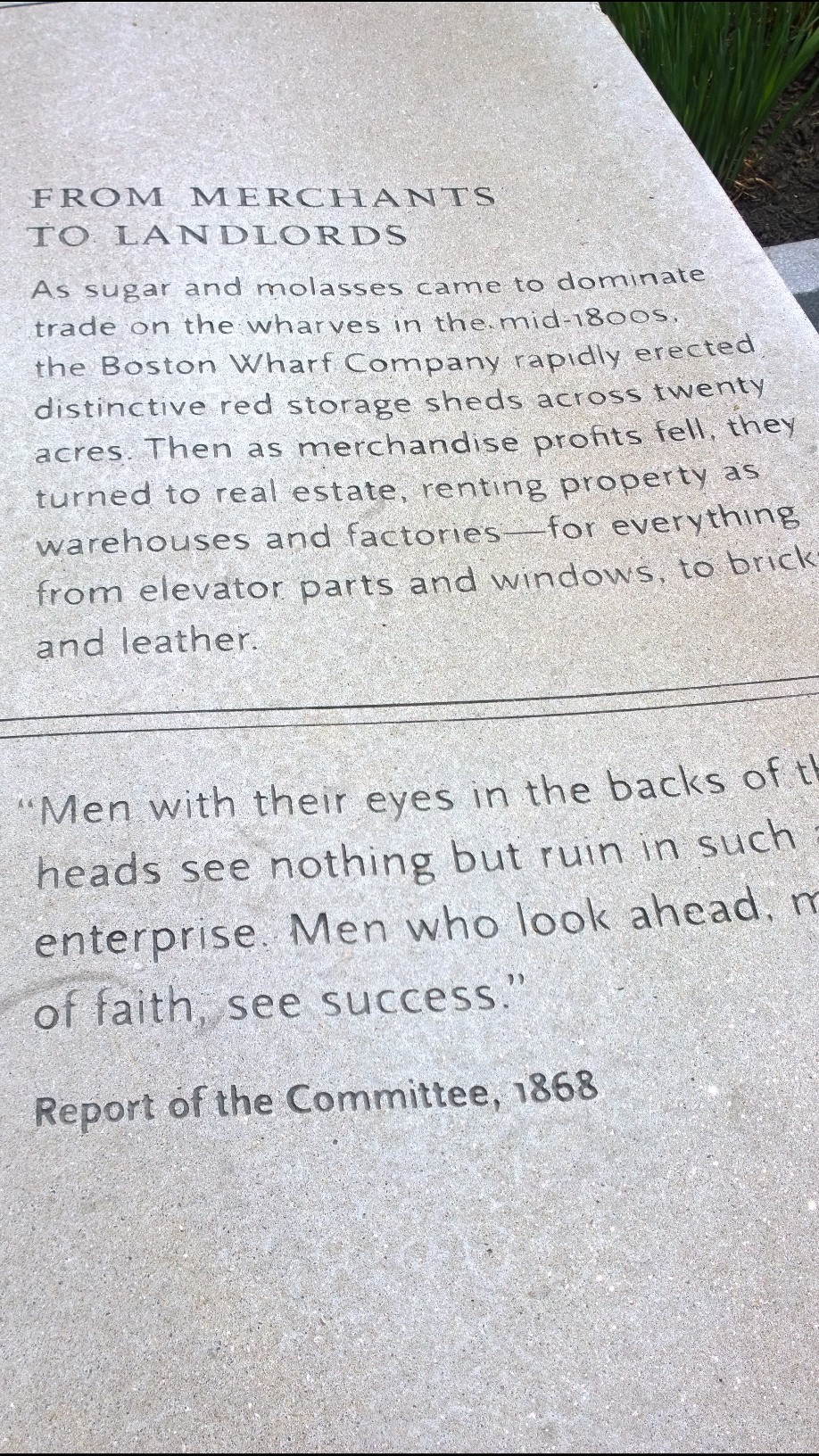
The line is metaphorical, of course, but I like treading a physical path with lots of photo ops while I’m working on the other path. It helps me think.
After work yesterday, I went with a colleague to observe a parent-engagement program organized by Lawrence Community Works (LCW) at the Oliver Partnership School, in Lawrence, Mass. I had long been interested in LCW’s use of circles to build a sense of community among strangers of very different backgrounds.
Lawrence is what is sometimes called a Gateway City, meaning it’s always been a gateway to the U.S. culture and experience for new waves of immigrants. It currently has a large Spanish-speaking Dominican population and foreign-born and native-born residents from all over.
The parent night was the third in a series. In the first two, facilitators had helped the participants to come up with agreed-upon ground rules (come on time, no cellphones, respectful attention to one another) and to choose an “obstacle” that they would like to address related to their children’s life at the school. They had selected recess, which is only 10 minutes. (Lunch is 15 minutes.)
Everything was conducted in both Spanish and English.
As the evening was getting going, Tony told me his children love school. He believes a good education is vital. He wishes he had more. He did learn Spanish and English in addition to his native Portuguese. The languages help him in his job working with troubled youth, a job he loves to go to every day.
In a warm-up exercise, we stood in a circle and stated our name, followed by our favorite fruit and the name and favorite fruit of everyone who spoke previously. It was fun and a great equalizing experience as anyone can be good at that and anyone can struggle with it. The people who went last had about 20 names and fruits to report and did really well despite language differences.
To discuss the recess issue, we separated into two groups — those who felt comfortable speaking English (which included the two teachers in attendance) and those who felt comfortable speaking Spanish. At the end we came together with the results of our investigation of three questions: why having a longer recess is important, why it might have been set up that way, and what parents themselves could do about it. (Asking the administration’s help was to wait for a joint meeting in June.)
I won’t make this post much longer, but I do want to say that I thought the way this was handled was very good. Parents appeared to feel that their opinions were welcome and that they could accomplish something. Continued engagement with them will be important as the work is a piece of a much bigger project by LCW that aims to help parents get skills for jobs. Unemployment is a serious issue in a city where many of the people are poor, have not had good educational opportunities, and are still learning English.
In Sweden, mangata is the word for the roadlike reflection the moon casts on the water. In Finland there’s a word for the distance reindeer can travel comfortably before taking a break: poronkusema. A terrific German word that people familiar with Concord, Massachusetts, will appreciate is Waldeinsamkeit. What do you think it means? Yep. “A feeling of solitude, being alone in the woods and a connectedness to nature.”
National Public Radio staff say: “Just as good writing demands brevity, so, too, does spoken language. Sentences and phrases get whittled down over time. One result: single words that are packed with meaning, words that are so succinct and detailed in what they connote in one language that they may have no corresponding word in another language.
“Such words aroused the curiosity of the folks at a website called Maptia, which aims to encourage people to tell stories about places.
” ‘We wanted to know how they used their language to tell their stories,’ Maptia co-founder and CEO Dorothy Sanders tells All Things Considered host Robert Siegel.
“So they asked people across the globe to give them examples of words that didn’t translate easily to English.”
I loved this report. You will, too. Read more at NPR, here.
Art: National Public Radio, “All Things Considered”








 Suzanne's Mom's Blog