Feeds:
Posts
Comments

Posts Tagged ‘sustainable’

In February, Treehugger posted an article on sustainable husbandry in Africa by Charlotte Kaiser, of the Nature Conservancy’s NatureVest arm.

“For thousands of years,” she writes, “the pastoralist communities of northern Kenya have herded their cattle alongside elephants and zebras, the grass of the rangelands shared between livestock and wildlife in relative balance. In recent decades, climate change, habitat loss, and human population growth have combined to erode that balance, leading to overgrazing and the degradation of the grasslands that both humans and wildlife need to survive.

“For over a decade, the Northern Rangelands Trust (NRT) has worked with the communities of Northern Kenya to develop community conservancies that support better management of cattle and grass. …

“A key tool in driving the better management of the rangelands is access to markets. … In 2008, NRT created the Livestock to Markets program (LTM), which brought the market to the Conservancies. In exchange for conservancies achieving specific targets in conservation, LTM buys cattle directly from the conservancies, purchasing several hundred head at a time from dozens of households. Providing access to markets allows pastoralists to better manage their herd sizes, since they know they can sell animals when they need to at a fair price. And LTM also encourages the herders to bank their cash, bringing mobile banking representatives to market days so herders can open bank accounts with the proceeds from the sale.

“Once the cattle are purchased, NRT treks the animals to Lewa Conservancy, a partner NGO. After six weeks of quarantine, the animals move to Ol Pejeta Conservancy, another partner, where they are fattened on grass for 15 months, improving the size and quality of the animals. Finally, the animals are [sold] into the Nairobi meat market. By capturing much of the full value of the supply chain, NRT can pay a levy on every animal they buy to the conservancies themselves. This levy funds conservancy investments in wildlife guards, ecotourism lodges, and community facilities like clinics and schools.” Check out the full article here, and the lovely pictures.

Photo: Ron Geatz
Livestock is the primary measure of wealth among herding communities of northern Kenya.

Read Full Post »

I learned about a sustainable, low-maintenance type of gardening from an article by Matthew Wilson in the Financial Times.

“Forest gardening is an ancient system with modern relevance,” he writes, “based on planting fruit, herbs and vegetables in distinct layer.

“This March marks the 15th anniversary of the death of Robert Adrian de Jauralde Hart, a man who quietly, and without outside recognition for much of his life, created a garden that was at once cutting edge but also rooted in ancient traditions and techniques. Hart was a pioneer in temperate forest gardening, and spent 40 years creating and tending to his eighth of an acre plot in Wenlock Edge, Shropshire.

“Hart had initially set out to make a traditional smallholding, with orderly beds of vegetables, a small orchard and assorted livestock. His aim was to provide healthy, health-giving food for him and his brother Lacon, who was born with severe learning difficulties and for whom Hart was the primary carer. Realising that the combined challenges of the smallholding and his responsibilities towards his brother were beyond him, he observed a planting of herbs and perennial vegetables in one corner of the smallholding that seemed to thrive in spite of a lack of intervention. Taking these observations further, Hart gradually converted the entire orchard into a forest garden, establishing one of the first prototypes for temperate climates.

“The principles of forest gardening are as ancient as the notion of cultivating plants for food. It is an agroforestry system, [composed] of planted layers with large trees at the apex and small, ground-covering herbs at the base. The spiritual descendants of ancient forest gardens can still be found across the world, in the ‘home gardens’ of Kerala, Zambia, and Nepal.” Read about how it works here.

Sometimes when you don’t have time to do things “right,” you discover shortcuts that work as well or better. Like boiling the corn cobs and the spaghetti together in the same pot.

Photo: Danita Delimont/Alamy
Avocado “family orchard” in Mexico

Read Full Post »

Looking through a pile of magazines recently, I found a 2011 newspaper article I had cut out about Hardwick, Vermont. It’s about reinventing the local culture around food and food-related businesses.

Dirk Van Susteren wrote at the Boston Globe, “If there were a ‘Locavore Capital of America’ one would expect it to be in sunny California or perhaps somewhere in the heartland … But, surprisingly, in rocky northern New England, just 45 miles from the Canadian border, is a place that could contend for that honor: Hardwick, a former quarrying town that until recently knew more pain than promise.

“In recent years Hardwick, population 3,200, located along a tumbling stretch of the Lamoille River, has seen a half-dozen innovative agricultural enterprises crop up, many with mission statements including such words as ‘community-based,’ ‘sustainable,’ and ‘organic.’

“The town, always a bit scruffy, and with a high jobless rate, might be on a green trajectory. And people are taking notice.

“Among the new operations here or in nearby towns: Jasper Hill Farm, which makes artisanal cheeses and provides aging, distribution, and marketing services to local cheesemakers; High Mowing Seed Co., an organic seed business, whose owner likes traveling around the country to tell the Hardwick farm and food story; Highfields Center for Composting, a soil-making business that collects its raw materials from restaurants, farms, and schools; Pete’s Greens, a CSA (community-support ed agriculture) farm that grows organic vegetables in gardens and greenhouses; and, finally, Vermont Soy, a tofu and soymilk producer.

“The area also has dozens of small-scale producers, from orchardists to maple sugarmakers. Their products sell at farm stands, at the summer farmers’ market, and at Buffalo Mountain Food Co-op and Cafe, a landmark in its 36th year. …

“Monty Fischer, the executive director of the Center for an Agricultural Economy, the nonprofit organization that helped spur these farm efforts, has kept count. ‘People from 40 states and 40 countries have come to ask about our agricultural cluster,’ he reports, from his downtown office.”

Read about the 2011 federal grant for the Vermont Food Venture Center, an incubator facility, the organic North Hardwick Dairy, where sunflowers are grown as a value-added crop, mead maker Caledonia Spirits, and more here.

And if anyone has been up there recently, I sure would love to know if the food culture is still going strong.

Photo: Wikipedia
North Main St., Hardwick, Vermont

Read Full Post »

Back in June, Jane Devlin tweeted a link to a story on a curious “urban algae canopy” designed for EXPO 2015 in Milan.

Ross Brooks wrote at Inhabitat, “The Urban Algae Canopy by ecoLogic Studio is a piece of bio-digital architecture that combines micro-algal cultures and real time digital cultivation protocols. To be displayed at Expo Milano 2015, the structure is able to control the flow of energy, water and carbon dioxide based on weather patterns, visitors’ movements, and other environmental variables. It’s the first of its kind in the world, and … will be able to produce the oxygen equivalent of four hectares of woodland, along with nearly 330 pounds of biomass per day.” More at Inhabitat.

DOMUSweb adds that Claudia Pasquero and Marco Poletto of ecoLogicStudio “proposed a new vision of future bio-digital architecture powered by microalgae organisms as part of the Future Food District project, curated by Carlo Ratti Associati at the central crossroads of the EXPO site. …

“The flows of energy, water and CO2 are … regulated to respond and adjust  to weather patterns and visitors’ movements.  As the sun shines more intensively, algae would photosynthesise and grow, thus reducing the transparency of the canopy and increasing its shading potential.” More from DOMUS.

Photo: ecoLogicStudio
Urban Algae Canopy

Read Full Post »

No matter how much you like your routine or how pleasant your surroundings, sometimes you just have to get up and go out. Today I needed a change of scene so, in spite of the freezing temperatures and high wind, I went to look at some art.

The Design Museum is not far from my office, and the folks there come up with lots of good projects. I blogged here about their Street Seats, an array of public benches designed by creative people from around the world.

This being Design Week in Boston, I decided to check out the exhibit space they are using in a new apartment building called 315 on A, a lovely renovation of an 18th century warehouse for coffee.

The new exhibit is called Green Patriot Posters and features handsome posters from professionals as well as the pretty impressive results of a school poster contest on the conservation theme.

Many of the posters explicitly reference WW II posters. You know: “Loose lips sink ships” and all that. Here, the posters urge viewers to pursue a more sustainable way of life and fight global warming. More.

Be sure to check the poster over the left shoulder of the woman speaker in this video. That was my favorite in the show because it made me laugh out loud. I think you can see a Paul Bunyan figure with an ax. He is looking at the tree he was going to cut with an uncertain expression as the tree is growing out of his foot.


Read Full Post »

I’m grateful to Scott, a former colleague, for putting this cool thing on Facebook. Looking at these healthy, growing plants is especially warming today, now that the temperature has gone back to 15 F.

Tim Blank at Future Growing LLC (which produces vertical aeroponic food farms) writes, “When you hear about a farm that supplies all-natural, sustainable produce, using 90% less water and 90% less land, one that utilizes the most advanced vertical aeroponic technology on earth, you surely would not guess it would be an Amish farm.

“Yet in Topeka, Indiana, you cannot get produce that is more local, fresh, healthy, and sustainable — even in the middle of an Indiana blizzard — like you can get at Sunrise Hydroponics, an Amish farm.

“Sunrise Hydroponics is owned and operated by husband-and-wife team Marlin and Loretta Miller on their rural farm in Topeka. I have had the privilege of working with the Amish community for more than half a decade, and have come to learn that, while their lives seem simple to many outsiders, their homes, farms, and businesses are highly innovative. The Amish utilize cutting-edge and creative forms of technology to improve their lives, while still falling within the guidelines of their belief system.” Read more here.

Greenhouse at Sunrise Hydroponics

Read Full Post »

The Nature Conservancy magazine had a story recently by Julian Smith on Patagonian sheep farmers who are learning to improve the grasslands where the sheep graze.

“One promising option, called holistic management,” writes Smith, “was first developed in the 1960s by Zimbabwean biologist Allan Savory. Healthy grasslands, like those formerly found in Patagonia, need herbivores, grasslands expert [Pablo] Borrelli says. The animals’ grazing and trampling encourage plant growth and help return nutrients to the soil. Sheep may have replaced wild horses and guanacos as the dominant grazers in Patagonia, but they can still play the role of the animals they replaced. This runs counter to the traditional practice of trying to help grasslands recover by simply grazing fewer and fewer animals.

“Under holistic management, stocking rates can actually increase. Periods of heavier grazing, with longer intervals in between for the land to recover, can mimic the movement of native herds in the past. The key is the timing of the grazing and the length of the rest periods.

“Getting that balance right isn’t easy, and finding it requires a few years of training with an accredited [Grassland Regeneration and Sustainability Standard] educator. Ranchers, Borrelli says, ‘need to learn how to see the land, to recognize the indicators of good and bad trends, to learn how to move their sheep.’

“To cover the up-front costs of implementing the standards, which run about 30 cents per acre for measures like new fencing, Patagonia and the Conservancy have donated more than $80,000. That kind of investment can quickly pay off. …

“ ‘They were impressive results,’ Borrelli says. ‘Things we hadn’t seen in 30 years.’ The prospect of being able to graze more sheep has brought new hope to struggling ranch owners, he adds. More than 30 ranches in Argentina and Chile are now trying holistic management in some form.”

More here, where you also can enjoy Nick Hall’s beautiful photos.

Read Full Post »

On Saturday we watched the documentary Urbanized, about urban planning.

Although there were many discouraging notes (Mumbai slums, Beijing smog, destructive construction in Stuttgart), there were enough positive ones to give hope.

I liked the grassroots gardening efforts in Detroit, pedestrian/bike paths in Bogota (while cars were relegated to mud), miraculous transformations of aging infrastructure (the High Line in Manhattan), lighted paths in Cape Town, and bicycle commuting in Copenhagen.

The point was made that walkability (one of my favorite topics, as readers know) and similar quality-of-life improvements in cities can be hugely beneficial to the planet just because cities are so big and changes there affect so many people.

Doug Foy, who helped get Boston Harbor cleaned up and now consults with New York City’s Mayor Bloomberg, has spoken at my workplace a few times. He likes to talk about how New York avoided buying a whole new water supply simply by partnering with plumbers unions to get standard toilets gradually replaced with low-flush toilets.

Read Full Post »

An editorial in the NY Times earlier this month praised the efforts of a Long Island organization committed to rescuing a lovely, endangered body of water.

The editorial said that in Shinnecock Bay, “pollution from fertilizer and septic runoff feeds frequent algae blooms that block oxygen and sunlight. …  Once-lush beds of eelgrass, shelter for the little fish that feed bigger ones, have largely disappeared from the western part of the bay.”

But there is hope. “What Shinnecock Bay has going for it are scientists working to restore its waters and tidal flats to health. The Shinnecock Bay Restoration Program, run by Stony Brook University’s School of Marine and Atmospheric Sciences and its Institute for Ocean Conservation Science, means to fix the problem, not just study it.

“The institute’s executive director, Dr. Ellen Pikitch, said a big part of the job was as simple as replanting eelgrass and seeding the bay with clams and oysters, which filter the water clean and make the bay better able to fend for itself. …  Local officials were doing their part by agreeing to close sections of the bay to shellfishing.”

More on what is being done now and ideas for even bigger efforts here. The program could serve as a model for sustainability elsewhere in the world. And we can all do our bit by using less fertilizer and thinking first before putting pollutants down our drains.

Read Full Post »

Aren’t inventors great? There certainly seem to be a lot around these days.

Of course, I am still a bit high on the Mass Challenge Awards last night, thrilled about Erik and the other deserving winners, like the nonprofit GRIT (Global Research Innovation and Technology), which makes an inexpensive wheelchair for use in the Third World.

Here’s another cool invention, from Israel: a cardboard bicycle.

Ori Lewis and Lianne Gross write at Reuters, “A bicycle made almost entirely of cardboard has the potential to change transportation habits from the world’s most congested cities to the poorest reaches of Africa, its Israeli inventor says.

“Izhar Gafni, 50, is an expert in designing automated mass-production lines. He is an amateur cycling enthusiast who for years toyed with an idea of making a bicycle from cardboard. …

“Cardboard, made of wood pulp, was invented in the 19th century as sturdy packaging for carrying other more valuable objects, but it has rarely been considered as raw material for things usually made of much stronger materials, such as metal.

“Once the shape [of Gafni’s bicycle] has been formed and cut, the cardboard is treated with a secret concoction made of organic materials to give it its waterproof and fireproof qualities. In the final stage, it is coated with lacquer paint for appearance.

“In testing the durability of the treated cardboard, Gafni said he immersed a cross-section in a water tank for several months and it retained all its hardened characteristics.

“Once ready for production, the bicycle will include no metal parts, even the brake mechanism and the wheel and pedal bearings will be made of recycled substances, although Gafni said he could not yet reveal those details due to pending patent issues.” Read more from Reuters, here.

Check this video posted by Gadizmo.

Baz Ratner /Reuters /Landov

Read Full Post »

K. Emily Bond has a nice article at EcoSalon on the greening of architecture. (Thanks for the lead, ArtsJournal!)

“The trend of vertical gardening is up,” writes Bond, “as is the rise of the jolly green skyscraper. Easy on the eyes and easier on the planet, the trend of upward greenery is transforming our concrete jungles into ivied oases. …

“As watchers of modern eco architecture, of course, there does come a point when we ask what it is, exactly, we’re looking at. … Is it architecture, or vegitecture?

“That’s what the Barcelona City Council and one Spanish firm are calling this, the Green Side-Wall, ‘represent[ing] the birth of a novel type of construction in the field of vegitecture.’ ” See the photograph.

“An interior staircase lends access to the metal platforms throughout; a pulley system facilitates the transport of planters, nests, and other materials within the prefabricated steel frame.” More.

It’s all a bit complicated. But what fun!

Photograph: Ecosalon.com

Read Full Post »

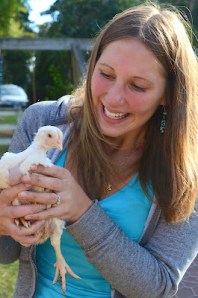
My friend’s great niece doesn’t come from professional farmers, but the gardening gene goes back at least to her Italian great grandfather. Now, having graduated from a liberal arts college and worked for various park services, she is — like a surprising number of young people today — going into farming.

At a farm blog, she describes raising organic chickens in Connecticut.

“Hi! Nichki and Laz from The Wooly Pig here, taking over the Barberry Hill Farm blog for an entry!

“We are young aspiring CT farmers who were lucky enough to meet Kelly and Kingsley last March and over the past several months they have become our good friends and farming mentors. This fall, the Goddards have been so kind as to lend us their pasture and their expertise so that we can raise our very first batch of chickens for our community.

“Our birds are pasture raised, which means they are brought up outdoors with plenty of access to fresh vegetation, open air, and sunlight.

“They are fed a strictly organic diet — an added cost for us that we feel is a worthwhile investment in our customers’ health. …

“We can’t thank our customers enough for supporting local, sustainable agriculture. Your good decisions help build strong, healthy communities right here in Connecticut. …

“For more information on our chickens, please contact us by email at TheWoolyPig@gmail.com.”

Read the engaging Barberry Hill Farm blog here. And if you live near Madison, Connecticut, get your chickens from The Wooly Pig

Photograph from http://www.barberryhillfarm.com.

Read Full Post »

Not long ago, I listened to a certain “Living on Earth” radio broadcast with amazement. A woman was explaining how she made up her mind to live without plastics. She did not make the effort sound easy, but she did make me think of ways I might cut back.

The “Living on Earth” account begins,”We live in a plastic-filled world. It’s used in almost everything, from cars to chewing gum to prescription drug bottles. Five years ago, Beth Terry decided to stop consuming plastic and she’s survived to tell the tale. Host Bruce Gellerman talks with Terry about her new book, ‘Plastic Free: How I Kicked the Plastic Habit and How You Can Too.’ ”

Terry tells the host, “Five years ago, almost to the day, I stumbled across an article about the plastic pollution problem in the ocean. And what completely blew my mind, and broke my heart, was this photo I saw of a dead albatross chick on Midway Island, thousands of miles from civilization — halfway between the United States and Japan. And it was just the carcass; it was full of plastic pieces. Like the plastic that I used on an everyday basis — things like bottle caps, things that didn’t come from the middle of the Pacific Ocean — they came from us. I just had to change. …

“I didn’t commit to stop using the plastic I already had, first of all, and I don’t recommend that anybody go through their house and purge the plastic and throw it away, because that’s just so wasteful, I think. But when my computer broke and it couldn’t be fixed — my first step is always to try and fix things and make them last as long as possible — but, when it couldn’t be fixed, I looked on Craig’s List and I found a secondhand computer.”

My own worry about plastics is how unstable the components are and how chemicals may escape into the air we breathe and the water we drink. When plastics are heated, as in a microwave, they can be dangerous. Please use ceramic containers for warming food in your — er — plastic microwave.

Read more of Terry’s alternatives to buying new plastics at “Living on Earth.”

Photograph: Beth Terry, with the plastic she collected in the first half of 2007.

Read Full Post »

A website affiliated with Fast Company and called FastCo.Exist has some interesting information on sustainability.

Consider the article showing how Mexico City is promoting several public goods simultaneously. The city’s environmental agency recently launched Mercado de Trueque, a barter market where recyclable materials are exchanged for fresh food to support the city’s farmlands.

Michael Coren reports: ” ‘This innovative program is designed to show citizens directly and tangibly how what we call trash becomes raw materials. If solid waste is properly separated, it still has value,’ writes the Ministry of Environment (in Spanish). The market accepts glass, paper and cardboard, aluminum beverage cans, PET plastic bottles, and returns ‘green points’ redeemable for agricultural products grown in and around Mexico City, including lettuce, prickly pears, spinach, tomatoes, plants, and flowers.” More here.

Co.Exist also has an article by Ariel Schwartz on how you may track where the things you buy come from. For example, your canned tuna. Check it out.

Read Full Post »

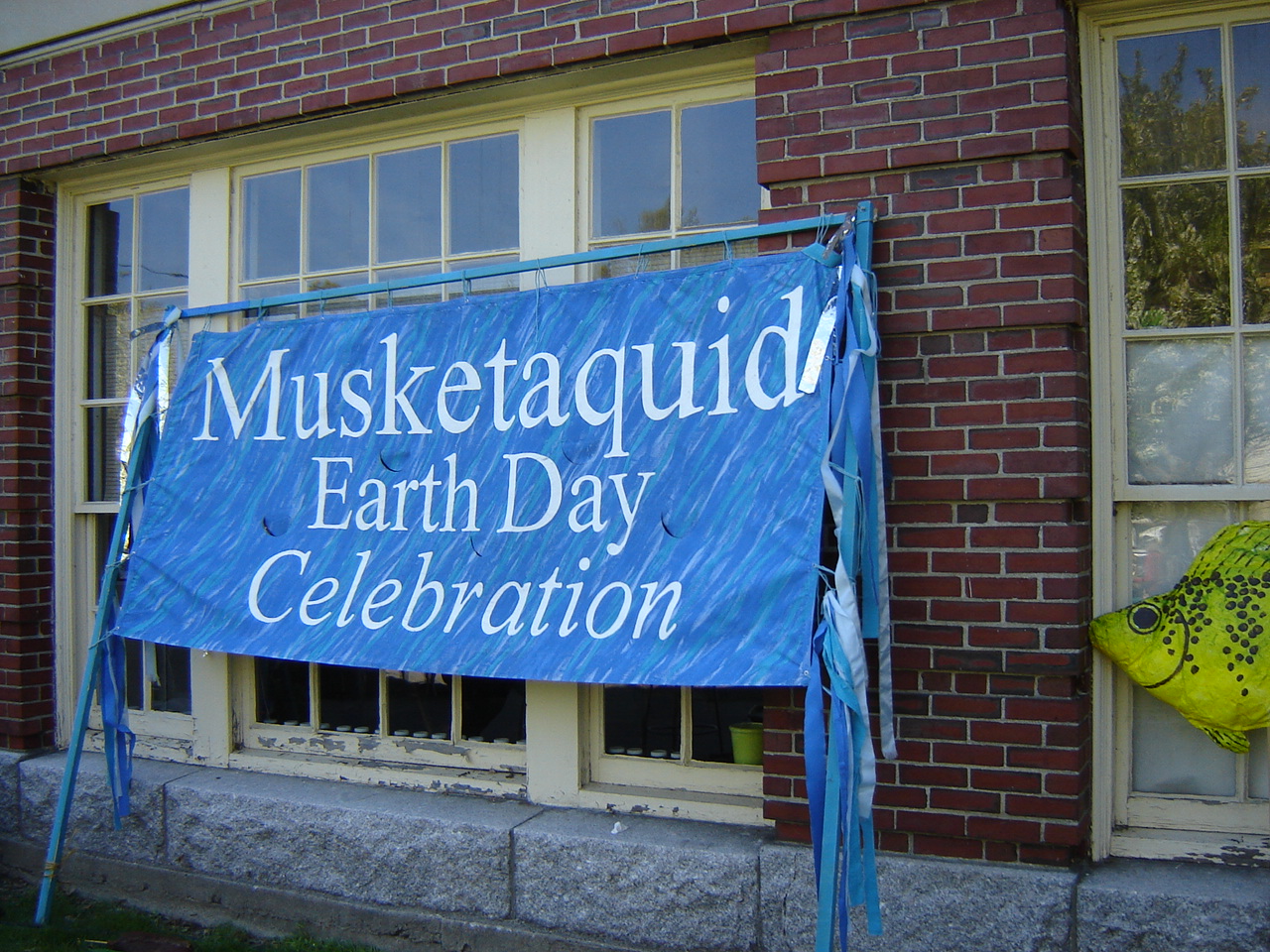
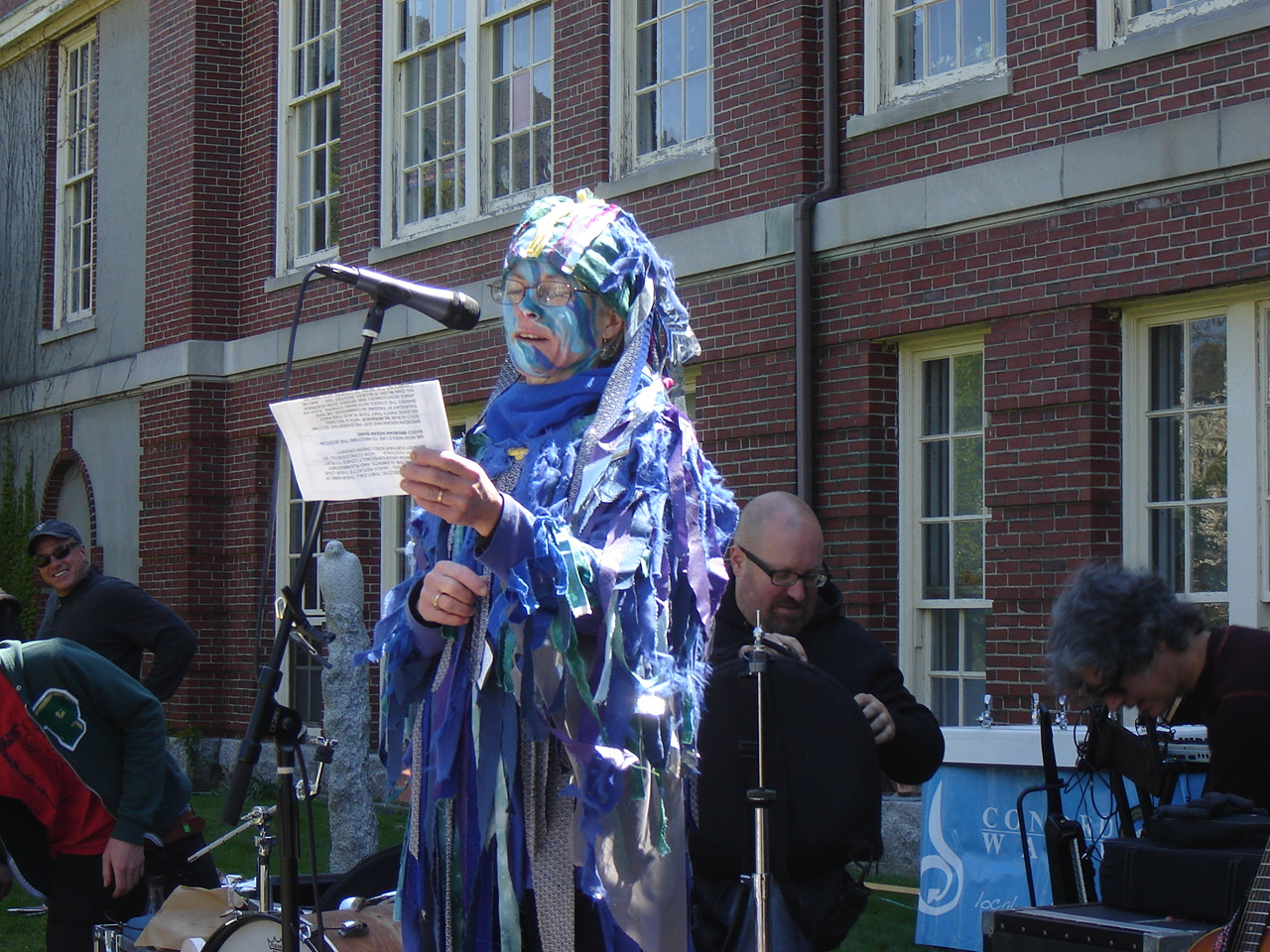
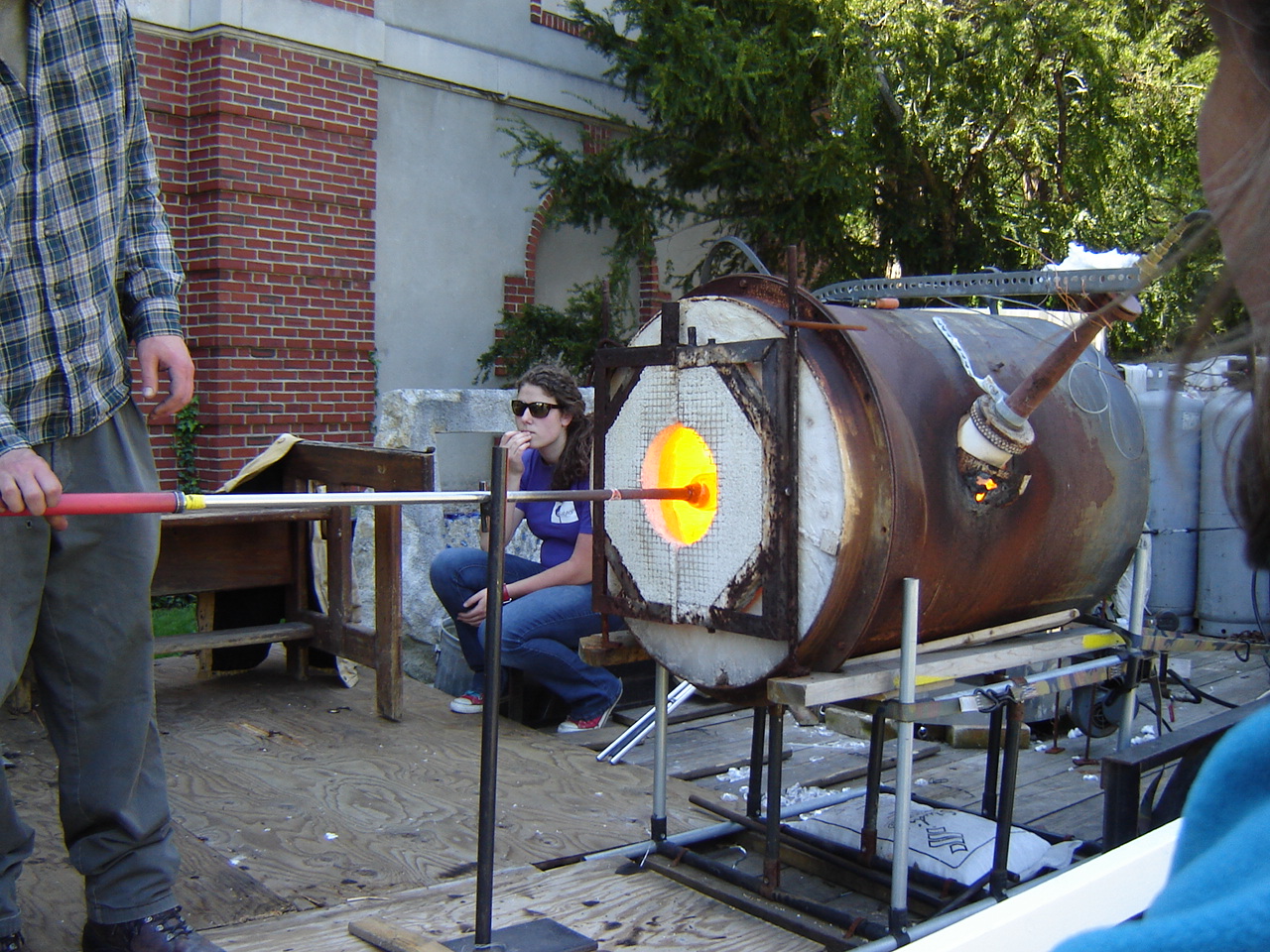
For some years now, Concord has had a fun and funky Earth Day that involves a parade with giant animal and bird puppets and a festival at the Emerson Umbrella Center for the Arts afterward.

The photos: The Blue Person is one of the event’s costumed organizers. Note also the glassblowing demonstration. The faucet made of plastic bottles is meant to remind you that drinking tap water is better for the environment. (Concord Town Meeting just passed a ban on the sale of bottled water — the second attempt to get the legal language right.)

More here.

Read Full Post »

« Newer Posts - Older Posts »