Feeds:
Posts
Comments

Posts Tagged ‘theatre’

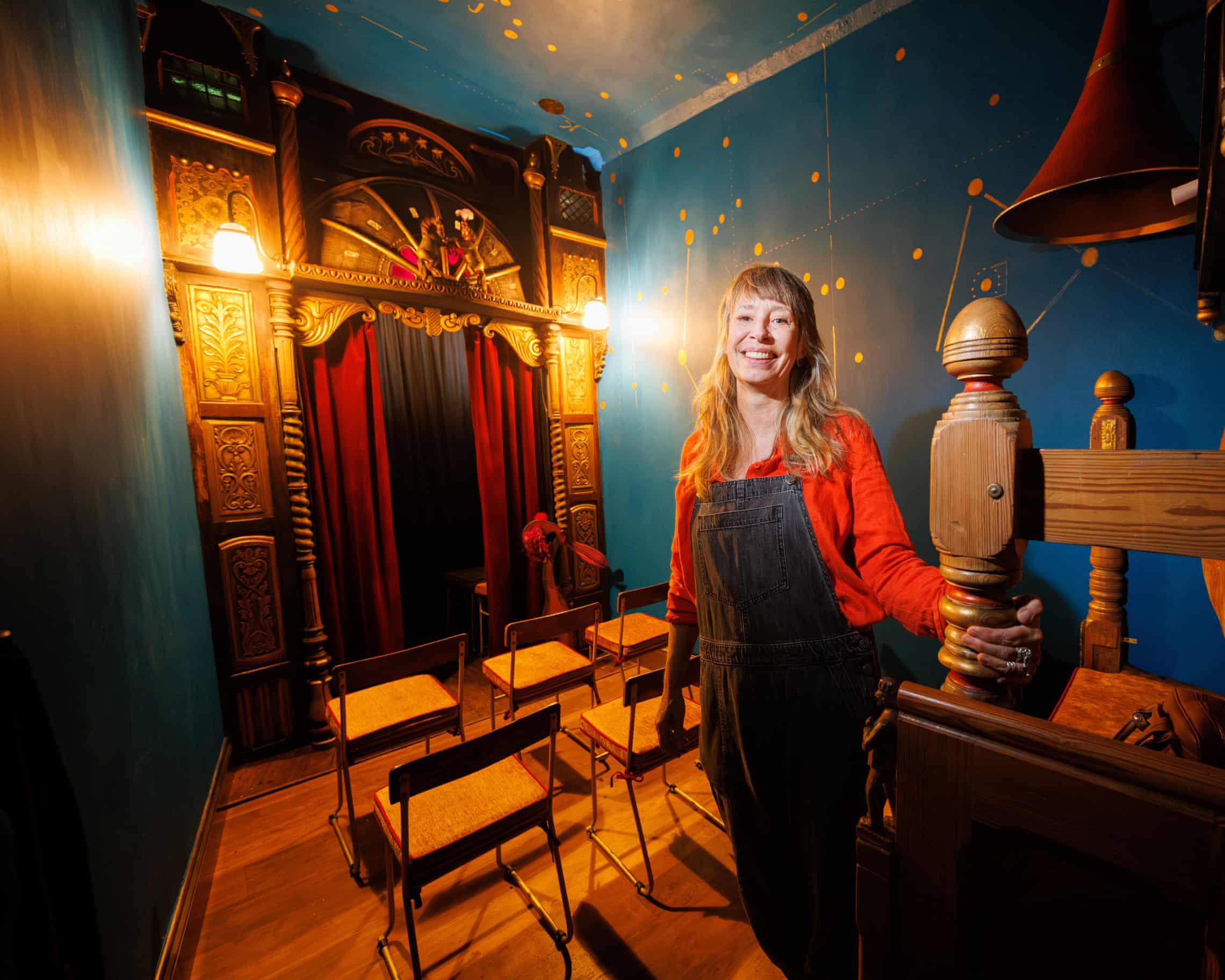
Photo: Sam Frost/The Guardian.
Loz Samuels, creative director of the tiny Theatre of Small Convenience, believes that in the digital age it is ‘really important’ to keep places like this alive. 

People care about having the arts in their lives. It’s not all about big donors wanting to show themselves in designer clothes at a charity ball. Although they are needed, too.

It’s mostly about the audience.

Jessica Murray writes at the Guardian about how a threatened UK theater, housed in what was once a Victorian public toilet, was brought back to life.

“Perched on a sign above a tiny stage draped with red velvet curtains are the Latin words Multum in parvo. Meaning ‘much in little,’ it has become the motto of this minuscule establishment in the Worcestershire town of Malvern.

“This is the world’s smallest commercial theater, with room for 12 people – or 16 with some standing – that has been brought back to life by local residents after falling into disrepair and at risk of demolition.

“Called the Theatre of Small Convenience, it was once a Victorian toilet and measures just [108 square feet] – the stage itself is a snug [16 square feet].

“ ‘Places like this are so rare now,’ said Loz Samuels, the theatre’s creative director and co-founder of the community interest company which runs it. …

“The theatre was created in 1997 by Dennis Neale, described as a local legend and eccentric performer who spent 19 years putting on puppetry shows in the space that captivated local children. In its heyday it was a much-loved and unique claim to fame for Malvern, with the theatre entering the Guinness World Records in 2002.

“But after Neale’s retirement in 2017, the building fell into disrepair and was badly damaged by a fire caused by a dehumidifier. With a destroyed roof, damp floor and damaged walls, local residents began to fear it would be lost for ever, especially with talk of a development next door. …

“Along with local volunteers Jan Birtle and Dibah Farooqui, [the community interest company] acquired the building from the council and raised [$22,000] from the local community to help get the renovation off the ground.

“ ‘It needs replastering, it needed rewiring, it needed a new floor, it needed underfloor heating. There’s obviously no room for heaters,’ Samuels said. …

“The theatre’s deep blue walls are adorned with a vivid gold constellation – with stars ‘sponsored’ by local residents – while intricate wooden carvings frame the stage.

“The challenge hasn’t been plain sailing, and Samuels has fears for the long-term future of the theatre. The team were recently rejected for Arts Council funding, and … with just 12 seats, making the space financially viable will take some creative thinking.

“Set to open its doors in October [2025], the theatre’s first show is Sceptre, a seance-themed immersive show designed specifically for the space. There are plans for a Narnia-style Christmas grotto and even weddings in the future.

“ ‘It is a challenge to find work that fits in here,’ she said. ‘But I feel like the building creates opportunities, you’ve just got to be imaginative. You can make real sensory experiences because you can control the light. As soon as you step foot in here, you forget the world outside, you could be anywhere.’

“Neale, who still lives locally, has also given the project his blessing and recorded a message that will be played at the start of future performances.

“ ‘I think what he did is so quintessentially English and so special,’ Samuels said. ‘He’s really happy, although I think at first he was a bit like, Who is this crazy woman?  …

“Samuels is urging performers and artists with original ideas for the space to come forward, and despite some nervousness, is optimistic for the future of the venue.

“ ‘I feel like it’s a strangely magical place and I just believe that the universe will look after it somehow,’ she said.”

More at the Guardian, here. No paywall.
Read Full Post »

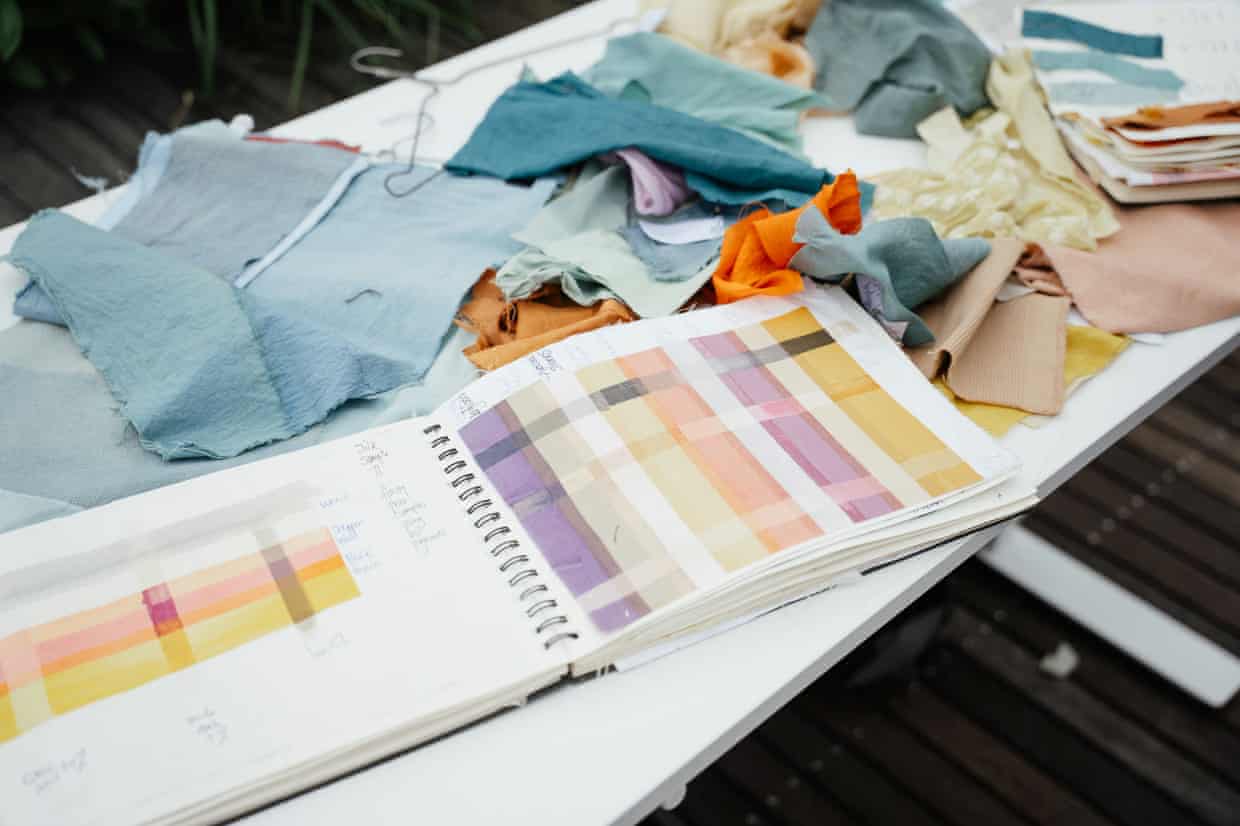
Photo: Rory Murphy.
Chemical dyes are often toxic for the environment and bad for human health, and that is why the National Theatre in London is planning to use natural dyes from a rooftop garden in its costumes.

My friend Ann is deep into using natural dyes for her textile art, and she even grows the plants that are used for those dyes. It is not just that she is concerned about all the synthetics in our environment, she loves the colors that nature produces.

In London, the National Theatre is on the same track.

Helena Horton  writes at the Guardian, “Squint at the roof of the grey, brutalist National Theatre on London’s South Bank and you might be able to spy a riot of color spilling from the concrete. This is the theater’s new natural dye garden, from which flowers are being picked to create the colors for the costumes worn in the theater’s plays.

“Chemical dyes are often toxic for the environment and bad for human health, so the costume designers at the theater are experimenting with using flowers including indigo, dahlias, hollyhocks, camomile and wild fennel to create the vivid colors used in their productions.

“The textile artist, Liz Honeybone, is buzzing with excitement about the opportunities the new garden is bringing. … She has been very concerned about the health impacts of using harsh, synthetic chemical dyes, which require users to be swaddled in protective clothing. …

“ ‘There used to be a thing called dyer’s nose, which is basically when the aniline dyes came in,’ Honeybone said, ‘They used to destroy your nasal membrane.’ …

“The theater is planning to use natural dyes from the garden in every production at the South Bank going forward, starting with Playboy of the Western World, which is on this autumn and winter.

“Claire Wardroper, costume production supervisor at the theater, said it was ‘a beautiful early 19th century piece, with lots of nice woolly jumpers, because it’s set in rural Ireland, and we can certainly get some nice colors into them.’ …

“They are trying to bring a gentler, more environmentally friendly way of dyeing into the mainstream. ‘We are saying that if you want to use this horrible synthetic dye, you can do that, but you can achieve this beautiful look by using a natural dye, and we can do it a little bit slower and a bit more sort of organically,’ said Honeybone.

“Wardroper added: ‘It’s unfortunate to say, but the theatre and film and anything creative in one-shot opportunity entertainment has a history of being incredibly wasteful.’ …

“Honeybone said: ‘It’s been such a good harvest. My indigo is more than I can cope with. I’ve got three shows going on at the moment, so I’ve had to recruit people to help me.’

“People may imagine the colors extracted from flowers will be muted compared with synthetic dyes, but Honeybone said this could not be further from the truth and she has been able to create neon greens and yellows. ‘Our forefathers were drowning in color. They loved it, it wasn’t hard to get and all the tapestries that were up on the wall were a riot of color. What we’re seeing now is the sad, faded leftovers,’ she said.

“Honeybone says she has become ‘obsessed’ with natural dyeing. ‘My daughter gave me a bunch of flowers on Mother’s Day, and I noticed there was some golden rod in it, so whisked that out and dyed with it just to see what it yielded. And it was the most glorious, strong yellow.’

“The garden is not only used for dyes but also as a refuge from the hustle and bustle of the theatre. The pair said actors were frequently seen pacing among the flowers, or sitting down on benches to learn their lines.

“The space is also a haven for wildlife. The grey concrete of the South Bank does not have a huge amount to offer pollinators, and they have been swarming to the garden to sample the nectar from the varied dye plants.

“Wardroper said: ‘We’re seeing so much more wildlife, like hummingbird moths, and we’ve got bees on the National Theatre roof which produce honey for the National Theatre. And they’re loving the variety of plants that we’ve planted as well. These are a new stock of plants that they just haven’t had access to. So the bee person that comes in and caters to the bees is very happy.’

“The pair hope that most if not all of the costumes at the theatre can eventually be produced using natural methods. But for now, Honeybone is enjoying the opportunity to start using these dyes.

“She said: ‘This is such an all round sensory experience, totally engulfed in the smells and the feeling. … It is just wonderful.’ ”

More at the Guardian, here. (Gotta love that someone in this earthy-crunchy field has a name like Honeybone and that Wardroper oversees the wardrobe!)

Read Full Post »

Photo: BBC.
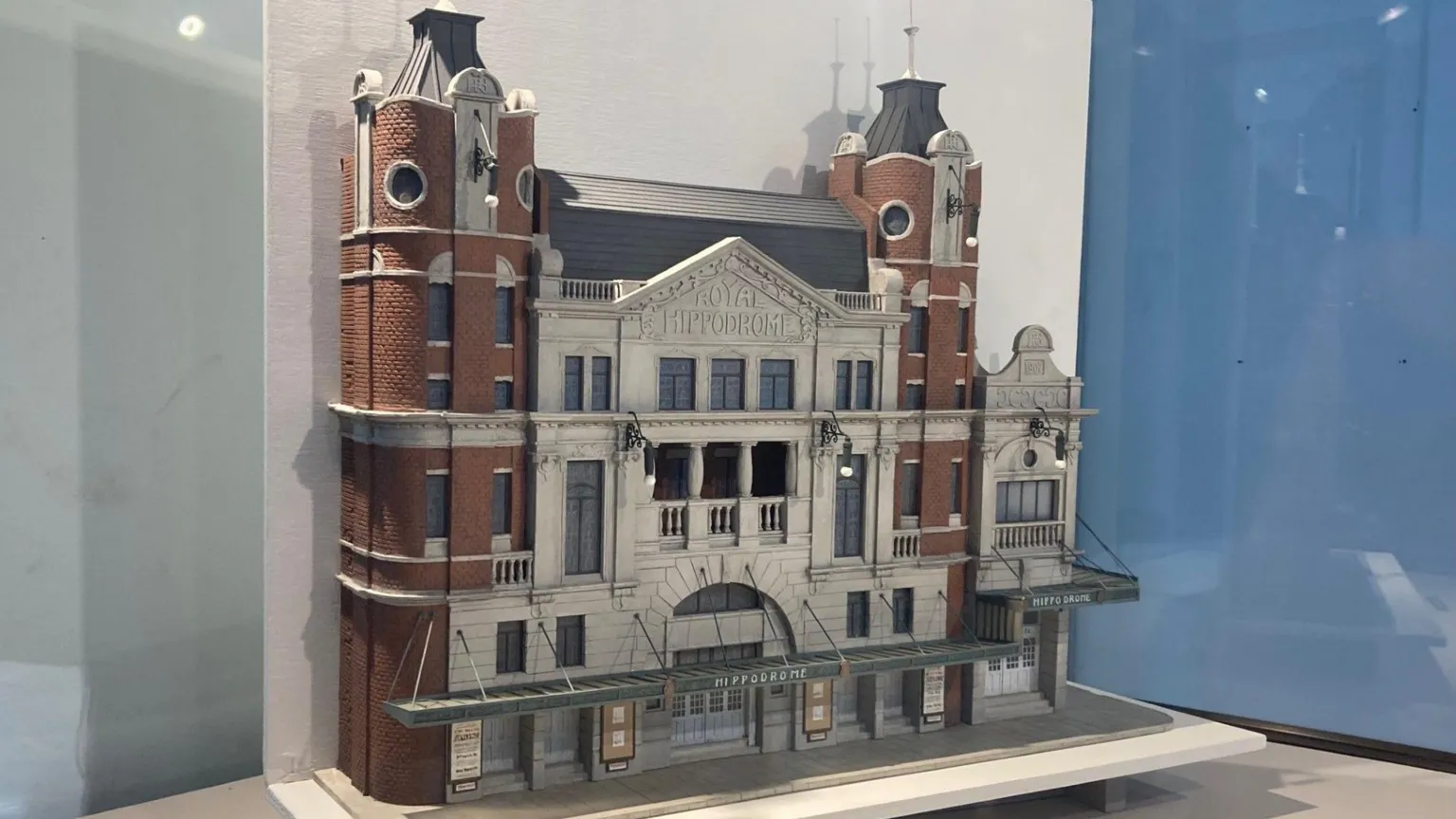
During lockdown, set designer Stuart Marshall started making models of Belfast’s lost theatrical world. Above is his model of the Hippodrome.

No one wants to go back to the pandemic’s lockdown, but enough time has passed for people to feel a little nostalgia for the creative projects some folks undertook during that dark time. I remember a guy in Boston who encouraged artists to send him miniatures of their work, which he would then display on his popular website. Refresh your memory of that here.

Jake Wood at the BBC reported in March on an exhibit in Northern Ireland that had its beginnings when a set designer was stuck at home.

“Miniature models of Belfast’s lost theatres created by set designer Stuart Marshall are bringing the city’s vibrant theatre history back into the the limelight. They are part of an exhibition at Ulster University for the Children’s Festival.

“Mr Marshall told BBC News NI that … ‘Children appreciate the miniature dolls house type model making, adults appreciate the skill that goes into making them, and older people who may remember when some of these places still stood. …

” ‘I started working on a model of the Grand Opera House as part of the heritage exhibition and through doing that got interested in looking at all the other theatres that aren’t about anymore. …

” ‘The Hippodrome was the most complicated and detailed one I’ve made; it took me around six weeks to make.’

“He said he mostly works from old photographs, but it can be hard to get enough accurate detail because ‘with a black and white photograph that you can’t move around, it’s basically static.’

“When photographs of the old theatres are not available or poor quality, Mr Marshall refers to old newspaper articles which sometimes have written descriptions of what materials the theatre was built from and how it appeared.

“Opening in the early 1870s, the Alhambra was Belfast’s first music hall and was a ‘real spit on the floor type joint,’ according to Mr Marshall. ‘In the early days, the Alhambra was more of a variety house, and I’ve heard that it wasn’t the most enticing establishment, quite a rowdy place.’ …

“A typical bill from the early days of the Alhambra shows performances which ‘would nowadays be contentious’ included events such as a minstrel show and a Japanese troupe. …

“To adapt to the evolution of mass entertainment, the Alhambra converted to a full-time cinema house in 1936. Between the late 1800s and its closure in 1959, the Alhambra suffered four separate fires.

“The Theatre Royal was Belfast’s original high-end theatre, opening in the late 1700s with a capacity of just over 1,000. The building was demolished and rebuilt a number of times.

” ‘As these places go, they kept getting burnt down or demolished and rebuilt again – there’s always a renewal aspect to them.’

“The Theatre Royal was to be Belfast’s ‘higher class establishment,’ which in the end became ‘a mixed-use building of shops and place called the “boom boom room,” which was like a dance hall upstairs. …

” ‘Now, there’s a little Starbucks in the corner where the building stood,’ he added.

“Not to be mistaken for the pub and music hall on Botanic Avenue, the Empire Theatre was situated on Victoria Square and opened to the public in 1894. …

“While it did adapt to the growing popularity of cinema, the Empire ‘stayed true to theatre for all of its life,’ Mr Marshall said.

“The Hippodrome was ‘more fiddly.’ … There aren’t too many quality photographs of the Hippodrome, so he ‘had to use his judgment’ when designing the model in terms of color scheme and scale.

“Coming quite late, the ‘Hippodrome was was built in 1907 originally with a cinema in mind’ as to take full advantage of the advent of modern cinema and growing popularity of picture shows.

” ‘And then there was the Ritz,’ which opened in 1938. The Ritz was, according to Mr Marshall, ‘a giant cinema more or less, but it called itself the Ritz Theatre.’ However, it did produce shows as part of the night’s entertainment.

” ‘They would have a brass band, dancers or a ballet, and then a film at the end. It also did huge concerts, people like the Stones, The Beatles and Billy Connolly all performed at the Ritz during their time,’ he added. …

“The Ritz was damaged by bombs hidden in the seats and the theatre’s interior and roof was destroyed in 1977.” More at the BBC Northern Ireland, here.

Did you do a particularly creative project during lockdown? Of, course, many of us kept on blogging away, but we would have done that anyway.

Read Full Post »

This is where I trot out sayings like “There is no new thing under the sun” and “Everything old is new again.” They may be clichés, but they reflect my delight in learning about a 19th C. invention that foreshadowed the 21st.

Natasha Kitcher, a doctoral researcher in the department of communication and media at Loughborough University, UK, writes about this at the Conversation.

“The idea of streaming live theatre into people’s homes,” she notes, “goes back to the Victorian era. From 1893 to 1925 the London Electrophone Company streamed the sound of live theatre into the home using a telephone device known as an Electrophone.

“Inventors of the time, including Alexander Graham Bell, had looked at the telephone and seen something that could be used to reach large groups of people – they understood that telephone cables could be used to deliver information from one person to many, and not just for one-to-one conversations.

“Music concerts, scientific lectures, church services and theatre shows were ‘streamed’ into the homes of those that could afford it across the country. For those with a smaller budget, listening salons were created. For the first time, you could experience a show without being in the theatre. This was, of course, well before the first live radio broadcast in 1920.

“Made possible thanks to the work of Frenchman Ernest Mercadier (who first patented headphones), the Electrophone used primitive headsets, copied from the French Théâtrophone (although, unlike the Théâtrophone, the Electrophone did not use stereo technology). …

“The Electrophone worked by sending information through telephone wires into a central receiver in the home where one or more headsets could be installed (each additional headset came with an extra cost). The sound listeners heard would be from small microphones secreted behind the footlights at the front of the stage.

In church services the microphones were hidden in fake wooden Bibles.

“Each Electrophone performance was a genuine live show taking place somewhere in the country – most commonly the big London theatres, such as the Adelphi Theatre or Covent Garden Opera. In 1896, the Musical Standard reported users from the time saying they could hear audience members in the theatre ‘rustling like leaves’ during the performance, which was broadcast live as it happened.

“Streaming genuine live shows meant that the listener at home experienced the start, end and [intermission] of a show just as if they were there. If someone slipped up or forgot a line, this would be just as obvious to audience members listening on headphones as it was to those inside the theatre. And Electrophone listeners could enjoy the experience of finding out ‘whodunit’ at the same time as audience members sitting in the stalls.

“The Electrophone cost £5 [$6.60] a year when it was first available for subscription in the 1890s – equivalent to around £120 [$158] today – and the unobtrusive nature of the technology involved meant that there was no need to reduce the size of the theatre audience. The London Electrophone Company paid for the technology to be installed in the theatre, the National Telephone Company (later the Post Office) would pay for the upkeep of the telephone lines and the theatre would receive a share of the Electrophone Company’s profits – exact records of how profits were shared are yet to be uncovered.

“Subscribers could pay an additional fee to be connected to a theatre for the season, such as the Covent Garden winter season. The high cost of the Electrophone (much more than a Netflix subscription today) almost certainly meant it was mainly used by the wealthy, but sets installed in hotels, public gardens and exhibitions were operated by the use of coin slots and, for a smaller fee, people could listen to snippets of live theatre and musical broadcast.

“People unable to attend the theatre, for whatever reason, could listen at home – just as French novelist Marcel Proust did in the early 20th century when he was too sick to make it out of his house.”

More here.

Read Full Post »

Photo: Kolya Kuprich
Outlawed Belarus Free Theatre has been successfully performing
A School for Fools and other plays despite the pandemic. It took some ingenuity, but they have plenty of that.

What kind of theater could handle a pandemic better than one that is of necessity always underground? If you’re fighting an authoritarian regime, you will continually find ways it doesn’t know about for getting your work out into the world — or you’ll go to prison.

Verity Healey writes at HowlRound,* “If any theatre company is going to feel at home during COVID-19 and the challenges the pandemic has brought to theatres worldwide, it is going to be Belarus Free Theatre (BFT), an outlawed company based in Belarus and the UK (its artistic directors Natalia Kaliada and Nicolai Khalezin, in fear of their lives, had to seek asylum in Britain in 2011).

In Belarus, where dictator President Lukashenko faces national elections in August — and is busy arresting citizens attending opposition rallies — the BFT ensemble is banned from performing and from registering as a theatre company because it produces democracy-promoting plays and global campaigns advancing human rights.

“Working out of a small garage in a secret location in Minsk, the country’s capital city, BFT is ineligible to apply for national funding, and ensemble members, continuing to perform illegally and underground, face the very real and constant threat of being arrested by the KGB. …

“On top of this, Lukashenko is a COVID-19 denier and has advised his citizens to drive tractors, go to the sauna, and drink vodka to prevent infection. Whilst he has not imposed a lockdown, he is using the virus as an excuse to ban protests of any kind (prescient in the run-up to the elections) and arrest anyone who raises a voice in opposition. This means that, in Minsk, BFT, in tandem with their colleagues in the UK, have voluntarily gone into self-isolation to protect themselves and their families whilst creating work from their living quarters — turning their homes, quite literally, into performance spaces.

“ ‘I get to spend twenty-four hours a day with the people I love, otherwise the lockdown is no different for me,’ says Khalezin.

“It will not come as a surprise then that, since late February, the company has premiered two full-length plays, facilitated and broadcast several online fairy tales with renowned artists such as Stephen Fry, Juliet Stevenson, Will Attenborough, and Sam West for their campaign #LoveOverVirus, and made all of their previous shows accessible for free on YouTube. …

“It’s their latest show, though, A School for Fools (ASFF), which is streaming live online, that has recently made the headlines. Adapted from Sasha Sokolov’s 1960s phantasmagoric modernist novel of the same name … the story charts the experiences of a young boy living with a dual personality disorder attending an oppressive school, a kind of place that used to exist in Eastern Europe (and still does in Kazakhstan). …

“Starring twelve of BFT’s ensemble members, all living in Minsk, in twelve locations (the actors’ mostly small Soviet-style [flats]), and with sixteen different camera setups hosted by Zoom, it is a feat of technical wizardry imagined by [director Pavel] Haradnitski’s artistic vision and Sveta Sugako’s broadcasting direction. …

“Haradnitski calls the need to do ASFF ‘a desire to act, because even in two months, actors can lose their skills.’ Previous conversations had with Haradnitski, Sugako, and Nadia Brodskaya, the producer for ASFF, have also revealed to me that for everyone in the ensemble BFT is a way of life, 24/7. …

“ASFF is not just an ideological road map out of the pandemic — i.e., using technology and social media platforms in new ways to bring live drama to people at home via laptops and devices. It is also a way of doing theatre that, as Khalezin says, we may have to return to more and more if the world faces other pandemics. …

“Zoom is not custom-made to handle large-scale live performances—it was invented purely for business meetings and conferences and it lacks the interfaces custom-made platforms might have (there are ones being developed especially for BFT, but they were not ready in time for the pandemic). ..

“One of Sugako’s and Haradnitski’s main difficulties, for example, was working out how to let the actors know what marks to hit, especially when it was required for actors to make it look like they were physically interacting with each other. In the end, Sugako had to use a webcam, pointed at her Zoom host interface, which allowed her to share her screen with the actors so they could see they were in the right place to make it look like they were connecting across frames.

“The other issue is Zoom’s propensity to kick people off the platform if their internet connection drops — which anyone who has ever been to Belarus will know is a common occurrence. And to make things more complicated, Sugako had to line up the sixteen devices — laptops, phones — in a particular order for actors to hit their cues. If they get out of sync, the whole show is scrambled.” Read how they handled that difficulty and others at Howlround,* here.

By the way, John has been to Belarus. Maybe he will confirm that the internet connections often get dropped.

* The staff of HowlRound Theatre Commons at Emerson College wish to respectfully acknowledge that our offices are situated on land stolen from its original holders, the Massachuset and Wampanoag people. We wish to pay our respects to their people past, present, and future.

Read Full Post »

91176756_112802980363679_5284517-2

Photo: Tiny Theatre
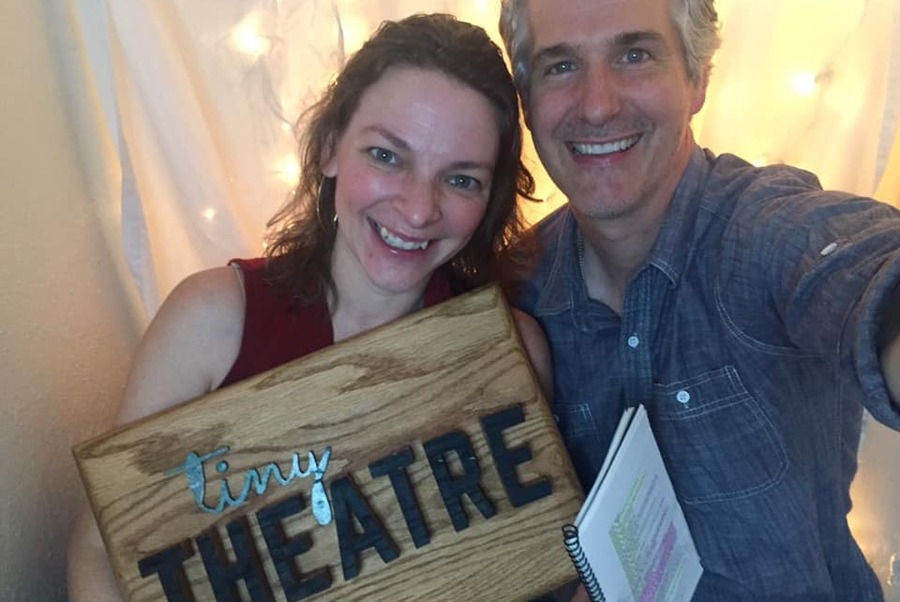
Rachel Burttram Powers and Brendan Powers, actors married to each other, created a theater in their closet for these self-distancing times.

Sandra’s dear departed mother had the best recipe for boredom: Go clean out a closet. Sandra cleaned out a lot of closets as a kid, and now as an adult, she is never bored because she knows how to find something more interesting to do.

When I was a kid, I was one to play in the closet rather than clean it and had many tea parties with Carole, accompanied by flashlights, cinnamon toast, and dolls.

Today’s story is about two actors, married and stuck at home in the pandemic, who did both: They cleaned out a closet and then played in it.

Sarah Tietje-Mietz reports at American Theatre, “The stage lights glow like dozens of small stars while the countdown to curtain plays over the intercom. … The actors come together, separated by mere inches, so close that their knees bump and their shoulders touch, so close that they have to lean back to even look at each other.

“The stage is a 4-by-4 closet, lit by a string of Christmas lights. … The audience is all online. Welcome to Tiny_Theatre.

‘I think there’s a need for humans to connect, maybe more than ever,’ said actor and Tiny_Theatre co-founder Rachel Burttram Powers. ‘Toni Morrison says that it’s the artist’s job to create in a time of crisis, you know? We created this out of necessity.’

“Tiny_Theatre is the passion project of Rachel and her husband/co-founder, Brendan Powers, as a response to the shuttering of all theatres in the wake of COVID-19. The couple perform from the guest room of their Fort Myers, Fla., home three times a week — Mondays, Wednesdays, and Fridays — on Facebook Live. …

“Rachel and Brendan have established a network of playwrights to tap into for their newest project. Some writers have even reached out directly with suggestions of work. Rights for the plays have all been granted gratis to the couple. …

“In early March, Rachel and Brendan were in the final dress rehearsal for Florida Rep’s production of Lucas Hnath’s A Doll’s House, Part 2. The theatre closed its door the next day. Though the couple’s turn as Nora and Torvald was recorded and streamed online, the two found themselves suddenly faced with an abundance of time and artistic energy.

“ ‘We were sort of in that mindset as performers,’ Rachel said. ‘We were ready to go eight shows a week. Suddenly it was like a needle pulled off the record.’

“Added Brendan, ‘A couple days in, once we knew we were canceling the show, I could see Rachel — I can tell when she’s thinking of something.’ …

“Back to Rachel: ‘I started cleaning out a back closet because I thought, “What would happen if you made a theatre at home?” We knew everyone was self-isolating. We both have a passion for new plays, and we have a lot of playwright friends who are very well established, and I just thought, “Let me just send an email to see if people would be game to play with us.” ‘ …

“There is evident respect in the way they communicate, not just as a married couple but as professionals in their field. Playwright Arlene Hutton acknowledges this interplay as creating an environment akin to a mini-repertory company in Tiny_Theatre. Hutton was already familiar with the couple, having worked with Brendan when he starred in her work, Running, and seen Rachel in Florida Rep’s production of Audrey Cefaly’s Alabaster. … ‘They’re not trying to make it more than it is, you know?’ …

“On March 21, Tiny_Theatre debuted with scenes from Cefaly’s Maytag Virgin. This inaugural performance was also the couple’s first Facebook Live experience. (Brendan did not even have a Facebook account at the time.) Their setup was a smartphone, a broken tripod, and a paint stirrer, all literally held together with duct tape. …

“The technical system has since been upgraded, which they credit to the community that has bloomed around Tiny_Theatre. Friends, family, followers, and even strangers have sent gift cards (resulting in a new iPad) as well as printer paper and toner (for printing and notating scripts). …

“There’s a goofiness and levity to these two, a palpable happiness for the work they are doing. Silliness aside, the two have dedicated years to honing their craft onstage. In such close proximity, their acting is distilled to their voices, the acuity in their facial expressions, the gentle placement of a hand, through which they transport their viewers beyond the confines of their closet.

“ ‘That’s been tricky,’ Brendan said of the lack of mobility. ‘As we read a scene — you’re an actor, you start to feel it, and then you get put in that situation where you can’t storytell physically or only very, very minimally.’ …

“It was this challenge that attracted Nathan Christopher, who found out about Tiny_Theatre through the Playwright Submission Binge online community and became enamored with the project after just one viewing. The Powerses accepted Christopher’s submission of his recent play A Man Walks Into a Bar, performing it on April 6, as well as Clairvoyant, which came from an open call they put out that asked writers to create short works inspired by a single photo they provided as a prompt.”

Read more here.

Read Full Post »

good-chance-dome_calais

Photo: Good Chance Theatre
A group that was founded to dramatize the plight of refugees in Calais, France, is now performing internationally.

Theater can often bring out the empathetic and compassionate side of audience members and lead to positive change in the world. As Amelia Parenteau writes at American Theatre, a play called The Jungle that grew around a refugee camp in Calais, France, may be helping viewers to see asylum seekers as people like themselves — and motivating them to take action.

“Good Chance Theatre was started by two Brits, Joe Murphy and Joe Robertson, when, in 2015, they passed through Calais, France, on their way to Germany and they saw the makeshift refugee camp that had formed there.

“Many theatremakers might feel the need to share the refugees’ story with the world, but first Murphy and Robertson wanted folks in the camp to have ‘a platform to express themselves,’ explained Dina Mousawi, Good Chance’s creative producer.

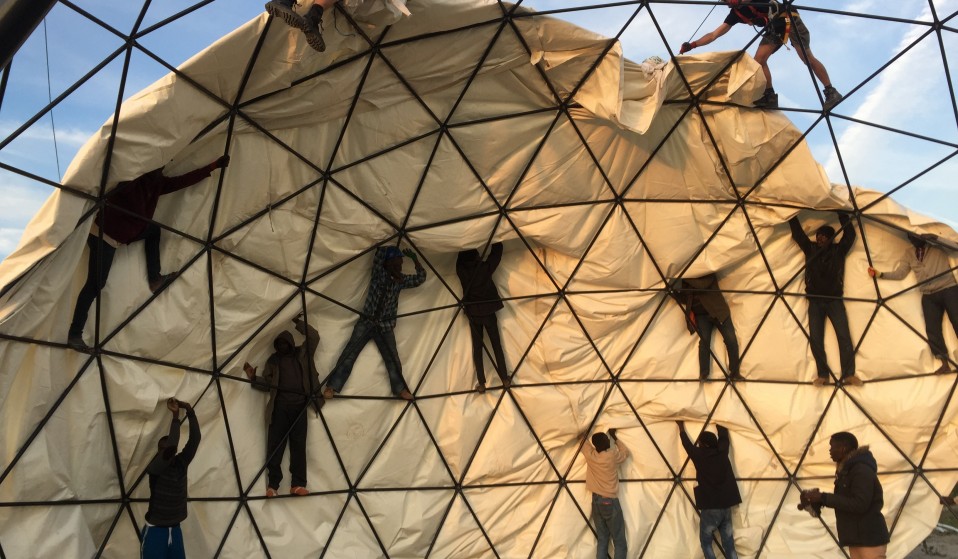
“So they decided to construct a theatre there in the shape of a geodesic dome, which has since become Good Chance’s signature pop-up venue; they spent seven months there in total.

“Vincent Mangado, a Théâtre du Soleil company member who joined their effort, described that first dome as a place ‘where everything could be spoken, a place of peace, a nerve center of the jungle, where you can share stories or throw a party, not just a theatre.’

“Upon returning to the U.K., Murphy and Robertson were commissioned to write a play about their experience in Calais, which grew up into the international hit The Jungle (now at the Curran Theatre in San Francisco through May 19). They traveled around the U.K., leading workshops with migrants and asylum seekers to continue gathering material. And cast members: The Jungle’s ensemble comprises of actors of 11 different nationalities, including some people Murphy and Robertson met in Calais who had since emigrated to Britain.

“The action of The Jungle is set in an Afghan restaurant that was built in Calais, and is staged with such an immersive aesthetic that audience members feel as though they are fellow diners at the restaurant. Along with the café, makeshift mosques, churches, shops, and other restaurants were constructed in Calais, despite extremely limited resources (just two water spigots and two porta-potties).

“Mousawi joined Good Chance in September 2018, though she had been doing similar work for years both on her own and with Complicité. In fact, she led the first Good Chance workshop in the dome in Calais with 35 Sudanese men in Arabic.

“Raised in Iraq, Mousawi left during the war to move to England, but returned to the Middle East during the height of the conflict in Syria, feeling called to help by making theatre. There she worked with Syrian women to produce work telling their stories, which only strengthened her conviction that theatre is for everybody, and should be radically inclusive. …

“ ‘Theatre can act as a tool for so many things, and one of the ways we use it is to encourage integration in areas where there might be tension.’ …

“To those audiences moved by The Jungle, Mousawi recommends reaching out to migrants recently arrived in your local community to see what you can do to make them feel welcome. ‘That’s what Good Chance is all about,’ she said. ‘Making people feel welcome, not alienated.’ ”

More here.

Read Full Post »

Photo: BBC
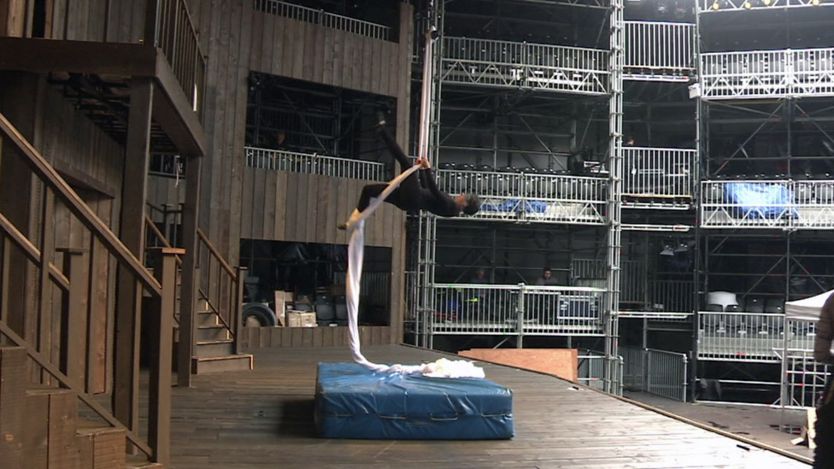
An aerial performer rehearses on stage at Shakespeare’s Rose, a pop-up theater in York, England.

You’ve heard of pop-up libraries, pop-up gift stores, and pop-up restaurants. Now here comes a pop-up Shakespeare theater in York, England.

Ian Youngs writes at the BBC, “Shakespeare’s Rose, which [opened in April] and has cost £3m, is Europe’s first ‘pop-up’ Shakespearean theatre. …

“The temporary theatre has been built in a car park in 28 days to a circular design, similar to those erected on Bankside in Shakespeare’s day.

“It will stage four of his plays with a cast including [TV actor] Alexander Vlahos, who will play Romeo in Romeo and Juliet, and Catesby in Richard III.

“As well as the audience members standing in the centre, a further 660 will watch from seats on three levels around the edge.

“Shakespeare and his contemporaries would recognise the design and ‘tricks’ like trapdoors and flying, which have hardly changed over the past 400 years, according to [producer James] Cundall.

” ‘They’d find everything they had in their theatre — they just probably wouldn’t recognise [Layher] scaffolding,’ he says. ‘Each length [of scaffolding] is probably about the same size as a standard oak beam, so that’s how Shakespeare’s oak became German scaffolding. …

“There was an actual Rose theatre in London in the Bard’s time, which was recreated for the 1999 film Shakespeare in Love. …

“Professor Judith Buchanan of the University of York, who has advised on the pop-up theatre, said: ‘Shakespeare’s Rose Theatre is not a historical reconstruction of the early modern Rose playhouse on Bankside, nor of any other early modern playhouse. It is an approximate and suggestive architectural allusion to the idea of the early modern playhouse.’

“The creators of the York theatre will hope that their venue doesn’t replicate some other aspects of the original Rose — which had to be closed occasionally due to riots or the plague, and which had one cast member who killed the other in a duel.”

Read more at the BBC, here, and at the Independent, here.

Read Full Post »


Photo: Arden Theatre Company
Staff of the Arden Theatre Company in 1995 celebrating their recently purchased home. The building is at 2nd and Arch, in the Old City neighborhood.

I always enjoy stories about the arts sparking neighborhood revitalization. John Timpane, of the Philadelphia Inquirer, recently covered one from the City of Brotherly Love.

“There’s a lot of turnover in the theater world, many an entrance and exit, so the Arden Theatre Company’s 30th anniversary this season is a testament to clear vision, luck, a lot of work, and even more talent.

“But this story embraces more than a theater – it’s about a neighborhood, Old City, that in part revitalized around the Arden, and how an arts venue plays a potent role in such transformations.

“It began with two 1980s theater buddies at Northwestern University near Chicago. ‘Aaron Posner and I talked all the time about starting a theater,’ says Arden cofounder and producing artistic director Terrence J. Nolen. …

“Cofounder Amy Murphy, who met Nolen when both were at Upper Darby Summer Stage, says … ‘When Terry said, “Let’s do this,” I thought, “Sure, I can go down for a few weeks and help out.” Right. We were 24, young, and dumb enough to do it.’ …

“Arden opened in 1988 with a Kurt Vonnegut adaptation. …

“Is there an Arden philosophy? ‘Our first commitment is to Philly actors,’ Nolen says. ‘When we first opened and started getting great reviews, people said, “Where did you get these actors?” We said, “They’re from here.” ‘

“You can feel that loyalty among grads of the Arden Professional Apprentice Program. … Raelle Myrick-Hodges is founder of Azuka Theatre and a busy theater professional. And she’ll direct an adaptation of Toni Morrison’s The Bluest Eye at the F. Otto Haas Stage March 1-April 1. She says, ‘I began as an apprentice at the Arden 24 years ago, and I’m so grateful I went there instead of to a grad school.’ …

“[Former Arden apprentice Scott] Greer says Arden’s 1995 arrival helped revitalize the ’hood: ‘When they got the space in Old City, they were a big part of changing that neighborhood. There was hardly anything there, and they started bringing in subscribers eight nights a week.’

“Ellen Yin, proprietor of Fork at 306 Market St., … said the Arden presence ‘helped build a clientele for the earlier 5:30-8 p.m. dining hours, which are crucial.’ She and several other restaurant owners regularly have partnerships with the theater. …

” ‘Blown away’ is a term Murphy uses for the whole Arden story. ‘All the people we know, all the good work we’ve done because of it,’ she says. ‘I’m very grateful. All of us are, and I think we always will be.’ ”

More here.

Read Full Post »


Photo: The Stage
Open Access Smart Capture’s glasses enable deaf theatergoers in Britain to read live captioning during a performance.

Earlier this month I posted about how the Vienna State Opera provides captions in six languages.

Today’s entry is on making dramatic productions more accessible to the deaf by means of glasses that churn out captions.

Georgia Snow writes at the Stage, “The National Theatre has unveiled new technology that will enable deaf audiences to see captions for performances in front of their eyes using special glasses, … removing the need for captioning screens in the auditorium.

“Developed by the NT with its innovation partner, consultancy firm Accenture, Open Access Smart Capture is being introduced during a year-long pilot.

“If it is a success, the result would be ‘transformational,’ [NT director Rufus] Norris said. …

“The glasses boast 97% accuracy in the timing of the captions, and can also facilitate audio description, for audiences with restricted vision. …

“The project is one of two new initiatives being introduced by the NT around accessibility, the second being an online video database showcasing deaf and disabled actors. …

“It is part of a drive to tackle the under-representation of disabled actors working in the profession, Norris said. …

“He added that ProFile also hopes to remove some of the barriers for deaf and disabled performers, for whom travelling to auditions and meetings can be difficult and expensive.” More at the Stage, here.

If nothing the else, the glasses will be fun. A few years ago, I got to see that for myself using Google Glass. An executive where I worked was having summer interns play around with programming the glasses to test the possibilities for the Fed. That didn’t go anywhere, but it was definitely fun.

Read Full Post »


Photo: American Theatre
A scene from “Mentiras Piadosas,” by the troupe Los ImproDucktivos. That’s the audience watching from behind the Venetian blinds.

Theater people keep thinking up new ways to create work that moves you in an immediate and intimate way and that attracts new audiences. We’ve written about theater in taxis in Iran and dramatic productions conducted one-on-one, among other experiments.

Now from Spain comes micro theater, 10-minute plays that allow you to stand in the same room with the actors.

Felicity Hughes writes at American Theatre, “On a rainy Thursday night in Madrid the bar of Micro Teatro Por Dinero is packed with a young crowd of theatregoers waiting to catch a short performance in one of the five tiny rooms in the venue’s basement. When our number is called, we’re led into a small dark room where the audience sits pressed up against each other sardine fashion on tiny stools.

A door is flung open, immediately breaking the fourth wall as a distressed young man stumbles in and sits down on my knee in floods of tears.

“ ‘Never before has there been a theatre so close, so intimate, and so open — there are no preconceptions, no limits, no censure,’ says Miguel Alcantud, the inventor of micro teatro, an abbreviated form of theatre. …

“The concept has since become so popular that the Micro Teatro Por Dinero franchise has been sold to venues in 15 different cities around the globe, including Buenos Aires, Mexico City, Lima, Lebanon, even Miami. …

“ ‘The cost of putting on a show is very small, and we change the program every month,’ Alcantud continues. ‘We don’t mind if the piece works or doesn’t work, because we’re always putting something new on. The commercial success of a single show doesn’t matter so much.’ …

“ ‘You feel as if you’re breathing alongside the public and they’re breathing with you,’ says [Juan Carlos Pabón, a Venezuelan actor]. ‘We’re dealing with a lot of emotion inside a scene and a lot of attention. There’s not as much artifice, so it’s a tough discipline; the public are really concentrating on you, and notice the good along with the not so good.’ ” More here.

The director in Miami says audiences seem to prefer comedies to dramas. I can see why. If you are going to be that up close and personal with strangers, you probably want keep things light.

Read Full Post »

On the other hand, your living room could be a perfectly good performance venue. In fact, the Guardian calls your living room the “hottest new arts venue.”

The newspaper’s Darryn King writes, “On a recent Friday night in Manhattan, around 20 people and one terrier gathered in the living room of an Upper East Side apartment to listen to a string quartet perform Beethoven, Ravel and Tchaikovsky.

“The guests sampled cheese and wine – several had brought bottles to share – and asked strangers: ‘Is this your first time?’ …

“There are similar events to this performance, organised by Boston-based chamber music concert community Groupmuse, happening in New York, San Francisco and four other cities every week: intimate shows taking place in living rooms of all shapes, sizes and levels of cleanliness, a paradoxically homely and exciting alternative to traditional theatres, concert venues and comedy clubs.

“And it isn’t limited to classical music. Thanks to a range of organisations putting on events in the home, there’s a good chance that, if you were so inclined, you could enjoy standup comedy, live theatre and rock gigs in the comfort of someone else’s residence tonight. Welcome to the latest and greatest nontraditional venue invigorating the city’s live performance scene: the humble living room.

“A lot of folks seek out live music to feel like they are actively contributing to and sharing in something larger than themselves – not just standing by, observing the experience,” says Groupmuse founder Sam Bodkin. “Living rooms are just the best way to do that.”…

“The New Place Players, a troupe of Shakespearean performers-for-hire, have also been busy immersing audiences. The group has staged their productions of Twelfth Night and A Midsummer Night’s Dream in homes all over the city, while also putting on regular supper-and-show performances in the sumptuous living room of the historic Casa Duse residence in Park Slope, Brooklyn.

“The productions are a harmonious blend of music, lighting, theatre, food and drink, amounting to a communal atmosphere that harks back to the experience of catching a theatre performance in Elizabethan times.” More here.

Photo: Groupmuse
A Groupmuse gig.

Read Full Post »

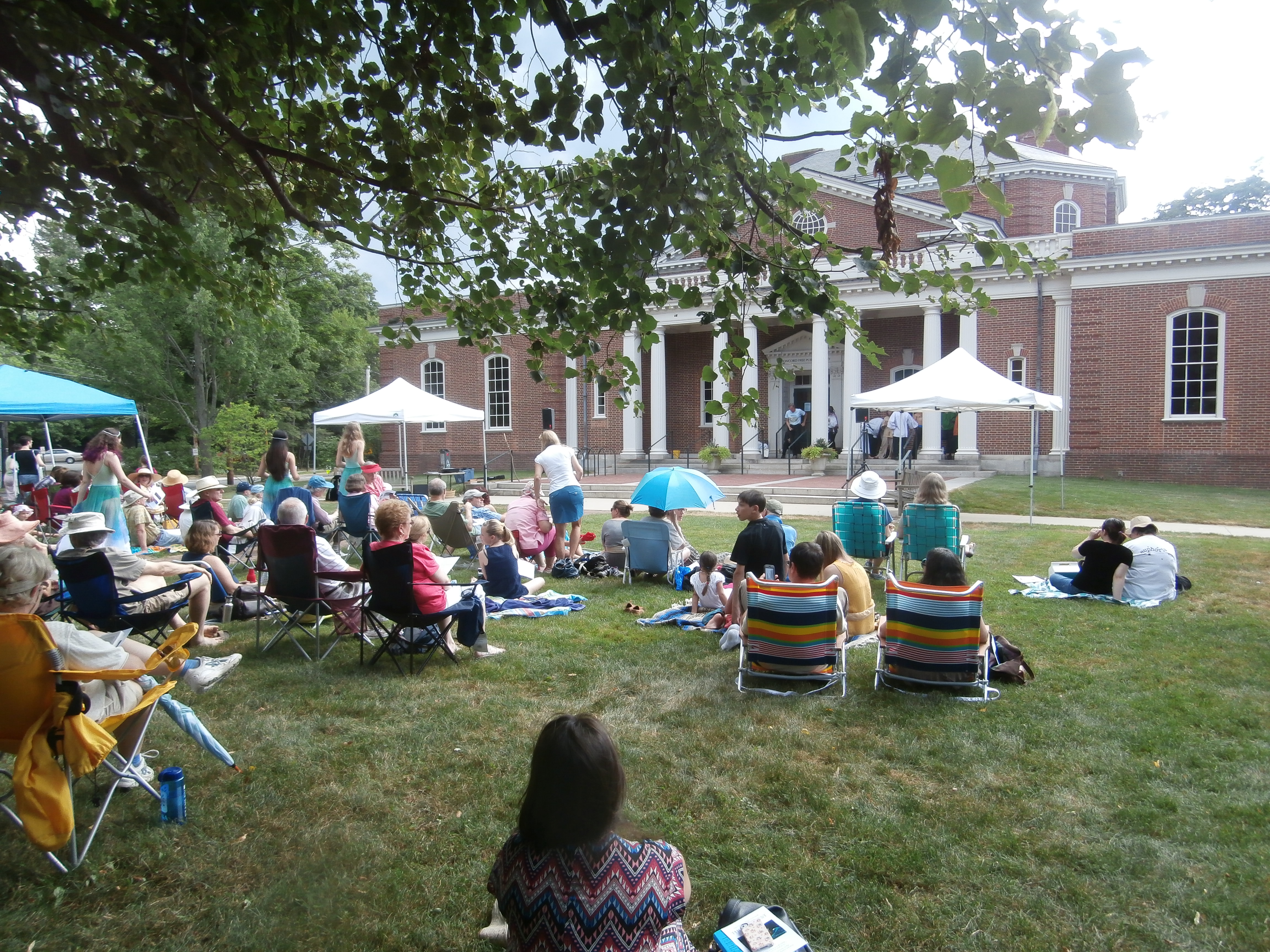
The Concord Players brought a one-hour version of Shakespeare’s “The Tempest” to the lawn of the library yesterday.

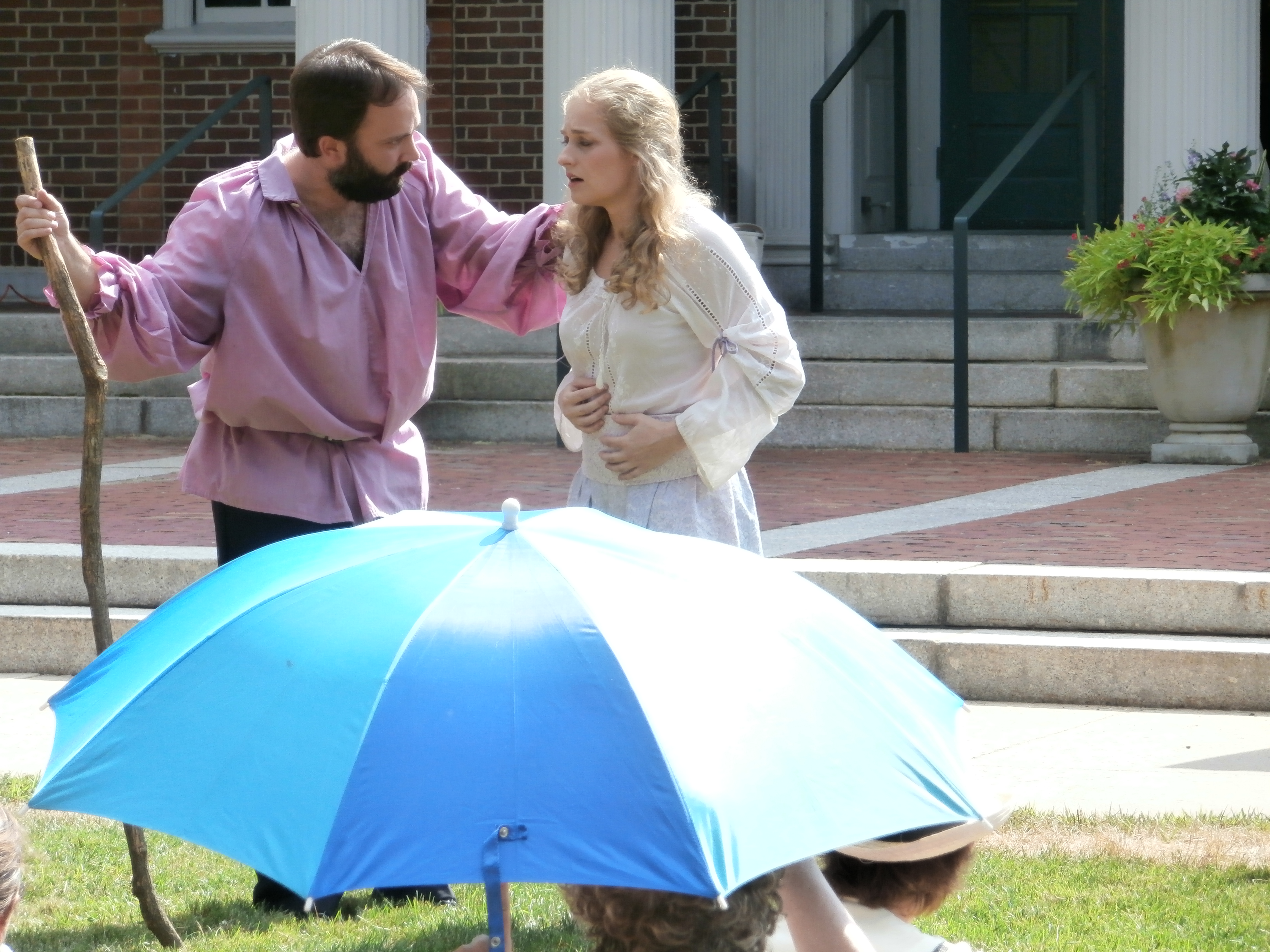
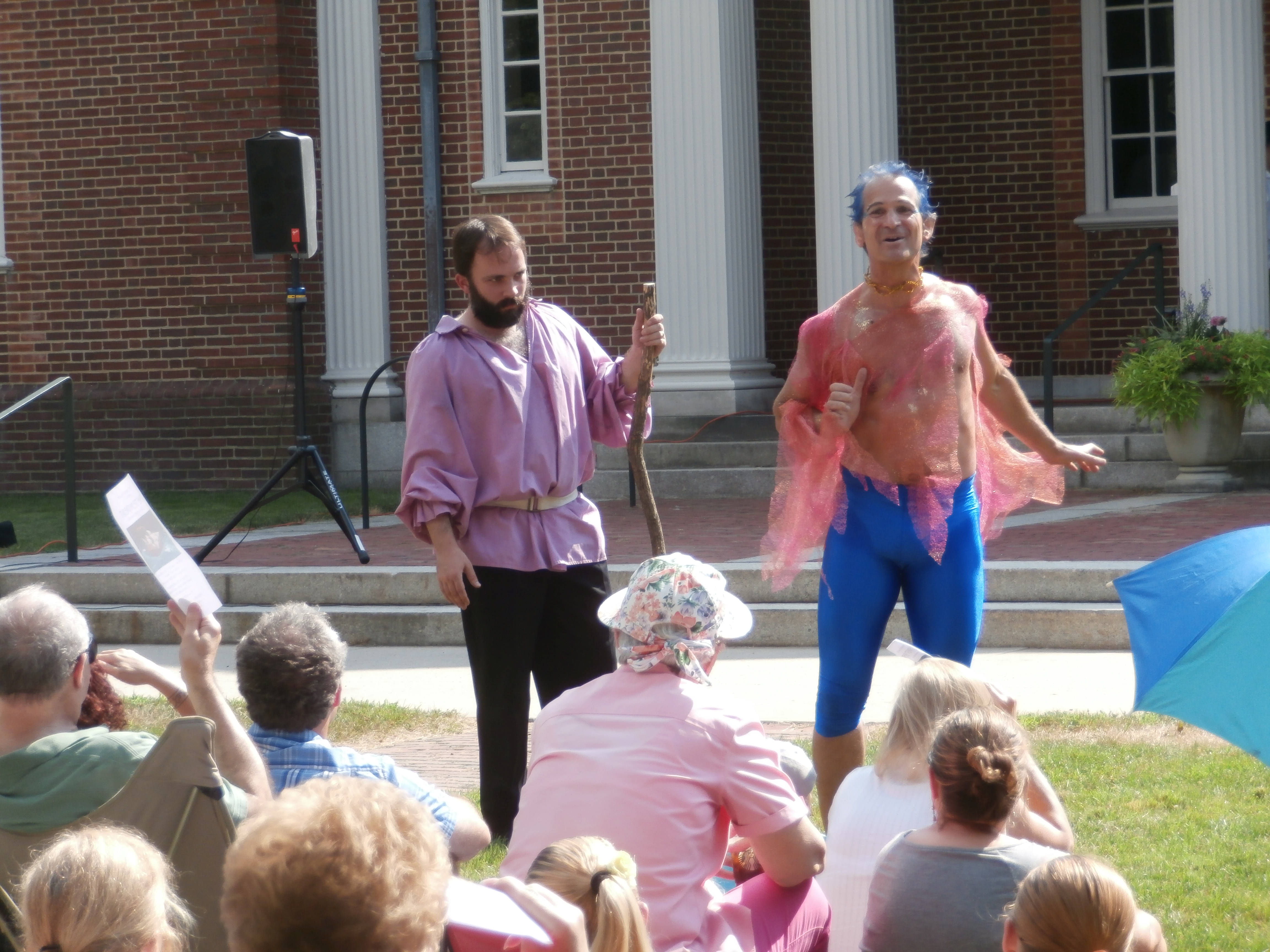
The Prospero was perhaps too young, considering that “The Tempest” is an aging Shakespeare’s valedictory, and there was some awkward overacting, but gee whiz, they had to shout to be heard outdoors. So, good for them to work so hard to give the public free theater in summer!

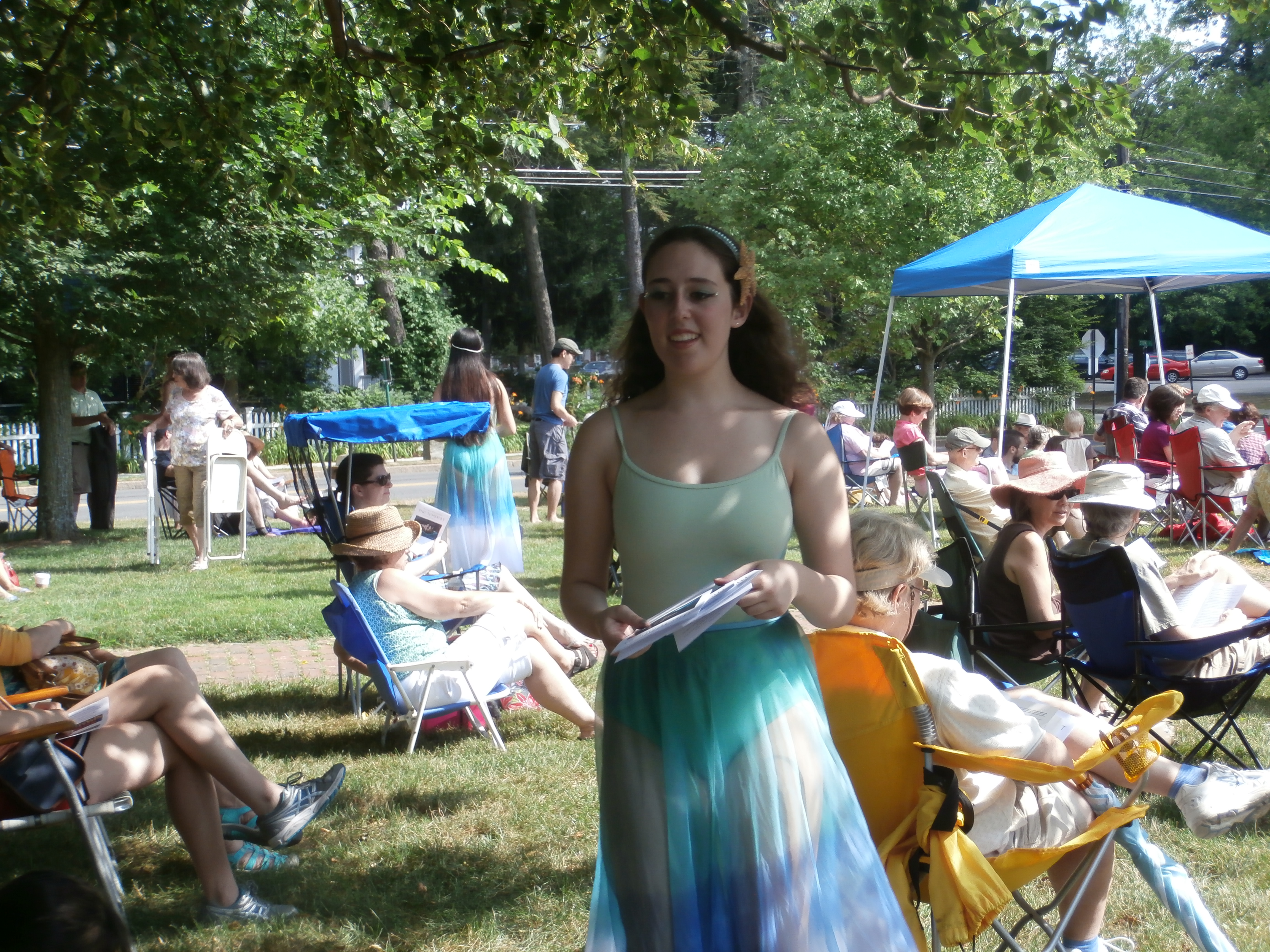
Several sea nymphs doubled as ushers and were lovely to behold.

concord-library-lawn-show

The-Tempest-sea-nymph

prospero-miranda-umbrella

jay-newlon-ariel-tempest

Read Full Post »

John sent me a good New Yorker story about “the Arslanköy Women’s Theatre Group, an all-female theatre group, based in rural Turkey, which is writing and performing plays.

“Ümmiye Koçak, who is now in her mid-fifties, was a forty-four-year-old farmworker with a primary-school education when she caught the theatre bug from a school play that a local school principal, Hüseyin Arslanköylü, had staged the previous year,” writes Elif Batuman.

“Ümmiye had never seen a play before, and it seeped into her thoughts. For a long time, she had been puzzling over the situation of village women and the many roles they had to play. In the fields, they worked like men; in villas, they became housekeepers; at home, they were wives and mothers.

“In 2000, with other women from her village, Arslanköy, she formed the Arslanköy Women’s Theatre Group. The group met every night at the school, after the women had worked ten- or twelve-hour days on farms. Their first production, a contemporary Turkish play called ‘Stone Almonds,’ sold out a theatre in the provincial capital of Mersin, and was written up in the national press.” Continued here.

Still more at the New Yorker blog, here.

I’m wondering about the mysterious figure at the left here. Hamlet’s father? But he doesn’t show up after people die, or does he? It was always a somewhat confusing play. As my father used to say, quoting I know not who: “The king dies, the queen dies, Ham dies — I calls it a helluva play!”

Photograph: New Yorker magazine
“Hamlet” performed in a mountain location near Arslanköy at dawn.

Read Full Post »

At the Paper Mill Playhouse in Millburn, New Jersey, a group of children are learning the joy of theater.

Tammy La Gorce writes in the NY Times that the playhouse now has a class for children with disabilities.

“The class is a logical next step for Paper Mill, which last year began offering a series of sensory-friendly presentations for children with autism in its ‘Theater for Everyone’ programming. Sensory-friendly shows are scripted to be more literal, with innuendo kept to a minimum, and the theater’s lighting and volume are adjusted to help audience members feel more comfortable.

“This year, in a partnership with VSA New Jersey, a nonprofit organization that provides arts programming for children and adults with disabilities, Paper Mill joined the ranks of theaters welcoming such children who have an interest in learning to perform.

“Parents of children with developmental disabilities ‘are seeing the benefits of arts education,’ said Lisa Cooney, 46, director of education for Paper Mill. ‘And they’re a lot more proactive than they used to be.’

“Those who run the programs find them rewarding as well. The children ‘give so much to us,’ said Mickey McNany, the director of Paper Mill’s Theater School, after the recent class. In it, her 10-year-old granddaughter, Mary McNany, who has Down syndrome, identified Mozart as the composer of ‘Eine kleine Nachtmusik,’ performed an improvised roller-skating scene and used sign language, as well as her voice, to sing a song.” Read more.

Below, Marnie McNany takes part with her children Finn and Mary.
Photograph: Aaron Houston for the New York Times

Read Full Post »

Older Posts »