Feeds:
Posts
Comments

Archive for October, 2016

Photo: Evensi

My husband and I alternate between our two sets of grandchildren on Halloween. Last year we got a kick out of seeing John perform the role of MC for the costume fashion show at the park on his street. Although we won’t be there this year, I’m glad I got to see my oldest grandson in this year’s Yoda costume and his sister as a mermaid. Her puzzlement about the way the bottom of her costume was cut led to explanations of mermaid anatomy and collaboration on mermaid drawings.

This year we join the Providence grandkids (one gentleman fire chief, one lady construction worker) for the gathering at Brown Street Park and the annual parade through blocked-off Providence streets.

Brown Street Park has many Friends (changed to “Fiends” for the holiday). It’s in an upscale neighborhood near the university and flourishes because of people who both care about it and know how to raise money. If only all Providence neighborhoods were like that (which I say because behind one place where I volunteer, there’s a filthy campsite where drugs are sold. I am told the city cleaned it up once, but the vacant lot reverted to its current sorry state. How I wish the city would try again and neighbors would feel that they could go in and plant a garden or something!) But I digress.

If you go to the Friends of Brown Street Park website, here, you will find a well-organized group of volunteers soliciting help from other potential volunteers for initiatives such as the Hallloween party and parade, the summer concert series and the Earth Day clean-up.

In poor communities, good things can happen, too, but no outsider can come in and decree what those good things should be. First come efforts to build trust among all neighbors, as suggested here, then come deliberations about what neighbors actually want. I am going to look into getting the city to deal with that no-longer-vacant lot. It’s so disturbing for children who attend nearby activities. All neighborhoods should be safe for children.
Read Full Post »

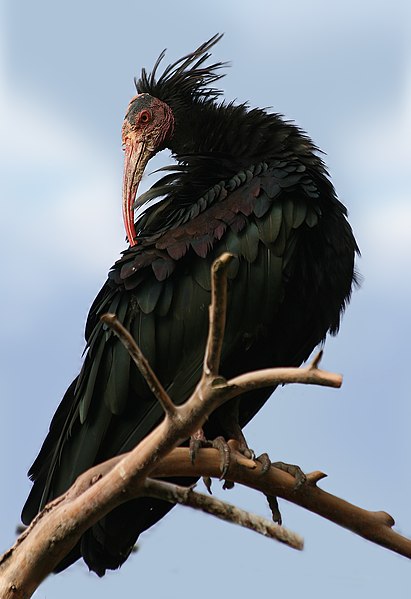
Recently, my husband pointed out an amazing story in the Audubon magazine about birds that were extinct in Central Europe. Today they are being reintroduced and learning where to fly by following a human-powered light aircraft.

Esther Horvath wrote, “Anne-Gabriela Schmalstieg and Corinna Esterer aren’t your typical foster mothers. For starters, the youngsters they care for aren’t humans — they’re captive-bred Northern Bald Ibises, a species that went extinct in Central Europe more than three centuries ago.

“For six months each year the two 20-somethings dedicate their lives to the birds, living onsite in campers at the Schönbrunn Zoo in Vienna, Austria, and looking after the ibises from sunrise to sunset seven days a week. The entire first month the women must abstain from coffee, alcohol, and cigarettes because they have to spit in the birds’ food to make it easier to digest. The chicks eat as many as 15 times a day, dining on a mash of rat, mouse, and chicken, as well as fresh grasshoppers.

“When the ibises aren’t eating or resting, the foster moms spend as much time as possible bonding with them. …

“From day one, they call over and over: ‘Komm, komm, Waldies, komm, komm’ (‘Come, come, ibis, come, come’). When the chicks are three months old, their caretakers move them from the zoo to an aviary in Seekirchen, where they slowly become accustomed to a microlight aircraft and learn to follow it during training exercises, the women calling all the while. …

“The birds journey between the same breeding grounds their ancestors did centuries ago and a suitable overwintering site. Unlike back then, humans now watch them every flap of the way thanks to GPS tags attached to each bird. (To follow their annual trek, download the Animal Tracker app.)

‘For us it is very emotional,’ Schmalstieg says. ‘The birds follow the aircraft because we are sitting in it.’

If you get the Audubon magazine, you can see the actual craft with the birds following it high in the air. Read the online version here.

Photo: Wikimedia
Adult Northern Bald Ibis

Read Full Post »

One of the things I like about twitter is being exposed to stories I probably wouldn’t read about in the New York Times. This one is from a UK website called Foodism and highlights an effort to build businesses from food leftovers that might otherwise be wasted.

“It’s 4pm at Borough Market and the gaggle of children are elated, having spent the day growing, buying and selling market produce. Now trading time is over, and it’s time for their little stall to close, there’s only one question left.

” ‘What will you do with your leftover produce?’ asks development manager David Matchett, who runs the market’s Young Marketeers project for local schools. ‘We can make it into leftovers for tomorrow,’ pipes up one kid. ‘Or we can give it to people!’ ‘We give our food to my old auntie,’ shouts another.

” ‘I’ve been running this project five years,’ Matchett tells [Foodism reporter Clare Finney], ‘and not once in that time has a child ever suggested throwing the food away.’ ”

Other uses are found, Finney writes, giving a new heat source at home as an example.

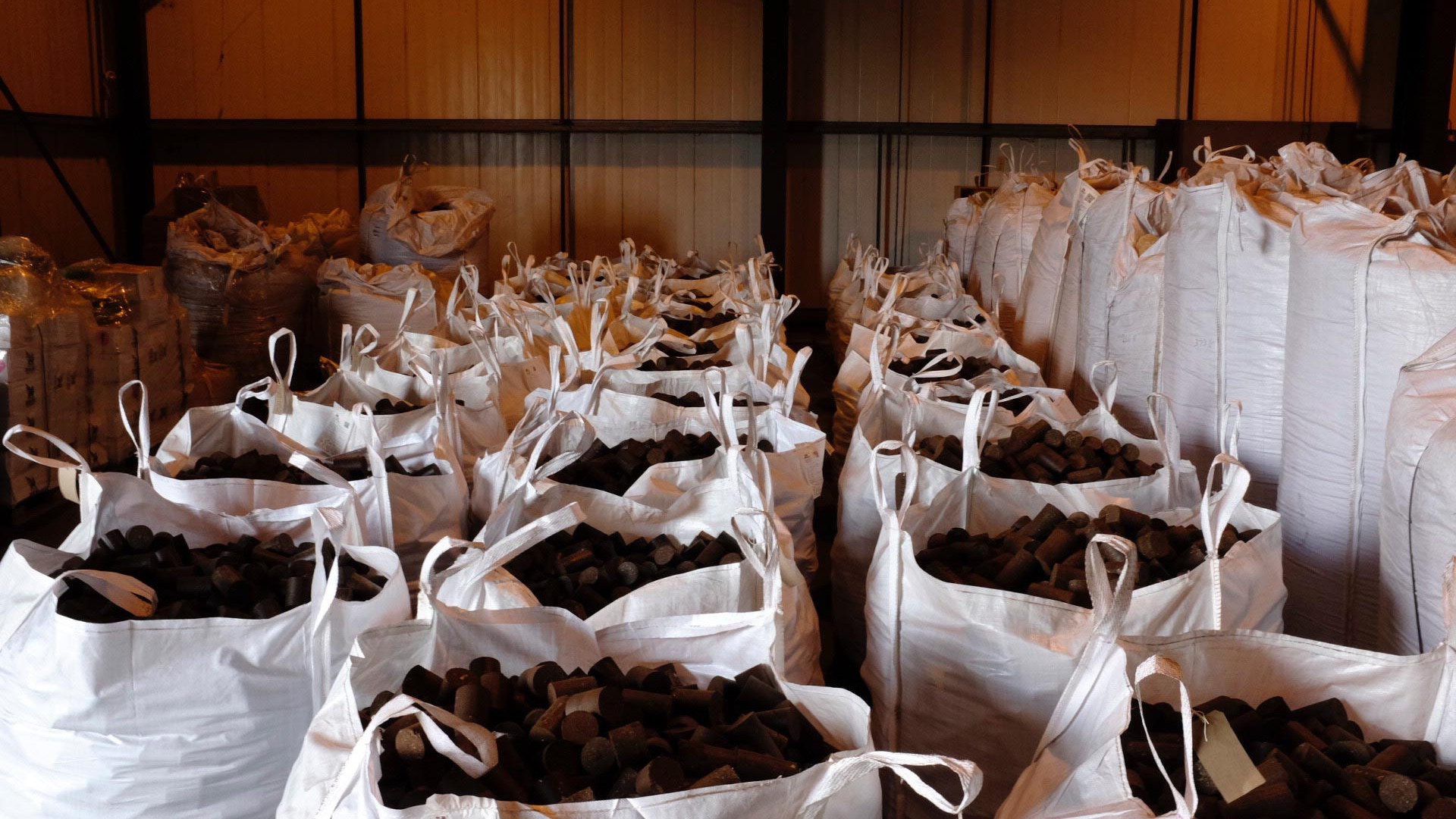
“The heat source is used coffee grounds, recycled by the innovative clean technology company Bio-bean into pellets for biomass boilers, biodiesel and briquettes for wood burners. …

“With its sharp branding, smart technology and simple but potentially revolutionary innovation, Bio-bean is irresistibly representative of the new generation of companies applying principles of modern business, as well as slick design, to an issue that can often appear stale and tasteless: wasted food. …

” ‘These are viable businesses,’ Kate Howell, director of development and communications at Borough Market, says of Bio-bean, and of those other companies turning food waste or surplus into consumables. Indeed, many of the biggest names in the world today actually started here with the market, which has provided a seedbed for sustainable businesses like Rubies in the Rubble, which makes a range of chutneys and sauces from supermarket rejects, Chegworth Valley of apple juice fame, and the street food stall selling meat from previously unwanted billy kids, Gourmet Goat.’ …

“A few months ago, [the grocery chain] Sainsbury’s launched a trial of banana breads made from bananas too bruised to sell in store, to enormous accolades. ‘Originally we estimated they would sell 1,000 loaves,’ says Paul Crew, director of sustainability at Sainsbury’s, with palpable excitement. ‘Customer feedback has been overwhelmingly positive and we’ve already sold 3,000, saving just as many bananas.’ ”

Hey, that’s what we all do with bruised bananas! Now you and I can claim to be trendy as well as thrifty.

Read the Foodism article here.

Photo: Foodism
Bio-bean turns used coffee grounds into pellets for biomass boilers, biodiesel and briquettes for wood burners.

Read Full Post »

Photo: Reuters/Mohamed Abd El Ghany
Visitors play music and talk together in a Cairo, Egypt, bookshop where the new “scream room” is found.

There’s a rather unusual bookstore in Cairo: one that offers customers a room where, if they feel the need to scream, they can just let it rip. No charge for ten minutes.

“Visitors to a bookshop in Cairo are being invited into a dark, soundproof room to scream at the top of their lungs in an effort to relieve their frustrations and escape from the stresses of daily life.

“The new ‘scream room’ is tucked away in the ‘The World’s Door’ bookshop and is also equipped with a full drum kit allowing customers to let go of their worries …

“Owner AbdelRahman Saad offers each visitor ten minutes inside the private scream room, free of charge. He believes it is the first room of its kind in the Middle East.

” ‘I entered it at a time when I was really stressed and came out much more relaxed,’ said frequent visitor Mohamed el-Debbaby. ‘What’s even better is that I was able to find solutions to the problem I was facing.” More here.

(Reporting by Reuters Television; Writing by Adela Suliman; Editing by Patrick Johnston/Jeremy Gaunt)

Photo: Reuters/Mohamed Abd El Ghany
Mohamed el-Debbaby, a dentist, screams in a soundproof room inside a bookshop in Cairo in an effort to escape from the stresses of daily life.

Read Full Post »

Art: Albrecht Dürer
“Virgin and Child With Pear,” at the Uffizi Gallery in Florence.  Heritage fruit archaeologist Isabella Dalla Ragione says it’s not a pear.

I loved reading about this side effect of an Italian woman’s work to preserve heritage fruits: she discovered that a fruit in a famous painting was mislabeled.

Elisabetta Povoledo writes at the NY Times, “On her farm, Isabella Dalla Ragione pursues a personal mission — saving ancient fruit trees from extinction — with a strong sense of urgency. Rescuing vanishing varieties is a race, she says, ‘and lots of times we arrived late.’ …

“To find and collect their forgotten varieties, for decades she and her father chatted up farmers and motley locals in the Umbrian and Tuscan countryside. They gathered branches, and with them the traditions and chronicles tied to the fruits. …

“But because fruit was not always described in detail in written records, she also began to examine the works of Renaissance and Baroque painters working in Umbria and Tuscany at a time when ‘artists had close relations to agriculture’ and were sensitive to the seasons and local varieties, she said. …

“A closer look at Albrecht Dürer’s ‘Virgin and Child With Pear,’ at the Uffizi Gallery in Florence, for example, reveals a clear misnomer, Ms. Dalla Ragione said.

“ ‘If it were a pear, it would show a stalk on top,’ she said. ‘Mary is clearly holding a muso di bue apple.’ …

“Ms. Dalla Ragione created a nonprofit foundation, the Arboreal Archaeology Foundation, in 2014 ‘because it made it easier to give a future to all this,’ she said.”

Read more about her quixotic but intriguing work here.

Photo: Francesco Lastrucci for The New York Times
Isabella Dalla Ragione picking apples on her farmstead in San Lorenzo di Lerchi, Italy.

Read Full Post »

At Public Radio International, Jason Margolis and Ari Daniel reported recently on a Massachusetts business incubator focused on helping green startups by providing them with inexpensive space and shared tools.

“A few years ago, when Sorin Grama had just finished graduate work at MIT and was looking for a place to build his new solar electricity startup, he came across an old abandoned warehouse.

“ ‘My partner and I were looking at it and said, ‘Well, it’s a lot of space here, maybe others can join, it’s kind of lonely,” Grama says. ‘We put out a call to the MIT community.’

“Within weeks, a handful of startups were sharing that cavernous space.

“ ‘And we bonded. All the companies created a nice community, and we started sharing tools, people and ideas, and reading each other’s proposals for funding, things like that,’ Grama says. ‘We had a great Christmas party one year.’ …

“Today, their home is a massive old mid-19th century pipe factory in Somerville, just outside of Boston. It’s called Greentown Labs, and it’s one of the most successful in a new wave of what are called green business incubators, clusters of startups looking to build a business by helping cut carbon emissions and fight climate change. …

“They’re saving money [by getting started] at Greentown. If you need a power saw or an industrial press, no need to buy your own — just sign up for a time slot in the machine shop. The incubator also brings shared intellectual resources, like software, human resources, even PR help. …

“Outgrowing the incubator is part of the point, showing there’s money to be made tackling the world’s climate and energy challenges.

“It’s a growth area that the Commonwealth of Massachusetts is betting on, putting millions in grants and loans toward a network of green tech incubators. Steven Pike, interim CEO of the Massachusetts Clean Energy Center, says it’s an efficient way to spend.

“ ‘We can try and go out and try to support individually 50 different companies,’ Pike says. Or, Massachusetts can invest in an incubator that supports 50 companies under one roof.

“He says Massachusetts has an audacious goal: ‘We want to be the Silicon Valley of clean energy, renewable energy.’ ”

More here.

Photo: Greentown Labs
Shared workspace at Greentown Labs.

Read Full Post »

Here’s a new idea for keeping waterways clean, and wouldn’t you know, the idea comes from the Netherlands.

David Z. Morris reports at Fortune magazine that at the September “World Port Days conference, the Port of Rotterdam debuted a pair of aquatic drones to help the port operate more efficiently and cleanly. One is the Waste Shark, an autonomous vessel to gather waste from the port’s busy waters before it can be washed out to sea. …

“According to Silicon Angle, The Waste Shark can gather up to 500 kilograms of waste, or 1120 pounds, before returning it to a collection point. The vessel also gathers data about water quality, and designs more efficient collection routes as it learns over time. …

“The craft, developed by RanMarine, could help curb the mounting environmental threat of ocean waste. Last year, there were an estimated 5.25 trillion pieces of plastic debris in the ocean, with 269,000 tons floating on the surface—and doing serious harm to ocean life.” More.

Those of you who followed Erik’s relatives’ summer sailing adventure from Denmark to the Mediterranean will recall how dangerous floating debris can be. Reminisce here.

Photo: RanMarine
The Waste Shark autonomous waste collector. 

Read Full Post »

Large quantities of clothes that are damaged in textile manufacturing end up in landfills. To organizations like Renewal Workshop, that seems like a waste. So they are stepping up to the plate, with real benefits to the planet.

“As discarded clothing piles up in landfills around the country,” writes the Huffington Post, “a handful of companies are trying to save some of those garments and give them new life.

“The Renewal Workshop is one of these. It takes shirts, jackets and other items damaged during manufacturing, then repairs and resells them for 30 to 50 percent off the original price, co-founder Nicole Bassett told The Huffington Post. Its goal is to prevent imperfect items, which traditional retailers can’t sell in stores, from being tossed in the trash. …

“Companies fighting clothing waste have their work cut out for them. The average American throws out 70 pounds of clothing or household textiles a year. Only 15 percent of that is recycled, according to a report by the Environmental Protection Agency. The other 85 percent ― around 13 million tons of textiles in 2013 ― ends up in landfills, where it decomposes alongside other solid wastes, releases greenhouse gasses and contributes to global warming.

“The Renewal Workshop is attempting to combat waste in the textile industry by ‘closing the loop,’ or trying to ensure new clothes are made from recycled or used garments. … It creates every single one of its products out of existing garments.

“The company partners with apparel companies like prAna, Ibex and Toad & Co, which are all outdoor clothing brands selected specifically for their commitment to sustainability, Bassett told HuffPost.

“The Renewal Workshop takes those brands’ damaged or returned clothes ― items with broken zippers, seam tears or missing buttons ― and then repairs, cleans and resells them at a discount.

“Apparel partners provide damaged items at no cost to The Renewal Workshop, and pay a partnership fee. When a customer buys a repaired garment, the partner business that provided it gets a portion of the sales, and the customer receives an item with the original company’s brand label and a Renewal Workshop label on it.” Read more here.

And ordinary folks can always help by giving old clothes to organizations that distribute nice ones to new users.

Photo: GaijinPot

Read Full Post »

102216-leaves-tinged-with-pink


102416-shadow-bondir-restaurant


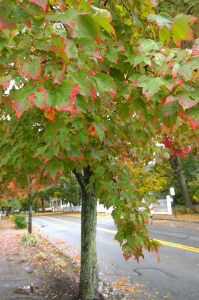
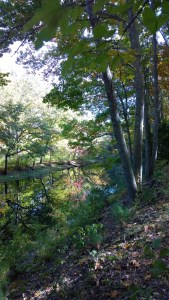
In spite of the drought, Massachusetts trees displayed some of their best colors this year. I’m sharing one photo taken along the Concord River, another that barely does justice to this month’s reds and golds, and a third that intrigued me because the green leaves were pink only on their tips.

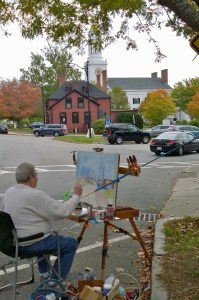
Other photographic offerings include a name shadow at Bondir restaurant, where we had lunch today, a pirate skeleton with his skeletal parrot in a Lowell bookshop/café, lovely plants in the café, an artist working en plein air, shadows of ivy trying to break into the house, and four book-themed scarecrows at the public library.

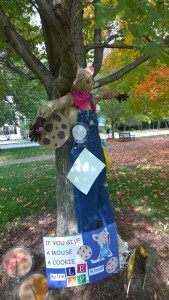
The first scarecrow was inspired by the book Strega Nona, the second by If You Give a Mouse a Cookie. The third scarecrow promotes the library’s seed catalog, and the fourth celebrates the counting books.

Don’t you wonder how the library came to do all that work? There must be 20 scarecrows altogether. I’m trying to picture the meeting where the boss says, “We’re doing scarecrows for Halloween. Who volunteers to do what?” Or maybe it was more spontaneous. It sure looks like people had fun with it.

101916-red-and-yellow-leaves

101516-autumn-river-reflections


102016-pirate-and-parrot-skeletons

102016-hypertext-bookshop-cafe-lowell


101616-en-plein-air-painter

101416-ivy-wants-in


101416-strega-nona-concord-library

101616-if-you-give-a-mouse-a-cookie


101616-concord-seed-library

102016-celebrating-counting-books


Read Full Post »

Photo: The Genesis Center

I’ve been having the best time lately. I’m volunteering in English classes at three refugee agencies, assisting the classroom teachers. The nonprofits are all near one another in Providence.

Dorcas International is an official refugee resettlement agency. It offers a range of services not just for refugees but for other immigrants and for native-born people living in poverty. At Dorcas, I help a teacher work with students who have just arrived in the United States. Most of them know no English at all, and some never went to school in their own countries and are just learning to write.

We have students from Myanmar, the Dominican Republic and Cape Verde, among others, but they are not all refugees. In fact, the majority of families being resettled by the State Department in Providence right now are from Syria and the Congo.

I read in the paper today that 80 percent of the refugees that have entered the United States this year are children, but I work with adults.

The Genesis Center is not a government resettlement agency, but it works with refugees and other immigrants on English and on job skills. It has a great culinary program and places many people in jobs. It also has a day-care center. The students I work with at the Genesis Center are generally a bit farther along in English.

The Refugee Dream Center was more recently established than the other two. It was founded by Omar Bah, a refugee who had been a journalist in Gambia and who had to flee when his articles on human rights garnered him death threats. Bah’s nonprofit is small so far, but its focus on helping people after the four months or so that they receive government assistance is needed. At the Dream Center last week, I worked with a woman newly arrived from Haiti and another from Burundi who has lived in Providence about a decade.

Pretty much all the students act grateful for the help, and it’s a treat to see a face light up when the penny drops. In January, closer to home, I plan to take a training to co-lead small conversation groups.

Did I mention I’m having a lot of fun?

Read Full Post »

Photo: The Daily Star
A temporary refugee camp in the eastern Lebanese town of Marj near the border with Syria.

Tina Rosenberg has an interesting op-ed at the NY Times about how aid groups in Lebanon are making life easier both for themselves and for the refugees that have flooded the country.

“Consider Lebanon, a country of 4.5 million people that has taken in probably close to 1.5 million Syrians fleeing their civil war. …

“In 2004, 99 percent of the world’s humanitarian aid came in the form of commodities: sacks of grain, stacks of blankets, building materials. Last year, that number had fallen to about 94 percent, according to a committee financed by Britain’s Department for International Development to study how best to use cash in humanitarian aid.

“Cash is catching on. A decade ago, the United Nations World Food Program was trying out cash in a few pilot programs. Now cash makes up a quarter of the organization’s portfolio …

“Since it’s easier, safer and carries less risk of corruption to provide cash electronically instead of handing people envelopes of bills, mechanisms should exist for debit cards or cellphone banking. …

“It’s no problem in Lebanon, a middle-income country known for commerce. … Here’s how it works: Each needy Syrian refugee family gets a banking card. Family members use it to shop for food at the 450 participating stores and markets; a family of five gets about $135 per month. …

“Many humanitarian groups in Lebanon help with sanitation systems and other in-kind assistance. Many run schools, or provide skills or business training. The cash is intended to address (a little; it’s not really enough to live on) refugees’ most urgent problems: What’s for dinner? Where am I sleeping?

“ ‘There is nothing that could replace cash,’ said Alan Moseley, the Lebanon country director for the International Rescue Committee, a member of the Lebanon Cash Consortium. ‘If we provided shelter materials, clothing, food or direct rent subsidies, it would be more costly to deliver and people would be getting things they don’t necessarily need.’ ”

More.

Read Full Post »

Moisés Rosas is an organ grinder in Mexico City. According to Azam Ahmed at the NY Times, Rosas’s art is not as popular with the public as it used to be, and that makes some folks wistful.

“ ‘This is a dying art,’ Mr. Rosas said as he turned the dull metal lever of his instrument, wrenching out a troubled squawk. ‘The youth don’t really value us.’

“So it goes for Mexico City’s organ grinders, among the city’s more curious class of street performers. For years, they were beloved by residents, but now they are in a gloomy mood, convinced that their art — and a central part of the city’s culture — is fading away. …

“They are losing fans. Many young people, forced to listen to their music while out at a restaurant or in a square, pay them to leave. The ranks of older patrons, who recall the organ grinders with nostalgia, are thinning.

“Then there is the competition, which has multiplied in recent years. There are break dancers, mimes, movie characters, musicians, artisans and the afflicted, all vying for spare change.

“Worse, there are the superheroes.

“ ‘Don’t even get me started on them,’ [Luis Román Dichi Lara, the head of the organ players’ union], said. ‘You place yourself in the perfect spot, start your music and, boom, here come Thor, Batman and Spider-Man.’

” ‘They intimidate us,’ he said. ‘There’s like 15 of them. They just kick you out.’ ”

But people who want to preserve the culture are supportive, Ahmed reports.

“On a recent evening, Carlos Martínez dropped a few coins in the hat of Sergio Pérez, an organist midway through his evening shift.

“ ‘Not many people help them,’ said Mr. Martínez, 44, an office worker. ‘I don’t really like to listen to them that much, but if no one gives them money, they won’t survive.’ ”

More here.

Photo: Thelmadatter
Barrel organ player in the Zocalo Mexico City.

Read Full Post »

When I was a child, the great blue whale was the attraction I most looked forward to seeing at the American Museum of Natural History in New York City. Now my grandchildren look forward to it.

But in an article on the website called Seeker about how the whale gets cleaned every year, I learned that the model I saw was not anatomically correct.

“The original model was based on measurements taken by American Museum of Natural History scientists in the 1920s. The measurements were of a dead female blue whale captured by a whaling station in the southern Atlantic, and although the artists who crafted the whale followed the original records, there were anatomical inaccuracies, likely because the whale that the scientists examined was already decaying. …

” ‘It was the wrong color. It had bulging eyes, probably due to decomposition,’ [Melanie Stiassny, curator for the Department of Ichthyology] said. In 2001, artists adjusted the body color and flattened the whale’s eyes, also adding a navel that had originally been omitted.

“Today, the [whale] resembles living blue whales more closely than before. However, while scientists’ knowledge of blue whales has certainly improved, there is still much about these giants that remains elusive.

” ‘We still don’t know how many blue whales are out there,’ Stiassny said. ‘We don’t know exactly where they go to breed. They still remain one of the great mysteries of the ocean.’ ”

More at Seeker.

Art: Richard Ellis

Read Full Post »

Photo: The Economist

Reversing desertification in Africa has to be one of the biggest challenges ever attempted. But if we believe that the longest journey starts with a single step, then the continent’s long journey is off to a good start.

According to the Economist, “Building a wall of trees across the width of Africa is a tall order. Solving the twin problems of land degradation and desertification poses a greater challenge still. But more than 60 years after it was first proposed, just such a project is underway at the edge of the Sahara. …

“In 1952 Richard St Barbe Baker, a British environmental scientist, proposed planting a swathe of trees across the southern reaches of the Sahara. The trees would block the wind and sand that move southward from the desert and improve the quality of the soil by binding sediment together and adding nutrients to the mix.

“Although Mr Baker was unable to convince others of his plan during his lifetime, the idea has since taken root. In 2005, Olusegun Obasanjo, then president of Nigeria, revisited Mr Baker’s proposition, seeing in it an answer to some of the social, economic and environmental problems afflicting the Sahel-Sahara region.

“An estimated 83% of rural sub-Saharan Africans are dependent on the region’s land for their livelihoods, but 40% of it is degraded—worn away by soil erosion, human activity and scorching temperatures—leaving much of it unfit for use.

“In 2007, Mr Obasanjo gained the support of the African Union. The Great Green Wall Initiative was launched the same year. Today some 21 African countries are involved in the project, which has grown in scope. Trees have been planted, but building a wall of them is no longer the priority.

“Instead, the wall of trees has become a vehicle for a wider goal: countries in the region working together to tackle climate change, food security and economic growth. Recent projects include abating soil erosion and improving water management in Nigeria, agri-business development in Senegal and forestry management in Mali.”

More at the Economist.

Read Full Post »

An ESPN sports producer set out to do a piece on two high school wrestlers with disabilities. Today they think of her as family. Karen Given reports the story at WBUR radio’s Only a Game.

“Dartanyon Crockett … is legally blind. ‘Being a black kid in the inner city with physical limitations, or what people call a disability, you’re already written off,’ Dartanyon says. ‘No one expects much from you. You’re basically useless. And I wasn’t in a position where I could fix that.’ …

“So he pretended he could see. He joined his high school wrestling team and didn’t even tell the coaches. … Dartanyon didn’t want the coaches to treat him any differently, so they didn’t. Then one day during senior year, Leroy Sutton joined the wrestling team at Lincoln-West High School in Cleveland. Dartanyon was one of the team captains, and he wasn’t the least bit worried that his team’s new recruit was missing something. Well, two somethings.

” ‘We were talking in the cafeteria, and I asked him what happened to his legs,’ Dartanyon says. ‘And he told me that, “Yeah, I was run over by a train.” And I laughed, one of those deep belly laughs. He had always heard the, “Oh, my god. Oh, I’m so sorry. Oh, how did that happen? Oh.” Just to see someone not feeling sorry for him, just kinda sparked a bond almost instantly.’ …

“Soon, Dartanyon was carrying Leroy on and off buses, up and down stairs and into the bleachers. …

” ‘I didn’t know he was blind,’ Leroy says. ‘I found out in class. I noticed he was, like, really close to the book we were reading. So I was like, all right, he has problems seeing. So I turned to a couple of the other students around me and I was, like, “Hey, man, let’s do this like a project style and read out loud.” ‘

“And that’s probably how things would have stayed, Dartanyon and Leroy helping each other out — both thinking it was no big deal — if not for an ESPN feature producer named Lisa Fenn.”

Fenn goes to interview them and is greeted by a coach who said that “he’d been praying really hard for Dartanyon and for Leroy because he felt, once they graduate, the world had nothing for kids like them.”

Turns out the world had quite a bit for them. But it took years. Read the whole story at “Only a Game,” here, because look:

Four years after they first met, Leroy “wrote Lisa a letter for Mother’s Day. … That letter is printed in Lisa’s new book, Carry On, A Story of Resilience, Redemption, and an Unlikely Family. …

When I first met you those were dark days,
In that time I was stuck in my dark way,
There was no light, so you set the world ablaze,
And you snapped me out of that phase,
Then you went further,
Showing me you cared,
Answering my calls now I know that you’ll be there,
Then you ask questions, so slowly I shared,
This world you showed me is simply more fair,
You pull me out of a world where it was not clear,
Glad you did, there was no more air,
But now these days I’m full of smile, and full of play,
Hope you feel loved today,
So I’d like to take this moment to say,
Thank you Mom.
I love you.

Photo: Brownie Harris
Leroy Sutton (left), Dartanyon Crockett (center) and Lisa Fenn, the ESPN producer who came to Cleveland to tell their story.

Read Full Post »

Older Posts »