Feeds:
Posts
Comments

Archive for February, 2018

Photo: Don Lyman
Threatened Blanding’s turtles have been parceled out to Massachusetts teachers and students to protect until big enough for the Grassroots Wildlife Conservation to return them to the wild.

I’m increasingly impressed with the science projects that schools are pursuing these days. My kindergarten grandchild, for example, brings home interesting science kits regularly — the latest involving batteries, wires, and electricity.

In Carlisle, Massachusetts, students are giving a leg up to tiny Blanding’s turtles, as Don Lyman, of the radio show Living on Earth (LOE), reports. The edited transcript follows.

“Lyman: On a clear but cold February day, snow from a recent storm blanketed the outdoor basketball courts at the Carlisle School. But inside the tank where two young turtles lived [Tsunami and Squirtle], it was a balmy 80 degrees or so, and the classroom itself teemed with excitement. I found myself among perhaps the only people with more questions than journalists: fifth graders. …

“Chris Denaro’s students grilled Emilie Schuler, the Director of Programs and Operations at Grassroots Wildlife Conservation, about everything from how many turtles are left in the world, to potential hazards the littlest ones face. …

“The kids were in the midst of a yearlong project to take care of two baby turtles, to give the hatchlings a head start in life, so they’d have a much better chance of surviving to adulthood and boosting the threatened species’ numbers when they’re released in the spring. … The kids were pros at feeding the turtles, giving them fresh water and weighing them, but they still had lots to learn about some amazing things the hatchlings – which they’d named Tsunami and Squirtle — could do. …

“Schuler: Can a turtle’s body – is it okay for a turtle, for its body to be 33 degrees? … That’s the really cool thing. It’s like kind of a superpower of turtles and of reptiles that they can have their body so, so cold. They can drop their body temperature like that and still be fine.

“Lyman: In order to still be okay with such a low body temperature, Blanding’s turtles have to slow down. Wa-a-ay down.

“Schuler: They’ve measured turtles that are this cold, and their heart was beating only one time every ten minutes. … Turtles have the ability to hold their breath for a really, really, really long time. Scientists have even done studies where they’ve purposely put turtles in water where they’ve bubbled out all the oxygen. Those turtles stayed under the water super-chilled for five months. …

“Your Blanding’s turtle cousins that are outside … in the winter right now … even if they were the same age as Tsunami, come April or May, when it starts getting warmer and they come out – what’s the size difference gonna be between Tsunami and their cousins?

“Lyman: The answer: around 7 or 8 times the weight! That’s the main reason why the headstart program is proving so valuable for boosting Blanding’s turtle population numbers. In just eight months, the kids make the baby turtles look like four-year olds. So they’re less attractive to predators like raccoons, herons, and bullfrogs, and much more likely to make it out in the wild.”

When I was in fifth grade, the teacher let a praying mantis egg case hatch in the classroom (and all over the school). That was certainly memorable, but I think the contemporary science projects involve more learning.

More at Living on Earth, here.

Read Full Post »

Deltalina was one of the first to introduce a note of humor in an airline-safety video. The question is, Do passengers retain life-saving information better — or worse?
The last place most of us would look for humor is in an airline-safety video, but as Benjamin Schneider writes at CityLab, comedy in safety information has become a thing.

“Ever since the introduction of in-flight entertainment screens in the 1980s,” writes Schneider, “airline safety videos have been a quintessential feature of commercial aviation. …

“But since the late Aughts, these straight-faced public service announcements have almost completely disappeared, to be replaced by spunky pop-culture riffs, irreverent humor, and eye-catching production.

“In an industry governed by such strict regulations, there is very little airlines can do to differentiate themselves from their competition. So, in 2007, when the airline startup Virgin America sought to carve out its niche as the airline that ‘can make flying fun again, … the in-flight safety video was one of the few features that could be tinkered with. …

“In the video, an unlikely cast of characters, including a toreador and a tech-obsessed nun, demonstrate the safety instructions, while the video’s lead animator, Gordon Clark, winkingly describes their mundane acts. … ‘It made people relaxed when they sat on the plane,’ Clark said. …

“Ironically, airline safety virality was first achieved by a relatively strait-laced video from Delta in 2008. The masses became obsessed with the video’s lead presenter, whose theatrical ‘no smoking’ finger wag earned her something of a cult following, and the moniker ‘Deltalina.’ … In the ensuing years, airlines have pulled out nearly every gimmick imaginable to make their safety video a YouTube sensation. …

“No airline has pursued this strategy with the dedication of Air New Zealand, which has released 14 high-concept videos since 2009, racking up a total of 108 million views online. … [Their first] video’s popularity paved the way for ever more ambitious projects, like ‘The Most Epic Safety Video Ever Made,’ a Lord of the Rings tribute complete with dwarves, elves, and battle scenes. …

“The contemporary crop of airline safety videos appear to have a contradiction at their heart. On the one hand, they are designed to compel passengers to pay attention to important safety information that they might otherwise ignore. On the other hand, the videos contain so much extraneous data that it can be difficult to catch the actual instructions. …

“[Some observers are] skeptical of their effectiveness. Brett Molesworth, an aviation researcher at the University of New South Wales in Sydney, told the Wall Street Journal that people tend to remember the funny parts of these videos, rather than the safety instructions. … Les Dorr, an FAA spokesperson, said that the FAA is in the process of revising their guidelines for these presentations.”

More at CityLab, here.

Read Full Post »

Photo: Richard Saker for the Guardian
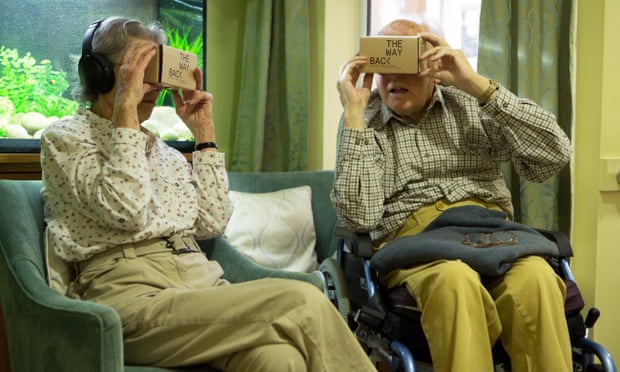
“Oh, this is fun. I feel as if I’m at the party.” Seniors fighting off dementia benefit from Wayback Virtual Reality.

I often think I overdid it in early 2000 repeating myself over and over to encourage an impaired relative to remember her childhood, but an article by Giulia Rhodes in the Guardian suggests that stirring up old memories can indeed be helpful to seniors with dementia.

“In a comfortable armchair, glass of sherry at her side,” writes Rhodes, “Elspeth Ford is getting to grips with her 3D goggles. …

“Elspeth, 79, is a resident at Langham Court, a dementia care home in Surrey, and today she is trialling a virtual reality project, Wayback, that has been designed especially for those living with dementia. Peering into her headset, Elspeth is temporarily transported to 2 June 1953, and a street party for the Queen’s coronation. She is enjoying a children’s fancy-dress competition. ‘I love that boy dressed as an Oxo cube,’ she laughs.

“This is the first in what will become a series of virtual reality films set at historic moments, and available free for those with dementia, their families and carers to enjoy together through a mobile phone and a pair of inexpensive 3D goggles. The idea was developed by three advertising creatives with family experience of dementia.

“For Camilla Ford, Elspeth’s daughter, it is an exciting concept. ‘It gave Mum a huge amount of pleasure and really engaged her,’ she says. … ‘She was immersed in this and it took her back to a time of happy memories, when she was productive and emotionally fulfilled.’

“Elspeth has had vascular dementia for seven years, and finding a point of contact increasingly involves moving to where she is, rather than trying to bring her into the present, says Camilla. ‘If she is in a place she can identify with, and we can see it too, we are somehow equalised. We are at a stage where we aren’t trying to create memories but to relish positive emotions, dropping the expectation of who Mum was and just being with the person in front of us.’

“Elspeth sets off for lunch with her son Dominic, still smiling. It is unlikely, says Camilla, that her mother will remember what has made her feel happy. ‘The point is that she feels uplifted, not necessarily that she knows why.’

“Dan Cole, one of Wayback’s creators, agrees. ‘If the film can open some memories, start a conversation or bring a smile, that’s a success,’ he says. The idea began to form after a drive around Camden, north London, with his father, then in the early stages of Alzheimer’s. ‘It was his old stomping ground and he kept recognising places and telling me little tales; the pub his dad drank in, where he hung about with his mates, even an alley where he once got into a scrap,’ says Dan. ‘In that fleeting moment it was so clear in his mind. I could ask questions. He could tell me things.’ …

“The resulting film was made over two days in a north-London street (satellite dishes and other modern trappings digitally removed) with a volunteer cast and crew of 187 and painstakingly sourced period props, costumes and menu (fish-paste sandwiches, notes one Langham Court resident approvingly). …

“Langham Court’s philosophy is based on the Butterfly Household model, devised by Dr David Sheard, a dementia specialist and CEO of Dementia Care Matters, who is supporting Wayback. ‘People living with dementia become more feeling beings than thinking beings,’ he says. ‘Feelings endure and are more to be trusted when facts diminish.’ ”

More.

Read Full Post »

Photo: Joseph Eid / Agence France-Presse
Painting the word “Peace” in Arabic over 85 rooftops on a Tripoli street for a project led by twin Lebanese street artists over a three-year period.

Nearly everyone wants peace. Nearly everyone expresses that over and over. You would think we would have peace by now. One large-scale expression of the world’s fervent wish in a city badly damaged by conflict took three years to accomplish.

Agence France-Presse reports, “From the street below it’s easy to miss the workers daubing rooftops as part of an ambitious art project in two battle-scarred neighbourhoods of Lebanon’s Tripoli.

“But the Ashekman street art duo behind the project say that once they’re done, the pistachio-green rooftops they are painting will spell out the word ‘Salam’ — Arabic for ‘peace’ — on a scale visible from space.

“The project, three years in the making, is the brainchild of 34-year-old twins Mohammed and Omar Kabbani. …

“They chose a site spanning the Bab Al Tebbaneh and Jabal Mohsen neighbourhoods, which have fought successive rounds of armed clashes in recent years. …

“Peace has been elusive in Sunni-majority Bab Al Tebbaneh and the adjacent Alawite-majority Jabal Mohsen. Fighters from the two areas have battled each other periodically for decades, and the war in neighbouring Syria, pitting a Sunni-dominated uprising against Alawite president Bashar Al Assad, has further stirred existing enmities. …

“Ashekman’s project runs on either side of the infamous Syria Street separating the two neighbourhoods. The duo hired workers from across the divide to help them complete the project.

” ‘All of the workers live here in the neighbourhood, they lived the conflict, some of them got shot,’ Omar Kabbani said.

” ‘Two years ago they were hiding from bullets … now they’re painting their rooftops proudly.’

“The brothers are sensitive to the observation that their project does little to address the most obvious scars of fighting or the area’s desperate poverty, often identified as a catalyst of the violence.

“They say they chose paint that will seal rooftops against rain and reflect ultra-violet rays, cooling the homes below.

“And in order to paint the rooftops, they had to negotiate with residents and often had to clear large amounts of trash and debris. …

“Walid Abu Heit, 29, joined the project as a painter after hearing about it from March, a Lebanese NGO that has worked on reconciliation and rehabilitation in the rival neighbourhoods. …

“He and other workers lugged heavy tubs of paint up seven floors and began plastering a roof with the fluorescent green, which flecked his hands and boots.

” ‘It’s an amazing project,’ he said, smiling and shading his eyes from the blazing sun.

” ‘The word peace, it’s a great word … we haven’t seen it for a long time, now we’re seeing it again.’

Read more here; also at National Public Radio, here.

And ponder the power of artistic twins here, at one of my posts on street artists Os Gemeos. The Greenway’s first giant mural, which they painted, is still my favorite. It makes you think about “The Other” as a sweet little kid.

Read Full Post »

Photo: MICRO
A visitor examines the MICRO mollusk museum.

Good things come in small packages, even museums, as we saw in this 2013 post. Since then, enthusiasm for micro museums has only increased, as Margaret Carrigan reports at the Observer.

“When scientist Amanda Schochet and designer Charles Philipp unofficially started MICRO, they wanted to make the world’s smallest museum about mollusks, a passion of Schochet’s.

“They realized that might be easy, considering there were no real mollusk museums at all. But as they started developing content and design, the pair realized that even small museums could have a big impact.

“In a year-and-a-half, they’ve created five 6-foot-tall natural history museums that have been installed around New York City, with the latest unveiled in mid-December at the Ronald McDonald House on the Upper East Side. The goal for Schochet and Philipp is to foster equal access to fundamental knowledge by creating installations that can be found outside of the traditional museum setting. …

“With intentions to become the most-visited museum in the country within five years … Schochet and Philipp plan to debut a new MICRO museum module every year, starting with the core sciences before delving into math and art. Their first physics edition, the Museum of Perpetual Motion, [was scheduled to] launch in early February. …

“Philipp: It started as a kind of tongue-in-cheek idea just between my partner, Amanda, and I. Amanda is a computational ecologist and knew there was a really rich history of mollusks in New York, especially oysters. So when she first moved here a few years ago, we started looking into whether we could go to a museum about mollusks. But we couldn’t find one, so we joked that if we made the smallest mollusk museum it would also de facto be the largest. …

“It wasn’t until we had a four-hour wait in a doctor’s office that it seemed like there could really be a market for something like this. There was a captive audience right in front of us looking for entertainment, and something to distract them that wasn’t just whatever rerun was on the office television. It was then we realized a mini-museum could have an impact, and we bounced the idea off some friends who worked in museums who really saw some sort of potential.

“We started doing some research and found that something like 90 percent of museum visitors across the U.S. are non-Hispanic whites. We also found that there are 135 museums in Manhattan, but in the Bronx — which has a comparable population — there are only eight. These both seemed like problems that could be addressed by bringing more museums to areas where there were few institutions with larger populations of minorities. And one way to do that was make small museums that could be installed anywhere. …

“We don’t have enough room in MICRO to get into a lot of history and context, so we have to be really mindful about how to present information and how best to do it that would entice the average passerby: How do we make someone with little knowledge of the subject who is perhaps just in the middle of running an errand and totally focused on the day-to-day stuff they need to be doing interested and curious enough to spend 10 minutes learning?

“We’ve come up with some interesting ways of solving that. In the mollusk museums, we’ve installed an eye-catching hologram in the base of it that boasts a digital aquarium. And we chose to use recognizable B-movie alien characters as a way of introducing mollusks to the viewer, since we found that many of them are based on these organisms because they seem so otherworldly.” More here.

I love that they want to get their museums into the Department of Motor Vehicles. Now that is an idea whose time has come!

Read Full Post »

b9cb4c5be96466ffe5e9e1e8f5886398

Art: Dawn Marie Livett
Music goes hand-in-hand with other creative endeavors. This teacher writes, “Through music, from classical to popular, kids encounter themselves and experience the feelings and sensations associated with their worlds.”

Jeffrey Pflaum, a reader of this blog who taught children creative writing for many years, asked me if I’d be interested in reporting on some of his techniques. I am. This post is adapted from one of his blogs.

Pflaum writes that using experiences, reflections, and insights geared to “struggling, reluctant, and average readers and learners” in grades 3 to 6 helps them develop. “One key step to learning about any world is to know our selves first. …

“As an introduction to reading and writing I deal with kids’ inside worlds. What does each child have to know about mind, self, and imagination in order to learn? What makes up this inner universe? Why is it so important to know the contents of our worlds before studying the worlds of different subjects? …

“My lessons connect with the children’s inner lives.  It doesn’t help when education builds test walls around creativity and motivation, two huge channels to learning and developing a passion for reading. Education’s role is to open up students’ worlds so they are receptive to new ideas. … Motivation becomes self-motivation and education means self-education.”

Pflaum finds that helping children to develop self-knowledge enables them to tap their inner worlds and use their life experiences to enrich both schoolwork and everyday life. “Thoughts, ideas, feelings, fantasies, daydreams, dreams, dialogues, monologues, memories, reflections, and all the mental image pictures are the stuff of our inside worlds,” he says.

In one exercise, “kids close their eyes, visualize words in the mind, describe them orally and in writing, and then draw/sketch what they ‘see.’ Some examples of words for this practice exercise are: dog, rose, apple, room, sky, rainbow, clouds, parrot, pencil, pen.

“From here, I’ll build two-word sentences such as: Frogs hop; children play; birds fly. And then I probe what they are viewing with questions: What are you looking at? What pictures do you see in your mind? What thoughts are triggered? What feelings are connected to the image? Can you describe the mind-picture and your experience? Draw/Sketch the sentence you visualized (crayons, markers, pencil, or pen).”

Another exercise I liked had to do with using music for creative inspiration. It starts with a counting technique and progresses to listening to music, with the following instructions: “ ‘Sit back and relax. Put your heads gently down on the desks, close your eyes, and enjoy the music. When it’s over, write whatever you experienced inside yourself.’ … They learn to appreciate the contemplation process and the music as it soothes them into their worlds and journeys of self-discovery. …

“Through music, from classical to popular, kids encounter themselves and experience the feelings and sensations associated with their worlds.  They see what brings them up and down and learn to create a positive attitude towards contemplation, reflection, and self-expression.”

More ideas for teachers can be found at http://www.JeffreyPflaum.com. Some approaches might also work with adult students.

Educator Jeffrey Pflaum

fixed20pic


https://www.bamradionetwork.com/home/experiences-reflections-and-insights-a-project-in-reading-and-emotional-intelligence

Read Full Post »

Photo: Jon Chase/Harvard Staff Photographer
Harvard student Manny Medrano displays a model of khipu knots, an information system that the Inca used to tally and record data. He decoded the meaning when he was 19.

This is a period in history when our hopes have been raised that young people will solve some of our knottiest problems. How can they do that? Because they have a fresh perspective, I think, and like the “whiz kids” in the Tracy Kidder book Soul of a New Machine, they don’t know what’s impossible.

At the Boston Globe, Cristela Guerra writes of a problem solved by a teenager — a literally knotty one. She calls it “a mystery that has left many scholars flummoxed.

“For all the achievements of the Inca Empire, including a massive roadway system, sophisticated farming methods, and jaw-dropping architecture, it was the only pre-Columbian state that did not invent a system of writing.

“Instead, the Inca, whose civilization originated in Peru and grew to include peoples and cultures all along the west coast of South America from 1400 to 1532, relied on knotted strings to encode information, a system so complex that scholars still struggle to make sense of it.

“Which is what makes the work of Harvard student Manny Medrano all the more remarkable. The young student provided new insight into how the Inca recorded information by analyzing the colors and the direction of the knots placed on the strings known as khipus. …

“Three years ago, freshman Medrano was working as a research assistant for Gary Urton, the Dumbarton Oaks Professor of Pre-Columbian Studies and chair in the Department of Anthropology at Harvard University. Medrano, then just 19, decided to spend his spring break analyzing the data from six khipus that were found in the collection of an old Italian count who’d lived in Peru. …

” ‘The only history we have of the Inca Empire are ones that were written by Spaniards after they conquered the Incas,’ said Urton. …

“There is no Rosetta Stone for khipus, no translation for what the patterns of knots represent, and no match between the Spanish documents and the khipus themselves. …

“Medrano set to work. Though he was most interested in studying mathematics and economics, he also had a strong interest in archeology. … He made graphs and compared the knots on the khipu to an old Spanish census document from the region when something clicked.

” ‘Something looked out of the ordinary in that moment,’ Medrano said. ‘It seemed there was a coincidence that was too strong to be random.’

“He realized that, like a kind of textile abacus, the number of unique colors on the strings nearly matched with the number of first names on the Spanish census.

“For example, if there were eight ‘Felipes,’ all were indicated by one color, while ‘Joses”’ were indicated by another color. …

“As a result of Medrano’s discoveries, Urton and Medrano produced a paper, [published] in the academic journal Ethnohistory in January. Medrano, now a junior, is the lead author of the article, ‘Toward the Decipherment of a Set of Mid-Colonial Khipus from the Santa Valley, Coastal Peru.’ …

“Medrano plans to continue his research. He has decided to major in applied mathematics and minor in archeology.”

More at the Globe, here.

Read Full Post »

Photo: Swem Library
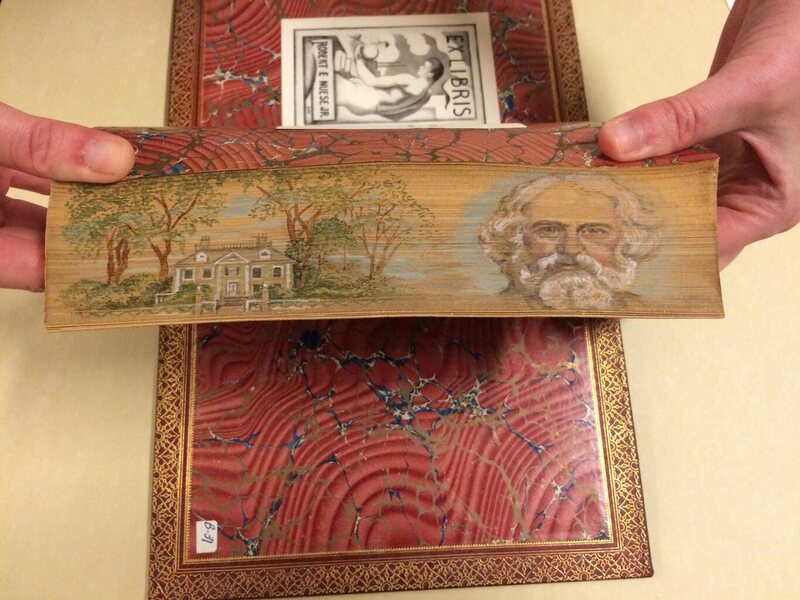
Art on page edges from
The Complete Poetical Works of Henry Wadsworth Longfellow. See 22 other examples at Atlas Obscura.

Have you ever noticed paintings along the page edges of old books? According to a 2016 Atlas Obscura article by Eric Grundhauser, they’re called “fore-page paintings.”

He writes, “While you don’t see them very often these days, fore-edge paintings were once some of the loveliest book illustrations around. … A fore-edge painting refers to an image painted or drawn on the closed leaves of a book. …

“Some ambitious, ‘disappearing’ fore-edge paintings were painted on the inside edges of the pages, so that the hidden scenes could only be seen when the page block was fanned in a certain direction. …

“These secret illustrations could be doubled, with an illustration on either side of the pages, revealing themselves depending on the slant of the page block (known as the ‘two-way double’). Some were painted so that if the book was laid open in the center, naturally splaying the pages to either side, two different illustrations could be seen on either side (known as a ‘split double’). …

“ ‘Sometimes the fore-edge paintings corresponded to the subject of the book, and sometimes not,’ says Jay Gaidmore, Director of Special Collections at the Earl Gregg Swem Library. The library holds the 700-strong Ralph H. Wark Collection, the largest collection of fore-edge painted books in America. …

“ ‘Most of the books are 19th century English fore-edges, but there are a few American scenes.’

“Fore-edge paintings can be found on books dating back to the 11th century, with early examples being decorated with symbolism and heraldry. …

“According to the Boston Public Library’s website for their 250+ collection of fore-edge books, for the most part the paintings were made using watercolors, and went unsigned, often being commissioned by a book-binding firm. …

“The technique has even been printed onto some modern books like Chip Kidd’s 2001 novel, The Cheese Monkeys, which was printed with a two-way double, disappearing fore-edge message. If the pages are shifted in one direction, the phrase ‘GOOD IS DEAD,’ appears, while if they are shifted in the opposite direction, the message, ‘DO YOU SEE?’ can be read.”

Tip of the hat to Fort Point artist Karen McFeaters, who retweeted this lead from @michikokakutani. More here, where you can see 22 additional examples.

Read Full Post »

A Year of Art Discoveries

Photo: Wikimedia Commons
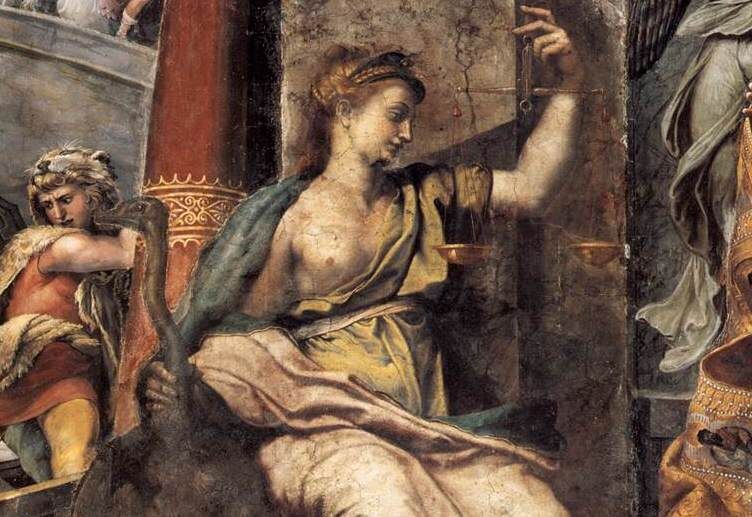
Two Allegory of Justice figures in the Vatican, once attributed to Raphael’s followers, were identified in 2017 as being by the master himself.

This Artsy report on 2017 art discoveries was pretty cool. Curiously, I had already written about one of the finds — here. It was the Rodin sculpture discovered in a New Jersey town hall.

Abigail Cain writes, “Art history is, by definition, primarily a thing of the past — but each year, some small portion of it is rewritten by those in the present.

“In 2017, we gained new insight on the early years of Leonardo da Vinci and the final ones of Andy Warhol; amateur archaeologists were rewarded with major finds; and several masterpieces were discovered, simply hiding in plain sight. From newly mapped Venezuelan petroglyphs to a long-lost Magritte, these are 10 of the most notable art-historical discoveries of the year.”

I especially loved that volunteers made the find that occurred in England. “A team of amateur archaeologists,” writes Cain, “dug up one of the most significant Roman mosaics ever discovered in Britain.

“The discovery was made in a field outside of Boxford, in southern England, by a group of local volunteers supervised by professional archaeologists. Although the project began in 2011, it wasn’t until August of this year — during the final two weeks of the scheduled dig — that organizers realized they’d found something extraordinary.

“As it turned out, they’d uncovered a remarkably well-preserved mosaic, built as part of a Roman villa that dates to roughly 380 A.D. Not only is it a rare find for the country — experts have labeled it the most exciting of its kind unearthed in 50 years — the subject and style of the artwork is highly unusual for the area. The work illustrates the story of Bellerophon, a Greek mythological hero tasked with killing the Chimera.”

Check out Artsy, here, to read about: the discovery that two figures in the Vatican were painted by Raphael and not his assistants; two ancient tombs in Egypt; the likely identity of Leonardo’s mother; a portrait by Peter Paul Rubens found hanging in a historic Glasgow house; a miniscule carving recovered from a Bronze Age tomb with “detailed handiwork centuries ahead of its time”; the last piece of a lost René Magritte painting found in Belgium; and drone technology that helped researchers map “massive, 2,000-year-old petroglyphs in Venezuela for the first time.”

Doesn’t it make you want to go out and discover some long-lost treasure?

Read Full Post »

lewisset_304x400

Photo: British Museum
One of the walrus-ivory pieces among the British Museum’s 12th century Lewis Chessmen is a castle that records the metaphorbíta í skjaldarrendur” (“biting its shield-end,” or fighting on in the face of great odds), a phrase still common in today’s Iceland.

Iceland is such an interesting country. I have enjoyed reading about how everyone gives books at Christmas and how volunteers embrace danger to rescue reckless tourists. Now the Economist explains that although almost no one else speaks it, Icelanders love their language.

“It is hardly surprising that Icelanders have names for the many different fish that abound in their surrounding waters — the various types of cod, herring and so on which they have been catching for centuries.

“It is rather more surprising that they have not just one word for the coelacanth, but three. …

“But Icelanders are keen namers of things — and would never dream of simply adopting a transliterated version of someone else’s word. So they call the coelacanth skúfur, which means ‘tassel.’ Or skúfuggi: tassel-fin. Or sometimes forniskúfur: ‘ancient tassel.’ [You can hear the spoken pronunciation at the Economist.]

“Icelanders are fiercely proud of their tongue and stay actively involved in its maintenance. On Icelandic Language Day they celebrate those among the population of 340,000 who have done the most for it. They love the links it gives them to their past.

“Ordinary Icelanders revel in their ability to use phrases from the sagas — written around eight centuries ago — in daily life. The commentator who says that a football team is bíta í skjaldarrendur (‘biting its shield-end’) as it fights on in the face of great odds, is behaving quite normally in borrowing an image from ancient tales of Viking derring-do. ….

“The result is something close to unique — a language that is at the same time modern (it can happily express concepts such as podcasting), pure (it borrows very few words from any other tongue) and ancient (it is far closer to the ancestral Norse tongue than its increasingly distant cousins, Danish and Norwegian). Its complex grammar has barely changed in almost a thousand years and has a distinct old-worldliness. But if, like the forniskúfur, Icelandic is a living fossil, it is a lovely and lively one. …

“From early on [Icelanders] were particularly keen on using it to write things down; much of what is known about Viking culture comes from Icelandic texts. In the 13th century Snorri Sturluson produced the Prose Edda, one of the earliest and most important accounts of the antics of Thor, Frigg, Loki and their kith and kin. …

“Some words do look similar to English ones: bók, epli and brauð are ‘book,’ ‘apple’ and ‘bread.’ …

“Some of these similarities, though, can mislead. An English-speaker who knows that dóm is cognate to the English word ‘doom’ may find the Reykjavik building marked dómsmálaráðuneytid rather menacing. But it is just the ministry of justice: ‘doom’ in English was once mere judgment; only later did it take on first the meaning of condemnation, then ruin.

“It is not clear in quite what way J.R.R. Tolkien meant the word when he named the climactic locale in The Lord of the Rings Mount Doom. But as a philologist interested in Norse and other ancient tongues, and keen on the archaic, he certainly knew his Icelandic.

“The name of the wizard Gandalf is taken from the Eddas. The Tolkiens’ Icelandic nanny, Adda, not only took care of the children; part of her role was to help him practice Icelandic. Mrs Tolkien was not pleased by the attention.”

Wow, that’s interesting because, as we learned in this recent post, Tolkien was orphaned at the age of 12. His early years with that nanny must have made a big impression on him.

Find other curious facts about the Icelandic language at the Economist, here, and listen to more of the pronunciations.

Read Full Post »

Photo: Gavin Ashworth
Klewicke, “Original Design Quilt” (Corning, New York, 1907), pieced silk, faille, taffeta, and satin, digitized by the American Folk Art Museum in New York City.

Nowadays, it’s not enough for museums to exhibit art that you can go see or read about in a book: they want to be able to share their treasures online. That’s why the American Folk Art Museum in New York City is digitizing the New York Quilt Project, which features more than 6,000 quilts and their histories.

Allison Meier writes at Hyperallergic, “From a 19th-century block pattern quilt made from a woman’s wedding dress, to a commemorative quilt celebrating the 1901 Pan-American Exposition in Buffalo, the New York Quilt Project contains an invaluable record of the state’s folk art history. …

“Now AFAM [the American Folk Art Museum] is digitizing these materials to make them more accessible. …

“The vast majority of these quilts are not at the New York City museum, but are heirlooms in private collections, whether an attic in the Catskills or a quilt trunk in Brooklyn. … AFAM has so far put about 1,500 quilts online, and expects to finish the digitization in 2019. AFAM also has related oral history recordings that they’re working to digitize.

“Quilt projects statewide were really popular in the ’80s, and people started collecting their histories,” [Mimi Lester, an AFAM archivist and project manager for the digitization] explained.

“The Kentucky Quilt Project, founded in 1981, was the first of these, inspiring a resurgence of interest in the United States. Frequently these grassroots initiatives revolved around ‘quilt days,’ at which people could have their family quilts documented. …

“People would bring their quilts to YMCAs or churches or museums, and we would have registrars there who would help the individuals fill out the forms and take photographs,” Lester said. …

“Details were recorded like family background, religion, where a quiltmaker learned the craft, why they made the quilt, and where they obtained textiles, and a small tab was sewn into the back of each quilt for identification. These stories often chronicle immigration.”

Click here for photos of some lovely quilts — and lovely quilters.

Hat tip: radio show Studio 360 on twitter, @studio360show.

Read Full Post »

Photo: Andrew Jackson for the Guardian
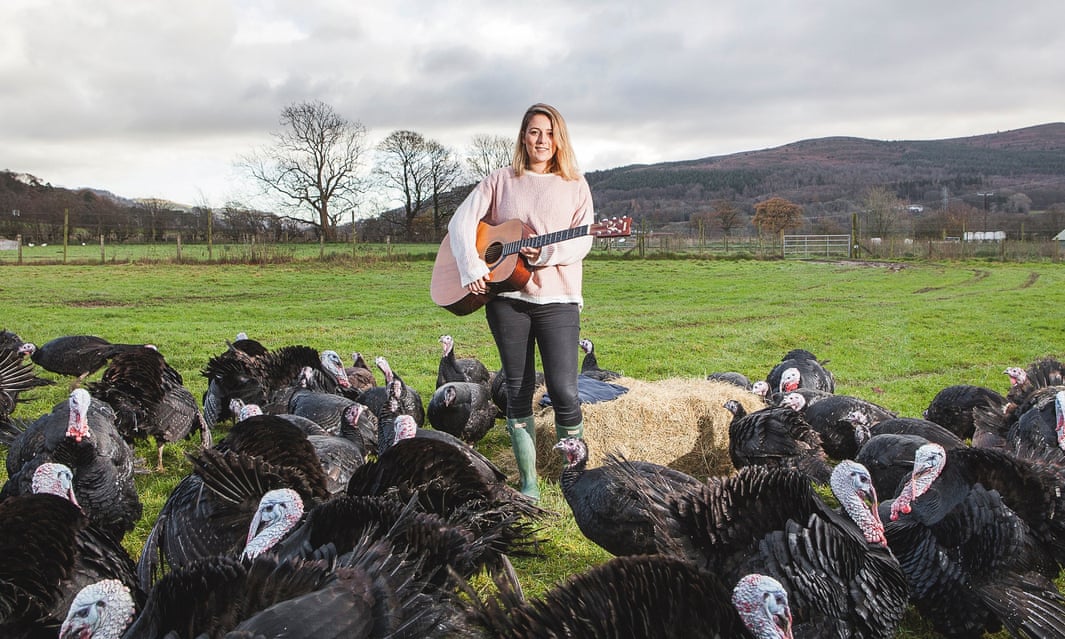
Elin William says, “From the moment I started strumming, the turkeys crowded ’round.”

A few months ago, I told my younger grandson that I had read a story about a woman who plays music to calm down turkeys. I don’t think he quite believed me.

But it’s true. Elin William wrote at the Guardian about her unusual use of music.

“I got my first guitar when I was 12, and it’s been a slow process of self-tuition since then. I also play piano and violin, but I only play the guitar to the turkeys on the Rhug Estate farm in Corwen, north Wales, where I work.

“It began as an experiment. Rhug is an organic farm, and the main principle is to create as little stress as possible for the animals. But the farm is on the side of a main road, so some get spooked by loud noises: the traffic, machinery or sounds from the car park. We started playing the radio to them overnight. We’d put on Classic FM when we were shutting up at 7 pm and leave it on until we returned in the morning.

“The turkeys in particular responded really well. So we started playing the radio all day, every day. Then my boss, Lord Newborough, thought, ‘What if the music was much more up close and personal?’ He knew I played guitar and suggested I had a go. …

“From the moment I started strumming, the turkeys crowded ’round. I got the impression they enjoyed listening to me play. They started pecking on the guitar and plucking the strings. That’s the result of organic farming: you get inquisitive animals, rather than ones that are scared. …

“I’ve now performed in front of hundreds of turkeys. … I sing Welsh folk songs and ones my dad would have loved to hear, like the Animals’ ‘House of The Rising Sun’ – that’s the one I like playing most. …

“I’ve been described as a turkey whisperer. It’s like a horse whisperer, but not as glamorous. I don’t have a magic touch – anyone who played to them would get the same reaction, to be honest. …

“I’m an animal lover and it’s important to me that the turkeys are happy. But I’m not a vegetarian. Getting so close to the birds doesn’t make me think I have to give up meat. Farming is a mega industry, but here the focus is on quality of life. Having worked with them, it’s impossible to imagine turkeys in cages.” Read more at the Guardian, here.

Read Full Post »

Photo: Elizabeth Hafalia, The Chronicle
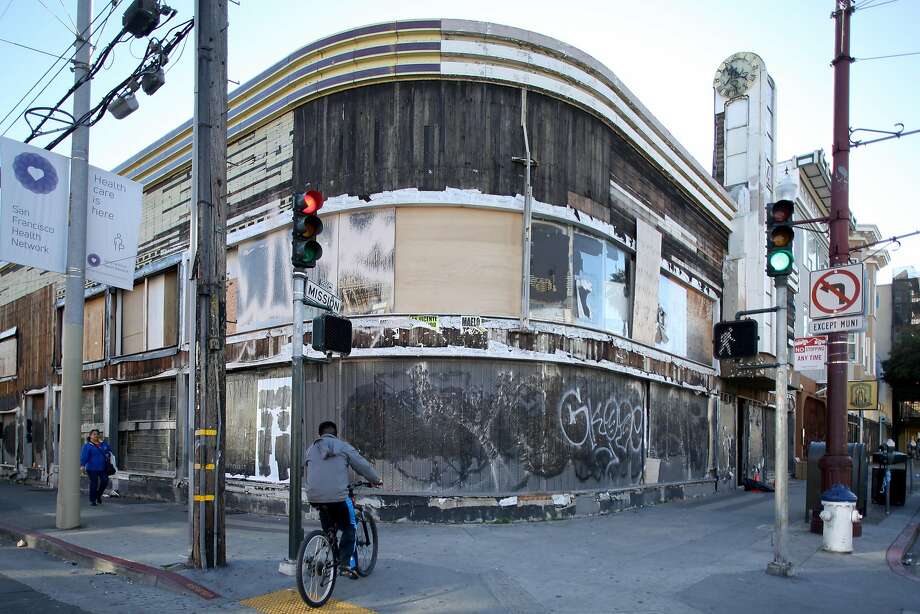
Facing a need for affordable housing and arts space, San Francisco’s Mission Economic Development Agency is joining with Dance Mission Theater and the Mission Neighborhood Centers to repurpose this neglected 1919 building.

Have you ever visited San Francisco’s Mission District? A poor, immigrant neighborhood, it is nevertheless a vibrant experiment in people-oriented housing and support for food entrepreneurs and the arts. The creative energy there is tangible.

Moreover, the neighborhood’s community-development folks never stop turning dreams into reality. J.K. Dineen has an update at the San Francisco Chronicle.

“A historic but long-neglected commercial building at Mission and 18th streets in San Francisco is poised to be rejuvenated with a mix of affordable housing, child care and dance.

“The dilapidated 1919 structure, a former furniture store that was remodeled with an Art Deco flair in the late 1930s, has been on and off the market for more than a decade. …

“Finally the Mission Economic Development Agency, a politically powerful group that often opposes market-rate housing, reached a deal to buy it by collaborating with Dance Mission Theater and the Mission Neighborhood Centers, which will open a child care facility there.

“ ‘We are all going in together to do a new model of cooperative living and dancing and taking care of our children,’ said Krissy Keefer, executive director of Dance Mission Theater. ‘It’s going to be very communal.’ …

“Brokers with the San Francisco office of the realty firm Marcus & Millichap … said market-rate developers were scared off by the Mission’s anti-gentrification political environment and that ‘MEDA was very good to work with.’ …

“The building will be the group’s first home ownership project — the others are rentals — and the first targeting middle-income families rather than low-income folks. Mission Neighborhood Centers is providing some of the project funding, along with two nonprofits: Low Income Investment Fund, a financial intermediary that provides capital for community developments, and the Neighbor to Neighbor fund.”

I’m sure everyone has read about the housing crunch in San Francisco, with tech employees pushing prices up. It’s good to hear of anything designed to ease the shortage. More here.

Read Full Post »

stella2

Stella McLennan Roca (1879–1954), a painter known for her landscapes and her influence on the arts community in Arizona.

At Christmas, friends in Minnesota sent a letter that included this update: “Out of the blue in the spring, Mariana was contacted by Lonnie Dunbier, an art historian who was searching for information about Mariana’s grandmother, Stella Roca.

“Lonnie was preparing a series of lectures, to be given in Lincoln, Nebraska, about early Nebraska women artists. Stella [had] grown up in Nebraska City before attending the Chicago Art Institute and moving to Mexico, where she met and married Mariana’s grandfather, subsequently settling in Tucson, where she became a widely acclaimed landscape artist. Over a couple months in the spring, all of Stella’s landscapes that we have were photographed and quite a lot of historical information was exchanged, updated and edited, resulting in a comprehensive biography for use in her lectures.”

What a lovely experience! As a person who saves every letter ever written to her, I thought about what fun it would be if someone contacted me for information like that.

And I’m always interested in women artists, so I went to Wikipedia to learn more. I got a little sidetracked fixing typos in the entry, but I figured out that an offer Roca received through the Art Institute of Chicago to teach in Mexico was what led to her meeting her future husband.

I also read that her “work was known for light colored desert landscapes and glowing mountains” and that she served as president of the Tucson Fine Arts Association in 1932 and “was featured in the ‘Who’s Who in American Art.’ ” I search the internet for some of her work and was impressed. Delightful.

As for being sidetracked, do you know that anyone can edit Wikipedia? People will check up on you, of course, but it is ridiculously easy, and as a former editor, I simply had to fix a couple misspellings and a run-on sentence. If I was wrong to do that, Wikipedia experts will let me know.

Art: Stella McLennan Roca

Read Full Post »


Photo: National Institutes of Health via AP
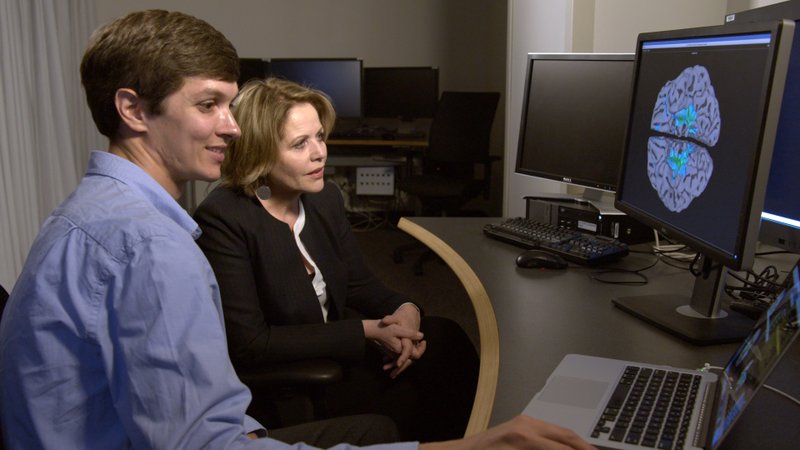
Soprano Renee Fleming looks at a brain scan with NIH neuroscientist David Jangraw after singing in the MRI machine.

To help scientists understand how music helps patients heal, notable musicians like opera’s Renee Fleming are getting brain scans.

Lauran Neergaard writes at the Associated Press, “Music increasingly is becoming a part of patient care — although it’s still pretty unusual to see roving performers captivating entire wards, like at MedStar Georgetown University Hospital one fall morning.

“ ‘It takes them away for just a few minutes to some other place where they don’t have to think about what’s going on,’ said cellist Martha Vance after playing for a patient isolated to avoid spreading infection.

“The challenge: Harnessing music to do more than comfort the sick. Now, moving beyond programs like Georgetown’s, the National Institutes of Health is bringing together musicians, music therapists and neuroscientists to tap into the brain’s circuitry and figure out how.

“ ‘The brain is able to compensate for other deficits sometimes by using music to communicate,’ said NIH Director Dr. Francis Collins, a geneticist who also plays a mean guitar.

“To turn that ability into a successful therapy, ‘it would be a really good thing to know which parts of the brain are still intact to be called into action. To know the circuits well enough to know the backup plan,’ Collins added. …

“ ‘The water is wide, I cannot cross over,’ well-known soprano Renee Fleming belted out, not from a concert stage but from inside an MRI machine at the NIH campus.

“The opera star — who partnered with Collins to start the Sound Health initiative — spent two hours in the scanner to help researchers tease out what brain activity is key for singing. How? First Fleming spoke the lyrics. Then she sang them. Finally, she imagined singing them.

“ ‘We’re trying to understand the brain not just so we can address mental disorders or diseases or injuries, but also so we can understand what happens when a brain’s working right and what happens when it’s performing at a really high level,’ said NIH researcher David Jangraw, who shared the MRI data with The Associated Press.

“To Jangraw’s surprise, several brain regions were more active when Fleming imagined singing than when she actually sang, including the brain’s emotion center and areas involved with motion and vision. One theory: it took more mental effort to keep track of where she was in the song, and to maintain its emotion, without auditory feedback.”

Read how the new insights are being used to study Alzzheimer’s patients and others here.

Read Full Post »

Older Posts »