Feeds:
Posts
Comments

Archive for June, 2019

190402-erika-hernandez-micop-community-leader-radio-indigena-dj-se-206p_6f4e8705eeab07bbf03092d2680ed931.fit-1240w

Photo: Arcenio Lopez
Erika Hernandez, of the Mixteco Indígena Community Organizing Project in California, is a Radio Indigena DJ.

As languages spoken by small communities disappear, overwhelmed by other languages, it’s encouraging to read that the digital media that’s part of the problem is also part of the solution. As is radio.

Ludwig Hurtado has the story at NBC News. “Josefino Alvarado, a California farm worker, describes his typical morning picking blueberries at a Ventura County farm.

“As the sun beats down on him and his fellow workers, a crackle of static hums at their feet. ‘Hola mi gente,’ (Hello, my people) a voice calls out from the radio’s speakers in Spanish. Then, ‘tanìndíí,’ which means ‘good morning’ in Mixteco.

“On this farm and most of the farms nearby, workers have their radios tuned into the same station: 94.1, Radio Indígena. … The community-run station boasts 40 hours of original programming every week, broadcasting music and talk shows in a handful of indigenous languages, as well as Spanish programming too.

“The station is a welcome cultural lifeline for thousands of farm workers who speak Mixteco or other indigenous Central American languages.

“ ‘Listening to it is a point of pride,’ Alvarado, who is a frequent listener, said. While he only understands Spanish and Mixteco, he often will listen to some of Radio Indígena’s shows in Zapoteco, Triqui, and Nahuatl. Even if he doesn’t understand them, he said he’s proud to hear the languages being kept alive on the airwaves.

“Alvarado, who moved to the U.S. in 1997, was born and raised in the city of Oaxaca in central Mexico, where he and his family learned Mixteco as their first language. Although Mixteco has come into the national spotlight thanks to the Academy Award-winning film, Roma, the language is still virtually unknown to the general population. …

“Due to economic and cultural pressure in Mexico, many Mixtec communities are shifting to Spanish. UNESCO considers almost half of Mixteco’s 50 dialects to be either severely endangered or at risk of endangerment.

“According to the 2010 census, over 685,000 Latinos in the U.S. identified themselves as American Indian, up from around 400,000 in 2000. But experts agree that the actual number of indigenous Latinos in the U.S. is much higher than estimated because many don’t report to the census due to stigma and immigration status. …

“ ‘There’s a lot of radio stations in Oxnard, but they just play music,’ said Roberto Jesús, who listens to the show every morning as he drives to work, getting informed about the news and about his legal rights as an immigrant. … In the U.S., Mixtecs face barriers because of their limited English and sometimes limited Spanish. This leaves many of them vulnerable to exploitation and discrimination.

“Radio Indígena is hosted and run by the Mixteco Indígena Community Organizing Project (MICOP), a nonprofit organization formed to provide health outreach, humanitarian support and language interpretation to this underserved and often unnoticed community. …

“Radio Indígena started when organizers saw a void in the city of Oxnard, but [Arcenio Lopez, executive director of MICOP and Radio Indígena] said that the station has listeners from all over the country and world, since the episodes are available to stream online. …

“Delfina Santiago and Carmen Vasquez co-host a show on Radio Indígena every Sunday from 10 a.m. to 1 p.m. Even though they don’t get paid for their work, the two spend lots of time during the week preparing for their program, ‘Al Ritmo De Chilena,’ which is an educational program that delves into the history of different indigenous cultures for each episode.

Santiago and Vazquez say that the digital age has played a role in keeping their language alive and keeping folks connected to one another, in a world where they might otherwise feel alone. Indigenous Mexican music can be found on YouTube and SoundCloud. …

“ ‘We’ve already lost three languages in Oaxaca,’ Santiago lamented. ‘They’re gone.’ ”

More here.
Read Full Post »

More and more people are recognizing that the mass migrations we’re seeing today — and the wars that seem to be the main cause — are tied to climate change.

Here is a story about a small city in Georgia, home to many immigrants, that has put two and two together and is determined to be part of the solution.

Writes Jason Margolis at Public Radio International’s show The World, “Clarkston, Georgia, is often referred to as the Ellis Island of the South. Some 60 languages are spoken in this city of 13,000 just outside of Atlanta, and perhaps half the population is foreign born. Many are refugees.

“Felix Hategekimana is a refugee from Rwanda, a soft-spoken man who doesn’t talk much about his backstory, except to say that he fled violence back home: ‘We have political issues and security [issues].’

“But Hategekimana says there’s more to the troubles in Rwanda. Droughts and floods have plagued his country in recent years, and that’s led to more people migrating.

“ ‘Some people lose life in the disaster of the rain,’ Hategekimana said. ‘Some people lose life, others lose their homes and they lose their property, like their farms where they plant their vegetables.’

“You hear a lot of stories like this from refugees in Clarkston. Legally, there’s no such thing as a ‘climate change refugee.’ Refugee status is only awarded based on a well-founded fear of persecution due to race, religion, nationality, political opinion or membership in a social group — not because your home got wiped out by a flood, or your crops were destroyed by a drought.

“But Clarkston’s mayor, Ted Terry, says the impacts of more extreme weather are woven throughout the lives of many new residents here. …

“Climate scientists agree that storms are becoming more severe, and the trend is only going to continue. Case in point, the Category 4 cyclone that struck southern Africa recently has left at least 600,000 people displaced. The immediate needs there — food, clean drinking water and shelter — are stark. After that, a big question: rebuild or relocate?

“It’s a dilemma that many people across the globe are facing, which will inevitably lead to more people on the move. But the world still hasn’t agreed on what to do with so-called climate refugees. Take a place like Syria.

“ ‘It becomes more drier, I think,’ said Malk Alarmash, a Syrian refugee now living in Clarkston. … But Alarmash can’t say that a lack of rainfall led people to flee Syria.

“ ‘I don’t know. I don’t have any information about that, like climate change,’ Alarmash said.

“An inability to pin the seeds of conflict on climatic shifts isn’t unusual; the relationship between climate change and forced migration is immensely complicated. … A drought can destroy people’s food supplies and livelihoods. That can lead to internal migration, inflame tensions and maybe even contribute to conflict and a refugee crisis. But all of this can unfold over years. …

“ ‘The climate is the last thing in their mind. They know it’s all related, but they just say, “This is from God,” ‘ said Omar Shekhey, a Clarkston resident who is originally from Somalia. …  ‘It goes together — the civil war, the war and the climate, you cannot separate them.’ …

“Shekhey says most Somali refugees aren’t connecting the dots to climate change. But as global temperatures continue to rise, Mayor Terry, who also works with the Sierra Club, believes that those dots will become clearer, even in the US.

“ ‘We’re looking at a future, I think, if we don’t take steps to reverse global warming, we’re looking at potentially hundreds of millions of people around the world, including you know, in America, Louisiana. Their coastline is disappearing,’ Terry said. ‘And so, at some point, there has to be some sort of recognition and define what it means to be a climate refugee.’ …

“Clarkston’s mayor [wants] to address the root of the problem, starting in his own community. It’s one reason Clarkston is committing to 100 percent renewable energy — instead of fossil fuels — by midcentury.

“ ‘In some way, we’re trying to alleviate future calamities. We just have to do our part; we have to consider ourselves part of the global community.’ ”

More at PRI, here.

dsc5861

Read Full Post »

image

Photo: J. J. Williams/Public domain
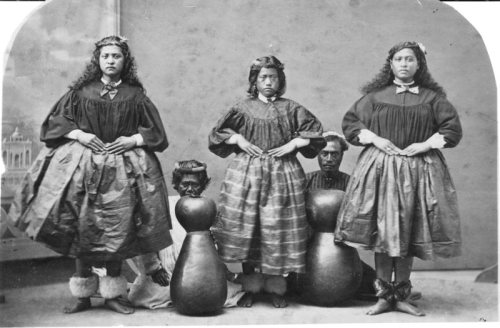
Hawaiian hula dancers photographed in J. J. Williams’s photo studio, circa 1885. The art form was suppressed for many years but is now celebrated around the world.

I was thinking recently that I’d love to learn some new dance forms. I took lots of ballet as a kid, and I keep reading that dancing is good for your health when you’re older. Essentrics, an exercise program I love, has taught me to focus on moves that are beneficial, not contorted. So what kind of dance would be good? Someone I know teaches salsa. Should I try that?

The following article got me wondering if hula might be good for me.

Ligaya Malones writes at Atlas Obscura about Hawaiʻi’s Merrie Monarch hula festival, “arguably the most prestigious event of its kind.

“Every spring, thousands of hula fans descend upon the Hawaiian town of Hilo and line the bleacher seats at Edith Kanaka’ole stadium. Thousands more across the islands — those unable to make it to Hilo themselves — watch live broadcasts on their televisions or computer screens. All these people are showing up and tuning in for the beloved Merrie Monarch Festival, sometimes referred to as ‘the Olympics of hula.’ …

“The three-day competition is part of several week-long events held throughout Hilo, home of Merrie Monarch since 1963. … Much credit is given to King Kalākaua, the last of Hawaiʻi’s kings, for reclaiming hula’s place in Hawaiian society. He was elected to the throne in the 1870s by the Hawaiian legislature, and often hosted hula-filled celebrations, including at his coronation. Merrie Monarch was Kalākaua’s endearing nickname and it is his contribution to hula that the competition honors every year.

“ ‘It’s electrifying,’ says Robert Ke’ano Ka’upu IV, who grew up in Hilo. Ka’upu has participated in the invitation-only competition for the last 30 years as a spectator, dancer, chanter, costumer, and now as kumu hula. … ‘I don’t get excited like this for any other competition,’ he says.

“During the festival, every inch of a performance is scrutinized. Dancers are evaluated and earn points for the way they enter and exit the stage, their facial expressions, posture, costume, lei, and adornment, says Ka’upu. However, the bulk of scoring is placed on the kumu’s interpretation of a song, known as a mele, and how well dancers interpret their kumu’s vision of the performance.

“To assist in deliberations, every competing group provides judges with a fact sheet that corresponds to each performance. These fact sheets, which are due before the competition, explain everything from a mele’s background to the meaning of the lei that dancers wear ‘so [the judges] get a better understanding of what each halau is doing,’ says Ka’upu. He adds that his halau will submit more than 70 pages of fact sheets to the judging panel for the competition this year. Judges bestow high scores to those who best personify technical excellence, and ultimately the expression of Hawaiian identity through chant and dance. …

“Hawaiian culture existed without the written word until western contact, so Hawaiians passed down knowledge orally and through dance. Through chant and movement, hula narrates place; honors goddesses and gods, such as Pele, goddess of fire; celebrates nature’s surroundings, from birds to waterfalls; and records genealogy and human emotion. ‘Kaulilua,’ for example, is one of Merrie Monarch’s most performed ancient hulas. The mele likens a woman to the island of Kauaʻi’s verdant Mount Waiʻaleʻale. …

“As Western influence grew and Hawaiʻi’s fate approached annexation and eventual U.S. statehood, so did the need for local manpower to fuel its new sugar economy. In 1858, missionaries with a keen interest in sugar’s profits pursued legislation to suppress hula even further, citing lethargy in sugar cane fields, promiscuity, and attrition from Sunday service. Records show a code of conduct published in 1859 required a license for ticketed, public hula performances. Yet hula persisted under the mesh of legal restrictions and moral shaming. Hawaiians still danced, particularly in more rural areas where government oversight trickled, missionary presence was scarce, and police all the more so. ‘Hula was never lost,'” says Dr. Taupouri Tangarō, director of Hawaiian culture and protocols at University of Hawaiʻi at Hilo.

For more on the competition and for more-contemporary hula photos, check out Atlas Obscura.

Read Full Post »

Photo: Ocean Sole
Says Ocean Sole: “We turn flip-flops into art and functional products and in turn raise visual awareness of the problem. … We are not only creating employment for a country that has 40% unemployment, but also sending a message about how we can help our planet.”

Around the world, flip flops have provided cheap footware for billions of people. Everyone loves them. Unfortunately, they’re part of the planet’s growing plastics and synthetics problem, a tsunami of trash that damages the environment and threatens marine life.

Some years ago, the company Ocean Sole was created to do something about that and at the same time provide employment in a high-unemployment region of Africa.

As Olivia Yasukawa and Thomas Page reported at CNN in 2017, “The shores of Watamu on the Kenyan coast should be pristine. They’re not. Downstream from an ecological disaster brewing a continent away, these placid waters are bearing the brunt of a foot-born problem: your flip flops. …

” ‘Over three billion people can only afford that type of shoe,’ says Erin Smith of Ocean Sole, a conservation group and recycling collective. ‘They hang on to them, they fix them, they duct tape them, mend them and then usually discard them.’ The average lifespan of a flip flop is two years, she adds.

“They’re ubiquitous, and the modern day synthetic rubber flip flop is not going away. In fact, tons of them are washing up on the East African coast. Reports suggest that at least eight million tons of plastic enters our oceans every year.

By 2050, there could be more plastic than fish in the seas by weight. …

” ‘We are actually receivers of pretty much the rest of the emerging world’s marine pollution,’ [Smith] argues. And a significant quantity of the pollution which appears on East Africa’s beaches come from discarded flip flops — approximately 90 tons a year. … They’re not only an eyesore, but a direct health hazard, and with no hope of biodegrading.

” ‘Our founder Julie Church back in the 90s discovered an entire beach … was just covered in flip flops,’ Smith says. ‘What she saw were not just dead fish that had been trying to eat in their natural habitat, but turtles unable to come up on to land and actually hatch. [The pollution] started to kill the plant life, it started to kill the crabs on the sand … we have deserted beaches that used to have communities there, that used to be able to fish, and the whole ecosystem has been ruined by this massive increase in marine pollution.’

“Matilda Mathias, a debris collector from the ‘Blue Team’ in Watamu, cites the benefits to the tourist industry when the beaches are clean, and says ‘we also benefit from the money.’

“Most of the detritus is recycled, some is reused, but in the case of flip flops, they’re upcycled. Ocean Sole has trained a team of 40-or-so artisans in a workshop in Nairobi to craft sculptures from these pre-owned, unloved objects into a source of income. Importing flip flops from recycling crews along the East Coast and from as far away as Zanzibar, Smith estimates the Ocean Sole team can repurpose approximately 800,000 flip flops a year. …

“There’s little chance artisans will run out of raw material any time soon as long as our flip flop habit remains.

” ‘I think it’s time for us to start looking for an alternative shoe, or an alternative material, to fit that kind of fashion need,’ argues Smith.”

More at Ocean Sole, here, and at CNN, here.

Warthog made of recycled flip flops by Ocean Sole. Many zoo gift shops carry these products.

Read Full Post »

Photo: Eye Ubiquitous/Rex/Shutterstock
“It is not in dispute that the shark is not in harmony with its surroundings,” a planning inspector wrote in 1992.

This is not a story about a real shark, although sharks are often on my mind as warming seas move the dangerous kinds to the northern beaches that my family frequents. There is certainly plenty to say about real sharks — both about avoiding the places that their food congregates (seals, for example) and about protecting them to live in the wild. (My 4-year-old granddaughter will tell anyone willing to listen that shark fin soup is bad.)

But this story is about shark art.

Aamna Mohdin writes at the Guardian, “One April evening in 1986, Bill Heine was sitting on the steps opposite his newly purchased terraced house in Oxford, drinking a glass of wine, when he turned to his friend and asked a simple question: ‘Can you do something to liven it up?’

“His friend, the sculptor John Buckley, provided an answer in the shape of an eight-metre (25ft) shark which would sit on his roof, perpetually appearing as though it had just crashed into the house from the sky. The fibreglass fish, which became known as the Headington Shark after the Oxford suburb, led Heine, a local journalist and businessman who died last week, into a six-year legal battle with the local council.

“The process turned a relatively unremarkable street into a beloved local landmark and resulted in one of the most notable triumphs of British eccentricity over petty bureaucracy. …

“ ‘You could see the Americans were taking off from Heyford outside of Oxford to bomb Gaddafi in Libya,’ Buckley said. Both Buckley and Heine wanted to make a powerful statement about the barbarity of war and the feeling of vulnerability and utter helplessness when disaster struck. …

“The artist started on the work immediately after his discussion with Heine. He worked with a group of volunteers – largely students and other anti-war activists – to build an artificial roof to hold the shark outside his studio. He didn’t tell any of them where he planned to put the sculpture. …

“ ‘The crane just dropped it straight in and it went in beautifully as the postman was passing,’ Buckley said. ‘That first morning was amazing. By Sunday, it was worldwide and its been like that for 30-odd years.’

“Oxford city council immediately opposed the installation of the shark. At first, they said it was dangerous to the public, but engineers and inspectors pronounced it structurally safe.

“Heine, an American who moved to the UK to study at Oxford University in the 1960s, then submitted a planning application, which was rejected by the council. He appealed to the environment secretary, then Michael Heseltine. …

“Heseltine’s planning inspector, Peter Macdonald, investigated and ultimately came out in favour of keeping the sculpture, with an official ruling that has gained legendary status among town planners for its defence of art.

“ ‘In this case it is not in dispute that the shark is not in harmony with its surroundings, but then it is not intended to be in harmony with them,’ wrote Macdonald in his official ruling. ‘The council is understandably concerned about precedent here.

‘The first concern is simple: proliferation with sharks (and heaven knows what else) crashing through roofs all over the city. This fear is exaggerated.

” ‘In the five years since the shark was erected, no other examples have occurred … any system of control must make some small place for the dynamic, the unexpected, the downright quirky. I therefore recommend that the Headington Shark be allowed to remain.’ …

“After Heine died [in March], tributes came flooding in from many locals, including city councillors.

“[Patrick Gray, an economist who lived his whole life in Oxford], described Heine as a ‘colourful character’ who inspired people. He said: ‘We once had a 12-year-old boy visit from America. He was miserable and unhappy when he arrived, so we took him to see the house. He left with a very big smile on his face.’ ”

More at the Guardian, here. And be sure to check out the shark-girl sculpture in Buffalo, NY, which blog KerryCan old me about. Pretty funny.

Read Full Post »

Photo: Nederlandse Spoorwegen
A special book given out as gift to readers during National Book Week is accepted instead of a ticket on the train.

The Dutch seem to be ahead of the curve on many things. I’ve posted about their friendly communities for people with dementia, about their environmental innovation, about their biking culture. This story is on their support for reading books.

Jon Stone writes at the Independent, “Dutch book lovers got free rail travel across their country’s entire network [in March] as part of the Netherlands’ annual book week celebrations.

“Every year since 1932 the Netherlands has encouraged reading with Boekenweek – a celebration of literature marked with literary festivals and book signings across the country.

“Traditionally, a well-known Dutch author writes a special novel – the ‘book week gift’ or Boekenweekgeschenk – which is given out for free to people who buy books during the festivities or sign up to a library.

“But the special book – this year the novel Jas Van Belofte by celebrated author Jan Siebelink, can also be presented instead of a rail ticket on every train in the country on the Sunday of book week.

“Nederlandse Spoorwegen (NS), the Dutch state railway company, has long been a sponsor of the annual festivities – and even organises book readings signings by top authors on its trains.

” ‘It is good to see all those happily surprised faces of travellers,’ author Jan Siebelink said after boarding a train for the city of Utrecht to meet passengers and read his book. …

“This year the book week gift was given out by bookshops to anyone who spent €12.50 on Dutch-language books.” More here.

And check out this cool article by Feargus O’Sullivan at CityLab, in which he describes a wide array of unusual ways to pay fares — ideas from all around the world.

Because of a problem with rail passes, he writes, England’s Virgin Trains let people pay with an avocado for a while. And “Indonesia’s second city, Surabaya, came up with a novel way of clearing its streets of plastic waste last autumn: It has been encouraging passengers to trade in trash for bus tickets.”

Among other creative approaches, Russia promoted the Winter Olympics by offering passes for doing a certain number of squats, Berlin partnered with Adidas to offer sneakers with a pass in the tongue, and Japan started experimenting with cryptocurrency.

Can you think of other ideas cities should try? Maybe on Giving Tuesday, transit systems could allow free travel for proof you gave to a charity.

Read Full Post »

At the beginning of June, my sister was back in the hospital because her cancer was causing new symptoms. Although the worst of the symptoms were brought under control fairly quickly, there were a couple weeks when we thought only a miracle would get us to Provincetown for the late June weekend we’d been counting on. My sister wanted to show her husband a part of Massachusetts she loved, as he had never seen it.

We had that miracle. Suzanne nudged it along by working on transportation, accommodations, and other details, but the main thing was that my sister was feeling so much better. Unlike me, she was able to walk miles without needing a nap!

Provincetown lies at the very tip of Cape Cod, and having a National Seashore there ensures that much of it is breathtakingly beautiful. The center of town is too hyper for some visitors, but I really love the manic energy. Drag-show Sunday brunch anyone?

No, we didn’t do that, but we had great walks, window shopping, and meals. The weather was perfect.

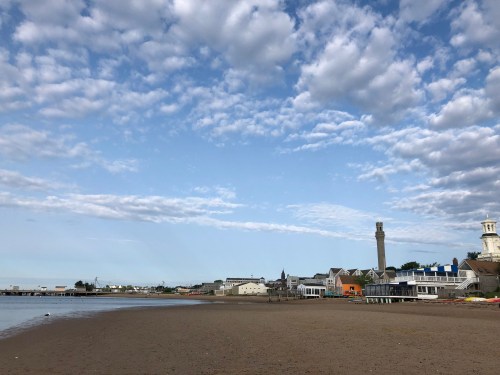
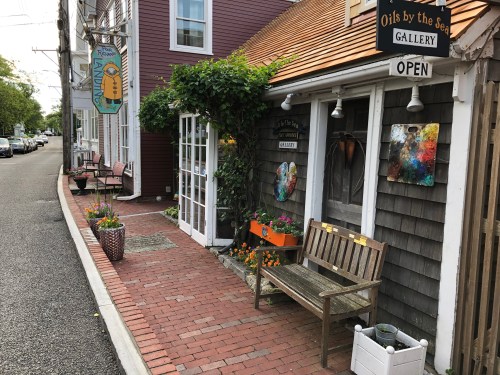
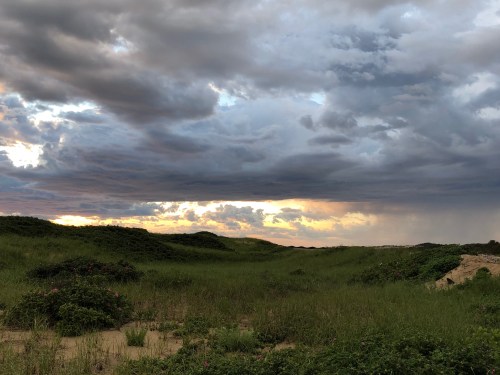
Below you can see beautiful clouds over the beach, with the Pilgrim Monument in the background. (Next year will be the 400th anniversary of the Pilgrims’ landing at what is now Provincetown.) That photo is followed by a picture of Commercial Street, which in summer looks this peaceful only in the early morning.

After the mural in the ice cream place that my sister likes is a wildly decorated shop building. Next up: a welcoming bathroom sign. (My younger grandson thought it was pretty odd of me to take that photo, but what can a kid do? Grandparents are sometimes odd.)

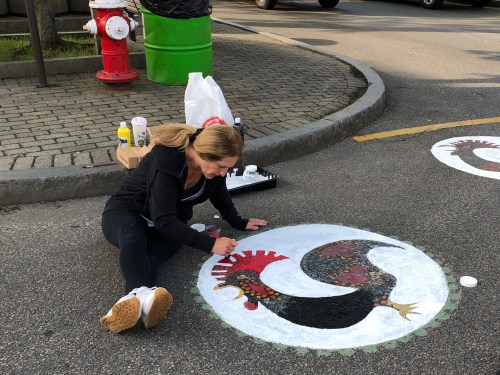
The Portuguese roosters around town are promoting a bakery. I found that Portuguese culture was well represented in P-town. And Wikipedia further explained that, historically, many sailors who spoke Portuguese landed there, often coming from the Azores.

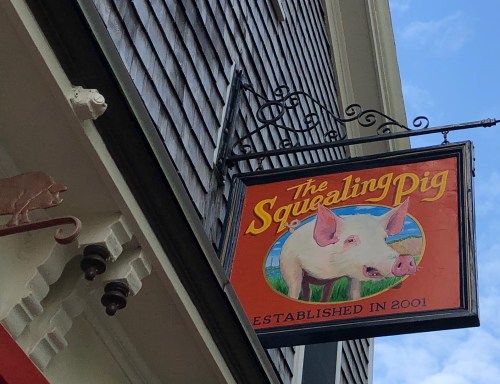
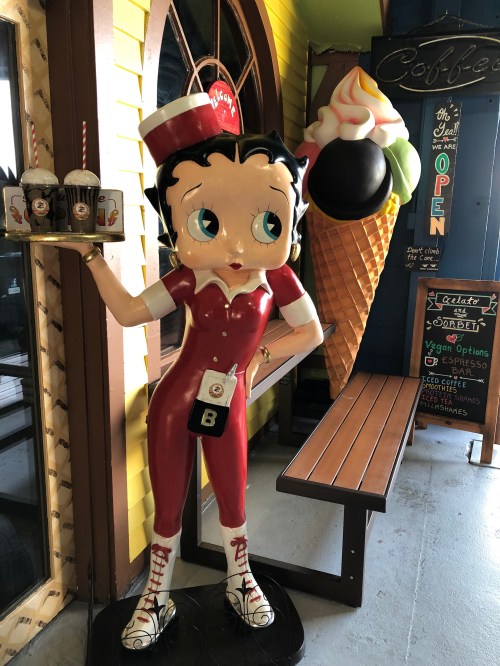
I loved some of the shop signs — and much of the kitsch. Only in P-town will you find proper appreciation of Betty Boop. Isn’t she cute?

The final three photos don’t need explanations.

062219-Provincetown-beach-clouds

062219-Provincetown-Commercial-Street

062219-Provincetown-ice-cream

062219-Provincetown-decorated-building

062219-Provincetown-bathroom-sign

062219-Provincetown-Portuguese-rooster

062219-Provincetown-Squealing-Pig

062219-Provincetown-Betty-Boop

062219-Provincetown-pay-whatever

062219-Provincetown-morning-shadows

062219-Provincetown-sunset

Read Full Post »

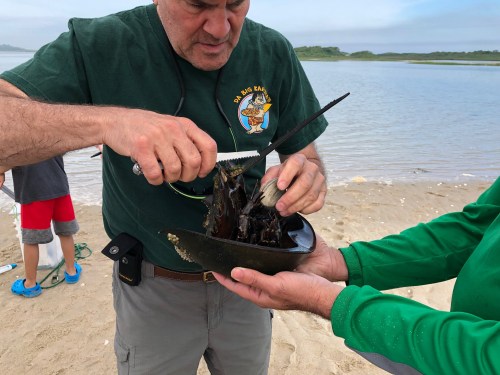
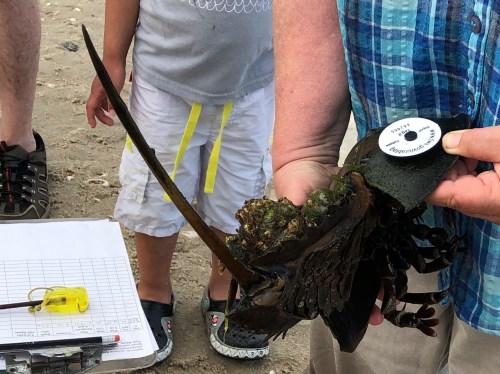
Well, I had a treat last week! I went to watch horseshoe crabs being tagged for research — kind of like birdbanding, but for crabs. The woman with the funny expression above was actually enjoying the whole thing and helping to take notes for the scientist, Kim Gaffett.

Kim, who may be best known to New Shoreham visitors for birdbanding, has been working for some years with Connecticut’s Sacred Heart University on an initiative called the Limulus Project. The idea is to learn more about the amazing horseshoe crab, a species that, depending on whom you ask, has managed to survive between two and five mass extinctions on Planet Earth, including the one that wiped out the dinosaurs.

In spite of their amazing record of survival, the crabs are considered threatened today, so it’s important to study them and try to find out what’s going on. As I wrote a few years ago, their blood has the ability to clot in the presence of bacteria, so it has become invaluable to pharmaceutical companies. Researchers are supposed to draw the blood as one would for a human and then have the fishermen return the crabs to the ocean, but that may not be happening consistently.

I asked Kim how she knew she would find any crabs that particular morning, and she told me that when there is a high tide and a full moon in June (flood tide), the horseshoe crabs come up to the shore to mate. The male has one claw like a boxing glove, with which he attaches to the female’s shell in order to be available when she drops her eggs. The eggs are fertilized outside the body. Sometimes other males are hanging around, and it’s possible for one batch of eggs to get fertilized by more than one male.

All sorts of marine life forms attach themselves to horseshoe crabs — seaweed, barnacles, slipper shells. Kim calls the crabs “their own ecosystem.” The crabs’ fellow travelers don’t usually cause any trouble, but as you can see below, a quahog had snapped onto a claw of one crab. A citizen scientist is shown detaching it.

From Phys.org, I read this about horseshoe crabs’ survival: “They have a special kind of blood, which … coagulates when it encounters bacteria. They can ‘wall up’ any wounds they receive.

“Another key to their survival seems to be their tolerance of habitats that fluctuate in salinity (levels of salt). When environmental changes happen, they can move to safety.

“An ability to live with low levels of oxygen is also important. [Natural History Museum expert Richard Fortey] adds, ‘The horseshoe crab was able to cope with periods of oceanic deoxygenation that were fatal to many marine organisms.’ ”

I was also interested in what Quartz had to say: “These amazing crab species are among the handful of species referred to as ‘living fossils’ because their current form resembles those found in the fossil record. Externally at least, the crab hasn’t changed much in nearly 450 million years. In that time, it has survived all five of Earth’s great mass extinctions, the worst of which killed off an estimated 95% of all marine species, and the most recent of which did away with the dinosaurs. …

“The crab’s blue blood contains a chemical called limulus amebocyte lysate (LAL), which thickens when it comes in contact with toxins produced by bacteria that can cause life-threatening conditions in humans. Labs use LAL to test equipment, implants, and other devices for these toxins.”

Kim says she hopes labs will start using the synthetic version of LAL more and give the horseshoe crab a break.

Note the tag below. Kim found one crab with a tag from a previous year, and she attached another tag to a newer find.

061719-removing-clam-from-horseshoe-crab

061719-.horsehoe-crab-tagging

Read Full Post »

Photo: Brian Peterson
Hmong writer Kao Kalia Yang with her father, Bee Yang. The daughter’s lyrical book about Bee Yang’s unconsciously artistic storytelling,
The Song Poet, will be turned into a youth opera in Minnesota.

When I was working at a magazine that focused on the concerns of lower-income communities, I sometimes tried to get the voices of immigrant authors in there. One such author was Kao Kalia Yang, a Minnesota Hmong writer whose work I greatly admired.

Yang spent her early childhood enduring the privations of a refugee camp in Thailand but eventually moved with her family to St. Paul, where poverty and a strange new culture made life difficult in whole new ways.

One of Yang’s lyrical memoirs focuses on her father and the way he sang stories about life in the old country that brought other Hmong immigrants to tears. Now it’s being turned into an opera for young people.

Jenna Ross writes at the Star Tribune, “Author Kao Kalia Yang’s father has been a farmer, a refugee, a machinist. But in a book about his life, Yang elevated his true vocation — poet. Soon, his story will be an opera.

“The Minnesota Opera announced [in April] that it’s creating a youth opera based on ‘The Song Poet,’ Yang’s acclaimed 2017 memoir about her father, Bee Yang, who composed and sang songs about life and politics, love and family.

“It’s the first time a Hmong story will be translated to the operatic stage, Yang said. … The book follows a young boy [Yang’s father] whose father dies, who grows up in a warn-torn country, who tries to find the place his father was buried. The tale begins in Laos, moves to a refugee camp in Thailand, then makes its way to Minnesota. …

“For its Project Opera, a youth vocal training program, the Minnesota Opera is scouting for stories that connect with young audiences and reflect the Twin Cities community, said Jamie Andrews, the company’s chief learning officer. When he sat down with ‘The Song Poet,’ he knew it would make an incredible opera.

“ ‘Kalia’s writing is just so lyrical and beautiful — so singable,’ Andrews said. … ‘The Song Poet’ becomes the third opera commissioned for Project Opera, which will premiere it at the Lab Theater in Minneapolis in 2021. …

“Bee Yang has performed traditional song poetry, or kwv txhiaj, since he was 12 years old, becoming a keeper of Hmong history. ‘When I began singing song poetry, I discovered I could share our stories of hurt and sorrow, of missing and despair, of anger and betrayal,’ he said in the book.

“This daughter’s telling of his story — and how it shaped her own — won the Minnesota Book Award for memoir and creative nonfiction. The 39-year-old author and Harding High School graduate is best known for her 2008 book ‘The LateHomecomer: A Hmong Family Memoir,’ which nabbed two Minnesota Book Awards. After graduating from Carleton College, Yang earned an MFA in creative nonfiction at Columbia University. …

“To ensure that the cast is diverse, the opera company will reach into the Hmong-American community, Andrews said. It’s working with the Saint Paul Music Academy and talking with Theater Mu, an Asian-American troupe. ‘It’s not just a Hmong cast,’ Andrews said. ‘But we’re doing some strategies already now for 2021, to build those connections and find those kids.’ …

“When Yang was young, she took the occasional field trip to the Ordway or the Guthrie. ‘You’d go in knowing that you’d be entering into a different culture,’ she said. ‘I couldn’t have imagined, as a child, walking into a place and seeing something from the Hmong story represented.

“I hope that for those young Hmong people who get to see this, it opens up possibilities for them. Not just Hmong — but all refugee children.’ ” More.

I highly recommend Yang’s memoirs. Maybe some of you will check them out.

Read Full Post »

Photo: Virginia Arts Festival
The original fire curtain of the Attucks Theatre in Norfolk, Virginia, depicts the Boston Massacre and the death of Crispus Attucks, the first to die in the Revolutionary War. Attucks was part African American and part Native American.

Don’t you love seeing old things restored and given new purpose? It’s not just the sight of a lovingly renewed object or building that’s inspiring, but the sense that anything that once had value can be brought back after years of abandonment.

Nicholas Som writes at CityLab, “Behind the modern walls of the Attucks Theatre in Norfolk, Virginia, century-old murals hide in darkness. Three pastoral scenes, created on the theater’s original 1919 walls, were uncovered in 2004 during the restoration that brought the theater back to life. But because of their age, exposing them to light and air could ruin them.

“ ‘Trying to find ways to create access to them without damaging them has been challenging,’ says Anthony Stockard, artistic director at Norfolk State University. So they’ll remain out of sight, sealed and preserved until a plan to display them safely can be established.

“Much like the murals, the history behind the Attucks itself is not immediately apparent from the brick and white terracotta that form the theater’s facade. But ask around Norfolk, and it won’t be too long before you find a city native with some kind of connection to the building. The place the Attucks holds in the collective memory of Norfolk’s African American community has not disappeared, even after years of vacancy, name changes, and collapsing ceilings.

“Appreciation for the Attucks is especially perceptible this year, the centennial of the theater’s construction. A steady stream of stars — from Leslie Jones of Saturday Night Live to basketball legend Kareem Abdul-Jabbar — is lined up to speak or perform, complementing the typical artists the Attucks welcomes every year. Ticket sales have accordingly skyrocketed. …

“ ‘The Apollo of the South.’ That was the nickname the Attucks garnered, referencing the famed Big Apple music hall. With national sensations like Duke Ellington, Louis Armstrong, Cab Calloway, and Ella Fitzgerald frequenting the stage, the Attucks was more than worthy of the designation. …

“Perhaps the Apollo Theater should be known as ‘The Attucks of the North.’ Because unlike the Apollo, the Attucks was funded and designed exclusively by African Americans, an extremely rare occurrence at the time. Twin City Amusement Corporation, the original developer, was formed by a group of black business owners. They approached local architect Harvey Johnson, who went on to help found what became Norfolk State University, to draw up the plans.

“Johnson always intended for the Attucks to be more than just a performance venue; in addition, it doubled as a silent movie house and contained 21 upstairs offices for African American businesses (Johnson himself set up shop there after its completion). They named the theater in honor of Crispus Attucks, a man of African and Native American descent who was the first person to die in the Revolutionary War, and depicted his death on its fire curtain. …

“The end of World War II brought changes that even the Attucks could not survive—at least, not in the same way. Young soldiers with money to spend returned to the city, and as Norfolk began to desegregate, the once-vibrant Church Street declined.

“Eventually, the curtain fell on the building’s time as a theater in 1953. … Denise Christian, project manager for the Attucks’ restoration, helped devise a three-phase approach. The first stage addressed the most pressing concerns: the blighted roof and the preservation of the historic curtain.

“Once pieces of the ceiling were no longer falling and the curtain had been cleaned and stored, the team moved on to the reconstruction of the auditorium seats, which had all been removed during the room’s years as a storage space. They decided to build around 700 new seats for comfort’s sake, though the theater originally squeezed in many more. Significant repairs also had to be made to the balcony and box seats.

“Finally, the Attucks was equipped with the modern trappings necessary for a multipurpose theater to succeed in the 21st century. A new three-story wing behind the building provides banquet rooms, dressing rooms, a green room, and a loading dock, transforming the Attucks into a place for events and arts classes, not just entertainment. …

“For Stockard, personally, being selected to co-chair Attucks100 by Norfolk mayor Kenny Alexander has felt like the culmination of a career-long dream, a ‘bucket-list moment. …

” ‘There was sort of a sense of nostalgia, of realizing these bricks were laid for and organized by African Americans,’ he says. ‘It was revolutionary for them to invest in the arts and entertainment that way—not just being the act, but being the producer and provider, and being able to control the place they had in the community.’ ”

More here.

Read Full Post »

Photo: Ann Hermes/ Christian Science Monitor
Judge Abby Abinanti presides over the Yurok Tribal Court in Klamath, California.

There has been a movement lately to restore to tribal courts the adjudication of certain types of crimes committed by Native Americans. The idea is that the traditional ways of handling problems often work better than those imposed by an outside system.

Henry Gass writes about one such court at the Christian Science Monitor.

“The mouth of the Klamath River – the spiritual heart of Yurok country – can be hard to find.  … Ira Thompson is here for his court date anyway, having made the 30-minute drive south from Crescent City. He grew up here, and when he got in serious trouble for the first time – a third DUI and a possible four months in jail – he knew he needed to come home. …

“So he reached out to the Yurok Tribal Court. He reached out to Abby Abinanti. …

“As Mr. Thompson enters, the air tastes of musky angelica root (burned by a paralegal minutes earlier to cleanse the room of pain, anxiety, and other negative energy).

“Judge Abby, as everyone calls her, is not your average judge. She sits at a table across from Mr. Thompson wearing her typical court attire: gray jeans and a crimson turtleneck. …

“ ‘How are things going?’ she asks him.

“ ‘Staying home,’ he replies.

“Mr. Thompson is under house arrest and participating in the court’s wellness program, a treatment employing Yurok cultural immersion. That’s the deal the tribal court struck with the county instead of jail time. He’s been home carving earrings out of redwood, making elk horn purses, and selling them. ‘That sounds good,’ she says, bringing the hearing briskly to an end about five minutes after it started. …

“When Judge Abinanti joined the Yurok Tribal Court in 2007 it operated like a normal state court, albeit on a much smaller scale. When most Yuroks got into trouble with the law they went to local state courts, and they entered a system designed to be adversarial and punitive. Root causes often went ignored and unaddressed, and recidivism inevitably followed.

“Judge Abinanti has taken the court in a different direction: one more communal and rehabilitative. It’s a judicial path followed by other tribes around the country. Personal responsibility and renewal – two pillars of the once nearly extinct Yurok culture – now permeate the court’s functions.

“Incarceration has largely been replaced by supervised release combined with Yurok traditions such as dancing and wood carving. Lawyering up for family disputes and child custody battles has been replaced by mediation. Almost every case is resolved through mediation – victims and perpetrators talking with each other – even if it takes years. Tribal courts resemble the growing U.S. restorative justice movement, which emphasizes repairing the harm caused by criminal behavior and getting all stakeholders involved. Judge Abinanti says it just resembles the old Yurok values system.

“The Yurok were village people, she likes to say. Living in clusters of redwood cabins along the Klamath River, people in the communities were so interdependent that when villagers did something wrong, they couldn’t just be locked away. They had to face consequences, but also become responsible, productive community members again. That’s tribal justice.

“After what she calls ‘the invasion’ by European settlers, the Yurok way of life was lost. By helping revive those values and applying them to modern-day problems – addiction, domestic violence, foster care – the Yurok say she’s not only meting out justice, she’s helping revive the tribe itself. And some U.S. criminal justice reformers are now beginning to explore what lessons can be learned from tribal courts. …

“Any Yurok tribe member is eligible to have their case heard in the tribal court (except for felony cases, which go to state or federal court). Judge Abinanti has expanded the kinds of cases the tribal court hears. … She also negotiates with other judges for alternative sentences for Yuroks convicted in other jurisdictions. …

“To fully understand Judge Abinanti’s approach to justice requires going back to the mid-19th century. … Massacres, slavery, and disease reduced California’s native population to about 30,000 within 23 years of statehood. Some tribes lost 95 percent of their population. The Yurok Tribe says three-quarters of its population died in this period, and the tribe faded into obscurity. …

“Judge Abinanti says that the Yurok history of decimation creates a generational trauma, a mental framework that shapes a cycle of behavior among some tribal members. ‘Until they get that, they feel sort of caught up in something that they can’t control or stop because they don’t know what it is or where it came from,’ she says. ‘We have to take responsibility for acquiring those habits and we have to deal with it….

“ ‘It’s one thing to just stop behavior, but I think it helps to stop the behavior if you know why,’ she says. …

“Understanding the ‘why’ helped change the ballgame for Jon Riggs, who has Yurok, Chetco and Cherokee ancestry. Raised off the reservation in a drug-addicted family, he started drinking and doing drugs at a very young age. He was 18 when he was arrested for the first time. …

“When last year he came back to the Klamath for the Jump Dance – a dance that’s meant to renew the world – he ‘was able to connect with something that was much deeper than I had ever done before.’ In January, he became a wellness case manager for the tribal court.”

More here.

Read Full Post »

Photo: Shirley Curry via Kotaku
A grandmother who plays the Skyrim video game has made more than 300 popular YouTube videos about her pastime. Her videos are said to be soothing.

File this article under “Never Too Old.” It’s a 2016 Kotaku story by Alex Walker that showed how one woman in her 80s became rather cutting edge.

“Unsurprisingly, Skyrim: Special Edition quickly became one of the most popular games on Steam over the weekend,” Walker reported. “And given that she had already established herself as a channel for older gamers and Skyrim fans, it made sense that Shirley Curry, aka Grandma Shirley, would return to Skyrim.

“Her 300th video highlights just how prolific the 80-year-old gamer has been when it comes to updating her YouTube channel. Her first Skyrim ‘Let’s Play’ was uploaded on September 18, and since then she’s received a Silver Play button from YouTube  —  a button given out to channels with more than 100,000 subscribers. …

“The Virginia-based grandmother … gained a following for [the videos’] calming, almost meditative quality.” More here.

I also saw this report from Elizabeth Tyree & Annie Andersen of WSET ABC television. They quote Grandma Shirley saying, ” ‘One of my sons gave me my first computer and he gave me a game, and he taught me how to use both and I got so addicted, I was playing that game day and night, day and night. He would say, “Mom you have to eat and sleep sometime,” Curry said.

“The Rocky Mount senior isn’t the only mature gamer. But she may be the only one with a huge cult following on YouTube.

” ‘It just went viral. I got on my email and it was like 11,000 emails and I didn’t know what to do. I sat here and cried,’ Curry said. …

“Her newfound popularity and the demand for her YouTube can be overwhelming.

” ‘Now, I just make my 30 minute recording. That’s about all I get to do. Because then I spend so much time reading comments and replying,’ Curry said.”

It’s good to have role models. I took up blogging in my 60s. It wasn’t because of the two old gals in wheelchairs who used to blog about politics in funny, unexpurgated language. But seeing them out there sure didn’t hurt. What other seniors have taken up something fun and different?

Read Full Post »

Photo: MedLinx
Some doctors find that museum visits are good for patients’ health. And now museums have started to add art therapists to their staff.

I can relate to the former colleague who often dashed out of work to look at art when he was stressed. Even if I don’t especially like the art, I always find going to museums and galleries soothing. And in recent years, I’ve started to see an increasing number of articles about the potential of art to improve health and healthcare. Last year, for example, I posted about museum visits being incorporated into medical training. (Click here.)

Now at the Hypoallergic podcast, Hrag Vartanian reports on museums hiring art therapists — and doctors actually prescribing visits.

“In Canada, an incredible new program allows doctors to prescribe museum visits to their patients. Hyperallergic’s Zachary Small visited the Montreal Museum of Fine Arts to talk with Stephen Legari, the first full-time art therapist on staff at a North American museum (he sees 1,200 patients a year), about his work in the city’s encyclopedic museum and what role art can plan in healing. …

“Zachary Small: After I saw the [Thierry Mugler] exhibition, I had the chance to meet with the museum’s art therapist on staff, Stephen Legari. … Canada is spearheading this movement. They are setting up systems where you can have a doctor prescribe you to the museum. …

“Hrag Vartanian: Weren’t they also doing that in the United Kingdom?

“ZS: Exactly. The UK actually started this movement and really innovated art as a therapy tool. That started in the mid-1990s with psychologists who found that art had some really positive effects on the brain. … A lot of other creative disciplines are doing this. Theater therapy is popular, especially with military veterans. I think the greater question we can ask is: Can art be used as a tool for therapy? When I sat down with Stephen a few weeks ago to discuss his work, I was thinking about that, and how art therapy actually functions in the room. …

Stephen Legari: The museum prescription was inspired by a movement in what’s called social prescribing. This has kind of taken off more in the UK. And in looking at the literature, we see that doctors were prescribing, in addition to things like eat better and get out there and walk more often, they were prescribing social activities within the patient’s community, with the belief that that was going to accelerate their healing and give them opportunity for more agency, that I am a participant in my healing. I’m not just waiting for something to be fixed for me. …

Art therapy is a therapeutic practice where we can explore your feelings, your memories, your desires, your thoughts about yourself and your life through making art — and then also through reflecting on it. In art therapy, we are focused on the process of making art, of being in the art-making and seeing what that feels like, and less on the product as something that we necessarily want to put a magnet on the fridge with, though many people do find that they feel good about the art that they make, and they want to keep it. …

“ZS: I’ve seen art therapy described as curative therapy. What does that mean?

“SL: That’s a charged word. I describe art therapy as a healing journey through the use of art and a therapeutic relationship. That’s maybe the shortest and best definition I’ve ever come up with. Art therapists believe in the containing power of art. So a participant like this can share something really traumatic, and the art helps to contain it. It’s not flowing out into the room and overwhelming everyone. … I don’t present art therapy as a replacement for any other kind of healthcare practice. It’s an ally. …

“HV: In the mid-1990s, Globe and Mail art critic John Bentley Mays wrote a fascinating article about how living with work by Toronto artist David Urban actually helped him with his depression. So I keep thinking about this. It’s unique that art serves all these different purposes in our lives.

“ZS: And it goes beyond illness. Stephen also works with immigrants who have just arrived in Canada, victims of violence — there’s a whole spectrum of people. That’s what makes his job really interesting and challenging; he has to figure out what artworks are going to help patients and edge them toward a deeper understanding of themselves.”

More here.

Read Full Post »

Photo: Story Hinckley
By following strict “passive house” standards, a multifamily affordable-housing complex in  Portland, Maine, slashes heating costs.
“Sometimes we turn off the heater because we feel so good,” says one resident.

The modern tendency to look at the old ways of doing things as some sort of backward stage of human development is being proved misguided again and again. In this story, heating and cooling costs are slashed by using an approach that, in part, taps the wisdom of first century BC.

Story Hinckley writes at the Christian Science Monitor, “Cities like Portland, Maine, have realized this energy-efficient design for the affordable housing sector – for residents who can really benefit from lower heating costs.

“Passive house-certified buildings are slightly more expensive to build upfront, but the heat and electricity bills are less than half of what it typically costs to heat a similar building in Portland.

“Passive house design is more than just an architectural novelty, says the team behind Bayside Anchor. It is also a necessary tool for residents or homeowners who care about long-term affordability. As the need for affordable housing grows across the United States, proponents say cities should move beyond building low-income housing as cheaply as possible. …

“Says Greg Payne, director of the Maine Affordable Housing Coalition and development officer at Avesta Housing, the nonprofit affordable housing provider that manages Bayside Anchor, ‘We have to promise that [the building] will be affordable for 45 years.’

“Before moving to Bayside Anchor two years ago, MD Islam, his wife, and their two young children lived in a home without heat.

“ ‘We had to suffer a lot,’ says Mr. Islam, who works at a local recycling plant. ‘Now my family – everybody – is happy. We feel very comfortable.’

“A high-tech ventilation system exchanges indoor air with fresh air from outside, all while retaining the temperature of the indoor air. Thick walls (with 10 inches of insulation, in Bayside Anchor’s case) and triple-pane windows keep the building airtight so very little heat escapes. Instead of a central heating system, each apartment has a small electric baseboard heater. …

“ ‘Sometimes we turn off the heater because we feel so good,’ says Mr. Islam. …

“Property manager Lucy Cayard [says] the passive house design has helped her build a deeper connection with the residents. Since much of the building takes care of itself, the building’s staff can put their time and resources elsewhere.

“ ‘We get to focus more on people’s needs and not the building’s needs,’ says Ms. Cayard. …

“The concept of passively heating and cooling a building is probably as old as architecture itself. Writing in the first century B.C., the Roman architect and military engineer Vitruvius observed that buildings in warmer climates tended to have northern exposures, with windows facing away from the sun, while those in cooler climates had southern exposures. Modern passive house techniques trace some of their history to energy-efficiency efforts in the U.S. during the OPEC oil embargo. The principles underlying Bayside Anchor’s design are further based on techniques honed by scientists in Europe in the 1980s and 1990s. …

“But with a national shortage of 3.7 million affordable rental homes, according to a recent report from the National Low Income Housing Coalition, new building approaches need to be explored. For example, says Mr. Payne, almost 600 households are currently on the waitlist for one of Bayside Anchor’s 36 affordable units.

“ ‘We are watching it happen all across the country,’ says Jesse Thompson, the Portland-based architect behind Bayside Anchor. ‘What’s different about Maine is that it’s the affordable housing folks who are the most progressive, who are moving the most quickly.’ ”

More here.

Read Full Post »

Photos: Niijang Xyaalas Productions
Actor Tyler York performing in
SGaawaay K’uuna. Actors had to learn a vanishing language in order to understand their lines in this film about one of Canada’s First Nations.

We’ve had a number of posts about vanishing languages, languages spoken by few people because younger generations are choosing to (or be forced to) speak a language used more widely. Nowadays it’s usually English that leads to not only the loss of a native language but the way of life it represents. As Brian Friel said in his play Translations, about the Irish language and culture, “it can happen that a civilization can be imprisoned in a linguistic contour which no longer matches the landscape of fact.”

Dalya Alberge wrote in March at the Guardian about a new film shot in a disappearing language.

“Plenty of films are somewhat incomprehensible, but a forthcoming movie is in a language that only about 20 people in the world can speak fluently. With subtitles, audiences will be able to understand a feature film titled SGaawaay K’uuna, translated as Edge of the Knife. …

“It is in two dialects of the highly endangered Haida language, the ancestral tongue of the Haida people of British Columbia. It is unrelated to any other language, and actors had to learn it to understand their lines.

“The film is playing an important role in preserving the language, its director Gwaai Edenshaw said. He told the Guardian:

‘I know that, if our language is this far gone, statistically it’s supposed to be over. But that’s not something that we’re willing to accept.’

“The Haida are an Indigenous First Nations community whose traditional territory is Haida Gwaii (formerly Queen Charlotte Islands), an archipelago of forested islands off the west coast of Canada.

“Edenshaw said most of the fluent Haida speakers were in his Haida Gwaii homeland. … He added that the community generally lives off the sea and makes dugout canoes and houses from local red cedars. Noting that their numbers were ravaged by smallpox and other diseases in the 19th century, he said a former population of tens of thousands has dwindled to a few thousand today. …

“More than 70 local people worked on the production, with Haida speakers taking incidental roles, weavers creating the costumes and other craftspeople making props. … It is part of a wider push to preserve the Haida language, including a new dictionary and recordings of local voices. …

“2019 is Unesco’s Year of Indigenous Languages, ‘to preserve, support and promote’ them worldwide. Mark Turin, associate professor of anthropology at the University of British Columbia and a specialist in endangered languages, told the Guardian that about half of up to 7,100 languages worldwide were ‘severely endangered’ and would likely cease to be used as everyday vernaculars by the end of this century unless action is taken. …

“He pointed to recent research that shows a correlation between indigenous language sustainability and decreased youth suicide within indigenous communities: ‘Speaking your indigenous language [has] public health implications.

” ‘This film – which I’ve watched and loved – has done something that I don’t think I’ve ever seen before, using a feature movie as a process of language revitalisation.’

More here.

Actors in a film based on a legend of the Haida people of British Columbia had to learn the Haida language to understand their lines. The movie has subtitles.

Read Full Post »

Older Posts »