Feeds:
Posts
Comments

Archive for February, 2021

Photo: KevinFielder at Imgur.
For those who celebrate the Lunar New Year (and those who tag along for fun), this is the Year of the Ox.

I asked a friend who was born in Northern China about the attributes of people born in the Year of the Ox. He told me it was all nonsense. Unsatisfied, asked, “Do you know anyone born in the Year of the Ox?” His father, he said. “So what’s he like?” I asked. “Obstinate. He’s hardworking but he’s really stubborn. Not open to new ideas.”

Sounds like an ox to me. You don’t have to believe in the Chinese Zodiac to see why it’s fun.

I went to a website called Chinese New Year, here, and to Wikipedia, here, to see what I could see. Wikipedia reports, “In Chinese mythology, many myths about oxen or ox-like entities include celestial and earthly beings. … In some cases, Chinese myths focus on oxen-related subjects, such as plowing and agriculture or ox-powered carriage. …

“According to some old mythological traditions there was a race held by a great deity to determine which creatures, in which order, would be the namesakes of the twelve-year cycle. The race was run, and swum, the finishing line being across a great river. The Rat and the Ox crossed easily enough, the Ox due to being large, powerful, and adept both on land and in water: the Rat asked the good-natured Ox for a ride on its back, but then ungratefully jumped off at the last minute to cross the finish line first.

“The Year of the Ox does not exactly correspond with years of the commonly used Gregorian calendar. For the 2021–2022 Gregorian time period, the Year of the Ox begins on 12 February 2021 and ends 31 January 2022.

This is a year of the Metal Ox.

The Chinese New Year website says, “In Chinese culture, the Ox is a valued animal. Because of its role in agriculture, positive characteristics, such as being hardworking and honest, are attributed to it.”

If you go to that website, you can check to see if you know anyone born in the Year of the Ox. Recent years include 1937, 1949, 1961, 1973, 1985, etc. You can also learn what the future may hold for an Ox Year baby, and what animal years provide the best marriage partners.

“Oxen are honest and earnest,” says the Chinese New Year site. “They are low key and never look for praise or to be the center of attention. This often hides their talent, but they’ll gain recognition through their hard work. They believe that everyone should do what’s asked for them and stay within their bounds. Though they are kind, it’s difficult for them to understand persuasion using pathos.

“[Men] born in the Ox Year are reliable and trustworthy. They put their entire heart into everything they do. They feel great responsibility towards their family as well. However, due to their confidence (almost arrogance), they don’t allow anyone to go against their rules. They hold [their] children to high expectations, even though it might be unrealistic.”

If you know people born in 1973, say — which, like this year, is a Metal Year of the Ox — you can tell them that they “face obstacles early on, although there are no financial worries. Friends and family aren’t much help, but [Metal Year Oxen] will be able to enjoy a comfortable retirement.”

Besides metal, there are other specific types of Ox Year: Water, Wood, Fire, and Earth. I heard about that taxonomy when my second grandson was born. Suzanne had visited Bhutan before her marriage, and was interested when a Buddhist monk suggested a name for her firstborn. She used the Swedish translation of that name as a middle name.

That baby came in a Dragon Year, and we learned he was, specifically, a “Water Dragon.” He does love to swim and sail, but he has a mysterious hostility to ice!


Read Full Post »

This Russian is not a teen, and she’s not political. She’s 22 and wants people to learn the natural-sounding American English that she teaches online.

I loved the TikTok video by Lera Sycheva (neurolera on TikTok) showing how one could pretend to be American in a Russian anti-government protest. Like most viewers, I assumed she was all about politics. She isn’t.

After the Daily Mail wrote an inaccurate story about Sycheva, PRI’s “The World” assigned a reporter to interview her over Skype this week. I don’t have the transcript, but I can quote Sycheva’s view of politics: “Politics are dirty. It’s not for normal people.”

At “The World,” Daniel Ofman got the real story: “Last month, leading up to a protest in support of opposition politician and Kremlin critic, Alexei Navalny, the hashtag #FreeNavalny blew up on Russian TikTok. But one video, in particular, grabbed a ton of attention. In it, a Russian TikToker with the username neurolera explains how to say some key phrases with an American accent, which ‘can save your life, or how to pretend to be American if you get detained at a protest.’ ”

Turns out her TikTok advice on pretending to be an American in a protest was based on something that happened more than a year ago in a different protest. At that time she saw a video on the news in which a Russian police officer left some guy alone because he claimed to be an American. Sycheva saw an opportunity for teaching American English.

If you listen to the interview at “The World,” here, you can get a bonus — Sycheva’s description of her time in Montana, where (unlike Russians, she notes ) people smile all the time.

Now, about the Daily Mail report: They got Sycheva’s age and motivations wrong, but they got it right how people were responding to the TikTok post.

Ryan Fahey reported, “Law enforcement agencies are preparing to suppress nationwide demonstrations after 44-year-old Navalny urged supporters to flood the streets to protest him being detained on return to Russia. Navalny, who was charged with flouting the rules of a suspended jail term, was being treated in Berlin for suspected poisoning with the nerve agent novichok. Soon after he roused from his coma, he accused President Vladimir Putin of orchestrating his attempted assassination.  

“Moscow police today said they would ‘immediately suppress’ any ‘unsanctioned protests’ in support of the dissident in the capital tomorrow. Protest coordinators have planned demonstrations in at least 65 other cities. Several Navalny aides have already been arrested. 

“TikTok user @neurolera, who gives her name as Lera in her bio, posted a video of herself explaining the pronunciation of common American phrases. .. Lera’s first tip is to confidently tell the officers, ‘I’m American’. She then stresses the tone and intonation for the statement to sound as if it’s coming from the lips of a native speaker. 

“If asked for a passport, Lera advises, protesters should tell the police they left it in their hotel room. Lera then suggests shouting: ‘You’re violating my human rights!’ … Finally, Lera advises demonstrators in trouble to pull out a phone and tell officers they will be getting in touch with their lawyer. …

“Teachers, and the Kremlin, have warned schoolchildren against attending. …

” ‘These are Western social networks, they manipulate our children in every possible way in order to bring them to the streets,’ parents’ leader Olga Letkova said. ‘At the protests, there will certainly be provocations and attempts to turn this into bloody massacres. … It is obvious that this is a coup attempt that is being conducted in the West.’ ” LOL.

More at the Daily Mail, here. You need to watch the video. Sycheva’s body language is hilarious. This is how other nationalities often see Americans — obnoxiously entitled.

Read Full Post »

Photo: Greg Clarke, Flickr.
News: when humans and owls hear a new sound, their pupils dilate. Read how owl research is helping doctors identify hearing problems in babies.

Living on Earth is a wonderful radio program covering environmental news, and with the help of donors, it stuck to its mission all last year despite pandemic obstacles. In this episode, Living on Earth explains how research into owl behavior might help some newborn humans avoid developmental difficulties.

Bobby Bascomb at Living on Earth and Oregon Public Broadcasting reporter Jess Burns have the story.

“BASCOMB: Newborn babies are given hearing tests shortly after they’re born. It’s important to establish they can hear properly to develop language skills, but it’s tricky to do. Babies can’t tell doctors what they are hearing. … Now it looks like researchers at the University of Oregon may have found a solution to the problem using … owls. …

“BURNS: Our story starts about 20 years ago at the University of Oregon. Neuroscientist Avinash Bala was trying to measure how well barn owls hear as a way to better understand how human brains process sound.

“BALA: We had the owl in a quiet room. We had a video camera like a security camera watching the owl.

“BURNS: While they were setting up the experiment, going in and out of the owl’s room. The odd door was slammed down the hall. Bala would drop something on a desk.

“BALA: And I realized that every time something unexpected happened, the owl’s eyes seem to get brighter.

“BURNS: They showed brighter on the video because the owl’s eyes were dilating in response to the new sound, reflecting more light back to the camera, like a cat in headlights. The experiment Bala was actually there to do wasn’t working, says Institute of neuroscience co-director Terry Takahashi.

“TAKAHASHI: Avenashi was extremely frustrated when he came up and said, ‘Hey, this doesn’t work. The only thing that happens when I play a song is the pupil dilates.’ And then all of a sudden, we all stop and go, ‘Aah wait a minute.’

“BURNS: They recognize this involuntary pupil response could be used to measure hearing in owls. And pretty soon thereafter, Bala figured out that humans have the same involuntary response to new sounds.

‘What I realized was that we could also use this in people who are unable to respond for one reason or another. And the biggest such group of people is infants. Because babies can’t tell us what they’re thinking.’

“BURNS: There are hearing tests for young children out there and in use. … But they all have different limitations says OHSU audiologist Kristy Knight.

“KNIGHT: One of the things that we really struggle with young children is knowing can they recognize the difference between sounds like else versus elf, for example. Our regular hearing tests don’t tell us that.

“BURNS: Knight is working with Bala to test a new pupil-response hearing test.”

The new hearing test helps researchers understand if a child or adult with a hearing aid is recognizing different sounds. The level of pupil dilation varies.

“BALA: It’s so reliable, and it’s so predictable. And that is what makes it so eminently usable.”

More at Living on Earth, here.

Read Full Post »

The Journey Junkies blog doesn’t seem to have a Reblog button, but I have their permission to share this post about an unusual garden in India.

They write: “The Nek Chand Rock Gardens had been on our radar for a long time before we finally made it there. Located in the city of Chandigarh, at the foot of the Himalayas, the gardens are one of India’s hidden gems. In fact, they largely undiscovered by foreign tourists. Indeed, on our visit, we were the only foreigners enjoying the gardens. Interestingly, although they are largely overlooked by visitors from overseas, the gardens are the second most visited tourist attraction in the country after the Taj Mahal. Around 5000 visitors a day enter the gates of the gardens to experience Nek Chand’s captivating wonderland.

“Although the gardens themselves are incredible, the story of the Nek Chand Rock Gardens is even more so. Nek Chand was born in 1924 in Pakistan and moved to India during partition in 1947. Two years later he joined the Highway Department in Chandigarh as part of the Refugee Employment Programme. In 1951, he secured a position as a road inspector at Chandigarh Public Works Department. His job was to supervise the construction of a re-vitalisation of the road system in the city. …

“It was Nek Chand’s job to supervise the re-vitalisation of the road system in the 1950’s. However, Nek Chand was a man with a vision. It was during this period, that he started to collect unwanted materials that had been discarded throughout the area. These were items that had been abandoned when the city was being re-built, as well as objects that had been thrown away by residents. He searched for rocks, broken crockery, coloured glass, along with tiles and whatever else he could find. With these materials, he secretly built a sculpture garden hidden on government land. It started small, just a patch of land, with stones bordering the area, together with a few sculptures. However, before long, the garden had expanded significantly and various courtyards were added.”

More here.

Read Full Post »

Bygone Jingles

Photo: CarGurus.
1953 Chevrolet. Back in the day, singer Dinah Shore was better known for singing the Chevrolet jingle than for her movies.

Given that you have to keep a distance from other people on your walk, it’s possible to sing quietly to yourself sometimes without feeling too ridiculous. The other day, for some reason, the old commercial for Rheingold Beer came into my head, and when I got home, my husband and I brainstormed about other well-remembered jingles.

Then I went on Youtube. I couldn’t find the commercial about the inkspot menace that will ruin “your rugs and furniture and clothes, and add a whole lot to your woes” (does anyone know it?), but I found several others.

What do you notice or think about when you play these ads? I notice there is no diversity among the characters. And I think how it’s a miracle anyone raised in this time became a feminist. All the messages for girls were about chasing some guy with nice hair. Check these out.

Rheingold Beer.

Chock Full o’ Nuts. The original jingle said, “Better coffee Rockefeller’s money can’t buy.” They had to change it.

Ipana Toothpaste.

Brylcreem.

Chevrolet.

Robert Hall.

Ajax.

Oscar Meyer Wiener.

Wildroot Cream Oil.

Send me your favorites?

Read Full Post »

Photo: Cairo Scene.
Last fall, the Mersal Foundation, a health-care nonprofit in Egypt, received one large award from AstraZeneca for its work with lung cancer patients and another to aid those afflicted with the Coronavirus.

When I read a story like today’s, which is about a nonprofit that’s filling the gaps in a health-care system, I think of my favorite Allen Ginsberg poem:

“When Music was needed, Music sounded
“When a ceremony was needed, a teacher appeared
“When students were needed, telephones rang
“When cars were needed, wheels rolled in …”

It reminds that good people can make things happen.

Sudarsan Raghavan reported recently at the Washington Post, “The pleas for help were flooding in. By 2 p.m., Raba Mokhtar was picking up the 131st call of the day to the Mersal Foundation’s 24-hour hotline. Like the vast majority, it was related to the coronavirus pandemic.

“On the other end of the line, a woman was frantically describing the condition of a relative, a 67-year-old man who had tested positive for the virus. He had a 100-degree fever and could hardly breathe. They had first tried the Health Ministry’s hotline to look for a bed in a government hospital, with no luck. …

“In a country where government health resources can be either stretched or inadequate and where most people cannot afford hospitalization, a once little-known charity has become a lifeline for thousands of Egyptians. For the past year, and especially during the latest coronavirus wave, the Mersal Foundation has contracted and paid for beds in private hospitals or provided oxygen tanks to people in need.

“Mersal and its founder, Heba Rashed, have become so trusted that more than a quarter-million people now follow her social media accounts to learn the true impact of the pandemic in Egypt. …

“Egypt has reported about 165,000 infections and 9,100 deaths since the start of the outbreak. Medical experts and even government ministers have publicly said the real numbers are far higher.

“Doubts among the public deepened in January when a video went viral online claiming that coronavirus patients at a government hospital had died because of a lack of oxygen. The government denied the report, but a week later Sissi ordered a doubling of oxygen production to meet increased demand.

“Against this backdrop, the Mersal Foundation has emerged as a trusted oasis of care. And Rashed, 40, has become a coronavirus prognosticator for her legions of followers.  

‘It makes me feel very responsible for every word I utter,’ she said. ‘People get affected by everything I say.’

“Growing up in Jordan and the Egyptian desert town of Fayoum, Rashed never intended to start a charity. In college, she studied Spanish and Arabic and later earned a master’s degree in linguistics and several diplomas in other fields. She later worked as a linguist and as a project manager. In her spare time, she volunteered at a local charity.

“Soon, Rashed said, she realized she had ‘no passion’ for her job and found her charitable work more fulfilling. She also noticed there were few nonprofit groups in Egypt specializing in health issues. So with two friends, she launched Mersal five years ago. ‘It was truly hard at the start,’ Rashed recalled. ‘We had no connections.’

“Eventually, they found a sympathetic donor. He gave roughly $1,300, and they set up the charity in Rashed’s apartment. Slowly they grew, soliciting donations mostly on social media. They began to get noticed by some larger donors.

“Today, the foundation has four offices in Cairo and one in the northern city of Alexandria, with roughly 200 employees, according to Rashed. …

“ ‘The second wave is much more vicious than the first one, in terms of the intensity of the infection,’ Rashed said. ‘The number of infections is bigger than the last wave. The symptoms are much more.’

“She was infected. So were more than half of her 100 employees in the office, forcing mass isolations. ‘It made it very hard to do our work,’ Rashed said matter-of-factly. …

“The case of the 67-year-old man who had been struggling to breathe was typical. His oxygen levels were extremely low, though he was using a tank. … Mokhtar, the employee who took the call, asked the man’s relative to send a complete medical report, X-rays of his lungs and any bloodwork. Mokhtar gave her the WhatsApp number.

“ ‘We will show them to the medical department, and we will get you a bed when one becomes available,’ Mokhtar said. ‘Peace be with you.’

“Finding a bed usually takes a few hours but can stretch into a day or two, employees said. … The foundation has contracted with more than 30 private hospitals. In some cases, patients who need help getting care can pay some or all costs. Mostly, though, the charity pays as much as $1,300 per day for hospital beds in intensive care units, money obtained in large part through online appeals for donations.”

More at the Washington Post, here. Grateful stories may be found at the Mersal Foundation Facebook page, here,

Read Full Post »

Photo: New York City Ballet Archives.
Maria Tallchief in the title role in George Balanchine’s ballet “Firebird.”

When I was a child, I was taken a couple times to see “The Nutcracker” at the New York City Ballet. I went backstage to see the ballerinas after the show and got autographs on slips of paper that, of course, I managed to lose. I got Patricia McBride. I got Maria Tallchief. Recently, I read an obit about Tallchief that filled in some blanks in her remarkable history.

Jack Anderson reported at the New York Times, “Maria Tallchief, a daughter of an Oklahoma oil family who grew up on an Indian reservation, found her way to New York and became one of the most brilliant American ballerinas of the 20th century, died [in April 2013] in Chicago. …

“A former wife and muse of the choreographer George Balanchine, Ms. Tallchief achieved renown with Balanchine’s New York City Ballet, dazzling audiences with her speed, energy and fire. Indeed, the part that catapulted her to acclaim, in 1949, was the title role in the company’s version of Stravinsky’s ‘Firebird,’ one of many that Balanchine created for her. …

“A daughter of an Osage Indian father and a Scottish-Irish mother, Ms. Tallchief left Oklahoma at an early age, but she was long associated with the state nevertheless. She was one of five dancers of Indian heritage, all born at roughly the same time, who came to be called the Oklahoma Indian ballerinas. …

“She was born Elizabeth Marie Tall Chief on Jan. 24, 1925 in a small hospital in Fairfax, Okla. Her father, Alexander Joseph Tall Chief, was a 6-foot-2 full-blooded Osage Indian whom his daughters idolized. … Her mother, the former Ruth Porter, met Mr. Tall Chief, a widower, while visiting her sister, who was a cook and housekeeper for Mr. Tall Chief’s mother.

“ ‘When Daddy was a boy, oil was discovered on Osage land, and overnight the tribe became rich,’ Ms. Tallchief recounted in ‘Maria Tallchief: America’s Prima Ballerina,’ her 1997 autobiography written with Larry Kaplan. …

“She had her first ballet lessons in Colorado Springs, where the family had a summer home. She also studied piano and, blessed with perfect pitch, contemplated becoming a concert pianist.

“But dance occupied her attention after the family, feeling confined in Oklahoma, moved to Los Angeles when she was 8. The day they arrived, her mother took her daughters into a drugstore for a snack at the soda fountain. While waiting for their order, Mrs. Tall Chief chatted with a druggist and asked him if he knew of a good dancing teacher. He recommended Ernest Belcher.

As Ms. Tallchief recalled in her memoir, ‘An anonymous man in an unfamiliar town decided our fate with those few words.’

“Mr. Belcher, the father of the television and film star Marge Champion, was an excellent teacher, and Ms. Tallchief soon realized that her training in Oklahoma had been potentially ruinous to her limbs. At 12 she started studies with Bronislava Nijinska, a former choreographer for Diaghilev’s Ballets Russes, who had opened a studio in Los Angeles. …

“Tatiana Riabouchinska became her chaperon on a trip to New York City, which, since the outbreak of World War II, had become the base of the Ballet Russe de Monte Carlo, a leading touring company. She joined the troupe in 1942.

“Nijinska, one of its choreographers, cast her in some of her ballets. But Ms. Tallchief also danced in Agnes de Mille’s ‘Rodeo,’ a pioneering example of balletic Americana. It was de Mille who suggested that Elizabeth Marie make Maria Tallchief her professional name. Her sister, who survives her, went on to achieve fame mostly in Europe.

“In the summer of 1944, the entire Ballet Russe de Monte Carlo served as the dance ensemble for ‘Song of Norway,’ a Broadway musical based on the life and music of Grieg, with choreography by Balanchine. And Balanchine remained as a resident choreographer for the company. …

“Balanchine paid increasing attention to Ms. Tallchief, and she became increasingly fond of him, admiring him as a choreographic genius and liking him as a courtly, sophisticated friend. Yet it came as an utter surprise when he asked her to marry him. After careful thought, she agreed, and they were married on Aug. 16, 1946. …

“Balanchine wanted a company of his own. In 1946, he and the arts patron Lincoln Kirstein established Ballet Society, which presented a series of subscription performances; it was a direct forerunner of today’s City Ballet. … Ms. Tallchief was soon acclaimed as one of its stars. …

“Ms. Tallchief remained closely identified with her Osage lineage long after she found fame and glamour in Paris and New York, and she bridled at the enduring stereotypes and misconceptions many held about American Indians. Recalling her youth in her memoir, she wrote of a dance routine that she and her sister were asked to perform at Oklahoma country fairs. …

” ‘It wasn’t remotely authentic,’ she wrote. … The performance ended with Marjorie performing ‘no-handed back-flip somersaults. In the end, [we] stopped doing the routine because we outgrew the costumes. I was relieved when we put those bells away for good.’ ”

More at the New York Times, here, and at the Library of Congress, here.

Read Full Post »

Photo: Associated Press.
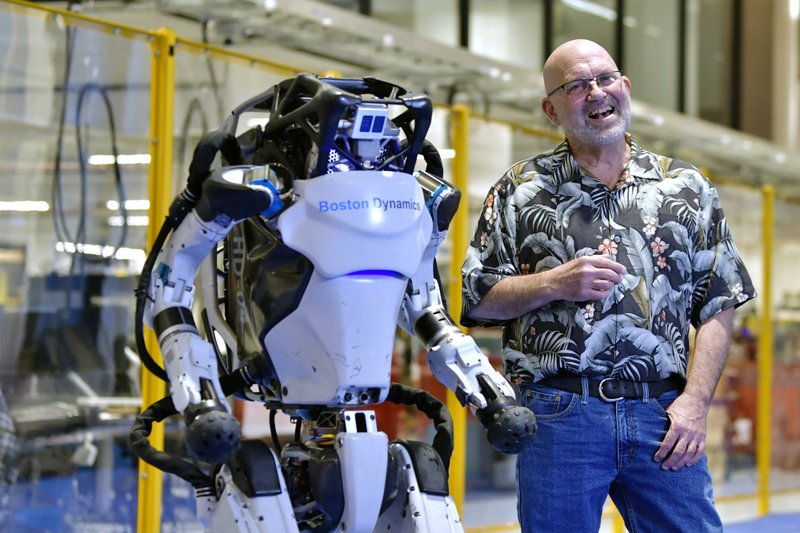
Marc Raibert, founder and chair of Boston Dynamics, with an Atlas robot that can dance with near-human fluidity.

We can probably all think of discoveries that initially seem frivolous or peculiar and later turn out to be important to humanity. So perhaps we shouldn’t laugh too much about a robot dancing to Motown. Who can tell what will come of it?

Rodrique Ngowi writes at the Associated Press (AP), “The man who designed some of the world’s most advanced dynamic robots was on a daunting mission: programming his creations to dance to the beat with a mix of fluid, explosive and expressive motions that are almost human.

“The results? Almost a year and half of choreography, simulation, programming and upgrades that were capped by two days of filming to produce a video running at less than 3 minutes. The clip, showing robots dancing to the 1962 hit ‘Do You Love Me?’ by The Contours, was an instant hit on social media, attracting more than 23 million views during the first week.

“It shows two of Boston Dynamics’ humanoid Atlas research robots doing the twist, the mashed potato and other classic moves, joined by Spot, a doglike robot, and Handle, a wheeled robot designed for lifting and moving boxes in a warehouse or truck. …

“[Says Boston Dynamics founder and chairperson Marc Raibert], ‘We didn’t want a robot doing robotlike dancing. We wanted it to do human dancing and, you know, when a human dances, the music has a beat and their whole body moves to it — their hands, their body, their head,’ he says. …

‘It looked like the robot was having fun and really moved with the music. And I think that had a lot to do with the result of the production.’

“Teaching robots to dance with fluid and expressive motions was a new challenge for a company that spent years building robots that have functional abilities like walking, navigating in rough terrain, pick things up with their hands and use attached advanced sensors to monitor and sense many things, Raibert says.

“ ‘You know, our job is to try and stretch the boundaries of what robots can do, both in terms of the outer research boundary, but also in terms of practical applications. And I think when people see the new things that robots can do, it excites them,’ he says.

“The advanced Atlas robot relies on a wide array of sensors to execute the dance moves, including 28 actuators — devices that serve as muscles by converting electronic or physical signal into movement — as well as a gyroscope that helps it to balance, and three quad-core onboard computers, including one that processes perception signals and two that control movement. …

“ ‘We’ve gotten calls from all around the world,’ Raibert says. ‘We got a call from one of the sound engineers who had recorded the original Contours performance back in the ’60s. And he said that his whole crew of Motown friends had been passing it around.’ “

More at AP, here.

A dancing Atlas robot at Boston Dynamics.

Read Full Post »

Photo: Adrian Dennis/AFP/Getty.
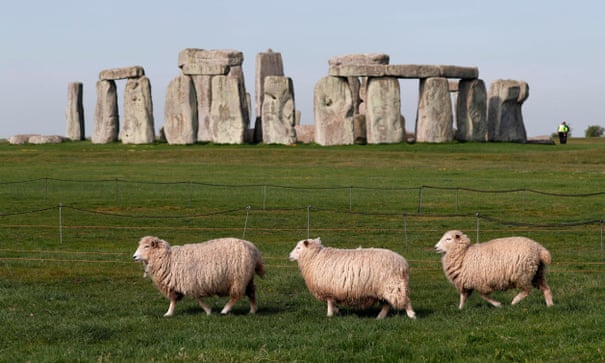
As construction for a tunnel under Stonehenge begins, archaeological surprises are turning up.

Do you ever wonder about the layers of civilization buried deep beneath your feet? John Hanson Mitchell wondered about my region’s layers back in a 1980s book, here. He got himself into a kind of trancelike state in which he believed he could sense the presence of indigenous tribes living their lives beside what is now Interstate 495.

More recently, as Steven Morris reports at the Guardian, “Bronze age graves, neolithic pottery and the vestiges of a mysterious C-shaped enclosure that might have been a prehistoric industrial area are [being] unearthed by archaeologists who have carried out preliminary work on the site of the proposed new road tunnel at Stonehenge.

“One of the most intriguing discoveries is a unique shale object that could have been part of a staff or club found in a 4,000-year-old grave. Nearby is the resting spot of a baby buried with a small, plain beaker. Ditches that flank the C-shaped enclosure contain burnt flint, suggesting a process such as metal or leatherworking was carried out there thousands of years ago.

“Just south of the site of the Stonehenge visitor centre, archaeologists came upon neolithic grooved ware pottery possibly left there by the people who built the stone circle or visited it.

“ ‘We’ve found a lot – evidence about the people who lived in this landscape over millennia, traces of people’s everyday lives and deaths, intimate things,’ said Matt Leivers, A303 Stonehenge consultant archaeologist at Wessex Archaeology. …

“The plan to drop the A303, which passes close to the stones, into a two-mile tunnel is hugely controversial, with many experts having said that carrying out such intrusive construction work would cause disastrous harm to one of the world’s most precious ancient landscapes and lead to the loss of hundreds of thousands of artefacts. A legal challenge was launched against the £1.7bn plan late last year.

“Highways England and Wessex Archaeology, which is leading the exploration of the tunnel corridor, said they were working on the project systematically and sensitively. …

“Close to the western end, two burials of Beaker people, who arrived in Britain in about 2,500BC, were found. One was an adult, buried in a crouched position with a pot or beaker. Also in the grave was a copper awl or fragment of a pin or needle and a small shale cylindrical object, of a type that is not believed to have been found before.

“ ‘It is an oddity,’ said Leivers. More detailed work will be carried out to find out what it is, but one theory is that it could be the tip of a ceremonial wooden staff or mace. Also found in the same area was a pit dating to the age of the Beaker people containing the tiny ear bones of a child and a very simple pot – a sign that this too was a grave. Usually Beaker pots are ornate but this one is plain, probably to reflect the age of the person who died.

“A little farther south, the C-shaped enclosure was found. ‘It is a strange pattern of ditches,’ said Leivers. ‘It’s difficult to say what it was, but we know how old it is because we found a near-complete bronze age pot in one of the ditches.’ …

“Another find was a group of objects dating to the late neolithic period – when the stone circle was built – including grooved ware pottery, a flint and red deer antlers. …

“Highways England said the amount of survey work that had been carried out was unprecedented because of the significance of the site. David Bullock, A303 project manager for Highways England, said: ‘There has been a huge amount of investigations so that this route can be threaded through so as to disturb as little as possible.’ ”

What mysteries will your everyday items pose for archaeologists of the future? What will more advanced people with no need for mouth guards or braces, say, make of gizmos like that?

More at the Guardian, here.

Read Full Post »

Photos: James Austin V.
Alaska is delivering vaccines by sled, boat, plane, and snowmobile. Flashback to the Iditarod origins — when diphtheria antitoxin was rushed to Nome by dog sled.

It’s so interesting to me which states are doing well with vaccine distribution and why! West Virginia was ahead of the pack because it used local pharmacies but also had a central sign-up site. Now Alaska seems to have taken the lead, and its techniques are completely different.

Cathy Free writes at the Washington Post, “Alaska, the state with the largest land mass in the nation, is leading the country in a critical coronavirus measure: per capita vaccinations.

“About 13 percent of the people who live in Alaska have already gotten a shot. … But the challenge for Alaska has been how to get vaccines to people across difficult, frigid terrain — often in remote slivers of the state.

“ ‘Boats, ferries, planes, snowmobiles — Alaskans will find a way to get it there,’ said the state’s chief medical officer, Anne Zink, 43.

“Alaskans are being vaccinated on fishing boats, inside 10-seater planes and on frozen landing strips. Doctors and nurses are taking white-knuckle trips to towns and villages across the state to ensure residents are protected from the coronavirus.

“Contributing to Alaska’s quick speed in getting the vaccine to its residents is a federal partnership that allows the state, which has more than 200 indigenous tribes, to receive additional vaccines to distribute through the Indian Health Service.

“Other reasons include the state’s small population of 732,000, as well as a high number of veterans, Zink said. The U.S. Department of Veterans Affairs is working with the Centers for Disease Control and Prevention to ensure that high-risk veterans receive priority for the vaccine.

“But one big reason is the state is practiced in delivering precious cargo by transport not often used in the Lower 48. Sometimes that even means adventures by sled. One all-female medical crew of four in December used a sled pulled by a snowmobile to deliver vaccine to the village of Shungnak in the state’s remote Northwest Arctic Borough.

‘It’s just an easier way to get around when you don’t have a lot of roads,’ said Kelli Shroyer, public communications director for the Maniilaq Health Center in Kotzebue, Alaska, where the crew started their journey. …

“Zink was so impressed by the sled crew’s delivery in December that she posted about it on her Facebook page. ‘I love the pictures of vaccination distribution in Alaska,’ she wrote. ‘Recipients expressed how grateful they were that even though they are so remote, they are getting this vaccine. They are not forgotten. …

‘One chief told me how his grandmother took his mother out to the wilderness for a year so that she would be safe. When they returned, they learned that most of their village had died.’ …

“Thousands of Alaskans are playing a role in getting people vaccinated, Zink said.

“Curt Jackson used to employ his water taxi, the Orca, to shuttle tourists from the small city of Homer to villages across Kachemak Bay that aren’t accessible by roads. In late December, Jackson received a request to take three nurses across the bay to Seldovia, a town with about 450 residents, including members of the Seldovia Village Tribe. Planes couldn’t fly that morning because of weather, and the water was rough.

“When the women climbed aboard his 32-foot aluminum landing craft and took seats in the windy darkness, Jackson said, he noticed that the woman in the middle, Candace Kreger, was clutching a bright blue cooler. That was when he realized that the women were traveling with the precious doses. …

“For Ellen Hodges, a doctor from Bethel, Alaska, the coronavirus vaccination effort is the most rewarding project in which she has been involved, she said. Hodges, 46, has flown to several villages in a six-seater plane to vaccinate medical workers and elders, who meet her on the runway.

“ ‘We land in the isolated tundra, and they’ll be lined up waiting,’ she said. ‘Some places have up to 30 people, and some have only one.’ “

More at the Washington Post, here.

An all-female medical crew from Alaska’s Maniilaq Health Center took a sled to deliver vaccine to the isolated village of Shungnak in December.

Read Full Post »

Photo: Tayler Gutierrez.
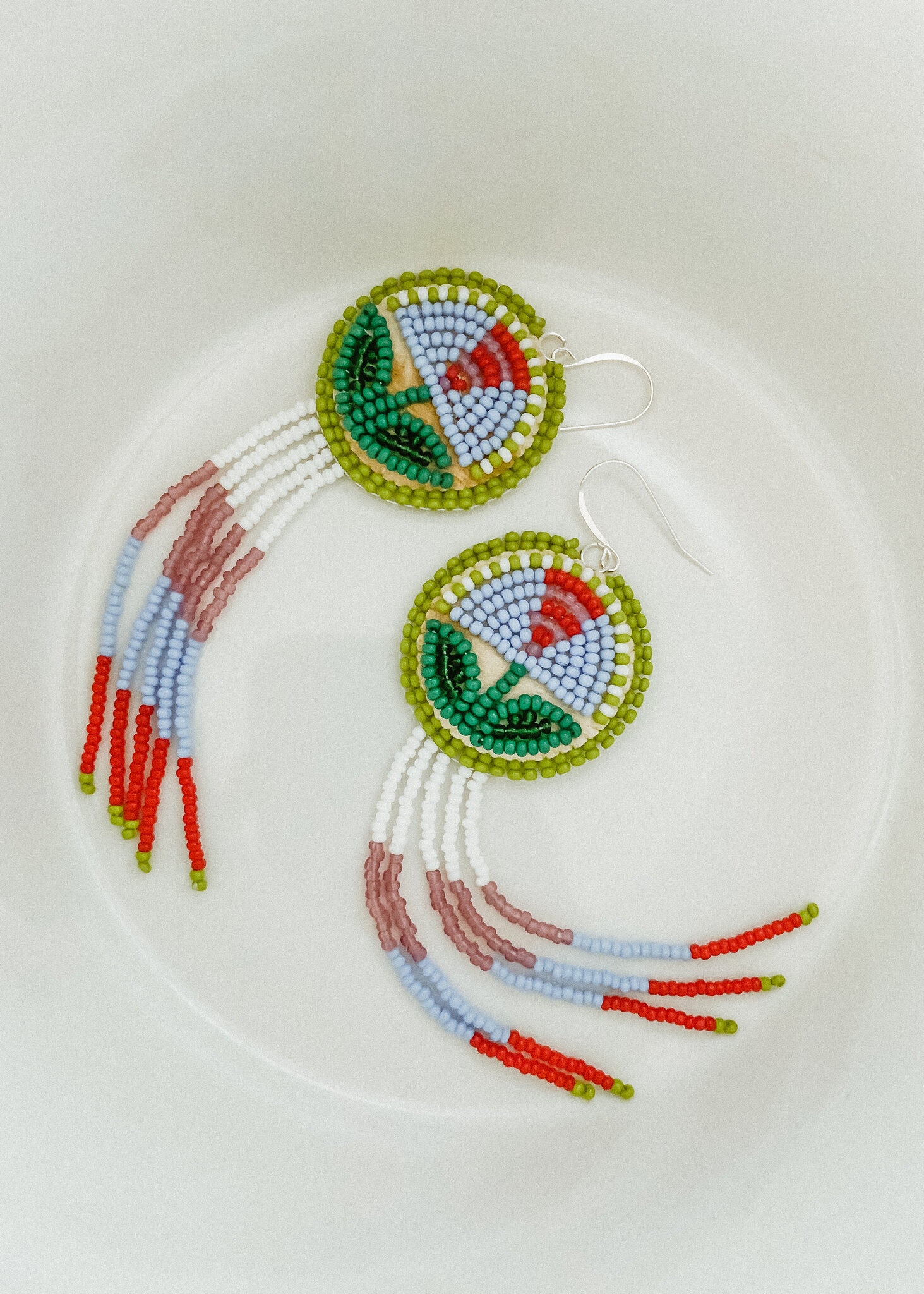
Earrings beaded onto smoked hide by the Cherokee artist Tayler Gutierrez.

You’re probably tired of all the whistling in the dark about good things that have come from lockdown when you know the past year has been mostly bad. But I wouldn’t want you to miss this cheerful story about indigenous beadworkers finding a market on Instagram during the pandemic.

Anna V. Smith reports on the phenomenon at the New York Times. “Last year, after the museum that Tayler Gutierrez worked at in Salt Lake City closed temporarily because of the coronavirus, she turned to her beadwork.

“A citizen of the Cherokee Nation of Oklahoma, Ms. Gutierrez, 24, had been practicing beadwork for years after learning from a mentor, the Diné poet Tacey Atsitty, and she already had a modest following on her Instagram page, where she posted her custom hat brims, earrings and leather pouches.

“But when the museum reopened in May, Ms. Gutierrez decided to take a much bigger leap: She put in her resignation notice and committed full-time to her craft. In July, she dropped her first collection of beadwork on Instagram; it included a set of earrings layered with two-tiers of dentalium shells and Swarovski crystals, and another pair with blooming flowers stitched with beads onto moose hide.

“With relatively few followers, she wasn’t expecting many people to buy. Instead, everything sold in five minutes.

“Ms. Gutierrez was shocked but thrilled — especially after the months of labor and love she had put into the work. (It takes around eight hours to make one pair of floral beaded earrings.) …

“Ms. Gutierrez just started her business ‘Kamama Beadwork last year, but she is one of many Indigenous beadwork artists on Instagram who have seen a spike in followers and sales that far outpaces their available stock.

“Partially, that’s because with craft fairs, powwows and art markets shuttered, many vendors and buyers are relying more heavily on the internet, [including] e-commerce websites like From the People, which launched in May as an online market space for Indigenous artists.

“Sales have been spurred by a national dialogue around racial injustice that has led to increased efforts to support Black and Indigenous artists and businesses. …

“As the Ojibwe fashion writer Christian Allaire has documented, the beading world is full of Indigenous artists blending traditional methods and contemporary forms: for example, Jamie Okuma and her beaded Louboutin stilettos; Skye Paul and her tattoo-inspired beaded patches or cow print beaded fringe earrings; and Tania Larsson’s fine jewelry made from musk ox horn and other natural materials of the Canadian Arctic.

“On Instagram, these artisans and others have amassed huge followings; when they drop collections or individual pieces, they sell out in minutes. Followers set alarms, pre-log into PayPal and have to buy as soon as the goods are available if they want a chance to snag anything at all. Recently, the same is true for Indigenous artists with half the amount of followers, including Ms. Gutierrez.

“Jaymie Campbell of White Otter Design Co. is one beadwork artist who has perfected the art of the Instagram drop. … As a full-time beader, Ms. Campbell made an Instagram account in 2016, a year after starting her business. At the time, there were seemingly fewer accounts by fellow artists, Ms. Campbell said. But that’s changed somewhat suddenly, as the isolation of the pandemic has connected more people in the digital sphere.

Virtual beading circles — online versions of community gatherings where beaders share techniques — have popped up, and many artists have experienced a surge in followers.

“ ‘The growth has been unprecedented, in my experience,’ Ms. Campbell said from her home in New Denver, British Columbia (population 473). On Indigenous People’s Day alone she gained over 2,000 followers from people promoting her work on social media.

“But in beadwork economics, more demand doesn’t necessarily mean more supply — and that is an important aspect of the work itself. As the Indigenous studies scholar and bead artist Malinda J. Gray, who is Anishinaabe Ojibwe Caribou Clan, from the Lac Seul Band, has written: ‘Beadwork encompasses a temporality that transcends the capitalist view of exchange.’

“Beadwork knowledge, materials and motifs are passed down through generations, Ms. Gray said, and those layers of time, meaning and memories give a piece of work ‘its own essence. And that’s something that cannot be mass produced.’ ”

And now for a word from our “sponsor”: Suzanne also sells jewelry on Instagram @lunaandstella, where you can find gorgeous antique heart lockets for Valentine’s Day. Or go to the website, here.

More at the New York Times, here.

Read Full Post »

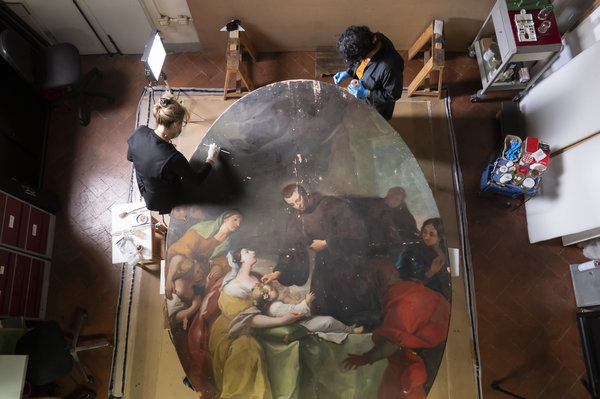
Photo: Ottaviano Caruso/AWA.
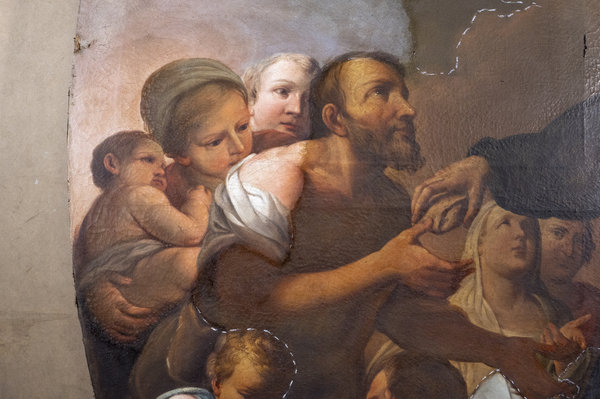
Restoration experts are working on Violante Ferroni’s painting Saint John of God Feeds the Poor.

An arts foundation in Italy asks, Where are the female Renaissance artists? Although many women who might have pursued some kind of art were probably bent over a tub of suds, there are others who created but are forgotten.

Sylvia Poggioli reported at National Public Radio’s “Weekend Edition” about new efforts to right centuries of wrong.

“Florence is one of the main stops on any art lover’s European itinerary. At the Uffizi Galleries, visitors can have their fill of works by Renaissance masters Leonardo da Vinci, Michelangelo and Raphael. Of course, none of these artists are women.

“In 2009, a new nonprofit foundation in Florence started to investigate why.

” ‘I started going into museum storages and attics and checking what was actually there, what works by women,’ says Linda Falcone, the director of Advancing Women Artists.

‘It was something that had never been done before because no one had ever before asked the question, “Where are the women?” ‘

“In the years since, AWA has shed light on a forgotten part of the art world, identifying some 2,000 works by women artists that had been gathering dust in Italy’s public museums and in damp churches. It has also financed the restoration of 70 works spanning the 16th to the 20th centuries.

“The organization was founded by Jane Fortune, an American philanthropist who died in 2018. Fortune was an intrepid art detective whom Florentines nicknamed ‘Indiana Jane’ in homage to her native state and her Renaissance treasure hunting skills. …

“During the Renaissance, Falcone says, ‘Women didn’t have citizenship. They couldn’t produce art as a profession. They couldn’t issue invoices. They couldn’t study anatomy.’ …

“A few Italian women were able to study painting in their fathers’ studios — most notably Artemisia Gentileschi, daughter of the 17th century painter Orazio Gentileschi. AWA is responsible for restoring David and Bathsheba, one of her paintings that was found after being hidden in a Florentine palazzo’s attic for 3-1/2 centuries.

“The group also rediscovered a 21-ft.-long canvas depicting 13 life-size males — the only known Last Supper painted by a woman. It is by the 16th century Dominican nun Plautilla Nelli — whose workshop was inside a convent in Florence. …

“Says [Falcone], ‘Nelli actually chooses sort of the key moment in which Christ announces his betrayal. And you have all of the apostles feeling the emotion of that very serious news. And so she is able to do a study of their responses, of their psychological responses.’ And, unlike most Last Suppers by male artists, Nelli puts food on the table, says Falcone.

‘She has lettuce, she has salt cellars, a lot of wine, bread for every apostle and knives and forks and beans and lamb — she did a Last Supper were people were meant to eat, first of all.’

“[Unlike] male artists of the time, Nelli signed her canvas — adding the words ‘pray for the paintress.’

“The nun’s works were prized by Florentines during the 16th century because they were believed to be imbued with spirituality. Her contemporary, the art historian Giorgio Vasari, wrote that she ‘would have done marvelous things if, like men, she had been able to study and to devote herself to drawing and copying living and natural things.’ …

“With backing from Advancing Women Artists, [art restorer Elizabeth Wicks] is currently restoring two large works by Violante Ferroni, an 18th century child prodigy of whom little is known today. …

“At the time, female artists were usually limited to painting still-lifes and small portraits. But while still in her 20s, Ferroni was awarded a prestigious commission by Florence’s San Giovanni di Dio hospital to paint two ovals — each of them 8-by-11 1/2 feet — with spiritual scenes to help heal the ill. The subject was usually reserved for men. …

“Falcone says that through restoration work, documentation and exhibits, AWA has contributed to a growing worldwide interest in and awareness of art by women. Yet the organization recently announced it is shutting down next June because it does not have sufficient funds to expand.”

More at NPR, here.

Photo: Francesco Cacchiani/AWA
Restoration expert Elizabeth Wicks and the nonprofit Advancing Women Artists have recently been restoring works by Violante Ferroni, a forgotten 18th century woman.

Read Full Post »

Rewilding in the UK

Photos: Murdo MacLeod
Scotland is inviting nature to return to abandoned industrial spaces.

The idea of “rewilding” industrial spaces, or turning them back to nature, makes me happy. One often reads about it happening in the UK, but we could do it, too, if we wanted to.

This photo essay in the Guardian is about how, in Scotland, rewilding often happens through benign neglect. Bella Bathurst wrote the text and Murdo MacLeod took the photos.

“Since the idea of rewilding took hold, it has generally been seen as a rural pursuit involving withdrawal from farmland so that animals and vegetation can restore their own ecology. At its most herbivorous, it includes allowing hedgerows or scrub to flourish unchecked. At its most primal, it involves deliberately releasing animals such as beavers or wolves in the belief that the re-entry of a single alpha species brings with it a cascade of ecological benefits. …

“The perception is that it is expensive, far away and often inaccessible. It certainly isn’t something that just anyone can do.

“But what if the wildest places of all were right under our feet? In the forgotten spaces in our cities, rewilding has always happened naturally, land falling under stone and resurging again, concrete lids flipped off before submerging once more. In the margins and the demilitarised zones, the abandoned embankments, the bits we don’t want or the lands already contaminated beyond human tolerance, ecology is thriving.

“In some places – such as the land around the abandoned Chernobyl nuclear plant in Ukraine – plant and insect life has adapted to the extreme conditions: boars have moved in, there is a new radiation-munching fungus and, in the thin strip of no-man’s land between the borders of North and South Korea, leopards and Asiatic black bears have been spotted. …

“In Scotland, the 40-mile strip between Glasgow and Edinburgh has always been mined, for not just coal, but stone, gravel, lead and even gold. After centuries of hard pickings, parts of Lanarkshire and Ayrshire have an upended appearance. What was underground is now on top and what was above has gone below, with buildings and bridges slumped over old drift mines and razor-lined spoil heaps terraced by extraction tracks. Wildfowl nest on lochs made from old coal holes and an orchid called Young’s helleborine, discovered in 1975, favours only the best iron ore. …

“At an explosives factory once owned and operated by the Alfred Nobel Company, [sections] are still in use, but most of the 330-acre site was long ago abandoned. Along the cracks in the old pipelines and through the decaying buildings, it would be quicker to list the native plants that are no longer there than those that are. …

“Public feeling is that big business should be obliged to make good what it has taken, but human attempts to restore land are often amateurish. Planting a few conifers and flinging around a mix of wildflowers may be a quick fix, but sometimes it appears that the best thing to do is nothing. …

“In 1913 the 13th Earl of Home tried to lift local unemployment at Douglas by allowing mining nearby. The mining unseated [his] castle, it was demolished, and the flooded workings (known locally as the Black Hole) are now so patterned with commuting birdlife that it resembles an avian Heathrow. …

“On the other side of the Clyde, between the Erskine Bridge and the old John Brown shipyard, lies what used to be the Beardmore naval construction works in Dalmuir. In the early 20th century it produced munitions, planes, submarines and warships before being converted into a fuel-supply depot and then being gradually abandoned.

“Now a cycle path runs through it, but otherwise there is nothing new here except nature: golden leaves of birch springing from the concrete jetty, hawkweed drifting Ophelia-like in the drowned oil storage tanks, wrens nesting in the rusted embankments, mallards cackling from the blackthorn scrub. …

“Dalmuir is beautiful, dangerous – and almost certainly contaminated. … Halflands like these can be among the most joyous and optimistic places on earth, but they can also carry with them a polluting sense of menace. Finding them means that you may end up meandering across an indeterminate line between a walk in the park and full-scale urban exploration; you explore at your own risk. …

“They also have a habit of vanishing. Brownfield sites tend to be classified as wasteland, and with the pressure on housing, they are first in line for redevelopment. Ardeer is intended for ‘regeneration’ and Dalmuir will shortly be dug up to make way for the Scottish Marine Technology Park, a deepwater ship hoist and a new small-vessel fabrication yard.”

More at the Guardian, here.

Abandoned naval construction works in Dalmuir, Scotland. Explore at your own risk.

Read Full Post »

Sometimes a small, well-networked country or state can do a better job making challenging things happen than the big guys can. I’m thinking, for example, about West Virginia’s remarkable success in getting the Covid vaccine into people’s arms. (NBC has a cool story about Mom & Pop drugstores and the advantage of knowing your community.)

Today’s story comes from a very different part of the world and concerns a very different topic: the struggling print-magazine industry.

Elle Hunt reports at the Guardian, “At 8.31am on a Thursday, Henry Oliver received a text message from his employer, alerting him to a company-wide Zoom call in 29 minutes’ time.

“The day was 2 April 2020, a week into New Zealand’s national lockdown to control the spread of coronavirus. Oliver, who is the editor of Metro magazine, and his team had been scrambling to adjust to remote working and – with magazine publishing not among the ‘essential services’ permitted to continue through the pandemic – a new digital-first operation.

“Within an hour of that text, Oliver and the 300-odd other employees of Bauer Media New Zealand were told they were being made redundant, the titles they worked on would be put up for sale, and the entire company was to close. …

“A privately owned German company operational in 13 countries, including the US, UK and Australia, Bauer had been a pillar of the New Zealand magazine industry since 2012. In particular it was known for its current affairs and long-form features journalism, as the home of the Auckland-centric Metro, North & South and The Listener – titles with steady subscriber bases and some of the most experienced and awarded journalists in the country on staff.

“In its suddenness and its sweep, Bauer’s decision seemed to sound a death knell for an entire industry. … Yet less than a year later, not only have Bauer magazines been brought back to life under new ownership, but also new titles have been launched – reflecting a flurry of investment and innovation in New Zealand media precipitated by the pandemic.

“Sydney private equity firm Mercury Capital purchased Bauer NZ for an unspecified sum in June (later renaming it Are Media) – extending a lifeline to The Listener and four other mastheads.

Metro and North & South were both acquired by independent investors seeking to preserve New Zealand’s tradition of long-form features journalism.

“Meanwhile, four entirely new monthly titles – staffed by former Bauer editors and writers, with former CEO Paul Dykzeul advising – were launched by School Road Publishing in November.

“The recovery, since the dire outlook in April, has exceeded all expectations: testament to the appetite of New Zealanders not just to read magazines, but to make them.

“The day after he was made redundant, Oliver started work on a zine. With a budget procured from property developer Britomart Group, he was able to deploy the talents of many of the journalists and designers who had been let go with him from Bauer. He gave it the tongue-in-cheek title Essential Services, describing it as a ‘small affirmation of life in the face of media industry collapse.’

“Oliver went on to produce two more issues with funding from government agency Creative New Zealand. … ‘I just thought to myself, it’s not really up to a German billionaire whether I get to make magazines or not.’

“Others too had spied opportunity in among the rubble. German-born journalists Konstantin Richter and Verena Friederike Hasel … made a ‘spontaneous’ offer on North & South to ensure its survival, as subscribers themselves. Richter is also a board member of the Swiss media giant TX Group, founded by his family, and splits his time between the two countries. …

“Richter describes their vision as ‘a mix of change and tradition’: retaining North & South’s time-honoured focus on issues that span the length of New Zealand, bridging the urban-rural divide – while injecting news and perspectives from further afield. He sees an opportunity to build on the tradition of investigative and long-form features journalism in a nation that is more receptive than others to the concept.

Metro, meanwhile, was bought by media entrepreneur Simon Chesterman, who retained Oliver as editor and moved the magazine to quarterly publishing. It relaunched with a splash in November with an exclusive essay from Lorde.

“Oliver says they were aligned on the importance of an Auckland-centric title in the age of coronavirus. ‘We’re going to be living in a more local world for the foreseeable future, so a city magazine, an authority on a specific place, can be more relevant than ever.’

“Plus, at a moment of up-to-the-minute, pandemic-driven doom-scrolling, ‘here is space for a slower media,’ says Oliver. ‘That was really what was taken away with the shutdown of the magazines.’

“To [Colin Peacock, host of Radio New Zealand’s Mediawatch programme], the industry’s reinvention suggests a new era of ‘start-up-style media’ in New Zealand. … Peacock points to Shepherdess – a new quarterly magazine for rural women, which launched in mid-March – and the free ‘mountain culture’ publication 1964 as examples of how print might be reinvented to serve a specific, perhaps localised audience. …

“In April, Bauer’s Australia and New Zealand chief executive Brendon Hill had said magazines would be ‘untenable’ in New Zealand through the pandemic: ‘Publishing in New Zealand is very dependent on advertising revenue and it is highly unlikely that demand will ever return to pre-crisis levels.’

“But the industry’s bounceback from catastrophe reflects New Zealand readers’ loyalty to their long-standing magazines – potentially to a fault, Peacock suggests. … The resurrection of The Listener, almost identical in form and focus, suggests there was next to no enthusiasm for a refresh, says Peacock. …

“Richter and Friederike Hasel are hopeful that North & South readers will embrace a new global perspective – especially at this time of transition, not just for New Zealand’s media but New Zealand itself. Bauer’s exit was ‘a shock to many,’ says Friederike Hasel – ‘but I think something good might come out of that.’ ”

More at the Guardian, here.

Read Full Post »

« Newer Posts