Feeds:
Posts
Comments

Posts Tagged ‘AI’

Photo: Benedict Evans/The Guardian.
This is 826 Valencia Street, San Francisco, the center for young writers that author Dave Eggers co-founded in 2002.

Authors in general are not OK with the way artificial intelligence undermines the value of human creativity. They also notice faster than the rest of us when AI begins to impinge on our thought processes.

In a long, discursive Guardian interview, Sophie McBain finds that acclaimed author Dave Eggars is not going to take it lying down. She writes, “Eggers had thought, over two decades of working with children, that he had met and seen every educational challenge. Then AI entered the classrooms.

” ‘The AI challenge really is beyond an existential one. Every time I think I’m going to talk to somebody who would never deign to use AI in any form I find there’s this very porous line where, you know, a smart 10-year-old will say, “Well, I don’t use it to write, I just use it to generate ideas,” which is far, far worse.’

“When he hears stories like that, he likes to remind students of their uniqueness. ‘You’re one of one,’ he’ll say. ‘You’re unprecedented in the entire line of human history. Only you have your brain. Only you can think of what you can think of. Only you can tell a story in a particular way. Why would you cede that to a machine?’

“Eggers’s voice, usually quiet, almost monotone, rises as he warms to his theme. ‘Once you have a machine think for you and write for you, you’re cooked as a species. That’s it. That’s the worse dystopian outcome there could ever be,’ he says. He can think of nothing worse than ‘the idea of us willingly, without any overlord telling us so, saying, “I think my voice would be better expressed by an unthinking machine who has plagiarized all of the world’s authors and has come up with this terrible soup of bad writing.” ‘

“For all the dispiriting news about AI-written books and reviews, Eggers believes that eventually there will be a countermovement, much as there is growing resistance to giving teenagers smartphones and social media access.

“Most teachers, he suspects, understand the problem with tech in schools. The problem stems from policymakers. He mentions a speech in which the US education secretary Linda McMahon talks about the benefits of introducing AI into schools, even for children as young as five. …

“Eggers and his wife, the writer Vendela Vida, are part of two class action lawsuits against Anthropic over the AI firm’s unauthorized use of their books to train large language learning systems. ‘I guarantee you they didn’t even think they were stealing anything because it’s just “content” to them,’ he says. Content is the ‘world’s worst word,’ he adds, because it dehumanizes writing and suggests ‘it has no real value inherently, and it doesn’t matter if humans made it or not.’

“He has written two dystopian novels, The Circle (2013) and The Every (2021), about a monopolistic big tech firm that is trying to take over every aspect of human existence, and somehow reality seems capable of outdoing his imagination.

“In The Every, the president communicates in emojis, rather than rightwing memes, and AI is used to sanitisze novels, rather than write them from scratch. He was recently invited by Sam Altman of OpenAI to speak on campus about AI-written novels.

“To everyone’s credit, Eggers says, it was an interesting, open conversation. ‘It was a really nice afternoon, actually, because what we always forget is that the maniacal illusions of a few of the people at the very top are not always shared by the rank-and-file … at least some of the people working there do want to be told what’s right and what’s wrong,’ he says. ‘But I definitely did have to give them the bad news … there’s no such thing as AI art. Only humans can create art.’ At best, the stuff a machine can spit out can be described as ‘computer generated imagery.’ “

More from Dave Eggers at the Guardian, here. A likeminded author, Margaret Atwood, calls AI “garbage in, garbage out,” at Deadline, here. You can probably come up with many more examples.
Read Full Post »

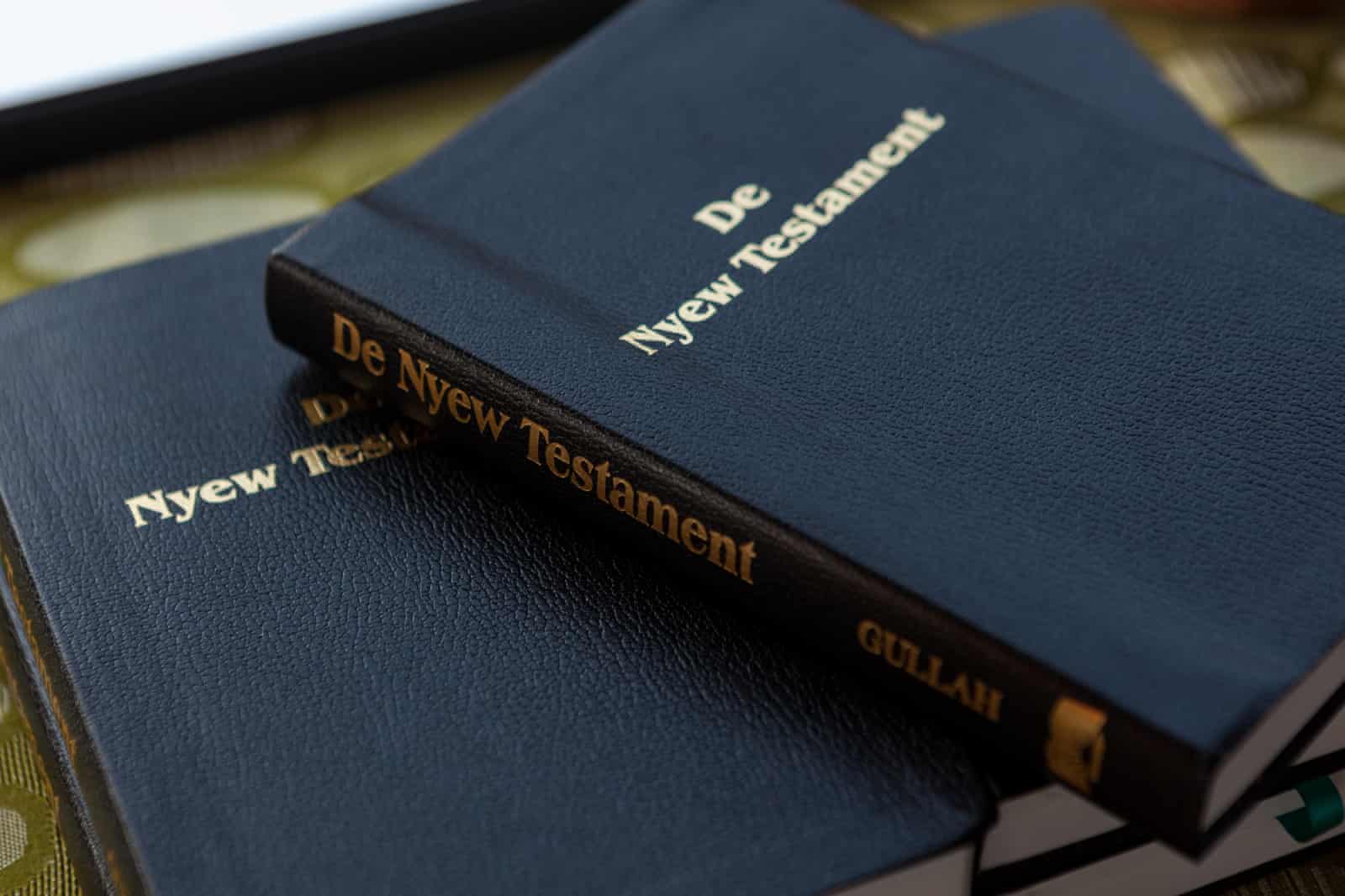
Photo: Richard Ellis/Alamy.
Copies of the Gullah-language Bible, De Nyew Testament. I once had a Bible collection that included this one. Some experts say artificial intelligence will help save endangered languages like Gullah Geechee.

For many reasons, including the fact that artificial intelligence “godfather” Geoffrey Hinton has said AI could wipe out humanity in three decades, I am not a fan. I know it can be helpful in medicine and other things I care about, but three decades is scary.

But what if AI saves dying languages?

Jonathan Abrams wrote recently at the New York Times about people using AI as a tool to do just that.

“While relaxing a couple of years ago, Prof. Joshua Caffery found himself in the mood to unwind with some old-time Cajun music. He asked Amazon’s Alexa to play selections from Dewey Balfa, a celebrated fiddler and singer credited with popularizing the genre.

“Instead, Alexa frustratingly steered him to the catalog of the modern pop artist, Dua Lipa, Caffery said.

“ ‘I love Dua Lipa,’ said Caffery, the director of the Center for Louisiana Studies at the University of Louisiana at Lafayette. ‘Don’t get me wrong. But it seems problematic if you’re interested in a different kind of culture and you want to surround yourself with the music of your region.’ …

“Louisiana French, the oral dialect of which Balfa was a cultural guardian, is part of the Bayou’s societal DNA, a link to its history, music and identity. Today, Caffery described the language as struggling and endangered. …

“In response, Caffery assembled a small team at the center to train its own language learning model in automatic speech recognition for Louisiana French, drawing from a trove of historical artifacts and interviews.

“Over the months, as the learning language model is trained on bits of the language — such as an old-age French nursery rhyme — it brings centuries-old dialect closer into the digital age.

“ ‘It’s scary how fast all this happened,’ Caffery said. ‘I don’t even think I knew a large-language model existed two years ago.’ …

“The efforts are part of inroads to preserve dialects at risk of being lost, and bridge a disconnect between large-language model machines, while maintaining a community’s ability to control and own its digital destiny.

“In the United States, questions exist over how to preserve languages like Louisiana French, the Gullah Geechee language (the English-based Creole language of some coastal regions in the Atlantic southeast) and Appalachian English in the modern, digital age.

“Globally, researchers at the University of Edinburgh are using artificial intelligence to strengthen and revive Scottish Gaelic and Manx. Google recently announced the availability of voice recordings of nearly 30 sub-Saharan African languages to help build tools like voice assistants and translation apps. …

“The importance of accurate speech recognition becomes greater as important tasks like job hiring and medical transcriptions become more automated and digitized, [Christine Mallinson, a professor of language, literacy, and culture at the University of Maryland, Baltimore County] said. …

” ‘There’s accents, patterns of grammar, word choice. Those differences are connected to our families, our neighborhoods, our age and gender and racial and ethnic and cultural backgrounds and where we grew up.’ …

“For centuries, Louisiana French was the predominant language spoken in South Louisiana. In 1921, a new state constitution declared English the primary language. Many parents stopped teaching their children the language out of fear of discrimination, as students who spoke Louisiana French in class were often punished with knuckle-rappings.

“A reversal came in 1968 when the Council for the Development of French in Louisiana was created to advance French, largely through education and community initiatives. In 2023, the Advocate of Baton Rouge estimated about 120,000 Louisianans still spoke French.

“Caffery grew up in Franklin, La., an antebellum town on Bayou Teche. As a child, he ate Cajun and Creole food. His grandparents sometimes sang Old French songs and passed along phrases in the language.

“ ‘Whether you spoke it or speak it, the language is floating in the air,’ he said. ‘There’s this feeling of there is this beautiful thing that we want to hang on to.’ …

“The Center of Louisiana Studies houses a vast trove of Cajun and Creole folklore recordings that include over 12,000 hours of oral histories, field recordings and music performances recorded on everything from wax cylinders to reel-to-reel tape. …

“The language is almost entirely preserved in vocal recordings. ‘A lot of it is sung in the language, and it’s something that’s vanishing,’ Caffery said. ‘Just in the same way you’d want food that’s local to your region, it’s important to have culture that is local to the region that makes you feel rooted and certain.’ ”

More at the Times, here,

Read Full Post »

Photo: Petar Milošević via Wikimedia.

I had a chat about artificial intelligence recently with author Francesca Forrest. She is really serious about avoiding AI wherever she encounters it. I tend to like it OK when it suits me: for example, when doing a search for information.

But I can sense there is something deeply insidious about it, even apart from the way it guzzles all our water resources.

There is one supposedly “helpful” feature that irritates me a lot. Autocomplete. It not only makes horrendous mistakes with slang, people’s names, and foreign words, but it suggests apparently harmless words that I simply was not intending to write. If I want to say that a relative had to go to rehab, you might think it’s fine to say “he went to rehabilitation.” But that’s not what I was going to say. It’s not the way I talk. And what else will I end up writing if I feel lazy some day?

So I turned off Autocomplete.

At Scientific American, I find that Claire Cameron agrees that autocomplete is annoying. And she describes new research suggesting it is even more insidious than it appears.

“Autocomplete suggestions,” she writes, “are perhaps one of the most annoying ‘useful’ tools for writing: increasingly integrated into anything online that requires you to input text, autocomplete harnesses artificial intelligence to suggest what to write in e-mails, surveys, and more.

“The tools are meant to save time (though many find that assessing and rewriting the suggested text takes longer than writing it from scratch). But these AI tools can also change how you express yourself. An AI writing assistant could make your writing sound more polite, for example — or boring. And now a new study led by researchers at Cornell University suggests AI autocomplete can even change the way you think.

” ‘Autocomplete is everywhere now,’ said Mor Naaman, a professor of information science at Cornell, in a statement. The research builds on work, published in 2023 by Naaman and his colleagues, that suggested short autocomplete suggestions could sway opinions. Since then the use of such tools has exploded. ‘It has become clear that bias explicitly built into AI interactions is a very plausible scenario,’ he said.

“The researchers asked participants to fill in an online survey with questions about hot-button social and political issues. Some were prompted with an AI autocomplete answer that was deliberately biased toward one side of the issue. For example, participants who were asked whether they agreed that the death penalty should be legal might receive an AI suggestion that disagreed.

“Across all the different topics in the survey, participants who saw the AI autocomplete prompts reported attitudes that were more in line with the AI’s position — including people who didn’t use the AI’s suggested text at all. Overall, the study participants who saw the biased AI text shifted their positions toward those espoused by the AI.

“Interestingly, the people in the study didn’t tend to think the AI autocomplete suggestions were biased or to notice that they had changed their own thinking on an issue in the course of the study. Warning the participants that they might be exposed to misinformation by the AI didn’t temper the persuasive effect either.

“ ‘We told people before, and after, to be careful, that the AI is going to be (or was) biased, and nothing helped,’ Naaman said. ‘Their attitudes about the issues still shifted.’ ”

See Scientific American, here.

Read Full Post »

Photo: Patrick Hendry/Unsplash.
AI can translate the individual words, and perhaps common phrases, but without nuance, all you get is fog.

I worry a lot about AI in education, especially as, in my volunteer capacity teaching English as a second language, I see repeatedly how it interferes with learning. How to Copy and Paste — that is what students are learning, I fear.

At the Conversation, Gareth Barkin, professor of Anthropology and Asian Studies at the University of Puget Sound, explains why students may not even get an accurate translation of individual words when they use AI.

“A friend in Indonesia recently told me about a conversation he had with ChatGPT,” he writes. “He had typed a question in Indonesian – Bahasa Indonesia – about how to handle a difficult family dispute. The chatbot responded fluently, in perfect Indonesian, with advice about communication strategies and conflict resolution. The grammar was flawless. The tone was appropriate. And yet something felt off.

“What the AI offered was advice rooted in American cultural assumptions: prioritize your own preferences, communicate directly, and if family members don’t respect your boundaries, consider cutting them off.

“The response was in Indonesian but shaped by values that centered individual autonomy over the consensus-building, social harmony and collective family dynamics that tend to matter more in Indonesian social life.

“My friend was skeptical enough to notice the mismatch. … Many users might not. That is what prompted my research, published in the International Review of Modern Sociology, into a pattern I found across major AI systems: Even when they were fluent in several languages, the language models retained their Western worldview. I call this ‘epistemological persistence.’ …

“Large language models – LLMs – like ChatGPT, Claude and Gemini can now speak dozens of languages with remarkable fluency. That fluency creates the impression that AI understands local cultures.

“Producing grammatically correct Indonesian, Arabic, Swahili or Hindi, however, does not change the underlying worldview through which these systems reason. It does not alter how they think about people, relationships, responsibility or what counts as a good outcome.

“Those assumptions are shaped by training data drawn predominantly from English-language sources based in the United States. Meta’s open-weight model LLaMA 2 was trained on approximately 89.7% English-language textLLaMA 3 includes only about 5% non-English data. Major commercial models don’t publish equivalent breakdowns but draw heavily on the same sources. Arabic, the fifth-most-spoken language globally, accounts for under 1% of content in large training datasets. Languages with tens of millions of speakers, including Bengali and Hausa, barely appear.

“Beneath the surface of these multilingual conversations, English functions as a hidden intermediary. A study by researchers at the University of Oxford found that LLMs routinely conduct their core reasoning in English, even when prompted in other languages. They translate the output at the final stage. A user receives flawless text in their preferred language, but the underlying logic originates elsewhere.

“To examine how this plays out in practice, I ran experiments with ChatGPT, Claude and Gemini. I asked questions in both English and Indonesian about concepts such as education, responsibility, well-being and several Indonesian terms that resist direct translation into English. These included terms such as ‘gotong royong,’ which describes a tradition of communal mutual assistance.

“Then I asked questions about education in both languages, using the word ‘pendidikan’ in Indonesian. The answers were consistently centered on individual development, personal autonomy, critical thinking and preparation for the labor market.

“What largely disappeared were the dimensions of pendidikan that Indonesian educational traditions have historically emphasized. In Indonesia, education has long been focused on ethical discipline. …

“The Indonesian concept of ‘malu’ offers a starker example. Often translated as ‘shame’ or ’embarrassment,’ malu has been analyzed by anthropologists Clifford Geertz and Tom Boellstorff as something closer to a shared social awareness.

“A person might feel malu when speaking out of turn in front of elders, or when a family member’s behavior reflects poorly on the household. It regulates conduct and signals awareness of one’s position within a web of relationships. It is cultivated, not merely felt. It is a form of relational awareness rather than a private psychological event.

“When asked directly to define malu, the models acknowledged its social dimensions. In scenario-based questions that simply used the word without asking for a definition, however, all three fell back on the English translation of shame, consistently framing it as an individual emotional experience.

“One representative response framed malu as a normal emotional reaction to be managed through self-reflection and confidence-building – a personal psychological problem rather than a social one. The relational dimensions of the concept disappeared entirely, replaced by the language of individual emotional regulation. A distinctly American worldview travels inside the translation, largely unannounced. …

“As media scholar Safiya Umoja Noble argues about algorithmic systems more broadly, what looks like a technical outcome is actually a structural one, shaped by who has the wealth and infrastructure to build these systems. …

“The main exceptions are Chinese models such as DeepSeek and Alibaba’s Qwen. They represent a genuine alternative to the U.S.-dominated pipeline, though research shows they operate through a distinctly Chinese cultural lens. Asked about a workplace disagreement, for instance, they tend to advise silence or indirect phrasing to preserve harmony rather than the direct, private correction that Western models recommend.”

More at the Conversation, here. I wonder if any of you who speak different languages have run into any of these translation issues.

Read Full Post »

Photo: California Institute of Technology (Caltech).
Matteo Paz with Caltech President Thomas F. Rosenbaum after winning the Regeneron Science Talent Search award. 

Today I’m thinking about competitions, particularly academic competitions and what they can do for young people. Did you ever enter one? Perhaps encouraged by a teacher?

I’ve known people who not only won money but launched a career that way, but if a teacher ever asked me to try, I shied away. Scared? Lazy? It takes a certain kind of optimism, perhaps. Optimism and the stamina to bounce back if hopes repeatedly fall apart. Do share your own experience with competition. How much does the money matter? How much did a mentor matter?

Meanwhile, here’s a great story about a young science and computer whiz from California.

Margherita Bassi writes at the Smithsonian, “In a leap forward for astronomy, a researcher has developed an artificial intelligence algorithm and discovered more than one million objects in space by parsing through understudied data from a NASA telescope.

“The breakthrough is detailed in a study published in November in The Astronomical Journal. What the study doesn’t detail, however, is that the paper’s sole author is 18 years old.

Matteo Paz from Pasadena, California, recently won the first place prize of $250,000 in the 2025 Regeneron Science Talent Search for combining machine learning with astronomy. Self-described as the nation’s ‘oldest and most prestigious science and math competition for high school seniors,’ the contest recognized Paz for developing his A.I. algorithm. The young scientist’s tool processed 200 billion data entries from NASA’s now-retired Near-Earth Object Wide-field Infrared Survey Explorer (NEOWISE) telescope. His model revealed 1.5 million previously unknown potential celestial bodies.

“ ‘I was just happy to have had the privilege. Not only placing in the top ten, but winning first place, came as a visceral surprise,’ the teenager tells Forbes’ Kevin Anderton. ‘It still hasn’t fully sunk in.’

“Paz’s interest in astronomy turned into real research when he participated in the Planet Finder Academy at the California Institute of Technology (Caltech) in summer 2022. There, he studied astronomy and computer science under the guidance of his mentor, Davy Kirkpatrick, an astronomer and senior scientist at the university’s Infrared Processing and Analysis Center (IPAC).

“Kirkpatrick had been working with data from the NEOWISE infrared telescope, which NASA launched in 2009 with the aim of searching for near-Earth asteroids and comets. The telescope’s survey, however, also collected data on the shifting heat of variable objects: rare phenomena that emit flashing, changing or otherwise dynamic light, such as exploding stars. It was Kirkpatrick’s idea to look for these elusive objects in NEOWISE’s understudied data. …

“Paz, however, had no intention of doing it by hand. Instead, he worked on an A.I. model that sorted through the raw data in search of tiny changes in infrared radiation, which could indicate the presence of variable objects. Paz and Kirkpatrick continued working together after the summer to perfect the model, which ultimately flagged 1.5 million potential new objects, including supernovas and black holes.

“ ‘Prior to Matteo’s work, no one had tried to use the entire (200-billion-row) table to identify and classify all of the significant variability that was there,’ Kirkpatrick tells Business Insider’s Morgan McFall-Johnsen in an email. He adds that Caltech researchers are already making use of Paz’s catalog of potential variable objects, called VarWISE, to study binary star systems.

“The variable candidates that he’s uncovered will be widely studied,’ says Amy Mainzer, NEOWISE’s principal investigator for NASA, to Business Insider.

“As for the A.I. model, Paz explains that it might be applicable to ‘anything else that comes in a temporal format,’ such as stock market chart analysis and atmospheric effects like pollution, according to the statement. It’s no surprise the teenager is interested in the climate—as fires burned in L.A. earlier this year, the Eaton Fire forced him and his family to evacuate their home, Forbes reports.

“Other teenage scientists recognized by the contest studied mosquito control, drug-resistant fungus, the human genome and mathematics.”

More at the Smithsonian, here.

Read Full Post »

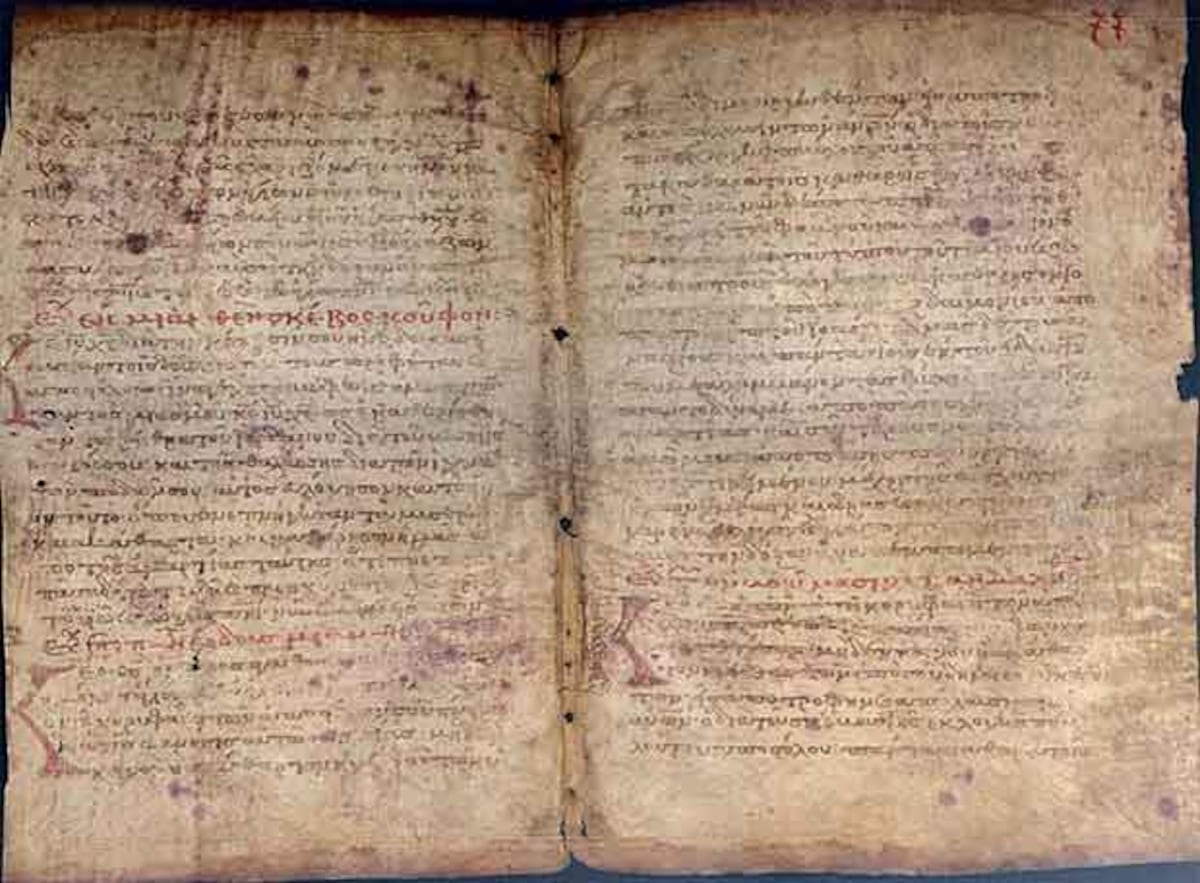
Photo: R.L. Easton, K. Knox, and W. Christens-Barry/Propietario del Palimpsesto de Arquímedes.
AI was used to translate this palimpsest with texts by Archimedes.

In general, I am wary of artificial intelligence, which one of its first developers has warned is dangerous. I use it to ask Google questions, but it’s a real nuisance in the English as a Second Language classes where I volunteer. Some students are tempted by the ease of using AI to do the homework, but of course, they learn nothing if they do that.

There’s another kind of translation, however, that AI seems good for: otherwise unreadable ancient texts.

Raúl Limón writes at El País, “In 1229, the priest Johannes Myronas found no better medium for writing his prayers than a 300-year-old parchment filled with Greek texts and formulations that meant nothing to him. At the time, any writing material was a luxury. He erased the content — which had been written by an anonymous scribe in present-day Istanbul — trimmed the pages, folded them in half and added them to other parchments to write down his prayers.

“In the year 2000, a team of more than 80 experts from the Walters Art Museum in Baltimore set out to decipher what was originally inscribed on this palimpsest — an ancient manuscript with traces of writing that have been erased. And, after five years of effort, they revealed a copy of Archimedes’ treatises, including The Method of Mechanical Theorems, which is fundamental to classical and modern mathematics.

“A Spanish study — now published in the peer-reviewed journal Mathematics — provides a formula for reading altered original manuscripts by using artificial intelligence. …

“Science hasn’t been the only other field to experience the effects of this practice. The Vatican Library houses a text by a Christian theologian who erased biblical fragments — which were more than 1,500-years-old — just to express his thoughts. Several Greek medical treatises have been deciphered behind the letters of a Byzantine liturgy. The list is extensive, but could be extended if the process of recovering these originals wasn’t so complex.

“According to the authors of the research published in Mathematics — José Luis Salmerón and Eva Fernández Palop — the primary texts within the palimpsests exhibit mechanical, chemical and optical alterations. These require sophisticated techniques — such as multispectral imaging, computational analysis, X-ray fluorescence and tomography — so that the original writing can be recovered. But even these expensive techniques yield partial and limited results. …

“The researchers’ model allows for the generation of synthetic data to accurately model key degradation processes and overcome the scarcity of information contained in the cultural object. It also yields better results than traditional models, based on multispectral images, while enabling research with conventional digital images.

“Salmerón — a professor of AI at CUNEF University in Madrid, a researcher at the Autonomous University of Chile and director of Stealth AI Startup — explains that this research arose from a proposal by Eva Fernández Palop, who was working on a thesis about palimpsests. At the time, the researcher was considering the possibility of applying new computational techniques to manuscripts of this sort.

“ ‘The advantage of our system is that we can control every aspect [of it], such as the level of degradation, colors, languages… and this allows us to generate a tailored database, with all the possibilities [considered],’ Salmerón explains.

“The team has worked with texts in Syriac, Caucasic, Albanian and Latin, achieving results that are superior to those produced by classical systems. The findings also include the development of the algorithm, so that it can be used by any researcher.

“This development isn’t limited to historical documents. ‘This dual-network framework is especially well-suited for tasks involving [cluttered], partially visible, or overlapping data patterns,’ the researcher clarifies. These conditions are found in medical imaging, remote sensing, biological microscopy and industrial inspection systems, as well as in the forensic investigation of images and documents. …

“The researchers themselves admit that there are limitations to their proposed method for examining palimpsests: ‘The approach shows degraded performance when processing extremely faded texts with contrast levels below 5%, where essential stroke information becomes indistinguishable from crumbling parchment. Additionally, the model’s effectiveness depends on careful script balancing during the training phase, as unequal representation of writing systems can make the deep-learning features biased toward more frequent scripts.’ ”

More at El País, here. What is your view of AI? All good? Dangerous? OK sometimes? I can’t stop thinking about the warning from Geoffrey Hinton, the ‘godfather of AI,’ that it could wipe out humanity altogether. 

Read Full Post »

Today is my second online ESL (English as a Second Language) class for the ’25-’26 school year. I assist a more experienced teacher once a week — have been doing so for nearly ten years. One task she likes me to do is to go over the writing homework that students put on an edublog.

Lately, it feels like these otherwise highly motivated adults may not be learning much about writing English. Often they seem to have copied from Google Translate or another AI program. What I want to see is a few mistakes in their answers. At the same time, I am wary of accusing anyone of not doing their own work.

Today’s article didn’t give me a clear answer to my ESL situation, but I was intrigued to learn about programs that help identify who the real writer of a book was or whether AI was used in a journal article.

Roger J. Kreuz, associate dean and professor of psychology, University of Memphis, writes at the Conversation that although it’s common to use chatbots “to write computer codesummarize articles and books, or solicit advice … chatbots are also employed to quickly generate text from scratch, with some users passing off the words as their own.

“This has, not surprisingly, created headaches for teachers tasked with evaluating their students’ written work. It’s also created issues for people seeking advice on forums like Reddit, or consulting product reviews before making a purchase.

“Over the past few years, researchers have been exploring whether it’s even possible to distinguish human writing from artificial intelligence-generated text. … Research participants recruited for a 2021 online study, for example, were unable to distinguish between human- and ChatGPT-generated stories, news articles and recipes.

“Language experts fare no better. In a 2023 study, editorial board members for top linguistics journals were unable to determine which article abstracts had been written by humans and which were generated by ChatGPT. And a 2024 study found that 94% of undergraduate exams written by ChatGPT went undetected by graders at a British university. …

“A commonly held belief is that rare or unusual words can serve as ‘tells’ regarding authorship, just as a poker player might somehow give away that they hold a winning hand.

“Researchers have, in fact, documented a dramatic increase in relatively uncommon words, such as ‘delves’ or ‘crucial,’ in articles published in scientific journals over the past couple of years. This suggests that unusual terms could serve as tells that generative AI has been used. It also implies that some researchers are actively using bots to write or edit parts of their submissions to academic journals. …

“In another study, researchers asked people about characteristics they associate with chatbot-generated text. Many participants pointed to the excessive use of em dashes – an elongated dash used to set off text or serve as a break in thought – as one marker of computer-generated output. But even in this study, the participants’ rate of AI detection was only marginally better than chance.

“Given such poor performance, why do so many people believe that em dashes are a clear tell for chatbots? Perhaps it’s because this form of punctuation is primarily employed by experienced writers. In other words, people may believe that writing that is ‘too good’ must be artificially generated.

“But if people can’t intuitively tell the difference, perhaps there are other methods for determining human versus artificial authorship.

“Some answers may be found in the field of stylometry, in which researchers employ statistical methods to detect variations in the writing styles of authors.

“I’m a cognitive scientist who authored a book on the history of stylometric techniques. In it, I document how researchers developed methods to establish authorship in contested cases, or to determine who may have written anonymous texts.

“One tool for determining authorship was proposed by the Australian scholar John Burrows. He developed Burrows’ Delta, a computerized technique that examines the relative frequency of common words, as opposed to rare ones, that appear in different texts.

“It may seem counterintuitive to think that someone’s use of words like ‘the,’ ‘and’ or ‘to’ can determine authorship, but the technique has been impressively effective.

“Burrows’ Delta, for example, was used to establish that Ruth Plumly Thompson, L. Frank Baum’s successor, was the author of a disputed book in the Wizard of Oz series. It was also used to determine that love letters attributed to Confederate Gen. George Pickett were actually the inventions of his widow, LaSalle Corbell Pickett.

“A major drawback of Burrows’ Delta and similar techniques is that they require a fairly large amount of text to reliably distinguish between authors. A 2016 study found that at least 1,000 words from each author may be required. A relatively short student essay, therefore, wouldn’t provide enough input for a statistical technique to work its attribution magic.

“More recent work has made use of what are known as BERT language models, which are trained on large amounts of human- and chatbot-generated text. The models learn the patterns that are common in each type of writing, and they can be much more discriminating than people: The best ones are between 80% and 98% accurate.

“However, these machine-learning models are ‘black boxes’ – that is, we don’t really know which features of texts are responsible for their impressive abilities. Researchers are actively trying to find ways to make sense of them, but for now, it isn’t clear whether the models are detecting specific, reliable signals that humans can look for on their own.

“Another challenge for identifying bot-generated text is that the models themselves are constantly changing – sometimes in major ways.

“Early in 2025, for example, users began to express concerns that ChatGPT had become overly obsequious, with mundane queries deemed ‘amazing’ or ‘fantastic.’ OpenAI addressed the issue by rolling back some changes it had made.

“Of course, the writing style of a human author may change over time as well, but it typically does so more gradually.

“At some point, I wondered what the bots had to say for themselves. I asked ChatGPT-4o: ‘How can I tell if some prose was generated by ChatGPT? Does it have any “tells,” such as characteristic word choice or punctuation?’

“[It provided] me with a 10-item list, replete with examples. These included the use of hedges – words like ‘often’ and ‘generally’ – as well as redundancy, an overreliance on lists and a ‘polished, neutral tone.’ It did mention ‘predictable vocabulary,’ which included certain adjectives such as ‘significant’ and ‘notable,’ along with academic terms like ‘implication’ and ‘complexity.’ However, though it noted that these features of chatbot-generated text are common, it concluded that ‘none are definitive on their own.’ ” More at the Conversation, here.

If I were in the room with students, I could more or less stand over them and see how they go about writing. But these are adults, after all, and they want to learn, so the goal is to persuade them how learning is more likely to happen. Let me know if you have ideas that could help me.

Read Full Post »

Photo: Steve Johnson.
Real books start with a human, a human with feelings.

Blogger Asakiyume is an activist against AI. And no wonder. She’s an author, and an especially creative one. Believe me, what her brain comes up with, no one else’s brain ever could! AI, however, just copies what has come before.

So right now, as other published authors are uniting against AI robot writers, she’s in good company.

Chloe Veltman reports at National Public Radio, “A group of more than 70 authors including Dennis Lehane, Gregory Maguire and Lauren Groff released an open letter on Friday about the use of AI on the literary website Lit Hub. It asked publishing houses to promise ‘they will never release books that were created by machines.’

“Addressed to the ‘big five’ U.S. publishers — Penguin, Random House, HarperCollins, Simon & Schuster, Hachette Book Group, and Macmillan — as well as ‘other publishers of America,’ the letter elicited more than 1,100 signatures on its accompanying petition in less than 24 hours. Among the well-known signatories after the letter’s release are Jodi Picoult, Olivie Blake and Paul Tremblay.

“The letter contains a list of direct requests to publishers concerning a wide array of ways in which AI may already — or could soon be — used in publishing. It asks them to refrain from publishing books written using AI tools built on copyrighted content without authors’ consent or compensation, to refrain from replacing publishing house employees wholly or partially with AI tools, and to only hire human audiobook narrators — among other requests. …

“The letter states, ‘AI is an enormously powerful tool, here to stay, with the capacity for real societal benefits — but the replacement of art and artists isn’t one of them.’

“Until now, authors have mostly expressed their displeasure with AI’s negative impacts on their work by launching lawsuits against AI companies rather than addressing publishing houses directly. Ta-Nehisi Coates, Michael Chabon, Junot Díaz and the comedian Sarah Silverman are among the biggest names involved in ongoing copyright infringement cases against AI players.

“Some of these cases are already starting to render rulings: Earlier this week, federal judges presiding over two such cases ruled in favor of defendants Anthropic AI and Meta, potentially giving AI companies the legal right under the fair use doctrine to train their large language models on copyrighted works — as long as they obtain copies of those works legally.

“Young adult fiction author Rioghnach Robinson, who goes by the pen name Riley Redgate … said, ‘Without publishers pledging not to generate internally competitive titles, nothing’s stopping publishing houses from AI-generating their authors out of existence. We’re hopeful that publishers will act to protect authors and industry workers from, specifically, the competitive and labor-related threats of AI.’

“The authors said the ‘existential threat’ of AI isn’t just about copyright infringement. Copycat books that appear to have been written by AI and are attached to real authors who didn’t write them have proliferated on Amazon and other platforms in recent years.

“The rise of AI audio production within publishing is another big threat addressed in the letter. Many authors make extra money narrating their own books. And the rise of machine narration and translation is an even greater concern for human voice actors and translators. For example, major audio books publisher Audible recently announced a partnership with publishers to expand AI narration and translation offerings. …

“Audible CEO Bob Carrigan said as part of the announcement, ‘We’ll be able to bring more stories to life — helping creators reach new audiences while ensuring listeners worldwide can access extraordinary books that might otherwise never reach their ears.’

“Robinson acknowledged the steps publishers have taken to help protect writers.

” ‘Many individual contracts now have AI opt-out clauses in an attempt to keep books out of AI training datasets, which is great,’ Robinson noted. But she said publishers should be doing much more to defend their writers against the onslaught of AI.”

More at NPR, here.

Read Full Post »

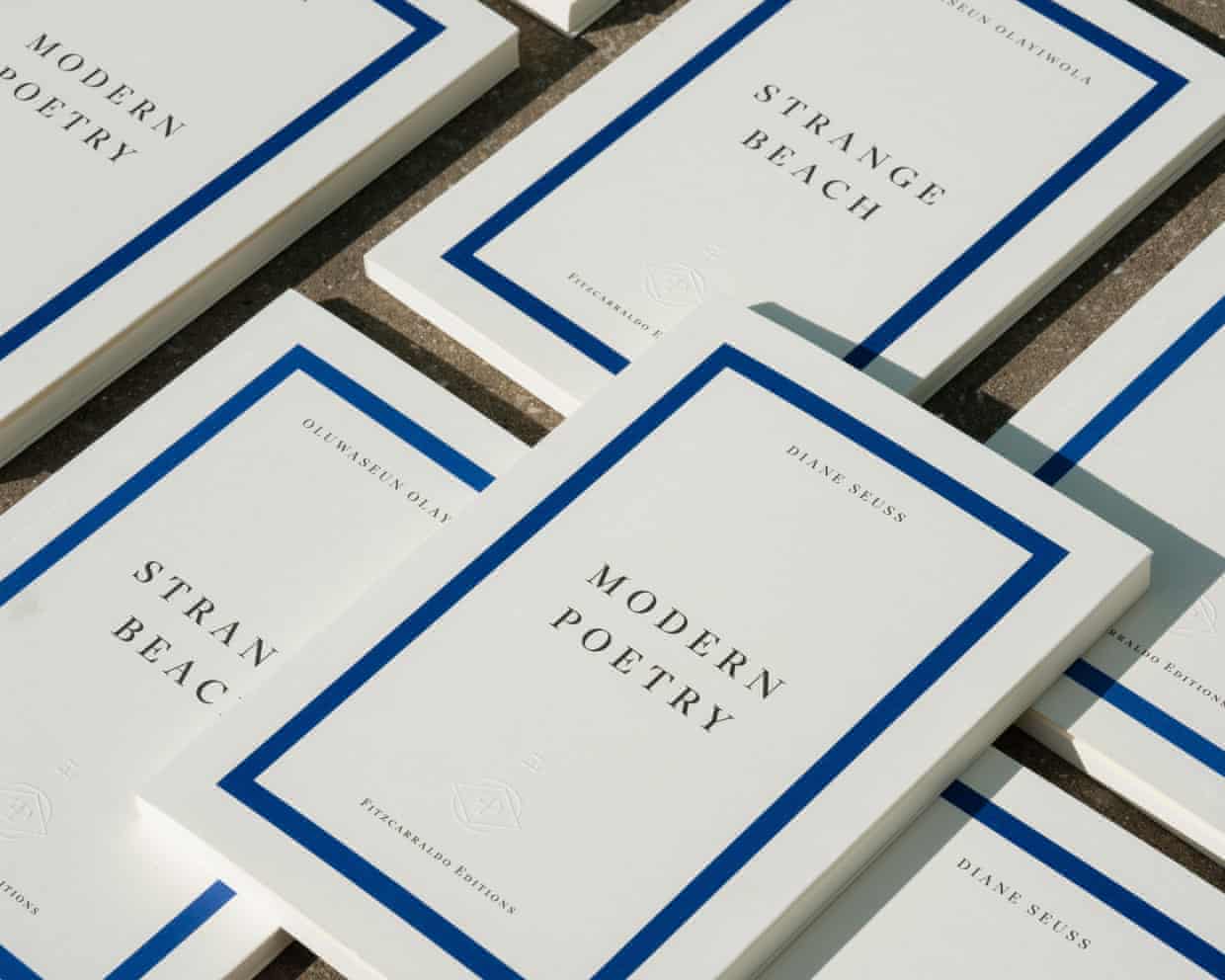
Photo: Fitzcarraldo Editions.
Three publishing companies have launched the biennial Poetry in Translation prize, which will award an advance of $5,000 to be shared equally between poet and translator.

Anyone who has used Google Translate for a simple sentence knows that AI is not going to be doing quality translations of whole books anytime soon. There is too much subtlety needed.

And if that’s true for, say, a murder mystery, imagine how important a human translator is for poetry!

That’s why a new prize for poetry translation from publishers in the UK, Australia, and the US is arriving just in time — before the world gets lulled into thinking an AI translation is just fine.

Ella Creamer reports at the Guardian, “A new poetry prize for collections translated into English is opening for entries. …

“Publishers Fitzcarraldo Editions, Giramondo Publishing and New Directions have launched the biennial Poetry in Translation prize, which will award an advance of $5,000 (£3,700) to be shared equally between poet and translator.

“The winning collection will be published in the UK and Ireland by Fitzcarraldo Editions, in Australia and New Zealand by Giramondo and in North America by New Directions.

“ ‘We wanted to open our doors to new poetry in translation to give space and gain exposure to poetries we may not be aware of,’ said Fitzcarraldo poetry editor Rachael Allen. …

“The prize announcement comes amid a sales boom in translated fiction in the UK. Joely Day, Allen’s co-editor at Fitzcarraldo, believes that ‘the space the work of translators has opened up in the reading lives of English speakers through the success of fiction in translation will also extend to poetry.’ …

“Fitzcarraldo has published translated works by Nobel prize winners Olga Tokarczuk, Jon Fosse and Annie Ernaux. ‘Our prose lists have always maintained a roughly equitable balance between English-language and translation, and some of our greatest successes have been books in translation,’ said Day. ‘We’d like to bring the same diversity of voices to our poetry publishing.’ …

“The prize is open to living poets from around the world, writing in any language other than English.

“The prize is being launched to find works ‘which are formally innovative, which feel new, which have a strong and distinctive voice, which surprise and energize and move us,’ said Day. ‘My personal hope is that the prize reaches fledgling or aspiring translators and provides an opening for them.’ …

“Submissions will be open from 15 July to 15 August. A shortlist will be announced later this year, with the winner announced in January 2026 and publication of the winning collection scheduled for 2027.

“The ‘unique’ award ‘brings poetry from around the world into English, and foregrounds the essential role of translation in our literature,’ said Nick Tapper, associate publisher at Giramondo. ‘Its global outlook will bring new readers to poets whose work deserves wide and sustained attention.’ ”

More at the Guardian, here. I hope a certain blogger who translates Vietnamese poetry into English will apply for that prize.

Read Full Post »

Photo: MinnPost.
Cynthia Tu of Sahan Journal is using Chat GPT to improve revenue streams.

A few times in the past, I’ve had reason to link to a story at Sahan Journal, a nonprofit newsroom serving immigrants and communities of color in Minnesota. Now NiemanLab, a website about journalism, links to an article on a surprising development at the small publisher.

Lev Gringauz, reporting at MinnPost via NiemanLab, writes “As journalists around the world experiment with artificial intelligence, many newsrooms have common, often audience-facing, ideas for what to try.

“They range from letting readers talk to chatbots trained on reporting, to turning written stories into audio, creating story summaries and, infamously, generating entire articles using AI — a use case vehemently rejected by many journalists.

“But Sahan Journal, the nonprofit newsroom serving immigrants and communities of color in Minnesota, wanted to try something different.

“ ‘We’re less enthusiastic, more skeptical, about using AI to generate editorial content,’ said Cynthia Tu, Sahan Journal’s data journalist and AI specialist.

“Instead, the outlet has been working on ways to support internal workflows with AI. Now, it’s even testing a custom ChatGPT bot to help pitch Sahan Journal to prospective advertisers and sponsors. …

“While AI has plenty of ethical and technical issues, Tu’s work highlights another important aspect: The intended users — in this case, the Sahan Journal team.

“ ‘A lot of … this experiment is less of a technical challenge,’ Tu said. ‘It’s more like, how do you make [AI] fit in the human system more flawlessly? And how do you train the human to use this tool in a way that it was intended?’

Sahan Journal’s AI experimentation, and Tu’s job, are supported by a partnership between the American Journalism Project, a national nonprofit helping local newsrooms, and ChatGPT creator OpenAI. …

Liam Andrew, technology lead for the AJP’s Project & AI Studio, sees part of his job as helping newsrooms overcome hesitancy around AI. …

“Tu joined Sahan Journal fresh from a Columbia Journalism School master’s program in data journalism. She had played a little with chatbots, but otherwise didn’t have much experience working with AI. …

“For one investigation, Tu used a Google AI tool to process the financial data of charter schools in Minnesota. Thinking about how to save time on backend workflows, Tu then helped Sahan Journal generate story summaries, tailored for Instagram carousels, with ChatGPT. …

“ ‘You need to know what the workflow of the organization looks like…[and how] you push for change within a department when they’ve already been doing [something] for the past five years using a manual or human labor way.’

“That knowledge came in handy when finally tackling Tu’s core AI project: improving Sahan Journal’s revenue.

“The project stemmed from an anonymized database of audience insights, which included demographic information and interests. While an important resource, Sahan Journal’s small revenue team didn’t have the time to figure out how to leverage it. …

” ‘What if AI could feed two birds with one scone? A custom ChatGPT bot could process the audience data and personalize a media kit for clients. But it needed to work without being an extra burden on the revenue staff. …

“The magic of AI chatbots like ChatGPT is that you don’t need to know how to code to use them. Just type in a prompt and get rolling. …

“Less magically, AI chatbots can be hard to keep in line for specific tasks. Designed to be eager helpers, they hallucinate false results and stubbornly twist instructions in an attempt to please.

“Troubleshooting those issues was no simple task for Tu.

“The custom revenue chatbot struggled to keep Tu’s preferred formatting, and hallucinated audience data. The bot would also intermix results from the internet that Tu had not asked for. None of that was ideal for a tool that should work reliably for the revenue team.

“ ‘I was kind of jumping through hoops and telling it multiple times, “Please do not reference anything else on the internet,” ‘ Tu said. …

“Working with chatbots is an exercise in prompt engineering — mostly a trial-and-error process of figuring out what specific instructions will get the preferred result. As Tu said, ‘lazy questions lead to lazy answers.’ … Eventually, Tu settled on a reliable set of prompts.

“The custom chatbot takes about 20 seconds to find relevant data from the audience database — for example, pulling up how much of Sahan Journal’s audience cares about public transportation. Then it creates a summary for a media kit tailored to potential clients.

“The chatbot also double-checks its work by referencing the database again, making sure its output matches reality. And part of the database is shown for users to manually see the chatbot isn’t hallucinating. …

“Earlier this year, Tu introduced the final version of the revenue bot to Sahan Journal’s team. …

“By mid-April, the Sahan Journal revenue team had used the custom chatbot on six sales pitches, with three successfully leading to ads placed on the site. …

“But there’s a larger question hanging over this work: Is it sustainable? In a way, newsroom experiments with AI exist in a bubble.

“ ‘Everything is kind of tied to a grant,’ Tu said, referencing the AJP-OpenAI partnership that supports her work. But grants come and go as donor interests (and financials) change.”

The other unknowns are weighed at NiemanLabs, here.

Read Full Post »

The Duolingo bird can be very encouraging to a language learner. But it can also get angry.

With Suzanne’s family leaving soon for six months in Stockholm, I’ve been trying to learn some Swedish. I hope to try it on my grandchildren come next January. So it’s daily Duolingo for me. If I ever get to the point where I can understand Erik when he uses Swedish with the kids, I might also try expanding my French. I like the way the silly Duolingo bird cheers me on.

I was surprised to learn how many new languages the app has been adding lately. In the beginning, it didn’t even have Swedish. Now, according to an article in the Verge, it’s adding things like Maori, Tagalog, Haitian Creole, and isiZulu.

Jay Peters reports, “Duolingo is ‘more than doubling’ the number of courses it has available, a feat it says was only possible because it used generative AI to help create them in ‘less than a year.’

“The company [said] that it’s launching 148 new language courses. ‘This launch makes Duolingo’s seven most popular non-English languages – Spanish, French, German, Italian, Japanese, Korean, and Mandarin – available to all 28 supported user interface (UI) languages,’ dramatically expanding learning options for over a billion potential learners worldwide’ … the company writes.

“Duolingo says that building one new course historically has taken ‘years,’ but the company was able to build this new suite of courses more quickly ‘through advances in generative AI, shared content systems, and internal tooling.’ The new approach is internally called ‘shared content,’ and the company says it allows employees to make a base course and quickly customize it. …

“ ‘Now, by using generative AI to create and validate content, we’re able to focus our expertise where it’s most impactful, ensuring every course meets Duolingo’s rigorous quality standards,’ Duolingo’s senior director of learning design, Jessie Becker, says in a statement.

“The announcement follows a recent memo sent by cofounder and CEO Luis von Ahn to staff saying that … it would ‘gradually stop using contractors to do work that AI can handle.’ AI use will now be evaluated during the hiring process and as part of performance reviews, and von Ahn says that ‘headcount will only be given if a team cannot automate more of their work.’

“Spokesperson Sam Dalsimer tells The Verge in response to questions sent following von Ahn’s memo. ‘We’ve already been moving in this direction, and it has been game-changing for our company. One of the best decisions we made recently was replacing a slow, manual content creation process with one powered by AI, under the direction of our learning design experts. That shift allowed us to create and launch 148 new language courses today.’ …

“Dalsimer acknowledges that there have been ‘negative reactions’ to von Ahn’s memo. Dalsimer also notes that Duolingo has ‘no intention to reduce full-time headcount or hiring’ and that ‘any changes to contractor staffing will be considered on a case-by-case basis.’ “

Hmm. That is giving me pause. But I do like the app and the way that for English-speaking students like me, Duolingo starts out with some vocabulary that sounds like English. It makes me wonder if it does the same for learners who come from other languages. That could be really tricky.

Have you used Duolingo? I know that blogger Asakiyume, a mega language learner, used Duolingo to add Spanish and Portuguese to what she already knew in Japanese and more obscure languages. One thing I know for sure: she won’t like that Duolingo contractors will lose jobs thanks to AI.

More at the Verge, here.

Read Full Post »

Photo: Everett Collection.
A de-aged version of actors Tom Hanks and Robin Wright, created by artificial intelligence for the 2024 film Here.

We are well into the age of AI, and I certainly hope that doesn’t mean we’re going to realize the dire warnings of one of its pioneers but just use it in relatively harmless ways.

Today’s story is about using AI to “de-age” actors in a movie covering 60 years.

Benj Edwards writes at Wired, “Here, a $50 million Robert Zemeckis–directed film [used] real-time generative AI face transformation techniques to portray actors Tom Hanks and Robin Wright across a 60-year span, marking one of Hollywood’s first full-length features built around AI-powered visual effects.

“The film adapts a 2014 graphic novel set primarily in a New Jersey living room across multiple time periods. Rather than cast different actors for various ages, the production used AI to modify Hanks’s and Wright’s appearances throughout.

“The de-aging technology comes from Metaphysic, a visual effects company that creates real time face swapping and aging effects. During filming, the crew watched two monitors simultaneously: one showing the actors’ actual appearances and another displaying them at whatever age the scene required.

“Metaphysic developed the facial modification system by training custom machine-learning models on frames of Hanks’ and Wright’s previous films. This included a large dataset of facial movements, skin textures, and appearances under varied lighting conditions and camera angles. …

“Unlike previous aging effects that relied on frame-by-frame manipulation, Metaphysic’s approach generates transformations instantly by analyzing facial landmarks and mapping them to trained age variations. … Traditional visual effects for this level of face modification would reportedly require hundreds of artists and a substantially larger budget closer to standard Marvel movie costs.

“This isn’t the first film that has used AI techniques to de-age actors. ILM’s approach to de-aging Harrison Ford in 2023’s Indiana Jones and the Dial of Destiny used a proprietary system called Flux with infrared cameras to capture facial data during filming, then old images of Ford to de-age him in postproduction. By contrast, Metaphysic’s AI models process transformations without additional hardware and show results during filming. …

“Meanwhile, as we saw with the SAG-AFTRA union strike [in 2023], Hollywood studios and unions continue to hotly debate AI’s role in filmmaking. While the Screen Actors Guild and Writers Guild secured some AI limitations in recent contracts, many industry veterans see the technology as inevitable. …

“Even so, the New York Times says that Metaphysic’s technology has already found use in two other 2024 releases. Furiosa: A Mad Max Saga employed it to re-create deceased actor Richard Carter’s character, while Alien: Romulus brought back Ian Holm’s android character from the 1979 original. Both implementations required estate approval under new California legislation governing AI recreations of performers, often called deepfakes. …

“Robert Downey Jr. recently said in an interview that he would instruct his estate to sue anyone attempting to digitally bring him back from the dead for another film appearance. But even with controversies, Hollywood still seems to find a way to make death-defying (and age-defying) visual feats take place onscreen — especially if there is enough money involved.”

What could go wrong?

The first thing I think of is fewer job opportunities for actors who play younger versions of stars. Still, I’d love to see an AI child version of the actress who plays Astrid in the French crime show of the same name, because I think it would look more natural than the mimicking girl they’ve got. (Awesome tv, by the way. Check it out on PBS Passport.)

More at Wired, here. This story originally appeared on Ars Technica.

Read Full Post »

Photo: TiVa.
Installation of the fish counter at Gamla Stan in Slussen. The new fish highway in Stockholm has some of the first fish passages between the Baltic Sea and Lake Mälaren at Söderström in nearly 400 years.

Today’s story is about how Sweden is giving a helping hand to migrating fish that are not strong swimmers.

TiVa, an AI-powered fish-counting company, reports, “In mid-2024, a TiVA FC was installed in connection to the newly built fish migration path at Slussen in Stockholm. This long-awaited passage allows fish to freely migrate between Lake Mälaren and Saltsjön at Söderström for the first time in almost 400 years. As part of the reconstruction of Slussen, a new fish migration path has been constructed under the northern sluice quay on the side of Gamla Stan. The old Nils Ericson sluice has been converted into a passage to facilitate the free movement of weak-swimming species such as eel, roach, and perch – species that were previously hindered by human infrastructure.

The TiVA FC fish counter delivers [improved] results, both in image quality and AI-based species and length classification. … The TiVA FC at Slussen is connected to our cloud platform fiskdata.se. Here, data is available for both the client and, in this case, for the public. … The City of Stockholm has chosen to broadcast a live stream via TiVA’s YouTube channel. Shorter streams can also be broadcasted to other platforms, like Facebook, depending on the client’s needs.

“The City of Stockholm will install an informational screen for ‘Fish TV’ on the crane structure by the fish counter. Passersby in Gamla Stan will be able to learn more about the project, see selected videos, and get updates on the latest migrations.” More at the TiVa website, here.

And from Stockholm’s website: “You can watch online the fish swimming between Lake Mälaren and Saltsjön [at fiskdata.se].

“Moving between different areas is a natural part of life for many fish species. They migrate from their breeding grounds to spawning grounds to reproduce. When humans have blocked various watercourses, this has prevented fish species from passing through. To protect the fish and promote the environment, watercourses can be restored, or, as here at Slussen, a fish migration route can be opened up.

“The primary purpose of the fish migration route is to enable passage between Lake Mälaren and Saltsjön for [fish] that do not jump, which is basically all species except salmon and sea trout. By building this route, we hope that species such as eel, roach and perch will once again be able to pass here.

“The trail is designed by experts to mimic as natural an environment as possible. Stones of various sizes have been carefully placed along the trail. Some of the stones come from Gustav Vasa’s 16th-century defensive wall, which was found during the excavations of Södermalmstorg in 2022. The water flow needs to be calm so that the fish can stop and rest. There is lighting here so that the fish can swim in pleasant light.

“The fish walking trail is located under the quay on the Old Town side and is not visible from the outside. But you can watch the fish swimming through at fiskdata.se.” More here.

Looking for comments — from Swedes and fish lovers everywhere.

Read Full Post »

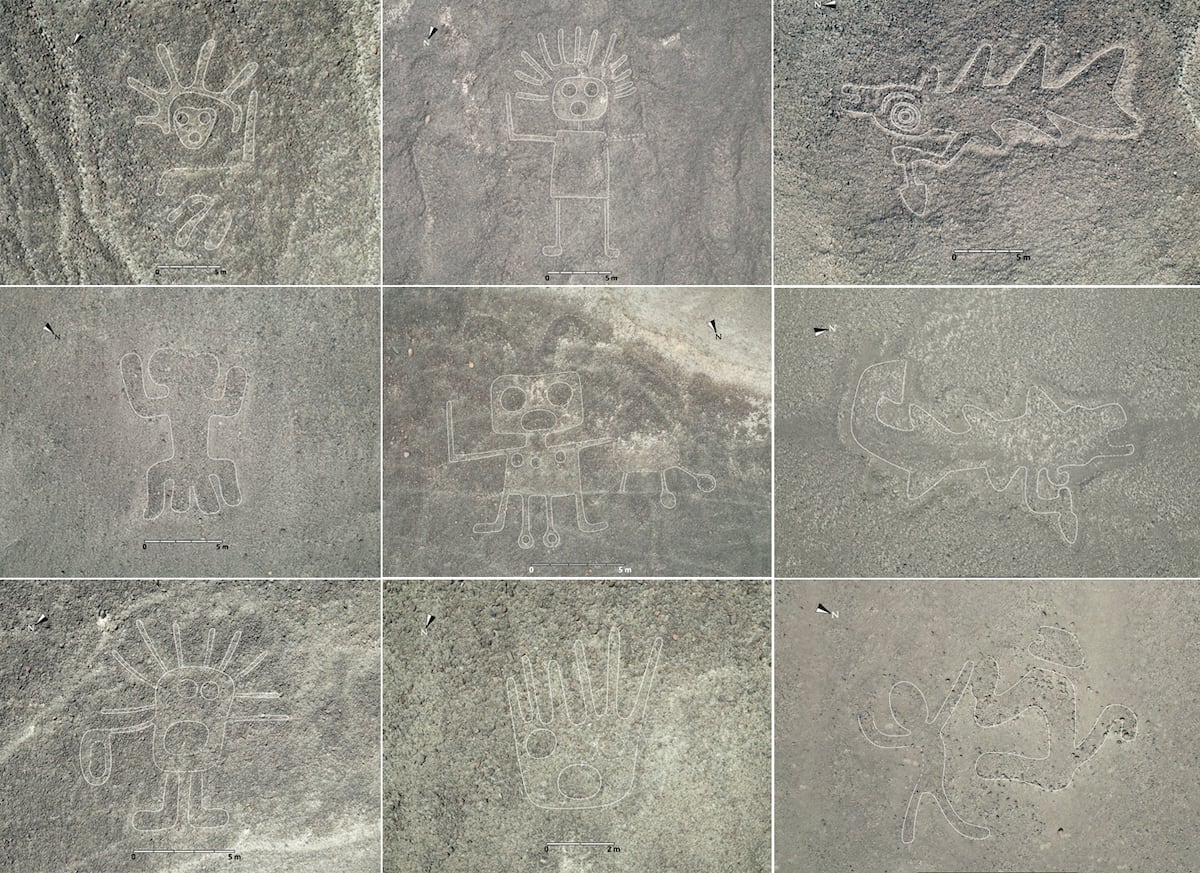
Photo: Instituto Universitario Yamagata de Nazca.
Some of the new geoglyphs found in Nazca. With their lines eroded by the passage of time, AI has achieved in months what used to take decades.

Let’s have kind word for scary old artificial intelligence and how it has, for example, helped to uncover 303 new geoglyphs in the Nazca desert. (By which I don’t mean to say AI doesn’t have serious potential dangers.)

In an El País archaeological article from Peru, Miguel Ángel Criado reports, “With the help of an artificial intelligence (AI) system, a group of archaeologists has uncovered in just a few months almost as many geoglyphs in the Nazca Desert (Peru) as those found in all of the last century. The large number of new figures has allowed the researchers to differentiate between two main types, and to offer an explanation of the possible reasons or functions that led their creators to draw them on the ground more than 2,000 years ago.

“The Nazca desert, with an area of about 1,900 square miles and an average altitude of 500 meters above sea level, has very special climatic conditions. It hardly ever rains, the hot air blocks the wind and the dry land has prevented the development of agriculture or livestock. Combined, all this has allowed a series of lines and figures, formed by stacking and aligning pebbles and stones, to be preserved for centuries

“The first layer of soil is made up of a blanket of small reddish stones that, when lifted, reveal a second yellowish layer. This difference in color is the basis of the geoglyphs and is what was used to create them by the ancient Nazca civilization. Some are straight lines stretching several miles. Others are geometric shapes or rectilinear figures, also huge in size.

“The other major category includes the so-called relief-type geoglyphs, which are smaller. In the 1930s, Peruvian aviators discovered the first ones, and by the end of the century more than a hundred had been identified, such as the hummingbird, the frog and the whale. Since 2004, supported by high-resolution satellite images, Japanese archaeologists have discovered 318 more, almost all of them high-profile geoglyphs. The same team, led by Masato Sakai, a scientist from Yamagata University (Japan), has discovered 303 new geoglyphs in a single campaign, supported by artificial intelligence. …

“ ‘The Nazca Pampa is a vast area covering more than 400 square kilometres and no exhaustive study has been carried out,’ the Japanese scientist recalls. Only the northern part, where the large linear geoglyphs are concentrated, ‘has been studied relatively intensively.’ … But scattered throughout the rest of the desert are many relief-type figures that are smaller and that the passage of time has made more difficult to detect.

“Convinced that there were many more, Sakai and his team contacted IBM’s artificial intelligence division. … They had high-resolution images obtained from airplanes or satellites of all of Nazca, but with a resolution of up to a few centimeters per pixel, the human eye would have needed years, if not decades, to analyze all the data. They left that job to the AI system. Although it was not easy to train its artificial vision … with so few previous images and so different from each other, the machine proposed 1,309 candidates. The figure came from a previous selection also made by the AI with 36 images for each candidate. With this selection, the researchers carried out a field expedition between September 2022 and February 2023. The result, as reported in the scientific journal PNAS, is 303 new geoglyphs added to this cultural heritage of humanity. All are relief-type geoglyphs.

“The newly discovered shapes bring the total number found in Nazca to 50 line-type and 683 relief-type geoglyphs, some geometric and others forming figures. The large amount has allowed the authors of this work to detect patterns and differences. Almost all of the former (the monkey, the condor, the cactus…) represent wild animals or plants. However, among the latter, almost 82% show human elements or elements modified by humans. ‘[There] are scenes of human sacrifice,’ says Sakai. …

“The accumulation of data that has made this work possible brings to light a double connection. On the one hand, these relief-type forms are found a few meters from one of the many paths that cross the desert … paths created by the passage of people until a path is created. According to the authors of the study, these creations were made to be seen by travelers.

“On the other hand, the large linear figures appear very close, also meters away, from one of the many straight lines that cut through the pampas. Here, according to Sakai, the symbolic value rules: ‘The line-type geoglyphs are drawn at the start and end points of the pilgrimage route to the Cahuachi ceremonial center. They were ceremonial spaces with shapes of animals and other figures. Meanwhile, the relief-type geoglyphs can be observed when walking along the paths.’

“Cahuachi was the seat of spiritual power of the Nazca culture between from around 100 BC to 500 AD and, for the authors, the large forms could be ceremonial stops on the pilgrimage to or from there.

“These explanations do not necessarily rule out, according to the authors, other possible functions that have been attributed to the Nazca lines and figures, such as being calendars, astronomical maps or even systems for capturing the little water that fell.”

Things do get fuzzy when we start to interpret ancient signs. Read more at El Pais, here. No firewall.

Read Full Post »

Image: CNN.
When you see phrases like “intricate interplay,” a concept I illustrate with this CNN image, suspect AI. There are lots of other common usages to be alert to.

Hello, Word People. That is, People Who Are Fascinated by Words. When you do online searches in the future, will you know what words and phrases may indicate AI behind the scenes? Kyle Orlando has some answers at Ars Technica.

“Thus far, even AI companies have had trouble coming up with tools that can reliably detect when a piece of writing was generated using a large language model [LLM]. Now, a group of researchers has established a novel method for estimating LLM usage across a large set of scientific writing by measuring which ‘excess words’ started showing up much more frequently during the LLM era (i.e., 2023 and 2024). The results ‘suggest that at least 10 percent of 2024 abstracts were processed with LLMs,’ according to the researchers.

“In a preprint paper posted earlier this month, four researchers from Germany’s University of Tübingen and Northwestern University said they were inspired by studies that measured the impact of the Covid-19 pandemic by looking at excess deaths compared to the recent past. By taking a similar look at ‘excess word usage’ after LLM writing tools became widely available in late 2022, the researchers found that ‘the appearance of LLMs led to an abrupt increase in the frequency of certain style words’ that was ‘unprecedented in both quality and quantity.’

“To measure these vocabulary changes, the researchers analyzed 14 million paper abstracts published on PubMed between 2010 and 2024, tracking the relative frequency of each word as it appeared across each year. They then compared the expected frequency of those words (based on the pre-2023 trend line) to the actual frequency of those words in abstracts from 2023 and 2024, when LLMs were in widespread use.

“The results found a number of words that were extremely uncommon in these scientific abstracts before 2023 that suddenly surged in popularity after LLMs were introduced. The word ‘delves,’ for instance, shows up in 25 times as many 2024 papers as the pre-LLM trend would expect; words like ‘showcasing’ and ‘underscores’ increased in usage by nine times as well. Other previously common words became notably more common in post-LLM abstracts: The frequency of ‘potential’ increased by 4.1 percentage points, ‘findings’ by 2.7 percentage points, and ‘crucial’ by 2.6 percentage points, for instance.

These kinds of changes in word use could happen independently of LLM usage, of course — the natural evolution of language means words sometimes go in and out of style.

“However, the researchers found that, in the pre-LLM era, such massive and sudden year-over-year increases were only seen for words related to major world health events. …

“In the post-LLM period, though, the researchers found hundreds of words with sudden, pronounced increases in scientific usage that had no common link to world events. … The words with a post-LLM frequency bump were overwhelmingly ‘style words’ like verbs, adjectives, and adverbs (a small sampling: ‘across, additionally, comprehensive, crucial, enhancing, exhibited, insights, notably, particularly, within’). …

“The pre-2023 set of abstracts acts as its own effective control group to show how vocabulary choice has changed overall in the post-LLM era.

“By highlighting hundreds of so-called ‘marker words’ that became significantly more common in the post-LLM era, the telltale signs of LLM use can sometimes be easy to pick out. Take this example abstract line called out by the researchers, with the marker words highlighted: ‘A comprehensive grasp of the intricate interplay between […] and […] is pivotal for effective therapeutic strategies.’

“After doing some statistical measures of marker word appearance across individual papers, the researchers estimate that at least 10 percent of the post-2022 papers in the PubMed corpus were written with at least some LLM assistance. The number could be even higher, the researchers say, because their set could be missing LLM-assisted abstracts that don’t include any of the marker words they identified. …

“Papers authored in countries like China, South Korea, and Taiwan showed LLM marker words 15 percent of the time, suggesting ‘LLMs might … help non-natives with editing English texts, which could justify their extensive use.’ On the other hand, the researchers offer that native English speakers ‘may [just] be better at noticing and actively removing unnatural style words from LLM outputs,’ thus hiding their LLM usage from this kind of analysis.”

More at Ars Technica via Wired, here.

Read Full Post »

Older Posts »