Feeds:
Posts
Comments

Archive for the ‘Uncategorized’ Category

image

Photo: Susie Armitage for Atlas Obscura
The line for Stolovaya 57, a Soviet-style cafeteria in a Moscow mall, shows the power of nostalgia and tight household budgets.

It’s funny how one can sometimes feel nostalgic for times that really were not great. There was privation and cruel lack of freedom in the old USSR, for example, but especially if a person was young then, there are aspects of that time that are missed. In this story, Russians miss the food they once enjoyed — or imagine they enjoyed — in Soviet cafeterias.

Susie Armitage writes at Atlas Obscura, “On a recent afternoon in Moscow, a line of hungry people stretched across the third floor of GUM, a stately 19th-century shopping arcade turned modern luxury mall overlooking Red Square.

“As the crowd waited to get into Stolovaya 57, a self-service cafe modeled on a Soviet workers’ canteen, a young woman snapped photos of the faux propaganda posters in the entryway. Inside, customers loaded their trays with fruity kissel, fuschia ‘fur coat’ salad, and jellied pork. On the hot food line, a woman in a white uniform dished out mashed potatoes, Chicken Kiev, and stuffed cabbage and curtly called out, ‘Next order, please!’ Murky jars of canned vegetables sat on shelves overhead. An abacus, like the kind used by Soviet shopkeepers, stood next to one of the cash registers. …

“As I stood in line with Pavel Syutkin, a culinary historian who co-authored CCCP COOK BOOK: True Stories of Soviet Cuisine with his wife, Olga Syutkin, he told me the long wait was just another period touch.

‘When you go step by step, 20 minutes, half an hour, you really get an effect of being inside the Soviet past,’ he said, recalling the anticipation that made the food taste better when he lived in Cold War-era Russia.

“I asked Syutkin why, in 2019, a mostly Russian crowd would wait this long for a bowl of borscht served with a heavy dollop of Soviet kitsch. He explained that Stolovaya 57 is one of the cheapest places to eat near Red Square …

“Aside from the prime location, Stolovaya 57’s popularity may have something to do with its name. Whether they’re from Moscow or a remote part of Siberia, Russians have a shared understanding of the word stolovaya, which means ‘dining hall’ or ‘cafeteria.’ Due to the Soviet legacy of public canteens, it’s shorthand for an affordable, filling, and predictable meal. …

“According to Anya Von Bremzen, author of Mastering the Art of Soviet Cooking, while a handful of these early canteens had genteel touches such as fresh flowers and live music, many were plagued by rats and served awful food. The cafeteria in the Kremlin was so bad that Lenin ordered multiple investigations. As it turned out, in addition to struggling with food shortages, the nascent Soviet state had replaced many professional chefs with ideologically pure but untrained ones. …

“While the dishes in any Soviet cafeteria were supposed to be identical, in practice the quality varied widely. A large stolovaya in Moscow or Leningrad (now St. Petersburg) typically served far better food than the canteens in smaller towns. …

“Lackluster food wasn’t necessarily the fault of individual chefs, who had to make do with whatever ingredients the state provided. The Soviet food supply system routed the best stuff to high-level officials and larger state enterprises. ‘Access to good products was a symbol of your place in the social hierarchy,’ Syutkin said. …

“In 1959, Soviet leader Nikita Khrushchev signed a resolution to make the system of public food service ‘more massive, comfortable, and favorable.’ … A publication called The Female Worker documented cafeterias with great interest, lauding a particular dining hall in the Byelorussian Soviet Socialist Republic (now Belarus) for its ingenuity in using kitchen scraps to raise its own pigs. …

“However, nostalgia isn’t the only thing motivating people to wait half an hour for plates of pickled herring. My 31-year-old friend Victor [points out] that many of his peers are on tight budgets. Russia’s economy has been sluggish in recent years, and paychecks still don’t go as far as they used to.” More here.

Photo: Universal History Archive/UIG via Getty Images
Women factory workers eating in a Soviet Union lunchroom in 1928.

image-1

Read Full Post »

refugee-moo-paw-with-vegetables
Photo: Sean Powers
Karen refugee Moo Paw shows the vegetables she’s grown at the Neighbor’s Field in North Carolina.

I’m always interested in what Karen refugees from Myanmar (Burma) are doing as they adjust to new lives in the United States — especially as I know Mia, a Karen woman in one of the Rhode Island English classes where I volunteer.

At the radio show Living on Earth (LOE), there’s an interesting Karen farming story from producer Sean Powers of Georgia Public Broadcasting and the Bitter Southerner podcast.

“BOBBY BASCOMB [LOE managing producer]: The United States has long been a place for political refugees to seek safety and put down roots, in some cases literally. In Comer, Georgia, a community garden called the Neighbor’s Field is helping refugees work through their trauma by working the land. …

“POWERS: It’s a hot Saturday afternoon in Comer, Georgia. Moo Paw is feeding her chickens, hens, goats, and ducks. There’s even a donkey. You could say they’re kind of like her babies. She is one of the many refugees at the Neighbor’s Field, who fled violence and persecution in Myanmar. That’s the country formerly known as Burma. …

“She says Burmese soldiers kidnapped her father, and used him as a porter to carry food for them. After leaving Myanmar, Moo Paw lived in a refugee camp in Thailand before moving to the United States with her husband and children. They relocated to the Atlanta area, before settling here in Comer. Her son, Tahay Than, says moving to Comer was to satisfy Moo Paw’s green thumb.

“TAHAY: My mom, where she lived in Burma or Thailand, she always liked to plant. You know, working the farm. So, when she farms, that makes her feel like she is home or something, like in a home country, mother country or something. So that’s why she moved to Comer. …

“PAW: My garden. Here vegetables. Here grass. Me planted the cucumbers this year. Here sweet potato. Very beautiful.

“POWERS: It’s that beauty that takes Moo Paw back to memories of her family. She and her son Tahay say in Myanmar, farming for their family was a way of life.

“PAW: My grandmother planted rice, peanuts. Chili, corn.

“TAHAY: Most of the time, everybody who lived in Burma, they would plant in order to survive.

“POWERS: And that makes this garden all the more meaningful. The vegetables growing here, they don’t look like your typical produce that you would find at most supermarkets in the United States. That’s because the seeds come from Myanmar and Thailand. …

“POWERS: The flavors growing in Moo Paw’s soil are just a small part of the pie. There are two-dozen plots of land at the Neighbor’s Field that are being rented by refugees from Myanmar. For a large plot, it’s a hundred dollars a year. Rebecca Smith [who versees the day-to-day operations at the Neighbor’s Field], says it’s been incredible to see how working the farm helps build community. …

“SMITH: They’re just amazing foragers, they can figure out how to cook everything and make it taste good, and it’s just stuff that we think are weeds. Like sometimes people will be out here just butchering a pig for a celebration or Moo Paw’s out here feeding her chickens and people in the garden and you just feel like you’re in a different world, not Comer, Georgia.”

More at Living on Earth, here. In North Carolina, too, there are Karen refugees working on farms. Read this at Transplanting Traditions.

Read Full Post »

img_5840_slide-ff1c3b28ab10fe2abcf7dd215aafd3846b326aee-s700-c85

Photo: Chris Livesay for NPR
A security guard blocks off the recording area outside the Violin Museum in Cremona, Italy, for a project to preserve every note of the Stradivarius violin.

When a whole town — or almost a whole town — gets on board to support an artistic project, the results can be impressive. I imagine that the key is to tap what matters to people. In this case, violins.

Christopher Livesay reported about the unusual preservation project at National Public Radio (NPR) in February.

“Inside the concert hall of the Violin Museum in Cremona, Italy, Antonio de Lorenzi plays the prelude from Bach’s Partita No. 3 on a Stradivarius violin. Cremona is the town where master luthier Antonio Stradivari crafted his storied instruments three centuries ago.

“But there’s no guarantee that his instrument’s inimitable sound will survive for centuries more, says Fausto Cacciatori, the museum’s chief conservator.

” ‘What will these instruments sound like in 200 years? I hope they can still be played,’ he says. ‘But you never know. All it takes is one unfortunate event. An earthquake, for instance. Think about what happened to so much art during World War II.’

“Cacciatori says Stradivarius instruments need a 21st century failsafe — and someone who understands music as well as technology to pull it off. Enter deejay Leonardo Tedeschi. …

“When he’s not spinning records, Tedeschi runs Audiozone, a northern Italian sound engineering firm. And he had an idea: ‘To bring the sound of Stradivari and make it accessible around the world,’ he says.

“The idea came to him in 2014, when he wanted to mix the analog sounds of Stradivarius violins in some of his own electronic recordings, but discovered the elements he needed were lacking. That’s when he reached out to the Violin Museum in Cremona, just a 45-minute drive from his native Piacenza, with a proposal.

“First, they would need to record Stradivarius instruments, and while they were at it, those of other master luthiers. Then they would have to save the recordings in a database that future composers could use to make their own music electronically.

“The Violin Museum, which was already concerned about preserving these sounds for future generations, agreed. … They would have to painstakingly record every possible note that can be played on each instrument.

” ‘Every possible note, and even more difficult, every note transition,’ explains Tedeschi. ‘From one note to all the other ones in the same string.’ …

“In the concert hall, Lorenzi, who is with the Italian Symphony Orchestra and has performed in the world’s top concert halls, plucks the notes C, D, E, F, G, A, B and C — ‘do, re, mi, fa, sol, la, ti, do’ — on the Stradivarius violin. Then down the scale, until the engineers say they’ve got it. …

“He says, ‘It takes a lot of mental and physical concentration. It’s one of the most demanding things I’ve ever done.’

“But that meditative concentration is hard-won. Outside the museum, Tedeschi points out the thorn in his side.

“A rumble passes as a woman drags a suitcase across cobblestones. Then, the hiss of a street-sweeper machine. It’s what you’d expect in a city of 70,000 people, with a bustling open-air market and a population of typically boisterous Italians. …

” ‘Every time we hear this sound, the sound will mix with the frequency of our instruments, so we cannot use that sound in our product,’ Tedeschi laments.

“At the end of December, just before recording was set to begin, he went to the mayor of Cremona, Gianluca Galimberti, and asked for help. … The mayor asked the people of Cremona to please keep it down, and blocked traffic around the concert hall during recordings from Jan. 7 to Feb. 9.”

Did it work? Read more here.

Read Full Post »

img_6977_custom-cc736ababb2851142350b8484394ed46b6ac9f94-s600-c85

Photo: Matthias Le Dall
Thanks in part to his original songwriting, singing, and guitar-playing, physics doctoral student Pramodh Senarath Yapa won this year’s “Dance Your PhD” contest.

This is such a creative idea: a “Dance Your Ph.D.” contest!

Just as almost any information can be compressed into a haiku, almost any abstract concept can be danced. That’s what my high school dance teacher said when she made us partner with classmates to choreograph scientific principles.  And when Page and I started to choreograph Lavoisier’s discovery of oxygen to the Firebird Suite, Miss Hinney reminded us that we had to give life to the concept, not do a historical reenactment. Hard but memorable.

That’s why I loved this story about dancing your PhD. Emma Bowman writes at National Public Radio (NPR), “Pramodh Senarath Yapa, a physicist currently pursuing his doctorate at the University of Alberta in Edmonton, Canada, has been named the 2018 winner of the ‘Dance Your PhD’ contest.

“The competition, sponsored by the American Association for the Advancement of Science (AAAS) and Science magazine, invites doctoral students and Ph.D. recipients to translate their research into an interpretive dance. The winner takes home $1,000.

“It took Senarath Yapa six weeks to choreograph and write the songs for ‘Superconductivity: The Musical!’ — a three-act swing dance depicting the social lives of electrons. The video is based on his master’s thesis, which he completed while pursuing his degree at the University of Victoria in Canada.

“The 11-minute sing-songy rendition is far less paralyzing than the jargony title of Senarath Yapa’s thesis alone: ‘Non-Local Electrodynamics of Superconducting Wires: Implications for Flux Noise and Inductance.’

” ‘Superconductivity relies on lone electrons pairing up when cooled below a certain temperature,’ Senarath Yapa told Science. ‘Once I began to think of electrons as unsociable people who suddenly become joyful once paired up, imagining them as dancers was a no-brainer!’ …

“John Bohannon, a former contributing correspondent for Science, founded the contest, now in its 11th year. It all started at a party one New Year’s Eve that was heavy on scientist attendees and light on the dancing. ‘I tapped into their competitive spirit,’ Bohannon tells NPR’s Scott Simon. …

” ‘I think in general, they’re exhibitionists. If you’re willing to stand up and defend some crazy obscure research topic that you’ve devoted your life to then there’s probably something in you that wants to dance.’ ”

More at NPR, here.

Read Full Post »

021619-grandson-tries-suminigashi-painting

The result of my grandson’s class in Japanese marbling technique. Suminagashi, or “ink-floating” on paper, has been around since the 12th century.

Not long ago, my older grandson’s class, which is studying Japan, went to the Boston Children’s Museum. The museum features an entire traditional home that was shipped from Japan years ago and rebuilt indoors.

While there, the 8-year-olds practiced an ancient painting technique, Japanese Suminagashi, which uses the unpredictable swirling of water to create one-of-a-kind images.

I love the idea of one-of-a-kind. Children are one-of-a-kind, too, all wonderful in their own way, and I like to hear about them getting a break from standardized-testing molds.

According to the website Beyond the Chalkboard, in which the Boston Children’s Museum helps teachers with enrichment activities, “Suminagashi, Japanese for ‘ink-floating,’ is a paper marbling technique that was practiced in Japan as early as the 12th century.  Creating these beautifully marbled pieces of paper encourages children to relax, focus and observe the changing swirls in front of them. …

“It is very important that everything used in this activity (the brushes, trays and jars) be as clean as possible. The trays or tubs you use should be at least 2 1/2” deep. Tupperware containers and some aluminum pie tins will work. Make sure that the paper you are using is smaller than the width and length of the trays.

“Fill each tray with 2 inches of room-temperature water, making sure to keep the water free of dust, oil or soap. Pour a small amount of sumi ink into each empty baby food jar, and have pairs of students share a jar.”

The instructions include advice on first discussing what swirls are and also what children already know about Japan.

Here are the instructions, in part.

“1. Make sure your hands and the water tray are CLEAN while you fill it with water. Keep the water and the papers free of dust, oil and soap.
“2. Find a steady place to lay your two brushes, wooden skewers or toothpicks.  Place one brush or skewer on the left side of the water tray and one on the right side.  Dip the left side brush or skewer into the ink.  If using a brush, you only need a little bit of ink!  The surface of the water will pull ink from the brush.  …
“3. Carefully touch the very tip of the inked brush or skewer just to the surface of the water in the middle of the tray.  …
“4. Lay down the inked brush and pick up the other brush (the un-inked one on the right side of the tray).  Touch the end of this brush or skewer either to the side of your nose (your nose has lots of oil on it), to a bar of soap, or (just barely) to the top of a detergent bottle.  Touch the tip of this oily or soapy brush/skewer to the water INSIDE THE DOT of ink (or the center of the tray, if you can’t see the ink yet).  You might see the ink that is floating on the surface of the water move away from where you touched. …
“5. Repeat, alternating between brushes, and always touch the brush tips in the middle of the ink circle on the surface of the water. You should soon see many concentric circles. Once you feel you have enough, you can gently blow across the surface of the water to start creating swirls. …
“6. When you like what you see on the water, pick up a piece of paper, holding it from the sides.  Bring the ends together a bit so the middle of the paper bends down toward the water — now you can lay the paper on the water, starting from the center and quickly laying down the sides and letting go. It may take some practice to get this to be a quick, smooth motion. …
“7. Now lift the paper off the water (if there seems to be a wash of ‘loose’ ink on the surface of the paper, try gently, quickly rinsing the paper under the faucet). The ink that actually printed will stay on the paper.
“8. Lay the your print on the newspaper to dry.”

More here and at Suminagashi.com. My grandson also alerted me to a Japanese anime called My Neighbor Totoro that he saw in school, and my husband and I got it from Netflix. We like Japanese animations.

Read Full Post »

042419-Luna-and-Stella-lockets-for-Mothers

I have two super kids, John and Suzanne, and I’m crazy about them both. But the reason that this blog is called suzannesmomsblog and not johnandsuzannesmomsblog is that it’s hosted by my daughter’s jewelry company, Luna & Stella. I really wouldn’t know what to write about if I blogged for John’s techy company, but at least I know a little about jewelry.

Lately, I’ve been interested in the idea that vintage necklaces, like the lockets that have been so popular at Luna & Stella, make for environmentally sound gift giving. After all, the mined materials are recycled.

Here’s how Suzanne puts it. “Antique and vintage jewelry is the most sustainable jewelry there is. No new mining + no new metal refining = zero environmental impact.

“Each piece comes with a century of history, and with a photo of your loved ones inside, an antique locket becomes an heirloom for a new generation.”

She adds, “We’ve got over 100 new locket arrivals coming for Mother’s Day. [And] we just added a new payment plan option — you can now pay over 4 interest-free installments. Just choose ‘Slice It’ at checkout.”

Write Suzanne at service@lunaandstella.com, and she will try to answer any questions you have about individual pieces. All one of a kind.

By the way, here is Suzanne herself in New York for a meeting at instagram, where if you follow her account, you can get previews of new arrivals. She’s wearing vintage lockets and the signature Luna & Stella moon and stars.

Photo: Vicky Vitello 

032819-Suzanne-Luna-and-Stella-NYC

Read Full Post »

mukhtar_20190213_frost_2

Photo: Evan Frost/MPR
Mukhtar Ibrahim gives a presentation about Sahan Journal at the Glen Nelson Center in Minneapolis.

When we lived in Minneapolis, we got to know a Somali-American who worked at our apartment building’s front desk and later ran for mayor. He was a friendly, curious man, who enlightened me a good bit about Islam and Africa. As a child in Somalia, he played soccer games interrupted by camels, and he loved to get news from around the world on the radio and then study the map to see where the news was happening.

Today the large immigrant community in his new country has a different way to get news.

Andrew Lapin reports at the Current, “Support from Minnesota Public Radio is enabling a website covering the state’s immigrant communities to expand into a full-time venture for its founder.

Sahan Journal is the brainchild of Mukhtar Ibrahim, who began his career as MPR’s first Somali-American reporter before joining the Minneapolis Star-Tribune. He has returned to MPR as a full-time network employee focusing exclusively on Sahan, with the network also providing a content-sharing agreement and other material support.

“Ibrahim said he wants Sahan to be ‘a one-stop shop for all things immigrant in Minnesota.’ …

“Ibrahim began the project in 2013 as a side venture, two years after earning his undergraduate degree from the University of Minnesota’s journalism school. The name ‘Sahan’ comes from the Somali word for ‘pioneer’ and traditionally refers to a group of respected men from a community who are chosen by village elders to embark on exploratory expeditions.

“Recruiting other writers of the Somali diaspora, Ibrahim published news and information related to East African politics and culture on the Sahan website. He tapped an influential network of contributors. One of Sahan’s former writers, Mustafa Muhummed Omer, was recently appointed acting interim president of the Somali Regional State in Ethiopia, one of the country’s nine governing regions divided by ethnicity.

“ ‘People were really hungry for that kind of content,’ Ibrahim said, adding that English-language news sources for young professional Somalis were hard to come by.

“As Ibrahim started a family and devoted more time to his day job, Sahan Journal fell by the wayside. … Ibrahim knew he wanted to return to Sahan Journal and broaden its focus to capture more of the state’s immigrant population, including Hmong and Liberian residents. After earning a master’s in journalism at Columbia University with the aid of a leadership fellowship from the Minnesota-based Bush Foundation, he redirected his attention to his passion project.

“Ibrahim found a willing partner for Sahan Journal in his former employers at MPR. Reaching the state’s immigrant communities is ‘the number-one priority for me,’ said MPR News Executive Editor Nancy Cassutt. …

“Cassutt said MPR aims to republish five stories a month from Sahan Journal, edited by an MPR News editor. She also said MPR would like to see Sahan Journal cover immigrant communities across the entire state of Minnesota, not just the Twin Cities. …

“Ibrahim also hopes to make mentorship and journalism education a part of his site’s mission. … By encouraging more immigrants to become reporters, Ibrahim said, the community will benefit. ‘We say there’s a lack of diversity in the newsrooms, but in the beginning we don’t even give people a chance,’ he said. ‘So this newsroom will be a place where people can run, can fail, can experiment with journalism.’ ”

More here.

Read Full Post »

6000

Photo: Daryl Mersom
A piece of a sgraffito by the Kazakhstan graphic artist Eugeny Sidorkin (1930-1982) was discovered behind a wall at a cinema in the former Kazakhstan capital. 

Modern art was considered degenerate in the former Soviet Union. It was dangerous to make it, dangerous to own it. Much was destroyed.

But as I wrote in this 2011 post about the wily collector of the “Desert of Forbidden Art” documentary, it could be hidden away in Central Asia without Moscow noticing.

More recently, approved Soviet art, no longer popular, was revealed behind a cinema wall in Almaty, the former capital of Kazakhstan. Nothing is ever completely lost.

Daryl Mersom wrote at the Guardian, “When Jama Nurkalieva and a small group of colleagues conducted a site survey of a disused Soviet-era panoramic cinema in Almaty, the former capital of Kazakhstan, they had no idea what lay behind the internal plasterboard wall that faces out towards the street – until someone spotted a narrow gap.

“As the caretaker shined a light into the darkness behind, the group caught a glimpse of a man’s head. Out came the toolbox and the rest of the artwork was slowly revealed: a Soviet-era sgraffito by the graphic artist Eugeny Sidorkin that had been lost and forgotten for decades.

“From the Italian graffiare, to scratch, sgraffito is a technique that involves placing one layer of plaster or cement over another, and then scratching through the superficial layer to reveal contours or patterns beneath.

“Built to a standardised design in 1964, the cinema was one of the largest in the USSR. It was fronted entirely by large panels of glass that offered an unobstructed view of the sgraffito to passersby. …

“While there is little incentive now to cover or remove Soviet-era artworks depicting folklore and natural landscapes, they were sometimes controversial in their day due to supposed hidden meanings.

“Ekaterina Golovatyuk, curator of an exhibition on Soviet modernist architecture at the Tselinny, recounts an anecdote in which an architect and an artist worked together to create a mosaic for a cafe. It was a straightforward depiction of a lake with a tiger on one side and goats on the other. ‘The [local communist] party was asking them, “What’s the meaning of this?” They were saying, “Nothing, it’s just a natural landscape” – but they couldn’t convince them that there was no hidden political message.’

“Golovatyuk believes Almaty has as many surviving mosaics as it does because Kazakhstan’s president, Nursultan Nazarbayev, changed the country’s capital from Almaty to Astana in 1997.

“With much of the country’s subsequent investment and development directed at this new ‘city of the steppes,’ Almaty escaped relatively unchanged.”

More at the Guardian, here. It’s interesting that although “degenerate” art is now accepted, actual Soviet art is forbidden in former Soviet republics relieved to be free of the yoke of communism. If you want to see the Lenin mosaic in Almaty, hidden behind a curtain, you have to make an appointment.

As the 16th century poet says, “Times Go By Turns.”

Read Full Post »

bees-at-the-lyric-final_0

Photo: Omari Daniel
Bees at the Lyric Hammersmith Theater in West London.

The arts are always struggling for funds, so it’s lucky that artistic people are by definition creative. In this story, some creative theater people thought up a way to help the environment while simultaneously raising a little cash for their work. It’s all part of a theater’s broad sustainability plan.

Sian Alexander writes, “As a leading producing theatre and the largest creative hub in west London, the Lyric Hammersmith welcomes around 200,000 people a year to its building, including 30,000 young people at classes and activities. We have nine Young Lyric partners based here, three resident companies, 50 permanent staff and over 500 freelancers each year – all under one roof.

“Our roof is also now a symbol of our long-standing commitment to environmental sustainability. As well as our public roof terrace, a green oasis in the heart of an urban environment, we have a green sedum roof — covered in plants — installed in 2015 during our last major capital redevelopment.

“Last year we teamed up with the local business improvement district, HammersmithLondon, to install three beehives on the roof, now home to 180,000 Buckfast honey bees. They seem to be happy here, and this summer we enjoyed a substantial honey harvest. We sell the honey in our café and at local markets, where it is a great conversation starter about our efforts to go green. …

“Bees have a critical role in food production, as around a third of the food we consume relies on pollination. The bees also help our green roof mature through pollination, and help improve air quality and biodiversity in the local area. …

“We strive to ensure our green values run through all elements of our business. For example, our building has air-source heat pumps and predominantly LED lighting; we send zero waste to landfill, working with First Mile and Scenery Salvage; our energy supply is 100% renewable electricity and green, frack-free gas; our finance and administration teams run on a paperless system; and all new staff and creative teams are given a reusable water bottle on their first day. …

“We are introducing a vegetarian and vegan specials menu in our bar and grill, visiting allotments and trying alternative foods. We are also running a stall at the local food market to engage the public on food packaging, as well as addressing food waste.”

More at Arts Professional, here.

Read Full Post »

Photo: Laurie Wolf at National Geographic
A screech owl in a Florida backyard was caught cohabiting with a duckling.

My sister had an idea that I’d like this story about an owl and a duckling, and she was right. Nature has a way of delighting us even if we’re grumpy, and according to a new Gallup poll, Americans are grumpy lately. Writes the New York Times, “Americans are among the most stressed people in the world. … Last year, Americans reported feeling stress, anger and worry at the highest levels in a decade.”

I can identify with that. But as it’s too rainy today for me to calm down with a walk in the woods, I will indulge myself in a vicarious bit of nature therapy from National Geographic.

Jason Bittel interviewed the amateur photographer who captured the scene above in her backyard.

” ‘Oh, we have an owl chick. This is wonderful!’ These were Laurie Wolf’s first thoughts when she noticed something small and fluffy bobbing up and down inside the nest box in her Jupiter, Florida, backyard. An eastern screech owl had taken up residence in the box about one month before, so she suspected it was an owl hatchling. But the truth was far stranger.

“As a storm rolled in and the sky darkened, Wolf and her husband caught a glimpse of the mother owl poking her head out of the nest box. And right beside the owl was a tiny, yellow-and-black duckling.

“ ‘The two of them were just sitting there side by side,’ says Wolf, a wildlife artist and amateur photographer. ‘It’s not believable. It’s not believable to me to this day.’

“Concerned that the predatory owl might eat the wood duck chick, Wolf contacted a raptor expert, who confirmed the duckling might be in danger. A local wildlife sanctuary agreed to care for the animal if she could catch it.

“But just as Wolf and her husband were about to intervene, the wood duck chick leapt out of the box and ‘made a beeline’ to a nearby pond, and she hasn’t seen the little critter since. …

“ ‘It’s not commonly documented, but it certainly happens,’ says Christian Artuso, the Manitoba director of Bird Studies Canada, who made a similar observation back in 2005 while he was studying eastern screech owls for his Ph.D. In that case, the female owl was actually able to incubate and hatch three wood duck chicks. …

“Parent ducks will sometimes lay an egg or two in someone else’s nest—usually another wood duck or another closely related species. …

“But shouldn’t the female owl be able to realize she’s sitting on the wrong eggs? After all, wood duck eggs are not only more oblong in shape than owl eggs, they’re also about twice the volume.

“Artuso says it’s impossible to know what a wild owl is thinking, but that it could be a case of what scientists call supernormal stimuli.

” ‘The parents might be thinking, Oh my god! This egg is huge! We’re going to have the best baby in the world!’ ”

More here.

Read Full Post »

Photo: Shutterstock/Elizaveta Galitckaia

She looked me dead in the eye and said: ‘How do I know I’m real?’

It takes nerve to put yourself out there to answer people’s philosophical questions. After all, most potential questioners have only the fuzziest idea of what philosophy is or what questions would be relevant to a philospher’s expertise. Some people are bound to treat the philosopher as a Dear Abby advice columnist, a psychiatrist, or an astrologer.

Here is what Boston University philosopher Lee McIntyre experienced, according to his report at the Conversation.

“The life choices that had led me to be sitting in a booth underneath a banner that read ‘Ask a Philosopher’ – at the entrance to the New York City subway at 57th and 8th – were perhaps random but inevitable.

“I’d been a ‘public philosopher‘ for 15 years, so I readily agreed to join my colleague Ian Olasov when he asked for volunteers to join him at the ‘Ask a Philosopher’ booth. This was part of the latest public outreach effort by the American Philosophical Association, which was having its annual January meeting up the street. …

“I sat between Ian and a splendid woman who taught philosophy in the city, thinking that even if we spent the whole time talking to one another, it would be an hour well spent. Then someone stopped.

“At first glance, it was hard to tell if she was a penniless nomad or an emeritus professor, but then she took off her hat and psychedelic scarf and came over to the desk and announced, ‘I’ve got a question. I’m in my late 60s. I’ve just had life threatening surgery, but I got through it.’

“She showed us the jagged scar on her neck. ‘I don’t know what to do with the rest of my life,’ she said. ‘I’ve got a master’s degree. I’m happily retired and divorced. But I don’t want to waste any more time. Can you help?’

“Wow. One by one, we all asked her to elaborate on her situation and offered tidbits of advice, centering on the idea that only she could decide what gave her life meaning. I suggested that she might reach out to others who were also searching, then she settled in for a longer discussion with Ian.

“And then it happened: A crowd gathered. …

“One young woman, who turned out to be a sophomore in college, stepped away from the group with a serious concern. ‘Why can’t I be happier in my life? I’m only 20. I should be as happy as I’m ever going to be right now, but I’m not. Is this it?’

“It was my turn. ‘Research has shown that what makes us happy is achieving small goals one after the other,’ I said. … ‘You can’t just achieve happiness and stay there, you have to pursue it. … You’ve got to choose the things that make you happy one by one. That’s been shown from Aristotle all the way down to cutting-edge psychological research. Happiness is a journey, not a destination.’ …

“Again it was quiet. Some who passed by were pointing and smiling. A few took pictures. It must have looked odd to see three philosophers sitting in a row with ‘Ask a Philosopher’ over our heads, amidst the bagel carts and jewelry stalls. …

“And then I spotted her … an interlocutor who would be my toughest questioner of the day. She was about 6 years old and clutched her mother’s hand as she craned her neck to stare at us. Her mother stopped, but the girl hesitated.

” ‘It’s OK,’ I offered. ‘Do you have a philosophical question?’ The girl smiled at her mother, then let go of her hand to walk over to the booth. She looked me dead in the eye and said: ‘How do I know I’m real?’

“Suddenly I was back in graduate school. Should I talk about the French philosopher Rene Descartes, who famously used the assertion of skepticism itself as proof of our existence, with the phrase ‘I think, therefore I am’? …

“Then the answer came to me. I remembered that the most important part of philosophy was feeding our sense of wonder. ‘Close your eyes,’ I said. She did. ‘Well, did you disappear?’ She smiled and shook her head, then opened her eyes. ‘Congratulations, you’re real.’ ”

More here.

Read Full Post »

Photos: The Plié Project
Annalisa Cianci of Teatro dell’Opera di Roma models a paper tutu for a project highlighting diversity in dance.

Did you ever see the intriguing documentary by Vanessa Gould called Between the Folds? It’s about origami masters, and my husband and I heard about it because Vanessa’s parents lived in our town.

I have never advanced in origami myself — folded fortune-tellers are about as far as I go — but I have great admiration for artists practicing the craft. And not long ago I read an astonishing story about a project involving origami ballet costumes.

Leah Collins wrote at CBC Arts, “On paper, it’s a partnership that doesn’t immediately make sense. Pauline Loctin (a.k.a. Miss Cloudy) is an origami artist and self-described ‘folding warrior.’ Melika Dez is a photographer, one who specializes in capturing dancers in action. And around this time last year, the Montreal-based artists began collaborating on something they call the Plié Project: an ongoing series of photographs featuring dancers from internationally famed companies, all wearing original, hand-folded costumes by Loctin.

” ‘Paper is kind of fragile, but at the same time, it’s a very strong material,’ says Dez. Beauty and strength and fragility, all in one: that’s how you describe a dancer, right there. But who gets to be those things? …

” ‘In a world where the ballerina “has to look” a certain way, we decided to showcase the beauty of these unconventional but extremely talented dancers and break the boundaries of stereotypes.’

Amanda Smith, Daphne M. Lee and Yinet Fernandez Salisbury of Dance Theatre of Harlem and Dandara Amorim Veiga of Ballet Hispanico. 

“Both artists have personal ties to the ballet, which partly explains their interest in the message. Loctin’s previous career was in classical music. The ballet, she explains, was always connected to her work. Dez is a dancer herself, and as a photographer, she shoots companies around the world, including the Black Iris Project in New York City.

” ‘In my work, I’m used to working with diverse people,’ says Dez. ‘There’s a wave of change that is happening in the dance world and it was important to me to push it forward because I myself, I’m a mix.’ …

” ‘There is a paper colour for every girl. … It was just an important message for me to put out there. For little girls to know that anything is possible no matter if they’re Black, white, Asian, Latina — anything is possible. They can do whatever they want as long as they put their heart into it.’ ”

More at CBC, here. There’s a terrific array of photos at the site.

Mai Kono of Les Grands Ballets. 

Read Full Post »

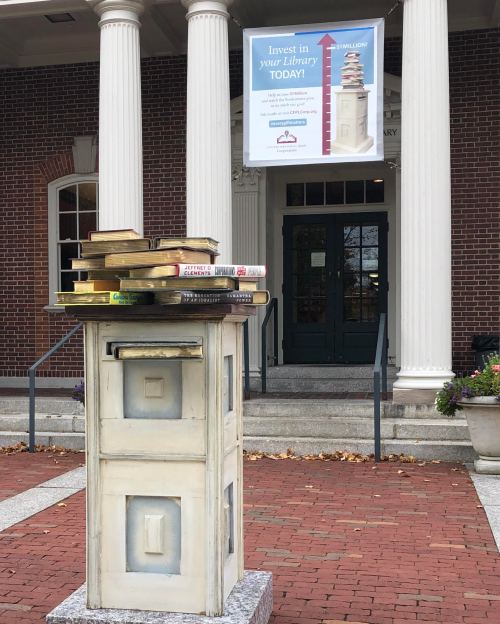
In our town, the library has launched a big campaign to raise money for an addition that will meet the evolving needs of library users. It’s already a wonderful library, and because it is the purview partly of the town and partly of an independent corporation, it has been protected from the budget cuts that have plagued many municipal libraries.

Libraries will always be important for books, but today they are also multiservice community centers that people trust. I think, for example, of the Ferguson Library, which sheltered frightened residents during days of violent clashes after the death of Michael Brown.

At the Nonprofit Quarterly (NPQ), Steve Dubb adds, “Libraries have continued to grow as their role as community hubs deepens. Here at NPQ, we have profiled libraries that have become maker spaces, supported gardening, and rented out musical instruments. …

“Yet another growing role, Emily Nonko reports in Next City, is in social service provision. Nonko notes that up to 30 libraries nationally, including in places like Chicago, Brooklyn, Denver, San Francisco, and Washington DC, have social workers on staff. A Chicago Tribune article last year mentioned  that Justine Janis, a clinical social worker at the Chicago library, was leading a national monthly conference call of social service workers on library staff.

“Nonko in particular focuses on efforts in San Francisco and Denver. [For instance, in] 2019, Denver Public Library budgeted for a team of 10, including four social workers and six peer navigators. The team, Nonko adds, supports all 26 branch locations.

“[Denver social worker Elissa] Hardy explains the Denver program’s rationale: ‘In social work we have this term called a “protective factor.” The library is a protective factor for people, which is basically a place or a thing where we’re helping to support people, and not change things negatively for them.’

“Certainly, anything that increases social supports is likely to improve public health. As the Brookings Institution and the Robert Wood Johnson Foundation have argued, the US underspends on social supports (and overspends on clinical care). In the American Journal of Managed Care, Ara Ohanian notes that, ‘On average, OECD [Organization for Economic Cooperation and Development] nations spend $1.70 on social services for every $1 on health services; whereas the US spends just 56 cents.’ …

“Libraries, of course, are just one piece of a larger puzzle, but they do make a difference. Leah Esguerra, who was the first clinical social worker hired by the San Francisco library system, tells Nonko that, ‘The idea was to reach out in a way that’s compassionate.’ Now, Nonko explains, the San Francisco Public Library now has a team of five that supports Esguerra. These social workers inform patrons about resources and services and have helped at least 130 people find stable housing.”

More at NPQ, here. My local library is not planning those kinds of services, but it’s positioning itself for the future. And to that end, it has interviewed an impressive range of constituencies, sometimes more than once. Very soon there will be new items available like seeds and tools you need only once in a while. There will be spaces just for teens or for adults to have coffee and chat. There will be improved areas for children, a shared garden, and more.

Read Full Post »

Photo: WGRZ
The owner of Sakina Halal Grill, Kazi Mannan, knows what it’s like to be hungry. Thanks to his paying customers in DC, he can give meals to the homeless for free.

Don’t you love successful people who remember how painful poverty and daily anxiety about food can be — and who decide to help others? Tim Ebner reports at the Eater in Washington, DC, about a restaurateur who did just that.

“Come 2 p.m. in many Washington, D.C., restaurants, the lunch rush is all but over. … But for Kazi Mannan, owner of Sakina Halal Grill, the lunch rush is just getting started.

“On a late-Friday afternoon, the door to his Pakistani-Nepalese-Indian restaurant keeps swinging open. A homeless man who is deaf walks through the door. He carries a note. Mannan reads it, then attempts to sign with the man.

“Mannan asks if he wants something to eat while gesturing toward his mouth. The man holds up two fingers and pulls out $2, but Mannan shakes his head no.

“ ‘No money,’ ” he says. ‘You eat for free.’

“That’s Mannan’s policy for every homeless person who walks through the door. At Sakina Halal Grill, the poor, homeless, and hungry eat for free — Mannan calculates he gave away 6,000 meals in 2016 — and the waiters serve them in the dining room, as if they’re full paying customers.

“The buffet-style, halal restaurant, which is undergoing a name change from Mayur Kabab House to Sakina Halal Grill — ‘It’s a tribute to all the mothers around the world,’ Mannan, who lost his mother Sakina, 26 years ago, says of the switch. …

” ‘I’m the little guy on this block,’ Mannan said. ‘And, I love it. …

‘I want to say, “Hey listen, corporate people and people in politics! Listen to me!” I want to show them what love can do, and I want to spread a wave of love that touches the lives of millions.’

“Mannan says he’s living the immigrant dream, in a place where people are likely to take notice. Keeping his door open — which he did Thursday during the #ADayWithoutImmigrants strike — is more than just good business, it’s an expression of his faith. …

” ‘Kazi Mannan: The restaurant has been here for decades. I took it over in 2013 and this really was my dream. I came from a village in Pakistan that didn’t have electricity or plumbing. Our school was completely outdoors. It was always my dream to overcome poverty and own a restaurant. …

” ‘I started working at a gas station off Benning Road in Northeast. At the time, it was a very dangerous neighborhood. I worked there for a few years, and eventually, I saved enough money to start a limousine service; someone told me that I could make my own money as a driver. The funny thing is — that’s where you meet all of the stars of D.C. I still own the company, and I’m very proud that I can provide jobs to people like me, immigrants. Because seriously for me, this is not about the money. …

” ‘My mother taught me to be generous and give with my time. Because remember, we were broke. But, if we had a guest visit, she would make tea and welcome them into our home. She gave everything of herself. …

” ‘I’m a Muslim-American. And I like to believe that when I’m giving to the poor and hungry, God sees that. Just the act of giving a smile to someone can be a blessing. Just think about what food has the power to do. …

‘ ‘The chefs work together … and not only do they make delicious food, but they represent places, which are typically at odds with each other. They come together in this kitchen and use pure love and food. …

” ‘I am proud to be Muslim-American. I am proud to be a citizen of this country. And as a Muslim, I want to show others the true essence of Islam — and that is to love.”

More at the Eater, here. Manna’s initiative seems to be going strong (click here for a 2019 update), which is reassuring as the Eater article is from 2017. I was sorry to see that when Panera tried something similar, a pay-what-you-want model, it didn’t last. (See Bloomberg.) As philanthropic people keep trying to find ways to feed the hungry while running a business, a model that works long-term will emerge. Meanwhile, one kind individual can make a huge difference in many lives.

Read Full Post »

042119-ready-for-egg-hunt

Whatever you did today, I hope it was nice. We had an egg hunt at our house (this year’s whacky egg-coloring technique worked well), and then we played in the park.

Above, you see the baskets ready for the four grandchildren. The painting on the wall is by my oldest grandson, who is not quite 9.

Below, looking pensive, is our youngest grandchild.

I used a branch of an early rhododenron to hang Easter ornaments.

042119-pensive-egg-hunter

042119-Easter-tree

Read Full Post »

« Newer Posts - Older Posts »