Feeds:
Posts
Comments

Archive for the ‘Uncategorized’ Category

As my father used to say, “One man’s Mede is another man’s Persian.” (My father studied Greek.)

Which could be a way of saying that the items one person doesn’t want are often exactly what someone else is seeking. Hence Goodwill, eBay — and a new company for handling merchandise returns.

“The Christmas gifts have been delivered, and Secret Santa is done,” writes Hiroko Tabuchi at the NY Times.

“Now, the work begins for Optoro, a start-up company that aims to reduce the financial and environmental costs of another great holiday tradition: returns. …

“Optoro’s approach to cutting waste is to offer retailers more direct and cost-efficient ways to sell their returned goods through a software platform that tracks returns, quickly assesses which channel is the most effective for each returned item, and routes products to those channels.

“For undamaged products that have a high resale value, like baby goods, power tools or tablet devices, Optoro’s software might direct products to its own discount site, Blinq.com, which sells open-box goods at discounts. (Optoro helps retailers test and grade those products.) For returns, or even excess inventory, that are available in bulk, products are routed to another site, Bulq.com, where discount stores and other off-price retailers can purchase merchandise by the pallet.

“And by amassing returns from retailers, Optoro is able to find takers for products with a lower resale value, like dented metal filing cabinets and other office furniture for scrap recyclers, which pay for goods or materials in bulk. Traditional retailers typically recover only about 20 to 40 percent of the retail cost of returned goods; Optoro helps companies recoup 50 to 70 percent of the cost.

“There always will be returns, but there will always be someone who wants them,” [Tobin Moore, chief executive] said.

More.

Photo: Jared Soares for The New York Times
Josh Russell working at the Optoro warehouse in Lanham, Maryland. 

Read Full Post »


Photo: Sara Krulwich/NYT

Everyone is beautiful in the ballet.”

The truth of that line is being demonstrated over and over again at English National Ballet — not just onstage but in classes for Parkinson’s patients.

According to the website Ballet.org, “Dance for Parkinson’s extends opportunities for people with Parkinson’s, their carers, friends and family members to engage in artistic dance activity inspired by the repertoire and within the professional environment of the dance studio.

“Regular weekly classes in London are based at our studios in Kensington. Our programme provides an insight into the way a production is put together with opportunities to meet our dancers and musicians, see rehearsals and English National Ballet performances.

The ballet did make me urgently want to move more, and move better and hinted at how this might be possible. – Participant, Dance for Parkinson’s London …

English National Ballet is proud to be part of the Mark Morris Dance Group Dance for PD membership programme and the Dance for Parkinson’s UK.” More at Ballet.org/uk.

The initiative receives significant support from the P H Holt Charitable Trust, D’Oyly Carte Foundation and Paul Hamlyn Foundation.

Read Full Post »

I checked Gwarlingo not long ago to catch up on Michelle Aldredge’s thorough, sensitive meditations on art and literature.

What caught my attention was her review of a movie about restoring an old house in Japan.

“It is rare to find a film that is pitch-perfect in its cinematography, story, pacing, and length,” Aldredge writes, “but Davina Pardo’s short film Minka is such a gem. (I owe writer Craig Mod a thank you for turning me onto this quiet masterpiece.)

“Based on journalist John Roderick’s book Minka: My Farmhouse in Japan, the film is a moving meditation on place, memory, friendship, family, and the meaning of home. Most remarkable, this haunting story plays out in a mere 15 minutes.

Minka is the Japanese name for the dwellings of 18th-century farmers, merchants, and artisans (i.e., the three non samurai-castes), but as Wikipedia explains, this caste-connotation no longer exists in the modern Japanese language, and any traditional Japanese style residence of an appropriate age could be referred to as minka. The word minka literally means ‘a house of the people.’

“The story of how AP foreign correspondent John Roderick and his adopted Japanese son Yoshihiro Takishita met, and then rescued a massive, timber minka by moving it from the Japanese Alps to the Tokyo suburb of Kamakura is full of small surprises and revelations (the biggest one comes at the end of the film).

Minka is a film that celebrates stillness. Pardo’s camera lovingly lingers on sun, shadows, and dust. But the peaceful home is not just a restored space full of beautiful, personal objects, it is also an expression of the deep connection between Roderick and Takishita and of familial love.”

Read about that at Gwarlingo, where the filmmaker will let you watch the entire 15-minute movie.

Photo: Davina Pardo & Birdlings LLC
A still from the film
Minka

Read Full Post »

An unassuming Indian American scientist, a former commuter-rail acquaintance of mine, led the teams behind the dengue-fever vaccine approved in December for use in Mexico.

Rogerio Jelmayer at the Wall Street Journal reports the vaccine was next approved for the Philippines and Brazil. “Sanofi Pasteur, the vaccine division of France’s SanofiSA, [has] secured approval from Brazilian authorities to market its dengue fever vaccine amid an explosion of cases across Latin America’s largest nation. …

“The approval of Dengvaxia comes as Brazil is battling two other serious mosquito-borne diseases for which there are no vaccines. In addition to dengue, Brazil also has seen a rise in the number of cases of chikungunya, [but] the most worrisome epidemic is the spread of the Zika virus.” The Wall Street Journal article is behind the firewall, so read more at the NY Times, here.

I’m hoping that my train buddy’s vaccine will come to the rescue for zika, too, as a blog I just visited suggests: “France’s Sanofi SA, which won endorsement toward the end of last year for the principal dengue immunization, has said it is inspecting the likelihood of applying its innovation for Zika.”

For all the negative press about drug companies, they do have teams quietly laboring for years on vitally necessary vaccines and cures.

Photo: Centers for Disease Control and Prevention (CDC)
An Aedes aegypti, the mosquito that spreads dengue fever.

Read Full Post »

The Christian Science Monitor collects wonderful stories for the series “People Making a Difference.” I’m on the email list and receive so much good news, it’s hard to choose what to share.

This story was written by Anita Satyajitin.

“The 41 boys of Sanmati Bal Niketan keep a lamp burning all the time in their home. They believe that the flame should never be extinguished, for as long as it burns, their ‘mother’ will be hale, hearty, and healthy.

“Their mother is Sindhutai Sapkal, a beggar who has used her earnings to raise 1,042 orphans over the past four decades.

“As a young pregnant woman in rural India, Ms. Sapkal was abandoned by her husband. She turned to begging for a living, seeking refuge in cowsheds, cemeteries, and train stations. But despite these hardships she found her calling as a mother to hundreds of children.

“Today Sapkal runs four homes for orphans and others in need across India’s state of Maharashtra, currently caring for more than 400 children and 150 women abandoned by their families.

“ ‘I have experienced what it feels like to have no one and nowhere to go. This [work] makes me feel like someone is dressing my wounds,’ Sapkal says.

“Four decades ago, when she would sing at train stations and beg to earn a living, she noticed the large number of orphans who made the stations their home. She had been grappling with thoughts of suicide, but instead she felt a strong call to care for the children.

“The more of them she looked after, the more vigorously she begged. …

“After a few years, with the help of supporters, Sapkal set up her first orphans’ home in Chikhaldara, a town in rural Maharashtra. As word about her work spread, people from other villages began to approach her with orphaned children. …

“Her innovative idea of having women abandoned by their families live in the same home as the children ensures that the children are cared for and the women have a family, too. …

“The children [are] all sent to nearby private schools or colleges to pursue an education. Sapkal, who travels between these homes, has worked with a network of nearby schools, colleges, and hospitals that offer their services free of charge or at a reduced rate to her children. …

“Sapkal’s success is also a result of the support she receives from the people she has raised. The day-to-day operations of her homes are run by her ‘children’ and their families.

“Dipak Gaikwad was 11 when relatives handed him over to Sapkal. When as an adult he inherited his ancestral home, he sold it and gave the money to her to carry on her work. Today he manages her Saswad home.”

More here.

Photo: Anita Satyajit 
Sindhutai Sapkal, who has nurtured more than 1,000 orphans, is seen here with a few of them at her home in Pune, India.

Read Full Post »

Artsy Providence

I’m coming to the conclusion that Providence would not be the special city it is without two particular colleges: Johnson & Wales University and Rhode Island School of Design. Brown is Ivy League and outstanding, but RISD and Johnson & Wales may be responsible for the culture.

Johnson & Wales turns out excellent chefs year after year, and many seem to start restaurants locally. (Oh, the lunches I’m having!) RISD, meanwhile, produces and draws to itself all sorts of designers and artists, who not only create art but seem to imbue the environment with creative ways of thinking about challenges.

Everywhere you go, there is something surprising — gigantic murals, fantastical clocks, robot sculptures, narrow building slices being converted into business spaces. Even the historical plaques are artistic.

Look at this crazy, skinny building, for example. Most of the old structure was sliced off and the empty space used for a parking lot. But a local revolving fund is helping to renovate the remaining building for offices and snack bars. It’s a building one room wide.

The plaques illustrating the city’s history are at One Financial Plaza.

I can only guess what is meant by the reference to rapping in Esperanto in the giant quote, but I had to take the photo since I used to speak the language.

012616-mural-with-mushrooms

012716-Esperanto-art-sign


012616-slice-of-bldg-under-renovation

012816-skinny-bldg


012716-Providence-harbor-plaque

012616-lamppost-plaque


012616-full-rigged-ships-plaque

Read Full Post »

Today I’m following up on my post about using moss in building design. KerryCan Googled around and found several recipes for getting moss to grow using buttermilk.

Then John sent me a cool article noting that photos of moss graffiti are becoming a bit of a meme on Instagram.

Tech Insider‘s Madison Malone Kircher writes, “People around the world are growing their own moss graffiti as innovative way to create living, breathing artwork. To do this, blend moss, yogurt, beer, and sugar into a liquid that will be used as ‘paint.’ From there, just apply the concoction to a wall in the design of your choosing and wait for the moss to grow in. For more detailed instructions, head here.

“If you’re looking for moss inspiration, Instagram is a great place to start. Just look up the hashtag #MossGraffiti for a look at some incredibly detailed, green artworks from around the world.” Kircher’s favorites are here.

WikiHow also has a recipe.

Photo: WikiHow

Read Full Post »

So much anxiety about “the others” these days, anxiety that is seldom based on knowing even one of those others!

That is why I found this story by Steve Annear in the Boston Globe so charming and important.

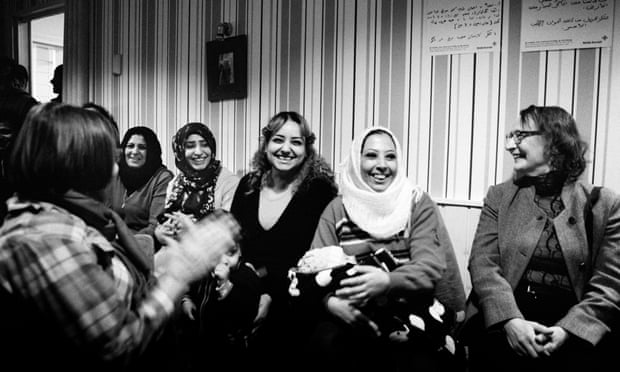
He wrote, “Mona Haydar knew that when she set up two signs outside a Cambridge library [in December] with the words ”Ask a Muslim’ and ‘Talk to a Muslim,’ she had to be prepared for strong opinions about her faith.

“But the Duxbury resident said the impromptu experiment led to a meaningful series of conversations about religion, politics, history, and sports. It was an experience that, even in a time of prejudice against Muslims, showed Haydar that ‘the community is loving.’

“ ‘We just wanted to talk to people and we didn’t see any harm in doing that,’ said Haydar. ‘We are just normal people. There is definitely fear [in America], and I want to talk about it, because it’s actually misplaced and misguided — I am really nice!’

“Holding a box of doughnuts and cartons of coffee from Dunkin’ Donuts, and wearing a traditional hijab, Haydar last Friday and Saturday planted herself alongside her husband, Sebastian Robins, outside the library for several hours each day.

“Haydar said that over the two days they spoke with more than 100 strangers. The initiative, she said, was inspired by a similar act, called Talk to an Iraqi, that was featured on ‘This American Life’ in 2008.” More here.

I’d say she gave a gift to the Cambridge populace, which although considered open-minded, is not monolithic. And she seems to have received a gift in return: the satisfaction of initiating an important conversation and of confirming that the majority of people are kind.

Photo: Mona Haydar
Mona Haydar and her husband, Sebastian Robins, stood outside of a library in Cambridge.

Read Full Post »

Nate Homan recently wrote a good human-interest story for the free subway newspaper, Metro. It’s about one of Boston’s subway musicians, a blind woman.

Michelle Abadia sits at Harvard Station early each morning that her T performer permit allows, strumming her guitar and singing to an audience she cannot see.

“ ‘Music was my passion from an early age. I don’t have a memory without it,’ Abadia said. ‘I am told that I was helping tune the piano when I was three.’ …

“She lost her sight to congenital cataracts at the age of 4 after six unsuccessful eye surgeries. She has started a GoFundMe page hoping to earn $20,000 to fund her musical career and to help pay for medical bills. …

“She earned a double degree in language studies and music in Boston College, and went on to earn a master’s in French literature and International Latin American Studies from Tufts. After that, she earned New England Conservatory master’s for vocal performances.

“Now she is trying to earn a living as a musician, after teaching Spanish at several colleges in the area and working as an interpreter in courtrooms.

“ ‘The commuters are half asleep, and I don’t know how effective I can be in brightening their days, but some people say the I do,’ Abadia said. …

“ ‘For anyone who is blind wants to be a musician, or anything, I would tell them to follow their dreams,’ Abadia said.”

More here.

Photo: Metro.us

Read Full Post »

I had to share a delightful report from the radio show Studio 360 in which Khrista Rypl looks at the cultural aspects of African textiles.

She writes, “African textiles are distinctive for their vibrant colors, bold patterns, and batik dyes that give the fabric a unique crackled texture. But I had no idea that some of the trendiest of these prints are actually designed and produced in the Netherlands by a company called Vlisco.

“Inge Oosterhoff wrote a wonderful deep dive into the history behind the Vlisco textile house, and explained how their designs have remained hugely popular in Africa since the late 1800s. But Vlisco doesn’t just make fabric; they’re known for their printed designs. … Some patterns are designed with different countries in mind, while others are distributed widely around the continent. As the patterns catch on among shopkeepers and consumers, many of them get colorful names like ‘Love Bomb,’ ‘Tree of Obama,’ and ‘Mirror in the Sun.’ …

“Many patterns are sold widely in Africa, and different countries and cultures adopt different meanings and associations. [A swallow] print is a perfect example. The fabric was used for airline uniforms in Togo, so there the pattern is commonly referred to as ‘Air Afrique.’ The pattern also symbolizes asking for a favor, like the hand of a woman in marriage. In Ghana, the swallow refers to the transience of wealth, and the pattern is referred to as ‘Rich Today, Poor Tomorrow.’ It has a similar connotation in Benin, where it’s referred to as ‘L’argent vole,’ where it could either be interpreted as ‘Money Flies’ or ‘Stealing Money.’ ”

More designs and more of Studio 360 report, “Textiles Tell a Cultural History,” here.

Photos: Vlisco

Read Full Post »

Don’t you love it when something that is extinct turns out not to be extinct at all? Like coelacanths, which, according to Wikipedia, “were thought to have become extinct in the Late Cretaceous, around 66 million years ago, but were rediscovered in 1938 off the coast of South Africa.”

While I’m waiting for someone to prove unequivocally the existence of the Ivory Billed Woodpecker, I will regale myself with Lazarus-like sea snakes in Australia.

I saw this Australian Associated Press story at the Guardian: “A species of sea snake thought to be extinct has been rediscovered off the Western Australian coast. A wildlife officer spotted two courting short-nosed sea snakes while patrolling in Ningaloo marine park on the state’s mid-north coast. …

“The Western Australian environment minister, Albert Jacob, said the discovery was especially important because they had never been seen at Ningaloo reef.

“A Department of Parks and Wildlife officer photographed the snakes on Ningaloo Reef and James Cook university scientists identified them.”

Maybe marine creatures such as sea snakes and coelacanths are more likely to be preserved than woodpeckers — hidden away in the ocean’s unexplored depths. Still, as a movie I reviewed, Revolution, made clear, the seas are threatened, too.

More on courting sea snakes at the Guardian.

Photo: Grant Giffen/AFP/Getty Images
The discovery of the short-nosed sea snake, previously thought to have been extinct, is significant because the species had never been seen in the Ningaloo marine park in Western Australia before.

Read Full Post »

One of the better aspects of the 2015 Massachusetts Conference for Women was hearing speakers like Candy Chang, an artist who engages ordinary people in public discourse.

At the December conference, Chang focused on Neighborland, a service co-founded with Dan and Tee Parham, that helps “residents and organizations collaborate on the future of their communities.”

This is how it works. Organizations start by posing a question. For example, they might hand out cards that say, “I want [blank] in my neighborhood,” and a resident might write in, “a night market.” Next, using Neighborland tools, ideas are collected from workshops, public installations, SMS, and Twitter. They are then discussed and voted on. The website says Neighborland has “sophisticated moderation, clustering, and de-duplication tools for organizers to aggregate all of the data from residents. Our reports make it easy for organizers to see trends in the data, make decisions, allocate resources, and keep participants involved in the fun part – making their neighborhoods better places.”

In this example, National Gardening Association’s Jenna Antonio DiMare reports on Adam Guerrero,  his Memphis, Tennessee, team of blight-busting ″Smart Mules,″ and their efforts to create a greener and more sustainable city.

“During the month of October, National Gardening Association (NGA) partnered with Neighborland to challenge Memphis residents to propose innovative projects to make their city and neighborhoods more sustainable. With a $1,000 grant awarded to the most promising project, Neighborland’s simple platform empowered local Memphis residents to ‘connect and make good things happen.’

“Despite receiving many inspiring project proposals, from founding an urban agriculture school to growing a newly established community garden, it was clear to NGA that the ‘Smart Mules’ project would have the greatest impact with the $1,000 award. …

″ ‘We are fighting [urban] blight, raising neighborhood morale, engaging our local government, and investing in a future for the neighborhood, all at the same time,’ writes the ‘Smart Mules’ team. To accomplish these goals, ‘Smart Mules’ provides work for many young, at-risk males who have been ‘largely dismissed’ or disenfranchised, according to team leader Guerrero.” More here about the work these young men are doing for sustainability.

(A couple years ago, I wrote about Candy Chang’s “Before I Die” interactive street art.)

Photo: Neighborland.com

Read Full Post »

012116-fish-for-supper

Art: Maggie Stern
“Fish for Supper”

Concord Art has mounted a juried show of member works. I have been twice this week. It’s accessible and stimulating.

When you first enter, you hear a strange clattering and turn to see a beat-up old medicine cabinet with vintage pill bottles inside that are rattling around like ghosts. Very amusing.

My former boss, Meredith Fife Day, had two lovely country scenes in acrylic from her travels in Ireland, and she was the one who reminded me to see the show.

I took a photo of Maggie Stern’s playful “Fish for Supper,” above. Stern says, “What I love most about art is that you get to make up the rules.” I Googled her and found that she has connections with the Fuller Craft Museum in Brockton, Mass., and has excelled in a variety of artistic realms, including illustrating children’s books and making kits for crafty folks to reproduce her original stitchery.

I was also drawn to Lorraine Sullivan’s use of vintage linens. There must be something in the air about vintage. I’ve been doing a little prospecting (along with Erik’s mother) to add to Suzanne’s new vintage locket collection at Luna & Stella, and have learned that the idea of mixing vintage with contemporary birthstone jewelry is quite popular.

In fact, all sorts of vintage items are being cherished now, to the point that it was not only wonderful but a bit painful to see how Sullivan used her seamstress grandmother’s handiwork in the piece below. Creative destruction. Happy-sad.

012216-vintage-linen-art-1

012116-vintage-linens-now-art


Read Full Post »

The first pictures feature berries, shadows, rain, and snow. I took them in Massachusetts.

The others are from Providence, which has long exuded an artistic vibe. I liked the sunrise on rooftops in one photo and a beautiful ornate building, sadly neglected. More-contemporary art pops up in unexpected places: the robot-like sculpture at a busy intersection and the robot in the ladies room at Small Point Café.

011716-shadow-berries

011616-raindrops-on-holly


011816-snow-on-hollu

011916-Providence-sculpture


011216-early-sunlight-Providence-_Pro

012016-beautiful-neglected-building


012016-WC-Robot

Read Full Post »

The 17th century Cavalier poet Richard Lovelace wrote in “To Althea from Prison,”

Stone walls do not a prison make,
Nor iron bars a cage;
Minds innocent and quiet take
That for a hermitage.
If I have freedom in my love,
And in my soul am free,
Angels alone, that soar above,
Enjoy such liberty.

I am not going to make the case that inmates at New York’s Rikers Island prison have “minds innocent and quiet,” but I will contend that poetry can help to free the soul.

Kirk Semple at the NY Times has a story about a poetry reading in the prison.

“The inmates at Rikers Island were slumped in plastic chairs, their expressions suggesting boredom and doubt. They had been pried from their favorite television shows to attend — of all things — a poetry reading. Some nice people from the public library, they were told.

“Then came the poet: unshaven, in his early 20s, dark hooded sweatshirt, dark T-shirt, dark ball cap slung backward on his head. Some men leaned forward, elbows on their knees. Expressions shifted to curiosity: This was not what they were expecting.

“ ‘I’m going to kick a couple of poems,’ the poet, Miles Hodges, said in a drawl of the street, before unleashing a blizzard of words titled ‘Harlem.’ His intonation percussive and incantatory, he spoke of race and of children playing amid ‘roached blunts and roached joints’ that were ‘scattered around the purple-, pink- and black-chalked R.I.P. signs as if whispering from the concrete jungle, “I’m resting in peace and high.” ’

“Mr. Hodges, 25, is a spoken-word performer and a somewhat unusual ambassador of the New York Public Library, where he was hired this year to help create programs to attract members of the millennial generation.

“For the past couple of months, he has been developing a spoken-word program at Rikers, where the library has for years offered a variety of services, including a book-lending system.

“ ‘I really wanted to include this other section of New York City that often doesn’t get discussed as part of the city,’ Mr. Hodges said in an interview. ‘You’ll hear me say a lot: They can lock your body up, but they can’t cage your mind.’ “

Asakiyume volunteers in a prison where she helps women with writing. Bet they would get a kick out of a poetry reading like that.

More at the NY Times, here.

Photo: Richard Perry/The New York Times
Miles Hodges, in cap, performing at Rikers Island.  

Read Full Post »

« Newer Posts - Older Posts »