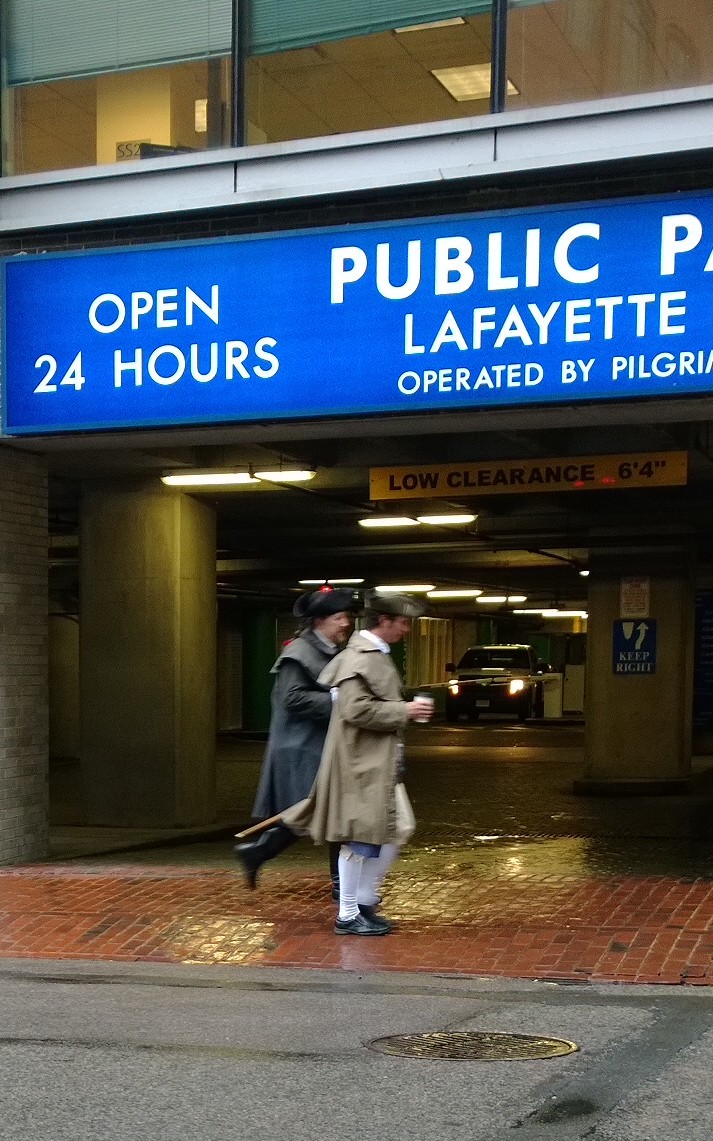
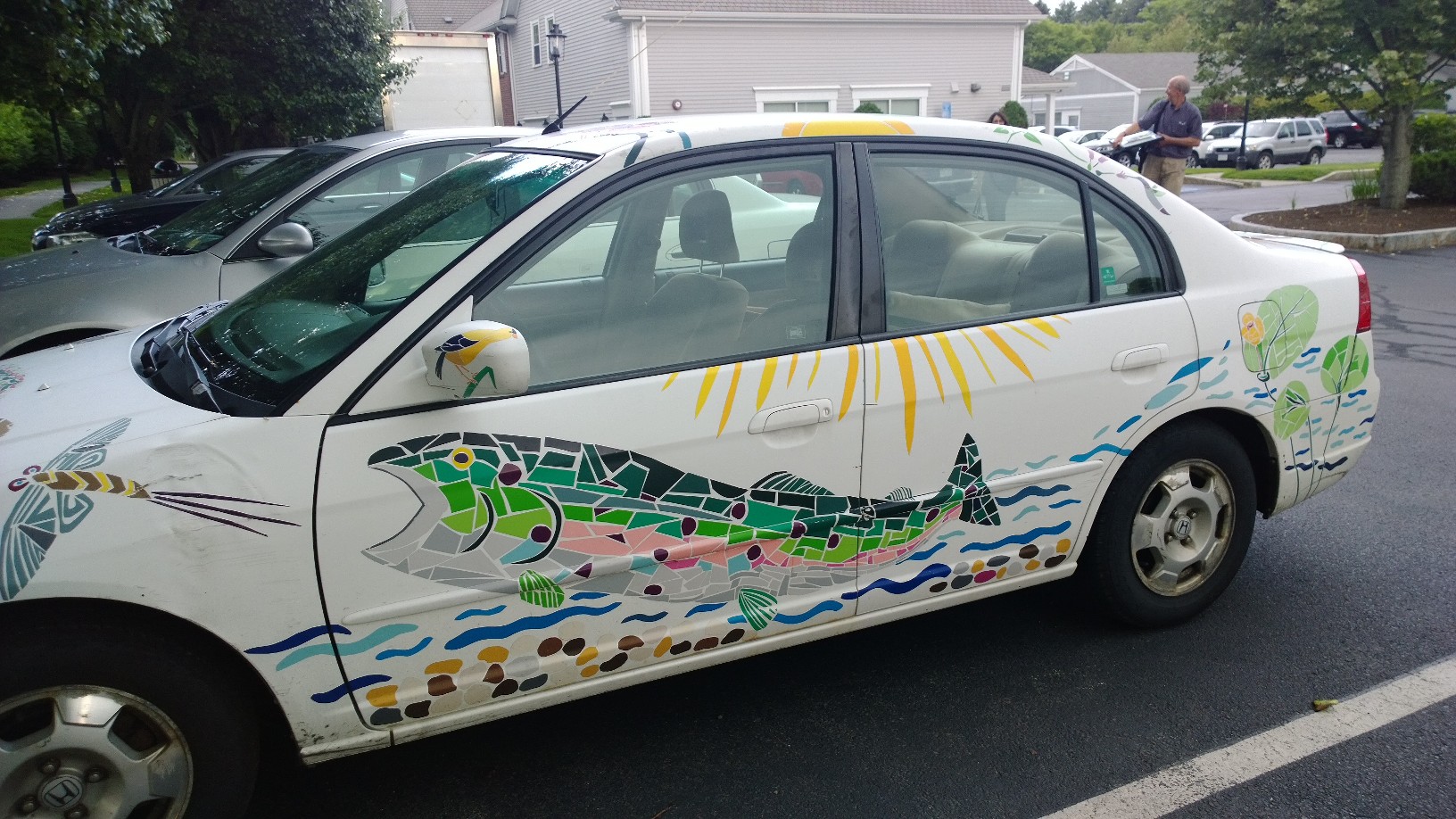
Here are a few recent photos. The owner of the fish car showed up as I was taking the picture, so I heard the artist’s story. He threw a party and provided his friends with every shade of adhesive-backed vinyl and pairs of scissors. And they cut small pieces to create a kind of mosaic of the fish, the sea, the goldfinch on the mirror, and so on.
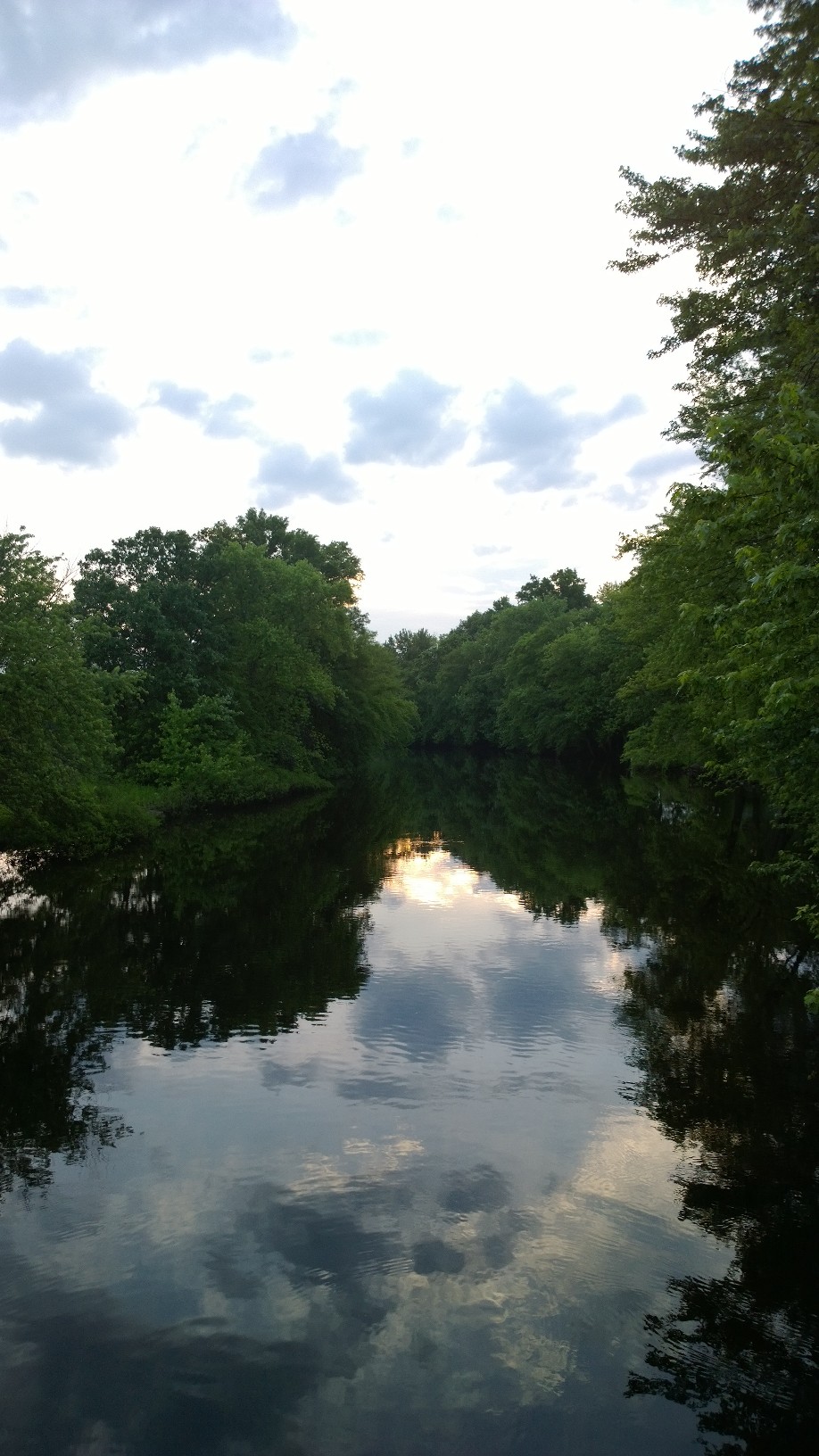
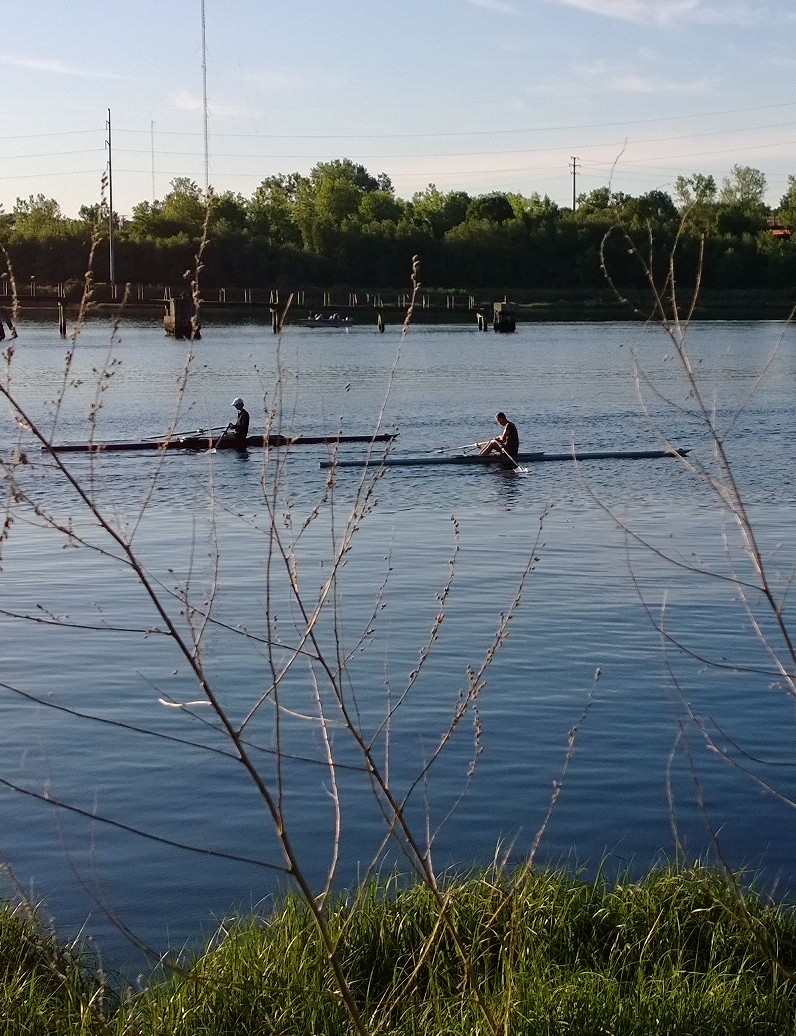
Next we have early morning looking over a river in Concord, then early-morning rowers on the Seekonk in Providence.
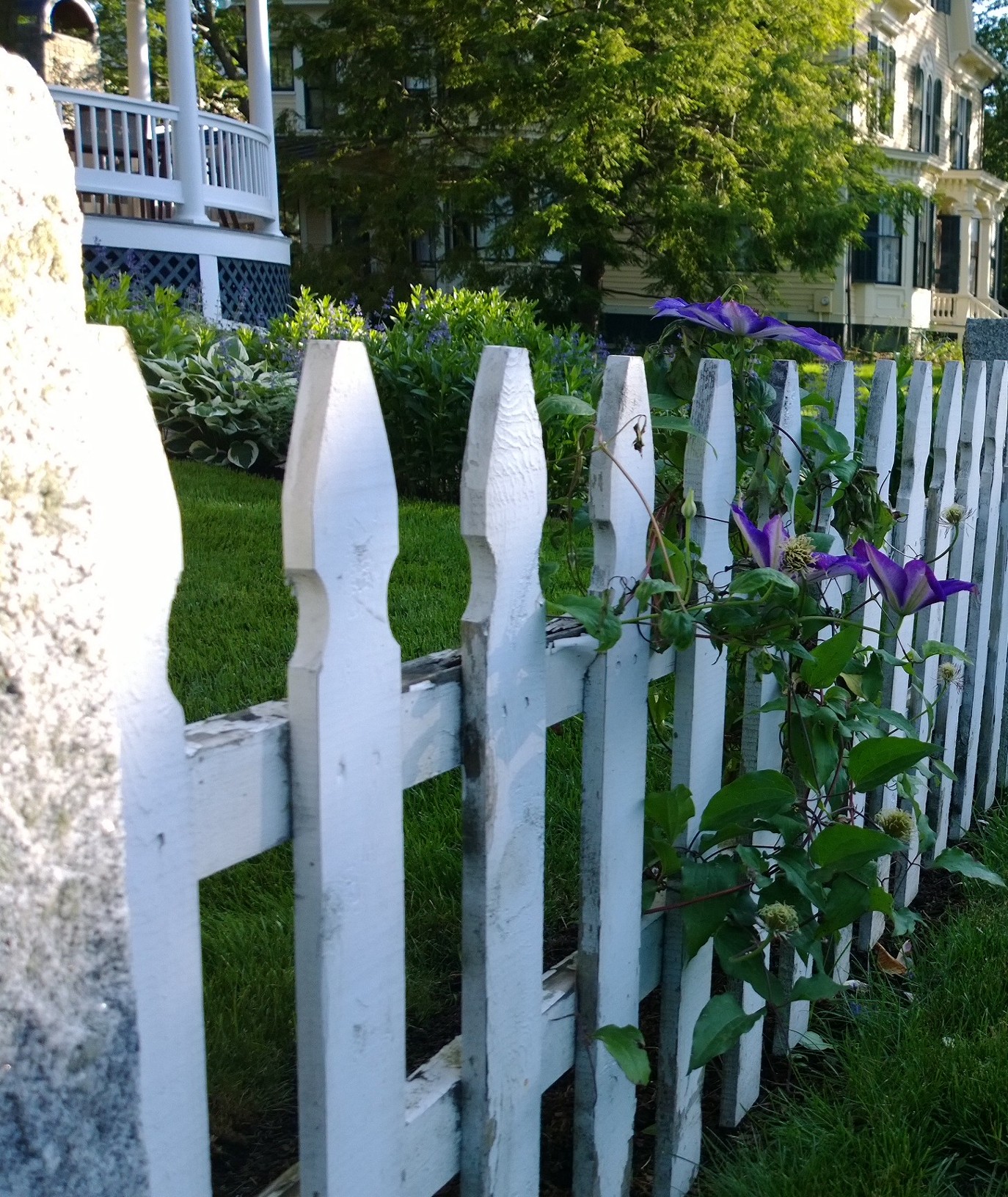
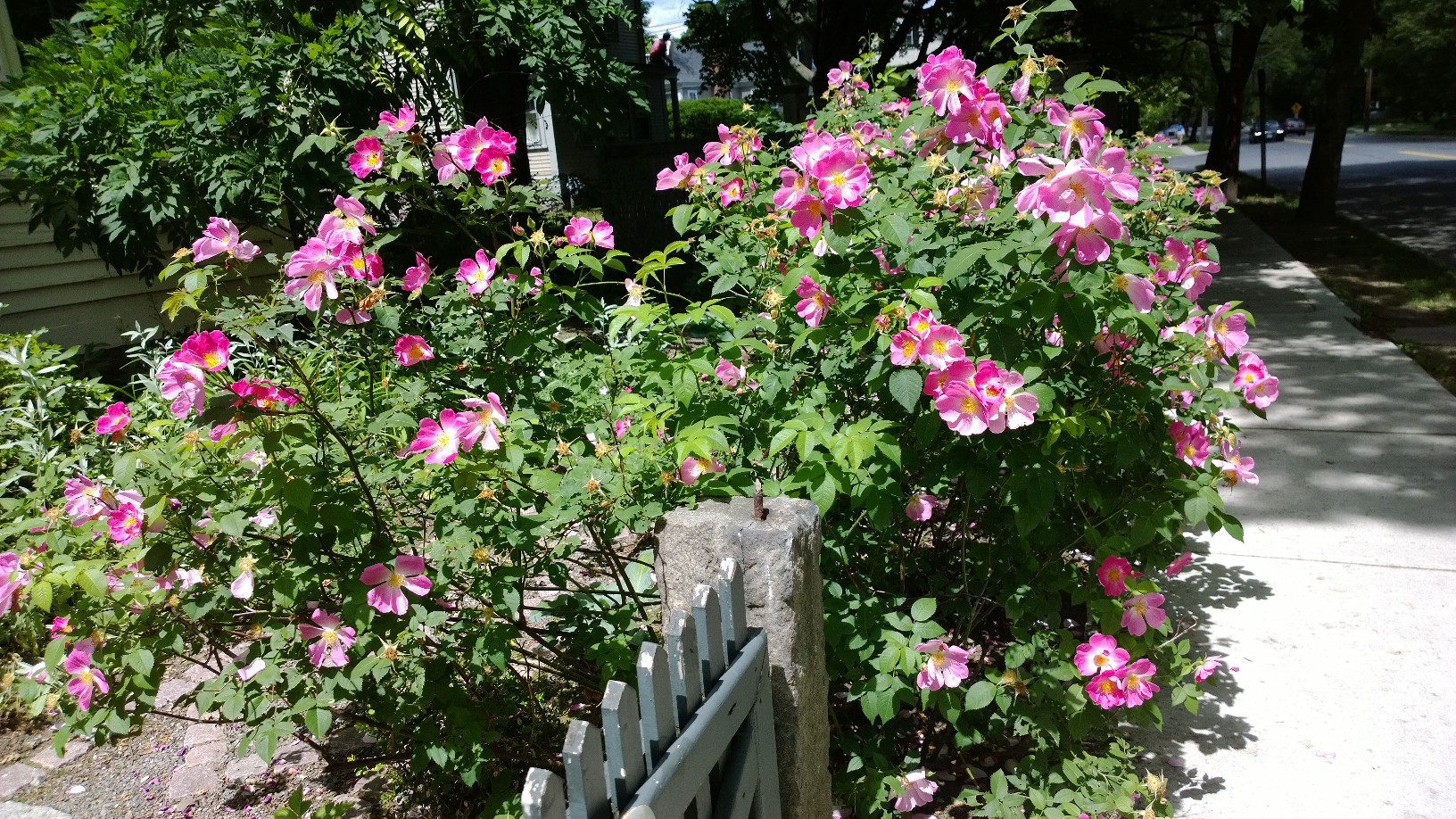
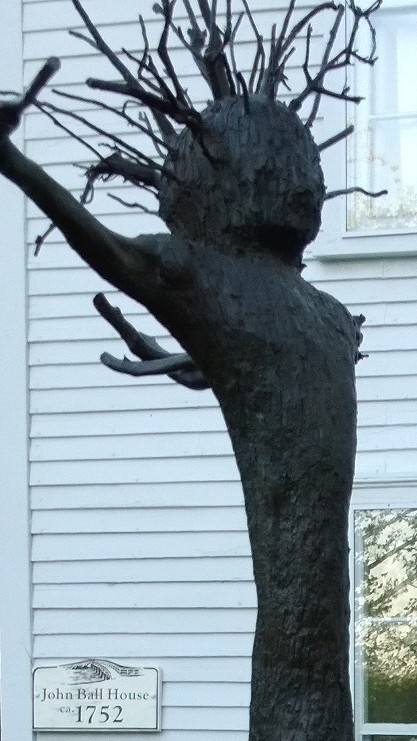
Early-morning roses follow on early-morning clematis. Modern sculpture does an early-morning stretch in front of the historic house that is now an art center.
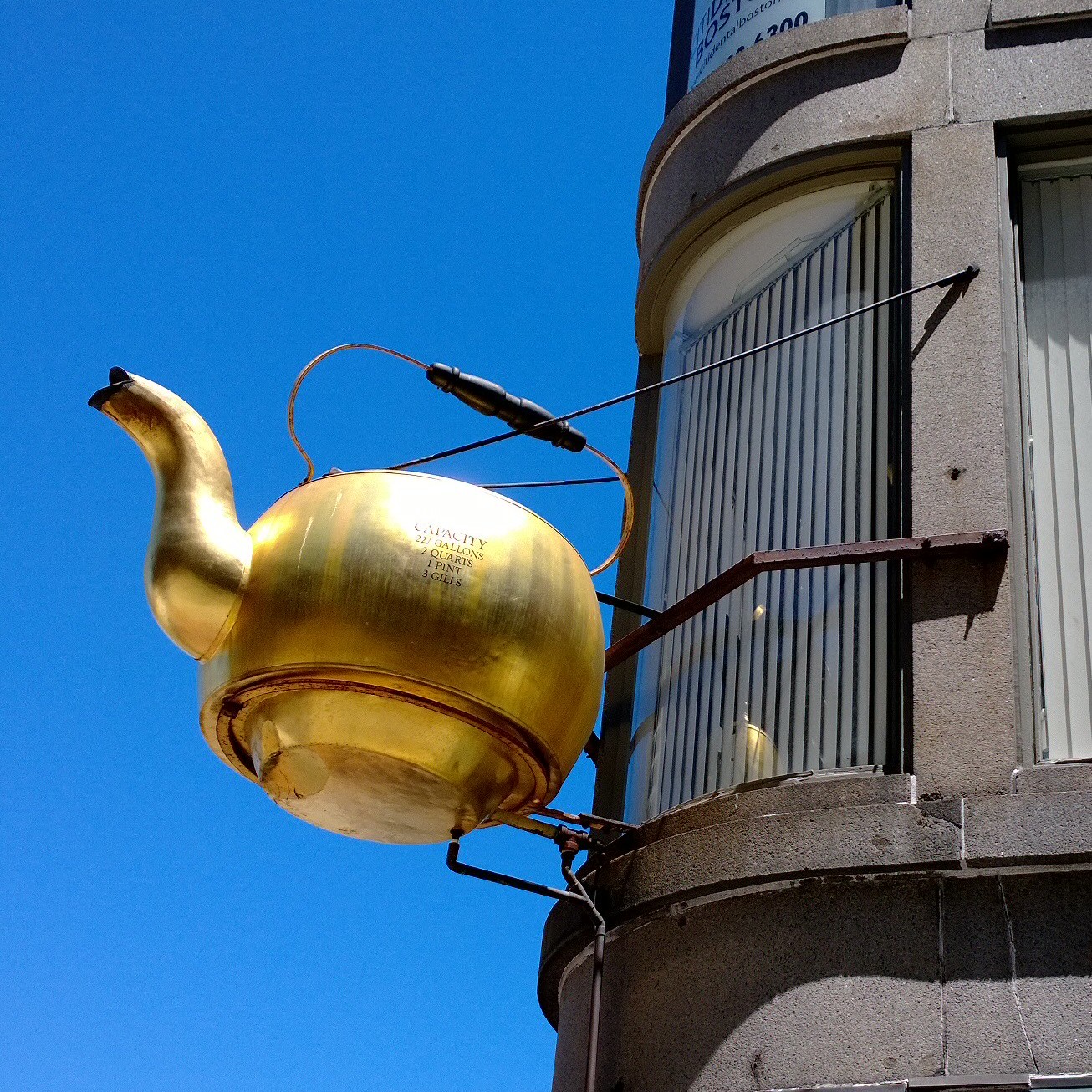
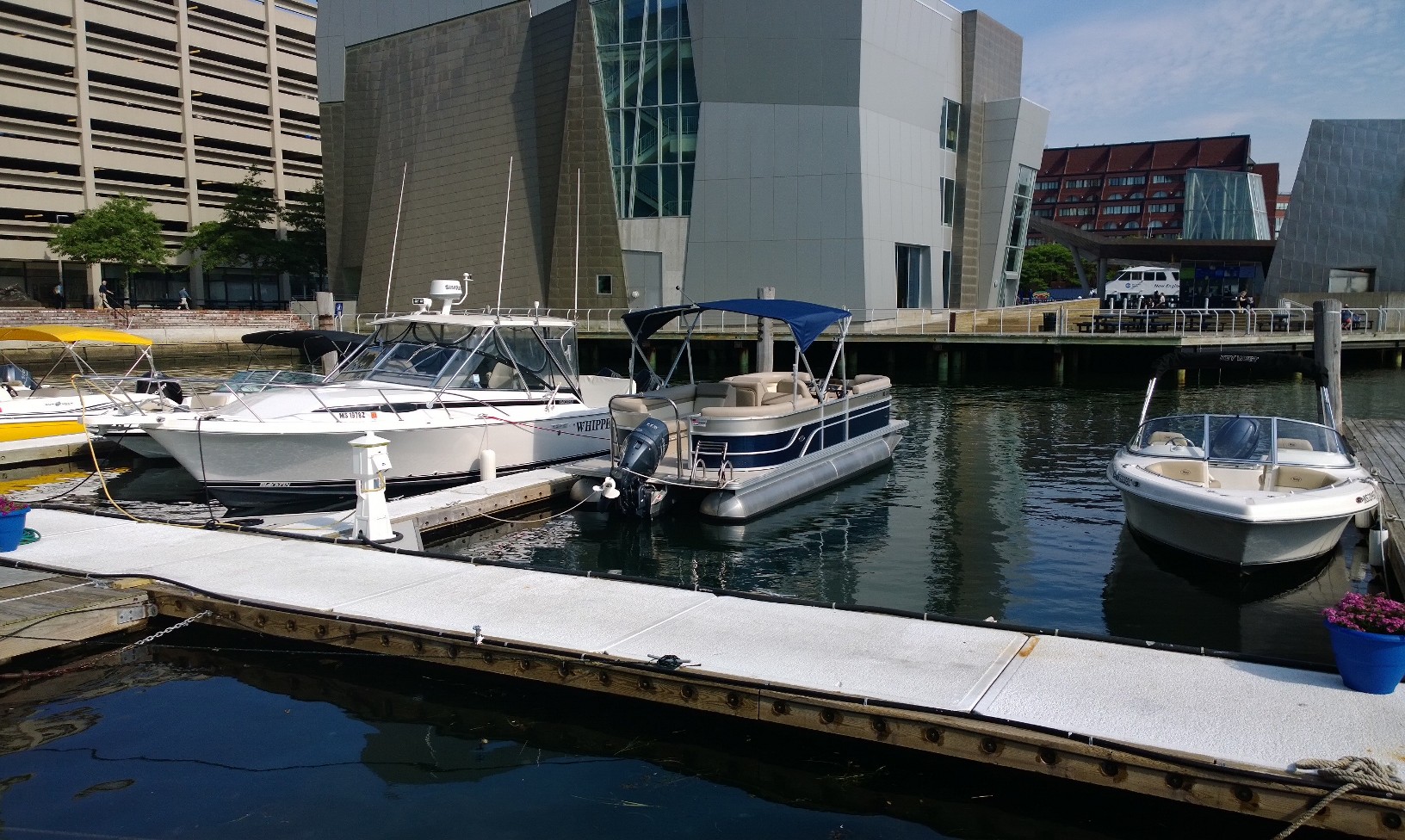
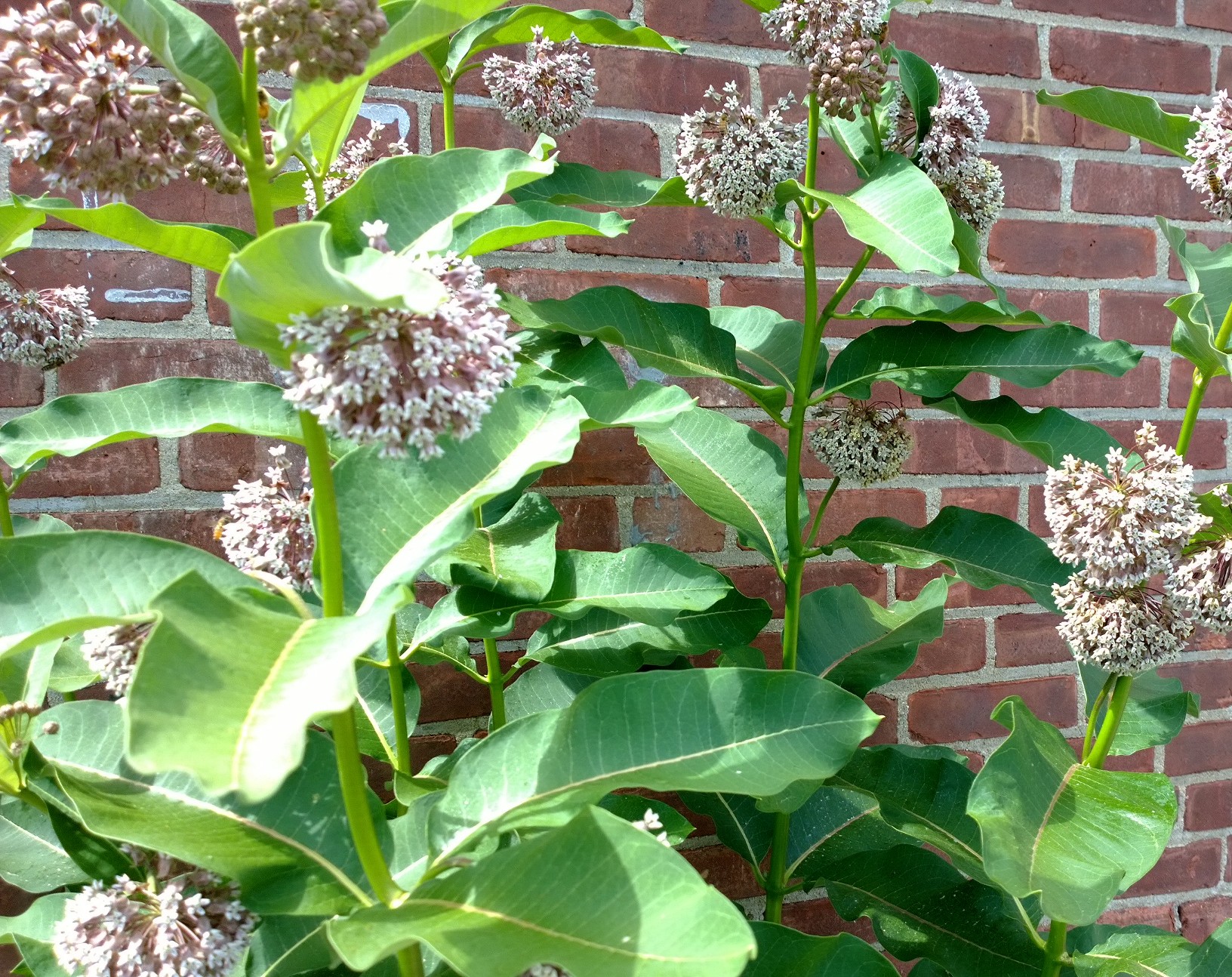
Then there is the teapot near Boston’s Government Center, private boats in Boston Harbor, and milkweed. (You’ll have to take my word for it that the milkweed was full of bees.)
Judith Ross, who also has a WordPress blog, saw a story she knew I would like. It’s about a Mass College of Art professor who got an idea for a quiet little memorial to Trayvon Martin.
Greg Cook writes at WBUR radio’s The Artery, “For about four years, Matthew Hincman had been eyeing the old stump of a lamppost at the corner of Eliot and Centre streets in Jamaica Plain’s Monument Square. It stood there, with two screws sticking pointing up, as if calling for something to go on top. …
“And he got to thinking about the granite monument tower on the other side of the square to a couple dozen West Roxbury men who died in the Civil War. …
“ ‘Who do we memorialize?’ he began to ask himself. ‘Why do we memorialize them in the public space?’
“And so it happened that a couple Wednesdays ago, right in the middle of the day, the Boston sculptor arrived with an assistant and proceeded, without permission from any official authorities, to attach a small, secret, cylindrical metal thing atop that lamppost.
“On its flat top is a low relief depicting a hoodie sweatshirt cast to the ground. … For Hincman, it’s a street art monument to Trayvon Martin.”
Read about other art projects by Hincman at The Artery, here. I like his stealth approach to many of them.
Photo: Michael Hincman A street art monument to Trayvon Martin
Even though she lived in Paris for several years, Melita is frequently startled by how kooky and fun the French can be.
Today she told me she just learned that they’ve been making a Riviera-type beach along the Seine for the past 12 summers.
I checked out Wikipedia: “Paris-Plages … is a plan run by the office of the mayor of Paris that creates temporary artificial beaches each summer along the river Seine in the centre of Paris, and, since 2007, along the Bassin de la Villette in the northeast of Paris. Every July and August, roadways on the banks of the Seine are blocked off and host various activities, including sandy beaches and palm trees.” More here.
The mayor’s website notes, “The summer transforms Paris. The cityscape dons greenery and the riverside thoroughfares become car-free resorts. The Paris Plages (Paris Beaches) operation kicks off on or around 20 July and lasts four weeks. …
“A Seine-side holiday. That, in a nutshell, is what Paris Plages is all about – complete with sandy beaches, deckchairs, ubiquitous ice cream sellers, and concerts for French and foreign guests. …
“The first beach [opened] in 2002. It spans three kilometres through historical Paris, and features open-air attractions (rollerblading, tai-chi, wall climbing, boules etc.). Refreshment areas, play areas and deckchairs are available for your time out unwinding by the river.” More.
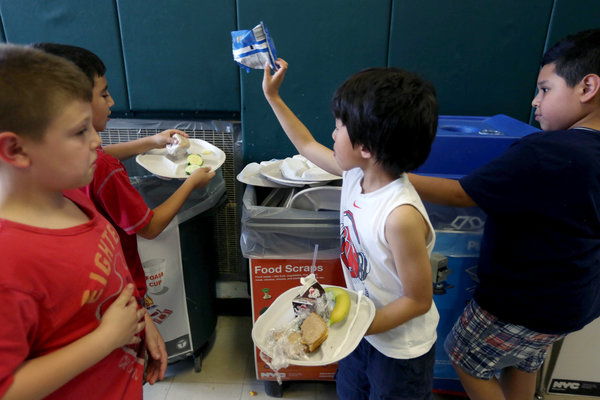
Discouraging as it is to read that many children won’t eat the healthful food schools are now providing, I take heart that at least they are learning to compost.
Al Baker writes at the NY Times, “The sad voyage of fruits and vegetables from lunch lady to landfill has frustrated parents, nutritionists and environmentalists for decades. Children are still as picky and wasteful as ever, but at least there is now a happier ending — that banana-filled bin is a composting container, part of a growing effort to shrink the mountains of perfectly good food being hauled away to trash heaps every year.
“New York City’s school composting program, kicked off just two years ago by parents on the Upper West Side, is now in 230 school buildings in Manhattan, Brooklyn and Staten Island, and is expected to more than double in size and reach all five boroughs in the fall, with an ultimate goal of encompassing all 1,300-plus school buildings. …
“The hope is that by building up composting in school, the city will help the environment, instill a sense of conservation in schoolchildren and, critically, save some money. The city paid $93 per ton in 2013 to dump in landfills, up from $68 in 2004. Composting saves the city $10 to $50 per ton, because the cost is offset by the sale of the end product, according to the Sanitation Department.” More here.
I tend to think kids will eventually eat something nourishing if that’s what’s available and they’re hungry. All I know is my kids eat everything now that they are grown-ups. (Still laughing that John came home from college and said, “How come you never told me I like mushrooms?”)
If Suzanne hadn’t spoken to a woman speaking Swedish to her little girl after toddler music class, I probably would never have known about the Australian mining community Tom Price and the Chinese opera written about it by the Swedish woman’s American husband. But there you are.
Ben Collins, Vanessa Mills, and Hilary Smale put together a story about the opera for ABC Australia.
“It’s a contender for the most unlikely arts even of all time,” they write, “the story of a small North West Australian iron ore mining town told in Chinese operatic style.
“It’s the attention grabbing work of an American artist called Daniel Peltz, who says he aims to provoke ruptures in the socio/cultural fabric through which new ways of being may emerge. In this case that means Chinese opera in a remote Australian mining town.
” ‘I look at Chinese opera as something that’s embedded in the landscape of China, just as iron ore is embedded in the Western Australian landscape. And I think of the gesture of the piece as a way of extracting this resource from China, digging it up and bringing it to Tom Price to tell a story of the town,’ Mr Peltz says. …
“The opera follows the story of Thomas Moore Price, who is said to have died at his desk just before the deal was completed that led to the mine which the town serves.
” ‘I did find an out-of-print book on Tom Price that was produced by Kaiser Steel which confirmed that component of the narrative. But my aim is not to write historically accurate narrative, it’s actually quite the opposite… I’m really looking at extracting elements of the story of this place and sending them to China to be transformed into this opera,’ Mr Peltz says.
“In the opera, Thomas Moore Price’s only daughter, Shirley, has an encounter with the ghost of her father at the summit of Mt Nameless. A 30 minute film of the opera being performed in China will be presented at the Tom Price Community Centre.
” ‘I’ve done a lot of work to make sure that it’s well subtitled so that people can access the narrative,’ says Mr Peltz.”
Wish I had known all this when Dan and his wife (the artist Sissi Westerberg) brought their daughter to my grandson’s two-year-old birthday party a few weeks ago.
The missed opportunities of life!
Read more here and listen to a clip of the traditional-style Chinese opera.
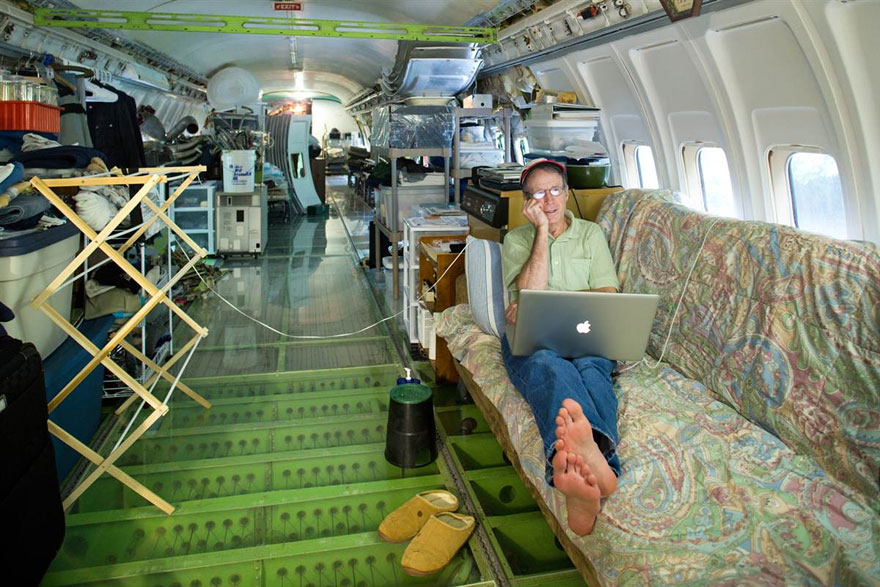
Being reminded recently that Bored Panda was a good place to look for cool stuff, I read about a guy who makes his home in an airplane.
“Bruce Campbell is an inventive engineer who bought a retired Boeing 727 aircraft fuselage and upcycled it into an unusual and innovative home. The huge 3-engine commercial airliner is propped up on concrete pillars in a suburban wooded area outside of Portland, Oregon, and has its own driveway.
“The aircraft features a makeshift shower, but he is still working to install a working lavatory and to restore some of the plane’s original interior elements, like seating and lights. Campbell lives in this plane 6 months every year, and spends the other part of the year in Japan, where he is also looking to buy and similarly re-use a retired Boeing 747 fuselage.”
Photo: John Brecher
Says plane denizen Bruce Campbell, “Shredding a beautiful and scintillating jetliner is a tragedy in waste, and a profound failure of human imagination.”
An Associated Press blurb in the Globe caught my eye today.
Here it is in its entirety: “Unity Plantation, Maine. A two-year quest by Unity College students to fit a black bear with a video collar has succeeded. The Morning Sentinel said Professor George Matula and about a dozen students trekked deep into a 4,000-acre patch of woods off Route 139 Thursday to fit the collar on a trapped bear. While one student kept the angry bear’s attention, another sneaked in from behind to deliver a shot to knock it out.”
I had to find out more. The website of Unity College, “America’s Environmental College” located north of Augusta in Waldo County, explains it wasn’t a professor-assisted prank.
“With permission from the Maine Department of Inland Fisheries and Wildlife, the Unity College Bear Study team does hands-on research to provide information on a bear population in Central Maine. Students work with faculty mentor George Matula and alumna mentor Lisa Bates ’08to tag, tattoo and radio collar bears to collect data and monitor activity.” More at Unity College, here.
But about actually collaring the bear. …
Matt Hongoltz-Hetling writes at the Kennebec Journal/Morning Sentinel, “Once Matula gave the all-clear, the students descended on the bear, intent and serious as each performed a well-defined role. They still spoke in whispers as they took blood samples, checked its vital signs and prepared to affix the all-important video collar to its neck. …
“One student, Leon Burman, cradled the bear’s head in his lap while he pulled back its lips, using a tattoo gun to leave an identification mark on the gums.
“[Student Jonah] Gula lifted the bear’s front right paw, inspecting a raw and red line defining the previous capture’s cable. Gula speculated later that it meant the bear was pulling at its snare more aggressively than most. The team treated it with a first-aid kit.” More here.
Suzanne has always admired Madeleine Albright, an interesting woman before, during, and after her stint as U.S. Secretary of State.
One thing that appeals to me about Albright is her sense of humor, a playfulness seen in the pins she collected for special occasions and to express both diplomatic — and not so diplomatic — thoughts.
The brooches on view through July 20 at her alma mater’s Davis Museum include an eagle pin that she wore to her swearing in, the serpent pin that was a response to a hostile Saddam Hussein observation, and a bee pin with a stinger to warn Yasser Arafat she was losing patience.
Jill Radsken recently toured the collection with Albright and recorded her recollectionsabout her pins, including a pin that went over like a lead balloon.
“She [recalled] her foreign policy pin faux pas when she wore a three-monkey ‘Hear no evil, speak no evil, see no evil’ set to a summer summit with Vladimir Putin. When the Russian leader inquired about the monkeys, Albright forcefully told him: ‘I think your policy in Chechnya is evil.’
“ ‘That was a time when I thought I’d made a mistake with my pin,’ she said.”
Photo: John Bigelow Taylor
Saddam Hussein published a poem calling Madeleine Albright, then ambassador to the United Nations, an “unparalleled serpent.” She decided to have fun with comment and got herself a serpent pin for her next meeting with Hussein’s officials.
Trust those Finns to come up with a crazy idea that really works.
Timon Singh writes at Inhabitat.com about a team of Finnish researchers from Aalto University and their electricity-free computer powered by water droplets.
Singh writes that the researchers “developed a new concept for computing that doesn’t require standard electric power. Instead, the team creates collisions of water droplets on a highly water-repellent (superhydrophobic) surface. The research, which was published in the journal Advanced Materials, could form the basis for tomorrow’s electricity-free computing devices.
“After a series of experiments, the team determined that the ideal conditions for rebounding water droplets on superhydrophobic surfaces required a copper surface coated with silver and chemically modified with a fluorinated compound. This allowed the surface to be so h2o repellent that water droplets rolled off when the surface was tilted slightly. Using superhydrophobic tracks, the droplets were able to be guided along designed paths.
“Using this method, the researchers demonstrated that water droplets could be used to demonstrate ‘superhydrophobic droplet logic.’ In the university’s press release, the team used the example of a memory device that was built where water droplets act as bits of digital information.”
If you aren’t deterred by the technical language, read more here.
Now I just need to know if the earth has enough water to make this green technology for computing a reality. We have an awful lot of computers.
When a do-gooder from the nonprofit Kounkuey Design Initiative told poor farmworkers at a California trailer park she wanted to work with them to build a place to relax and play, they didn’t think much would come of it.
Patricia Leigh Brown writes at the NY Times why the community is happy to have been proved wrong.
“When Chelina Odbert, the 36-year-old co-founder of the nonprofit Kounkuey Design Initiative, based in Los Angeles, showed up two years ago and asked residents to propose ideas for a park that they might design and build collaboratively, most assumed she was yet another do-gooder bearing ‘muchas promesas’ that would come to naught.
“And yet, after more than a year of drawing, debating, hauling rocks and waiting out bureaucratic delays, the residents had a fiesta recently to celebrate the opening of the park, a public space built out of railroad ties and other simple materials. It has a playground, a community garden, an outdoor stage and a shade structure where neighbors can gather and gossip even on 110-plus-degree days.
“The park, which doubles as a zócalo, or traditional town square, exemplifies a new phase for both Kounkuey (KDI for short) and the field of public-interest design, which tries to put design tools into the hands of neighbors who can create local change. …
“Alberto Arredondo, 51, lives across from the garden and has become its keeper. … Before, he said, he would come home after a day in the fields picking grapes and collapse on the sofa. The park, he added, has ‘de-stressed the women.’
“His theory was borne out by Rosa Prado, whose commitment to the park never wavered. ‘It helps with depression,’ she said. ‘You go out your door, and you see a lady in the park and sit next to her.’ She added, ‘Then a few minutes later, you forget what you’re worried about.’ ”
Photo: Monica Almeida/The New York Times Residents of all ages turn out for the opening of a new public space, by the Kounkuey Design Initiative, in St. Anthony’s Trailer Park, home to farmworkers east of Palm Springs, Calif.
Remember this post on rhubarb batteries? Well, according to radio show Studio 360, there’s no need to draw the line at rhubarb. Especially if you are creative, like photographer and artist Caleb Charland.
Julia Lowrie Henderson writes. “His series Back to Lightis inspired by that old science class experiment: if you stick a galvanized nail in one end of a potato and a copper wire in the other, it will become a battery. Charland generates enough electricity from the fruit to power the lights that illuminate his shots. He uses long exposures to take these photographs, but nothing is added digitally to the images.
” ‘My practice as an artist combines a scientific curiosity with a constructive approach to making pictures,’ Charland says. ‘I utilize everyday objects and fundamental forces to illustrate experiences of wonder.’ ”
From the Artist’s Statement on his website: “The way we understand the world relies so much on our ability to measure it. Given that many measurements are based on the proportions of the human body it’s clear we measure stuff to find our place amongst it all and to connect with it in some way.
“By exploring the world at hand, from the basement to the backyard, I have found a resonance in things. An energy vibrates in that space between our perceptions of the world and the potential the mind senses for our interventions within the world. …
“For me, wonder is a state of mind somewhere between knowledge and uncertainty. It is the basis of my practice and results in images that are simultaneously familiar yet strange. Each piece begins as a question of visual possibilities and develops in tandem with the natural laws of the world.”
More here. Click through the pictures. To my mind, citrus makes especially appealing batteries.
I live under a waterfall. You can’t get to my back door this time of year without crouching under a waterfall of dogwood. It’s especially true after a rain shower.
Bob has been supportive of my random photos, taken with a Nokia Lumia 1020 phone, so I’m emboldened to post them frequently, even when I don’t have much to say.
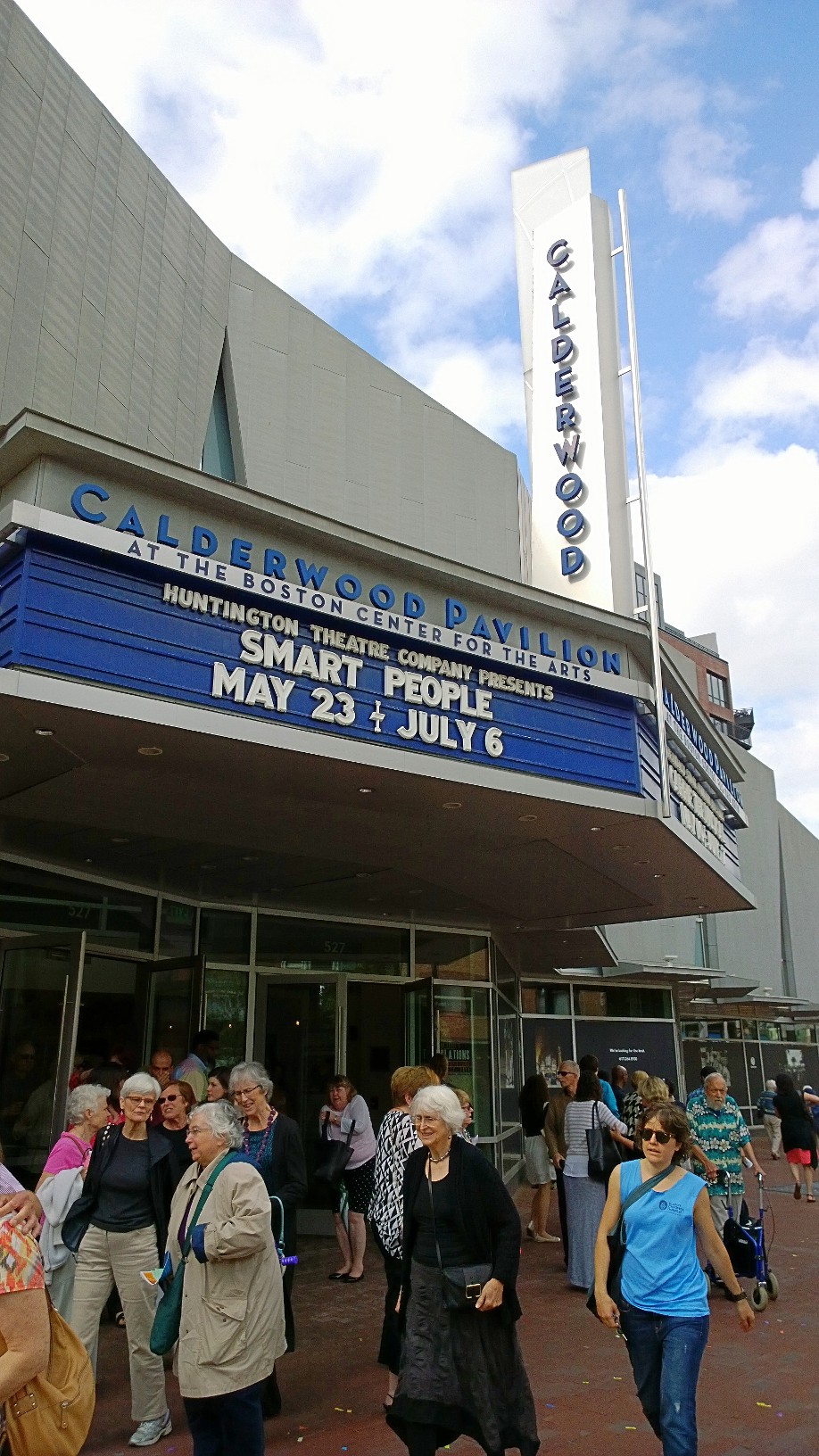
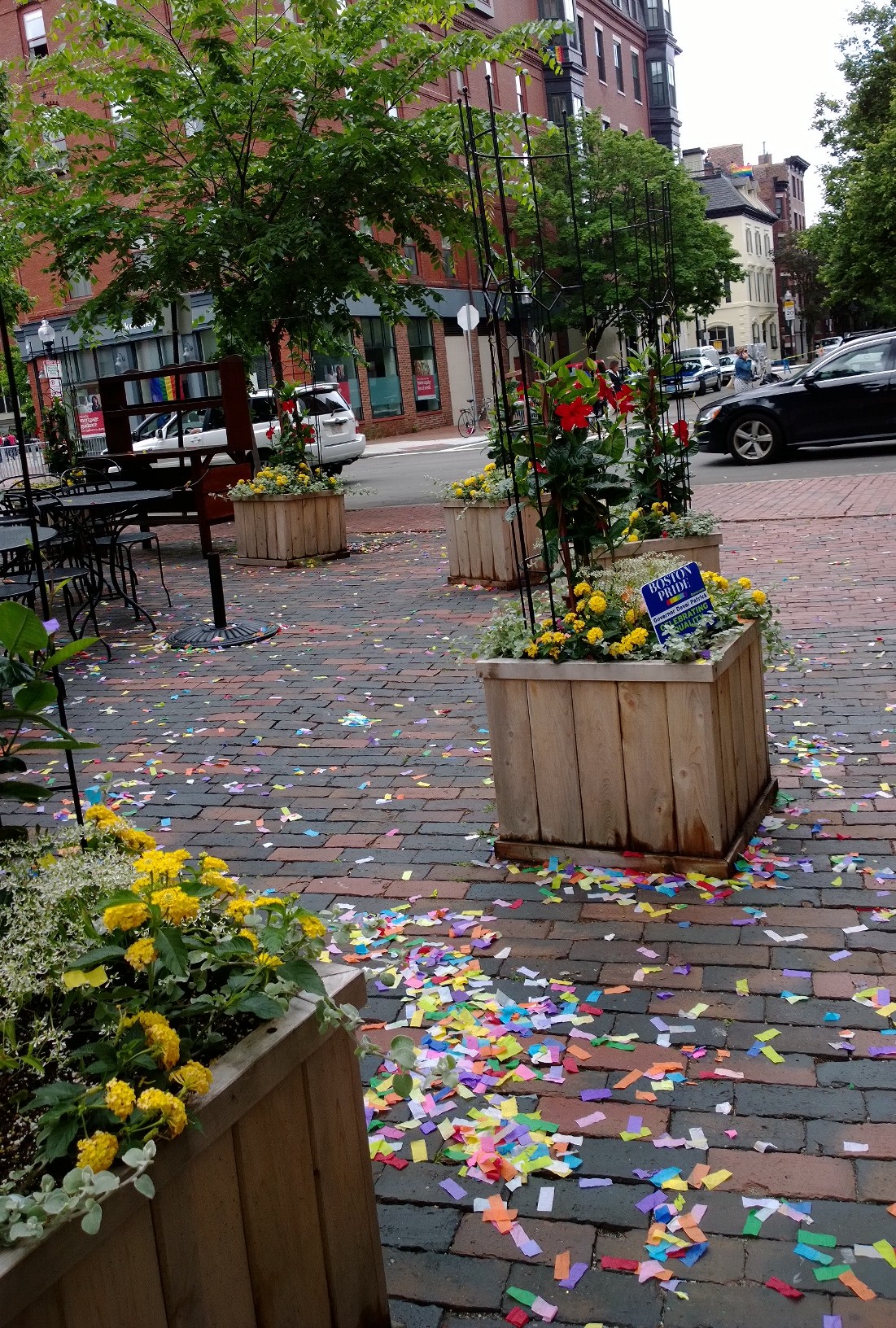
Below, you will see what else was going on in the South End yesterday when we attended a well-done play about race relations, Smart People (running through July 6).
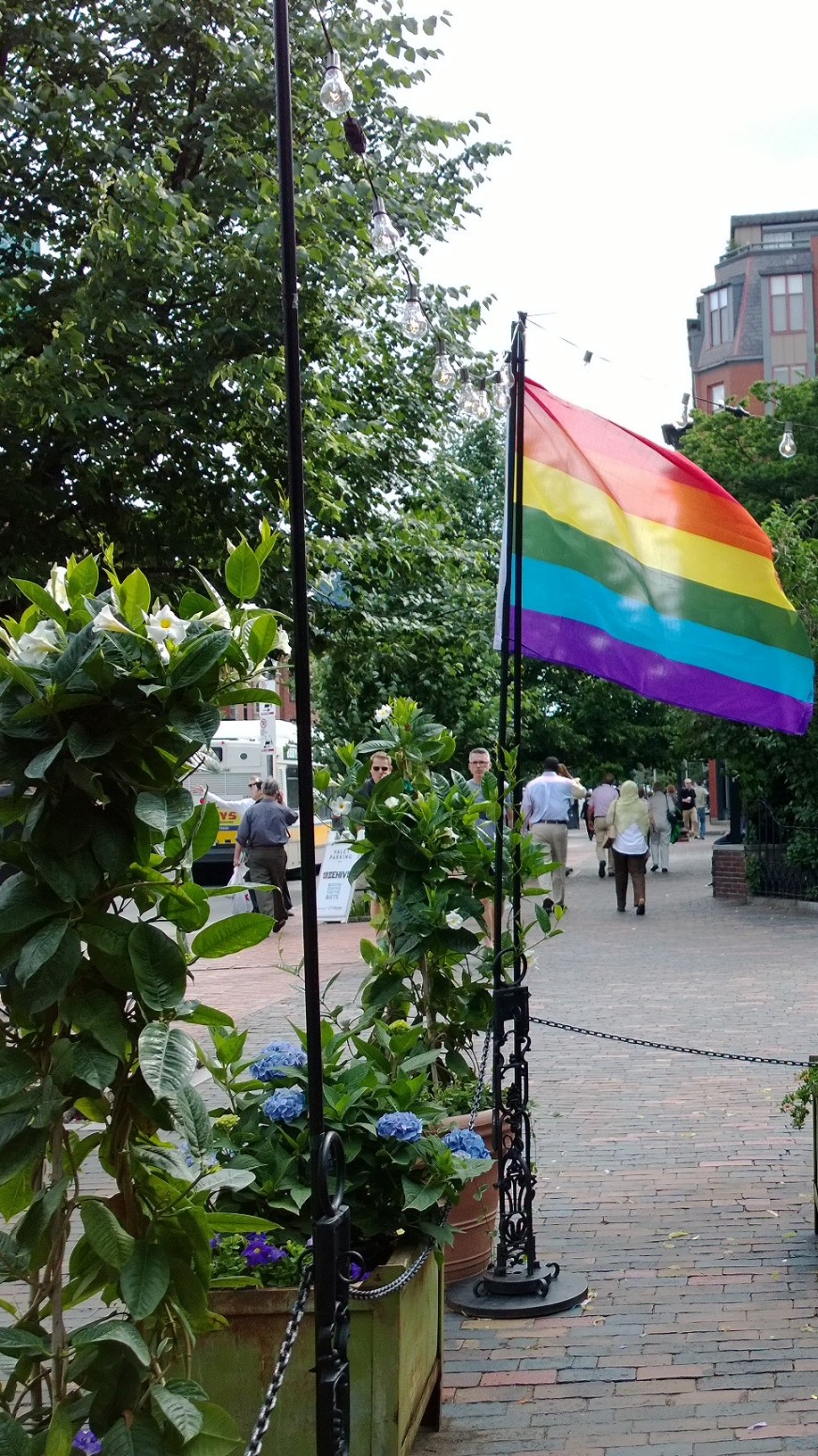
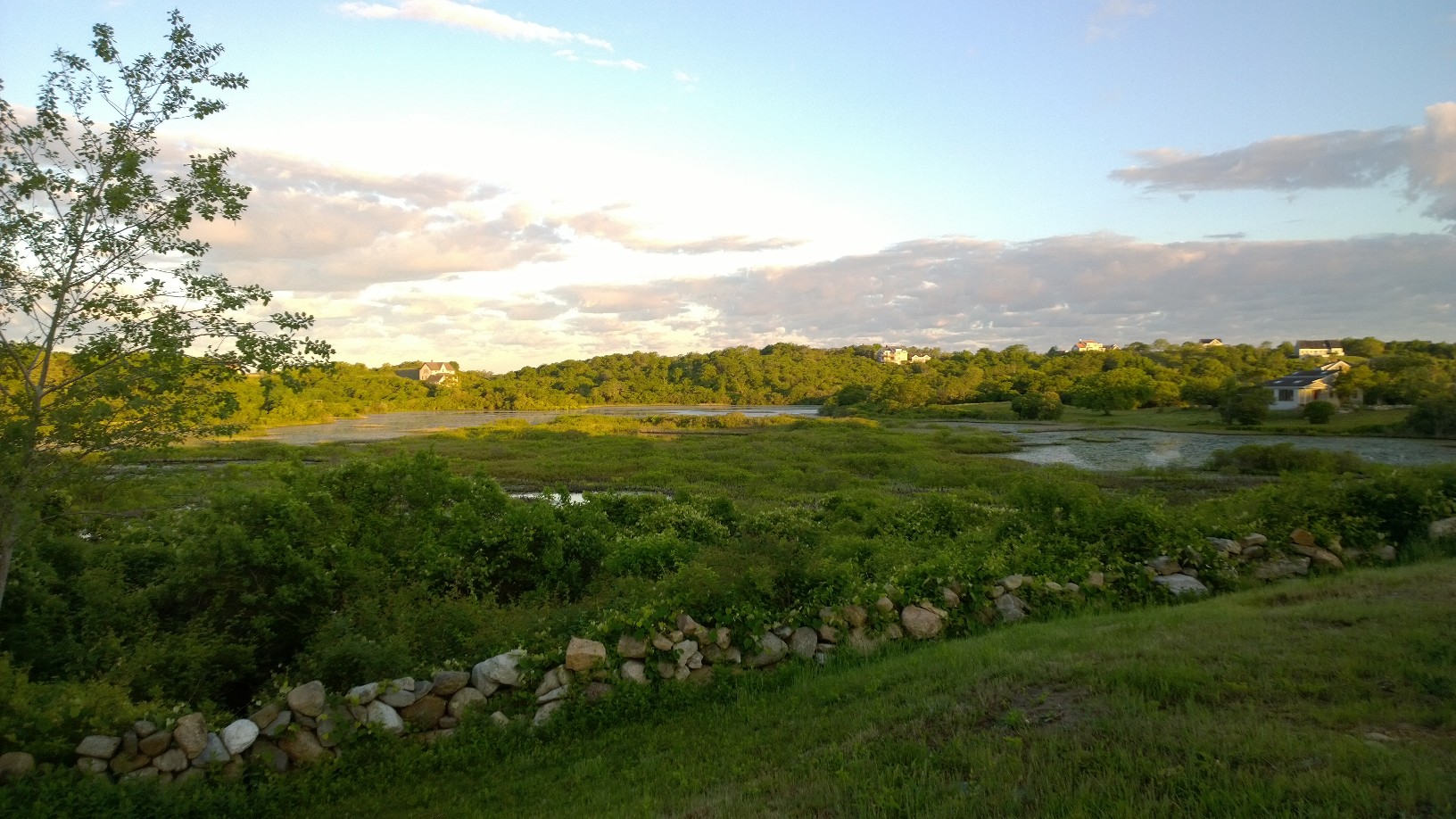
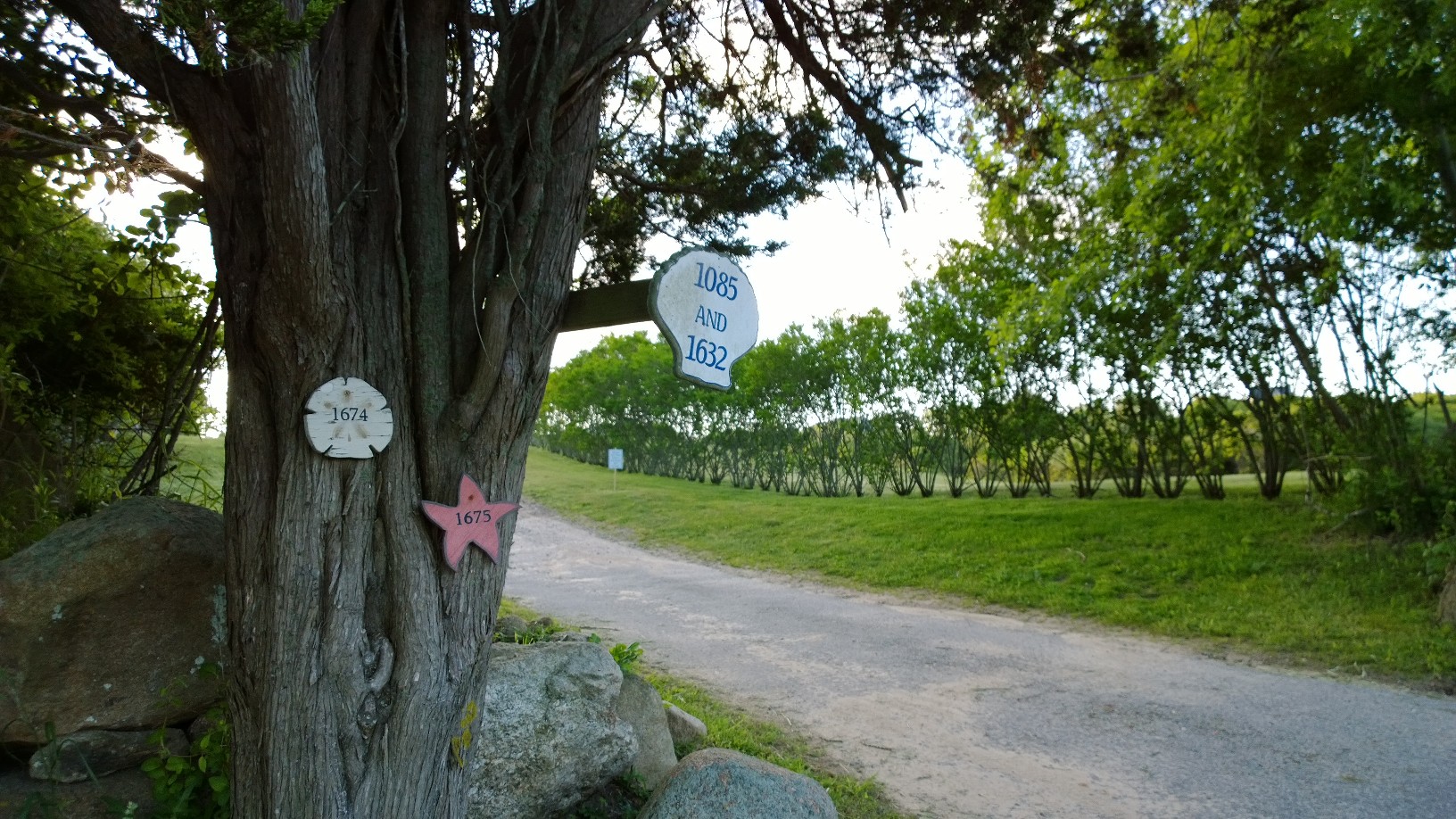
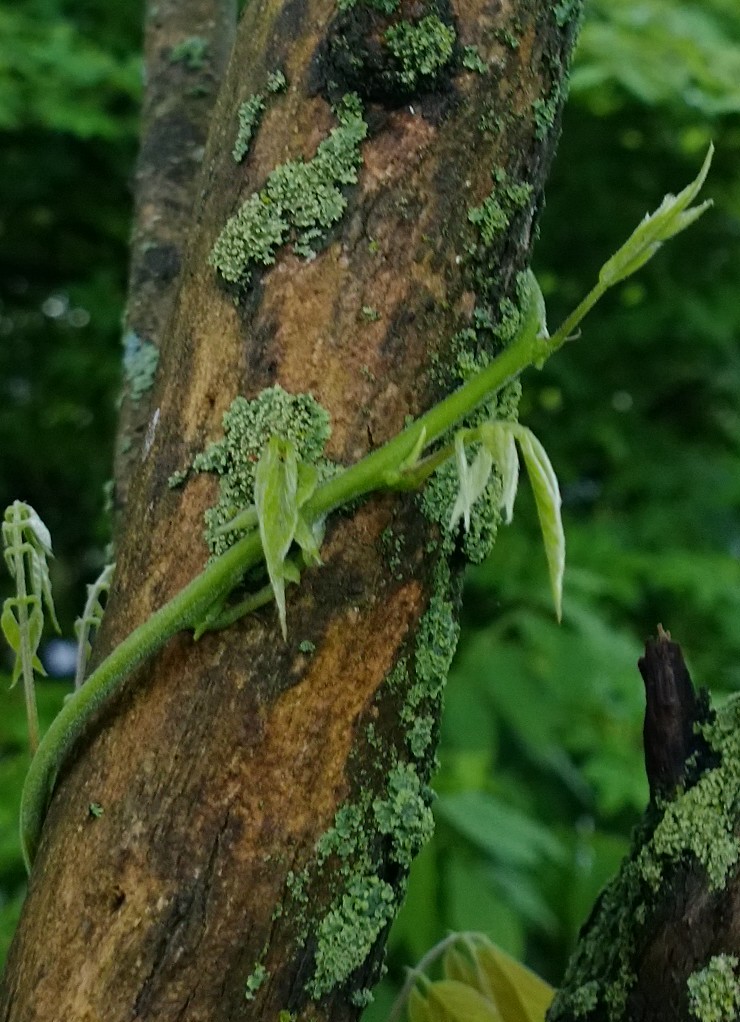
You will also note that I got interested in a climbing wisteria vine, typical Boston pedestrians in period dress, sunrise in Rhode island, and house numbers there that caught the spirit of the seashore.
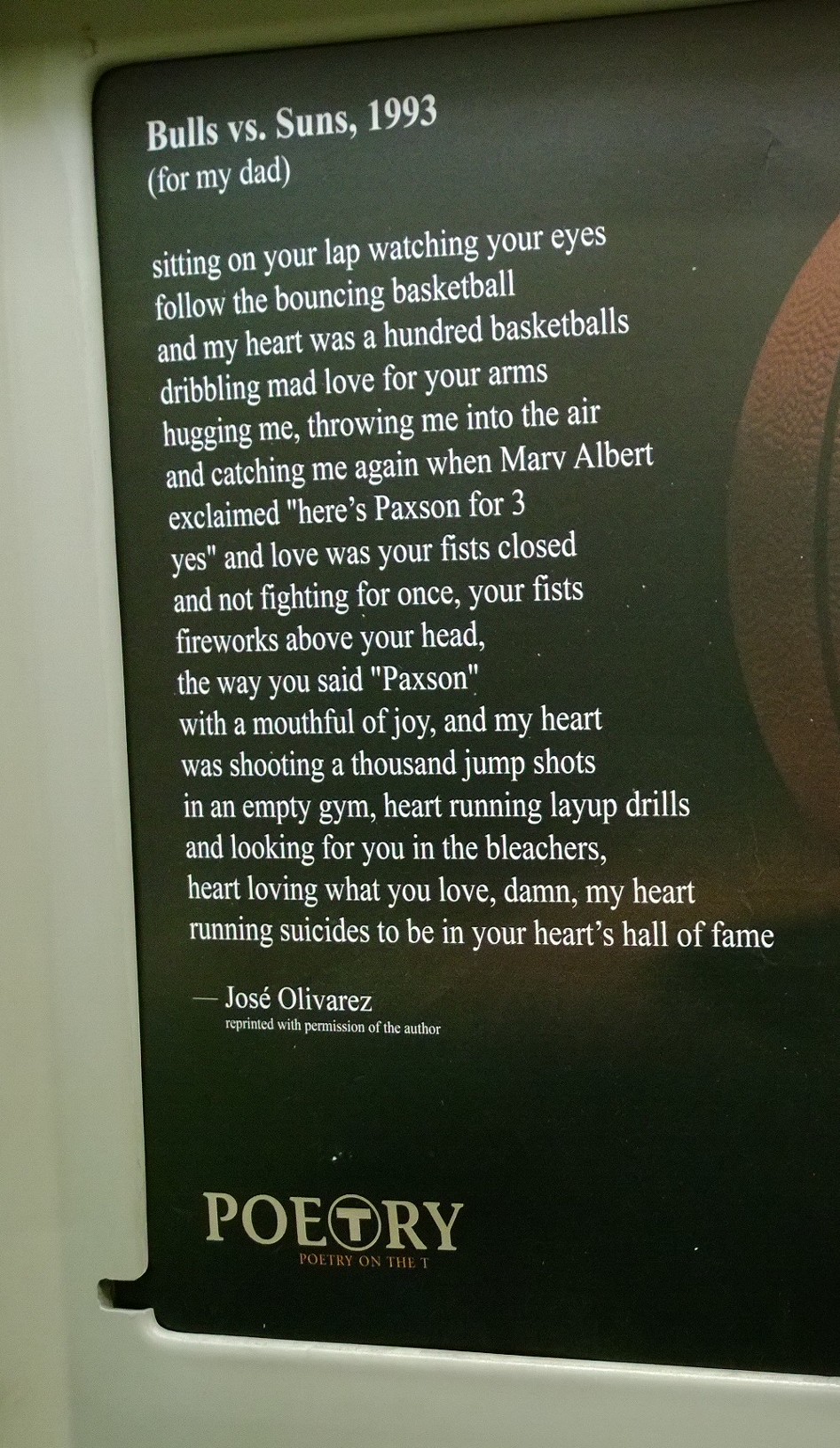
I was always impressed when I saw a poem in the place of an ad in the New York City subway. Now Boston has caught on.
Martine Powers wrote recently at the Boston Globe, “Finally, Bostonians will have the chance to experience the pleasures of poetry on the MBTA.
“Mass Poetry [is] bringing poems to advertisement spaces on subway cars. The initiative, dubbed PoeTry, is part of the organization’s Poetry in Public Spaces initiative, which began last year, said Mass Poetry program director Laurin Macios…
“ ‘Contemporary poetry is barely taught in schools, and often when it is, it is taught in a very scholastic sense instead of an artistic one,’ Macios said. “People often grow up without ever realizing there is poetry out there that can speak to them, or that they can speak back to. …
“Each appearance of a poem includes a tearsheet on the corner of the sign, allowing passengers to take a copy of the poem with them if the spirit strikes them.”
One poem in the series, says Powers, “What Travels,” by Joseph O. Legaspi, takes place on a subway car. “What travels beneath their secret faces? What is train but transport to other lives?” More at the Globe.
The independent bookstore where I live is assuming the whole town knows that the publisher Hachette is fighting with Amazon. I say that because it has devoted a whole window to Hachette books, with a statement about carrying any book you want but no statement about the Amazon fight.
Amazon may finally have gone too far. People are fighting back against its absolute power. Asakiyume, for example, is practically a one-woman campaign to get its warehouse staff better working conditions.
And there are other initiatives. Jennifer Rankin writes at the Guardian, “Independent booksellers are being sent reinforcements in the battle against Amazon …
“My Independent Bookshop, a social network for book lovers from PenguinRandom House, [is] an online space where anyone can review their favourite books and show off their good taste on virtual shelves.
“Crucially, readers can also buy books from the site, with a small proportion of takings going to support scores of local independent book stores. …
“A reader’s nominated home store – which doesn’t have to be geographically close – will get 5% of the revenues from every physical book they buy and 8% on an ebook. The site is a tie-up with the e-commerce website Hive, which has been offering a similar service to local shops since 2011.”
Read more at the Guardian, here. Check out the lively comments there, too.
Photo: Sarah Lee for the Guardian
The new Penguin Random House may give independent booksellers a boost in online sales.
My, but we work hard at the office. At 4 today, everything stopped and we went to the break room to watch the World Cup. A co-worker from Ghana called his brother. Everything had stopped in Ghana, too.
In honor of the world’s fascination with soccer today, I am posting a futbol story from Bill Littlefield’s radio show Only a Game.
At the show’s website, Ellis O’Neill describes an encounter he had with homeless soccer: “It’s 9 p.m. and the sun went down long ago, but that’s not stopping this group of about 20 young men from playing soccer under the bright lights of a turf field in Puente Alto, a poor suburb to the south of Santiago, Chile.
“Homeless Soccer aims to offer the benefits of sports to Chile’s homeless. It’s been so successful that, over the past eight years, it’s grown from one team that practiced in one Santiago park to almost 100 teams all over the country.
“Domingo Correa is a longtime participant in Homeless Soccer. He first joined back in 2011, and his nickname is Jack Sparrow. With his long dreadlocks and beard, his piercings and rings and his high, sharp cheekbones, he lives up to the name. But Correa doesn’t have a pirate ship, much less any treasure. For 15 years, he lived on the streets of Santiago.
“ ‘There’s no way out, you know?’ Correa said. ‘You think everything has been lost. You have no hope of finding stable work. Also, I had been involved in crime, so I had “stained papers,” as we say here: I had a criminal history. The distance between society and living on the street is enormous.’
“One day, while Correa was watching a Homeless Soccer practice in a Santiago park, the team’s psychologist invited him to join in. He decided to take a stab at it, and he liked what he found. For the first time, there was a group of people that was always there for him – every Monday and Wednesday evening on the soccer field.”
 Here are a few recent photos. The owner of the fish car showed up as I was taking the picture, so I heard the artist’s story. He threw a party and provided his friends with every shade of adhesive-backed vinyl and pairs of scissors. And they cut small pieces to create a kind of mosaic of the fish, the sea, the goldfinch on the mirror, and so on.