Feeds:
Posts
Comments

Archive for the ‘Uncategorized’ Category

My friend Jean Devine is always up to something interesting. A Brown U grad, with an MBA from Simmons, she used to work in investor relations but in recent years has been testing the waters of social entrepreneurship.

Her latest initiative, with Barbara Passero of Sandpiper Creative, is called meadowscaping and is intriguing on many levels.

With access to a Waltham church lawn for a summer youth program, Jean and Barbara will work with kids to convert the yard into a meadow that uses native species from Garden in the Woods and provides a habitat to the bugs and other small creatures that make a healthy environment.

From the Meadowscaping for Biodiversity website: Meadowscaping “is an outdoor, project-based, environmental education program that provides middle school youth with real-world experiences in STEAM learning (Science, Technology, Engineering, Arts and Math), while inspiring and empowering them to address challenges to the environment and our society.

“Today, few children spend time experiencing Nature and the benefits of outdoor recreation, education, and contemplation. Founder and former Director of the Children and Nature Network (C& NN) Richard Louv coined the phrase nature-deficit disorder to describe the negative effects of reduced outdoor time on children’s development. …

“Children who spend little time outdoors may value nature less than children who spend time outdoors in free play. Similarly, children who feel part of something bigger than themselves may … understand their dependence on a clean environment and know that they are responsible for caring for the Earth as their home.” More here.

The idea behind the meadowscaping summer program is that children, both at a young age and as they become adults, can actually do something about the environment.

Remember our post “The Doctor Is In” about the woman who sets up in a Providence park to listen to your worries about global warming (here)? Stop worrying and do something, say the meadowscape entrepreneurs. Give up lawn chemicals, plant a meadow, provide a home for tiny necessary critters, and work to make change.

white-iris-in-morning

Read Full Post »

When I was a teacher in Pennsylvania hoping to get accreditation, a supervisor from the teachers college where I took classes came to observe me at work. It was quite a long time ago, and the only thing I recall is that he remarked that I needed to do more with my classroom bulletin boards.

There I was, trying to do creative things with 11-year-olds in language arts (the play within the play from A Midsummer Night’s Dream springs to mind), but his checklist required him to observe the bulletin boards.

So imagine my delight when I saw an article today about a study suggesting teachers may be putting too much emphasis on bulletin boards and wall decorations.

Jan Hoffman writes at the NY Times, “That bright, cheery look has become a familiar sight in classrooms across the country, one that has only grown over the last few decades, fed by the proliferation of educational supply stores. But to what effect?

“A new study looked at whether such classrooms encourage, or actually distract from, learning. The study … found that when kindergartners were taught in a highly decorated classroom, they were more distracted … than when they were taught in a room that was comparatively spartan.

“The researchers, from Carnegie Mellon University, did not conclude that kindergartners, who spend most of the day in one room, should be taught in an austere environment. But they urged educators to establish standards.

“ ‘So many things affect academic outcomes that are not under our control,’ said Anna V. Fisher, an associate professor of psychology at Carnegie Mellon and the lead author of the study, which was published in Psychological Science. ‘But the classroom’s visual environment is under the direct control of the teachers. They’re trying their best in the absence of empirically validated guidelines.’ ”  Hence the impetus for the study. Read more here.

Photo: Psychological Science
In a new study, 24 kindergartners were taught in two classroom settings: one unadorned, the other decorated with posters and artwork.

Read Full Post »

Here’s an unusual approach to art. Christopher Bollen at Interview magazine has the story.

“Since 2005, the 41-year-old [Marie] Lorenz has been navigating New York Harbor in her handmade plywood-and-fiberglass boat, taking friends, artists, and willing participants on nautical odysseys of the city’s rivers and islands.

“The project, Tide and Current Taxi … has its roots in multiple artistic practices — from traditional Romantic seascape and marine painting to more radical iterations of performance art …

“It helps that the Brooklyn-based artist, who could command a boat by the age of 6, is an adventurer at heart — the kind of avant-garde pioneer more often found on Manhattan’s dry land than in its surrounding waters. Lorenz has extensive knowledge of the city’s waterways. ‘When I got to New York, I realized that the tides were significant,’ she says. …

“Lorenz uses the tides like a motor to propel her boat, as well as the time-trusted manual labor of paddling. She usually sits at the stern, with passengers facing forward at the bow and in the middle.  …

“The boat trips themselves are often captured on video by a waterproof digital camera fixed to a metal pole jutting up from the stern. The camera’s eye is in the position of fellow traveler or a Charon-like ferryman through the derelict metropolis. Perhaps what is most arresting about her work is the way it destabilizes our usual perception of the city itself — specifically the hypnotic rocking of the Manhattan skyline.

” ‘You usually see the city on solid ground,’ Lorenz says. ‘I think when you’re floating, you see differently, your vision expands. You get to see the city from an in-between zone.’ ”

More here.

Sebastian Kim

Read Full Post »

I love reading about and sometimes seeing offbeat and experimental theater. You may recall a couple recent posts on Iranian productions, for example — one play performed in a taxi, and another featuring a script the actors aren’t allowed to see until it’s time to go on stage.

So I was intrigued by a story in the Guardian about an experiment with one-on-one productions. Lyn Gardner writes, “Earlier this year I was lucky enough to take part in Whispers, a project created by the Exeter-based Kaleider, that takes the form of a co-operative gifting chain of performance, as a story and a metal tablet pass from person to person who each take responsibility for passing it on.

“At the Brighton fringe something similar is taking place with Host, a project created by the Nightingale Theatre that takes place in one of two bathing huts. Taking the form of a short text written by Tim Crouch … it works like this: You enter the bathing hut and somebody performs the text to you, and then you perform the text – reading from the script – to the next person.

“All participants subsequently get sent a copy of the script via email. This means that they can set off their own chains of reading and receiving, which creates in effect a tree that then has branches going off from it but which are all traceable back to that first performance by Tim Crouch in Brighton. It’s like a baton being passed.” More here.

This week, I’m having dinner with three other women who have at various times been active in the Concord Players. We meet up a couple times a year to indulge in theater talk as most of our other friends are not into that. I’ll be sure to pass along some of these experiments. The Concord Players isn’t a place that indulges in avant garde, but we all like hearing about what’s going on in the wider world.

“Host,” a one-on-one play at the Brighton Fringe Festival in England, is performed in this bathing hut.

Read Full Post »

potentilla


There are still some unspoiled parts of Rhode Island, and a fine day in June,  before the crowds of summer, is an ideal time to appreciate it.

Here are a few Rhode Island photographs for you.

060714-iris


sunny-RI-morning-060714

boat-hulls-blue-sky


Read Full Post »

I love the staircases from around the world that are posted at Catraca Livre. Wish I could remember where I got this link. Andrew Sullivan? Twitter? This Is Colossal? It’s been a while since I saw it.

I picked the staircase with the koi fish to show you, but there are 16 other amazing staircases at the site. The website is based in Brazil and run by Gilberto Dimenstein. I can’t read the Portuguese. If you can, let me know what it says?

“Muitas pessoas fazem o possível para fugir do esforço de subir alguns degraus. Mas para alguns artistas de rua, elas são fontes de inspiração para suas criações. O site BoredPanda listou 17 escadas ao redor do mundo que são verdadeiras obras de artes a céu aberto.”

OK. I guess the pictures originated at Bored Panda, a site we blogged about once before. You should check that, too.

More staircases here.

Photo: http://queminova.catracalivre.com

Read Full Post »

Someone has finally recognized seaweed for the artistic creation it is.

That someone is Josie Iselin, whose book An Ocean Garden: The Secret Life of Seaweed was reviewed by Dana Jennings in the NY Times Science section Tuesday.

Jennings begins, “The secret to finding unsuspected beauty, artists and naturalists will tell you, is in knowing how to slow down and really look. The writer and photographer Josie Iselin certainly knows how to do that, as she shows in her beguiling new book, An Ocean Garden.

“In her introduction Ms. Iselin … writes, ‘I fell in love with seaweed at the kitchen counter.’ (She would bring back samples and study them there.) And it vexes her that others don’t share in her tidal pool crush. …

“The 100 color photographs here, though, just might convince some people …  The book focuses on seaweeds found in Maine and California, both states she has lived in; the species names tickle the tongue in the same way that the seaweeds themselves can tingle bare feet: knotweed and bladderwrack, bull kelp and green scrap, pepper dulse and sugar kelp, Turkish towel and Irish moss.” Read more about the book, here.

We’re headed to the beach this weekend with John and his little ones. Maybe we will be able to identify some seaweeds there.

Photos: Josie Iselin
Clockwise from top left, seaweeds from Josie Iselin’s new book: Macrocystis, Ulva lobata, Calliarthron tuberculosum, Egregia menziesii, Gloiosiphonia verticillaris and coralline algae.

Read Full Post »

Schools are not putting as much emphasis on handwriting as they used to, given the growing use of electronic devices, and that can be a good thing in some ways. (As a teacher, I was bored witless checking penmanship workbooks.)

But guess what. The Law of Unintended Consequences is rearing its head.

Maria Konnikova writes at the NY Times, “Psychologists and neuroscientists say it is far too soon to declare handwriting a relic of the past. New evidence suggests that the links between handwriting and broader educational development run deep.

“Children not only learn to read more quickly when they first learn to write by hand, but they also remain better able to generate ideas and retain information. In other words, it’s not just what we write that matters — but how. …

“A 2012 study [published in Trends in Neuroscience and Education] led by Karin James, a psychologist at Indiana University, lent support to that view. Children who had not yet learned to read and write were presented with a letter or a shape on an index card and asked to reproduce it in one of three ways: trace the image on a page with a dotted outline, draw it on a blank white sheet, or type it on a computer. They were then placed in a brain scanner and shown the image again. …

“When children had drawn a letter freehand, they exhibited increased activity in three areas of the brain that are activated in adults when they read and write … By contrast, children who typed or traced the letter or shape showed no such effect. ” More here.

Konnikova reports that even doubters of the study’s significance wonder if the act of writing by hand makes you think more.

Photo: Karin James
Samples of handwriting by young children.

Read Full Post »

flowers-in-lobby

flowering-4th-floor-roof


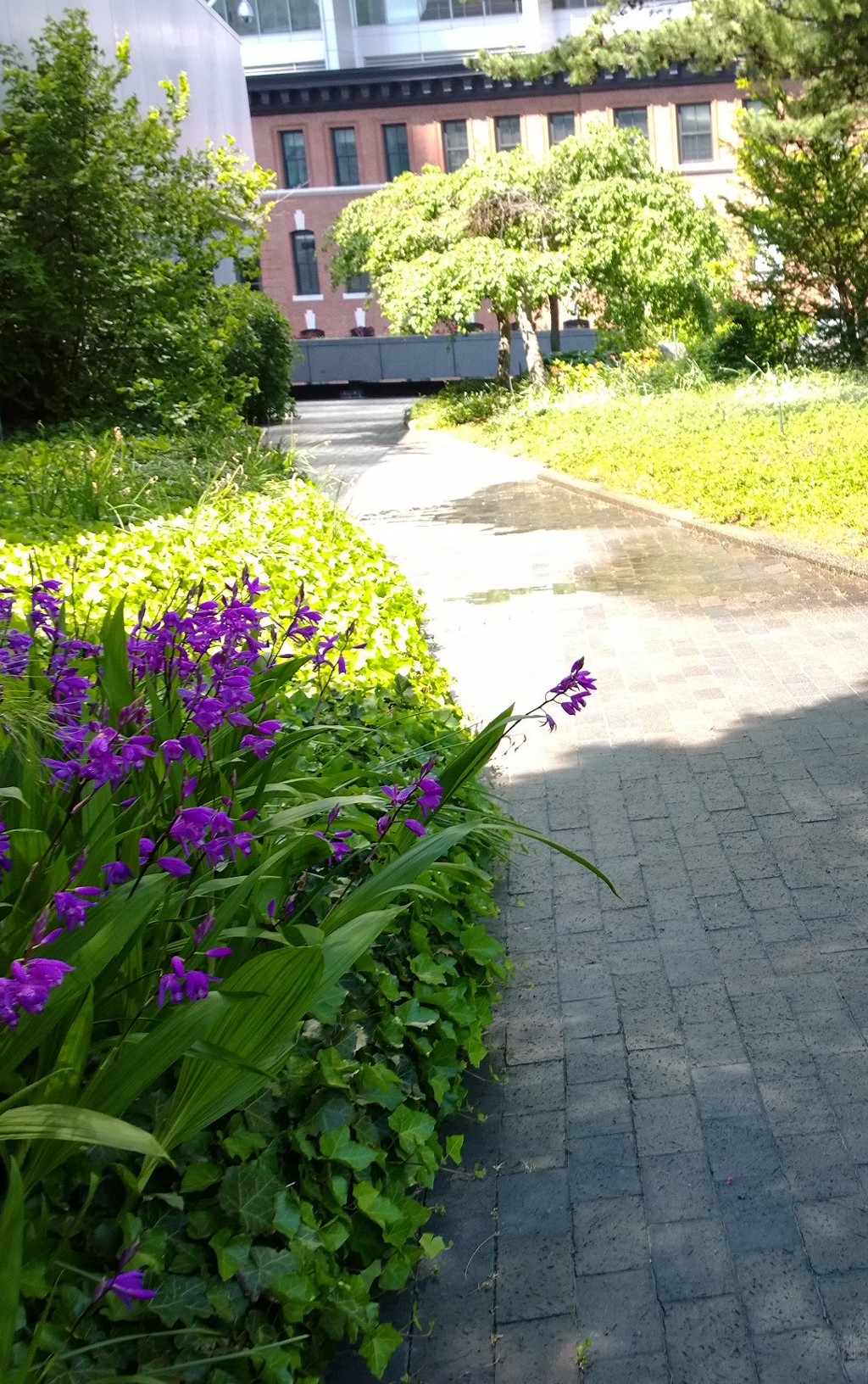
roof-garden-at-office-buildingHere are some photographs from Greater Boston this spring.

The first three represent the work of an exceptional landscaper in an office building downtown.

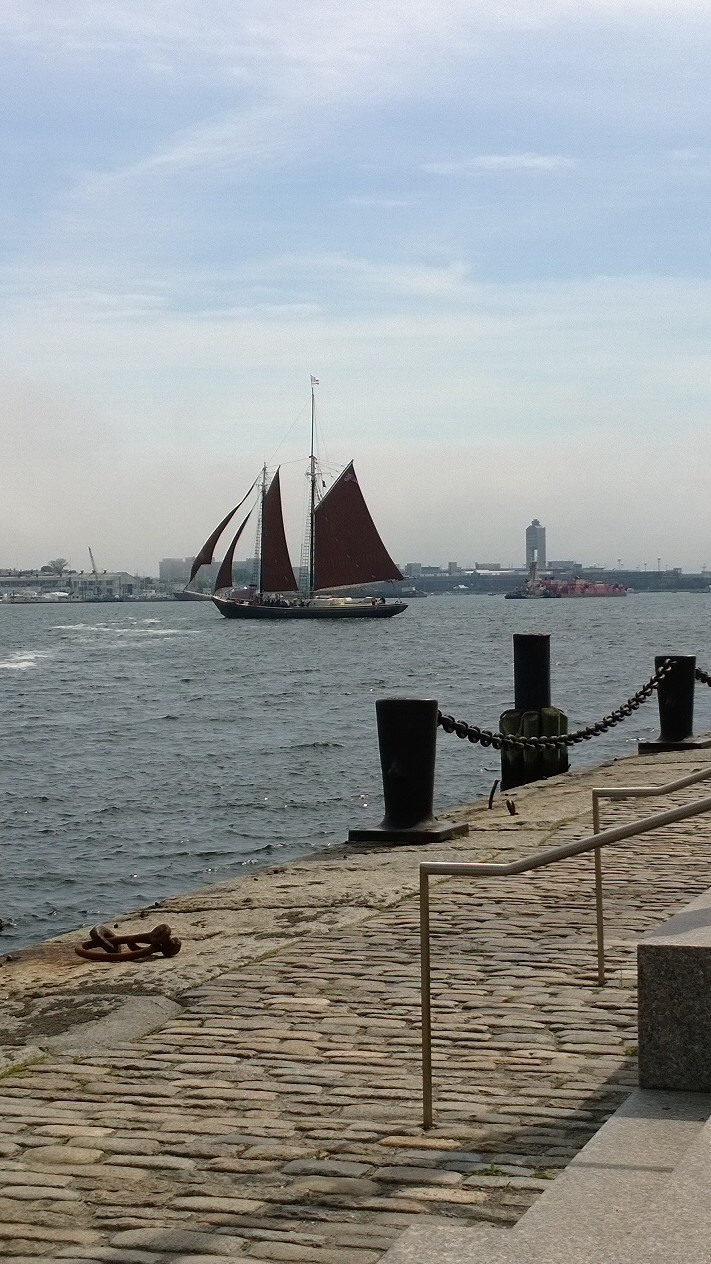
I also want to show you that the Barking Crab may be surrounded by construction in the Seaport District but is still open for business. There’s a tall ship in the Harbor. The blue whale in the Greenway carousel is ready to ride, and the Greenway demonstration garden is producing strawberries. The Dewey Square farmers market has plenty of produce and flowers.

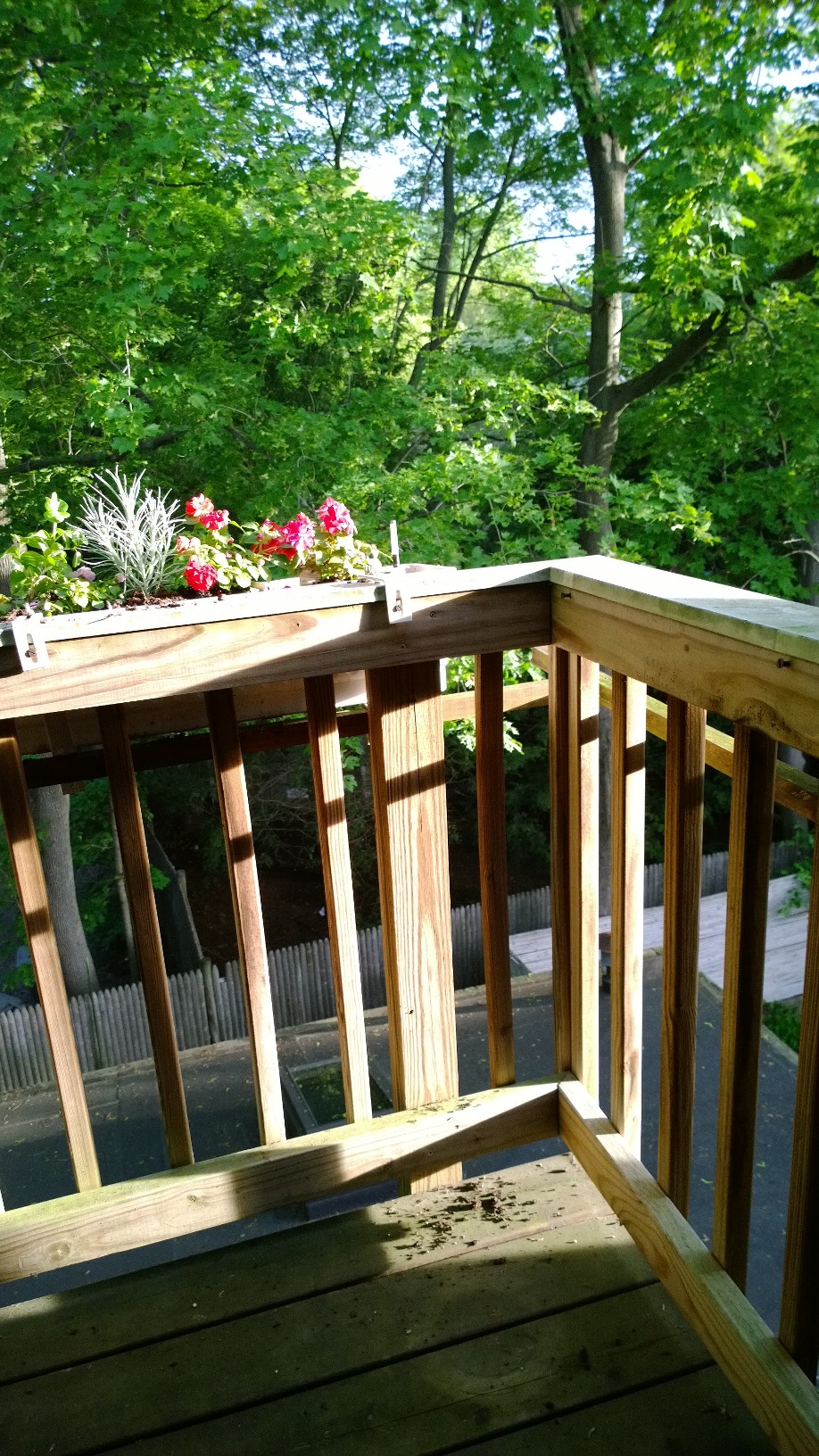
I threw in the third-floor balcony at home.


barking-crab-boston

may27-2014-boston-harbor-sailing


blue-whale-and-carousel

060314-farmers-market


urban-greenway-grows-strawberries

balcony-early-morning


blooming


Read Full Post »

Sindya N. Bhanoo writes at the NY Times about a surprising discovery under the waters of Lake Huron.

“A 9,000-year-old stone structure used to capture caribou has been discovered 120 feet beneath the surface of Lake Huron. Researchers say it is the most complex structure of its kind in the Great Lakes region. …

“The remarkable structure consists of a lane with two parallel lines of stones leading to a cul-de-sac. Within the lines are three circular hunting blinds where prehistoric hunters hid while taking aim at caribou. …

“The site was discovered using sonar technology on the Alpena-Amberley Ridge, 35 miles southeast of Alpena, Mich., which was once a dry land corridor connecting northeastern Michigan to southern Ontario.

“In their paper in the Proceedings of the National Academy of Sciences, the researchers suggest that the hunting structure was used in the spring, when large groups of hunter-gatherers assembled.”

Hard to imagine life 9,000 years ago. Anthropological archaeologists have the best fun. More here.

Photo: University of Michigan via Associated Press

Read Full Post »

As a child, I used to go to my father’s college reunions. All very rah-rah. Now I go to my husband’s at Haverford, which are more self-deprecating and lend themselves to funny stories about football players having to go through the cafeteria line and beg bookworms to come scrimmage.

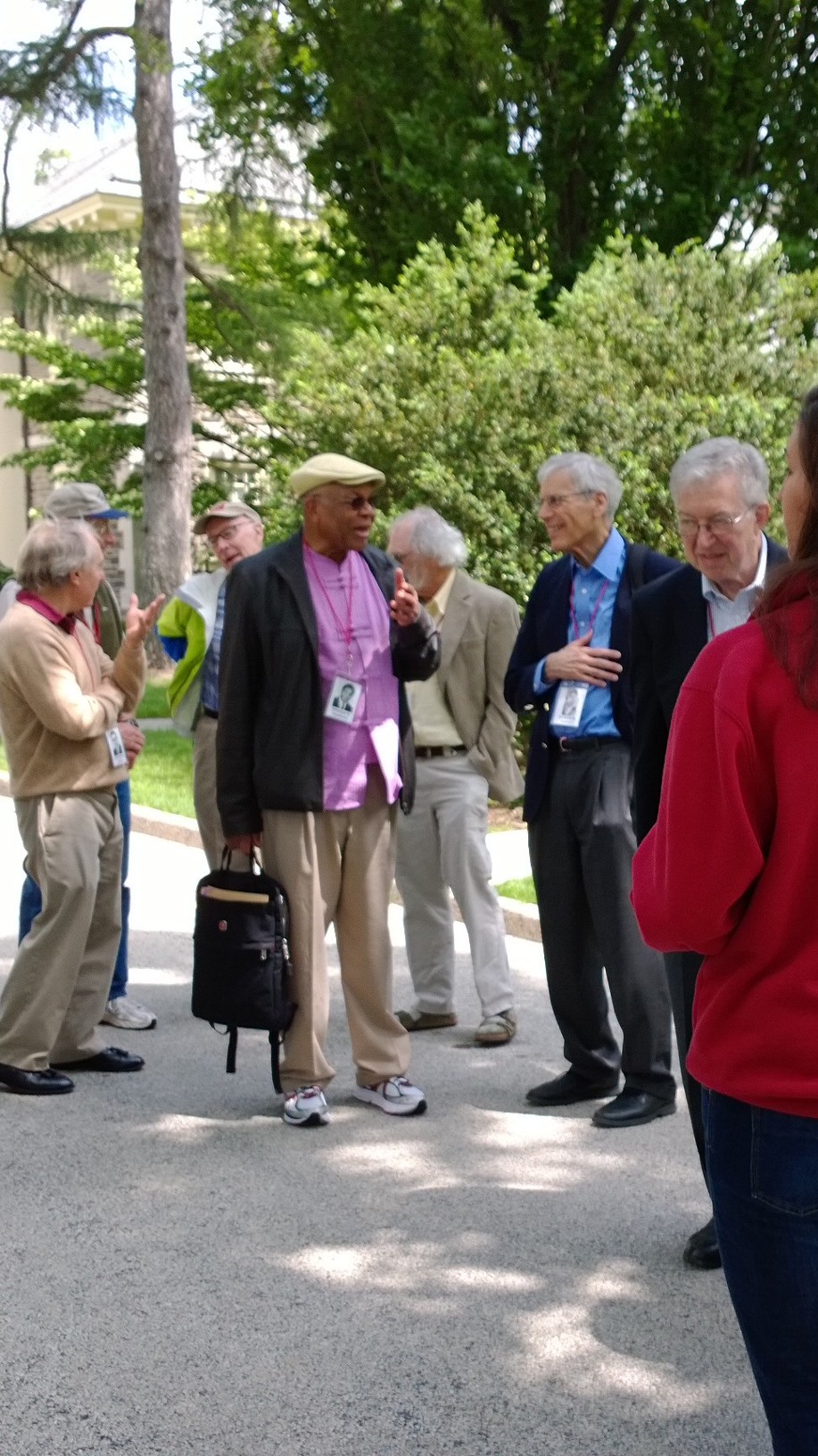
I spent the weekend pondering whether the more-aged classmates got that way because they quit work or quit work because their health failed. And — amid conversations with people I never see, stimulating panel talks, green-green lawns and trees with nameplates, funny speeches and boring speeches, catching up with a friend who married one of the engineering majors, taking a campus tour, and attending a Quaker memorial service for the deceased classmates — wondering if I would go to my own when it comes around.

053014-campus-tour043114-Haverford-renunion


signs-on-trees

Read Full Post »

At my husband’s college reunion yesterday, we heard a former classmate talk about a wonderfully innovative school he founded  in San Diego (High Tech High).

After hearing that a fairly typical class project was developing a genetic bar code to identify endangered species in the bush, my husband wondered how such an inventive school can function in today’s teaching-to-the-test world. I myself figured that whatever the kids absorb from meaningful projects and cutting-edge teaching they absorb deeply enough to pass tests if they need to.

And when I think of the lengths to which test mania is going, I think more schools should learn from High Tech High. Consider the latest testing aberration: robots grading essays.

Les Perelman at the Boston Globe gives examples:

” ‘According to professor of theory of knowledge Leon Trotsky, privacy is the most fundamental report of humankind. Radiation on advocates to an orator transmits gamma rays of parsimony to implode.‘

“Any native speaker over age 5 knows that the preceding sentences are incoherent babble. But a computer essay grader, like the one Massachusetts may use as part of its new public school tests, thinks it is exceptionally good prose.

“PARCC, the consortium of states including Massachusetts that is developing assessments for the Common Core Curriculum, has contracted with Pearson Education, the same company that graded the notorious SAT essay, to grade the essay portions of the Common Core tests. Some students throughout Massachusetts just took the pilot test, which wasted precious school time on an exercise that will provide no feedback to students or to their schools.

“It was, however, not wasted time for Pearson. The company is using these student essays to train its robo-grader to replace one of the two human readers grading the essay, although there are no published data on their effectiveness in correcting human readers.

“Robo-graders do not score by understanding meaning but almost solely by use of gross measures, especially length and the presence of pretentious language. The fallacy underlying this approach is confusing association with causation. A person makes the observation that many smart college professors wear tweed jackets and then believes that if she wears a tweed jacket, she will be a smart college professor.” More here.

Uh-oh. Sounds like the children’s book Petunia. Fortunately, a timely explosion taught the silly goose that books have pages you need to read, that carrying a book under your wing doesn’t make you smart.

More explosions needed.

Photo: blog.spoongraphics.co.uk

Read Full Post »

Barnes-3


Barnes-waterfall

Today I need the Indian goddess with the many arms because I want to say about the Barnes Collection in its new home, “On the one hand, on the other hand, on the third hand …”

After I saw the documentary The Art of the Steal, about how the fabulous art collection that was willed to a historically black college to keep it from art-world experts ended up in the hands of art world experts, I thought a trustee at Lincoln University had sold his patrimony for a mess of pottage. Now I think that receiving untold wealth is a curse and the donor better have a good plan and lots of resources to support the unfortunate recipient. (More about the movie.)

That’s two hands.

On Thursday, having visited the Albert C. Barnes collection in its new Philadelphia Museum of Art building, I needed a few more hands.

On the third hand, the building is gorgeous in its simplicity and displays the art (69 Cezannes, anyone? How about 60 Matisses? 44 Picassos? 178 Renoirs? Do you love Seurat? Van Gogh? Pennsylvania Dutch furniture?) in the quirky layout of the old Merion, Pa., setting and without labels as Barnes did. On the fourth hand, lack of labels is annoying. On the fifth hand, the art experts provide an ipod with lectures on selected works and a booklet to identify all the items exhibited. On the sixth hand, faithful as the layout is, Dr. Barnes, who made his money in pharmaceuticals and wanted ordinary working families to enjoy and study art without the filter of the art establishment — would have had a heart attack about the entry fee and the standard gift shop and coffee shop and other luxurious museum appointments.

The museum is definitely worth seeing, for the building, the art, and the way the roaring controversy was all handled. But it’s the little things I will cherish like finding black and white illustrations that reminded me of Dickens illustrations and turned out to be by the school friend Barnes asked to help form his taste and get him started on collecting (William Glackens).

Giorgio de Chirico, Portrait of Albert C. Barnes, 1926

Read Full Post »

We watched Only When I Dance on Netflix last weekend, and afterward my husband did a Google search on the dancer who won the awards.

(The other dancer was heartbreaking. She was told that because she was black, there would be no opportunity in Brazil to join a company and she’d have to win a place abroad. Abroad, they told her she weighed too much — even though she was quite slender. Her family was poor and sacrificed everything for her.)

Dancer Irlan Silva ended up at the Boston Ballet.

James H. Burnett III wrote about him for the Globe. “At 23, Silva is a rising talent with Boston Ballet. But six years ago he wasn’t sure whether he’d even live long enough to see his dream of a career in ballet come to fruition. …

“Where he came from — a gritty favela in Rio de Janeiro — was documented in a critically acclaimed 2009 documentary called Only When I Dance, in which Silva and another dancer from the slums of Rio, Isabela Coracy, battle the odds in pursuit of their careers. Favelas, shanty towns that surround the city, are rife with poverty and violence. …

“Silva’s interest in ballet developed when he attended a professional performance at the age of 10. ‘I was hooked immediately,’ he says.

“He says his natural flexibility and leaping ability carried him until he was able to receive formal training, but not every flexible would-be dancer in Brazil was able to land a spot in Centro de Dança Rio, the nation’s premier ballet school.

“ ‘My teacher — a great teacher — Mariza Estrella  is responsible for inspiring me and pushing me on my way, out of the nest.’ …

” ‘Ballet can be expensive,’ he says. ‘My mother ran a cafe from her home. She still does in the same place. And she just made sure I had whatever I needed, like ballet shoes. …

“His father … Irenildo Santos, a factory worker in Rio, said through an interpreter in a recent phone interview that his son’s dancing ability was what convinced him that ballet was a worthwhile pursuit.

“ ‘We live in a very tough community. It can be very dangerous. There is crime. And there are even people who wish to harm you if you don’t behave in a certain way or fit a certain mold. … But when I saw him dance the first time, I was very moved. And now I am his fan. I am his biggest fan.’ ” Read more.

Photo: Essdras M Suarez/Boston Globe
Dancer Irlan Silva

Read Full Post »

It’s a little hard to get my head around using this topic for an opera, but an article at FastCo Design makes it seem almost logical.

“A legendary 1960s battle over the urban design of New York City is getting its dramatic due. The struggle between urban planner Robert Moses and journalist/activist Jane Jacobs over Moses’s proposed Lower Manhattan Expressway will become an opera, thanks to composer Judd Greenstein and director Joshua Frankel.

“Moses and Jacobs had deeply divergent visions of New York City’s future. Moses was the powerful planner behind a swath of New York City expressways that displaced half a million people during his reign as the city’s master builder. He envisioned a city built for easy driving.

“Jacobs, who popularized the idea of eyes on the street — the notion that streets are safer and more vibrant when there are pedestrians on them — vehemently opposed Moses’s plans to raze Washington Square Park and much of Greenwich Village, where she lived, to build yet more miles of highway.” More here.

If you ask nicely, I will sing you the lyrics Arnold Horwitt wrote to the tune of “Everything’s Coming Up Roses” (substituting the word Moses) that the crowd sang on a ferry ride to protest a road Moses proposed for Fire Island.

Photo: FastCoDesign

Read Full Post »

« Newer Posts - Older Posts »