Feeds:
Posts
Comments

Archive for the ‘Uncategorized’ Category

The NY Times had an article today about the subtleties of standup comedy in different languages.

Not only can jokes get lost in translation, but an immigrant from one country may be completely hilarious to an immigrant from another country while falling flat with temporary visitors from his own country.

Sarah Maslin Nir writes, “In a city where a priest, an imam and a rabbi really could walk into a bar on any given day — along with just about anyone from around the globe — what different cultures laugh at is as diverse as the city itself. …

“Cultural stumbles are a theme in immigrant comedy in New York, said Oleg Boksner, a Brooklyn comedian who is preparing a one-man show called ‘From Russia With Laughs.’ In it he has fun with his heritage through caricatures like the transplant from Communist Russia who tries to join in with the American custom of Halloween, but  scares away trick-or-treaters with his Soviet-style treats: a raw potato and an onion. ‘I’ve had people from Mexico relate to it as well,’ Mr. Boksner said of his act, ‘because they relate to the difficulties of being an immigrant in one form or another.’

“But when he played before a crowd of Russian visitors at B. B. King Blues Club and Grill in Midtown a few years ago, those jokes bombed. …

“And every foreign comedian must tackle the thorny task of figuring out which jokes just will not translate. Take the Mexican one about the chicken who was the height of foolishness. Why? Because he was looking for a pencil when he was surrounded by pens! ‘Plumas’ in Spanish, means ‘pens’ but also, critical to the joke, ‘feathers.’ ”

More.

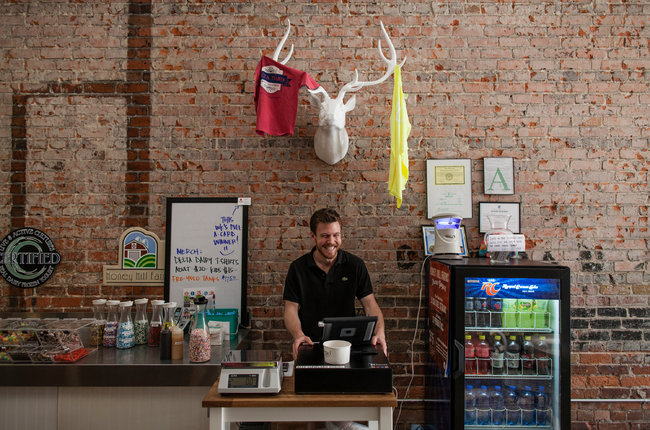
Photograph: Yana Paskova/NY Times
Ali Sultan, a Yemeni-American comedian who lives in Minnesota and performed at the Comic Strip in Manhattan last month, claims to have studied at the University of I’ll Just Google It.

Read Full Post »

There was a lovely National Public Radio story the other day about the rediscovery of Gospel singing brothers 30 years after they thought their career was over.

“In 1970, brothers Gean and Tommie West, both reverends, started a gospel group together in Dallas. They called themselves The Relatives, pressed a few singles and amassed a good following.

“By 1980, The Relatives had gone their separate ways, and for three decades that was that. But a few years ago, a Texas DJ and record collector who’d heard their music came knocking, and brought up the idea of a reunion. Now, they’re releasing their first album of original work in 30 years, The Electric Word.”

Gean and Tommie spoke with and sang for NPR’s Scott Simon, here.

Read about the company that relaunched The Relatives, Heavy Light Records, here, at the Austin Chronicle.

At the Chronicle, Thomas Fawcett writes, “For co-owners Noel Waggener and Charisse Kelly, married roughly the same amount of time they’ve been collecting records together, 16 years, Heavy Light is a deeply personal endeavor. In 2001, Waggener founded Waxploitation! (now Soul Happening), dusty-fingered local DJs who fuel dance floors with rare funk 45s. Bonding with master of ceremonies Obatallah Hayter, the late Harlem-born pianist who rapped over records from his wheelchair, the pair had an epiphany. …

“The result, Heavy Light Records, has so far amassed more than 4,000 recordings, including a sizeable chunk licensed from the heirs of San Antonio businessman E.J. Henke, who owned several small labels, including the Harlem, Satin, and Warrior imprints.” Noel was the DJ who brought The Relatives back. Jim Eno produced “The Electric Word.” More.

Photograph: Andrew Shapter
The Relatives teamed with members of members of Black Joe Lewis & the Honeybears to record the new album The Electric Word. Left to right: Matt Strmiska, Earnest Tarkington, Zach Ernst, Rev. Tommie West, Dale Burns, Rev. Gean West, Tyron Edwards.

Read Full Post »

You know that spring is coming when there’s still daylight at Porter Square as the evening train arrives, when the chickadee changes its call from “chick-a-dee-dee-dee” to “hear me ” (listen), and when neighbors’ trees sprout sap-collecting cans.

My mother tried maple sugaring one year, but spent too much on stove gas to cook it down slowly.

Asakiyume, are you making maple syrup this year?

I will be looking for other signs of spring soon: motorcycles, lawnmowers, people washing cars in driveways, neighbors talking more, and the first crocus. But I already saw bluebirds. In the dead of winter, believe it or not. They were cleaning off the berries from the deciduous holly bushes. Astonishing!

maple sugaring in the burbs

maple sugaring

Read Full Post »

The West Concord 5 & 10 is a crammed-to-the-gills, family-run institution, the place you go for what used to be called notions and sundries — and for anything you have tried and failed to find anywhere else.

But the 5 & 10 may be on its last legs as a result of long-term changes in shopping patterns and the collapse of a supplier that gave credit.

A cash mob was organized for today, and the faithful turned up in droves, promising to spend at least $20. Whether the show of loyalty can save the business for the family remains to be seen, but it must have warmed the cockles of their hearts.

Nancy Shohet West’s article Thursday in the Globe West helped to get the word out:

“According to [store manager Chris] Curtis, his main supplier, Arrow Wholesale Inc. in Worcester, which had provided quirky inventory to small, dime-store-type businesses all over the country for generations, went out of business. That loss, coupled with the decrease in business facing small neighborhood shops everywhere, as more consumers flock to malls, super­stores or online, was draining the lifeblood out of the West Concord 5 & 10.”

Organizer Polly “Stadt said she and her 13-year-old daughter, Emma Hill, agreed that this was awful news. Browsing the shelves for inexpensive, amusing, or useful items was a tradition not only among adults in the community but among children Emma’s age as well. They decided something had to be done, and then Stadt remembered a tactic to save a local business that a friend in Texas had told her about: a cash mob.

“In a cash mob, according to the website www.cashmob.com, committed supporters ‘come together to shop in a locally owned establishment to support their favorite local business and support the area economy. Each ‘mobber’ spends an agreed-upon amount, usually $20.

“Stadt and her daughter said they decided a cash mob was just what the West Concord 5 & 10 needed, providing an influx of money and, more importantly, bringing attention to its plight. They talked to Curtis, chose a date — the first Saturday in March — and started putting out the word: Emma on Facebook, and her mother by e-mail and word of mouth.”

Now I’m just hoping we didn’t strip the shelves so customers in the weeks to come find nothing to buy.

More about a wonderful store and about how social media may help save it.

saving the 5&10

West Concord 5&10

Read Full Post »

According to Doug Donovan at The Chronicle of Philanthropy, here. the number of volunteers in the United States is at its highest level since 2005.

“More than one-quarter of Americans did volunteer work in 2011, providing 7.9 billion hours of service worth $171 billion. …

“The 1.5 million additional volunteers boosted the national rate to 26.8 percent of the population, a half percentage point higher than 2010. But the dollar value dipped by $2 billion, as the average number of hours Americans volunteered in a year dropped to 32.7 from 33.9, the Corporation for National and Community Service reported.

“Robert Grimm, director of the Center for Philanthropy and Nonprofit Leadership at the University of Maryland, said the increase was mainly the result of the growth in the American population, not a response to the economy or other factors.”

Well, that’s too bad. People who don’t squeeze some sort of volunteer work into their lives are missing out. If you find an opportunity that works for you, it can be very satisfying.

Where I work, people have been volunteering for years at an inner city school, and the experience just gets better and better. Not only do we feel like we are really helping the kids improve their skills, but we enjoy building friendships with others in our organization as we ride the van to our destination.

I don’t want to make my volunteering to sound like a bigger deal than it is. Each person gives only about an hour and a half a month, overlapping with lunchtime. My point is that even a little bit can make a difference for someone, especially when combined with the efforts of others. One and one and 50 make a million.

Photograph: Mike Brown/The Commercial Appeal/AP
Three volunteers share a laugh while they serve home-cooked meal to residents of Memphis Towers, an independent living community for the elderly and disabled in Memphis, Tenn, Dec. 10, 2012.


Read Full Post »

Lincoln Institute of Land Policy

Because the lecture was on walkable communities, I walked to the Lincoln Institute of Land Policy today.

Julie Campoli was scheduled to talk about her book Made for Walking: Density and Neighborhood Form.

From the Institute’s website: “In this era of high energy prices, economic uncertainty, and demographic change, an increasing number of Americans are showing an interest in urban living as an alternative to the traditional automobile-dependent suburb. Many people are also concerned about reducing their annual vehicle miles traveled as a way to lower greenhouse gas emissions affecting climate change. …

“Researchers delving into the question of how urban form affects travel behavior identify specific characteristics of place that boost walking and transit use while reducing [vehicle miles traveled]. In the 1990s some pinpointed diversity (of land uses), density, and design as the key elements  … After a decade of successive studies on the topic, these ‘three Ds’ were joined by two others deemed equally important—distance to transit and destination accessibility … Added to the list is another key player: parking.”

Campoli talked about all five elements, showed great pictures, and shared intriguing stories from successful communities. More.

By the way, if I had gone by car to the lecture instead of on foot, I would most assuredly have missed the possum, one of the more contemplative creatures in Cambridge today. He was still on his branch when I walked back after the presentation. But he had turned around.

possum_near_Harvard_Square.


Read Full Post »

Today it’s a bit hard to imagine Cezanne, Matisse, Duchamp, and Van Gogh shocking anyone, but at the Armory art show in New York City 100 years ago, they did. Tom Vitale at National Public Radio has the story.

“On Feb. 17, 1913, an art exhibition opened in New York City that shocked the country, changed our perception of beauty and had a profound effect on artists and collectors.

“The International Exhibition of Modern Art — which came to be known, simply, as the Armory Show — marked the dawn of Modernism in America. It was the first time the phrase ‘avant-garde’ was used to describe painting and sculpture. …

“It was the Europeans — Van Gogh, Gauguin, Cezanne, Picasso, Matisse, Duchamp — that caused a sensation.

“American audiences were used to seeing Rembrandts and Titians in their galleries — ‘a very realistic type of art,’ says Marilyn Kushner, the co-curator of an exhibition called ‘The Armory Show at 100’ that opens in October at the New York Historical Society. …

“The most talked-about painting in the 1913 Armory Show deconstructed a human figure in abstract brown panels in overlapping motion. Marcel Duchamp’s Cubist-inspired Nude Descending a Staircase was famously described by one critic as ‘an explosion in a shingle factory.’

“In 1963, on the 50th anniversary of the Armory Show, Duchamp was interviewed by CBS reporter Charles Collingwood. The audio is now at the Smithsonian’s Archive of American Art.

“When Collingwood asked Duchamp if he had realized that the piece would create ‘such a “furor,” ‘ the artist responded: “Not the slightest.” …

“Duchamp went on in the 1963 interview to say that, at the time, artists had lost the ability to surprise the public.

” ‘There’s a public to receive it today that did not exist then. Cubism was sort of forced upon the public to reject it. You know what I mean?’ Duchamp said. ‘Instead, today, any new movement is almost accepted before it started. See, there’s no more element of shock anymore.’ ” More.

Photograph: Marcel Duchamp’s Cubist-inspired Nude Descending a Staircase was famously described by one critic as “an explosion in a shingle factory.” (Copyright succession Marcel Duchamp / ADAGP, Paris / Artists Rights Society (ARS), New York 2013)

Read Full Post »

My colleague Bob put me on to a NY Times blog called “Lens,” and in particular, a post by James Estrin about a modest 2013 version of the Farm Security Administration’s photographic outreach of the 1930s.

He writes, “Just as the Farm Security Administration unleashed a team of photographers to chronicle the United States in the 1930s, Lens is beginning a new interactive project called ‘My Hometown.’

“In the coming months, we are asking high school students to help create a 21st century portrait of America, turning their cameras on their neighborhoods, families, friends and schools. …

“Participants must either be enrolled in high school or be 14 to 18 years old. All submissions must be uploaded under the supervision of a photography class teacher or program instructor by the May 1 deadline. …

“The resulting collection of photographs will be shown in an interactive gallery of several thousand pictures that will be sortable by geography or theme. We will also highlight select images in a series of posts on the Lens Blog. Many of the photos will be archived at the Library of Congress (just like the Farm Security Administration) photos. …

“If your high school or community-based photography program wants to participate, the instructor should contact the Lens editors by e-mail at lens.projects@gmail.com. …

“We will start accepting entries on March 20.” More.

As Bob commented to me, an initiative like this is likely to appeal to kids. Writing essays about one’s hometown might be harder to get charged up about, especially if you don’t feel like a writer. But everyone takes pictures, and some teens will be inspired to be artful with them.


Photograph: Dorothea Lange/Library of Congress/Farm Security Administration

Read Full Post »

When grandmas recite poetry before you are three, the look on your face probably translates as, “What the heck?”

Here we are testing out Edward Lear’s “The Owl and the Pussycat.”

A week or so ago, Ogden Nash’s “Custard the Dragon” held a certain fascination, but there was ambivalence about the “big, sharp teeth.”

In the spontaneous-story department, we have been working on variations of “The Three Bears” and are edging up on “The Pig Won’t Jump over the Stile.” Stay tuned.

listening to Edw Lear poem

what kind of story is this?

Read Full Post »

The radio show “On the Media” had a great story Saturday. It was about a guy who made movies using ordinary people who wanted to be in the movies. He had only one script, and for 40 years, in small towns across America, he rounded up locals who thought they had the next Shirley Temple in their midst and shot The Kidnapper’s Foil.

As soon as his newest cast dealt with the kidnappers, the film launched into a talent show. And that was as close as any small-town girl got to being the next Shirley Temple.

From the radio show: “The practice of itinerant filmmaking — traveling from town to town, charging a fee for residents to become the stars of a film — mostly died out in the early 50’s. But one man continued the practice for nearly 40 years, filming the same movie over and over again. [Brooke Gladstone] talks to Caroline Frick, Executive Director of the The Texas Archive of the Moving Image about her decade-long fixation on filmmaker Melton Barker and his oft-filmed movie The Kidnapper’s Foil.”

Read all about it.

Read Full Post »

A few random pictures from my window, from walks, from train travel.

I am struggling to understand my new camera. It speaks in code.

wintry angles

MBTA geometry

Chas St Jail luxury

Concord Art Assoc

reach higher

antique shop

Read Full Post »

On Wednesday, according to Todd Feathers in the Boston Globe, a New Hampshire scallop fisherman found something unusual in his catch.

“As Mike and Padi Anderson sold their catch of scallops on the dock Wednesday night in Rye Harbor, N.H., it was not just their shellfish that drew people’s interest. It was an ­object that looks like a 6-inch-long tooth that Mike had dredged up from the ocean earlier that day. …

“A crew member e-mailed a picture to a geologist from the University of New Hampshire, and a short while later the verdict came back: The tooth almost certainly belonged to a woolly mammoth. …

“The tooth weighs about 5 pounds and still has remnants of the root that connected it to the mammoth’s gums, Mike Anderson said in a phone interview from the deck of his boat, the F/V Rimrack. …

“The Andersons, who are married, will have to wait until William Clyde, the geologist, ­returns from a trip to South America before they can confirm that the tooth once belonged to a mammoth, but for them, the preliminary ruling is enough.”

Anderson seems excited to head back out for more archaeology. More.

Reminds me of John Hanson Mitchell and his book Ceremonial Time, which describes his attempts to sense and experience 15,000 years of life around his home in Massachusetts.

Finding a woolly mammoth tooth must really make one pause and think about big things.

Photograph of scallop fisherman Mike Anderson: Ionna Raptis/ Portsmouth Herald via AP

Read Full Post »

I find lots of great links at Andrew Sullivan’s blog. Besides having an excellent staff, he seems to have half the world forwarding cool stuff to him. Otherwise, I probably would never have stumbled on Feature Shoot, which showcases work from up-and-coming and established photographers.

In one article, Amanda Gorence writes, “Photographer Fernando Decillis traveled to Pasto, Colombia for the elaborate Carnaval de Negros y Blancos, a five day festival celebrating the Epiphany that has been a tradition since 1912. …

“El Desfile Magno [the great parade] is a mind-blowing display of immaculately crafted floats made by incredibly talented artists. The artists are usually honored with this task through family ties and only after years of studying the traditional craft. … Decillis gives us a front row spot to the festivities, the artists and the giant masterpieces of Pasto’s celebrated tradition.

“Decillis was born in Montevideo, Uruguay. He is based in Atlanta mixing it up with a variety of advertising, editorial and conceptual work.” More, here.

Photograph: Fernando Decillis

Read Full Post »

There was a nice article in the NY Times last week about people aging in place and inadvertently creating a retirement community. My husband sent me the link.

“When the co-op conversion wave began in New York City in the 1960s,” writes Constance Rosenblum, “singles and young married couples flocked to the Upper West Side hoping to get a piece of the action. Some of those people, now in their 70s, are still there, cemented in place by apartments bought for a song or equally treasured rent-stabilized units.

“As the neighborhood’s population has grayed, some apartment houses have morphed into what social scientists call NORCs — naturally occurring retirement communities. The most recent census estimates indicate that 22 percent of Upper West Siders, or 46,000 people, are 60 or older, compared with the citywide average of 17 percent. Attracted by convenient shopping, abundant mass transit and a wealth of cultural activities, many older residents hope to remain in their apartments the rest of their lives.”

I am a huge fan of walkable communities for people of any age, and I have often wondered why retirement communities are built in the middle of nowhere. Cost of land, I suppose. But if I couldn’t walk (or wheel myself) to shops, public transportation, the library, and so on, I would be very unhappy.

Perhaps it is the generation now nearing retirement that will make so-called Smart Growth a reality at last — simply because they don’t want to be out in the middle of nowhere.

More from the Times.

Photograph: Marcus Yam for The New York Times
The walking group of Bloomingdale Aging in Place doesn’t let snow interfere with a constitutional in Central Park.

Read Full Post »

Gregg, an inventor who works with John, tweeted today about a mega toy fair in New York City. (He didn’t say if he and John have any skin in the game, although I know that at least one toy is among their recent techy projects.)

Dante D’Orazio describes the trade show at The Verge (a website that covers “the intersection of technology, science, art, and culture”).

“Toy Fair isn’t what you would expect. The New York-based toy trade show is the largest in the Western hemisphere — it had nearly 30,000 attendees last year — but there are no children. Hundreds of thousands of square feet are dedicated to the things children love, like action figures, dolls, model cars, board games, arts and crafts, sports equipment, and video games, but there’s a strict rule: no admittance to anyone under 18 years of age. …

“The tech world has affected these toy companies greatly. We saw the beginnings of it last year, but at Toy Fair 2013 the largest companies are all integrating iPads and iPhones in some way into their product lines. Entire toys built around iPads were very popular; we saw everything from an iPad-enabled farm set for pre-schoolers to a magic Barbie mirror that takes advantage of Apple’s tablet. It’s no longer just ‘batteries not included’ — you’ll need to buy an iPad if you want to play with some of these toys.”

More.

Photographs: The Verge, which offers a lush array of toy fair pictures, here. Of course, not all toys need to be high tech to attract kids.

Read Full Post »

« Newer Posts - Older Posts »