Feeds:
Posts
Comments

Archive for the ‘Uncategorized’ Category

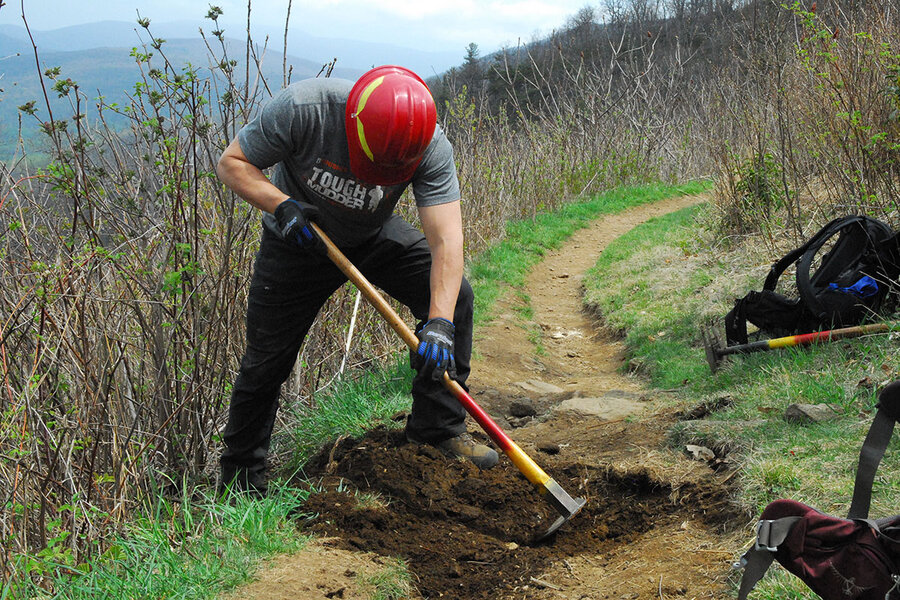
Photo: Noah Robertson/The Christian Science Monitor.
“Trail maintainer Russell Riggs digs an impromptu drain in Virginia’s Shenandoah National Park, May 1, 2022. The drain helps water gently slope down the mountain and off the trail, limiting erosion,” CSM reports.

I grew up at the foot of the Ramapo Mountains and although I never became a serious hiker, I always loved walking in the woods there. The Ramapo Mountains are part of the Appalachians. Today we learn how volunteers maintain the famed Appalachian Trail. Even in a pandemic.

Noah Robertson has the story at the Christian Science Monitor. “The view from Jewell Hollow overlook is hard to beat. More than 3,000 feet above ground in Shenandoah National Park, it’s a 180-degree window into miles of valley and mountains. Surrounded by a mossy stone fence and hiking trails, the sight is one of the best in Virginia.

“But today, Kris English isn’t focused on that. Instead, she’s looking at dirt – grassy green to tan to gravelly brown. 

“She pauses when the ground gets dark. Telling her three-person crew to stop, she teaches them to study dirt like paint swatches (every artist needs a canvas). Darker dirt is wetter dirt. Wetter dirt means the trail will erode faster. 

“Then Ms. English, a technical trail specialist for the Appalachian Trail Conservancy, shows them how to dig a drain. 

“Grabbing a 4-foot hybrid rake known as a McLeod, she clears debris in wide brushstrokes and carves a gentle slope. Five minutes later there’s a comet-shaped channel to guide water down the mountain. …

“Ms. English, leading a training session that morning in early May, helped add a few volunteers to the roster of those who routinely preserve the Appalachian Trail – the East Coast’s 85-year-old, 2,200-mile hikers’ paradise. Her role is professional, but each year a 14-state network of trail crews from Georgia to Maine volunteer hundreds of thousands of hours to keep the trail sustainable, accessible, and clean. 

The pandemic has made it harder. When indoor gatherings were off limits, people went outdoors in record numbers. And, not knowing basic hiking etiquette, they made a mess. 

“That hasn’t stopped the volunteers. Last fiscal year, the Potomac Appalachian Trail Club, which oversees 240 miles of the trail – 101 of which are in Shenandoah National Park – amassed 2,000 more volunteer hours than it did the year before the pandemic. [To] Wayne Limberg, one of the PATC’s district managers in Shenandoah National Park, … the response shows that people understand the Appalachian Trail’s inherent contract. It offers humans an almost unrivaled opportunity to interact with nature. But that agreement takes preservation. 

“ ‘We want to make sure that it can be enjoyed by those of us living now and also future generations,’ says Mr. Limberg, who helped Ms. English lead the training session in May. ‘Trails need to be maintained.’ …

“Humans want to see nature. But nature doesn’t always appreciate the interest. Trails solve that problem by concentrating folks into a single, relatively small path, she says. The arrangement maximizes people’s exposure to nature and minimizes their impact. 

“But this is a fragile agreement. Humans – particularly new hikers – can disturb the forest with litter, graffiti, music, and millions of footprints. Nature, for its part, will always try to take the trail back with weeds, moving water that erodes the path, and fallen trees known as ‘blowdowns.’ 

“Hence, the need for trails creates a need for trail maintainers. And trail maintainers need training. 

“After a series of safety tips, Ms. English walks her group to a set of tools. … The fire rake’s harsh triangles help clear gravel and debris. The mattock’s two ends can dig earth and tear roots. …

“ ‘I could nerd out about tools for a minute,’ she says. And briefly she does, even posing in proper technique – like the relaxed stance of a surfer, not the hunch of an ‘old witch.’

“Maintainers follow several simple rules. Preserve a 4-foot-by-8-foot rectangular ‘trail prism’ free of weeds and fallen trees so hikers can freely walk. Gather litter. Report anything they can’t fix.

“And, perhaps most important of all, guide water. Rain needs to flow down the backslope and off the edge, not pool on the treadway. Otherwise, the path will erode, gather debris, or change shape entirely as months of nature junk accumulates. 

“Official policy is that the treadway should slope down at a 5-degree angle. The reality is almost never that precise. If they want an impromptu level, Ms. English says, a half-filled, transparent water bottle will work.

“Ms. English, Mr. Limberg, and the crew’s other two members remove a rickety log ‘water bar’ and replace it with a fresh channel. Pulling the log up, Ms. English finds two curled millipedes. Mr. Limberg finds a AA battery. 

“In the last two years, litter like that has only become more common. ​​… The motto for seasoned hikers is ‘leave no trace.’ But many of the new visitors during the pandemic hadn’t yet learned the code. The Appalachian Trail has many access points and can’t record each hiker. But the multiple trail maintainers interviewed by the Monitor described a clear increase in use over the last two years. With it, too, they found an increase in waste and degradation – from little bags of dog poop left in a stack at the trailhead to spray-painted boulders. 

“ ‘When you see stuff that frustrates you, you don’t like it, but you realize that’s why I’m here,’ says Jim Fetig, who manages the PATC’s program of paid seasonal trail ambassadors known as ‘ridgerunners.’ ‘You just rise to the occasion and take care of it and move on.’

“To Mr. Limberg, the good news is that trail maintenance is getting back to its natural state. When national and state parks closed at the beginning of the pandemic, his trail crew’s work stopped as well. Even when things reopened, there were capacity limits and required social distancing. …

“It’s been more than 20 years since Mr. Limberg joined the PATC. Two decades of maintenance have reminded him that ‘the mountain always wins.’ No matter how many times he digs drains, whacks weeds, and lifts litter, the trail will need more work. It’s humbling.  But it also gives him a connection to the land he might not otherwise have.”

More at the Monitor, here.

Read Full Post »

Photo: Yano via Wikimedia.
Kamikatsu, Japan, has worked for years to become a zero-waste town.

Here’s an update on an ambitious Japanese town I wrote about here a few years ago. It’s Kamikatsu, where the residents are still working hard at creating a completely sustainable way of life.

Michelle Ye Hee Lee and Julia Mio Inuma have a report at the Washington Post. “Tucked away in the mountains of Japan’s Shikoku island, a town of about 1,500 residents is on an ambitious path toward a zero-waste life.

“In 2003, Kamikatsu became the first municipality in Japan to make a zero-waste declaration. Since then, the town has transformed its open-air burning practices for waste disposal into a system of buying, consuming and discarding with the goal of reaching carbon neutrality. Now, the town estimates it is more than 80 percent of its way toward meeting that goal by 2030.

“But even for a town its size, carbon and waste neutrality is a high bar. And with more than half of its residents over 65 years old, the rural community is rapidly shrinking. The town is working with manufacturers to encourage them to use more recyclable materials, which would help reduce waste and burning. …

“The Zero Waste Center is the town’s recycling facility, where residents can sort their garbage into 45 categories — there are nine ways to sort paper products alone — before they toss the rest into a pile for the incinerators. …

“The town offers an incentive system in which people can collect recycling points in exchange for eco-friendly products. There are signs depicting what new items will be made out of those recycled items, and how much money the town is saving by working with recycling companies rather than burning the trash. …

“ ‘When residents cooperate, the money used for recycling is reduced at the same time, so you can see the merit to cooperating,’ said Momona Otsuka, the 24-year-old chief environmental officer of the center.

“Two things are key to creating a culture of widespread recycling, she said: policies, such as the 1997 Japanese law that gave towns and cities authority to recycle waste, and the cooperation of residents.

“Attached to the Zero Waste Center is a thrift shop where residents can drop off items they don’t want anymore, and others can take them free. All they need to do is weigh the item they take from the shop and log the weight in a ledger so the shop can keep track of the volume of reused items.

In January alone, about 985 pounds’ worth of items were rehomed — from unused batteries and sake glasses to furniture, maternity clothing and toys. The number is displayed inside the shop. …

“Rise and Win Brewing Co. brews two types of zero-waste craft beer, made of farm crops that would otherwise be thrown out because they are too misshapen to be sold publicly. … For years, the brewery tried to find an efficient way to donate leftover grain from brewing beer. Composting took a long time, and delivering fertilizer to farmers was a lot of work. So last year, they developed a way to convert used grain into liquid fertilizer, which is then used to grow barley for beer. …

“Hotel Why opened in 2020 as a part of the Zero Waste Center facility, which is constructed in the shape of a question mark to depict the question: Why do we create so much waste? The hotel feels like a secluded cabin in the woods, and at night, the stars resemble a planetarium.

“Each guest is given six bins to sort garbage during their stay. The sleek decorations are all reused materials, including a patchwork quilt made of denim scraps, and a wall display made of ropes. The furniture is salvaged from showroom models.

“The hotel emphasizes using just what you need. At check-in, guests cut individual bars of soap so they get just the amount they need for their stay. Coffee beans are ground based on the number of cups the guest wants, so that nothing goes to waste.

“Kamikatsu residents and businesses work to minimize as much food waste as possible. For example, at Cafe Polestar, there was one dish available for lunch to reduce waste: curry made with local vegetables.

“Even the leaf used to decorate their dishes was produced locally, from a company called Irodori, which has been selling products made from Kamikatsu’s lush forestry since 1986. There are 154 families in town involved with the project, mainly women aged 70 and older who can pick leaves to create intricate designs. The leaves are then sold to high-end spas, hotels and restaurants in Japan and other Asian countries, to create sustainable decorations.

“ ‘Our business helps people realize that there are valuable items even in mundane everyday things around them,’ said Tomoji Yokoishi, Irodori’s chief executive.”

More at the Post, here, where you can also read about the town’s ride-share system and its roughly 40 drivers, including the mayor, who use “a handful of cars so they can drive residents or visitors.”

I loved so many of the ideas and like to imagine towns everywhere coming up with their own unique ones.

Read Full Post »

Photo: DiverseAbility.
After leaving academia, Alice Sheppard “began exploring the techniques of dancing in a wheelchair and learning how disability can generate its own movement.” 

An unusual and dramatic entertainment took place in Chicago in May. It was the brainchild of Alice Sheppard, a fearless risk taker in a surprising sequence of careers. Today she is a choreographer, but as recently as 2004, she had never considered that dance could be compatible with her disability. According to DiverseAbility magazine, “she was a professor in medieval studies at Penn State.” Then a dancer with one leg dared her to try a dance class.

Lauren Warnecke says of Sheppard at the Chicago Tribune, “Alice Sheppard does not shy away from a challenge. In devising her latest dance, ‘Wired,’ she and her Bay Area disability arts company Kinetic Light had to first write the rule books for wheelchair aerial dance.

“Kinetic Light’s mission is to create art that centers disability. Sheppard and the rest of the company are disabled artists who make work for disabled performers. Key to that vision are questions and advocacy around access — who ‘gets’ to dance and who ‘gets’ to watch or experience art? Since the company’s founding in 2016, Sheppard’s work consistently explores the intersections of disability, race and gender. ‘Wired,’ premiering May 5-8 at the Museum of Contemporary Art in Chicago, is no exception, though it’s the first of Kinetic Light’s growing catalog to incorporate aerial dance.

“Actually, the first step for Sheppard was to read everything she could find about barbed wire. Sheppard, a dancer, choreographer and scholar with a doctorate in medieval studies from Cornell University, devoured the literature on this sharp-edged, steel wire’s fraught history.

“The initial spark for ‘Wired’ came from a visit to the Whitney Museum, where Sheppard viewed Melvin Edwards’ 1969 barbed wire sculpture, ‘Pyramid Up and Down Pyramid.’ …

“It led her down a barbed wire rabbit hole. Sheppard’s source material lends multiple metaphors to what has become her latest multimedia dance piece. Indeed, few pieces of steel are saddled with so much context. Barbed wire is primarily a strict form of forced separation, used in trench warfare and applied in the United States as a means of keeping incarcerated people in, for example, or livestock in and intruders out as ranchers in the American West increasingly claimed land as their personal property.

“Throughout the piece, the dancers wrestle with this unwieldy, unforgiving object, their bodies enclosed by a tangle of wires and barbs. As she continued to explore, Sheppard knew ‘Wired’ had to be an aerial dance. …

“Having never studied aerial dance before, Sheppard and Kinetic Light company members Laurel Lawson and Jerron Herman started from scratch. With support from some 30 artists and engineers with backgrounds in rigging, automation and flight, Sheppard, Lawson and Herman took to the air. …

“ ‘We are not the first disabled artists to fly, by any means,’ she said. ‘There is, of course, in circus arts, a deep and rooted history of disability and flight. That’s not random or new. And there’s a history of disabled dancers also doing aerial work in the UK, New Zealand and the U.S. Part of that history and legacy is to recognize that flight isn’t random. It is perfectly within the tradition and the culture for disabled dancers. What is new here is the construction of the show. It’s not a circus.’

“The process for ‘Wired’ started at Chicago Flyhouse in late 2019. Before the dance and other artistic elements could even begin to take shape, Kinetic Light was faced with huge technical considerations.

“ ‘Before we could even get to “here’s a pretty dance, here’s the choreography,” ‘ she said, ‘we had to get to, “how does this thing fly?” ‘ …

“Lawson, who is also an engineer, assisted in developing the chairs and harnesses needed for her and Sheppard safely ascend into the air. Company member and dancer Herman completes the cast of three and has yet another setup. Herman, who has cerebral palsy, dances sections of ‘Wired’ with a girdle-type harness used to suspend him above the stage. …

“Sheppard reiterated that she and Lawson are not the first disabled artists to fly ,,, but they are the first disabled dancers in the U.S. to explore a thorough compendium of techniques, which includes low flying on hard lines and bungees, as well as flight patterns suspended from joystick-operated, motorized cables. The pandemic enabled Kinetic Light to make connections with then-unemployed entertainment workers with expertise in automation who would not otherwise have been available.

“In a way, ‘Wired’ serves as a primer on wheelchair flight.

“ ‘Understand, this is not actually documented,’ Sheppard said. ‘There are no books. There are no teachers … All of these questions that are easily available to non-disabled aerial artists because there’s a history and tradition here — we just had to figure that out bit-by-bit.’ ”

More at the Chicago Tribune, here.

Read Full Post »

Photo: Pacific Beach Coalition.
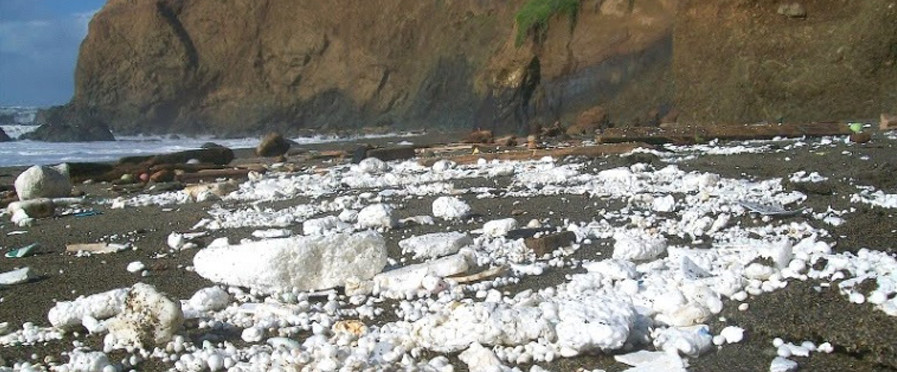
Scientists investigate whether a “superworm” can help solve our styrofoam problem.

It’s no secret that plastic has become a huge challenge for our poor old planet. Concerned people are finding solutions where they can. Ploggers of India (and other countries) pick plastic off the ground when they go jogging. Plastic Free Hackney is a UK town that aims to do without. Artists turn plastic waste into sculptures.

In today’s story, we learn about scientists testing a “superworm” that might be able to break down a particular kind of plastic, styrofoam.

Pranshu Verma reports at the Washington Post, “A plump larva the length of a paper clip can survive on the material that makes Styrofoam. The organism, commonly called a ‘superworm,’ could transform the way waste managers dispose of one of the most common components in landfills, researchers said, potentially slowing a mounting garbage crisis that is exacerbating climate change.

“In a paper released [in June] in the journal of Microbial Genomics, scientists from the University of Queensland in Brisbane, Australia, showed that the larvae of a darkling beetle, called zophobas morio, can survive solely on polystyrene, commonly called Styrofoam.

“The findings come amid a flurry of research on ways bacteria and other organisms can consume plastic materials, like Styrofoam and drinking bottles.

“Now, the researchers will study the enzymes that allow the superworm to digest Styrofoam, as they look to find a way to transform the finding into a commercial product. Industrial adoption offers a tantalizing scenario for waste managers: A natural way to dispose and recycle the Styrofoam trash that accounts for as much as 30 percent of landfill space worldwide. …

“The material is dense and takes up a lot of space, making it expensive to store at waste management facilities, industry experts said. The cups, plates and other materials made from it are also often contaminated with food and drink, making it hard to recycle. Polystyrene fills landfills, where it can often take 500 years to break down and decompose, researchers have found. …

“In 2015, researchers from Stanford University revealed that mealworms could also survive on Styrofoam. The next year, Japanese scientists found bacteria that could eat plastic bottles. In April, researchers from the University of Texas found an enzyme which could digest polyethylene terephthalate, a plastic resin found in clothes, liquid and food containers. …

“[The Microbial Genomics study’s coauthor Christian Rinke] said he was excited by his research results but noted it will take time to develop into an industrial solution, estimating somewhere between five to 10 years.

“To conduct the study, his research team in Australia fed the superworms three separate diets. One group was given a ‘healthy’ solution of bran. The second was given polystyrene. The third was put on a starvation diet.

“Ninety percent of the larvae that ate bran became beetles, compared with roughly 66 percent from the group given polystyrene and 10 percent from those forced to starve. This indicated to researchers that superworms have enzymes in their gut that can effectively digest Styrofoam.

“Next, the scientists will study those enzymes to see how well they can digest polystyrene on a large scale — modifying them if necessary to become more effective. ‘We want to not have gigantic superworm farms,’ he said. ‘Rather, we want to focus on the enzyme.’

“If the research proves successful, Rinke said waste managers could collect and grind Styrofoam materials and put them into a liquid solution made with the superworm enzyme. The solution would ideally dispose of the Styrofoam or digest it in a way that allows new plastic products to be created, thereby reducing the need for new plastic materials, Rinke said.

“ ‘If you can go all the way to the end,’ he said, ‘the idea is to use the system and come up with a biological solution to recycle plastic.’

“Despite the findings from Rinke and others, there are reasons that none have successfully translated into industry applications over the past decade, researchers said. Andrew Ellington, a professor of molecular biosciences at the University of Texas at Austin, said it has been difficult to find a plastic-digesting organism or enzyme that can operate in industrial conditions, which often process trash in very hot environments or through the use of organic solvents. … He suggested an alternative solution.

“ ‘I believe that we will be able to offer up, in the not-so-distant future, worm-based composting kits so that individuals can do this themselves,’ he said.

“Jeremy O’Brien, the director of applied research at the Solid Waste Association of North America, said there are other business challenges in putting this type of solution into use. As envisioned, the solution would require waste managers to collect Styrofoam separately from other trash, he said, which makes it cost-prohibitive.

“O’Brien also said it remains unclear what kind of organic waste the enzyme process would generate, and he worries it could harm the microorganisms landfills already use to process trash and reduce odors. He added that a more desirable and cost-effective solution would be to take Styrofoam in landfills and condense them enough so that they can be turned into new plastics.”

More at the Post, here. What do you think of this? Is breaking plastic down to enzymes enough to keep us safe?

Read Full Post »

Piñatas as Art

Photo: Henry Gass/Christian Science Monitor.
Piñata sculptor Alfonso Hernandez in his garage studio in Dallas. He is one of a growing group of piñata makers hoping to transform the industry and get recognition for the piñata as an art form.

When you think of piñatas, what do you picture? Kids’ birthday parties? Long cudgels? Here’s an article about people who want you to know that piñatas can be a serious art form.

Henry Gass asks at the Christian Science Monitor, “Would you take a sledgehammer to the David? A flamethrower to the Mona Lisa? A shredder to the latest Banksy? (Actually, scratch that last one.)

“Why then, some people are beginning to ask, would you want to pulverize a piñata? Alfonso Hernandez, for one, wants you to lower the bat and take off the blindfold and appreciate the artistry of a form that dates back hundreds of years.

“The Dallas-based artist has crafted life-size piñata sculptures of Mexican singer Vicente Fernández and Jack Skellington from The Nightmare Before Christmas. He wants the public to help turn an industry into art.

“ ‘Piñata makers never treated it like an art form,’ he says. ‘They’re taught to make it fast. It doesn’t matter what it looks like, just hurry up because they’re going to break it.’

“Unsatisfied with the generic mass production that has characterized their discipline for decades, piñata makers are pushing the artistic limits of the party pieces. These piñatas, bigger and more detailed, are made out of wood, foam, wire, and clay, and sculpted to look like beloved icons and life-size low-riders. Some move, some are political, and some even talk. Rihanna is a fan, as are, increasingly, art galleries.

“For generations, the real cost of bargain piñatas has typically been borne by the piñata makers themselves working long, arduous hours for less than minimum wage. By proving that piñatas can be more than just clubbable party pieces, people like Mr. Hernandez hope they can both create art and bring a wider respect and dignity to a craft long viewed as cheap and disposable.

“ ‘It’s been an underappreciated art form,’ says Emily Zaiden, director and lead curator of the Craft in America Center in Los Angeles. ‘Piñatas are so accessible. They speak to everybody,’ she adds. But there’s also a flip side. Piñatas ‘can be about appropriation, can be about, I think, the trivialization of a cultural tradition.’

“A new generation of Hispanic artists, she continues, ‘see how much metaphorical potential piñatas have, and how deeply it reflects their identities.’ …

“There are lots of questions around where piñatas come from. They may have emerged in Europe, or China, or the Aztec era – or in all three independently. There are few preserved, written historical records on the origins of piñatas – another sign of how underappreciated the craft has been, Ms. Zaiden believes.

“ ‘A lot of this work probably hasn’t been collected or preserved in ways that other types of art have been,’ she says. ‘It’s all speculation and oral history really,’ she adds, ‘but that goes hand in hand with the idea that these are ephemeral objects.’

“For centuries, piñatas were used for religious ceremonies in Mexico. Typically built to resemble a seven-pointed star, symbolizing the seven deadly sins, they would decorate homes – and be smashed – during the Christmas season.

“Their religious significance faded over time, and they became the popular children’s birthday party feature. But as the piñata industry commercialized, quality and craftsmanship became secondary to quantity.

“Yesenia Prieto grew up in that world. A third-generation piñata maker, she watched her mother and grandmother create in her grandmother’s house in south central Los Angeles, and when she was 19 she started helping herself. It was a constant struggle to survive, she says.

“ ‘I was tired of seeing how poor we were,’ she adds. ‘My grandma was about to lose her house. And we just needed to make more money. We needed to survive.’

“She describes a week in the life of a typical piñata maker. A four-person crew makes about 60 units out of paper, water, and glue a week. Selling wholesale, they make $600 and split it between the four of them. That’s about $150 for a full week of work. …

“ ‘What you’re seeing is an art form having to be mass produced and rushed because they’re getting sweatshop wages,’ she adds. …

“In 2012, Ms. Prieto went independent from her family, and independent from the mainstream piñata industry. She founded Piñata Design Studio and set to making custom, complex pieces that reflect the artistic potential of the craft.

“They’ve created pterodactyls and stormtroopers. They’ve made a giant Nike sneaker, and an 8-foot-tall donkey for the 2019 Coachella music festival. They made a piñata of singer Rihanna for her birthday. …

“But the need to hustle hasn’t abated, according to Ms. Prieto. They work longer on their piñatas than most makers do – up to 16 hours in some cases – but still struggle to sell them for more than $1 an hour. They’ve been leveraging the internet and social media – posting pictures of pieces as they’re being made, to illustrate the labor that’s involved – and they’re slowly raising their price point. …

“She’s also now reaching out to other piñata makers about forming a co-op. By working together, she hopes, piñata makers can get paid fairly, at least. Artistic quality could also improve. And as people see elaborate, custom piñatas more often, she believes, demand will grow, and pay will grow with it. …

“ ‘There is a shift taking place,’ she adds. She’s seeing piñatas in galleries more often. But ‘there’s [still] a need for us to push hard to survive.’ ”

More at the Monitor, here.

Read Full Post »

Photo: Suzanne and John’s Mom.
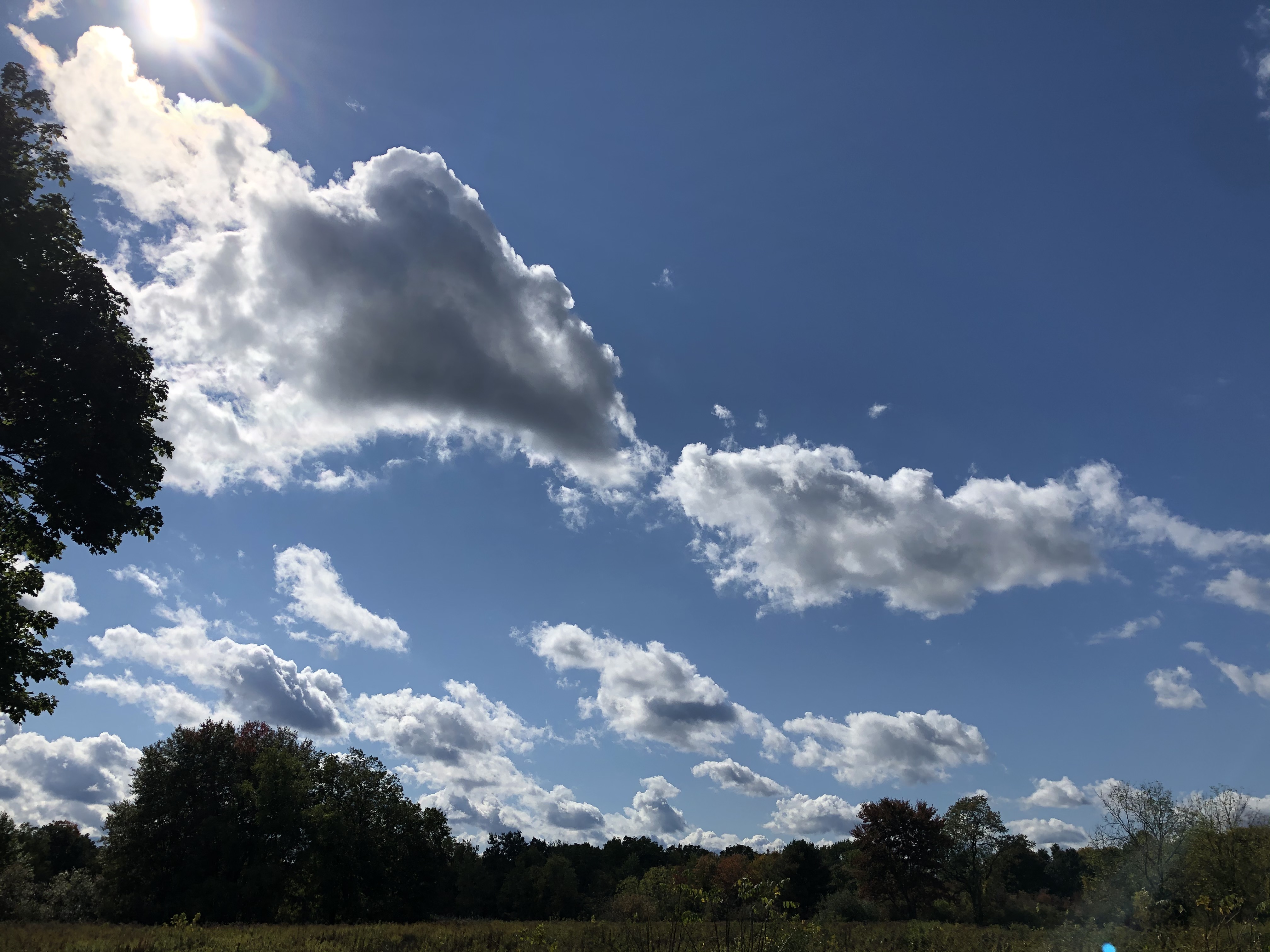
Blue skies over Concord.

Have you ever wondered about the blueness of skies and oceans? Maybe people from the dawn of time did, too. Or maybe not. Did they notice that the sky is “blue” before they had a word for the color?

Kevin Loria at Business Insider offers a story “about the way that humans see the world and how, until we have a way to describe something, even something so fundamental as a color, we may not even notice that it’s there.

“Until relatively recently in human history,” he reports, ” ‘blue’ didn’t exist, not in the way we think of it.

“As the delightful Radiolab episode ‘Colors’ describes, ancient languages didn’t have a word for blue — not Greek, not Chinese, not Japanese, not Hebrew. And without a word for the color, there is evidence that they may not have seen it at all.

“In the Odyssey, Homer famously describes the ‘wine-dark sea.’ But why ‘wine-dark’ and not deep blue or green?

“In 1858 a scholar named William Gladstone, who later became the prime minister of Great Britain, noticed that this wasn’t the only strange color description. Though the poet spends page after page describing the intricate details of clothing, armor, weaponry, facial features, animals, and more, his references to color are strange. Iron and sheep are violet; honey is green.

“So Gladstone decided to count the color references in the book. And while black is mentioned almost 200 times and white about 100, other colors are rare. Red is mentioned fewer than 15 times, and yellow and green fewer than 10. Gladstone started looking at other ancient Greek texts and noticed the same thing — there was never anything described as ‘blue.’ The word didn’t even exist. …

“Gladstone thought this was perhaps something unique to the Greeks, but a philologist named Lazarus Geiger followed up on his work and noticed this was true across cultures.

“He studied Icelandic sagas, the Koran, ancient Chinese stories, and an ancient Hebrew version of the Bible. Of Hindu Vedic hymns, he wrote: ‘These hymns, of more than ten thousand lines, are brimming with descriptions of the heavens. Scarcely any subject is evoked more frequently. The sun and reddening dawn’s play of color, day and night, cloud and lightning, the air and ether, all these are unfolded before us, again and again … but there is one thing no one would ever learn from these ancient songs … and that is that the sky is blue.’ …

“Every language first had a word for black and for white, or dark and light. The next word for a color to come into existence — in every language studied around the world — was red, the color of blood and wine. After red, historically, yellow appears, and later, green (though in a couple of languages, yellow and green switch places). The last of these colors to appear in every language is blue.

The only ancient culture to develop a word for blue was the Egyptians — and as it happens, they were also the only culture that had a way to produce a blue dye.

“If you think about it, blue doesn’t appear much in nature — there are almost no blue animals, blue eyes are rare, and blue flowers are mostly human creations. …

“We do not know exactly what was going through Homer’s brain when he described the wine-dark sea and the violet sheep — but we do know that ancient Greeks and others in the ancient world had the same biology and therefore same capability to see color that we do. But do you really see something if you don’t have a word for it?

“A researcher named Jules Davidoff traveled to Namibia to investigate this, where he conducted an experiment with the Himba tribe, which speaks a language that has no word for blue or distinction between blue and green.

“When shown a circle with 11 green squares and one blue, they could not pick out which one was different from the others — or those who could see a difference took much longer and made more mistakes than would make sense to us, who can clearly spot the blue square.

“But the Himba have more words for types of green than we do in English. When looking at a circle of green squares with only one slightly different shade, they could immediately spot the different one. Can you?”

Go to Business Insider, here. to see what is meant.

Loria continues, “Davidoff says that without a word for a color, without a way of identifying it as different, it is much harder for us to notice what is unique about it — even though our eyes are physically seeing the blocks it in the same way. …

“For more fascinating information about colors, including information on how some ‘super-seeing’ women may see colors in the sky that most of us have never dreamed of, check out the full Radiolab episode.”

What else don’t we see because we don’t have a word for it? Certain kinds of cloud or qualities of snow? Facial expressions? Clearly it depends on the culture in which we were raised.

Hat tip: Hannah. Thank you for realizing blog readers would like this!

More at Business Insider, here.

Read Full Post »

Photo: Igor Kasyanyuk via WIFR.
Abigail Barlow and Emily Bear, co-creators of a Tiktok musical based on the television show Bridgerton.

Are you on TikTok? I haven’t gone deep there, but I’ve gotten a kick out of the few things I’ve seen, mostly clips recommended by some other website. Today I want to highlight something fun: a musical created just for this kooky platform.

At the Conversation, Sarah Bay-Cheng, Dean of the School of Arts at Canada’s York University, asks, “Is musical theatre an event, a sound — or something else?

“The 2022 Grammy Award for best musical theatre album went to a show that originated as a TikTok smash hitThe Unofficial Bridgerton Musical by duo Abigail Barlow and Emily Bear.

Bear, a 20-year old pianist, composer and former child prodigy produced the album. She and Barlow both composed music and wrote lyrics. Barlow, a singer who previously established herself with a massive TikTok fan base, sings almost all the parts of all the songs.

“What does all this mean for the future of musical theatre?

Inspired by hit Netflix series Bridgertonproduced by Shonda Rhimes, Bridgerton: The Unofficial Musical won the Grammy over productions created by established figures such as composer and producer Andrew Lloyd Webber. ….

“Musical theatre albums typically circulate as the official cast recordings of staged musical theatre performances including full orchestrations. In this case, Barlow and Bear began their collaboration over Zoom [during Covid] and together performed all of the roles.

“Their collaboration didn’t end there. Over the course of creating The Unofficial Bridgerton Musical, Barlow and Bear played to other fans of the show via TikTok: They rehearsed their songs, interacted with fellow performers and contributed to the thriving creative fan culture for which the video platform has become known. …

The Unofficial Bridgerton Musical was not the first musical adaptation to emerge on TikTok. In 2020, during pandemic shutdowns, an online fan base of the Disney film Ratatouille began creating, sharing and developing Ratatouille tribute songs — like an ode to Remy the rat by one user given a (digital) orchestral treatment by another user — until this swelled into a Ratatouille musical TikTok community.

“Eventually, leaders of the theatre and digital media production company Fake FriendsMichael Breslin and Patrick Foley, adapted the collective project for an online performance. …

“With Disney’s permissionRatatouille the TikTok Musical streamed for two performances in January 2021, raising over US$2 million for the Actors Fund. …

“Although the [Bridgerton] win was historic, musical theatre has always circulated through networks of media, popular culture and fandom.

“Long before social media allowed users to create and share music online, audiences performed songs from theatrical productions at home. … For example, as musical theatre scholar Stacy Wolf points out, the Rodgers and Hammerstein song ‘I’m Gonna Wash That Man Right Out of My Hair’ was used for a hair product commercial.

“If musical theatre of the past was an event, today it is more akin to a community. … The musical Hamilton amplified access to tickets and online media buzz by creating a hashtag contest, #Ham4Ham. Fans using the hashtag had the chance to win front-row seats.

“But today but just getting a seat is not enough. New audiences want to be part of the process, and scholars are paying attention.

“Throughout the creation of Unofficial Bridgerton, locked-down Broadway performers joined in the collective development. They shared ideas and performed songs with Barlow and Bear.

“In an interview with NPR, Barlow noted that theatre is a gate-kept art form and at $200 a ticket not many people can go. In comparison, online adaptations create more access and more interest. …

“I first heard about Barlow and Bear’s album from a former student of mine who works in the writers’ room for Bridgerton. It’s not a coincidence that Rhimes’s show was source material to inspire new musical theatre creation.

“Rhimes’s television projects consistently challenge dominant cultural narratives, ensuring that what people see on the screen reflects the realities of contemporary life. … She calls it ‘making TV look like the world looks.’ In response to her work, creative fan cultures emerge with media platforms facilitating dynamic, diverse and ongoing collaborations.

“This attention to the diversity of representation and Grammy recognition for new modes of production are changing musical theatre for the better. Rather than a singular location or sound, theatre of all kinds today is a dynamic experience created across multiple networks, communities and identities. We should recognize and celebrate these talents.”

More at the Conversation, here.

Read Full Post »

Photo: federico-giampieri-R0lftflMYPw-unsplash.
Generations share the love of fishing.

Today’s story is about a guy who provides outings to fatherless children — on Father’s Day and year-round.

Cathy Free wrote about him at the Washington Post.

“It was hard not to notice the 8-year-old boy across the street who stormed in and out of his own house. The boy, a neighbor of William Dunn in Lakeland, Fla., did it often enough that Dunn wanted to see if he could help.

“ ‘I wondered what was going on in his life, so one day, I decided to ask him,’ said Dunn, 57. ‘He told me that he didn’t have a father, and I realized there might be something I could do for him.’

“Dunn had grown up fishing with his dad and had helped him for a time with his lobster business in the Florida Keys.

‘Fishing always brought me peace and it taught me how to be patient,’ he said. ‘When you’re on the water, you can forget about your problems and just appreciate the moment.’

“Dunn, who has three children of his own, approached the boy’s mother and asked for permission to take him fishing.

“One Saturday afternoon on the water soon led to another, and pretty soon he was teaching the boys’ friends and other kids in the neighborhood how to rig a line, hold a fishing pole and reel in a big catch. That was 15 years ago.

“Since then, he’s taken groups of kids out almost every weekend to fish. Most of them didn’t have father figures in their lives, and had never fished before.

“Some of them were foster kids who had shuffled for years from one home to the next, he said. ‘They’d been through a lot and they’d seen a lot, and their lives were difficult,’ Dunn said. ‘But when they were fishing, all of that faded away.’ …

“In the beginning, Dunn spent a good chunk of his paycheck from his job selling tires to help fund the weekend fishing expeditions on charter boats, he said. Then in 2018, he started the nonprofit Take a Kid Fishing Inc. in Lakeland, a city with dozens of lakes located between Tampa and Orlando.

“In the past 3½ years, he and a small group of volunteers have introduced more than 2,500 kids — most without fathers around — to the experience of spending peaceful time on the water, and the exhilaration of nabbing a fish. …

“ ‘I’m the youngest of six and I always had a great relationship with my dad,’ he said. … ‘He told me that fishing isn’t about what you catch — it’s about the memories you make.’ …

“Through public and private donations to his nonprofit, he said he’s able to go deep-sea fishing with up to 20 kids at a time, or take smaller groups on Saturday lake outings on a charter boat.

“ ‘We only keep the fish we need and toss the rest back,’ he said. ‘And at the end of the day, I’ll help to fry up the catch and feed the kids fish tacos for dinner.’ …

“Terra Pryor of Lakeland, Fla., said all three of her children have struggled emotionally since their dad, Richard Pryor, died in a car accident in January 2020. ‘I was especially worried about my son, Jayden, who was 10 then,’ said Pryor, 32. ‘He was really close to his dad and felt he needed to take over the man of the house role immediately … I was wondering what to do to help him, and then I learned about Take a Kid Fishing.’

“Jayden, now 12, has become a devoted fisherman thanks to regular outings with Dunn, he said.

“ ‘Will has helped me to grow by taking me fishing,’ he said, noting that he once caught a shark that Dunn helped him to cut loose.

“ ‘I hope he knows I mean it when I say, “Thank you,” ‘ Jayden said.”

More at the Post, here.

Read Full Post »

Photo: via Wikimedia Commons and Hyperallergic.
Unknown artist, “Mummy portrait of a young woman named Eirene from Egypt” (c. 1st century BCE), encaustic on wood panel.

Isabella Segalovich at Hyperallergic recently had a lot of fun surveying women’s eyebrows in art.

“Being a public persona on the internet means that my face is looked at almost constantly by strangers,” she writes, “leading to uninvited comments about one feature in particular: my eyebrows. On TikTok, the more viral my video, the more ‘feedback’ my bushier-than-average, Ashkenazic brows receive. Reactions range from applause to truly unhinged amounts of anger and disgust. 

“I started wondering: Have people always been this weird about eyebrows? … Let’s take a quick tour of how [eyebrow] ideals have shown up in art across civilizations throughout history: from bushy, to bold, to completely bare. 

“Ancient Egypt: No matter the gender, many people in Ancient Egypt took special care to bolden their eyebrows with kohl or mesdemet. Like other Northern African and Asian cultures, the face was understood to be sacred, and thus, it required protection: kohl and mesdemet both served to guard against infections around the eyes. Kohl is used by many to this day around the eyes, both for adornment and for spiritual protection or devotion. This preference for strong eyebrows combined with traditions of carved reliefs resulted in highly defined, expressive arches in many Ancient Egyptian portraits. [Check Hyperallergic to see that the] wooden Inner Coffin of the Singer for Amun-Re is a beautiful expression of this high-contrast aesthetic. …

“Nigeria: From 1500 BCE to about 500 CE, a culture in Nok, Nigeria left behind now-famous terracotta sculptures with particularly detailed faces. Researchers Peter Breunig and James Ameje observed Nigerian craftsman Audu Washi, who showed them how to make these terracotta features using traditional methods.

A sharpened, sanded-down piece of wood is gently pushed into the clay to create fine details including the very distinct, graphic [Nok] eyebrows.

“The arched outlines of the eyebrows in these sculptures are similar across the portraits, but subtle tweaks in their shape and the space between them conjure vastly different personalities.

“Ancient Greece and Rome: While it’s hard to imagine with today’s inaccurate images of pristine white sculptures, many women in Ancient Greece and Rome were also unibrow fans! In some settings, a hairy unibrow was not just considered beautiful, but viewed as a sign of wisdom. Victoria Sherrow’s Encyclopedia of Hair recounts how Ancient Greek women used powdered antimony (also known as kohl) or even patches made of goat hair glued onto the forehead to achieve this look. A fresco of Terentius Neo and his (unfortunately anonymous) wife was a unique find in Pompeii because they are displayed as having equal status. Many may have been envious of her pair of prominent eyebrows — or really, just the one. …

“China: Women of the Tang Dynasty in China (618–907 CE) painted their eyebrows in dozens of different fashions, long, short, thick, thin, and wavy, depending on what was in style that year. Well-off women would use qingdai, a blue-ish pigment made from indigo. The woman in the portrait [here] has her face painted with additional decoration on her forehead — huadianor plum makeup. In 5000 Years of Chinese Costume, Xun Zhou writes that women would even decorate between their brows with luminous materials like ‘specks of gold, silver, and emerald feather.’ 

“Europe: Women in late medieval art display a very distinct hairstyle; that is, no hair at all! John Block Friedman writes that ‘misogynistic scientific writing had made female body hair a psychic and physical danger to men.’ So when it came to eyebrows, some women would pluck them until they were almost nonexistent. This plucking extended to thinning out hairlines to reveal large, bald foreheads. Petrus Christus’s 1449 painting ‘A Goldsmith in His Shop’ shows a wealthy woman bedecked in sumptuous fabric. She may have even used harsh chemicals to help rid herself of unsightly hairs. …

“Japan: Eyebrow fashion had an especially unique moment in the Heian period of Japan (794–1185 CE) where, in a manner similar to Chinese trends, both men and women would pluck out their eyebrow hairs completely, drawing new ones an inch above the natural browline. One of these styles was known as hikimayu (引眉) in which both thumbs were dipped in black makeup pigment and then used to create mirroring prints far up on the forehead. This print actually comes from many centuries later in 1876, and is a part of Toyohara Kunichika’s dazzling print series titled Thirty-six Good and Evil Beauties, which are portraits of ‘good and evil’ women throughout Japanese history. …

“Iran: At the beginning of the Qajar dynasty in Persia (1785–1925), male and female ideals of beauty grew closer and closer together, and so did the eyebrows! [Scholar] Afsaneh Najmabadi has shown that women would darken their eyebrows and even decorate their upper lips with mascara to show a faint mustache. Men often took on stereotypically feminine features, sometimes appearing beardless with slim waists in paintings.”

For fabulous pictures from those locales/eras and others, click at Hyperallergic, here. There is even a lovely eyebrow photo of a robot called Kismet. No firewall at Hyperallergic; donations encouraged. PS. Check out the author’s eyebrows here.

Read Full Post »

Photo: Tohumtoprak.
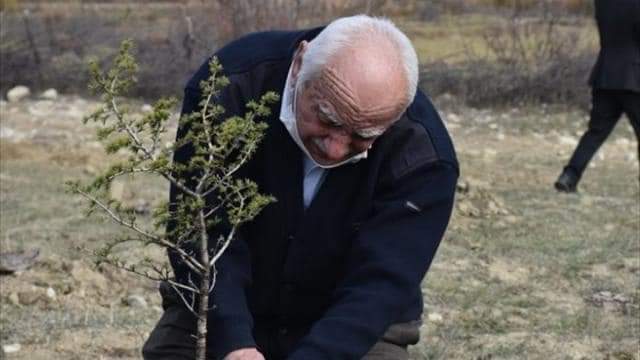
Working with his team and villagers, retired forest chief Hikmet Kaya has helped create a forest on once-barren land in Turkey.

Around the world, people have learned that planting trees can help us fight back against global warming. But it’s not as easy as sticking them in the ground. You have to ensure they live. And thrive.

Jessica Stewart reports on one initiative at My Modern Met, “Hikmet Kaya has proved that good intentions and hard work can yield big rewards. The retired Turkish forest management chief has posed proudly in front of the barren land that he and his team have transformed into a lush forest.

“He began his career in the town of Sinop in 1978 and while he retired 19 years later, his legacy has continued to grow — literally.

“Working together with his team and villagers, he brought in and planted 30 million saplings over the course of his tenure. Long after his retirement, these trees have continued to grow; and today, this barren stepped land has undergone an incredible transformation. … Needless to say, he admits he’s very happy with the results.

“It’s a wonderful example to set for the rest of the country. According to Global Forest Watch, Turkey has seen a 5.4% decrease in tree cover since 2000. … Combatting deforestation often comes down to governmental policy changes, which makes it important for individuals to know who they are voting for and to make sure their environmental concerns are heard. Still, that hasn’t stopped people from taking matters into their own hands and taking action.”

More at My Modern Met, here (where you’ll also find links to tree-planting stories from the Philippines, Pakistan, and Ethiopia).

There’s a tree maven in India who worked without help. You may have read about him. I’ll share Andrei Tapalaga‘s History of Yesterday story in case you missed the news.

“When talking about saving the environment, most people come with the comment of ‘how much difference will I make?’ … In this article, I want to present a man who has defied any kind of odds and showed the world that if you set your mind to something it will become possible.

“Jadav ‘Molai’ Payeng spent 40 years of his life planting trees, gaining the nickname of ‘Forest Man’ in India for transforming a [barren island] into a forest. [At this point] Payeng had covered 1,400 acres with trees. There is no exact number of trees as he never kept track, but we are looking at around 1.5 million trees planted in 40 years.

“Payeng was born in 1963 near the small rural town of Jorhat, India. From a young age, he saw a small island near the coast of the Brahmaputra River suffering from erosion. In many of his interviews taken by the media in India, he described that he had spent some of his [childhood] playing in that forest and it was heartbreaking seeing its vegetation slowly die.

“That is why in 1979, when Payeng was 16 years of age, he decided to plant at least one tree a day for as long as he lives, calling it giving back to Mother Nature. … The start to this incredible journey was difficult, not only [considering] the road ahead, but it was simply difficult to find tree seeds to plant. His vision was not to plant only one type of tree, but many different types. …

“As the years went by, the problem of finding seeds was solved as the trees he had planted years ago started to give seeds. With more seeds, he was able to plant even more trees every day. The island is surrounded by a flowing river, so the water supply was never a problem. …

“There are many people out there just like Payneg who have dedicated most of their life toward an honorable cause but rarely get noticed. The media in India actually discovered Payeng by mistake when in 2008, a herd of over 100 wild elephants strayed into the forest he had created.

“Payeng notified the forest department about the elephants and they thought he was crazy at first as there was no forest on the island. Upon the forest department’s inspection of the island, the community around Jorhat told them about Payeng’s efforts, at which point the media from India bombarded Payeng. [He] was also made an official forester for the forest he had created on Majuli island.

“In 2012 Payeng was interviewed by the Times, where he confessed that he had always asked for help but no one wanted to assist him. … Now the island is greener than ever whilst being inhabited by all sorts of wildlife from rabbits to tigers and even rhinos. The plantation of trees had slowed down as Payeng is becoming old and tired. However, he is trying to make his children continue what he had started.”

For more on Payeng’s initiative, click at History of Yesterday, here.

Read Full Post »

Photo: Guy Peterson.
A circus troupe offers hope to Senegal’s street children.

Poor children in Senegal often have a heartbreaking life, but one who rose above years of deprivation figured out a way to help others by sharing something that helped him. Today I’m drawing from three sources about what that was.

The BBC writes, “Every year, thousands of young Senegalese children are sent to the cities to study the Quran, only to find themselves forced into begging for money and food on the streets.”

DW.com reports about help coming from a man who was once one of their number. “In Senegal, circus skills were not really seen as a ‘proper’ or ‘respectable’ job. But that didn’t stop a former street beggar from founding Senegal’s first circus company in 2010. Today, Sencirk teaches circus acts to underprivileged kids. [The kids have even] represented Senegal with their juggling and acrobatic skills on the acclaimed TV show Africa’s Got Talent.”

Guy Peterson expands on the initiative at the Christian Science Monitor. “Under the shade of a dusty canvas tent in the sweltering heat, five men rehearse for a circus tour of France the following week.

“They make up Senegal’s only circus troupe, and each of them took long roads to get here, overcoming difficult childhoods, facing rejection by their families after they escaped abusive religious schools, and living on the street. …

“According to human rights groups, the talibés, as the boys are known, are vulnerable to exploitation and abuse from teachers. Talibés are forced to beg for money each day, and if their quota is not filled, they can be beaten and starved.

“Senegal has seen increasing youth unemployment, which leads many young adults to consider emigration if they can’t find opportunities at home. Sencirk helps them see those opportunities. 

“Modou Touré escaped [and] after taking up circus training in Europe, he returned to Dakar and founded Sencirk in 2006, providing free training to teens who escaped from their schools. The program allows them to work through traumatic experiences and to see paths toward a better future, whether that means working in the circus or reintegrating into society.

“An older performer and teacher at Sencirk, Sammi, explains, ‘We can teach them how to work together, how to grow, to believe in themselves.’ ”

According to the BBC, Sencirk’s founder “trained in Sweden for three months and toured with professional circus troupes around the world, before setting up the Sencirk tent in Dakar.

” ‘Circus is my therapy,’ says Mr Touré, now 31.

“The practice also assists him control his emotions and has the capacity to help others like him, he says.

” ‘It gives them confidence and helps them battle their demons.’ “

One 14-year-old trainee told the BBC, that “he loves everything about the circus: ‘It helps me learn and it makes me aware.’ …

“He hopes to join Sencirk as a full-time performer one day.

“Mr Touré’s troupe conducts regular free workshops at rescue homes for street children and women’s shelters to provide entertainment and identify talent.

” ‘It shows them they can go from the streets to making a living in the circus,’ Mr Touré says.

“Out of both necessity and the desire to preserve what they call the ‘Africanness’ of their shows, Sencirk uses locally found materials to make its equipment, such as trapezes, safety mats and juggling balls.

“Sencirk’s unique approach to circus is to share personal stories that other West Africans can relate to.

“One performance portrays the draws and dangers of clandestine migration to Europe. Another shares the experience of living as a talibé runaway.

“It’s a community built on resilience – a group of people working through shared trauma who are strengthened by their ability to overcome it together.”

More at the Monitor, here.
Read Full Post »

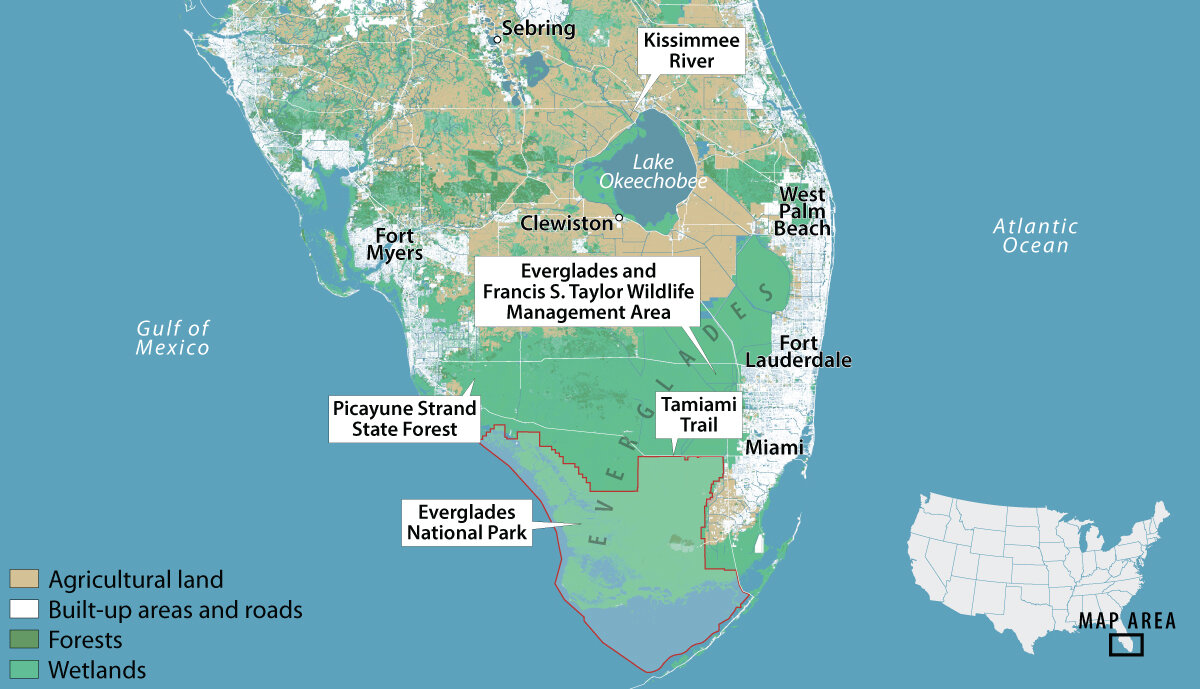
Map: Jacob Turcotte/Christian Science Monitor.
Efforts are afoot in Florida to save the the biodiversity of the Everglades by saving the water.

Last Thanksgiving, when John and family went to Florida, they sent great videos of a ride on one of those Everglades airboats that seem to float above the surface and allow visitors to get up close and personal with Everglades wildlife.

I had read, though, that the Everglades region was in trouble from overdevelopment and water pollution. Today’s article shows people are making a strong effort to protect it.

Richard Mertens has the story at the Christian Science Monitor, “Eight hundred feet up, the helicopter banks hard to the left. The horizon disappears. Mark Cook, an avian biologist, peers out his side window at a small irregular patch of water below. It’s hardly distinguishable from innumerable other patches that lie in every direction, dark and shining amid a ragged expanse of brown marsh grass and green tree islands.

“There’s one small difference: This patch is flecked with tiny specks of white, scattered like scraps of paper around a puddle.

“ ‘This year is pretty quiet,’ Dr. Cook has been saying. ‘It’s not very good for wading birds.’

“Now he looks more closely. The specks resolve into a variety of different birds, not all of them white: great egrets, snowy egrets, wood storks, white ibises, and pale pink roseate spoonbills, all standing in and around the shallow water. …

“For the birds of the Everglades, it’s not really been good for almost a century. First came the plume hunters of the 1800s and early 1900s, who shot birds by the thousands so that their feathers could adorn women’s hats in New York and London. Then came the speculators, developers, and visionaries who did more lasting damage, draining the marshes, logging the cypress swamps, digging canals, and building levees. They turned the Everglades into fields and housing tracts until half of it was gone. What’s more, says Paul Gray, a biologist with Audubon Florida, ‘The half of what’s there is all screwed up.’ 

“Today the state of Florida, the federal government, and many private organizations and individuals are working to bring the Everglades back -– at least the half that’s still left. Everglades restoration became national policy in 2000 when Congress adopted the $7.8 billion Comprehensive Everglades Restoration Plan.

“Since then, lawsuits, political fighting, and dwindled funding have at times slowed progress. But in recent years restoration efforts have gained momentum. Some projects have been completed, and new ones are underway. …

“ ‘The Everglades ball is rolling,’ says Peter Frederick, a retired wildlife ecologist at the University of Florida and an expert on Everglades restoration. 

“But will it work? Everglades restoration is a long-term undertaking. It’s expected to cost $23.2 billion and take until 2050 to finish. People often say it’s the largest ecological restoration project ever. ‘A lot could stop it,’ says Dr. Frederick. …

The Everglades system is unique in the world, an inextricable mix of water and vegetation resting on a shallow bed of porous limestone.

“More than just Everglades National Park, the Everglades once encompassed the whole southern third of the Florida Peninsula. … In those days, water that fell during Florida’s summer rains drained slowly south into Lake Okeechobee, a huge basin that in many places is hardly deeper than a suburban swimming pool. When the water was high, it lapped over the southern rim and flowed a hundred miles south in a broad sheet, through swamps and saw-grass marshes, wet prairies and sloughs, before finally discharging through mangrove swamps and coastal islands into the Gulf of Mexico. It was a rich and biologically diverse ecosystem governed by water. And the land was very flat. …

“Today those Everglades are mostly gone. They’re no longer a single vast interconnected system of flowing water but a collection of divided and diminished parts – large shallow basins separated by levees and tied together by gates and canals, with some devoted to holding water, some to cleaning it, and others to conserving wildlife.

“Lake Okeechobee is diked and polluted, and the swamps and saw-grass marshes that once received its overflowing waters are a checkerboard of sugar cane fields. The flow of water from north to south is much reduced, where it survives at all. For all its natural abundance, the Everglades today is an artificial landscape, a creature of engineering as much as topography and nature. 

“The main challenge of restoration is hydrological. It’s to re-create the old pre-drainage conditions by delivering more clean water to the Everglades. It’s to bring back the old cycle of rising water in summer followed by a long drying out through the winter. It’s to restore, at least in part, the slow flow south.

“The easiest way to accomplish this would be simply to pull the plug: tear down the dikes and levees, fill the canals, and send the engineers home. But restoration is also political, and it has always involved more than the Everglades. Its aim is also to provide clean water to coastal cities and estuaries and protect them from flooding. It’s to preserve and irrigate an agricultural district the size of Rhode Island that sits in the middle. …

“ ‘They all say the best engineer is no engineer at all,’ says Dr. Frederick. ‘Let nature do the work. The problem is that we now want to do more things with that water than we used to.’

“Dr. Cook enjoys a stork’s-eye view of the Everglades. His weekly flights take him over both the good and the bad, the degraded and the only partly degraded. [Some] areas are thick with cattails, a sign of nutrient pollution. Passing over one of these, Dr. Cook says, ‘We can’t get it back to what it once was, for maybe 100 to 200 years. But we can improve it for wildlife.’ …

“Sometimes there are surprises. In 2017, Hurricane Irma inundated the Everglades. The next spring, birds nested in numbers no one living had ever seen. To biologists, it seemed a vision of the old Everglades – and of what might still be.

“ ‘As an ecologist, you think, you get the water right and maybe they’ll come back,’ Dr. Cook says.”

Lots more on what’s being done at the Monitor, here. No firewall.

Read Full Post »

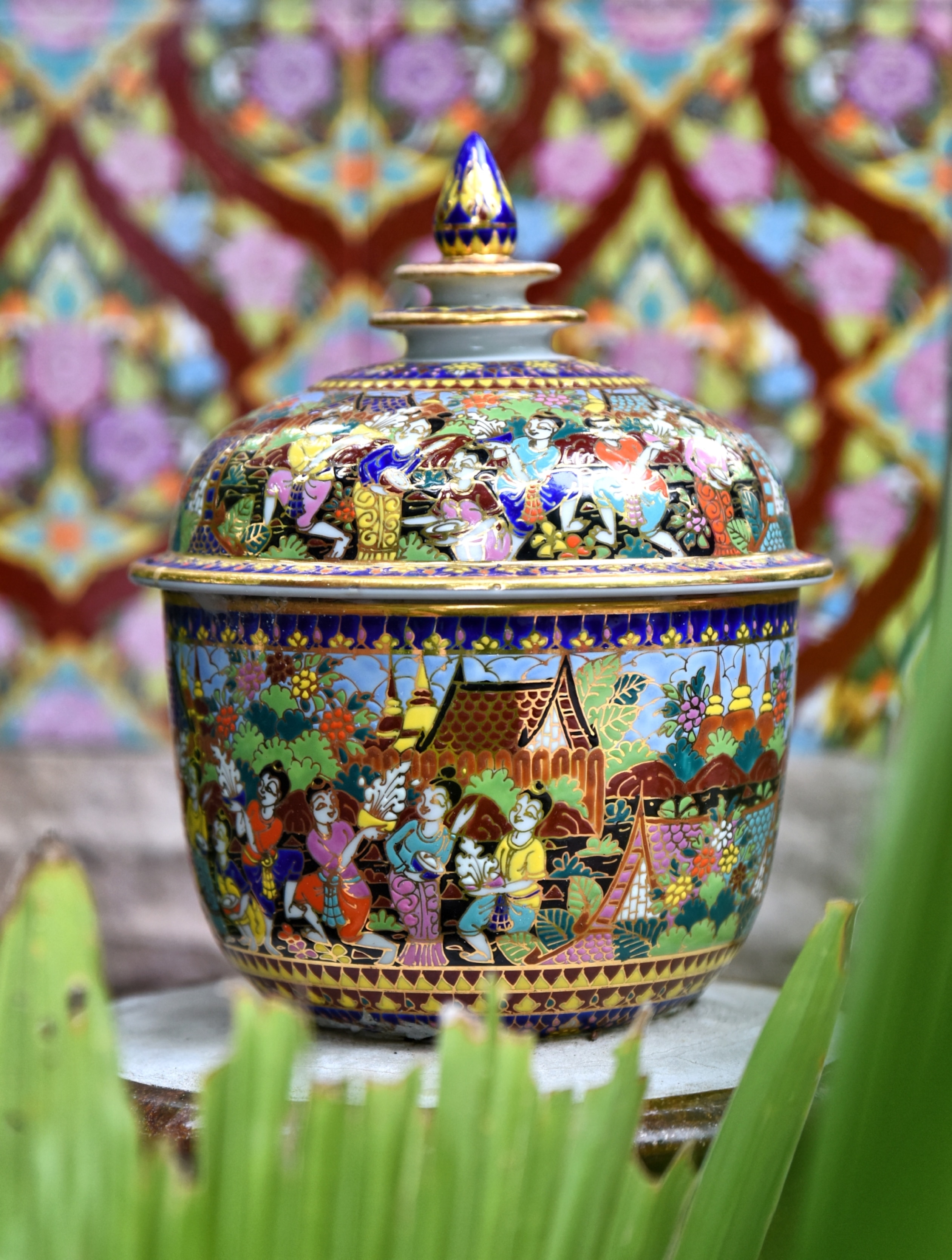
Photo: Ronan O’Connell.
Once reserved only for Thailand‘s elite, authentic benjarong porcelain takes highly skilled artisans days to create.

The other day, Princeton University reported that “a tortoise from a Galápagos species long believed extinct has been found alive and now confirmed to be … the first of her species identified in more than a century.” Wow. Good thing there are people working all the time to identify and save species.

Efforts to save dying arts are also important. Here is one practiced in a village in Thailand.

Writing last November at National Geographic, Ronan O’Connell reported, “Few tourists to Bangkok know that the glimmer of the iconic Wat Arun temple is thanks to the same magnificent Thai porcelain that decorates five-star hotel lobbies or serves as dinnerware in high-end Bangkok restaurants.

“Hand painted with intricate Buddhist motifs, benjarong porcelain once was reserved only for Thailand’s elite. In the 18th and 19th centuries, Thai royalty ate from delicate benjarong dishes and plates, wealthy women stored jewelry in benjarong boxes, and Bangkok’s palaces displayed tall benjarong vases.

“In the early 1900s, mosaics made of benjarong shards began embellishing many of the city’s most important Buddhist temples. … But it soon fell out of favor, and porcelain production eventually ceased.

“It would now exist only as an antiquity if not for a village that, in the 1980s, saw an opportunity to revive the art form. Located about 19 miles west of Bangkok, Don Kai Dee has grown to become what Atthasit Sukkham, assistant curator of the Southeast Asian Ceramics Museum at Bangkok University, describes as the sole source of authentic benjarong. …

“As of November 1, vaccinated travelers can visit Thailand quarantine-free, where they can buy benjarong from the artists at Don Kai Dee, learn the history of Thai ceramics at Bangkok’s Southeast Asian Ceramics Museum (reopening in December), and admire the exquisite benjarong decorations in the Thai capital’s Grand Palace. …

“It took the 1982 closure of a ceramics factory near Bangkok to resuscitate this royal craft. Urai Tangaeum was one of dozens of Thai artists made redundant when that workplace closed in Samut Sakhon province, where Don Kai Dee is also located. …

“Instead of wallowing in her misfortune, Tangaeum recounts, she decided to take a risk. After studying benjarong designs, she began painting them on plain ceramics sourced from factories. When it became apparent Thai buyers appreciated this forgotten product, she bought her own kiln. Slowly, Tangaeum created a start-to-finish benjarong studio at Don Kai Dee. Nearly 40 years later, this has become a co-operative where dozens of potters share skills and knowledge.

“During tours of Don Kai Dee led by senior workers, tourists to the village learn that each benjarong item is crafted using a nine-step process involving up to four different artists. It begins with soils from three Thai provinces. When mixed together they provide the perfect blend of plasticity, heat absorption, and white-color finish.

“After being shaped on a pottery wheel, the benjarong item is set in an electric kiln for 10 hours at 1472°F (800°C). Once it cools, the item is coated with a glaze and baked for another 10 hours at an even higher temperature, until it gleams.

“The next step is benjarong’s trademark. Artists paint designs with liquid gold, which costs $5,000 per liter, according to Tangaeum’s daughter, Nippawan. This gilding is executed only by veteran workers, who have 20-plus years’ experience in a profession which some artists can continue well into their 60s.

“Finally, another worker traces around the golden lines with colored paints, then a supervisor inspects the piece. The process finishes with another blast in the oven. It takes three to four days to produce a benjarong cup, dish, or plate, which go for at least $30 each. That time frame extends to two weeks for the largest vases, which can be up to six feet tall and cost as much as $10,000. …

“While shops across Thailand sell mass-produced, cheaper versions of benjarong, Don Kai Dee is the only source of authentic, traditional benjarong, according to ceramics expert Sukkham. At Don Kai Dee, tourists can purchase ready-made items and have them personalized on site, or order custom artworks to be shipped to their homes.

“The village does not have a website, with most of its sales done in person at the village, or via art dealers who facilitate purchases for rich clients, Pongmatha says. Some of these buyers pay up to $30,000 for particularly intricate, gold-laden dining sets.

“The expense of benjarong reflects the painstaking intricacy of its crafting. It requires poise and persistence to scrawl precise benjarong designs for hour after hour. It is those attributes, above all, that decide whether a benjarong student can become a master.

“ ‘We have many young people who come to the village to learn benjarong, but most don’t last,’ [villager Prapasri Pongmatha] says. ‘They have enough skill, but not the patience. Making benjarong can make you crazy if you aren’t patient. But if you are patient enough, it is very soothing, nearly like meditating.’

“The humble incomes earned by Benjarong artists also deter young Thai people from learning this craft, according to her daughter, Supawan Pongmatha. The 39-year-old says she loves making these ceramics. But she does so only in her spare time, having decided to instead become an art teacher, a more stable job with a higher salary.

“ ‘Young people want to make money, to feel they have a safe job with a good future,’ Supawan says. ‘Being a benjarong artist is not as reliable.’

“Without a robust new generation of craftspeople making benjarong, its future is uncertain, the villagers agree. Forty years ago, benjarong was a relic. Having slowly roused this art form out of hibernation, the artists of Don Kai Dee are now fiercely trying to keep it awake.”

More at National Geographic, here. Wonderful pictures. (Four free articles per month.)

Want to watch a short video about another endangered craft? Learn about making toe shoes in the UK, here.

Read Full Post »

Looking for turtles.

I do my wandering in a small circumference, but I’m always finding something new. Today’s photos are from favorite haunts in Massachusetts and Rhode Island.

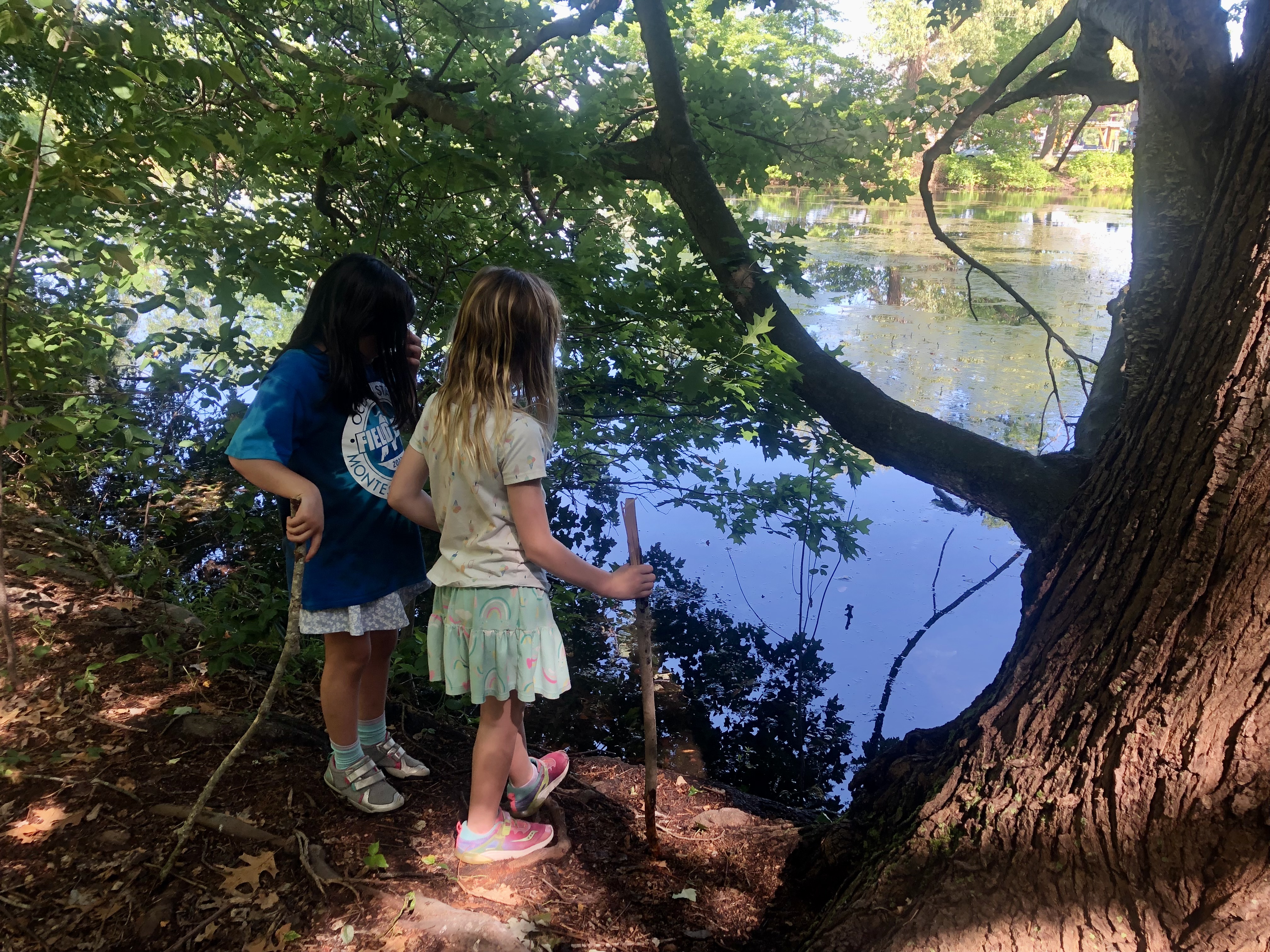
As a kid, I spent a lot of time exploring the woods. Now the granddaughter above and her friend enjoy doing the same thing. They particularly like tromping through the less traveled paths — a great opportunity to practice poison ivy identification.

The next photo shows another Providence pond beloved of turtles. My granddaughter worries about them when they lay eggs on the small beach where people walk.

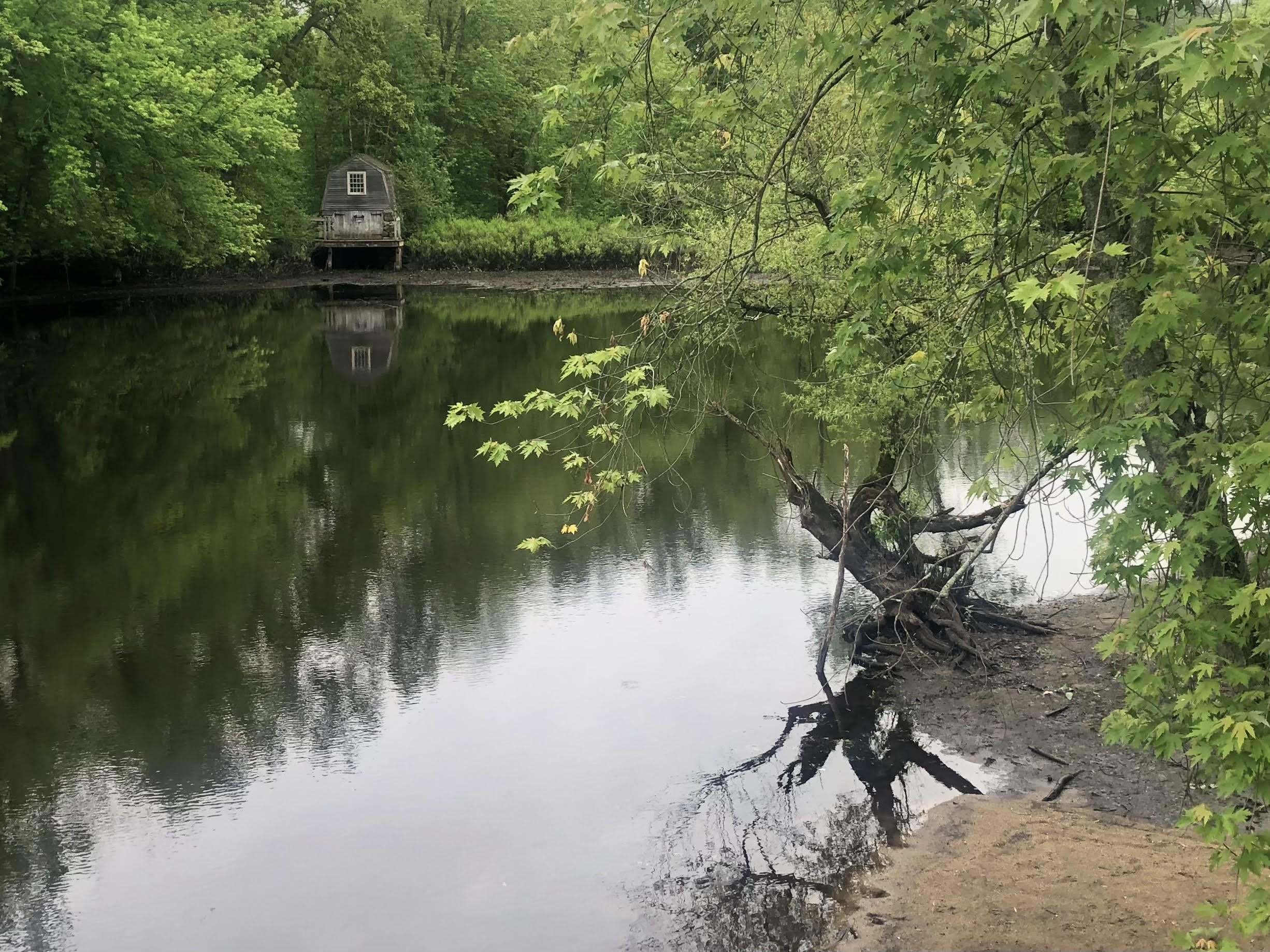
The next scene was taken from the North Bridge in Concord. The little boathouse belongs to the Old Manse. A fisherman is having a relaxing day on the river near there.

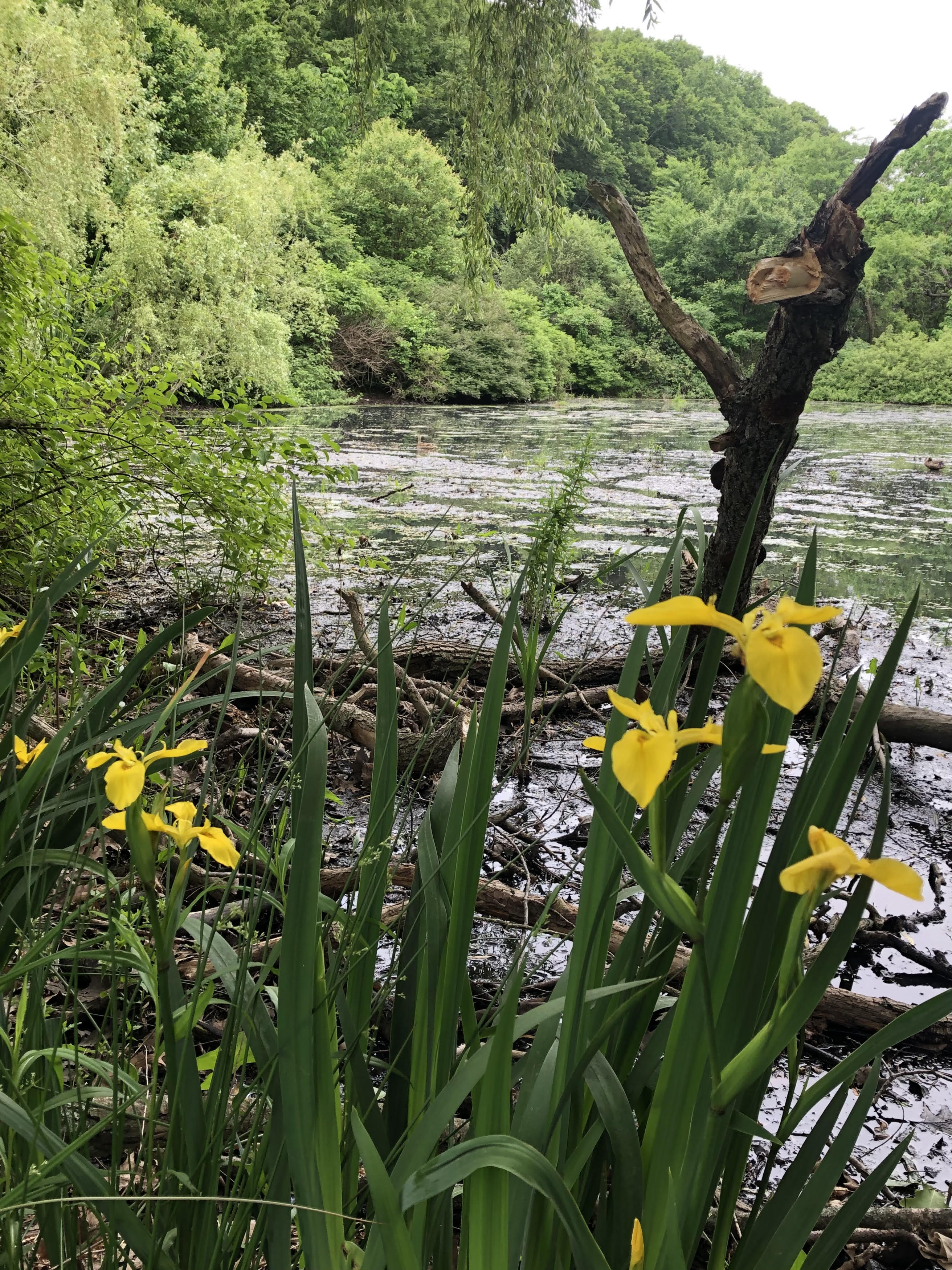
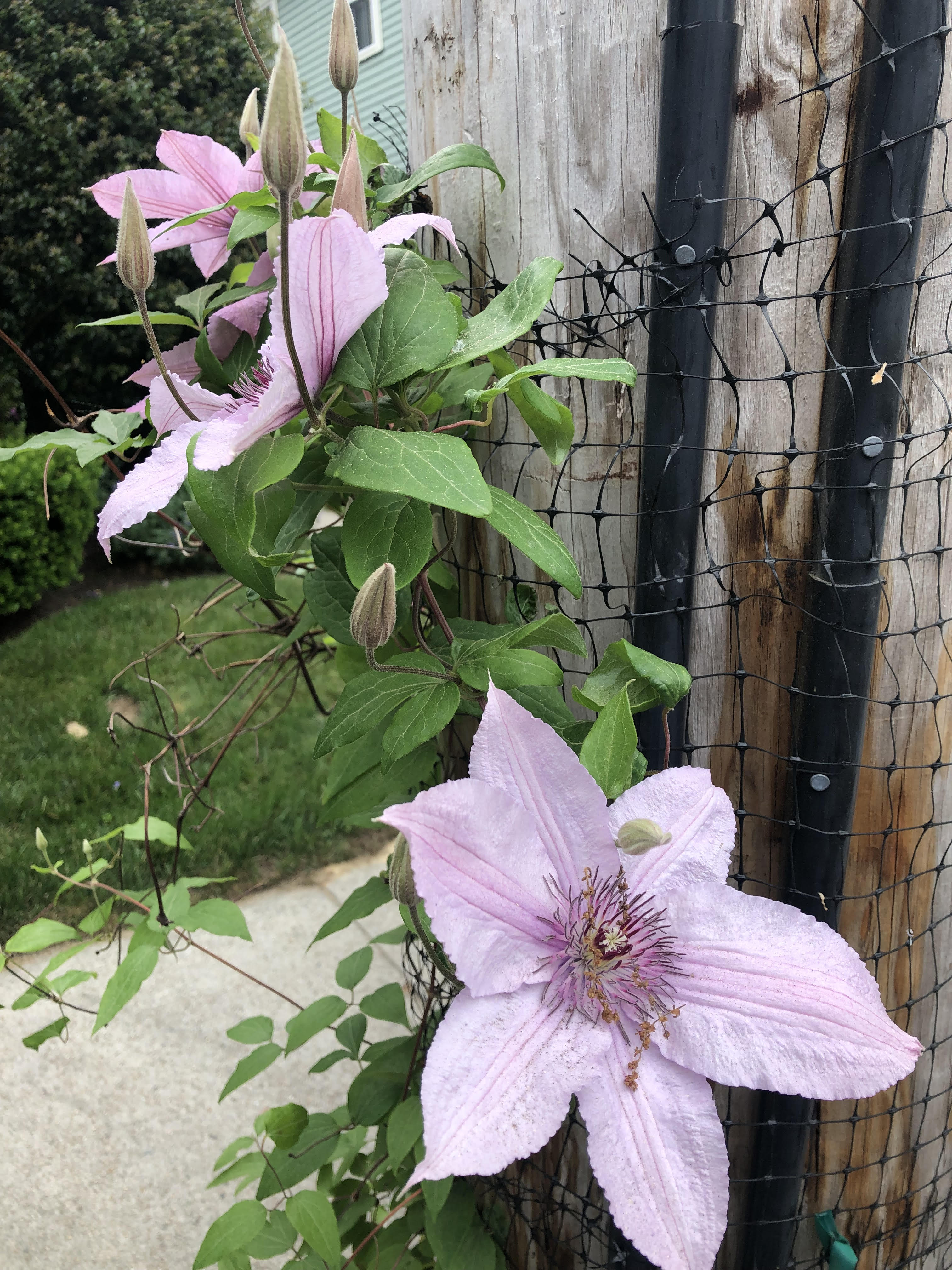
Lots of lupines in a yard devoted to native plants. Iris in my yard. Clematis on a phone pole.

Do you have a guess how far below the Clayhead Trail the beach in the next photo is? This is a true optical illusion as the distance is scores of feet down. Would love it if someone from New Shoreham could tell me just how many. 100?

The next shot is of our town in Massachusetts. The play Our Town was actually performed outdoors in the street here, directed my my friend Dorothy Schecter years ago.

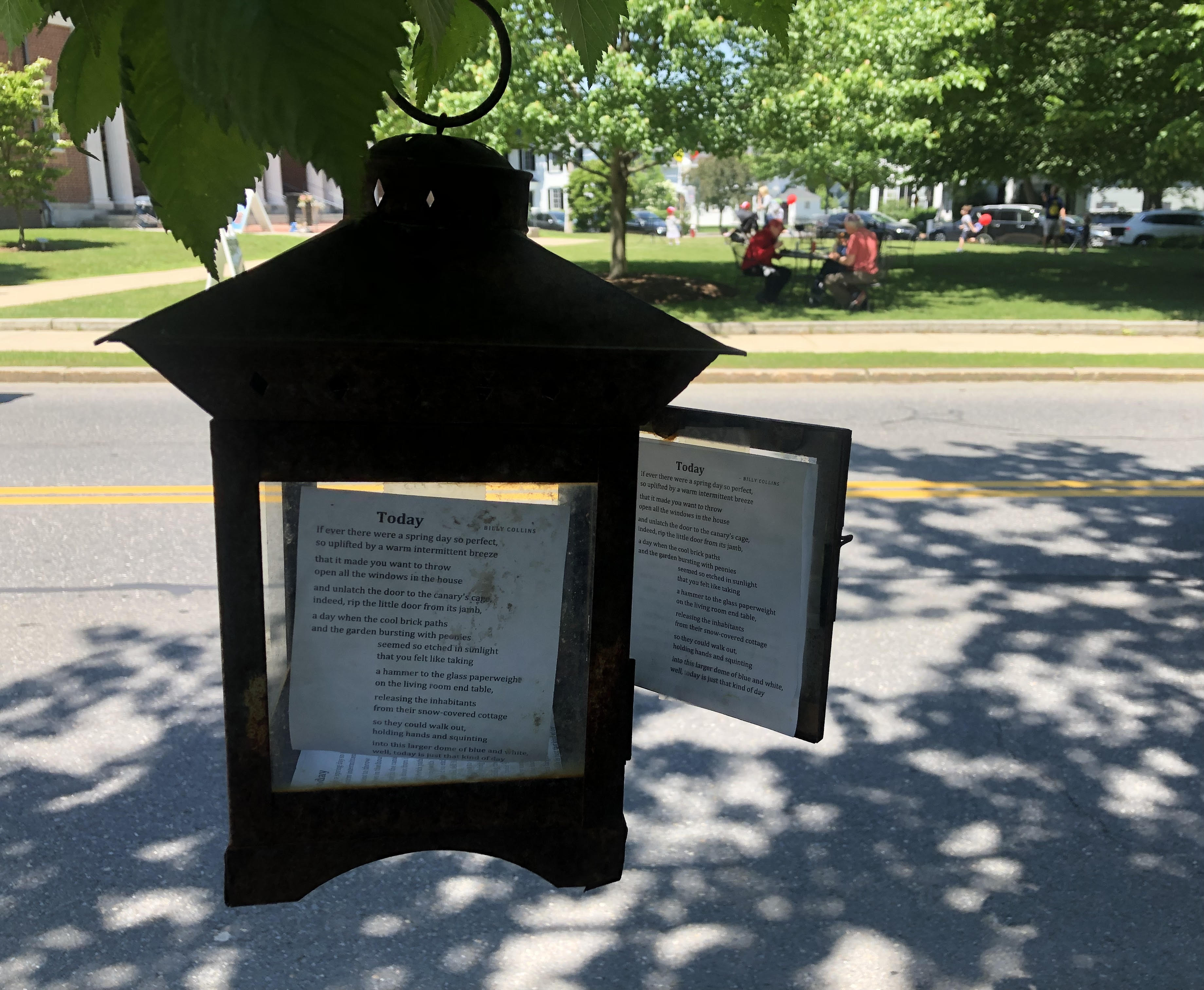
A creative resident hangs a lantern with poetry free for the taking.

I hope you’ll get a kick out of the bumper sticker. Unfortunately, no one was singing when I walked past. Next is a photo of a local second hand shop, followed by one of the cute veggie tables at the new health-food store.

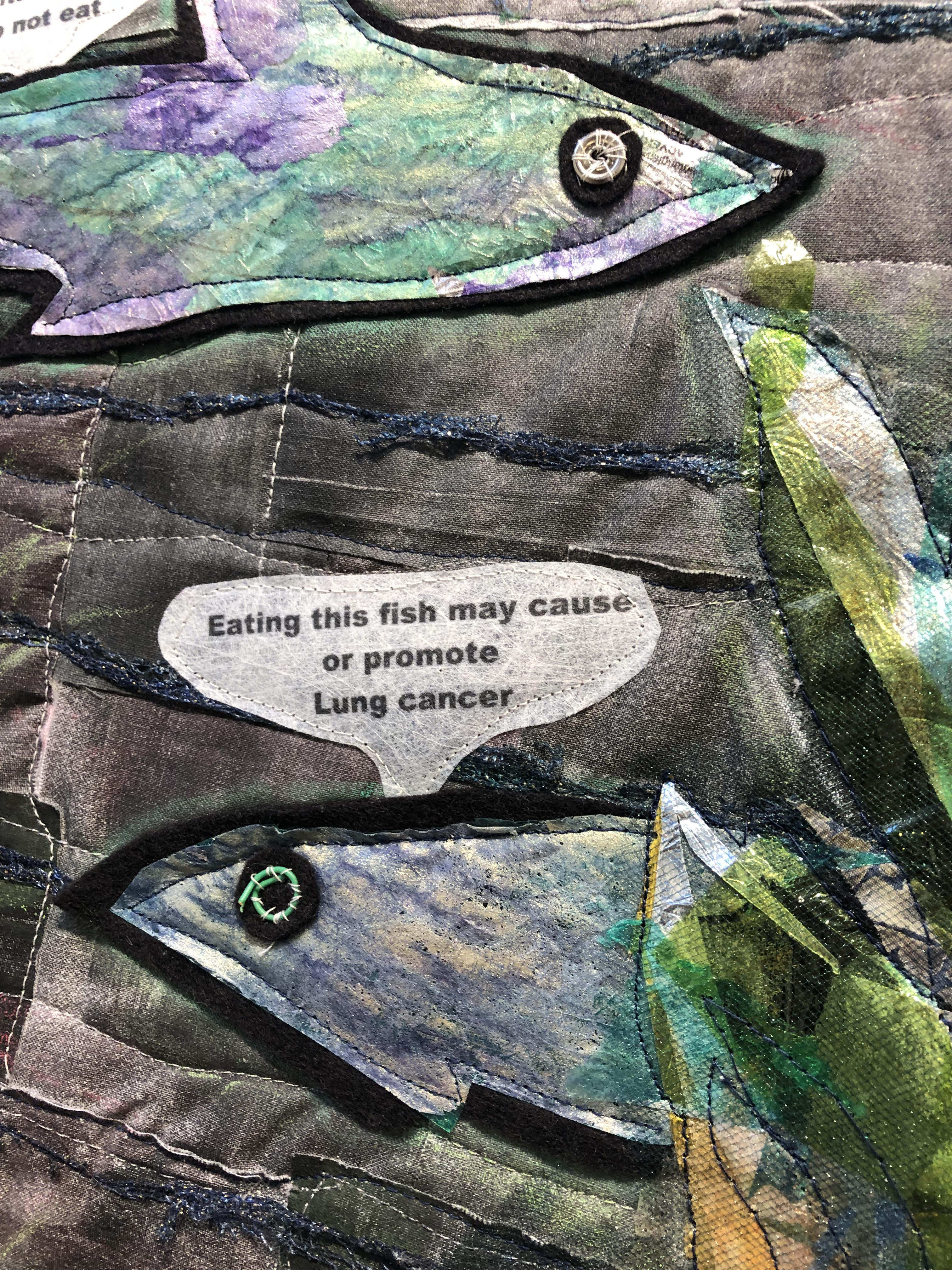
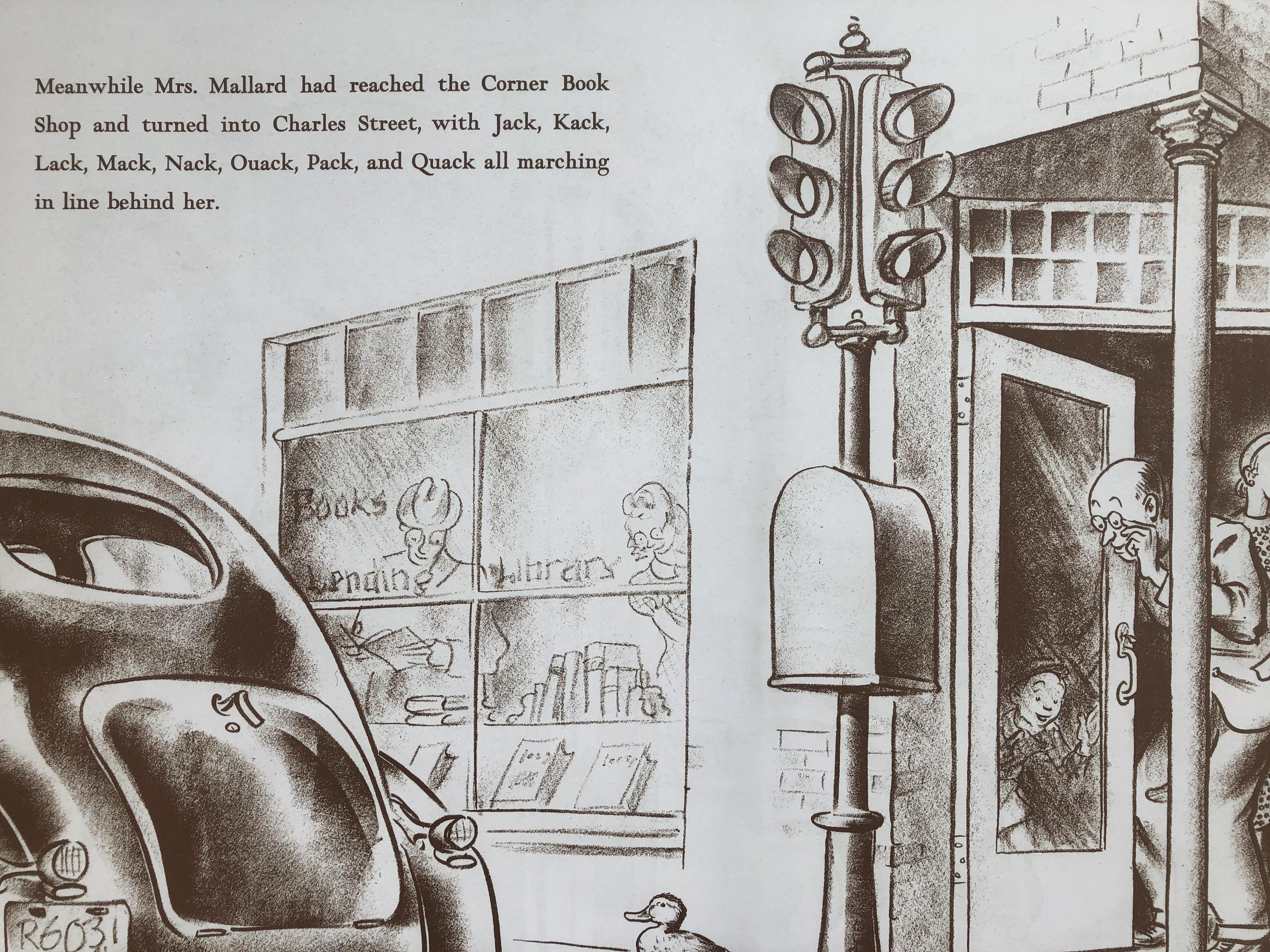
The quilted warning about eating the fish you catch was in Pawtucket at an Art League of Rhode Island show called “Under the Surface.” The Make Way for Ducklings wallpaper covered the windows of a Boston shop that was being renovated.

Read Full Post »

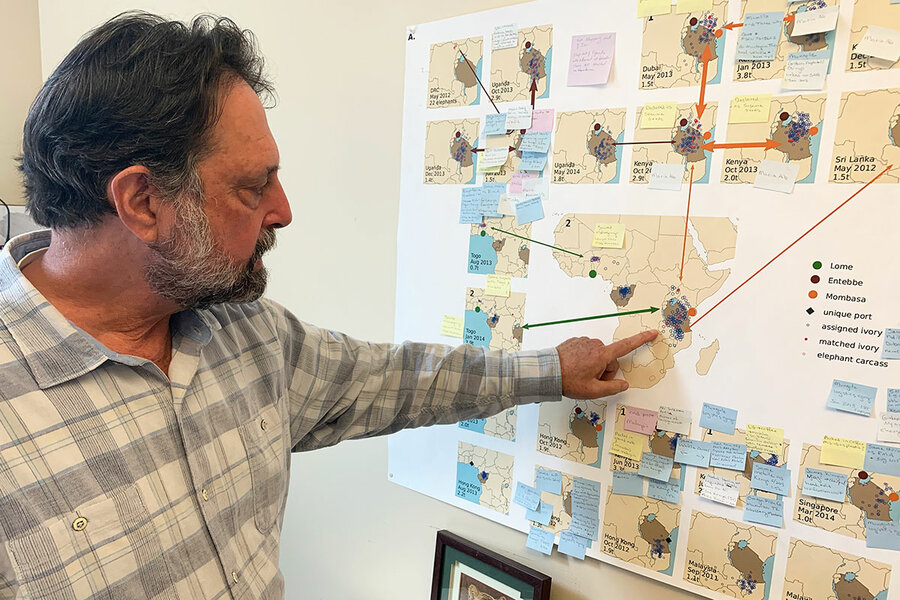
Photo: Dean Paton.
At Sam Wasser’s University of Washington office, maps show where ivory poaching occurs and where the contraband is exported. Dr. Wasser’s DNA work revealed that most ivory comes from east and west-central Africa.

It’s sad to read that gangs with powerful tentacles in every country are deeply embedded in the trafficking of endangered species. But on the other side, you know, environmental warriors have superpowers of their own, powers that go beyond righteous indignation.

Dean Paton writes at the Christian Science Monitor, “When Sam Wasser was a young biologist studying baboons in Tanzania, he never imagined he would one day lead an international force cracking down on the smuggling of illegal goods, from elephant ivory to pangolins and timber.

“Yet fighting transnational criminal organizations, or TCOs in law enforcement parlance, is exactly what he’s doing today, all because of his passion for animals.

“And because he discovered how to extract DNA from elephant poop.

“Today, Dr. Wasser is a professor at the University of Washington in Seattle. But in 1989 he was observing environmental stresses on baboons when Tanzania launched … a ‘brutal crackdown’ on elephant poaching rings. Tanzania battles a reputation for being among a handful of worst offenders in Asia and Africa that fuel the illegal ivory trade.   

“[The crackdown] had unexpected consequences. ‘All of a sudden our baboons started to be killed by leopards at an incredibly high rate,’ Dr. Wasser says. … The team realized the leopards had mostly ignored the local baboon fare while feasting on the remains of elephants left by poachers, who took only the tusks.  

“The decline in elephant carrion and subsequent decimation of the baboon troops ‘made me realize how significant poaching really was on all levels,’ he says, ‘and on all the other species that were similarly affected by the ecological cascade of events.’

“A self-described ‘animal nerd,’ Dr. Wasser points out that elephants are ‘some of the smartest animals around,’ he says. ‘They can recognize themselves in a mirror. You can put a spot on their forehead, and they’ll look in a mirror and they’ll wipe it off. That’s a high cognitive ability.’ But ‘we lost over 100,000 elephants from 2007 to 2015. There are currently an estimated 415,000 elephants remaining in Africa.’

“Dr. Wasser explains that poachers often go back and kill members of the same elephant families – so frequently that he believes it creates a form of elephant PTSD.

“Elephants also exhibit a strong interest in their dead. ‘They’ll go and they’ll just explore the carcasses of elephants. … It’s just too hard to watch, and the fact that we’re developing ways to potentially stop it – it keeps me going.’

“For the baboon studies, Dr. Wasser used hormones from animal dung to help understand their reproductive successes or failures. That work led Dr. Wasser to think, ‘You know, I could apply these tools to elephants. … You could then go and collect dung samples from elephants across the continent, genotype all the samples, and essentially create a DNA map,’ he explains. ‘And we could then get the DNA from the ivory to match to the map.’ …

“By 1997 Dr. Wasser had cracked the code and published one of the first papers on extracting DNA from elephant feces, and ‘right around the same time we were moving forward to see if we could develop methods to get DNA out of ivory.’

“Dr. Wasser’s team got its first break in 2005: Bill Clark, chair of Interpol’s Wildlife Crime Working Group, asked for help analyzing a shipment of ivory intercepted three years earlier in Singapore. It had been the largest seizure of ivory to date, about 6 tons, which included 40,000 carved hankos – also called chops – small pieces of ivory used throughout Asia to ink one’s name or seal on correspondence. Each would fetch about $200 retail, making the hankos alone worth $8 million.

“Until Dr. Wasser and his colleagues employed their emerging science to analyze that seizure, the biologist says ‘everyone’ believed these tusks were coming from all across Africa. But, using their dung-to-DNA analyses, ‘that’s not what we found.’

“Dr. Wasser’s game-changing work helped law enforcement realize the ivory was coming from a small number of specific areas in east and west-central Africa – yet was being shipped out of ports on either side of the continent. …

” ‘People don’t understand the intricate structure in wildlife crime,’ explains Rod Khattabi, a former homeland security agent who now runs the Justice Initiative for the Grace Farms Foundation, which partners with Dr. Wasser to train law enforcement agencies in Africa. … Wildlife criminals operate like independent cells, which makes arresting disparate elements of the syndicate tougher.

“ ‘That’s why Sam is so critical – because he can connect the dots,’ Mr. Khattabi says. ‘He’ll tell me, “Rod, this stuff is coming from Rwanda” even if it shipped out of Togo. He can almost pinpoint where the elephant got killed.’ …

“Dr. Wasser’s sleuthing has expanded beyond elephants. ‘The work that we were doing with the illegal ivory trade – we realized it was relevant to all of these other species that are all coming out of Africa,’ he says. ‘Same problem: transnational criminals shipping it on containers – and us needing to really get the transnational criminals.’

“In 2021, with funding from the Washington State Legislature, Dr. Wasser and his colleagues formed the Center for Environmental Forensic Science. ‘There were also other tools that other scientists were using that could complement what we’re doing,’ he says. ‘Now we’ve got over 40 scientists from the University of Washington alone that are part of our center’ using an array of synergistic methods including isotopes, chemistry, and handheld DNA detectors to fight a spectrum of crimes.”

More at the Monitor, here. No firewall.
Read Full Post »

« Newer Posts - Older Posts »