Feeds:
Posts
Comments

Photo: Jahi Chikwendiu/The Washington Post
Eddie Adams rehearses on a cello at George Mason University.

This summer I have been reading installments about the early life of someone I thought I knew well when she was a child. I thought I knew how difficult life was for her and her younger brother after her parents divorced. Wrong. Without getting into details, I’ll just say I didn’t have the slightest idea. Reading her story, I feel like crying. I feel like going back in time and trying to fix things.

Fortunately, I know this girl as an adult and can see that somehow she was saved, with the violin playing an important role in saving her. I’m telling you this because I want to share a story about a boy who was saved by a cello.

Allison Klein reported the cello story in April at the Washington Post.

“Eddie Adams didn’t have the money to buy college textbooks this semester, so he had to rely on his classmates at George Mason University to loan him theirs. He is the principal cellist in the school orchestra, but he couldn’t afford to buy or even rent a cello. That, too, he had to borrow.

“That was two weeks ago.

“After a story ran in The Washington Post about Adams’s tormented, impoverished childhood and how the cello has become his lifeline, people started donating money — more than Adams ever imagined was possible.

“The day the story ran, April 13, Adams looked at a GoFundMe page that had been set up for him and saw it had reached $25,000. It was so much money, he was sure there was a technical problem with the fundraising site.

“ ‘I legitimately thought it was a glitch in the system,’ said Adams, 20, who as a child moved around Northern Virginia with his mother and five siblings about seven times, including to a homeless shelter in Alexandria.

“The next day when the fundraiser reached $70,000 — and hundreds of people had left comments telling him he was worth every penny — he texted his strings professor and mentor, June Huang: ‘I’ve been crying all day … happy tears.’ …

“As of late Wednesday evening, the GoFundMe donations had reached $141,120.

“ ‘I still don’t want to believe it happened because it’s too much money for me to even think about,’ said Adams, who is estranged from his family and whose only home is his dorm room.

“On top of that, people donated other large and personal gifts. Two people are buying him cellos, one valued at up to $20,000 and another that will be specially made for him, valued at more than $30,000. A couple in Delaware bought him a $700 custom-fitted tuxedo he will wear during performances. Gift cards and checks started arriving at the university, totaling close to $5,000.

“The City of Alexandria invited him to play at a homeless shelter, Huang said. He plans to do it. …

“Adams’s first move was to pay a $250 deposit for an educational music festival he will be attending this summer. Then he went to the dentist for the first time since he was a child. And he paid off $15,000 in student loans that were accruing interest and had been weighing heavily on him.

“ ‘That was a very big moment for me,’ he said. …

“Huang, whose support of Adams was described in the Post story, said she has been deluged by calls and emails from people who want to help Adams.

Huang first heard Adams play at an audition for the school’s orchestra. She dropped her pencil, forgetting to score his performance because she found it so soulful and beautiful. …

“It was Huang’s private violin student Noah Pan Stier who at age 12 set up the GoFundMe page last year after Huang told him about Adams’s difficult childhood. Noah recently turned 13 and had a bar mitzvah, asking for donations for Adams instead of gifts. By early April, Noah had reached his goal of raising $10,000. That is the same GoFundMe that is now at more than $141,000. …

“Now, Huang is the point person coordinating Adams’s donations and talking with people around the country and in places such as Germany, England and Singapore who contacted her in recent days wanting to help. She has been getting pro bono guidance from various estate planners, tax lawyers and accountants to figure out how to keep the money safe for Adams and make it last. She said she’s been in nonstop motion the past 10 days, but she’s thrilled with all the support. …

“Huang said she includes one of Adams’s close friends, Adam Rothenberg, and his former middle school teacher, Gerald Fowkes, in financial discussions she has with Adams for transparency’s sake. She keeps all his financial information in a binder the four of them can look at. And she’s trying to teach Adams how to manage his newfound money at the same time she’s trying to figure it out herself. …

“Adams said he is now getting a lot of attention on campus, as people approach him and say they had no idea that his past was so difficult, that he faces so many challenges. He’s shy so the attention is not always easy for him.

“ ‘I have anxiety about these types of things, but I should get used it because it’s all really good,’ he said. ‘I’m trying not to think about it because finals are coming up and I’m trying not to let that take up all my head space. I still need to study and practice as much as I was before. I need to focus on my schoolwork because that’s the whole purpose of it all.’ ”

Read more at the Washington Post, here.
5109

Photo: David Tipling/Getty Images
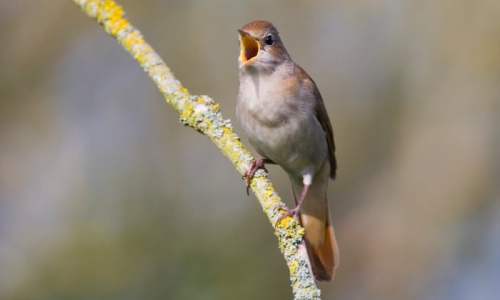
The nightingale’s song has been inspiring writers for more than a thousand years, but today most people have only recordings.

I’m reading one of the Narnia books to my younger grandson (The Horse and His Boy), and naturally some of the cultural references are to author CS Lewis’s England. We turned to our North American bird book when a nightingale was mentioned, and no nightingale was there. I’ll be showing him this story.

Patrick Barkham reports at the Guardian, “The nightingale has virtually disappeared from Britain over the past 50 years, its population plummeting by 93% to fewer than 5,500 pairs. But now a chorus of nightingale events are being arranged by artists, musicians and filmmakers to raise awareness of the plight of one of the country’s most celebrated but endangered birds.

“Birdsong was played on phones [in April] as the street artist ATM spent the day painting a nightingale in a gallery on the square, and more than 750 people attended a concert [of musicians performing] with amplified nightingale song.

Let Nature Sing, a track of pure birdsong including the nightingale, has been released by the RSPB to highlight the loss of more than 40 million birds from the UK in 50 years. …

“Its song was played in Berkeley Square as ATM painted a nightingale on the tailplane of a Wellington bomber at an event organised by the makers of a new documentary, The Last Song of the Nightingale.

“In 1924, the BBC’s first live-to-radio broadcast featured the cellist Beatrice Harrison playing a duet with a nightingale recorded in her garden in Surrey. The BBC continued this annual tradition until 1942, when the broadcast was famously abandoned when microphones picked up the sound of Wellington and Lancaster bombers en route to attack Germany, and the radio engineers realised the sounds could forewarn Hitler. …

“[Folksinger Sam] Lee said the nightingale was the most inspiring of musicians.

“ ‘For me it’s pure song,’ he said. ‘It’s an animal that is so utterly at one with music and the environment and using all the tropes and articulation and emotional capacity of a human musician, in the shape of a tiny brown feathered being.’ …

“Lee will rework the classic song ‘A Nightingale Sang in Berkeley Square’ at a free Extinction Rebellion event in the square, after which the audience will be encouraged to disperse through the streets of London with the nightingales’ song playing on their phones.

“Lee said … ‘At this rate we’re going to lose our nightingales, and so many species are in massive decline. We have to start celebrating these species and the arts are a very important way of brokering awareness and creating an agency for change.’ …

“ATM said he was convinced that nightingales did once sing in Berkeley Square. ‘It’s all about whether there was dense scrub in the square and I wouldn’t be surprised if there was one singing here 150 years ago.

“ ‘I lived in Berlin and the nightingale’s song was a common sound. Unfortunately the modern ethos of park-keeping is lawns and open spaces. People are frightened of the impenetrable places the nightingale needs.’ ”

More.

good-chance-dome_calais

Photo: Good Chance Theatre
A group that was founded to dramatize the plight of refugees in Calais, France, is now performing internationally.

Theater can often bring out the empathetic and compassionate side of audience members and lead to positive change in the world. As Amelia Parenteau writes at American Theatre, a play called The Jungle that grew around a refugee camp in Calais, France, may be helping viewers to see asylum seekers as people like themselves — and motivating them to take action.

“Good Chance Theatre was started by two Brits, Joe Murphy and Joe Robertson, when, in 2015, they passed through Calais, France, on their way to Germany and they saw the makeshift refugee camp that had formed there.

“Many theatremakers might feel the need to share the refugees’ story with the world, but first Murphy and Robertson wanted folks in the camp to have ‘a platform to express themselves,’ explained Dina Mousawi, Good Chance’s creative producer.

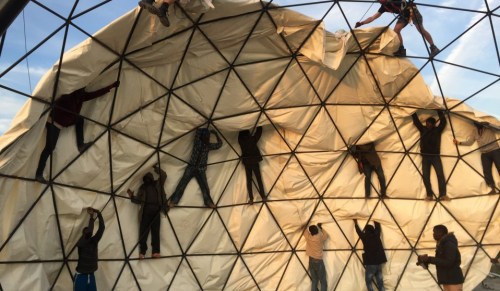
“So they decided to construct a theatre there in the shape of a geodesic dome, which has since become Good Chance’s signature pop-up venue; they spent seven months there in total.

“Vincent Mangado, a Théâtre du Soleil company member who joined their effort, described that first dome as a place ‘where everything could be spoken, a place of peace, a nerve center of the jungle, where you can share stories or throw a party, not just a theatre.’

“Upon returning to the U.K., Murphy and Robertson were commissioned to write a play about their experience in Calais, which grew up into the international hit The Jungle (now at the Curran Theatre in San Francisco through May 19). They traveled around the U.K., leading workshops with migrants and asylum seekers to continue gathering material. And cast members: The Jungle’s ensemble comprises of actors of 11 different nationalities, including some people Murphy and Robertson met in Calais who had since emigrated to Britain.

“The action of The Jungle is set in an Afghan restaurant that was built in Calais, and is staged with such an immersive aesthetic that audience members feel as though they are fellow diners at the restaurant. Along with the café, makeshift mosques, churches, shops, and other restaurants were constructed in Calais, despite extremely limited resources (just two water spigots and two porta-potties).

“Mousawi joined Good Chance in September 2018, though she had been doing similar work for years both on her own and with Complicité. In fact, she led the first Good Chance workshop in the dome in Calais with 35 Sudanese men in Arabic.

“Raised in Iraq, Mousawi left during the war to move to England, but returned to the Middle East during the height of the conflict in Syria, feeling called to help by making theatre. There she worked with Syrian women to produce work telling their stories, which only strengthened her conviction that theatre is for everybody, and should be radically inclusive. …

“ ‘Theatre can act as a tool for so many things, and one of the ways we use it is to encourage integration in areas where there might be tension.’ …

“To those audiences moved by The Jungle, Mousawi recommends reaching out to migrants recently arrived in your local community to see what you can do to make them feel welcome. ‘That’s what Good Chance is all about,’ she said. ‘Making people feel welcome, not alienated.’ ”

More here.

01_yvesmarchandromain20meffre_repurposedtheaters_photovertical

Photo: Yves Marchand and Romain Meffre
Two French photographers spent years capturing the new uses of old movie theaters, like this one. Now a gym, the building was once famed as the Alhambra Theater of San Francisco.

Sometimes spectacular old buildings simply cannot be returned to their original purpose. Times change. But as I learned from pictures by two French photographers, many people value the old movie theaters and are giving them new life.

Michael Hardy writes at Wired, “Between the 1920s and the 1950s, Hollywood studios built thousands of ornate movie palaces in cities across the United States. Warner Bros., Paramount, RKO, MGM, and others competed to build the biggest and gaudiest cinematic cathedrals to showcase their big-budget blockbusters. In this vertically integrated era of filmmaking, when the major studios tightly controlled the production, distribution, and exhibition of movies, these palaces served as the showrooms in which they displayed their wares. Seating thousands of spectators, the theaters were decorated in a fanciful array of styles, including art deco, art nouveau, and ancient Egyptian.

“In 1948 the US Supreme Court found that such vertical integration violated the Sherman Antitrust Act and ordered the biggest movie studios to divest themselves of their theater chains. The decision spelled the end for the era of the movie palace, as the studios were forced to sell or close their theater holdings. Television and suburbanization — the grand old theaters were mostly located in downtown areas — provided the coup de grâce.

“One of the grandest of the old palaces was Detroit’s United Artists Theatre, a 2,000-seat, Spanish Gothic–style venue that showed movies from 1928 until the 1970s. French photographers Yves Marchand and Romain Meffre stumbled across the abandoned theater in 2005 while working on a series about the effects of deindustrialization on the city.

“Stunned by the building’s fading grandeur, Marchand and Meffre began traveling the country, seeking out other abandoned theaters to photograph.

‘The amount of fantasy and detail are amazing in some of the theaters,’ Meffre says. ‘I don’t think we have anything comparable in Europe except for our cathedrals.’ …

“After discovering some tastefully repurposed palaces, such as Brooklyn’s cavernous Paramount Theater—now used as a gymnasium by Long Island University—they expanded the scope of their project. Not all renovations were so sensitive. Marchand and Meffre shot palaces that have been transformed into grocery stores, office buildings, even school bus depots. …

“Because the palaces are so expensive to tear down, many have survived more or less intact, a process the photographer calls ‘preservation by neglect.’ ”

Funny. Here’s to life-saving neglect!

More at Wired, here.

04garden1-jumbo

Photo: Mark Baldwin
A dense carpet of woodland perennials. Thomas Rainer, a landscape architect, calls plants “social creatures” that thrive in particular networks.

Today we understand that trees and other plants are the lungs of the planet and that we are losing too many every year, so it behooves us to understand them better and do what we can to help the remainder thrive. Even in our yards.

At the New York Times, Margaret Roach offers some tips from a landscape architect.

“Thomas Rainer and I have both been doing the botanical thing for decades,” she writes. “We know, and use, many of the same plants — and even much of the same horticultural vocabulary. But what he and I see when we look at a butterfly weed or a coneflower, or what we mean when we say familiar words like ‘layering’ or ‘ground cover,’ is surprisingly not synonymous.

“It turns out I’ve been missing what the plants were trying to tell me, failing to read botanical body language and behavior that could help me put plants together in combinations that would solve challenges that many of us have: beds that aren’t quite working visually, and garden areas that don’t function without lots of maintenance. … I asked Mr. Rainer, a landscape architect based in Washington, D.C., to lend us his 3-D vision.

“Roach: You visit a lot of gardens, and probably hear from gardeners like me with beds that just aren’t working. What’s the most common cause?

“Rainier: First, we have to understand that plants are social creatures. Our garden plants evolved as members of diverse social networks. Take a butterfly weed (Asclepias tuberosa, named this year’s Perennial Plant of the Year by the industry group the Perennial Plant Association), for example. The height of its flower is exactly the height of the grasses it grows among. Its narrow leaves hug its stems to efficiently emerge through a crowded mix. It has a taproot that drills through the fibrous roots of grasses. Everything about that plant is a reaction to its social network. And it is these social networks that make plantings so resilient.

“So if we think about the way plants grow in the wild, it helps us understand how different our gardens are. In the wild, every square inch of soil is covered with a mosaic of interlocking plants, but in our gardens, we arrange plants as individual objects in a sea of mulch. We place them in solitary confinement.

“So if you want to add butterfly weed to your garden, you might drift it in beds several feet apart and tuck some low grasses in as companions, like prairie dropseed, blue grama grass or buffalo grass.

“Start by looking for bare soil. It is everywhere in our gardens and landscapes. Even in beds with shrubs in them, there are often large expanses of bare soil underneath. It’s incredibly high-maintenance. It requires multiple applications of bark mulch a year, pre-emergent herbicides and lots and lots of weeding.

“The alternative to mulch is green mulch — that is, plants. This includes a wide range of herbaceous plants that cover soil, like clump-forming sedges, rhizomatous strawberries or golden groundsel, and self-seeding columbine or woodland poppies.

“Roach: If I want to try to do it more as nature does, what am I aiming for? Where do I take my cues?

“Rainier: The big shift in horticulture in the next decade will be a shift from thinking about plants as individual objects to communities of interrelated species. We think it’s possible to create designed plant communities: stylized versions of naturally occurring ones, adapted to work in our gardens and landscapes. This is not ecological restoration, it’s a hybrid of ecology and horticulture. We take inspiration from the layered structure in the wild, but combine it with the legibility and design of horticulture. It is the best of both worlds: the functionality and biodiversity of an ecological approach, but also the focus on beauty, order and color that horticulture has given us. It’s possible to balance diversity with legibility, ecology with aesthetics.

“And it is a shift in how we take care of our gardens: a focus on management, not maintenance. When you plant in communities, you manage the entire plantings, not each individual plant. This is a pretty radical shift. It’s O.K. if a plant self-seeds around a bit, or if one plant becomes more dominant. As long as it fits the aesthetic and functional goals. We can do much less and get more.” More here.

What do you think? I’m not a gardener, but I have a little yard, and I take Rainier’s point about how every patch of bare soil creates problems. I wonder what the Meadowscaping folks might have to say about combining horticulture and ecology in this way.

Rhode Island has an outstanding independent, environmental news publication called ecoRI News. Who says local news is dead?

Well, actually, it is very much endangered and requires heroic efforts by those who understand its importance. Reporting at ecoRI News, for example, played a pivotal role in the rejection of an unnecessary new fossil-fuel plant in Burrillville, after a fight that lasted years (producing hostile stickers on utility poles throughout the state). The story may have been partly about quality of life in a small Rhode Island community, but as we now know, every bit of fossil fuel threatens the whole planet.

Local news addresses other issues that have international implications. As Tim Faulkner reported at ecoRI News in April, “Plastic pollution is everywhere, showing up in the air, water, food, and consequently in our bodies.

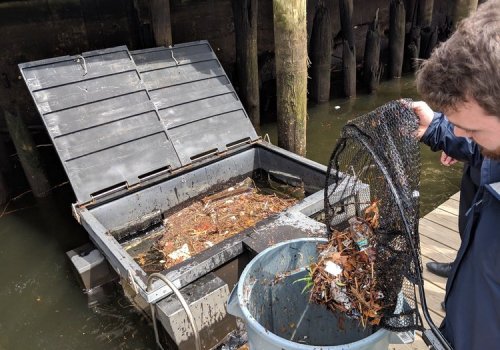
“To draw attention to this ubiquitous waste problem, plastic-catching traps, called trash skimmers, have been installed around Narragansett Bay to collect plastic debris and other trash in the marine environment.

“The latest skimmer was recently unveiled inside the hurricane barrier on the Providence River. It’s heralded as the first trash skimmer to be installed in a state capital.

“Using a pump to draw in debris, the partially submerged plastic box catches surface trash such as floating bottles and tiny debris called microparticles. Each skimmer costs about $12,000.

“Since 2017, three trash skimmers in Newport and one in Portsmouth have collected 27,000 pounds of trash. Cigarette butts, plastic food wrappers, and foam debris are the most common items collected. The skimmers are emptied daily throughout most of the year by interns and student groups. Each contains between 20 and 200 pounds of daily trash. The skimmers have collected unusual items such as floating plastic disks from a wastewater treatment plant in East Providence.

“The project is run by Clean Ocean Access, the Middletown-based pollution advocacy group directed by David McLaughlin.

“ ‘The skimmer is the last line of defense for our oceans, and each installation allows for open, positive, and forward-thinking conversation of how to solve the local and global problem of litter and marine debris,’ McLaughlin said. …

“Plastic bags are one of the top items collected in the trash skimmers. So far, 10 Rhode Island municipalities — Barrington, Bristol, Jamestown, Middletown, New Shoreham, Newport, North Kingstown, Portsmouth, South Kingstown, and Warren — have enacted bans on plastic retail bags. East Providence, Providence, and Westerly are poised to pass bans. …

“The trash skimmer project is funded by 11th Hour Racing, a Newport-based funder of ocean stewardship initiatives. … Two skimmers are operating in Newport Harbor and a third is in the water off Fort Adams. Another is at New England Boat Works in Portsmouth. A trash skimmer is operating in Gloucester, Mass., and a new trash skimmer is scheduled to be unveiled in New Bedford Harbor during the week of Earth Day. Other skimmers are planned for Stamford, Conn., and possibly Fall River, Mass.”

More here.

Photo: Tim Faulkner/ecoRI News
The Providence trash skimmer, which helps to clear plastic waste from Rhode Island waters, is fixed to a floating dock below the riverfront deck at the Hot Club
img_20190419_134501

6016

Photo: Akhil DT
“Censorship is anti-creation” … A quote from a lecture by Salman Rushdie, as seen on a StickLit poster on a Bangalore cement pillar. StickLit brings literature to the people using stickers.

In the New York metro and the T in Boston, I’ve enjoyed the poetry posters that give riders something more meaningful to read and ponder than ads. Now I’m learning about a new poetry-for-the-people effort in India. It uses poetry stickers in both English and a local language in site-specific venues.

Priyanka Sacheti reports at the Guardian, “There are thousands of street food carts in New Delhi. But only one has the opening lines of Riyazat Ullah Khan’s poem ‘Wazoodiyat’ on the side:

Where can the pauper keep his pain of existence?
He has no container but a heart.

“The sticker bearing the couplet is from a campaign called StickLit, which seeks to make literature more accessible by placing quotes in public spaces.

“Nidhin Kundathil and Manoj Pandey had the idea for the project while contemplating the advertisements, posters and billboards that are consumed almost subliminally on Indian streets.

“ ‘We thought of turning this [visual] experience on its head to create a completely new and refreshing alternative for passersby – [one] which was not just selling something, for a change,’ says Pandey, 32, a freelance writer in Darjeeling.

“The idea subsequently evolved: they would make what they call the world’s largest library – ‘the largest repository of good literature in public spaces: a library that’s free for all.’ So they hit the streets, putting up free-format stickers, posters and wall murals. …

“After starting in Bengaluru and Delhi in 2017, the project has spread all over India, with volunteers in various cities taking it up. The stickers are available from the StickLit website and the founders encourage people to download them and use them freely. …

“The founders encourage placement based on context: poems in railway stations, for example, when people have longer to contemplate them; shorter quotes and excerpts for busy streets. They also use place-specific languages – Hindi in Delhi, or Kannada in Bengaluru – alongside English. There are plans to share prison poetry in prisons as well.

“Kundathil, 33, a Bengaluru-based graphic artist, handles the design. He says he deliberately chooses bold, brightly-coloured fonts and minimal design elements in order not just to attract attention but to ensure that attention remains focused on the text.

“The list of authors chosen is inclusive and diverse, from Rushdie and former government minister Shashi Tharoor to newer voices such as Nishita Gill and Nikhil Mhaisne. They have also shared works of Kannada literary greats across Bengaluru. ‘A lot of our material consists of work by aspiring writers as well,’ Pandey says, adding that the project is open to submissions.

“ ‘We like to believe that people, especially the young, are drawn towards StickLit as they are not cynical,’ Pandey says. ‘They still believe that a pen can change the world. And we’d like to foster that.’ ”

More at the Guardian, here.

hobbyhorse-dispatch-slide-w7o4-jumbo

Photo: Dmitry Kostyukov for the New York Times
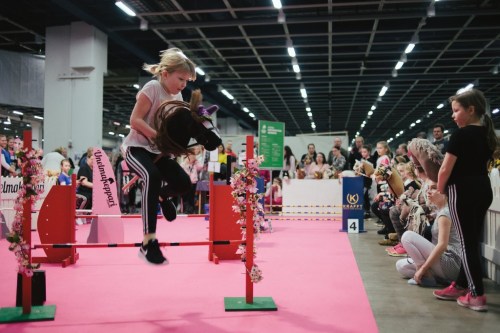
A girl performing during a hobbyhorse competition in Helsinki in March 2019.

Now here’s an unusual pastime: hobbyhorse competitions. Who knows how these things get started with kids? They make up their own fun. It starts out as private play, under the radar, and before you know it, it’s on TV.

Ellen Barry reported from Finland for the New York Times. “A dozen girls waited in line in a Helsinki arena for the dressage competition, ready to show off their riding skills, their faces masks of concentration.

“The judge put them through their paces — walk, trot, canter — and then asked them for a three-step rein-back, that classic test of a dressage horse’s training and obedience. The judge looked on gravely, occasionally taking notes.

“If anyone thought it strange that the girls were riding sticks, no one let on. The make-believe world of the hobbyhorse girls extended as far as the eye could see.

“A veterinarian lectured girls on hobbyhorse vaccination schedules, saying ‘check that the eyes are clear and there is no nasal discharge.’ The girls discussed hobbyhorse bloodlines and hobbyhorse temperaments, hobbyhorse training routines and hobbyhorse diets. There were rhinestone-studded bridles for sale. …

“ ‘The normal things, that normal girls like, they don’t feel like my things,’ [Fanny Oikarinen, 11,] said. But she is at home in the world of hobbyhorses, where boys and grown-ups have no place.

“Fanny and her friend, Maisa Wallius, are training for summertime competitions. They have choreographed a two-part dressage routine to a song by Nelly, the rapper. Asked which types of girls are drawn to hobbyhorses, Maisa thinks for a while before answering.

“ ‘Some are sports girls,’ she said. ‘Some are really lonely girls. And some can be the coolest girl at school.’

“It is impossible to say exactly when the Finnish hobbyhorse craze began, because it spread for years under the radar before adults became aware of it.

“In 2012, a filmmaker, Selma Vilhunen, stumbled across internet discussion boards used by hobbyhorse enthusiasts and was enraptured.

“Teenage girls had invented a form of hobbyhorse dressage, in which the rider’s lower body pranced and galloped like a horse, while her upper body remained erect and motionless like a rider. This evolved into an elaborate network of coaches and students and competitions, but it was discussed only online, for the most part.

“ ‘It was like a secret society,’ Ms. Vilhunen said.

“One of the girls she sought out as a guide to the hobbyhorse scene was Alisa Aarniomaki, a teenager from a city on Finland’s west coast.

“Leather-jacketed and fuchsia-haired, Ms. Aarniomaki was a celebrity in the online world for her hand-sewn hobbyhorses and riding videos, but she was apprehensive about letting her classmates know about it. When she was 12, some friends happened to spot her practicing in the woods near her school, and teased her for playing a child’s game. …

“When Ms. Vilhunen’s documentary film, ‘Hobbyhorse Revolution,’ was released in 2017, it captured its subjects in long spells of raucous joy. This was important to the filmmaker, who has made adolescent girls the focus of much of her work.

“ ‘Little girls are allowed to be strong and wild,’ she said. ‘I think the society starts to shape them into a certain kind of quietness when they reach puberty.’ …

“Within the rapidly expanding community of enthusiasts, the problem of ridicule really doesn’t come up. ‘I haven’t run into that sort of situation in a long time,’ [Ms. Aarniomaki] said. ‘I live in a bubble that is filled with hobbyhorses.’ ”

More here.

telemmglpict000194617024_trans_nvbqzqnjv4bqa7n2cxnjwnyi3tcbvbgu9twu-kwrahvlajxy1texvlq

Photos: Greek Ministry of Culture
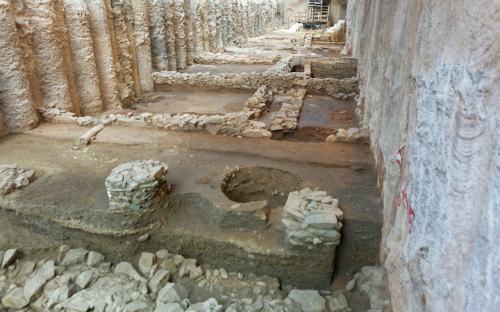
Hellenistic era building foundations, found at Agia Sophia Station, Thessaloniki.

Having studied Ancient Greek for five years in school, I retain a soft place in my heart for the culture and history of that part of the world and am always interested in the latest archaeological finds. Here is a story about setting out to build a subway system in the city of Thessaloniki and finding unexpected treasures.

Nick Squires writes at the Telegraph, “The construction of a metro network beneath the Greek city of Thessaloniki has unearthed an extraordinary treasure trove of ancient artefacts, from gold wreaths and rings to statues of the goddess Aphrodite. …

“Archeologists have dug up more than 300,000 artefacts, from coins and jewellery to marble statues, amphorae, oil lamps and perfume vases. They were found in what would have been the thriving commercial centre of the ancient city, which was the second most important conurbation in the Byzantine Empire after Constantinople.

“During the construction of the metro network, archeologists found a stone-paved road, the Decumanus Maximus, which would have run through the heart of Thessaloniki in the sixth century AD, as well as the remains of villas, shops, workshops and an early Christian church. More than 5,000 tombs and graves were uncovered, some of them containing exquisite golden wreaths.

“ ‘The excavations are the biggest archaeological project of recent years in Greece,’ Yannis Mylopoulos, the chairman of Attiko Metro, the company building the network, told the Telegraph. …

“ ‘A large number of statues depicting Aphrodite have been found in the city centre, while several more came to light in the area around the Church of the Acheiropoietos (a fifth century AD Byzantine church),” Dr Polyxeni Adam-Veleni, the head of the antiquities department in Thessaloniki, told a recent conference on the discoveries. …

“Work on the new metro system, which is designed to ease traffic congestion and reduce air pollution in the city, began in 2006. The network of 18 stations was supposed to have been finished in 2012, but progress was stalled by the discovery of so many antiquities. It is now due to be operational next year.

“The 100 yard-long paved road – the Decumanus Maximus – will remain in situ and will be incorporated into one of the network’s stations, Eleftherios Venizelos, named after a prominent politician and national hero from the early 20th century.

“ ‘People will be able to see it when they enter and exit the metro station and can even go down and walk on it if they want,’ said Prof Mylopoulos. …

“Incorporating ancient archeological sites into an underground rail network was a huge challenge in terms of both engineering and expense. … Findings from the metro excavation will be displayed in various museums in Thessaloniki.”

More here.

Gold crown from a burial dating to the late 4th – early 3rd century. BC found at Syntrivani Station, Thessaloniki.

telemmglpict000194617025_trans_nvbqzqnjv4bqo3jbnce98wracn_ld9fncsjzdweakvyotoziza28su0

3641

Photo: Hayley Madden/Spread the Word
Theresa Lola is the new young people’s laureate for London. Her writing has been described as “breathtakingly beautiful.”

Poetry will survive at least one more generation, judging from the numbers of young people who are enjoying it and even buying poetry books.

Sanjana Varghese writes at the Guardian, “Poet Theresa Lola, named the new young people’s laureate for London, says she hopes to use the role to help the capital’s demonised youth to find confidence in their voice.

“The 24-year-old British-Nigerian from Bromley, south London, studied accounting and finance at university before turning to poetry. She is the third young people’s laureate, after Caleb Femi and Momtaza Mehri. The joint winner of the 2018 Brunel international African poetry prize, her debut collection, In Search of Equilibrium, was published in February, and was described as breathtaking by author Bernardine Evaristo. …

“ ‘It’s easy for us to demonise young people and social media,’ [Lola] said. ‘Poetry was instrumental for me, to find my voice and to find my confidence, and hopefully it can do that for other young people too.’

“Sales of poetry books have increased over the last three years, hitting an all-time high of [$15 million in the UK] in 2018. Two-thirds of poetry buyers are now under 34, with teenage girls and young women identified as the biggest consumers last year. …

“ ‘A lot of young people are seeing that yes, [poetry] is reflective of their experiences and upbringing. They’re getting to understand that [it] exists anywhere. I’m hoping to meet so many different young people and help them see the poetry in their lives,’ Lola said.

“ ‘London is so important to me, especially for my craft – it’s such an eclectic city. It inspires me to be a form of myself in every poem.’ …

“The young people’s laureate title was established by writer development agency Spread the Word in 2016. Lola … will work on four residencies around London and a PoetryLab, which aims to nurture talented young poets in the capital.

“Spread the Word director Ruth Harrison said: ‘At a time of political uncertainty, when young people’s lives, concerns and aspirations are often ignored and dismissed, it is vital that their voices are heard by those in power.’ ” More.

My grandchildren are big on finding words that rhyme. Not that a poem has to rhyme, but sometimes that’s where nascent poets get hooked. I have made up some silly poems with the kids while driving home from school, and I expect they’ll always get a kick out of making words go together in surprising ways.


7111

Photo: Sasha Gusov/Alamy
Boris Giltburg … and a composite image showing his fiercest critics.

Becoming a professional musician requires dedication no matter what the situation, and you have to admire the perseverance of all musicians. But sometimes the dedication is so completely over-the-top it deserves an Olympic medal.

Pianist Boris Giltburg survived to tell his own story at the Guardian.

“There I was in a verdant valley, playing an open-air concert to 2,000 people, with snow-capped mountains rising off in the distance behind the stage. …

“As night fell, the brightly lit piano became a shining beacon in the surrounding blackness. It also became, I now realise, an immensely attractive object to various heat- and light-loving creatures. Shortly after the opening of Chopin’s Ballade No 1, a thin black insect landed on the keyboard. Before long, it was joined by another, then a few more, and by the time I got to the whirlwind of passages in the coda, I was fighting a mounting panic – as there were insects everywhere. …

“In the interval, the promoters sprayed me all over with insect repellant. It made me very sticky – and it seemed to matter not a bit to the crawlies occupying the keyboard. If anything, they seemed to actually be attracted to it, with several now landing on my ears and a few others exploring the nape of my neck. …

And then there are all my encounters with bats.

“Bats like to live in theatres, particularly in old Italian-style ones that provide them with comfortable rafters above the stage, and plenty of flying space in the darkness above. I discovered this fact during a rehearsal in one such theatre, when loud, neurotic squeaks erupted above me as I started playing. ‘Ah, the bats!’ the promoters said with smiles, in reply to my slightly concerned questions. ‘They’ve lived here since always. Don’t worry – you can’t hear them from the hall.’ …

“It turned out that having had the theatre as their residence for ages, the bats had become very cultured – and also very opinionated. They liked the Rachmaninov preludes well enough and listened politely. The darkening mood of Prokofiev’s 8th sonata, however, put them into a state of nervous agitation. They clearly didn’t like my take on it and I heard them fluttering above me, conversing in worried squeaks.

“Then came Ravel’s La Valse, darker still. That turned out to be too much. At first there was ominous silence from above but then in the coda, as the demise of the Old World inescapably approached in rising waves, first one and then many black-brown signs of the bats’ displeasure rained down on to the stage.

“[It] fell from above on my hands and the very brightly lit keyboard. The first made me jump – literally — and I pulled my hands off the keys for a split second. I then managed to go on, all the while noticing in growing discomfort and disbelief the continued delivery of the bats’ verdict on my performance. I think that was the bat equivalent of zero stars.

“After the concert, I was livid with indignation and shock. I expected the same sort of reaction from the promoters, but they took a much more pragmatic and good-natured view of the situation. Bats lived in theatres, they said, and that was that. Apparently they saw the discharge from their vantage point in the hall and thought it quite funny.

“They also told me of a previous attempt to curtail the bats’ activity (and population) with the help of an owl – but the owl proved to be just as, well, opinionated as the bats. It had nothing against Ravel, but seemed to show a particular dislike of the cello, which it let be known in no uncertain terms. After two cellos and their adjoining players had to be wiped clean, the owl was dismissed, and the bats had free rein to continue their musical education.

“I go back to that theatre almost every year. The audience is wonderfully enthusiastic, the acoustics clear and carrying, and the promoters’ hospitality among the warmest I’ve ever experienced. But I still haven’t been able to win over the bats. During my last visit, they pooh-poohed the 2nd movement of Beethoven’s Emperor concerto.”

More here.

closer-6576_wilds_hp_2120x1080

Photos: The Wilds
In Columbus, Ohio, you can camp overnight at the zoo.

A couple of my grandchildren brought sleeping bags on their latest visit, hoping to try camping — if not in a tent, then on the bedroom floor. A tent might be a little too exotic for where they are in life, although it worked for Suzanne when she was five weeks old.

Exotic camping makes me think of my friend Cathy. I saw her on the train the day she retired, and she told me that she was planning an overnight at the Columbus zoo. Apparently, you can sleep in a yurt. It’s not cheap. There is also a lodge or cabins, if you prefer.

The website says, “Today, it’s difficult to imagine The Wilds and its 9,000 plus acres as anything but a home to rare and endangered species from around the globe living in open range habitats.

“However, the park that has transformed wild life conservation practices was once devoted to strip mining.”

I loved reading this description of how the landscape was rescued from that devastation.

“The immense landscape of The Wilds and its mining history provides an ideal setting to study the process of ecological recovery and restoration. Ongoing biological inventories have recorded over a thousand species and provide an essential baseline for studying changes in populations over time.

“It is difficult for trees to survive on reclaimed mine land due to soil compaction and low nutrient availability. Instead, The Wilds has successfully established nearly 700 acres of prairies at The Wilds which provide beneficial pollinator and wildlife habitat.  Now we are conducting research to see how prairies change soil properties over time and whether the deep roots of prairie plants can prepare the land for the return of forests. …

“Wetlands are considered the most biologically rich ecosystems in the world.  However, development has caused these habitat types to become among the most endangered. The Wilds has restored a 20-acre area into a quality wetland refuge that supports a diversity of vegetation, waterfowl, and aquatic wildlife.  The removal of invasive species such as cattail is an ongoing effort. The ultimate goal is to increase native wetland vegetation and improve habitat for waterfowl and other aquatic wildlife. …

“Many of the reclaimed forests at The Wilds are in poor health, with low species diversity and overgrown with invasive species. The restoration department is currently working on restoring ~30 acres of forest. In order to accomplish this, invasive plant species are removed and native ones are planted in their place. Removal and replacement is a long and tedious process, but ultimately it will increase the biodiversity of the area. In addition, we intend to create native amphibian habitat by constructing two vernal pools and improving existing wetlands in the area. The end result of these combined efforts is expected to encourage more native animal and insect species to not only inhabit the area, but to thrive. …

“We have expanded our scope to improving the reclamation process immediately after mining. One essential step is seeding the land with new plant species. Traditional seed mixes used in land reclamation are not designed to create diverse habitat for wildlife, they simply aim to revegetate the land. We helped [the Ohio Department of Natural Resources] create more ecologically friendly seed mixes and monitored to see if sites planted with the native mix could revegetate the land as well as the traditional mix. Thus far, we have seen that mixes including native grasses and pollinator plants can definitely be successful, and that they undeniably increase native cover over traditional mixes. We are still working on long term monitoring of this project.”

To the conservationist side of me, this is all very impressive. But having just read a deep, thoughtful history of the destruction of Appalachia called Ramp Hollow, I can’t help but think that mining destroyed not only the environment but the ability of families to make a living off the land. I’d really like to see restoration for the people, too.

More.

Restoration Ecology

brautigan-web-1020x1141

Image: Jennifer Luxton / Seattle Times
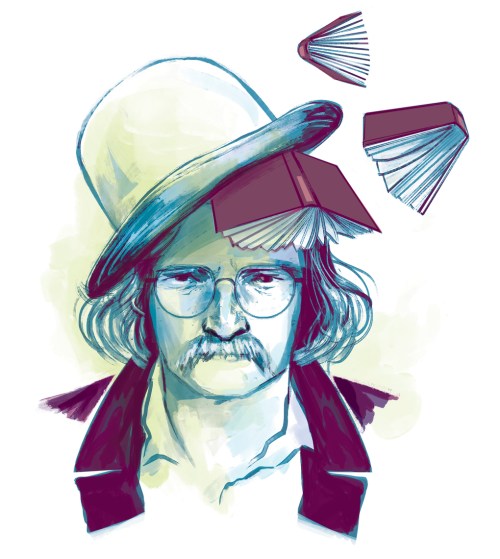
Richard Brautigan, best know for the quirky
Trout Fishing in America, encouraged unpublished writers to express themselves. Now there’s a library in his honor — a library of unpublished manuscripts.

In bookshops, I have often perused books by Richard Brautigan but have always concluded they were too odd for me. After reading about the unusual library the writer inspired, however, I have changed my mind. I’m going to take the plunge.

Megan Burbank writes at the Seattle Times, “It’s easy to trace the lingering influence of Tacoma-born writer Richard Brautigan if you know where to look. Though known for depicting San Francisco’s counterculture of the 1960s and ’70s with surrealistic flair, you’ll find one of his greatest legacies on three bookcases in the basement of Vancouver’s Clark County Historical Museum.

“Known as the Brautigan Library, the collection spans family histories, absurd Brautigan-esque capers, DIY religious tracts and memoirs of ordinary lives. They don’t feel like books at all, really, so much as the complete, unfiltered contents of other people’s minds. And they all have one thing in common: They’re unpublished. …

“When I visited the Brautigan Library in February, I couldn’t stop thinking of a passage from ‘Trout Fishing in America,’ perhaps Brautigan’s best-known work, that compares a bookstore to a graveyard:

‘Thousands of graveyards were parked in rows like cars. Most of the books were out of print, and no one wanted to read them any more and the people who had read the books had died or forgotten about them …’

“The books I encountered, crouched on the floor in that vaguely antiseptic-smelling basement, ran a fierce gamut. … Some stood out for their titles alone. My favorite was Alyce Cornyn-Selby’s ‘Did She Leave Me Any Money? A philosophical comedy about men, money, motivation, winning strategies, architecture, nudism, trucking, corporate assassinations, heart attacks, sexual politics, hometown parades, Spiritual Warriors, and the dredging of Willapa Bay.’ …

“The rows of manuscripts are punctuated with little cardboard printouts of mayonnaise jars, a nod to the collection’s cataloging technique, known as the Mayonnaise system.

“The name is a reference to the last line of ‘Trout Fishing in America.’ (‘Expressing a human need, I always wanted to write a book that ended with the word Mayonnaise.’)

“When Richard Brautigan died in 1984, control of his literary estate fell to his daughter, Ianthe Brautigan Swensen. [She] started getting letters from a man named Todd Lockwood. … His request [to create a library like the one in a Brautigan novel] was the first proposal Brautigan Swensen received that reminded her of the person her father had been.

“ ‘All of the sudden, I was like, “Right, this is the father that I remember,’” ‘ she says. ‘And right after my dad died, I was so — obviously — devastated and I thought in my mind that I’d lost him forever, and I picked up one of his books and there he was.’ …

“In 1990, Lockwood took on [the role of the novel’s librarian, who collected manuscripts.]. His Brautigan Library, based in Burlington, Vermont, operated as a nonprofit. At its peak, he says, it had about 100 volunteer librarians and attracted visitors from out of town.

“But in 1997, it closed due to lack of funding, and the manuscripts were put in storage in Lockwood’s basement.

“This caught the attention of John Barber, a faculty member in the Creative Media and Digital Culture program at Washington State University, Vancouver, who had once studied under Brautigan.

“He found space for the collection at the Clark County Historical Museum, and the library was moved and reopened in 2010. The manuscripts in the library date from the Vermont years: 1990-96. In 2013, it began accepting manuscripts again, but only electronically; there’s not enough space to keep accumulating paper volumes.” More.

What fun! This could be for you!

190402-erika-hernandez-micop-community-leader-radio-indigena-dj-se-206p_6f4e8705eeab07bbf03092d2680ed931.fit-1240w

Photo: Arcenio Lopez
Erika Hernandez, of the Mixteco Indígena Community Organizing Project in California, is a Radio Indigena DJ.

As languages spoken by small communities disappear, overwhelmed by other languages, it’s encouraging to read that the digital media that’s part of the problem is also part of the solution. As is radio.

Ludwig Hurtado has the story at NBC News. “Josefino Alvarado, a California farm worker, describes his typical morning picking blueberries at a Ventura County farm.

“As the sun beats down on him and his fellow workers, a crackle of static hums at their feet. ‘Hola mi gente,’ (Hello, my people) a voice calls out from the radio’s speakers in Spanish. Then, ‘tanìndíí,’ which means ‘good morning’ in Mixteco.

“On this farm and most of the farms nearby, workers have their radios tuned into the same station: 94.1, Radio Indígena. … The community-run station boasts 40 hours of original programming every week, broadcasting music and talk shows in a handful of indigenous languages, as well as Spanish programming too.

“The station is a welcome cultural lifeline for thousands of farm workers who speak Mixteco or other indigenous Central American languages.

“ ‘Listening to it is a point of pride,’ Alvarado, who is a frequent listener, said. While he only understands Spanish and Mixteco, he often will listen to some of Radio Indígena’s shows in Zapoteco, Triqui, and Nahuatl. Even if he doesn’t understand them, he said he’s proud to hear the languages being kept alive on the airwaves.

“Alvarado, who moved to the U.S. in 1997, was born and raised in the city of Oaxaca in central Mexico, where he and his family learned Mixteco as their first language. Although Mixteco has come into the national spotlight thanks to the Academy Award-winning film, Roma, the language is still virtually unknown to the general population. …

“Due to economic and cultural pressure in Mexico, many Mixtec communities are shifting to Spanish. UNESCO considers almost half of Mixteco’s 50 dialects to be either severely endangered or at risk of endangerment.

“According to the 2010 census, over 685,000 Latinos in the U.S. identified themselves as American Indian, up from around 400,000 in 2000. But experts agree that the actual number of indigenous Latinos in the U.S. is much higher than estimated because many don’t report to the census due to stigma and immigration status. …

“ ‘There’s a lot of radio stations in Oxnard, but they just play music,’ said Roberto Jesús, who listens to the show every morning as he drives to work, getting informed about the news and about his legal rights as an immigrant. … In the U.S., Mixtecs face barriers because of their limited English and sometimes limited Spanish. This leaves many of them vulnerable to exploitation and discrimination.

“Radio Indígena is hosted and run by the Mixteco Indígena Community Organizing Project (MICOP), a nonprofit organization formed to provide health outreach, humanitarian support and language interpretation to this underserved and often unnoticed community. …

“Radio Indígena started when organizers saw a void in the city of Oxnard, but [Arcenio Lopez, executive director of MICOP and Radio Indígena] said that the station has listeners from all over the country and world, since the episodes are available to stream online. …

“Delfina Santiago and Carmen Vasquez co-host a show on Radio Indígena every Sunday from 10 a.m. to 1 p.m. Even though they don’t get paid for their work, the two spend lots of time during the week preparing for their program, ‘Al Ritmo De Chilena,’ which is an educational program that delves into the history of different indigenous cultures for each episode.

Santiago and Vazquez say that the digital age has played a role in keeping their language alive and keeping folks connected to one another, in a world where they might otherwise feel alone. Indigenous Mexican music can be found on YouTube and SoundCloud. …

“ ‘We’ve already lost three languages in Oaxaca,’ Santiago lamented. ‘They’re gone.’ ”

More here.

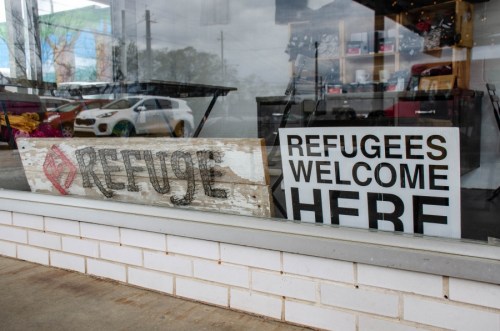
More and more people are recognizing that the mass migrations we’re seeing today — and the wars that seem to be the main cause — are tied to climate change.

Here is a story about a small city in Georgia, home to many immigrants, that has put two and two together and is determined to be part of the solution.

Writes Jason Margolis at Public Radio International’s show The World, “Clarkston, Georgia, is often referred to as the Ellis Island of the South. Some 60 languages are spoken in this city of 13,000 just outside of Atlanta, and perhaps half the population is foreign born. Many are refugees.

“Felix Hategekimana is a refugee from Rwanda, a soft-spoken man who doesn’t talk much about his backstory, except to say that he fled violence back home: ‘We have political issues and security [issues].’

“But Hategekimana says there’s more to the troubles in Rwanda. Droughts and floods have plagued his country in recent years, and that’s led to more people migrating.

“ ‘Some people lose life in the disaster of the rain,’ Hategekimana said. ‘Some people lose life, others lose their homes and they lose their property, like their farms where they plant their vegetables.’

“You hear a lot of stories like this from refugees in Clarkston. Legally, there’s no such thing as a ‘climate change refugee.’ Refugee status is only awarded based on a well-founded fear of persecution due to race, religion, nationality, political opinion or membership in a social group — not because your home got wiped out by a flood, or your crops were destroyed by a drought.

“But Clarkston’s mayor, Ted Terry, says the impacts of more extreme weather are woven throughout the lives of many new residents here. …

“Climate scientists agree that storms are becoming more severe, and the trend is only going to continue. Case in point, the Category 4 cyclone that struck southern Africa recently has left at least 600,000 people displaced. The immediate needs there — food, clean drinking water and shelter — are stark. After that, a big question: rebuild or relocate?

“It’s a dilemma that many people across the globe are facing, which will inevitably lead to more people on the move. But the world still hasn’t agreed on what to do with so-called climate refugees. Take a place like Syria.

“ ‘It becomes more drier, I think,’ said Malk Alarmash, a Syrian refugee now living in Clarkston. … But Alarmash can’t say that a lack of rainfall led people to flee Syria.

“ ‘I don’t know. I don’t have any information about that, like climate change,’ Alarmash said.

“An inability to pin the seeds of conflict on climatic shifts isn’t unusual; the relationship between climate change and forced migration is immensely complicated. … A drought can destroy people’s food supplies and livelihoods. That can lead to internal migration, inflame tensions and maybe even contribute to conflict and a refugee crisis. But all of this can unfold over years. …

“ ‘The climate is the last thing in their mind. They know it’s all related, but they just say, “This is from God,” ‘ said Omar Shekhey, a Clarkston resident who is originally from Somalia. …  ‘It goes together — the civil war, the war and the climate, you cannot separate them.’ …

“Shekhey says most Somali refugees aren’t connecting the dots to climate change. But as global temperatures continue to rise, Mayor Terry, who also works with the Sierra Club, believes that those dots will become clearer, even in the US.

“ ‘We’re looking at a future, I think, if we don’t take steps to reverse global warming, we’re looking at potentially hundreds of millions of people around the world, including you know, in America, Louisiana. Their coastline is disappearing,’ Terry said. ‘And so, at some point, there has to be some sort of recognition and define what it means to be a climate refugee.’ …

“Clarkston’s mayor [wants] to address the root of the problem, starting in his own community. It’s one reason Clarkston is committing to 100 percent renewable energy — instead of fossil fuels — by midcentury.

“ ‘In some way, we’re trying to alleviate future calamities. We just have to do our part; we have to consider ourselves part of the global community.’ ”

More at PRI, here.

dsc5861