I was hoping to have a factory tour to write about this fall, but when I went to the MeetUp page to register, it turned out New England Factory Tours was taking a break.
I like factory tours. I remember a tour of a lima bean packaging factory on Shelter Island, NY, when I was a kid, and a Kodak tour when Suzanne and John were little.
I have often referred to the lima bean factory when trying to explain to colleagues why a good publishing process involves doing things at the right time. You wouldn’t try to put the lima beans in the package after you had pasted the wrapper around it, and you shouldn’t make lots of changes to your original paper after it has been copyedited, laid out, and readied for press.
What I gleaned from Kodak was mainly how much got thrown away. It seemed wasteful, but the guide said it was cheaper to toss things. I’d like to see the lean manufacturing that’s more common today.
The Boston Globe‘s Jon Christian wrote about a trip to manufacturer Built-Rite, which makes automation systems for industrial tasks.It’s in Lancaster, Mass.
“Built-Rite is the fourth plant visited by the group of manufacturing enthusiasts known as New England Factory Tours. Inspired by a similar group in San Francisco, it is indicative of the cachet manufacturing has gained in recent years as a new generation of entrepreneurs known as makers turn their attention from software and services toward tangible products — from hardware to drones to smartwatches.
“The growth of this movement is underscored by the emergence of shared workspaces such as Artisan’s Asylum in Somerville, the home of startups such as 3Doodler, the maker of a 3-D printing pen, and Greentown Labs, also in Somerville, a hardware incubator that houses wind turbine developer Altaeros Energies, weather sensor maker Understory, and other firms. …
“In Massachusetts, manufacturing still employs about 250,000 people, paying average wages of about $80,000 a year compared with about $60,000 for all industries, according to state labor statistics. Most manufacturing in the state is so-called advanced manufacturing that uses sophisticated processes, makes sophisticated products, and requires highly skilled workers.” More.
I’m hoping the MeetUp organizer gets going again. A factory tour is something fun to do with kids and can make a lasting impression.
Photo: Kieran Kesner for The Boston Globe
During a tour of Built-Rite Tool & Die, president Craig A. Bovaird (center) spoke with tour organizer Chris Denney and visitor Erik Sobel, a principal at Technology Research Laboratories.
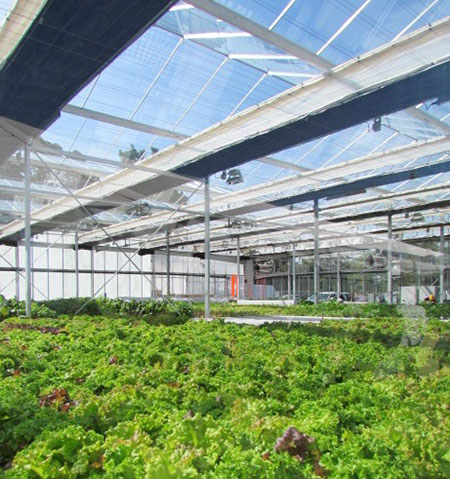
Tim Faulkner at ecoRI has been covering Rhode Island’s newest food initiatives. Recently he wrote about the unusually advanced greenhouse of Boston Greens. in Kingstown.
“Lewis Valenti, CEO and founder of the greenhouse and the Boston Greens line of leafy green vegetables and herbs it produces, spent five years studying how to start a business that grows produce indoors and year-round. …
“The result is what Valenti describes as the most technologically advanced greenhouse in New England. The 8,400-square-foot glass barn relies on advanced computer programs to manipulate light, feeding and humidity.
“All plants are fed a fertilizer-rich water that recirculates in a system of troughs at the base of the plants, a process known as hydroponic growing. The water alone goes through several filters and processes that strip it of minerals and all non-water elements. A nutrient mix is then reintroduced before it is fed through the hydroponic system.
“The benefits are an ability to control the nutrients in the plants and increase their overall health benefits. There are no pests and therefore no need for pesticides or herbicides, according to Valenti. The process conserves water, using 1,200 gallons a day compared to 28,000 gallons for a comparable outdoor field, according to Valenti. The yield is higher, too. The greenhouse will grow 250,000 heads of lettuce throughout the year, producing the equivalent of a 4-acre farm. …
“So far, the $1.3 million project has been privately funded, and it’s already generating revenue. All future harvests of lettuces and herbs have been pre-sold to a handful of restaurants and eight grocery stores in Rhode Island and Massachusetts.
“Valenti, who went to college in Rhode Island and keeps a home in East Greenwich, said Rhode Island is a foodie state with top restaurants, culinary schools and a burgeoning agricultural movement. But with limited space for farmland, the new greenhouse is the best way to keep the local food movement sustainable while creating jobs, he said.
“ ‘I can’t think of a better place to grow food than Rhode Island,’ Valenti said.”
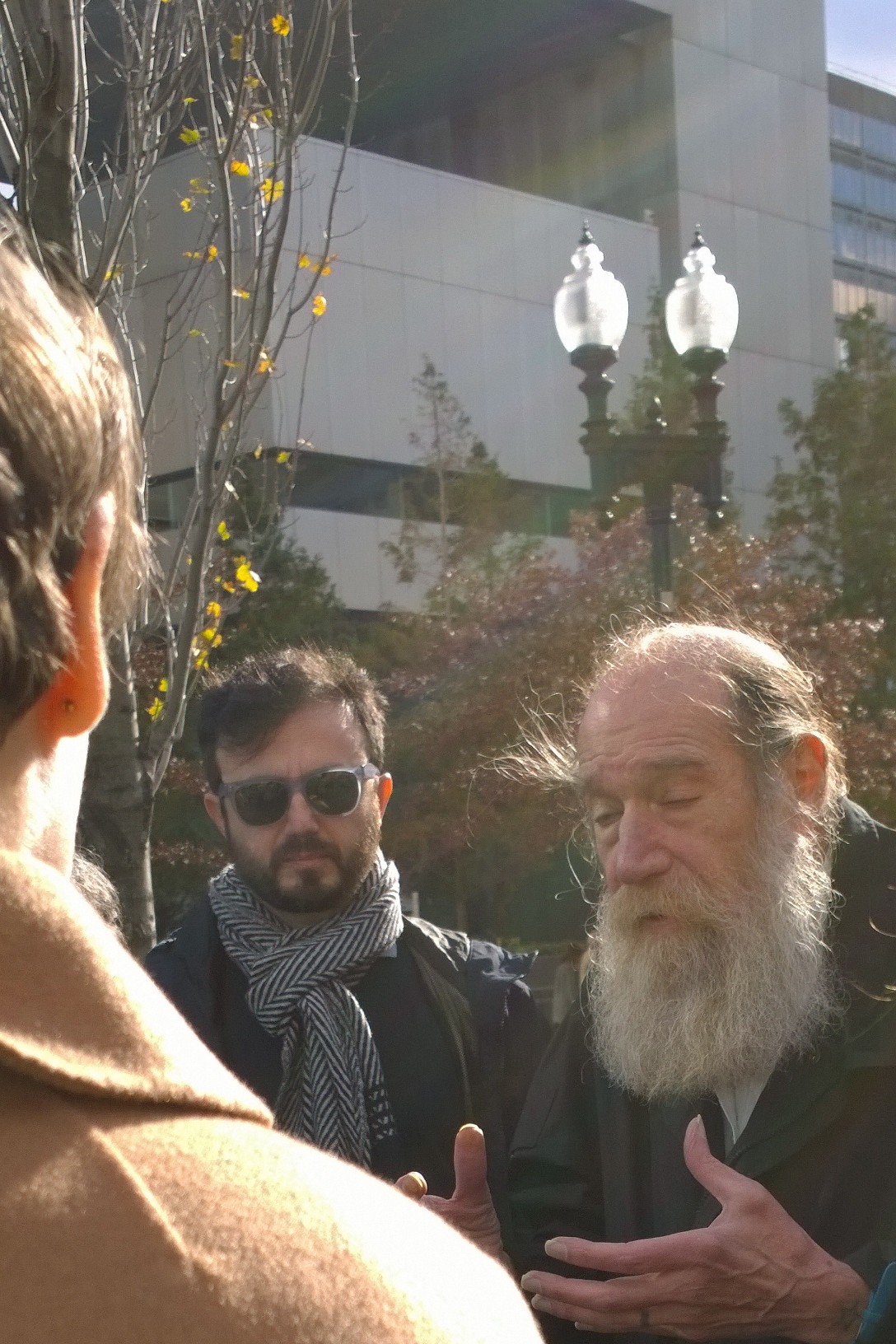
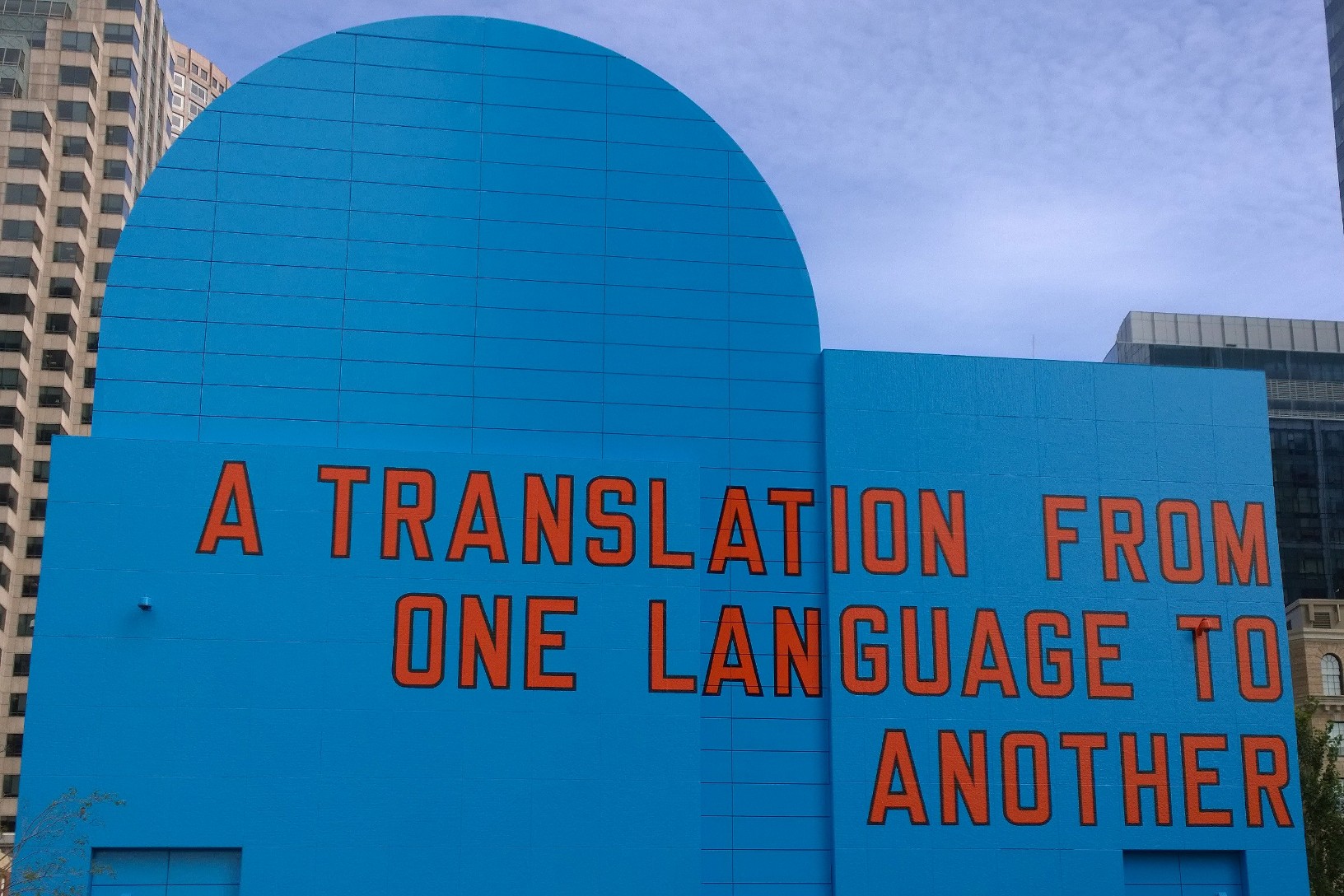
The latest Greenway mural in Dewey Square comes courtesy of MIT’s List gallery and is the work of Lawrence Weiner. I admit to liking it even though it seems to be nothing more than bright orange letters on a blue background, with words saying, “A translation from one language to another.”
I am letting it sink in. Perhaps it’s about the translation from the artist’s idea to a work that others see. Perhaps something is lost in the translation. Perhaps it’s about how differently we understand one another, even without so-called language barriers.
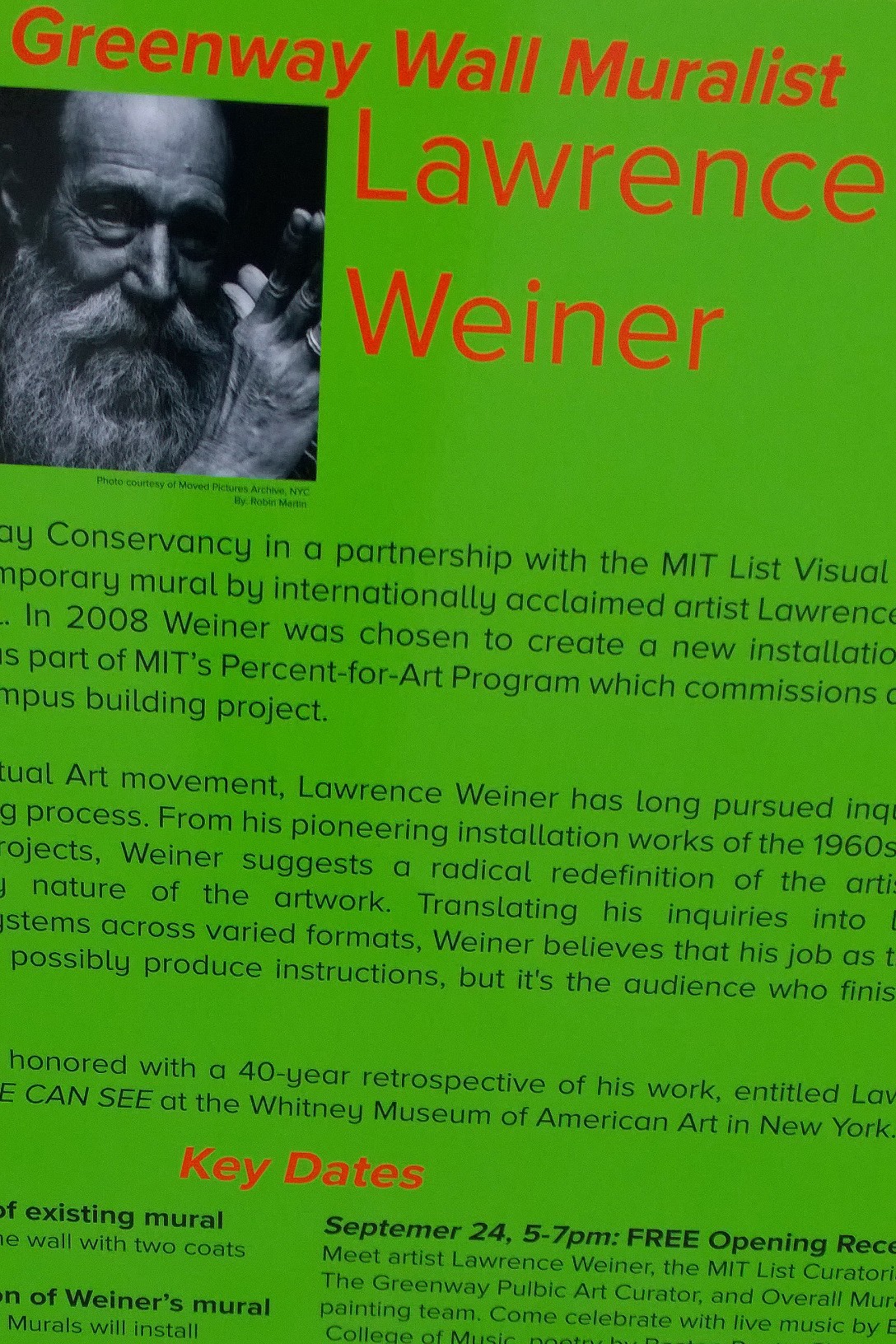
Here’s what the Greenway writes, “Lawrence Weiner is considered a key figure in the Conceptual Art movement, which includes artists like Douglas Huebler, Robert Barry, Joseph Kosuth, and Sol LeWitt.
“A primary motivating factor behind Weiner’s work is the desire to make it accessible, without needing to purchase a ticket or understand a secret visual language. He contended that language reaches a broader audience, and situating language in contexts outside traditional art-viewing settings, such as art museums, furthers that reach.
“Thus, he began creating works consisting of words and sentences or sentence fragments that he displayed in public spaces, books, films, and other accessible media, as opposed to the cultural institutions that might deter broad and diverse viewership. Click here for an interview with Lawrence Weiner.” More at the Greenway site.
Malcolm Gay at the Boston Globe adds, “For Weiner, the work is less about art historical knowledge, outrage, or relating to other people. It’s about a viewer’s individual response to an object in the world — an object that’s been created by another person.
“ ‘Our job is not to throw things at people,’ he said. ‘The work doesn’t exist unless somebody decides to deal with it. You can pass it on your way work, and it’s not going to screw up your day. But if you pay attention to it, it might screw up your life.’ ”
When the MBTA subway system decided to rebuild the stop called Government Center a couple years ago, it began a search for the artist who created the original murals there to see if she would like them back, and if not, if she would be OK with selling them.
It wasn’t easy to find her.
As Malcolm Gay writes at the Boston Globe, she was baking pies as part-owner of the Pie Place Café in Grand Marais, Minnesota.
“ ‘I got a phone call one day,’ [Mary] Beams explained, ‘and a voice I didn’t know said, “How does it feel to know that all of Boston is looking for you?” I had no idea what to say.’
“Beams, it turned out, hadn’t disappeared at all. An animator who had been a teaching assistant at Harvard’s Carpenter Center for the Visual Arts, and whose work has been collected by the Museum of Modern Art, she’d simply left the art world …
“With her blessing, the MBTA plans to hold an online public auction of the artworks, giving Bostonians a chance to own a piece of the city’s history.
“The online auction and display of murals will run Oct. 20-29, with a kick-off event at the state Transportation Building at 10 Park Plaza on Oct. 21. … The event will be something of a homecoming for Beams, who left Boston soon after completing the murals. She has never been back.
“ “I am so curious to see them again,’ she said. ‘I’ve gone on and lived this whole other life. But to be able to confront something that you made 35 years ago and ponder what they’ve been through? It’s quite amazing.’ ”
Pictures of the murals — and more information on the artist — here.
Martin Del Vecchio narrates his beautiful drone shots of Gloucester, Mass.
As Greg Cook writes at WBUR’s show the Artery, drones have as many uses as human creativity can devise, some good, some not so good.
He focuses on the photography and art applications. “In April, a graffiti artist going by the name KATSU used a customized drone to (illegally) scrawl paint high up on a Manhattan billboard that had been thought inaccessible to taggers. A video posted to YouTube in March, shows a bicyclist riding high up along a cliff in (according to the post) Sedona, Arizona. People have brought back astonishing footage from flying drones into fireworks and active volcanoes.
“Video by video, drones are transforming how we see the world — and this new view is changing how we understand the world.
“ ‘It’s not a fad,’ says Randy Scott Slavin, founder of the New York City Drone Film Festival. ‘Flying cameras are here to stay for sure. Because the perspective they get is great.’ …
“[Slavin] fell for drones when he got a Phantom a few years back. ‘I would shoot everywhere I went. Every time I went on vacation, I would shoot,’ he says. ‘Before I knew it, I started showing it to some of my director friends and they were like, “Shoot for me.” ‘ ”
Helen Greiner, CEO of Massachusetts-based Drone maker CyPhy Works says, “You’re just seeing the world the way a bird sees.” More here.
Photo: Greg Cook/WBUR As drones have become cheaper and easier to fly, many people, like Martin Del Vecchio of Gloucester, are exploring the creative possibilities.
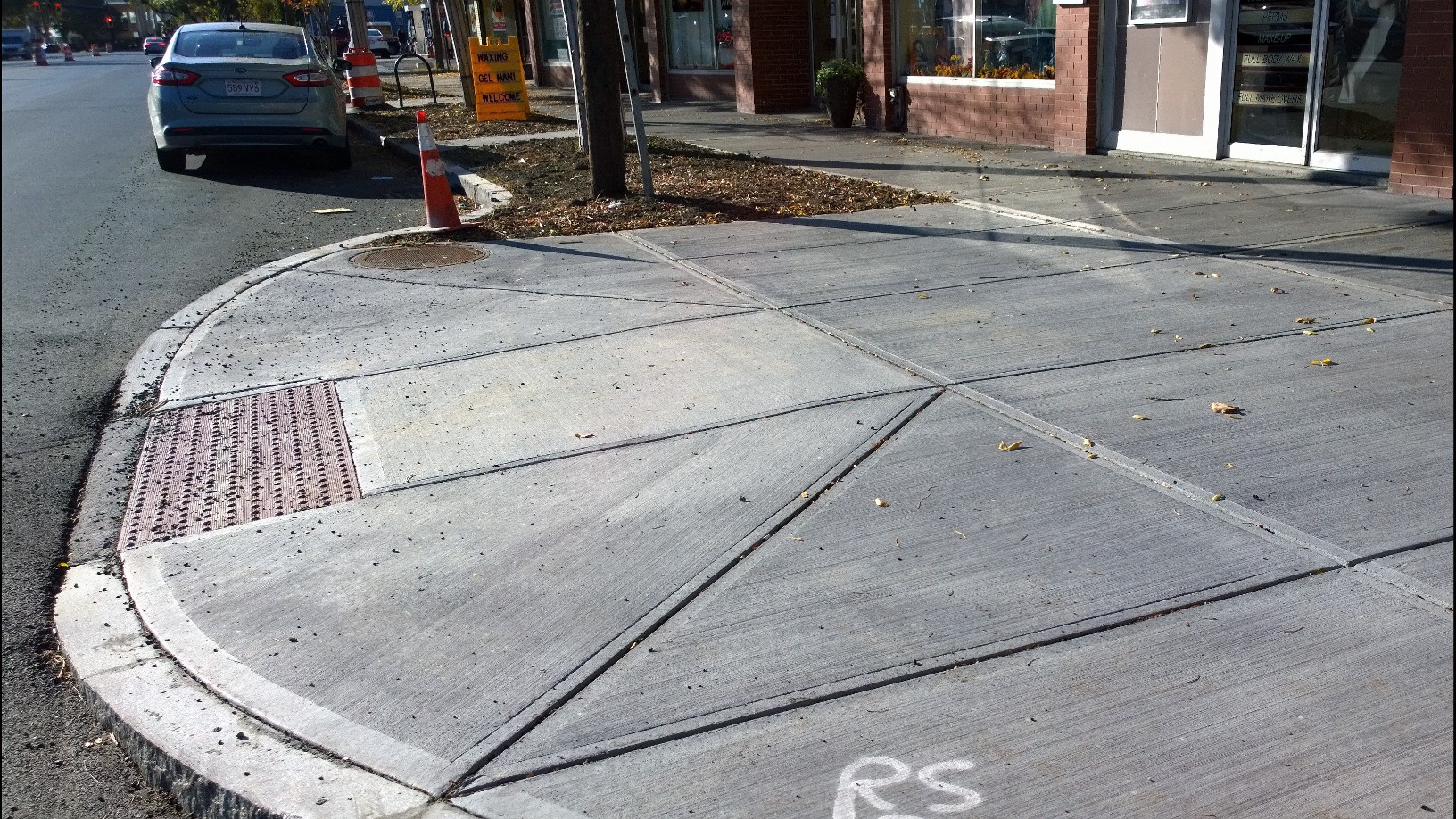
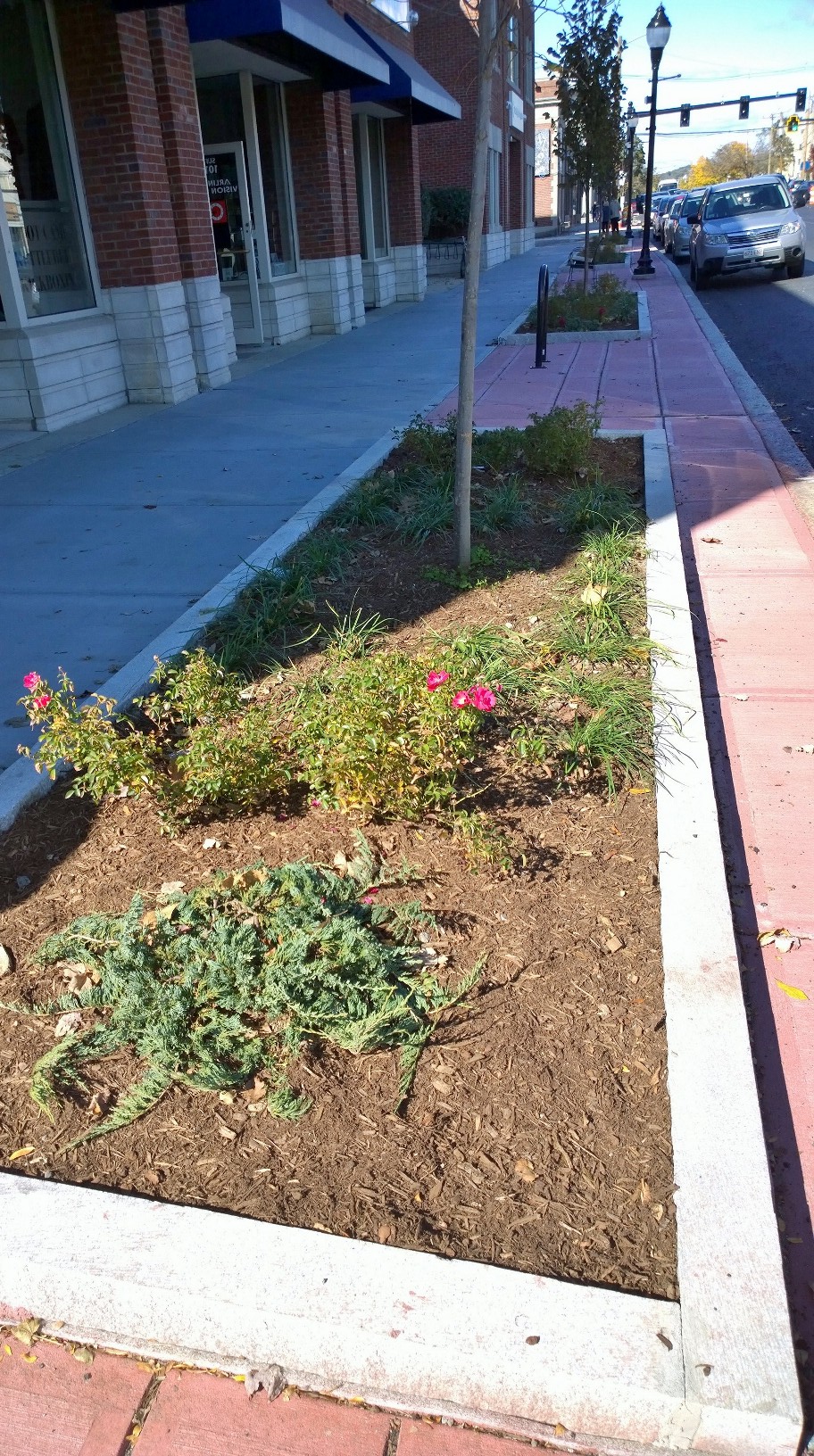
Massachusetts Avenue in East Arlington is shrinking. After contentious debate, the town decided to widen the sidewalks, add barrier islands in the street, and new plantings and benches.
The job is not done, but in spite of construction and less room for vehicles, the traffic doesn’t seem to have increased — one of those counterintuitive results that designers tout. The goal is to make the street more pedestrian and bike friendly and allow more community activities on sidewalks. Through the tree committee, John has been involved with the beautification side of things.
One of the issues that gets raised when a major disruption like this is afoot is the effect on small businesses. Neighbors are making a point of shopping local, hoping that Arlington merchants won’t suffer.
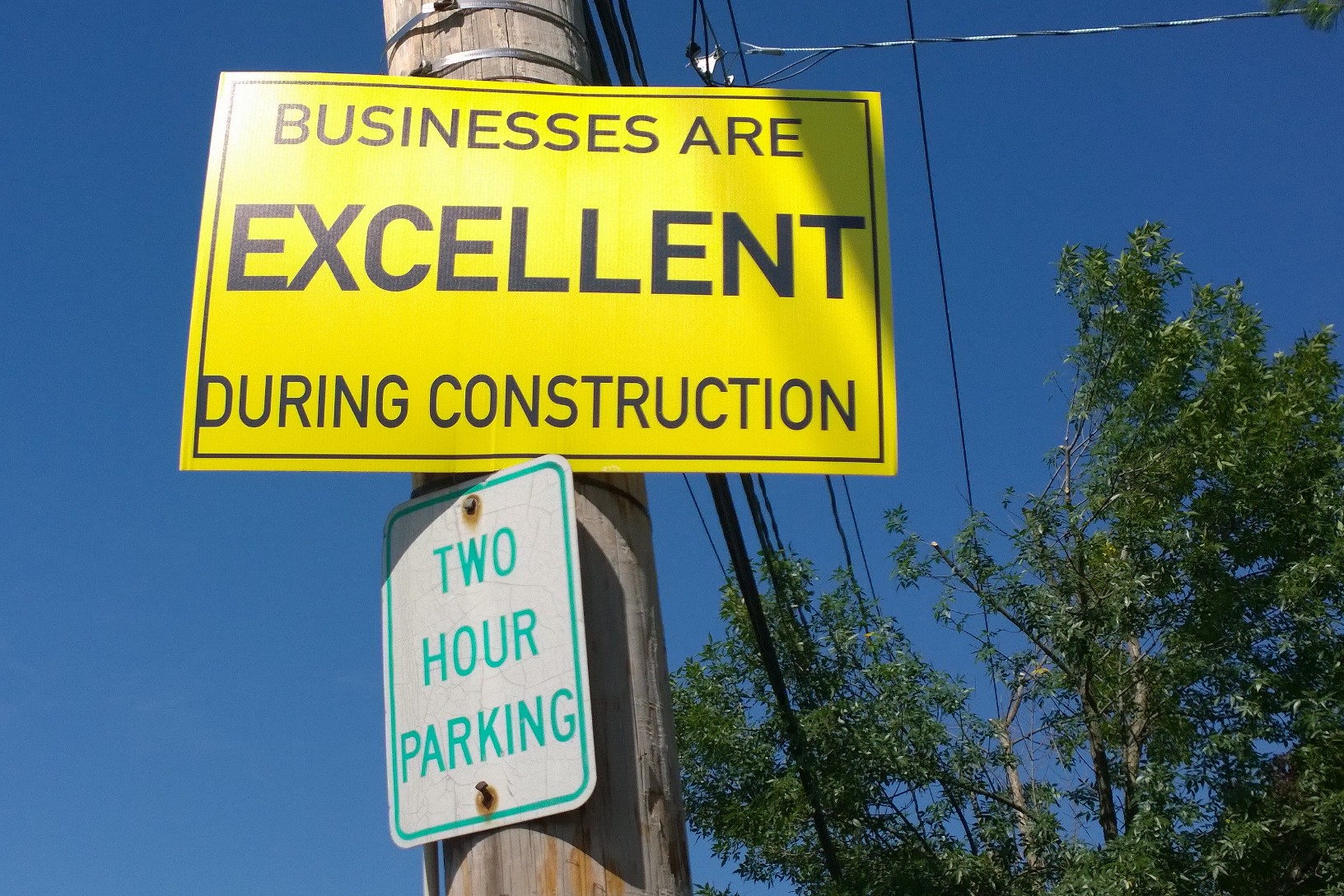
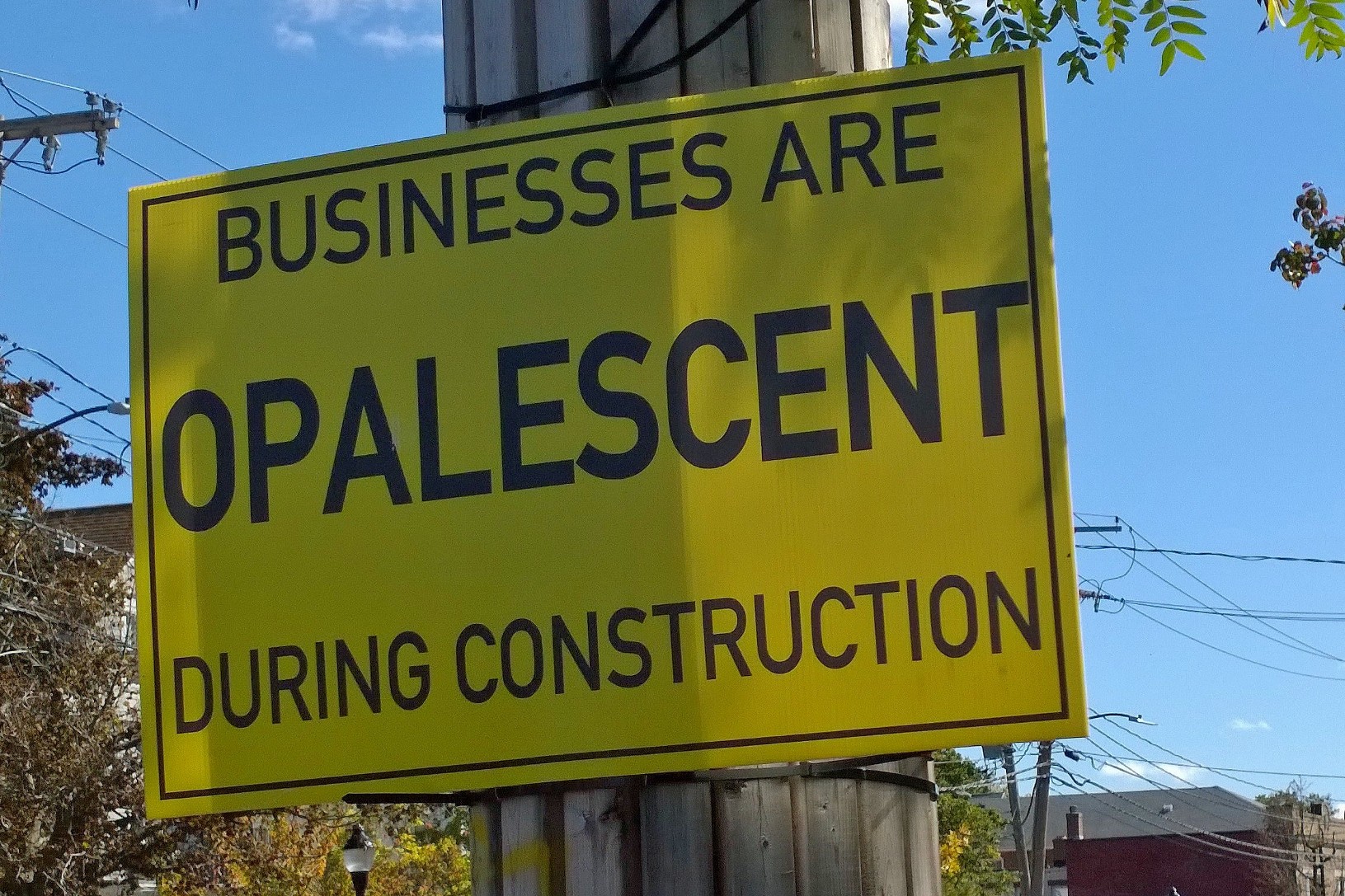
And to make sure residents don’t forget how important that is, there is an amusing signage campaign — signs saying that “Businesses are [fill in the blank] during Construction.”
For example, “Businesses are Opalescent during Construction.” Other Mad-Libs-type adjectives used are Quirky, Colorific, Radiant, Prismatic, Harmonic, Niblicious, and Excellent.
Below, I include a couple of the signs. And I tried to show how the project is coming along — the wide sidewalk, the plantings, the bench. I look forward to seeing how the residents begin to make use of their new public spaces.
I’ve been learning a lot lately from reading ecoRI’s Tim Faulkner. Recently he wrote about entrepreneurial approaches to taking carbon out of the atmosphere. He notes that one of the more ironic opportunities, according to Thorne Sparkman of investor Slater Technology Fund, is through the oil and gas industry, which uses CO2 in extraction and now can at least bury it instead of releasing it.
“Finding ways of supplying some [CO2] from existing carbon sources is a one of the main markets in the emerging, and broadly defined, field of carbon capture and storage (CCS),” writes Faulkner.
“ ‘CO2 is everywhere, but it has not really been harnessed,’ said Emily Cole, co-founder of Liquid Light, a New Jersey-based startup that wants to reduce greenhouse gasses by transforming carbon dioxide into industrial chemicals. …
“Enhanced Energy Group of West Kingstown is also looking at cutting emissions from the oil and gas industry, while increasing production. Its founder, Paul Dunn, spent 25 years designing engines for the Navy, some of which were emissions free. He’s now building power sources that sequester CO2 before it vents into the air. …
“Bioprocess Algae is converting unwanted CO2 into algae for fish and animal feed, and as nutritional supplements. The company recently relocated its headquarters from Portsmouth, R.I., to Shenandoah, Iowa, to be closer its CO2 supply source, a corn-fueled ethanol plant.”
Chief technology officer Toby Ahrens says that sequestering carbon dioxide in algae may not have large-scale prospects, but so far, it is one of the few profitable opportunities in this arena. More at ecoRI, here.
Photo: iStock
Trees are one way to sequester carbon.
Is the New England cottontail no longer in trouble? I guess, as David Abel suggests at the Boston Globe, it depends on who you talk to.
“The threatened New England cottontail — the region’s only native rabbit, made immortal in The Adventures of Peter Cottontail [by Thorton Burgess] — appears to be making a comeback.
“Federal wildlife officials [are] removing the cottontail from the list of candidates to be named an endangered species. It’s the first time any species in New England has been removed from the list as a result of conservation efforts. …
“Wildlife officials said the bark-colored rabbits, which have lost nearly 90 percent of their dwelling areas to development, are benefiting from an increasing effort to protect their habitat. …
“The rabbit, which has perky ears and a tail that looks like a puff of cotton, has been the victim of development that has wiped out most of the region’s young forests. … Unlike its abundant cousin, the Eastern cottontail, the New England species relies on the low-lying shrubs of young forests for food and protection from predators, such as raptors, owls, and foxes. …
“Some environmental advocates worry that the federal government may be acting prematurely in removing [New England cottontails] from the list of candidates for endangered status …
“It has never been easy to galvanize concern for the cottontails, given how much they look like the nonnative Eastern cottontails. Those rabbits, brought to the region by trappers in the 19th century, have flourished because they have better peripheral vision than the native bunnies …
“ ‘People think they’re everywhere,’ Scott Ruhren, director of conservation for the Audubon Society of Rhode Island, said of the local cottontails. ‘But like every species, they are important and deserve a place on the New England landscape.’ ” More here.
Update January 10, 2019: More good news at EcoRI, here. If zoos can do more this sort of wildlife restoration, they will go a long way toward justifying their existence to opponents.
Photo: Mark Lorenz for The Boston Globe A New England cottontail bred in a refuge in Newington, N.H., was penned Thursday in advance of its release.
It took a little poking around on the web as neither the Rhode Island State Arts Council nor the Block Island Airport seem to have published any information on the airport’s new exhibit, but I can finally share some tidings of artist Neal Personeus.
From Cape Scapes: “Neal began his interest in driftwood sculptures as a young boy on the beaches of North Truro in Cape Cod, Massachusetts. His original works were typically pirate ships in the sand made from the various flotsam and jetsam that Cape Cod Bay and the Atlantic Ocean would return to the land. By the time he was in his early teens, his works began to change towards wharf scenes and typical seaside shops perched upon interesting driftwood base pieces.
“When Neal was in his early twenties, he became an architectural and engineering draftsman. He rented a beachside cottage with some friends during the summer of 1984, and spent the entire vacation working beachside on his sculptures while watching the Olympics. It was during this time that he honed in on the type of works he would ultimately settle upon. Utilizing his interest in architecture, he would scour the beaches and dunes for beautifully bleached and unusually shaped base pieces, and then picture the style of house that would blend into and compliment the environment of the base piece.” More here.
You can find lots of Neal’s work on Pinterest if you search on Neal Personeus. And check out this Warwick Museum of Art poster featuring the piece called “Yeah … but the view” here.
Art: Neal Personeus This humorous piece, currently in an exhibit of Personeus sculptures at the Block Island Airport, is called “Yeah … but the view.”
Rupa Shenoy had an interesting story on WGBH radio recently. It was about local startups interested in urban farming. I wrote previously about Higher Ground Farm, situated on top of the Design Center in South Boston, but Grove Labs, with its use of LED lighting for indoor gardening, was new to me.
Shenoy says, “Some of these new entrepreneurs are thinking big. Jamie Byron and Gabe Blanchet graduated from MIT and started Grove Labs two years ago with the idea to make every living room a potential growing space. …
“Their product is a cabinet that allows people to grow fruits and vegetables year-round in the home. It’s connected to the internet, controlled by an app on your phone, and designed to make urban farming easy and engaging.
“There are a few models set up in a space at Greentown Labs in Somerville, which they share with other startups. Each wooden cabinet, with several components, is about the size of an entertainment center.
“At the heart of the cabinet system is a fish swimming in a tank. The waste from that fish is sucked into tubes and converted into nitrate fertilizer. The fertilizer is pumped around the cabinet to trays filled with brown clay pebbles. That’s where the fruits and vegetables grow, with the pebbles serving as soil. Byron says once you get the system up and running, you can harvest enough for about two small salads everyday.” More at WGBH.
For more on using fish to fertilize your produce, see my recent post about an experiment in Duluth, here.
Photo: Rupa Shenoy / WGBH News Somerville startup Grove Labs plans to sell cabinets for growing produce in your home.
As a child, were you ever into secret communication methods? A couple tin cans on a line between houses? Invisible ink? Goose language?
I was. Which is why this Cranston Library fundraiser appealed to me. You could embed a message in the library branches’ sidewalks. But it would only be visible when wet.
Gregory Smith wrote about WaterWalk for the Providence Journal: “Library officials are inviting the public to pay $25 for an opportunity to display an image and a pithy message in a now-you-see-it/now-you-don’t manner on walkways. …
“At work is a technique in which library staff members and volunteers will apply a stencil and a superhydrophobic (water-repellent) solution to display the image and message. On a sunny day, the image and message are invisible, but on a rainy day, they become visible.
“The images are expected to last six months to one year and have been demonstrated to last even in the Northeast, where a snow shovel is likely to scrape the surface, according to Katy Dorchies, community engagement manager for the libraries. ..
“The donor is allowed to select one of three images and to compose a personal message of up to 10 characters — a name or a phrase. …
“The three images reflect someone’s love of reading, interest in technology and support for libraries, respectively. …
“The images are scheduled to be in place at the beginning of October.” More here.
Photo: Frieda Squires/The Providence Journal files Walkways at the Cranston’s central library, seen here, and two branch locations will feature in WaterWalk, a fundraiser.
Gotta love MIT. There is always something crazy going on over there. And when MIT and Rhode Island School of Design (RISD) ideas come together, watch out.
At WBUR radio, Fred Thys explains about a new, multidiscipline design program.
Matt “Kressy has put MIT’s first-ever integrated design and management (IDM) students in a kind of boot camp. He wanted to immerse the engineers, designers and business school students in a project where they would have to work in concert. …
“The task: build instruments from found materials. And boy did the students find materials. Mechanical engineer Maria Tafur, from Bogota, made a clarinet from a carrot. Engineer Tammy Shen, from Taipei, has made an instrument that includes glass bottles. …
“Kressy was teaching a course at the Rhode Island School of Design when he got the idea for the new IDM master’s program. He was also teaching engineers and business students at MIT — but it was the design students from RISD that caught Kressy’s attention by asking a critical question:
‘How does this product enhance our lives?’ …
“Kressy says it took 13 years for his idea for a design program to get traction at MIT. When it did, he was able to pick 18 students with completely different criteria from what MIT typically uses.
“ ‘And that rubric had crazy metrics, such as the metric love,’ Kressy says. ‘And the love metric was basically: Does this candidate have a large capacity for love and compassion? …
“ ‘When I showed the rubric to my colleagues here, let’s just say it got mixed responses,’ he says, laughing.”
To get at the love-and-compassion metric, he asked applicants to submit a portfolio indicating their efforts to make the world a better place.
You can read here about the impressive portfolios, struggles to get to MIT from poor countries, and inventive ideas for the future.”
Photo: Jesse Costa/WBUR
MIT integrated design graduate students Maria Tafur and Masakazu Nagata play their homemade instruments along with Brave Sharab, 7, on Main Street in Cambridge.
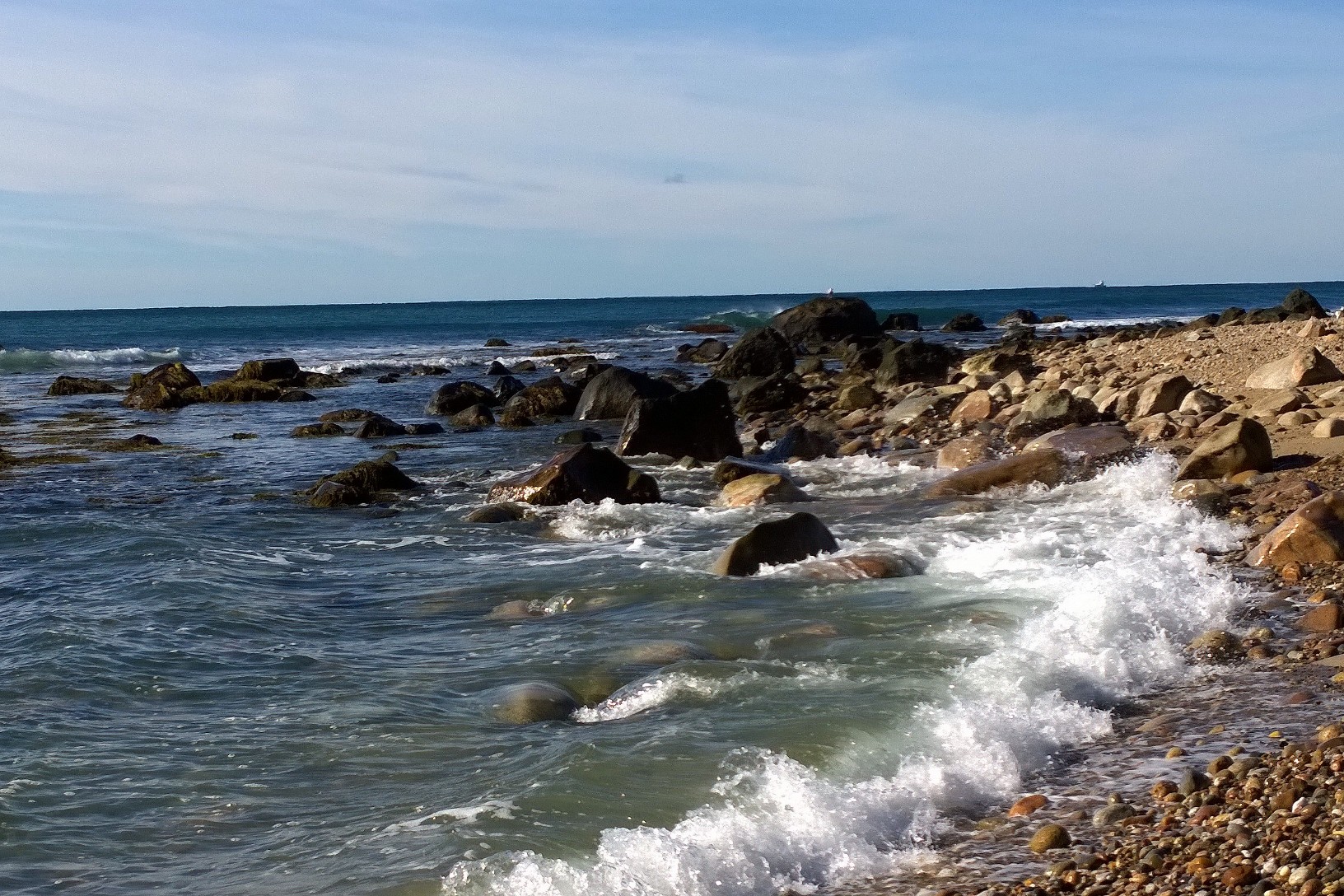
A bouncy boat ride in heavy rain last night. A warm sunny morning. Here are a few photos from my last island weekend of 2015.
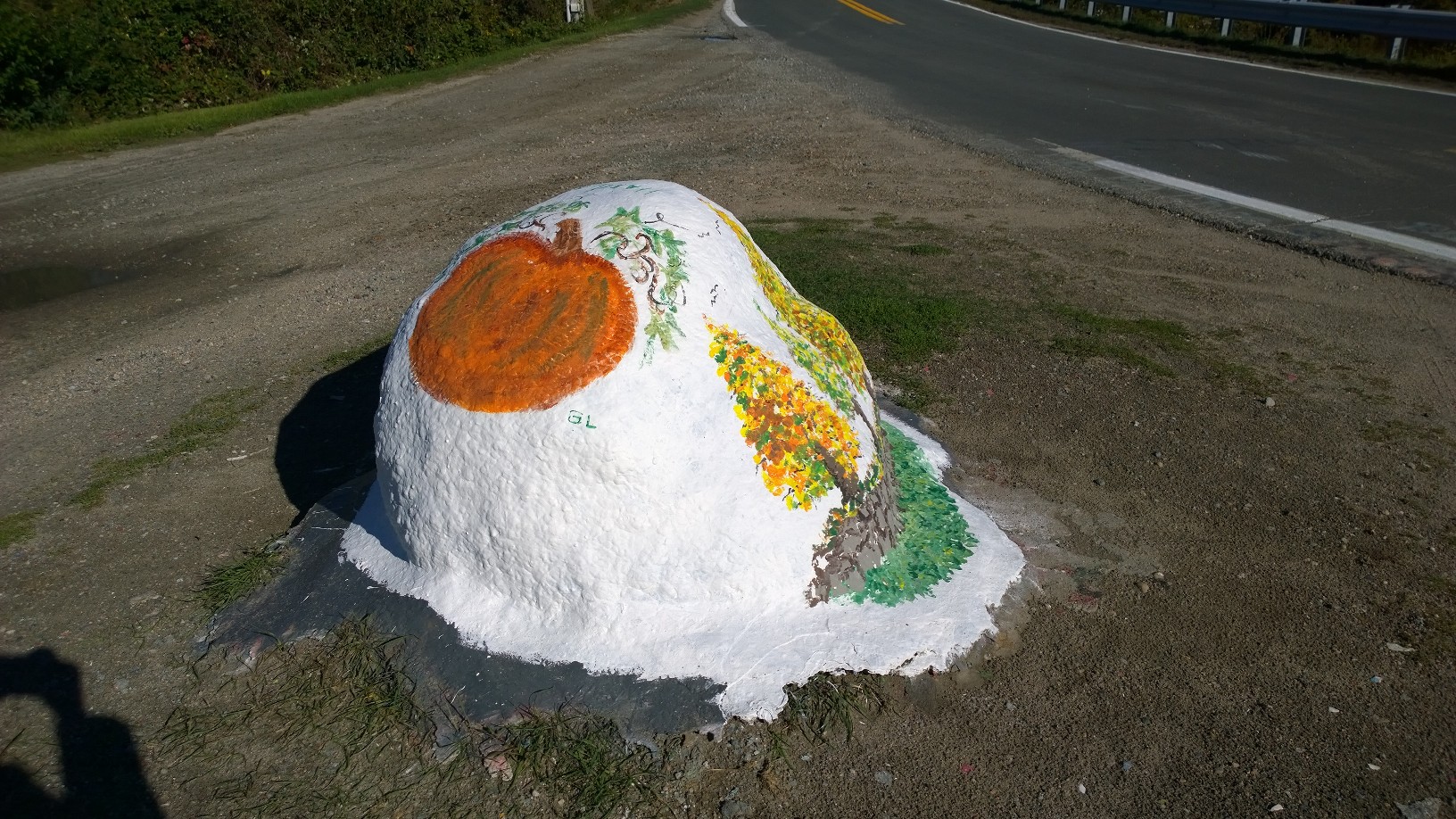
An especially nice autumnal theme for the Painted Rock. Whoever painted it was lucky to have their artwork survive nearly three days. That would be unheard of in the summer, when birthday messages get painted over by wedding felicitations several times a day.
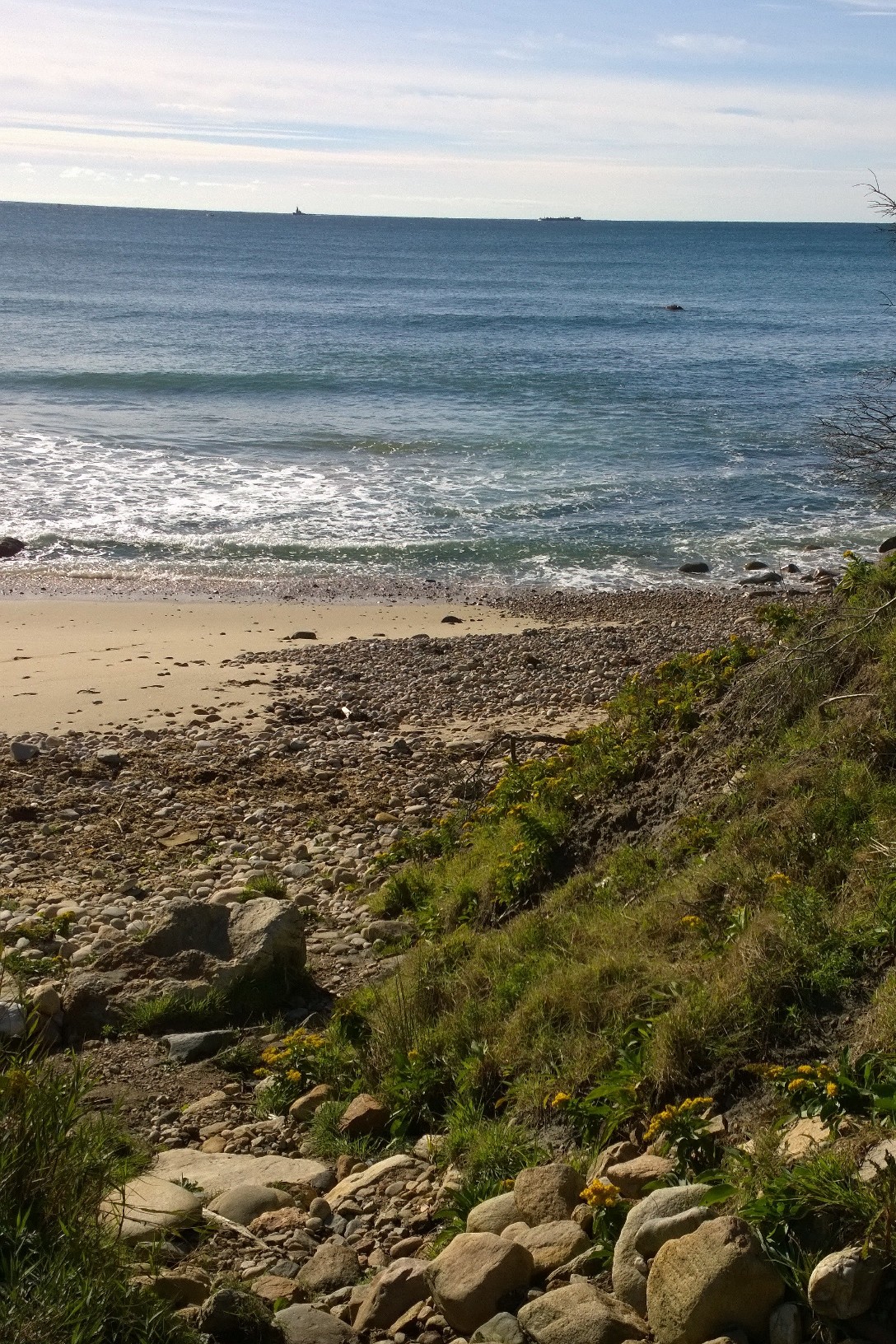
Down the bluffs on a steep path. Waves breaking on the beach. Tide pools.
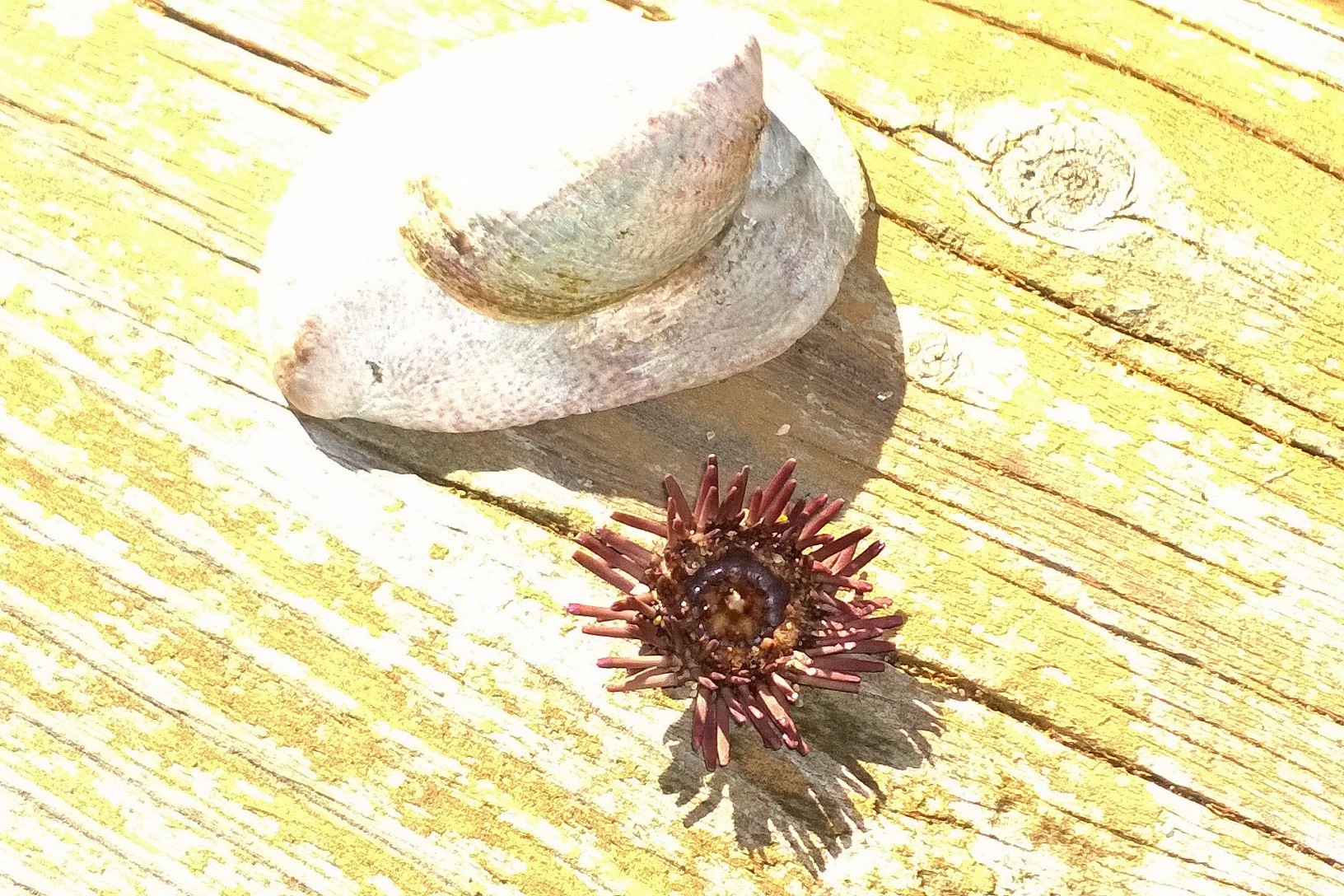
I was delighted to find a little urchin (I don’t think I ever had before) and a slipper shell with a smaller slipper shell hitching a ride.
New online services make it easy to borrow things you need temporarily but don’t want to buy.
Janet Morrissey writes at the NY Times, “When vandals broke into Stephanie Ciancio’s Land Cruiser in 2014 and stole her car stereo, she did not have the time and money to replace it. It was particularly vexing for Ms. Ciancio, a 34-year-old San Francisco resident, because she had been planning to take a four-day road trip to Fern Canyon, Calif., over the long July 4 weekend, and the idea of making the eight-hour drive without music was depressing.
“So she logged onto Peerby.com, typed in her predicament, and within 40 minutes was connected with someone willing to lend her a Beats wireless Bluetooth speaker for her car trip.” She was thrilled.
Peerby founder Daan Weddepohl, Morrissey contintues, “was born in Rotterdam in 1980 and developed a passion for computers and programming at a young age. ‘I asked for a compiler for my 13th birthday,’ he said.
“He pored over books and joined online bulletin boards to hone his programming skills. His parents, both psychiatrists, encouraged his entrepreneurial spirit and interest in technology. But it was a fire that ignited the Peerby dream.
“In February 2009, fire ripped through Mr. Weddepohl’s apartment building, … Most of Mr. Weddepohl’s belongings were destroyed by fire, water or smoke.
“He was devastated. But in the months after, Mr. Weddepohl watched in amazement as friends — and even strangers — offered furniture, tools and other items to help him get back on his feet. It was a revelation. “’ discovered that the people around me were so much more important than the stuff,’ he said. ‘People love to help other people out — we’re wired to help others.’ ”
Read how the Peerby concept grew from the ashes, here.
I blogged earlier this year about this concept. You can read “Borrowing Gadgets you Need Only Once,” here.
Photo:Jason Henry for The New York Times Stephanie Ciancio was able to borrow a wireless Bluetooth speaker from Matt Dodge through an online service called Peerby.com.
A Lancaster, Massachusetts, woman who came to the country at age 12 without a word of English is giving back by helping immigrants get a start in farming — and her model is being picked up around the nation.
Jane Dornbusch at the Boston Globe writes, “Maria Moreira, 62, is fond of the proverb ‘Necessity is the mother of invention.’ When her kids were small and she and her husband had a dairy farm in this Central Massachusetts town, she had plenty of milk, hungry kids to feed, and a need to make a little money.
“So she started a business making a soft Portuguese cheese — she calls it simply Portuguese fresh cheese — that reflected her roots in the Azores, where she was born.
“That was in 1986. A year earlier, she had seen another need, and, in her own inventive way, she’d set about meeting it. Moreira and her husband, Manny, had a 70-acre field, not far from their farm, that they used to grow corn.
“A Hmong woman, an immigrant from Laos, approached Moreira about using a small corner of the field to grow her own crops. Soon, word spread, and little by little the entire field was given over to immigrant farmers, each in charge of his or her own plot. Today, says Moreira, 275 farmers are growing more than 75 kinds of vegetables at what is now called Flats Mentor Farm. …
“Gus Schumacher, former Massachusetts commissioner of food and agriculture, came to know Moreira’s work when he served as a USDA undersecretary in the late ’90s. He notes that she was among a handful of leaders — others included John Ogonowski (one of the pilots killed on 9/11) and Jennifer Hashley, of New Entry Sustainable Farming Project — supporting refugees and immigrants in establishing themselves as farmers and market gardeners. It’s a movement that has since gained momentum nationally, he says. ‘But it all started in Massachusetts.’ ”