When the Swedish poet Tomas Tranströmer won the Nobel Prize for Literature, I wrote a post about it. Several Swedes, including Erik and his mother, had told me about Tranströmer, and I have a couple books of his poems in translation.
An obit by Bruce Weber in yesterday’s New York Times gave me a lot more information about “a body of work known for shrewd metaphors couched in deceptively spare language, crystalline descriptions of natural beauty and explorations of the mysteries of identity and creativity. …
“Though he was not especially well known among American readers, he was widely admired by English-speaking poets, including his friends Robert Bly, who translated many of his poems, and Seamus Heaney, himself a Nobel laureate in 1995.”
It seems Tranströmer also was a trained psychologist, who “worked in state institutions with juvenile offenders, parole violators and the disabled. …
“Mr. Tranströmer’s poetry production slowed after his stroke, but he took refuge in music, playing the piano with just his left hand. As a testament to his prominence in Sweden, several composers there wrote pieces for the left hand specifically for him.
“He was also an amateur entomologist. The Swedish National Museum presented an exhibition of his childhood insect collection, and a Swedish scientist who discovered a new species of beetle named it for him.”
Here is an excerpt from a poem the New York Times printed in the obit:
Photo: Jonathan Nackstrand/Agence France-Presse — Getty Images Tomas Tranströmer with his wife, Monica, after winning the Nobel Prize in Literature in 2011.
There are a few websites that are always reliable for blog topics: Brain Pickings, Studio 360, Only a Game, On the Media, Eco RI News, Arts Journal, and until recently, AndrewSullivan.com (Andrew retired).
Another website I like a lot is the one for the radio show Living on Earth. Here Living on Earth‘s Steve Curwood touches base with writer Mark Seth Lender to learn about lambs that teach themselves to climb (kind of like the kids in the wild playgrounds we’ve noted).
“Rocky Mountain bighorn sheep are born with all the climbing gear they need: feet evolved to grab and hold on near-vertical rock, and an uncanny sense of balance. Writer Mark Seth Lender came across a herd of the sheep near Alberta’s Jasper National Park late last summer and discovered that for the lambs, having the equipment is not enough. They still have to learn how to use it.”
Lender explains, “They are working it out. The lambs, by themselves. Where the mountain tapers smooth and hard off the ridgeline. The rest of the herd, already picking their way among the crags and cracks is heading down. But the lambs upon this unfamiliar terrain, hold back. The ewe by her stance and where she looks has led them here. To the edge. But will not show them how. Down they will learn on their own.
“She stands aside, and waits. …
“They are not full of play. They stand on the high point and look, long, toward the river and the sweet grass far … far … below. They look. And look: To left to right slowly turning their heads. They plan: each move, each angle polished into an extended curve. A calculus: For every way point, every stopping place, the risk of a dead end. …
“Sometimes the only down is up: they scramble against the vertical, grappling with their cloven feet, the ledge where the gamble led too narrow for a bird. Sometimes, what looks easy is impossible: the gradual slope, which ends in a sheer and impassible cliff. Sometimes the granite cleaved along the head grain is the only path and the only safety a headlong run, the living rock inclined too steep for caution.
“The hooves of rocky mountain bighorn sheep are broad as a puck, gray as the living rock (as if the color gives them grip). They hold, like India rubber pads, where purchase seems untenable, a magician’s trick, inertia where there should be none. Up where the trees are far and few and the dead wood outnumbers the living.” More here.
Photo: Mark Seth Lender
The ewe leads them to the edge, but will not show them how to climb down.
John reads Business Insider pretty regularly, and I must say it alerts him to some great ideas for this blog. Here is a story about innovative beekeepers by Simon Thomsen at Business Insider Australia.
“Two Australian inventors are changing the way honey is harvested and the world can’t get enough of it. Father and son Stuart and Cedar Anderson spent a decade creating a revolutionary system that allows beekeepers to harvest honey on tap, without disturbing the hive.
“After a decade of research and development, the Andersons launched their idea on the crowdfunding platform Indiegogo [Feb. 23]. Within two hours, they’d sold $830,000 (£420,000) worth of beehives. Their initial target was $70,000 (£35,500). Within three hours they’d sold more than $1 million (£507,000) of products.
“The first 500 top-of-the-line beehives, costing $600 (£390), sold out within an hour. They’ve now released a further 1000 hives, along with a range of cheaper options.
“The Andersons has some idea how how intense interest was when they posted a video of their invention on YouTube and it attracted nearly 1 million viewers within two days. This morning they had interest from 80,000 people before the launch, and were forced to switch from Kickstarter to Indiegogo as the crowdfunding platform at the last minute realising that they needed to cater for the US market, find an American manufacturer and charge in USD (which Kickstarter doesn’t allow) to overcome exchange rate fluctuations.” More here.
What a great story: build a better beehive and the world will beat a path to your door. Now if someone would just donate a few to the beekeepers in Sudan we wrote about recently …
Photo: Facebook Beekepers Cedar and Stuart Anderson
When I first read about the discovery of a snug getaway in a Toronto tunnel, I thought, of course, of Ralph Ellison’s Invisible Man. You remember the black man who finally gave up hope of being treated like a regular human and, realizing he was already invisible to most people, established a hidden pied sous terre, lavishly draining off electric power to light his home underground.
The Toronto story turned out a bit different.
The NY Times had the first episode. “It was a baffling discovery,” Ian Austen wrote, “a hand-dug tunnel just over 33 feet long, tall enough for an adult to stand inside, fed with electricity, drained by a water pump and expertly reinforced with lumber and plywood. It started in dense woods near a tennis stadium — and it did not lead anywhere.
“After more than a month of investigation by the Toronto police, the identities and motives of whoever built the tunnel remain as mysterious as they were the day it was found. So … the police turned to the public for help. …
“The news of the tunnel prompted swift speculation on cable television that it might be part of a plan for a terrorist attack on the Pan American Games, which will be held in Canada this summer. The stadium, located on the York University campus, is scheduled to host tennis for the games. But [Deputy Chief Mark] Saunders said repeatedly … that there was no evidence to support that theory or to indicate that the tunnel was intended for anything illicit at all.
“ ‘There’s no criminal offense for digging a hole,’ he said. …
“Chief Saunders said that the tunnel was equipped with ‘a moisture-resistant lighting system’ and that, despite the bitter January weather, ‘it was very comfortable inside,’ with a temperature between 70 and 75 degrees. A 12-foot aluminum step ladder gave access to the tunnel, and a small pit near the entrance held a Honda generator and an air compressor. The pit was lined with thick foam, apparently meant to muffle the sound of the machinery.” More.
A US News & World Report follow-up story is here. Can you guess? It was nothing nefarious — just a comfy man cave that a couple buddies built to get away from it all.
Photo: USNews.com
Toronto’s Deputy Police Chief Mark Saunders explains evidence photos as he speaks to the media about solving the tunnel mystery.
“That’s precisely the kind of cosmic awe environmental writer Elin Kelsey and Toronto-based Korean artist Soyeon Kim seek to inspire in kids in You Are Stardust (public library) — an exquisite picture-book that instills that profound sense of connection with the natural world. Underpinning the narrative is a bold sense of optimism …
“Kim’s breathtaking dioramas … mix tactile physical materials with fine drawing techniques and digital compositing to illuminate the relentlessly wondrous realities of our intertwined existence: The water in your sink once quenched the thirst of dinosaurs; with every sneeze, wind blasts out of your nose faster than a cheetah’s sprint; the electricity that powers every thought in your brain is stronger than lightning.
“But rather than dry science trivia, the message is carried on the wings of poetic admiration for these intricate relationships:
“Be still. Listen.
“Like you, the earth breathes.” More here.
Popova adds these thoughts from particle physicist and cosmologist Lawrence Krauss:
Atoms come in different types called elements. Hydrogen, oxygen and carbon are three of the most important elements in your body. … How did those elements get into our bodies? The only way they could have got there, to make up all the material on our Earth, is if some of those stars exploded a long time ago, spewing all the elements from their cores into space. … So, most of the atoms that now make up your body were created inside stars! The atoms in your left hand might have come from a different star from those in your right hand. You are really a child of the stars.
Art: Soyeon Kim
From the children’s book You Are Stardust
In Ethiopia, you can eat the plate, in the UK the coffee cup.
Stephanie Strom writes at the NY Times, “Diners at KFC restaurants throughout Britain soon will be able to have their coffee — and eat the cup, too.
“KFC, one of the chains operated by Yum Brands, is going to test an edible cup made from a wafer coated in sugar paper and lined with a heat-resistant white chocolate. …
“The new cup addresses several of the trends bedeviling the food business today, including consumer concerns about the environmental impact of packaging, as well as their desire for simplicity.
“ ‘This type of edible packaging is definitely aligned with the global consumer mind-set in terms of sustainability and simplifying their life,’ said Shilpa Rosenberry, senior director of global consumer strategy at Daymon Worldwide, a consulting firm that works with many food companies. ….
“Ms. Rosenberry said she had even seen examples of retail packaging that could be turned into furniture, and boxes that could be repurposed for practical uses. …
“The new Scoff-ee Cup to be used at KFC, first reported by USA Today, was made in partnership with the Robin Collective, which calls itself a ‘purveyor of curious events and experimental food.’
“The chocolate lining will melt and soften the crisp wafer in the same way that a biscotti softens when dipped in coffee.” For those of us who drink our coffee fast, while it is still hot, that should work. The cup will soften but not too much. Family members who leave a half-filled cup around all morning would end up with a puddle, I suppose. It’s almost worth a trip to England to test it out.
Meanwhile, poet friends have been busy capturing present realities and past screen shots. Ronnie Hess wrote a poem inspired by watching home movies of her Fire Island childhood. It reads in part,
“follow your sister
“as she leaps and cartwheels along
“the beach into the sea. I see your eyes
“follow her, your mind dart,
“your body imitate her older moves.” The whole poem is at Quill and Parchment.
And poet Nancy Greenaway caught the mood of our endless winter with this roll-over-and-go-back-to-sleep nugget
The Barnes Collection is a quirky museum that is now located in Philadelphia. The eccentric art collector required all his art to be displayed a particular way. Which is perhaps why two Cézannes hidden behind other works weren’t uncovered before now.
Writes Randy Kennedy in the NY Times, “In 1921, the wily art collector Albert C. Barnes wrote to Paris to his friend and fellow collector Leo Stein, who was in dire need of money and had deputized Barnes to sell some of his holdings in the United States. They included five watercolor landscapes by Paul Cézanne, but Barnes reported that he had failed to find ‘anybody who seems to think they are sufficiently important to want to own them.’
“It was pure mercantile flimflam. Barnes turned around and bought the watercolors for himself, at $100 each, installing them permanently in his personal museum near [Philadelphia]. Now it turns out that Barnes got a better deal than even he had thought: A conservation treatment of the watercolors has revealed two previously unknown Cézanne works — a graphite drawing and a watercolor with graphite — on the verso (the reverse side) of two of the watercolors.
“Hidden beneath brown paper backing, the newly discovered pieces are unfinished, but they have sent tremors through the world of Cézanne scholarship, where additions to his body of work are exceedingly rare and where even the resurfacing of long-unseen pieces can be huge news. …
” ‘These are a perfect example of how much we still don’t know about this collection,’ said Martha Lucy, a consulting curator at the Barnes and an expert on its Renoir and Cézanne holdings. ‘To add new work to Cézanne’s oeuvre is incredible.’ “
I have yet to see for myself any marked improvement in Boston traffic resulting from the city’s use of the Waze app, but maybe that’s because I didn’t try to go to the football parade right after the blizzard.
Nick Stockton reported, “Even on a good day, Boston’s roads are more tangled than a Celtic knot. … So the city’s traffic managers decided to call in the apps.
“Specifically, the city reached out to Waze, a driving and directions tool owned by Google. By sharing the [snowy Patriots] parade route on the service, the city helped users steer themselves around traffic, potentially easing the overall road burden.
“That one-time data fling has resulted in a longer term data-sharing relationship. … Boston will give Waze a heads-up about any planned closures, and in return the app’s owners will give the city’s traffic management center access to its profoundly valuable stream of user data. In the short term, this will let the city be more responsive to traffic problems as they arise. But going forward, Boston’s road-runners hope the data will help them fine-tune their traffic light timing and keep congestion from building up in the city’s intestinal road network. …
“Boston isn’t an outlier here, either: Governments all over are using private companies to fill technology gaps. Google’s transit specification—the way it pushes bus and train times to Google Maps users—has become the de facto standard for how cities publish their mass transportation schedules. Entire states are buying cycling data from Strava to build better bike lanes.” More here.
Maybe the next occasion for Boston to use Waze will be the upcoming marathon, when the three people we’re calling Team Sweden will be running (Erik, his sister, and their cousin), and it’s impossible to drive.
(Thank you, The Fort Pointer, for tweeting this story.)
What would it be like to live in an earth dome? The California Institute of Earth Art and Architecture (Cal-Earth) can help you check out the concept for a day or a weekend or the 12-15 weeks it will take to teach you to build a dome home. Maybe you’d rather settle for building just a “rocket stove mass heater.” Cal-Earth can teach you to do that, too. Hesperia, California, is the place. (Although Cal-Earth’s mailing address is Claremont, near Suzanne’s alma mater.)
From the website: “Superadobe technology was designed and developed by architect Nader Khalili and Cal-Earth Institute, and engineered by P.J. Vittore. Superadobe is a patented system (U.S. patent #5,934,027) freely put at the service of humanity and the environment.”
The television station KCET has more. Reporter Kim Stringfellow says, “As a humanitarian, architect and teacher, Khalili developed the Superadobe building technique incorporating a tubular sandbagging system filled with locally sourced earth that are reinforced with a barbed wire technology and stabilized lime, cement, or asphalt that is locally produced. Dwellings can be used temporarily or may be stabilized, waterproofed, and finished with plaster to create a permanent building. Originally from Iran, Khalili’s structures and building techniques are inspired and informed by centuries of earth building found throughout the Middle East and North Africa. He also is known for his Geltaftan Earth-and-Fire construction system which as also known as Ceramic Houses. ”
Teny Gross tweeted this nice story from the Brown University alumni magazine.
Courtney Coelho wrote, “On a snowy December evening, lights were visible through the second-floor windows of List Art Center as the visual arts department’s Critique Intensive held its last session. Mixed with the students in the large studio space were four working artists—Elise Ansel ’84, Chitra Ganesh ’96, Keith Mayerson ’88, and Rob Reynolds ’90—who’d spent sixteen weeks with the class, teaching, critiquing, and discussing art.
“The class was the brainchild of Chair of Visual Art Wendy Edwards, who hopes it will serve as a model for future classes. ‘Alumni bring a generosity to their approach to the Brown students,’ Edwards said. ‘They love coming back here, they love giving, and they’re very professional and committed to helping our students.’ ” More here.
Speaking of art education in Providence, RISD just got a new president, an artisan herself. Meredith Goldstein at the Boston Globe writes, “The Rhode Island School of Design has chosen its 17th president. Rosanne Somerson takes the title effective immediately, the Board of Trustees announced [in February]. Somerson, a RISD grad and furniture designer, has been serving as the school’s interim president since January 2014. The board says it chose to keep Somerson in the job after a nine-month international search.”
The Globe article is here. Disegno magazine has an interview with Somerson, here.
Photo: Mike Cohea
Rose Congdon ’15, left, and her classmates critique work created for the visual art department’s Critique Intensive, a class taught by four alumni artists last semester.
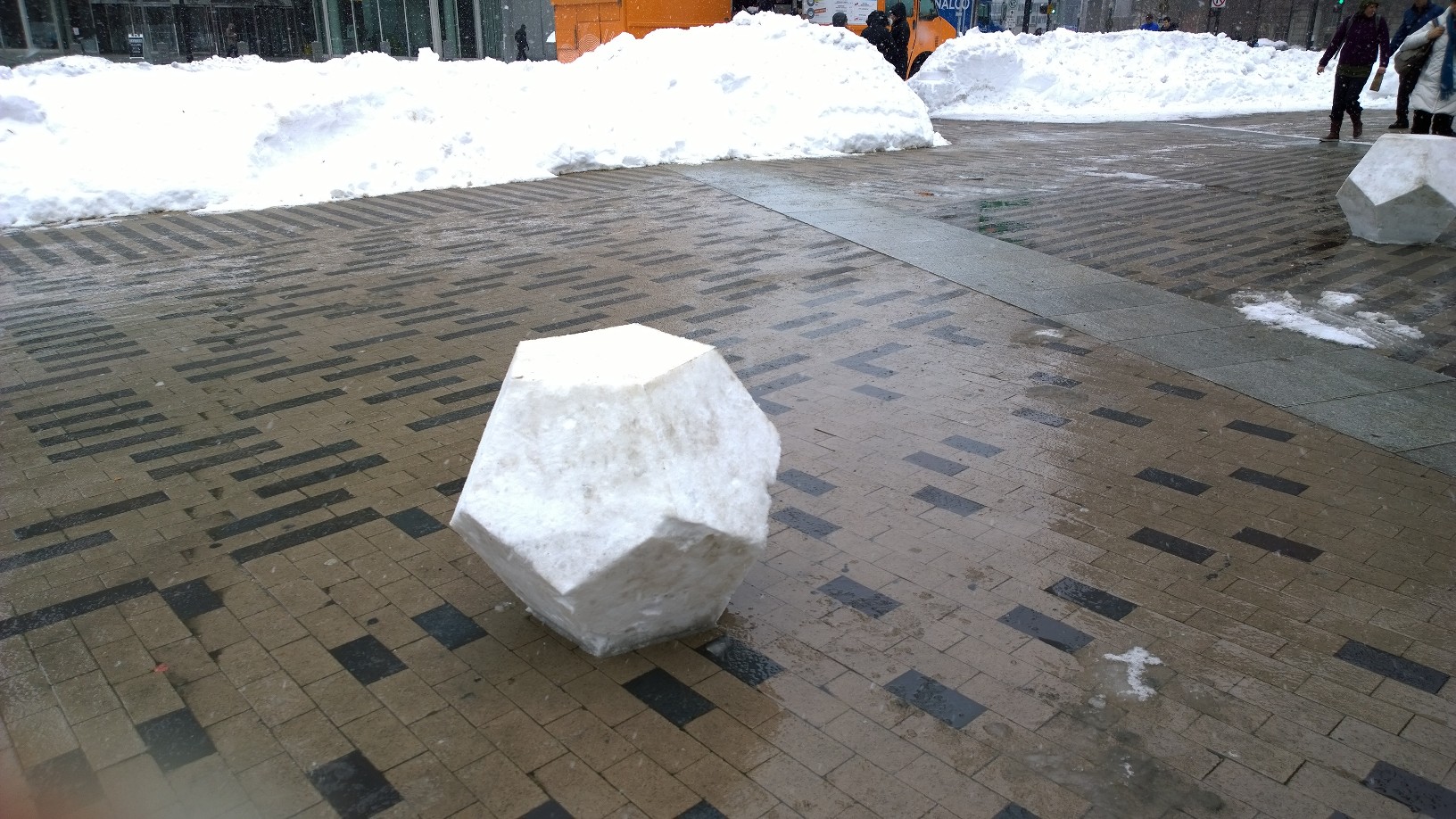
I wrote about New American Public Art back when I first posted a photo of the group’s giant geometric snowballs in Dewey Square.
I looked them up. Their tumblr blog says, “We are a collaborative of artists, engineers, programmers and designers with the mission of developing beautiful, interactive public art. Our method of development is always contextual. The existing physical and social aspects of a space are integral to the installation. The art form we create is more than the physicality of the work, it is the social curiosity and interaction of the audience with the piece.”
Alas, curious snowplows interacted with the interactive snow sculptures, and the snowballs are no more. But the artists seem to be fine with their work being ephemeral. Their approach supports the notion that it is good to notice things that can’t be captured permanently. It’s good just to enjoy. And interact.
I say that, but I’ve been regretting for two weeks that I couldn’t bring myself to capture in a photo several strangers facing me on the subway since one woman was looking my way. It would’ve been a great shot. In the midst of a sea of black-coated commuters, there were three astonishing reds: a woman with a bright red shawl, another with a red-red coat, and a young man with brilliant new red boots.
I’ve been looking for reds ever since and pondering how to take a photo without being noticed.
If I ever get tired of tai chi, I’m going to hunt down a ballet class like the one described at Newsday by Donna Kutt Nahas.
“Older adults,” she writes, “are taking their places along the ballet barre and living out their childhood fantasies. Once the province of the young, ballet is drawing late-life ballerinas and, to a lesser extent, male ballet dancers, who are returning to the art after a decades-long absence. Some, with no previous experiences, are attempting pliés and pirouettes for the first time.
“There is no statistical data on how many in the over-50 set are skipping yoga or the gym for ballet, but experts say the physically strenuous and mentally challenging pastime can improve vitality and provide a social outlet for older adults.
” ‘Ballet is low-impact, aerobic, weight-bearing, great core training and great for joint mobility, because you work the muscle in numerous positions,’ says Chris Freytag, an emeritus member of the board of directors of the San Diego-based American Council on Exercise. ‘And it’s great for brain fitness, because you have to connect your brain to doing a number of steps or sequences.’ “More at Newsday, behind the firewall.
On second thought, I think tai chi is more my speed. I took a lot of ballet as a child and even as a young adult. But I think I better just watch the ballerinas do it. And before long, it’s likely that one of the grandchildren will be taking it up.
Photos in the longer article: John Williams, Steve Pfost and Jeremy Bales
People are taking up ballet in their 50s, 60s, and beyond.
Goats are becoming increasingly popular for controlling invasive plant species.
Joanna Jolly writes at the BBC News Magazine, “Each country has its own invasive species and rampant plants with a tendency to take over. In most, the techniques for dealing with them are similar — a mixture of powerful chemicals and diggers. But in the US a new weapon has joined the toolbox in recent years — the goat.
“In a field just outside Washington, Andy, a tall goat with long, floppy ears, nuzzles up to his owner, Brian Knox. Standing with Andy are another 70 or so goats, some basking in the low winter sun, and others huddled together around bales of hay. …
” ‘We started using them around this property on some invasive species. It worked really well, and things grew organically from there.’
“They are now known as the Eco Goats — a herd much in demand for their ability to clear land of invasive species and other nuisance plants up and down America’s East Coast. …
“One of the reasons goats are so effective is that plant seeds rarely survive the grinding motion of their mouths and their multi-chambered stomachs — this is not always the case with other techniques which leave seeds in the soil to spring back.
“One of the more high profile jobs they have worked on was cleaning up the Congressional cemetery in Washington two years ago. Large crowds came to watch as the animals spent a week chomping the overgrowth of Honeysuckle, Ivy and Poison Ivy. …
“This is one of the things he likes about taking goats into urban areas — the response of the city-dwellers, who are ‘fascinated,’ he says, to see how efficiently the goats gobble up the vegetation. …
“Goats aren’t a silver bullet. Knox often combines the goat clearance with some manual root cutting and even with a chemical treatment if needed. But his goats have started to make an impact on the weeds choking America and, he says, they are having a lot of fun doing it.”
More of the story — and some great pictures — here.
Mary Ann is a creative person and a great source of blog ideas. She also remembers topics I’ve enjoyed in the past. For example, the stealth book artist in Scotland. She sent me word of the artist’s new accessibility.
The BBC reports, “An anonymous artist has been leaving delicate paper sculptures made from old books at locations in Edinburgh and around Scotland for more than three years. The identity of the woman has remained secret despite the international attention that the book sculptures have received.
“BBC Scotland’s arts correspondent Pauline McLean conducted an interview with her — via email to maintain her anonymity.
“Question: Why did you start making the sculptures?
“Answer: The first book sculpture, a little tree for The Scottish Poetry Library, was made primarily as a response to library closures and cutbacks. But it was also as a bit of fun for the library staff who, throughout Scotland, the UK and much further afield, provide a service in straitened times — above and beyond. It was a poor attempt to illustrate the notion that a book is more than just a book — and a library is a special kind of building.
“It’s no secret that I would like everyone to have access to books, art, artifacts and the buildings that house them. Not just those with the money for a ticket. I think it’s true that the immediate way we can and do now access information has altered things. But it remains important to have expert help, to see things for real, to have buildings set aside that inspire and make expectations of us and that anyone can enter. …
“I like to think the sculptures have served their purpose in some small way, but I do worry that they overly draw attention to themselves as objects. My intention was never that they be viewed as artworks or even that they would last. They are, after all, made from clapped-out old books. The end for me though was in leaving them. Once a gift is given it is in the hands of another.” More here.
There are several good pictures of book sculptures at the BBC site. Suzanne’s Mom couldn’t resist the one below. It makes me nostalgic for the inspired ceramic tea cups of Anne Kraus.
Photo: Anonymous book sculptor
“Nothing beats a nice cup of tea (or coffee) and a really good book.”