In parts of South Sudan, honey is providing a bit of hope for the future. Barbara Lewis reports at Reuters that the charity Honey Care Africa has invested $1 million in the country, helping farmers earn more than $75,000 from beekeeping and benefiting 400 families.
“A harvest of honey from the equatorial forests of South Sudan will help its struggling poor and, through the pollination of bees, improve the nation’s crop yields, those involved say.
“Spring production over the coming weeks is expected to deliver 60 tons, double the volume of an initial batch of exports last year to Kenya.
“South Sudan’s honey harvests had suffered because decades of fighting closed off the former main trade route through the north.
” ‘Honey production is not a panacea. We’re not trying to save the country or eliminate the conflict, but we do want to do our part,’ Madison Ayer, head of the development charity Honey Care Africa, told Reuters.
“Honey Care Africa has been working since 2013 in South Sudan, where it sees potential to collect honey from bees immune to the problems that have depleted colonies in the United States and to a lesser extent in Europe.
“The charity has worked in Kenya for a decade, but droughts can be a problem for honey-making there, so it sought to expand. …
” ‘When I get the money from the honey, I pay the school fees of my children. I buy other things like sugar, tomatoes, onions. I keep some money with me for emergencies in case my children get sick,’ Lilian Sadia James, one of the South Sudanese beekeepers working with Honey Care, says.”
Some African communities are rediscovering the value of mud for building cool, comfortable homes — and sparing trees.
This story is from the Thomson Reuters Foundation by way of the the Christian Science Monitor feature “Change Agent.”
“Building a house in the poorest villages of southern Mali has for years involved cutting trees for timber frames and struggling to save cash for a corrugated iron roof. Now families are turning to an alternative: Nubian-style domed mud-brick homes that are cheaper, protect fast-vanishing local forests, and make homes cooler in the worsening summer heat, experts say.
“Earthen homes with vaulted brick roofs – a style adopted from Nubia in northern Sudan – are being promoted across the Sahel, including in Burkina Faso, Senegal, and Mauritania, as part of efforts to build resilience to climate change.
” ‘Most people, more than half, don’t have the decent housing they dream of because it costs too much to build. This is going to change with the Nubian vault,’ predicted Chiaka Sidibe, a mason in Massako, one of the Malian communities adopting the new building style.
” ‘You just have to make mud bricks that don’t cost money, and fellow villagers help you to build your house,” he said. …
“The local office of the Association la Voûte Nubienne, the international non-governmental organization that is promoting the Nubian vault building style, has helped train local builders in mud-brick construction techniques. The aim is to build a sustainable, self-supporting market for the homes, said Moussa Diarra, the NGO’s local coordinator.
” ‘It can take much time to reach this goal, but I’m confident the initiative will succeed,’ he said.”
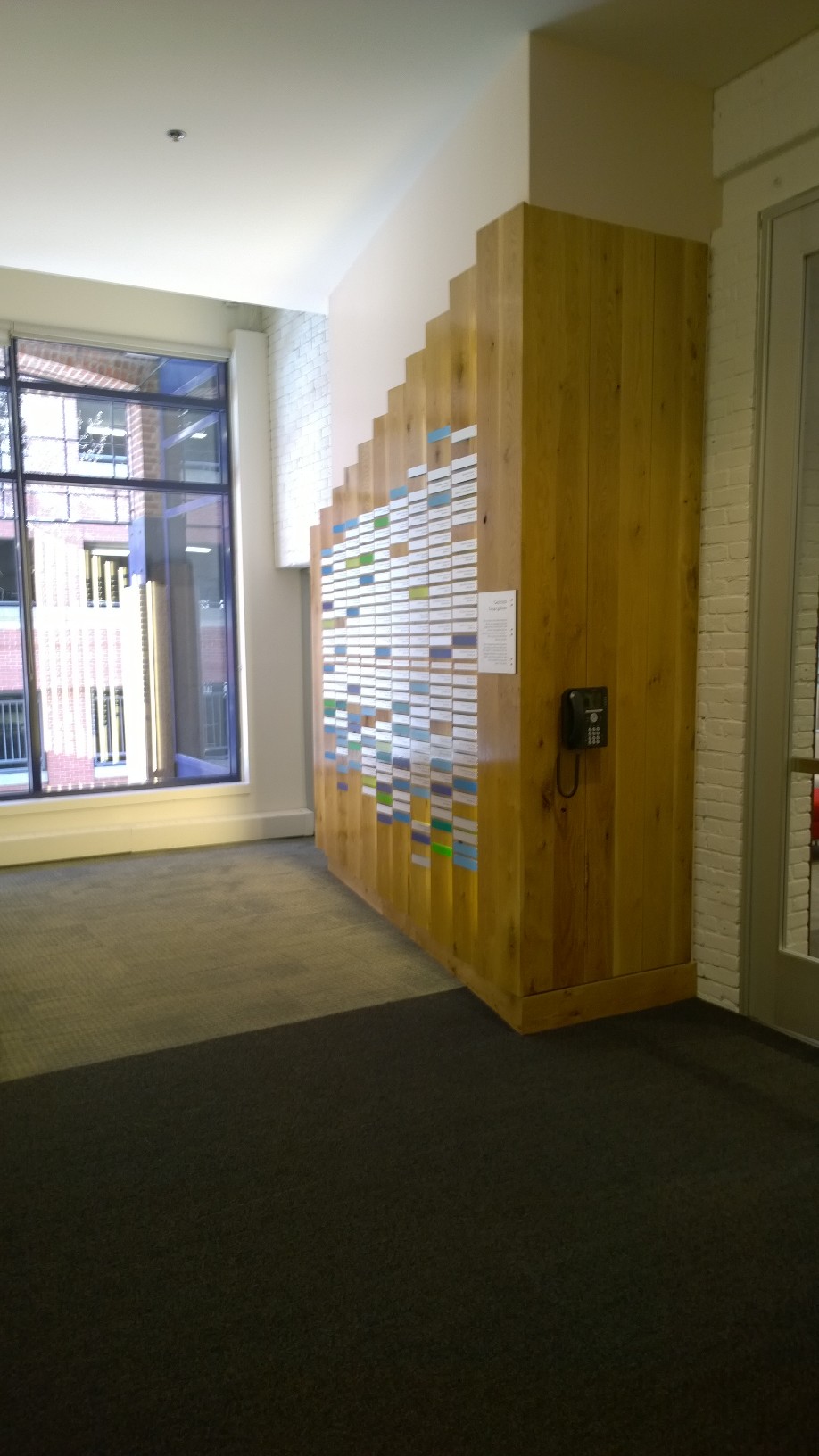
A year or so ago the Unitarian Universalist Association sold their historic but drafty headquarters on Beacon Street near the Massachusetts State House and started fixing up a former warehouse in the Fort Point area, also referred to as the Innovation District.
Whether in the long run this will prove to have been a wise move remains to be seen. But having decided to take a peek at the new place recently, I feel I am qualified to opine that the new headquarters is better insulated.
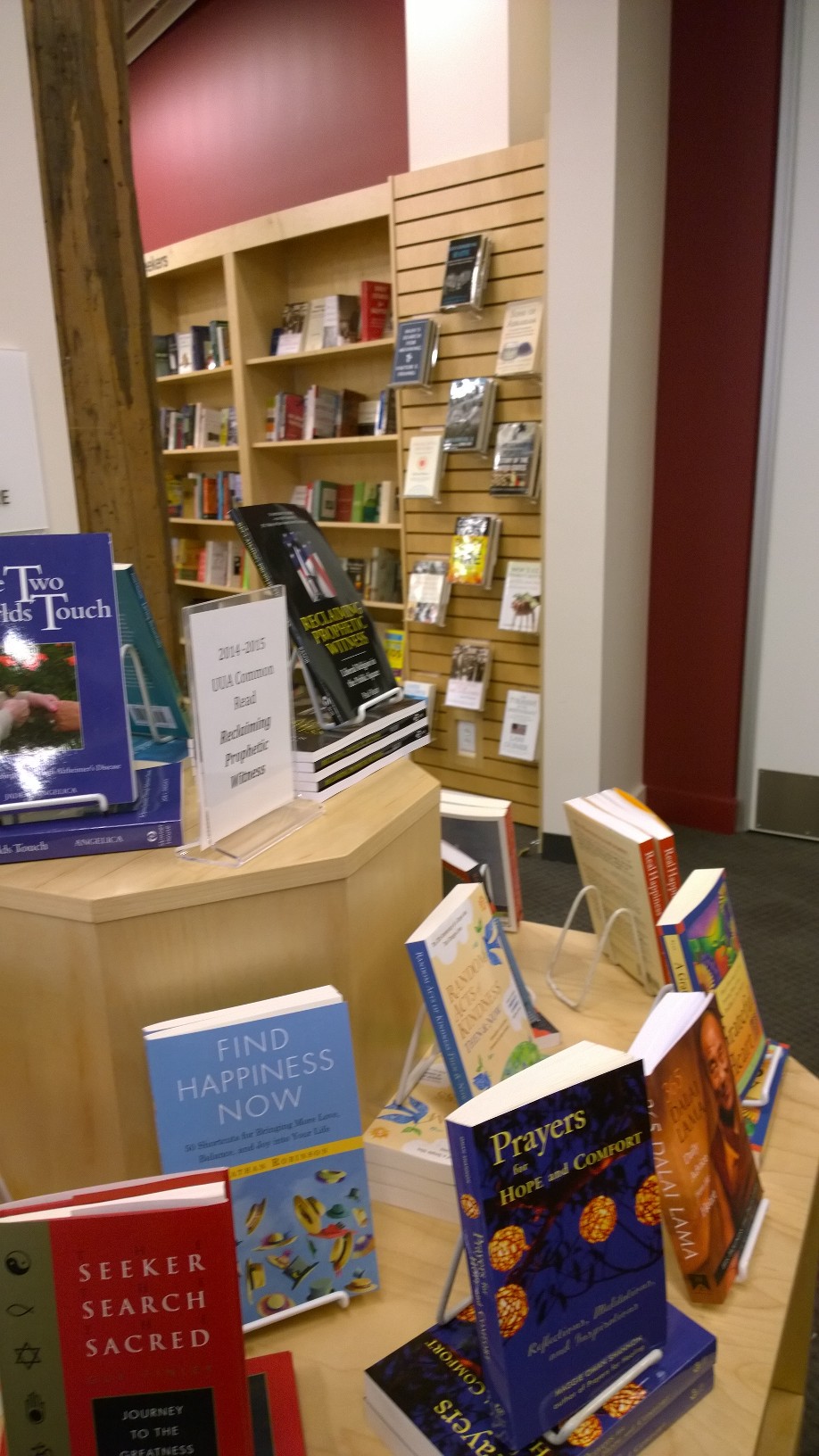
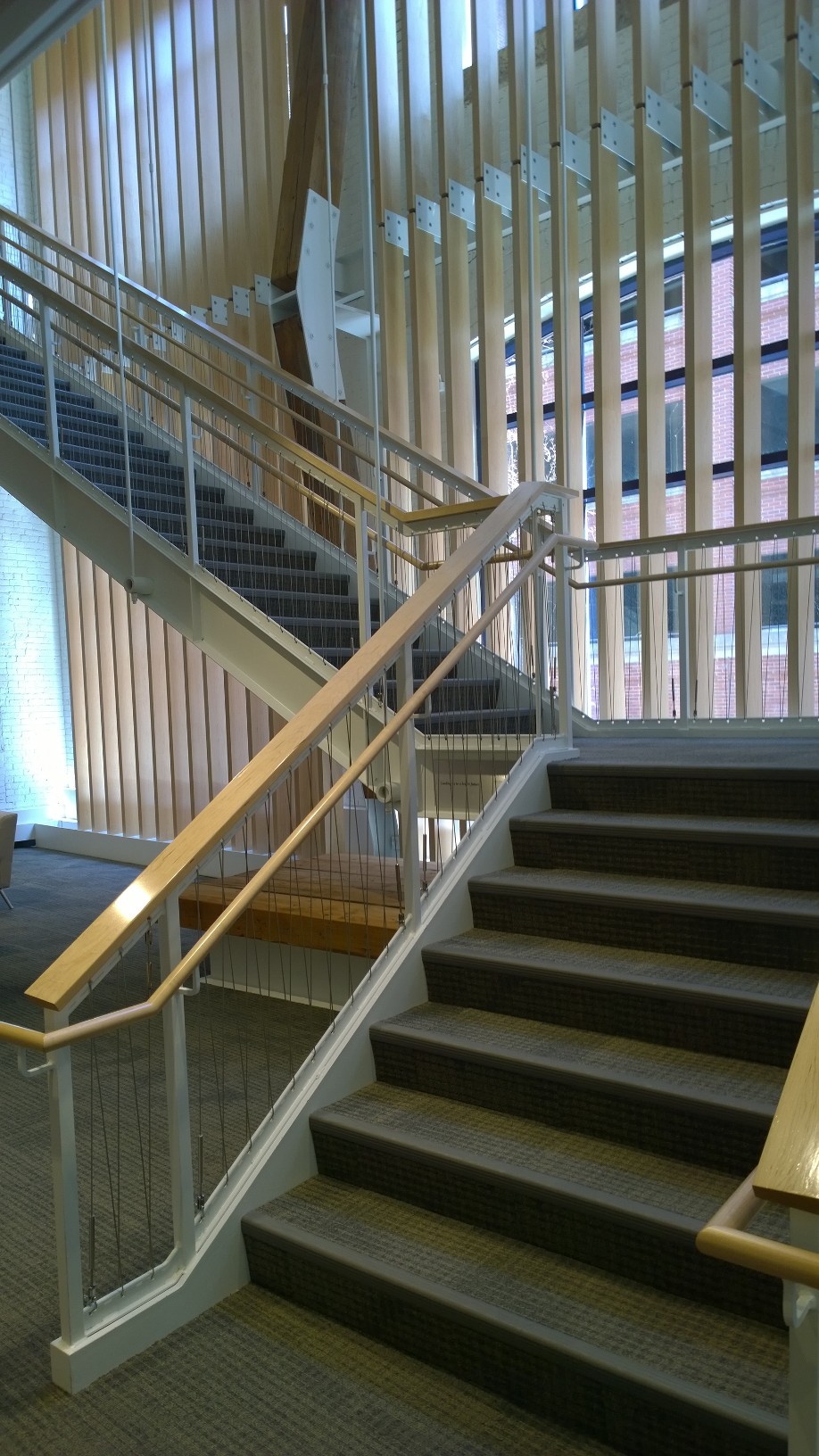
The building at 24 Farnsworth Street, which in addition to the UUA headquarters, houses the Beacon Press and a UU bookstore, was extremely quiet when I went on a weekday afternoon — like a library of yore. There was a receptionist in the reception area, two people working quietly at computers in the bookstore, and low voices from two meeting rooms in the back. I took a few pictures. I really liked the high ceilings and the tall warehouse pillars and windows.
I am crazy about the Fort Point area, but I am also concerned that the plethora of brand new office buildings is not helping the area’s vulnerability to a future Hurricane Sandy. It’s next to Boston Harbor and extremely exposed. Some builders are actually incorporating flood walls.
The Boston Globe had this story: “Boston’s effort to redevelop its waterfront is running into a major obstacle: Water. From downtown to East Boston to Dorchester, rising sea levels are posing an increasingly urgent threat to developers’ plans to build hundreds of homes, offices, stores, and parks along Boston Harbor, with many acknowledging the need to reinforce existing properties and redesign new ones in case of flooding from another Hurricane Sandy-like storm. …
“Several building owners are already preparing for the growing possibility of flood waters. At Fan Pier, developer Joseph Fallon has moved critical electrical systems higher in his buildings. Nearby, developers of a residential tower at Pier 4 are proposing to use special flood barriers for lower entrances. And the newly built Spaulding Rehabilitation Hospital in Charlestown is surrounded by protective walls and landscaping buffers, and no patient programs are located on the ground floor.”
The entrance to the new UUA headquarters is up several stairs, so maybe the planners were cognizant of potential floods and hoping never to regret their loss of the hill.
John recently reminded me about an organization started in Boston to help people with disabilities or experiencing homelessness to create and sell their art.
The Miami Herald is one of many outlets that have picked up the story.
Brittany Chandani writes, “When Harvard graduate Liz Powers received a grant for social work, she decided to help homeless or disabled artists by sharing their artwork with the Boston community.
“When Powers realized there wasn’t a professional marketplace to sell their works, she organized an annual art show. Customers, however, wanted more than a yearly show, leading Powers and her brother, Spencer, to develop ArtLifting.com, an online marketplace devoted to selling artworks created by homeless or disabled artists. ArtLifting, a project incubated at the Harvard Innovation Lab, selects artists from nonprofits and homeless shelters across the country; it curates their art to highlight the top pieces from each artist. …
“Upon finding an Instagram tag #ArtTherapy, Spencer contacted David McCauley of Rise Up Gallery in Wynwood [FL], who simultaneously contacted Spencer upon seeing his Instagram page for ArtLifting. The serendipitous moment made the perfect partnership. …
“McCauley, an artist who broke his C6 vertebrae in a diving accident, moved from New Jersey to Miami to establish Rise Up Gallery, a branch of the nonprofit foundation he created in New Jersey after his accident. The pop-up gallery exhibits quarterly at various locations. McCauley also conducts free art therapy workshops at Jackson Rehabilitation Hospital. …
“ArtLifting now features three Florida artists on its website: David McCauley, Laurie Kammer and Elizabeth D’Angelo. ”
Photo: Marsha Halper/Miami Herald Staff David McCauley, a mixed-media artist and the founder of Rise Up Gallery, smooths the edge of one of his new artworks at ArtCenter / South Florida in Miami Beach. Rise Up Gallery is a nonprofit organization that provides free art therapy workshops.
Not sure how I learned about this story in the St. Louis Post-Dispatch, but I knew right away it would be good for the blog. It seems that enterprising neighbors of some vacant urban land started a garden on it 35 years ago, always wondering what would happen if the owners ever turned up.
Reporter Paul Hampel writes, “Joe Spears was ready to give up the farm. He had no legal claim to the plot of land in Kinloch, after all. Spears was just one of several dozen people who, without any official clearance, had been planting and harvesting greens, okra, melons, beans, tomatoes and peppers for the past 35 years on about nine vacant acres abutting North Hanley Road.
“When an executive from one of the largest construction firms in the Midwest approached the amateur farmers in the fields last fall, it looked like a good thing was coming to an end.
“ ‘We were never trying to pull the wool over anyone’s eyes,’ Spears, 70, of Rock Hill, said … ‘It wasn’t our property. And it wouldn’t be right for us to make a scene when the rightful owners told us to move on.’
“The rightful owner, Clayco Inc., explained that the minifarms lay in the path of the planned expansion of NorthPark Business Park, the company’s massive development … Then came a proposal that caught the farmers, including Armstead Ford, by surprise.
“ ‘Clayco offered to give us another place to farm,’ Ford, 75, of Northwoods, said. ‘I was hopeful but skeptical.’ …
“Clayco president Bob Clark allayed those concerns when he announced that the company was relocating the farmers to 8 acres in Berkeley that they had asked him for, just across North Hanley Road from the old farm.
“And the farmers won’t have to capture rain in barrels or haul in water to the new site: Clark, 56, was throwing in an irrigation system, along with a building on the property that has running water, electricity and restrooms.”
Read the rest of the story here, and check out the other photos.
Photo: Laurie Skrivan, lskrivan@post-dispatch.com Armstead Ford, 75, stands in the spot of his former garden at the “Kinloch farms.” Clayco is giving the urban farmers their own swatch of land, which the group will own outright.
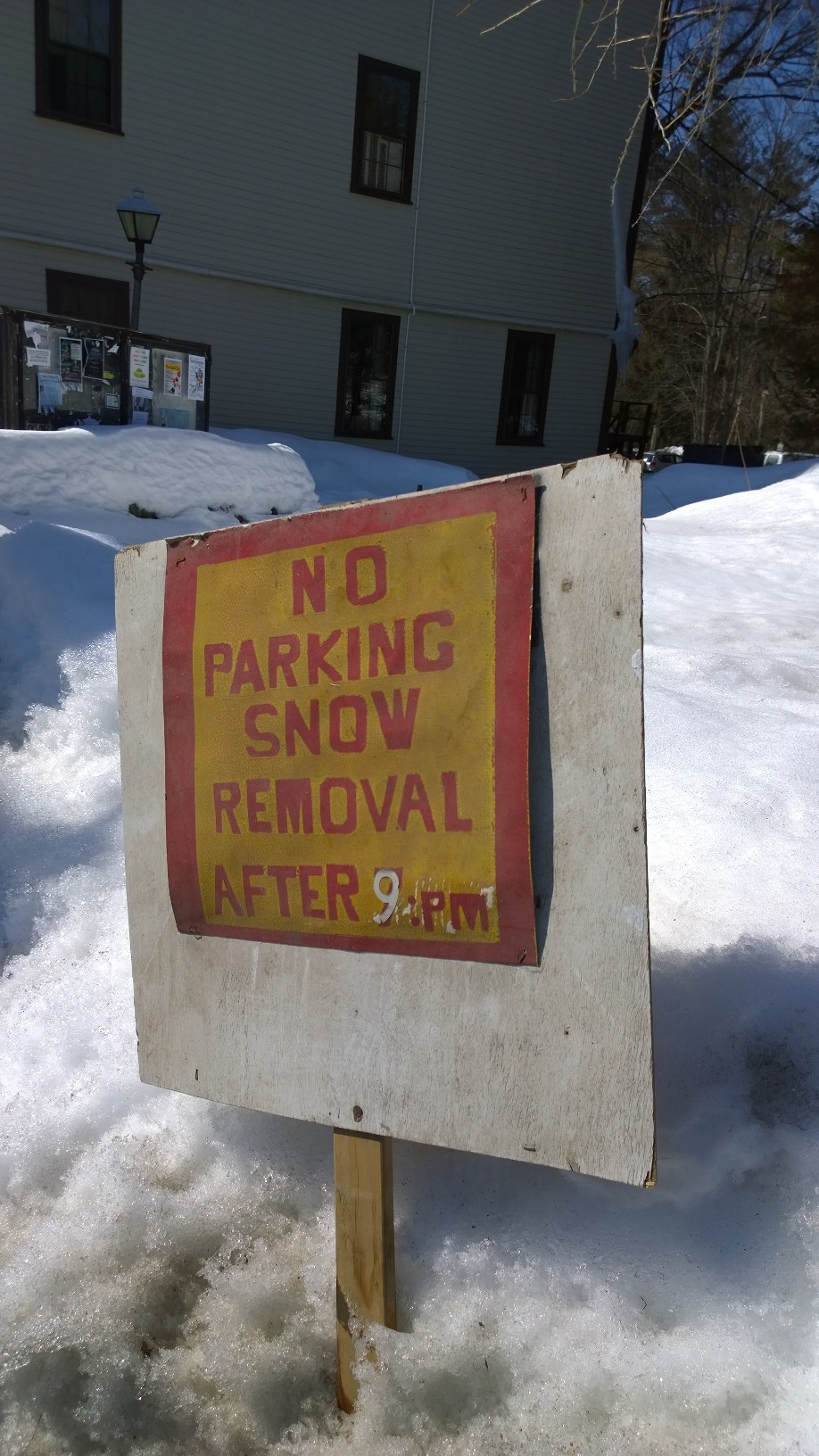
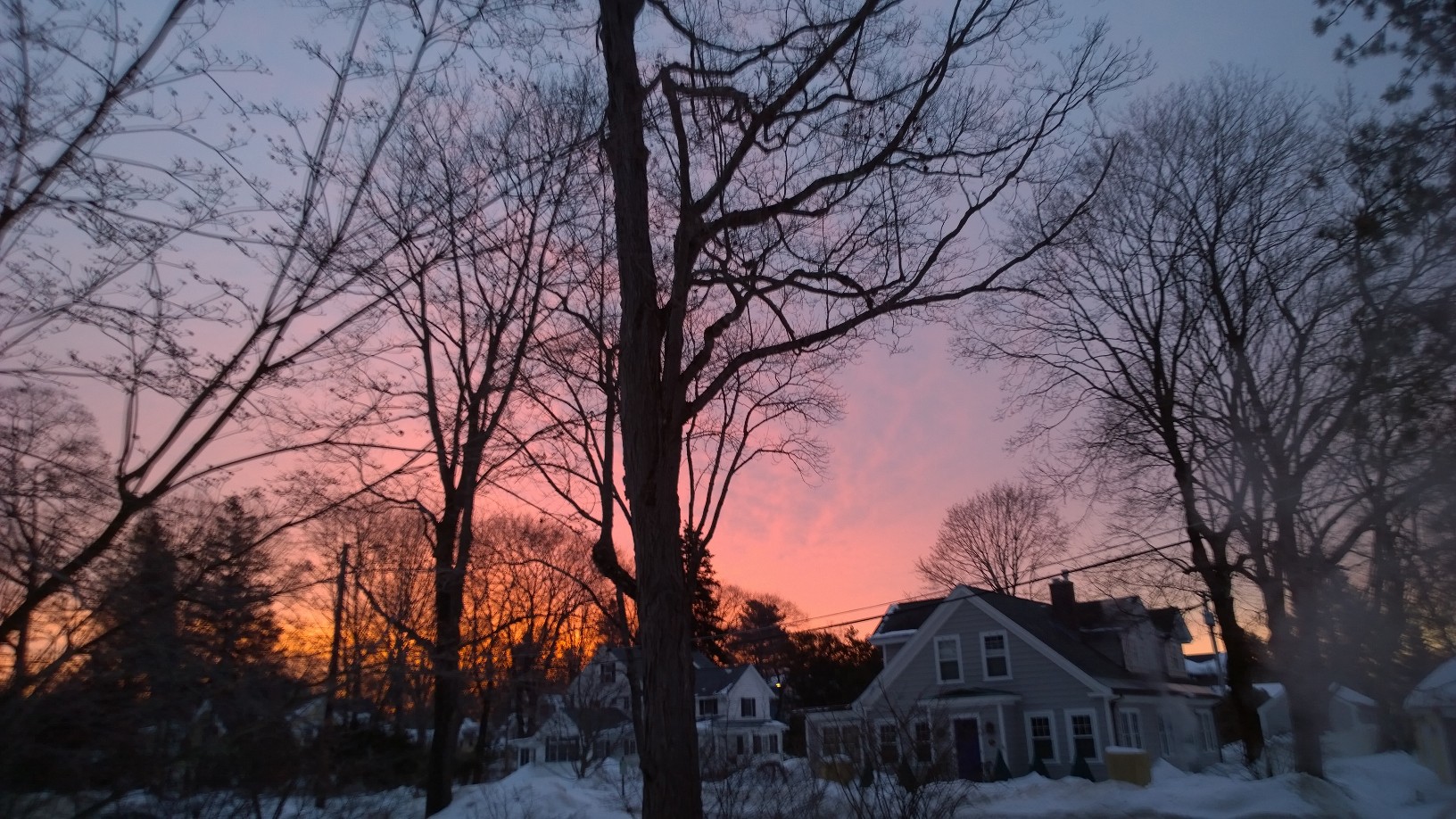
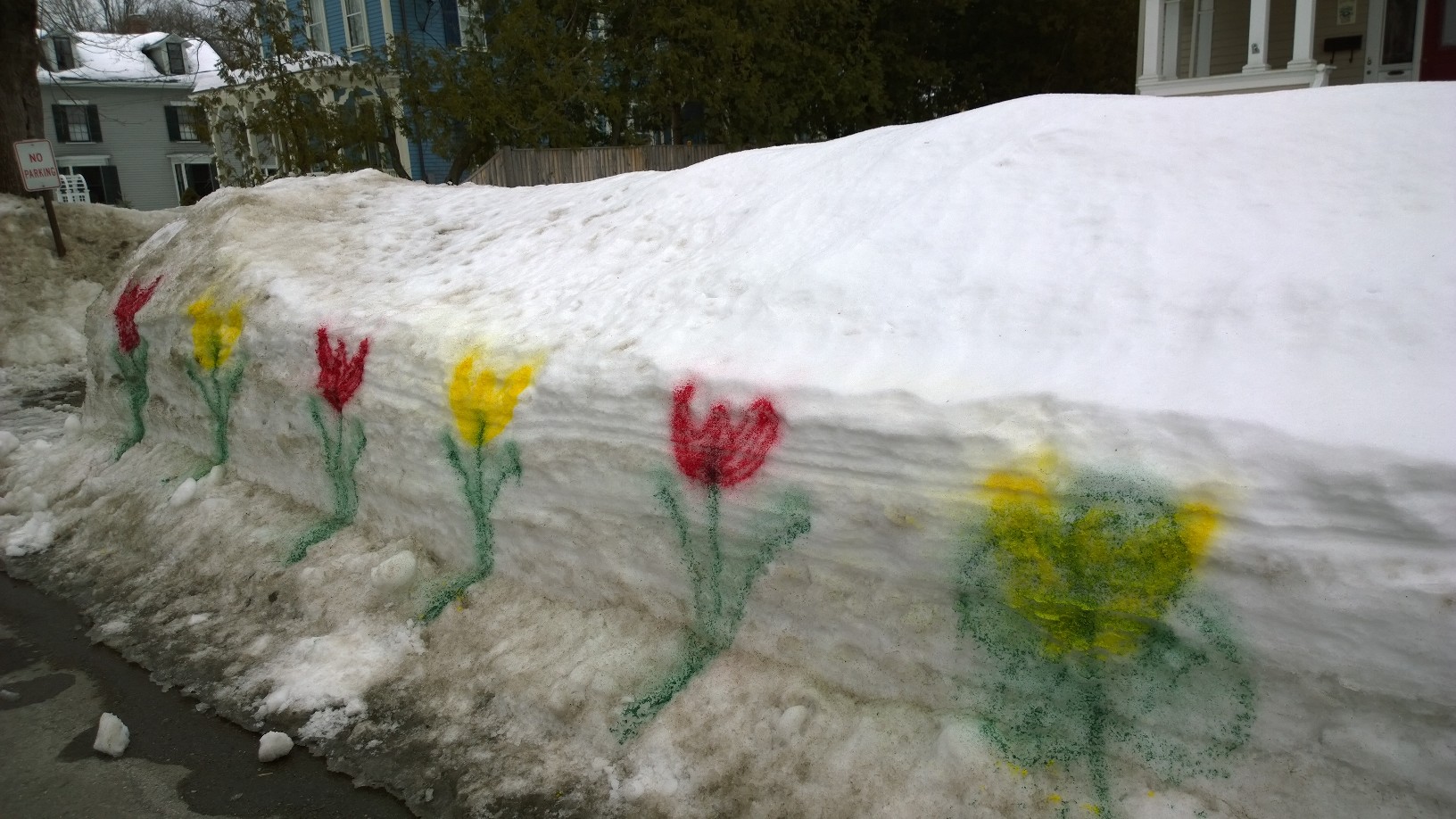
It’s Daylight Savings, the sun is shining, the snow is starting to melt, and the birds are sounding excited.
I don’t think snowy Boston will get its record accumulation, but at least it has a shot at a stronger transit system, especially if the guys backing a summer Olympics decide the competing cities have trains and buses that work even when challenged.
Here are a few recent photos that show us moving on from winter to spring.
(PS. If you are on ello, would you look for suzannesmom there? I need more contacts to help me figure out this so-called anti-Facebook, which carries no ads. It’s very art- and design-oriented, which is lovely, but I think I’d get more out of it with friends.)
First there was the photo, which was tweeted with a link to tumblr. But tumblr offered no story and no credit. I did some searching and found the story at The Trumpet. It reminds me of this post on Sam and Leslie’s Uni, a pop-up library that has traveled from New York to Kazakhstan and many places in between.
At The Trumpet, Jeremiah Jacques reports on a Mongolian Andrew Carnegie (without the fortune). “What do you do if you are a young book lover? You go to the library. But what if you live in the rural regions of the Gobi desert? Your situation would be bleak — were it not for Dashdondog Jamba. He has devoted his life to writing, translating, publishing and transporting books to children all over Mongolia with his Children’s Mobile Library.
“ ‘I can’t remember how many trips I have made—I have lost count,’ Mr. Jamba said. ‘Sometimes we travel by camel, sometimes on horseback, and with horse carts or ox carts; we now also have our van.’
“Over the last 20 years, his library has traveled 50,000 miles through every province of Mongolia — mostly before the van was part of the operation. Jamba’s assistants are his wife and his son. They often spend several days in one place to give as many children as possible a chance to read their books.
“ ‘[It] is a little different from other libraries,’ Jamba says. ‘The walls of this reading room are made of mountains covered with forest, the roof is blue sky, the floor is a flower-covered steppe, and the reading light bulb is the sun.’
“Jamba created his library in the early 1990s, shortly after Mongolia abandoned communism and adopted free-market economics. Life in Mongolia changed dramatically, mostly for the good. But organizations focused on children’s literature fared badly. They were viewed as profitless, so no private investors wanted to take them over. Most children’s libraries were converted into banks.
“Jamba tried to keep the libraries alive. … Ever since, he’s been writing children’s books, translating foreign youth literature into Mongolian, and bringing books to children who would otherwise never read them. Several of his original books have earned the Best Book of Mongolia award. Some of his stories have been put to song. Some have been made into movies. In 2006, his mobile library won the prestigious ibby-Asahi Reading Promotion Award.” More here.
Photo: Dashdondog Jamba
Dashdondog Jamba has traveled more than 50,000 miles through every province of Mongolia with his Children’s Mobile Library.
Imagine my surprise, driving along, flipping channels, to hear the unique voice of John and Suzanne’s high school history teacher, long retired. And he was on Only a Game. I know the show’s host is eclectic, but I couldn’t see how Bill Littlefield was going to work into his sports show Eliot Lilien’s expertise in World War I or Russian history.
Well, what do you know! It turns out Only a Game was focusing on the high school’s 50 years of a sport that Mr. Lilien started there: fencing.
Littlefield writes that 50 years ago, to get the program started, Mr. Lilien “found a few opponents at other secondary schools in the Northeast, and some at colleges, and some at clubs. …
“ ‘When you first began the program 50 years ago,’ I asked, ‘did you ever imagine that it would still be going strong in 50 years?’
“ ‘I didn’t think about,’ he said. ‘But I’m very grateful that it has been, and that this high school has been willing to support it.’
“Some of Lilien’s first recruits showed up hoping to bring Dungeons & Dragons to life with swords. He had to teach them that the sport required not fantasy but discipline, balance, tactics, psychology, and brains — most of the time.
“ ‘Of course, if you’re faster than anyone else, and stronger, it becomes less important,’ Lilien said.
“ ‘The mental part of it?’ I asked.
“ ‘If you can launch a gigantic attack, it doesn’t make any difference how smart the other person is. He’s gonna get hit,’ Lilien answered.”
I wonder if the 50-year mark at the high school as anything to do with the local resurgence of interest in fencing. The space across from my hairdresser, where the wonderful craft shop Dabblers used to be, has morphed into a fencing studio. Fun to watch when you’re getting your hair cut.
In February, Treehugger posted an article on sustainable husbandry in Africa by Charlotte Kaiser, of the Nature Conservancy’s NatureVest arm.
“For thousands of years,” she writes, “the pastoralist communities of northern Kenya have herded their cattle alongside elephants and zebras, the grass of the rangelands shared between livestock and wildlife in relative balance. In recent decades, climate change, habitat loss, and human population growth have combined to erode that balance, leading to overgrazing and the degradation of the grasslands that both humans and wildlife need to survive.
“For over a decade, the Northern Rangelands Trust (NRT) has worked with the communities of Northern Kenya to develop community conservancies that support better management of cattle and grass. …
“A key tool in driving the better management of the rangelands is access to markets. … In 2008, NRT created the Livestock to Markets program (LTM), which brought the market to the Conservancies. In exchange for conservancies achieving specific targets in conservation, LTM buys cattle directly from the conservancies, purchasing several hundred head at a time from dozens of households. Providing access to markets allows pastoralists to better manage their herd sizes, since they know they can sell animals when they need to at a fair price. And LTM also encourages the herders to bank their cash, bringing mobile banking representatives to market days so herders can open bank accounts with the proceeds from the sale.
“Once the cattle are purchased, NRT treks the animals to Lewa Conservancy, a partner NGO. After six weeks of quarantine, the animals move to Ol Pejeta Conservancy, another partner, where they are fattened on grass for 15 months, improving the size and quality of the animals. Finally, the animals are [sold] into the Nairobi meat market. By capturing much of the full value of the supply chain, NRT can pay a levy on every animal they buy to the conservancies themselves. This levy funds conservancy investments in wildlife guards, ecotourism lodges, and community facilities like clinics and schools.” Check out the full article here, and the lovely pictures.
Photo: Ron Geatz
Livestock is the primary measure of wealth among herding communities of northern Kenya.
You can view “Maps from Fiction” in the Boston Public Library’s Leventhal Map Center through October 25 — including a map of Fairyland, a map of Oz, and a map showing both Wild Island and the Island of Tangerina.
Mark Feeney writes at the Boston Globe, “Whether the places are real or imaginary, every map is itself a kind of fiction. Those lines and color shadings and cross-hatchings and numerals and words are as ‘real’ as the sentences in a novel or characters in a cartoon are.
“The London and southern England found in Holling C. Holling’s ‘Sherlock Holmes Mystery Map’ are as real as an order of fish and chips, but the events recorded on it aren’t. … The 100-Acre Wood of the Winnie-the-Pooh books are more familiar to some than their own backyards, in no small part thanks to the enchanting watercolors Ernest H. Shepard drew on its maps. What places are more vivid in the minds of readers than Midde-earth, Oz, Narnia, Neverland, H.P. Lovecraft’s Dreamlands, or George R.R. Martin’s ‘Song of Ice and Fire’ lands?”
Feeney’s article also muses about a Harvard exhibition of historical maps called “Finding Our Way: An Exploration of Human Navigation.” More here.
Illustration: Ruth Chrisman Gannett
Map from the storybook My Father’s Dragon, by Ruth Stiles Gannett.
I’ve been wanting to share this remix of Disney’s Alice in Wonderland but hoped to add something beyond saying that I like it.
Then today, Asakiyume tweeted some comments on fantasy that science fiction writer Ursula K. Le Guin posted at the Book View Cafe blog.
Le Guin was reacting to a comment Kazuo Ishiguro made about his latest novel when he was interviewed by the NY Times: “Will readers follow me into this? Will they understand what I’m trying to do, or will they be prejudiced against the surface elements? Are they going to say this is fantasy?”
Le Guin launched into a spirited defense of fantasy in which she mentions the very story I had been thinking about for this post.
“Fantasy is probably the oldest literary device for talking about reality. ‘Surface elements,’ by which I take it he means ogres, dragons, Arthurian knights, mysterious boatmen, etc., which occur in certain works of great literary merit such as Beowulf, the Morte d’Arthur, and The Lord of the Rings, are also much imitated in contemporary commercial hackwork.
“Their presence or absence is not what constitutes a fantasy. Literary fantasy is the result of a vivid, powerful, coherent imagination drawing plausible impossibilities together into a vivid, powerful and coherent story, such as those mentioned, or The Odyssey, or Alice in Wonderland.” More here.
I love Le Guin’s characterization of fantasy. It reminds of something C.S. Lewis said about writing good fantasy. He said that, within the laws of its own realm, everything had to be plausible. Or words to that effect. And he wrote an essay with a splendid title, “Sometimes Fairy Stories Say Best What’s to Be Said.” (For a comparison of Tolkien’s and Lewis’s ideas about fantasy, check this essay.)
The American Booksellers Association has a surprise for anyone who thinks that independent bookstores are a dying breed.
According to their website, “In 2014, the American Booksellers Association welcomed 59 indie bookstores that opened in 25 states, the District of Columbia, and the U.S. Virgin Islands. This is the largest number of new stores joining ABA in a single year since the start of the Great Recession in 2008.
“The new stores include nine branches or satellites of existing businesses and five stores selling primarily used books. In another sign of the health of independent bookstores, 29 established ABA member businesses were bought by new owners. …
“Bookends and Beginnings, which was opened by spouses Jeff Garrett and Nina Barrett in June in Evanston, Illinois, has succeeded despite the presence of what some might assume to be obstacles: potential competition from an enormous Barnes & Noble a few blocks away, campus bookstores associated with Northwestern University and the University of Chicago, and multiple small, used bookstores throughout the neighborhood.
“The general bookstore offering new, used, and bargain books is in the former location of the well-known antiquarian bookstore Bookman’s Alley. …
“It was Garrett, a rare library collections expert, who introduced one of the store’s surprise top sellers: a carefully curated selection of international children’s books in 26 different languages. Barrett said the success of these books makes sense because of the surrounding area’s diverse demographics, including Skokie, which Barrett described as ‘the biggest melting pot you can imagine.’ ”
The Booksellers Association offers more shop profiles and a complete list of new stores, branches, and satellites joining the association in 2014, here.
While we’re on the subject, you might enjoy a WordPress blog by Wendy Welch, Little Bookstore of Big Stone Gap, in Virginia, here. In addition to writing book reviews, she has many stories about life in her town and about the book trade in general.
One of Studio 360‘s regular hosts spoke recently with a woman who believes good design can and should be used to enhance the most mundane and cheerless places.
The radio show’s website says, “Going to the DMV, doing the dishes, commuting to work: what would you change if you could? Kurt talked with designer Ingrid Fetell about how better design can make all the difference.
“Fetell wants to ‘create principles that are informed by what the cognitive sciences are showing us about the way that objects, surfaces, colors, textures, patterns make us feel, and use those as principles for designing things that really make us feel good,’ she tells Kurt Andersen. Her curiosity stems from noticing that certain things seem to universally make people feel a sense of joy — like confetti, balloons, and bubbles. ‘It was really born out of a curiosity to understand why certain things make even babies smile.’
“She points to Edi Rama as a real-life example of putting these ideas into practice. Rama, who is now Prime Minister of Albania, was named the World Mayor in 2004 after painting much of Tirana in bright colors. The results were remarkable. ‘He found that people actually started paying their taxes after the painting,’ she tells Kurt. ‘People stopped littering as much and the shopkeepers started taking the metal grates off their windows and opening glass window fronts back out to the street.’ ” More here.
I like the idea of trying to understand what makes a baby smile. Or laugh. There are so many wonderful YouTube videos of babies laughing hysterically when someone tears paper or when a dog eats popcorn. Why is that hilarious? Because it’s startling?
By the way, Studio 360 is collaborating with Fetell and IDEO “to redesign a thing, place, or experience that is unnecessarily joyless.” Send your ideas on Twitter or Instagram, and tag #bringjoy. I sent “homeless shelter.”
Paint job: Edi Rama, who became prime minister of Albania
It always seems so limiting to put anything in a category. Some WordPress bloggers are good at categorizing their posts, and I’m sure that helps many readers, but my posts are never about one thing only.
Netflix makes movie recommendations based on categories that pigeonhole movies we’ve rated highly. But the approach seems clunky. Just because we have liked a lot of foreign films (Wadjda, Son of Rambow, Princess Mononoke), that doesn’t mean we like all foreign films. Maybe we like the ones we’ve seen for some other reason than being foreign. Maybe they are less glitzy, more honest, or more entertaining.
He are some funny categories Netflix recommended for my husband and me: “emotional, independent films based on books,” “critically acclaimed foreign movies,” “mind bending movies,” “anime,” “musicals,” “social & cultural documentaries,” “critically acclaimed emotional movies,” and “horror movies.” Horror!? Where did they get that?
At the late, lamented Kate’s Mystery Books in Cambridge, you could get pretty sound advice on books from Kate herself. She would ask you to name some mysteries you liked, and you might say you had read all of Tony Hillerman and Arthur Upfield. Then she would say, “Different cultures.”
Well, ye-es. But what kept me coming back to those authors were detectives who were likable and endings that were positive in some way. no matter how small. Kate did give me some authors I loved, like Eliot Pattison (mysteries about Tibet and, more recently, several about 18th century American Indians), but other books about different cultures might be too noir for me or too fluffhead, like mysteries with animal detectives.
I suppose categories help a bit. I just think they are clunky. Where would I file this post, now? Movies? Books? Retail? Misconceptions? Colin Cotterill, Dr. Siri, Laos?
Colin Cotterill writes a series that is both funny and deadly serious about a 70+ coroner in Laos, Dr. Siri, a likable antihero with an offbeat bunch of equally likable cronies.
Although my husband and I are not in any design field, we’ve enjoyed watching videos like Gary Hustwit’s Helvetica (the history of a typeface) and his Objectified (on industrial design). It’s interesting to see how designers think about things like a new font or machine.
Recently at National Public Radio’s Weekend Edition, Ari Shapiro talked about a new typeface meant to represent Sweden.
He reports, “Nearly every country has a national flag, a national anthem, a national bird. Not many countries have a national typeface. Sweden recently commissioned a team of designers to come up with a font to represent the country on its websites, press releases, tourism brochures and more. …
“The typeface that [Soderhavet] designers created looks pretty much the way you would expect a Scandinavian typeface to look, too.
” ‘The Scandinavian tradition is pretty humble, easygoing and clean,’ says Stefan Hattenbach, one of the designers of the new Sweden Sans. Less is more, you could say.’
“He started by collecting images of old Swedish street signs and company logos. He pulled images of Swedish wallpaper, cars and furniture, and looked for what he calls the red thread running through it all.
” ‘There’s an expression in Sweden, too,’ Hattenbach says. ‘We say lagom, which is not too much and not too little.’ ”
The ancient Greeks had a similar expression: “Nothing in excess.” The only letter with a flourish is q. Says Hattenback, “Q is not used that much, so you can often be a little more playful with that.”
See what you think of Swedish Sans, below, and read the rest of the NPR story here.
Swedish Sans, by Soderhavet
A typeface to represent official Sweden