Feeds:
Posts
Comments

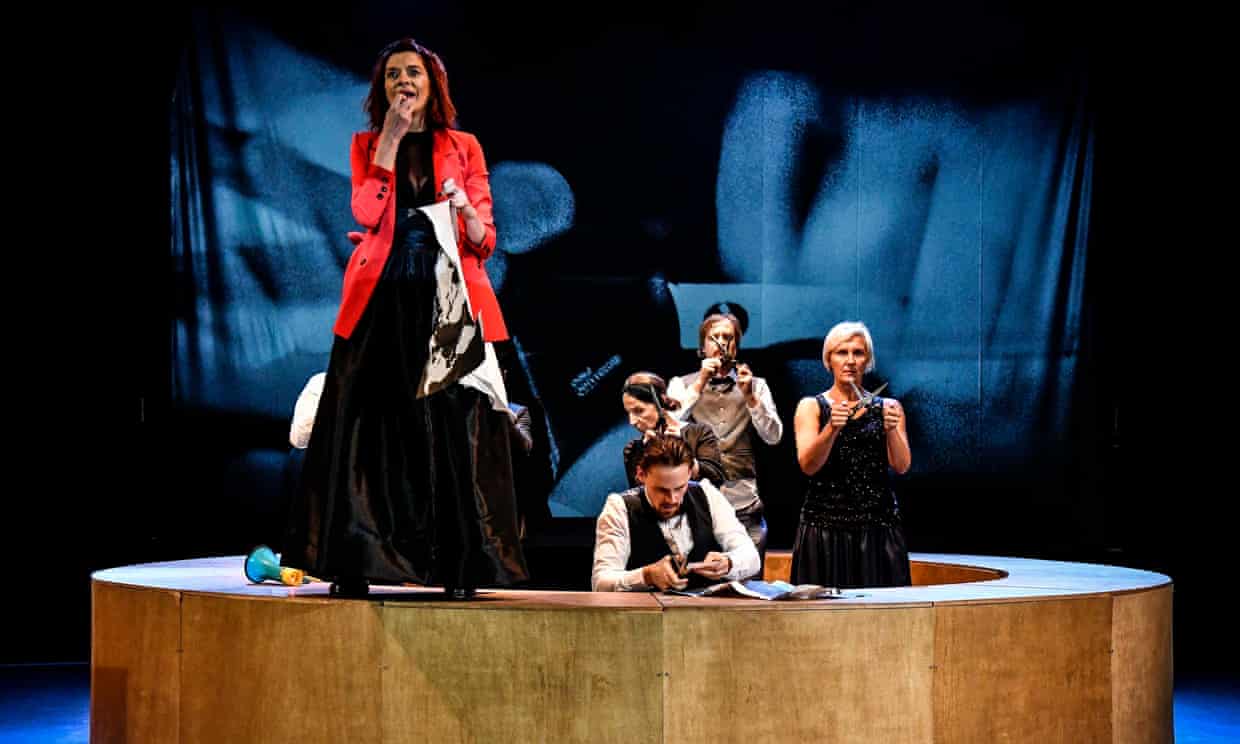
Photo: Atdhe Mulla.
The play Negotiating Peace had its premiere at Pristina’s Oda theatre in October, before going on tour. 

Wars eventually end, but the peace that follows is often uneasy. Art can bring some laughs into people’s lives and add to the accumulation of small things that make a more lasting difference.

Philip Oltermann writes at the Guardian, “When political leaders present war as the only solution, it is up to artists to remind people that finding peace is still possible. That is the starting point for a Kosovo-based theatre company, Qendra Multimedia. …

“The lesson it draws, and the genre it chooses to present its findings, is unexpected: the Kosovan playwright Jeton Neziraj’s Negotiating Peace shows the diplomacy of peace as a farce, albeit a necessary one.

“Dramatizing roundtable talks between the fictional warring countries of Banovia and Unmikistan, the play is a frenzied comedy in which vain generals can only be lured to the negotiating table by promises of Hollywood films celebrating their actions. Opposing parties get drunk while negotiating demilitarized zones, mix up drafts of ceasefire agreements and sign on the wrong dotted line. Maps of disputed territories are partitioned with paper scissors until holy lands turn into showers of confetti. …

“ ‘When you talk about serious things, you must not talk about it in a serious way,’ said Orest Pastukh, a Ukrainian actor who is one of five members of Qendra’s multinational cast with first-hand experience of their country going to war. ‘If we would speak seriously about war and peace, everybody would go mad.’

“The play … is loosely based on the Dayton accords that in 1995 brought a halt to the three-and-a-half-year Bosnian war, the deadliest chapter in the breakup of Yugoslavia. At its premiere at Pristina’s Oda theatre last week, it also mixed in elements of the peace settlement that four years later ended the war in Kosovo. …

“To end that conflict between Serbs and Kosovo-Albanians in the breakaway province, Nato acted more swiftly and aggressively than it had done in the Bosnian war. In downtown Pristina, gratitude for the US’s assertive leadership in the peace talks is still palpable. There is a statue of a waving Bill Clinton, a bust of Madeleine Albright and a street named after Richard Holbrooke. …

“It may seem surprising, therefore, that in Negotiating Peace, moral certitudes come wrapped in sarcasm and not in pathos. The Holbrooke-type character, Joe Robertson, played by Harald Thompson Rosenstrøm, a Norwegian, is not just a ‘beast of peace’ but also ‘a schizophrenic, a brutal Mazarin.’ …

“ ‘When I read Holbrooke’s memoir To End a War, I realized that the negotiating table was also a kind of stage,’ Neziraj said on the eve of his play’s premiere. ‘And a dramatic stage on which actors were acting quite bizarrely,’ involving negotiators staging walkouts and new political borders ‘being drawn on napkins.’

“He said studying the Dayton agreement, as well as the Oslo accords signed between Israel and Palestine in 1993, had robbed him of the illusion that peace talks were structured conversations led by experts in their fields. ‘They are the fruit of the wills of individuals at a certain moment,’ Neziraj said. …

” ‘War doesn’t end when you lay down your arms,’ Neziraj said. ‘We in Kosovo live in an interim state, which is not war but neither a fully fledged peace.’ …

“Neziraj is aware of his own cynicism, and Negotiating Peace eventually manages to snap out of it. Towards the end of the play, the summit looks like a failure: faith in the UN is shot to shreds, there are calls for a second conference organized by the EU.

The chief negotiator appeals to the audience for advice to break the deadlock.

“As the play tours around the Balkans, the company intends to invite different real-life witnesses on to the stage. In Pristina the job fell to Aida Cerkez, a veteran Associated Press correspondent who covered the siege of Sarajevo from the Bosnian capital. Her 10-minute monologue changes the mood of the play.

“ ‘The only precondition for peace is to get everybody around the same table,’ she said after the curtain call. ‘And to get everybody around the same table, you have to militarily weaken the dominant side. As long as one side can think it can win, there’s no reason to sit down at the negotiating table. In Bosnia, that condition was met by Nato bombing. …

” ‘Peace is not the absence of armed conflict,’ she said. ‘In Bosnia we are living the absence of armed conflict, not peace. But that’s not nothing. It’s a lot.’ “

More at the Guardian, here. No paywall.
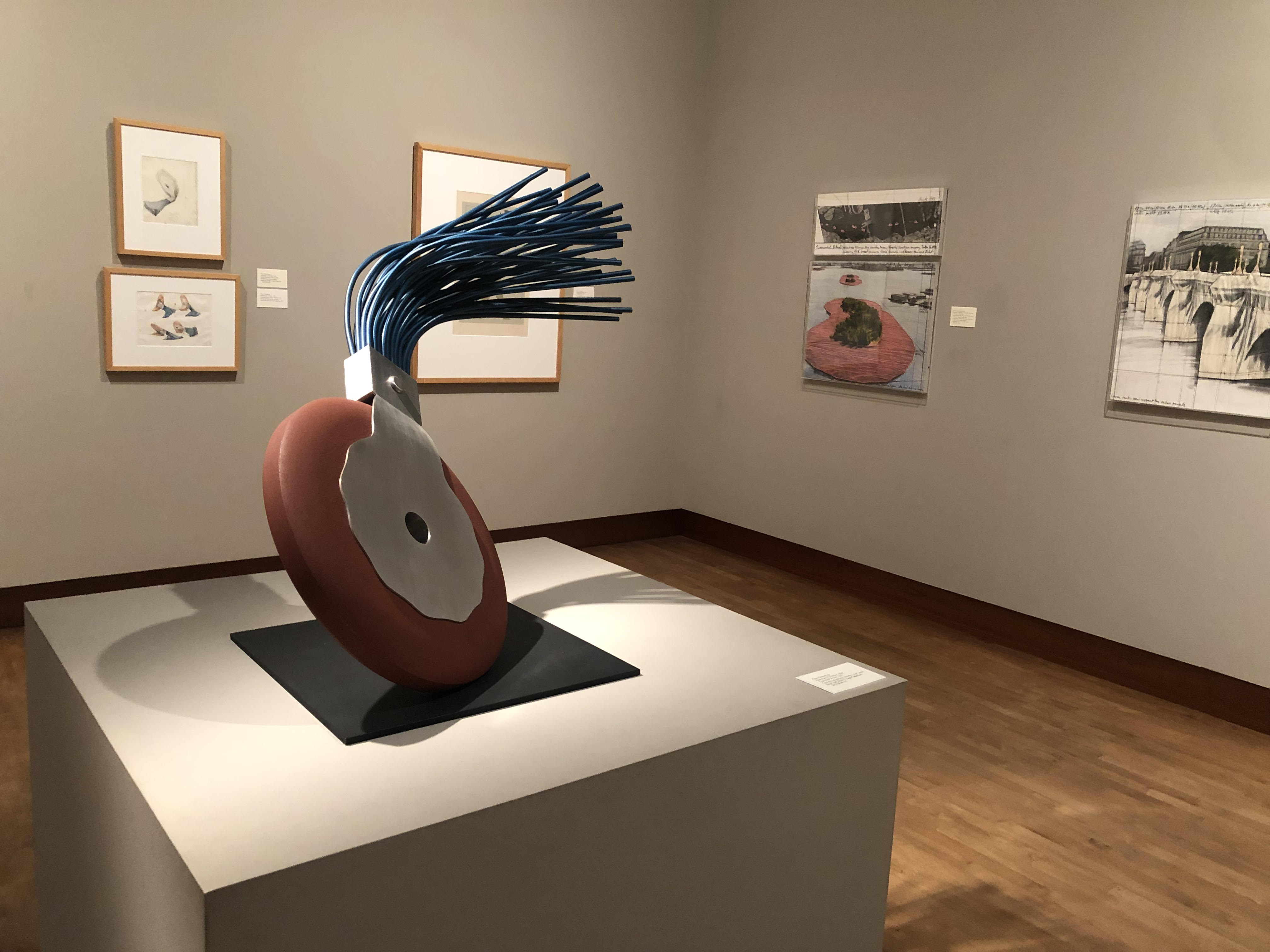
Photo: John and Suzanne’s Mom.
“Typewriter Eraser,” by Claes Oldenburg, at Chazen Museum of Art, Madison, Wisconsin, August 2022.

When I saw this a year and a half ago in Madison, I loved so much that Claes Oldenburg was drawn to the artistic possibilities of a typewriter eraser that I took a picture.

More recently, a larger, outdoor version of that eraser drew in an owl.

Alisa Tang has the story at the Washington Post.

“It was the morning of Friday the 13th, and staff members were tending the grounds of the National Gallery of Art Sculpture Garden when they spotted something amiss: feathers sticking out of the blue bristles of the gigantic typewriter eraser.

“As they stepped in for a closer look, they realized a barred owl was stuck in the brush of ‘Typewriter Eraser, Scale X‘ — the garden’s six-meter-tall steel-and-fiberglass sculpture of the once-common office relic.

“The bird was still. But as the gardeners approached, it turned its head and blinked. …

“Brett McNish, the garden’s supervisory horticulturist, wrote in an email, ‘Occasionally, we see hawks momentarily perched on other taller sculptures in the garden, but never on Eraser. This is the first Owl seen in the garden.’ …

“There is a lot of wildlife in the garden, including dozens of species of birds and small mammals, McNish wrote. Hawks mainly like to sit on ‘Graft,’ a stainless steel sculpture of a leafless tree, though they tend not to stay for long. …

“Then came Friday the 13th and the extraordinary owl in the eraser. It was unclear how the owl got into its predicament, but staff members sprang into action. ‘It clearly needed help,’ McNish wrote.

“Workers hauled out a ladder and steadied it under the eraser. McNish, feeling ‘slightly anxious’ because of the bird’s thrashing as staff members neared, put on goggles and heavy-duty rose-gardening gloves for protection. He climbed the rungs and extracted the bird.

“The gallery’s sculpture conservation department provided a quilted cotton blanket normally used to move artwork to swaddle the owl, and McNish said that within an hour of its rescue, the owl was delivered into the care of City Wildlife, an animal rescue center in D.C.

“ ‘It was extremely lethargic, and it looked really sad,’ said Jim Monsma, City Wildlife’s executive director. ‘An owl during the day should not just be lying there in a box. It should be trying to fly away. It looked like it had just given up.’ …

“Staff members evaluated the owl, X-rayed it and found no broken bones. But its right shoulder was swollen, its ‘gums’ were pale, and it wouldn’t eat, said Sarah Sirica, a veterinarian and City Wildlife’s clinic director.

“The clinic put the owl on pain and anti-inflammatory medication, injected it with an electrolyte solution around the base of its leg and put it in a private room in a large cage that was lined with cloth so it wouldn’t damage its wings. The clinic bought frozen dead mice, thawed them and left them in the cage overnight — which is when owls normally eat — but the owl didn’t touch the food.

“So staff members hand-fed it: One person held the owl, while another, sometimes Sirica, wore gloves, opened the owl’s beak and put pieces of chopped-up thawed mice into its mouth, ‘a finger-length down,’ Sirica said.

“After about a week, Sirica deemed the owl healthy enough to travel; the swelling on its shoulder had gone down, and its gums were pink again. On Oct. 21, a City Wildlife volunteer drove the bird to Tri-State Bird Rescue & Research in Newark, Delaware. Upon arrival, staff at the facility placed it directly inside a 100-foot-long, gravel-floored flight enclosure for ‘prerelease flight conditioning,’ said Lisa Smith, the executive director of Tri-State Bird Rescue.

” ‘It gives them the opportunity to have a long flight. Then we can evaluate that they are flying properly — you can’t do that in a small enclosure,’ Smith said. ‘You have to see multiple flaps. Also, the enclosure is 20 feet high, so you want to make sure they can get from the ground up and make it from one end to the other at that height.’ …

“Tri-State Bird Rescue has admitted … ducklings that fall into storm drains, and birds that lose their nests during storms or get caught in sticky glue traps. But eraser owl was a novelty. …

“Tri-State Bird Rescue normally will return an adult bird of prey to the area where it was found, but it avoids transporting younger raptors because they can injure their wings in the carrier. Besides, as juvenile birds of prey become adults, they often have to find territory away from where they were raised anyway, Smith said. … ‘For the birds’ safety, we tend to release them here. It’s good habitat. It’s migration season.”

More at the Post, here.

And just for no reason, here’s a handy expression you can use the next time you are in Sweden: “Det är ugglor i mossen.” There are owls in the marsh. Erik’s mother says, “It is something that is not quite OK or not reliable. You should really not believe it. It’s a sort of feeling.” Maybe “I smell a rat”?

Caribbean Seed Art

Photo: Botanique Studios & Thomas Barzilay Freund.
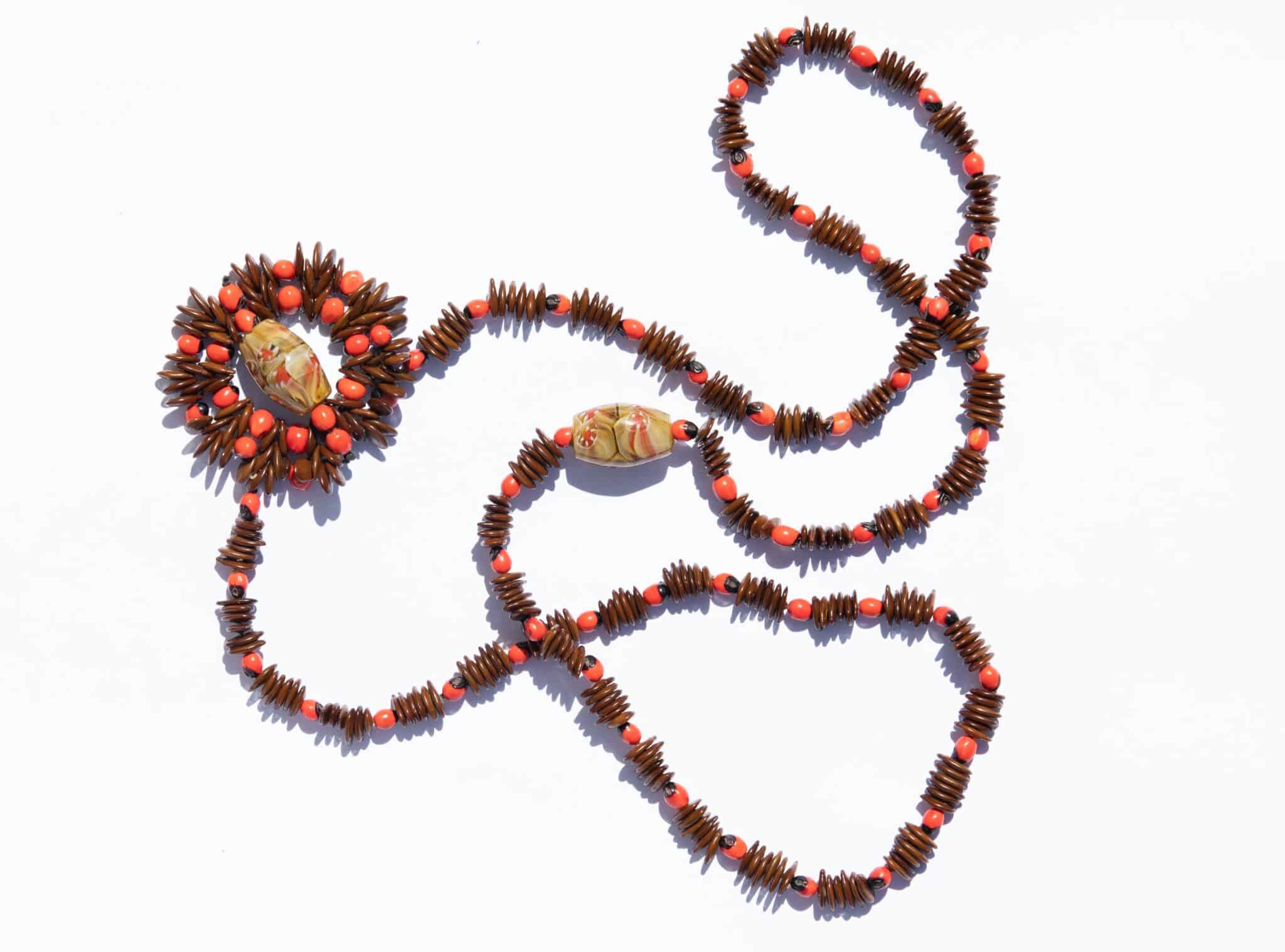
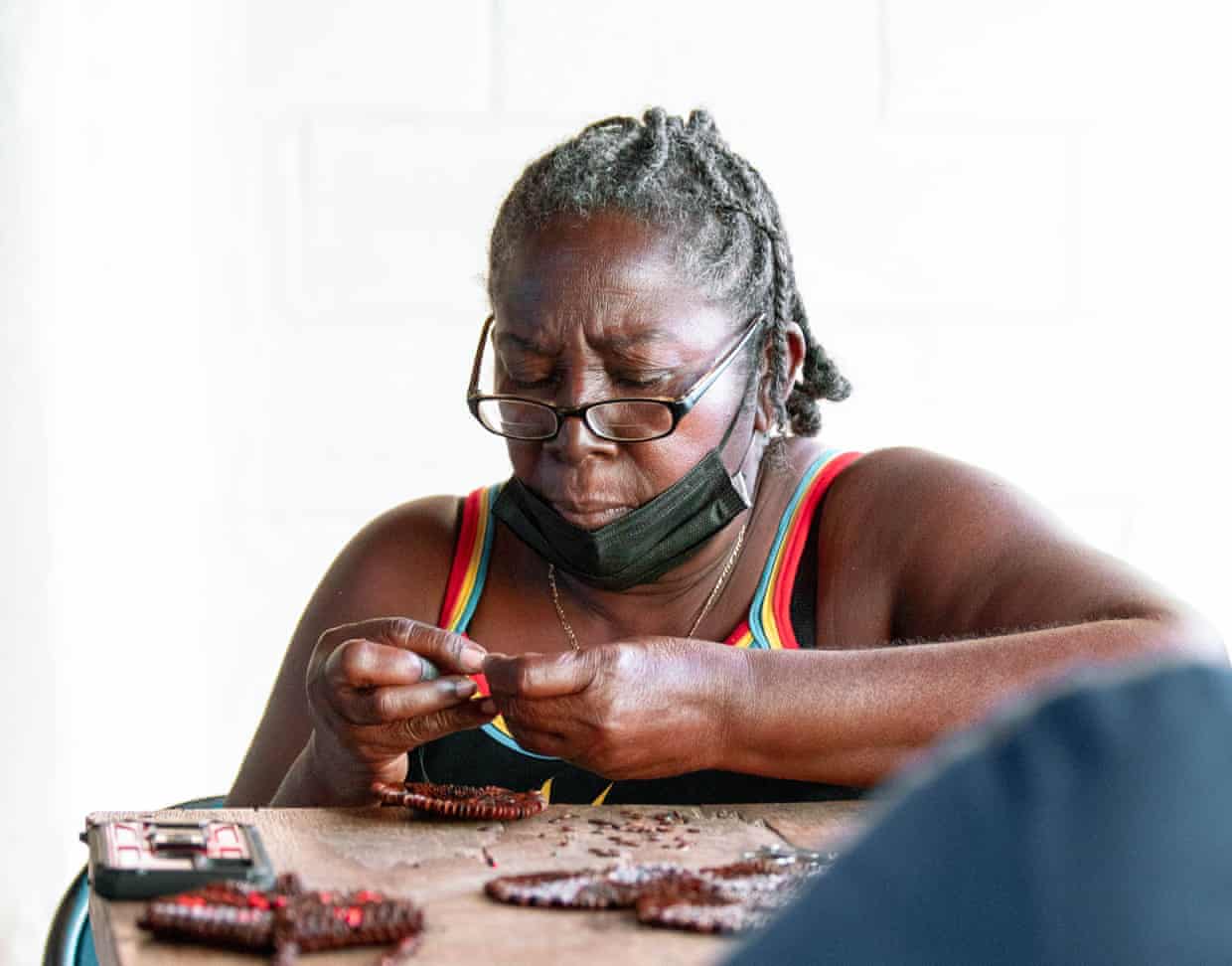
“Louise Edwards has been making jewelry from tamarind seeds for more than 50 years,” the Guardian reports.

Today’s story is bringing back memories. I’d completely forgotten that as a child I had a seed necklace like one of these. I have no idea where my mother got it. Maybe on my parents’ trip to St. Thomas. Did you ever see one?

Sarah Johnson writes at the Guardian, “For a little more than 50 years, Louise Edwards has been collecting tamarind seeds that grow wild on the Caribbean island of Antigua to create earrings, mats and belts.

“Edwards grew up surrounded by women stitching the seeds, but today she is one of only five remaining master artisans on the island, all in their 70s.

“ ‘It’s a dying art,’ she says. ‘We will soon give it up when we can’t see.’

“Practiced for centuries in the twin-island nation of Antigua and Barbuda, home to about 100,000 people, seed work began among enslaved African women forcibly brought to the islands and post emancipation it became a source of income. …

“Anne Jonas, secretary to the governor general of Antigua and Barbuda, with the help of Barbara Paca, the country’s cultural envoy, have applied for funding to expand free workshops to teach seed art.

“In 2017, Jonas founded Botaniqué Studios, dedicated to revitalizing the practice. ‘This is extremely transformative in terms of my appreciation for what we consider to be uniquely Antiguan and Barbudan heritage artisanship,’ says Jonas. …

“Seed work is laborious. Wild tamarind (Leucaena leucocephala) is one of the world’s 100 most invasive species; it grows everywhere, and collecting seeds causes no environmental damage.

“The seeds are boiled in sea water and kept moist, before being strung together by hand – Edwards has lost a number of fingernails during her career due to accidentally stabbing her finger with the needle. Once the seeds dry, they remain hard for decades.

“It takes Edwards an hour to make earrings, but more intricate pieces, such as placemats, can take a week. ‘The young ones don’t want to do it. They say it’s too much work and not enough money for the work they put into it,’ Edwards says.

“But the workshops are a start to renewing interest, says Jonas.

“Denise Walcott, 47, went to her first workshop in June with her 16-year-old daughter. ‘My daughter likes it, and I love it,’ she says. ‘The pieces are beautiful and the designs are so intricate. … This is an Antiguan culture and it should be a way of life for us. It is something that is empowering for us to use as an avenue to go along with our tourism industry.’ …

“As well as the Botaniqué website, Jonas showcases products on social media. Seed work featured as part of Antigua and Barbuda’s offering at the Venice Biennale, one of the world’s longest-running cultural festivals, and is on display at the Frank Walter exhibition at the Garden Museum in London.

“Michelle Donawa, another workshop attendee, learned seed art from her grandmother and is working on a book. ‘It’s something to preserve culture, as well as an educational tool,’ she says. …

“ ‘I think if young people see this, and how you can make something so beautiful that can [also bring in an income], they’d become very interested, especially if they are at home with nothing to do,’ says Walcott. ‘I really hope to see this being produced in Antigua on a larger scale, and exported.’ “

Folks, if you ever despair of humanity, think about how humans make art out of everything they see. More at the Guardian, here. No firewall.

And for a different kind of seed art, see my recent post on the Minnesota State Fair, here.

Photo: Thomas Barzilay Freund.
Botaniqué Studios
 Best of Both Worlds necklace. Style meets sustainability.

Music That Reduces Pain

Photo: Laura Chouette/Unsplash.
A study by McGill University in Montreal, Canada, asked participants to listen to different types of music and rate how it affected their pain levels.

The other day on the radio I heard a doctor talk about treating pain in the age of the opioid crisis. His ideas sounded risky and seemed based on a study of one — himself. Having been in recovery from opioid addiction for 15 years, he found he could handle a lot of opioids when he broke his leg. He didn’t get addicted again.

Can every recovering addict do that? Seems like there ought to be better ways. So far, opioids are the only thing that works for severe pain. Today’s story talks about a way to reduce suffering, but only a little.

Nicola Davis writes at the Guardian, “If you are heading to the dentist, you may want to turn up a rousing Adele ballad. Researchers say our preferred tunes can not only prove to be powerful painkillers, but that moving music may be particularly potent.

“Music has long been found to relieve pain, with recent research suggesting the effect may even occur in babies and other studies revealing that people’s preferred tunes could have a stronger painkilling effect than the relaxing music selected for them.

“Now, researchers say there is evidence that the emotional responses generated by the music also matter.

“ ‘We can approximate that favorite music reduced pain by about one point on a 10-point scale, which is at least as strong as an over-the-counter painkiller like Advil [ibuprofen] under the same conditions. Moving music may have an even stronger effect,’ said Darius Valevicius, the first author of the research from McGill University in Montreal, Canada.

Writing in the journal Frontiers in Pain Research, Valevicius and colleagues report how they asked 63 healthy participants to attend the Roy pain laboratory on the McGill campus, where researchers used a probe device to heat an area on their left arm – a sensation akin to a hot cup of coffee being held against the skin.

“While undergoing the process, the participants [listened] to two of their favorite tracks, relaxing music selected for them, scrambled music, or silence.

“As the music, sound or silence continued, the participants were asked to rate the intensity and unpleasantness of the pain. …

“When the auditory period ended, participants were asked to rate the music’s pleasantness, their emotional arousal, and the number of ‘chills’ they experienced – a phenomenon linked to sudden emotions or heightened attention, that can be felt as tingling, shivers or goosebumps.

“The results reveal participants rated the pain as less intense by about four points on a 100-point scale, and less unpleasant by about nine points, when listening to their favorite tracks compared with silence or scrambled sound. Relaxing music selected for them did not produce such an effect. …

“Further work revealed music that produced more chills was associated with lower pain intensity and pain unpleasantness, with lower scores for the latter also associated with music rated more pleasant.

“ ‘The difference in effect on pain intensity implies two mechanisms – chills may have a physiological sensory-gating effect, blocking ascending pain signals, while pleasantness may affect the emotional value of pain without affecting the sensation, so more at a cognitive-emotional level involving prefrontal brain areas,’ said Valevicius, although he cautioned more work is needed to test these ideas. …

“The researchers say it is not yet known if moving music would have a similar chill-creating effect in those who do not favor it, or if people who favor such music are simply more prone to musical chills.

“What’s more, they say the size of the study might mean some relationships cannot be detected, while the relaxing music may not have been played for long enough for an effect to have been seen.”

More at the Guardian, here. No paywall. Guardian readers voluntarily donate to support the news.
Art Behind Bars

Photo: Riley Robinson/Monitor Staff.
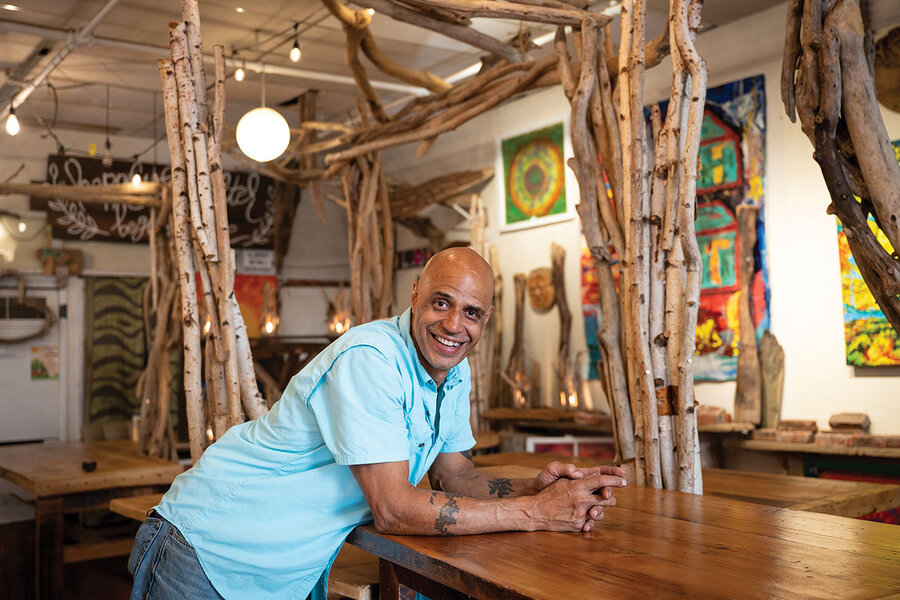
Artist Danny Killion poses in his gallery, Weathered Wood, in Troy, New York. He is one of many who have benefited from the Prison Arts Program.

Some folks have no sympathy for people in prison and would begrudge any type of cultural program that might help them. “If they wanted to do [art, music, a GED …], they shouldn’t have committed the crime.”

But many of us know that life circumstances and not always conscious decisions can accumulate until someone is in big trouble. I like the Norwegian approach to corrections, here, and the often small but meaningful work that is done in the US.

Troy Aidan Sambajon wrote about an example at the Christian Science Monitor.

On a long table, Jeffrey Greene prepares bundles of colored pencils for delivery to Connecticut state prisons. …

“Finished artwork lines the shelves of this airy warehouse, home to the permanent collection of the Prison Arts Program. Mr. Greene reaches up to a high shelf and retrieves a model RV, rendered in detail down to the windowsills. The shingles were cut from cardboard with a nail clipper and glued with a mixture of floor wax and nondairy creamer. Another artist unraveled a prison blanket and crocheted the threads into a 3D horse. …

“[Mr. Greene] has known his students for years, even decades. He can describe the medium they use and the metaphors their pieces convey, and has seen how the artistic process helps students deal with issues like depression, anxiety, and post-traumatic stress disorder.

‘Art unsettles habitual modes of thought and gives you the opportunity to think differently,’ says Robin Greeley, professor of art history at the University of Connecticut.

” ‘It can disrupt your whole routine and can create a sense of wonder.’

“The Prison Arts Program is one of the oldest correctional arts programs in the United States. It’s the longest-running program of Community Partners in Action, a criminal justice nonprofit based in Hartford. …

“Mr. Greene never intended to work in the prison system. After graduating from Hamilton College in New York, he volunteered to teach art workshops in prison on a whim. But he’s never forgotten the impression left by his first day on the job. 

“ ‘Everyone’s developing in this artificial, man-made, absurd, adversarial environment. It’s ridiculous,’ recalls Mr. Greene. …

“ ‘What drives Jeff really is the ability to show the humanity of the prison, of the people that are incarcerated,’ says Beth Hines, director of Community Partners in Action. ‘They know they can count on him when they get out.’

“In each prison he visits, Mr. Greene instructs his students to create art that only exists because they exist. He says it’s about more than finding a hobby while behind bars: ‘They are people that are coming out into the world with this incredible empathy and curiosity.’ Even if they never leave the prison system, he adds, that mindset can have a positive effect on others. …

“For years, Natasha Kinion felt like she’d been swallowed alive in prison. ‘I was guilt-ridden. I was shameful. I was really broken,’ she says in a phone interview. 

“A mother of four who has experienced domestic abuse and substance addiction, Ms. Kinion spent 13 years at York Correctional Institution in Connecticut. There she started making abstract art. 

“ ‘It took me at least the first six years of my incarceration to really open up and allow the healing process to start,’ says Ms. Kinion. …

“Mr. Greene helped Ms. Kinion send her artwork to her children. Her daughter Mayonashia Jones once received a drawing of a butterfly trying to fly with broken wings. She remembers thinking of her mom and wondering, ‘Has she always felt like that?’ …

“Since her release in 2019, Ms. Kinion has published a book about her journey, titled Stand Up You’ve Been Down for Too Long, and has opened her own digital art company, Dezigning Deztiny. 

“ ‘I never told him this … but Jeff is really my hero,’ says Ms. Kinion.

“Danny Killion had little interest in art when he was robbing banks in Connecticut. Then he was caught and sentenced to 12 years in prison. ‘Prison can be a very cold, hard environment,’ says Mr. Killion. …

“He spent 10 years in the Prison Arts Program, learning to concentrate on the artistic process and find solace in a concrete cell. 

“ ‘I’ve never met anyone who’s a more profound teacher,’ says Mr. Killion, who finished his sentence in 2007. As he found his feet in society, Mr. Greene would drop by, offering art materials and a listening ear.

“After working in construction, Mr. Killion began creating furniture using driftwood from the Hudson River. In 2013, he opened his own art studio and gallery, Weathered Wood, in Troy, New York. He traces his transformation back to those first classes with Mr. Greene. …

“This year, Mr. Killion unveiled his first public commission, a sculpture of twisted scrap metal depicting a man breaking through chains, installed at Old New-Gate Prison, a historical site in East Granby, Connecticut. Mr. Greene was there too, both men now standing outside prison gates.”

More at the Monitor, here.

Finding Black Santa

Photo: SantasJustLikeMe.

Last season, Elizabeth Chang and Lateshia Beachum had a story at the Washington Post about finding a Santa of your child’s ethnicity. I’ve been saving it up.

“Shortly after noon on a winter Friday, a group of families line up to see one of the Washington, D.C. area’s most sought-after celebrities, a superstar they tracked to the center court of a suburban Maryland shopping mall.

“That luminary, enthroned on a bright-green couch and surrounded by giant red-and-gold packages, is Black Santa.

“This particular Black Santa — at the Mall at Prince George’s, in the majority-Black county of the same name — was ‘the only one I could find,’ said Erin Heard. She traveled there from neighboring D.C. with her husband, Correll Heard, and their 3-year-old son, Micah, who turned out to be a bit trepidatious of the jolly old elf.

“Correll said that when he was young, Santa was ‘just an old White guy with a beard. I don’t think I really thought about it.’ But after you become a parent, he said, ‘you want to see your child see someone who looks like him doing the same things other people do.’

“Although the D.C. metropolitan region is very diverse, with Caucasians making up less than half the population, there is a serious dearth of non-White St. Nicks. Victoria Clark, marketing director for the mall, said that Black Santa has been a staple there for decades, attracting a lot of returning families. ‘It’s a big draw to have an African American Santa,’ she said.

“Kiaira Reeves was there with her almost-1-year-old son, Kalani. ‘Representation is very important to me,’ she said. ‘We even went to Target and got wrapping paper with Black Santa.’ …

“Research into diversity in media suggests that minority children who see Santas who look like them can feel increased self-confidence and self-esteem, said Nekeshia Hammond, a psychologist in Brandon, Fla., while White children benefit by experiencing cultural diversity.  ‘Representation does positively affect children,’ she said.

“But there is a long way to go until Black Santas are easy to find. Parents seek Black Santas through online groups, their network of friends, TikTok videos from parents who have found one. …

“Edwina Walker thought living in predominantly Black Prince George’s County meant it would be easy to give her grandson the same experience she had as a child, when her own grandmother took her to meet a Black Santa in a mall in New Jersey. … But when Walker started to look for a Black Santa near her Oxon Hill home, she came up short. Eventually, she consulted a national Facebook group for people trying to find a Black Santa and drove nearly an hour to Columbia, Md., for the photo. …

“Houston and other areas of Texas have Pancho Claus. The Wing Luke Museum in Seattle’s Chinatown-International District offers a visit from an Asian Santa. The Disney theme parks introduced Black Santas last year, to acclaim.

“The Mall of America near Minneapolis — the largest mall in the country — is perhaps leading the charge. This year, The Santa Experience there has had its most diverse lineup ever with six Santas: two Black, one Asian who speaks Cantonese and three White, one of whom speaks Spanish.

“ ‘It just makes sense,’ said Lando Luther, who owns the two Santa Experience locations at the mall. ‘There are so many different cultures that celebrate Christmas. And we believe that representation matters, and for a child to see themselves in such a positive figure is important.’ ”

More at the Post, here.

Cross-Border Orchestra

Photo: Cross Border Orchestra of Ireland.
The peace proms involves 6,000 children from schools all over the island, from diverse backgrounds and abilities.

Today’s story is not necessarily a holiday topic unless peace is a holiday topic. … Well, there’s that.

Niall McCracken wrote at the BBC about one longstanding Irish peace initiative.

“The passion of 15-year-old Cara is written all over her face as she takes her handmade violin from its case. She is one of the youngest musicians in the Cross Border Orchestra of Ireland.

“I’m in Dundalk, County Louth, in the Republic of Ireland,” McCracken continues, “to watch her and more than 100 other young musicians rehearse ahead of a series of concerts. Cara, from County Down, plays in the strings section of the orchestra that emerged out of the Northern Ireland peace process.

“It was set up in 1995, a year after republican and loyalist paramilitaries announced ceasefires. This followed more than a quarter of a century of violence in Northern Ireland.

“The key aim was to use music to connect young people from Catholic and Protestant backgrounds on both sides of the Irish border. Almost 30 years on, this remains the central goal of the 140-member orchestra.

“Cara attends a Catholic girls’ grammar school in Ballynahinch and has always loved music.

” ‘I started playing violin and piano when I was young. You have to practise a lot but it’s taught me so much about perseverance,’ she said. … ‘There are still aspects of life in Northern Ireland that can make it difficult to meet people from different backgrounds. … Going to the orchestra has been great because I’ve made friends from all sides of the community, all over the country.’

“The orchestra has also ignited Cara’s love for different types of music. ‘I just wouldn’t have listened to things like Ulster-Scots music, simply because I just wouldn’t have been exposed to it because it wasn’t played where I live. But I love the pipes they use and getting to become immersed in that Ulster-Scots music and culture has given me a whole new perspective.’

“The orchestra combines Ulster-Scots culture, including bagpipes and Lambeg drums, with Irish traditional instruments such as uilleann pipes, the harp, the fiddle and bodhrán (drum). They also have their own take on some of the biggest pop, rock and dance songs in the charts.

“A diverse range of music has been key to the project’s success, according to the orchestra’s founder Sharon Treacy-Dunne.

“She is originally from Hackballscross, a rural village in County Louth in the Republic of Ireland, a few miles south of the border with Northern Ireland.

” ‘Growing up in the 1970s and 80s, and as a young teacher in Dundalk in the early to mid-90s, before the ceasefire and the Good Friday peace agreement, I remember being really worried about what I was seeing,’ she said. … ‘Then in 1994 when we reached this momentous ceasefire, as a teacher I thought I needed to be some sort of role model. The only thing I knew was music.’

“Sharon began writing to schools on both sides of the Irish border about taking part in the orchestra. She said: ‘To be honest it took a while to bring some of the Protestant schools on board, but music was the answer. Once we made it clear that we were also using music that was important to them with instruments such as pipes and Lambeg drums, that was a huge turning point.’ …

“Being part of the orchestra also means young people like Cara had the chance to perform at New York’s famous Carnegie Hall on St Patrick’s Day earlier [in 2022].

” ‘It was unbelievable, I could never have imagined having an opportunity like that, but music just opens up so many doors,’ she said.

“The New York concert was part of a series of events to mark the 25th anniversary of the 1998 Good Friday Agreement. The deal brought an end to 30 years of conflict in Northern Ireland, known as the Troubles.”

More at the BBC, here. No paywall. Upcoming events orchestra here.
Local Mermaid Instructor

Photo: Brett Stanley.
The Ocean State’s Jesse Jewels as a mermaid.

Some readers may remember reading in a 2021 post (here) that the US has not one but two mermaid museums! Through that article, I myself learned that spending your free time as a mermaid or merman is a real thing. And quite an industry for waterproof-costume makers.

Today we hear from Emily Olson at ecoRI News, that there’s a mermaid in Rhode Island who’s a serious activist for the ocean.

“When she was young, Jessie Jewels imagined herself a mermaid, moving effortlessly beneath the waves, hair billowing in the current as she played with her ocean friends. But too soon she outgrew her imaginary mermaid tail and contented herself — at least for a while — with exploring the sea on two legs. …

“Jewels is a free diver certified by the National Association of Underwater Instructors, a SCUBA diver, a kayaker, and a Save The Bay beach captain, a role that tasks her with organizing beach cleanups. And in 2021, she revisited the ocean of her childhood imagination when the siren song of mermaiding reached her ears.

“ ‘I found out there’s a culture of mermaids and mermen and mertheys who approach mermaiding as a hobby and athletic sport, and it called to me,’ said Jewel, who willingly succumbed to temptation and donned — or grew, as she’d say — a tail of her own.

“She slowly became more immersed in the culture and decided to test her skills by entering the Miss Mermaid USA pageant, which is similar to Miss USA, but with a twist. ‘You wear the dresses and do all the glam and answer all the questions, but we also do underwater modeling and swimming to show our grace, poise, and distance abilities,’ she said.

“Breath holding is also part of the competition and Jewel can hold hers for 2 minutes, which may sound like a lot to a landlubber, but is a mere fraction of what some professional aquarium mermaids can do.

“Jewels won the Miss Mermaid USA state competition in 2021, 2022, and 2023. She uses her platform to advocate for the importance of clean waterways and draw attention to her work with Save The Bay.

“ ‘I am constantly on Narragansett Bay, and I have seen how things have changed,’ she said. ‘There is a lot of debris floating on the surface, and underwater, there’s a big problem with algae and bacteria, exacerbated by overfishing. I’m in that water, so I see the problems. We’re losing our wild places.’

“She also believes in keeping Rhode Island waters accessible, a value she shares with Save The Bay. …

“When Mermaid Jessie Jewels appears at children’s birthday parties, she encourages them to be stewards of the sea and protect aquatic life. She’s also a mixed-media artist, and a portion of every piece of mermaid-related art she sells goes to Save The Bay. …

“For those who want to join the merfolk community, Jewels hosts mermaid makeovers and photo shoots at her art studio, but she recommends that anyone who wants to learn to swim like a mermaid take a swimming class with a focus on safety. And she stresses the importance of always having a swim buddy.

“And Jewels is really strong, partly due to her months of training last year that led her to the merlympics — an athletic competition for mermaids. The competition requires athletes to don their tails and swim lengths in a pool and navigate an underwater obstacle course. … ‘It was a very, very challenging competition, but super fun,’ she said.

“To learn about Jessie Jewels’ classes and entertainment, visit jessiejewelsart.com. To join her at a Save The Bay beach cleanup, visit savethebay.org.”

More at ecoRI News, here. No paywall.

Toys for Migrant Tots

Photo: Natacha Larnaud for CBS News.
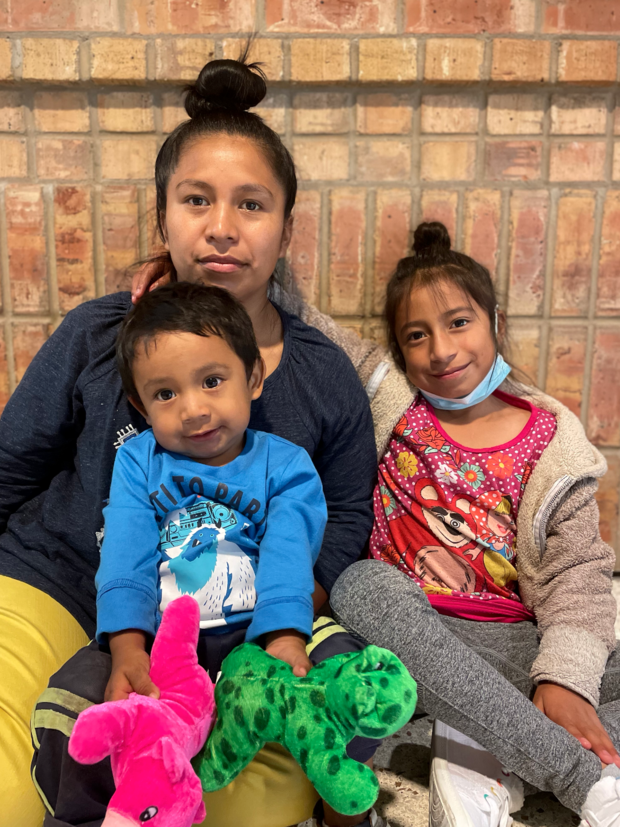
From CBS News: “Jacqueline and her two kids sit at a bus station in Brownsville, Texas, hours after being released from Border Patrol custody on April 30, 2021.”

This is the season of the couple who had no place to rest — and the baby who whose gifts were gold, frankincense, and myrrh. Will all the newly displaced children of 2023 have any gifts?

Theresa Vargas wrote at the Washington Post last year about a program for migrant children that made some little travelers very happy.

“The young boy in the red and black jacket didn’t need to look through the toys sitting on the blanket in front of him. As other children walked past stuffed animals, puzzles and building blocks, looking for items that called to them, he made his way straight to a dump truck almost half his size. If you had peeked in on that moment, which took place outside a Virginia church, you would have seen that boy holding the truck tightly. …

“Days before the volunteer collective Food Justice DMV planned to hold the giveaway event on Dec. 17, founder Denise Woods sent out an SOS, letting supporters know that volunteers didn’t have enough food or toys this year to give to the migrant families they serve in the Washington region. What makes the group’s toy collection different from the many others that take place at this time of year is volunteers gather secondhand items and get them to families who might fall beyond the reach of other organized efforts, because of language barriers and deportation fears.

“ ‘It pains me that people who have lost all coming here, may not celebrate Navidad the way they deserve and the way we want: a warm plate of food from home: beans, rice oil and maseca and a side of gifts,’ Woods wrote in an email at the time. …

“People in D.C., Maryland and Virginia started looking through their homes and gathering the toys their children and grandchildren no longer used. They then drove them to one of several places that were collecting items on behalf of Food Justice DMV.

“They brought puzzles and board games and art kits. They brought a toy stove, a toy shopping cart and a bike. They brought small stuffed animals and medium stuffed animals and jumbo stuffed animals. …

“Thousands of people throughout the Washington region responded. All it took was learning that children around them might go without to decide they wouldn’t let that happen. …

“By the time the giveaway event arrived, volunteers were carting truckloads of items to a church in Falls Church. There, migrant families found them spread across blankets and tables. Children who might not have received anything for Christmas left with their arms full and their parents left carrying bags of items. …

“[One teen] said her mom is from Guatemala and works hard at her cleaning job to pay the rent and keep the family fed, but that doesn’t leave much money for her to buy presents during the holidays. That day at the church, the teenager said, her mom and the whole family left smiling.

“ ‘We were so thankful,’ she said. ‘I just want to thank everyone so much.’ …

“ ‘For so long I think we felt, not accurately, that no one really cared, because we were existing on fumes and praying we would make our food costs,’ Woods said. ‘Now we know people do care and care deeply.’ …

“The strangers who came together to help the families recognized the system is broken, not people, she said.”

More at the Post, here.

Photo: Antonio Olmos/The Guardian.
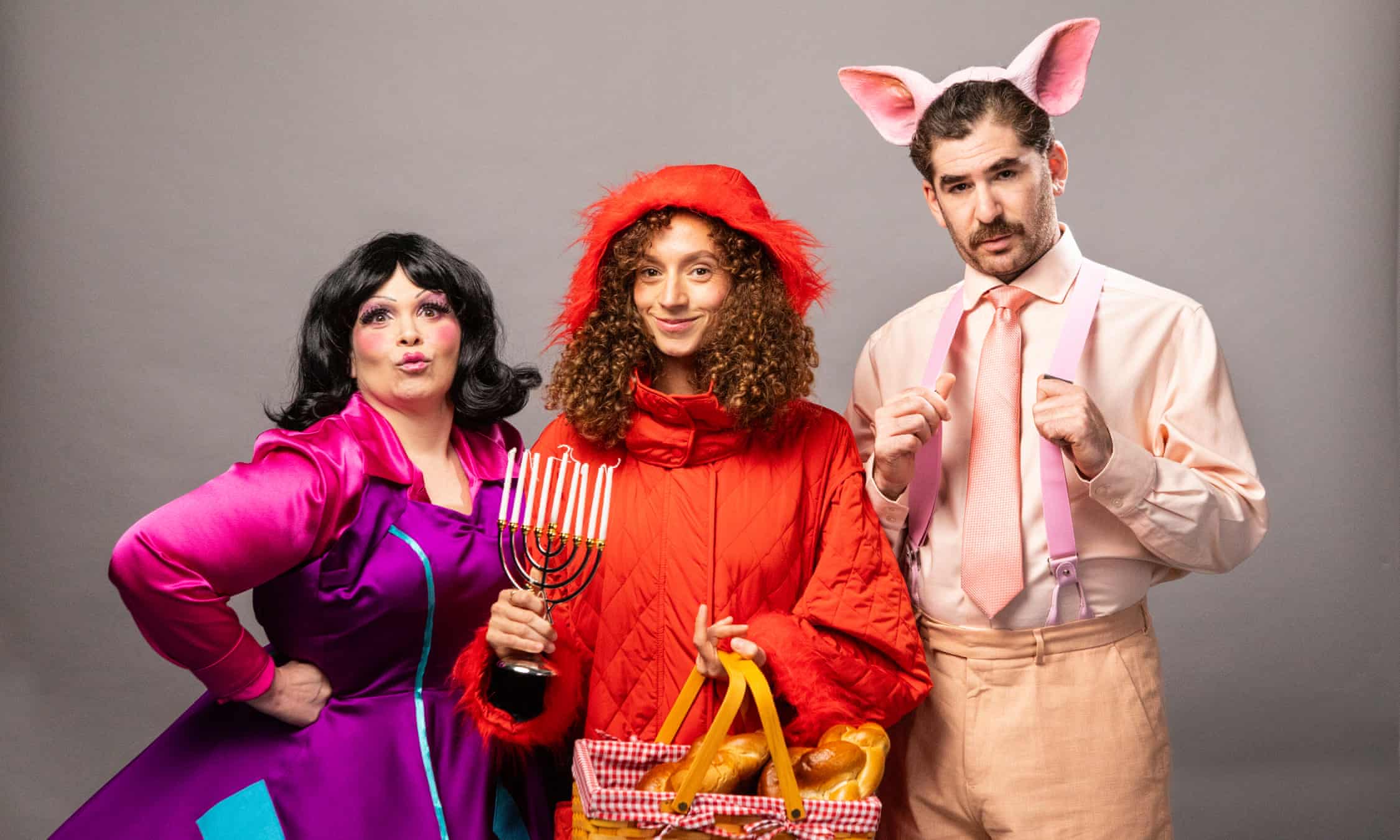
Debbie Chazen, Gemma Barnett and Josh Glanc, the stars of JW3’s holiday pantomime in London.

There’s a kind of Christmas entertainment in England (English friends: correct me if I am describing this wrong) called a pantomime, or panto. I have read about it but never seen it. It’s kind of like the old, slapstick Punch and Judy show, but without puppets.

This year, a comedy troupe in London is doing a takeoff of Christmas panto in a Jewish storytelling style.

Deborah Linton writes at the Guardian, “What else would you call ‘Britain’s first professional Jewish pantomime’ but Red Riding Hood and the Big Bad Pig? And where else would you set it but north London, at Hanukah? At the JW3 centre in London – an arts and community venue. …

“The cast of the first professional stage production to merge two great traditions in Jewish storytelling and festive panto are gathered around a table sharing their experiences of both. And the crossover, it transpires, is richer and more obvious than one might first imagine.

“Comedy, community, a fairytale quest and a flawed hero are ‘at the heart of every panto,’ says the show’s writer, Nick Cassenbaum. ‘But I think it comes from … the Talmudtoo.’ …

“So, too, the panto dame, he says – in this instance Mother Hoodman, Red’s eccentric mum who appears on stage heavily made up, wigged and wearing a voluminous dress modeled on a Hanukah dreidel singing You Spin Me Round – has a natural home in both traditions. ‘A panto dame is warm, loving and says the wrong thing. It’s a Jewish mother,’ says Cassenbaum. …

“Audiences will be immersed in a production that combines Jewish humour and music (imagine new lyrics to Jewish artists including Amy Winehouse, Doja Cat, Paul Simon and Craig David) with traditional panto magic – lots of slapstick comedy, a scene where the leads get lost in the woods, and cartoonish baddies – as it transposes the millennia-old Hanukah miracle into a fairytale fit for 2023.

“Cassenbaum’s premise is that Red, a hard-working young scientist pushing against the plans her mum – the dame – has for her to marry a Jewish doctor, sets out on a quest to find enough sustainable energy to power her village through Hanukah. … The wolf, the main antagonist in the storybook version, is replaced here by a hyper-capitalist pig, the best known non-kosher animal of the lot. Although, Cassenbaum explains, ‘in my mind, all the characters are Jewish, even the pig, who as a city boy who made a lot of money under Thatcher, maybe isn’t so open about his Jewishness.’

“Cassenbaum, a former street performer … was interested ‘in how we could hold both things – something that was really British, all the panto techniques, but something that also felt unashamedly Jewish. With panto, you have to pick from the canon of fairytales. Red Riding Hood is such a short story, you’re not so set with the script. I wanted to make something that can hold Jewish traditions, dense Jewish jokes and reflect certain Jewish archetypes, so you’ll see the ex-black-cab driver and a wolf who is a neurotic mess.’ …

“It mirrors the generational Jewish experience – and the immigrant humor that accompanies it. ‘Humor is our biggest cultural export. It’s truth humor,’ says Josh Glanc, an award-winning Australian comedian who plays the pig. …

” ‘In British popular theatre, Jews were there from the [beginning] – Bud Flanagan (who sang the theme tune to Dad’s Army), writers Barry Cryer and Marty Feldman – but they weren’t “out.” Then, with more modern comedians, like Matt Lucas and Sacha Baron Cohen, the Jewishness is secondary to the joke. Through it all, there’s something about using community and humor as a way of fitting in and being part of things, a means of assimilation.’

“Gemma Barnett, who plays Red, agrees. ‘It’s intense self-awareness,’ she says. … ‘Red’s constantly trying to work out if she believes what her mum believes. I love the character.’ …

“East London-born musical director Josh Middleton, a world-leading klezmer (eastern and central European Jewish folk) musician, has given Streisand and other Jewish artists a klezmer flavor, via accordion and violin live on stage, as well as a lyrical rewrite and song sheet, in pure panto style. …

“ ‘Let’s take the premise of rewriting pop songs, because that’s what people expect at panto, but let’s do people of Jewish descent. … I want them to recognize the songs and enjoy that familiarity, and I want them to feel they’re at a Jewish panto,’ says Middleton.”

More at the Guardian, here. No paywall, but they do rely on donations.

Photo: Elaine Velie.
The New York Botanical Garden’s annual Holiday Train Show features nearly 200 miniature landmarks, all made of natural materials. This miniature is the Guggenheim Museum.

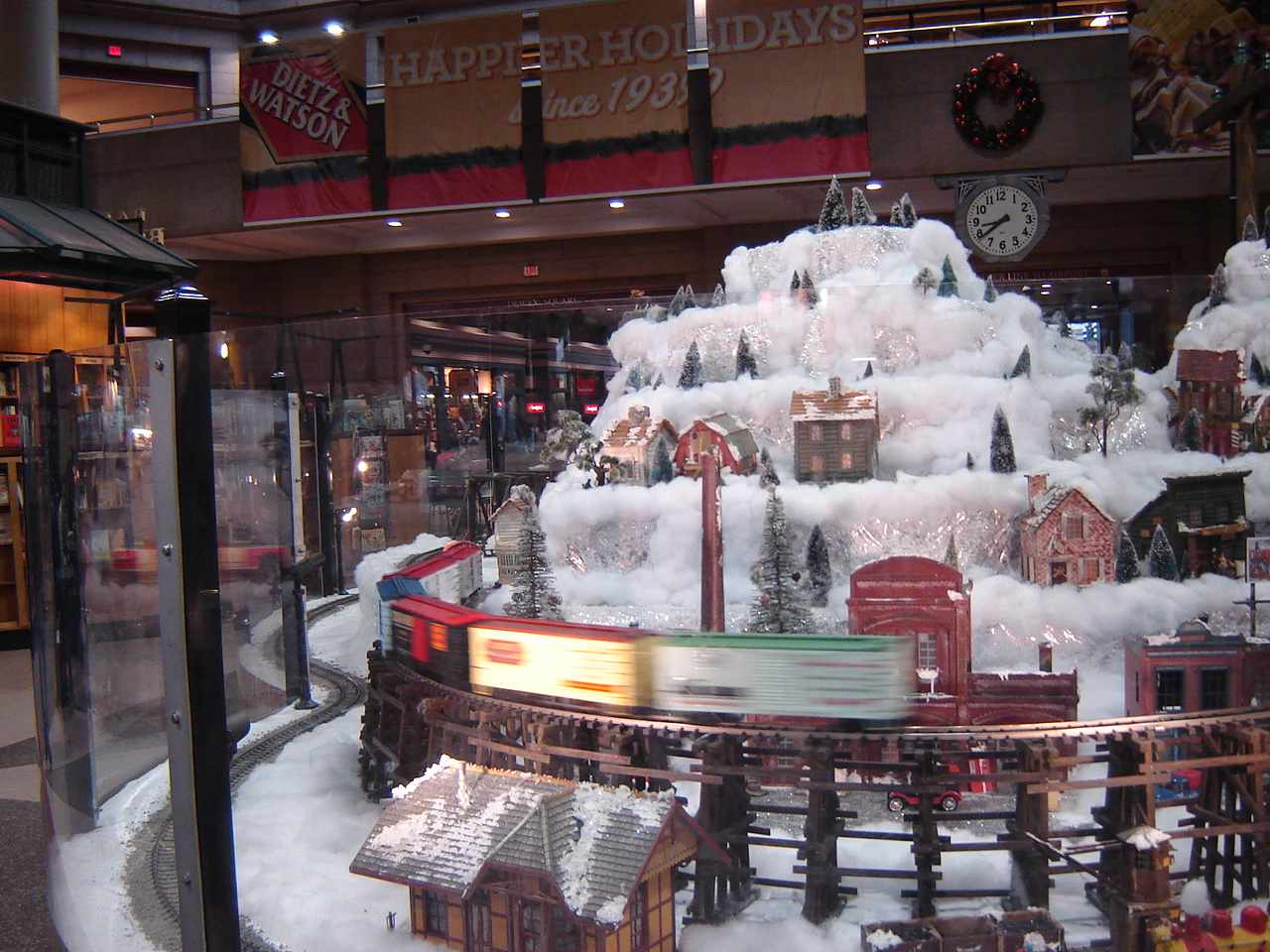
Probably because gifts of toy trains have long been associated with Christmas, model train displays are big at the holiday season. When I was working at the Fed, I loved the seasonal layouts at nearby South Station. (See below.)

Now Elaine Velie is reporting at the art newspaper Hyperallergic about a particulticularly artistic setup in New York.

“Inside the New York Botanical Garden’s (NYBG) Enid A. Haupt Conservatory, a miniature Guggenheim Museum sports a mushroom-cap roof, the Statue of Liberty is made of palm fronds, and the Brooklyn Bridge is supported by a dizzyingly intricate arrangement of tiny twigs. The scaled-down landmarks are just a few of the nearly 200 NYC buildings constructed using natural materials at NYBG’s annual Holiday Train Show, where around 20 doll-size conductors barrel and weave over a half-mile of track.

“The show begins outdoors, where trains circle jagged mountains and zoom above giant snowdrop flowers and rabbits in a fairytale-style enchanted forest, carting pinecones, bark, and acorn tops.

Photo: New York Botanical Garden.

“Laura Busse Dolan runs the Applied Imagination company that creates the structures in the exhibition. Dolan’s father, Paul Busse, founded Applied Imagination in 1991, and a year later, the botanical models maker displayed 15 buildings in NYBG’s first Holiday Train Show. Each year, a team of 15 artists adds new work to the show, and NYBG changes the exhibition’s layout and plantings. …

“This year’s train show is the biggest to date and stars Coney Island’s long-gone giant elephant, Manhattan’s demolished old Penn Station, Hudson Valley mansions, a miniature Central Park, and a host of museums including the Metropolitan Museum of Art, the Frick, and the Guggenheim, among other structures.

“ ‘I think Frank Lloyd Wright would very much approve of this,’ Dolan said of the mini-Guggenheim made of ‘cobbled together’ pieces of shell fungus. Another standout is a copy of NYBG’s Mertz Library. It’s decorated with black walnuts that an NYBG staff member collected. …

“The grand finale can be found in the conservatory pond room. City landmarks like the Statue of Liberty, the Empire State Building, the Staten Island Ferry, the Plaza Hotel, and even the Oculus float on the stagnant water and line the stone fountain. …

“ ‘We’re in awe of the beauty,’ [visitor Mary] Trester said. ‘And the craft of the artists — the attention to detail and everything they do.’

“The Holiday Train Show is open through January 15, 2024.”

Extraordinary pictures at Hyperallergic, here. No firewall.

Photo: Suzanne’s Mom.
Model train at South Station Boston.

Lamb Mowers

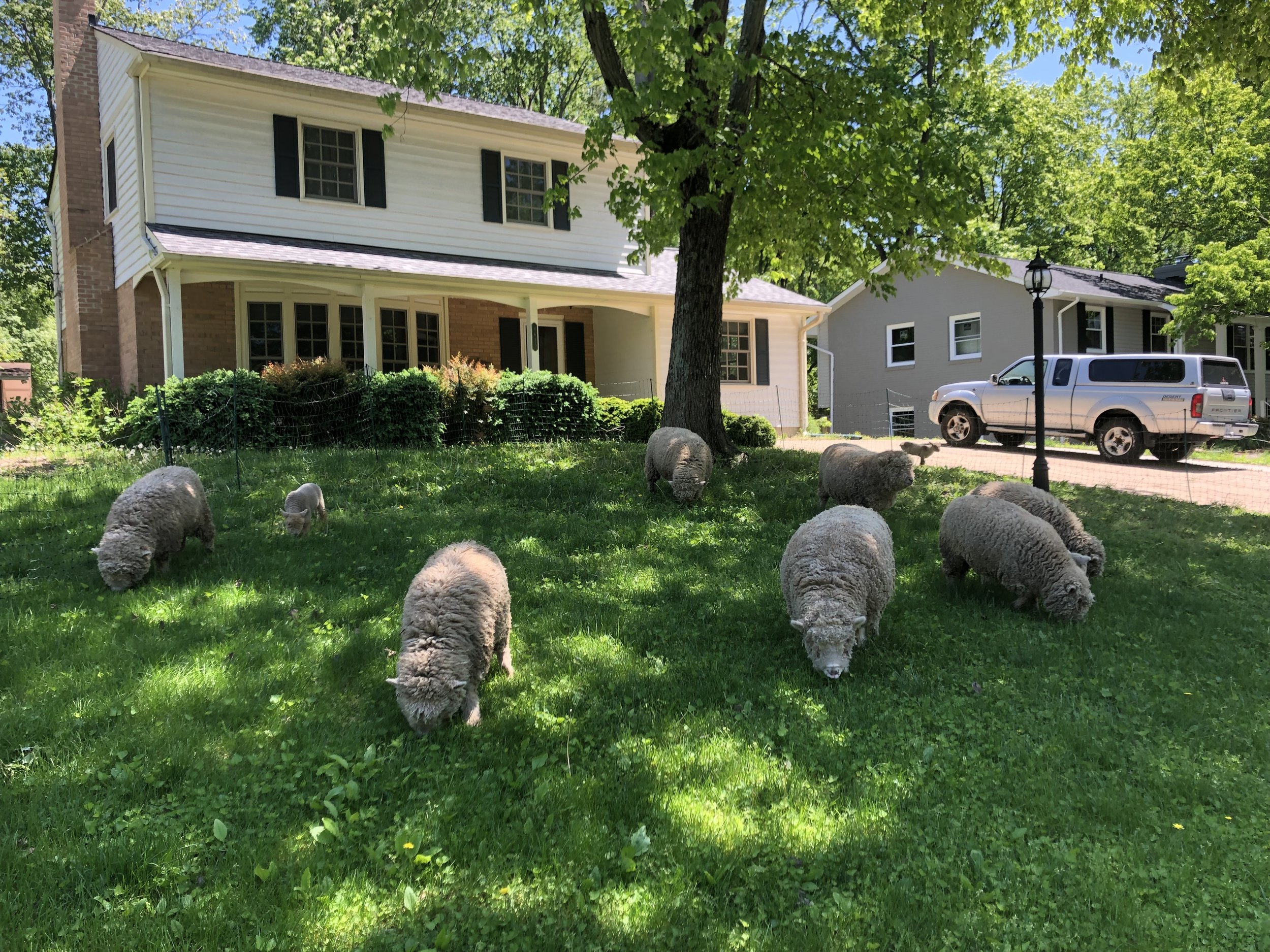
Photo: Lambmowers.com.

When I was in New York during my sister’s illness, I walked around a lot and saw some wonderful sights. One was a small churchyard where rented sheep from out of state were doing the maintenance work.

The idea is catching on.

Michael J. Coren writes at the Washington Post, “Every summer, before heading to the beach, we’d have to ensure [my friend’s] grass was cut. We’d push a roaring lawn mower under the scorching Florida sun. The carpet of scratchy St. Augustine grass seemed to grow faster than we could mow it.

“If only I had known about the amazing grazing solution pioneered millennia ago. ‘Lawn mowers’ were once synonymous with hoofed livestock — goats, sheep, horses and other herbivores — that foraged grasses, seedlings and what are now called weeds. By constantly mowing and fertilizing, they created open pastures and lawns.

“A variety of storied lawns have relied on grazing to keep up appearances. Starting in 1863, sheep were a common sight in New York’s Central Park — the ‘Sheep Meadow‘ was not a metaphor. Flocks could be found munching on public parks in London, Boston and Chicago. In 1914, more than 100 sheep were invited to the nation’s capital to graze near the Lincoln Memorial, and later the White House grounds. Then they promptly disappeared as machines assumed their role.

“After a long hiatus, animals are returning. Europe, ravaged by wildfires, is now paying for fire flocks, herds of sheep to thin vegetation and reduce wildfire risk, resurrecting the silvopastoralism of the past. Sheep are appearing in solar farms, vineyards, cemeteries, golf courses and even atop green roofs. California is enlisting goats as firefighters across the state, while the University of California at Davis relies on sheep to keep its campus in good health.

“Suburbia is the next frontier. Lamb Mowers, billed as the country’s only sheep-led lawn care service, is munching its way to success. The small business in Northern Virginia employs more than a dozen sheep to mow, weed and fertilize suburban lawns across the region. The modest animals are changing hearts and minds, and perhaps pointing Americans toward a different relationship with their grass.

“If grass were a crop, it would be the largest in the United States. Turf grass covers an estimated 1.9 percent of the continental United States, according to a 2005 NASA analysis of satellite images, including residential and commercial lawns, golf courses and similar landscapes. Together, these would represent the largest irrigated crop in the United States, three times bigger than corn.

“This comes at a steep cost— not least to wildlife displaced by sod. The average homeowner spends about 70 hours a year on lawn and garden care, according to the U.S. Bureau of Labor Statistics’ American Time Use Survey. Maintenance costs are hundreds of dollars per year, according to estimates by the University of Nebraska-Lincoln’s extension service.

“But Cory Suter, the self-described ‘Chief Shepherd’ of Lamb Mowers, discovered another way on his permaculture farm in Northern Virginia. Since 2016, rather than pull out heavy equipment, Suter released his flock of babydoll Southdown sheep to graze on nuisance plants such as poison ivy and multiflora rose. It worked. And he realized a market probably existed in the surrounding suburbs.

“So he bought a trailer, loaded up about 15 sheep, and opened for business. People were soon booking regular two-hour, $195 visits for ‘weed and feed’: The sheep clip the grass tops and munch weeds, while leaving sheep pellets that dissolve into rich fertilizer in the first rain or watering.For bigger jobs, Lamb Mowers offered a 24-hour Sheep-over’ for $250, a price he says is competitive with comparable fossil-fuel-powered lawn services.

“Sheep are lawn care experts. They are more gentle grazers than goats or horses, clipping grass tops and nibbling weeds homeowners would like removed. They leave about four inches of the blade: just the right height, says Michigan State University Extension, to maximize root growth and shade out weeds. Any lower, as some lawn companies mow, and the grass will grow even faster to reach the sun, necessitating more mowing.

“ ‘Sheep love the sweet tips of grass, and biodiverse diets like the weeds in your yard’ including bittercress, chickweed and onion grass, says Suter, who grew up farming on a Mennonite homestead in the Shenandoah Valley of Virginia. ‘That’s a perfect buffet for our sheep.’ ” More at the Post, here.

Is now the time I remind readers that lawns are generally bad for the environment and that we need lawn weeds for pollinators if we want them to make our food possible? Oh, well, sometimes we do need lawns. For kids to play on, say. Definitely better than plastic astroturf.

Modern Menorahs

Photo: Janie Korn.
“Challah Menorah” by Janie Korn. 

Today is the first day of Hanukkah, and I can finally share the Hyperallergic article I’ve been saving on the creativity that goes into making menorahs.

Sarah Rose Sharp writes, “The central activity of the eight-night holiday is the lighting of candles, which symbolizes the restoration of the Temple of Jerusalem in 164 BCE, reclaimed from Seleucid takeover in 175 BCE. After Judah the Maccabee led a rebel force to win back the Temple, only enough lamp oil remained to last for a single night. But legend has it that the lamps burned for eight nights, and because of this, celebrants light an escalating series of eight candles held by a menorah.

“As a fixture of even largely non-practicing Jewish households, menorahs come in all styles, from traditional to modern, simple to maximalist. Their aesthetics and symbolism are a vast subject, but in honor of Hanukkah year 5783 (by the Hebrew calendar), let’s take a look at some great menorahs that break the mold!

“New York’s very own Jewish Museum has a vast collection of Hanukkah lamps — the largest in the world, with more than 1,000 pieces — like a whimsical deconstructed menorah by Peter Shire. Senior Curator Claudia Nahson explained how artists like Shire, working in the 1980s, began to upend the centuries-old menorah design. …

“ ‘Peter Shire typically takes familiar objects and reimagines their shapes, colors, and materials so that we barely recognize them,’ Nahson told Hyperallergic. ‘In his inventive Hanukkah lamp, a mixture of pastel and hot colors, industrial metals, and a cantilevered, swirling arrangement of parts challenge the modernist aesthetic of simplicity that had dominated design for a century.’ …

“While most menorahs rigidly indicate where to place the nightly candles, the ‘Emerald Ripple Menorah’ by the local industrial design studio Friends Of takes a more organic approach, enabling the user to arrange the candles in circles that radiate out from the center point, occupied by the shamash that is used to light the other candles. …

“Why not celebrate Hanukkah with a candle-lit shoutout to everyone’s favorite egg bread? This incredible menorah [above] was created by visual artist and curator Janie Korn, and is sure to make any carb-lover light up.

“Since holidays of all kinds are an opportunity to gather with your community and engage in the roots that connect us to something bigger, menorahs of mushroom clusters by ceramic artist Ben Noam perfectly encapsulate the spirit of the season. Noam’s series, which he began for his own family to celebrate the holiday, reimagines the age-old rites of Hanukkah in a fun and colorful piece that can displayed year-round.

“ ‘[I] drew on the California Clay Movement to create a psychedelic fantasy rooted in Jewish stories,’ Noam told Hyperallergic. ‘The mushrooms form architectural villages — like a shtetl — inspired by the bright colors of Chagall, Jewish modernism, and the forest mushrooms that emerge with the changing of the seasons.’ …

“Holidays are also a great time to reflect on where you’ve been and where you’re going. In 2021, the Jewish Museum Berlin expanded their collection to include their first-ever modern menorah, a stunning 1924 work by the German-born sculptor Ludwig Yehuda Wolpert that evokes Art Deco sensitivities. Hetty Berg, the museum’s director, explained that the acquisition was in line with the institution’s focus on Jewish ceremonial objects by German artists from the late 19th and early 20th century.

“ ‘We want to document the stylistic change that took place during this era,’ Berg said. ‘Only a very small number of Jewish ceremonial objects made by artists in Germany during the 1920s still exist today. Wolpert’s Hanukkah menorah is a prime example of this decisive period and Modernism’s creative awakening, and it fills a gap in the museum’s collection.’

“And this is hardly the only 20th century artist moved by the imagery of menorahs. Though the Surrealist painter Salvador Dalí was not Jewish, he produced several sculptures inspired by the branches of the olive tree that grows in Jerusalem. (The olive tree is also an important symbol of Palestinian resistance.) Dalí’s 1981 ‘Peace Menorah’ has organic lines and subtle details, including a face and a star of David etched into its stem.

“When it comes to fine art menorahs, there are clearly many directions one can turn, but obviously the most avant-garde is not part of any museum collection, but available online at BananaMenorah.com. … Very much in the spirit of Hanukkah, Banana Menorah is an institution born out of scrappy necessity. According to their website, Samantha Weisman was visiting her goyish boyfriend, Zach Lupei, over college winter break and needed to improvise a menorah to celebrate Hanukkah.

“ ‘That first menorah was created from an underripe banana, a chopstick, and some creative thinking,’ according to Weisman and Lupei. They’ve celebrated with banana menorahs ever since, and finally decided to quit wasting bananas and make things official in stainless steel.”

More great menorah photos at Hyperallergic, here. No firewall. And check out the wild array of menorahs at the Jewish Museum in New York, here.

Photo: Sophie Hills/The Christian Science Monitor.
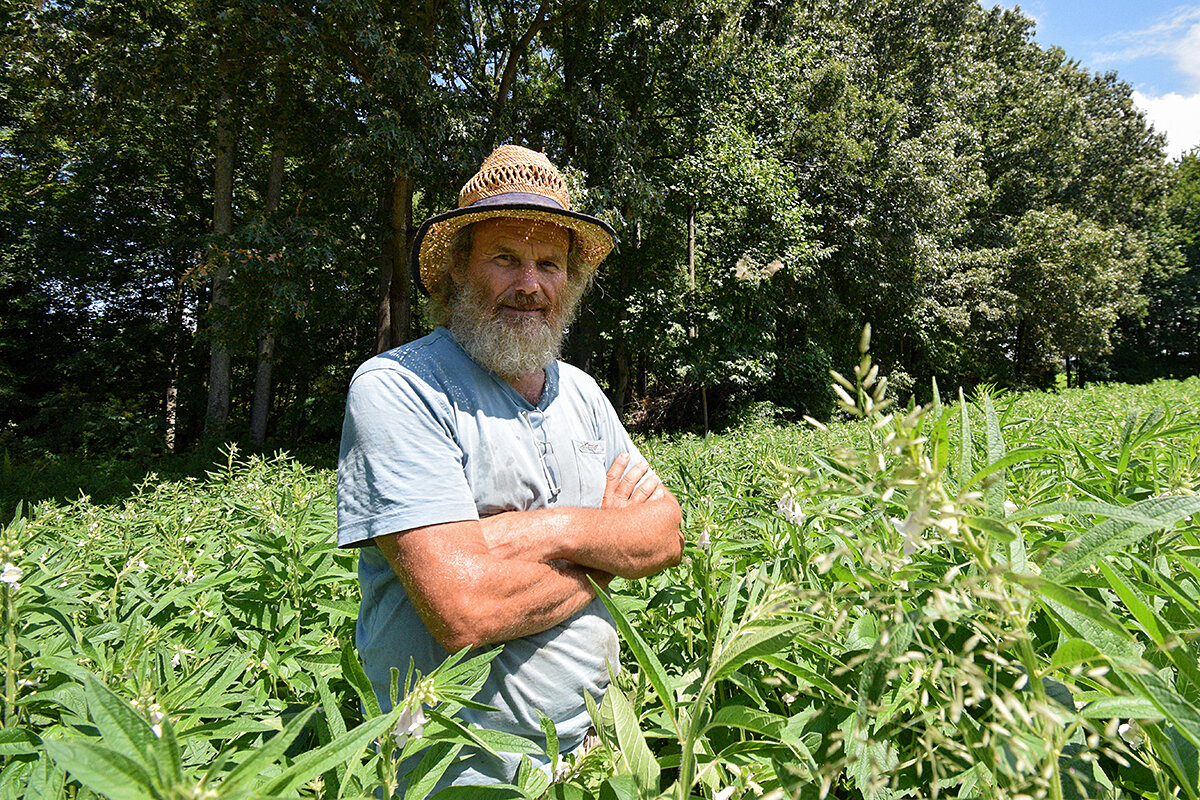
Heinz Thomet stands in a field of sesame on his farm in Newburg, Maryland, Aug. 17. Mr. Thomet tries to grow nearly everything he eats.

I love the first line of today’s story about “one of only two commercial rice farmers in Maryland.” Because who knew there were rice farmers anywhere in the US? Don’t you think of rice farmers as being almost entirely in places like Japan and Vietnam?

Sophie Hills writes at the Christian Science Monitor, “Heinz Thomet is one of only two commercial rice farmers in Maryland. The other is Nazirahk Amen of Purple Mountain Organics. Not one to accept the status quo, Mr. Thomet grows six varieties of rice on his farm in southern Maryland, where most fields are planted with soybeans and corn. Mr. Thomet didn’t start growing rice until sometime during the past decade. His explanation for why he added the crop is simple: ‘I eat rice.’ …

He is the sort of person who has utter faith in natural processes but none in institutions.

“He’s always been a farmer, from growing up on a farm in Switzerland to working on a famed biodynamic farm in the United States as a young man. Since 2000, he’s farmed in Newburg, Maryland. There, in addition to the rice, he grows barley, Sichuan peppers, bananas, grapes, bitter lemons, oats, kiwis, sesame seeds, figs, and more, depending on the season. 

“It’s difficult to make a profit on rice in Maryland. Farm-to-table was a natural concept for Mr. Thomet even before the movement expanded out of California in the early 2000s.

And though small-scale, direct-to-consumer farming is difficult to justify commercially, Mr. Thomet’s main concern remains the quality of the food he grows and stewardship of his land.

“In this case, that means successfully producing rice – a crop grown by few others on the East Coast. ‘Nothing of what I do makes sense for a cheap food system, but if you recognize a decentralized food system as food security, then I start to make sense,’ says Mr. Thomet. ‘If you look at diversified farms as part of the resilience towards a global weather pattern change, then I start to make change.’

“In an era of climate disruptions that are changing where everything from coffee and cacao to mustard and olives can be successfully grown, a decentralized food supply – like the one Mr. Thomet espouses – is getting a second look.

“After decades of factory farming and reliance on a global food chain that sends bananas, grapes, mangoes, and avocados thousands of miles to stores, returning to the idea that food should be grown where it is eaten is no easy task. And rice-growing is a useful case study.

“It’s unusual to find rice farmers anywhere on the East Coast, says Raghupathy Karthikeyan, Newman endowed chair of natural resources engineering at Clemson University in South Carolina. Rice production in the U.S. now takes place mainly on commercial farms in the Midwest and the South. But Mr. Thomet and fellow farmer Mr. Amen are holding on, despite the tight profit margin for small-scale, organic farmers.

“Both Mr. Thomet and Mr. Amen grow upland rice, a method that doesn’t use water for weed control, instead requiring labor-intensive weeding. While both sell their rice, neither grows enough to register on the U.S. Department of Agriculture census. Historically, Maryland farms mainly grew tobacco, and South Carolina was rice country. But the end of slavery and changing weather patterns made rice-farming less profitable. At one time, about 225,000 acres in South Carolina were planted with rice. Today, it’s somewhere between 25 and 50 acres. In Maryland, it’s 2.

“Agriculture in Maryland, as in most of the U.S., doesn’t supply much of the produce purchased in the state. Maryland farms produce more grain than other crops, and most of that is used for livestock feed and seed. 

“Mr. Thomet’s interest is in locally grown crops for food, and he has a loyal base of customers, including restaurants. 

“For Mr. Thomet, it’s not just about protecting the locavore movement. It’s also about stewardship. He quotes the motto of his family’s farm, Next Step Produce: ‘Committed to growing nourishing food in harmony with nature.’ …

“He eats what he grows and tries to grow whatever he wants to eat. In fact, Mr. Thomet has a nearly complete food system growing on the 30 acres he cultivates. The one thing he can’t grow is sugar cane, so he grows sweet sorghum instead, which is made into molasses. 

“Day length, sun exposure, and night temperature in Maryland are all sufficient for rice to thrive, he says. Next Step Produce starts the rice in a greenhouse and then transplants it, allowing for more growing days so the farm can grow higher-yield varieties.

“Whether upland or lowland, rice is no longer profitable to grow in South Carolina – the historical center of U.S. rice-farming – unless it’s grown as a hobby, says Dr. Karthikeyan, who’s leading a study on climate-resilient rice production. The remaining commercial rice farms he’s aware of in the U.S. all grow lowland rice in paddy fields.

“Rice is a labor-intensive crop, even if you flood it, says Dr. Karthikeyan. The yield gap between upland and lowland rice is large, making it hard to turn a profit growing commercial varieties upland. That extra labor limits how many acres of rice Mr. Thomet plants, since they’re weeded by hand. It’s also reflected in the price, he says.

“Still, in his eyes, everything comes down to priorities and societal values. There’s no good reason everyone shouldn’t have access to nutritious, locally grown food, he says. Next Step Produce, which he runs with his wife and daughters, was certified organic for two decades until last year, when a red-tape snarl was the last straw for Mr. Thomet. But his customers don’t care about the label at this point, he says. They know his growing practices. …

“Benjamin Lambert, the executive chef at Modena, a restaurant in Washington, D.C., has bought from Mr. Thomet since 2007, when he met him at a local farmers market. ‘As a chef, you look for good ingredients,’ he says, standing in the restaurant, a James Beard Award hanging just behind him.”

More at the Monitor, here. No firewall. Subscriptions solicited.

A Few Pictures

I’m taking it a bit easy as I recover from Covid, but I wanted to show you how things have looked around here lately. The photos are mostly from my routine walks along the road by the golf course. Sometimes I take golf course pictures and send them to Lynn in Florida, where she can play all year. I love the long early-morning shadows. Soon the hills and sand traps will be covered in snow.

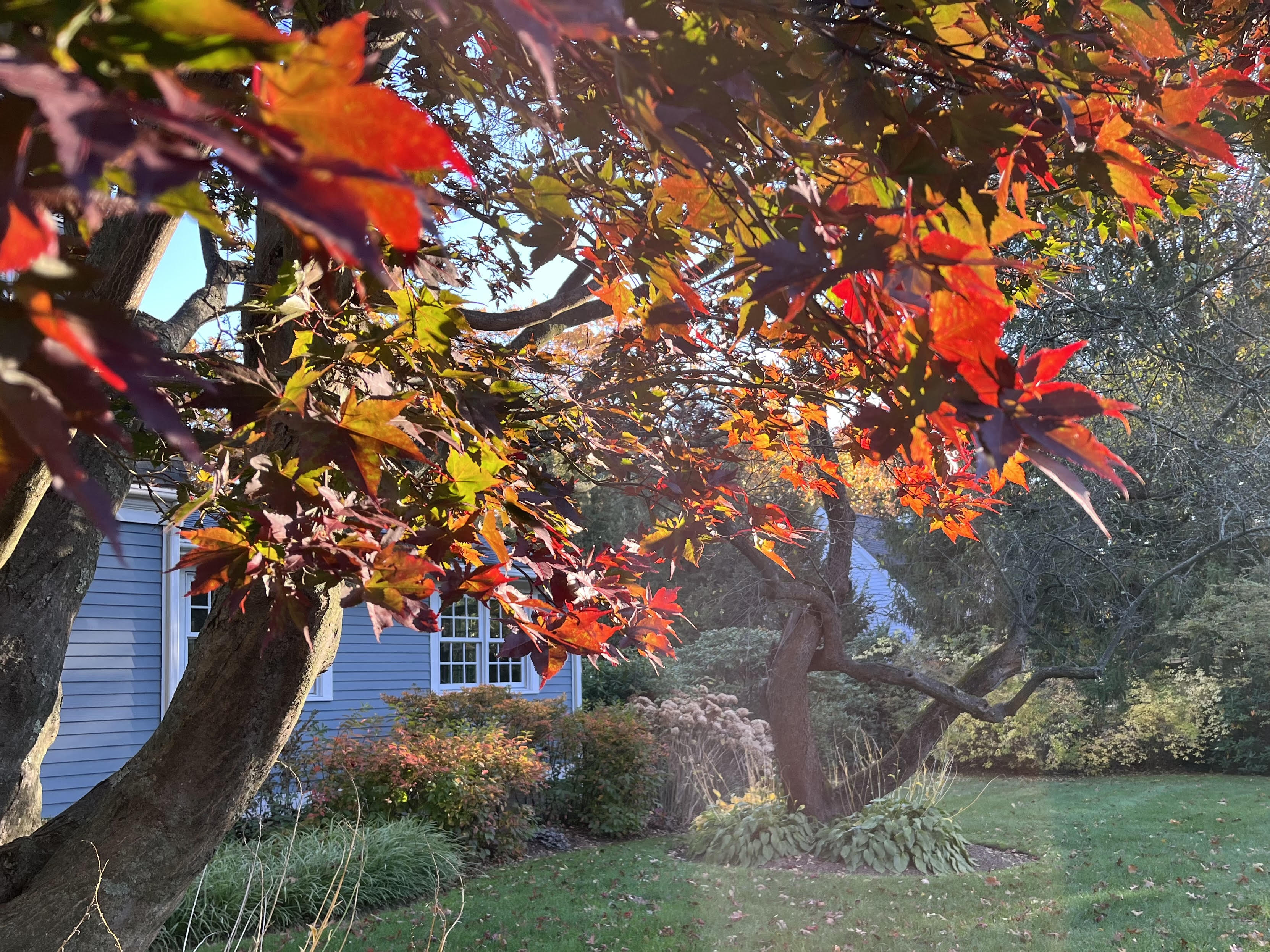
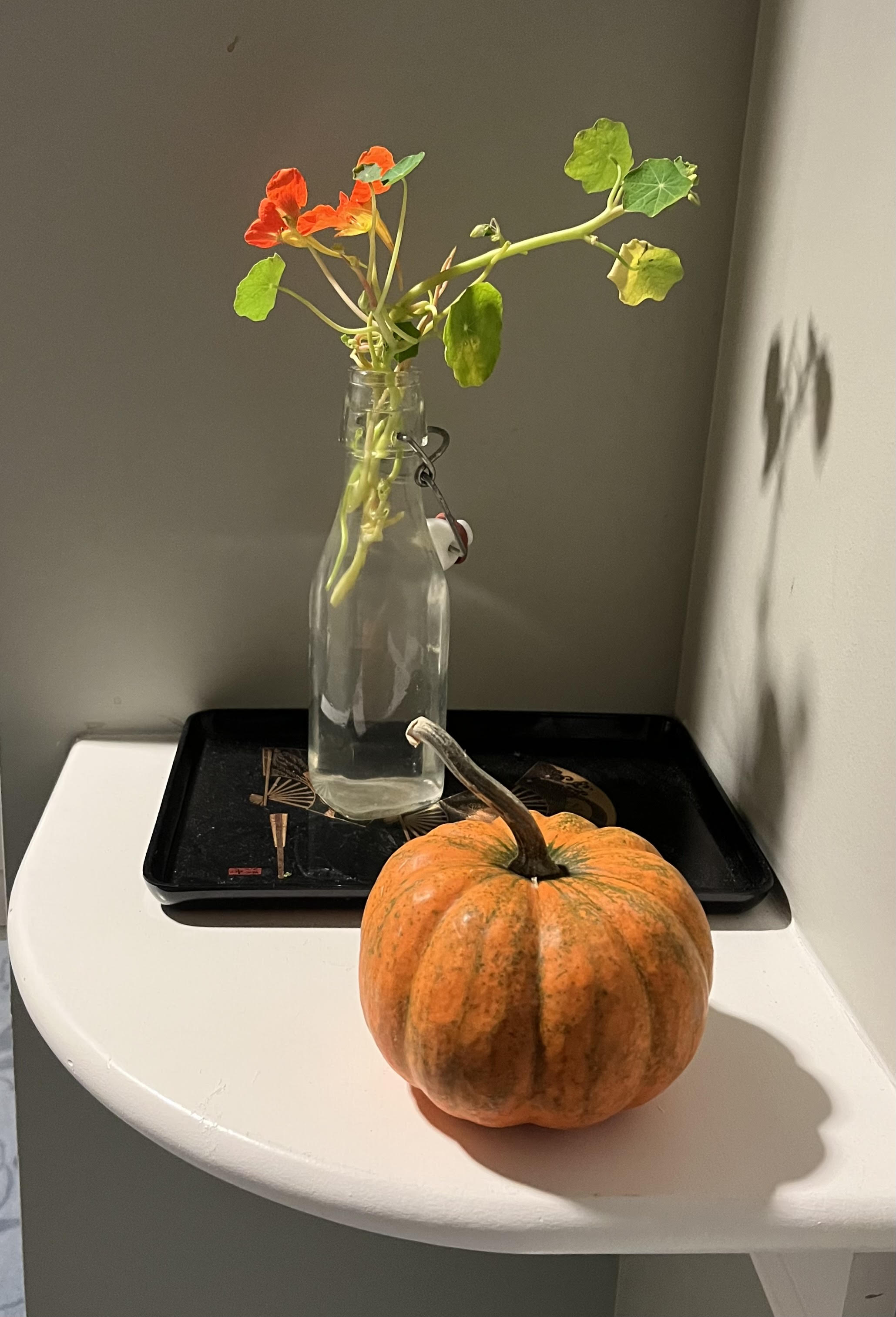
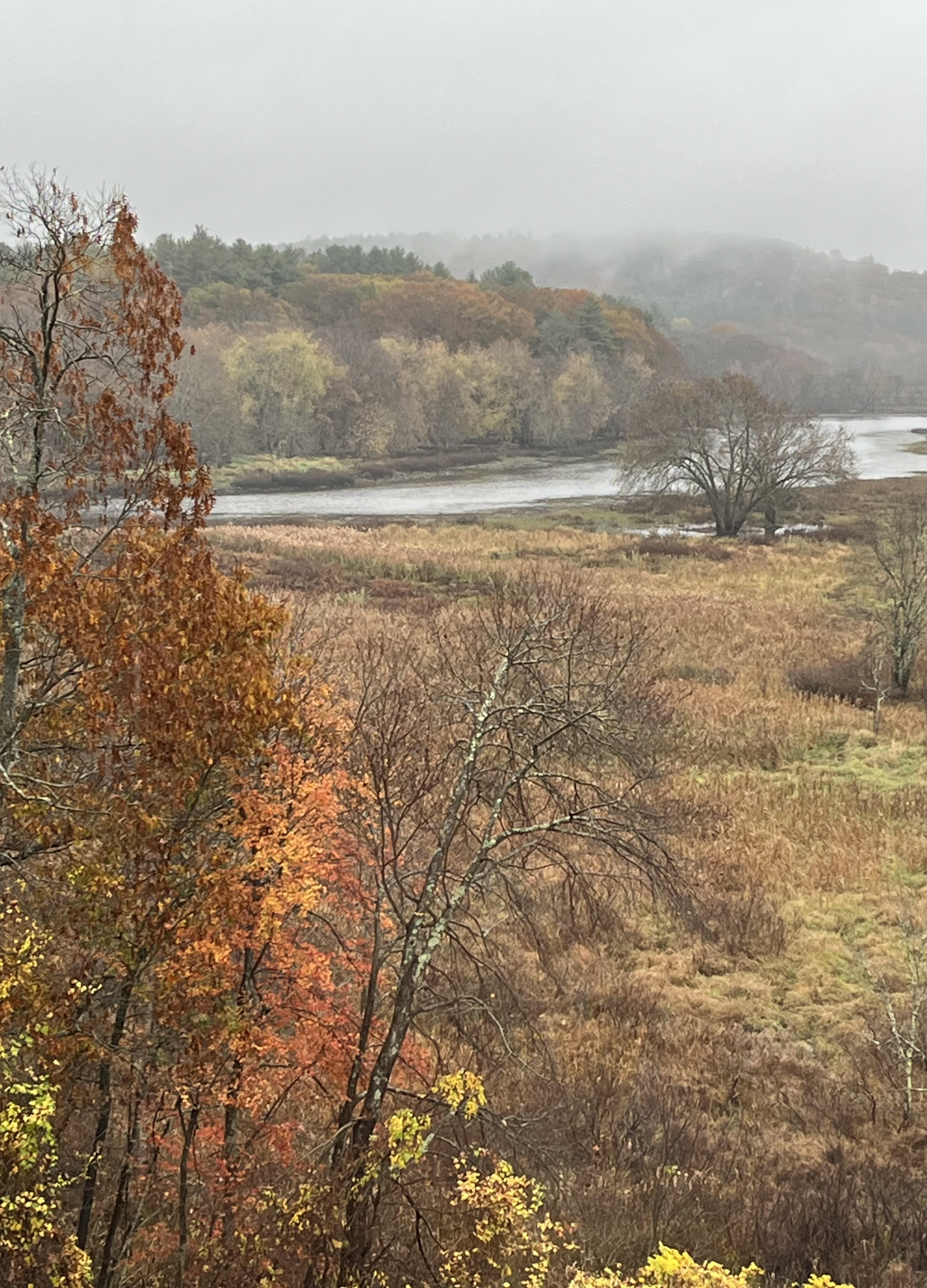
The other photos include samples of fall color that came late this year, the foggy river, wet leaves, a last nasturtium, and feathery grasses.

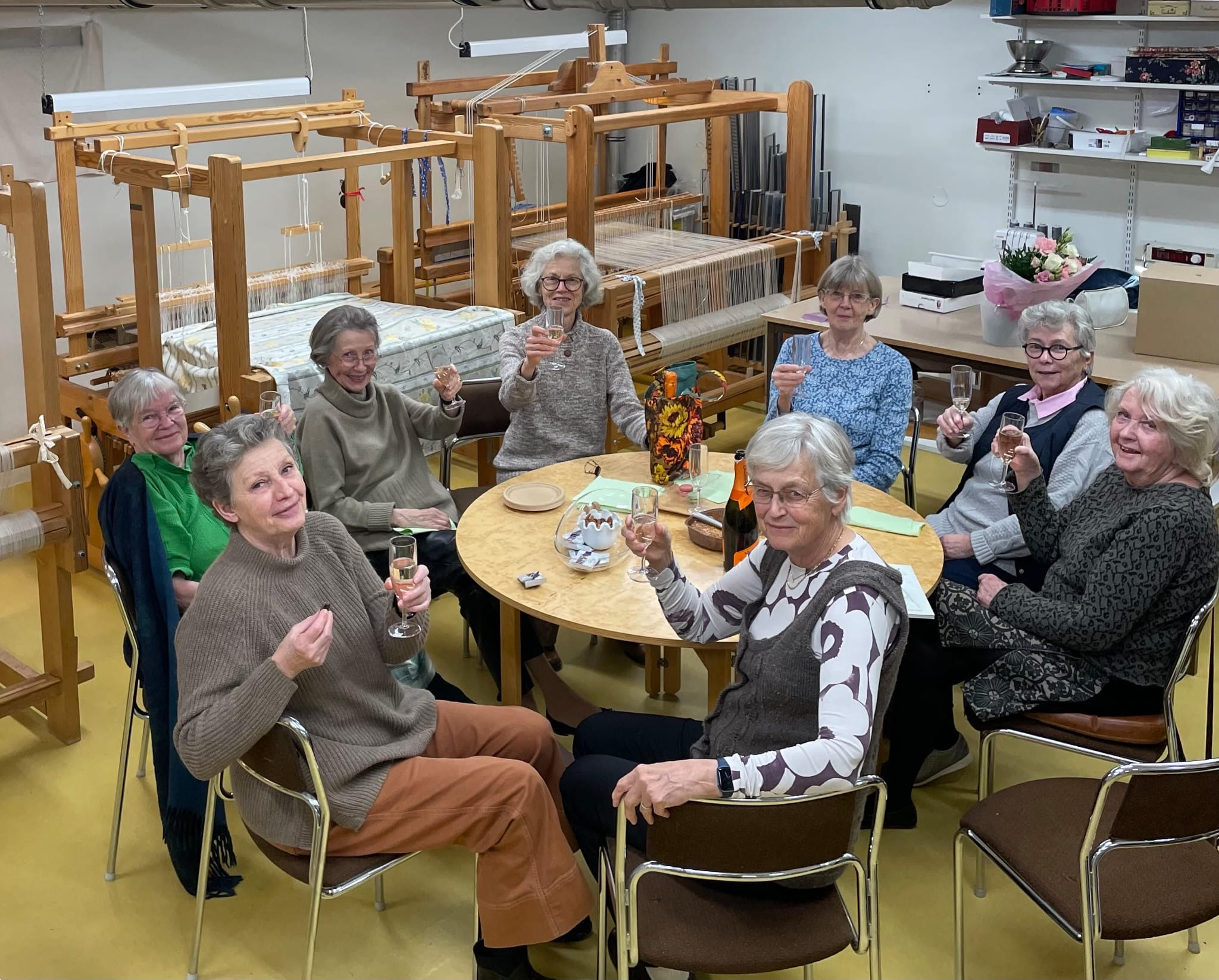
Erik’s mom sent the last picture. She, too, has moved into a retirement place, but in Sweden. The photo shows her lifting a glass with other residents celebrating their 80th year. Don’t you love the looms?