Feeds:
Posts
Comments

Photo: Mia McPherson/ On the Wing Photography.
Western Meadowlark singing.

Doctors are starting to recommend meditation to lower blood pressure in older people. When meditation was first suggested to me, I scoffed in my usual know-it-all way (what my husband used to call my “stranglehold on the truth”), but as I researched different kinds of meditation on the web, I gradually became a believer.

One of the ways meditation experts get you to focus on the here and now is to have you pay attention to each of your five senses in sequence, as in one five-minute meditation from the Washington Post. Others add that listening specifically to birdcalls can be therapeutic.

At the Post, Richard Sima says, “Looking to improve your mental health? Pay attention to birds. Two studies published last year in Scientific Reports said that seeing or hearing birds could be good for our mental well-being. …

“Research has consistently shown that more contact and interaction with nature are associated with better body and brain health.

“Birds appear to be a specific source of these healing benefits. They are almost everywhere and provide a way to connect us to nature. And even if they are hidden in trees or in the underbrush, we can still revel in their songs.

” ‘The special thing about birdsongs is that even if people live in very urban environments and do not have a lot of contact with nature, they link the songs of birds to vital and intact natural environments,’ said Emil Stobbe, an environmental neuroscience graduate student at the Max Planck Institute for Human Development and author of one of the studies.

“Recent research also suggests that listening to recordings of their songs, even through headphones, can alleviate negative emotions. …

“In one study, researchers asked about 1,300 participants to collect information about their environment and well-being three times a day using a smartphone app called Urban Mind.

“The participants were not explicitly told that the researchers were looking at birds — the app was also collecting data about other vitals such as sleep quality, subjective assessment of air quality, and location details. But the 26,856 assessments offered a rich data set of what is associated with mental well-being in real time in the real world.

“By analyzing the data, the researchers found a significant positive association between seeing or hearing birds and improved mental well-being, even when accounting for other possible explanations such as education, occupation, or the presence of greenery and water, which have themselves been associated with positive mental health.

“The benefits persisted well beyond the bird encounter. If a participant reported seeing or hearing birds at one point, their mental well-being was higher, on average, hours later even if they did not encounter birds at the next check-in.

Ryan Hammoud, a PhD candidate at the Institute of Psychiatry, Psychology & Neuroscience at King’s College London and an author of the study, called it a ‘time-lasting link.’

“Intriguingly, the birds benefit both healthy participants and those who have been diagnosed with depression. …

“A second study found that listening to short — just six-minute — audio clips of birdsong could reduce feelings of anxiety, depression and paranoia in healthy participants.

“ ‘Listening to birdsong through headphones was able to hit the same pathways that might be beneficial toward mental well-being,’ said Hammoud, who was not involved in the second study. …

“Researchers asked 295 online participants to self-assess their emotional states and to take a cognitive memory test. Then they randomly assigned the participants to listen to birdsongs or traffic noise, of more or less diversity. The researchers then had the subjects remeasure their emotional and cognitive states.

“Participants who listened to more diverse birdsongs (featuring the acoustic acrobatics of eight species) reported a decrease in depressive symptoms in addition to significant decreases in feelings of anxiety and paranoia. And those who listened to less diverse birdsongs (two bird species) also reported a significant decrease in feelings of anxiety and paranoia. …

“By contrast, listening to more or less diverse traffic noise worsened symptoms of depressive states.

“The research shows the ‘healing aspects of nature, or also the not-so-positive effects of urban surroundings,’ said Stobbe, an author of the second study. …

“Birds help us feel more connected with nature and its health effects, Stobbe said, and the more connected we are to nature, the more we can benefit from those effects.

“One hypothesis on nature’s salubrious effects, known as the attention restoration theory, posits that being in nature is good for improving concentration and decreasing the mental fatigue associated with living in stressful urban environments. Natural stimuli, such as birdsong, may allow us to engage in ‘soft fascination,’ which holds our attention but also allows it to replenish.

Nature — and birdsong — also reduce stress. Previous research has found that time spent in green outdoor spaces can lower blood pressure and cortisol levels, Hammoud said.

“It is not yet understood how birdsong affects our brains, but neuroimaging studies have found brain responses of stress reduction to other forms of nature exposure.”

More at the Post, here.
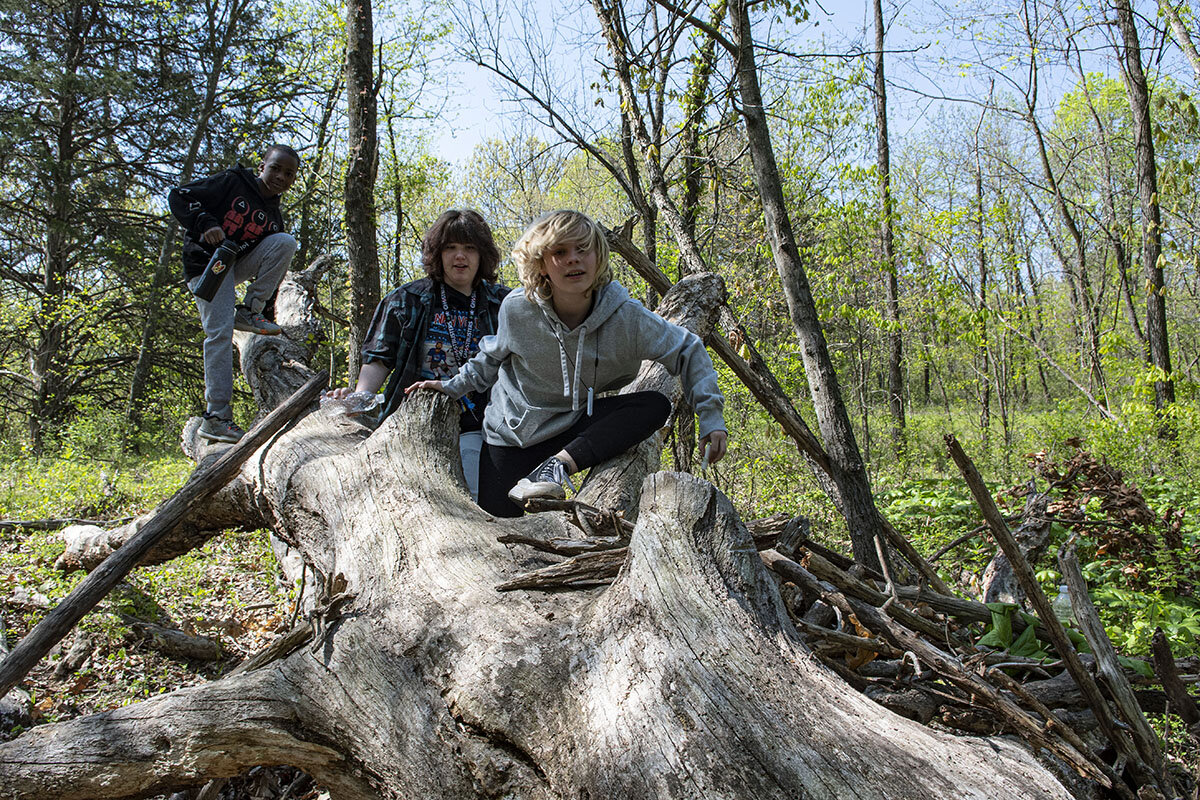
Photo: Alfredo Sosa/CSM Staff.
Students from Thorpe Gordon Elementary in Jefferson City, Missouri, at the Runge Conservation Nature Center in April.

It’s not a new idea, but it’s gaining traction: Getting kids outside into nature benefits their learning.

Jackie Valley writes at the Christian Science Monitor, “Down a hiking path and through the woods, giggles and chatter echo from a clearing where elementary students have just finished constructing makeshift shelters.

The challenge blended environment with engineering, hence this visit to the Runge Nature Center from third, fourth, and fifth graders. They’re part of a STEM (science, technology, engineering, and math) club at nearby Thorpe Gordon Elementary in Jefferson City, Missouri. …

“A boy announces he saw a turkey, while another student proclaims ‘teamwork’ her favorite part. The scene portrays what conservation leaders and educators in Missouri are hoping to instill in the state’s youngest residents: an appreciation for the outdoors, a new experience, and some learning along the way.

“ ‘I think it’s so important,” says Melanie Thompson, a librarian from the elementary school who’s leading the STEM group on this day. ‘Kids don’t spend enough time playing outside.’

“In Missouri, efforts to connect children with nature date back to 1939. That’s when the Nature Knights program launched, giving children recognition for conservation practices. Three years earlier, the state’s residents approved an amendment that created an apolitical conservation agency.

“Today, terms such as nature education, outdoor learning, and environmental education refer to instruction that, in many ways, takes students out of traditional classroom settings. Subtle nuances exist, though, depending on the location and programming. The Environmental Protection Agency defines environmental education as a type of learning that allows people to ‘explore environmental issues, engage in problem solving, and take action to improve the environment’ – while also not advocating a particular viewpoint.

“The Missouri Department of Conservation, meanwhile, sees nature education as a way to ‘inspire and educate individuals about nature so they appreciate and ultimately protect our resources and wild places,’ says Brian Flowers, a regional supervisor for the agency’s education branch. …

“ ‘You introduce them to it,’ says Mr. Flowers, referring to conservation, natural resources, and wildlife. ‘You show them why it’s important, and, eventually, that leads to that they care about it. They protect it.’

“A study called The Nature of Americans, conducted in 2015 and 2016, found that more than 80% of children surveyed said time in nature made them feel creative, happy, healthy, and smarter. …

“ ‘Once they’re there, there’s so much that happens – curiosity and creativity and just enjoyment of being outside,’ [Megan Willig, a program coordinator for the National Environmental Education Foundation] says. It can also introduce students to career pathways in the natural resource, conservation, and STEM fields.

“In a grassy field not far from an elderberry patch, a sustainably designed building with large windows and a gently sloping roofline is under construction. It’s the future Boone County Nature School, which occupies land in the Three Creeks Conservation Area and will welcome a rotating cast of 12,000 to 13,000 students each year, says Mr. Flowers.

“The project represents a partnership among the Missouri Department of Conservation, Columbia Public Schools, community organizations, and other school districts in Boone County.

“Columbia Public Schools has hired a teacher to lead instructional efforts at the Boone County Nature School, which fits into the district’s overall mission to pour more resources into place-based learning, says Michelle Baumstark, the chief communications officer. About half of the district’s students qualify for free or reduced-price lunch.

“ ‘These may not be experiences that they would have any other way and when you can create an access to an enriching opportunity, that can change the trajectory of a kid,’ she says.

“The land surrounding the nature school will feature a food forest, pollinator plots, a prairie restoration area, trails, a pavilion, and a council house with three tiers of stadium seating. The karst topography of the conservation area – caves, springs, and hills – is typically only found in southern Missouri near the Ozarks, making it an ideal exploration area for local children, Mr. Flowers says. …

“The Missouri Department of Conservation also operates programs that teach students archery and how to fish, among other things. And, in St. Louis, pavement will be removed and replaced with a green schoolyard at Froebel Literacy Academy. Picture a park-like setting with trees and wildflowers, where students can play and learn through STEM activities.

“The schoolyard project represents a step toward outdoor equity for children who grow up in urban areas that have more concrete and asphalt than lush, green recreation space, says Aaron Jeffries, deputy director of the Missouri Department of Conservation. …

“There’s no national standard for outdoor learning or environmental education, says Ms. Willig of NEEF, which was congressionally chartered in 1990 to complement the work of the EPA. So efforts differ by state and local jurisdiction, though she has seen more interest in making it a formal part of the curriculum.

“If barriers such as time or transportation exist, Ms. Willig recommends that school systems seek community partnerships. For instance, a local nonprofit that supports watershed health, she says, may be keen on helping with programming.

“ ‘The school doesn’t need to reinvent the wheel or start from scratch,’ she says.”

More at the Monitor, here. No firewall, nice pictures.

You can read another of my posts on kids benefiting from nature at school, here.

Subway Tap Dancer

Photo: William Frederking.
Ja’Bowen Dixon is a performance and visual artist on the Broadway Dance Center faculty. He is one of the founding members of the tap dance company M.A.D.D. Rhythms

The New York subway gets a bad rap these days, but did you know about all the art down there? So much great stuff to experience.

Gia Kourlas writes at the New York Times, “You can tell when Ja’Bowen is feeling a song. The grounded power of his feet — whether tapping delicate, whispery notes or hitting rhythmic patterns with ferocity and speed — enlivens an unassuming place: a subway platform.

“But beyond his sleek and supple feet, there is simply his presence. With rigor, elegance and humor, he takes the craft of tap seriously while disarming the crowds that pass through his impromptu theater.

‘You know, more than tap dancing, I’m working to bring some good energy to the city, to the moment where I am.’

“Stumbling on Ja’Bowen is like uncovering a New York City art secret. The lucidity of his body and the music that it produces are steadying forces in an unpredictable space. For months now, this Chicago transplant has been bringing quality tap to the uptown F platform at Delancey Street/Essex Street.

“What he creates with taps and a wooden board — his portable stage — is a reciprocal experience. His dances are containers for waves of energy that pass between him and a crowd. He is a dance artist who makes people smile. Of all ages. In the subway.

“ ‘I get real hyped, and then the audience gets real hyped, and then I lay back a little bit and the audience gets a little quiet,’ he said. ‘It’s like a tennis match going back and forth.’

“His improvs often start slowly. ‘If I’m being honest,’ he said, ‘sometimes people aren’t paying attention or could care less that I’m down there.’

“When a dancer, or really any performer, needs too much love, I tend to look the other way. Ja’Bowen is different. He can seem lost in his own world, dancing for himself until he feels the people around him drawing closer, looking — taking a break from social media to watch a live performance. That’s when he sends his energy out to the crowd.

“Ja’Bowen knows audiences love it when he dances fast, but his preference is to sit back in the pocket, to swing. His internal focus — the way he listens and reacts in this unprotected space of strangers — is a vulnerable display of deep body-mind awareness. And while his musical sensitivity starts at his feet, it doesn’t end there. He dances with his entire self. He likes to play with the levels and emotions in music.

“Ja’Bowen hails from a tap family in Chicago, where his older brother and a friend started the collective company M.A.D.D. Rhythms in part to give Ja’Bowen, then a teenager, something to do. Ja’Bowen joined the percussive-forward group with no formal training. Once he became proficient enough, he started performing in the streets.

“ ‘That’s what really developed my talent more than anything else,’ Ja’Bowen said. ‘You build the skill in rehearsals, but performing is a different thing.’

“If a train is a minute or so away and he’s done with his number, he’ll pick up his mic and invite kids on the platform — they watch him in awe — to learn a step. ‘I’m inviting the kids up, and I’m wishing everybody a good day and that’s intentional,’ he said. ‘You know, more than tap dancing, I’m working to bring some good energy to the city, to the moment where I am.’

“That idea is proven again and again. ‘Hey, tap dancer!’ a woman cried out from the opposite side of the platform one day. She wanted to know where to find him on Instagram.

“Where does his inspiration come from? Ja’Bowen, also an actor and musician, draws a lot from Jimmy Slyde for the way he used tap as a way to connect with an audience, as well as Sammy Davis Jr. and Gregory Hines. ‘It’s not just their footwork but their presentation,’ he said, ‘the way they talk to an audience when they’re onstage, the way they stand still.’

“Tap, he added, is like music. ‘The notes that you’re not playing also have just as much importance as the notes you do play.’ ”

More at the Times, here. Awesome videos.

Photo: Still image of A1 Hand Car Wash surveillance video.
Ron Nessman stops a baby stroller that was freely rolling into the path of traffic after being blown by wind in California. 

I once read a mystery series in which a man spends all his spare time trying to track down the homeless man said to have pushed his wife and child into the path of a New York subway car. But appearances can be deceiving, as readers learn if they stick with the series.

I thought of those books when I read today’s story about a homeless man who stopped a runaway stroller.

Ramon Antonio Vargas reports at the Guardian, “Having experienced homelessness and unemployment for years, Ron Nessman was leaving a job interview at an Applebee’s restaurant in California when a baby in a stroller rolling into the path of several cars captured his attention.

“Nessman sprinted toward the stroller, stopped it before it reached the roadway, saved the child from harm – and landed his first job in years. …

“ ‘I didn’t even have time to think about it,’ Nessman told the local news station KOVR-TV when reflecting on his actions, which many have hailed as heroic. ‘You just react.’

“Unhoused for about eight years, Nessman had reportedly been living with his sister during recent months and was in need of work when he went to an Applebee’s in San Bernardino county to interview for a position washing dishes at the restaurant on May 1. Nessman had left the interview and was waiting on a bench outside when he spotted an extraordinary emergency unfolding.

“A woman had stopped on the driveway of a nearby car wash and loaded her great-nephew into a stroller when strong winds blew the baby away from her. The woman chased after the stroller but fell, and she struggled to get back up as she helplessly watched the baby roll toward a street which was packed with motorists who may or may not have been obeying a speed limit of 40 miles an hour.

“Nessman immediately jumped up from the bench, sprinted to the stroller and stopped it with his right hand as it approached the nearest traffic lane, according to dramatic video captured by a surveillance camera at the car wash. He turned the stroller around and began wheeling it up the driveway as at least eight cars who did not appear to notice the scene zoomed by.

“ ‘I said, you know, “I got it!” ‘ Nessman recounted. … I felt so bad for the lady. I got nephews and nieces. I can imagine something like that.

” ‘I wouldn’t have been able to live with myself if I did nothing.’ …

“The video of Nessman’s leaping into life-saving action circulated widely on social media. Nessman told the California news station KNSD that relatives as far away as Florida and Missouri had seen the footage.

“In his interview with KOVR, Nessman said he began experiencing homelessness after becoming deeply struck with grief over his girlfriend’s unexpected death.

“ ‘It was sudden and I didn’t want to do anything,’ Nessman said. …

KNSD reported on May 4 that Applebee’s subsequently hired Nessman, and his orientation was scheduled for the next day.”

More at the Guardian, here. No firewall.

Photo: Goldman Environmental Prize.
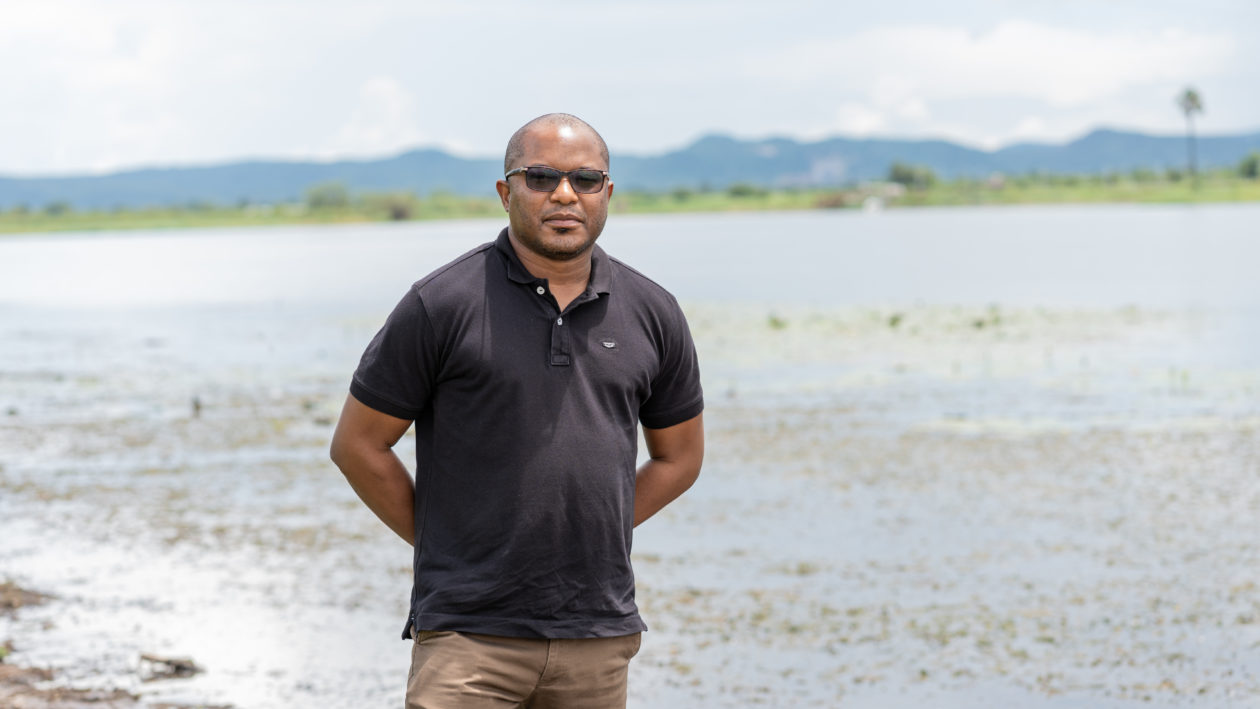
Chilekwa Mumba took on a UK mining giant that was polluting Zambia — and won.

Today’s story shows how one person can make a difference, even when the goal is considered impossible. It’s also a cautionary tale, because you can win the battle and not the war. The irony is that powerful entities can excuse polluting a region in order to meet “green economy” needs.

Jocelyn C. Zuckerman reported at Yale Environment 360, “The southern African nation of Zambia is home to a wealth of minerals — in particular, lots of the copper and cobalt that the world will require to power a green economy. Among its largest operations is the Konkola Copper Mines (KCM), located in the country’s Copperbelt Province.

“In 2004, U.K.-based Vedanta Resources acquired the controlling stake in KCM, whose operations span 11 square miles along the Kafue River. Soon after, residents noticed that the Kafue was emitting foul odors. Fish began dying. Crops began to wither.

Livestock fell ill. And villagers came down with mysterious headaches, nose bleeds, rashes, and burns.

“Chilekwa Mumba, who had grown up in the region but since moved to the Zambian capital, Lusaka, learned of the problem and vowed to do something about it. In an interview with Yale Environment 360, he talks about how he spent the next several years facilitating meetings between the communities and British lawyers, gathering water samples, and convincing former mine workers to provide evidence for a lawsuit that made its way through the British court system. Finally, in 2019, its Supreme Court found that KCM’s parent company could be held accountable in the U.K. for environmental damage from the mine’s operations.

“Not only had Mumba, 38, who was awarded a Goldman Environmental Prize [in April], helped win significant financial compensation for the 2,000 villagers involved, but his case set a legal precedent that British companies can be held accountable for the environmental fallout of their operations overseas. …

Yale Environment 360: KCM was already a presence when you were growing up in the town of Chingola. … You did your primary schooling in Chingola, so you got a good education in part thanks to the mine, which funded the schools? …

Mumba: They had excellent schools. We moved to Lusaka when I was 15, but I still went to school under the mine system. I went to a boarding school that was supported by the mines, including KCM.

e360: In 2004, Vedanta Resources, which is headquartered in the U.K., acquired a controlling stake in KCM. What happened after that?

Mumba: When they took over, there was too much collusion with government. They were not being held to account on many different issues. Based on what I was reading in the media, I started talking to residents in Chingola. We’ve got family and friends there, and my parents still maintain a home there. I used to go back occasionally, but it became almost a permanent home when I started to find out about the reports [of pollution]. I began realizing that what I’d been hearing was correct. And I started to do my own investigation. …

“I went to the same spot I used to go to as a child to fish. … There were basically no fish, and the smell of chemicals was quite evident. The soil makeup was different from what I remembered when I was young.

e360: Did you confront the company? …

Mumba: I had a couple of meetings with a local lawyer representing the villagers, and he was telling me that nothing would happen, that I shouldn’t waste my time. But he did give me quite a bit of information, and I put it in my file.

e360: You wrote letters to something like 100 law firms?

Mumba: A combination of law firms and environmental NGOs, all over the world. I was just randomly sending them out from my Yahoo address. I got a lot of automatic replies. And then there was an automatic reply from [British law firm] Leigh Day, followed up with an actual email from a person, Katie Gonzalez. I can never forget that name. I happened to find it in my email and was surprised. They told me they would be there in two weeks.

e360: How did the community respond to this British lawyer coming in? Did they trust him?

Mumba: Not immediately. But the way he is — Oliver Holland, I have to absolutely mention him — he was a white guy in a remote village, but he has this aura about him where he is very friendly, so they warmed up to him.

e360: What sort of evidence did you bring to court?

Mumba: We gathered water samples and soil samples and found that copper, iron, cobalt, and dissolved sulfates were present far beyond legal limits. We also took in — though we did not put that to the court — blood tests for various clients, to test for the presence of heavy metals. We already had overwhelming evidence from the water and the soil.

e360: Did you have help from anybody inside the company?

Mumba: A former mine manager, who knew the whole process and how there was gross negligence on the part of pollution control, gave us a lot of documents. He, of course, did not want to be named, so we videoed his testimony using certain means where his identity could be withheld. …

“Because of my connection to the case, I would get random calls and they would say, ‘Can we meet you? We want to help you. But protect our identity.’ So I would meet as many as possible. I would talk to everyone. It was part of the investigation, to get all that evidence together. …

“At the time, funnily enough, I was working for a local law firm, as a business development consultant. But I abandoned that work and decided to do this. I honestly didn’t even think that I was doing an investigation per se. It all came together when I was just simply inquiring into all these issues. …

e360: We know that copper and cobalt will be critical to the new green economy. Lots of people, including in the United States, want Zambia’s minerals. How does that help or hinder your position?

Mumba: I see it as a very dangerous position, especially the thirst for cobalt. I feel like the communities around the mines have never gotten a fair share of the deal. America says the end game of mining is they want clean energy. Cobalt is one of the components for that. So right now we need to be more watchful about how these mining operations are taking place and what benefit goes to the community.”

More at Yale Environment 360, here. No firewall.

Photo: Loren King.
Art at St. Ann Art and Cultural Center, Woonsocket, Rhode Island.

For my first issue of a certain Boston Fed magazine in 2005, I was a bit panicked about learning the ropes of editing a new field. I managed to line up an article on a troubling change in bankruptcy law from Elizabeth Warren. And through my friend Nancy L, I talked to a guy who knew everyone in the community development field in the region and who put me in touch with Joe Garlick at the Woonsocket Neighborhood Development Corporation (now NeighborWorks) in Rhode Island.

And so it was that I got a memorable tour of initiatives benefiting residents of this former industrial town, where the rivers once ran with clothing dyes.

Today I learn that I better go back to Woonsocket and check out a particular church, now a cultural center.

Amanda Milkovits reports at the Boston Globe, “Swing open the heavy doors of this twin-spired former Roman Catholic church on an ordinary city street some Sunday afternoon, and enter a museum that takes your breath away.

“Elegant and intricate fresco murals soar across the barreled ceiling and along the walls of the nave, above the sanctuary and alcoves, and the choir loft. Scenes from Bible stories, and religious figures, saints and sinners, angels and devils, nearly glow from the frescoes’ warm pastel colors, painted in the style of the Italian High Renaissance.

“Years ago, Yankee Magazine dubbed St. Ann Arts and Cultural Center as the Sistine Chapel of America, and that’s no exaggeration. The former church, which is actually larger than the Sistine Chapel in Rome, is home to the largest collection of fresco paintings in North America.

“Its place here in this working-class city on the northern edge of Rhode Island, away from the tourist meccas of Providence and Newport, can make visitors feel as if they’ve discovered an incredible treasure.

“ ‘That’s why we say it’s the best-kept secret, and the worst-kept secret, too,’ said Joe Petrucci, a docent and volunteer. ‘Because it’s a wonderful gem, but not a lot of people know about it.’

“Along with the stunning frescoes, there’s the rich color and depth of 40 stained-glass windows made by artisans in Chartres, France, and the hand-carved marble altar and the marble stonework imported from Carrara, Italy. Outside, the church’s twin 165-foot cupola towers resemble those of the Shrine of Sainte-Anne-de-Beaupré outside Québec City, and have been an integral part of Woonsocket’s skyline for a century.

“But for the keepers of St. Ann, what makes the former church so distinctive to the city of Woonsocket is how an artist immortalized its residents in the frescoes.

“Guido Nincheri, an Italian-born artist considered the Michelangelo of North America, painted these ordinary people into his extraordinary artwork. The mill workers, the mischievous children, and those lost in World War II, and other residents were models for the 475 faces painted into the frescoes.

“ ‘Aside from the incredible, amazing art and the architecture, the stained glass and the marble work, my favorite part is the story of how it came to be. It’s a part of my heritage,’ said Dominique Doiron, St. Ann’s executive director and Woonsocket native, who was a parishioner until the church closed in 2000. ‘Especially in such a time of turmoil, to be able to look at something and go, What if we all just got along? Look at the great things that we can accomplish together.’

“Roll back the calendar more than a century, back when Woonsocket was nicknamed ‘Le Petit Canada’ for its large population of French-Canadians, who’d arrived in the city to work in the mills. This church on Cumberland Street, which opened in 1918, was the second French-Canadian parish in the city.

“The church was the social hub for its hardworking parishioners, and there were seven Masses on Sundays, standing room only, Doiron said. Though they were poor, the parishioners pooled together their own meager funds for the construction of their church, and later, for its beautification. …

“While the architecture was beautiful, there wasn’t enough money to complete the interior, so the gray stucco cement walls weren’t plastered. That would turn out to be a lucky accident.

“In 1925, the 35th anniversary of the founding of the parish, the parishioners raised money again to install 40 stained-glass windows, made in Chartres, France.

“During the Great Depression, the priest leading St. Ann’s still wanted to do something about those plain walls. the Rev. Ernest Morin visited different churches throughout Rhode Island for ideas, and ended up at St. Matthew Church in Central Falls, where Nincheri was painting.

“Nincheri had been knighted by Pope Pius XI as one of the great artists of the Roman Catholic Church and would win four papal awards for his work. He’d studied the Old Masters style in Florence and apprenticed in stained glass in Montreal.

“Nincheri had immigrated to Canada and later moved to Rhode Island, where he was working on churches and public projects. Morin invited him to visit St. Ann’s.

“ ‘As soon as he walks into the building, the first thing Nincheri notices is, Oh my God, the walls and ceilings aren’t plastered,’ Doiron said. ‘Now, he’s getting excited, because this is a rare opportunity to do the fresco style.’ …

“The technique, which reached its height in the Italian Renaissance, requires that an artist is both careful and quick, because there is no room for error.

“At this, Nincheri was a master. He explained the possibilities to Morin, how Michelangelo had painted the frescoes in the Sistine Chapel in Rome, and he could do the same here, at this busy Woonsocket church. They settled on a contract for $25,000 in 1940. …

“Nincheri told a reporter for the Woonsocket Call newspaper that St. Ann’s would be ‘America’s most beautiful church.’

“As Nincheri began the work, he studied the faces of people in the community. … ‘All of the faces were people of the parish and people of the city of Woonsocket at the time. He would always be on the lookout for a face that would fit a particular subject, and he would invite them to sit for him,’ Doiron said. ‘And what we now have here is a scrapbook, a pictorial history of who we now call the “Greatest Generation.” ‘ ” More at the Globe, here.

See also my 2018 post on a Sistine Chapel replica in Mexico, here.

Photo: RTÉ.ie (Raidió Teilifís Éireann), Ireland’s National Public Service Media.
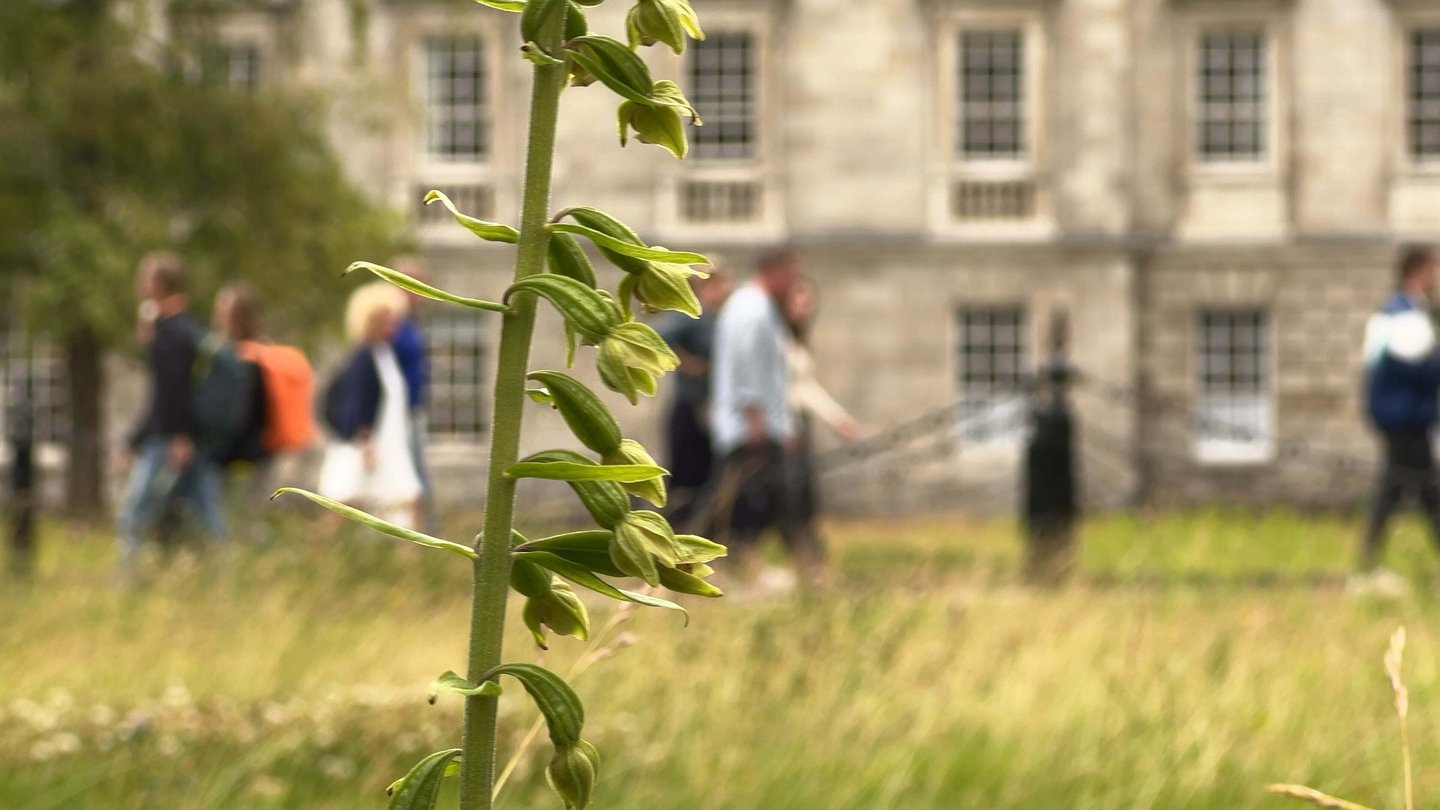
One of the broad-leaved helleborines near the front arch of Trinity College in Dublin. Good things are growing in the city after No Mow May.

John made a good point about No Mow May the other day. The initiative to give a chance to plants that pollinators love has been growing, but why destroy the improved ecosystem by mowing in June?

Philip Bromwell writes at RTÉ (Ireland’s National Public Service Media) about an approach in Dublin.

“Two species of orchids have been discovered growing on the campus of Trinity College in Dublin city centre, much to the surprise and delight of botanists.

“The wild plants — a broad-leaved helleborine and a pyramidal orchid — have popped up in a lawn next to Trinity’s iconic Front Arch.

“Inspecting the 60cm [~2 foot] broad-leaved helleborine, Professor Jennifer McElwain, from TCD’s School of Natural Sciences, said … ‘It’s really unusual to find this orchid anywhere. It’s rare. It’s extra unusual to find it in the middle of Trinity, right in Front Square, in the middle of the city.’

“There are around 30 different species of wild orchids in Ireland. Some thrive in fields, others prefer bogs, woods or mountains.

“Professor McElwain believes the appearance of the orchids in Trinity are the result of the university’s participation in ‘No Mow May’ – the annual campaign that encourages gardeners to not mow their lawn during the month of May so that plants and pollinators benefit.

” ‘We wanted to implement a positive measure for biodiversity. So, we just simply stopped mowing this lawn in May. And that was difficult to do, because a lot of people really like finely cut lawns. But we stopped mowing, and this wonderful orchid began to emerge. And there’s not just one — there are three orchids, including another species. So, we actually have an orchid-rich meadow.

‘That’s a botanist’s dream and our only intervention has been to stop mowing the lawns.’

“Orchids have the smallest seeds of all flowering plants, with a typical seed the size of a speck of dust.

” ‘A seed could have blown in by wind. It could have come in on the feet of people, or been brought in by a bird,’ Professor McElwain explained. ‘Alternatively, this seed could have been in this lawn for decades. Underground, just waiting for the right conditions to allow nature to thrive. And the right conditions in this case happened to be not mowing the lawns.’

“Flower-rich, grassland habitats are rapidly disappearing from the island of Ireland and one third of our wild bees are threatened with extinction.

“Trinity installed wildflower meadows on College Green in 2020 after thousands of students, staff and members of the public voted to replace the manicured lawns at the front entrance to the university with the more nature-friendly alternative. …

” ‘I think this a really hopeful demonstration that biodiversity and nature can thrive if we just give it time and space. We are in the midst of biodiversity and climate crises. It can seem overwhelmingly complex to solve it, but it’s our responsibility to show what’s possible.

” ‘In this lawn alone, more than 35 plant species have come up. And if you think each one of those plant species supports one or two species of pollinators, that’s 90-odd species. If this lawn was a mown, clipped lawn, you would have a species diversity of one.

” ‘This demonstrates how simple measures can lead to really spectacular results. Never in our wildest dreams did we expect this,’ she said.”

More at Ireland’s National Public Service Media, here. No firewall. For more insight on the importance of meadows, see my friend Jean’s Devine Native Plantings, here.

How do you feel about giving up lawns? We have not had one for years, initially because neighborhood dogs kept destroying ours, but nowadays because we like the look of vinca. I do think that while a family’s kids are young, a lawn for outdoor games is pretty necessary, but not with weed- and bug-killers.

Photo: Edwin Ndeke/The Guardian.
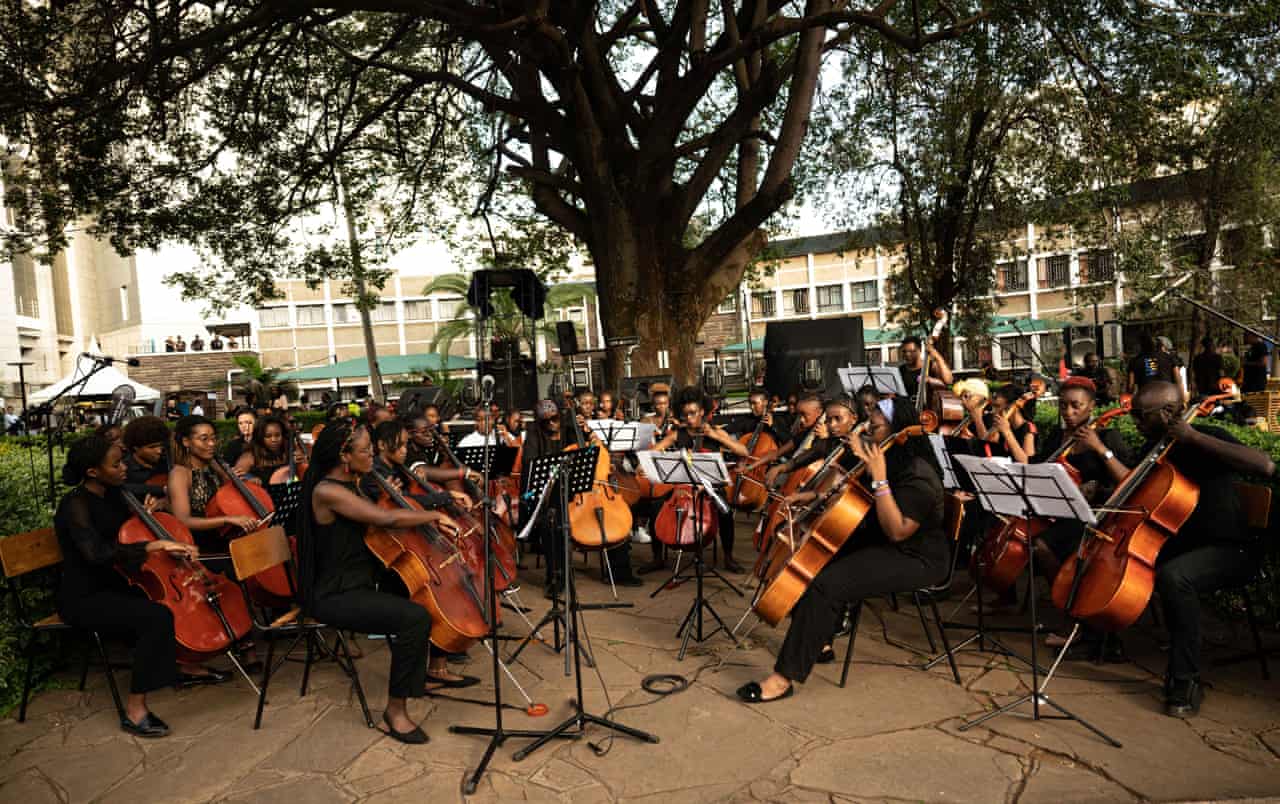
Kenyan classical musicians gave an outdoor performance in Nairobi recently. Cellist Yo-Yo Ma also performed that day. 

Do you know the cellist Yo-Yo Ma? He seems to be performing in a different country every day, and often he’s performing for charity. I follow him on Instagram, and I’m always amazed.

Caroline Kimeu wrote at the Guardian in June about Yo-Yo Ma’s recent visit to Kenya.

“Nairobi’s bustling Kenyatta market is an unlikely place to hear classical music. Yet playing today in front of stalls where butchers roast meat and hairdressers compete over heads to braid is a very surprising busker: the distinguished cellist Yo-Yo Ma. Playing ‘Over the Rainbow’ alongside Kenyan percussionist Kasiva Mutua, he matches his cello to her beats in a truly eclectic mix.

“Ma’s broad artistic sensibilities make weaving together the diverse musical traditions of drum and cello seem like a natural fit. ‘It was symbolic to introduce [classical] music to the crowd through something they know and understand,’ says Mutua. ‘Africans understand rhythm to their core.’ …

“Nairobi is Ma’s last stop of his Bach Project – a five-year, six-continent global tour. With its rising cultural and artistic scene, organizers say the city was near the top of the cellist’s list.

“The project marked Ma’s ambition to connect cultures and people across the world, performing Johann Sebastian Bach’s cello suites in 36 countries. …

“Bach’s cello suites were not well known by the time of the composer’s death in 1750. They began to resurface nearly a century later, and were brought to prominence in the 1930s when Pablo Casals, one of the world’s most highly regarded cellists, performed and recorded the neglected suites.

“Ma has recorded interpretations of the suites three times, with more than a decade between each.

“They are wrapped up with his life’s memories, he has said, citing his first encounter with Bach’s music when he was four: his father, Dr Hiao-Tsiun Ma, taught him the first suite in small, incremental steps. …

“ ‘For almost six decades, they have given me sustenance, comfort and joy during times of stress, celebration and loss,’ Ma wrote at the start of the Bach Project in 2018. ‘What power does this music possess that even today, after 300 years, it continues to help us navigate through troubled times?’

“Beyond busking, Ma takes to a more conventional stage with a concert at the Kenya national theatre. His audience now is a classical crowd – the [$145] auditorium tickets sold out in 24 hours – with prominent members including the arts minister, Ababu Namwamba, and the US ambassador, Meg Whitman. …

“Ma plays as though he is the only person in the room. Only the loud applause breaks through to him, earning his bow and embrace of the audience, arms flung wide. The solemn, lonely fifth cello suite – his penultimate performance – makes the auditorium fall silent.

“From a viewing room on the upper balcony, Brian Kivuti, a 34-year-old Kenyan jeweler, listens with closed eyes. ‘For me, it was a practice in presence,’ says Kivuti. ‘There are no lyrics telling you how to feel. It’s just the music and you, feeling your way through, so you pay more attention to how the notes make you feel. …

“ ‘When I started to listen with my body, I could feel notes of hope, the quiet of a Sunday morning, the dizziness of preparing for a party. The rise and fall of the notes allow you to tap into more than just everyday feelings.’

“At the theatre’s Wasanii restaurant, workers perched on rooftop balcony seats to watch a screening of the performance. For Margaret Wanjiru, a 22-year-old waitress, Ma’s music is a far cry from what she knows, such as her tribe’s Mugiithi. ‘It may not be the music I grew up with, but it slows you down, however much you’re busy, and allows you to get lost in your thoughts.’

“The Nairobi Orchestra, one of the oldest in Africa, performs ahead of Ma’s set, and its musicians are thrilled to have him in the auditorium. Violinist Bernadette Muthoni says: ‘For me, it was very huge to think that Ma was going to play just a few metres from where we were. He’s what a lot of us aspire to.’ …

“Ma is increasingly interested in using his work for social impact. He played outside the Russian Embassy in Washington DC last year to protest against its war in Ukraine, and dedicated his Songs of Comfort to providing solace for people during the difficult days of the pandemic.”

More at the Guardian, here.

Photo: Ben Toht.
Liz Sexton’s rat mask for Halloween in Brooklyn, New York, a few years ago started her papier-mâché art career.

I’m guessing that nearly everyone who launches into serious downsizing finds a papier-mâché puppet head that a kid made in school — in my case, not only Suzanne’s puppet head but also one that I made around age 10. Clumsy as the heads invariably are, it’s painful to get rid of something that feels so much like an accomplishment.

Today’s story is about a woman who has raised papier-mâché to high art.

Alex V. Cipolle reports at Minnesota Public Radio, “Hunched over her work bench with a box cutter, Liz Sexton carves out the spikes on the back of a horseshoe crab. … The crab is papier-mâché and the size of a shield. Composed of more than a dozen layers of paper bags, its shell feels as strong as one, too.  …

“The crab is one of more than 15 papier-mâché animal masks and sculptures Sexton is preparing for her first-ever solo exhibition. The show, ‘Liz Sexton: Out of Water,’ [opened] May 5 at the Minnesota Marine Art Museum in Winona, Minn. …

“At her home studio in St. Paul, many of these animal creatures — an Atlantic walrus, a humpback angler fish, a polar bear — stare down at her from the shelves. Others are placed around the house in various stages of completion. …

“Her masks are incredibly lifelike. And papier-mâché is only step one. She can spend upwards of 100 hours on a mask, honing the details using woodworking techniques, be that carving more than a hundred tri-pointed teeth of a marine iguana, or using an orbital sander to achieve the milky smooth skin of a beluga whale. …

“Sexton receives commissions from around the globe, so they must withstand all the perils of international shipping. And the masks, she says, are meant to be worn, after all. …

“Her partner, Ben Toht, is a fellow creative and collaborator. He shoots photos and creates gifs of Sexton wearing her masks in the wild, which will also be featured in the exhibition. Watching the masks progress from their initial lumpy gumdrop shape, he says, is incredible. …

“Like many of us, Sexton learned papier-mâché as a kid — her dad taught her. For many years, she did it as a hobby. …

“ ‘I moved around a lot. I was in France and Germany,’ she says of her time living in small apartments in Europe. With papier-mâché, ‘you don’t need a lot of supplies or space. You get some newspapers for free, some flour and water, and you can make whatever you want.’ 

“In her free time, she would make costumes and props for weddings. The turning point was Halloween in New York, when she and Toht were living in Brooklyn. For the city’s annual Halloween parade, she made them masks of the city’s patron saint, the rat. 

“ ‘It was kind of incredible,’ Toht says. ‘With all the insanity of New York, and all the insanity of New York Halloween, these always got a lot of attention. People love the rats.’ They recall how people would chant ‘New York City rats’ at them. …

“Since then, Vogue Singapore has used her masks in video shoots. And the New York Times Style Magazine commissioned 70 animal busts for a star-studded 2019 event. …

“Sexton and Toht moved back to Minnesota from New York right before the pandemic. Her family, a family of artists, lives here. As Sexton rips up paper bags, she says they are surprised by her career, but very excited. …

“Sexton has also been an animal lover since she was a kid, and she’s particularly keen on marine life. Part of her artistic process, she says, is doing deep research into her subjects. 

“She talks with ease about how the blood of horseshoe crabs is used for vaccines or describes the unusual mating habits of angler fish. 

“ ‘Oh, another fun fact: Manatees can regulate their buoyancy by releasing gas from their bodies,’ she says, laughing. ‘I put that in the show notes because I thought kids would appreciate it.’ “

Liz Sexton: Out of Water” runs through Sept. 3 in Winona, Minnesota. 

More at Minnesota Public Radio, here. No firewall. Delightful pictures.

Art: Mo Willems.

One day in spring, the school that two of my grandchildren attend had a dress-as-your-favorite-character day. The school principal wore a Mo Willems T-shirt that warned, “Don’t let the Pigeon drive the bus.”

Did you love that book series? Now that all four grandkids are reading advanced books, I feel a certain nostalgia for the Pigeon days. Fortunately, I can still see Pigeon at the opera.

David Allen writes at the New York Times, “Do you know the words to the Queen of the Night’s stratospheric showcase from ‘The Magic Flute’? Maybe the Duke’s famous tune from ‘Rigoletto’? Carmen’s Habanera?

“No, not those words. The other ones: the words, at least, as they are now known to my 6-year-old daughter and the hundreds of children who took grown-ups like me to the Kennedy Center here recently for the premiere of ‘The Ice Cream Truck Is Broken! & Other Emotional Arias,‘ an experiment, including a short new work by the composer Carlos Simon, in what it might mean to draw a very young and impossibly demanding audience into a life in opera.

“See, you might think that Carmen is relating her views on love, but no. Listen closely, and you’ll find that the singer should have shared her cotton candy with her friends, and absolutely will … tomorrow. ‘La donna è mobile’? That’s about how milk squirts out your nose if you happen to laugh at exactly the wrong time. The Queen’s aria? That’s still about anger, but it now invokes something far worse than the vengeance of hell.

“ ‘This bicycle,’ it begins, in a fit of preschool pique, ‘is such a poo-poo vehicle.’

“Opera’s great composers have a new librettist, and he is almost certainly the only person who could induce an institution like the Kennedy Center to do something like this, let alone get Renée Fleming to join him in hosting it; inspire a quintet of young singers to ham their way through it; and persuade Simon, one of the busiest composers around, to crown the show with a 20-minute piece that gives an attention-seeking, picture-book Pigeon the prima donna spotlight it has surely always craved.

“The writer for it all? Mo Willems, who, it turns out, really loves opera! …

“ ‘It’s big emotions. … It’s direct communication. It’s interior dialogue. It’s self-discovery.’ …

“Willems has always been a broader artist than just a writer of picture books, though that task alone is such that he calls it ‘as easy as describing the history of Byzantium in three words.’ Some of his most celebrated characters — who include a venturesome plushie called Knuffle Bunny, the on-and-off best friends Elephant and Piggie, and that insatiable, inimitable Pigeon — had already starred in musicals that he had written before he formalized his long association with the Kennedy Center in 2019, when he became its education artist in residence. That three-year position coincided with the pandemic, to which he responded with invaluable ‘Lunch Doodles‘ videos, but it still let him explore a range of genres, including symphonic music, which he said ‘has always been important to me.’

“ ‘Beethoven’s Fifth is the easiest example,’ he explained, ‘but it’s basically the arc of an episode of television, or a movie: “Ba-ba-ba-baaam,” oh, it’s exciting — and then you take the theme, you take the theme, and then you build with it. So when I was writing a show called “Codename: Kids Next Door,” which is a silly sort of action comedy, I would literally write to the symphony.’

“For the National Symphony Orchestra, Willems painted giant abstractions to accompany a cycle of Beethoven’s nine symphonies, and he worked with the musician Ben Folds to adapt one of his books, ‘Goldilocks and the Three Dinosaurs,‘ for the concert hall. Hearing plans for ‘Goldilocks’ led Tim O’Leary, the general director of the Washington National Opera and a Willems-reading father of three, to inquire about a commission. …

“The author quickly sent him a copy of an Elephant and Piggie book — ‘I Really Like Slop!‘ — with the inscription ‘Tim, this book really sings.’ By their second encounter, Willems had the libretto in his head, a sketch of the characters in concert dress and a title: ‘SLOPERA!

“ ‘Obviously, once it was called the “SLOPERA!” we had to do it,’ O’Leary said.

“ ‘SLOPERA!’ could only be performed live outdoors on account of the pandemic, but an indoor recording, with piano accompaniment, was shown virtually to more than 300,000 schoolchildren. Piggie gets Gerald the Elephant to try slop, a stinky green delicacy among porcine foodies. He does, after his initial refusals upset his companion, and he endures the consequences in something like a bel canto mad (or death) scene. He recovers, though, and tells Piggie that while he might not like her food, he still likes her. …

“Willems said, reflecting on what writing his first libretto taught him, aside from the importance of placing consonants carefully. ‘If you look at a picture book manuscript, and you can understand it, it has too many words. If you look at just the illustrations, and you can understand it, the drawings are too detailed. They both have to be incomprehensible. It’s very similar with writing an opera, that the words that you’re using have to be dependent on the music, but the music has to be dependent on the words, and either of them shouldn’t really be able to stand alone.’ …

“[Oznur] Tuluoglu, a young soprano whose most recent prior role was Barbarina at the Annapolis Opera, took on the title character. ‘When you train, you have to be able to sing Mozart, you gotta be able to be a pigeon.’ “

More at the Times, here.

Photo: Elayna Yussen — Bloomberg/Getty Images.
It’s not just hospitals that have critically low staffing levels. Our aging population is retiring, and most industries are hurting for labor. We need more immigrants.

Happy Fourth!

We think of ourselves as a nation of immigrants, but only for the past. We have turned against immigration at a time we badly need more applicants for every kind of job. The effects of labor shortages can be dangerous if we are talking about hospitals or aviation, for example. But it’s bad all over. I’ve read that even the military is having trouble finding recruits.

Today’s article is about nurses, but you can substitute almost any job category and think about whether better immigration policies, with a good route to citizenship, would help.

Alex M. Azar and Kathleen Sebelius wrote in Time magazine’s Ideas section, “The United States is about to learn the hard way what happens when an entire generation of nurses retires without enough new clinicians to fill their shoes at the bedside.

“As a result, hospitals in the same country that performed the first successful kidney transplant and pioneered anesthesia and heart rhythm restoration will have no choice but to ration care.

“That’s the only way to describe what happened to an Alabama man who was turned away from 43 different hospitals across three different states before ultimately dying of a cardiac emergency 200 miles from home because no nearby system had an available intensive care bed it could staff. …

“And it’s what happened to expecting mothers in Idaho earlier this year when the only hospital in the 8,000-person city of Emmett said it had become ‘unsustainably expensive to recruit and retain a full team of high-quality, broad-spectrum nurses to work.’ That followed an earlier decision by an upstate New York facility to pause its maternity services after struggling to recruit enough replacements to offset staff resignations and retirements. …

“A nurse old enough to retire today has only known the U.S. health care system in a nursing shortage, but they’ll tell you it’s never been more challenging. It’s a crisis in five parts, including increased demand for care by an aging population and workforce, restraints that hinder nurses from practicing at the top of their licenses, lingering burnout from the pandemic, an inability to educate enough new nurses, and a recently throttled pipeline of qualified international talent.

To fill the gap in care left by retirements and burnout, federal economists calculate that the U.S. health care system will need to add at least 200,000 new nurses every year through 2026.

Nursing schools reject tens of thousands of applicants every school year. It’s not because these would-be nurses failed to meet admission criteria — it’s largely because the schools don’t have enough nurse educators to train them. As limited instruction capacity squeezes the number of new matriculating nurses, hospitals have increasingly relied on foreign-educated nurses, who’ve grown to represent roughly 15% of the U.S. nursing workforce.

Employment-based health care immigration is a complex labyrinth of rules and regulations that doesn’t make it easy or fast for an international nurse to emigrate and begin treating American patients. Under current law, international nurses compete for the same limited number of employment-based green cards within an enormous pool of applicants that include IT workers, lawyers, engineers, and architects. Unlike those other workers, nurses do not qualify for temporary visas. So, while many computer engineers from other countries apply for green cards after moving to the U.S. and working under an H1-B visa, nurses must complete the immigration process entirely overseas.

“Under the best conditions, that’s a multi-year process in which the nurse has passed English language and licensure exams, established a sterling overseas clinical record, and secured a job offer that has been demonstrated not to harm U.S. workers. Now, that timeline will grow significantly, thanks to a recent visa freeze instituted by the U.S. State Department.

“The State Department tightly monitors the number of employment-based green cards issued against the remaining number for the fiscal year, which is set by Congress and has been untouched since 1990. Post-pandemic resurgent demand for this category recently forced State to issue a notice of visa retrogression, an immigration term of art that refers to eligibility backdating when demand exceeds equilibrium. As a result, any nurse who became eligible for their green card after June 1, 2022 — which amounts to thousands of nurses who have been winding through the system for upwards of two years — is ineligible to enter the country until the backlog has cleared. In practical terms, American hospitals won’t be get the nurses they’ve been counting on any time soon.

“Despite the urgency to get more nurses to the bedside, the State Department and the White House have zero discretion. The responsibility falls to Congress, which reserves the authority to issue visas and allocate them for specific immigrant preference categories. Each year, processing issues and other inefficiencies across various government agencies involved result in thousands of issued visas going unused. Health care advocates have begun pressing Congress to recapture some of these allocated-but-untouched green cards for the express use of immigrant nurses. There’s precedent: Congress did just that in 2000 and 2005.

“More recently, one bipartisan proposal introduced last Congress, the Healthcare Workforce Resilience Act, would have set aside tens of thousands of these mothballing visas for nurses and doctors. But it didn’t pass, and a new version has yet to be reintroduced. According to the nonpartisan Congressional Research Service, there are roughly 220,000 employment-based visas that were available for recapture as of 2021. …

“The nursing shortage isn’t a red-vs-blue, rural-vs-urban issue. It’s not about the southern U.S. border or the gridlock that defines D.C. It’s about a pregnant mother getting the care she and her baby deserve. It’s about the heart attack patient not being turned away because the emergency room doesn’t have the nurses to treat him. This is a whole-of-America crisis and we need a whole-of-government response, including a sensible loosening of licensing requirements, prioritize positive patient outcomes by modernizing the responsibilities and standards of nursing, supporting expanded educational opportunities, and enabling lawful employment-based immigration.”

More at Time, here.

Photo: Hasan Ali.
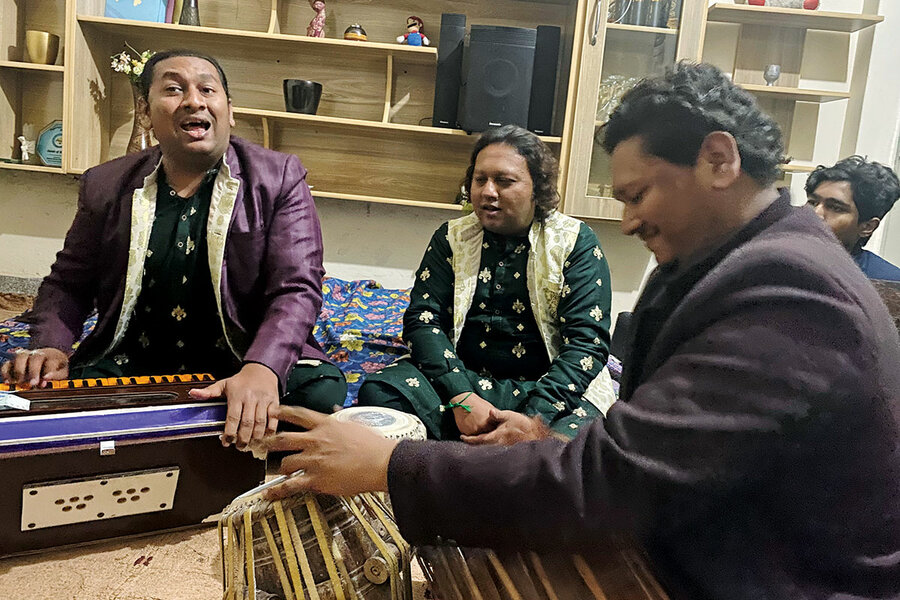
Brothers Tuqeer Ali Khan and Khurram Ali Khan perform a qawwali, a style of Sufi Muslim devotional music. The Christian Science Monitor writes, “The duo rose to prominence after being featured on The Dream Journey’s YouTube channel.”

Everyone loves the music of their youth. But what if it starts to disappear from the the radio and the other places it used to be played? Fortunately, a few enthusiasts have the power to turn things around if they care enough.

Hasan Ali reports at the Christian Science Monitor, “In the short interlude between musical pieces, Tuqeer Ali Khan looks suspiciously at his harmonium.

“ ‘Has someone tried to tune this?’ he asks, his eyes squinting in disapproval.

“ ‘No one has touched it but you,’ replies his brother and musical partner, Khurram.

“ ‘Are you sure?’ says Mr. Khan, raising an eyebrow. ‘It sounds a little off to me.’

“If it is, no one in the small audience seems to have noticed. Though he is only 10 minutes into the mehfil-e-samaa – a concert given in an intimate setting – he has created a mood of rapture. He resumes the performance with one of the numbers that made him famous. ‘Spring has come but my beloved has not,’ he sings. ‘My heart cries in anguish.’

“Though he comes from a family of musicians and is now considered one of Pakistan’s most promising classical vocalists, up until a couple of years ago Mr. Khan was virtually unknown outside of Dipalpur. Then he and his brother were featured on The Dream Journey

“Now in its ninth year, the audio-visual project is helmed by a small group of friends who record Pakistani musicians and publish their material on a dedicated YouTube page. The Dream Journey aims to promote traditional, Sufi-style music, the popularity of which has declined in recent decades due to geopolitical pressures. Their channel has amassed over 36 million views and 169,000 followers, and has launched several careers. But above all else, it serves as a source of joy not just for international audiences, but also for the project’s music-loving founders and featured musicians.

“ ‘My brother and I used to go around begging music producers to give us a chance,’ Mr. Khan says. ‘It was only when we were featured on The Dream Journey‘s YouTube channel that our careers began to flourish.’

“ ‘I pray for them every day,’ adds Khurram, who is himself an accomplished singer and tabla player. ‘All of our success is due to them.’

The Dream Journey project was started by eight music enthusiasts.

“ ‘We basically got to know each other online,’ says Musab bin Noor, a medical doctor. ‘It was always a desire to someday get together and listen to music as a group and that finally happened in 2014 when everybody’s schedules aligned.’

“They decided to visit musicians in their homes – the place where they practiced and felt most comfortable. ‘There’s nothing made up about it,’ explains Arif Ali Khan, a founding member who lives in Canada but regularly travels to Pakistan to work on The Dream Journey Project. ‘The focus is only on the music.’

After the group’s first trip to Karachi, team member Mahera Omar, a documentary filmmaker by profession, published her concert recordings online.  

“ ‘YouTube was becoming quite big in Pakistan at that time,’ she remembers. ‘The response we would get and people’s comments would just blow us all away.’

“Asif Hasnain, another founding member, describes the success of the YouTube channel as ‘miraculous.’ 

“ ‘When you put up a video and it gets 10,000 hits, you say, “Oh my God, it’s huge!” … And then suddenly you find that something has hit 3 million,’ he says. ‘I think the beauty of it is the surprise.’

“And for listeners, discovering the sounds of traditional Pakistani music – including new twists on familiar qawwalis, or Sufi devotional songs – brought its own kind of joy.

“ ‘So heartening to see a young qawwal party deliver a performance that would make the old maestros proud,’ writes one YouTube commenter by the name of Talha Khan. …

“The launch of The Dream Journey channel came at a time when Pakistan’s classical music scene was stagnant, leaving many performers struggling to make a living. 

“ ‘The job of the artist is not to go around begging people to listen to them. We are supposed to practice and perform,’ says Akbar Ali, a classical vocalist based in Lahore. ‘Musicians who were millions of times more talented than I am have left this world in a state of destitution.’ …

“Veteran performer Babar Niazi credits The Dream Journey with helping to revive the genre, saying ‘they’re basically filling the gap left by state institutions who have stopped doing their jobs.’ ”

More at the Monitor, here. No firewall. Reasonable subscription rates.

Porch Culture

Photo: Suzanne and John’s Mom.
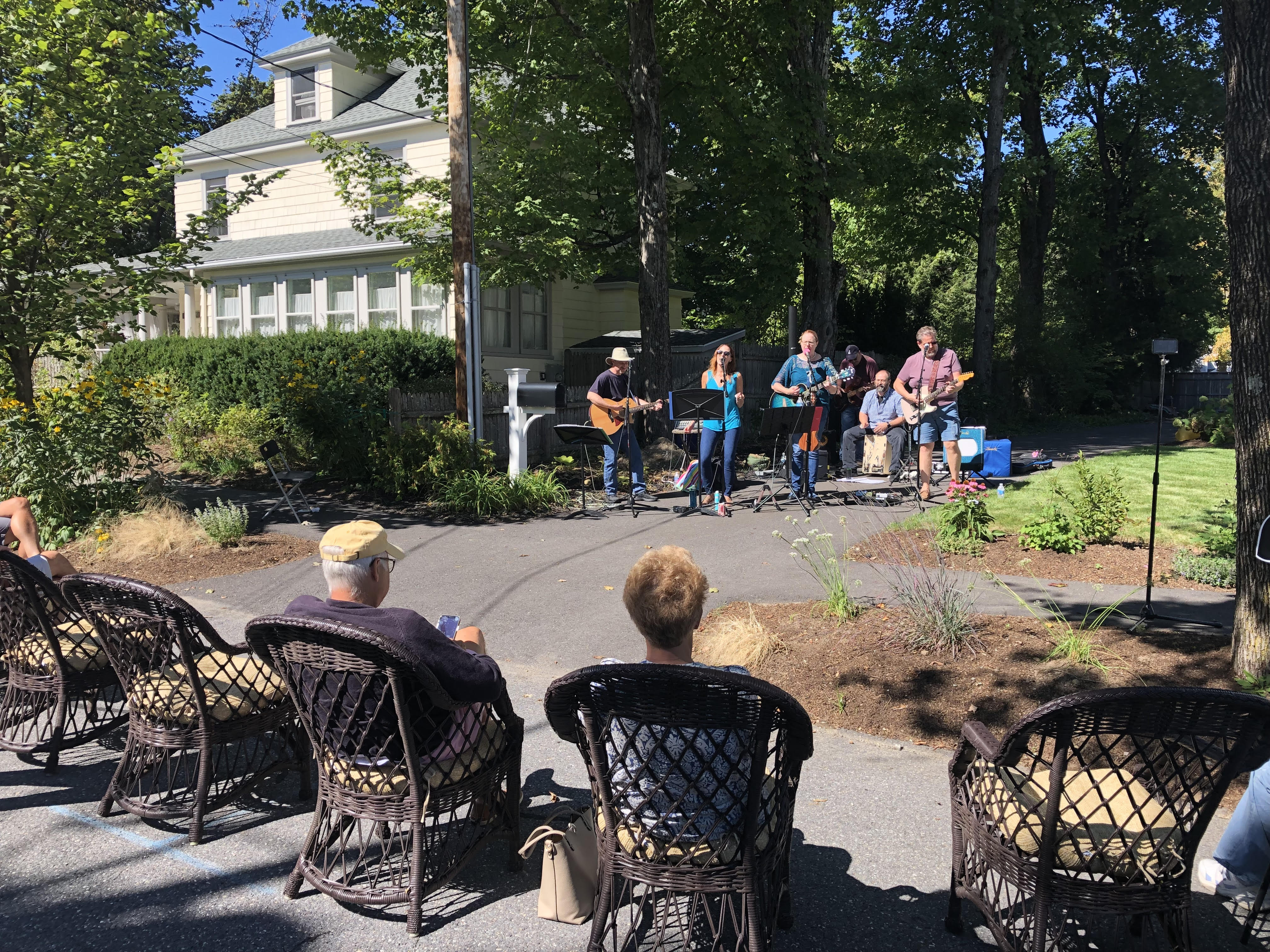
Porchfest events in Massachusetts towns promote neighborliness.

When Sara and I traveled together at age 16, one of the many things I learned from her was that it was perfectly fine to be friendly to strangers under some circumstances. You know, for example, how women who don’t know each other may strike up a conversation in a restaurant ladies room? That’s the kind of thing that was a revelation to me.

Nowadays, some folks have gotten more wary. Too wary. It is one factor in an epidemic of loneliness.

Sophie Hills  writes at the Christian Science Monitor, “Lida and Mark Simpson sit on the steps of their porch with friends while the blues rock band Red Medicine plays in a yard across the street. People crowd all four corners of the intersection, dancing and chatting. It’s PorchFest in Petworth, a neighborhood of Washington, D.C. Some 100 performers will play on porches and yards throughout the day. A new group of people walks up, searching for space with a view of the band. ‘Sit, sit,’ says Ms. Simpson with a big smile, gesturing toward the wall at the edge of the yard.

“The Simpsons, who have a 4-year-old and a 6-year-old, chose Petworth because it’s walkable, close to restaurants and playgrounds and public transit, and still has a neighborhood feeling. When they first moved in eight years ago, Ms. Simpson says she hoped for an active front porch culture. But it didn’t quite coalesce until people began socializing from their yards in 2020. Happily, says Ms. Simpson, ‘porch and stoop culture restarted during the pandemic, and it’s stayed around.’

“[This spring], the U.S. surgeon general declared an epidemic of loneliness and isolation, saying that 1 in 2 adults reported experiencing loneliness even before the pandemic. At a time when neighborliness is decreasing and Americans are growing further apart, some, like the Simpsons, are intentionally building relationships within their communities. And events like porch fests are growing in popularity. Central to a culture of neighborliness, many say, are front porches. …

“ ‘As it has built for decades, the epidemic of loneliness and isolation has fueled other problems that are killing us and threaten to rip our country apart,’ wrote Surgeon General Vivek Murthy in the New York Times on April 30, announcing a framework to rebuild community. …

“A front porch is a liminal space, says Michael Dolan, a writer and editor in Washington. ‘It’s the outside of the inside and the inside of the outside. … When people who have [porches and stoops] don’t use them, they’re missing out on the opportunity to interact with the environment. [And] the environment includes humans and includes passersby, includes somebody coming up to ask directions, includes somebody coming by to say hello.’

“The type of neighborliness embodied by Mister Rogers is no longer the norm. Over half of Americans say they only know some of their neighbors. … Over half of Americans who say they know some of their neighbors say they never get together socially, according to a Pew study from 2019.

“It takes curious and open people to build the kind of community that has block parties, borrows ingredients, and watches each other’s kids, but social spaces like front yards and porches are important too, says [Campbell McCool, founder of a Mississippi development that centers community life]. ‘A front porch is central to the whole personality of a neighborhood,’ he says. …

“Historically, Mr. McCool says, three things sped the decline of the front porch in suburbia in the 1950s: air conditioning, television, and the car. Air conditioning and TV coaxed people indoors. Cars meant more people lived further apart from each other.

“When sociologists began studying differences between residents in neighborhoods with and without porches, they found that in the latter there was little to no interaction. People drove straight into their garages, and private backyard decks grew in popularity. …

“Today, polls show that older Americans are more likely to have neighborly connections. Just 4% of Americans over 65 say they don’t know any of their neighbors, compared with 23% of adults under 30. …

“Karen Goddard, who prefers porches to private decks, calls herself a ‘professional porch sitter’ in her attempt to make neighborliness popular again. …

“The point, Ms. Goddard says, is to meet on front porches without agendas, minutes, or formality – ‘just meeting and conversation.’

“It resonated with Ms. Goddard as something she was already doing. ‘My friends in my neighborhood in New Hampshire knew that they could come to my house any Friday night and hang out on the porch,’ she says. …

“ ‘I like to smile and make eye contact and say “hello” if possible, because I just think that’s important for human connection and for neighbors.’

“The porch has always been a place of social interaction, says Mr. Dolan. That’s been his experience for the four decades he’s lived in the Palisades neighborhood of Washington, where he says neighborliness shines. …

” ‘I like to answer my door and say hello to the people who come to my house,’ he says. ‘[One gains] the feeling of trust in the neighborly compact, the ability to rely on one’s neighbors and call one’s neighbors. … Or even if your neighbors bother you, … you tolerate them because they’re neighbors. So it’s a sense of place that reinforces your feeling of being part of something.’ ”

More at the Monitor, here. No firewall. Subscriptions welcome.

Photo: Erika Page.
The Christian Science Monitor says, “An Afro-Uruguayan rhythm may be traced back to slavery, but it’s transcending present-day divisions and differences to spark joy across Uruguay.” This group performed in Barrio Sur, Montevideo, in March.

There is a kind of street music in Uruguay that is wildly joyful and welcoming to all kinds of people. It’s called candombe.

Erika Page reports at the Christian Science Monitor, “One by one, the drums unite from every direction. Slung over shoulders, cradled by old-timers, and clasped on either side by children, they meet on a corner in the Montevideo neighborhood of Barrio Sur.

“The pulse begins sporadically, an unorchestrated call to gather. Those perched on curbs and leaning against cars perk up and wander over. By the time the Uruguayan flag takes to the air, waving from one side of the street to the other in the hands of a proud bearer, the drums are thumping in perfect unison. Dancers give life to the beat as they lead the parade down the block.

“This is candombe, a distinctly Uruguayan rhythm brought into being by the descendants of enslaved Africans who arrived at the port of Montevideo in the 18th century. Today that lineage is celebrated loudly and triumphantly, with this event marking the end of the Carnaval season. Wherever candombe goes, it makes visible a culture long left out of mainstream Uruguayan society.

“In the past few years, interest in candombe has boomed both within Uruguay and abroad. While some worry popularity could water down the tradition’s richness, those in the community say this beat belongs to everyone, and all are invited to make it their own.

“ ‘For us, it doesn’t matter your ethnicity, your skin tone, your age, your gender, if you have three university degrees, or if you never finished high school,’ says Wellington Silva, who has led this troop, one of the city’s most revered, alongside his brother since their father passed away. ‘The drums bring joy, they open channels of communication, they turn us into brothers and sisters.’

“As the sun dips out of sight, the division between procession and observers fades. Dancers, shy at the start, now twist their hips and kick out their feet as children weave in and out of the crowd making its way down the iconic Isla de Flores street. …

“ ‘Anyone who happens to pass by is bound to hear and to want to know more,’ says Álvaro Salas, the director of culture at the nonprofit Mundo Afro, which focuses on the visibility and rights of the Afro-Uruguayan population. ‘That’s the most natural part of being human. We have to love joy.’

“There are three main styles of candombe in Montevideo. … Cuareim 1080, was born on this very block, named after the historic address of the building where the parade convenes. [It] used to be a tenement where the city’s poor lived, including Mr. Silva’s father. 

“The practice of candombe had faded in the late 19th and early 20th centuries but found a new home in these communal living spaces. In the late 1970s, this and other conventillos, as the tenements were known, were cleared by the military dictatorship in an effort to make the center of Montevideo more attractive.

“ ‘They pick you up and throw you out, and what happens? You expand,’ says Dr. Salas. ‘Today, there is candombe in every neighborhood in Uruguay.’ …

“Afro-Uruguayans make up around 10% of the Uruguayan population and are three times as likely to live in poverty as white Uruguayans. But members of the candombe community say their music is a celebration rather than a protest.

“Fernanda Rossana was a kid when her family’s home in the Ansina conventillo was razed. She spent the rest of her childhood on the outskirts of town. These days she is a proud participant of the Ansina candombe troop and is here dancing in support of her husband, a member of Cuareim 1080.

“ ‘That’s candombe – not losing our essence or our roots,’ she says, dressed in bright orange. ‘It’s demonstrating that we are free.’ …

“For Mr. Silva, the leader of Cuareim 1080, candombe is a way of life open to anyone, whether they are of Afro-Uruguayan descendence or not. Everyone is welcome, he says, ‘as long as you understand that your freedom ends where another’s freedom begins, you always extend a hand, and you always greet your neighbor. When you have something someone needs, you offer it, and when you need something, come, because someone will provide it.’ ” 

More at the Monitor, here. No firewall. Subscriptions are encouraged.

Photo: Jay Thakkar.
A worker examines a wooden beam in a traditional Indian kath kuni building. These earthquake-resistant structures lack metal and mortar, allowing them to flex as needed during a tremor.

I keep learning about ancient construction techniques that beat modern ones. Remember the post about self-healing concrete, here? That was in Rome. Today’s story explains why some buildings in Turkey and Syria withstood the earthquakes in February and points to ancient buildings in northern India.

Shoma Abhyankar writes at Nautilus, “The powerful 7.8 magnitude earthquake that struck Turkey and Syria on February 6 killed almost 50,000 people, most of whom died under rubble.

“The tragedy falls in a decades-long history of outsized death and destruction from recent earthquakes: The 1999 İzmit earthquake near Istanbul killed at least 17,000 people. … The immediate cause of the human tragedies was not the shaking ground itself, but the buildings people were in, most of which were constructed of reinforced cement concrete, a relatively quick and cheap building method.

“Earthquakes don’t have to be so deadly, say scholars who study this issue. Many traditional buildings have stood the test of time in regions that have endured high seismic activity for centuries.

“In Japan, people had long built earthquake-resistant structures mostly from wood. But a different tradition shows that even stone buildings can withstand vigorous shaking — if they are built with clever physics and architectural adaptations, honed over the centuries.

“In the mountainous region of Himachal Pradesh in India, near where the Indian Plate is colliding with the Eurasian Plate, many structures built in the kath kuni style have survived at least a century of earthquakes. In this traditional building method, the name, which translates to ‘wood corner,’ in part explains the method: Wood is laced with layers of stone, resulting in improbably sturdy multi-story buildings.

“It is one of several ancient techniques that trace fault lines across Asia. The foundations for the timber lacing system of architecture may have originally been laid in Istanbul around the fifth century. … Despite their ancient origins, this model of construction has mostly fared better over centuries than much of the contemporary building across the continent’s many active seismic zones.

“Built along the natural contours of the hills, kath kuni buildings typically get their signature corners from giant deodar cedars, which grow upward of 150 feet tall and 9 feet across in the Himalayas. These wooden beams layer between dry stones, which create walls. A single wooden ‘nail’ joins the beams where they come together.

“As the ponderous-looking structures rise vertically, usually up to two to three stories, the heavy stone masonry reduces, giving way to more wood. The overhanging roof typically has slate shingles resting on wooden beams. ‘The structure is like a body with heavy base, the projecting wooden balconies are limbs, and the heavy slate roof is like a head adding stability to the structure,’ says Jay Thakkar, a faculty member at the Centre for Environmental Planning and Technology University in Ahmedabad, India, who co-authored the book Prathaa: Kath-kuni Architecture of Himachal Pradesh

“The buildings stand free of any mortar or metal, which makes them more capable of shifting and flexing along with torques in the ground. This brilliance of mobility even continues underground. They are built over a trench at least a few feet deep filled with loose stone pieces that works as a flexible plinth. While a building constructed out of what seems almost like rubble to begin with might seem a strange defense against earthquake damage, it works. The gravitational force of the structure itself holds the stones in place.

“ ‘Unlike the cement brick wall, which becomes a single solid mass, the dry stone masonry is flexible,’ Thakkar says. ‘Staggered joints allow the external forces like tremors of earthquakes to be dispersed through the masonry thus preventing cracks in walls.’ He adds, ‘The wooden pin at the corner joint of two beams also allows movement. So when an earthquake hits, the structure sways and shakes but doesn’t collapse.’ ”

More at Nautilus, here. No firewall.