Feeds:
Posts
Comments

Posts Tagged ‘architecture’

A friend from my childhood called Caroline has been following this blog, sometimes making comments related to her field, which is architecture.

Today Caroline sent me a link that she knew would be a perfect fit here. The story is about a design competition to address New York City’s rising seawater.

Kayla Devon wrote about it at Builder Online, “In the next 30 years, roughly 30% of Manhattan is expected to sink below sea level, according to a climate study by the NASA Goddard Institute for Space Studies. Instead of trying to stop the inevitable, Brazilian architect Walmir Luz focused on embracing it.

“After studying climate predictions from the United States Landfalling Hurricane Probability Project and the history of Manhattan’s edge, Luz designed a utopian/dystopian future for New York (depending if you’re a glass half-full or half-empty kind of person).

“Luz’s NYC 2050 concept makes flooding a part of city life by taking inspiration from Venice. Luz designed structures as levels that could allow water to move through lower levels as the sea rises. Streets would become permeable so water can wash over the roads instead of flooding them, and more barriers would surround the city’s edges.

“Luz completed the concept as his thesis for his Bachelor of Architecture degree from Cornell University, and won a Silver award in the urban planning and urban design category at the A’Design Award & Competition. He now works as an architect for Gensler.” More at Builder Online.

I love it when people who read the blog come upon topics that they know will fit and then send them along. I like being able to share the cool stuff with a wider audience. Thank you, Caroline.

Design: Walmir Luz
Luz won a design award for a concept making the best of rising sea levels in New York City.

Read Full Post »

A while back, I showed a photo of a very skinny building near my workplace. Now I have some professional photos from the Providence Revolving Fund, and I think they convey the uniqueness of this building better than my photograph.

I love how Providence works so hard to repurpose old and interesting buildings. This one is only a piece of an old building. Once condemned, it is now lovely and functional.

Here’s what the Providence Revolving Fund had to say before the dedication in May. “The partnership of David Stem, Lori Quinn and the Providence Revolving Fund announce the completion of the formerly-condemned George C. Arnold Building (built 1923).  The Providence Redevelopment Agency (PRA) also played a pivotal role in the revitalization of this unique building.

“The mixed-use building houses two commercial units (Momo and a soon-to-be-opened [Asian] market) and three residential units.  Two of the units are rented at affordable prices.  The historic building rehabilitation was self-financed by the partnership and utilized Federal and State Historic Tax Credits and City of Providence Home Funds.”

I’ve noticed that most Providence buildings have names and people use the names, as if the buildings were pets. When you call something by its name, it strengthens your bond to it.

I’ve had the teriyaki chicken crêpe at Momo a couple times. Messy but delicious. I’m eager for the Asian market to open.

skinniest-building-ever

051216-Arnold-Bldg-Prov-Revolving-Fund


051216-Arnold-Bldg-Prov-Revolving-Fund2

051216-Arnold-Bldg-Prov-Revolving-Fund-Momo


Read Full Post »

021916-Doorway-takes-flight-Prov


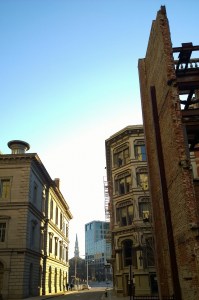
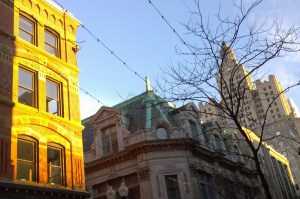
I really like the architecture in downtown Providence, otherwise known as “downcity.” I like that the façades of old buildings are often preserved to enhance next-generation buildings and that some old buildings are adapted in their entirety for new purposes. Even if a building is rather pedestrian, some artist will add a flourish.

And isn’t it great to live in the time of the Internet and be able to find answers to almost anything that’s puzzling? For example, what’s with the guy wearing a turban on one downcity building?

Well, Wikipedia says that in the early nineteenth century, a shopkeeper called “Jacob Whitman mounted a ship’s figurehead above his store. The figurehead, which came from the ship Sultan, depicted the head of an Ottoman warrior. Whitman’s store was called ‘At the sign of the Turk’s Head.’ The figurehead was lost in a storm, and today a stone replica” is found on Turk’s Head Building’s building’s 3rd floor façade.

Wikipedia also notes that when the 16-story building was completed in 1913, it was the tallest in the area and considered a “skyscraper.”

021816-distant-steeple

021816-facade-Providence


021716-walk-this-way

021816-Turks-Head-Providence

Read Full Post »

I checked Gwarlingo not long ago to catch up on Michelle Aldredge’s thorough, sensitive meditations on art and literature.

What caught my attention was her review of a movie about restoring an old house in Japan.

“It is rare to find a film that is pitch-perfect in its cinematography, story, pacing, and length,” Aldredge writes, “but Davina Pardo’s short film Minka is such a gem. (I owe writer Craig Mod a thank you for turning me onto this quiet masterpiece.)

“Based on journalist John Roderick’s book Minka: My Farmhouse in Japan, the film is a moving meditation on place, memory, friendship, family, and the meaning of home. Most remarkable, this haunting story plays out in a mere 15 minutes.

Minka is the Japanese name for the dwellings of 18th-century farmers, merchants, and artisans (i.e., the three non samurai-castes), but as Wikipedia explains, this caste-connotation no longer exists in the modern Japanese language, and any traditional Japanese style residence of an appropriate age could be referred to as minka. The word minka literally means ‘a house of the people.’

“The story of how AP foreign correspondent John Roderick and his adopted Japanese son Yoshihiro Takishita met, and then rescued a massive, timber minka by moving it from the Japanese Alps to the Tokyo suburb of Kamakura is full of small surprises and revelations (the biggest one comes at the end of the film).

Minka is a film that celebrates stillness. Pardo’s camera lovingly lingers on sun, shadows, and dust. But the peaceful home is not just a restored space full of beautiful, personal objects, it is also an expression of the deep connection between Roderick and Takishita and of familial love.”

Read about that at Gwarlingo, where the filmmaker will let you watch the entire 15-minute movie.

Photo: Davina Pardo & Birdlings LLC
A still from the film
Minka

Read Full Post »

The first pictures feature berries, shadows, rain, and snow. I took them in Massachusetts.

The others are from Providence, which has long exuded an artistic vibe. I liked the sunrise on rooftops in one photo and a beautiful ornate building, sadly neglected. More-contemporary art pops up in unexpected places: the robot-like sculpture at a busy intersection and the robot in the ladies room at Small Point Café.

011716-shadow-berries

011616-raindrops-on-holly


011816-snow-on-hollu

011916-Providence-sculpture


011216-early-sunlight-Providence-_Pro

012016-beautiful-neglected-building


012016-WC-Robot

Read Full Post »

John sent a link to an Atlantic article by Rose Eveleth on how mosses and lichens are being using in building design.

“For most architects,” she writes, “moss and lichen growing up the side of a structure is a bad sign. … But a new group is trying to change all that. Instead of developing surfaces resistant to moss and lichen, the BiotA lab wants to build facades that are ‘bioreceptive.’“BiotA lab, based in University College London’s Bartlett School of Architecture, was founded last year. The lab’s architects and engineers are working on making materials that can foster the growth of cryptograms, organisms like lichens and mosses. The idea is that ultimately they’ll be able to build buildings onto which a variety of these plants can grow. Right now, they’re particularly focused on designing a type of bioreceptive concrete.

“Marcos Cruz, one of the directors of the BiotA lab, says that he has long been interested in what he sees as a conflicted way of thinking about buildings and beauty: ‘We admire mosses growing on old buildings, we identify them with our romantic past, but we don’t like them on contemporary buildings because we see them as a pathology,’ he says. …

“Richard Beckett, another director of the BiotA lab, says that he’s interested in the project flipping the usual way that buildings are designed, at least in a small way. “Traditionally architecture is a top-down process, you decide what the building will look like, and then you build it. Here we’re designing for a specific species or group of species …

” ‘Every architect you speak to talks about the skin of the building,’ says Beckett. … Instead of skin, the lab wants people to think of the exterior of a building as bark. ‘Not just a protective thing, a host; it allows other things to grow on it, it integrates as well.’ ” More here.

I love the concept, but the story left me wondering what the designers’ main motivation might be. They say it’s not about green and sustainable buildings. It seems to be about aesthetics, being “attractive.” They do want the mosses to be self-sustaining and the look to be purposeful.

Photo: Dinodia/Corbis

Read Full Post »

Dezeen magazine has an article on an apartment building in Australia that seems to change color depending on your viewing angle.

“The triangular window bays that project from the facade of this Sydney housing block by MHN Design Union appear either red or yellow, depending on the viewing angle.”

The apartment block was designed “for local developer Crown Group on a plot in Waterloo, a former industrial area that is gradually being redeveloped into a residential neighbourhood.

“The architects based the design of the facade on the sculptures of Yaacov Agam, an Israeli artist who is known for his brightly coloured kinetic and optical illusion works – which also influenced a series of rugs by London studio Raw Edges. …

“The building’s form tapers to a point at the rear, creating triangular floors that range from 10-high at the front to seven at the back. …

“The building is shortlisted for two awards at this year’s World Architecture Festival, which will be held in Singapore at the beginning of November.” More here.

Photo: John Gollings

Read Full Post »

What would it be like to live in an earth dome? The California Institute of Earth Art and Architecture (Cal-Earth) can help you check out the concept for a day or a weekend or the 12-15 weeks it will take to teach you to build a dome home. Maybe you’d rather settle for building just a “rocket stove mass heater.” Cal-Earth can teach you to do that, too. Hesperia, California, is the place. (Although Cal-Earth’s mailing address is Claremont, near Suzanne’s alma mater.)

From the website: “Superadobe technology was designed and developed by architect Nader Khalili and Cal-Earth Institute, and engineered by P.J. Vittore. Superadobe is a patented system (U.S. patent #5,934,027) freely put at the service of humanity and the environment.”

The television station KCET has more. Reporter Kim Stringfellow says, “As a humanitarian, architect and teacher, Khalili developed the Superadobe building technique incorporating a tubular sandbagging system filled with locally sourced earth that are reinforced with a barbed wire technology and stabilized lime, cement, or asphalt that is locally produced. Dwellings can be used temporarily or may be stabilized, waterproofed, and finished with plaster to create a permanent building. Originally from Iran, Khalili’s structures and building techniques are inspired and informed by centuries of earth building found throughout the Middle East and North Africa. He also is known for his Geltaftan Earth-and-Fire construction system which as also known as Ceramic Houses. ”

Tell me this is not a hobbit house.

Photo: Geoff Lawton 

Read Full Post »

Photo: Fernando Guerra | FG+SG

ArchDaily has published the editorial team’s choices for best houses of 2014. Some of the houses are widely fanciful, like storybook dwellings. Be sure to look at them all.

The magazine says, “For another year, in 2014 ArchDaily has featured hundreds of houses from designers around the globe, with homes that appear to float above ground, sink below grade, snake through forests, jut over cliffs, and blur the line between building and environment.

“This year, we’ve seen some of the most intuitive, outlandish, and creative designs cropping up around the world, from São Paulo to Ho Chi Minh City to Stockholm, and to celebrate the end of the year we’ve rounded up our 50 best projects from 2014, representing an incredible range of living environments from the world’s most innovative architects.

“Enjoy the sandy surrounds of House in Miyake or the minimalist paradise of Love House; or escape for a getaway to Weekend House in Downtown São Paulo. Find out which houses stray from the norm, reviving the wooden cottage and redefining the stone cabin with a touch of linearity and serious panoramic views. Step inside wondrous spaces that soar skyward or connect with the earth, speak to the divine or convene with the spiritual – and yet all share the unmistakable feeling of ‘home.’ ”

See the amazing houses here.

Architecture on the Stockholm page includes homes, apartment complexes, and the public library. Perhaps a Swedish reader will be familiar with a few of them.

Read Full Post »

You have heard of “slow food” and perhaps “slow money” (a loan with a long time to pay back) and other efforts designed to help us reduce the often meaningless haste of modern life. Well, Cousin Claire has been posting news on Facebook about another slow movement that is sure to intrigue you, Slow Textiles.

Says Slow Fiber Studios on its About page, “We are founded on a simple intention: to offer real-world insight into the multifaceted and holistic practice of textile-making. Slow Fiber Studios™ offers dynamic, hands-on field study programs in diverse areas of the world where textile culture runs deep — India, Mexico, Japan, France, Italy, and on. We believe the best way to understand a philosophy is to see it being lived.”

Here is a description of a 2012 offering: “Special opportunity to travel throughout India with Yoshiko, who has been exploring this country for over 30 years (lived in Ahmedabad in 1983/84 on an Education & Culture Fellowship and frequent 3-month residencies spanning 3 decades). Yoshiko will introduce her friends in India who are involved in welfare, community empowerment, and cultural sustainability projects.

“Tour Highlights: natural dyes, organic cotton cultivation, handloom weaving, khadi, biodynamic farming, architecture, local food and religion, contemporary art and design educational institutions, museums, solar energy development, hand spinning and weaving wild silks and Tibetan wool in Himalayan communities.” More here.

How well I remember the wistful feeling I got in reading the book Lark Rise to Candleford when the beautiful handmade lace was spurned as soon as the factory-made came in. There is something to be said for speed and efficiency, but also something to be said for craft.

Photos: Slow  Fiber Studios

Read Full Post »

Back in June, Jane Devlin tweeted a link to a story on a curious “urban algae canopy” designed for EXPO 2015 in Milan.

Ross Brooks wrote at Inhabitat, “The Urban Algae Canopy by ecoLogic Studio is a piece of bio-digital architecture that combines micro-algal cultures and real time digital cultivation protocols. To be displayed at Expo Milano 2015, the structure is able to control the flow of energy, water and carbon dioxide based on weather patterns, visitors’ movements, and other environmental variables. It’s the first of its kind in the world, and … will be able to produce the oxygen equivalent of four hectares of woodland, along with nearly 330 pounds of biomass per day.” More at Inhabitat.

DOMUSweb adds that Claudia Pasquero and Marco Poletto of ecoLogicStudio “proposed a new vision of future bio-digital architecture powered by microalgae organisms as part of the Future Food District project, curated by Carlo Ratti Associati at the central crossroads of the EXPO site. …

“The flows of energy, water and CO2 are … regulated to respond and adjust  to weather patterns and visitors’ movements.  As the sun shines more intensively, algae would photosynthesise and grow, thus reducing the transparency of the canopy and increasing its shading potential.” More from DOMUS.

Photo: ecoLogicStudio
Urban Algae Canopy

Read Full Post »

On the whole, I believe in having zoos, but I do realize most of the animals would rather not be there.

So I was interested in a zoo concept that was tweeted this week by @SmallerCitiesU. It’s an article about a plan for a zoo in Denmark.

At Good magazine, Caroline Pham asks, “Is there an ethical way to publicly display captive animals? Danish architecture firm BIG (Bjarke Ingels Group) is on a mission to answer that question with a hefty redesign of Denmark’s Givskud Zoo. …

“Their recently revealed plans for what has been dubbed ‘Zootopia’ attempt to mesh nature with inventive design in a 1,200,000 square meter park imagined under advisement from the zoo staff. Manmade buildings would hide within the constructed natural environments and animal habitats would mimic ones found in the wild as much as possible.

“Renderings showcase a circular central plaza with an ascending ramp-like border where visitors can enjoy panoramic views of the entire park, which features varying natural environments (that seem to be fairly open-air) connected by a four-kilometer hiking trail. …

“The project is currently in progress, with the first phase set for completion in 2019.” More here.

Photo:  Bjarke Ingels Group

Read Full Post »

What happens to the buildings, some of them by great architects, after a World’s Fair is over?

Jade Doskow at Jade Doskow Photography wants to save them. She is part of a group that might save at least one.

From her website: “April 2014 marked the 50-year anniversary of the New York World’s Fair, part of which is the iconic New York State Pavilion, designed by Philip Johnson, one of the most revered architects of the last 100 years.

“Famously described by Ada Louise Huxtable as ‘carnival with class,’ the Pavilion is in serious need of renovation before it deteriorates further. In Doskow’s two large-scale photographs of the New York State Pavilion both the grandeur and the decay of this magnificent structure are readily apparent.

“People for the Pavilion (PFP) is a volunteer-run advocacy organization whose mission is to develop a vibrant community around the structure, and to ultimately preserve and develop a sustainable reuse plan for it.” More here.

Musée magazine writes that Doskow’s interest in the afterlife of World’s Fair buildings extends beyond New York: “Onishi Project Gallery presents Jade Doskow’s ‘World’s Fairs: Lost Utopias,’ for the 50th anniversary of the 1964 New York World’s Fair. Her seven-year project captures the memory of the fair by documenting the architecture and grounds left behind. The images hold a melancholy feeling about people and the spaces they no longer use, while displaying the fun atmosphere of the memories retained in these dormant structures.”

See Doskow’s photos of other World’s Fairs, including Buckminster Fuller’s dome in Montreal, here. 

Photo: Jade Doskow
New York 1964 World’s Fair, “Peace Through Understanding,” New York State Pavilion

Read Full Post »

If you like trompe l’oeil painting — that sleight of hand that makes you think you are seeing one thing when it’s really another — you will love “invisible” architecture.

Writes Mallika Rao at the Huffington Post, ” ‘Invisible’ architecture isn’t a novel concept … But it’s an evolving one. Given the pace of technological change, an architect is never done finding fresh ways to make a building disappear.”

Consider the picture below.

“The revelation is the technology the architects chose not to use,” says Rao. “No fancy LEDs or futuristic materials are needed to build “Invisible Barn,” as the parallelogram-shaped structure pictured in Socrates Sculpture Park is known. The brainchild of the New York-based architecture firm stpmj, it’s designed to be made of wood and sheeted with mirror film, at a cost of $5,000.

“The idea is to ‘blur the perceptual boundary’ between object and setting, according to a statement sent by the architects to The Huffington Post. Niches built into the structure mean the experience changes the closer you get — up close, you can see where true birch trees turn into reflected ones. …

“If it seems whimsical, that’s because the idea was hatched for the Folly contest, an annual event held by the Architectural League of New York. The name references the age-old concept of the ‘architectural folly,’ a fanciful, small building typically set in a garden as a conversation starter.” More here.

Photo: stpmj, an architecture firm

Read Full Post »

Photograph: Devesh Uba
Grocery store in Makoko, Lagos, Nigeria.

A recent manmade-island story in the Guardian made me think of Francesca Forrest’s lovely novel Pen Pal, which involves a girl in a floating community in the U.S. South who corresponds with a political prisoner in Asia.

The Guardian article, however, is about designers and architects building islands for populations threatened by rising seas.

Jessa Gamble writes, “It may seem like science fiction, but as rising sea levels threaten low-lying nations around the world, neighbourhoods like [the Yan Ma Tei breakwater in Hong Kong’s Causeway Bay, where residents live in boats] may become more common.

“Whereas some coastal cities will double down on sea defences, others are beginning to explore a solution that welcomes approaching tides. What if our cities themselves were to take to the seas? …

“The immediate and most numerous victims of climate change are sure to be in the developing world. In Lagos, the sprawling slum of Makoko regularly suffers floods, and its stilted houses are shored up with each new inundation. It’s under threat of razing by authorities.

“The Nigerian-born architect Kunlé Adeyemi proposes a series of A-frame floating houses to replace the existing slum. As proof of concept, his team constructed a floating school for the community. Still, many buildings do not make a city: infrastructure remains a problem here. One solution would be to use docking stations with centralised services, rather like hooking up a caravan to power, water and drainage lines at a campground.” More.

It all sounds like Noah building an ark. But I can’t help thinking it would be better to end global warming in the first place.

Photograph: Seasteading Institute, by way of the Guardian
The Seasteading Institute proposes a series of floating villages.

Read Full Post »

« Newer Posts - Older Posts »