Feeds:
Posts
Comments

Posts Tagged ‘art’

The other day I was walking past the Emerson Umbrella and saw some new sculptures  on the lawn. I thought one, the graceful bent metal below, looked like two people dancing.

Geoff Edgers of the Boston Globe came to town to watch the installation and interview the sculptor, David Stromeyer.

“Stromeyer, a Marblehead native who splits his time between Vermont and Texas, has had his work shown at, among others, the deCordova Sculpture Park and Museum in Lincoln, National Building Museum in Washington, D.C., and the University of Vermont’s Robert Hull Fleming Museum, in Burlington. Stromeyer also has a connection to Concord. His sister-in-law, Mimsey Stromeyer, is a painter and mixed-media artist who is one of 54 artists renting space at Emerson Umbrella. …

“On the first day of installation, in the rain, Stromeyer and crew unloaded the steel pieces. The first challenge was lifting the heavy steel pieces over a series of wires on the site. On the second day, with the sun out, the artist worked on moving those pieces into place and mounting them properly. …

“He takes pride in the fact that he creates his art, from the twisting of the metal to the sandblasting and painting.

“ ‘It sounds really simple, but you don’t grab one end and turn it in the way you intuitively might think,’ he said. “[Each piece has] to be built incrementally, every inch, bending it in multiple directions at once. I spent two months building jigs for the hydraulic press to create those forms. And each twist is different.” More.

I’ve known Mimsey West (her professional name) for 30 years. One of her sons was in school with John. I love her art, especially some slightly abstract watercolors she did years ago of sheep in Wales.

A couple times a year the Umbrella artists hold open studios, and it really is a treat to go — lots of art available for one-of-a-kind holiday gifts.
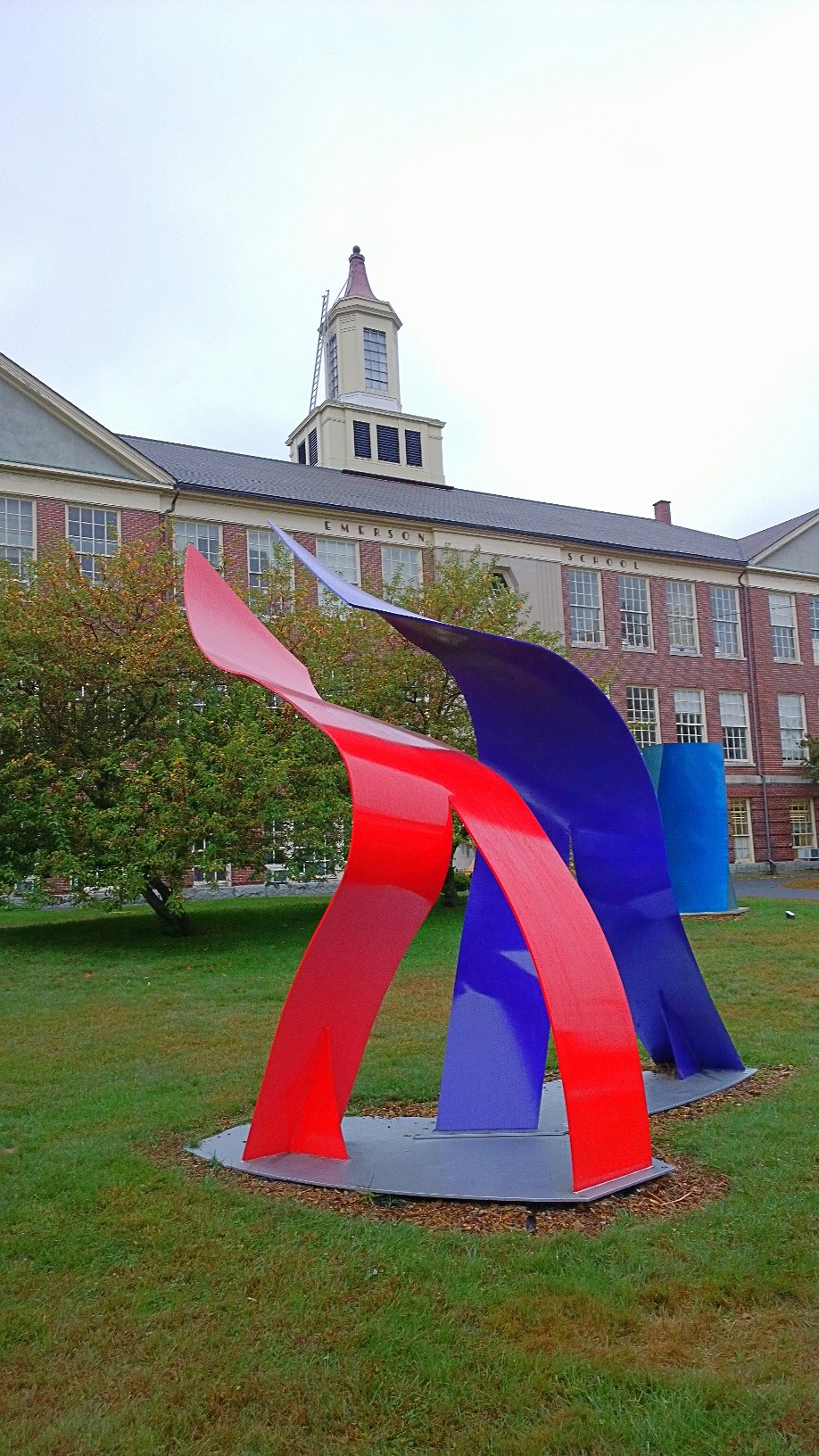
waltz-of-the-sculptures

Read Full Post »

Someone tweeted this today, and I thought you would like it.

Chinese artist Ai Weiwei has created a nighttime art installation made of bicycles all lit up.

On October 5, says Alice at the website My Modern Met, “Chinese artist and activist Ai Weiwei presented a new version of his incredible Forever Bicycles installation. As the centerpiece of this year’s Scotiabank Nuit Blanche, the all-night contemporary art event that takes over city streets, 3,144 bicycles, the most Weiwei has used of this work to date, were stacked 100 feet in length and 30 feet in height and depth in Toronto’s Nathan Phillips Square. This was the first time the installation has been displayed in an open air, public space. Since this was a night-time festival, it was spectacularly lit up with pink and blue lights.”

Check My Modern Met for a stunning array of photos, here.

Photo: http://www.mymodernmet.com

Read Full Post »

Here’s a lovely story by Bella English at the Boston Globe.

Like many other people who feel helpless after a tragedy, illustrators of children’s books wanted to do something useful last April 15 and were delighted to be asked to give their talents.

“After the Boston Marathon bombings,” writes English, “Joe and Susan McKendry of Brookline wanted to do something. …

“Joe, an artist who teaches at the Rhode Island School of Design, thought he could auction off a couple of paintings he did for his first book, ‘Beneath the Streets of Boston: Building America’s First Subway.’

“But then he realized he had something more valuable: connections to other artists. Why not make it a group project? We Art Boston was born, with dozens of artists contributing paintings or illustrations to the cause: the emergency and trauma fund at Boston Children’s Hospital.

“The fund helps children and families get the treatment they need ‘when faced with a tragedy,’ says Stacy Devine, an associate director with the Boston Children’s Hospital Trust. What began as a response to the Marathon bombings expanded to include all traumatic events. …

“The McKendrys also wanted to hold a community event for children to get more directly involved. On Oct. 20, We Art Boston is hosting a family day on the Rose Fitzgerald Kennedy Greenway, right across from the New England Aquarium.

“All of the donated artwork will be framed and on exhibit, and people can bid on them through volunteers who will place the bids online using iPads. Several of the illustrators will be there and will sign books or, for a donation to the cause, draw portraits of stuffed animals for children who bring their favorite one along.”

More.

Henry Cole’s “Penguin Pride” (l8-by-12 inches, framed) has a value of $550 and a suggested bid of $250.

Read Full Post »

This was posted at an Arlington blog last May, but I just saw the sculpture it refers to.

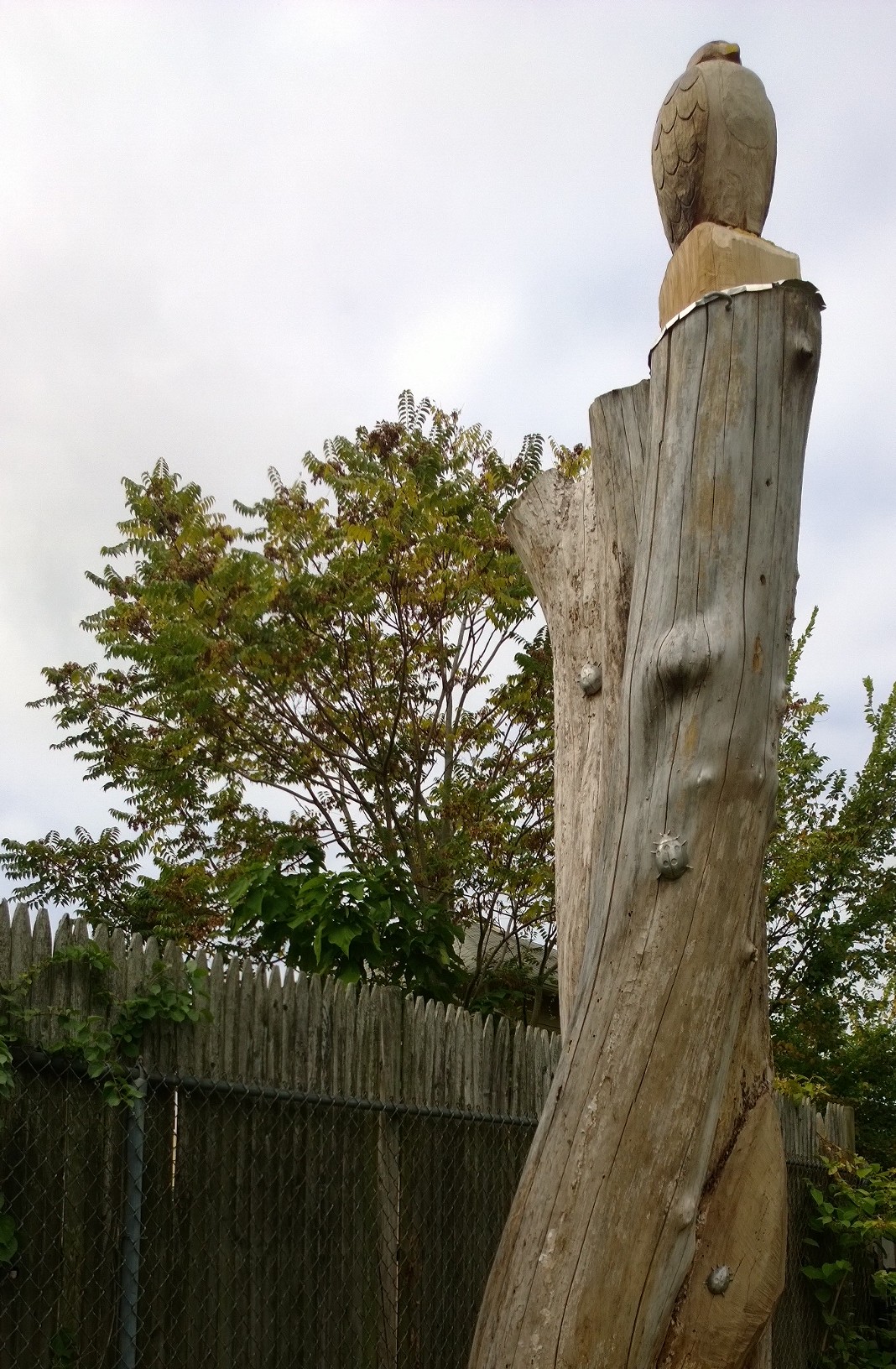
“You are invited to watch the ladybugs for the Waldo Park Tree Sculpture being made right before your eyes … Work by artists has already begun to transform a tall tree stump on the hill in Waldo Park … into multimedia sculpture that features local birds, animals and insects. The Friends of Waldo Park are holding two community participation days as this work is created. …

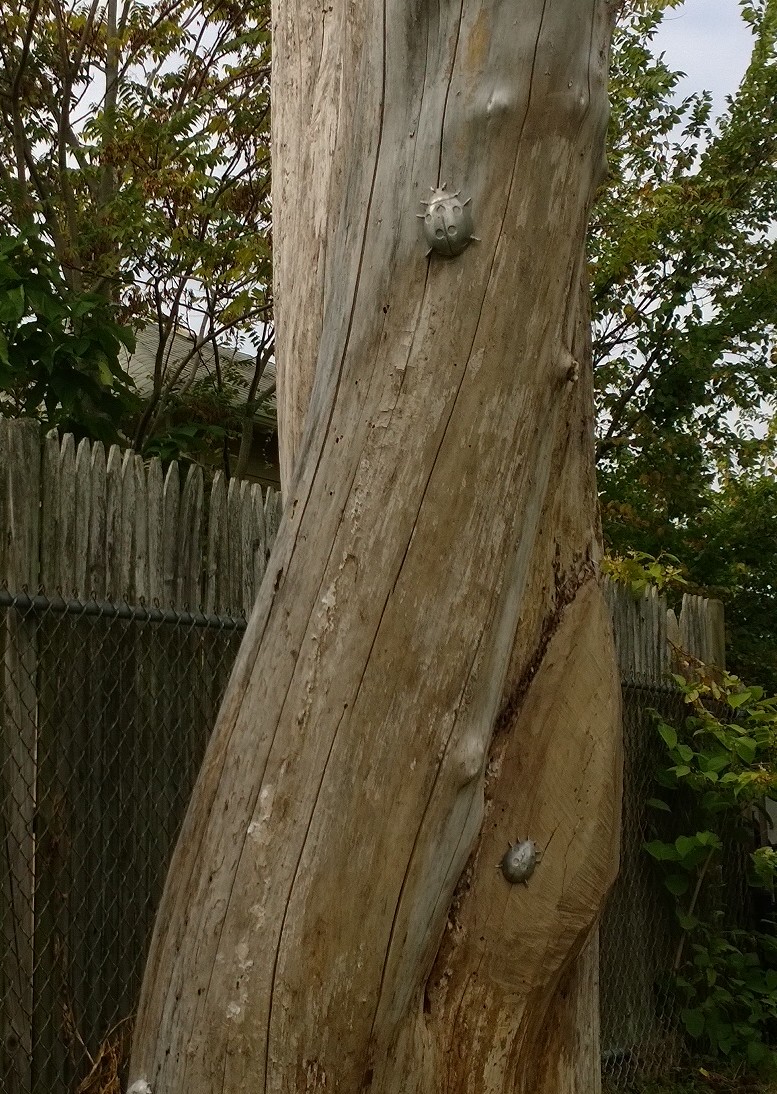
“Watch the metal-smiths at work as they cast aluminum ladybugs to be bolted onto the tree sculpture. Stop by for however long you’d like to see how metal-casting is done!” More.

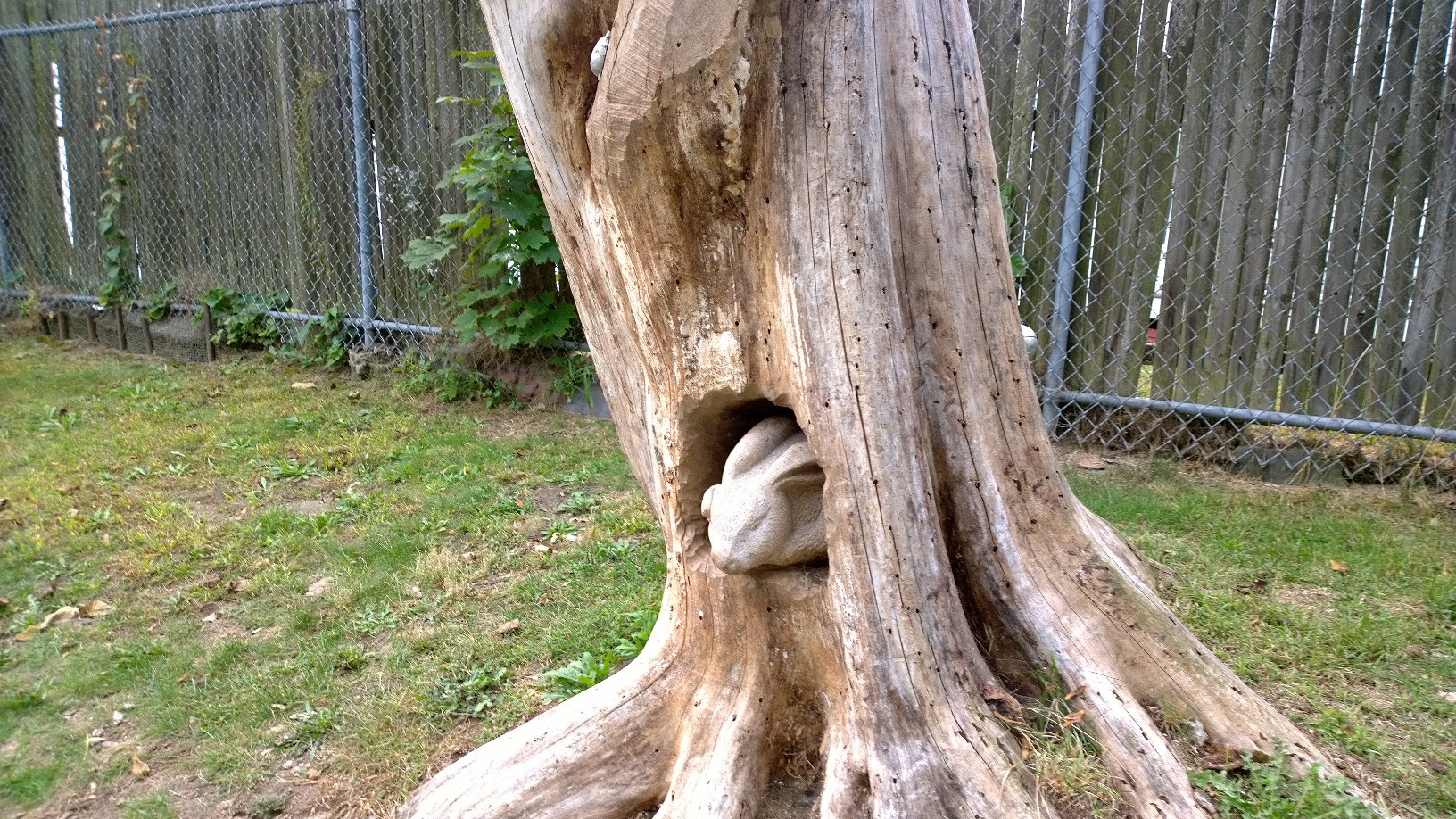
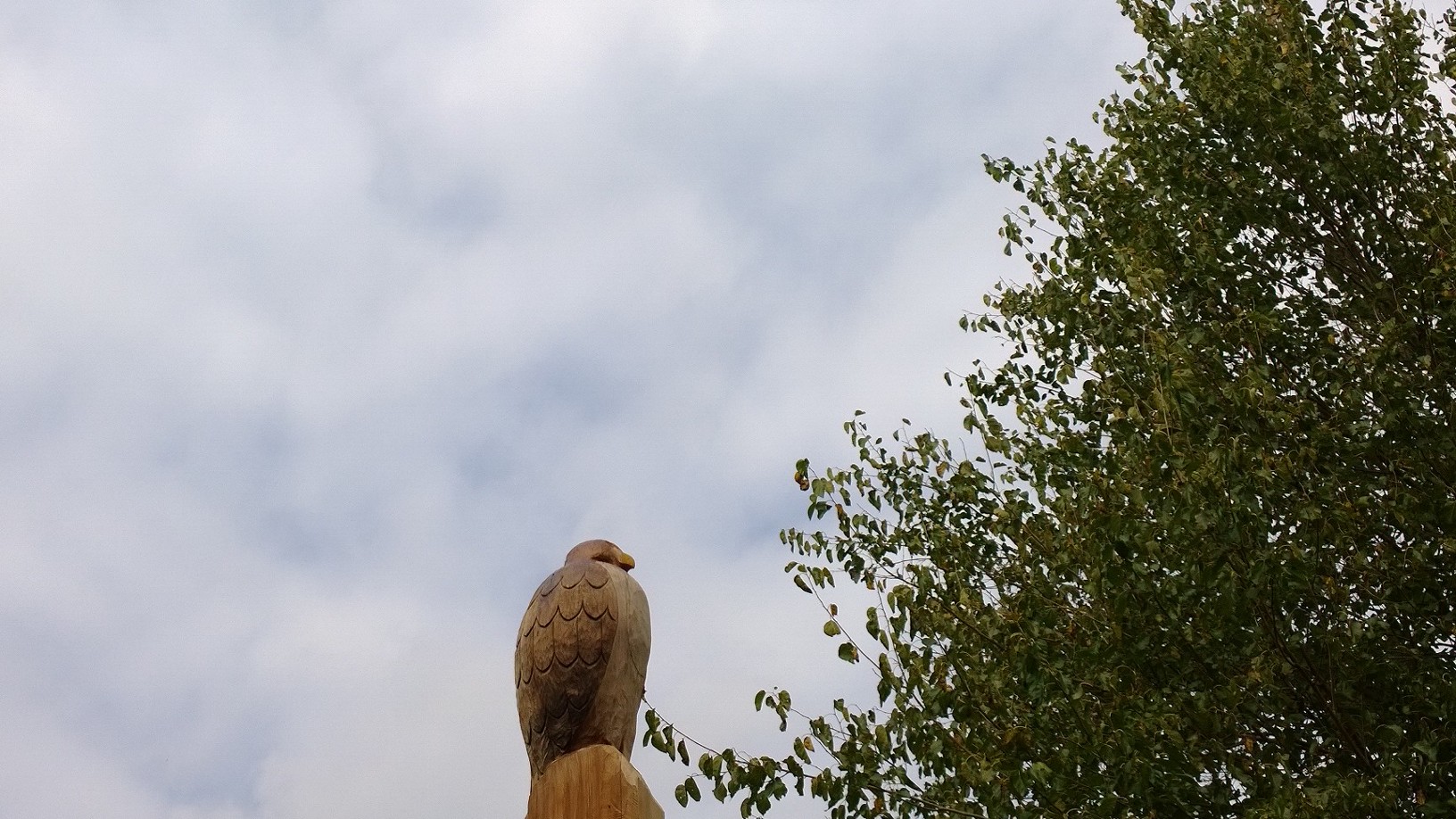
Note the metal ladybugs crawling up the trunk, the bunnies peeking out from inside, and the hawk on top.

carved-hawk-and-metal-bus

bug-close-up

rabbit-in-tree-waldo-park

hawk-carved-from-dead-tree

Read Full Post »

Back in August, the Ideas section of the Sunday Globe had a short piece by Kevin Hartnett on a robot that creates art. Well, a robot that copies art. It’s a discomforting notion.

“When you watch an artist paint,” writes Hartnett, “individual brush strokes can seem random. It’s often not until close to the very end that the image the painter is after becomes clear. This is doubly true when you watch e-David, the robot painter, at work. e-David (the name stands for ‘Drawing Apparatus for Vivid Image Display’) was created by a team of engineers at the University of Konstanz in Germany. It’s a former welding robot that has been retrofitted to reproduce, brush stroke by brush stroke, existing works of art. The robotic arm has access to five different brushes and 25 colors of paint, and after each dab of paint, it takes a photograph of what it has painted so far. Computer software analyzes the photograph and tells e-David where to place the next brush stroke.

“The strangeness of the process is especially evident when e-David signs the art at the end, beginning by making the dot over the ‘i’ and then writing the rest of its name backwards.” More.

Having recently read an amusing novel about the Gardner heist, The Art Forger, I can’t help thinking that e-David could have quite a career — maybe not fooling any experts but at least making serviceable reproductions.

Photo: Oliver Deussen, University of Konstanz
Painting by e-David, a robot

Read Full Post »

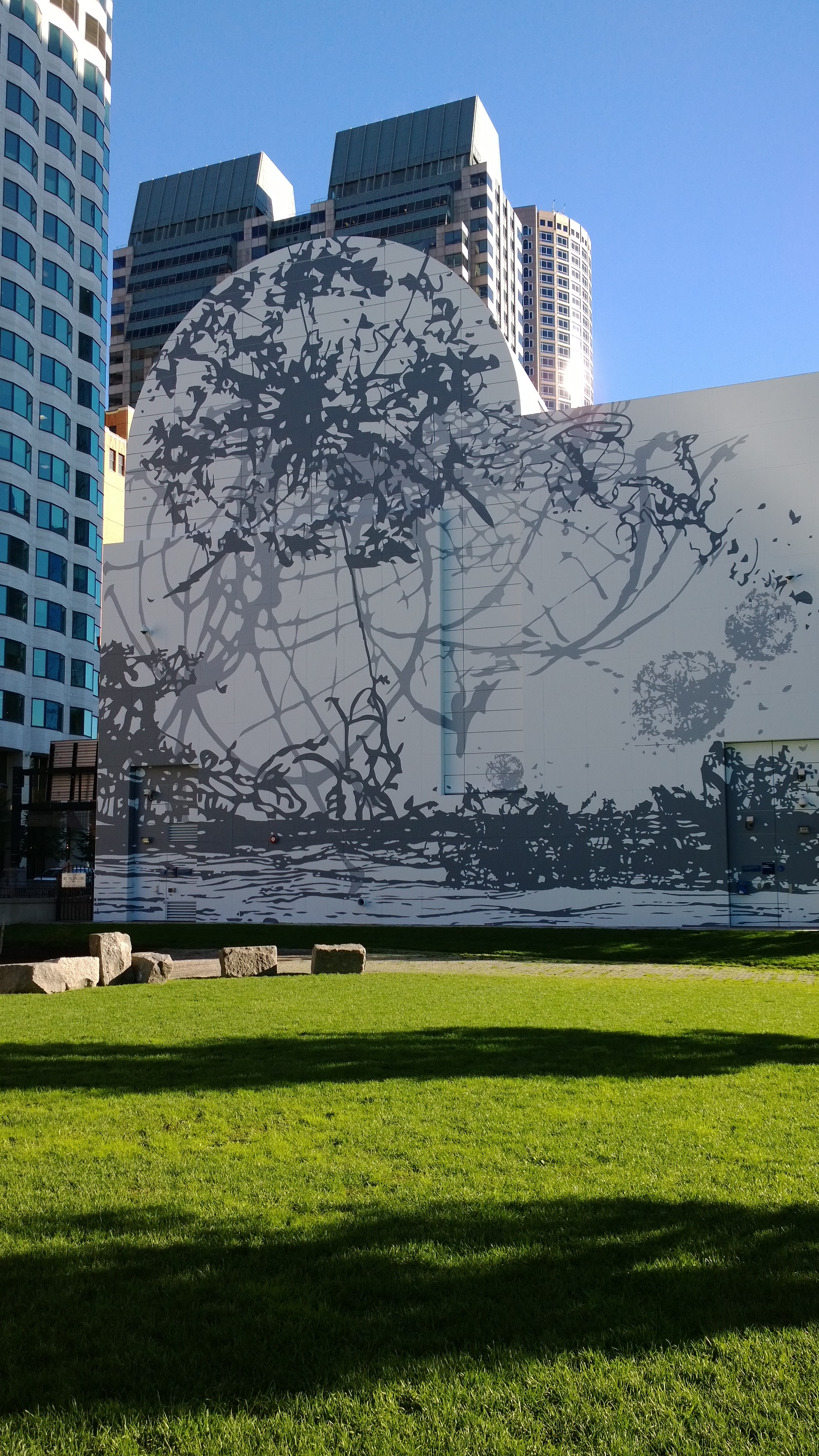
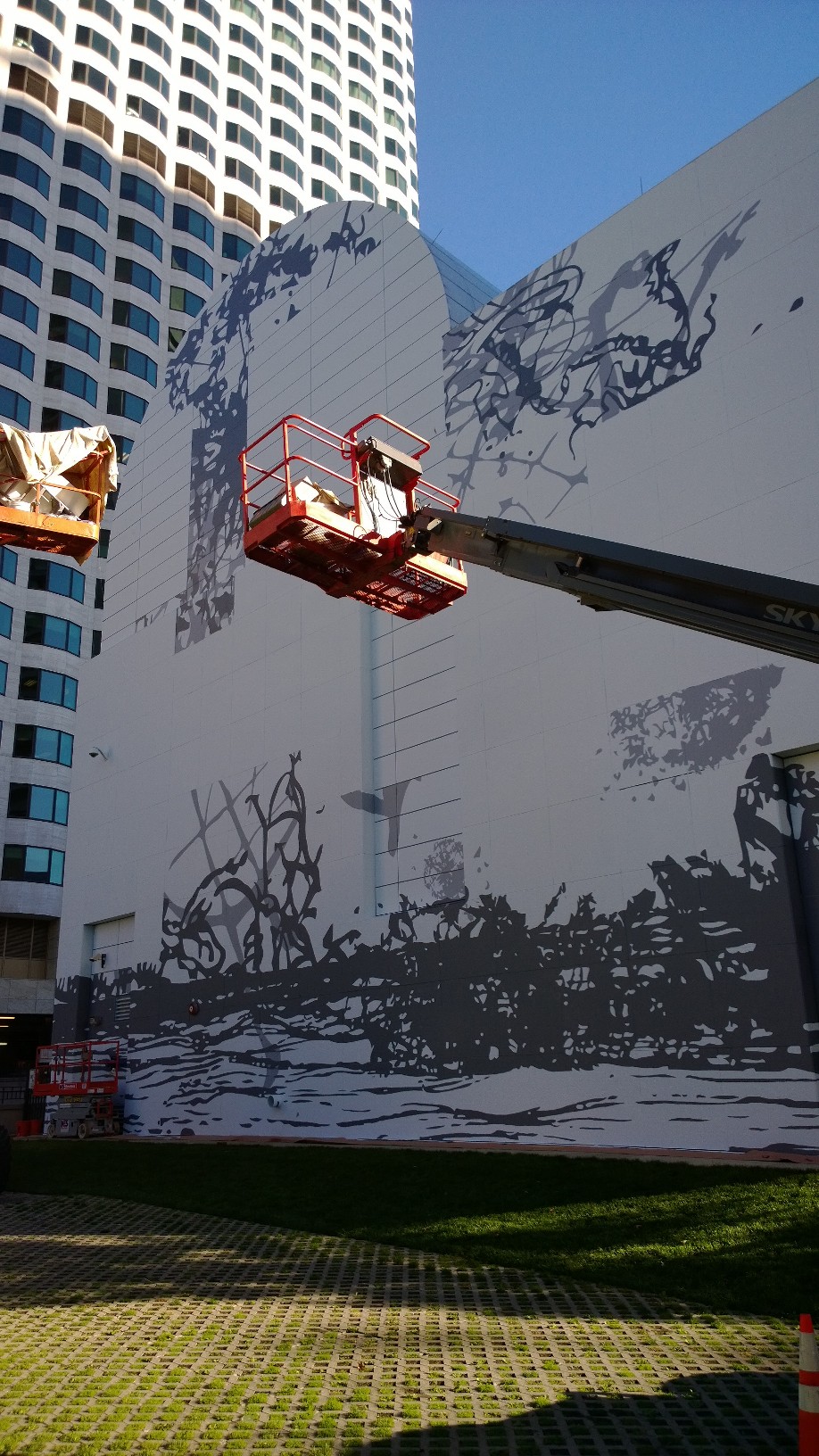
Remember the new Dewey Square mural I blogged about recently, here?

The Boston Globe has a brief update for you, but their picture is blocked by a cherry picker. As soon as the Greenway moved the heavy equipment, I shot my own picture.

Be watching for more on Dewey Square. I have blogged about the two months that Occupy Boston camped there. I have blogged about the Greenway’s teaching garden alongside the Big Dig exit and about the farmers market that sets up Tuesdays and Thursdays. Soon I will show pictures of the pianos that arrived today — with people playing them, I hope.

Dewey-Square-mural-Sept-2013

Read Full Post »

Matadero was an old abandoned slaughterhouse in Madrid. Lately it has been “evolving into a cultural laboratory, where a new arts financing strategy is being tested.” So says Doreen Carvajal in the NY Times.

“Companies and institutions are providing financial support to supplement dwindling government arts subsidies, but with a twist: they don’t just send checks, they move in.

“Within the walled 59,000-square-foot center, there are public theaters and exhibition spaces that last year drew more than 500,000 visitors for music and art events and avant-garde plays. But five new residents are private institutions, including a designers’ association, a publishing house’s foundation and offices of Red Bull, the Austrian energy drink maker.

“They are in the compound rent-free for now, but have invested millions in the remodeling of pavilions there, as well as in programming, from art exhibitions to music festivals.

“These new partnerships are forged, out of necessity, here in Spain, where government support for culture has plunged by almost 50 percent over the last four years, a result of a lingering economic crisis that hit late in 2008.”

Some observers worry about the downsides of corporations having a big influence on what art gets shown, but haven’t the arts always had to have some help from patrons or companies?

Probably it pays just to be wary, to recognize when there is undue influence, and to push back. Certainly smaller, more experimental projects are unlikely to find a home under a Red Bull banner.

Read more at the Times, here.

Photo: Carlos Luján for The International Herald Tribune
Inside Matadero Madrid: A closer look at the arts complex.

Read Full Post »

Candy creates interactive street art. Her “Before I Die” wall garnered a lot of attention — and contributors. Folks wanted more.

So she decided to create a website explaining in detail how others could replicate the wall.

Here she tells how it all started: “It’s easy to get caught up in the day-to-day and forget what really matters to you. After I lost someone I loved very much, I thought about death a lot. This helped clarify my life, the people I want to be with, and the things I want to do, but I struggled to maintain perspective. I wondered if other people felt the same way. So with help from old and new friends, I painted the side of an abandoned house in my neighborhood in New Orleans with chalkboard paint and stenciled it with a grid of the sentence “Before I die I want to _______.” Anyone walking by could pick up a piece of chalk, reflect on their lives, and share their personal aspirations in public space.

“It was an experiment and I didn’t know what to expect. By the next day, the wall was bursting with handwritten responses and it kept growing: Before I die I want to… sing for millions, hold her one more time, eat a salad with an alien, see my daughter graduate, abandon all insecurities, plant a tree, straddle the International Date Line, be completely myself…  People’s responses made me laugh out loud and they made me tear up. They consoled me during my toughest times. I understood my neighbors in new and enlightening ways.”

Candy’s how-to page reads, in part, “Once you’ve created a wall, you can share your wall here by creating a mini-site! A mini-site is a page where you can post photos and responses and document the story of your wall. It’s super easy to use, absolutely free, and no technical skills are required. Visit the Budapest mini-site to see an example.”

Everything you need if you’re going to create a “Before I Die” wall is here.

Photo: Before I Die

Read Full Post »

You may recall a past post about the Greenway mural by Os Gemeos, Brazilian twins who had a show at the Institute of Contemporary Art and painted street art around Boston when they were here. I posted pictures of their work-in-progress for the Greenway, here.

Geoff Hargadon photographed the finished work for the Boston Globe, below.

That giant mural is gone now, and Matthew Ritchie is working on the next one. I took a picture of it today and plan to take more for the blog as Ritchie wraps up.

Geoff Edgers at the Globe gives some background on this new piece. “The Institute of Contemporary Art has commissioned British-born Matthew Ritchie, known for using scientific principles to inspire his work, to take over the enormous outdoor canvas.

“Ritchie’s 5,000-square-foot seascape will be installed the week of Sept. 16 and remain up for as long as 18 months.

“The collaboration … is part of a residency for Ritchie that will include a multimedia performance with members of the rock bands The Breeders and The National, concerts at the museum and elsewhere, and a video project to be produced with the ICA’s teen program. But the biggest splash for the public will come on the exterior of the Big Dig ventilation building in Dewey Square.”

Read more at the Globe, here, and at the Greenway site, here.

Photo: Suzanne’s Mom

Matthew-Ritchie-Greenway-art

Read Full Post »

If you saw a sign in a museum saying that the suggested entry fee for students was $8, would you ask if you could pay $2? Would you even ask what the sign meant?

Museums may be taking too much for granted about what people know.

All summer, after classes, Chanel Baldwin hung out in the lobby of the Brooklyn Museum for the air-conditioning. She didn’t understand that the $8 “suggested” student admission was merely suggested. So she got to know intimately the only painting that was in the lobby, and she thought about what was meant by the details surrounding the black man on the horse in “Napoleon Leading the Army Over the Alps,” by Kehinde Wiley.

One day when her cousin was cooling in the lobby with Chanel, NY Times reporter Anand Giridharadas showed up, explaining that they could go through the entrance gate without paying. “No donation today, thank you,” Giridharadas said to the cousins’ astonishment.

“The gates parted,” writes the reporter. “We received green tags to prove our bona fides. … The first room set [Chanel] alight and held her rapt until she had to leave. There was no label too tedious to read, no piece undeserving of her scrutiny. …

“ ‘Look at the detail on it,’ she said of a Fred Wilson mirror, gasping.

“A piece called ‘Avarice,’ by Fernando Mastrangelo, gripped Ms. Baldwin. It appeared from afar like a classic Aztec sun stone. But she got up close. Traced her fingers over it. Went to one side, looked at it; went to the other side, considered it that way. She noticed that the piece was made of corn, and then detected a toothpaste tube, soda bottles and cowboy hats lurking on the surface, all crackling with meaning.

“Watching her,” says Giridharadas, “I realized how the inadvertent exclusion from these rooms must have trained her eyes. … New York is run on the kinds of understandings that kept the cousins in the lobby, with so many places formally open to anyone but protected in their exclusivity by invisible psychic gates.

“Ms. Baldwin suggested a more honest approach, since people tend to think you have to pay: ‘They should just put a sign out telling us that it’s somewhat free.’ ” More here.

Suzanne’s Mom admits that she might not have known the secret code either. But then, she always had the $8.

Photo: Karsten Moran for The New York Times
Chanel Baldwin exploring the Brooklyn Museum after learning that “suggested” when admission fees are “suggested,” that could mean free.

Read Full Post »

Cultural institutions are getting smaller. And more local.

We wrote about a library in a phone booth here and the Little Free Library here. You can see fully realized short films on YouTube and street art just around the corner.

Now folks in Somerville have launched a museum in a doorway. It’s The Mµseum.

From the website: “Judith Klausner (Co-Founder, Curator) is a Somerville MA artist with a love for small, intricate, and overlooked things. She first dreamed up the Mµseum in 2010, as a way to combine her love of  serious miniature art with her passion for making art accessible, and her conviction that New England arts institutions should show the work of New England artists. Three years (and a lot of planning) later, she is delighted to see it become a reality. … Contact Judith at judith@themicromuseum.com.

“Steve Pomeroy (Co-Founder, Engineer) is a programmer and a builder, both by profession and by nature. He’s largely responsible for the engineering behind the Mµseum, from the solar-powered miniature track lighting to the 3D-printed doric columns and laser-cut façade typography. He formally studied computer science at the Rochester Institute of Technology where he discovered a love of communication protocols and formal computer languages. Contact Steve at steve@themicromuseum.com.”

WBUR had a story on the micro museum here.

There is something childlike and innocent about miniature enterprises. Didn’t you always think as a child you could take a few toys and tea cups and bags of flour and new sponges from around the house and set up a table on the street as an authentic store? You thought, Why not? Just do it.

I get a kick out of people just doing it.

Photo: Mara Brod, http://marabrod.com/fineart.html

Read Full Post »

Did you like last week’s entry on stained glass windows that produce solar energy? Well, there’s more.

Kristine Lofgren writes at Inhabitat about an amazing solar chandelier.

“British artist Luke Jerram is known for his stunning art installations, which are often inspired by science. His latest project, unveiled [last year] at the Bristol and Bath Science Park, is the world’s largest solar chandelier! The 16.5-foot-tall chandelier is made of 665 glass bulbs that spin when exposed to light …

“The chandelier was created using glass radiometers rather than traditional light bulbs. As the sun hits each radiometer, it begins to turn, speeding up and slowing down as the light changes. The overall effect is a shimmering, gently moving piece of artwork. At night, it is lit up using electric light.” More.

By the way, Inhabitat also features a piece on a sculptural sound chamber that sings when the wind blows, here.

Read Full Post »

And speaking of payment systems, community-supported agriculture has been around for years and, more recently, community-supported art. I blogged about the approach here in 2011, when the Cambridge Center for the Arts embraced the concept.

The NY Times has written about it, too. Randy Kennedy lays out the principles: “For years, Barbara Johnstone, a professor of linguistics at Carnegie Mellon University [in Pittsburgh], bought shares in a C.S.A. — a community-supported agriculture program — and picked up her occasional bags of tubers or tomatoes or whatever the member farms were harvesting.

“Her farm shares eventually lapsed. (‘Too much kale,’ she said.) But on a recent summer evening, she showed up at a C.S.A. pickup location downtown and walked out carrying a brown paper bag filled with a completely different kind of produce. …

“ ‘It’s kind of like Christmas in the middle of July,’ said Ms. Johnstone, who had just gone through her bag to see what her $350 share had bought. The answer was a Surrealistic aluminum sculpture (of a pig’s jawbone, by William Kofmehl III), a print (a deadpan image appropriated from a lawn-care book, by Kim Beck) and a ceramic piece (partly about slavery, by Alexi Morrissey).

“Without even having to change the abbreviation, the C.S.A. idea has fully made the leap from agriculture to art. After the first program started four years ago in Minnesota … community-supported art programs are popping up all over the country …

“The art programs are designed to be self-supporting: Money from shares is used to pay the artists, who are usually chosen by a jury, to produce a small work in an edition of 50 or however many shares have been sold.”

Read all about it, here. Could be risky if you really don’t want a sculpture of a pig’s jawbone. But if you look at it as supporting the arts, you are likely to be satisfied with that side of things — and there’s always a chance you will love what you get or find its value increase.

Photo: Zoe Prinds-Flash
Drew Peterson’s prints and Liz Miller’s collages were among the art for members of this C.S.A., community-supported art, in Minnesota.

Read Full Post »

Oh, boy, what a cool site! Modern Hieroglyphics started following me after my last Banksy post, so I clicked and took a look at his site. It’s all about street art. I especially loved this post on “reverse graffiti.”

Says Modern Hieroglyphics, “Paul Curtis (Moose) uses a powerwasher to remove dirt and grime off of walls, resulting in the creation of stunning images and patterns. The new art form is known as ‘reverse graffiti’ or ‘clean tagging,’ and is growing in popularity all over the world. This is the story of Moose. …

” ‘I became an artist by accident really, I was promoting music that my label was releasing by using reverse graffiti. I created it for that purpose, then I would do large pieces for fun or like a strange hobby, then people started to ask me to work for them… and the Internet happened and I became notorious. …

” ‘I discovered reverse graffiti one day when I was a teenager working as a dishwasher in a restaurant. I aimlessly wandered out of the kitchen one day to just be in the restaurant section. I’d cleaned everything I could in the kitchen, and felt like I owned the place. So when I saw a small mark on the wall, I reached for the my cloth and wiped it off, only to find that in the process of wiping the mark off the wall, I made a much bigger mark by cleaning the original mark with the cloth.

” ‘In those days people smoked freely in establishments and the wall was brown with nicotine. I had always thought that the wall was painted that color, and now this almost-white cleaning stripe was shining out of the wall like I had a tin of white spray paint and started to write. It was quite a shock for me, and I spent a long time trying to rectify what looked like damage but was only cleaning.

” ‘Years later, while gazing out of the window on a bus, I saw that in the road tunnels in Leeds, these clean marks appeared everywhere, drunks sliding home along the tiled walls left long streaks that looked like chrome in the car lights. Later on, I finally did something with that observation.’ ”

More samples of Moose’s art are at Modern Hieroglyphics.

Art by Paul Curtis (Moose), creator of reverse graffiti

Read Full Post »

Artist Sarah Hall is killing two birds with one stone. Or solving two challenges with one creation. According to Canadian Public Broadcasting, Hall has made stained glass windows that can convert the sun’s rays into energy for the building the stained glass embellishes.

Emily Chung writes, “Lux Gloria by Sarah Hall, at the Cathedral of the Holy Family in Saskatoon, is currently being connected to Saskatoon Light & Power’s electrical distribution network, confirmed Jim Nakoneshny, facilities manager at the cathedral.

“The artwork, which consists of solar panels embedded in brightly coloured, hand-painted art glass, had just been reinstalled and upgraded after breaking and falling into the church last year.

“Once it is connected, the cathedral will be able to use the solar power produced by the art installation to offset its own power consumption from the regular grid, Nakoneshny added.

“According to Kevin Hudson, manager of metering and sustainable electricity for Saskatoon Light & Power, the solar panels are expected to produce about 2,500 kilowatt hours annually or about a third to a quarter of the 8,000 to 10,000 kilowatt hours consumed by a typical home in Saskatoon each year.”

Read all about it at the CBC, here.

Photo: Sarah Hall on Popsci.com website
Lux Gloria: The solar-stained glass installment features dichroic glass and will be connected to the electrical grid in Saskatoon, Saskatechewan.

Read Full Post »

« Newer Posts - Older Posts »