Feeds:
Posts
Comments

Posts Tagged ‘art’

At first, Suzanne and Erik thought the chair backs attached to tree stumps on Blackstone Boulevard must have been the work of a conservancy-type organization. The boulevard’s broad, shaded medial strip for walkers, runners, and baby carriages is always well maintained and welcoming.

But it turns out that a “guerrilla good deed campaign” is behind the tree-stump art. Erin Swanson, of Providence’s East Side Monthly, tracked down a vigilante known as Johnny Chair Seed.

“Last summer,” Swanson writes, “a few friends were having themselves a little stroll down Power Street when they stumbled upon a broken chair, discarded on the sidewalk. A few footsteps further, they happened upon a tree stump. ‘It started as just a random idea. We figured someone got drunk and broke the chair,’ says the anonymous mastermind behind the array of stump chairs now scattered throughout the East Side. ‘I hear people have started calling me Johnny Chair Seed,’ he says with a devilish smile. ‘I kind of like it.’

“With the help of two friends (two of the ‘select few’ who know his true identity), Johnny has constructed a total of ten stump chairs including those on Hope, Rochambeau, Blackstone, Elmgrove and Larch, among others.” The full article is here.

Makes me want to do a stealth project again. It’s been too long. I have something in mind involving poetry. Stay tuned.

Photograph: East Side Monthly

Read Full Post »

I’m happy to see some long-neglected murals being restored in Harlem. Robin Pogrebin has the story in the NY Times:

“When the Works Progress Administration [WPA] commissioned murals for Harlem Hospital Center in 1936, it easily approved the sketches submitted by seven artists, which depicted black people at work and at play throughout history. The hospital, however, objected, saying four of the sketches focused too much on ‘Negro’ subject matter … .

“Protesters rallied around the art, though, lodging complaints as high as President Franklin D. Roosevelt, and the murals ultimately prevailed.

“Over the years, those wall paintings deteriorated or were obscured by plaster. Now they have been restored and brought front and center as part of a new, $325 million patient pavilion for the hospital, on Lenox Avenue at 135th Street that will be unveiled on Sept. 27. …

“The artists — the last of whom, Georgette Seabrooke, died last year — were not well known and their murals portrayed ordinary people going about their daily lives. Vertis Hayes’s ‘Pursuit of Happiness’ panel traces the African diaspora from 18th-century African village life to slavery in America to 20th-century freedom; from agrarian struggles in the South to professional success in the industrialized North.” More.

The WPA cost money, but it put a lot of people to work. And look at all the great things that were created! I especially love the idea that unemployed people were paid to paint murals, write and produce plays, interview ordinary Americans for the National Archives, and record folk music. I know it was a stressful time, but thinking about the art makes me almost nostalgic.


Photograph: Karsten Moran for The New York Times
Elizabeth Kolligs works on restoring Vertis Hayes’s “Pursuit of Happiness” at Harlem Hospital.


Read Full Post »

She doesn’t do only trees, but she knows trees inside and out.

Katherine Pacchiana has a nice update in the Daily Voice, a newspaper in North Salem, New York.

Sally Frank was in the middle of the Maine woods as she talked, via cell phone, about her collection of tree art, now on display at the Ruth Keeler Library.

“ ‘Most of what I do is make prints,’ she explained. ‘Unfortunately, I have a day job, but I like to do monotypes which are spontaneous and don’t take a long period of time.’ Monotypes are a form of prints, dating back to the 17th century. Each is made individually.

“Frank has been drawing all her life and has trained in many places, including Simon’s Rock in Great Barrington, Mass., and Long Island University, where she earned a master’s in fine arts. At the age of 19, she was apprenticed to Tom Bostelle, the American painter and sculptor who was a colleague of Andrew Wyeth.

“ ‘I’ve always drawn trees and the natural landscape. I went from focusing on the architecture of a tree – its sturdy trunk and the strong presence it has on the landscape – to what is left when a tree dies away and leaves forms behind.

“ ‘I’m fascinated by the texture and light that trees create, the  patterns – a tree’s essence.’ ” Read more.

Today I happened to be in Great Barrington for a work conference on affordable housing in rural areas. It was my first visit since Sally’s parents’ wedding, which I remember as being in a Unitarian church. I was hoping to get a picture I could post, but I saw only St. Peter’s and the Congregational church.

The Red Lion Inn in Stockbridge looked vaguely familiar, and I wondered if that was where we were staying when my father, as best man, realized he’d forgotten the wedding ring and raced back to fetch it while Uncle Jim paced anxiously, muttering words I recall as, “He always does this”!

Read Full Post »

I liked Jacki Lyden’s story at National Public Radio about some unusual artists in the 1960s.

“If you traveled by way of Florida’s Route 1 in the 1960s, you might have encountered a young, African-American artist, selling a lushly painted oil landscape from his car. They weren’t allowed in galleries during Jim Crow segregation — but motels, office buildings and tourists would buy their vivid works.

“Together, they formed a loosely associated band around Fort Pierce, Fla., that came to be known as The Highwaymen. At $20 a painting, they made their way out of agricultural jobs like citrus-picking and defined the cultural look of an era.

“Their paintings departed from an earlier tradition of landscape painting in Fort Pierce. A.E. ‘Beanie’ Backus, considered the father of the landscape movement there, caught the clouds and savannahs and inlets that were falling to developers in the mid-century. He would teach many youngsters who came to his studio, including the teenage Alfred Hair, leader of The Highwaymen.

“These artists would take off in their own direction. But success has brought enduring tensions on their home turf, raising questions about art, race and cultural legacy. …

“The who’s who of The Highwaymen can be tricky. (A curator named Jim Fitch coined the name in the ’90s and it stuck.) Gary Monroe, author of The Highwaymen, Florida’s African-American Landscape Artists, counts 26 original painters — 18 of whom are still living. That’s how many were inducted into the Florida Artists Hall of Fame in 2004.”

Lots more.

Photograph: Gary Monroe
Alfred Hair (left) and Robert Lewis

Read Full Post »

Gwarlingo pointed me to Time In, an initiative that provides arts experiences for children who might not get such enrichment any other way.

Time In brings some of the youngest, most at-risk public school children OUT of underserved classrooms and INTO the world of the living arts every week of the school year.

“Starting from Pre-K, children {try] hands-on art in our studio one week, with hops to the world’s best galleries and museums the next! Regardless of their backgrounds, children are children. The world of imagination, creativity and fantasy is their most fertile ground. Time In acknowledges children’s phenomenal gifts and innate abilities and is dedicated to developing learning environments that stimulate, rather than stifle.

“We are proud to have changed the lives of more than 1,000 underserved Pre-K-2nd graders since 2006, and look forward to working with over 400 children this year. Time In will continue to foster not only wonderfully conceptual thinkers, but perceptive and aesthetically sensitive children, each of whom will be poised to nourish our society in the days to come.”

Read more. Or vote for the nonprofit on Facebook as Part of Chase Community Giving.

Read Full Post »

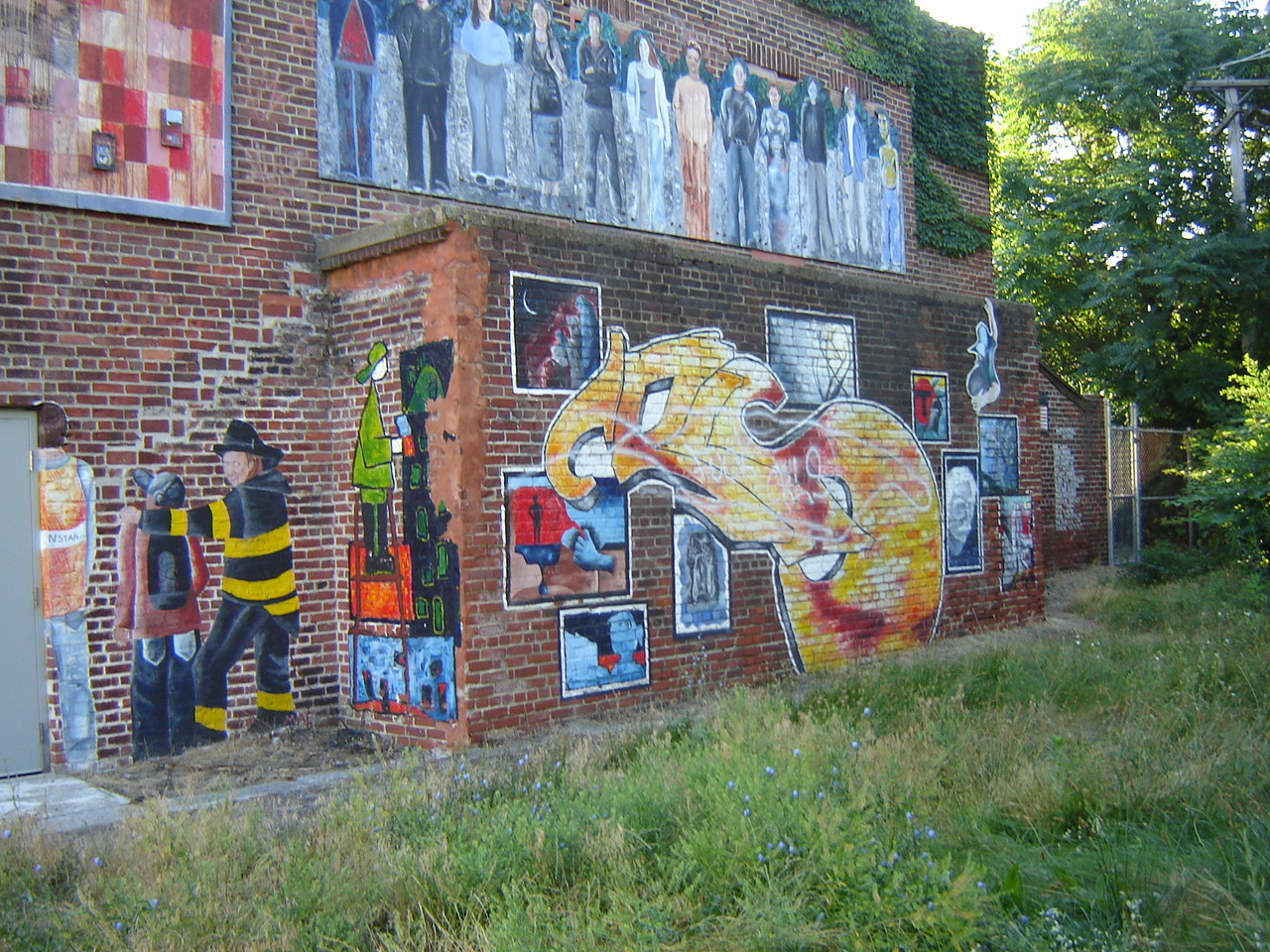
These two murals are from Somerville and Gloucester. Do you get the feeling that the towns themselves have different personalities? One seems to record the history of the city in a formalized way. The other is more about people’s lives today.

If you know more about the genesis of these murals, I’d love to hear it. In both cases, the murals seem to have been created with permission. I wonder if you think that permission subverts the subversiveness of street art?

Makes me think of the kids in eighth grade who were asked to create nice Halloween paintings on shop windows so the windows wouldn’t get soaped as a Halloween prank.

The goody-two-shoes kids painted windows with pumpkins and witches. The rough kids still soaped windows.

Read Full Post »

When I saw the headline at Wired, it didn’t really compute.

“Artists Create Portraits on Live Grass.” What? I don’t get it. Did the artists set up easels and paint with oils? Did they paint directly on the grass?

Writer-photographer Jakob Schiller explains.

“It all started, as these things sometimes do, by accident. In 1990, before they worked in photography, [Heather] Ackroyd and [Dan] Harvey created an art installation that covered an entire room with grass. As part of the art piece they had left a ladder leaning against a wall and when they went to remove it they saw that the ubiquitous and fast-growing plant had been imprinted with the shadow. The grass had stayed yellow where the ladder had prevented it from receiving any light.

“ ‘We didn’t know straight away what we were looking at, but we knew that we had observed something important,’ Ackroyd says.

“They began playing with the idea of manipulating the light that hits grass and by the next year were projecting light through an old 35mm Kodak projector onto a swath of grass on the wall.”

What to think as the grass withers and dies? It’s kind of a Dorian Gray scenario.

Read more about the project at Wired‘s Raw File, here.

Photograph: Ackroyd & Harvey.
Myles, Basia, Nath and Alesha, The Big Chill Festival, Eastnor Castle, between the Cotswolds and the Welsh Marches. 2007

Read Full Post »

A couple Sundays ago, it was so hot that all we could do was sit. When we came to ourselves, we said: Who has air conditioning besides the supermarket? Where can we go to see something interesting or entertaining without wilting?

The deCordova Sculpture Park and Museum is a place of wonder. It’s true that sometimes the wonder takes the form of “What the heck?!” But more often it provokes pondering and admiration. The piece below was both lovely to look at and food for thought. The artist filmed people moving obscurely behind ice. The work suggested ideas to me beyond the idea of ice (although ice itself was worth focusing on that day).

Ice often makes an appearance in art. I think of the First Night (New Year’s Eve) sculptures in Boston.  And I remember a whole ice wonderland in St. Paul one January when we lived in Minnesota. Then there is the ice story by a native of that city, F. Scott Fitzgerald.

Fitzgerald apparently wanted to cut his ties with his hometown, but St. Paul had other thoughts, naming the theater where “A Prairie Home Companion” plays just for him, and conducting a posthumous reading of “The Great Gatsby” in his honor.

Fitzgerald’s short story “The Ice Palace” is about a southern girl who tries to adjust to the culture of her betrothed’s wintry landscape. She becomes lost and terrified in an ice palace that somehow reflects his family and his nature, and she decides her future should unfold back home in the South. I read that a long time ago, but I recall many meanings for ice in it.

Meanwhile, at the deCordova, the “Ice Cave” video seems to be about the limits of perception, about seeing through a glass darkly.

What are the people doing? we wonder. Even if we knew, would we know what it meant?

Please share your ice images with the blog.

Image from Daniel Phillips’s Ice Cave video is at the Dodge Gallery in New York.


Read Full Post »

For an artsy, literary treat, take a look at the Project Gutenberg version of painter Marsden Hartley‘s out-of-print book, Adventures in the Arts: Informal Chapters on Painters, Vaudeville, and Poets, dedicated to Alfred Stieglitz.

Hard to resist an introduction like this:

“Sometimes I think myself one of the unique children among children. I never read a fairy story in my childhood. I always had the feeling as a child, that fairy stories were for grown-ups and were best understood by them, and for that reason I think it must have been that I postponed them. I found them, even at sixteen, too involved and mystifying to take them in with quite the simple gullibility that is necessary. But that was because I was left alone with the incredibly magical reality from morning until nightfall …

“I was constantly confronted with the magic of reality itself, wondering why one thing was built of exquisite curves and another of harmonic angles. It was not a scientific passion in me, it was merely my sensing of the world of visible beauty around me, pressing in on me with the vehemence of splendor, on every side. …

“It is because I love the idea of life better than anything else that I believe most of all in the magic of existence.”

(Thank you, Ellen Levy, for sending me the link.)

Art:  Marsden Hartley

Read Full Post »

I love artists. They come up with the wackiest ideas. And often the ideas have bypassed the rest of us because they are in fact so incredibly sane.

In the July 27, 2012, Boston Globe, Stephanie Steinberg writes about two such artists.

Carla “Repice, 40, and Geoffrey Cunningham, 37, who met while studying at Lorenzo de’ Medici school of art in Italy, started the performance art project Office of Blame Accountability [in 2007] while working on a separate project in California. The two artists, now self-proclaimed ‘blame accountants,’ were frustrated by the lack of accountability by the media, government, and individuals. …

“Repice had recently purchased a red 1920s telephone at a flea market. As they sat on a bench outside Cal State Fullerton Grand Central Art Center in Santa Ana discussing whom to blame for personal and countrywide problems, Repice brought up the idea of the phone representing an emergency call.

“ ‘We were talking about blame accountability, and there was this red phone, and we thought, “OK, let’s create an office. . . . Let’s place a desk on the sidewalk and facilitate a space where people can engage this idea of blame and accountability,” ’ ” she said.

“Within an hour, they set up a desk and placed a typewriter, mock blame forms, and, of course, the telephone on top. They then started asking random passersby, ‘Do you have any blame to place?’ ”

The lovely part is that the “blame accountants” also ask people to consider their own role is the thing they are blaming on others. The results can be quite touching. Read more.

Photograph: Tisha Kawcak

Read Full Post »

Sunday evening I went over to Concord Academy to hear Seán Curran talk about how he creates choreography. Betsy, one of the dancers from his company, did a beautiful job of demonstrating what he meant.

As a little boy growing up in Watertown, Seán said, he waited eagerly for the mail that brought Look magazine. He liked to cut out pictures and make collages with them.

He says that his approach to choreography is similar. He arranges many snippets or dance phrases in different ways. His challenge is to edit down the many ideas so that the choreography doesn’t topple from too much weight.

I make collages, too. I have always liked the idea of taking a bunch of random things people have said and trying to make a play out of them, for example.

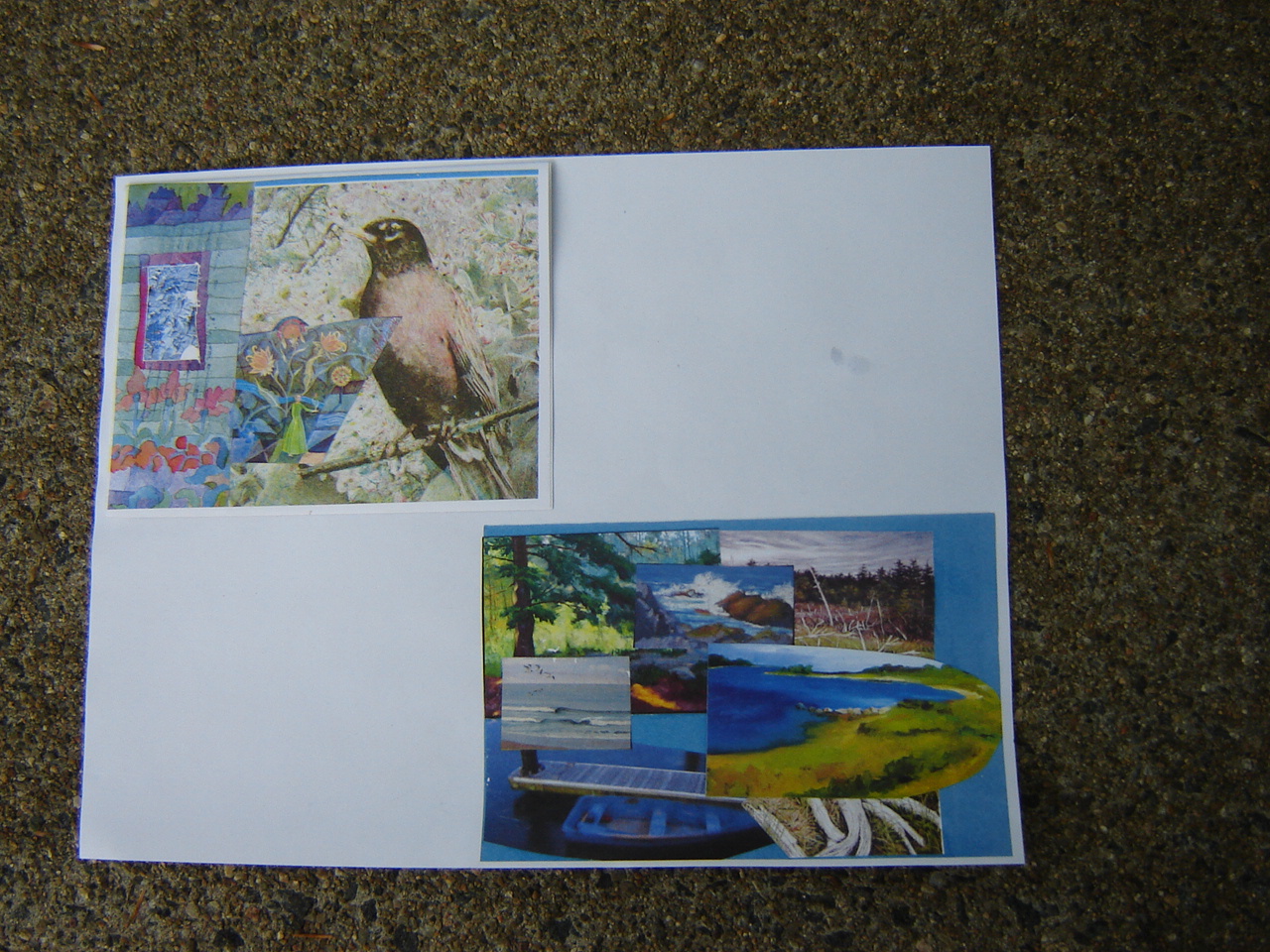
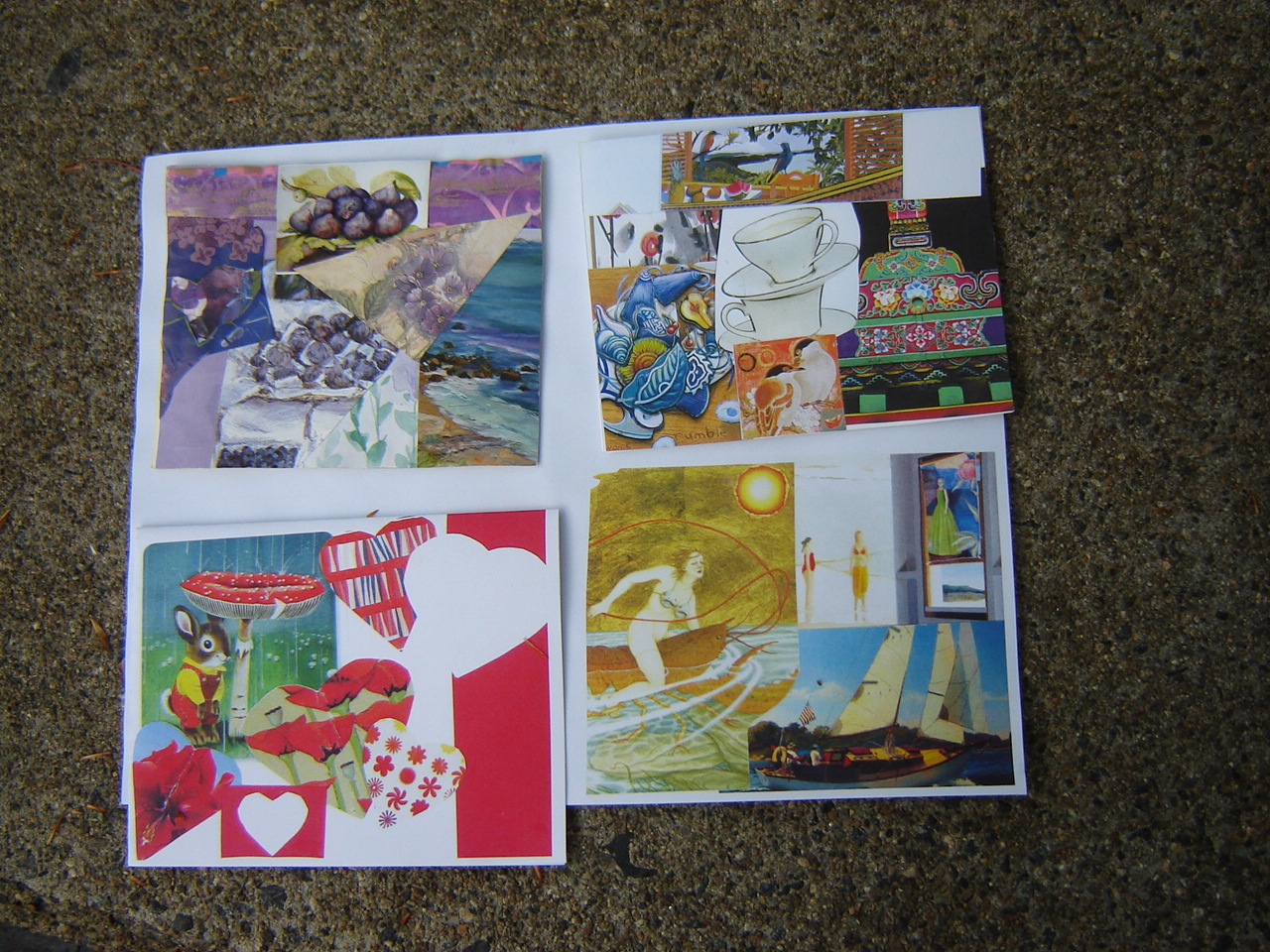
I also make collage greeting cards. I keep a box of promising pictures, cut from magazines and gallery postcards. I go through the whole pile and set aside maybe 20 items that somehow remind me of the person for whom I am making the card. Then I edit them down to the few pieces that will be best for the particular occasion.

All that happens before I cut the shapes and decide on how to arrange them. Sometimes I do a cutout of a cutout and put something else in the space: for example, I cut a vista out of a painting of a window and put a girl in the space (bottom right).

Here are examples.

Read Full Post »

Photograph: South End Knitters

Today I am thinking about the South End Knitters, the stealth street artists who wrap their knitting around parking meters and fire hydrants and telephone poles.

Writes Linda Matchan in the Boston Globe, “The South End Knitters’ weekly meetings at a Washington Street café seem innocuous, but don’t be fooled. Over knitting needles and yarn at the long table they’ve commandeered, they are contemplating something far more mischievous than a sweater. They’re graffiti knitters, and they’re plotting their next target. …

“As with graffiti, no two tags in the yarn-bomber subculture are alike. They range from sleeves on parking meters to tubes on tree limbs to sweaters on statues: A recent high-profile example is the neon pink sweater that the New York street knitter Olek crocheted in December for the 16-foot ‘Charging Bull’ statue on Wall Street.”

What put me in mind of the South End Knitters was an extraordinary post at the WordPress blog Pickled Hedgehog Dilemma, which describes a crochet effort that is drawing a lot of attention to the plight of vanishing corals.

Concerned about the effect of global warming on reefs, Margaret Wertheim and her twin sister got an idea that involved “crocheting corals. They used a crocheting technique invented by mathematicians in 1997 to model hyperbolic shapes called hyperbolic crocheting. … This ended up being a perfect technique for producing coral reproductions. …

“They crocheted a lot of corals,” continues Pickled Hedgehog, ” then they did something to change the world. They shared their corals with art museums. They got a community in Chicago to crochet with them. Then the crafting became a movement and groups all over the world started to crochet corals.”

Read Pickled Hedgehog Dilemma’s illustrated summary here. And if you have the time, this TED talk is super.

Pickled Hedgehog Dilemma

Read Full Post »

I have admired the New England artist James Aponovich for some time but had not seen his paintings up close until the Clark Gallery in Lincoln had a show of his recent work. Amazing!

I am probably not using accepted art history terms, but the paintings  make me think of Italy and the Renaissance and are breathtakingly luminous. He might feature, for example, a large, glorious amaryllis flower in an ornate urn on a wall high over a traditional, distant landscape. You just want to go there.

The work in the current show is the result of Aponovich making up his mind to create a painting a week for an entire year. He succeeds splendidly, often making everyday items like Chinese takeout feel exceptional. For my money, there is not a dud in the bunch. (Although my money can’t stretch to even the smallest of the 52 pictures.)

I am so grateful to galleries that make work like this free for anyone who walks in off the street to view. Museums, wonderful as they are, don’t often let you in free.

Read Aponovich’s blog about the 52 weeks. Cate McQuaid in the Globe captures the essence of the show. Check her out, too.

Read Full Post »

First there were ghost leaves embedded in the sidewalks. And then … mystery messages.


Read Full Post »

Eben Horton, a glassblower with a studio in Wakefield, Rhode Island, loved hearing how glassblowers in Lincoln City, Oregon, had hidden special creations on a local beach for a community treasure hunt.

Inspired to do something similar, he settled on the idea of glass floats, the kind traditionally used on fishing nets.

The Block Island Tourism Council helped Horton launch the Glass Float Project. The council’s site has details.

“WHEN: The hunt begins June 2nd, 2012, and continues indefinitely. It only ends when all the floats have been found!

“WHAT: 200 Glass Floats (glass orbs about the size of a grapefruit) will be hidden on Block Island. Floats will be dated, numbered and stamped with the shape of Block Island. All floats are clear glass except for 12 (because it is 2012), which are special colored orbs. One super special float is made entirely out of gold leaf.

“WHERE: 100 floats on beaches and 100 floats on Greenway trails. Floats will be hidden above the high tide mark but NEVER in the dunes or up the bluffs.”

Understandably, they don’t want people walking on the dunes, which protect the island in storms.

Check the council website for the bio on the artist, too: “Eben creates custom one of a kind pieces on an individual basis out of his studio that he calls ‘The Glass Station’- a converted 1920’s gas station.” More.

Read Full Post »

« Newer Posts - Older Posts »