Feeds:
Posts
Comments

Posts Tagged ‘art’

Unless you are going to the Danforth Museum of Art, I do not recommend ever going to Framingham (traffic issues, strip mall issues).

But I am very glad I finally made it to the Danforth today because it is a lovely museum with a community outreach effort that I admire.

The exhibit I went to see was described in the Boston Globe by by Sebastian Smee.

“One of the things you notice first in ‘Eternal Presence,’ a terrific career survey of John Wilson at the Danforth Museum of Art, is how attentive Wilson is to the faces of children. From his earliest days sketching his brother to his most recent large-scale drawings in charcoal, the impulse has remained the same: It is an impulse toward clarity, toward truth. He doesn’t sentimentalize or caricature children. …

“What you notice later is the high number of pictures showing children in the arms of adult men and women. … Wilson is after something elemental and profound. But the resulting image is not just another mother and child, or dad with young kid. There is instead, each time, something tender and hard-won about what you are looking at. A hope, a promise, a lament all in one.

“Wilson, 90, is one of Boston’s most esteemed and accomplished artists. He was born in Roxbury, the son of parents from British Guiana (now the nation of Guyana), was admitted to the School of the Museum of Fine Arts in 1939 after developing a natural aptitude for art at the Roxbury Boys Club, where he attended classes taught by SMFA students.”

Smee goes on to describe Wilson’s long career, including a stint in France, his interest in the Mexican muralists, and his sculptures of Martin Luther King Jr. (one is in the Capitol rotunda).

Amazing that the artist is around and will be giving a talk at the museum. Try to go. The show is up until March 24. And you may enjoy as much as I did the African American sculptures by Meta Vaux Warrick Fuller from the permanent collection and the joyful Harlem watercolors of Richard Yarde.

More at the Globe.

Lithograph by John Wilson

Read Full Post »

Photograph: Ginnette Riquelme for The New York Times
Artist Amor Muñoz pays workers at her mobile factory about $7.50 an hour. “I’m interested in sharing the experience of art,” Ms. Muñoz says.

An artist in Mexico City hires people off the street at $7.50 an hour to help create “electronic textiles.”

Amor Muñoz uses a megaphone to shout, “One hundred pesos an hour!”

Damien Cave at the NY Times continues the story. “The rush was on. By the time Ms. Muñoz parked in her usual spot outside a hospital in one of Mexico City’s peripheral neighborhoods, a line had already formed. Women of all ages squeezed together — one held a baby, another was nearly too old to walk — as Ms. Muñoz opened up a white wooden box revealing thread, needles, cloth, timecards and employment contracts. The work involved creating interactive art pieces that combine the old craft of sewing with 20th-century electronics and 21st-century tags allowing smartphone users to look up who worked on a given piece. …

“Her maquiladora, or factory, she said, is a ‘fantasy’ meant to condemn the harsh reality of a global economy that uses and discards poor workers, especially women, to keep prices low. …

“She described Mexican wages as an insult to human dignity, and every time her mobile factory appears, the power of work for reasonable pay goes on display. The crowds that gather are typically large. Sometimes people push and shove for two hours of work and $15, though once the day’s employees are selected (first come first hired), a calm tends to follow. …

“Many of the women seemed to appreciate a chance to be involved in an art project. María González, 75, smiled widely when handed a needle and adjusted her purple scarf, excited to be creating something rather than worrying about her husband in the hospital. ‘This,’ she said, sewing without looking down, ‘is a wonderful distraction.’ ”

Read more about how happy the women are to work at that wage on art, even if it’s only for two hours.

Read Full Post »

A busy holiday here in New England with both our kids, their spouses, and the two grandsons. Every time we thought we were nearly done opening presents, one or more of us needed a nap.

The distaff side produced a chicken masala (with rice, nuts, raisins, cilantro, coconut, and chutney from Swaziland via the Servv catalog), creamed spinach, salad, and pear crumble.

Meanwhile, here’s a Christmas-y story from South America …

“In 2001, when Argentina’s economy was near collapse and property prices plummeted, UCLA art prof Fabian Wagmister bought a 15,000-square-foot abandoned warehouse in Buenos Aires. When he finally set out to clear the remaining debris from the building last year, he uncovered more than 100,000 Christmas ornaments piled in one of the back rooms.

“What to do with a trove of metallic bulbs, plastic wreaths, and bags of fake snow for a sunny Argentine Christmas?

“Re-gift them, of course,” writes Elise Hennigan at Pacific Standard.

“ ‘As artists we were immediately taken by the powerful expressive potential of the materials,’ says Wagmister.

“Now the director of the University of California, Los Angeles’s Center for Research in Engineering, Media, and Performance (REMAP), Wagmister invited a team of ten artists, researchers, and programmers from Los Angeles to distribute the ornaments to the surrounding community …

“Starting on December 15, the team invited community groups to visit the warehouse, one among many lining a historically working-class district that has seen an influx of technology companies. There, the researchers have encouraged participants to develop projects that will use the ornaments to express their identities, struggles and aspirations. On December 23, the groups took to the streets and decked the halls accordingly.” More.

 Photograph: Pacific Standard
Some of the found ornaments going up around Argentina’s capital

Read Full Post »

, a National Public Radio (NPR) reporter, had an intersting story a while back about a vibrant art community in rural Marfa, Texas.

“This tiny town perched on the high plains of the Chihuahua desert is … a blue-chip arts destination for the sort of glamorous scenesters who visit Amsterdam for the Rijksmuseum ...

“It all started when the acclaimed minimalist artist Donald Judd left New York City in the 1970s for this dusty dot of a town. He wanted to escape the art scene he claimed to disdain. With the help of the DIA Foundation, Judd acquired an entire Army base, and before he died in 1994, he filled it with art, including light installations by Dan Flavin and Judd’s own signature boxes. One hundred of them, made of silvery milled aluminum, are housed in two old brick artillery sheds. … Now, all 400 acres of the site are run by the Chinati Foundation. …

Sculptor Campbell Bosworth, for one, loves living and working in Marfa.

” ‘You just come out here and you feel like, I want to make something; I want to do something!’ ”

Read more about art in exurbia. Cities are not the only places where art can be made.

But you knew that.

Photograph: Judd Foundation/Licensed by VAGA, New York, NY
In the 1970s, minimalist artist Donald Judd moved to Marfa, Texas, where he created giant works of art.

Read Full Post »

Suzanne says I have an art esthetic. That makes me laugh.

My esthetic, as far as I can tell, is mostly a preference for painting that is wavy: Charles Burchfield, Virginia Lee Burton, Grant Wood, Marsden Hartley, Kate Knapp, Edvard Munch, Reginald Marsh.

A massive mural by one of my wavy favorites, Thomas Hart Benton, has recently been rescued from storage. Carol Vogel has the story in the NY Times.

“On New Year’s Day 1931, a new and radically different building opened amid the town houses of West 12th Street: Joseph Urban’s International-Style New School for Social Research, with one room in particular as a star attraction. Thomas Hart Benton, the American realist painter, had lined the third-floor boardroom with nine panels of what would be a 10-panel mural, ‘America Today,’ depicting a panoply of pre-Depression American types, from flappers to farmers, steel workers to stock market tycoons. Lloyd Goodrich, a prominent art historian, pronounced it a breakthrough that heralded a new approach to mural painting, ‘of actually taking reality and making mural art directly out of it.’

“Eight decades later, ‘America Today,’ now considered one of the most important and famous examples of American scene painting, is languishing in storage. That will change, however, because AXA Equitable, the insurance company that bought it nearly 30 years ago, has decided to donate it to the Metropolitan Museum of Art. …

“The only problem,” writes Vogel, “is that the museum is so squeezed for space that the mural’s first public appearance after the handover won’t be until at least 2015, when the Met takes over the Whitney Museum of American Art’s landmark Marcel Breuer building on Madison Avenue (after the Whitney’s move to the meatpacking district).” More.

Something to look forward to in 2015.

Photograph: The Metropolitan Museum of Art, New York

Read Full Post »

Every day, no matter what else is going on around the world, artists are thinking of new ways to express beauty.

Henry Grabar writes an Atlantic Cities “postcard” about two Belgian designers’ insight that plates lit from the inside could make something wonderful out of discards — while saving a tree from being cut down for Christmas.

The resulting “tree” of broken cups and plates glows ethereally and was selected for display in the town square of Hasselt, Belgium.

” ‘We decorated the tree with objects which would otherwise have remained invisible,’ MOOZ designers Inge Vanluyd and Stefan Vanbergen wrote in their DesignBoom submission.” Not just invisible, I would add, but thought to be useless.

More.

Photograph: MOOZ, via DesignBoom (an independent publication dedicated to architecture and design)

Read Full Post »

For architecture buffs everywhere, an article on a collaboration between Hariri Pontarini Architects and Gartner Steel and Glass that has led to an unusual place of worship in South America.

Lisa Rochon writes in Toronto’s Globe and Mail that starting last September “at the Gartner Steel and Glass testing facility in Bavaria, Germany, translucent panels of cast glass [were] mocked up. Artisans at Toronto’s Jeff Goodman Studio, working in close collaboration with Toronto’s Hariri Pontarini Architects, produced the thick, milky glass for a Baha’i temple on the edge of metropolitan Santiago, Chile.

“The protective embrace of the domed temple, to be defined by nine petals (or veils), will be fabricated of myriad shapes in cast glass, with 25 per cent of them noticeably curved. Luminous and white is what design lead Siamak Hariri had in mind; seen up close, they look like streams of milk frozen in place.

“It took years of testing and the rejection of hundreds of samples at the acclaimed Goodman Studio (which typically makes chandeliers or small-scale screens of glass) to arrive at the 32-millimetre-thick cast glass with matte finish. ‘That the design is finally being mocked up in Germany represents a major milestone,’ says Hariri. …

“The project is unique in the world, says Gartner’s managing director, Armin Franke, from his office in Germany. Hariri’s exacting specifications have presented many challenges. For one thing, the architects want only the most minimal silicon joints between the heavy cast-glass panels. The panels – made from countless glass rods laid on a sheet and baked at Goodman Studio – are stronger than stone, according to tests, to satisfy a Baha’i requirement that the building endure for 400 years, and to survive one of the most active earthquake zones in the world.”

I love how many players around the world are collaborating on the innovations behind this project.

Lots more on the project here and at the Baha’i website, here.

Photograph: Hariri Pontarini Architects. A computer-generated rendition of the Baha’i House of Worship under construction in Santiago, Chile.

Read Full Post »

I keep a folder of things I want to check out in walking distance of the office. Today I pulled out a Boston Globe article from 2-1/2 years ago, “Depression-era mural gets a second chance to shine,” and set out.

A Stephen Etnier mural of Boston Harbor that had been rolled up and stored away in 1981 was back on display.

Etnier, as Brian Ballou wrote in the Globe, was “one of hundreds of artists across the country picked by the federal government in the late 1930s to early ’40s to depict characteristic scenes of their region in post offices. …

“In early 2005, postal employee Brian Houlihan came across the painting and alerted Dallan Wordekemper, the federal preservation officer for the United States Postal Service. The mural was sent to Parma Conservation in Chicago, which began to restore the artwork in late 2008.”

The restored painting, “Mail for New England,” was unveiled in April 2010, but it took me until today to get to the post office branch at Stuart and Clarendon.

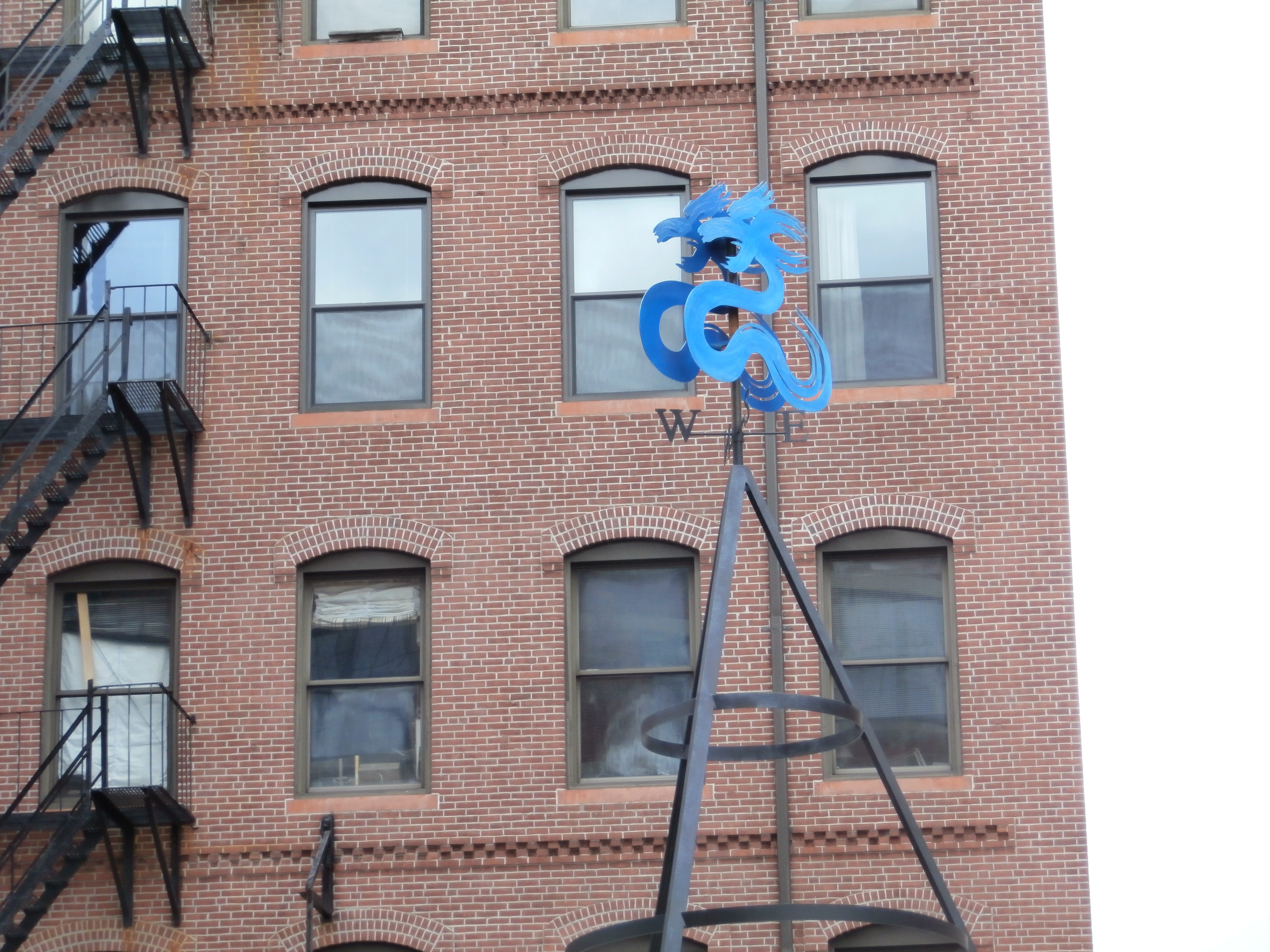
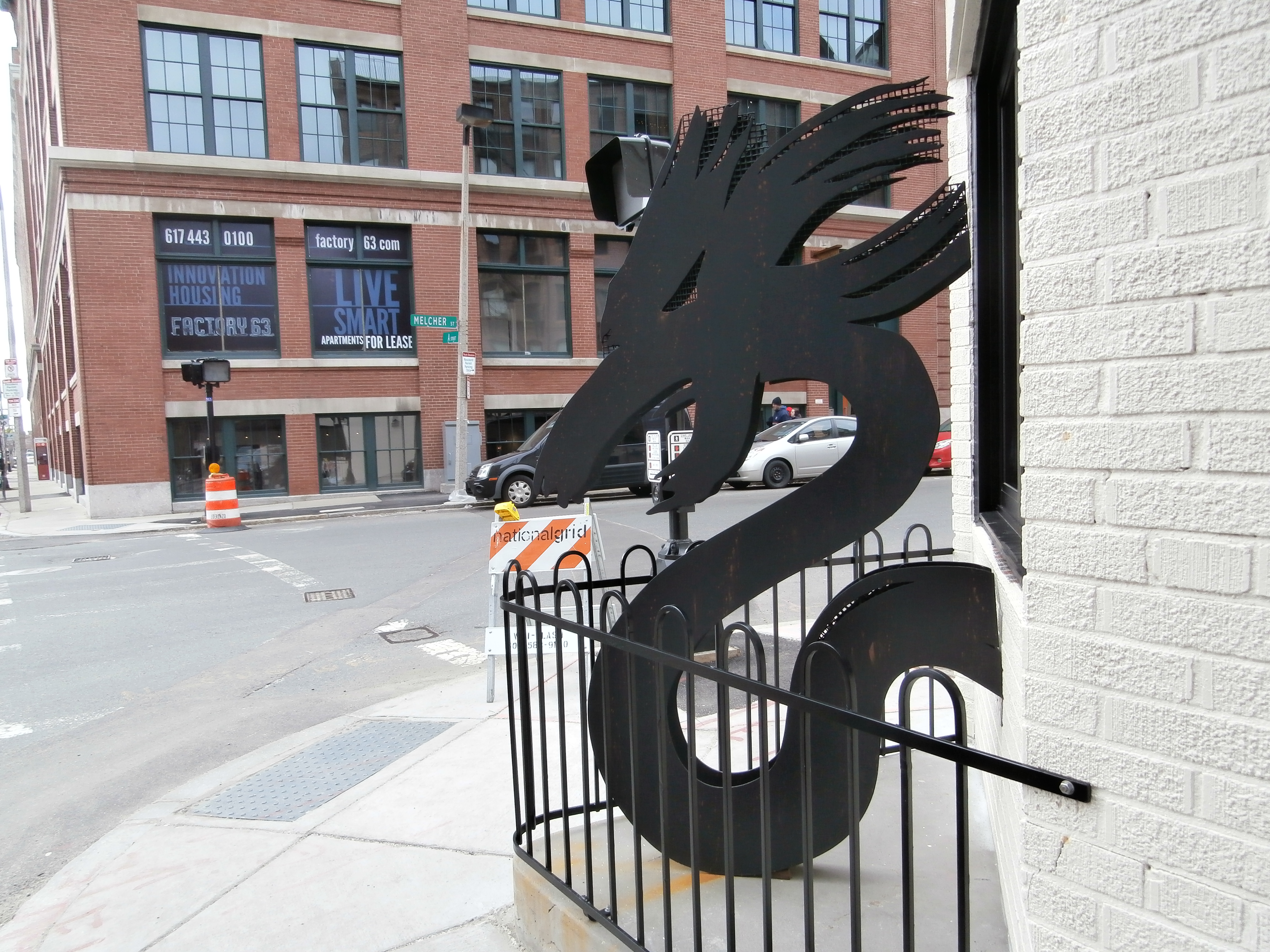
I got an extra bonus, too, because on the way I saw a completely unexpected bit of street art by the famed Gemeos twins, whose work at the ICA and Dewey Square was described in an earlier post.

Read Full Post »

At first, Suzanne and Erik thought the chair backs attached to tree stumps on Blackstone Boulevard must have been the work of a conservancy-type organization. The boulevard’s broad, shaded medial strip for walkers, runners, and baby carriages is always well maintained and welcoming.

But it turns out that a “guerrilla good deed campaign” is behind the tree-stump art. Erin Swanson, of Providence’s East Side Monthly, tracked down a vigilante known as Johnny Chair Seed.

“Last summer,” Swanson writes, “a few friends were having themselves a little stroll down Power Street when they stumbled upon a broken chair, discarded on the sidewalk. A few footsteps further, they happened upon a tree stump. ‘It started as just a random idea. We figured someone got drunk and broke the chair,’ says the anonymous mastermind behind the array of stump chairs now scattered throughout the East Side. ‘I hear people have started calling me Johnny Chair Seed,’ he says with a devilish smile. ‘I kind of like it.’

“With the help of two friends (two of the ‘select few’ who know his true identity), Johnny has constructed a total of ten stump chairs including those on Hope, Rochambeau, Blackstone, Elmgrove and Larch, among others.” The full article is here.

Makes me want to do a stealth project again. It’s been too long. I have something in mind involving poetry. Stay tuned.

Photograph: East Side Monthly

Read Full Post »

I’m happy to see some long-neglected murals being restored in Harlem. Robin Pogrebin has the story in the NY Times:

“When the Works Progress Administration [WPA] commissioned murals for Harlem Hospital Center in 1936, it easily approved the sketches submitted by seven artists, which depicted black people at work and at play throughout history. The hospital, however, objected, saying four of the sketches focused too much on ‘Negro’ subject matter … .

“Protesters rallied around the art, though, lodging complaints as high as President Franklin D. Roosevelt, and the murals ultimately prevailed.

“Over the years, those wall paintings deteriorated or were obscured by plaster. Now they have been restored and brought front and center as part of a new, $325 million patient pavilion for the hospital, on Lenox Avenue at 135th Street that will be unveiled on Sept. 27. …

“The artists — the last of whom, Georgette Seabrooke, died last year — were not well known and their murals portrayed ordinary people going about their daily lives. Vertis Hayes’s ‘Pursuit of Happiness’ panel traces the African diaspora from 18th-century African village life to slavery in America to 20th-century freedom; from agrarian struggles in the South to professional success in the industrialized North.” More.

The WPA cost money, but it put a lot of people to work. And look at all the great things that were created! I especially love the idea that unemployed people were paid to paint murals, write and produce plays, interview ordinary Americans for the National Archives, and record folk music. I know it was a stressful time, but thinking about the art makes me almost nostalgic.


Photograph: Karsten Moran for The New York Times
Elizabeth Kolligs works on restoring Vertis Hayes’s “Pursuit of Happiness” at Harlem Hospital.


Read Full Post »

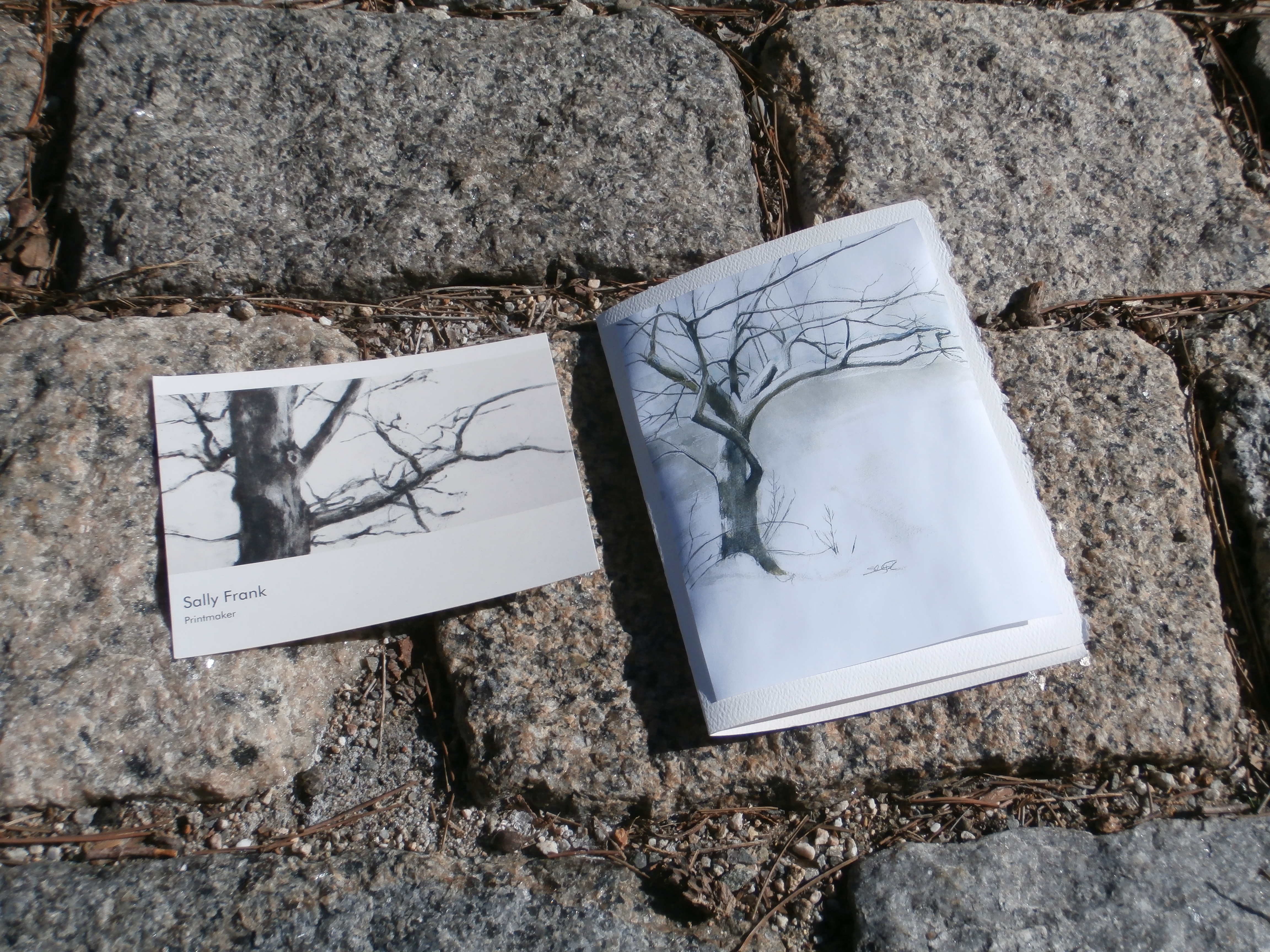
She doesn’t do only trees, but she knows trees inside and out.

Katherine Pacchiana has a nice update in the Daily Voice, a newspaper in North Salem, New York.

Sally Frank was in the middle of the Maine woods as she talked, via cell phone, about her collection of tree art, now on display at the Ruth Keeler Library.

“ ‘Most of what I do is make prints,’ she explained. ‘Unfortunately, I have a day job, but I like to do monotypes which are spontaneous and don’t take a long period of time.’ Monotypes are a form of prints, dating back to the 17th century. Each is made individually.

“Frank has been drawing all her life and has trained in many places, including Simon’s Rock in Great Barrington, Mass., and Long Island University, where she earned a master’s in fine arts. At the age of 19, she was apprenticed to Tom Bostelle, the American painter and sculptor who was a colleague of Andrew Wyeth.

“ ‘I’ve always drawn trees and the natural landscape. I went from focusing on the architecture of a tree – its sturdy trunk and the strong presence it has on the landscape – to what is left when a tree dies away and leaves forms behind.

“ ‘I’m fascinated by the texture and light that trees create, the  patterns – a tree’s essence.’ ” Read more.

Today I happened to be in Great Barrington for a work conference on affordable housing in rural areas. It was my first visit since Sally’s parents’ wedding, which I remember as being in a Unitarian church. I was hoping to get a picture I could post, but I saw only St. Peter’s and the Congregational church.

The Red Lion Inn in Stockbridge looked vaguely familiar, and I wondered if that was where we were staying when my father, as best man, realized he’d forgotten the wedding ring and raced back to fetch it while Uncle Jim paced anxiously, muttering words I recall as, “He always does this”!

Read Full Post »

I liked Jacki Lyden’s story at National Public Radio about some unusual artists in the 1960s.

“If you traveled by way of Florida’s Route 1 in the 1960s, you might have encountered a young, African-American artist, selling a lushly painted oil landscape from his car. They weren’t allowed in galleries during Jim Crow segregation — but motels, office buildings and tourists would buy their vivid works.

“Together, they formed a loosely associated band around Fort Pierce, Fla., that came to be known as The Highwaymen. At $20 a painting, they made their way out of agricultural jobs like citrus-picking and defined the cultural look of an era.

“Their paintings departed from an earlier tradition of landscape painting in Fort Pierce. A.E. ‘Beanie’ Backus, considered the father of the landscape movement there, caught the clouds and savannahs and inlets that were falling to developers in the mid-century. He would teach many youngsters who came to his studio, including the teenage Alfred Hair, leader of The Highwaymen.

“These artists would take off in their own direction. But success has brought enduring tensions on their home turf, raising questions about art, race and cultural legacy. …

“The who’s who of The Highwaymen can be tricky. (A curator named Jim Fitch coined the name in the ’90s and it stuck.) Gary Monroe, author of The Highwaymen, Florida’s African-American Landscape Artists, counts 26 original painters — 18 of whom are still living. That’s how many were inducted into the Florida Artists Hall of Fame in 2004.”

Lots more.

Photograph: Gary Monroe
Alfred Hair (left) and Robert Lewis

Read Full Post »

Gwarlingo pointed me to Time In, an initiative that provides arts experiences for children who might not get such enrichment any other way.

Time In brings some of the youngest, most at-risk public school children OUT of underserved classrooms and INTO the world of the living arts every week of the school year.

“Starting from Pre-K, children {try] hands-on art in our studio one week, with hops to the world’s best galleries and museums the next! Regardless of their backgrounds, children are children. The world of imagination, creativity and fantasy is their most fertile ground. Time In acknowledges children’s phenomenal gifts and innate abilities and is dedicated to developing learning environments that stimulate, rather than stifle.

“We are proud to have changed the lives of more than 1,000 underserved Pre-K-2nd graders since 2006, and look forward to working with over 400 children this year. Time In will continue to foster not only wonderfully conceptual thinkers, but perceptive and aesthetically sensitive children, each of whom will be poised to nourish our society in the days to come.”

Read more. Or vote for the nonprofit on Facebook as Part of Chase Community Giving.

Read Full Post »

These two murals are from Somerville and Gloucester. Do you get the feeling that the towns themselves have different personalities? One seems to record the history of the city in a formalized way. The other is more about people’s lives today.

If you know more about the genesis of these murals, I’d love to hear it. In both cases, the murals seem to have been created with permission. I wonder if you think that permission subverts the subversiveness of street art?

Makes me think of the kids in eighth grade who were asked to create nice Halloween paintings on shop windows so the windows wouldn’t get soaped as a Halloween prank.

The goody-two-shoes kids painted windows with pumpkins and witches. The rough kids still soaped windows.

Read Full Post »

When I saw the headline at Wired, it didn’t really compute.

“Artists Create Portraits on Live Grass.” What? I don’t get it. Did the artists set up easels and paint with oils? Did they paint directly on the grass?

Writer-photographer Jakob Schiller explains.

“It all started, as these things sometimes do, by accident. In 1990, before they worked in photography, [Heather] Ackroyd and [Dan] Harvey created an art installation that covered an entire room with grass. As part of the art piece they had left a ladder leaning against a wall and when they went to remove it they saw that the ubiquitous and fast-growing plant had been imprinted with the shadow. The grass had stayed yellow where the ladder had prevented it from receiving any light.

“ ‘We didn’t know straight away what we were looking at, but we knew that we had observed something important,’ Ackroyd says.

“They began playing with the idea of manipulating the light that hits grass and by the next year were projecting light through an old 35mm Kodak projector onto a swath of grass on the wall.”

What to think as the grass withers and dies? It’s kind of a Dorian Gray scenario.

Read more about the project at Wired‘s Raw File, here.

Photograph: Ackroyd & Harvey.
Myles, Basia, Nath and Alesha, The Big Chill Festival, Eastnor Castle, between the Cotswolds and the Welsh Marches. 2007

Read Full Post »

« Newer Posts - Older Posts »