Feeds:
Posts
Comments

Posts Tagged ‘artist’

I learned about an unusual artist today because I was following @FortPointArts on twitter. Her name is Heidi Kayser, and just when I no longer have an office with a view of Fort Point Channel, she has launched an art project on the water. Sigh.

Anyway, I went to her website and poked around. This blog entry from 2011 is a typically amusing one, and I think one of my readers may want to try the experiment:

“Sarah Rushford arrived today and we got right to work … The mission, as we chose to accept it, was to construct some sort of wearable platforms to hold the cameras on the back of my legs. Wonderful engineers that we are, Sarah and I  ingeniously came up with [contraptions] made of CD cases, zip ties, rubber bands, twine and alligator clips. …

“Sarah filmed me tramping across the beach. I filmed my ankles tramping across the beach. It was very surprisingly difficult to walk wearing the cameras — I couldn’t extend my knees very much, so finding balance in soft sand proved challenging but oddly meditative. My attention had to be focused on every step, otherwise I’d fall and damage the cameras.

“When we were nearly finished, the curious beach-goers who had been pretending to ignore me as I walked steadily and weirdly by them, came up to us and asked what we were doing.” Read more.

Photograph: Sarah Rushford

Read Full Post »

Gareth Harris of the Financial Times writes that foundations set up by successful artists or their estates are becoming a force to be reckoned with in the art world.

“ ‘Artist-endowed foundations are the sleeping giants of philanthropy,’ says András Szántó, a New York-based analyst and cultural consultant. Indeed, these charitable foundations, endowed by an artist with assets (archives, property and art among them) used for the public good, are quietly but dramatically changing the US art landscape through their grant-making programmes, scholarship, research activities and contributions to museum collections. …

“The greatest challenge, for a start-up private operating foundation,  [according to Christy MacLear, the Rauschenberg Foundation’s executive director], is making the transition from an unregulated art industry player to a highly regulated non-profit entity.

“Such sticky issues aside,” Harris continues, “artists’ foundations could, one day, match or even top government funding for the visual arts in America.

“Szántó stresses that their full impact is yet to be felt. ‘With an unprecedented cohort of well-to-do painters and sculptors among the older generation,’ he says, ‘the golden age of artist foundations may yet be ahead.'”

The Andy Warhol Foundation’s Joel “Wachs, meanwhile, is evangelical, declaring: ‘Successful artists have a unique opportunity to support those artists that come after them.’ ”

Read more in the Financial Times.


Read Full Post »

As long as health insurance is out of reach for so many, creative approaches to coverage are likely to keep sprouting up.

I knew a doctor 30 years ago who took care of elderly single people for life — and inherited their houses. He ended up with a lot of houses.

More recently, CBSNewYork/AP reported that “a new program lets uninsured New York City artists exchange their art for medical services.

“Tony-Award winning actor Lin-Manuel Miranda and rapper and radio personality Roxanne Shante helped launch the ‘Lincoln Art Exchange’ at Lincoln Hospital in the Bronx” early this year.

“Under the program, artists will earn ‘health credits’ for every creative service they perform. In exchange they’ll be able to obtain doctor’s visits, laboratory tests, hospitalization, emergency care, dental care and prescriptions at Lincoln.” Read more at CBS Local.

I would be interested in other unusual examples of how people are accessing care today.

Photograph: nyc.gov

Read Full Post »

Nancy L. urged me to take a look at the work of Providence-based artist Anne Spalter. I found fascinating, kaleidoscopic videos and stills at various online locations.

From her artist statement: “Anne Morgan Spalter creates art works that explore her concept of the ‘modern landscape.’ The works depict modern landscape elements or ways of viewing our surroundings and use traditional materials as well as digital imaging, printing, and video.

“Spalter takes hundreds of digital photos and videos each year, often from the windows of moving cars and planes, that capture both technologically advanced ways of moving through the landscape and the modern structures that are in it …”

She is the author of The Computer in the Visual Arts, which former RI School of Design president Roger Mandle described as, “a seductively articulate and illuminating introduction to the rapidly expanding world of the computer and art, design, and animation.”

She and her husband are collectors of early computer art. “In early 2011, the DeCordova Museum in Lincoln, MA,  exhibited works curated from the collection,” notes Spalter’s c.v. MoMA has shown pieces from the collection, too.

This video, called I95, will amaze anyone who has driven that daunting thoroughfare.

Find some stills from videos by Anne Spalter here.

Read Full Post »

There’s this one doctor who is generally quite late, so I always plan to take half a vacation day when I have an appointment with her. On Thursday, however, she was on time, so after I saw her, I got on a bus and went to SoWa (“South of Washington,” known for art galleries). Ferris Bueller’s Day Off.

I had got it in my head that I would like to buy an Easter hat this year. No one does Easter bonnets anymore. It used to be fun, if a little ridiculous.

After I left some of Suzanne’s Luna & Stella cards in the SoWa building where there are  open studios on first Fridays, I went over to the hat shop.

The hats were pretty gorgeous, but pricey. (It’s art, after all.) The smallest little saucer with a couple feathers was $150. The more magnificent hats were close to $400.  So I just looked. You should look, too. Amazing, huh?

Marie Galvin, the artist, writes on her site: “Galvin-ized Couture Hats and Headpieces are handcrafted with innovative design & techniques. These fabulous creations are perfect for Weddings, Ascot, the Kentucky Derby and Cocktail Parties.”

Nothing about Easter.

Can’t you picture me in a back pew of the U-U church in this little number? Sigh.

Read Full Post »

Back in December, Asakiyume and her daughter and I went to see a graphic art exhibit in Fitchburg. We were all quite taken with a dark, wordless story that Lynd Ward carved nearly a century ago. So I thought I would mention that, according to the New York Times, a documentary about Ward will be shown in Maine next Saturday.

Scroll down in a column by Eve Kahn, here, to the subhead “An Illustrator’s Life.”

“The prolific illustrator Lynd Ward had fans as diverse as superhero-comic-book collectors, the poet Allen Ginsberg and the graphic novelist Art Spiegelman. In the 1920s and ’30s Ward carved woodblocks for wordless books about capitalism’s oppressive side effects. …

” In later years Ward mainly illustrated stories by other authors, but his compassion for the underdog still came through, especially in his 1942 watercolors for Hildegarde H. Swift’s ‘Little Red Lighthouse and the Great Gray Bridge.’ ”

The Times reporter interviews filmmaker Michael Maglaras, who “has devoted much of the past two years to a new movie, ‘O Brother Man: The Art and Life of Lynd Ward,’ which will have its premiere on March 31 at the Maine Festival of the Book in Portland.

“Mr. Maglaras and the producer Terri Templeton based the film partly on archives that the family preserved after Ward’s death in 1985, and they extensively interviewed Ward’s younger daughter, Robin Ward Savage.”

Now, that is a movie I would like to see. Here’s a clip.

Read Full Post »

I went to the Concord Library today to hear children’s book author and illustrator Ed Emberley give a charming talk to a crew of little kids sitting on a rug.

Emberley used an easel and colored chalks to demonstrate simple ways to create pictures. It was clear that he was used to talking to young children and loved making them laugh. The kids responded gleefully. Grownups did, too.

Several fans asked him — and his wife and collaborator, Barbara — to sign books they had brought along. One woman told me that her kids, now grown, still knew all the words to the Emberleys’ book Drummer Hoff, winner of the 1968 Caldecott Award for  illustration.

I took home a worksheet with Emberley’s drawing tips so I can do more-interesting doodles in long meetings at work.

Read Full Post »

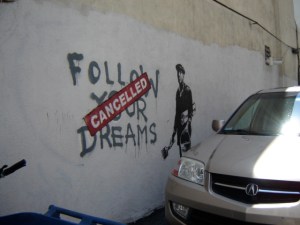
I am intrigued by street art, and have blogged a few times about the British street artist Banksy. For example, here.

So I wanted to share Nicholas Barber’s article “The Full Banksy Experience” at More Intelligent Life.

“Last week I was driving home along an unlovely stretch of main road in east London,” writes Barber, “when I saw what looked like a billboard on the side of a building. It had a friendly message printed in neat black letters: ‘Sorry! The lifestyle you ordered is currently out of stock.’

“It took a few seconds to process. It was definitely pithy, and definitely cheered me up at the end of a boring drive, but what was it? An advert? Did it have The Economist’s red logo at the bottom? Or was it … could it be … a Banksy?

“A few days later, an item in the local paper confirmed that it was indeed a Bansky, and a photo was on the artist’s website. I felt as if I’d lucked into a new artistic experience.

“The pleasure you get from a Banksy comes from the whole process: the chancing upon on an artwork in the unlikeliest of places, the speculation over how it got there, the uncertainty over whether it’s his or not, the subsequent authentication, and then the knowledge that it might have been rubbed out by the time you return.”

That is similar to my own reaction, except for the fact that I knew what I was looking for. And to this day, it has not been “authenticated.” Do you think it looks like a Banksy?

Read Full Post »

Dutch artist Peter Gentenaar makes stunning paper sculptures that Nathaniel Ross at Inhabitat (“design will save the world”) describes as “soaring through the air like flying jellyfish. …

“Peter Gentenaar’s art was born out of the limitations of what he could (or couldn’t) create with store-bought paper. So with the help of the Royal Dutch Paper Factory, he built his own paper factory and devised a custom beater that processes and mills long-fiber paper pulp into the material you see in his artwork. He saw the potential that wet paper had when reinforced with very fine bamboo ribs, and he learned to form the material into anything his imagination would allow.”

Check out the machine Gentenaar uses to create his paper. You can buy one. He describes it thus:

“A machine suitable for beating long fibers, flax, hemp or sisal, as well as for beating soft and short fibers like cotton linters. The machine is built in stainless steel and has a bronze bedplate. The bronze bedplate has the same curve as the knife roll, this gives effective grinding/beating over a surface of: ± 20 x 10 cm. The distance between the roll and the bedplate can be finely adjusted. Also the weight under which the fibers are beaten can be varied from 0 to 60 kilo’s. This means you can use the beater on very delicate fibers and on very strong and rough fibers as well. I never have to cook my fibers. There is a factory guarantee on the beater of one year. At present I’m getting a CE mark, which ensures certain safety standards. There are over 70 beaters of this type sold over the last 12 years and they are all still working.”

Art: Peter Gentenaar

Read Full Post »

You may have read about the monumental projects of the artist Christo. Perhaps you even went to see “The Gates” when his orange banners dotted Central Park.

Well, Christo is at it again, proposing to “drape 5.9 miles of fabric across a 42-mile stretch of the river” in Colorado for two weeks. And he’s once again exposing himself to the hostility of people who feel passionately protective of a particular space. It’s the cost of doing business.

In this February 10 Denver Post article: “Christo sits stone-faced as they call him a liar, a cheater, a con man, a killer, as they politely suggest he is a fool, as they angrily denounce him as an enemy of nature. He is the world’s most famous artist and this is what he must endure for these odd projects he dreams up. Here, in southern Colorado, where he hopes to drape 5.9 miles of silvery fabric over the Arkansas River, it is the same as it was in Manhattan where he battled 25 years to hang orange material from 7,503 gates in Central Park, and in Berlin, where he had to persuade 612 German parliamentarians, one by one, to let him wrap his cloth around the Reichstag.” Read more.

Whatever else you might say about him, the man has patience. An even more recent article in the Denver Post, February 22, indicates that he has moved the target date from August 2014 to August 2015. (The first of many target dates was summer 2001.)

“At the two final public hearings for the Over the River project earlier this month, the Fremont County Board of Commissioners fielded almost 10 hours of heated support and opposition as well as 575 letters. On Tuesday, the three-member board decided it would not make a decision regarding the artist’s request for a temporary-use permit at its next scheduled meeting Feb. 28.

” ‘We simply feel we are not ready for a formal vote,’ said Commissioner Debbie Bell, noting that the board is scripting a list of conditions for the project. The board could make a final decision at its March 13 or March 27 meeting, she said. …

“Christo’s decision to delay reflects his desire to share yet-to-be-developed emergency-management plans that detail traffic, safety and other issues during the installation process. It also restores the 28-month construction period, which was pinched when federal approval stretched nearly three years.” Read more.
Read Full Post »

Jonathan Harris sounds like a kindred spirit. Of course, he’s a real photographer, and I’m not. But back in August 2010, he decided to take a photo every day of something that interests him and write a short piece about it for the web.

He made that decision on his birthday, writes Jennifer Preston in the NY Times.

“For the next 440 days, Mr. Harris, 32, a noted artist and digital technologist, whose work has been widely exhibited from MoMA to the Le Centre Pompidou in Paris, carried out his project. It has evolved into a new Web site he founded, called Cowbird — a social network that has attracted more than 7,000 people since it began last December, including award-winning photographers and writers. Mr. Harris said it is a place for slow, long-form storytelling, the ‘opposite of Twitter and Facebook .’ ” Read more.

The reason I say that he’s a kindred spirit is not just that he writes something longer than one would write on Twitter or Facebook, but because he makes a point of finding something that interests him and then writes about it for the length the topic requires.

When Suzanne and Erik said I could write about anything that interests me in the Luna & Stella blog, I couldn’t pass up an opportunity like that. Not sure how many of you go the birthstone-jewelry company from this blog, which probably doesn’t work like a regular business blog, but at least you know what Suzanne’s Mom is like and a bit about Suzanne and Erik and their extended family, too. They think that’s good, because jewelry that starts with birthstones is all about family and other close relationships.

Read Full Post »

Today I went to the last performance of Red, a drama about Abstract Expressionist painter Mark Rothko at the SpeakEasy Stage. It starred the inimitable Thomas Derrah with a young actor who was new to me, Karl Baker Olson.

It’s always interesting to read reviews of shows that touch different creative realms. For example, an opera critic who reviews Porgy and Bess might have a different take from a theater critic.

In the case of Red, theater critics were full of praise, but an art critic I read found the story thin.

Not being either kind of critic, at least not at the moment, I thought it moving, well acted, and well directed. The set by Cristina Todesco and featuring Rothko’s studio was amazing, dim, with the chapel-like quality Rothko found necessary for communing with a painting and seeing it vibrate.

Read Full Post »

I met Mary Driscoll in playwriting class last summer.

Mary has had a lifetime focus on social justice for marginalized people. She has traveled to foreign countries to work with refugees. For people with HIV, she has taught pilates and the healing art of telling one’s stories. She has performed with mission-oriented theater troupes. And she is the founder of  OWLL, On with Living and Learning, which helps ex-offenders build new lives after prison.

At Mary’s invitation, my husband and I found our way last night to what is a virtual artist colony in the long-abandoned but reemerging warehouse district of South Boston. In Mary’s loft apartment, one of the artists she has drawn into her orbit presented a wonderful cabaret show to raise money for OWLL’s production of Generational Legacy about mothers and children after prison.

Michael Ricca interpreted songs by Michel Legrand with great humor and feeling (including the theme song of our wedding, “What Are You Doing for the Rest of Your Life?”). Ricca is performing the songs and others by Legrand at Scullers in March.

My husband and I enjoyed talking to Mary’s guests  — artists, actors, musicians, social activists, old  friends. We’re especially keen to keep an eye on the doings of the Fort Point Theatre Channel in the Midway Studios building, where Mary  lives and works. The collaborative productions in the Black Box Theatre sound intriguing and offbeat. We like offbeat.

Read Full Post »

I am psyched. I blogged a while back about UBS banker Geoff Hargadon, who is also a conceptual artist with a crazy sense of humor.

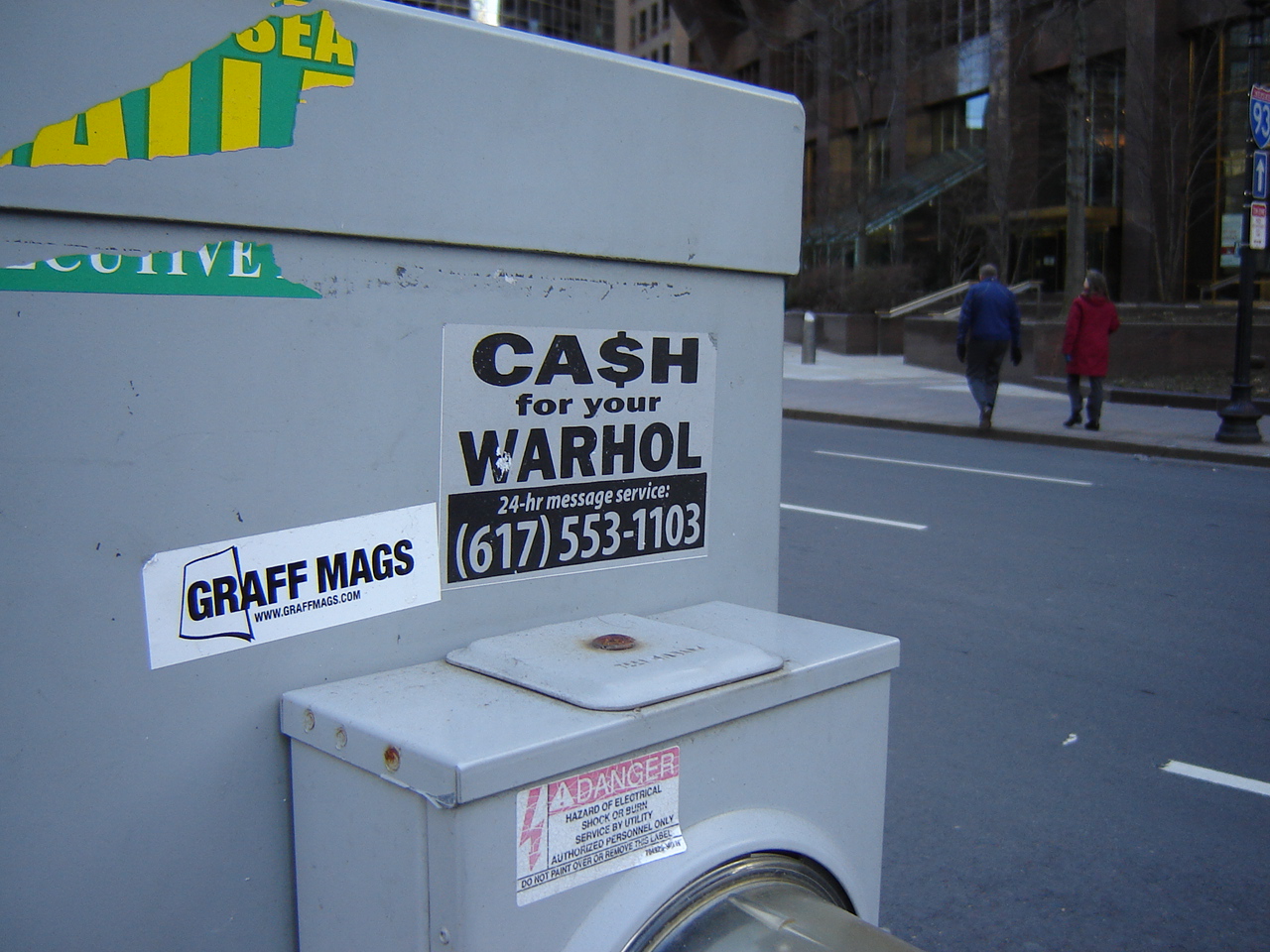
After Brandeis University’s then president made noises about selling the art collection of the Rose Museum, Hargadon put a sign outside on the grass: “Cash For Your Warhol.” It looked like the signs on telephones poles or in abandoned lots that lure the unwary into deals too good to be true.

Hargadon has put his signs up hither and yon, like the street artist Banksy in a way, or Shepard Fairey.

Yesterday I noticed one in the Boston financial district as I waited for the light to change. It’s at the corner of Congress and Franklin streets. I came back today and took a picture. Anyone want to call the number?


Read Full Post »

My Neighbor’s Cow

My neighbor’s cow is still sporting Christmas lights in mid-January. I like the subjects that interest her deeply (in her gut, really), and I love her high-heeled shoes and pink socks. I also appreciate that she is very calm and unlikely to kick over a a lamp and start the Chicago Fire.

My neighbor’s cow is detached and steady and, other than donning Christmas lights, never changes.

Read Full Post »

« Newer Posts - Older Posts »