Feeds:
Posts
Comments

Posts Tagged ‘artist’

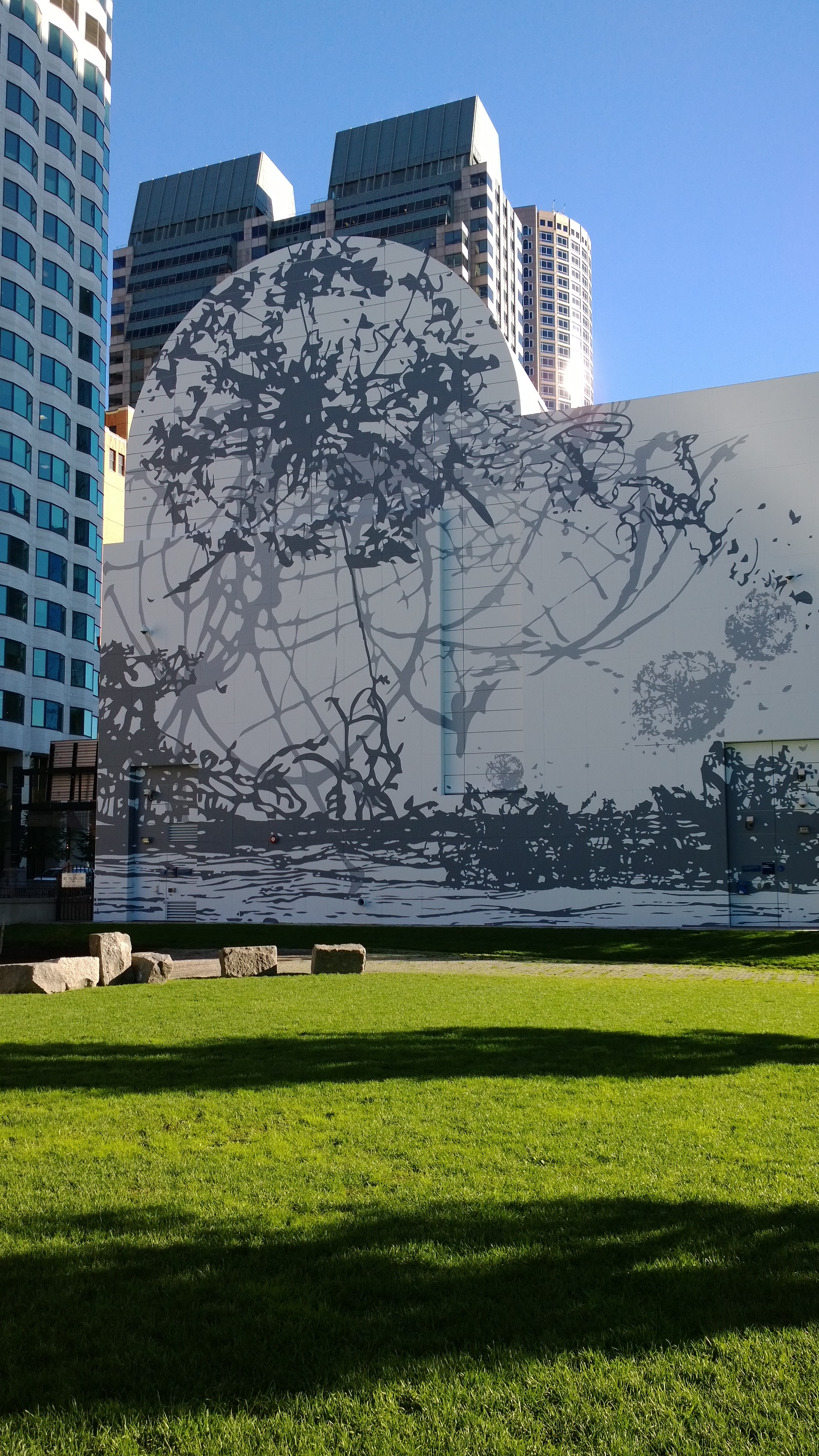
Remember the new Dewey Square mural I blogged about recently, here?

The Boston Globe has a brief update for you, but their picture is blocked by a cherry picker. As soon as the Greenway moved the heavy equipment, I shot my own picture.

Be watching for more on Dewey Square. I have blogged about the two months that Occupy Boston camped there. I have blogged about the Greenway’s teaching garden alongside the Big Dig exit and about the farmers market that sets up Tuesdays and Thursdays. Soon I will show pictures of the pianos that arrived today — with people playing them, I hope.

Dewey-Square-mural-Sept-2013

Read Full Post »

Candy creates interactive street art. Her “Before I Die” wall garnered a lot of attention — and contributors. Folks wanted more.

So she decided to create a website explaining in detail how others could replicate the wall.

Here she tells how it all started: “It’s easy to get caught up in the day-to-day and forget what really matters to you. After I lost someone I loved very much, I thought about death a lot. This helped clarify my life, the people I want to be with, and the things I want to do, but I struggled to maintain perspective. I wondered if other people felt the same way. So with help from old and new friends, I painted the side of an abandoned house in my neighborhood in New Orleans with chalkboard paint and stenciled it with a grid of the sentence “Before I die I want to _______.” Anyone walking by could pick up a piece of chalk, reflect on their lives, and share their personal aspirations in public space.

“It was an experiment and I didn’t know what to expect. By the next day, the wall was bursting with handwritten responses and it kept growing: Before I die I want to… sing for millions, hold her one more time, eat a salad with an alien, see my daughter graduate, abandon all insecurities, plant a tree, straddle the International Date Line, be completely myself…  People’s responses made me laugh out loud and they made me tear up. They consoled me during my toughest times. I understood my neighbors in new and enlightening ways.”

Candy’s how-to page reads, in part, “Once you’ve created a wall, you can share your wall here by creating a mini-site! A mini-site is a page where you can post photos and responses and document the story of your wall. It’s super easy to use, absolutely free, and no technical skills are required. Visit the Budapest mini-site to see an example.”

Everything you need if you’re going to create a “Before I Die” wall is here.

Photo: Before I Die

Read Full Post »

Cultural institutions are getting smaller. And more local.

We wrote about a library in a phone booth here and the Little Free Library here. You can see fully realized short films on YouTube and street art just around the corner.

Now folks in Somerville have launched a museum in a doorway. It’s The Mµseum.

From the website: “Judith Klausner (Co-Founder, Curator) is a Somerville MA artist with a love for small, intricate, and overlooked things. She first dreamed up the Mµseum in 2010, as a way to combine her love of  serious miniature art with her passion for making art accessible, and her conviction that New England arts institutions should show the work of New England artists. Three years (and a lot of planning) later, she is delighted to see it become a reality. … Contact Judith at judith@themicromuseum.com.

“Steve Pomeroy (Co-Founder, Engineer) is a programmer and a builder, both by profession and by nature. He’s largely responsible for the engineering behind the Mµseum, from the solar-powered miniature track lighting to the 3D-printed doric columns and laser-cut façade typography. He formally studied computer science at the Rochester Institute of Technology where he discovered a love of communication protocols and formal computer languages. Contact Steve at steve@themicromuseum.com.”

WBUR had a story on the micro museum here.

There is something childlike and innocent about miniature enterprises. Didn’t you always think as a child you could take a few toys and tea cups and bags of flour and new sponges from around the house and set up a table on the street as an authentic store? You thought, Why not? Just do it.

I get a kick out of people just doing it.

Photo: Mara Brod, http://marabrod.com/fineart.html

Read Full Post »

Did you like last week’s entry on stained glass windows that produce solar energy? Well, there’s more.

Kristine Lofgren writes at Inhabitat about an amazing solar chandelier.

“British artist Luke Jerram is known for his stunning art installations, which are often inspired by science. His latest project, unveiled [last year] at the Bristol and Bath Science Park, is the world’s largest solar chandelier! The 16.5-foot-tall chandelier is made of 665 glass bulbs that spin when exposed to light …

“The chandelier was created using glass radiometers rather than traditional light bulbs. As the sun hits each radiometer, it begins to turn, speeding up and slowing down as the light changes. The overall effect is a shimmering, gently moving piece of artwork. At night, it is lit up using electric light.” More.

By the way, Inhabitat also features a piece on a sculptural sound chamber that sings when the wind blows, here.

Read Full Post »

And speaking of payment systems, community-supported agriculture has been around for years and, more recently, community-supported art. I blogged about the approach here in 2011, when the Cambridge Center for the Arts embraced the concept.

The NY Times has written about it, too. Randy Kennedy lays out the principles: “For years, Barbara Johnstone, a professor of linguistics at Carnegie Mellon University [in Pittsburgh], bought shares in a C.S.A. — a community-supported agriculture program — and picked up her occasional bags of tubers or tomatoes or whatever the member farms were harvesting.

“Her farm shares eventually lapsed. (‘Too much kale,’ she said.) But on a recent summer evening, she showed up at a C.S.A. pickup location downtown and walked out carrying a brown paper bag filled with a completely different kind of produce. …

“ ‘It’s kind of like Christmas in the middle of July,’ said Ms. Johnstone, who had just gone through her bag to see what her $350 share had bought. The answer was a Surrealistic aluminum sculpture (of a pig’s jawbone, by William Kofmehl III), a print (a deadpan image appropriated from a lawn-care book, by Kim Beck) and a ceramic piece (partly about slavery, by Alexi Morrissey).

“Without even having to change the abbreviation, the C.S.A. idea has fully made the leap from agriculture to art. After the first program started four years ago in Minnesota … community-supported art programs are popping up all over the country …

“The art programs are designed to be self-supporting: Money from shares is used to pay the artists, who are usually chosen by a jury, to produce a small work in an edition of 50 or however many shares have been sold.”

Read all about it, here. Could be risky if you really don’t want a sculpture of a pig’s jawbone. But if you look at it as supporting the arts, you are likely to be satisfied with that side of things — and there’s always a chance you will love what you get or find its value increase.

Photo: Zoe Prinds-Flash
Drew Peterson’s prints and Liz Miller’s collages were among the art for members of this C.S.A., community-supported art, in Minnesota.

Read Full Post »

Oh, boy, what a cool site! Modern Hieroglyphics started following me after my last Banksy post, so I clicked and took a look at his site. It’s all about street art. I especially loved this post on “reverse graffiti.”

Says Modern Hieroglyphics, “Paul Curtis (Moose) uses a powerwasher to remove dirt and grime off of walls, resulting in the creation of stunning images and patterns. The new art form is known as ‘reverse graffiti’ or ‘clean tagging,’ and is growing in popularity all over the world. This is the story of Moose. …

” ‘I became an artist by accident really, I was promoting music that my label was releasing by using reverse graffiti. I created it for that purpose, then I would do large pieces for fun or like a strange hobby, then people started to ask me to work for them… and the Internet happened and I became notorious. …

” ‘I discovered reverse graffiti one day when I was a teenager working as a dishwasher in a restaurant. I aimlessly wandered out of the kitchen one day to just be in the restaurant section. I’d cleaned everything I could in the kitchen, and felt like I owned the place. So when I saw a small mark on the wall, I reached for the my cloth and wiped it off, only to find that in the process of wiping the mark off the wall, I made a much bigger mark by cleaning the original mark with the cloth.

” ‘In those days people smoked freely in establishments and the wall was brown with nicotine. I had always thought that the wall was painted that color, and now this almost-white cleaning stripe was shining out of the wall like I had a tin of white spray paint and started to write. It was quite a shock for me, and I spent a long time trying to rectify what looked like damage but was only cleaning.

” ‘Years later, while gazing out of the window on a bus, I saw that in the road tunnels in Leeds, these clean marks appeared everywhere, drunks sliding home along the tiled walls left long streaks that looked like chrome in the car lights. Later on, I finally did something with that observation.’ ”

More samples of Moose’s art are at Modern Hieroglyphics.

Art by Paul Curtis (Moose), creator of reverse graffiti

Read Full Post »

Artist Sarah Hall is killing two birds with one stone. Or solving two challenges with one creation. According to Canadian Public Broadcasting, Hall has made stained glass windows that can convert the sun’s rays into energy for the building the stained glass embellishes.

Emily Chung writes, “Lux Gloria by Sarah Hall, at the Cathedral of the Holy Family in Saskatoon, is currently being connected to Saskatoon Light & Power’s electrical distribution network, confirmed Jim Nakoneshny, facilities manager at the cathedral.

“The artwork, which consists of solar panels embedded in brightly coloured, hand-painted art glass, had just been reinstalled and upgraded after breaking and falling into the church last year.

“Once it is connected, the cathedral will be able to use the solar power produced by the art installation to offset its own power consumption from the regular grid, Nakoneshny added.

“According to Kevin Hudson, manager of metering and sustainable electricity for Saskatoon Light & Power, the solar panels are expected to produce about 2,500 kilowatt hours annually or about a third to a quarter of the 8,000 to 10,000 kilowatt hours consumed by a typical home in Saskatoon each year.”

Read all about it at the CBC, here.

Photo: Sarah Hall on Popsci.com website
Lux Gloria: The solar-stained glass installment features dichroic glass and will be connected to the electrical grid in Saskatoon, Saskatechewan.

Read Full Post »

Photo: Getty Popperfoto
L.S. Lowry, (pictured in 1957), the artist from Manchester, is the subject of a major new show at the Tate Britain gallery.

Some years ago when my husband was in England on business, he acquired a print of workers coming and going outside a factory. The original was by L.S. Lowry, whose paintings of industrial Britain turn out to be very popular in the UK.

Popularity, however, is not a ticket to being shown at the Tate Britain. Belatedly, Lowry will receive a retrospective in 2014.

Oliver Wainwright at the Daily Mail writes, “Clouds of smoke belch from forests of chimneys, while armies of spidery figures scuttle to and fro between narrow terrace houses and imposing factory gates.

“Crowds of fans shiver on the edge of a football field, a fist-fight breaks out, and barefoot children tease a stray cat on the street corner.

“These are the scenes depicted in the haunting paintings of L.S. Lowry who, more than any other artist, managed to capture the strange, bleak beauty of daily life in northern industrial towns.

“His dream-like images captured the popular imagination, adorning chocolate boxes and biscuit tins, tea towels and jigsaws.

“Yet they are scarcely to be found on the walls of our major national galleries. The Tate owns 23 of his works, but has only ever exhibited one on its walls in the past 20 years — and then only briefly. …

“Why has it taken so long?

” ‘He’s a victim of his own fan base,’ said Chris Stephens, Tate Britain’s Head of Displays. ‘What makes Lowry so popular is the same thing which stops him being the subject of serious critical attention. What attracts so many is a sort of sentimentality about him.’

“This is a strangely inverted piece of art world logic,” Wainwright comments, “where the popularity of an artist is seen as an obstacle to showing their work.”

If you’re an artist, be careful to stay off “chocolate boxes and biscuit tins, tea towels and jigsaws” — or wait to be discovered by art experts of a future generation.

More here and here.

 © The estate of L.S. Lowry
L.S. Lowry, Coming out of School, 1927

Read Full Post »
When I was little, I liked to look at the cartoons in my parents’ New Yorker, and the ads, too if the pictures were interesting.

I loved the old ads for the Philadelphia Bulletin, in which one skinny, anxious guy in black, like a modern day Cassandra, tried to get people’s attention about something going wrong. Cassandra’s fate was to see the future and never be believed. His was never to be heard.

Usually what he saw was something that had me worried, too, like a shark coming onto the beach. I really couldn’t understand why all those beachgoers were reading the paper instead of paying better attention. On some level, I sensed that the ad might not hit its mark: it might make people wary of reading the Bulletin and maybe getting eaten by a shark.

My husband remembers those ads, too, and when we were reminiscing about them in a restaurant Saturday, he did some Googling and turned up the artist’s name and the cartoon below.

The cartoonist was Richard Decker. Wikipedia writes about him here.

From his obit: “Mr. Decker worked nearly four decades as a contract cartoonist at the New Yorker, starting with the magazine in 1929 and becoming well-known on its pages for his detailed cartoons and lush washes. …

“Those cartoons Mr. Decker crafted that did not appear in the New Yorker often found their way into such magazines as the Saturday Evening Post, Look, Colliers and Playboy.

“And over the years, he also did illustrations for advertising campaigns. Among the best known was a 28-year Philadelphia Bulletin series, which ran until the 1960s, that centered on the slogan, ‘In Philadelphia, nearly everybody reads the Bulletin.’ A major feature of the campaign was ‘Mr. Nearly’ – the only man around not reading the paper.” Decker’s full obit is here.

The cartoon character Mr Nearly is no more. But I can’t help hoping that sometime before his demise, someone heard his warnings.

Photo from the University of Pennsylvania

Read Full Post »

Suzanne is in Denmark at the moment and sent me a website for something unusual she saw there: a modern Stonehenge.

“The idea of creating The DODECALITH arose in 2006 when the composer Gunner M. Pedersen saw sculptor Thomas Kadziola’s land art project Anemarken (Ancestors’ field) … on the island of Lolland.

“The composer suggested that he and the sculptor create a Stonehenge on Lolland, consisting of a circle of twelve huge menhirs with heads in the open countryside.”

The creators write, “On a hill overlooking the sea, we are creating a singing monument … that will give everyone from near and far an experience of greatness, closeness and beauty, of time’s migrations and settlements. It will express pride and humbleness, times gone by, the present, and, importantly, time coming. …

“The stone figures will stand on invisible foundations and they will sing!
Under a circle of natural sitting stones, a 12 channel sound system will be installed. This system will allow spatial electro acoustic song and music specially created for The DODECALITH to sound inside the circle at intervals every day, all year round. …

“The ancestors [came] from afar, from the land to the south where the waters rose 7,500 years ago and sent the Lolers on their long journey. … Along the coast from Ravnsholt to Ravnsby alone, over 70 burial mounds have survived, several of which are passage graves. … There are now only four mounds … It is here we are re-erecting the Ring of the Lolers, The DODECALITH, to let the new Lolers ancestors sing.” More.

Read Full Post »

There is always so much to share from Andrew Sullivan’s site.  In a recent entry he pointed to a book called The Art Instinct, by Denis Dutton.

“Micah Mattix reviews

“The first feature of our inclination toward art is that we seem to have a universal love of landscape paintings — and not just any landscape, but landscapes similar to those our ancestors would have encountered on the African savanna. A central pillar of evidence for his argument is a 1993 study commissioned by Russian painters Vitaly Komar and Alexander Melamid that surveyed people from ten diverse countries and found a surprising number of consistent aesthetic preferences. …

“Dutton suggests that this seemingly universal preference for paintings depicting open spaces, trees, water, and animals is related to our ancestors’ search for food and safety. Such landscapes would have presented opportunities for cultivation; and the presence of water and climbable clusters of trees — which could have served as lodgings for game and provided safety from predators — would have been preferred by hunter-gatherers to either a dark forest or desolate plains.” More.

Evolutionary psychology often seems like a stretch, but it’s fun to think about. I do like landscapes.  I also like abstraction. In any case, I’m sure my ancient Picts and Celts ancestors, if such they were, would have liked the 19th century painting Andrew picked to go with his entry.

Who can resist a Turner?

Image: Petworth Park: Tillington Church in the Distance, J. M. W. Turner, c. 1830, via Wikimedia Commons


Read Full Post »

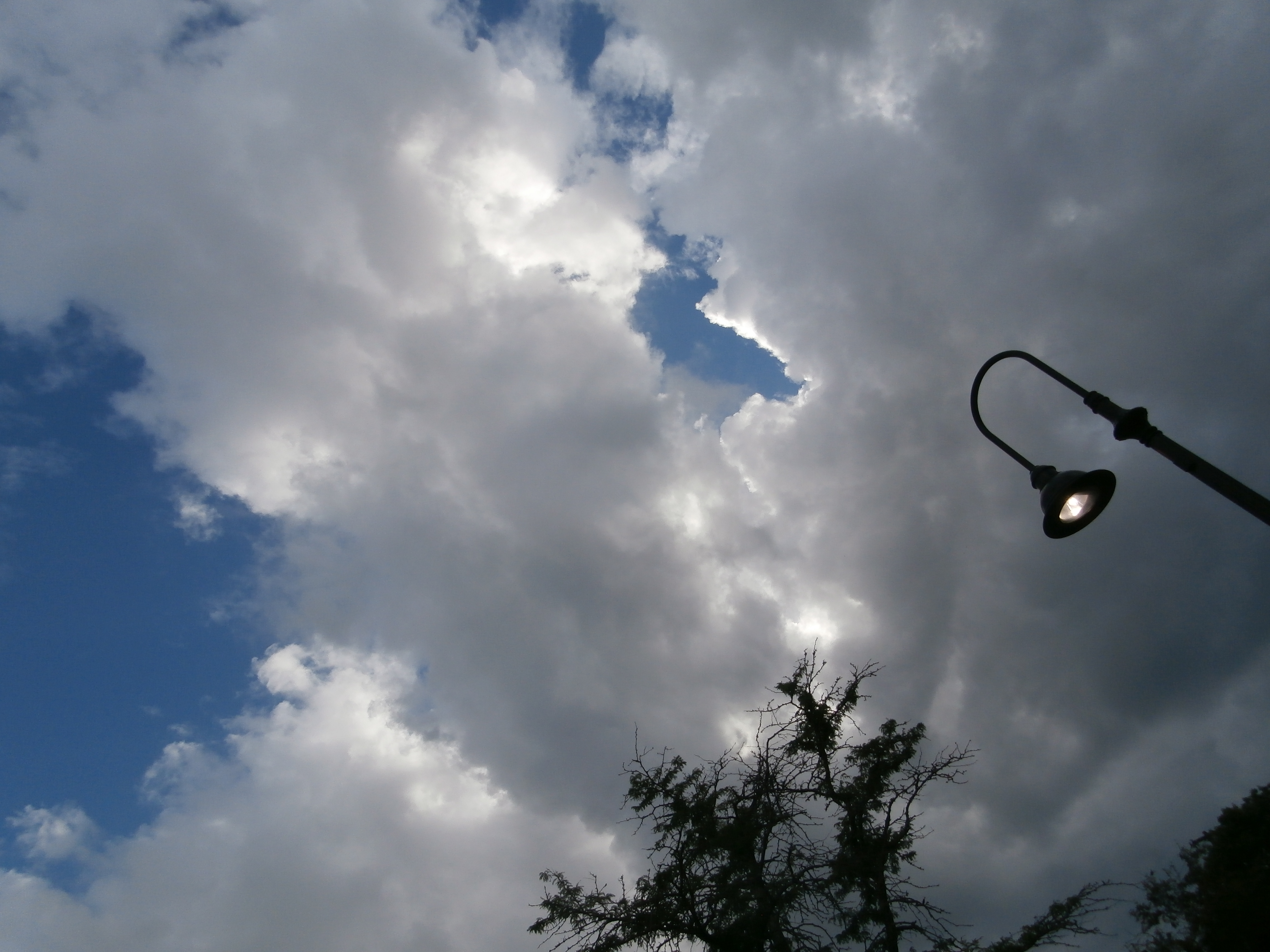
Wish I could have captured the transformation of the sky over Boston about 4:30 this afternoon. It was like a sci-fi flic of a force from outer space taking over the world in one fell swoop. One minute the sky outside my window was all blue sunshine and puffy white clouds — the next, an ominous dark front was racing out of the northeast and eating everything in its path.

I would have liked a picture to contribute to Sharon Silverman’s art installation. She is building one in December and needs sky photos in a 4″x6″ print form (only sky, no buildings or trees or anything else in the picture): Sharon Silverman, P.O. Box 1212, Haverhill, MA 01831, silvermanarts@comcast.net.

Sharon says, “Remember to put your name and address on a separate piece of paper so that you can be added to the list of artists who are contributing their work to this project.” It sounded like a rare chance to be an “artist.”

I have quite a few sky pictures, but could round up only two for Sharon that didn’t have anything else in them. (Maybe only one, since a bird showed up in a print.)

Here are a few recent sky photos — two that are just sky.

And check my previous post on ForSpaciousSkies.com.

rainbow-in-June

boston-harbor-clouds

more-clouds

clouds-sun-lampost

clouds

just-clouds

Read Full Post »

How delightful! Suzanne told me that Georgia’s childhood friend Jules calls his Rhode Island oyster business Walrus and Carpenter.

Lewis Carroll’s poem “The Walrus and the Carpenter” was the first poem I memorized in school. I was 11. It was a long poem but not too hard after memorizing the script of Alice in Wonderland at 10 (I was Alice’s understudy).

Here’s where oysters come in:

“O Oysters, come and walk with us!”
The Walrus did beseech.
“A pleasant walk, a pleasant talk,
Along the briny beach:
We cannot do with more than four,
To give a hand to each.”

The oldest oyster is wary and has no intention of leaving his oyster bed. But a slew of young oysters jump up, ready for a pleasant walk and talk. After many verses:

“O Oysters,” said the Carpenter,
“You’ve had a pleasant run!
Shall we be trotting home again?’
But answer came there none–
And this was scarcely odd, because
They’d eaten every one.

Read the whole poem, here.

And if you are in Rhode Island, please check out Walrus and Carpenter Oysters. On their website, you will find bios about the oyster cultivators on the team and information on where to show up for their current dinner series.

Suzanne particularly recommends reading some of the links on the company’s press page, especially the one to the New Yorker article (here) about how a dismantled bamboo art installation from the roof of the Metropolitan Museum of Art called Big Bambú ended up making oysters happy in Rhode Island.

Photo of the original John Tenniel art: wikimedia.org

Read Full Post »

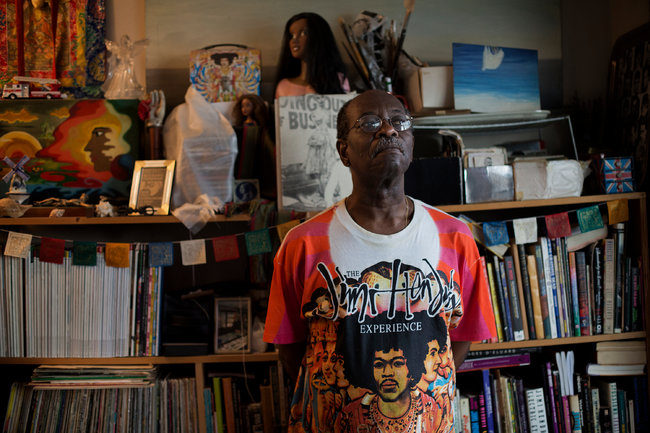
An artist discovered at 64 has a gallery show in New York.

Jim Dwyer writes at the NY Times, “For more than three decades, [Rafael Leonardo] Black, 64, has made a portal to the world in dense, miniature renderings of ancient myth and modern figures: Frank Wills, the security guard who discovered the Watergate break-in; Shirley Temple as a sphinx; the head of the surrealist André Breton as the head of John the Baptist; Marianne Faithfull in multiple incarnations.

“Until recently, few people ever saw his work because he had almost no visitors. He held paying jobs as a typist in a law firm, a salesman at Gimbels and then Macy’s, and as a secretary in a school. Most recently, he has worked mornings as a part-time receptionist in a hospital. …

“ ‘I just never made the effort to sell it,’ Mr. Black said. ‘I never expected to be able to make a living at it, but I’ve always done it since — well, I guess, since I’ve known my self.’

“Then [in May], a Manhattan gallery owner, Francis M. Naumann, mounted ‘Insider Art,’ an exhibition of 16 works by Mr. Black. Ten of them sold within days, at prices ranging from $16,000 to $28,000.

“ ‘People liked them, people who know art,’ Mr. Black said. ‘It makes me very happy.’ …

“Late last year, [his friend John] Taylor passed along Mr. Black’s number to [another] friend, Tej Hazarika, who publishes in the art world. Mr. Hazarika urged Tom Shannon, an artist and inventor, to look at the work. In turn, he brought it to Mr. Naumann’s attention. …

“ ‘If you are going to make a picture, you have to make something that’s in concert with the way the world operates,’ Black said. ‘There’s a line from the Lovin’ Spoonful: “You came upon a quiet day, and simply seemed to take your place.” ‘ ” More.

Photo: Victor J. Blue for the NY Times
“There’s a saying: ‘Everybody writes poems at 15; real poets write them at 50,’ ” said Rafael Leonardo Black, who draws miniature figures.

Read Full Post »

There’s an in-demand artist who goes to Wal-mart to find subjects. His name is Brendan O’Connell. Maria Godoy writes about him at National Public Radio.

“Most people would be hard-pressed to call Wal-Mart a source of artistic inspiration. … Yet that’s exactly what artist Brendan O’Connell sees in the sprawling big-box stores. For the past decade, O’Connell has been snapping photographs inside dozens of Wal-Marts. The images have served as inspiration for an ongoing series of paintings of everyday life — much of which involves shopping, which O’Connell calls ‘that great contemporary pastime.’ …

“Wal-Mart stores, he notes, are ‘probably one of the most trafficked interior spaces in the world.’ In the tall, open, cathedral-like ceilings of Wal-Mart’s big-box stores, he sees parallels to church interiors of old. …

“As artistic matter, [Wal-mart is] a part of everyday life that seems to have resonated with lots of people. Since [a February New Yorker profile began a] media blitz …  sales of O’Connell’s work have jumped dramatically, he told me [in April]. ‘I sold more in a week than I did in some years,’ he says. …

“The people doing the buying, he says, come from all over the country.

” ‘What I’m struck by is this relationship to brands,’ he says, noting that buyers have called to inquire about specific paintings: ‘ “Do you still have the Corn Flakes? … I want the Maxwell House.” Whatever brand it is that they have a personal relationship with. And that, to me, is fascinating.’ ”


“O’Connell’s work is probably out of the price range of the average Wal-Mart shopper,” adds Godoy. “But he’s passionate about a project to bring art to the masses. The idea behind everyartist.me is to create a collaborative art project involving 1 million elementary school kids across the country. And all the recent attention on his Wal-Mart series has helped jump-start funding for the project … he says.”

(Thank you, Andrew Sullivan, for the lead.)

Image: http://www.brendanoconnell.com
Blond with yams

Read Full Post »

« Newer Posts - Older Posts »