Feeds:
Posts
Comments

Posts Tagged ‘black’


I had an awfully nice lunch yesterday, and I’d like to tell you about it. It involved two nonprofits — the mostly Caucasian conservation group Trustees of Reservations and the mostly African American community-outreach enterprise called Haley House.

The trustees had a really great idea recently to do meaningful art installations on a couple of their properties and chose one next to the Old Manse in Concord. The Old Manse is most often associated with 19th Century novelist Nathaniel Hawthorne, but the grandfather of Ralph Waldo Emerson was also a resident and saw the historic events unfold at the North Bridge on April 19, 1775.

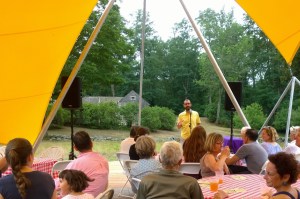
Artist Sam Durant wanted to draw attention to the presence of slaves in the early days of Concord and launch a discussion, so he constructed a kind of big-tent meeting house, with a floor made of the kinds of materials that might have been in slave buildings.

The Trustees conferred with him on a series of “lyceums” that might bring races together at the site. They decided that at the first one, they would encourage races to break bread together and talk about food traditions.

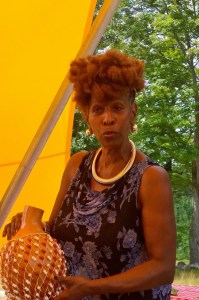
From Haley House in Roxbury, they brought in a chef, a beautiful meal, and singer/educator/retired-nurse Fulani Haynes.

I ate a vegan burger, sweet-potato mash, very spicey collard greens and wonderful corn muffins. Also available were salad and chicken.

Haynes sang a bit and talked about the origins of Haley House, how it helps low-income people and ex-offenders and local children, teaching cooking and nutrition and gardening, among other things. She invited attendees to tell food stories from their early years, and several brave spirits stood up.

That participatory aspect of the activities helped to reduce the impression that African Americans were making entertainments for a mostly white audience (art, food, music entertainments).

I loved the whole thing and learned a lot. (For example, Grandpa Emerson had slaves living upstairs, and “the embattled farmers” who “fired the shot heard ’round the world” were able to go marching off because slaves were working the farms. I really didn’t know.)

African American artifacts are on display next door at the Old Manse. The art installation will be up until the end of October 2016.

More here.

Photos: Artist Sam Durant offers the crowd a new lens on history. The chef from Haley House keeps an eye on the African American cuisine. Fulani Haynes demonstrates how a food can become an instrument.

081316-artist-Sam-Durant-at-installation-picnic

081316-Fulani-Haynes-sings-in-Old-Manse-field


081316-Haley-House-chef-and-corn-muffins

Read Full Post »

In spring 2008, during a sometimes distressing primary season, an African American coworker and I decided to try something under the radar at work.

We decided to invite other colleagues of good will to help create a monthly lunch-hour discussion group on Race in America.

At first it was slow going. Some people we invited were suspicious. Would we be seen as troublemakers? Was it “legal”? Would it be just a gripe fest about our workplace?

My friend was supervising our high school interns at the time, and several of those showed up. One or two white employees came. Black colleagues were more wary. On days that no one came, one of us was bound to say to the other, Maybe this isn’t going to work. At which point, the other would say, Let’s give it another month.

Little by little, attendance grew. We kept the focus on topics in the news and participants’ life experiences. There was no agenda. We’d say, Does anyone have a topic they want to discuss today? There were always topics. We agreed to keep what was said inside our basement meeting room. There was zero hierarchy. What everyone brought to the table was openness and a willingness to listen.

We listened. We asked questions. We argued, with respect. We laughed. We worried. We learned. There were so many gradations of opinions, based on individuals’ experiences. There was never unanimity of one race versus another.

One participant said last year the monthly discussions had really opened his eyes and changed some of his views profoundly.

My friend retired a couple years ago and I left in January, but the group is still going strong under new leaders. I really miss it. I cannot tell you how many times I have wanted to hear what members have to say about something in the news or something I see in my town. I feel like I hardly know my own views without adding the nuances of what my former colleagues are thinking and feeling.

This past week, I’ve read lots of advice about what people of good will can do about race relations and injustice: join demonstrations and meetings, write government representatives, open their hearts to losses on both sides, listen to young activists, stand on their right not to show an I.D. (Fifth Amendment). Maybe some of those ideas are good.

But I still love the idea of creating a group where people of different races and backgrounds listen to one another’s way of seeing things. Over the eight years, Race in America members have come and gone, but participants routinely say that the group works because of the trust that is built.

For getting started, it worked well that we were two friends — one identifying as African American, one as Caucasian. She needed me, and I needed her. I never felt I should go up to a black colleague I didn’t know and pitch a discussion on race. She was a star at that.

Maybe it’s a hopelessly small thing for combating what we see in the news. But I do think people of different races have too few opportunities to listen to one another about matters that touch the heart.

120715-Fed

Read Full Post »

Candice Frederick, of the New York Public Library’s Schomburg Center for Research in Black Culture, recently posted research by Katherine Ellington on an African American artist who was new to me.

From Ellington notes: “Augusta Savage was among [a] group of artists who came to Harlem from the Jim Crown South in search of opportunity and where her creative expression could thrive.

“My quest for Augusta Savage (1892 –1962) sculpture led me to a first-time visit to the Art and Artifacts Division of the Schomburg Center for Research in Black Culture. … As a young girl in the early twentieth century, Savage began shaping ducks out of red clay found in the backyard of her home in Green Cove Springs, Florida. Savage’s work gained local attention when she entered and won a prize at a local county fair, which led to community support for further study.

“In 1921, she moved to Harlem after studying at State Normal College for Colored Students (now Florida A & M University). Savage later completed a four-year program in sculpture in three years at Cooper Union. …

“In 1931, Savage … opened the Savage Studio of Arts and Crafts — a fine arts training ground for over 1,500 students including many well-known Harlem Renaissance artists such as Charles Alston, Ernest Crichlow, Norman Lewis, Morgan Smith and Marvin Smith, Jacob Lawrence and Gwendolyn Knight Lawrence. …

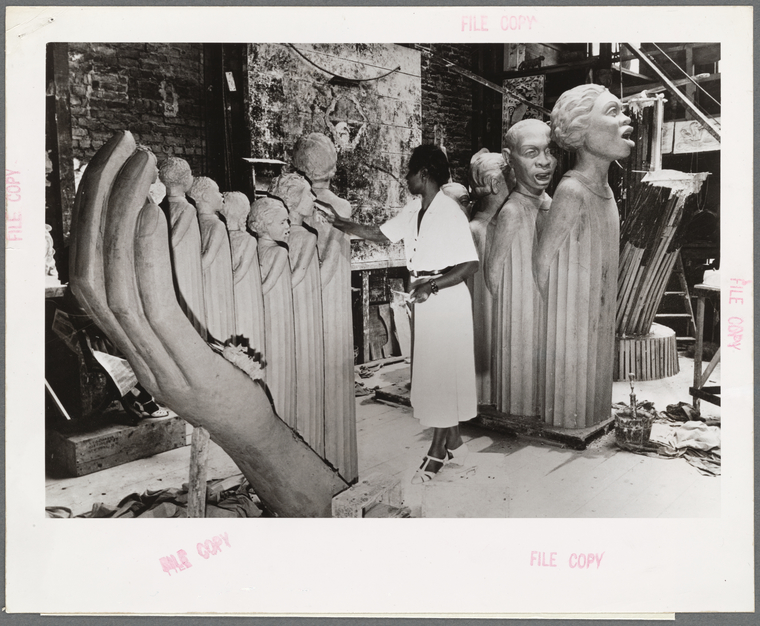
“In 1934, Savage became the director of the newly established Harlem Community Art Center, after she was commissioned by the 1939 World’s Fair. Around that time she created “The Harp” as a series, but it was destroyed during the cleanup after the fair. …

“Savage’s art was often in response to the fight against racism. She used a variety of methods, shaping clay and plaster, casting bronze, and later years, carving marble and wood. In the Augusta Savage collection, there are works that illustrate themes such as nineteenth-century romanticism and African and Greek culture. As a trained portraitist, her busts include Marcus Garvey, W.E.B. Du Bois, James Weldon Johnson and Gwendolyn Bennett.”

More here.

Photo: The New York Public Library. Image ID: 1654255
“Harp,” by Augusta Savage

Read Full Post »

Asakiyume writes a blog I enjoy a lot, and this week she had an intriguing post on Jackie Ormes, generally considered the first female African American cartoonist. See examples of work by Ormes at Asakiyume’s blog, here.

According to wikipedia, Ormes (1911 to 1985), “started in journalism as a proofreader for the Pittsburgh Courier, a weekly African American newspaper that came out every Saturday. Her 1937-38 Courier comic strip, Torchy Brown in Dixie to Harlem, starring Torchy Brown, was a humorous depiction of a Mississippi teen who found fame and fortune singing and dancing in the Cotton Club.”

The strip waxed and waned as Ormes pursued her many career interests, bur she always returned to Torchy.

“In 1950, the Courier began an eight-page color comics insert, where Ormes re-invented her Torchy character in a new comic strip, Torchy in Heartbeats. This Torchy was a beautiful, independent woman who finds adventure while seeking true love. …  The strip is probably best known for its last episode in 1954, when Torchy and her doctor boyfriend confront racism and environmental pollution. Torchy presented an image of a black woman who, in contrast to the contemporary stereotypical media portrayals, was confident, intelligent, and brave.”

Being a cartoonist seems harder than writing a blog. You not only need to find daily topics that interest you enough to dwell on, but you have to encapsulate them in a piece of art. Asakiyume sometimes illustrates her posts, but art is one thing you won’t find me doing here. (Unless maybe a collage.)

Read Full Post »

« Newer Posts