Feeds:
Posts
Comments

Posts Tagged ‘books’

Photos: Rachel Watson
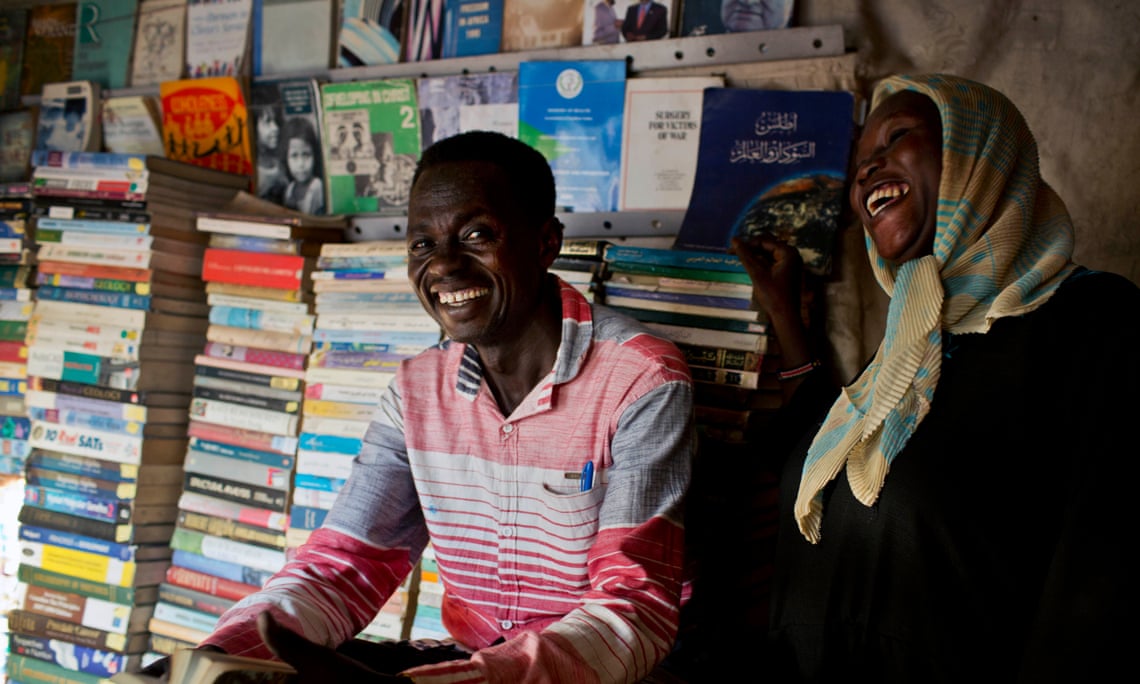
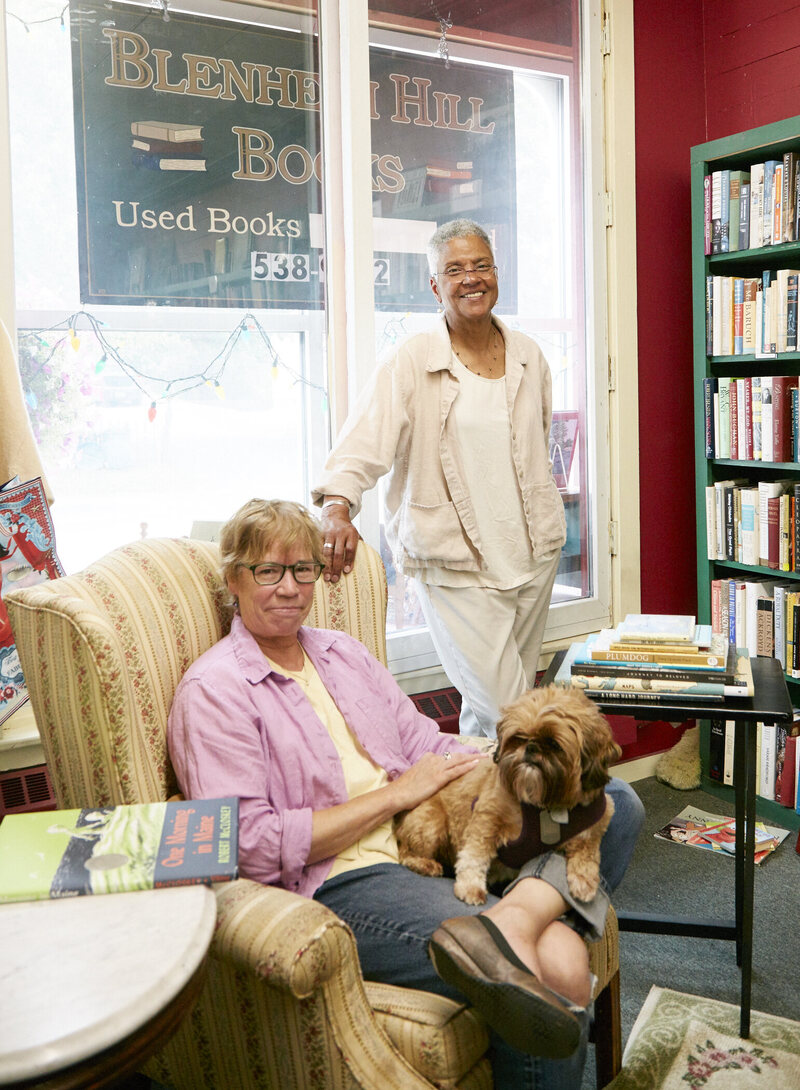
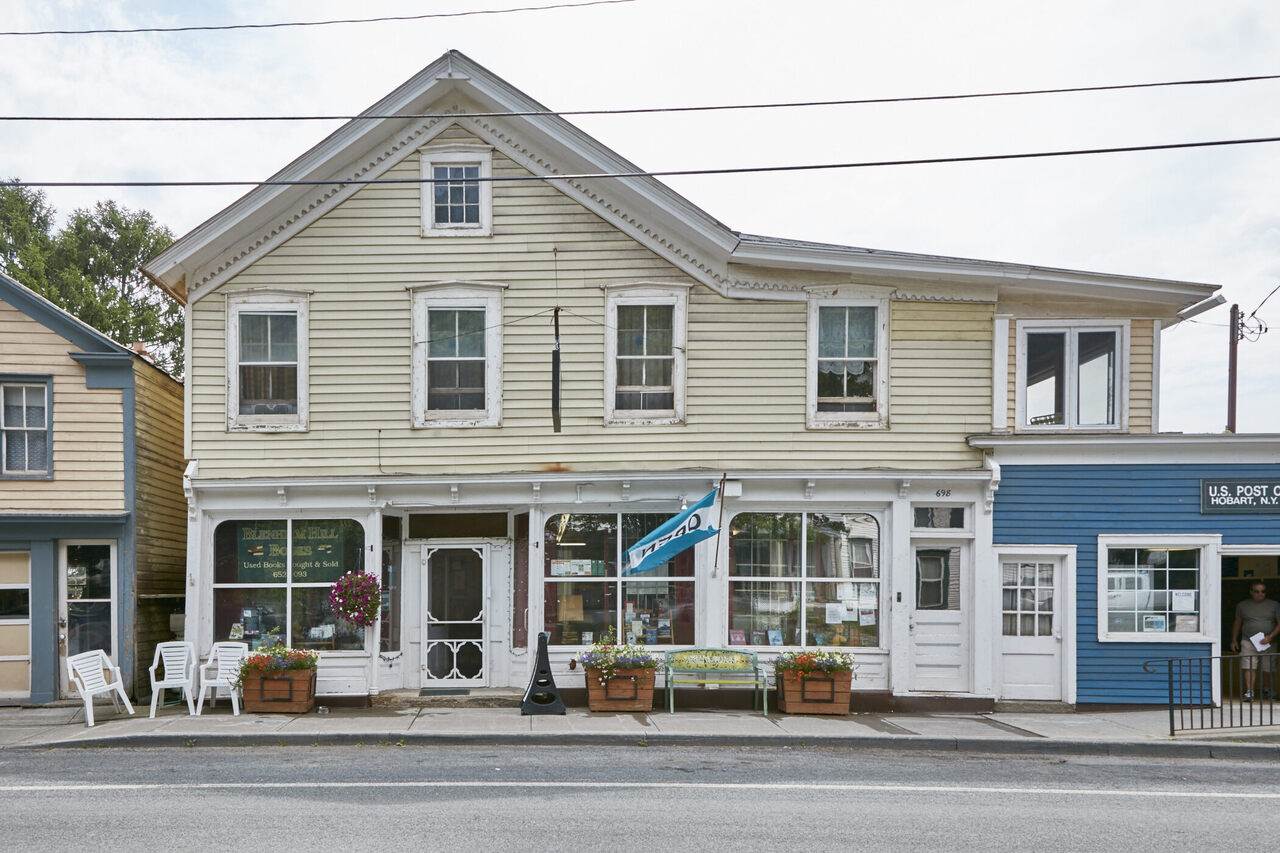
Barbara Balliet and Cheryl Clarke, owners of Blenheim Hill Books, one of five bookstores in an upstate New York village of 500 souls.

This village sounds like heaven to a book lover. I think the people who live there must be very happy. I’m pretty sure they are well-read.

Daniel A. Gross writes at Atlas Obscura, “The village of Hobart, New York, is home to two restaurants, one coffee shop, zero liquor stores, and, strangely enough, five independent bookstores. … Fewer than 500 people live in Hobart. Yet from Main Street, in the center of town, you’re closer to a copy of the Odyssey in classical Greek, or a vintage collection of Jell-O recipes, than a gas station.

“This literature-laden state of affairs emerged just after the turn of the millennium, when two residents of Manhattan, Diana and Bill Adams, stopped in Hobart during a trip through the Catskills. ‘We were both intrigued,’ says Bill, who worked as a physician for 40 years. … He and his wife, Diana, a former lawyer, were looking for retirement activities that they could pursue into their old age.

“During that first trip, in 2001, the couple spotted a corner store for rent at the end of Main Street. After speaking with the owner, they decided to rent it on the spot, and soon they were lugging their hefty personal book collection to Hobart, one rental car-load at a time. They didn’t expect to establish a book village in the process. ‘There was no plan,’ Bill says. They weren’t even sure whether their bookstore would survive in the foothills of the Catskills, three miles from the main highway.

“But they did own a lot of books. … That was how it became possible to buy a leather-bound collection of classical verse, or a set of classic political essays, in a tiny village more than two hours from New York City. Wm. H. Adams Antiquarian Books had a relatively quiet first year. But then Don Dales, a local entrepreneur and piano teacher, decided that one good bookstore deserves another, and opened his own shop. …

“Readers, like shoppers at the mall, often wandered back and forth between the shops. As more bookstores came to town, one of Hobart’s original booksellers (no one can quite remember who) began to describe the town as ‘the only book village east of the Mississippi.’ (Other American book towns include Stillwater, Minnesota, and Archer City, Texas.) …

“Barbara Balliet and Cheryl Clarke, a couple who spent their careers at Rutgers University, moved to Hobart at around that time. Clarke was surprised to find such a tiny community, far from cities or colleges, so overrun with books. …

” ‘She says, “You find all kinds of people who like books, and they’re not just college-educated.’ When the two women arrived, they met a bookseller who was ready to sell her stock, so Balliet bought it and they hopped into business themselves.

“Both women saw right away that, compared to other Catskills towns that have lost jobs and emptied out, Hobart seemed to be coming back to life. … The bookstores were a part of that. …

“Balliet says that, although she can’t make a living off the store, she can make a tidy profit — enough to grow a garden, travel, and buy more books. …

“According to the International Organisation of Book Towns, [the first] was Hay-on-Wye, Wales, founded in 1961 by Richard Booth. … Others include Wigtown, Scotland; Featherston, New Zealand; Kampung Buku, Malaysia; and Paju Book City, South Korea.

“As Hobart evolved, individual book shops have found their own specialty, like siblings who each choose their own path. ‘We try to complement each other,’ Balliet says. ‘Each one maintained its own identity and individuality,’ adds Bill Adams. Creative Corner Books, a cozy one-room shop that specializes in craft, cooking, and DIY books, is Hobart’s only shop with a knitting corner.”

More here.

Hat tip: @michikokakutani on twitter

Photo: Blenheim Hill Books in Hobart.
Read Full Post »


Photo: Lucy Young/Evening Standard
Jonathan Privett, co-owner of Word On The Water inside the barge.

I love stories about unusual libraries and unusual bookstores. Here’s one from the New York Times about a bookselling endeavor powered by the famed eccentricity of Englishmen.

Rod Nordland writes, “The two men who run London’s only floating bookstore, Word on the Water, are living proof that there really is something you can do in life with an English lit degree, other than teach English literature.

“The store — a 50-foot-long canalboat stuffed to its bulkheads and overflowing onto the towpath with books — has a permanent berth on the Regent’s Canal, around the corner from the British Library. This comes after years of its owners staying one step ahead of eviction from the canals, by relocating fortnightly.

“It is doing so well that Paddy Screech, 51, an Oxford-educated Cornishman with a close-trimmed beard and a soft-spoken manner, and Jonathan Privett, 52, a gaptoothed Yorkshireman who has trouble staying still for long (except with a book), finally took their dream vacations this year. …

“The men got the idea for the store from a book, of course — ‘Children of Ol’ Man River,’ in which Billy Bryant recounts how his British immigrant family arrived on the Mississippi River, homeless, living on a floating board, which they built into a theater, and then into the showboat craze of the late 1800s.

“When they met, Mr. Privett was living on a canalboat, part of a subculture of boat dwellers who berth on London’s canals for free — as long as they keep moving periodically. Mr. Screech had been working with homeless people and drug addicts, while caring for an alcoholic mother at home. ‘Overnight, she stopped drinking and turned into a little old lady who only drank tea,’ he said. …

“Mr. Privett had the book-business experience. Before settling on his canalboat, he had at times been a homeless squatter who supported himself selling used books from street stalls.

“A French friend, Stephane Chaudat, provided a boat big enough to be a store, a 1920s-era Dutch barge; he remains their partner.

“Mr. Privett had a stock of used books. Mr. Screech borrowed 2,000 pounds from his then-sober mother as capital, and their business was born in early 2010. …

“Things went downstream fast. Forced by the berthing laws to move every fortnight, they often found themselves on parts of the nine-mile-long Regent’s Canal with industrial buildings and no customers. …

“Mr. Screech said. ‘For years, it just felt like it was going to sink.’

“Then it did. A friend used the sea toilet on the book barge and left an inlet open, and the boat sank to the bottom; even their prized copy of ‘Ol’ Man River’ was lost. Shortly later, the boat Mr. Privett lived on sunk as well, and he lost all of his family photographs.

“ ‘[We] were just sitting there on the towpath, crying,’ Mr. Screech said. …

“As the canal trust peppered them with legal notices, fines and threats to have the boat barge lifted out of the water and broken up, their supporters got busy, too. One rallying cry of a Twitter post, from the science-fiction author Cory Doctorow, was retweeted a million times, Mr. Screech said.”

Read the whole saga here.

As small blurbs filling out New Yorker magazine columns were once titled, “There’ll always be an England.”

Read Full Post »

Photo: Getty
Auckland Libraries in New Zealand figured out why their books were going missing and came up with a win-win solution.

If you know how to read, you want to read, and librarians want you to read. But not everyone has easy access to books. That is why some readers in New Zealand were sneaking books.

Mark Molloy writes at the UK’s Telegraph, “A New Zealand library has finally solved the mystery of why some books were going missing from its shelves.

“Auckland Libraries staff were bewildered after finding some books were being hidden in random places. They initially thought kids playing pranks were to blame, but later discovered it was the city’s rough sleepers who were actually stashing the books so they could return the next day to continue reading.

“ ‘A lot of our street community were wanting to put them underneath the couches or underneath book shelves and kind of hiding them in various places,’ librarian Sean Taylor told TV NZ. … Without a permanent address they were unable to sign up for a library card that would allow them to take the literature away.

“As a solution, Auckland Library created a new section where books can now be left overnight and picked back up again the next morning. …

“ ‘They are really well read. We’ve got a guy who I’ve had a discussion about the meanings of words and we’ll talk about the reference section and it’s the kind of intellectual conversation you’d expect from an academic.’ …

“Auckland Library says it sees itself as a ‘home for the homeless’ and holds regular cinema screenings and a book club for those sleeping rough. …

“ ‘One guy told me he moved to the city several years ago, and that none of his family back home knew he was homeless,” [said Rachel Rivera, manager of Auckland Libraries]. He used our computers to keep in touch with them. It was his lifeline to his family,’ she said.

“ ‘They value our service, like many of our communities do, for different reasons. But they don’t always feel safe and welcome, and that is something we can and should take steps to address.’ ”

More at the Telegraph, here. And look: Everything at the Auckland libraries website is in both English and Maori.

Read Full Post »

Photo: DollyParton.com.

For years, country music legend Dolly Parton has been giving back to the community with an initiative to boost child literacy. It started small in Tennessee and spread across the world.

What’s interesting, writes Melville House editor Ryan Harrington at mhpbooks.com, is that the small Knoxville mailing service that her foundation tapped to help in the literacy effort has kept up with the demand.

“Way way back in 2012,” writes Harrington, “we wrote about the international impact of Dolly Parton’s child literacy initiative, Imagination Library. We offered this bit of background on the project:

Launched by singer/actress Dolly Parton, the Imagination Library is a literacy program run by Parton’s Dollywood Foundation that sends enrolled children a free book every month from the month of their birth until they enter kindergarten. Growing up in rural Sevier County, Tennessee, Parton had friends and relatives who were illiterate, which was part of what led her to start a literacy program in her home county. The Imagination Library has been reproduced in 566 counties in the US, across 36 states, as well as in Canada. …

“The story of Dolly’s project is one of non-stop growth — and the once-tiny Knoxville company contracted to manage the original mailings has kept up with an amazingly increased volume.

“Direct Mail Services began its relationship with the Dollywood Foundation twenty years ago, mailing 1,000 books per month to children around Sevierville. A few years later, the foundation announced that the program would be open to any communities across that US that wanted to participate, and Direct Mail Services’ business exploded. …

“The company is preparing for more growth, as the foundation remains committed to expanding its reach. [Cortney Roark reporting for the Knoxville News Sentinel says], ‘Five percent of the U.S. population younger than 5 years old receives a book through the program. The goal is to reach 10 percent by 2024.’ ”

I could easily imagine a small company crumbling under such sudden high demand, so congratulations to Direct Mail Services for rising to the challenge.

More at Melville House, here.

Read Full Post »

Photo: Jason Koxvold

Question: What is halfway between the book-sharing Little Free Libraries that are sweeping the country and your town library? Answer: A personal library set apart from your home in a tiny house.

The Today show interviewed an artist whose friends helped him build one, perhaps also securing themselves a place to stay as a guest.

Christina Poletto reports, “In New York’s Ulster County, at the base of the Catskills Mountains, Jason Koxvold’s woodland home has a new addition to the property that is nothing short of stunning. There, tucked among the property’s forest of oak trees, sits a tiny one-room library which holds 2,500 books.

“Koxvold, a British artist based in New York, owns the property and was inspired to carve out a space specifically for solitude and escape. ‘I work from this location and was looking to make a quiet space for writing and reflection,’ Koxvold told TODAY.

“When there’s an overflow of visiting guests, the forest library also serves as an additional bedroom. …

“Koxvold desired a simple, singular structure that he could construct on his own using red oak from the property.

“Using already-felled trees left over from the construction of the main house, cut trees were planed on site into large log sections measuring 8 x 8 feet. After air drying the 12,000 lbs of milled red oak for several seasons, they became the shelving and cubbies that make up the the library’s interior.

“Koxvold was able to complete this structure with the help of eight different friends over the course of a year.

“While the monolithic shape and black exterior is shocking against the natural forest forms, the interior, heated by a single small wood stove, is as warm as it is cozy. A lone picture window looking into the forest is a source of natural light. …

“If you’re lucky enough to be invited as a guest, you’re welcome to leave a private message in one of the books on the shelves.” More.

Nice idea about leaving notes. In Suzanne and Erik’s Harlem apartment, an entire wall was available for written messages. Guests loved it.

Read Full Post »

Photo: City of Asylum
City of Asylum Books specializes in translation and world literature. 

With Amazon opening retail bookstores in Greater Boston and elsewhere, the independent bookstores we all love are more threatened than ever. What new models will help them survive?

The Nonprofit Quarterly discusses one idea.

Louis Altman writes, “Conventional wisdom is that the goliath Amazon, the dominant and diversified Internet retailer of everything from books to 7-string zithers has, with unbeatable pricing and almost infinite selection, crushed all brick-and-mortar booksellers in its path. …

“The truth is that independent booksellers are thriving, with 30 percent growth in the number of these stores from 2009–2016, to 2,311 as of 2016. Between 2014 and 2015, independent booksellers saw their market share actually grow from 7 percent of all book sales in 2014 to 10 percent in 2015. …

“The answer may lie with niche-filling shops like Pittsburgh’s new City of Asylum Books, part of a nascent multipurpose cultural center on the city’s North Side called Alphabet City Center. Alphabet City is a consolidated space recently acquired by City of Asylum, a nonprofit arts organization providing sanctuary and forums of expression for exiled writers of all genres from other countries, introducing many unsung voices to the Pittsburgh public through literary community events. …

“The nonprofit bookstore opened … January 14th, offering some 10,000 titles on a wide range of subjects, specializing in translated works and world literature, in 1,200 square feet of space in the Alphabet City building, which includes a bar, restaurant and a venue for readings, performances and workshops. The bookstore sells everything from cookbooks to children’s books to poetry and harbors a giving library, where patrons can take—and give—books for free. …

“Kepler’s Books of Menlo Park, California, [restructured] as a community-owned bookstore, creating a ‘hybrid model’ maintaining operation of the for-profit bookstore, connecting it with a nonprofit arm housing and sponsoring local literary events and presentations for local schools and the community.” More here.

Whether the independent bookstore will find salvation in nonprofit approaches remains to be seen, but creative thinking is sure to be a requirement for longevity. I myself think independents will need to provide services that many used bookstores, particularly nonprofit used bookstores like the Bryn Mawr Book Store in Cambridge, Mass., provide — for example, tracking down out-of-print books for a fee.

My local independent doesn’t offer many extras. It won’t order self-published books for customers, so I am forced to use Amazon if I want one. “Self-published” can include popular books published in England but not yet available in the US through normal channels. Amazon will provide. Why not independents?

There are other issues with my local independent such as shelving two of my three ordered books when they are all the same title, not offering delivery for a fee, and having a website they know is not worth using. But I want the shop to survive, so I order anything from there that it is willing to get for me.

I’d be interested in other people’s experiences and advice for independents.

Read Full Post »

Photo: Kate Holt for the Guardian
Juma’a Ali, 34, centre, a Christian from the Nuba mountains in Sudan, who fled to Malakal in South Sudan. Here, he is pictured in his bookshop in Malakal’s camp. 

Sometimes refugees take it upon themselves to improve life in the camps where they hope to live only temporarily. I have read in the past about adults who teach the children who are missing out on school. In fact, I once met a man who did that in a Nepalese camp in India. In this story, a refugee offers books.

Ben Quinn writes at the Guardian, “Juma’a Ali glances fondly at the ceiling-high stacks of titles in his makeshift bookshop, a collection that ranges from Virginia Woolf to Canadian Tax Law (1995 edition).

“Just over three years ago, carrying as many books as he could bring, he sought refuge in war-torn South Sudan following the persecution that he says he experienced as a Christian, across the border in Sudan’s Nuba mountains.

“The books were gathered along the way in Sudan and South Sudan. Most are second-hand copies from libraries in South Sudan and donations from abroad. He wasn’t a bookseller in his home country; he worked with his local church. …

“He sells the books at the camp for very small amounts of money, and is fiercely proud of his role as the bookseller of Malakal. His little shop stands as a source of education and distraction from the often unbearable conditions the camp’s residents live with on a daily basis. …

“Among the most sought-after titles by the more than 33,000 residents of the camp are the Bible and the Oxford English Dictionary, although collections of love poems also find takers. ‘Whenever there is conflict or war, people are reading books about politics and religion. When there is peace, there is also more love,’ says Ali…

“Some day, he says, he wants to leave the camp, adding: ‘Europe is a place I think about, but how to get there? It’s locked up and is closed off to us. I want to be positive and I hope for peace here some day. The problem is how to bring people together after so much has happened.’ ”

Although this story was published as recently at January 4, even more recent news about impending famine in South Sudan has me fearful for Ali and those he serves with his books. I will try to find a follow-up story.

More here.

Read Full Post »

Here’s a story from Total Croatia News, which I am not quite sure how I found. Probably a link on ArtsJournal or Facebook or Twitter. I can’t claim to read it regularly.

Daniela Rogulj wrote back in December that with its open digital library, Croatia is the first Free Reading Zone. The top 100,000 digital books from around the world — both bestsellers and academic books — are available without any cost, card, or code.

You do need to be within Croatia’s borders, and you have to download the free “Croatia Reads” app on Android or IOS smartphones and tablets.

The concept was tested early last autumn at Zagreb’s Velvet Café, and it worked. The generous support of sponsors enables publishers and authors to be paid when books are read.

More at Total Croatia News, here, and at Publishing Perspectives, here.

Now I’m wondering what’s on the book list. (Asakiyume: Offer your book?)

Photo: Digital Media Diet
The digitizing of books has enabled Croatia to become the world’s first Free Reading Zone. If you are in Croatia, download the “Croatia Reads” app for access to 100,000 bestselling and academic books.


Read Full Post »

An African writer’s gratitude to a generous book lover in his childhood city has inspired an online bookstore geared toward African authors.

Daniel A. Gross writes at the New Yorker, “Magunga Williams grew up in Kisumu, a Kenyan city that’s home to more than three hundred thousand people but to only two major bookstores. There, Williams told me recently, ‘people depend on books that they find in supermarkets.’ Most of these books come from the United States and Europe. ‘These supermarkets do not have a rich African collection,’ Williams said.

“But there was one place where he could always find a wider range of books. It was the personal collection of a local man, whose house became a neighborhood meeting place and an unofficial sort of public library. …

“Williams moved to Nairobi and began an undergraduate program in law, but he never forgot the way that a house full of books, in a city with too few, became an escape. …

“So Williams, while he was in school, started a literary blog, Magunga.com, and … he made it his mission to create a space like that library—not in a house but on the Internet. The result is a fledgling online pan-African bookshop: the Magunga Bookstore.

“In becoming a bookseller, Williams was, in part, following in the footsteps of his girlfriend, Abigail Arunga. A few years ago, Arunga, a Nairobi-based freelance writer in her late twenties, stopped by a few local bookstores and asked if they would stock ‘Akello,’ her self-published collection of poems.

“At one shop, she was told that Kenyans don’t read poetry. At another, an employee claimed that her ninety-three-page book was too short. ‘They told me that my book had to be at least a hundred pages,’ she said. So she decided to sell the book herself — at poetry readings, literary festivals, even family gatherings. …

“An epiphany came last winter, when Williams was reading an article in the Guardian and noticed that the newspaper operates its own online bookstore. He told Arunga that they were going to open a bookstore, too. …

“Williams earns his living by writing sponsored posts on his blog, which attracts around five thousand readers each day. He asked his Webmaster, David Mabiria, to add a new tab to the Web site, which would offer books for sale. … He and Arunga requested book donations from writer friends, who provided copies of their own work. They launched the feature with ten titles in stock, under a simple slogan: ‘Spreading the Word.’

“Word spread slowly. The Magunga Bookstore made its first sale in December, 2015, when Williams was out of town — he had to ask a friend to deliver the book. ‘He was telling me he was in traffic,’ Williams recalled. ‘And I was, like, “I don’t care. Just go get a boda-boda ride.“ ‘ (Boda-boda is East African slang for a motorcycle taxi.) He remembers telling the friend, “I’ll pay you even if it costs me double the price. Just to make sure the client is happy.” ‘ ”

More at the New Yorker. And while you’re clicking, take a look at the Magunga Bookstore site, here.

Photo: Facebook/Babishai Niwe Poetry
Abigail Arunga and Magunga Williams at the 2016 Babishai Poetry Festival, in Ntinda, Uganda.

Read Full Post »

Vanessa Thorpe wrote recently at the Guardian about some old nursery tales that are finding a new audience.

“Old-fashioned language and quaint illustrations are part of the ageless appeal of a classic children’s book, so stop modernising them: this is a growing plea from the parents of young readers – and it seems publishers are beginning to listen.

“[A September 2016] decision to turn back to the original look and vocabulary of the Famous Five books by Enid Blyton has opened the door for another classic children’s author, a forgotten star of storytelling, to be republished, as written, this autumn. Convinced that the best stories stand the test of time, editors at Pikku Books are to bring out original versions of stories by writer Elizabeth Clark, once a familiar sight on nursery bookshelves.

“ ‘There’s always going to be a market there for an elegant turn of phrase and a beautifully crafted story,’ said Elena Sapsford, founder of Pikku. ‘As a child, there are a few well-known classics you work your way through, but it is quite obvious there must have been more good writing going on, and often things are out of print just because copyright contracts have been lost.’

“Clark was a Winchester vicar’s eldest daughter, born in 1875. She found her vocation telling stories to the children in her village and began to teach others, moving to London and becoming a lecturer at teachers’ training colleges as well as the author of a series of successful children’s books, often illustrated by the acclaimed Nina Brisley.

“Clark’s stories, including ‘Dobbin and the Silver Shoes’ and ‘The Cat that Climbed the Christmas Tree,’ were often drawn from foreign folklore and legend and many were broadcast on the BBC’s Children’s Hour radio show in the 1920s. Sapsford came across the writer when secondhand editions were given to her family, and she then set about tracking down the Clark literary estate.

“ ”You have to become a detective because there was a lot of poor record-keeping in many publishing companies and I had to dig quite deep,’ she said. ‘I really don’t think they need any change of vocabulary.

People are looking for something fresh but we tend to forget that for young children everything is new.

More.

Children do seem to like the flowery language. My three-year-old granddaughter, for example, is a fan of the way Beatrix Potter tells the story of Peter Rabbit and can fill in the blanks when an adult reads the book to her. I myself like that explaining a word can lead to an interesting discussion or tangent.

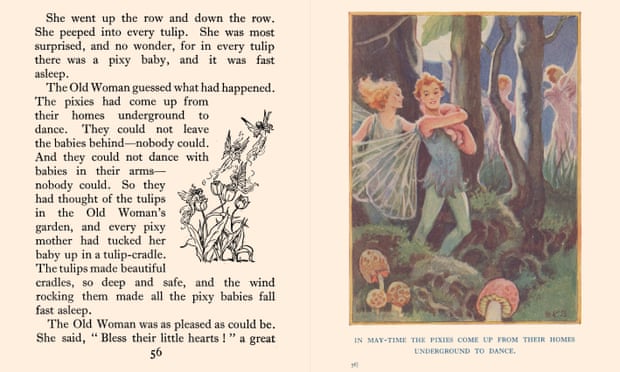
Reprint from the Talkative Sparrow & Other Stories, by Elizabeth Clark 

Read Full Post »

102216-leaves-tinged-with-pink


102416-shadow-bondir-restaurant


In spite of the drought, Massachusetts trees displayed some of their best colors this year. I’m sharing one photo taken along the Concord River, another that barely does justice to this month’s reds and golds, and a third that intrigued me because the green leaves were pink only on their tips.

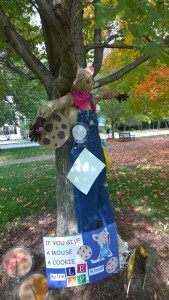
Other photographic offerings include a name shadow at Bondir restaurant, where we had lunch today, a pirate skeleton with his skeletal parrot in a Lowell bookshop/café, lovely plants in the café, an artist working en plein air, shadows of ivy trying to break into the house, and four book-themed scarecrows at the public library.

The first scarecrow was inspired by the book Strega Nona, the second by If You Give a Mouse a Cookie. The third scarecrow promotes the library’s seed catalog, and the fourth celebrates the counting books.

Don’t you wonder how the library came to do all that work? There must be 20 scarecrows altogether. I’m trying to picture the meeting where the boss says, “We’re doing scarecrows for Halloween. Who volunteers to do what?” Or maybe it was more spontaneous. It sure looks like people had fun with it.

101916-red-and-yellow-leaves

101516-autumn-river-reflections


102016-pirate-and-parrot-skeletons

102016-hypertext-bookshop-cafe-lowell


101616-en-plein-air-painter

101416-ivy-wants-in


101416-strega-nona-concord-library

101616-if-you-give-a-mouse-a-cookie


101616-concord-seed-library

102016-celebrating-counting-books


Read Full Post »

072516-Little-Free-Library-Providence


If you don’t already follow Maria Popova’s Brain Pickings on twitter or receive her emails, you might want to consider it.  For me, she is a source of science ideas and children’s book reviews and all sorts of deep thoughts on a myriad of topics. And she always suggests complementary readings at the end of her posts.

Here she reports on a short, animated Ted-Ed that romps through the history of books.

“Carl Sagan saw books as ‘proof that human beings are capable of working magic,’ Popova begins. ‘Reading books is the most glorious pastime that humankind has yet devised,’ Polish Nobel laureate Wisława Szymborska observed in her memorable meditation on why we read. …

“Books, Susan Sontag wrote in her beautiful letter to Borges, grant us ‘a way of being fully human.’

“Indeed, any thinking, feeling human being knows that it is impossible to be fully alive and awake to the world without reading, and so we’ve come to see books not only as essential to our humanity.

“But this wasn’t always so. …

“How did something so nascent become so elemental to our humanity? That’s what educator Julie Dreyfuss and animator Patrick Smith … explore in this short TED-Ed animation chronicling the history of books:

As the book evolves and we replace bound texts with flat screens and electronic ink, are these objects and files really books? Does the feel of the cover or the smell of the paper add something crucial to the experience, or does the magic live only within the words, no matter what their presentation?

More here.

Read Full Post »

You never know what you will pick up from twitter. I started following Ferguson Library tweets after the death of Michael Brown. The library has wonderful tidbits about books, among other topics.

A tweeted tidbit on the antiquity of fairy tales is from Science magazine.

David Shultz writes, “A new study, which treats these fables like an evolving species, finds that some may have originated as long as 6000 years ago.

“The basis for the new study, published in Royal Society Open Science, is a massive online repository of more than 2000 distinct tales from different Indo-European cultures known as the Aarne–Thompson–Uther Index, which was compiled in 2004. Although not all researchers agree on the specifics, all modern Indo-European cultures (encompassing all of Europe and much of Asia) descended from the Proto-Indo-European people who lived during the Neolithic Period (10,200 B.C.E.–2000 B.C.E.) in Eastern Europe. Much of the world’s modern language is thought to have evolved from them.

“To conduct the study, Jamshid Tehrani, an anthropologist at Durham University in the United Kingdom, and colleagues scanned the repository. They limited their analysis to tales that contained magic and supernatural elements because this category contained nearly all the famous tales people are familiar with. This narrowed the sample size to 275 stories, including classics such as Hansel and Gretel and Beauty and the Beast. …

“Tehrani says that the successful fairy tales may persist because they’re ‘minimally counterintuitive narratives.’ That means they all contain some cognitively dissonant elements—like fantastic creatures or magic—but are mostly easy to comprehend.

“Beauty and the Beast, for example contains a man who has been magically transformed into a hideous creature, but it also tells a simple story about family, romance, and not judging people based on appearance. The fantasy makes these tales stand out, but the ordinary elements make them easy to understand and remember. This combination of strange, but not too strange, Tehrani says, may be the key to their persistence across millennia.”

More.

(from a Ferguson Library tweet)

An illustration of Beauty and the Beast from 1913.

Read Full Post »

Do we praise the work of librarians enough? I started following the Ferguson Library on twitter and Facebook after reading how it was the calm eye of the storm in Ferguson, Missouri, amid the 2014 riots. As a result, I now get good leads about other libraries. Here is a report on Ohio librarians who go the distance — and beyond.

Katie Johnson at School Library Journal describes her experience with “Play, Learn and Grow, a pop-up storytime and early learning program created through a collaboration between Twinsburg (OH) Public Library and Akron Metropolitan Housing Authority (AMHA). …

“I noticed that none of the children living in the housing development were coming to storytime at our library. I reached out to AMHA representatives, hoping they would be open to the idea of the library hosting a weekly program at the development. They were, partnering me with one of their employees, Kellie Morehouse, who was already working with families within the complex.

“We set up Play, Grow, and Learn in an unused room behind the apartment leasing office. Our initial goal was to get to know children age five and younger and their families through storytime, crafts, and free play. As the weeks went on, we saw everything that these families lacked: employment, education, transportation, healthy food, proper healthcare, access to preschool, even reliable phone service.”

They got involved in all those areas — helping children get vaccinations and nutritious food, for example, and arranging for isolated young mothers to address depression.

“Early experiences with storytime revealed a desire of the young mothers to interact with one another.  This led the AMHA representative to suggest teaming storytime with one of the organization’s programs for moms.  AMHA and a local behavioral health agency had been working together to provide maternal depression support groups to low-income women in other parts of the county. …

“Twice a month, the moms in our storytime are able to meet in a group setting with a professional to discuss their frustrations and worries. Mom-ME Time has become key, as so many of our moms are dealing with heavy pressures every day, and most do not have a strong support network. Being able to vent and get helpful parenting advice can be crucial to the choices they are making for their young children.”

It is worthy of applause when a librarian sees the whole child, not just a child in storytime, and tries to tackle the barriers to a better life. More here.

Photo: Katie Johnson/School Library Journal
Moms are included in programming for children.

Read Full Post »

In December, when the Association of Rhode Island Authors (ARIA) was having its annual expo, Erik sent me an email alert. Even though I couldn’t get there, I was curious.

I don’t think of myself as an author, and I’ve never joined a writing group despite the well-known advice from Anne Lamott. But I guess I’m an honorary author as my oldest grandchild once thought it was the same thing as being an editor. (The magazine I used to edit came to his house, and when he saw my photo in it and John explained that I helped to write the articles, he said, “Is Grandma an author?”)

I know that at least one reader of this blog is a Rhode Island author, Tracy Lee Karner.

According to the Association of Rhode Island Authors website, the December meeting was focused on memoirs.”The Lively Literati returns to The Elephant Room in Cranston’s Pawtuxet Village on Thursday, December 17, with authors Patricia Mitchell, Connie Rose Ciampanelli, and Debbie Kaiman Tillinghast. The authors will be discussing memoir writing and sharing short excerpts from their most recent works. Following the presentation, audience members are invited to share their own short writing or poetry, on any topic, at our open mic.”

Also at the website, you can read about the members and many association activities. Note that the “next regular meeting of the Association of Rhode Island Authors will take place on Thursday, January 14, in the Community Room at the Thundermist Health Center, 186 Providence Street, West Warwick. Informal networking begins at 6:30 p.m. and the meeting begins at 7:00 p.m. New authors, members and guests are always welcome.”

Photo: Association of Rhode Island Authors
ARIA member Mark Perry, who agreed to a stint as ‘Post’ Mark, the elf who works in Santa’s mail room. He fielded some surprising questions from kids.

Read Full Post »

« Newer Posts - Older Posts »