Feeds:
Posts
Comments

Posts Tagged ‘children’

As a scientist with young children, Gregg often tweets ideas for engaging kids in science. Recently @gfavalora tweeted about a website with instructive and fun videos. It’s called The Kid Should See This.

The site describes the video below thus:

“To celebrate World Ocean Day 2013, director and animator Akiko McQuerrey created a Papa Cloudy stop-motion music video: Overfishing Song from Papa Cloudy’s Restaurant.

Overfishing—catching fish faster than they can reproduce—is an urgent and devastating issue, and may be the single biggest threat to ocean ecosystems… The global fishing fleet is operating at 2.5 times the sustainable level—there are simply too many boats chasing a dwindling number of fish.

“What can we do to help? With more sustainable practices, our oceans can be healthy and plentiful for everyone. Recommendations from the Monterey Bay Aquarium suggest that we select sustainable fish from restaurants and stores, and diversify the kinds of fish we eat beyond just the popular choices.

“To help make these choices easier, they created a Monterey Bay Aquarium Seafood Watch pocket guide and mobile app. They even have recipes and more information about how to solve our ocean challenges.”

More videos here.

Read Full Post »

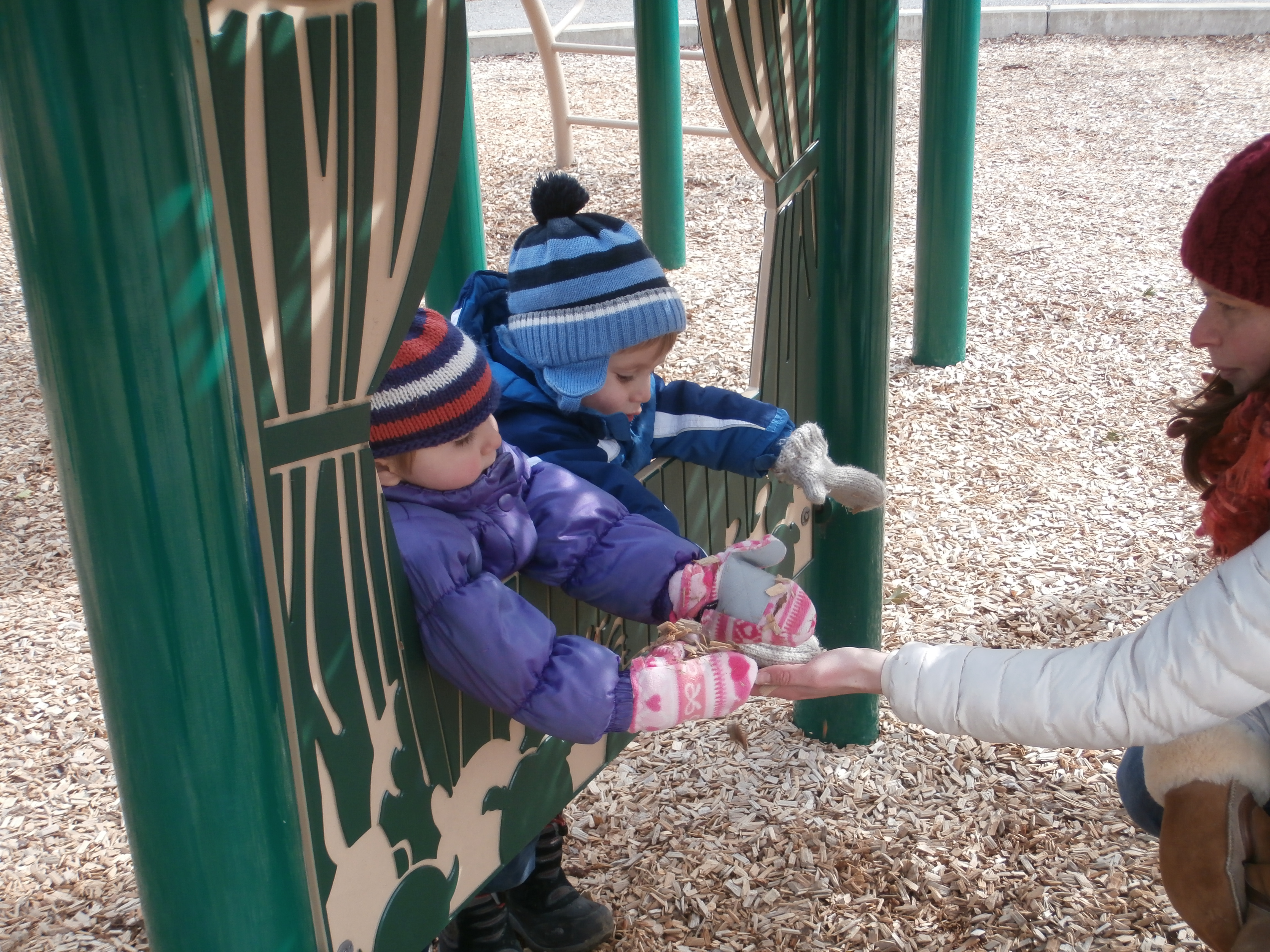
At around age 2-1/2, small people begin to be ready for friendship. My almost-three-years grandson plays with his friend now, instead of just in the same space.

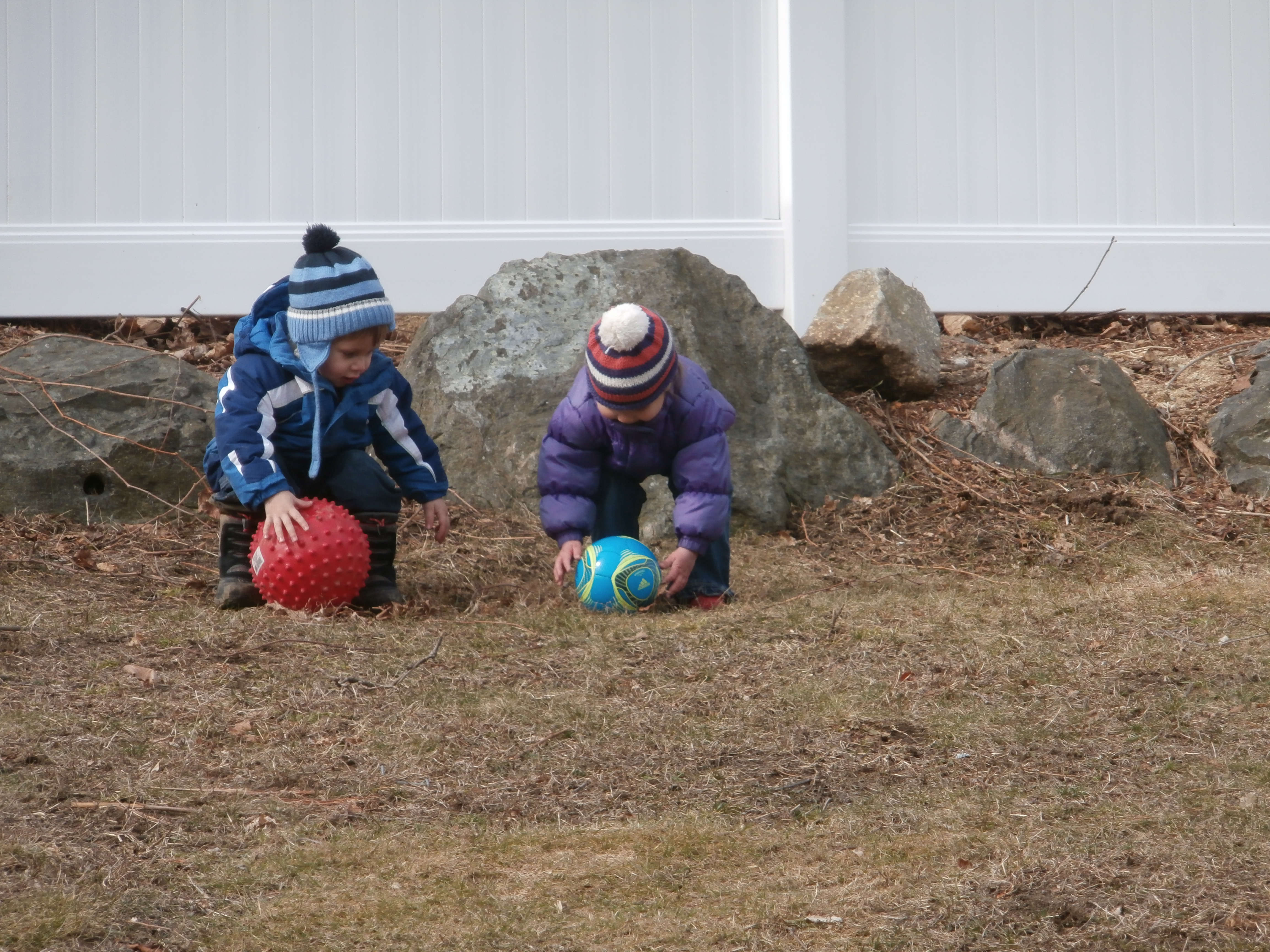
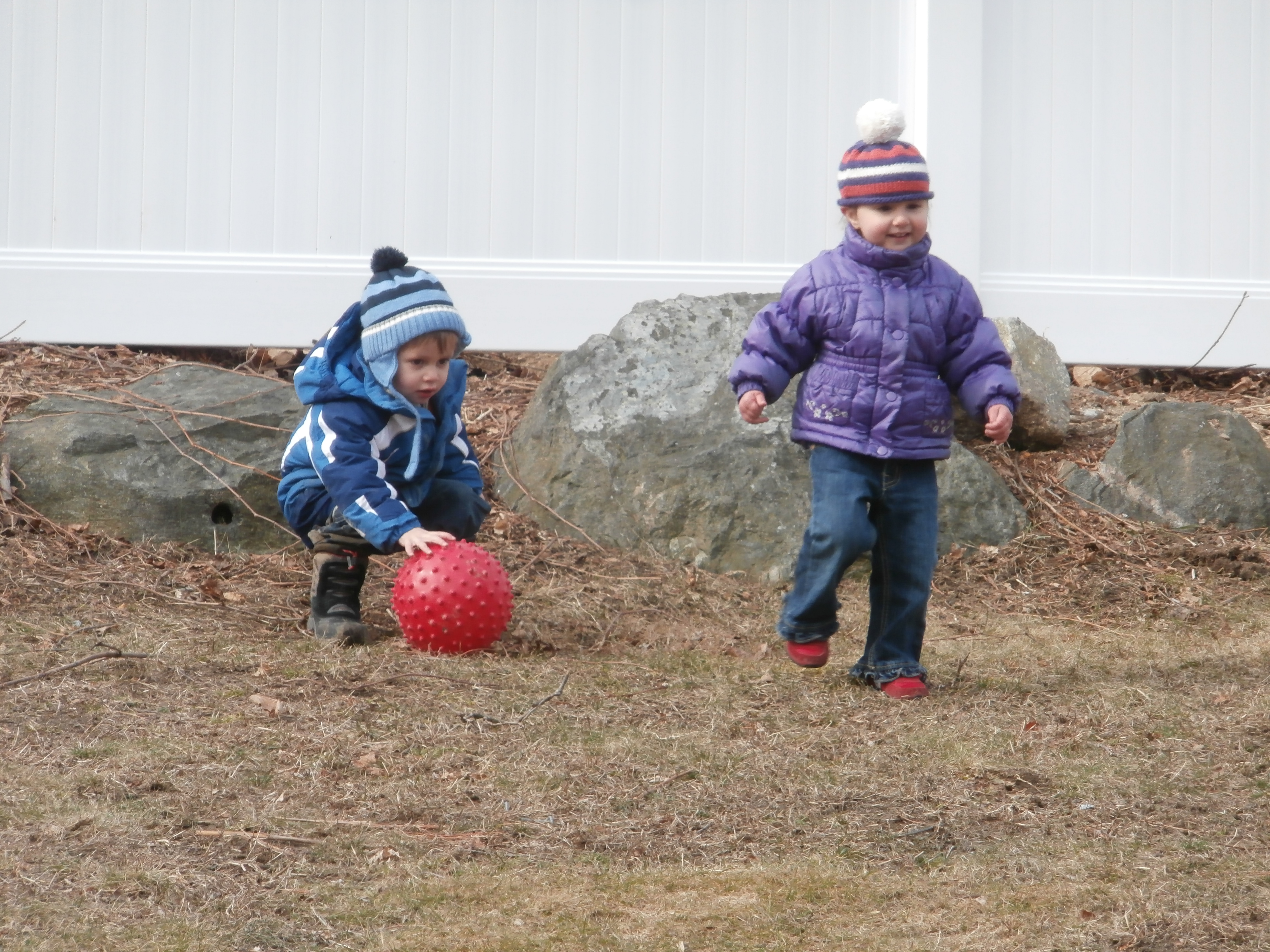
They understand each other’s words. They find the same things funny — leaning way, way back on the swing, climbing back up the chute of the double slide, feeding wood chips to mitten puppets, getting ready to kick the ball down the hill when suddenly it decides to go ahead without you.

I spent a little time Saturday morning with my grandson, his friend, and her mother. I told the mother how much I love the learning-language stage. She agreed and gave me an example of how it can be confusing when one word has two meanings.

She said she had told her daughter that the new baby brother had no teeth you could see but that the teeth were in his gums. Sometime later, when her daughter asked what she was chewing and she answered that she was chewing “gum,” the little girl thought her baby brother’s teeth must be in there.

Two and a half is a time so full of strange new things, she probably didn’t think it was any stranger than anything else.

A WordPress blogger in Australia [subsequent correction: not Australia but B.C Canada in the Okanagan] has another cute story, here.

Hungry mitten puppets

get ready to kick

the ball got away

casting light, not shadow

Read Full Post »

When grandmas recite poetry before you are three, the look on your face probably translates as, “What the heck?”

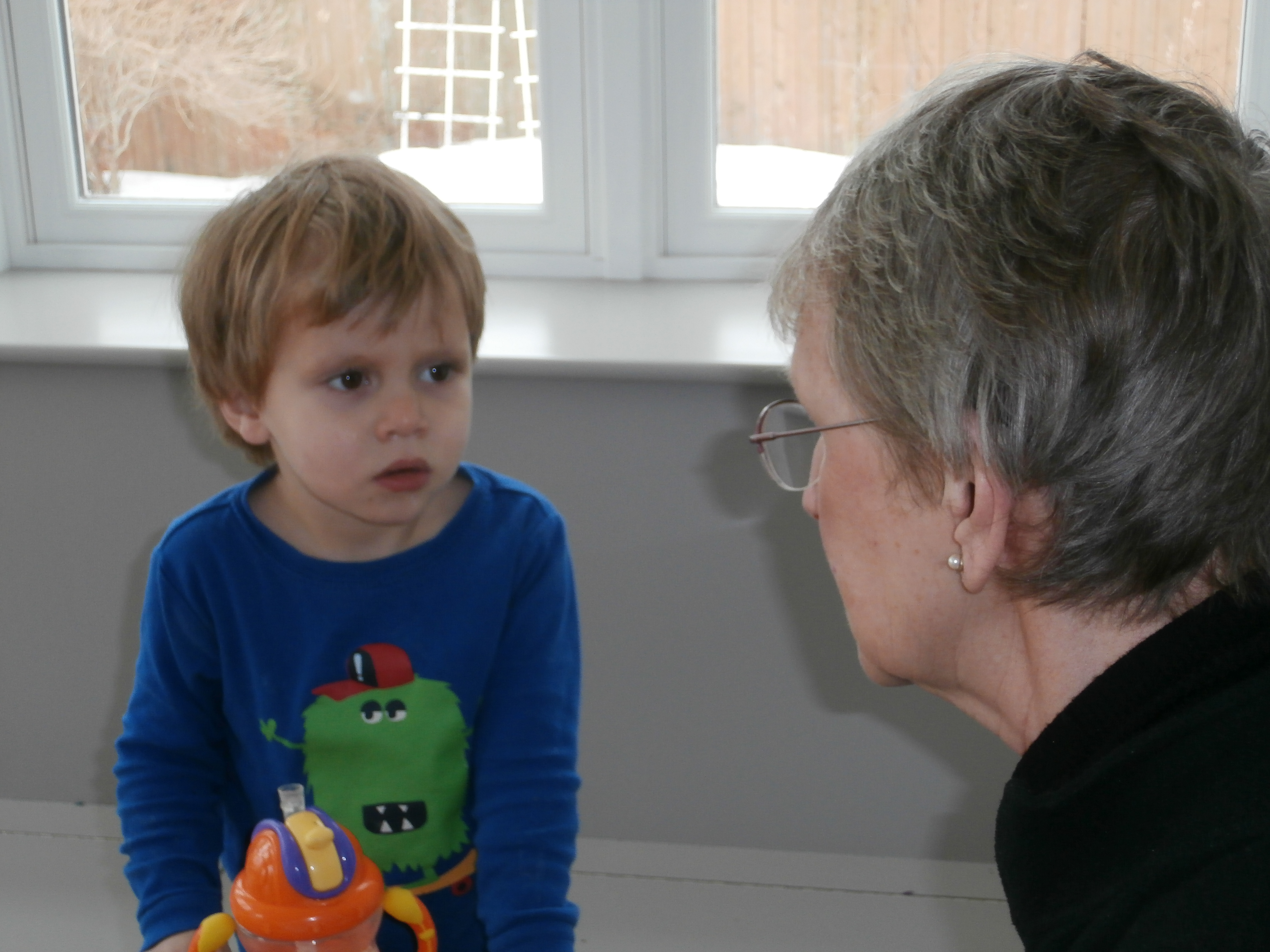
Here we are testing out Edward Lear’s “The Owl and the Pussycat.”

A week or so ago, Ogden Nash’s “Custard the Dragon” held a certain fascination, but there was ambivalence about the “big, sharp teeth.”

In the spontaneous-story department, we have been working on variations of “The Three Bears” and are edging up on “The Pig Won’t Jump over the Stile.” Stay tuned.

listening to Edw Lear poem

what kind of story is this?

Read Full Post »

We blogged a while back about tutoring students via distance learning. Kyle Spencer at the NY Times wrote about it here:

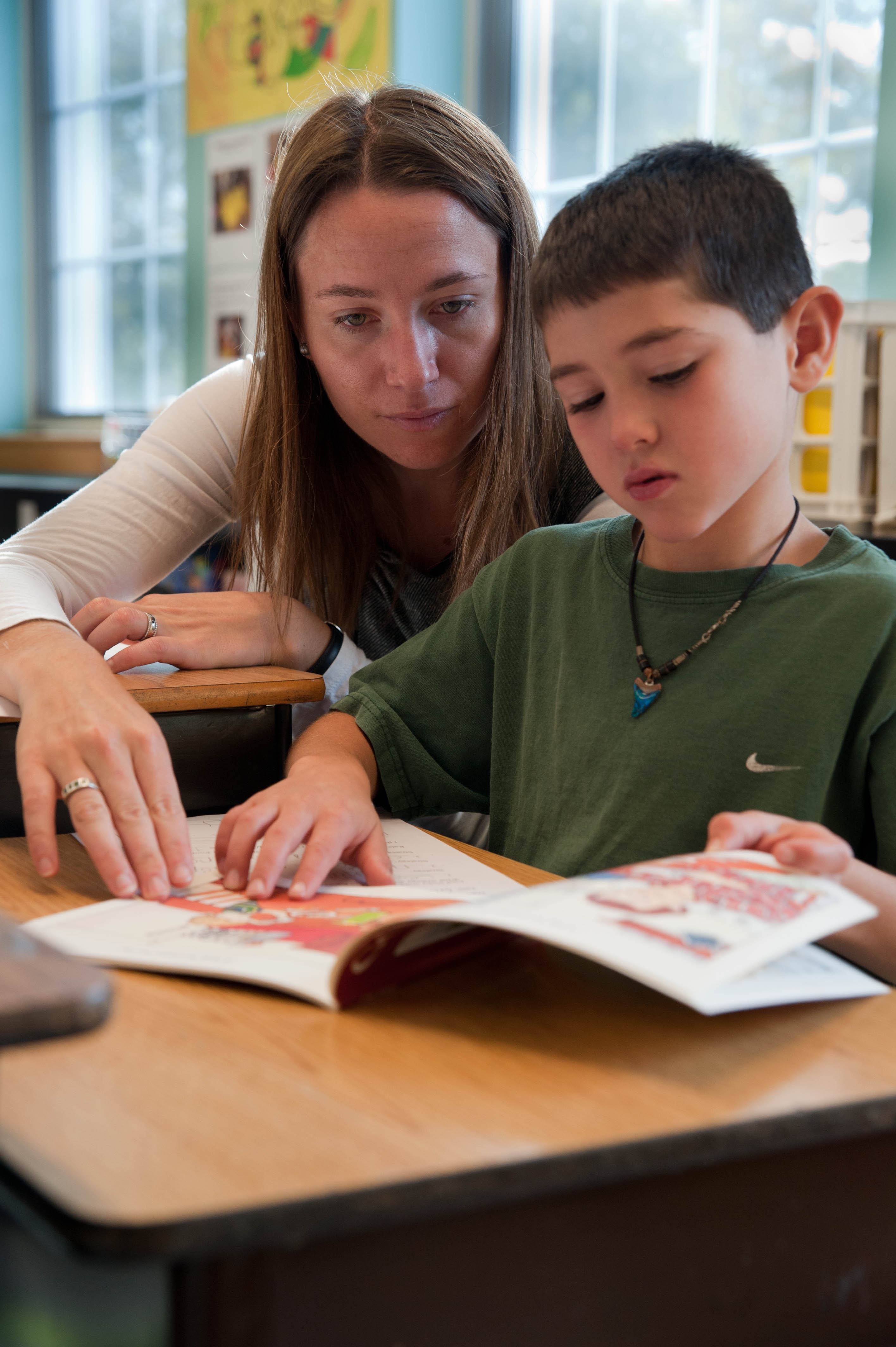
“Newly designed software for the tutoring of beginning readers has bridged the gap, allowing volunteers to meet students online from a distance. P.S. 55 is testing the program with students in its four first-grade classes.”

Now it turns out that remote tutoring is not the only kind of remote volunteering possible. In this article by Casey Armstrong at Shareable, we learn more about why “volunteers don’t have to be in the room anymore to physically volunteer.”

“As far as fun volunteering opportunities go, playing with kittens at an animal shelter is probably unequaled. It’s no wonder that the option to do this over the internet is a popular one. The Oregon Humane Society gives volunteers the chance to control robotic arms wielding toys for bored cats waiting to be adopted. This opportunity is not only good for the cats and volunteers, but it’s a great way to encourage donations and adoptions.

“And, if you look beyond the surface, this is more than just a stunt. It proves a concept: Volunteering can be done from anywhere by anyone if you accommodate it with the right technology. … Check out Reach-In.com if you’re interested in setting up your own robot volunteer opportunity.”

Photograph: Librado Romero/The New York Times
Edward Muñoz, a first grader at P.S. 55 in the Bronx, works out tricky words with Jenny Chan, his tutor in Midtown Manhattan.

Read Full Post »

This weekend, having spent special time with both grandsons and a brand-new granddaughter, I have been pretty aware of how much promise children hold.

Not just my grandchildren. All children.

But sometimes children who live in poverty need a boost from the rest of us. Kind of like at christenings when everyone in the congregation says they will help the baby learn and grow even though they don’t know the baby’s family and may not see them again. It’s a symbol that people take all children seriously.

At the Chronicle of Philanthropy, Suzanne Perry writes about the Washington, DC, version of the federal Promise Neighborhoods initiative that takes the nation’s responsibility toward children very seriously.

“The D.C. Promise Neighborhood Initiative, one of the country’s premier efforts to lift children out of poverty by offering a comprehensive array of educational and social services, has won a five-year, $25-million federal grant to step up its work.

“The grant, one of just seven of its kind that the Education Department awarded last month, was an especially sweet victory for the Washington project, which is working to turn around the city’s Parkside-Kenilworth neighborhood. Last year, it failed to win a similar award because it missed the application deadline due to technical problems it faced when e-mailing its proposal.

“This time, the group’s leaders left no stone unturned to ensure the application met all of the federal agency’s specifications, says Ayris Scales, the executive director—who now calls the project ‘the comeback kid’ and says she feels like ‘Cinderella at the ball.’

“The Washington effort is among dozens across the country that are following an approach pioneered by Geoffrey Canada, founder of Harlem Children’s Zone, which involves marshaling schools, nonprofits, and other community organizations to help children in troubled neighborhoods from ‘cradle to college.’ ” More.

By the way, I blogged about Geoffrey Canada and the movie on Harlem Children’s Zone, Waiting for Superman, a couple years ago, here.

Photograph: Cliff Owen/AP/File
A three-year-old pre-kindergarten student practices drawing spirals during a class at Powell Elementary School in Washington, DC. The DC Promise Neighborhood Initiative offers ‘cradle to college’ help to children in the nation’s capital.

Read Full Post »

John knows a good blog topic when he sees it. This tip he gave me is about minimally invasive education, which brings learning to the poorest of the poor.

According to wikipedia, “Dr. Sugata Mitra, Chief Scientist at NIIT, is credited with the discovery of Hole-in-the-Wall [HiWEL]. As early as 1982, he had been toying with the idea of unsupervised learning and computers.

“Finally, in 1999, he decided to test his ideas in the field. On 26th January, Dr. Mitra’s team carved a ‘hole in the wall’ that separated the NIIT premises from the adjoining slum in Kalkaji, New Delhi. Through this hole, a freely accessible computer was put up for use.

“This computer proved to be an instant hit among the slum dwellers, especially the children. With no prior experience, the children learned to use the computer on their own. This prompted Dr. Mitra to propose the following hypothesis: ‘The acquisition of basic computing skills by any set of children can be achieved through incidental learning provided the learners are given access to a suitable computing facility, with entertaining and motivating content and some minimal (human) guidance.’ ”

More at Hole-in-the-Wall.com. Also at the Christian Science Monitor.

And of course, I have to say a word about the program’s appearance in Bhutan, since Suzanne loves Bhutan.

“One of the major projects that HiWEL is in the process of executing is for the Royal Government of Bhutan. The project is part of a large Indo-Bhutan project formally known as the Chiphen Rigpel (broadly meaning ‘Enabling a society, Empowering a nation’). Chiphen Rigpel is an ambitious project designed to empower Bhutan to become a Knowledge-based society.” Read more.

Photograph: HiWEL
Playground Learning Stations in Dewathang Gewog of Samdrup Jongkhar District in Eastern Bhutan.

Read Full Post »

Lisa W. Foderaro writes in today‘s NY Times (here) about several elaborate carved-pumpkin events in and around New York City. Her article caught my eye because yesterday Suzanne and Erik took their baby dragon and Erik’s mother, sister, niece, nephews (in costume), yours truly and my husband to something pretty dramatic along those lines. In Providence.

As I was reading Foderaro and feeling competitive with New York, this bit in the story jumped out:

“Two carvers, Ray Villafane and Andy Bergholtz, who developed a national following on the Food Network’s ‘Halloween Wars’ show, were at the [New York Botanical] Garden in mid-October, using six-inch rinds of Atlantic Giant pumpkins to sculpture the zombie, whose organs and intestines poke through his cracked ribs. Their assistants were busy harvesting chunks of pumpkin with handsaws and, for the zombie’s jeans, steaming pumpkin rinds.

“Mr. Villafane, a commercial sculptor who has made a year-round business out of carving pumpkins, said … his one disappointment this year was that the official ‘all-time biggest pumpkin,’ the first to weigh more than a ton, did not make it to the Bronx, as was planned. The 2,009-pound specimen, grown by Ron Wallace in Coventry, R.I., ran into trouble.

“ ‘It sprang a leak and rotted on the way,’ Mr. Villafane said. ‘We wanted to carve the world-record holder, so that was sad.’ ”

Well, excu-use me! A Rhode Island monster pumpkin should have gone to the Roger Williams Zoo’s Spectacular, which was way better than anything the Times described. I’m afraid that Mr. Villafone tempted fate. Clearly a curse struck that giant pumpkin when it crossed the border.

The Roger Williams Zoo Spectacular lasts the whole month of October, involves 25 carvers carving 25,000 pumpkins (replaced as they decay), and many fun themes (with piped-in music). We wandered from “Star Wars” to Beatles to “Gone with the Wind” to “The Wizard of Oz” and on and on. I was as amazed as the relatives visiting  from Sweden.

The idea of 25 people carving pumpkins for a month is in itself amazing to ponder. How much do pumpkin carvers get paid? What work do they have during the other 11 months? Are any from Rhode Island School of Design?

The Spectacular would have been a bit scary for the youngest among us, I think, but he was jet-lagged and zonked out in the stroller. A buffet before the walk around the lake was super and got us in early, in front of incredibly long lines. Read more about it all here.

Photograph by Suzanne, Luna & Stella

Read Full Post »
Gwarlingo pointed me to Time In, an initiative that provides arts experiences for children who might not get such enrichment any other way.

Time In brings some of the youngest, most at-risk public school children OUT of underserved classrooms and INTO the world of the living arts every week of the school year.

“Starting from Pre-K, children {try] hands-on art in our studio one week, with hops to the world’s best galleries and museums the next! Regardless of their backgrounds, children are children. The world of imagination, creativity and fantasy is their most fertile ground. Time In acknowledges children’s phenomenal gifts and innate abilities and is dedicated to developing learning environments that stimulate, rather than stifle.

“We are proud to have changed the lives of more than 1,000 underserved Pre-K-2nd graders since 2006, and look forward to working with over 400 children this year. Time In will continue to foster not only wonderfully conceptual thinkers, but perceptive and aesthetically sensitive children, each of whom will be poised to nourish our society in the days to come.”

Read more. Or vote for the nonprofit on Facebook as Part of Chase Community Giving.

Read Full Post »

Ashoka, which defines itself as “a global organization that identifies and invests in leading social entrepreneurs,” has a blog called Changemakers that might interest readers. The March 26 post is on teaching and empathy.

Nora Cobo at the Center for Inspired Teaching writes, “While test-based assessments are essential, they reflect only one type of data and one kind of skill that students need. Schools must also focus on students’ social-emotional growth in order to create sound learning environments. Such settings help students develop interpersonal competence and improve short- and long-term academic and personal outcomes.

“Center for Inspired Teaching partners with teachers to change the school experience for students to include these critical skills. … Instead of looking at students’ behavior as something to be corrected, we train teachers to look at students’ behavior in terms of unmet needs. In particular, we ask teachers to consider students’ needs for Autonomy, Belonging, Competence, Developmental appropriateness, and Engagement — the ABCDE of learners’ needs.

“For example, a teacher may encounter a student who repeatedly gets frustrated and leaves his seat to chat with classmates when he encounters a complicated geometry problem. Rather than assuming the student has a bad attitude, the teacher strives to figure out which of the student’s needs is not being met. The teacher may discover that the student learns best when physically engaged – and offer him the option to tackle the equation by measuring distances by walking.

“Similarly, a teacher may find a student who refuses to work in a group setting, saying she just prefers to work alone. In examining the student’s unmet needs, that teacher may discover that the student longs for more autonomy with her work – and empower that student to create on her own.

“The teacher may discover, upon further engaging her skills of empathy, that other members of the group aren’t treating the student kindly, and therefore the student’s need for belonging is not being met when classroom groups are self-selected. …

“Placing empathy at the core of teachers’ practice ensures that students learn how to think, not just what to think – and go beyond covering the curriculum to learn the skills they need in order to thrive.”

More here.

Photograph: Kate Samp, Strategies for Children

Read Full Post »

Tom Jacobs alerted me to a piece he published at Pacific Standard, a publication that reports on studies in the social sciences.

Newly published research, he says, provides some support for the notion that children by nature want to help others.

“ ‘From an early age, humans seem to have genuine concern for the welfare of others,’ concludes a research team led by Robert Hepach of the Max Planck Institute for Evolutionary Anthropology. …

“But how exactly do you discover a toddler’s motivation? The researchers took a novel approach: by looking straight into his or her eyes.

“They note that our pupils enlarge in response to emotionally stimulating sights, and deduced this could provide an indication of what specifically prompts kids to perk up and take notice. Are they aroused by the sight of someone in need—or, perhaps, by the realization that they could play the hero by helping?

“Their experiment featured 36 2-year-olds, who viewed a scene in which an adult needed help reaching for a can or crayon. One-third of the children were allowed by their parents to help the person in need (almost all did so); another third were held back from providing assistance.”

Curious? Read more.

(By the way, the same institute was behind some research that Alan Alda featured on the PBS show The Human Spark, here.)

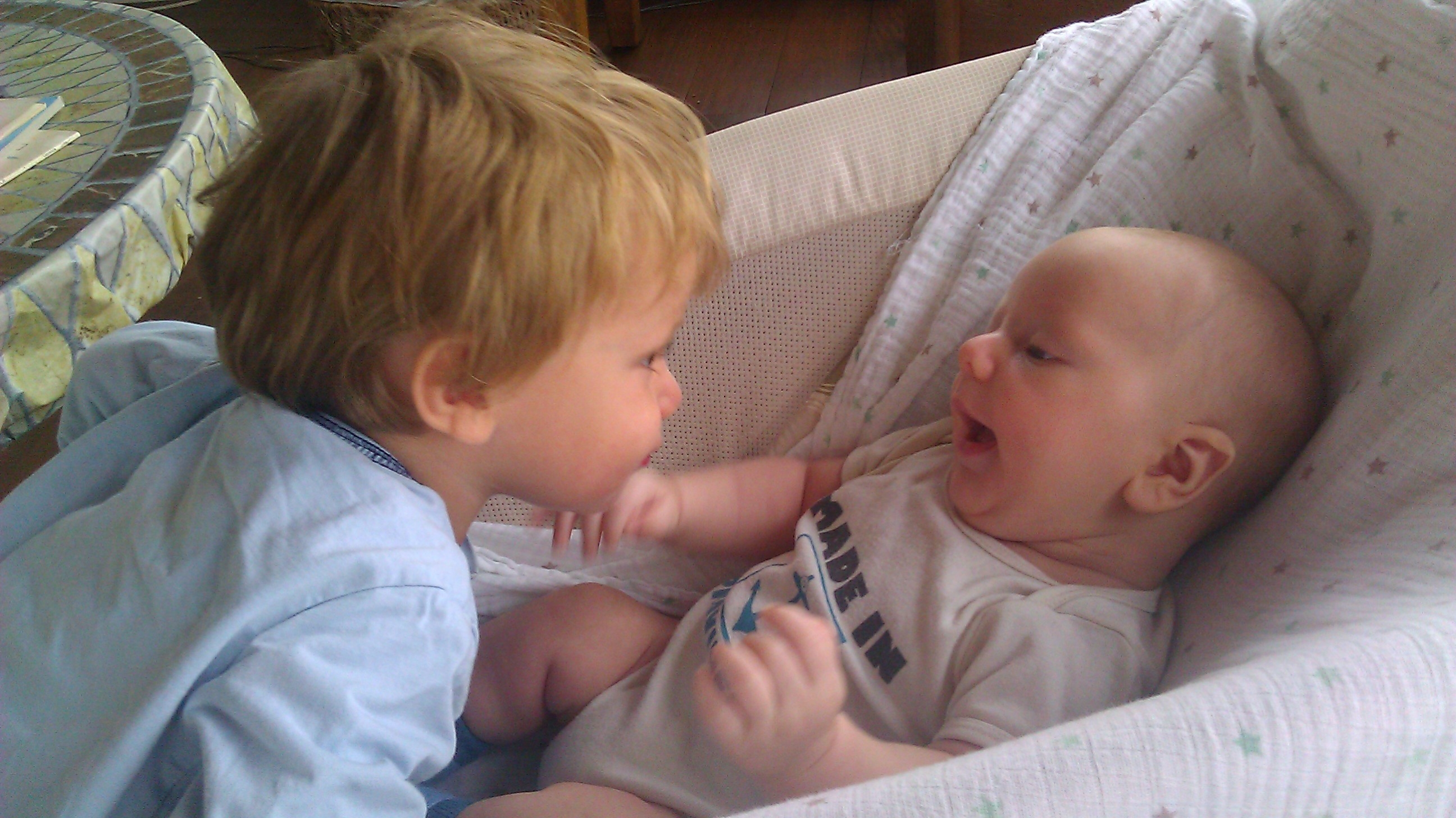
Photograph: Two-year-old meeting his cousin’s need for conversation.

Read Full Post »

I took a taste of local strawberries, and they brought back the little wild strawberries of my childhood. And how a friend might come over, and I might tell her in whispers that I had found a secret place.

I wouldn’t say where exactly until we got close, and she would have to promise not to tell anyone. Then, checking around that no one was watching, I would lead her into a stand of pine trees and out into a clearing in the middle. And there we would sit down and pick wild strawberries, which are always sweeter than any in the supermarket.

Today I was asking my boss about his vacation with his wife’s family in France. He said his four-year-old had such freedom there to run outside and play with cousins. It reminded him of the freedom of his own childhood, and he thought his daughter was only just now experiencing the way childhood is supposed to be. Where he lives, in the city, his little girl could never just run out  like that.

(If you are interested, here is one of many studies on the importance of nature and play in childhood.)

Read Full Post »

When I worked with Denise at a certain hyped management magazine, I always knew she had better things in her than the tasks she was given there.

Moreover, she was the most sensible 25-year-old I had ever met. After moving on to better jobs, including writing for teens at Scholastic, she turned to the hardest and most important work in the world. And on the whole, it seems to suit her.

But nothing can stop the itch to write. Here she shares the joy and frustration of reading repetitive stories to book-hungry kids:

“Nothing brings me more joy than knowing how much my 5-year-old son, Isaiah, looks forward to sitting in our rocking chair while I read him books at bedtime. And my heart swells with love whenever my 2-year-old twins, Joel and Nina, bring me books and say, ‘Read book, please.’

“But, holy moly, I’ve run into a very serious problem. While Isaiah can enjoy a variety of different stories, the twins are all about sameness. Even though I rotate their books constantly so we’re not reading the same ones every week, the repetitiveness of reading these books is driving me crazy.

“I’m sure many parents are familiar with the rhythm and rhyme scheme of many children’s board books, ‘Bend and reach, touch your toes. Now stand up straight and touch your nose!’ Lately, I’ve been adding a few colorful rhymes in my head as I read these books to the twins. ‘Clap your hands, then point to your shoes, reading this book is driving me to booze!’ ” Read more.

(I admit I felt the same way about Richard Scarry. The pictures were darling, but the words, not so, even if I did let “five-seater pencil car” become part of my vocabulary.)

For a mom with twins, it is must be twice as much “bend, reach, touch your toes,” but for sure these kids will grow up to be readers.

This is Denise with one of her three book mavens.

Read Full Post »

Did you catch the story today about the young boy whose composition was performed by the New York Philharmonic?

At the National Public Radio site, Jeff Lunden writes: “What would it be like if you were 10 years old and composed a piece of music that was played by the New York Philharmonic? For a few New York City school kids, including one fifth-grader, it’s a dream come true, thanks to the orchestra’s Very Young Composers program.

“Composer Jon Deak, who played bass with the New York Philharmonic for more than 40 years, says the idea for Very Young Composers came when he and conductor Marin Alsop visited an elementary school in Brooklyn several years ago.”

Now every year, “72 lucky kids in six New York area schools participate in this free after-school program. …

” ‘The kids are not chosen for being musical geniuses,’ [the Philharmonic’s director of education, Theodore] Wiprud says. ‘The guidelines we give the schools, in trying to identify some fourth- and fifth-graders for the program, is that they be kids for whom this could make a difference. Whether or not they study an instrument is not necessarily a good predictor of whether they’re going to do something creative in music.’ …

” ‘Some of these kids have trouble locating middle C on a piano,’ Deak says. ‘Does that mean they can’t compose music of depth? No. What do they have to do? They have to hum it for us, sing, whistle, tap the rhythms — even if they can’t notate them — and we get their piece.’

“As [teaching artist and composer Daniel] Felsenfeld puts it, ‘The most important thing about this class is that you never, ever, ever write their music for them — not even a little.’ ”

I’m hearing a refrain from yesterday’s post: all children have music in them and you should just let it flower.

Read more and listen to the performance of young Milo Poniewozik’s composition at NPR.

Photograph of student Milo Poniewozik and the New York Philharmonic: Michael DiVito

Read Full Post »

I’ve been meaning to blog about the wildly successful music-education program out of Venezuela, El Sistema.

Here music critic Mark Swed follows the L.A. Philharmonic to Caracas and writes about El Sistema for the Los Angeles Times.

“Musically, Venezuela is like no other place on Earth. Along with baseball and beauty pageants, classical music is one of the country’s greatest passions.

“In the capital, Caracas, superstar Venezuelan conductor Gustavo Dudamel is mobbed wherever he goes. Classical music teeny-boppers run up to him for autographs when he walks off the podium at concerts. The state-run music education program, which is known as El Sistema and from which Dudamel emerged, is the most extensive, admired and increasingly imitated in the world. One of its nearly 300 music schools for children, or núcleos, is deep in the Venezuelan Amazon, reachable only by boat. …

“The basic tenet of José Antonio Abreu, the revered founder of El Sistema, is the universal aspect of music. He likes to say that music is a human right. That’s an effective, politically expedient slogan. But what he has demonstrated on a greater scale than ever before is that music is not so much a right as a given. El Sistema is not about talent, ingeniously effective system though it may be for discovering and fostering musical talent. The truly revolutionary aspect of El Sistema is its proof that everyone has a capacity for music.”

Read about how El Sistema has spread worldwide in the Los Angeles Times.

Children at La Rinconada in Caracas, Venezuela, Feb. 14, 2012. Gustavo Dudamel, right, among students at a showcase of El Sistema in Caracas, Venezuela, Feb. 15. Photograph: Mark Swed / Los Angeles Times

Read Full Post »

Tom Jacobs at Pacific Standard reports on new research into the benefits of music for children.

“Music education produces myriad benefits,” he writes, “strengthening kids’ abilities in reading, math, and verbal intelligence. New British research suggests it may also teach something less tangible, but arguably just as important: The ability to empathize.

“In a year-long program focused on group music-making, 8- to 11-year old children became markedly more compassionate, according to a just-published study from the University of Cambridge. The finding suggests kids who make music together aren’t just having fun: they’re absorbing a key component of emotional intelligence.”

The research team was led by Tal-Chen Rabinowitch of the university’s Centre for Music and Science. Read more.

Photograph: Pete Pahham/Shutterstock

Read Full Post »

« Newer Posts - Older Posts »