Feeds:
Posts
Comments

Posts Tagged ‘community’

Attempts to improve housing for low-income people have often destroyed a sense of community. That’s eminently clear in Robert Kanigel’s new biography of Jane Jacobs, an activist who helped to end the construction of the large complexes known as the “projects.”

So there is some irony in a new Global Oneness film about a 70-year-old housing project that probably once destroyed a neighborhood but has since created its own sense of community. Today it is threatened with what sounds like very pleasant improvements.

Life is complicated.

The Global Oneness Project has interviewed Yesler Terrace residents and created a film to spark discussion of the pluses and minuses of revitalization.

Even the Walls is a short documentary about the multi-generational residents living within Yesler Terrrace, a public-housing neighborhood in downtown Seattle grappling with the forces of gentrification.

“For over 70 years, Yesler has been home to thousands of Asian, Asian American, African, African American, Native American, Hispanic, and Caucasian residents. The 30-acre property is being redeveloped quickly and the residents are being forced to make a decision — collect their memories and belongings and leave, or return to a place they know well, but do not recognize due to heavy reconstruction.

Even the Walls chronicles the intimate stories and experiences from the residents of Yessler and defines the human connection to home and community.”

The film is here. Lesson plans for teachers are here. And the good intentions of the City of Seattle are described here.

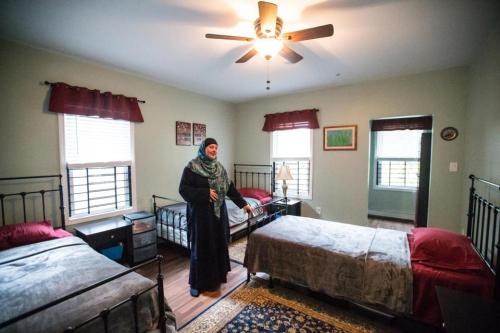
Photo: Seattle Housing
In an organic 70-year process, the residents of Seattle’s somewhat worn Yesler Terrace have made the “projects” into a real community. So not everyone is thrilled that improvements are afoot.

Read Full Post »

We have no idea what Wednesday will bring, but let’s do this. Let’s commit to focusing on what we once shared with that friend whose life path led him to a different decision. Let’s honor his or her life path if not the most recent destination. We’ve had different life experiences.

Let’s focus on what we both like: the funny things small children say, lazy days at the beach, imaginative Halloween costumes, the blended aromas of a Thanksgiving kitchen, Peter Pan.

There’s no need to bring Abe Lincoln into this, but well, you know: A house divided against itself cannot stand.

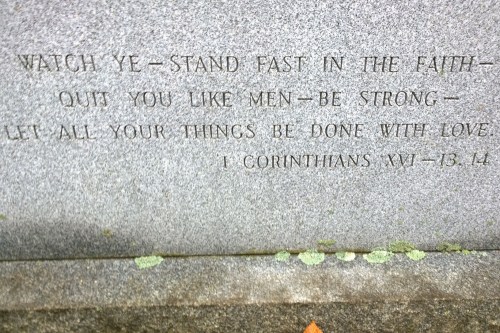
As I passed by on my walk last Thursday, this engraving with its old-fashioned wording spoke to me.

110316-let-all-your-things-be-done-with-love

Read Full Post »

As in other cities nationwide, relations between communities and police are often tense in Boston, but here is a small effort that focuses on reducing arrests and getting help for people who are troubled.

Evan Allen writes at the Boston Globe, “When Officers Michael Sullivan and Jeff Driscoll and senior crisis clinician Ben Linsky head out on their beat in Mattapan, they seek out the most vulnerable citizens: the drug-addicted, the homeless, and the mentally ill. Theirs is the only unit of its kind in the city, and its mission since it was started in February is to help, not arrest, people [with problems]. It’s part of a broader effort in the Police Department to work with the community. …

“Sullivan, Driscoll, and Linsky, who make up Mattapan’s ‘Operation Helping Hands,’ spend two nights a week freed from dispatch calls. Instead, they get to know the people on the streets, figure out what services they need, and try to provide them.

“ ‘You’re one part social worker, one part cop, and one part older brother,’ Sullivan said. …

“The number that [Police Chief William] Evans is most proud of is arrests: for the past year and a half, officers have been locking up fewer and fewer people. The city saw a 15 percent reduction in 2015, followed by the 10 percent drop so far this year.

” ‘When I came on the job, you measured what kind of an officer someone was by quantitative statistics. How many arrests. How many moving violations. We don’t do that anymore,’ Evans said. ‘I think our officers get it: It’s not about throwing people behind bars, it’s about getting them services and opportunities.’

“Driscoll, a 39-year-old father of two, has been on the force for 10 years, all of them in Mattapan. Before that, he served for several years in Watertown. He and Sullivan, a 32-year-old father of a 2-year-old boy, who joined the force three years ago, both grew up in police families, wanting to be officers. When Mattapan Captain Haseeb Hosein decided to start Helping Hands, they were an easy choice.

“ ‘With everything that’s going on in this country, the biggest thing is trust and fear. So how do we break those two barriers down? I think we break it down by building relationships,’ Hosein said. ‘They’re really good guys who understand the environment that we’re in, that we need to go the extra mile.’ ” More.

Getting people services that really create lasting change would be ideal, but who can cavil with de-escalating potential blowups? Ensuring that you don’t make matters worse than they are already is surely an important step.

Photo: Jessica Rinaldi/Globe Staff
“Operation Helping Hands,” made up of two officers and a crisis clinician, is the only Boston Police unit of its kind.

Read Full Post »

Upscale housing developers used to advertise tennis courts, pools, or golf courses as desirable amenities. Today they are increasingly likely to tout farmland.

Amy Hoak writes at MarketWatch about a family in suburban Chicago, where neighbors’ lawn chemicals have killed off pollinators. She reports that the Faheys are moving to a community that offers more opportunity for growing vegetables.

“Set in Hampshire, Ill., about 50 miles from downtown Chicago, Serosun Farms is a new home-conservation development, restoring wetlands, woodlands and prairie, and preserving farmland throughout. Already, the frog population has grown exponentially from the conservation work done onsite, and monarch butterflies are also on the rebound, said Jane Stickland, who is working on the project with her brother, developer John DeWald. Their efforts also are boosting the bee population. …

“Serosun plans to incorporate about 160 acres of working farmland, making farm-to-table a way of life for residents through regular farmer’s markets. The community also offers eight miles of trails, an equestrian center and fishing ponds: 75% of the development will be reserved for farming and open space. …

“The concept isn’t new, but ‘agrihoods’ are gaining in popularity, said Ed McMahon, senior resident fellow for the Urban Land Institute, an organization that focuses on land-use issues. He tracks about 200 agrihoods, where residential development coexists with farmland. …

“ ‘We started to realize you could cluster houses on a small portion of a farm and keep the farm working,’ he said. People were often drawn to the open spaces. More recently, however, there has been a huge interest in locally grown food. ‘All of a sudden, agrihoods have become a hot commodity in residential development,’ McMahon said.” More here.

This concept is not only for upscale developments. In urban neighborhoods without access to a local grocery or healthful food, affordable housing combined with community gardens and sales outlets are moving along without much fanfare. In Providence, for example, West Elmwood Housing Development Corporation‘s new Sankofa Apartments partner with the Sankofa Initiative, an outlet for homegrown food and handmade crafts from many countries. The initiative is satisfying to residents on a personal-development level and as a way to meet neighbors and build community.

Photo: J. Ashley Photography
Serenbe farmers’ market.

Read Full Post »

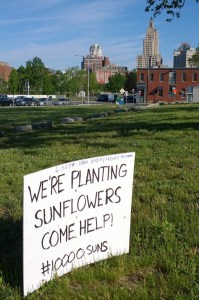
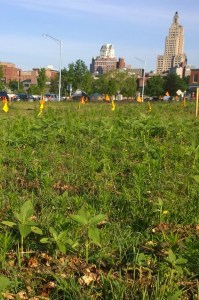
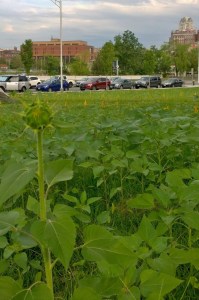
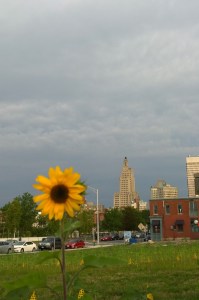
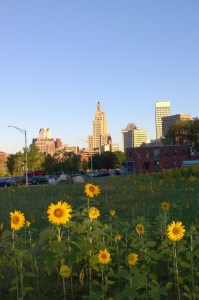
For the longest time, it looked like nothing at all, this art installation of 10,000 sunflowers where route 195 once polluted the soil.

Adam E. Anderson, the brains behind the community-building project, writes on his website, “Ten Thousand Suns is a summer-long botanical performance in which over 10,000 sunflower seeds have been planted and being nurtured over the course of the summer months, on land that until recently sat under a highway, with high compaction, low-organic material, and embedded with toxicity.  …

“Rather than using high maintenance and energy intensive large swaths of turf grass, the installation uses the bio-accumulating (removes toxins) and habitat creating properties of Helioanthus (aka, Sunflower) planted in rows in a series of large circles, leaving paths in-between for intimate exploration.

“The project will create a spontaneous and unique cultural identity for the citizens of Providence and its visitors during the summer months.”

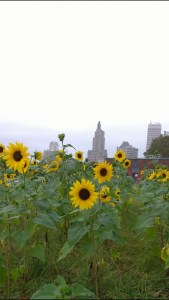
With little rain all summer, the project looked like a hopeless cause for many weeks. Until it didn’t.

In celebration of the cheery results, I want to share a few lines of a poem about a goldfinch loving a sunflower. Because who wouldn’t love a sunflower?

From poet Ross Gay‘s “Wedding Poem”

Friends I am here modestly to report
seeing in an orchard
in my town
a goldfinch kissing
a sunflower
again and again
dangling upside down
by its tiny claws
steadying itself by snapping open
like an old-timey fan
its wings
again and again
until swooning, it tumbled off
and swooped back to the very same perch …

Read more about the project at Adam Anderson’s site, here, and on Facebook, here. Click on my photos to check the dates.

060816-plant-sunflowers-superman-bldg

060816-help-us-plant-sunflowers


071216-sunflower-seedlings

081616-sunflower4


082916-finally-sunflowers

090716-sunflowers-growing


091316-sunflowers-providnece

Read Full Post »

Photo: Leigh Vincola, ecoRI News
David Kuma, left, is learning to farm under the tutelage of Ben Torpey.

In this story from Leigh Vincola, an ecoRI News contributor, several good things are happening simultaneously.

“David Kuma set out to grow more of his own food as he learned about industrial agriculture and all of its poisons. His father, a biologist, always had a garden growing up, so an innate knowledge of plants followed his curiosity.

“Born in Brooklyn, N.Y., raised partially in rural Illinois and then in Attleboro, Mass., Kuma understands urban, rural and suburban lifestyles and how plants can fit into each.

“Today, Kuma is one of three participants in the Southside Community Land Trust’s (SCLT) farm apprentice program …  Acknowledging that it has been historically difficult for minority populations to enter into commercial growing, the program’s mission is to provide organic farming experience and education to those who are interested.

“Kuma is partnered with Ben Torpey at Scratch Farm, a small-scale, chemical-free operation at Urban Edge Farm. Urban Edge is a state-owned, 50-acre piece of land managed by SCLT, where seven separate farms grow and share resources. The farm was established to give new farmers access to land and a community to learn from. As part of his paid apprenticeship, Kuma spends a full day on the farm two days a week and is learning a lot quickly. …

“From transplanting and cover crops to solarizing and low-till cultivation, Kuma is learning what it takes to run a small-scale farm naturally. His eyes have been opened to the importance of soil health.

“ ‘There’s a lot more to it than putting seeds in the ground,’ he said.

“For Torpey, having an apprentice is rewarding.

“ ‘Dave comes with a intuitive sense of plant biology and his curiosity reminds me that what we’re doing is fun,’ Torpey said. ‘It encourages me to experiment with new things.’ ” More here.

Don’t they both look happy? Nature can do that to you.

Photo: Scratch Farm


Read Full Post »

Good things continue to happen in the West End of Providence, thanks in large part to the vision and community responsiveness of West Elmwood Housing Development Corporation (WEHDC) under the direction of Sharon Conard-Wells.

Tuesday, WEHDC held a reception to celebrate past accomplishments and the new mixed-income housing development they are about to build. The mayor came. Community members came. Many of Rhode Island’s movers and shakers came. I came.

It was impressive to see how WEHDC’s projects have flourished when you consider that 10 years ago, the nonprofit was tackling the cleanup of a nearby industrial site and hoping to turned the blighted Rau Fastener factory into beautiful mixed-income housing — keeping their fingers crossed that the market would respond.

The market sure did respond, and now WEHDC is starting the second phase. At the same time, it continues community work of many kinds. Antoine started out doing lead abatement and now works with young people in the neighborhood. Adeline works with the community farm and the Sankofa World Market. Rosa and Debra do housing counseling and lending. Rachel manages WEHDC’s many partnerships and is always looking for more.

The energy and optimism are tangible, and it was good to see the recognition the nonprofit is getting from people in a position to ensure that the good work keeps going. The current wish list includes new laptops and web design work (in case you know anyone interested in offering help that is sure to be used wisely). Check out WEHDC here.

Photo: Sankofa Initiative

Read Full Post »

Looking through a pile of magazines recently, I found a 2011 newspaper article I had cut out about Hardwick, Vermont. It’s about reinventing the local culture around food and food-related businesses.

Dirk Van Susteren wrote at the Boston Globe, “If there were a ‘Locavore Capital of America’ one would expect it to be in sunny California or perhaps somewhere in the heartland … But, surprisingly, in rocky northern New England, just 45 miles from the Canadian border, is a place that could contend for that honor: Hardwick, a former quarrying town that until recently knew more pain than promise.

“In recent years Hardwick, population 3,200, located along a tumbling stretch of the Lamoille River, has seen a half-dozen innovative agricultural enterprises crop up, many with mission statements including such words as ‘community-based,’ ‘sustainable,’ and ‘organic.’

“The town, always a bit scruffy, and with a high jobless rate, might be on a green trajectory. And people are taking notice.

“Among the new operations here or in nearby towns: Jasper Hill Farm, which makes artisanal cheeses and provides aging, distribution, and marketing services to local cheesemakers; High Mowing Seed Co., an organic seed business, whose owner likes traveling around the country to tell the Hardwick farm and food story; Highfields Center for Composting, a soil-making business that collects its raw materials from restaurants, farms, and schools; Pete’s Greens, a CSA (community-support ed agriculture) farm that grows organic vegetables in gardens and greenhouses; and, finally, Vermont Soy, a tofu and soymilk producer.

“The area also has dozens of small-scale producers, from orchardists to maple sugarmakers. Their products sell at farm stands, at the summer farmers’ market, and at Buffalo Mountain Food Co-op and Cafe, a landmark in its 36th year. …

“Monty Fischer, the executive director of the Center for an Agricultural Economy, the nonprofit organization that helped spur these farm efforts, has kept count. ‘People from 40 states and 40 countries have come to ask about our agricultural cluster,’ he reports, from his downtown office.”

Read about the 2011 federal grant for the Vermont Food Venture Center, an incubator facility, the organic North Hardwick Dairy, where sunflowers are grown as a value-added crop, mead maker Caledonia Spirits, and more here.

And if anyone has been up there recently, I sure would love to know if the food culture is still going strong.

Photo: Wikipedia
North Main St., Hardwick, Vermont

Read Full Post »

I love listening to Worcester-based WICN (jazz radio). Bonnie Johnson had an especially good show yesterday, opening with Cynthia Scott and 3rd, 4th & 5th graders of PS32 in Brooklyn, NY, singing “Dream for One Bright World.”

“There is a new day dawning
“The time is now
“The world is ready for a change …

“Let’s teach out children to care
“To help one another
“And mend broken hearts
“So many children in the world
“Have never had a chance
“Their time has come …

(More lyrics here.)

You can listen to WICN online at wicn.org. Bonnie Johnson’s program is described at Colors of Jazz. “Bonnie Johnson is host of Colors of Jazz on Sunday afternoon from noon-4 pm. If you asked the Worcester native how she found jazz, she would tell you that jazz found her. As an undergraduate student at Howard University in Washington, DC, Ms. Johnson became a fan of the Quiet Storm featured on the college station WHUR-FM. …

“Ms. Johnson appreciates the diversity and the evolution of music. As a self-taught electric bassist, she has enjoyed many years of playing various types of music with her daughter and close friends in a family band. Growing up, she sang in the St. Cecilia Girl Choir at All Saints Worcester. …

“Ms. Johnson holds B.A. in Liberal Studies and M.S. in Communications and Information Management degrees from Bay Path College. She believes the future of jazz is in our children, stating, ‘Music and the arts is one area that gives young people an outlet and release of creative energy. While there are many children exposed to music through lessons and attending live performances, there are too many more that are not.’ One of Johnson’s primary goals as host at WICN is to reach youth in creative ways through community engagement.”

That’s something to think about on Martin Luther King’s birthday — and maybe to act on, too.

Bonnie Johnson, host of WICN radio’s Colors of Jazz 

Read Full Post »

Following up on yesterday’s post, which highlighted simple pleasures like spending time in the library, I give you this report by Morgan Ribera at Bustle.

“Apparently, libraries provide patrons with a happiness that money can’t buy. Or at least nothing less than almost two grand in cash. According to a recent study commissioned by the U.K.’s Department for Culture, Media, and Sport, the act of going to the library induces joy equivalent to that brought on by a £1,359 ($1,878) pay raise.

“The study was conducted in an attempt to measure which activities have the most positive impact on an individual’s well-being. Visiting a library scored among the top joy-generating activities, alongside dancing and swimming, giving us yet another reason to hang-out at our local library. …

“And this U.K. study adds even more to the proof already stacking up on the value of libraries, a value that was evidenced extensively in a Pew Research Study released [in March]. The rather pleasing results of this eye-opening Pew study showed that habitual library goers maintain stronger community ties, are more likely to socialize with friends and neighbors, and exhibit higher levels of technological engagement.”

More at Bustle, here.
Photo: Bill Lapp

Read Full Post »

Ron Finley is a man of humble ambitions. He aims to save the planet, beginning with urban gardeners. I heard an interview with him on America’s Test Kitchen as I was driving home today.

From his website: “Let’s grow this seed of urban guerrilla gardening into a school of nourishment and change. Help spread his dream of edible gardens, one city at a time. …

“In part of this effort, Ron is planning to build an urban garden in South Central LA that will serve as an example of a well-balanced, fruit-and-veggie oasis – called ‘HQ.’ Inspired by the idea of turning unused space such as parkways and vacant lots into fruitful endeavors, this garden and gathering place will be a community hub, where people learn about nutrition and join together to plant, work and unwind. HQ will create a myriad of jobs for local residents, and this plot of land will be a self-sufficient ecosystem.”

It all started, according to Ron, when he “wanted a carrot without toxic ingredients I didn’t know how to spell.” He began to plant food near his house, on a strip by a road.

“The City of Los Angeles owns the ‘parkways,’ the neglected dirt areas next to roads where Ron was planting. He was cited for gardening without a permit.”

After Ron “started a petition with fellow green activists, demanding the right to garden and grow food in his neighborhood … the city backed off.” More here.

When asked on America’s Test Kitchen if his gardens were not just about obesity and healthful eating but also about making neighborhoods more livable, Ron said he wanted to do that for the whole planet.

Read Full Post »

Candy creates interactive street art. Her “Before I Die” wall garnered a lot of attention — and contributors. Folks wanted more.

So she decided to create a website explaining in detail how others could replicate the wall.

Here she tells how it all started: “It’s easy to get caught up in the day-to-day and forget what really matters to you. After I lost someone I loved very much, I thought about death a lot. This helped clarify my life, the people I want to be with, and the things I want to do, but I struggled to maintain perspective. I wondered if other people felt the same way. So with help from old and new friends, I painted the side of an abandoned house in my neighborhood in New Orleans with chalkboard paint and stenciled it with a grid of the sentence “Before I die I want to _______.” Anyone walking by could pick up a piece of chalk, reflect on their lives, and share their personal aspirations in public space.

“It was an experiment and I didn’t know what to expect. By the next day, the wall was bursting with handwritten responses and it kept growing: Before I die I want to… sing for millions, hold her one more time, eat a salad with an alien, see my daughter graduate, abandon all insecurities, plant a tree, straddle the International Date Line, be completely myself…  People’s responses made me laugh out loud and they made me tear up. They consoled me during my toughest times. I understood my neighbors in new and enlightening ways.”

Candy’s how-to page reads, in part, “Once you’ve created a wall, you can share your wall here by creating a mini-site! A mini-site is a page where you can post photos and responses and document the story of your wall. It’s super easy to use, absolutely free, and no technical skills are required. Visit the Budapest mini-site to see an example.”

Everything you need if you’re going to create a “Before I Die” wall is here.

Photo: Before I Die

Read Full Post »

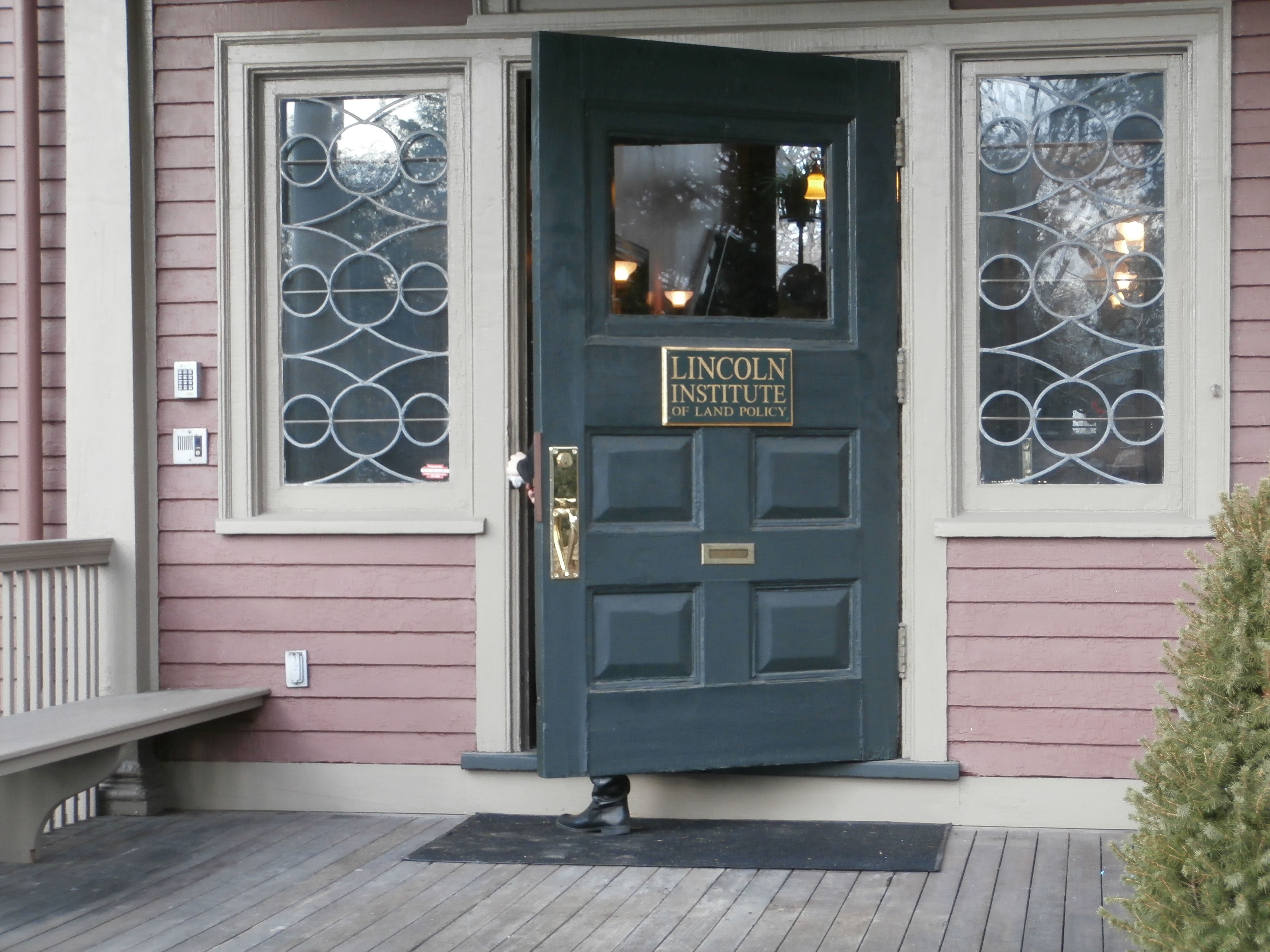
Lincoln Institute of Land Policy

Because the lecture was on walkable communities, I walked to the Lincoln Institute of Land Policy today.

Julie Campoli was scheduled to talk about her book Made for Walking: Density and Neighborhood Form.

From the Institute’s website: “In this era of high energy prices, economic uncertainty, and demographic change, an increasing number of Americans are showing an interest in urban living as an alternative to the traditional automobile-dependent suburb. Many people are also concerned about reducing their annual vehicle miles traveled as a way to lower greenhouse gas emissions affecting climate change. …

“Researchers delving into the question of how urban form affects travel behavior identify specific characteristics of place that boost walking and transit use while reducing [vehicle miles traveled]. In the 1990s some pinpointed diversity (of land uses), density, and design as the key elements  … After a decade of successive studies on the topic, these ‘three Ds’ were joined by two others deemed equally important—distance to transit and destination accessibility … Added to the list is another key player: parking.”

Campoli talked about all five elements, showed great pictures, and shared intriguing stories from successful communities. More.

By the way, if I had gone by car to the lecture instead of on foot, I would most assuredly have missed the possum, one of the more contemplative creatures in Cambridge today. He was still on his branch when I walked back after the presentation. But he had turned around.

possum_near_Harvard_Square.


Read Full Post »

Jay Walljasper appeared recently in the Christian Science Monitor (by way of Shareable). Designated one of The Monitor‘s “change agents,” he has written about ways to build a sense of community in a book called The Great Neighborhood Book.

Walljasper believes that “providing people with ways to come together as friends, neighbors, and citizens creates a firm foundation that enables a neighborhood to solve problems and seize opportunities.

“The neighborhood is the basic building block of human civilization, whether in a big city, small town, or suburban community. It’s also the place where you can have the most influence in making a better world.”

Tips are provided here.

My own neighborhood has block parties on an annual basis. It hasn’t led to solving any major problems, although we did manage to get a rabid raccoon carted away not long ago. Even though most of us meet only once a year, I think we would help one anther if there was a disaster.

Pictures of Sunday’s convivial block party are below, followed by a photo of neighbors somewhere else actually working together on a project. That kind of collaboration probably produces deeper bonding.


Photograph below by Manuel Valdes/AP/File
Two volunteers hold the top of a spiral slide being installed at a neighborhood park in Kent, Wash., in 2011.

Read Full Post »

Evolutionary biologist David Sloan Wilson has just published a book recounting his efforts to apply the principals of his discipline to improving urban life.

The book is called The Neighborhood Project: Using Evolution to Improve My City, One Block at a Time, and it sounds cool.

Mark Oppenheimer writes in the NY Times:

“For years the evolutionary biologist David Sloan Wilson paid little attention to Binghamton, N.Y., where he lived and taught. ‘I hadn’t joined the PTA,’ he writes, ‘attended council meetings, given blood, or served turkey to the homeless on Thanksgiving.’ …

Photographer: Jonathan Cohen

“Five years ago Mr. Wilson, the author of two popular books about Darwin, decided it would be fruitful to apply his training to the (human) animals closer to home. With colleagues at Binghamton University, Mr. Wilson founded the Binghamton Neighborhood Project to use evolutionary theory, along with data collection, to improve the quality of life in his struggling city.”

Although the work is still — evolving — the people he works with make interesting reading as do the experiments.

Oppenheinmer says that the “best chapters describe some of the preliminary work Mr. Wilson’s team has done. For example the Project gave a wide cross section of Binghamton schoolchildren the Development Assessment Profile, a survey that measures sociability, citizenship skills and the conditions that promote such traits. Students rated their agreement with statements like ‘I think it is important to help other people’ and ‘I tell the truth even when it is not easy.’

“The project then figured out where the most trusting, pro-social children lived: which neighborhoods, in other words, seemed to be breeding the most social capital. Using the technology on which Google Earth relies, the project created a krig map — a topographical map representing demographic data — for the city. The valleys showed areas with low social capital, the peaks with high.”

The results have implications for where community-building intiatives might have the most impact. Read the whole review here.

Read Full Post »

« Newer Posts - Older Posts »