Feeds:
Posts
Comments

Posts Tagged ‘farm’

Here’s something fun from the UK paper the Telegraph: Irish farmers taking pictures of themselves on mobile phones. The farm animals add that certain je ne sais quoi.

Emily Gosden has the story.

“Photos of Irish farmers taking ‘selfie’ photos with their livestock have gone viral,” writes Gosden, “being republished on dozens of news sites around the world. …

“The snapshots were originally submitted to the Irish Farmers Journal for its ‘selfie on the farm’ competition. Ten finalists picked by the journal include a photo by Patricia Farrelly from Ballyjamesduff, posing with a goose and an axe, and a shot entitled ‘two fine beards’ by Peter Desmond from Ballinhassig, sporting a beard and posing alongside a bearded goat.”

More here.

Photo: Irish Farmers Journal/Facebook
Farmer P.J. Ryan from Newport, County Tipperary, in his prize-winning selfie. The picture was submitted by his daughter Aisling.

Read Full Post »

Did you catch Luke Runyon’s story about a trend in suburban housing that sites homes near farms for the fresh food? It was at National Pubic Radio today (courtesy of Harvest Public Media).

According to Runyon, “There’s a new model springing up across the country that taps into the local food movement: Farms — complete with livestock, vegetables and fruit trees — are serving as the latest suburban amenity.

“It’s called development-supported agriculture, a more intimate version of community-supported agriculture — a farm-share program commonly known as CSA. In planning a new neighborhood, a developer includes some form of food production — a farm, community garden, orchard, livestock operation, edible park — that is meant to draw in new buyers, increase values and stitch neighbors together.

” ‘These projects are becoming more and more mainstream,’ says Ed McMahon, a fellow with the Urban Land Institute. He estimates that more than 200 developments with an agricultural twist already exist nationwide. …

“In Fort Collins, Colo., developers are currently constructing one of the country’s newest development-supported farms. At first blush, the Bucking Horse development looks like your average halfway-constructed subdivision. But look a bit closer and you’ll see a historic rustic red farm house and a big white barn …

“When finished, Bucking Horse will support more than 1,000 households. Agriculture and food production are the big draws, [developer Kristin] Kirkpatrick says. Land has been set aside for vegetables. There will be goats and chickens, too, subsidized by homeowners. Soon they’ll be hiring a farmer for a 3.6-acre CSA farm. There’s also a plaza designed for a farmers market, and an educational center where homeowners can take canning classes.”

Sounds like fun. Read more.

Photo: Serenbe Farms
Paige Witherington is the farmer at Serenbe Farms, a 30-acre certified organic and biodynamic farm adjacent to a housing development outside Atlanta. It’s one of more than 200 subdivisions with an agricultural twist nationwide.

Read Full Post »

It might be getting a bit cold for the outdoor classroom, but this article by Melanie Plenda in the Boston Globe suggests that not even snow will stop these preschoolers from learning about nature.

“In the back of the farmhouse at Drumlin Farm Community Preschool in Lincoln sit five chickens surrounded by a gaggle of preschoolers — eyes wide, waiting. The teacher opens the egg box door, and the students, staying slow and small like they were taught, peer in.

“ ‘And when they find an egg there,’ says Paula Goodwin, director of the school, ‘we ask them to make a nest with their hand, and they very gently pass the egg from one to another. And it’s a very special time, because they don’t need a lot of special instructions except to look for a child whose hands are in the shape of a nest. … It’s one of the magical moments in the school year. They are so generous with sharing the egg, and they may not have even learned each other’s names yet.’

“Drumlin is a nature- and farm-based preschool, which means that rain or shine, maybe not sleet but definitely snow and temperatures down to 15 degrees, the 14 3- to 5-year-olds are outside learning math, science, language, and how to be curious. Visiting captive wildlife, doing farm chores, and taking part in planting activities provide opportunities for all kinds of learning.” More.

Judging from my three grandchildren, I’m pretty sure no kid needs to “learn how” to be curious (“Poppa, what is the sun for?”), but we all hope for schools that continually encourage their curiosity.

Photo: Porter Gifford

Read Full Post »

The Globe has a good story today on Whole Foods, which hired an urban farming company to grow an anticipated 10,000 pounds of food per year on the roof of its Lynnfield, Massachusetts, store.

Erin Ailworth writes, “The soon-to-open Whole Foods Market in Lynnfield will offer its customers something the company says no other major grocery chain has offered before: ‘rooftop produce,’ picked from a field atop the store. …

“Whole Foods and its contractors say the commercial roof garden is an experiment that, if it succeeds, could encourage other grocers to do the same, boosting efforts to expand rooftop gardening. Such gardens not only insulate buildings, lowering heating and cooling costs, but also decrease storm-water runoff, which can overwhelm sewer systems and carry pollutants into waterways.

“And they yield fruits and vegetables that do not need to be trucked or flown, cutting transportation costs and emissions, including of greenhouse gases. The rooftop produce — a tiny fraction of Whole Foods’ inventory — will be sold in the Lynnfield store or used in its prepared foods.

“A green roof, however, is not cheap. It can cost up to 60 percent more than a traditional roof, according to the Sustainable Cities Institute, a program of the National League of Cities. …

“Whole Foods began thinking about the project three or four years ago, [Robert Donnelly of Whole Foods] said, and at first planned to build a basic green roof — essentially, a lawn atop the store. Then the company came across Green City Growers and Recover Green Roofs, two Somerville companies that partnered on a 4,000-square-foot garden above the Ledge Kitchen & Drinks restaurant in Dorchester. (That garden provides about 75 percent of the veggies and herbs served at the Ledge.)

“Whole Foods’ plans quickly became more ambitious as company officials realized the 45,000-square-foot roof (nearly an acre) provided plenty of space for farming.” More. There’s also a fun video at the Globe site showing the construction of the roof farm.

Suzanne’s Mom’s Blog had another roof garden post here; a post about Glide Memorial’s roof garden here; and a related entry about the Guardian Environment Network, here.

Photo: David L. Ryan/Globe Staff
Workers dumped soil into containers on the Lynnfield Whole Foods roof, which was reinforced to bear the extra weight.

Read Full Post »

If you had to guess one church in San Francisco that would be all over the idea of rooftop gardening to feed whoever needs feeding, which one would it be?

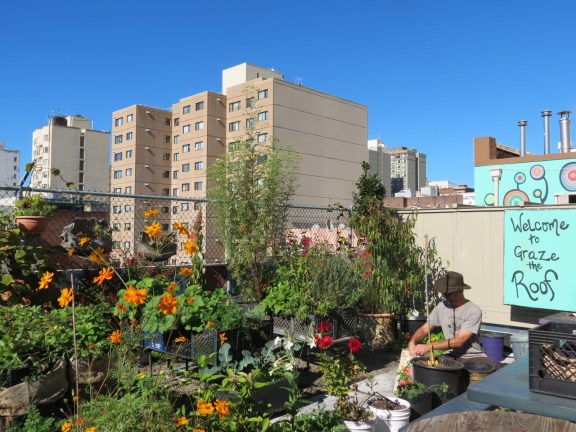
Right. Glide. I like its garden’s name: Graze the Rooftop.

“Graze the Roof is an edible, community-produced vegetable garden on the rooftop of Glide Memorial Church, a progressive church and nonprofit located in the Tenderloin district of San Francisco.

“Graze the Roof features lightweight (upcycled) raised garden beds made from milk crates; a worm composting system and an educational mural which ties the whole project together. Glide youth and volunteers from throughout the Bay Area maintain the garden and host monthly tours and workshops.”

Do you live in the San Francisco area? Looks like there are a lot of fun workshops available, such as Designing Sustainable Habitats, Introduction to Permaculture, and Urban Fruit Tree Stewardship. Read more here.

Photo: Graze the Roof

Read Full Post »

Vermonters care a lot about their farms. So when a dairy farm in South Woodstock was threatened with development, the neighbors bought it.

“Perched on a hill overlooking a valley,” writes Ann Trieger Kurland at the Boston Globe, “Farmstead Cheese Co. began as a neighborly plan to preserve a dairy farm.

“The bucolic 18-acre site was a former water buffalo farm and creamery that produced mozzarella and yogurt. When its owners moved to Canada and put the land up for sale, locals worried about the loss of jobs and the disappearance of another bit of the Green Mountain State’s rich heritage. They feared that the pastoral landscape might be grabbed by a developer.

“So 14 neighbors banded together to buy the farm and decided cheese making might safeguard its future. Within the year, they rebuilt the creamery, brought in a mixed breed herd — Holstein, Jersey, Ayrshire, and Swiss Brown — to blend milks and make farmstead cheese. They started the first community-owned dairy farm in the state. In two years, the company has won dozens of awards for its cheddar, a harvarti-style tilsit, Edam, and English and French-style cheeses.

“The new owners are not novices. They include seasoned farmers and food industry executives who hired experienced staff. The top cheese maker, Rick Woods, 46, has been plying his craft for 19 years. ‘We’re a new company, but it’s not the first time around the block for these people,’ says Sharon Huntley, who is in charge of marketing.” Read more about the community-owned farm and where you can buy the cheeses.

Photo: Vermont Farmstead Cheese Co.
At the community-owned in South Woodstock, Vt., there are 135 cows.

Read Full Post »

We’re going to the Mother’s Day brunch at Verrill Farm, one of 18 farms in the Boston suburb Concord.

The farm started out as a dairy business in 1918, but today just raises flowers, fruits, and vegetables. There’s an enclosed farmstand that in addition to produce and flowers, sells prepared meals, baked goods, and specialty items. Verrill bounced back from a devastating fire a few years ago and is often credited on menus around the region.

We enjoy the farm’s outdoor brunches. Suzanne and John are likely to run into people they knew in elementary school, now with their own kids in tow. We’ll eat at trestle tables under tents, and the grandsons will be able to ride ponies, climb on a wooden climbing thing like a boat, and roll down the hill. Our granddaughter usually gets a kick out of watching whatever her brother is doing.

The moms will probably be wearing their birthstone jewelry from Suzanne’s company, Luna & Stella. You may want a piece, too, for yourself or your mom. If so, Suzanne says, “You can use BLOGMOM13 for free shipping.”

Read Full Post »

Take two tomatoes and call me in the morning.

***

The University of South Carolina has developed a manual for health centers that want to collaborate with farmers markets on health, even writing food prescriptions for patients who need to improve their eating habits.

The manual’s authors, Darcy Freedman and Kassandra Alia, write in the intro of their manual:

“Farmers’ markets have grown in popularity in recent years as a place for improving health, increasing economic growth for local agriculture, and building communities. …

“Though the rebirth of farmers’ markets represents an exciting movement in the United States, data reveal that the benefits of farmers’ markets are not evenly distributed. Communities with the greatest need for farmers’ markets, for instance, are least likely to have them.

“In the present manual, we describe an approach for developing a health center‐based farmers’ market. Health centers, in particular federally qualified health centers or FQHCs, were identified as a strategic place to locate farmers’ markets because they may be located in food desert contexts (i.e., low‐income communities with low‐access to healthy food retailers). Additionally, locating at a health center makes an explicit connection between farmers’ market and preventive medicine.” More.

Photo: Aram Boghosian for The Boston Globe

Read Full Post »

Photograph: http://americanflatbread.com/lareau-farm. Lareau Farm is home to American Flatbread in Waitsfield, Vermont.

@@@

A few of my readers will see “Waitsfield, Vermont” and think “skiing.” That’s because they were skiing there a couple weeks ago.

But this post is about the man who launched American Flatbread in Waitsfield in 1985, franchising his restaurant concept in other states and using his business success as a platform to advocate for the environment and other causes.

“In the fall of 1979,” writes Mike Ives for the Christian Science Monitor, “George Schenk stuffed all his worldly possessions into his pickup truck and moved from upstate New York to central Vermont. After settling in the sleepy ski town of Waitsfield, he began working as a dishwasher, freelance photographer, and live-in baby sitter.

“He also apprenticed at local restaurants and learned from chefs who were cooking in ways that emphasized local and regional ingredients. By 1985, Mr. Schenk was selling his own ‘flatbread,’ a variation on the brick oven-style pizza he’d eaten as a teenager, topped with Vermont produce.

“Serving nutritious food, he realized, was a good way to promote the kind of community values he’d absorbed in his Connecticut childhood and the ecological principles he’d embraced in his previous careers as a farmer and forester. …

” ‘I felt as though the environmental dimension of food needed a voice,’ Schenk recalls.

“Today, American Flatbread operates three popular Vermont locations, exports frozen pizzas nationwide, and is franchising its restaurant concept in other states.

“But profit isn’t Schenk’s only priority: For more than two decades he has donated thousands of his flatbreads to the poor and sick. He’s also held an average of eight benefit bakes each year to raise money for those in need.”

Although his political views and “civil disobedience” actions have often raised hackles, the people who know him best defend him.

“They insist his commitment to his employees and community is sincere and unwavering,” writes Ives. ” ‘I don’t always agree with George, but I always appreciate him,’ says Amy Shollenberger, former executive director of Rural Vermont, a nonprofit farm advocacy group. ‘He loves everybody, wears his heart on his sleeve — and walks his talk.’ ”

Read more.

Brian Mohr/EmberPhoto
George Schenk founded American Flatbread pizza as a way to showcase local produce and advocate for both community and global causes.

Read Full Post »

Every couple weeks, it seems, I read another story about young people taking up farming. It is not an easy thing to do.

This photographer couple is getting started by attending Farm School in Athol, Mass. They also are recording their progress on a website called Plough & Stars.

“Dina Rudick has worked as a staff photographer and videographer for the Boston Globe for 10 years. … Dina is also an adjunct faculty member at Boston University’s School of Journalism and has worked as a media consultant and media trainer … Her work can be seen at www.dinarudick.com.

“Erik Jacobs is also an award winning photographer …  A selection of his editorial work can be seen at www.JacobsPhotographic.us.

“Together, Erik and Dina also run a boutique video production company called Anthem Multimedia.”

But they want to be farmers.

Here is a bit of their blogging about Farm School:

“We’re six weeks into life at Maggie’s and already we’ve established steady working relationships with the all animals on our farm.  We lead cows to fresh pasture daily and pull fresh eggs out from under broody hens.  We try to our best to keep the peace with Mr. Marbles the pushy ram and I’ve even grown accustomed to the regular mouse fiestas inside my bedroom walls.” You can follow their adventures here.

A blog is not exactly run of the mill when written by award-winning photographers. Their pictures are fantastic.

P.S. Here is a past post I wrote on the young-farmer trend.

Photograph at http://ploughandstarsproject.com/we-are/

Read Full Post »

Photograph: Leah Nash for the NY Times
Tyler and Alicia Jones on their farm in Corvallis, Ore.

I’ve blogged before about young people who are attracted to farming. Here, I wrote about a friend’s great niece raising organic chickens on a farm in Connecticut.

At the same time, I have been reading about the phenomenon. For example, Dawn Thilmany and S. Sureshwaran wrote in a publication called Choices about “Innovations to Support Beginning Farmers and Ranchers.” And the USDA has increased the numbers of programs they have for beginners.

Recently, Isolde Raftery wrote in the NY Times about a young farming couple in Corvallis, Oregon.

“For years, Tyler Jones, a livestock farmer,” Raftery wrote, “avoided telling his grandfather how disillusioned he had become with industrial farming.

“After all, his grandfather had worked closely with Earl L. Butz, the former federal secretary of agriculture who was known for saying, ‘Get big or get out.’

“But several weeks before his grandfather died, Mr. Jones broached the subject. His grandfather surprised him. ‘You have to fix what Earl and I messed up,’ Mr. Jones said his grandfather told him.

“Now, Mr. Jones, 30, and his wife, Alicia, 27, are among an emerging group of people in their 20s and 30s who have chosen farming as a career. Many shun industrial, mechanized farming and list punk rock, Karl Marx and the food journalist Michael Pollan as their influences. The Joneses say they and their peers are succeeding because of Oregon’s farmer-foodie culture, which demands grass-fed and pasture-raised meats. …

“Garry Stephenson, coordinator of the Small Farms Program at Oregon State University, said he had not seen so much interest among young people in decades. ‘It’s kind of exciting,’ Mr. Stephenson said. ‘They’re young, they’re energetic and idealist, and they’re willing to make the sacrifices.’ ” Read more.

Check out the National Young Farmers Coalition, here.

Read Full Post »

Nourishing the Planet, a Worldwatch Institute project, “assesses the state of agricultural innovations with an emphasis on sustainability, diversity, and ecosystem health, as well as productivity.”

At the Nourishing the Planet blog, Jenna Baning writes about five groups of farmers in Africa who are sharing their problems and finding that the group has more solutions than the individuals.

1. Africa Rice Center “has been developing learning tools that focus on reaching as many farmers as possible … One powerful method has been farmer-to-farmer videos, which feature local experts sharing their knowledge about seed drying and preservation, rice quality, and soil management.”

2. Self-employed Women’s Association (SEWA), “a member-based Indian trade union that brings together approximately 1.3 million poor, self-employed women workers. … These women meet monthly in groups across the country to discuss challenges they are facing and identify possible solutions. SEWA’s Village Resource Centers connect the farmers with agricultural supplies, including improved seeds and organic fertilizers, as well as trainings.”

3. Songtaab-Yalgré, a rural women’s association that began “by teaching each other how to read and write in their local language. After gaining this basic, but critical skill, the organization then found ways to boost members’ incomes by producing shea butter products.”

4. Ecova – Mali was founded by two former Peace Corps Volunteers in 2007 because they saw that local people were better at training other local people than foreigners were. It “runs a training center and testing ground 35 kilometers (22 miles) outside of Bamako, Mali’s capital, as well as provides small grants to local farmers.”

5. The First Annual Conference of Indigenous Terra Madre, “a network launched by Slow Food International in 2004, focuses on protecting and promoting improved education, biodiversity, and connections between food producers and consumers. In June 2011, 200 representatives from 50 indigenous communities around the world met in Jokkmokk, Sweden, for the first-ever Indigenous Terra Madre Conference.

“The meeting, hosted by the native Arctic people known as the Sámi, and organized in partnership with Slow Food Sápmi and Slow Food International, discussed food sovereignty issues, the importance of preserving traditional knowledge for future generations, and ways to involve indigenous people and local communities in policy decision making and implementation.

“Small-scale farmers and indigenous people around the world shared their experiences and the solutions they had developed in response to the challenges they faced in common. As TahNibaa Naataanii, a participant in the meeting from the US-based Navajo Sheep Presidium, described, ‘We hear stories of the same thing that is happening in our own countries and own lands, and it gives us hope.’ ”

More here.

Photograph: Noor Khamis/Reuters/File
A farmer sets rice seedlings into paddy fields in Kirinyaga district, about 62 miles southeast of Kenya’s capital, Nairobi. The Africa Rice Center helps farmers share solutions to problems with each other.

Read Full Post »

I like win-win stories like this one from National Public Radio. It’s about a new crop with a lot of monetary potential — and distinct advantages for the environment.

“It doesn’t require any land or fertilizer. Farming it improves the environment, and it can be used in a number of ways. So what is this miracle cash crop of the future? It’s seaweed.

“Charlie Yarish, professor of ecology and evolutionary biology at the University of Connecticut, loves seaweed. In nature, he says, when seaweed turns a rich chocolate color, that means the plant is picking up nitrogen, a process called nutrient bioextraction. …

“Many plants and animals cannot survive when there is too much nitrogen in the water, but seaweed is able to ‘capture’ the nitrogen, as well as contaminants in the water.

“A United Nations report says that nearly 16 million tons of seaweed were farmed in 2008 — most of it in Asia. Yarish helped a company called Ocean Approved start the United States’ first open-water kelp farm in the Gulf of Maine in 2006 … Now, he’s helping to create a seaweed farm off the coast of Connecticut.

“Bren Smith owns and runs the Thimble Island Oyster Company, off the coast of Branford, Conn. After his business was hit hard by Tropical Storm Irene last year, ruining about 80 percent of the shellfish crop, Smith started looking around for something more resilient to farm. That’s when he found Yarish, who agreed to help set him up in the seaweed farming business. …

” ‘There’s no barns, there’s no tractors. This is what’s so special about ocean farming. It’s that it’s got a small footprint and it’s under the water. I mean, we’re so lucky; I feel like I stumbled on this just great secret that we then can model and spread out to other places,’ ” Smith says. …

” ‘The plan is to actually split it into a couple different experimental markets — one for food, one for fertilizer, one for fish food. I’m [also] working with a skin care company in Connecticut, and then one for biofuel,’ Smith says. He’s even hoping he can someday fuel his own boat with biofuel from the seaweed.”

Craig LeMoult has the whole story here at NPR, where you also can listen to the audio.

Photograph by Ron Gautreau
Oyster fisherman Bren Smith on his boat.

Read Full Post »

The U.S. Department of Agriculture funds a wide range of activities to boost the economic strength of small towns and rural areas. It doesn’t just fund farmers, although farmers may benefit from a more vibrant rural economy.

To that point, here’s an story from the Philadelphia Inquirer by Howard Shapiro on how the USDA is helping a New Jersey theater.

“A little semiprofessional theater amid the farmland of Hammonton, N.J., has become the beneficiary of more than a half-million dollars in grants and low-interest loans from a most unlikely arts angel: the U.S. Department of Agriculture. …

“The Agriculture Department money is coming directly to the theater in three acts, so to speak: a $23,000 grant to improve its historic building and its ticketing and computer programming; an $89,000 20-year loan at 3.5 percent interest, mainly to enhance stage equipment; and a 30-year loan of $482,000 at 3.38 percent interest, to buy its building.

” ‘It’s an unusual project for the USDA to finance,’ said Howard Henderson, the department’s rural-development director for New Jersey. “This is a fascinating way we’ve been able to benefit a rural community.’

“The Rural Development program, financed by Congress, exists to strengthen or help establish facilities in rural communities that will improve downtowns, provide services, and encourage local activities. But money usually goes to such projects as firehouse restoration or, as in New Jersey’s northern Sussex County, a plan for hospice units.”

The Eagle Theatre applied for the money because, according to Henderson, everyone around Hammonton knows how active the USDA has been in supporting growth. More.

Photograph: http://theeagletheatre.com/about-us/

Read Full Post »

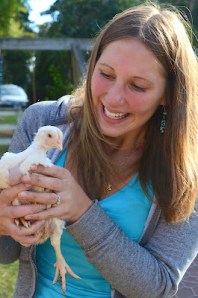
My friend’s great niece doesn’t come from professional farmers, but the gardening gene goes back at least to her Italian great grandfather. Now, having graduated from a liberal arts college and worked for various park services, she is — like a surprising number of young people today — going into farming.

At a farm blog, she describes raising organic chickens in Connecticut.

“Hi! Nichki and Laz from The Wooly Pig here, taking over the Barberry Hill Farm blog for an entry!

“We are young aspiring CT farmers who were lucky enough to meet Kelly and Kingsley last March and over the past several months they have become our good friends and farming mentors. This fall, the Goddards have been so kind as to lend us their pasture and their expertise so that we can raise our very first batch of chickens for our community.

“Our birds are pasture raised, which means they are brought up outdoors with plenty of access to fresh vegetation, open air, and sunlight.

“They are fed a strictly organic diet — an added cost for us that we feel is a worthwhile investment in our customers’ health. …

“We can’t thank our customers enough for supporting local, sustainable agriculture. Your good decisions help build strong, healthy communities right here in Connecticut. …

“For more information on our chickens, please contact us by email at TheWoolyPig@gmail.com.”

Read the engaging Barberry Hill Farm blog here. And if you live near Madison, Connecticut, get your chickens from The Wooly Pig

Photograph from http://www.barberryhillfarm.com.

Read Full Post »

« Newer Posts - Older Posts »