Feeds:
Posts
Comments

Posts Tagged ‘global warming’

It’s interesting to me how artists who believe in a particular cause will use what they know best to advance that cause. Sometimes it takes art to get a wider audience to understand an issue.

At the Greenpeace blog, Elvira Jiménez and Erlend Tellnes wrote in early June about how pianist and composer Ludovico Einaudi is raising awareness of global warming.

“The Greenpeace ship Arctic Sunrise set off from the Netherlands carrying a very special load: the voices of eight million people. Messages from around the globe calling for governments to save the Arctic from threats such as oil drilling and destructive fishing. …

“As the ship stopped in Svalbard, Norway, Europe’s gateway to the Arctic, it welcomed aboard a very special guest: renowned pianist and composer, Ludovico Einaudi. With him a grand piano, to undertake his most challenging performance yet, in the Arctic surrounded by ice. …

“As he performed this piece for the first time — in front of a magnificent surging glacier — the music echoed across the ice, a moment that will remain in our minds forever.” More here.

If one picture is worth a thousand words, maybe this one had an effect: a couple weeks later an international conference voted for protection of the Arctic.

Pilar Marcos followed up at the Greenpeace blog on June 30: “At a meeting held in Ostend, Belgium, last week, the OSPAR Convention agreed to adopt specific measures to protect its Arctic region, including a commitment to secure a marine protected area (MPA) in 2016.

“This means an unprecedented agreement on Arctic protection, which could result in safeguarding the first piece of a future sanctuary in the High Arctic in just a few months’ time. [It’s an] area equivalent in size to half of the surface of Spain, [where] no oil drilling or large industrial fishing will take place, and where the protection of threatened habitats and species will be the priority.”

Photo: Greenpeace
Acclaimed Italian composer and pianist Ludovico Einaudi performs “Elegy for the Arctic” on a floating platform in the Arctic Ocean, the world’s most vulnerable ocean.

Read Full Post »

A Dutch diplomat started following me on twitter. He’s a Yale World Fellow, so how bad could it be? (Better than, say, Contagious Disease Fellow.)

@Alex_Verbeek is focused on environmental issues, and today he tweeted about the Stockholm Environment Institute, “ is ranked second best think tank worldwide.”

Because of my Swedish relatives, I naturally felt curious about SEI and looked it up. The website doesn’t say which think tank is first — or at least not prominently — but it does say that the US office is in Somerville, Mass., of all things. You learn something every day. I did know that the great environmental radio show Living on Earth is in Somerville, but the city is still a bit under the shadow of its industrial past.

From SEI’s website: “SEI’s vision is a sustainable future for all. Our mission is ‘to support decision-making and induce change towards sustainable development around the world by providing integrative knowledge that bridges science and policy in the field of environment and development’.

“To deliver on our mission, we work across issues like climate change, energy systems, water resources, air quality, land-use, sanitation, food security, and trade, and we approach these issues from a range of perspectives from the natural and social sciences.

“We combine scientific research with policy analysis, connecting our work to decision-makers and civil society in global governance, national public policy, regional cooperation, local planning, and the private sector. We generate and share knowledge that catalyses action, and always take a highly collaborative approach: stakeholder involvement is at the heart of our efforts to build capacity, strengthen institutions, and equip partners for the long term.

“Making scientific knowledge accessible is a priority. We publish our own series of open-access reports and briefs, alongside articles in leading academic journals, and work creatively through a range of media to ensure that our research is available to those that need it. We convene seminars and conferences that bring together decision-makers, academics, and practitioners to debate key issues and share knowledge, and engage in and inform policy processes, development action, and business practice worldwide.”

Whew! Wonky! Wish I could introduce SEI to Somerville neighbor Steve Curwood of Living on Earth. He’s pretty good at using everyday language for listeners.

I hope to learn more about the Stockholm Environment Institute, in any case, and am delighted its US office is so close to home.

Photo: Stockholm Environment Institute
One environmental concern SEI is studying is disaster risk in the Asia-Pacific region.

Read Full Post »

Last month, Steve Curwood of the radio show Living on Earth covered a special conference on climate change.

“Curwood: A coalition of 80 leading Islamic clerics, scholars and officials meeting in Istanbul has issued a declaration on climate change, ‘calling on all nations and peoples to phase out greenhouse gas emissions as soon as possible.’ …

“Islamic nations, including wealthy oil-producing states, are taking action on global warming, says Wael Hmaidan. He’s director of Climate Action Network International, one of the conference organizers and joins us now from Istanbul. …

“Hmaidan: I was really happily surprised by how rigorous the Koran and the Islamic teachings on the environment and the care for the planet. It’s a core function of Islam to care for the planet. It’s a responsibility. … It talks about the delicate balance that all the creatures have on Earth and it’s the responsibility of humans to protect this balance.

“It also talks actually about how humankind should not think that they are more important than other creatures. It talks about the role of all creatures and the need of respect, this diversity in the planet. So all of these kinds of proverbs from the Koran and the Islamic teachings, as well as stories about Prophet Mohammed’s life and his care for the environment clearly [makes] environmental care and climate change key issue for an Islamic teaching. And hearing strong statements saying that it is forbidden not to phase out greenhouse gas emissions coming from Islamic scholars is something very inspiring, even for climate activists. …

“There’s an agreement to establish an informal group … that will follow up on all the ideas that came out from the conference. And the ideas are varied, some of them are high-level, like I mentioned going to the UN agencies, to governments, but also the representatives of the organizations that attended want to create action plans in their communities of influence, to bring the declaration. … We need to transform all mosques to renewable energy, and so on. So a lot of ideas, and they’ve created this platform Muslims for Climate to continue the dialogue.”

More here.

Photo: Islamic Relief
Mohamed Ashmawey, CEO of Islamic Relief Worldwide and one of the Climate Change Symposium organizers addresses attendees.

Read Full Post »

At Moth Radio Hour, people who can tell stories well are recorded telling theirs before an audience, without notes or prompts. I was driving home one day when I heard a story by Jensi Sartin, who showed fishermen in Bali how to save their livelihoods by “banking” some fish.

A bit of background on Sartin comes from the Aspen Ideas blog: “Jensi Sartin is the director of the Reef Check Foundation Indonesia in Bali, where he devises community-based strategies to protect the coral reefs in Indonesia. [In] his story ‘The Fish Bank,’ [he talks] about how he tried to bring the fish back to Bali.

‘This is not just about 75 percent of the world’s coral reef going extinct, it’s not just about the fish that will just disappear. This is about people, because there are lots of people that depend on this coral reef. There are a lot of people that depend on the fish and this healthy coral to feed their family.’

“Sartin says that his experience growing up in the rainforests of Borneo – where deforestation was already under way – prepared him for his professional career as an advocate for the world’s oceans. ‘All of these things are connected,’says Sartin. … ‘Protected areas are not about managing resources, they are about managing people.’

“Sartin says community-based conservation forms a crucial part of sustainable development, especially in regions of the world that are environmentally stressed.” Here is the Aspen link.

If you missed my review of the climate-change movie Revolution, which shows how coral reefs are sending us a warning, check it out here.

And you can listen to Sartin’s inspiring storytelling at Moth.

Photo: Caroline Lacey
On the Moth Radio Hour, Jensi Sartin talks about creating a fish bank.

Read Full Post »

Suzanne’s Mom was asked to review Revolution, a film by the young environmentalist, biologist, diver, and Sharkwater filmmaker Rob Stewart.

Encompassing gorgeous deep-sea photography, scientific climate-change testimony, a representative of the drowning country of Seychelles, and many youth demonstrations, the documentary forces you to think about what the burning of fossil fuels is doing to the oceans and what it means for the future of the planet. It also gives you the sense that anyone can do something about it — take up a camera, make a poster, or write a letter that makes a change.

The film is infused with a sense of youth, of young people saying, “Enough!” I particularly loved the moment early on when Stewart, who had read only two books on filmmaking, is flubbing his lines in front of Darwin’s Arch. What comes across in addition to the humorous inexperience is a feeling of energy, optimism, and determination.

The film has many engaging details about sea life that Stewart can’t resist throwing in, like how the endangered pygmy seahorse, which camouflages itself to look like coral, “mates for life — and the guy gets pregnant!”

He talks about how the burning of fossil fuels creates too much carbon dioxide, which is absorbed by the ocean and is harmful to anything that needs to grow a skeleton, which is pretty much everything but nasty, poisonous creatures that flourish in the muck where corals died, like the flamboyant cuttlefish. Coral expert Charlie Veron comments that at the same rate of ocean acidification caused by too much CO2, there will be no coral reefs in 50 years.

Stewart also looks at the island nation Madagascar, sole home of lemurs, explaining that endangered tropical forests are responsible for 1/4 of the world’s species and 1/3 of our oxygen. Madagascar scientist Serge Rajaobelina says that population growth on the island and the burning of the trees for development has meant the loss of 80 percent of the forest in 40 years, more than in 55 million years.

The movie goes on to cover perhaps a few too many youth protests, including one in which an inspired, tree-planting young boy says, “We have found we have to save our own future,” and is later arrested in tears.

But then we get to see that children and young adults are actually having an impact.

A sixth-grade class in Saipan writes letters to the Saipan government against killing sharks for shark fin soup, and the government signs a law preventing the practice. In fact, we are told, since the first Stewart film, China, the main adherent of shark-fin soup, has dropped the practice by 70 percent, and 100 countries have banned it.

The upbeat Saipan children who comment on their successful advocacy embody the truth of my favorite Pete Seeger line, “one and one and 50 make a million.” Says one, “Maybe the world might not end because of what we are doing.”

Watch the Revolution trailer here.

[We do not accept gifts here, so the DVD that the film company sends me for screening and reviewing will be forwarded to Save the Bay, RI.]

The late Rob Stewart. The filmmaker did not come up from a dive 1/31/17 near Key Largo.
rob_stewart_memdf

Read Full Post »

Some African communities are rediscovering the value of mud for building cool, comfortable homes — and sparing trees.

This story is from the Thomson Reuters Foundation by way of the the Christian Science Monitor feature “Change Agent.”

“Building a house in the poorest villages of southern Mali has for years involved cutting trees for timber frames and struggling to save cash for a corrugated iron roof. Now families are turning to an alternative: Nubian-style domed mud-brick homes that are cheaper, protect fast-vanishing local forests, and make homes cooler in the worsening summer heat, experts say.

“Earthen homes with vaulted brick roofs – a style adopted from Nubia in northern Sudan – are being promoted across the Sahel, including in Burkina Faso, Senegal, and Mauritania, as part of efforts to build resilience to climate change.

” ‘Most people, more than half, don’t have the decent housing they dream of because it costs too much to build. This is going to change with the Nubian vault,’ predicted Chiaka Sidibe, a mason in Massako, one of the Malian communities adopting the new building style.

” ‘You just have to make mud bricks that don’t cost money, and fellow villagers help you to build your house,” he said. …

“The local office of the Association la Voûte Nubienne, the international non-governmental organization that is promoting the Nubian vault building style, has helped train local builders in mud-brick construction techniques. The aim is to build a sustainable, self-supporting market for the homes, said Moussa Diarra, the NGO’s local coordinator.

” ‘It can take much time to reach this goal, but I’m confident the initiative will succeed,’ he said.”

More here.

Photo: UN Climate Change Secretariat

Read Full Post »

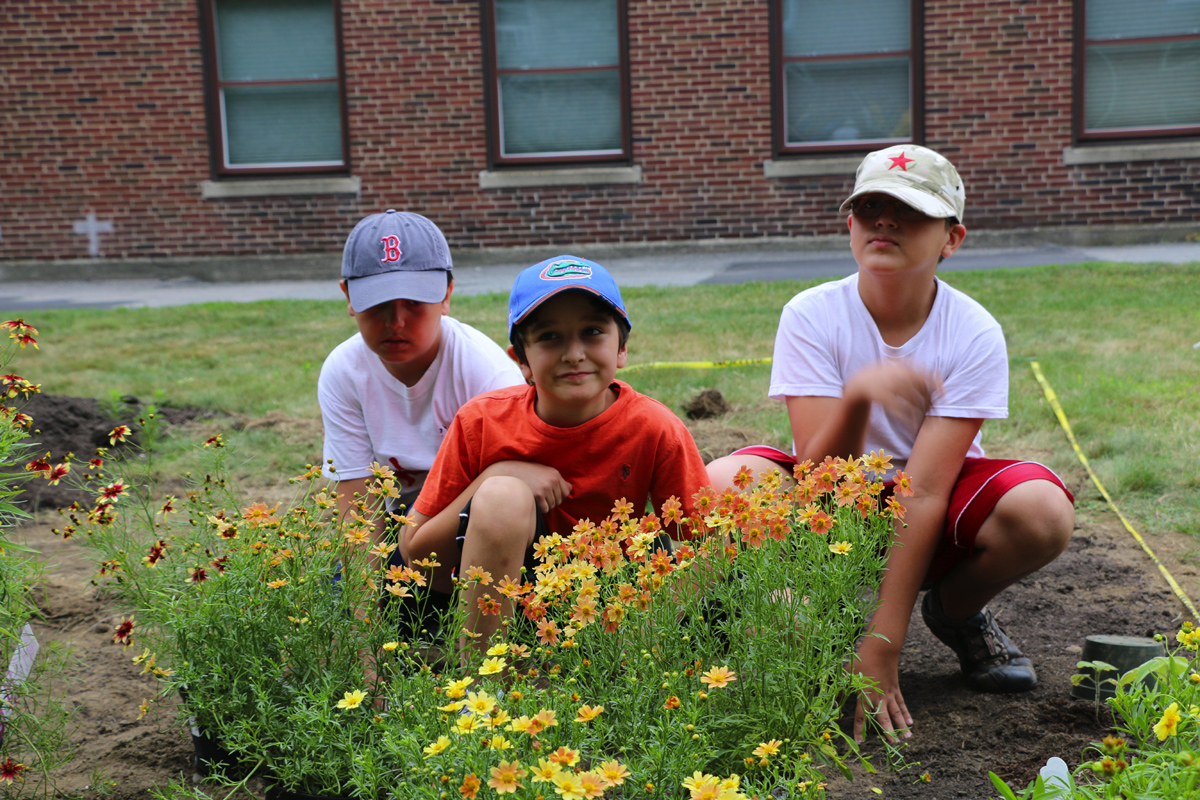
In June I wrote (here) about my friend Jean Devine’s latest venture, “Meadowscaping for Biodiversity.” Jean hoped to get middle-grade kids involved in creating a meadow where once there was lawn juiced with chemicals — and learning how meadows provide habitat for many small creatures. She conducted a pilot program over the summer with her collaborator Barbara Passero and an 8th grade science teacher, Steve Gordon.

Jean e-mails her friends and fans, “We’re delighted to announce that our 8-week summer pilot of “Meadowscaping for Biodiversity” in Waltham, MA, was a great success! The three of us, along with a strong soil turner and a landscape designer, worked with a few boy scouts (and their mothers) to repurpose a 400 square foot plot on the east lawn of Christ Church Episcopal (750 Main St. across from the Waltham Public Library) into a meadow filled with native plants.

“Why did we do this? To engage youth in fun, project-based, outdoor education, while providing native plants as habitat — especially food source — for bees, caterpillars, butterflies, birds, etc.

“The end result? An aesthetically pleasing product and proof that Meadowscaping for Biodiversity, a generative/environmental education program, pays a solution forward to the next generation by inspiring, engaging, and empowering students to be problem solvers and stewards of the Earth. All involved, including the vendors who supplied plants and garden materials, were able to see that this program helps heal the Earth and improve outdoor educational opportunities for youth ‘one meadow at a time.’ Now all we have to do is convince funders, teachers, city planners etc. of the benefits of this program!”

If you fit any of those categories or just want to learn more, contact information is here.

biodiversity-kids

Read Full Post »

My friend Jean Devine is always up to something interesting. A Brown U grad, with an MBA from Simmons, she used to work in investor relations but in recent years has been testing the waters of social entrepreneurship.

Her latest initiative, with Barbara Passero of Sandpiper Creative, is called meadowscaping and is intriguing on many levels.

With access to a Waltham church lawn for a summer youth program, Jean and Barbara will work with kids to convert the yard into a meadow that uses native species from Garden in the Woods and provides a habitat to the bugs and other small creatures that make a healthy environment.

From the Meadowscaping for Biodiversity website: Meadowscaping “is an outdoor, project-based, environmental education program that provides middle school youth with real-world experiences in STEAM learning (Science, Technology, Engineering, Arts and Math), while inspiring and empowering them to address challenges to the environment and our society.

“Today, few children spend time experiencing Nature and the benefits of outdoor recreation, education, and contemplation. Founder and former Director of the Children and Nature Network (C& NN) Richard Louv coined the phrase nature-deficit disorder to describe the negative effects of reduced outdoor time on children’s development. …

“Children who spend little time outdoors may value nature less than children who spend time outdoors in free play. Similarly, children who feel part of something bigger than themselves may … understand their dependence on a clean environment and know that they are responsible for caring for the Earth as their home.” More here.

The idea behind the meadowscaping summer program is that children, both at a young age and as they become adults, can actually do something about the environment.

Remember our post “The Doctor Is In” about the woman who sets up in a Providence park to listen to your worries about global warming (here)? Stop worrying and do something, say the meadowscape entrepreneurs. Give up lawn chemicals, plant a meadow, provide a home for tiny necessary critters, and work to make change.

white-iris-in-morning

Read Full Post »

At the radio show Living on Earth, Steve Curwood recently interviewed Gary Cook of Greenpeace about an effort to get tech companies to be greener.

CURWOOD: “Back in 2012, you criticized Apple for using carbon-intensive energy from coal plants to power its servers. …

COOK: “Just after we spoke, they made a commitment to be 100 percent renewably powered, and as the end of last year, they even made that goal. So, it’s been quite a big shift.

CURWOOD: “100 percent renewable energy. How’s that possible?

COOK: “It requires some effort. Apple has done a lot in North Carolina where they have their largest data center in terms of deploying two different solar farms and an onsite fuel cell that’s powered with biogas energy, so it’s all renewable. They have several other data centers. … In Oregon they’re using wind; in Nevada they’re using solar.

“So they’ve actually shown a commitment from the top, been very aggressive, probably the most aggressive of any of the brands to make sure as they grow, they’re using clean energy.

CURWOOD: “Biogas. Where are they getting that from?’

COOK:” Currently, they’re getting that from landfill and some other renewable sources. The landfill is methane capture in the southeast, and they’re having that piped to where their data center is in North Carolina.”

The radio interview covers several other efforts tech companies are making. It’s a good thing, too, when you consider, as Living on Earth points out, “If the Internet were a country, it would be the sixth largest consumer of electricity in the world.” More here.

Photo: George Nikitin, Greenpeace
The Greenpeace Airship A.E. Bates flies over Facebook headquarters with a banners reading “Building a Greener Internet” and “Who’s The Next To Go Green?” Apple, Facebook and Google have committed to powering their data centers with renewable energy.

Read Full Post »

What’s not to love about Rhode Island? OK, a few shady politicians, high unemployment, low graduation rates — I get it. But Rhode Islanders definitely overdo the “ain’t it awful” schtick.

Architectural Digest has just named Providence the best small city in America for a host of good reasons (thanks for that tip, Suzanne), and if you like “quirky,” Rhode Island has lots of that, too. No one would ever call a big state quirky. For some characteristics, small is better.

Speaking of quirky, this story was passed along by Kate C. It’s about a creative-writing instructor at Brown University who is worried enough about global warming to set up a booth in a public park to commiserate with others about the issue.

Philip Eil writes in the Providence Phoenix,  “It is a crisp Tuesday afternoon in May at Burnside Park in downtown Providence. …

“A few minutes after 2:30 pm, Kate Schapira arrives at the south entrance of the park, pulling a bright red metal hand truck. Over the next few minutes, she unpacks and arranges items from the truck: a small wooden desk; a wooden stool; a rainbow-colored beach umbrella with a white plastic stand; a box containing a stack of homemade cardboard “RI IS MY HOME” cards, each with its own labeled sketch of local flora and fauna (“Eastern Chipmunk/Tamias Striatus,” “House Sparrow/Passer Domesticus”); a glass jar labeled “DONATIONS OF 5¢ FOR ENVIRONMENTAL JUSTICE LEAGUE OF RI”; a pad of poster-sized paper with a hand drawn map of the state of Rhode Island under the words “PUT YOUR WORRIES ON THE MAP”; and two cardboard signs to be affixed to front of the table that read “CLIMATE ANXIETY COUNSELING 5¢” and “THE DOCTOR IS IN.” …

“Today is the first day of Schapira’s Climate Anxiety Counseling. Over the next four weeks, the 35-year-old poet and Brown University creative writing instructor will report to this spot, five days a week, for three hours per shift (two on Saturdays), to talk with passersby about the Earth’s changing climate.” More here.

If you have ever cherished time spent in accommodations overlooking one of Rhode Island’s magnificent beaches, you might like to stop in for a visit with the “doctor” and discuss what might be done to keep the lovely Ocean State from acquiring too much ocean.

Photo: Providence Phoenix

Read Full Post »

Some posts at Andrew Sullivan I only need to glance at briefly and bells go off: for example, this entry about an artist who works with coral.

Andrew quotes Amelia Urry writing about Courtney Mattison, who became enamored of coral while studying conservation biology at Brown University and moonlighting at the Rhode Island School of Design.

“Mattison’s newest piece, Our Changing Seas III,” says Urry at Grist, “depicts a hurricane-spiral of bleached corals coalescing to a bright center. You can read it as a message of hope or one of impending doom, depending on your disposition …

At the heart of Mattison’s artwork is her desire to inspire real-life changes in how people view and treat the world’s oceans and environments. Similar to the Our Changing Seas series, Courtney Mattison’s Hope Spots collection comprises 18 vignettes, each of which represents a vital marine ecosystem in its ideal form (that is, protected from various threats such as global warming or pollution).” Read more at Grist, here.

Art: Courtney Mattison
“Our Changing Seas III,” a ceramic coral reef

Read Full Post »

Photograph: Devesh Uba
Grocery store in Makoko, Lagos, Nigeria.

A recent manmade-island story in the Guardian made me think of Francesca Forrest’s lovely novel Pen Pal, which involves a girl in a floating community in the U.S. South who corresponds with a political prisoner in Asia.

The Guardian article, however, is about designers and architects building islands for populations threatened by rising seas.

Jessa Gamble writes, “It may seem like science fiction, but as rising sea levels threaten low-lying nations around the world, neighbourhoods like [the Yan Ma Tei breakwater in Hong Kong’s Causeway Bay, where residents live in boats] may become more common.

“Whereas some coastal cities will double down on sea defences, others are beginning to explore a solution that welcomes approaching tides. What if our cities themselves were to take to the seas? …

“The immediate and most numerous victims of climate change are sure to be in the developing world. In Lagos, the sprawling slum of Makoko regularly suffers floods, and its stilted houses are shored up with each new inundation. It’s under threat of razing by authorities.

“The Nigerian-born architect Kunlé Adeyemi proposes a series of A-frame floating houses to replace the existing slum. As proof of concept, his team constructed a floating school for the community. Still, many buildings do not make a city: infrastructure remains a problem here. One solution would be to use docking stations with centralised services, rather like hooking up a caravan to power, water and drainage lines at a campground.” More.

It all sounds like Noah building an ark. But I can’t help thinking it would be better to end global warming in the first place.

Photograph: Seasteading Institute, by way of the Guardian
The Seasteading Institute proposes a series of floating villages.

Read Full Post »

No matter how much you like your routine or how pleasant your surroundings, sometimes you just have to get up and go out. Today I needed a change of scene so, in spite of the freezing temperatures and high wind, I went to look at some art.

The Design Museum is not far from my office, and the folks there come up with lots of good projects. I blogged here about their Street Seats, an array of public benches designed by creative people from around the world.

This being Design Week in Boston, I decided to check out the exhibit space they are using in a new apartment building called 315 on A, a lovely renovation of an 18th century warehouse for coffee.

The new exhibit is called Green Patriot Posters and features handsome posters from professionals as well as the pretty impressive results of a school poster contest on the conservation theme.

Many of the posters explicitly reference WW II posters. You know: “Loose lips sink ships” and all that. Here, the posters urge viewers to pursue a more sustainable way of life and fight global warming. More.

Be sure to check the poster over the left shoulder of the woman speaker in this video. That was my favorite in the show because it made me laugh out loud. I think you can see a Paul Bunyan figure with an ax. He is looking at the tree he was going to cut with an uncertain expression as the tree is growing out of his foot.


Read Full Post »

Cate McQuaid, my favorite Boston Globe art critic, who usually covers more esoteric subjects, explains some large artsy globes seen around Boston in recent days.

“Huge, colorful orbs line up in a row down the Tremont Street side of Boston Common. It looks like a giant might be marshaling his marbles. Get up close, and you’ll see that the spheres, each 5 feet in diameter, are globes, fancifully decorated and proffering solutions to climate change.

“ ‘Cool Globes: Hot Ideas for a Cooler Planet’ has landed in Boston. The public art project, for which artists designed globes with green strategies to contend with environmental issues, originated in Chicago in 2007 and has traveled the world.”

Environmental activist Wendy Abrams, says McQuaid, is the initiative’s founder.

“Abrams cites two inspirations for the project, the wrecked cars that Mothers Against Drunk Driving pointedly deploy in their Crash Car Program, and the painted cow sculptures that showed up in the streets of Chicago in 1999 — a public art project that prompted Boston to follow suit with painted cod.”

Read about individual artists’ Cool Globe themes, the outreach to students, and more, here.

The first two photos below are near the Park Street subway station. The third is in front of the aquarium, and I am not sure if it is part of the traveling series.

cool-globes-boston

globes-for-a-coller-planet

globe-at-aquarium

Read Full Post »

At Public Radio International’s “The World,” David Leveille has a story on research at Ellesmere Island in northern Canada.  There, University of Alberta biologist Catherine La Farge is finding that some frozen plants are able to begin growing again after 400 years on ice.

“Cold as it may be during the winter,” writes Leveille, “it’s a part of the world where glaciers are melting and ice sheets are breaking up due to climate change.

“One glacier there is called the Tear Drop glacier. As it has melted, some interesting plant life was exposed.”

La Farge’s results, published in the Proceedings of the National Academy of Sciences “suggest that bryophytes, representing the earliest lineages of land plants, may be far more resilient than previously thought, and likely contribute to the establishment, colonization, and maintenance of polar ecosystems.” Who knows what else is under the glacier and about to be thawed out.

More.

Photo: Catherine La Farge
In vitro culture of Aulacomnium turgidum regenerated from emergent Little Ice Age plants beneath the Tear Drop Glacier, Sverdrup Pass, Ellesmere Island, Nunavut.


Read Full Post »

« Newer Posts - Older Posts »