Feeds:
Posts
Comments

Posts Tagged ‘harlem’

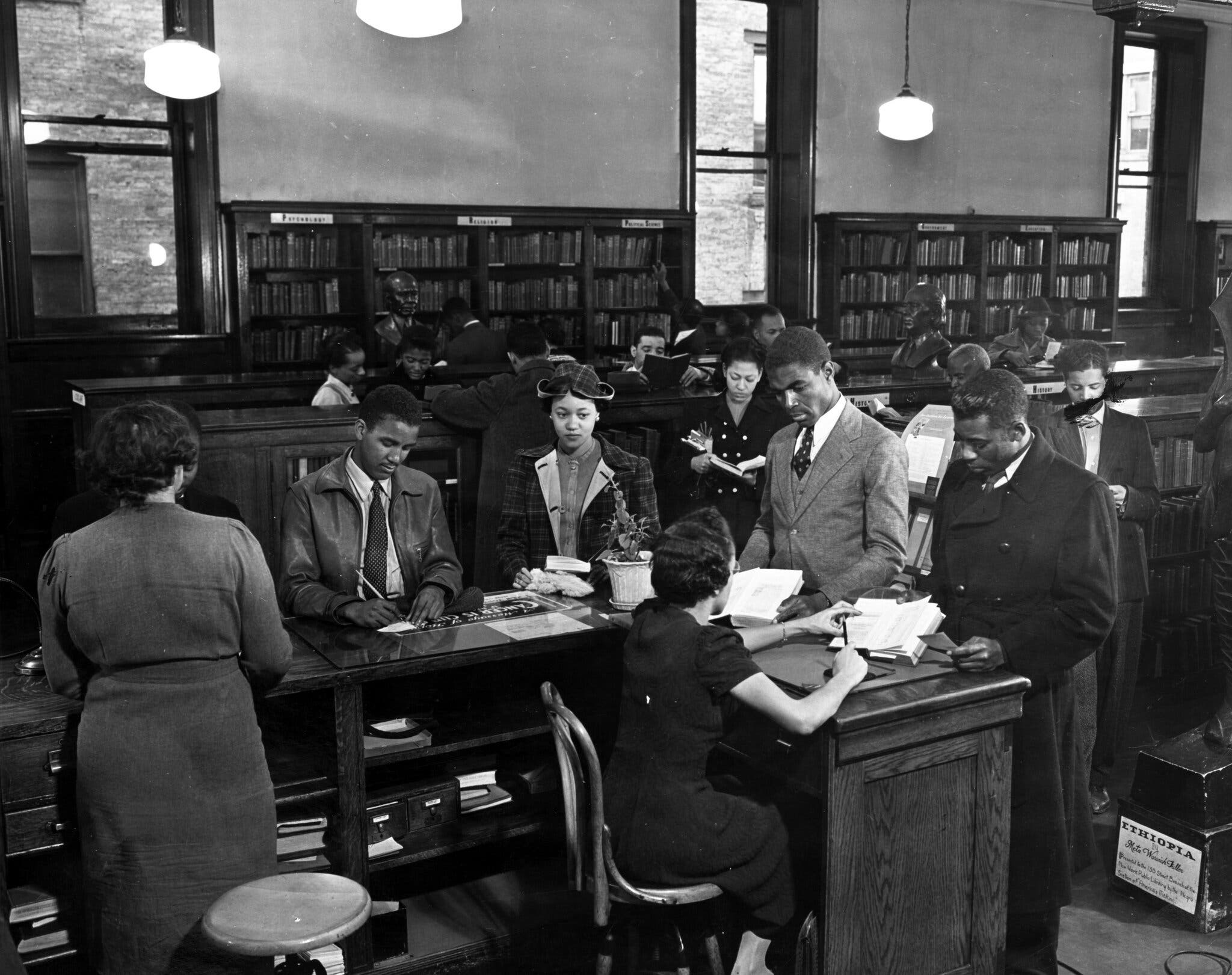
Photo: New York Public Library.
In 1925, the New York Public Library system established the first public collection dedicated to Black materials at its 135th Street branch in Harlem, now known as the Schomburg Center for Research in Black Culture.

I have read numerous accounts of what a public library has meant to poor children with insatiable curiosity. The most recent was the autobiography Up Home by future intellectual and university president Ruth J. Simmons. She grew up in a desperately poor Black sharecropper’s family in Texas. Books and encouragement from Black teachers meant everything.

Meanwhile in Harlem, Black librarians meant everything to generations of Northern children.

Jennifer Schuessler reports at the New York Times, “It was a banner day in the history of American libraries — and in Black history. On May 25, 1926, the New York Public Library announced that it had acquired the celebrated Afro-Latino bibliophile Arturo Schomburg’s collection of more than 4,000 books, manuscripts and other artifacts.

“A year earlier, the library had established the first public collection dedicated to Black materials, at its 135th Street branch in Harlem. Now, the branch would be home to a trove of rare items, from some of the earliest books by and about Black people to then-new works of the brewing Harlem Renaissance.

“Schomburg was the most famous of the Black bibliophiles who, starting in the late 19th century, had amassed impressive ‘parlor libraries’ in their homes. Such libraries became important gathering places for Black writers and thinkers at a time when newly created public libraries — which exploded in number in the decades after 1870 — were uninterested in Black materials, and often unwelcoming to Black patrons.

“Schomburg summed up his credo in a famous 1925 essay, writing, ‘The American Negro must remake his past in order to make his future.’ In a 1913 letter, he had put it less decorously: The items in his library were ‘powder with which to fight our enemies. …

“Today, figures like Schomburg and the historian and activist W.E.B. Du Bois (another collector and compiler of Black books) are hailed as the founders of the 20th-century Black intellectual tradition. But increasingly, scholars are also uncovering the important role of the women who often ran the libraries, where they built collections and — just as important — communities of readers.

“ ‘Mr. Schomburg’s collection is really the seed,’ said Joy Bivins, the current director of the Schomburg Center for Research in Black Culture, as the 135th Street library, currently home to more than 11 million items, is now known. ‘But in many ways, it is these women who were the institution builders.’

“Many were among the first Black women to attend library school, where they learned the tools and the systems of the rapidly professionalizing field.

On the job, they learned these tools weren’t always suited to Black books and ideas, so they invented their own.

“At times, they battled overt and covert censorship. … But whether they worked in world-famous research collections or modest public branch libraries, these pioneers saw their role as not just about tending old books but also about making room for new people and new ideas.

“ ‘These librarians were very tuned in and understood that a cultural movement also needs a space,’ said Laura E. Helton, a historian at the University of Delaware and author of the recent book Scattered and Fugitive Things: How Black Collectors Created Archives and Remade History. …

“In the 1920 census, only 69 of the 15,297 Americans who listed their profession as librarian were Black. Many cities in the segregated South had no library services at all for Black citizens. And even in the North, those branches that did serve them often had few books geared to their interests, and sometimes no card catalogs or reference collections at all.

“That started to change, if slowly. In 1924, in Chicago, Vivian Harsh became the first Black librarian to lead a public library branch there. [But] no place captures the transformations of the era more than Harlem, where, starting in 1920, a white librarian named Ernestine Rose hired four young Black librarians at the 135th Street library. …

“The poet Arna Bontemps (who himself later became a librarian) recalled visiting the 135th Street library after his arrival in Harlem in 1924. ‘There were a couple of very nice-looking girls sitting at the desk, colored girls,’ he said. ‘I had never seen that before.’ …

“Other ‘girls’ at the branch fostered the neighborhood’s artistic ferment in different ways. Among them was Regina Andrews, a young librarian from Chicago (where she was mentored by Harsh) who came to New York City on vacation in 1922 and decided to stay. She … soon settled into an apartment at 580 St. Nicholas Avenue with two friends who worked at Opportunity, a new magazine that aimed to capture the creative ferment bubbling up in Harlem. Nicknamed Dream Haven, the apartment quickly became a salon and crash pad for some of the most celebrated figures of the period.

“It was there that Alain Locke held some planning meetings for the special issue of the Survey Graphic magazine that later grew into his landmark 1925 anthology The New Negro. And it was there that many Black artists and writers who attended the 1924 Civic Club dinner now recognized as an opening bell of the Harlem Renaissance gathered.”

Read more at the Times, here.

Read Full Post »

Photos: Suzanne and John’s Mom.

I love walking around dirty old New York, even in cold and rainy weather. Today’s photos are from last weekend, when I took the train down for a wedding.

It’s the small things one notices. The saxophone player under the pedestrian bridge in Central Park, where the sound amplifies like an orchestra. He was playing “Beauty and the Beast,” with his sax case open for tips, a stick placed inside to keep any bills from blowing away.

A nicely dressed woman on a city bus scrolling her phone and wearing a rubber Halloween monster mask — blue and green rubber with a gaping hole at the nose and beaver teeth hanging down.

Then there were two people from my childhood that I ran into on the same morning in the Upper West Side. Not people I even knew from the Upper West Side but from Fire Island. The one I met in an elevator was a close childhood friend. The one I met in a diner was someone I knew from the Ocean Beach teenage musicals I directed. So there we were in a diner on Broadway singing one of those old teenage show tunes.

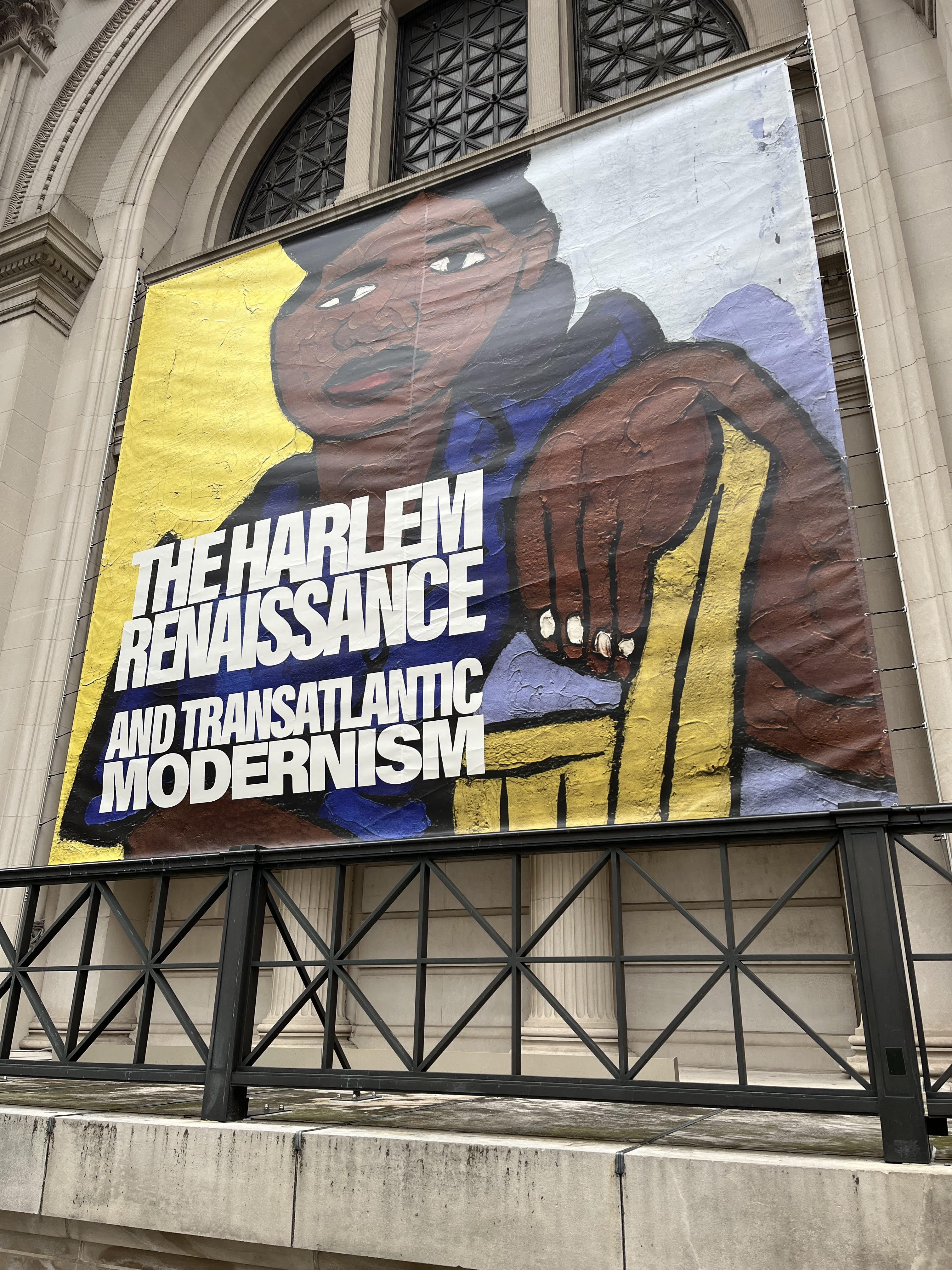
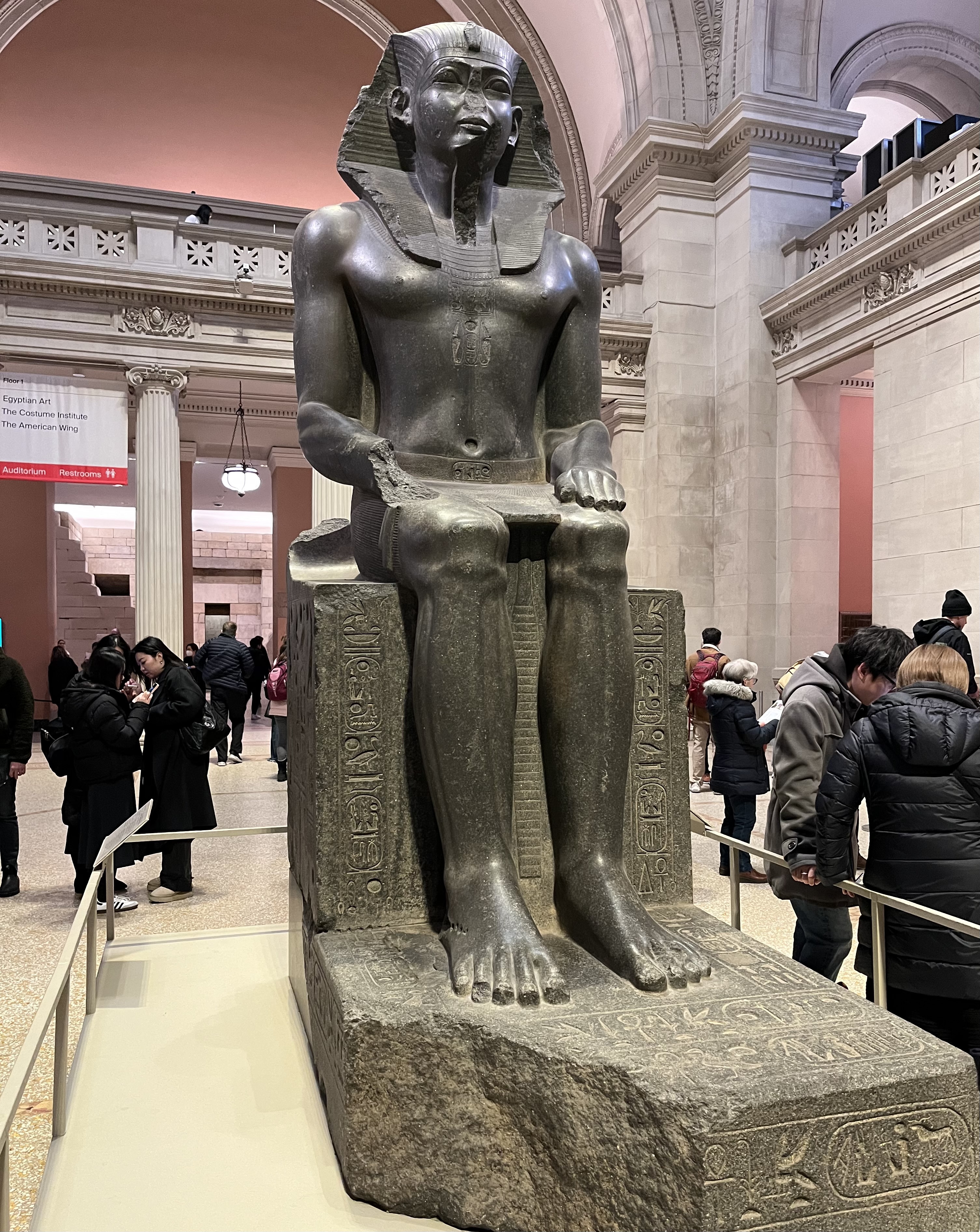
I got myself lost in Central Park on my way to the Met Museum to see the Harlem Renaissance exhibit. Like all New York, it was way too crowded, too many long lines. You spend 20 minutes waiting to buy a ticket, and then, if you want to unload your coat and backpack, you can wait in a ten-minute line to check them in and another long line to pick them up. I decided I could carry mine.

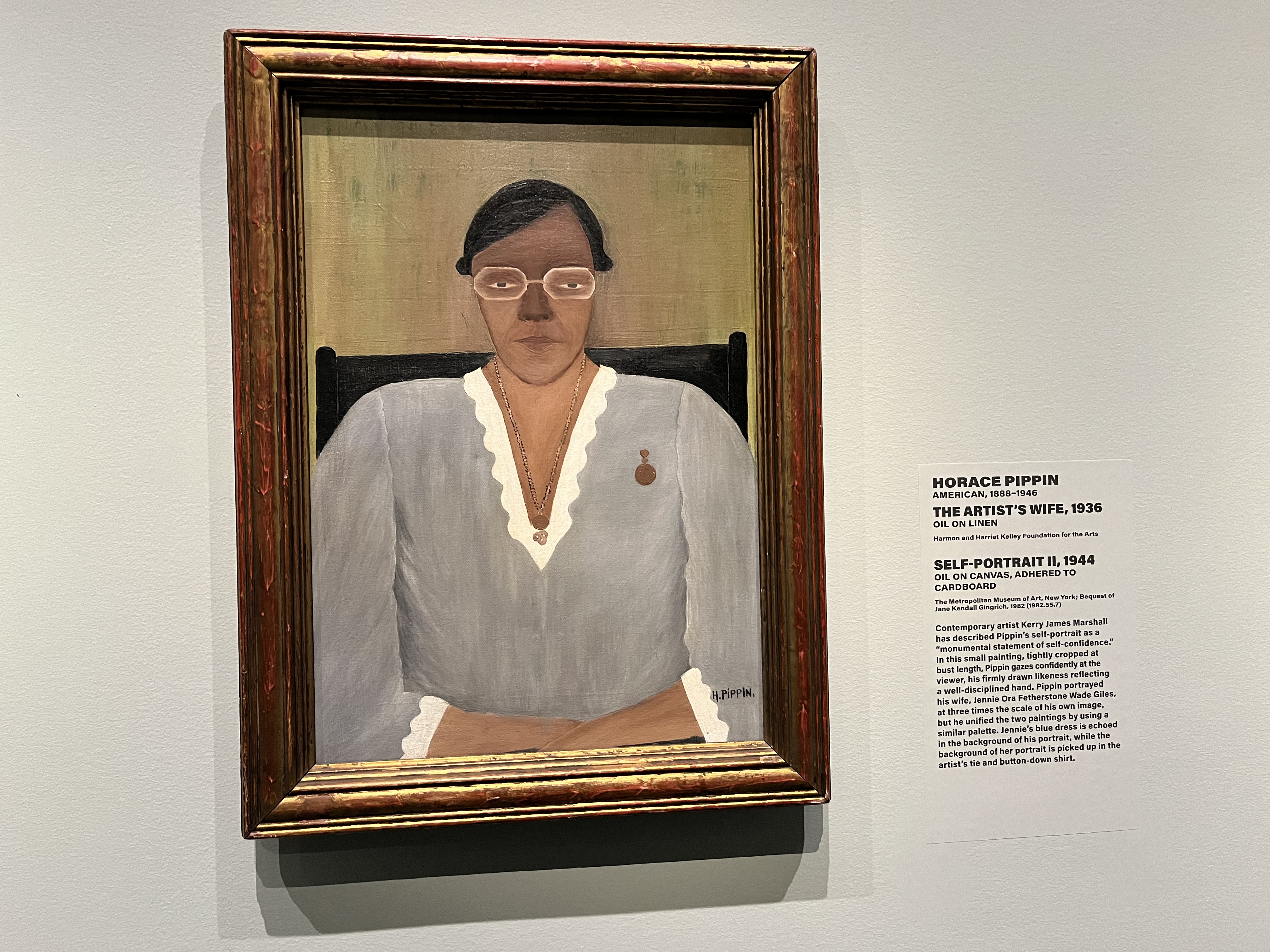
I photographed the Horace Pippin painting for my artist friend Meredith, a Pippin fan. There were many works by Aaron Douglas, but it was too crowded for much picture taking. Here’s a representative sample of Douglas’s art from the Rhode Island School of Design Museum.

The Met exhibit was huge, with portraits of luminaries like Langston Hughes, Zora Neale Hurston, James Weldon Johnson, and Marian Anderson, and scenes of Black life in the 1920s and ’30s rendered in many styles and media. Some artists, like photographer Carl Van Vechten, were not technically part of the Harlem Renaissance, but close observers.

Moving on to other New York sights.

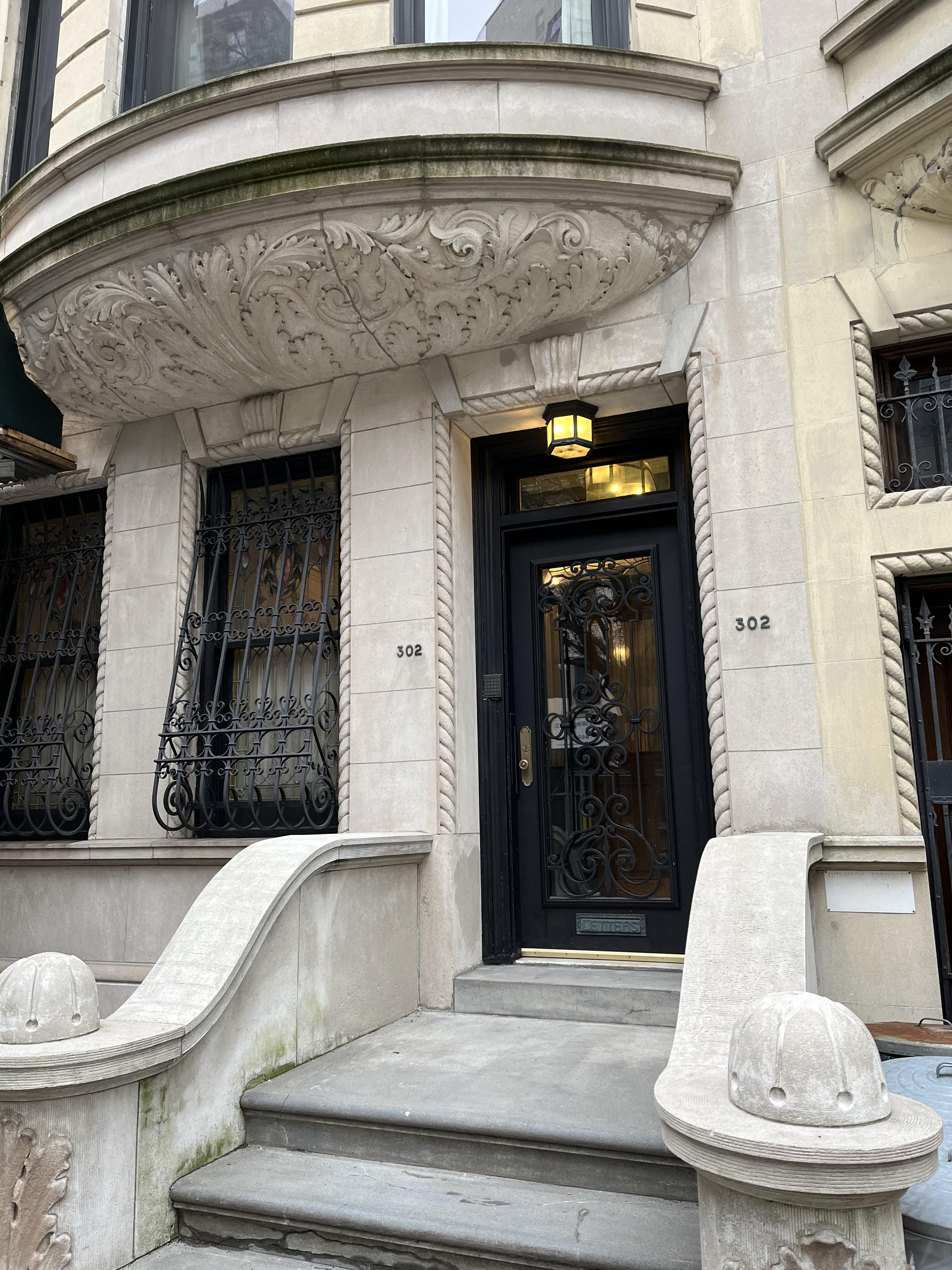
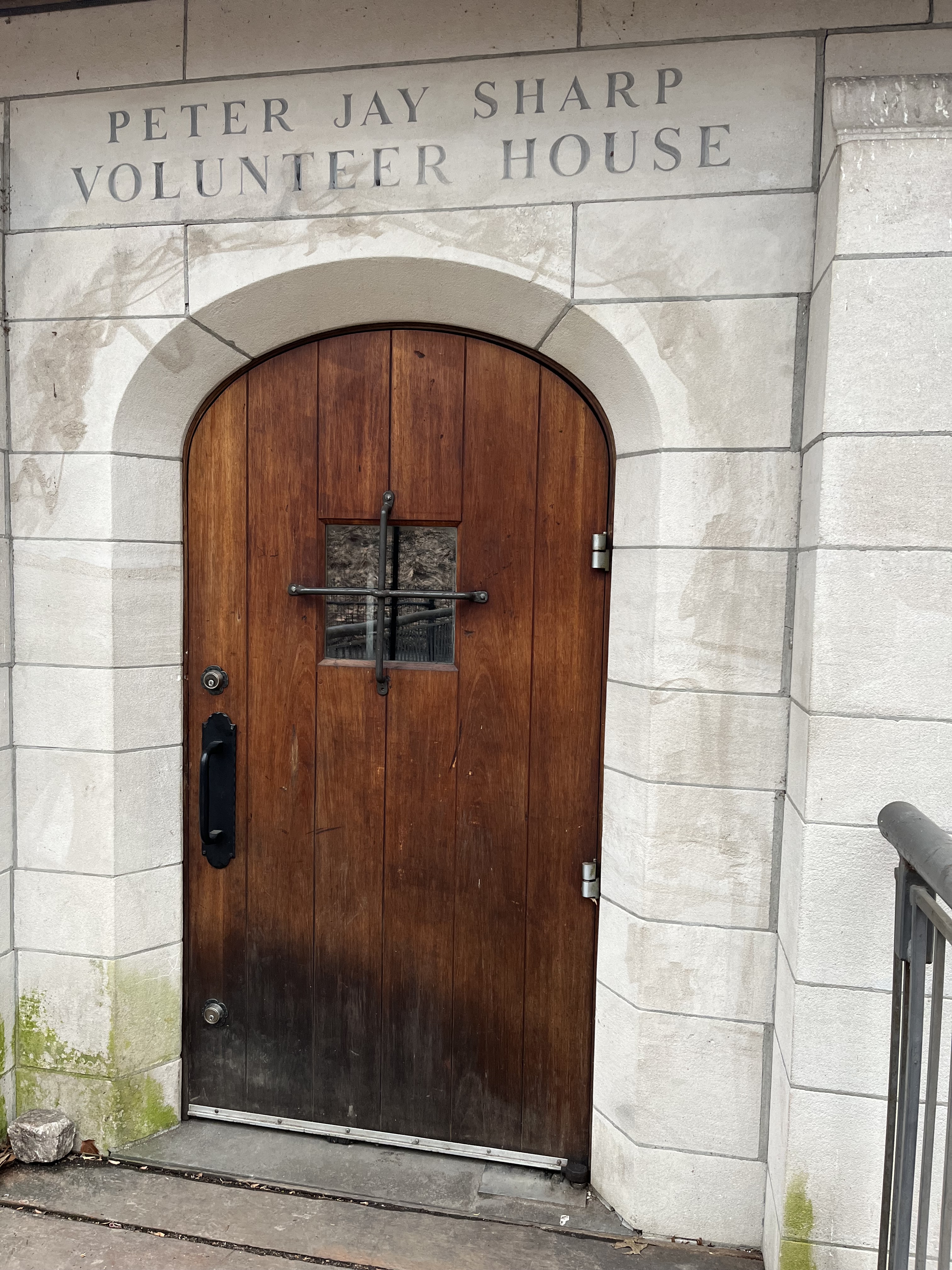
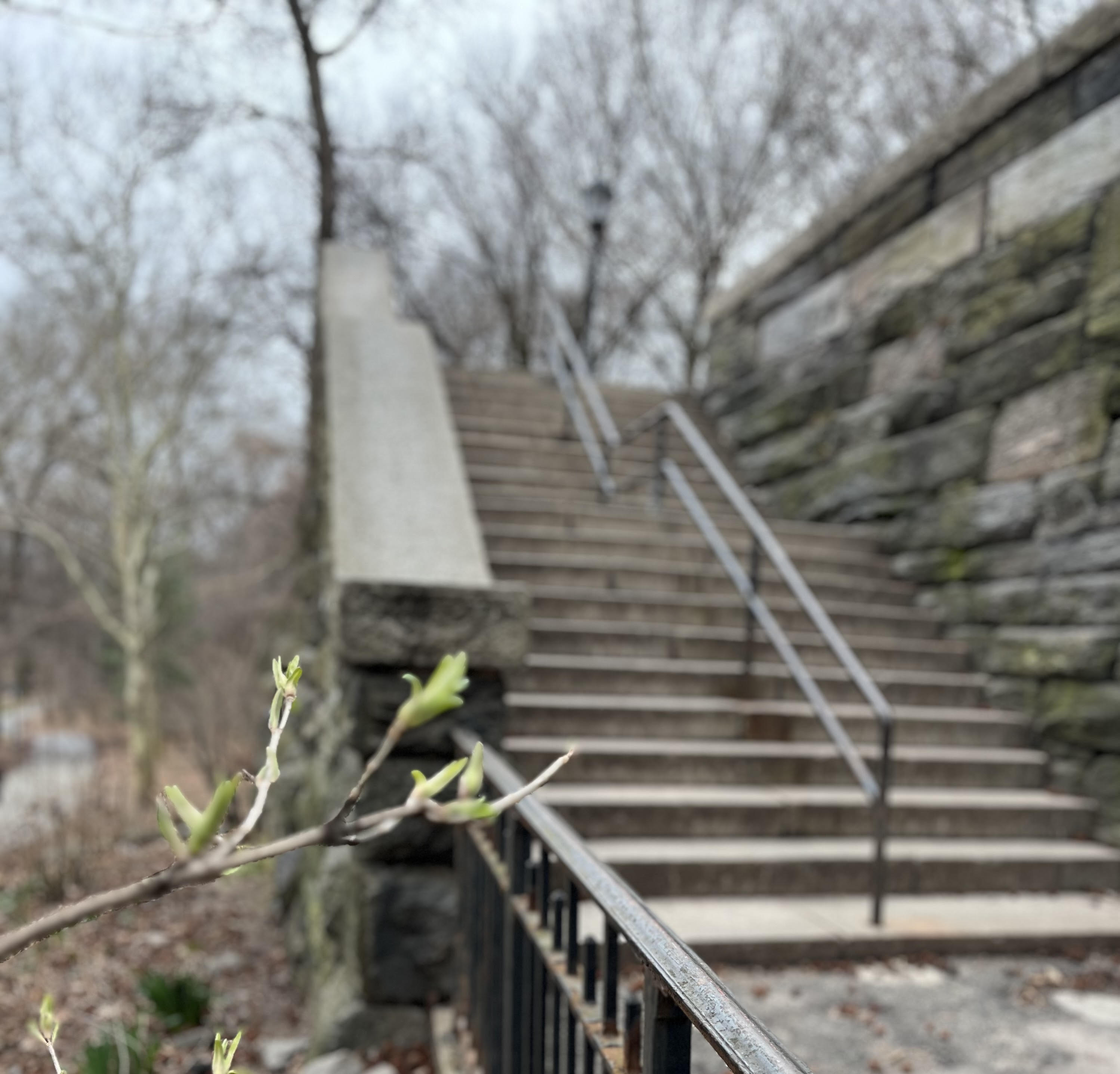
I often envy blogger Sheree, at View from the Back, who can post the most wonderful door photos. Of course, she lives in Europe. I have to go to New York to get anything comparable. Here are two interesting doors, the second in Riverside Park, where signs of spring were defying the miserable weather.

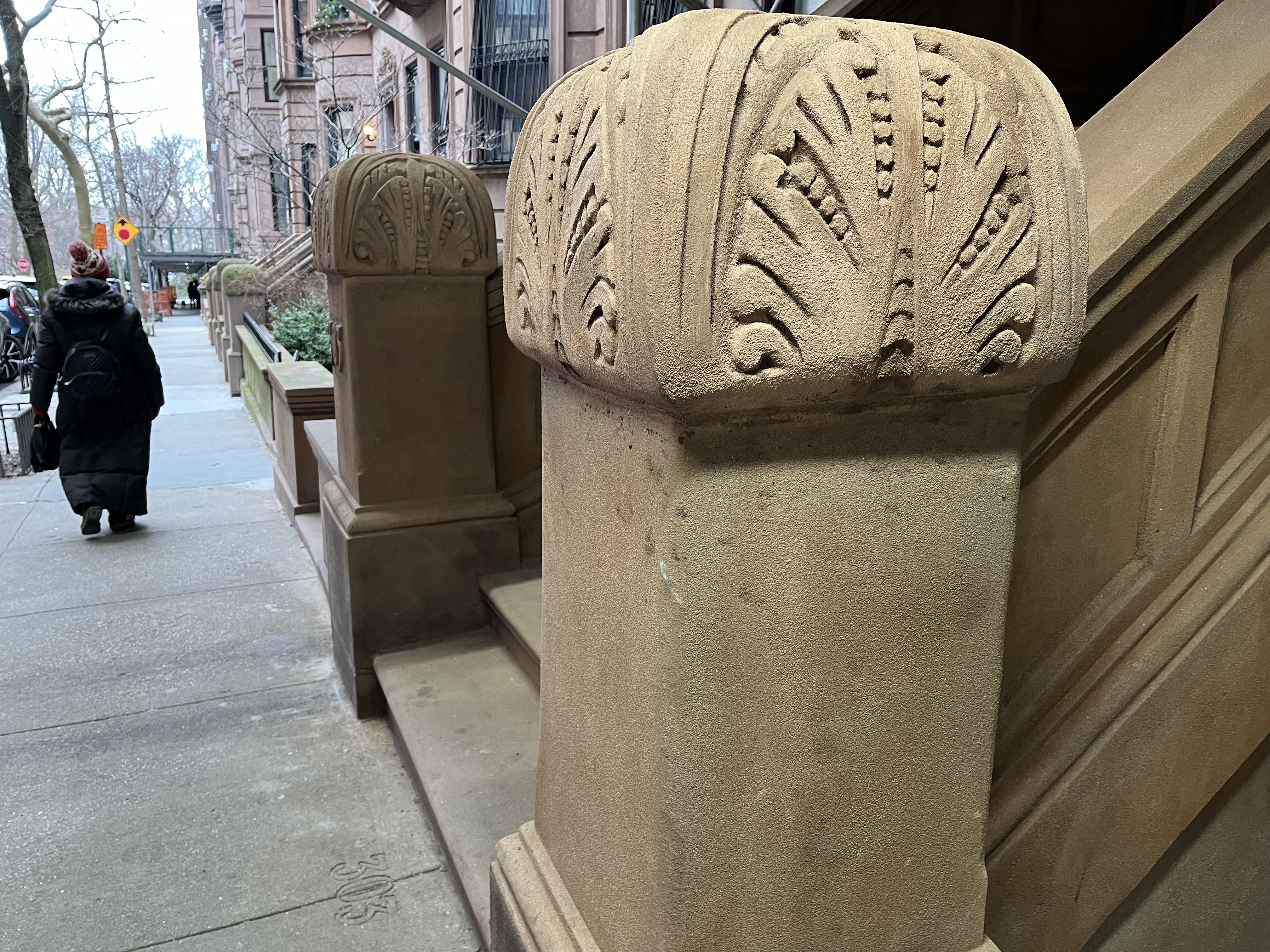
I love that new homeowners in New York often clean up the lovely, old architectural details. Notice the carved staircase, all sandblasted and spiffy.

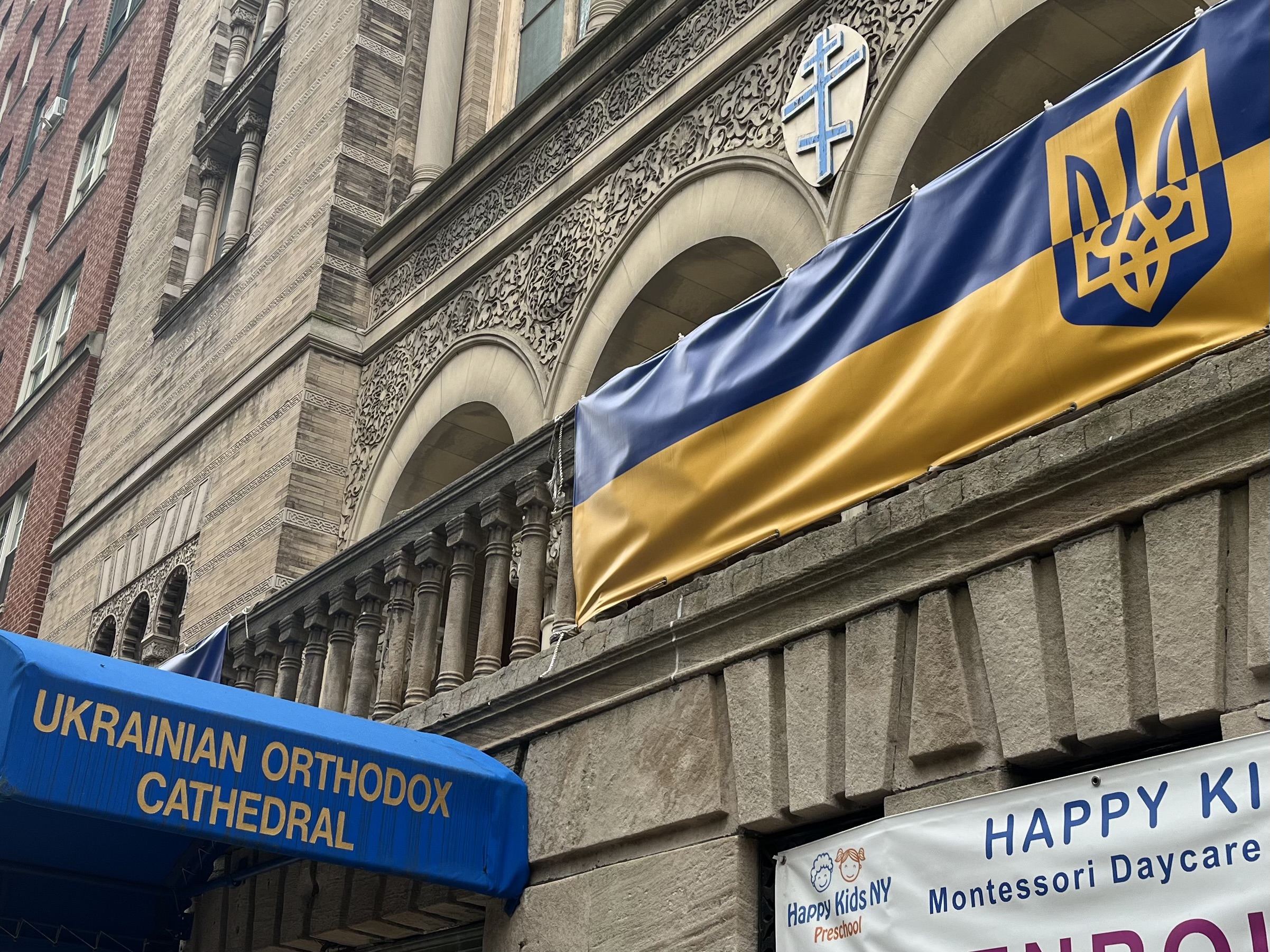
Finally, here’s a shot for my Ukrainian friends. Thinking of you. Always.

Read Full Post »

Photo: Harlem Honeys and Bears.
Formed in 1979, the Harlem Honeys and Bears Swim team teaches seniors ages 64 and over, how to survive in the water, as a therapy for chronic illness, and to promote health and wellness in general.  

Reading today’s story about water ballet in Harlem, I am remembering how much I enjoyed the synchronized swimming class I took a long time ago. I still find the move called skulling useful in the water.

Laure Andrillon reports at the Washington Post about a senior group in Harlem that uses the practice for both socialization and health.

“Monica Hale recently turned 69,” writes Andrillon, “but she says she still feels like a youngster every time she dives, swims upside-down or practices the ‘barrel,’ a sophisticated move she usually attempts with a trusted synchronized swimming partner.

“Hale, who is Black, became fascinated with synchronized swimming as a child while watching the champion swimmer and movie star Esther Williams, a White woman, perform in water musicals on television. ‘She would do these fabulous turns and come up at the surface like a flower,’ Hale recalls. ‘I remember thinking, I want to do this one day. But you never saw Black people doing this. You never saw Black people very much in the water at all.’

Today, Hale is the proud captain of the Harlem Honeys and Bears, a synchronized swimming team for seniors 55 and older, whose current members are between 62 and 101 and almost exclusively Black.

“Like Williams, the Honeys and Bears create and perform what used to be called ‘water ballet’ — synchronized choreographed routines accompanied by music — in addition to competing in traditional swim races. But instead of Hollywood, Harlem is their home, and part of their mission is teaching younger Black swimmers. …

“It is a survival skill still deeply lacking in the African American community. … At their biweekly practices, Hale spends most of her time in the shallow end of the pool, teaching basic skills to recruits, some of whom don’t know how to swim when they join the team. She holds their hands while they submerge their faces in the water and cradles them while they learn to float on their backs. …

“The Honeys and Bears also hold monthly meetings to share ideas about how to spread the message that swimming can be learned by anyone, at any age. They find purpose in trying to bridge the racial gap that makes Black people of their generation less likely to swim than White seniors.

“Team members say synchronized swimming takes care of the body and the mind, and being part of a close-knit team is a way to work out and socialize at the same time. Their impressions are borne out by research, which finds that swimming offers a full-body workout that’s easy on injured or arthritic joints — a common problem for older people. It also de-stresses and burns calories, and it’s good for the heart.

“The Honeys and Bears perform at local pools, in other boroughs of New York and even out of state. Since the early 2000s, they have also traveled as a team to race individually during the state and national Senior Games, always sporting matching red sweatsuits. Some use a cane or a walker to access the pool deck, and sometimes employ a lift to slip into the water. But once they float in what they nickname their ‘fountain of youth,’ they feel more capable than when on land.

“The Honeys and Bears started gathering at the ‘bathhouse,’ an old name for what is now called the Hansborough Recreation Center, in 1979. … It was their way, they say, of reclaiming the swimming pool, a place where many team members did not feel welcome or comfortable for most of their lives.

“Some migrated to Harlem from states where interracial swimming was not allowed until the Civil Rights Act outlawed segregation in public spaces in 1964. Others grew up in New York, where pools were not officially segregated, but ‘a de facto racially segregated use was in place,’ historian Jeff Wiltse writes in Contested Waters: A Social History of Swimming Pools in America.

“ ‘When I was a little girl, my brother and I would go to the pool on colored days,’ explains Rasheedah Ali, 87, a member of the team who lived in Cincinnati before moving to Harlem in 1967. …

” ‘Of course, we need to remember our past,’ she says. ‘But we should also tell the story of whom we became — a bunch of joyful Black elders who thrive in the water.’

“Born and raised in Harlem, Gerterlyn Dozier, 89, remembers swimming in the late 1930s at what was then called Colonial Park on 146th Street, instead of the Thomas Jefferson pool on 111th Street, just a few blocks from her building. ‘If you had dark skin, it was too dangerous for you to wander’ near the closer pool, she says, because of hostile White neighbors. …

” ‘[Today] we make it a party,’ says Dozier with a burst of youthful laughter. ‘Hopefully, our kids will feel like they belong in this space and this sport. And by the time the next generation comes, the statistics will have changed.’ ”

More at the Post, here, and at Columbia Community Service, here.

Read Full Post »

Photo: Mark Lennihan.
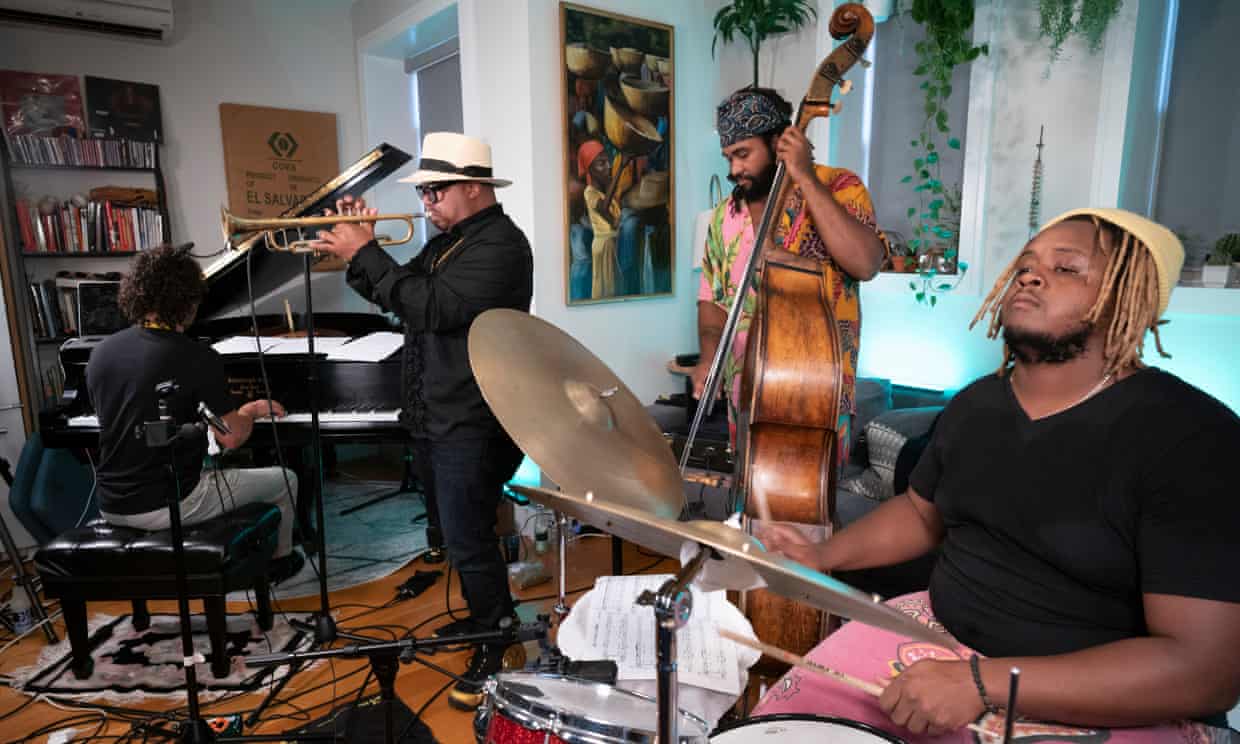
Emmet Cohen (left), Nicholas Payton, Russell Hall, and Kyle Pool livestreaming one of the weekly jazz concerts Cohen launched from his small apartment when the pandemic struck.

I was listening to Christian McBride hosting “Jazz Night in America” (streaming weekly at WICN, here), and he made me want to learn more about the young musician Emmet Cohen.

Allen Morrison wrote at about Cohen’s pandemic venture at the Guardian: “It’s the most exclusive jazz concert in New York. Only about eight guests can attend the weekly shows, by invitation only, squeezing into the 32-year-old jazz pianist Emmet Cohen’s fifth-floor walk-up in Harlem. Meanwhile, thousands more around the world tune into livestreams of the event on Facebook and YouTube.

“Live From Emmet’s Place started as a near-desperate response to the disappearance of gigs for musicians when the Covid-19 pandemic began. Ninety-four shows later, the weekly concert featuring Cohen, his trio with bassist Russell Hall and drummer Kyle Poole, and a roster of guest musicians who represent some of the jazz world’s leading lights, has evolved into the most highly watched regular online jazz show in the world.

“Talking on a recent Monday afternoon four hours before showtime, Cohen, a one-time child prodigy who has become one of his generation’s most highly regarded jazz pianists, was chilling in a T-shirt and shorts. At this hour, his one-bedroom apartment seems relatively spacious by New York standards. But that’s only until the technicians – a piano tuner, a sound engineer, a videographer – start arriving and setting up equipment. …

After two and a half years, [it’s] been transformed from a ragtag live shoot using only an iPhone into a hi-tech, multi-camera production with pristine sound.

“The superior production values would count for little if they were not in the service of a charismatic, often dazzling, trio of performers. Partly it’s Cohen’s energy, exceptional musicianship, and likable personality. Partly it’s the appeal of his inclusive brand of jazz, incorporating the entire tradition of the genre from the 1920s to the present day. And partly it’s the joy and esprit de corps with which the trio perform, evident in Cohen’s frequent ear-to-ear grin and the trio’s telepathy.

“At first, the current music scene in Harlem was the central focus of the show. ‘There’s such a high concentration of great musicians living here, right down the block,’ he said, citing regular guests like saxophonists Patrick Bartley and Tivon Pennicott and trumpeter Bruce Harris, all rising jazz stars on the New York scene.

“ ‘There’s a rich history of great jazz musicians living in this area: Billie Holiday lived on the corner, Mary Lou Williams up the street, Thelonious Monk would hang out here … all the stride piano greats would play Harlem rent parties. Duke Ellington and his whole band lived here, Sonny Rollins … So, it just felt very natural to host a Harlem rent party, but an updated, digital, virtual version, where we could invite people in to try to make the rent and get the musicians paid at a time when people were really struggling.’

“These days, Live From Emmet’s Place has an audience that averages about 1,000 fans each Monday night on Facebook and YouTube, but videos of most of the shows, as well as dozens of individual songs, have logged tens of thousands more views on YouTube. One video, featuring the sparkling French-born jazz singer Cyrille Aimee, has racked up 4.6m views.

“ ‘I wanted to figure out how to create an online community where we could play and make money. When you play at [the New York City jazz club] Smalls there are 80 people, if you sell out; at Birdland, 250. When we did the first concert from the apartment on March 22, 2020, after one week the livestream had 40,000 views. For a jazz group to reach that many people requires months, if not years, of touring.’ …

“In its pre-pandemic infancy, the webcast’s unlikely success could scarcely have been imagined. In February 2020, Cohen and the trio were flying high. … ‘Suddenly we had no gigs and no idea when we would play again.

“[The show] quickly became an international ‘communal gathering,’ Cohen said. ‘And community, in a time of hardship, turned out to be the most important thing.’ …

“ ‘When I’m on the road,’ Poole said, ‘people say to me, “I’m part of the Emmet’s Place community.” ‘ …

“ ‘The pandemic caused incredible destruction and dismay, but there was a silver lining,’ Cohen reflected. … ‘The fact that we’re a family, Kyle, Russell and me, showed the brotherhood and what it means to be a band in a time of crisis.’ ”

Live From Emmet’s Place can be viewed most Monday nights at approximately 7:30 PM ET on Facebook and YouTube. More at the Guardian, here. And at NPR, here, you can click on links to several of the musical numbers.

French speakers, Rejoice.

Read Full Post »

A new exhibit at the Whitney in New York City highlights the art of some outstanding black photographers, a group that worked not just in New York but around the world.

Nadja Sayej reports at the Guardian, “In 1973, a group of 14 New York photographers huddled into a photo studio on West 18th Street in Manhattan, posing in front of a Hasselblad camera for a group shot authored by Anthony Barboza, who stands smiling in the picture.

“ ‘I remember arranging the lighting and then my assistant took the photo,’ said Barboza to the Guardian. ‘It’s a photo of a family. That’s what it is. A family photo.’

“It shows the members of the Kamoinge Workshop, a collective of black photographers who formed in 1963 to document black culture in Harlem, and beyond, from live jazz concerts to portraits of Malcolm X, Miles Davis and Grace Jones, as well as the civil rights movement and anti-war protests.

“A selection of over 100 photos by the group are on view in a survey at the Whitney Museum of American Art in New York called Working Together: The Photographers of the Kamoinge Workshop, which runs until 28 March. …

“The Kamoinge (pronounced kom-wean-yeh) collective all started in 1963, when a group of 14 black New York photographers came together to form a group, to trade skills and offer critiques to one another. They chose ‘Kamoinge,’ as it means ‘a group of people acting together’ in Kenya’s Gikuyu language. They worked to tell black stories by depicting black communities, from local neighbors to superstars, and saw their rise around the same time as the Black Arts Movement. Kamoinge photographer Adger Cowans, who is 84, always believed the group could show the truth of black lives, more so than an outsider. …

“ ‘When I wasn’t shooting commercial work in the studio, I was shooting out in the streets,’ … said Barboza. ‘We all learned from each other. They were my greatest mentors.’ …

” ‘I did a lot of portraits of black artists and musicians in my spare time,’ said Barboza who photographed Michael Jackson at 21, as well as James Baldwin and Gordon Parks. Nine of the 14 original artists are alive today, working and living in New York, including Beuford Smith, Ming Smith and Herb Randall. …

“As one of the group’s members Ray Francis said in 1982: ‘We were a group that stars fell on,’ and credit observational photographers like Henri Cartier-Bresson, Gordon Parks and Dorothea Lange as influences. Another member, Ming Smith, calls it: ‘Making something out of nothing. I think that’s like jazz.’

“The Whitney exhibition is organized into five sections, including one community-focused section, which details the day to day life of people in the city, at work, play and travel. Another section is focused on music, as jazz has been a prime influence in the group. …

“There are also sections devoted to abstraction and surrealism, civil rights, depicting figures in the movement, and one global section, focusing on African diasporic communities, as the photographers traveled to Cuba, Senegal and Jamaica to shoot, as well as the South. …

“Harlem-born photographer, Shawn Walker, one of the group’s founding members, is showing a photo depicting two dapper men in white suits and hats on Easter Sunday in Harlem, dated 1972. ‘I would go to the churches and after everyone came out of mass, I’d go to 125th Street to lurk at everyone hawking off all their new wares,’ he said. …

“ ‘I would hang out around Hotel Theresa, even now if you’re not doing anything and you hang out in that area, you’re bound to come home with some photos. Even if I’m coming home from shopping and I have an extra 30 minutes, I’ll grab a seat and watch people come by and start shooting.’

“It has been a tough year for Walker. ‘I caught the virus and lost a leg, but I’m alive,’ he says. …

“Ming Smith was the group’s first female member. She recently said in an interview: ‘Being a black woman photographer was like being nobody,’ explaining that: ‘It was just my camera and me. I worked to capture black culture, the richness, the love. That was my incentive. It wasn’t like I was going to make money from it, or fame – not even love, because there were no shows.’ …

“As Barboza says, the key to a good portrait is not necessarily technical savviness, but to convey emotion, a feeling. It isn’t about over-thinking anything. .. ‘There’s a quiet, spiritual feeling from the photographs,’ said Barboza. ‘It’s beauty. I call it “the eye dreaming.” ‘ ”

More at the Guardian, here.

Read Full Post »

Photo: Robert W Kelley/Time Life Pictures/Getty Images
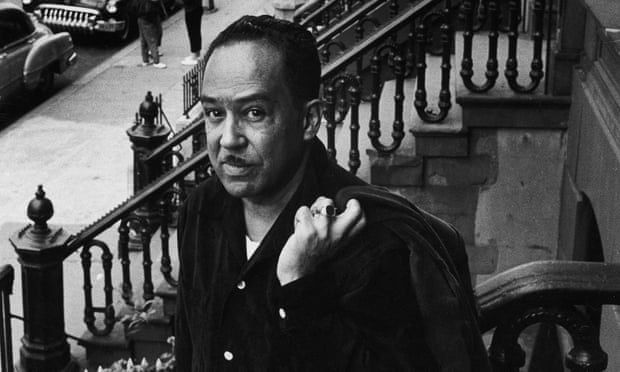
Langston Hughes on the front steps of his house in Harlem, June 1958.

Before Suzanne and Erik moved to Providence, they were living in a lovely renovated brownstone in Harlem.

There’s a fine line between newcomers investing where there’s been too much disinvestment — and gentrification. The early changes seem to benefit a neighborhood and its people, but inevitably rising property values push out many longtime residents and institutions.

Today, a group of Harlem artists from various disciplines are banding together to keep a significant piece of the Harlem Renaissance around to nourish African American arts.

Tom Kutsch writes at the Guardian, “All that signifies the legacy of a house once occupied by the poet laureate of Harlem is a small bronze plaque, partially covered by a cedar tree’s branches and the green ivy that envelops much of the building.

“The onetime home of Langston Hughes has sat largely unoccupied for years, but a new movement is trying to reclaim, for a next generation of artists, the space of a man who is forever intertwined with the Harlem Renaissance.

“Spearheaded by writer, performer and educator Renée Watson, the collective effort is busily trying to raise the necessary funds to purchase a lease and make needed renovations to the house. …

“Watson plans to make the Hughes house the home of the I Too, Arts Collective that she launched alongside the effort, which aims to, in her words, have ‘programming that nurtures, amplifies, and honors work by and about people of color and people from other marginalized communities.’ …

“The collective gets its name from one of Hughes’s most famous poems – I, Too – in which his narrator concludes by intoning:

They’ll see how beautiful I am
And be ashamed—
I, too, am America.

“Watson is using the crowdfunding website Indiegogo to solicit donations for the project, for which they’re hoping to raise at least $150,000 to cover a lease and begin the renovation process. By the time of publication, they had raised more than $54,000, already exceeding the $40,000 Watson says would cover at least a six-month lease. …

“For more than a century, Harlem has been inextricably linked to black life and culture in America; the birthplace of the aforementioned Harlem Renaissance, which fostered a wide array pre-eminent black artists and writers, from Zora Neale Hurston to Claude McKay and Duke Ellington. …

” ‘The erasure of black Harlem may come despite our best efforts …’ said Tracey Baptiste, a local children’s author who is involved with Watson’s collective. ‘But this project is about making sure that gentrification doesn’t also happen in the hearts and minds of our artists.’ ”

More here.

Read Full Post »

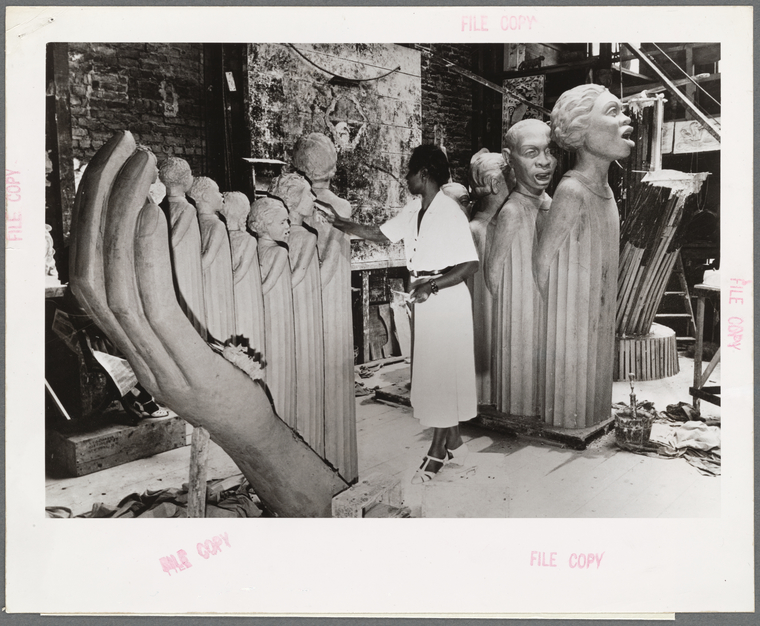
Candice Frederick, of the New York Public Library’s Schomburg Center for Research in Black Culture, recently posted research by Katherine Ellington on an African American artist who was new to me.

From Ellington notes: “Augusta Savage was among [a] group of artists who came to Harlem from the Jim Crown South in search of opportunity and where her creative expression could thrive.

“My quest for Augusta Savage (1892 –1962) sculpture led me to a first-time visit to the Art and Artifacts Division of the Schomburg Center for Research in Black Culture. … As a young girl in the early twentieth century, Savage began shaping ducks out of red clay found in the backyard of her home in Green Cove Springs, Florida. Savage’s work gained local attention when she entered and won a prize at a local county fair, which led to community support for further study.

“In 1921, she moved to Harlem after studying at State Normal College for Colored Students (now Florida A & M University). Savage later completed a four-year program in sculpture in three years at Cooper Union. …

“In 1931, Savage … opened the Savage Studio of Arts and Crafts — a fine arts training ground for over 1,500 students including many well-known Harlem Renaissance artists such as Charles Alston, Ernest Crichlow, Norman Lewis, Morgan Smith and Marvin Smith, Jacob Lawrence and Gwendolyn Knight Lawrence. …

“In 1934, Savage became the director of the newly established Harlem Community Art Center, after she was commissioned by the 1939 World’s Fair. Around that time she created “The Harp” as a series, but it was destroyed during the cleanup after the fair. …

“Savage’s art was often in response to the fight against racism. She used a variety of methods, shaping clay and plaster, casting bronze, and later years, carving marble and wood. In the Augusta Savage collection, there are works that illustrate themes such as nineteenth-century romanticism and African and Greek culture. As a trained portraitist, her busts include Marcus Garvey, W.E.B. Du Bois, James Weldon Johnson and Gwendolyn Bennett.”

More here.

Photo: The New York Public Library. Image ID: 1654255
“Harp,” by Augusta Savage

Read Full Post »

It’s not always easy for low-income people to get access to food that is healthful, and once children get accustomed to salty, fatty, sugary snacks, junk food becomes comfort food and stores see little demand for better items. But if children know what would taste good and be good for them, they are on the road to better nutrition.

That is why the folks fighting childhood obesity are enlisting the support of several hip-hop artists that young people admire.

Winnie Hu at the NY Times writes, “Adrian Harris, known as Easy A.D. to his fans, has rapped about street life in the South Bronx as a member of the Cold Crush Brothers, a group that is among the pioneers of hip-hop.

“Now Mr. Harris also raps about broccoli.

“ ‘If you think you eat healthy, say ‘”me,” ‘ Mr. Harris called out over a pounding bass that shook the gym at the Future Leaders Institute, a charter school in Harlem, on a recent morning. A photo of a cart laden with fruits and vegetables filled a screen behind him. ‘Boys and girls,’ he added, ‘there are no Doritos on that cart.’

“Mr. Harris, calling himself a ‘health M.C.,’ aims to reach children who might otherwise tune out nutrition lessons. His vegetable rap is part of a growing public health campaign that has enlisted hip-hop artists such as Doug E. Fresh, Chuck D and DMC of Run-DMC to work alongside doctors and nutritionists in fighting obesity and related illnesses in poor communities. The campaign is being rolled out this year in 18 cities.” More here.

Photo: Ozier Muhammad/The New York Times
Adrian Harris, also known as Easy A.D., made a pitch for healthy eating recently at the Future Leaders Institute in Harlem.
 

Read Full Post »

Another great one from the “Only a Game” show on WBUR radio.

Bill Littlefield describes a tournament between young lacrosse players in Harlem and middle schoolers from the Boston suburbs: “There are many stories that have built up over the years of kids being asked questions in Harlem as they carry the lacrosse stick on the subway, including, ‘What is that thing? A fishing pole? ’”

“Charles Gildehaus, a board member of an organization called Harlem Lacrosse and Leadership, is one of the people responsible for children in Harlem mystifying their friends on the subway.

“Gildehaus, who is also president of the youth lacrosse organization in Concord, Mass., where he and his family live, spoke with me on a recent Sunday afternoon on the lacrosse field at Lincoln-Sudbury Regional High School. There 6th, 7th, and 8th grade boys from Concord and some of Boston’s other western suburbs had formed teams with players from Harlem’s Frederick Douglass Academy.

“ ‘Concord’ may have mythical implications [to the Harlem kids] now, but according to Gildehaus’s wife, Pamela, a driving force in the event they call ‘The One Nation Tournament,’ at first the trip just seemed scary.

“’We picked the kids up,’ she remembered. ‘They arrived in Concord in the pitch black, and they got off the bus, and everyone was quiet and shy, and very fearful. And we put them in our car, and this one boy looked out the window at all the trees and said, “Oh, my gosh, are there wolves in these forests?” And then I pulled the car into the garage, and another one said, “You put the car right in the house?” ‘ ”

“During her first experience hosting the boys from New York, Pamela Gildehaus and her husband took in 12 lacrosse players. Ms. Gildehaus became concerned about the only one of the dozen who wasn’t active and loud.

“ ‘This one boy was sitting very quietly in a chair, reading a book. And I said, “Are you okay?” And he said, “I’m just in the middle of a really great book.” And my daughter, who was 11 at the time, said, “Oh, my gosh, I’m reading the same book.” ‘ ” More here.

I love how Littlefield seeks out these offbeat sports stories. He covers pro sports, too, and invites lots of expert commentators on, but for me the delights of his show are in stories like this one, the one about the K9 Fitness Club, and oddball “games” that only he would think qualify for a sports show. Every story has the perfect musical bridge, too, but Littlefield says it’s a guy on the WBUR staff who picks the music.

Try to catch the show. It’s hosted in Boston but picked up in other markets.

Photo: Bill Littlefield/Only A Game
The One Nation Tournament in Concord, Mass., brings middle school lacrosse players from New York and Boston’s suburbs together. 

Read Full Post »

Photo: Free Arts NYC

Free Arts NYC is one of several free arts programs around the country supported by people who believe every child should have arts opportunities. Too many school districts have cut back on programs that trigger the creative imagination, and children whose families can’t pay for extra classes often miss out the most.

When Suzanne and Erik were living in Harlem, Suzanne volunteered for Free Arts NYC at the Dream Charter School, having learned about it from her 92nd Street Y ceramics teacher. The teacher told her that the Y had actually been the organization responsible for bringing the concept to New York.

In childhood, whenever Suzanne wrapped up one arts class, she could hardly wait to sign up for the next one. She knows what the arts can mean to a child and has carried that appreciation into adulthood and the birthstone jewelry at Luna & Stella (the company behind this blog).

So from now until December 31, $5 of every Birthstone Charm Necklace will go to support Free Arts NYC. More about the promotion here, at Free Arts NYC, or here, at Luna & Stella.

Photo: Luna & Stella

Read Full Post »

Unless you are going to the Danforth Museum of Art, I do not recommend ever going to Framingham (traffic issues, strip mall issues).

But I am very glad I finally made it to the Danforth today because it is a lovely museum with a community outreach effort that I admire.

The exhibit I went to see was described in the Boston Globe by by Sebastian Smee.

“One of the things you notice first in ‘Eternal Presence,’ a terrific career survey of John Wilson at the Danforth Museum of Art, is how attentive Wilson is to the faces of children. From his earliest days sketching his brother to his most recent large-scale drawings in charcoal, the impulse has remained the same: It is an impulse toward clarity, toward truth. He doesn’t sentimentalize or caricature children. …

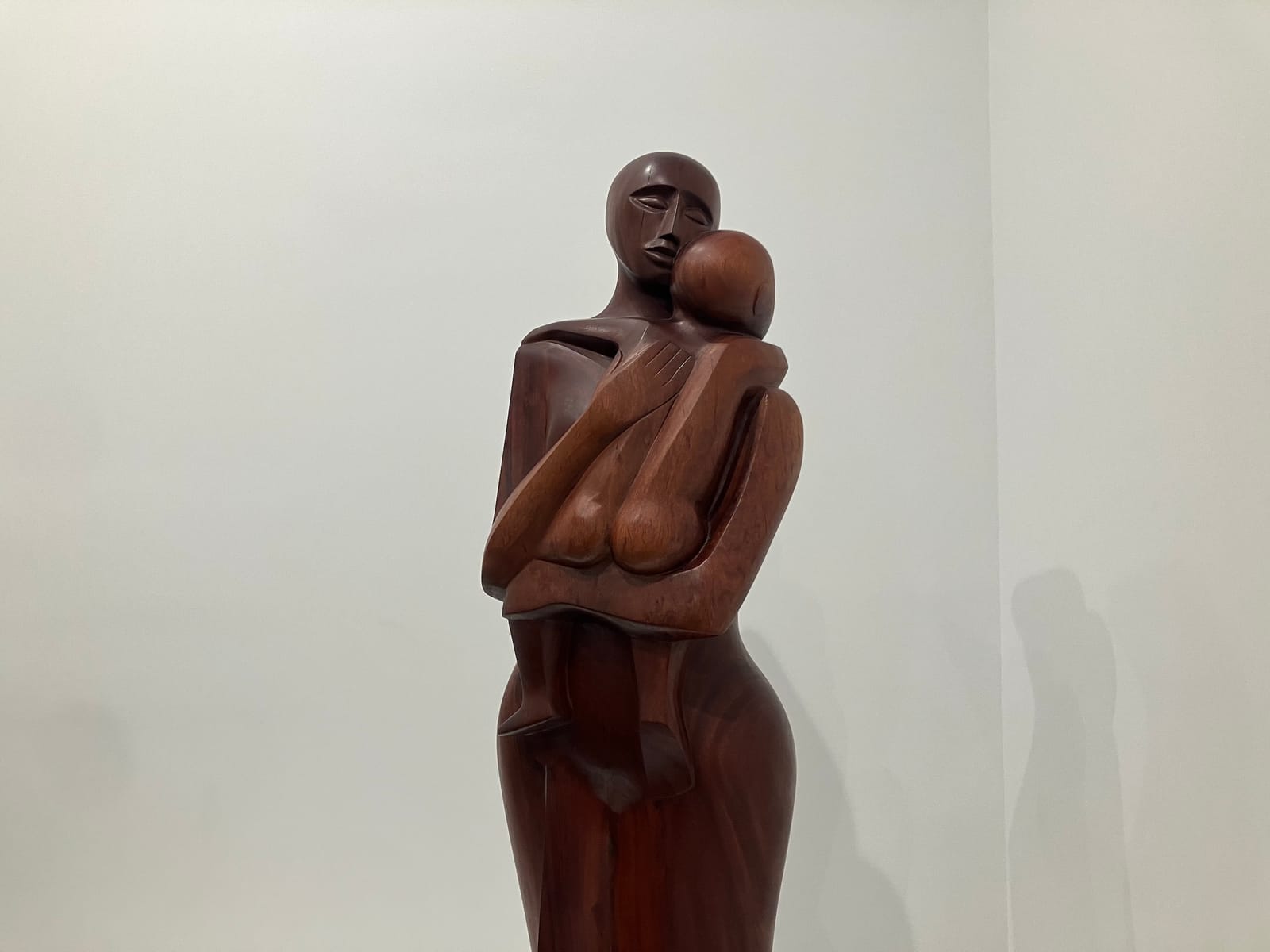
“What you notice later is the high number of pictures showing children in the arms of adult men and women. … Wilson is after something elemental and profound. But the resulting image is not just another mother and child, or dad with young kid. There is instead, each time, something tender and hard-won about what you are looking at. A hope, a promise, a lament all in one.

“Wilson, 90, is one of Boston’s most esteemed and accomplished artists. He was born in Roxbury, the son of parents from British Guiana (now the nation of Guyana), was admitted to the School of the Museum of Fine Arts in 1939 after developing a natural aptitude for art at the Roxbury Boys Club, where he attended classes taught by SMFA students.”

Smee goes on to describe Wilson’s long career, including a stint in France, his interest in the Mexican muralists, and his sculptures of Martin Luther King Jr. (one is in the Capitol rotunda).

Amazing that the artist is around and will be giving a talk at the museum. Try to go. The show is up until March 24. And you may enjoy as much as I did the African American sculptures by Meta Vaux Warrick Fuller from the permanent collection and the joyful Harlem watercolors of Richard Yarde.

More at the Globe.

Lithograph by John Wilson

Read Full Post »

I’m happy to see some long-neglected murals being restored in Harlem. Robin Pogrebin has the story in the NY Times:

“When the Works Progress Administration [WPA] commissioned murals for Harlem Hospital Center in 1936, it easily approved the sketches submitted by seven artists, which depicted black people at work and at play throughout history. The hospital, however, objected, saying four of the sketches focused too much on ‘Negro’ subject matter … .

“Protesters rallied around the art, though, lodging complaints as high as President Franklin D. Roosevelt, and the murals ultimately prevailed.

“Over the years, those wall paintings deteriorated or were obscured by plaster. Now they have been restored and brought front and center as part of a new, $325 million patient pavilion for the hospital, on Lenox Avenue at 135th Street that will be unveiled on Sept. 27. …

“The artists — the last of whom, Georgette Seabrooke, died last year — were not well known and their murals portrayed ordinary people going about their daily lives. Vertis Hayes’s ‘Pursuit of Happiness’ panel traces the African diaspora from 18th-century African village life to slavery in America to 20th-century freedom; from agrarian struggles in the South to professional success in the industrialized North.” More.

The WPA cost money, but it put a lot of people to work. And look at all the great things that were created! I especially love the idea that unemployed people were paid to paint murals, write and produce plays, interview ordinary Americans for the National Archives, and record folk music. I know it was a stressful time, but thinking about the art makes me almost nostalgic.


Photograph: Karsten Moran for The New York Times
Elizabeth Kolligs works on restoring Vertis Hayes’s “Pursuit of Happiness” at Harlem Hospital.


Read Full Post »

Asakiyume writes a blog I enjoy a lot, and this week she had an intriguing post on Jackie Ormes, generally considered the first female African American cartoonist. See examples of work by Ormes at Asakiyume’s blog, here.

According to wikipedia, Ormes (1911 to 1985), “started in journalism as a proofreader for the Pittsburgh Courier, a weekly African American newspaper that came out every Saturday. Her 1937-38 Courier comic strip, Torchy Brown in Dixie to Harlem, starring Torchy Brown, was a humorous depiction of a Mississippi teen who found fame and fortune singing and dancing in the Cotton Club.”

The strip waxed and waned as Ormes pursued her many career interests, bur she always returned to Torchy.

“In 1950, the Courier began an eight-page color comics insert, where Ormes re-invented her Torchy character in a new comic strip, Torchy in Heartbeats. This Torchy was a beautiful, independent woman who finds adventure while seeking true love. …  The strip is probably best known for its last episode in 1954, when Torchy and her doctor boyfriend confront racism and environmental pollution. Torchy presented an image of a black woman who, in contrast to the contemporary stereotypical media portrayals, was confident, intelligent, and brave.”

Being a cartoonist seems harder than writing a blog. You not only need to find daily topics that interest you enough to dwell on, but you have to encapsulate them in a piece of art. Asakiyume sometimes illustrates her posts, but art is one thing you won’t find me doing here. (Unless maybe a collage.)

Read Full Post »

I heard the singer Harry Belafonte give a speech today. Boy, is he ever “in the fray” at 85!

He covered his life story: the journey from New York to his mother’s Jamaican relatives to be raised by a poor but big-hearted village; service in WW II; involvement in black theater in Harlem; acting training at the New School with classmates such as Marlon Brando; and social justice activism with people like Eleanor Roosevelt, JFK, Martin Luther King Jr., and Nelson Mandela.

His “monologue” was loaded with intriguing and amusing anecdotes, and his face lit up in that wonderful youthful smile that many will recall.

I was interested to see where the talk would wind up, because it was clear that helping the poor and combating injustice still make him tick. He moved on from his own story to honoring the youthfulness and nonviolence of the Occupy movement and then zeroed in on his current concern, our prison system.

He asked why the country has more people in prison than any other country and why we spend more to build prisons than schools. He acknowledged that states like California and New York are beginning to find better ways to deal with underlying social ills. Belafonte himself volunteers at SingSing to help inmates get a college education.

Bruce Springsteen, he said, once asked him how to deal with some of the issues the country faces, and Belafonte answered that when someone knocks on his door, he opens it. He thinks it is important to hear whatever the knocker has to say.

I can attest to that. As a young teen I myself knocked on his door, and he opened it. I wish I could say I was knocking about social justice, but it was something mundane. That summer people were circulating petitions to keep a road from being built on Fire Island, which we loved partly because there were no roads. Harry Belafonte signed the petition.

Here he is, just having fun.

Read Full Post »

I’m thinking of a hymn I like and a line that seems to go with Thanksgiving,  families, friends, and all the familiar faces that make up one’s context.

“Roots, hold me close.”

An early walk turned up these roots bordering Central Park. Also a fancy streetlight at Duke Ellington Circle. And the Dana Discovery Center on the lake called Harlem Meer.

We bought flowers on the way back to Suzanne’s apartment, then got to work helping cook the feast. The cranberry sauce from my previous post was a big hit. Also the Swedish apple pies from Erik’s cousin.


Read Full Post »

Older Posts »