Feeds:
Posts
Comments

Posts Tagged ‘nature’

Photo: Suzanne Kreiter/Globe Staff.
Lacey Kohler, Urban Greening Projects co-ordinator and Cristiane Caro, cofounder of Pearl Street Garden Collective, worked in the new microforest in Providence, Rhode Island.

I have posted a lot about Miyawaki urban forests in Massachusetts, thanks to my friend Jean (Biodiversity Builders), who showed me several she’s helped to create. I didn’t know that similar work was afoot in nearby Rhode Island.

These efforts are all about what a dense little forest can give to a city neighborhood where there’s very little nature left. It can remove dangerous carbon from the atmosphere while spreading biodiversity all around, making the city a healthier place for both humans and critters.

Ed Fitzpatrick reports on the Rhode Island venture at the Boston Globe, “The asphalt grid of South Providence is lined with multifamily homes and concrete sidewalks. But along Pearl Street, one lot stands out.

“It’s lush and green, with nearly 270 trees packed into a 1,000-square-foot lot. Officially called the Pearl Street Garden, it contains a tiny forest in the middle of the urban jungle.

“ ‘Microforests’ like this one are cropping up in places ranging from Elizabeth, N.J., to Cambridge, Mass., to Pakistan. South Providence has two, both along Pearl Street, created by Groundwork Rhode Island and the Pearl Street Garden Collective. …

“ ‘This isn’t habitat restoration on the scale that is needed in terms of the world,’ said Jacq Hall, director of special projects at Groundwork Rhode Island … but it is a really great way, especially in a city, for people to become very in close touch with biodiversity and why it’s important and why it’s also beautiful.’

“In May, more than 100 people came out to plant the microforest. …

“The pocket forests adhere to the ‘Miyawaki method’ devised in the 1970s by Japanese botanist Akira Miyawaki, which calls for planting a wide variety of local trees in large numbers and in very tight quarters. …

“Massachusetts now has at least 20 microforests, according to Alexandra Ionescu, a Providence resident who is associate director of regenerative projects at Biodiversity for a Livable Climate, a Cambridge-based nonprofit that promotes ecosystem restoration to address climate change. …

“Rhode Island is the smallest and second most densely populated state in the nation, and a 2022 study found it contains 139 square miles of asphalt, concrete, and other hard surfaces, amounting to 13 percent of its land area. Hall said the benefits of forests and tree-lined streets are not distributed evenly in Rhode Island. …

“[Hall said], ‘We’re trying really hard to go back into those places that have been aggressively paved over and try to work in little bits of nature to bring those benefits to more people.’ …

“Hall said microforests help combat climate change because they grow so quickly. With plants packed close together, they both collaborate and compete for resources, racing to reach the sun first. She said research shows forests grown using the Miyawaki method grow 10 times faster than a traditional landscape planting. …

“Hall said projects such as this received a big boost in funding from the federal Inflation Reduction Act of 2022. ‘It was a historic moment,’ she said. …

“Groundwork Rhode Island and the Pearl Street Garden Collective are now looking for other funding sources” because of federal curbacks.

More at the Globe, here. And if you want to know more, search this site for “Miyawaki.” Or just click here.

Read Full Post »

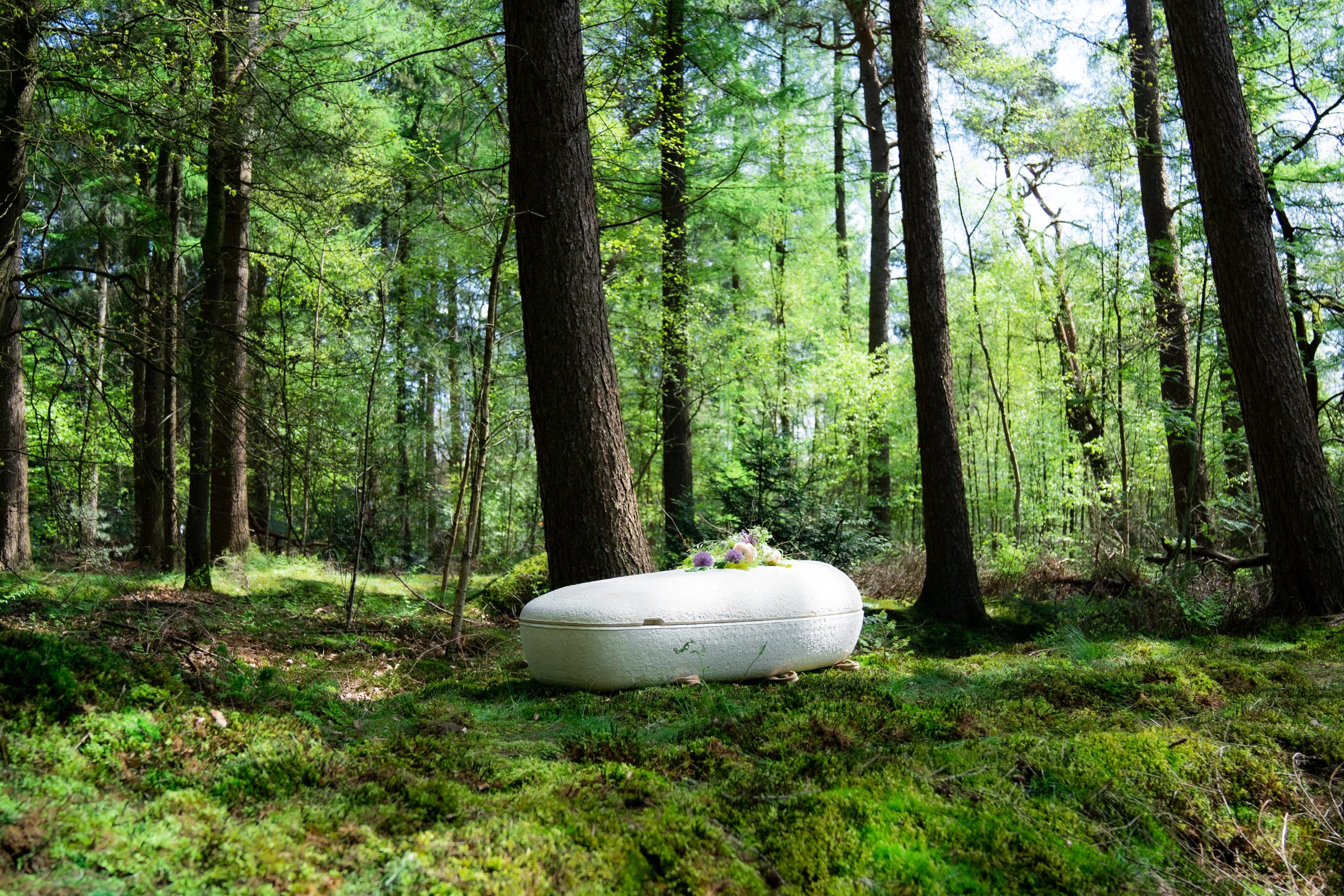
Photo: The Optimist Daily.
Website the Optimist Daily says, “Mushroom caskets offer an earth-friendly goodbye in North America’s first burial of its kind.”

Blogger Will McMillan at A Musical Life on Planet Earth gave me the lead for today’s story. And because my husband and I just recently entertained two mushroom enthusiasts from a recent conference, I decided today was a good day to tell you how some folks take their love of mushrooms to the end — and beyond.

“Traditional burials,” writes the Optimist Daily, “though deeply meaningful, often come at a steep environmental cost. The chemicals, hardwood, and land use involved can have long-term ecological impacts. But a quiet revolution in burial traditions is beginning to bloom and its roots are made of mushrooms.

“In a first for North America, a burial using a fully biodegradable mushroom casket took place on a serene hillside in rural Maine. The Loop Living Cocoon, developed by Dutch company Loop Biotech, is made entirely from mycelium, the intricate root system of fungi. The casket is grown in just one week, naturally breaks down within 45 days, and enriches the soil it returns to.

“ ‘My father always told me that he wanted to be buried in the woods on the property that he loved so much,’ said Marsya Ancker, whose father Mark C. Ancker was laid to rest in the pioneering casket. ‘He wanted his final resting place to nourish the land and plants he cherished.’ …

“Though this was a first for North America, Loop Biotech has already facilitated more than 2,500 burials across Europe using mushroom caskets. Green burials are an alternative that avoids embalming fluids, hardwood caskets, and steel-reinforced concrete vaults, and they’ve been steadily growing in popularity since the 1990s.

“ ‘Since 2005, the Green Burial Council has certified over 250 providers and recorded 400+ green cemeteries across the U.S. and Canada: a clear sign of growing demand for environmentally conscious end-of-life choices,’ said Sam Perry, president of the Green Burial Council.

“The statistics are striking. According to the Council, conventional U.S. burials consume roughly 20 million board feet of wood, 4.3 million gallons of embalming fluid, and 1.6 million tons of concrete each year.

“Bob Hendrikx, founder of Loop Biotech, believes funerals can be more than a final goodbye. ‘We created the Loop Living Cocoon to offer a way for humans to enrich nature after death. It’s about leaving the world better than we found it.’

The Global Green Burial Alliance, founded in 2022, is helping reshape global perspectives on death. Entirely volunteer-run, the organization connects families with green providers and empowers people to reclaim their voice in end-of-life decisions. …

“Ed Bixby, founder of the Global Green Burial Alliance, believes these choices create a legacy of compassion. … ‘To embrace the living with our death becomes the final act of kindness we can bestow upon our planet.’

“With innovations like the mushroom casket and a groundswell of interest in sustainable options, a cultural shift appears to be underway. It asks that we reimagine death not as an ending, but as a way to nourish new life.”

So there’s that.

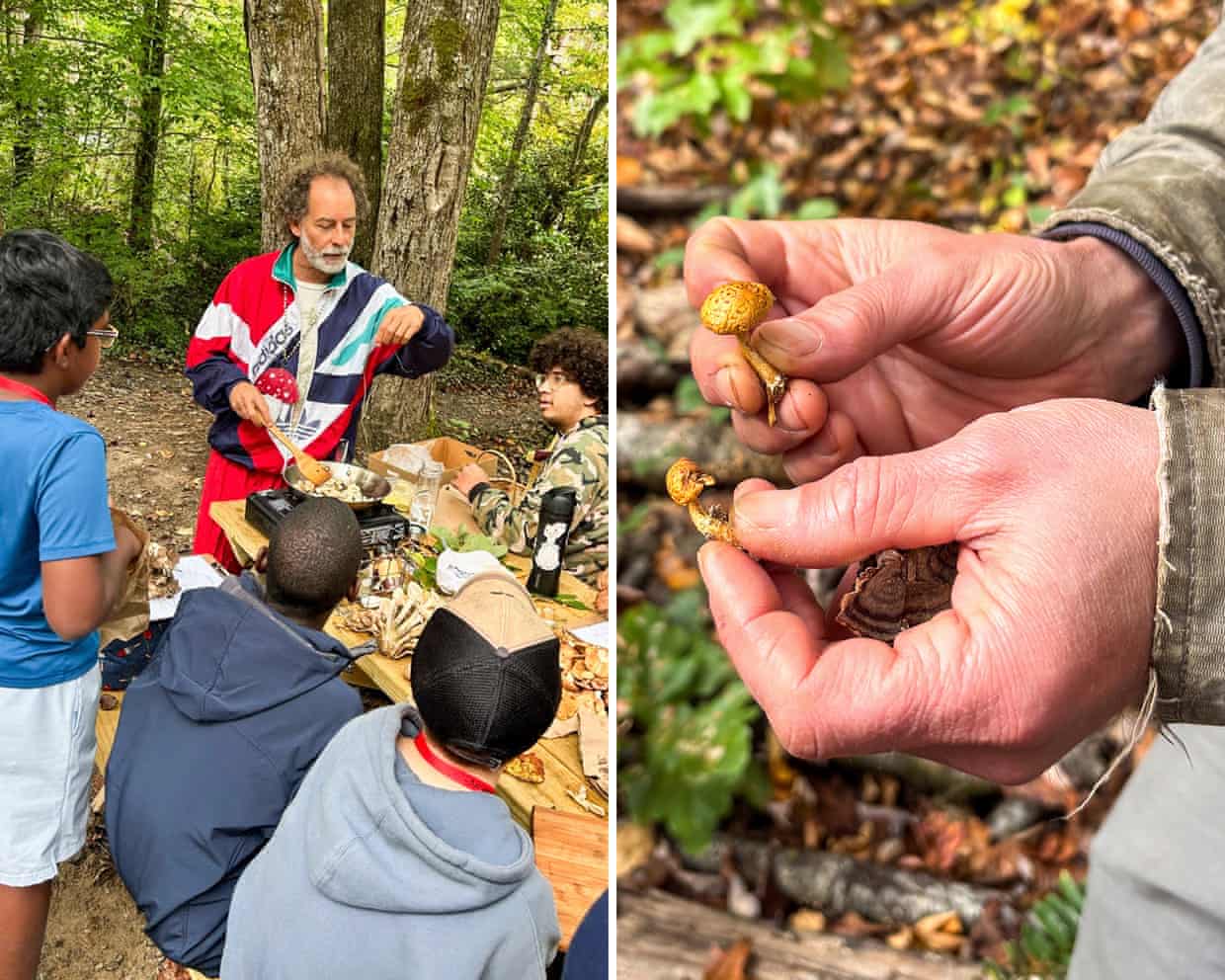
Sometime I’ll tell you about our mycologist visitors. Theirs is a whole different world. And when you live in a retirement community and are in danger of too much sameness, “different” is especially welcome.

Consider for example, how we learned from these guys that truffles are actually all over the world but buried very deep. And how they might even have been the “manna” in the desert described in the Bible. They do grow in desert places like Saudi Arabia.

So says the CEO of MycoSymbiotics, William Padilla-Brown, who, we learned, was a speaker at the conference. His bio describes him as a “Multidisciplinary Citizen Scientist practicing social science, mycology, phycology, molecular biology, and additive manufacturing. William founded MycoSymbiotics in 2015, and has since developed it into the innovative practical applied biological science business it is today. William holds permaculture design certificates acquired through Susquehanna Permaculture and NGOZI, and a certificate from the Bigelow Laboratory for Ocean Sciences in algal culturing techniques. He has published the first English-language books on cultivating the cordyceps mushroom and regularly leads courses on their cultivation. William’s research has been sponsored by several organizations and his work has been featured in multiple publications, including Fantastic Fungi and VICE. He also founded and manages MycoFest, an annual mushroom and arts festival, now on its eleventh year.”

So many unusual pursuits in this world! I am not knowledgeable enough to recommend the ideas of any mycologists or herbalists, nor am I planning a mushroom burial, but I sure am a sucker for anything interesting.

Doesn’t curiosity keep us all going?

More at the Optimist, here.

Read Full Post »

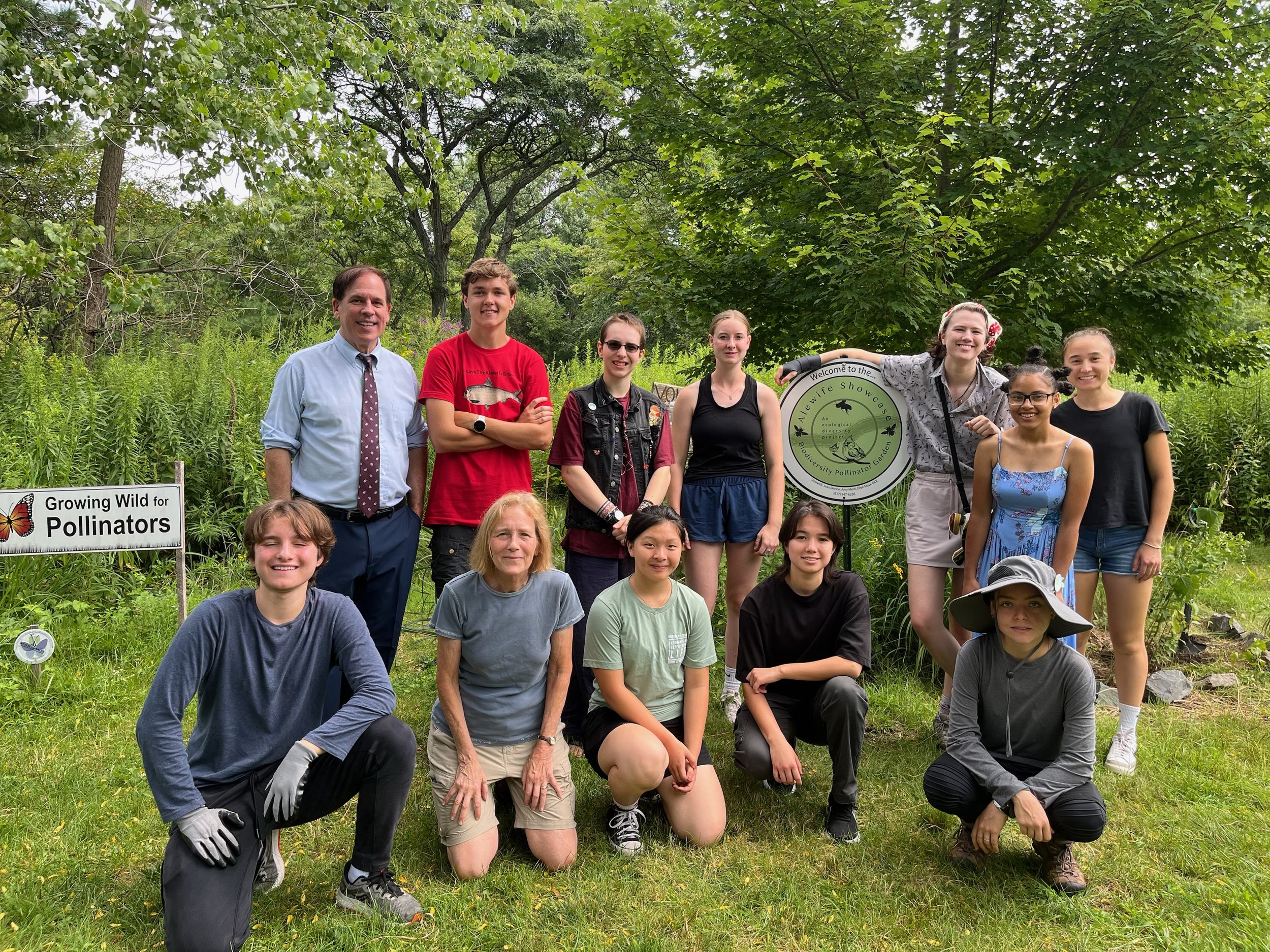
Photo: Devine Native Plantings.
Jean Devine, founder of Biodiversity Builders, is in the front row, second from left. She engages young people in the important work of improving the environment.

Recently, I blogged about my friend Jean Devine, founder of Biodiversity Builders, and described how she took me on a tour of local urban forests. (Click here.)

Now I find that Edible Boston has caught up with her and is highlighting the amazing environmental work Jean’s been doing with young people.

Nicole Estvanik Taylor writes, “Ask the average Gen Z-er to name their favorite native plant and you might expect a blank stare. But for alumni of the Biodiversity Builders program, the hard part is narrowing it down.

“Strawberries come to mind for Jasmine Rancourt, International School of Boston graduating senior — ‘or maybe butterfly weed, because it’s really pretty and vibrant … and it attracts butterflies, obviously.’

“Belmont High School’s Sophia Shaginian chose to plant bleeding heart in front of her house because it’s ‘absolutely gorgeous’ and ‘blooms all summer long.’

“Leia Ahmad-LeBlanc of Arlington Catholic High School gravitates to the striking red pods of wild sumac. ‘You can actually make lemonade out of it, and it’s a good source of food for animals.’

“And UMass Amherst student Kira O’Neill is partial to black birch trees: ‘They have such beautiful yellow leaves in the fall. And if you scratch a twig, it smells like root beer.’ 

“The students got to know these and many other plant species native to Massachusetts through a six-week paid summer internship created and run by Jean Devine, a Belmont-based environmental educator, native plant coach and specialty landscaper.

“Entering its fourth year, Biodiversity Builders has provided 55 high school students from Arlington, Belmont and Cambridge with hands-on experience designing and installing native plant gardens and removing invasive flora. The curriculum also covers entrepreneurial concepts like mission and marketing and culminates in a native plant sale run entirely by the students. …

“It’s only been a decade or so that Devine herself could tell you much about birch trees or bleeding hearts. …

“ ‘I was looking for opportunities to mentor youth and get them outdoors as an antidote to “nature-deficit disorder,” ‘ she says, referencing a term coined by journalist Richard Louv in his book Last Child in the Woods.

“A walk with a scientist opened Devine’s eyes to the ecological value of native plants, including as a source of food and shelter for pollinators and other wildlife, and the threat invasives pose to biodiversity. Teaching kids how to restore this balance struck her as ‘an ideal project with a purpose that helped the world and the youth at the same time.’ …

“After several years running nature programs for school kids in Cambridge and Brookline, she launched her own business, Devine Native Plantings, in 2021. Biodiversity Builders followed a year later, operating as a nonprofit under the fiscal sponsorship of the Vermont-based Tiny Seed Project. It partners with the Cambridge Mayor’s Summer Youth Employment Program to support the participation of students from that city and covers the rest of its budget through grants and crowdfunding. This July, it will recommence with a fresh batch of 14 high school students and a pair of college mentors, plus four young professionals interested in the Biodiversity Builders approach.

“ ‘Jean is so high energy and enthusiastic about the curriculum,’ says O’Neill, who did the program in 2022 and returned last summer as a mentor. ‘She very easily connects with the students … and she knows so many of the people in the area doing similar kinds of work.’

“Among her many affiliations, Devine is a co-founder of the Mystic Charles Pollinator Pathways Group, which maps local gardens that support declining populations of native bees, butterflies and birds. She guided Belmont High School’s Climate Action Club in creating a pollinator garden and is part of an intergenerational committee of Belmont residents organizing to plant a Miyawaki miniforest. As a member of the Native Plant Community Gardeners group in Cambridge, she’ll help install Danehy Park’s first pollinator garden this summer — with upkeep to come from the 2025 Biodiversity Builders crew. …

“For 2024 Biodiversity Builders participant Rancourt, who has artistic leanings, planning gardens that are aesthetically pleasing and ecologically useful was a highlight of the program.

“ ‘It turns out you have many colorful native plants that can be used,’ Rancourt reasons, ‘instead of those other plants that are colorful but look like plastic for pollinators.’ …

“Ahmad-LeBlanc, part of last summer’s cohort, says she applied to Biodiversity Builders after watching her sister go through the experience two years prior.

“ ‘She would always come home covered in dirt, she would have to wear super high socks because there were a lot of ticks, but she had a great time,’ she says. When it was her turn to get dirty, she understood why. ‘I think it was easier for us to process the information because it was all really hands-on … It’s a way that we’re not usually able to learn in school.’

“The Alewife reservation is Biodiversity Builders’ home base, but the students tend plots in other community spaces. … Last summer they removed invasives at Mass Audubon’s Habitat Education Center and Wildlife Sanctuary with the aid of its resident goats; toured Mount Auburn Cemetery with a herpetologist, a horticulturalist and an artist; and took the T to East Boston for birdwatching in Belle Isle Marsh. They also donned gloves and climbed into canoes with the Mystic River Watershed Association to remove thick, spiny mats of invasive water chestnuts from the Arlington Reservoir—filling 270 laundry baskets by day’s end.

“ ‘It was just amazing how we were all collaborating and working all together,’ says Shaginian, who shared a canoe with Devine. ‘I remember how big that pile was. It was huge.’

“Shaginian says pulls like that one, or the sweaty hours spent uprooting black swallow-wort along the edge of the Minuteman Bike Path, impressed upon her both the enormity of the problem and the importance of doing her part. …

“ ‘For me, the idea of getting paid to do gardening, which I did at my house for fun, was novel and exciting,’ says O’Neill, ‘and definitely cemented the idea that I wanted to study something related to working outside when I got to college.’ “

More at Edible Boston, here, and at this blog, here.

Read Full Post »

Photo: Mark Vonesch / Modern Biology.
“Fungi whisperer” Tarun Nayar started experimenting with connecting a synthesizer to plants and fungi during the early days of the COVID-19 pandemic. 

Today we have another example of the creative work that got a lift during the pandemic. Not that we ever want a pandemic, but it doesn’t hurt to remember that good things can flourish in the shelter of nothing-much-going-on.

Radhika Iyengar writes at Atlas Obscura about some pandemic-era experiments. “On a pleasant December morning, Tarun Nayar was at a mangrove reserve in Mumbai, where he plugged his synthesizer into a thick leaf. The sound that emerged was hypnotic and otherworldly, blending a sense of the future with nostalgic echoes of 1980s synthwave. It felt like something right out of Stranger Things.

“Nayar is not your traditional musician—he’s a fungi whisperer. By connecting cables from his custom-built modular synthesizers to mushrooms, fruits, and leaves, he transforms their natural bioelectric signals into captivating sounds. …

“Over the last five years, Nayar has jammed with myriad types of fungi, including trumpet-shaped chanterelles and the glorious, red-roofed fly agaric mushrooms. He has also collaborated with a giant ficus tree, clumps of bamboo, sword ferns, a pineapple, and even the odd-looking citrus fruit called Buddha’s Hand. ‘It’s an intoxicating feeling to be able to make all these crazy sounds and program really interesting melodies, many of which will probably be impossible to play on a traditional instrument,’ he muses.

“Music has always been central to Nayar’s life. Born to a Punjabi father and a Canadian mother, he was immersed in Indian classical music from an early age, particularly through his training in tabla, a type of hand drum. But for the past four years, the former biologist, who is based in Montreal, has been experimenting with what one may describe as plant music.

“Nayar’s journey into this experimental soundscape began during the COVID-19 pandemic, when he was living on a tiny island north of Vancouver, surrounded by nature. That’s when he began ‘messing around’ with flora. He recalls plugging a software synthesizer into a salmonberry bush. ‘All of a sudden, the synthesizer started playing a piano patch,’ he says. ‘I could actually “listen” to the salmonberry bush.’ …

“In 2021, Nayar started posting videos of his ‘little experiments’ on the internet under the stage name Modern Biology. While initially his videos on TikTok received only three to four views, slowly they gained momentum and worldwide attention, leading to tens of thousands of people appreciating his work. ‘To be honest, I was quite surprised that people were interested in this relatively niche practice. It really gave me a feeling of community during the pandemic when my bubble was quite small,’ admits Nayar. Today, he has over 379,000 followers on Instagram alone.

“To be clear, fruits, fungi, and trees don’t make music. They don’t even produce sounds that lie within the audible range of human hearing. But as Nayar explains, ‘almost every behavior in plants and fungi is mediated by electrical impulses, just like in humans. Every thought, every movement, every little cellular division is associated with an electrical activity. These signals or processes are all reflected in the conductivity of the organism’s body. All I’m doing is tapping into these fluctuating electrical fields and translating the electrical signals into musical notes.’…

“His interest in sound synthesis began several years before the pandemic, sparking a deep fascination that eventually led him to build his own analog synthesizers at home. He pursued courses focused on DIY synthesizers made out of breadboards—versatile plastic boards with perforated holes, designed for assembling electronic circuits by plugging in jumper cables. …

“One of the first exercises in the online course involved the humble orange. ‘We had to use it in a circuit as a resistor,’ Nayar recalls. ‘Everything has electrical resistance, but some materials are so resistant that current can’t even pass through them. Fruits and vegetables, however, are effective conductors, allowing electrical current to flow through them.’

“When Nayar squeezed the orange, he realized that its conductivity changed, and the sound changed with it. ‘The pitch of the oscillator went up or down depending on whether you were squeezing it or not,’ he says, adding with a hint of amusement, you can actually play the synthesizer just by squeezing the orange!’

“From holding festivals in parks to conducting intimate gatherings at restaurants, Nayar has been gaining attention for his experimental music. His goal is to encourage people to reconnect with nature. ‘For the most part, as human beings we kind of forget that the world is alive,’ he says.”

Lots more at Atlas Obscura, here, where you can also listen to some musical results.

Read Full Post »

Photo: John and Suzanne’s Mom.
Fungi and algae receive less than 0.2% of conservation funding, according to a new study. Small speices never seem as cool as rhinos and elephants.

Is it human nature to pay more attention to the large and aggressive than to the small and quiet? As a female, I think so.

At the Guardian, Mariam Amini writes about how that tendency, when applied to the study of the natural world, can be harmful to the planet.

“Most global conservation funds go to larger, charismatic animals,” she says, “leaving critically important but less fashionable species deprived, a 25-year study has revealed.

“Scientists have found that of the $1.963bn allocated to projects worldwide, 82.9% was assigned to vertebrates. Plants and invertebrates each accounted for 6.6% of the funding, while fungi and algae were barely represented at less than 0.2%.

“Disparities persisted among vertebrates, with 85% of all resources going to birds and mammals, while amphibians received less than 2.8% of funding.

“Further funding bias was found within specific groups such as large-bodied mammals towards elephants and rhinoceros. Although they represent only a third of that group, they were the focus of 84% of such conservation projects and received 86% of the funding. Meanwhile mammals such as rodents, bats, kangaroos and wallabies remained severely underfunded, despite being considered endangered.

“ ‘Nearly 94% of species identified as threatened, and thus at direct risk of extinction, received no support,’ said Benoit Guénard, the lead author of the study. ‘Protecting this neglected majority, which plays a myriad of roles in ecosystems and represents unique evolutionary strategies, is fundamental if our common goal is to preserve biodiversity.’

“Alice Hughes, a coordinating lead author of the research, said: ‘The sad reality is that our perception of “what is threatened” is often limited, and so a few large mammal species may receive more funding than the near-12,000 species of reptile combined.

“ ‘Not only does this limit our ability to implement protective measures, but it closes opportunities to researchers. I have lost count of the number of times collaborators have switched taxa [organism populations] purely because theirs was difficult to fund. This leads to a chicken and egg situation – some of the groups with the highest rates of recent extinction, like freshwater snails, have the most outdated assessments.’

“The study, led by Guénard and colleagues at the University of Hong Kong, analyzed 14,566 conservation projects spanning a 25-year period between 1992 and 2016. …

“ ‘We are in the midst of a global species extinction crisis,’ said research author Bayden Russell. … ‘We need to change how we think about conservation funding. The community needs to be educated about the value of biodiversity and protecting species that are under threat.’ …

“ ‘Governments, in particular those which represent the main pool of funding, need to follow a more rigorous and scientifically driven approach in conservation funding,’ said Guénard.”

More at the Guardian, here.

And be sure to check Anna Kuchment’s Boston Globe interview with Mandë Holford, here, about a poisonous snail with lifesaving properties. It reads in part: “Some of the most powerful drugs in our medical arsenal come from animal venom. Ozempic was derived from Gila monsters, a lizard native to the southwestern US; Prialt, used to treat chronic pain in HIV and cancer patients, comes from deadly cone snails; and captopril, the first ACE inhibitor, a class of drugs used to treat high blood pressure, came from Brazilian pit vipers.”

Read Full Post »

Photo: Teagan Glenane/The Guardian.
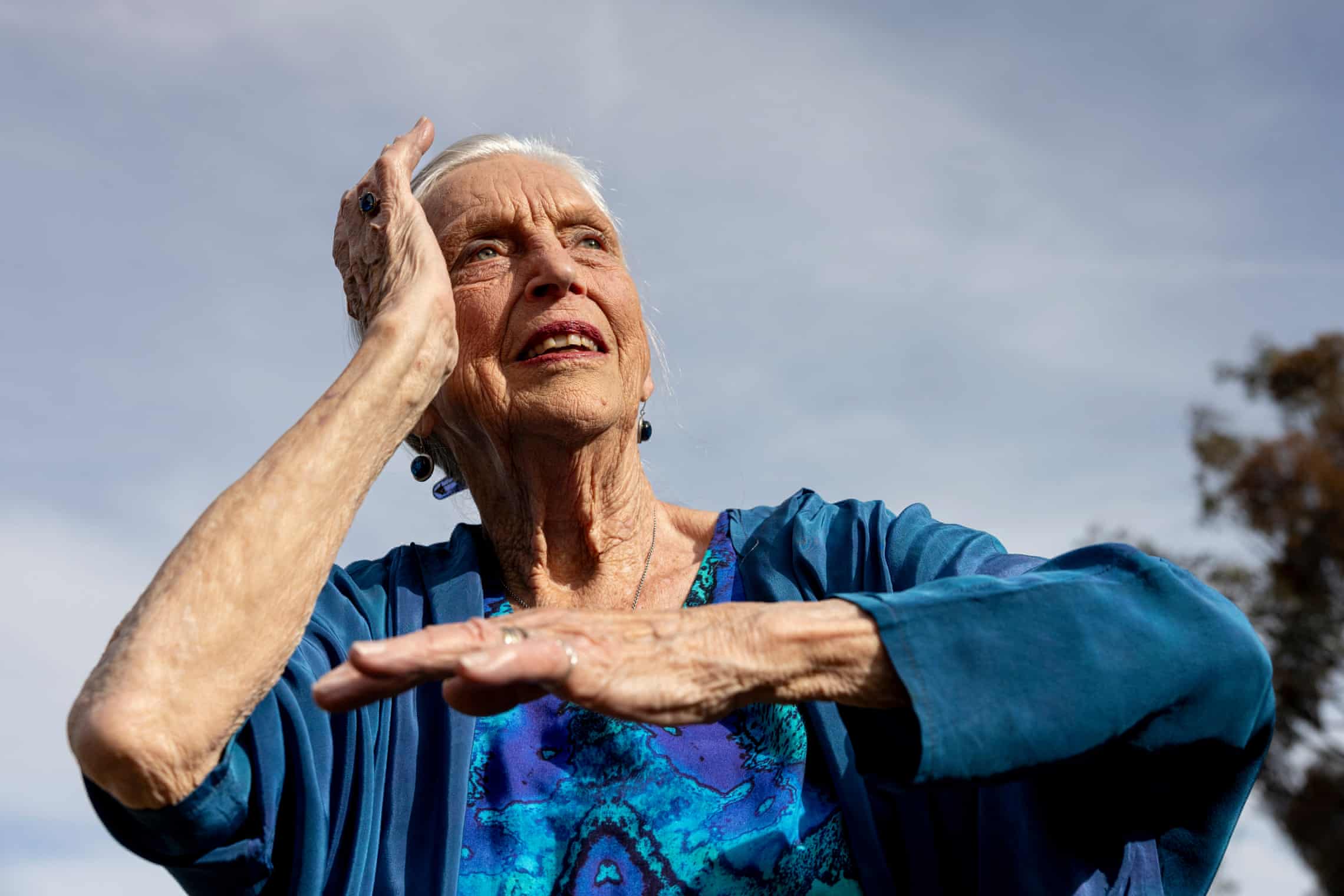
Australian choreographer Elizabeth Cameron Dalman at her property in Bungendore, just outside Canberra. “I’d always been inspired by nature, which I imagined as I was performing.”

As an older citizen who thinks backing up in a parking lot is living life on the edge, I can never resist a story about elderly people who ignore aging.

Steve Dow at the Guardian wrote recently about a dancer in Australia.

“At 91, Elizabeth Cameron Dalman dances in nature at her bushland retreat outside Canberra, Mirramu Creative Arts Centre, surrounded by writers, singers and visual artists. … ‘So many people bring up this age thing,’ she says, ‘and my reply is that in dance we are ageless.’

“A contemporary dance pioneer in Australia, Dalman has just seen the final performance of one of her ‘great inspirations’ and occasional collaborators, dancer Eileen Kramer, in a filmed component of the dance work ‘Afterworld,’ part of Sydney festival. Kramer died in November at 110. ‘I’m going to live to that age,’ Dalman chuckles.

“In Adelaide in 1965, Dalman co-created Australian Dance Theatre, running the company for a decade, confounding the era’s prejudice against modern dance and women artistic directors. …

“She [likes to] talk about what feeds longevity, pointing to medical research showing the health and mobility benefits of dancing for Alzheimer’s and Parkinson’s patients. ‘It’s not just pure exercise, you are adding creative activity,’ she says. ‘You’re engaging the left and right side of the brain.’ …

“Dalman has been consulting with ADT’s current artistic director, Daniel Riley, on the company’s 60th anniversary production ‘A Quiet Language.’ … The show, created by Riley, is billed as an examination of legacy, ‘transmuting the rebellious energy of the company’s early days into an electric new era.’

“Over the past decade, Dalman herself has graced international stages, notably touring for four years as part of the Irish choreographer Michael Keegan-Dolan’s critically acclaimed ‘Swan Lake/Loch na hEala,’ which transposed the classical ballet to the Irish midlands. When Keegan-Dolan posted an international callout for a woman aged 60 with long white hair to play the story’s cranky, arthritic matriarch, Dalman – 82 at the time – emailed saying she had the requisite long white hair. …

“Dalman has always been determined to dance. … She enrolled in dance class at three, learning both classical ballet and modern. Later, she began an arts degree at the University of Adelaide. …

“In 1957, aged 23, Dalman paid her way to London with the hope of launching a dance career. There, she saw a life-changing performance by the Mexican choreographer José Limón. ‘He touched my soul. I thought, “Oh wow, that’s how I want to dance,” ‘ she recalls. In 1960-61 she studied at the Folkwang school in Essen, Germany, where her classmates included Pina Bausch: ‘She was amazing, a technical whiz.’

“In Germany, Dalman met the Colombian American choreographer Eleo Pomare, who rose to prominence in the civil rights era. She created works with Pomare’s company from 1961 to 1963, living in Amsterdam with him and four other dancers. Pomare later remarked that Dalman danced ‘as if she swallows the heat and you feel that the heat is burning from the inside out.’ …

“Dalman returned to Australia in late 1963, and performed in the artist Stan Ostoja-Kotkowski’s experimental theatre show ‘Sound and Image’ at the 1964 Adelaide festival. It inspired her to open a dance school, and in 1965 she took her students on a regional tour, alongside dancers from Royal Ballet alumnus Leslie White’s Adelaide academy.

“Buoyed up by the tour’s success, Dalman and White set up Australian Dance Theatre, but the going was financially tough, and White left in 1967. Dalman put Australian Dance Theatre forward to perform in the 1968 Adelaide festival, but when it turned down her request for financial support she instead bought some half-price cruise ship tickets and took the troupe on its first international tour, sailing to the Netherlands, Switzerland and Italy.

“Back home, Dalman faced discrimination because of her gender: ‘I felt the battle, I had to keep proving myself. Even once we got a little bit of funding later, in 1973, and I’d been running the company since 1965, never in the red, this board member, a man, said, “Oh we have to do something about the finances, they haven’t been run correctly.” Then he took us into the red the next year.’

“Dalman remained artistic director until 1975. Then, having split with her husband, she and [their son] Andreas moved to Ventimiglia, a seaside town in northern Italy. … She founded a dance school and a youth dance theatre there in 1976, and it became ‘a place of healing.’

“In 1986, on a visit home to Australia, Dalman met another mature artist, who became an inspiration: the Japanese butoh dancer Kazuo Ohno, then almost 80. … A decade later, Dalman and Andreas visited Ohno – who was still dancing, and preparing to tour the US – at his Yokohama home. ‘He said, “Oh Elizabeth, it’s so good to talk to a senior, mature artist.” ‘ Dalman, then 60, had been contemplating ending her career. ‘When I met him, I realized I had to keep going.’

“In 1989, Dalman bought a 40-hectare property at Bungendore, near Weereewa/Lake George, outside Canberra. The bush reminded her of Italy, dancing among the olive groves or by the river. She established Mirramu Creative Arts Centre there the same year, followed by Mirramu Dance Company in 2002. …

“ ‘It was hard leaving Adelaide because that was my home, but the pull of this place, the land and the lake, is very powerful.’ “

More at the Guardian, here.

Read Full Post »

Photo: Valkyrie Pierce/Unsplash.
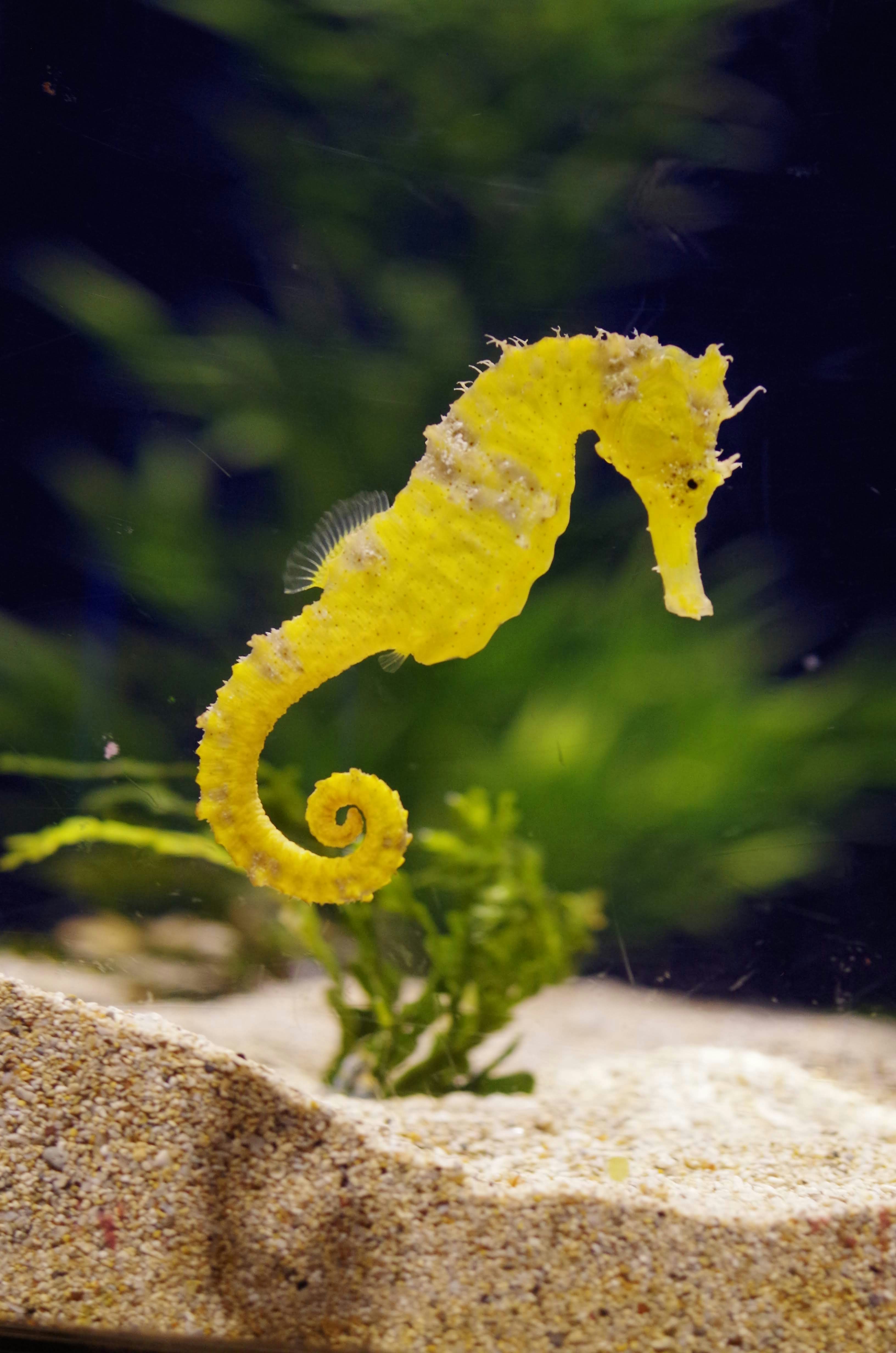
Citizen scientists are helping us learn more about seahorses.

For all its shortcomings, social media has enabled us to work together on meaningful projects if we so choose. Consider the citizen scientists who are expanding our knowledge of the natural world.

Erin Blakemore has a story at the Washington Post about the latest research on seahorses — and how you can help study them.

“Members of the public are helping to advance research on sea horses, the tiny fish that can be found in coral reefs, shallow waters and estuaries around the world, according to a study.

“When researchers looked at the results of public contributions to the iSeahorse science project between 2013 and 2022, they found the community effort enabled scientific advances in the field.

“Citizen contributions provided new information on 10 of 17 sea horse species with data once considered deficient and helped update knowledge about the geographic distribution of nine species, researchers wrote in the Journal of Fish Biology. Some of the observations even helped scientists better understand when and how sea horses breed. … According to the project website, iSeahorse has amassed about 11,000 observations from more than 1,900 contributors to date.

“Overall, the researchers were able to validate 7,794 of the observations from 96 countries and 35 sea horse species. The volunteer observers even noted rare species that traditional monitoring probably would not detect, they write.

“ ‘Seahorses are very much the sort of fascinating species that benefit from community science, as they are cryptic enough to make even formal research challenging,’ Heather Koldewey, the project’s co-founder and the lead on the Bertarelli Foundation’s marine science program, said in a news release. …

“Want to get involved? Visit https://projectseahorse.org/iseahorse/ to learn more. More at the Post, here.

And check out this page from the Journal of Ethnobiology and Ethnomedicine, here. It reads, in part, “Seahorses are endangered teleost fishes under increasing human pressures worldwide. In Brazil, marine conservationists and policy-makers are thus often skeptical about the viability of sustainable human-seahorse interactions.

“This study focuses on local ecological knowledge on seahorses and the implications of their non-lethal touristic use by a coastal community in northeastern Brazil. Community-based seahorse-watching activities have been carried out in Maracaípe village since 1999, but remained uninvestigated until the present study. …

“We interviewed 32 informants through semi-structured questionnaires to assess their socioeconomic profile, their knowledge on seahorse natural history traits, human uses, threats and abundance trends.

“Seahorse-watching has high socioeconomic relevance, being the primary income source for all respondents. Interviewees elicited a body of knowledge on seahorse biology largely consistent with up-to-date research literature. Most informants (65.5 %) perceived no change in seahorse abundance. Their empirical knowledge often surpassed scientific reports, i.e. through remarks on trophic ecology; reproductive aspects, such as, behavior and breeding season; spatial and temporal distribution, suggesting seahorse migration related to environmental parameters.

“Seahorse-watching operators were aware of seahorse biological and ecological aspects. Despite the gaps remaining on biological data about certain seahorse traits, the respondents provided reliable information on all questions, adding ethnoecological remarks not yet assessed by conventional scientific surveys. We provide novel ethnobiological insight on non-extractive modes of human-seahorse interaction, eliciting environmental policies to integrate seahorse conservation with local ecological knowledge and innovative ideas for seahorse sustainable use. Our study resonates with calls for more active engagement with communities and their local ecologies if marine conservation and development are to be reconciled.”

Read Full Post »

Photo: Curtis Quam via Civil Eats.
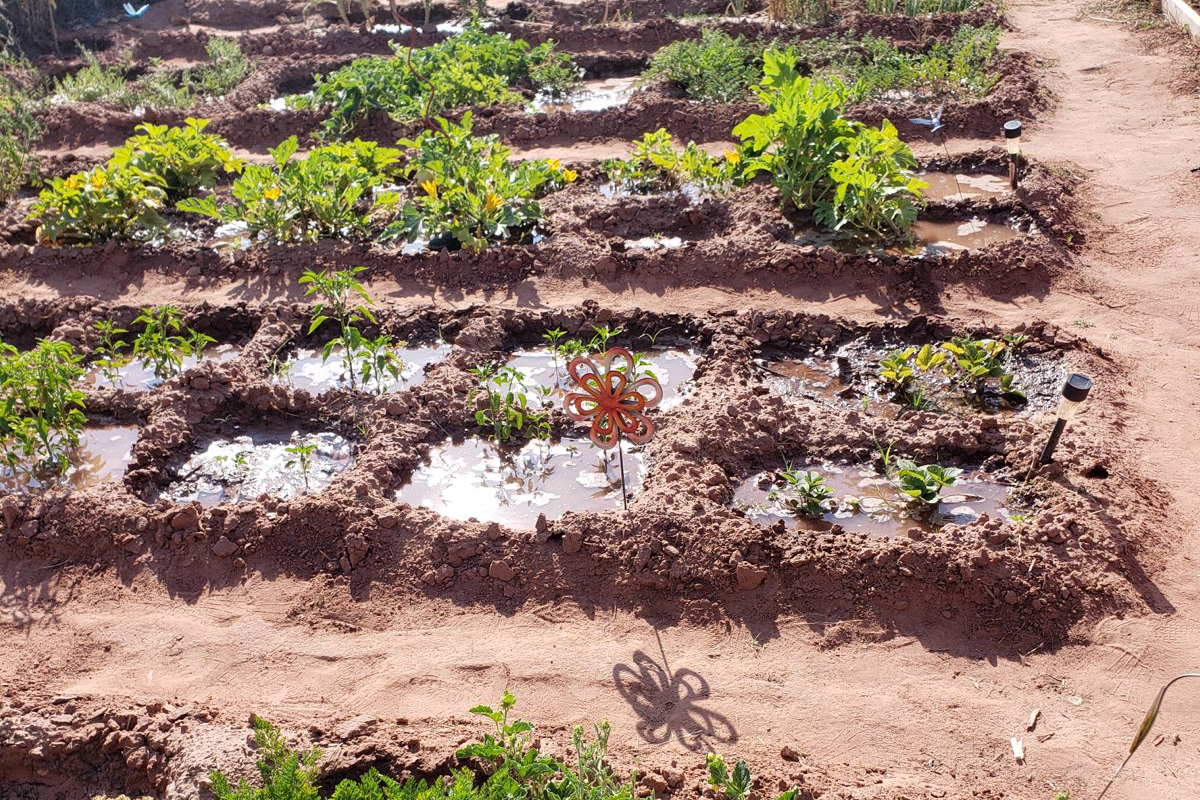
According to Civil Eats, “In the face of climate change and persistent droughts, a growing number of people from Zuni Pueblo in New Mexico and elsewhere are adopting the traditional farming practice.”

Some days, reading the news, I just feel fed up with what capitalism has done to the human race — not to mention the planet. I don’t know how to get out of my own role in this mess, but if nothing else, I can at least learn a little about indigenous ways that are different.

Samuel Gilbert describes nine practices at the Washington Post: Zuni waffle gardens, “good fire,” ancient Irrigation, the original carbon capture, dryland farming, restoring salmon runs, resilient seeds, Swinomish clam gardens, and climate-smart design.

“Since the first Earth Day in 1970,” Gilbert writes, “the world has experienced profound ecological changes. Wildlife populations have decreased by 69 percent, the result of habitat loss caused by rapid industrialization and changing temperatures. 2023 was the hottest year on record. …

“Jim Enote, 66, has been planting a traditional Zuni waffle garden (or hek’ko:we in the Zuni language) since before he could walk.

“ ‘My grandma said I started planting when I was an infant tied to a cradleboard,’ said Enote, who grew up on the water-scarce Zuni Pueblo on the southeastern edge of the Colorado plateau. ‘She put seeds in my baby hands, and I dropped seeds into a hole.’

“Enote has continued this ancient garden design, creating rows of sunken squares surrounded by adobe walls that catch and hold water like pools of syrup in a massive earthen waffle. The sustainable design protects crops from wind, reduces erosion and conserves water. …

“Before European settlers traveled to the American West, Indigenous people managed the landscape of northern California with ‘cultural burns’ to improve soil quality, spur the growth of particular plants, and create a ‘healthy and resilient landscape,’ according to the National Park Service.

“ ‘The Karuk have developed a relationship with fire over the millennia to maintain and steward a balanced ecosystem,’ said Bill Tripp, director of natural resources and environmental policy for the Karuk Tribe. ‘A good portion of the resources that we depend on, in the natural environment, are dependent on fire.’

“But in the mid-19th century, Indigenous burning was outlawed. Not only did that cause the Karuk to lose a vital part of their culture, but also, it invited potentially worse wildfires. The burns had reduced the amount of fuel accidental fires feed on. …

“Prescribed burning has returned as state and federal agencies recognize the importance of fire in managing forests. In 2022, California passed legislation affirming the right to cultural fire and is considering another bill (backed by the Karuk Tribe) to reduce the barriers to cultural burns on tribal lands. …

“In New Mexico, there are 700 functioning acequias, centuries-old community irrigation systems that have helped the parched state build water resilience. These acequias — a design from North African, Spanish and Indigenous traditions — were established during the 1600s. … Unlike large-scale irrigation systems, water seepage from unlined acequias helps replenish the water table and reduce aridification by adding water to the landscape. The earthen ditches mimic seasonal streams and expand riparian habitats for numerous native species.

“ ‘It’s a very good and sustainable system to take water from one source and put it into the community,’ said Jorge Garcia, executive director of the Center for Social Sustainable Systems and secretary of the South Valley Regional Association of Acequias. … ‘We need to maintain those knowledge systems, especially if we continue through dry years.’ …

“U.S. forests are carbon sinks, sequestering up to 10 percent of nationwide CO2 emissions. Indigenous forestry can play a critical role in reducing global warming by restoring biodiversity and health to these ecosystems, including the management of culturally significant plants, animals and fungi that contribute to healthier soil.

“ ‘We know that most of the carbon in the forest is stored in the soil, and healthy soil depends on diversity,’ said Stephanie Gutierrez, a member of the San Carlos Apache Tribe and the forests and community program director for Ecotrust. …

“Yet tribal forestry remains severely underfunded and underutilized on public lands. Indigenous Hawaiians are reintroducing ancient food forests once destroyed by overgrazing, logging and commercial agriculture. These biodiverse edible forests increase food security and build nutrient-dense soils that sequester carbon.

“The Hopi nation in Arizona receives an average of 10 inches of rain per year — a third of what crop scientists say is necessary to grow corn successfully. Yet Hopi farmers have been cultivating corn and other traditional crops without irrigation for millennia, relying on traditional ecological knowledge rooted in life in the high desert.

“ ‘I like to call traditional ecological knowledge the things my grandfather taught me,’ said Michael Kotutwa Johnson, a Hopi dryland farmer and academic. Hopi farming practices include passive rainwater harvesting, myriad techniques to retain soil moisture, and a reliance on traditional seed varieties superbly adapted to the desert.

“ ‘The fact we are able to raise crops such as maize with only 6 to 10 inches of precipitation as opposed to the standard 33 inches of precipitation is outstanding,’ Johnson said.”

Learn about the other techniques at the Post, here.

Read Full Post »

Photo: Mary Jo Hoffman.
Palourde clam shells from the Mediterranean Sea, part of Mary Jo Hoffman’s decades-long creative endeavor celebrating the beauty of the natural world.

I’m reading a lovely YA novel celebrating the wonder of the natural world (Gather), so my train of thought today fits right in with the topic of a recent New Scientist article. It’s about a woman with a huge collection of nature photos.

Gege Li writes, “Since 2012, Mary Jo Hoffman has taken one snap a day of the natural objects around her. She explains what lies behind two of them – and what the ‘art of noticing’ has brought to her life. …

“Since 2012, aeronautical engineer-turned-artist Mary Jo Hoffman has taken one photo a day of the natural objects around her. But what started out as a creative challenge to simply get better at art composition has now evolved into a ‘comprehensive way of being,’ she says.

“Twelve years and thousands of photos later, Hoffman still finds beauty in her surroundings, often no further away than her home in Saint Paul, Minnesota. Her book, Still: The art of noticing .. collects 275 photos from her project, two of which are shown [at New ScientistI].

“Pictured in the main image above, are an assortment of palourde clam shells from the Mediterranean Sea, the remnants of a spaghetti and clam dinner in southern France. Hoffman wanted to commemorate the varied coloration of each clam, and this aftermath proved too good an opportunity to pass up.

“[Another photo shows] a feather from a sandhill crane. Hoffman selected this downy number during the moulting season of a resident pair of cranes that have set up their summer nests next to her house.

“Hoffman’s background in aeronautics means her idea of beauty has always bent towards the mathematical – the intricacies of feathers, for example, seen with the naked eye or zoomed in to the finest details, illustrate ‘beauty at every level,’ she says.

“As for the project, ‘I truly feel I have stumbled onto an elegantly simple practice that lets me experience the sacred almost every day,’ she says.” More at New Scientist, here.

“The art of noticing” is also what you’re supposed to do in meditation and breathing exercises, am I right? That sort of thing really calms me down if I need calming down. Some instructors even enccourage noticing each of your five senses slwoly and thoughtfully because when you are just noticing your breath or your sense of smell, say, you don’t get overwhelmed by whirling thoughts.

By the way, blogger Rebecca Cuningham is another photographer who’s an artist at noticing. From Minnesota, too. Check her out.

Read Full Post »

Photo: Mitchell Joachim/Terreform ONE.

Most builders rely on steel and concrete in construction, but the production of those materials is bad for the environment. That’s why innovative thinking in architecture is so important. At Fast Company, Nate Berg describes one unusual experiment.

“In a forest along the Hudson River north of New York City, a strange new building is slowly rising. The strangeness of the building is that it’s meant to be occupied by humans, animals, and plants. The slowness of the building is that it’s made out of — made by, really — growing trees.

Fab Tree Hab is a 1,000 square foot tent-shaped pavilion that uses grafted white willow trees to form its walls and roof. Using a computer-designed scaffolding system to precisely guide their growth, these trees are bent to create a living canopy that will, through specifically placed tree grafts and planter boxes, fill out the form and structure of the almost-entirely bio-based building. The scaffold can eventually be removed and reused elsewhere. Within 10 years, it would be a kind of multi-armed and interconnected mega tree house. It’s a prototype that could show how buildings may eventually be grown rather than built.

“The project comes from Terreform One, a nonprofit art, architecture, and urban design research group led by architect Mitchell Joachim. The idea behind this project has had a tree-like maturation period, starting from seed around 2002. Habitat for Humanity had launched a design competition looking for new approaches to building suburban housing. At the time, Joachim was pursuing a PhD in architecture at the Massachusetts Institute of Technology, exploring the application of ecological processes to design.

“Along with fellow doctoral researchers Lara Greden and Javier Arbona, he began to explore new ways ecological processes might be applied to the design brief of getting massive amounts of housing built. …

“The idea of shaping trees into usable structures goes back thousands of years. ‘You can find examples of this within illuminated manuscripts, within the bible,’ Joachim says. The main problem, though, is that these structures take a long time to grow.

“Joachim and his collaborators began thinking of ways to accelerate the process. Initially they explored growing trees hydroponically, and transplanting them into a scaffold. This would have given them height very quickly, but the strength of the trees would have been less than naturally grown trees. With hopes of turning this tree-based system into a viable approach to building, Joachim and his collaborators decided they also needed that strength.

“By this point, Joachim was years into the research process, and had launched Terreform One. In looking at other methods for growing trees quickly, the team learned about biomass farms, which grow trees that are harvested and burned to create electricity. These farms grow tightly packed rows of trees that rise dozens of feet in height within just a few years. The tall, slender trees seemed perfect for use in the scaffold Joachim and his team envisioned. The design shifted and the project was reoriented around replanting white willows harvested from a commercial biomass farm.

“The Fab Tree Hab pavilion that’s now standing in the forest in New York is made up of these replanted trees. Planted together in clusters, the trees make up a few dozen vertical ribs of the pavilion. Designed to graft together over time into a thicker tree, each cluster forms what will be a pillar of the building.

“While they’re still young and pliable, the clusters have been bent into the mass timber scaffold, which is itself a unique piece of architecture, appearing somewhat like an upside-down boat hull. The ribs of the scaffold guide the trees upwards and along the path of what will eventually be a sloping pitched roof. In the wall space between the vertical trees, the scaffold is outfitted with planters and habitat for other plant and animal species, each made from biodegradable materials like hand-crocheted jute and bioplastic. After a year’s growth, it’s estimated that the tree elements will be able to physically support the weight of these planters and habitat structures.

“ ‘It is kind of a land coral, or a terrestrial reef. It attracts all kinds of things to live inside it and around it and underneath it and then thrive in that section of the forest,’”’ Joachim says.

‘On day one we had frogs move into the shelter.’

“About halfway up the arched pavilion, additional planters create space for the Fab Tree Hab’s key architectural element. This is where additional trees can be grafted onto the tree structure as it matures, enabling the building to rise even taller. …

“ ‘The point of the entire structure is a prototype to really get this right so that this could be replicated anywhere,’ Joachim says. He envisions the system being scaled up, made into a kit of parts people could use to grow, say, a garage or a backyard pergola, and eventually even a house. There could be tree-walled museums grown over a decade, or even opera houses with resonant walls of willow timber that are alive and still growing.”

More at Fast Company, here. No paywall.

Read Full Post »

Photo: National Park Service.
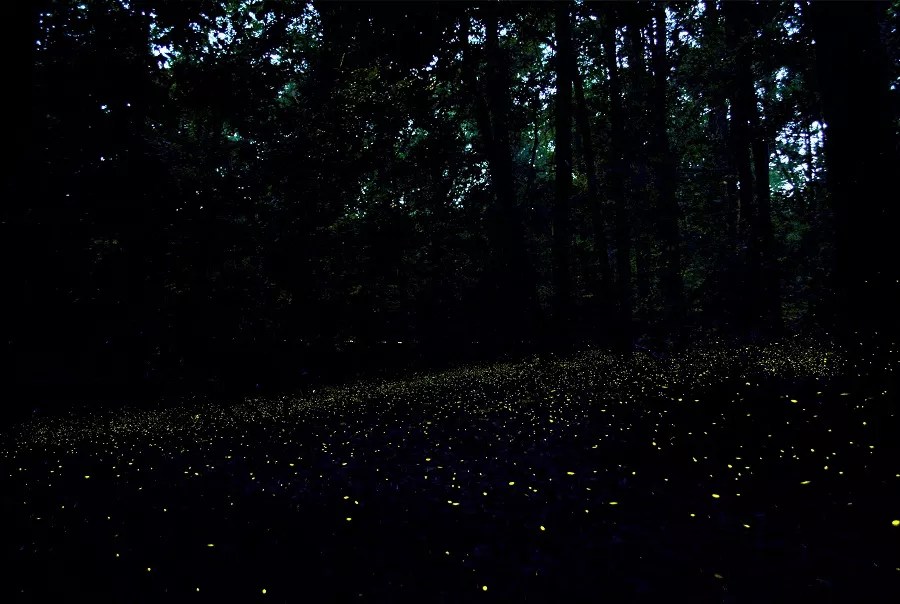
Mid-May to mid-June, synchronous fireflies light up the forest at dusk in Congaree National Park, South Carolina.

I used to love seeing fireflies as a kid, and now they are rare where I live. It makes me sad. What’s it all about? What is to be done?

Dino Grandoni at the Washington Post has this to say about the dangers to fireflies and possible ways to help bring them back.

“As a younger man, Joe Cicero saw ‘thousands and thousands of them.’ Swarms of fireflies put on a soundless fireworks show for him every summer in southern Arizona. The sight of the fireflies flashing in unison was so mysterious and mesmerizing that the entomologist made the study of the flickering insects his life’s work.

“Four decades later, Cicero, now retired, still goes back to those oak woodlands. Today, though, they’re mostly dark. The fireflies have been decimated, Cicero lamented. ‘Down to just a trivial few relative to the big population they had back then.’

“For many Americans, their otherworldly glow signals the start of summer. But across the country, many of these harbingers of summer may be blinking out of existence. What was once a series of tales from old-timers about the decline of fireflies from the days of their youth is coalescing into a disturbing scientific truth.

“Nearly 1 in 3 firefly species in the United States and Canada may be threatened with extinction, firefly experts estimate in a recent comprehensive assessment. … New research is shedding light on how these ethereal insects are struggling to thrive in the brightly lit world we have built around them.

“And the problem is bigger than a single type of bug. … In so many spots where scientists look, insects of all sorts are vanishing, … leading to fears of a potential-though-still hotly debated ‘bugpocalypse,’ which could unravel food webs for birds and other insect-eating animals and cause calamity for farmers who need pollinators to grow crops.

“ ‘I know a lot of people who hate insects. I’ve never met a single person who didn’t like fireflies,” said Sara Lewis, a Tufts University biologist and author of Silent Sparks: The Wondrous World of Fireflies.

“To understand the threats to fireflies, start underground. Fireflies in the United States spend the vast majority of their lives in their larval state, roaming the dirt to consume snails, worms and other soft-bodied grub several times their size. In contrast to their gentle summertime image, baby fireflies are vicious predators.

“But much of the swampy soil young fireflies need to thrive is increasingly being bulldozed for golf courses, suburban subdivisions and other types of development, making habitat loss a top threat. …

“ ‘These wetlands only occur right along the beach along the Mid-Atlantic,’ said Christopher Heckscher, an environmental scientist at Delaware State. … In Arizona, the Southwest synchronous firefly that Cicero studies is being trampled by different threats. Cattle and all-terrain vehicles in Coronado National Forest are stomping out its riverside habitat, he said. …

“When the time is right in the spring, juvenile fireflies seek a spot to pupate. Much like how a caterpillar transforms into a butterfly, a young firefly rearranges its body to turn into an adult. Then they take flight.

“The adults live for only a few weeks — with one thing on their minds. Fireflies flicker at each other to find their mates. …

“Males of certain species work together to woo mates by synchronizing their pulses. Other varieties are more ruthless, imitating the flashes of smaller fireflies to lure them in — and eat them. There are more than 2,000 species of fireflies globally, each doing a different dance.

“Even in the best conditions, males drifting in the air struggle to find females on the ground. ‘Mating success rate in darkness is not especially high,’ said Avalon Owens, a research fellow at Harvard. …

“Increasingly, we’re the ones making it harder. The artificial light we pour into the night is interrupting these bioluminescent courtships.

“To test the impact of light pollution, Owens set up a mating arena on her porch in her home outside Boston in 2020 during the height of the coronavirus pandemic. …

“In a study published last year, Owens and Lewis found exposing a semi-nocturnal firefly species called Photinus obscurellus to a bright light on the porch completely prevented it from mating. Out in the wild, the [researchers] found males of a related species, P. greeni, preferred LEDs meant to imitate females that were bathed in darkness.

“Brightening the night not only makes it harder for fireflies to see each other, it may also trick them into thinking it is daytime, Owens said. ‘It erases their habitat,’ she added. …

“Not every type of firefly is in peril. Some are actually thriving in our well-lit world.

“The big dipper firefly, named for the swooping arc it draws in the sky, evolved to come out at dusk and does not seem to mind modern streetlights. In their field experiments, Owens and Lewis found artificial lighting had little impact on the big dipper’s mating. Plenty can be found in well-lit corners of Central Park in New York.

“For many fireflies, there is a painful lack of data on even baseline populations. While some species remain abundant, overall, we risk the loss of firefly biodiversity. …

“While reversing climate change and other environmental threats is monumentally difficult, saving fireflies from light pollution is relatively easy. ‘You literally can just turn off the light, and the threat is gone,’ said Candace Fallon, a senior conservation biologist with the Xerces Society, a nonprofit conservation group pressing the federal government to extend endangered-species protections to fireflies. …

“For now, firefly aficionados are trying to inspire the next generation. Nearly 30,000 people flock to the Great Smoky Mountains each year to watch the park’s fireflies light up in sync. In Arizona, Cicero stages similar nightwatch parties for the few synchronous fireflies that remain there.”

More at the Post, here.

Read Full Post »

Photo: Eldred Allen.
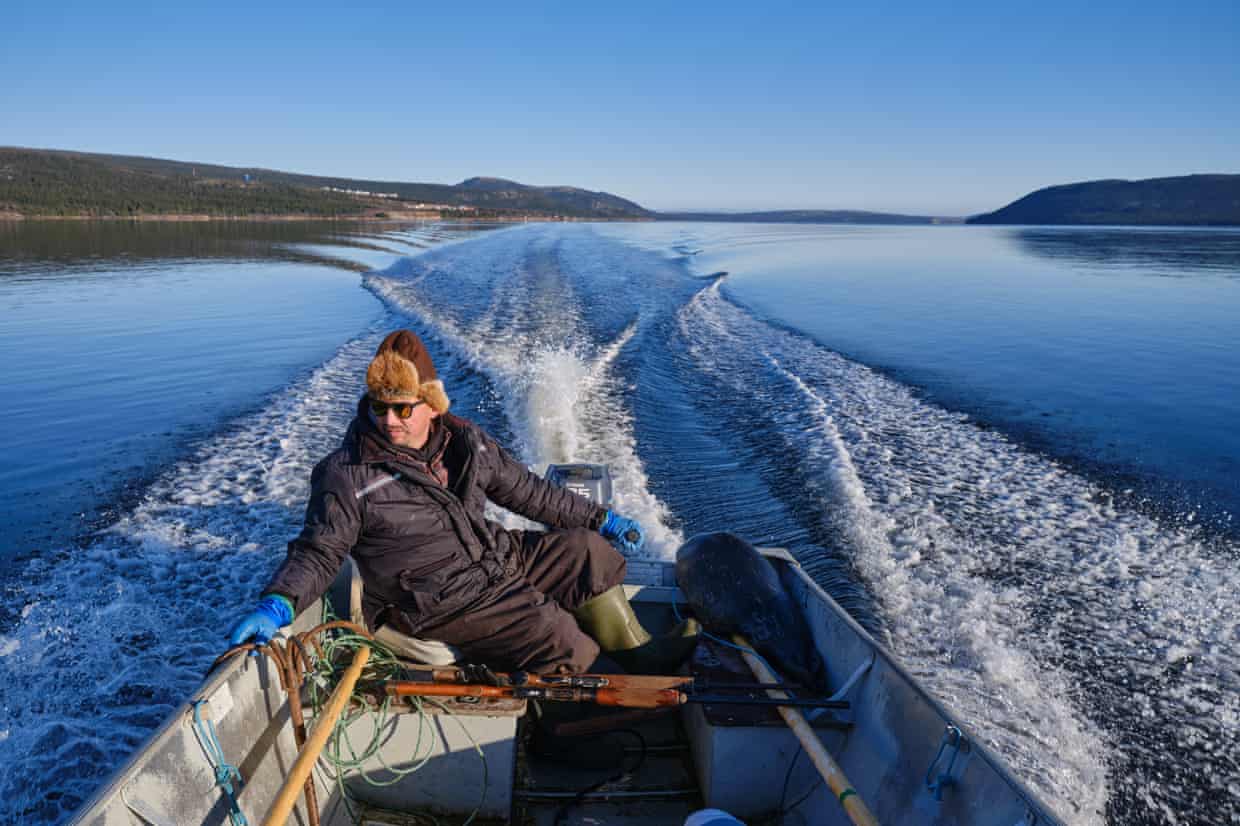
Martin Shiwak, an Inuit, with his hunting rifle in his boat, on Lake Melville, near Rigolet in Nunatsiavut, Canada.

Can you handle another story about how we are finally learning that indigenous ways are better for everyone in a changing climate? I don’t mean we all need to hunt and fish. I’m talking about protecting land and water from resource exploitation.

Ossie Michelin writes at the Guardian that “the environment Inuit have lived in for millennia is changing fast. Canada’s government once ignored Indigenous knowledge of it but now they are jointly creating the Nunatsiavut conservation area. …

“Martin Shiwak accelerates his boat to grab the seal he has shot before the animal sinks out of sight. Shiwak has hunted for years in the waters of Lake Melville, by the Inuit community of Rigolet in Nunatsiavut.

“As he hauls the ringed seal into the vessel, he says he counts himself lucky to have found one so quickly. ‘Sometimes you have to drive around here in the boat nearly all day to find a seal,’ Shiwak says. ‘Nowadays you can’t even afford to – C$60 only gets you five gallons of gas.’

“Nunatsiavut – one of four Inuit homelands in Canada – is where the subarctic becomes the Arctic. An autonomous region of Labrador-Newfoundland province, it is located at the extreme north-east corner of North America.

“Winter temperatures here can average -30C (-22F) with the windchill, as the Labrador current brings Arctic ice floes down along the coast, and a host of marine life from, plankton to polar bears. From November to June, shipping is impossible because sea ice covers the entire 9,320-mile (15,000km) coastline, so all food and supplies must be flown in. In Rigolet, a frozen 1.5kg (3.3lb) chicken will set you back C$25 (£15). Hunting is not just a tradition but a necessity. …

“As a young boy, he learned to hunt and fish with his father and grandfather, who in turn had learned these vital skills from their elders. It is also how Shiwak learned the core Inuit values of taking only what is needed, sharing, sustainability and respect for nature – values he is passing down to his own children. …

“But while traditional knowledge has allowed Inuit to survive in this harsh environment for so long, the climatic conditions they rely on are changing quickly. Since 1950, Nunatsiavut has lost 40 days of ground snow a year. Its sea ice is vanishing faster than anywhere in the Canadian Arctic. …

“There is very little local people can do about that: although the region is roughly the size of the Republic of Ireland, Nunatsiavut’s population is less than 3,000, spread among five small towns. What they can do, however, is work to protect what they have. That’s why Nunatsiavut is partnering with the Canadian government to co-develop the world’s first Inuit Protected Area of this type.

“While there are other Inuit-led marine conservation programs in Canada, this will be the first to bear the title of Inuit Protected Area. … Built on Inuit values and culture, this type of conservation area would allow Indigenous people to continue traditional practices of hunting and fishing.

“That was not always the case. Past conservation policies saw Inuit at best only consulted and at worst completely ignored. Many Inuit hunters and fishers faced fines, had their equipment confiscated and their catches from hunting and fishing taken.

“Despite being granted the power to self-govern in 2005 (after 30 years of negotiations with the Canadian government), Nunatsiavut still lacked the final say over conservation in its waters. Final decisions defaulted to federal or provincial ministers.

“Now, at last, Nunatsiavut can jointly create and co-manage the protected area, based on Inuit priorities, as an equal authority. This will allow Inuit to practice traditional hunting and fishing in the area, while protecting the waters from industry and development.

“ ‘Just because we’re small doesn’t mean we can’t do something,’ says James Goudie, deputy minister of lands and natural resources in the Nunatsiavut government. ‘We can show the world that a small region can protect a massive amount of biodiversity.’

“The Inuit Protected Area would only cover about a third of Nunatsiavut’s nearly 50,000 sq km of offshore waters, but the region is home to important populations of fish such as salmon and Arctic char, the breeding grounds for many migratory birds, and the habitat of Arctic marine mammals including polar bears, beluga whales and seals.

“Establishing a protected area is also a pre-emptive strike against resource exploitation. Significant natural gas deposits have been found offshore along the Labrador shelf, but it has remained largely unexplored because of the ice. As the climate warms, however, the region is becoming more accessible – the Inuit Protected Area would prevent such resource exploration. …

“The borders of the new area have not been finalized, with the feasibility report expected in 2024 or 2025. But [Rodd Laing, Nunatsiavut’s environment director] notes: ‘You don’t need lines on a map to recognize the great work that happened already with Inuit relative to conservation and the management of ecological resources.’

“After all, he says, for countless generations of Inuit, conservation was not an option that could be ignored: it was a way to ensure there would be enough to eat, and enough next time as well.”

More at the Guardian, here. Nice photos. No firewall.

Read Full Post »

Photo: Lakshmi Rivera Amin/Hyperallergic.
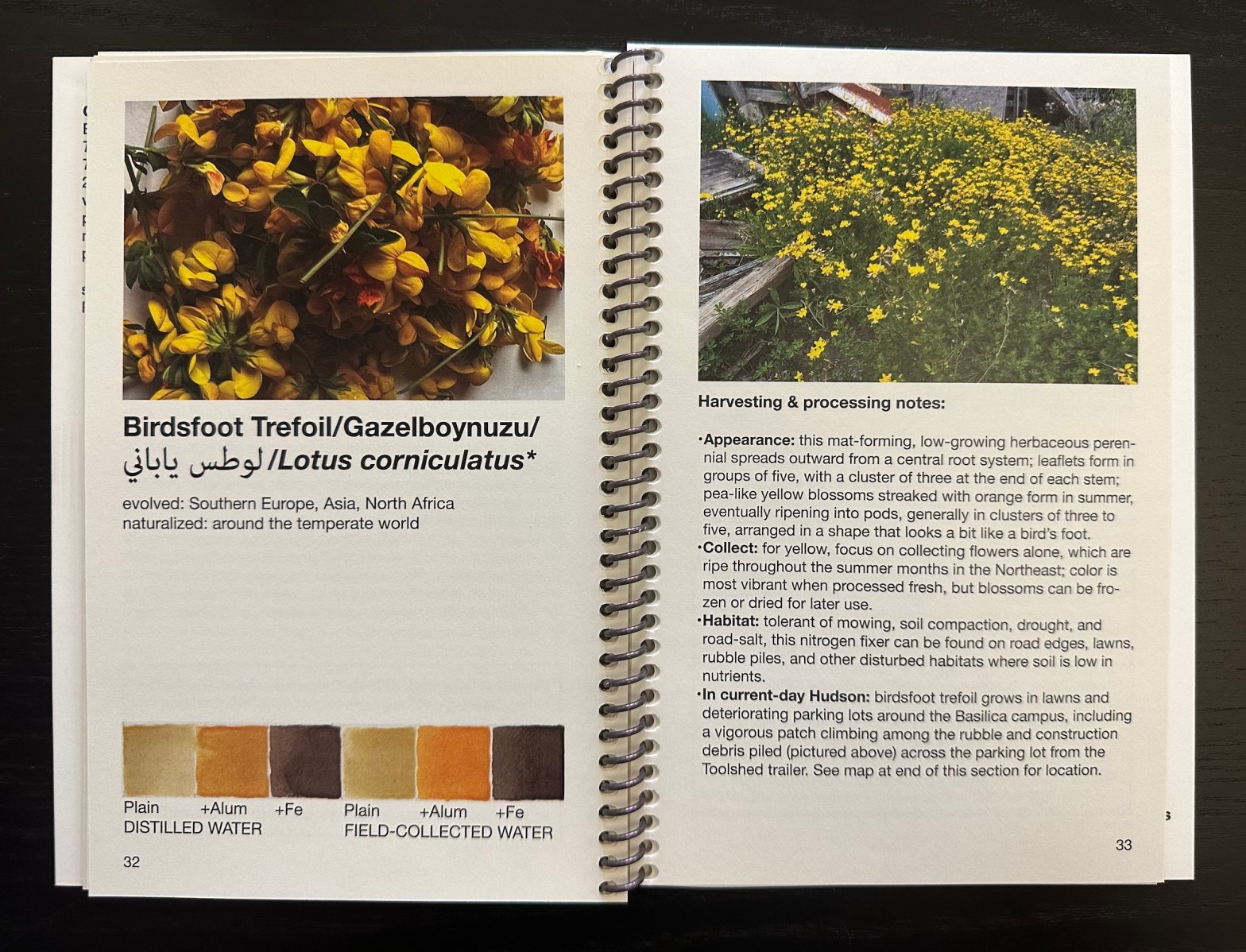
Page spread from Feral Hues, a book by Ellie Irons on making your own paints.

Artistic types are going back to nature for pigments these days. My friend Ann grows special weeds and flowers to make dyes for her beautiful textiles. In today’s Hyperallergic interview by Lakshmi Rivera Amin, we learn about an artist making her own paints.

“Taking the concept of a ‘green thumb’ several steps further, artist Ellie Irons approaches plants as a literal source of color: She creates her watery paintings with pigments tinted by organic hues found in the natural world. These works … record, honor, and reorient our relationship to the vegetation around us, specifically in current-day New York State’s Hudson area.

“I picked Irons’s brain about the process of creating her own paints through harvesting on the occasion of her recent book, Feral Hues: A guide to painting with weeds (Publication Studio Hudson). This interview has been lightly edited for clarity.

Hyperallergic: What is the most joyful part of making your own pigments?
Ellie Irons: There are many joys, which is why I’ve been entranced by the process for so many years: an ever-deepening and shifting connection to urban ecosystems and the land that supports them that emerges through careful, considered harvesting practices; the smells, colors, and textures that reveal themselves when plant parts are processed by hand in the studio; the joy of sharing the process with other humans who also become entranced by the relatively simple act of lovingly harvesting often overlooked weedy plants and creating paint with them; the process of attuning to the cycles of vegetal life sprouting, growing, blossoming, fruiting, [dying] across the seasons and years — there is always something to delight in and harvest, in any habitat, even in deep winter. …

H: How has your practice evolved over the past several years?
“Irons: I would say recently, since maybe 2019, my work has become more locally rooted and grounded. In the decade before that, I found myself investigating plants across urban habitats in a global sense — comparing pokeweed and honeysuckle growing in a parking lot in Taipei with the same species sprouting from a concrete river in current-day Los Angeles, for example.

“I’m still fascinated by those global connections, and find them resonant and relevant, but in recent years my focus and my daily practice have shifted to be more bioregional — I take the Mahicanituck/Hudson River Watershed as a salient range in which to work, connecting with human and plant populations up and down the river from New York City to the Adirondacks. …

“This shifting focus is based on a range of factors, from my increasing discomfort with energy-intensive travel to my new(ish) status as a mother to my day job with a community science and art organization that focuses on hyper-local environmental justice issues, to of course, the ongoing impacts of the pandemic. There are other ways it has changed, of course — writing has become increasingly important to me, as has enduring land-based work (a result of living in a shrinking upstate city where access to soil and open earth is simpler than in New York City, where I started working with plants more than a decade ago).

H: What are your favorite plants to work and be in relation with, and why?
Irons: Perhaps unsurprisingly, I have many favorites, and feel fortunate regularly meet plants who are new to me — my loves change by the season, and across contexts. Right now, in early August, each morning I’m greeted by innumerable, intensely blue Asiatic dayflower … blossoms lining the border of my neighbors’ chainlink fence where it meets the sidewalk.

“The blossoms only last until noon or so, depending on the weather and the intensity of the sun. I take 20 to 30 blossoms most mornings, and store them in a small cup in the freezer, accumulating them until I’m ready to process them into a range of shades of blue.

“I love dayflowers for the way they become unmissable once they catch your eye, and draw you in. They have an unassuming stature, foliage that’s easy to overlook, but when they burst into flower for several hours each morning, the proliferation of electric blue petals — almost sparkling if you look closely — can feel like tiny jewels sprinkled along the sidewalk. …

“Having migrated to the American continent, they live well in cities, where they are sometimes appreciated as a ‘wildflower,’ and are gaining notoriety as a super weed in round-up ready soybean fields, where they’ve demonstrated resistance to the herbicide glyphosate. And in their native China they are being studied as a hyperaccumulator due to their ability to thrive on the polluted soils of old copper mines, absorbing large amounts of heavy metals. …

H: What do you hope anyone interested in approaching plants as material sources for art will first consider and reflect upon?
Irons: I hope people will keep in mind processes of gratitude and respect — of mutual exchange, rather than of taking to satisfy a material need. This can look many ways. Maybe even just asking yourself a few questions before harvesting: Who else might be in relation with this plant, human or more-than-human? What is the plant doing here and why? How long has this plant been here, will they be here tomorrow, or in 100 years?” 

More at Hyperallergic, here. No paywall, but subscriptions are encouraged.

Photo: Ermell/Wikimedia Commons.
Asiatic Dayflower, or Commelina communis.

Read Full Post »

Photo: Arnold Gold/Hearst Connecticut Media via Middletown Press.
Turtles stand on a tire in Pameacha Pond in Middletown on June 30, 2023.

How do people end up protecting wildlife? They are not necessarily longtime nature lovers. Maybe they just work at a dry cleaner.

Cathy Free reports at the Washington Post, “Every summer at Best Cleaners in Middletown, Conn., employees throw open the front and back doors and the slow parade begins. Very slow.

“During nesting season from May through September, turtles ramble into the store, ease their way past the front counter and racks of freshly cleaned jackets and skirts, and crawl for the opposite door.

“They’re among dozens of female Eastern painted turtles on their annual summer migration from Middletown’s Pameacha Pond to lay their eggs at a grassy marsh behind the dry-cleaning store. In late summer and early fall, the trek changes direction, with tiny hatchlings making their way back to the pond.

“To head either direction, the turtles need to cross South Main Street, a busy two-lane road that is part of Route 17.

“Some of the turtles are smashed by cars during their precarious annual journey, so current employees at Best Cleaners decided about five years ago to start saving as many turtles as they could, including the ones they saw wandering around the store and in the parking lot.

“ ‘I believe that people who were at the shop in the years before us also helped out,’ said Matt Dionne, regional manager for Best Cleaners, adding that the Middletown South Main Street location has always opened the doors and windows every summer to help cool things off. …

“Looking down and finding turtles in the shop is pretty common [in July], often several times a week. That’s when the employees know it’s time to help them safely cross the street. …

“The store’s eight employees routinely monitor the parking lot for stray turtles every summer, he said, noting that they’ll gently scoop them up and carry them to where they’re going — either to the marsh or the 19-acre pond.

“ ‘The babies can be as small as a quarter,’ Dionne, 36, said. ‘There’s a good chance they won’t make it across the road by themselves.’

“Assistant manager Jennifer Malon is among those who regularly makes a trip across the road with a turtle or two in hand. She also gives a lift to the occasional snapping turtle, but she makes sure to carry those in a dustpan. …

“ ‘Every summer, we’re always looking at our feet because we don’t want to step on them,’ said Malon, 37. ‘They’re important to the environment.’

“Although painted turtles are the most common turtles in North America and aren’t endangered in Connecticut like bog turtles and spotted turtles, they’re important indicators of healthy ecosystems, said Brian Hess, a wildlife biologist with Connecticut’s Department of Energy and Environmental Protection.

“They’re also vulnerable to land development that imperils habitat and migration paths, he said.

“ ‘An adult turtle might survive a raccoon trying to eat it, but it can’t survive an encounter with a car,’ Hess said. …

“Dionne hopes that rescuing the turtles will give them a better chance to make it to breeding age — usually about age 10 or so.

“ ‘Humans are the ones who built infrastructure around their habit, so we owe it to the turtles to do anything we can to give back,’ Dionne said.

“He and Malon were among those in Middletown who rallied last year to save Pameacha Pond from being turned into a city park. Students from Wesleyan University made an eight-minute documentary about the community’s efforts to keep the centuries-old haven for a variety of turtles, birds and frogs.

“ ‘They were going to drain the water from the pond, then because of the turtles, they decided not to,’ Malon said. ‘A lot of people love the turtles.’ …

“Mac Falco, manager of the Best Cleaners shop in Middletown, said many of his customers can’t imagine a summer without seeing a few slow-moving turtles in the shop when they pick up their dry cleaning.

“ ‘It’s part of the summer experience — everyone thinks it’s wonderful that we’re helping them across,’ Falco said. …

“He and other employees carefully place rescued baby turtles at the top of the pond bank across the street, then enjoy watching them climb down to the water.

“Painted turtles — named for their colorful markings — are often spotted basking in the sun on rocks and logs by kayakers on the pond, Dionne said.

“ ‘They’re fascinating, instinctual little creatures with built-in GPS systems that know where the water is,’ he said. ‘But if for some reason they end up lost in our shop, we’re happy to stop what we’re doing and pick them up.’ ”

More at the Post, here.

Read Full Post »

Photo: Suzanne and John’s Mom.
Wild black cherries are edible. They are more pit than pulp, but they taste good.

It’s been a while since I’ve written a post on foraging, but if you search on the word at this site, you will find a few — like the post about the homeless teen who learned life skills from foraging, here.

Lauren Colella has some new thoughts on the ancient art at Sierra magazine: “Summertime for me brings back childhood memories of backyard harvesting. Inspired by books like My Side of the Mountain, I used to search for edible plants: sassafras for tea, wild cherries for pies, and walnuts for snacking. I learned the hard way that walnut juice stains your hands.

“I didn’t know it, but I was participating in the millennia-old act of foraging. The practice is about more than free food and the thrill of the search — it’s an opportunity to engage with local ecosystems and learn more about the species in your area. …

“While today only a few hunter-gatherer groups live off what they hunt and gather, foraging has been a common human practice for hundreds of thousands of years. Members of the working classes depended on it to supplement their diets up until the 1800s. Thanks to these traditions — along with intel from contemporary botanists and mycologists — modern foragers can access extensive catalogs of edibles, often in the form of handy apps like Forager’s Buddy and iNaturalist. Chances are that no matter where you live, you’ll find naturally growing and uncultivated plants, fungi, and insects to eat.

“When scouting spots, be wary of areas near roads or industrial sites that could be contaminated with pollutants, and avoid harvesting plants near farms or lawns likely treated with pesticides and herbicides.

“Start by seeking out commonly found harvestables — like wild onions, berries, and apples — then carefully cut them from the stem or branch and avoid damaging nearby plants or fungi. Be aware that not all wild plants may be consumed raw. Do your research before popping anything into your mouth.

“While many Americans live within walking distance of edible wild plants such as hawthorn berries, yarrow, dandelions, and chickweed, ‘most people have no clue how useful these plants are in terms of food, fiber, and medicine,’ says Lynn Landes, founder of Wild Foodies of Philly. Among the free online resources listed on her organization’s site, Landes names Plants for a Future as a particularly reliable directory, thanks to its extensive descriptions of plants fit for consumption. She also recommends Eat the Planet because it includes details on bugs and mushrooms to eat and avoid.

Fallingfruit.org maps forageable plants and indicates whether they’re on private or public land. Many universities encourage staff and students to nosh on campus flora. … At the Bay Area’s California School of Traditional Hispanic Herbalism, Charles Garcia passes on wisdom learned from his mother, a curandera (folk remedy healer). Garcia points out that many forageable plants have dual uses, such as stinging nettle, which can be eaten or made into anti-inflammatory salves and extracts, and Pacific blackberry, a tasty plant whose leaves treat diarrhea. …

“Among the Millennial and Gen Z foragers who’ve taken to social media, perhaps the most famous is Alexis Nikole, or @blackforager, an Ohio-based outdoors educator whose Instagram and TikTok feeds abound with recipes and sustainable harvesting guidelines. Nikole touts an “honorable harvest” mindset—collecting only what you need, expressing gratitude by giving back to the earth (like composting), and harvesting only from legally permissible areas. …

“Foraging laws and regulations — generally designed to reduce damage to topsoil and avoid disruption to wildlife and gaps in vegetation where invasive species can flourish — vary by state and dictate what you’re allowed to take. … Volunteering during city parks’ weed-removal days can be a great way to legally source larger quantities of dandelion, mustard, and Japanese knotweed, which are routinely removed before they overpower neighboring plants.”

Check Colella’s Do’s and Don’ts list at Sierra, here, where you can also see her excellent illustrations. No firewall.

Read Full Post »

Older Posts »