Feeds:
Posts
Comments

Posts Tagged ‘postaday’

Racing against the clock, the last fluent speaker of a Native American language records folktales and creates a dictionary.

Jia Tolentino writes at the website Jezebel, “Marie Wilcox, an octogenarian Native American woman from the San Joaquin Valley in California, was born on Thanksgiving in 1933; she grew up in a one-room house with the grandmother who delivered her and spoke her native Wukchumni …

“In this 10-minute mini-doc from the Global Oneness Project, via NYTLive, Marie talks about speaking primarily English to her children, who worked alongside her in the fields for a good part of the year. She started learning Wukchumni when her sister started speaking it again in an attempt to pass the endangered language on to each their kids.

“ ‘I was surprised she could remember all that,’ her daughter says. ‘She just started writing down her words on envelopes. … She’d sit up night after night typing on the computer, and she was never a computer person.’

“ ‘I’m just a pecker,’ says Marie. ‘I was slow.’

“She decided to make a dictionary. ‘Not for anyone else to learn — I just wanted to get it together.’ …

“According to a New York Times piece on this documentary from 2014:

Before European contact, as many as 50,000 Yokuts lived in the region, but those numbers have steadily diminished. Today, it is estimated that fewer than 200 Wukchumni remain.”

Watch the short film Marie’s Dictionary, by Emmanuel Vaughan-Lee, here. I found it moving.

Photo: Emmanuel Vaughan-Lee

Read Full Post »

In a recent Wired article, Sarah Zhang calls the humble tarp “an aid worker’s secret weapon.” I had no idea the amount of work that went into developing a reasonably priced tarpaulin that won’t fray or get too hot.

“Ask an aid worker,” writes Zhang, “and the paeans to tarpaulin come pouring out. Cheap, lightweight, and waterproof, ‘tarpaulin is the most common shelter material,’ says Joseph Ashmore, shelter consultant for the International Organization for Migration. Responders and survivors can use tarpaulin for roofs, fences, and flooring—but don’t limit your imagination to shelter. ‘I’ve seen people dry rice on it, in latrines, as bags, as trousers, as umbrellas,’ Ashmore adds.

“Not all tarpaulin is created equal, though. The Red Cross catalog’s tarpaulin is the crème de la crème of plastic sheeting. … These obsessively engineered 4×6 meter plastic sheets last years, and it all goes back to one French … .

“Patrick Oger was a purchasing officer for Doctors Without Borders when he first got the tarpaulin assignment in 1993. …

“Working mostly alone — while still doing his job as a purchasing officer — Oger completed the specifications for tarpaulins in three years. Since 1996, the Red Cross, UNHCR, Doctors Without Borders, UNICEF, and Oxfam have given out millions of tarps manufactured to those specs. Factories in China, Korea, Vietnam, India, Pakistan, and Kenya churn out the tarpaulin to use all over the world. And they’re cheap, at just $15 a pop in the Red Cross’s catalog. ‘We’ve really made a good product. It is saving money. It is saving lives,’ says Oger.”

Read here how Oger befriended and learned from an engineer at the Danish company where tarps were previously sourced (a company that charged a high price because it had patented the eyelets) and how he kept making technical improvements and testing them.

I like that Oger is still inventing. I’ll never make a blanket judgment about purchasing officers again.

Photo: Reuters/Corbis
Tarps are unloaded for distribution for internally displaced people in Mubimbi, South Kivu, DRC, on March 4, 2013. 

Read Full Post »

Well, here’s a new concept in energy production: braking regeneration.

Diane Cardwell writes at the NY Times, “Along Philadelphia’s busy Market-Frankford subway line, the trains behave like those of any transit system, slowing to halt at the platforms and picking up passengers.

“But more is happening than meets the eye. In an experimental system that is soon to be more widely adopted, every time the trains pull into certain stations, they recover the kinetic energy as they brake and channel it as electricity to battery banks at one of two substations.

“The batteries, managed by software, can then use that power to push the trains back out or to help modulate electricity flows on the grid.

“The system is unusual because the batteries are being used for more than just powering the trains, said Gary Fromer, senior vice president for distributed energy at Constellation, the power provider that will own and operate the system for the transportation authority.

“The electricity savings alone do not justify the battery costs, he said, so it was important to find another source of revenue, which comes from selling energy services to the grid. …

” ‘We don’t have to front the money and we’re reaping both savings and actually money coming back our way,’ said Jeffrey D. Knueppel, general manager of the transportation authority. The base technology of the system, known as regenerative braking, was one of the breakthroughs that allowed for the development of hybrid and electric cars like the Prius.” More here.

This reminds me of my 2012 post on inmates in Brazil who bike to create electricity — and reduce their sentences. And this post from 2013 about lighting schools by playing soccer. All hail to human ingenuity!

Photo: Jessica Kourkounis for The New York Times
The Market-Frankford subway line in Philadelphia is part of a regenerative braking experiment.

Read Full Post »

There is always so much to discover, sometimes right under our feet. That’s why I suspect that archaeology, despite the drudgery, is a happy career.

Washington Post reporter Patricia Sullivan found some happy archaeologists who discovered an ancient ship where a hotel is being built. (Of course, the hotel people are probably tearing their hair out right about now.)

Sullivan writes, “A large, heavy ship, scuttled between 1775 and 1798, is being dug out of its damp grave at the site of a new hotel construction project in Old Town Alexandria.

“Archaeologists found the partial hull of a ship at 220 S. Union Street, part of the city’s major redevelopment of the Potomac River waterfront. It’s on the same one-block site where workers two months ago discovered a 1755 foundation from a warehouse that is believed to have been the city’s first public building.

“ ‘It’s very rare. This almost never happens,’ said Dan Baicy, the hard-hatted field director for Thunderbird Archaeology, the firm watching for historic evidence during construction. ‘In 15 years that I’ve done this work, I’ve never run into this kind of preservation in an urban environment where there’s so much disturbance.’ …

“Digging by hand, archaeology crews uncovered a nearly 50-foot-long remnant of the keel, frame, stern and flooring, estimated to be about one-third of the original hull. The wood did not decay, Baicy said, because once it was buried, oxygen could not reach it. …

“The find has archaeologists surprised and ecstatic. Unlike the warehouse, which was noted in old city records, there was no known documentation of the buried ship’s existence.”

More at the Washington Post.

Photo: Kate Patterson/The Washington Post
Remnants of a late-18th-century vessel were discovered during excavations for a new hotel on the Old Town Alexandria waterfront.

Read Full Post »

In Bolivia, an indigenous woman who would have been disenfranchised before the presidency of Evo Morales has become a popular wrestler. And  she loves what she does.

connects with Angela La Folklorista in La Paz to report her story at WBUR’s Only a Game.

“She calls herself, ‘Una mujer de la pollera.’ Woman of the skirt. That’s another way of saying ‘I’m a cholita.’ Cholitas are indigenous women of Bolivia, usually ethnically Quechuan or Ayamaran. You can recognize cholitas by their ankle-length puffy skirts and their tiny bowler hats, which seem like they’ll fall off any minute. …

“Until recently, cholitas were second-class citizens, boxed out from higher education and often stuck cleaning homes,” generally relegated to the kitchen.

“Where Angela works is nothing like a kitchen.

” ‘In the ring,’ Angela says in Spanish, ‘I have a technical fighter style. I’m not rough. I’m on the nice side. There are bad cholitas, as you would call them, but my style is technical.’

“Angela is a cholita luchadora — a Bolivian pro-wrestler. She fights in a league similar to Lucha Libre in Mexico or the WWE in the United States. It’s the kind of wrestling with heroes and villains, entrance songs. Angela gives me two ringside tickets for the upcoming bout in El Alto – La Paz’s sister city. She’s the headliner. …

“Angela doesn’t fight other women. She fights the men. There’s some weird sexist stuff happening, but by the end of the match Angela is always the winner. …

“ ‘I’m very happy and content to have another night of fighting,’ she says in Spanish, ‘another night of art, adrenaline and strength, another night that I’m in the center of the ring, happy, doing what I like most.’ She’s covered in sweat.

“ ‘Mi madre es luchadora,’ Angela’s middle-school aged daughter Theresa says.

“ ‘It’s a pleasure for me that she’s a wrestler,’ Theresa says in Spanish, ‘I’m very proud of her, I’m her number one fan.’

“Theresa describes the cholitas luchadoras as one of the Seven Wonders of the World. But she doesn’t want her mom’s job. It’s too dangerous for her. And unlike the cholitas who came before her, Theresa can choose her own dream.”

More here.

Photo: Trevin Spencer/Only A Game
The cholitas luchadoras of El Alto. Angela La Folklorista is on the far right.

Read Full Post »

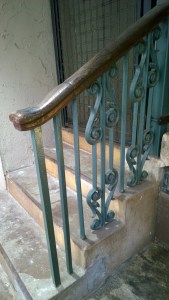
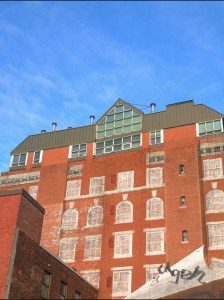
I’m starting off here with four Providence photos: the railing at the Arcade, a message promoting the city as the “creative capital,” trompe l’oeil windows on a brick wall (note the page turning in the lower right corner), and a frieze near the Dean Hotel harking back to a club called Ginger’s.

Next we have three views of Minuteman National Park in Concord on a springlike February day. Seated on the river bank close by was a solitary figure sending wistful melodies from his wooden recorder out over the flood. I hesitated to disturb him and didn’t take a picture.

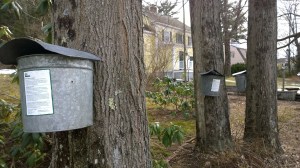
Buckets for maple sugaring are appearing all over town. It isn’t really spring yet, though: the daffodils came from the supermarket.

022316-railing

022216-pvdnooksandcrannies


022216-not-real-windows-Prov

022316-Gingers-in-Providence


022516-Concord-Minuteman

022516-Minuteman-National-Park


022516-North-Bridge

022116-maple-syruping


021416-daffodils


Read Full Post »

My friend Kristina is an artist with a long-time interest in shells. At a Harvard-based shell club that she frequents, she meets many interesting artists and scientists — including George Buckley, a Caribbean coral reef researcher who made the video below.

Buckley says, “Little did I know in 1976 that my first visit to Bonaire to study land snails … and dive with Captain Don Stewart would lead to a career interconnected with Bonaire and to some 100 more return trips!

“Bonaire became the focus of case study after case study of marine management and biodiversity in my Harvard University environmental management program. [Dozens] of research and study groups, students, magazine writers and photographers that I brought to the island all fell in love with the landscapes and the emerald sea of Bonaire.

“The early years of the Bonaire Marine Park [BMP] and STINAPA [Dutch acronym for national park] … were a great adventure and while my efforts with the Carco Project and Marecultura were not as successful as hoped, both helped to lay the groundwork for future efforts around the world as to best practices in that field.

“The BMP’s pioneering leadership in education, moorings, gloves policies, banning light sticks and spearfishing, creating the ‘Nature Fee’ and so much more led to Bonaire’s well-deserved world-wide recognition. The efforts to save Klein Bonaire were a testament to international collaboration and stand to this day as the Hallmark of what a committed group of concerned people can accomplish. It is indeed true that Bonaire is to conservation of nature as Greenwich is to time – with credit to Captain Don.”

If you are on Facebook, check out the rest of Buckley’s post.

Photo: Sand Dollar in Bonaire


Read Full Post »

Over at the Brain Pickings blog, Maria Popova has a review of a book that features photos of famous meals in fiction.

“Food and literature have a long and arduous relationship … But nowhere does that relationship come alive more vividly and enchantingly than in Fictitious Dishes: An Album of Literature’s Most Memorable Meals  … an ingenious project by designer and writer Dinah Fried, who cooks, art-directs, and photographs meals from nearly two centuries of famous fiction. Each photograph is accompanied by the particular passage in which the recipe appeared, as well as a few quick and curious factlets about the respective author, novel, or food.

“The project began as a modest design exercise while Fried was attending the Rhode Island School of Design a couple of years ago, but the concept quickly gripped her with greater allure that transcended her original short-term deadline.

“As she continued to read and cook, a different sort of self-transcendence took place. [Although] a near-vegetarian, she found herself wrestling with pig kidney for Ulysses and cooking bananas eleven ways for Gravity’s Rainbow. …

“All of Fried’s photographs are immensely thoughtful (Ishmael’s austere dinner from Moby-Dick is not only a nautically appropriate serving of clam chowder, but also appears lit by candlelight), and some bear a distinct undertone of cultural meta-satire (representing A Confederacy of Dunces is the ultimate edible Americana, a hot dog on a classic All-American diner tablecloth).”

Check out Popova’s review here, and revel in photographs that include Sylvia Plath’s avocado and crabmeat salad, Oliver Twist’s request for “More,” Proust’s petite madeleine, Alice’s Mad Tea Party, and Heidi’s toasted cheese.

Photo: Dinah Fried
“On buffet tables, garnished with glistening hors-d’oeuvre, spiced baked hams crowded against salads of harlequin designs and pastry pigs and turkeys bewitched to a dark gold.” — The Great Gatsby, by F. Scott Fitzgerald, 1925

Read Full Post »

Clay Scott recently reported on the radio show Living on Earth that the 2015 drought in Montana forced black bear families into areas with cars and other dangers — orphaning many cubs.

“The hot dry summer meant not a lot of berries, and that in turn meant that many bears had to forage far from their normal territory. Quite a few of those wandering bears ended up being shot, or hit by cars.

“And that means there were a lot of orphaned black bear cubs this year. Like the one a friend and I saw when we were driving down a dirt road on the prairie, miles from suitable black bear habitat. At first, as it scurried through the grass, it looked like a black lab puppy. Then it scampered up a power pole.”

Scott called Brady Murphy, a game warden. Murphy, in turn, called two other wardens whom he knew to have tranquilizer darts.

As Scott explains, “Game wardens in Montana cover vast territories. Teigan Winters is driving 50 miles to get to where we are. Kqyn Kuka is on her way from north of Great Falls – that’s an hour and a half drive. I ask Murphy why, in the middle of hunting season, three wardens would converge on a power pole in the middle of the prairie to tranquilize a black bear cub.”

Murphy replies, “You don’t do this job to get rich. You do it because you love the resources and you want to protect them. And you have that strong passion.”

The wardens create a firecracker-type explosion to get the bear to come down the pole, and when he does, they use the dart.

“They lay the cub carefully in the back of the pick-up. It turned out to be a male, less than 25 pounds. He’ll spend the winter at Montana Wild, the wildlife rehab center in Helena, and will be released next spring.”

More at Living on Earth, here.

Photo: Sarah Hewitt
A black bear cub perched atop a power pole.

Read Full Post »

What is going on with the oceans? Warming trends are bringing sea creatures further north and for longer periods.

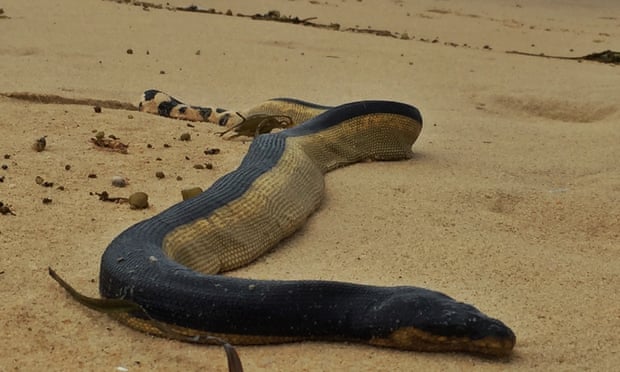
In January, Oliver Milman reported at the Guardian about a sea snake with a suggestive name (“Why you yellow-bellied sea snake, you …!”) that has suddenly shown up in California.

“California beachgoers have been urged to steer clear of a species of highly venomous sea snake following a third, and unprecedented, instance of an aquatic serpent washing up on to the state’s beaches.

“A 20-inch yellow-bellied sea snake was discovered on a beach near San Diego … The sighting was the third reported instance since October of the species, which prefers the tropical waters of the Pacific and Indian oceans, washing up on California’s beaches.

“The only previous verified sighting of a washed-up yellow-bellied sea snake was in 1972. Experts believe the snakes have ridden a warm current of water, fueled by the exceptionally strong El Niño climatic event, farther north than they have ever previously ventured. …

“ ‘It’s been an incredibly interesting year for southern California. We’ve seen tuna and marlin and tropical bird species such as red-footed boobies,’ said Greg Pauly, curator of herpetology at the Natural History Museum of Los Angeles County. …

“Yellow-bellied sea snakes are fully aquatic snakes capable of swimming vast distances. Although they are highly venomous, their targets are small fish and it’s thought they have yet to cause a recorded human death. However, Pauly said people should keep their distance if they encounter another washed-up snake.

“ ‘They are fairly docile and it’s unlikely for someone to be envenomated,’ he said. ‘It’s rare for them to bite people, it’s usually fishermen who are carelessly pulling up fishing nets.’ ”

More here.

Photo: Carolyn Larcombe/Wandiyali Images
Seen in California after el Niño, yellow-bellied sea snakes usually live in the deep waters of the Pacific and Indian oceans. 

Read Full Post »

In a Washington Post story last month, described how Reddit helped in the identification of a very rare atlas.

“A reference librarian at the National Library of Norway came across an old Ottoman atlas in the collections there that seemed perfect for a Reddit board devoted to the appreciation of maps. Weeks later, he figured out that the map in question was a previously-unknown copy of one of the rarest atlases in the world: the Cedid Atlas.

“The librarian, Anders Kvernberg, otherwise known as Reddit user PisseGuri82, posted an image from the atlas to r/mapporn  … He simply identified the map — which he pieced together from scans of different pages from the atlas — as an Ottoman world map from 1803. …

“The atlas went back into the library’s collections, where it would have stayed, ignored, had Kvernberg not seen a post two weeks later from another r/mapporn user who posted an Ottoman map of Africa from the same year. …

“As Kvernberg learned more about the rare book, the Library of Congress’s page scans started to look very familiar. ‘Then I realized this was the very same atlas I had held in my hands a few weeks earlier,’ Kvernberg wrote on Reddit.

“ ‘I ran off to tell our expert on maps, Benedicte Gamborg Briså, that I had something I thought she should take a look at,’ Kvernberg told The Post. …

“Briså told The Post that the National Library of Norway’s copy of the Cedid Atlas is the 15th known surviving copy — 14 others are held by various libraries around the world.”

Read the whole saga here. Three cheers for highbrow Redditors!

Photo: Nikolaj Blegvad, The National Library of Norway

Read Full Post »

If you walk frequently in the same area, you notice more things.

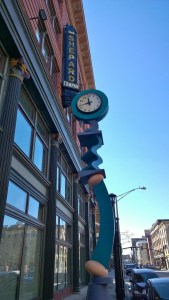
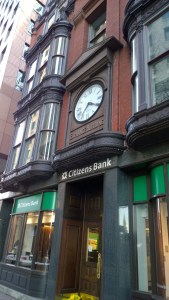
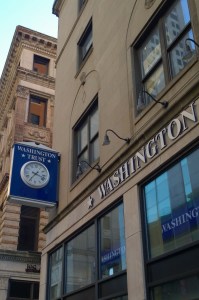
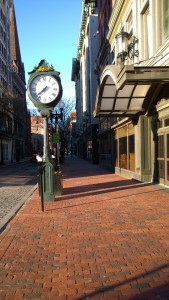
The other day it occurred to me that Providence has an unusual number of public clocks — and they all have the right time.

The clocks below are in a block or two of one another.

I wondered about the green freestanding clock with curlicue writing spelling out “Shepard.” An Internet search brought up the Providence Architecture website at Brown University.

“A historic, notable element of the Shepard Building is the late 19th century cast-iron clock, which still stands in front of the building on Westminster Street.”

And the Shepard Building? Turns out it’s a former department store that once covered a whole block and now houses the downcity campus of the University of Rhode Island.

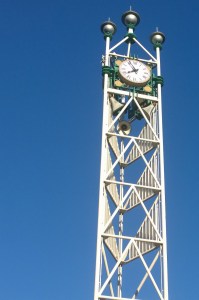
The very tall clock is at Johnson & Wales University. My favorite clock is the one that looks like something from Alice in Wonderland. It suggests to me that although “the time is out of joint,” it will all be OK in the end.

021716-time-is-out-of-joint

021816-clock-Citizens-Bank


021816-clock-Wash-Trust

021816-Westminster-St-clock


021916-JWU-clock


Read Full Post »

The view from my former office included a spectacular sunrise over Boston Harbor, but I also like the more human scale of my current view.

The new office is up two stories. Birds congregate in the tree outside the window. I will be watching as the buds start to open in a few weeks.

I check out the people on the street while I eat my lunch — what they are carrying, what they are doing.

Here is a woman standing in a doorway, having a lengthy conversation on her mobile phone. She has long blond hair and a camel coat. Here is a man clambering from the backseat of a car (an Uber ride?) lugging two grocery bags and several large buckets of what looks like salsa. Here is another man wearing no coat despite the cold weather, remonstrating with someone just ahead of him on the crosswalk.

A woman and man are walking down the side street. They pause. I think they know each other. She seems to be writing something on a piece of paper.  She gives it to him.

She touches his arm in a kind way. They separate. Oh. Maybe it wasn’t a note. Maybe it was money. I’m deciding they didn’t know each other. He is looking in the window at Dunkin Donuts, swinging some keys. Will he go in and buy something with the money? No. He crosses the street in a desultory way, addresses a young woman who rushes by, looking back once. He ambles out of my view, swinging the keys.

A man with a yellow puffy jacket and a black cap is sweeping debris into a dustpan near the Dunkin Donuts. I recently saw someone else dressed like him in the neighborhood. I conclude they are part of a city cleanup crew.

I didn’t get a photo of the Providence police car outside the Dunkin Donuts. Perhaps another day.

021716-from-office-window

Read Full Post »

021916-Doorway-takes-flight-Prov


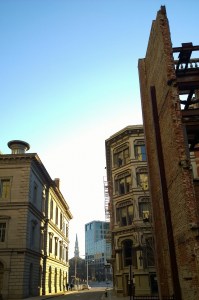
I really like the architecture in downtown Providence, otherwise known as “downcity.” I like that the façades of old buildings are often preserved to enhance next-generation buildings and that some old buildings are adapted in their entirety for new purposes. Even if a building is rather pedestrian, some artist will add a flourish.

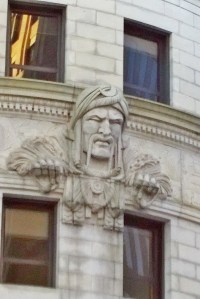
And isn’t it great to live in the time of the Internet and be able to find answers to almost anything that’s puzzling? For example, what’s with the guy wearing a turban on one downcity building?

Well, Wikipedia says that in the early nineteenth century, a shopkeeper called “Jacob Whitman mounted a ship’s figurehead above his store. The figurehead, which came from the ship Sultan, depicted the head of an Ottoman warrior. Whitman’s store was called ‘At the sign of the Turk’s Head.’ The figurehead was lost in a storm, and today a stone replica” is found on Turk’s Head Building’s building’s 3rd floor façade.

Wikipedia also notes that when the 16-story building was completed in 1913, it was the tallest in the area and considered a “skyscraper.”

021816-distant-steeple

021816-facade-Providence


021716-walk-this-way

021816-Turks-Head-Providence

Read Full Post »

I often think that malls today are wasted space. Public places sheltered from the elements, they could be used so much better than they are. When Suzanne was 18 months or so, East View Mall was my favorite place for having her work off steam. She loved toddling up and down the aisles and looking at all the sights. Everyone fussed over her, which meant her sometimes wall-climbing stay-at-home mom enjoyed much-needed adult conversation.

Lately, if outdoor walking is too wet or icy, I may choose to take my morning walk in Providence Place. I think other people could consider the mall for walking and toddler entertainment. And malls themselves could promote more uses since they must now compete with online shopping and a renewed preference for small boutiques. Cities could help malls fund certain public activities.

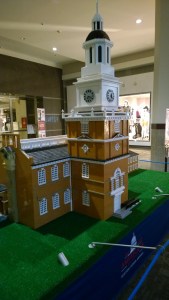
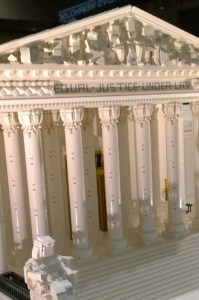
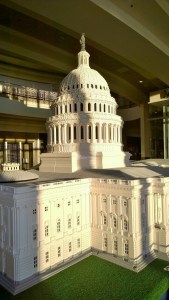
I was quite surprised on my Friday walk to find a traveling exhibition of elaborate Lego creations in Providence Place. Lego is advertising itself while also sharing a little history of government in the United States.

So as unnerving as it was to see our beloved Independence Hall surrounded by flashy clothing stores and run-amok consumerism, I’d rather feel the inspirational vibes from Independence Hall there than not.

In addition to Philadelphia’s most beloved landmark, note the Supreme Court, the Statue of Liberty, and a gigantic recreation of the Rhode Island statehouse. These photos represent only a sample of what is there until the show moves on to another state capital. Meanwhile, there is also a nice Lego play area for kids to make their own constructions.

(Isn’t it funny how a Lady Liberty made of Legos makes my fuzzy photography doubly pixilated?)

021916-Lego-Lady-Liberty

021916-Lego-Independence-Mall-Prov-Place


021916-Lego-US-Supreme-Ct

021916-lego-RI-Statehouse


Read Full Post »

« Newer Posts - Older Posts »