Feeds:
Posts
Comments

Posts Tagged ‘poverty’

An obvious barrier for single mothers who want a good education is lack of day care. Some high schools help low-income moms with that, but not many colleges. Kirk Carapezza writes at WGBH radio about one college that is leading the way.

“Twenty-three years ago, when Endicott College President Richard Wylie set out to subsidize room, board and childcare for single teenage mothers at this small, four-year private college in Beverly, Massachusetts, he met some resistance. …

“What Endicott decided to do was admit ten low-income single mothers each year, providing them with housing, meals, and childcare. Today, Endicott’s Keys to Degrees program costs the college about half a million dollars a year. It’s an expensive program for a school with a relatively small $65 million endowment, but Wylie says the school has a moral and professional obligation to help single parent students.

“ ‘We’re not here just to educate the brightest and the most privileged,’ Wylie said. ‘If I can send my football team out of the country to play, why can’t we do more?’

“College is usually an opportunity for students to get ahead and improve their lives. But that promise can lead to disappointment for low-income parents if they can’t find affordable, high-quality childcare. According to the Institute for the Women’s Policy Research, only 17 percent of college students with children graduate within six years. …

“A new poll from NPR, the Robert Wood Johnson Foundation and the Harvard T.H. Chan School of Public Health finds more than 70 percent of parents say the cost of childcare is a serious problem. And experts say that cost can prevent students with children from graduating.

” ‘Childcare and taking care of your kids can be a major barrier in terms of completion,’ said Gina Adams, a senior fellow at the Urban Institute. Adams says more schools focusing on serving student parents could positively affect the economy, since most jobs created after the recession require more than a high school degree.

“ ‘Education absolutely is a route out of poverty for low-income parents and for their kids,’ Adams said. ‘But if they have kids and we don’t provide them with the opportunities to make sure that their children are well cared for, then they are unlikely to enroll or be able to succeed.’ ”

More at WGBH radio, here.

Photo: Kirk Carapezza/WGBH
Sarah Schuyler, a junior at Endicott, and her son Asher play in their dorm room after class.

Read Full Post »

Photo: Star Tribune
Ojibwe poet Jim Northrup

I have been trying to learn something about tribal cultures in the United States. I liked Spokane/Coeur d’Alene tribal member Sherman Alexie’s Thunder Boy (a charming picture book for young children) and The Lone Ranger and Tonto Fistfight in Heaven (an early, painful collection of short stories). Now I am reading some Native American poetry.

One poet, Jim Northrup, recently died. Here is a beautiful obit by Jana Hollingsworth in the Duluth News Tribune.

“Jim Northrup was a ‘tough man’ who taught his eldest sons to survive in the elements by living in a tepee on the Fond du Lac Reservation for several years, when money and jobs were scarce.

“But it was more than physical survival, said his son, Matthew, on Tuesday, the day after his father died from cancer-related complications. He taught them how to be strong in a world that didn’t treat everyone the same, he said, using humor — and education — as tools.

” ‘ “When you have really nothing else,” he said to me a lot, “you have your humor,” Matthew said. ” ‘When you grow up poor on the rez and when you grow up a lower class in society, you realize that.’

“Northrup, an award-winning writer of books, columns, plays and poetry — and a prominent member of the Fond du Lac Band of Lake Superior Chippewa — died [in July]. He was 73.

“Northrup was a storyteller, known for his stark and honest writing about his experience as a U.S. Marine in Vietnam and his early years at a federal boarding school. He was funny and pointed in his writings about everyday life on the reservation, politics and change in Indian Country. He wrote as a way to heal himself from some of the trauma he experienced during the war, he said earlier this year.

” ‘I knew my poetry was being used in vets’ groups to help people open up (and) maybe even write their own poetry as part of their healing,’ he told the News Tribune in March. ‘It worked for me, so I hoped it helped (others).’ ”

More here, where you can hear Northrup read a poem in Ojibwe about passing along the culture. Read the whole obit. It’s really lovely. I hated to cut it.

Read Full Post »

Laura Bliss at the Atlantic‘s City Lab has a story on young people you may have seen performing in a New York subway car. She reports that in the film We Live This, the teens’ hopes seem hemmed in by poverty.

“ ‘Showtime’ dancing is a hallmark of the New York City transit scene,” writes Bliss. “Hoping for donations, crews of young black and Latino men perform exuberant choreographies for subway passengers, twisting and leaping from pole to pole with artful ‘lite-feet‘ dancing in between—and never before shouting, ‘It’s showtime!’

“Who are these dancers scraping by on their earnings? A new, short cinéma vérité documentary, We Live This, shines a light on the world of one crew, whose four young members perform on the J train. They are talented, hardworking, committed, and full of dreams, the film shows. But for some, the obstacles are high, and the alternatives slim. …

“Forty, is homeless.

‘As I’m dancing on the train, I’m thinking about where am I sleeping at night,’ he says. ‘Who should I call? Who is going to pick up? What if they don’t answer?’

“Showtime is the best way he he knows to a better life, a way into a community, he says. …

“Of course, the subway is no simple launchpad to success. While some passengers love the dancing, many others avoid eye contact, and some even yell at crews to switch cars. …

“ ‘I hope people will watch this and look at these young men as human beings,’ the film’s director, James Burns, tells CityLab. ‘And see the last vestiges of a culture that may be dying out.’ ”

More.

WE LIVE THIS – OFFICIAL TRAILER from HAYDEN 5 on Vimeo.

Read Full Post »

Dan Holin, who used to run a Concord-Lowell volunteer partnership called the Jericho Road Project, is now director of special projects at UTEC in Lowell. (UTEC doesn’t use the longer title its youth founders originally came up with, but since people ask, it was United Teen Equality Center.)

UTEC describes itself as a nonprofit that “helps young people from Lowell and Lawrence, Mass., trade violence and poverty for social and economic success. It works to remove barriers that confront them when they want to turn their lives around and offers young people paid work experience through its social enterprises: mattress recycling, food services and woodworking.”

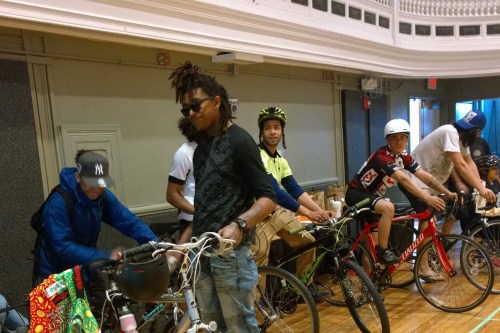
On May 15, Acton’s Pedal Power joined members of the Concord-based Monsters in the Basement bicycling club to share their bike-repair expertise with young people who wanted to acquire bikes and learn to maintain them. Holin, a serious biker himself, organized the event to give UTEC young people two things that he said they normally lack: transportation and fun.

At the event, one of them, Sav, recounted his story of change. Before UTEC I never talked to anyone,” he said. “I was a problem child on the streets. I was hanging around with gangs, selling drugs. I don’t do that now. Seven months ago, I moved from a place with nothing positive. Atlantic City. I let my family know I’m ready to live life. It was hard for me to get into something good: I’ve got a lot of tattoos and a record. But I’m in the culinary program here. It’s a family. They make you feel like you are somebody that has a chance. They give me love like a family. They changed my life for the better. There are so many new things to do here. Yesterday I went kayaking.”

More here.

Sav, in sunglasses, got a good bike at UTEC’s bike event in Lowell on May 15. The bike will provide transportation to his job at UTEC. It will also provide some much needed fun.

051516-UTEC-bike-clinic.jpg

Read Full Post »

Some initiatives that are costly up front have benefits that far outweigh those costs but don’t show up for years. Even then, people may disagree about what caused the outcomes.

One such initiative sends nurses to new mothers who are young, poor and often friendless to help ensure that their babies get a leg up in life.

At the Washington Post

“A high school senior learns that she’s pregnant — and she’s terrified. But a registered nurse comes to visit her in her home for about an hour each week during pregnancy, and every other week after birth, until the baby turns 2. The nurse advises her what to eat and not to smoke; looks around the house to advise her of any safety concerns; encourages her to read and talk to her baby; and counsels her on nutrition for herself and her baby.

“This kind of support, with trained nurses coaching low-income, first-time mothers, is among the most effective interventions ever studied. Researchers have accumulated decades of evidence from randomized controlled trials — the gold standard in social science research — following participants for up to 15 years. They have consistently found that nurse coaches reduce pregnancy complications, pre-term births, infant deaths, child abuse and injury, violent crimes and substance abuse. What’s more, nurse coaches improve language development, and over the long term, cognitive and educational outcomes.

“Nurse coaching is a vital tool that addresses both the liberal concern about income inequality and the conservative concern about inequality of opportunity. …

“Still, nurse coaching reaches only 2 to 3 percent of eligible families. Which raises the question: if it’s so successful — and people on both sides of the aisle support it — why can’t it be scaled to reach every eligible family?”

There are two stumbling blocks according to the reporters: First, funding must be cobbled together from numerous unpredictable sources; second, the costs are up front, whereas the benefits to government and society appear over time.

“If nurse coaching were fully scaled to reach every eligible family, the costs to state and federal governments would outweigh the savings for the first five years. But then the savings would start to outweigh the costs. Over 10 years, the net savings would be $2.4 billion for state governments and $816 million for the federal government.”

So the question becomes: do we have the patience? More here.

A similar initiative that Suzanne started supporting when she lived in San Francisco focuses on homeless mothers. Read about the great results of the Homeless Prenatal Program here.

Photo: iStock
When nurses coach low-income moms, their babies benefit.

Read Full Post »

A certain community organization that believes in the importance of affordable housing also believes in the importance of community. That is why it fosters numerous community-building initiatives, including the new Sankofa farm and market.

Leigh Vincola at ecoRI reports from Providence.

“If you have traveled around the city’s West End this winter, you may have noticed a number of buildings going up rather quickly. Wondering what they are and who they belong to?

“The answer is Sankofa, a Ghanaian word meaning to go back, get what is yours and make positive progress in the future. The Sankofa Initiative of the West Elmwood Housing Development Corporation (WEHDC) is doing just this.

“The initiative was born in 2011, when the WEHDC completed an extensive survey of West End residents that determined their primary concerns centered around health and food. In a predominately low-income neighborhood — 32.5 percent of households live below the poverty level — the survey determined that for many the West End is a food-insecure neighborhood. There isn’t enough access to fresh food, and particularly food that is culturally relevant to the immigrant populations that make up the community, primarily Central American, West African and Southeast Asian. …

“Sankofa is a response to these needs, and has three main elements: an affordable housing development, a large-scale community garden and a weekly World Market. The $15 million project is funded by Rhode Island Housing and work is underway on all aspects.” Read up on the amazing range of positive efforts here.

According to the market’s Facebook page, things will get going for spring with a “pop-up market May 7th, from 12pm to 4pm at Knight Memorial Library on Elmwood Ave. There will be art, bath and hair products, handmade jewelry, homemade candles, fresh food, FREE seeds, henna, giant bubbles and much more.”

Photo: Sankofa Initiative
The Sankofa World Market is a local farmers market with international flavor.

Read Full Post »

Here’s an idea that could give a welcome boost to underprivileged children: a free connection to the Internet at their home.

It seems that Google, in the spirit of its discontinued motto “Don’t be evil,” is piloting a new public service.

Matt Hamblen at Computerworld reports, “Google Fiber [recently] announced free gigabit Internet service to residents of selected public housing projects connected to its fiber optic service in U.S. cities.

“The program was launched at West Bluff, an affordable housing community in Kansas City, Mo., where 100 homes have been connected to Google Fiber. Across the Kansas City area, Google is now working with affordable housing providers to connect as many as nine properties that could reach more than 1,300 local families.

“Google described the program as an extension of its work with ConnectHome, an initiative of the U.S. Department of Housing and Urban Development (HUD) and the Obama administration. …

“In addition to free Internet, eligible residents will work with ConnectHome partners like Connecting for Good and Surplus Exchange to be able to purchase discounted computers and learn new computer skills, Google said.” More here.

Depending on what the housing developments are like to live in and whether they provide supports like the Family Self-Sufficiency program to move people to independence, this could be a useful piece of the difficult poverty-reduction puzzle. So, good on Google!

Photo: ConnectHome 
A resident of West Bluff in Kansas City and her son are among the first of 1,300 families in area affordable housing units to receive Google Fiber gigabit Internet service at no cost.

Read Full Post »

One of the better aspects of the 2015 Massachusetts Conference for Women was hearing speakers like Candy Chang, an artist who engages ordinary people in public discourse.

At the December conference, Chang focused on Neighborland, a service co-founded with Dan and Tee Parham, that helps “residents and organizations collaborate on the future of their communities.”

This is how it works. Organizations start by posing a question. For example, they might hand out cards that say, “I want [blank] in my neighborhood,” and a resident might write in, “a night market.” Next, using Neighborland tools, ideas are collected from workshops, public installations, SMS, and Twitter. They are then discussed and voted on. The website says Neighborland has “sophisticated moderation, clustering, and de-duplication tools for organizers to aggregate all of the data from residents. Our reports make it easy for organizers to see trends in the data, make decisions, allocate resources, and keep participants involved in the fun part – making their neighborhoods better places.”

In this example, National Gardening Association’s Jenna Antonio DiMare reports on Adam Guerrero,  his Memphis, Tennessee, team of blight-busting ″Smart Mules,″ and their efforts to create a greener and more sustainable city.

“During the month of October, National Gardening Association (NGA) partnered with Neighborland to challenge Memphis residents to propose innovative projects to make their city and neighborhoods more sustainable. With a $1,000 grant awarded to the most promising project, Neighborland’s simple platform empowered local Memphis residents to ‘connect and make good things happen.’

“Despite receiving many inspiring project proposals, from founding an urban agriculture school to growing a newly established community garden, it was clear to NGA that the ‘Smart Mules’ project would have the greatest impact with the $1,000 award. …

″ ‘We are fighting [urban] blight, raising neighborhood morale, engaging our local government, and investing in a future for the neighborhood, all at the same time,’ writes the ‘Smart Mules’ team. To accomplish these goals, ‘Smart Mules’ provides work for many young, at-risk males who have been ‘largely dismissed’ or disenfranchised, according to team leader Guerrero.” More here about the work these young men are doing for sustainability.

(A couple years ago, I wrote about Candy Chang’s “Before I Die” interactive street art.)

Photo: Neighborland.com

Read Full Post »

After Albuquerque’s harsh approach to homelessness resulted in the death of a schizophrenic man in 2015, the city has done a 360.

NY Times reporter Fernanda Santos describes the current approach to homelessness: “Will Cole steered an old Dodge van along a highway access road one recent Tuesday, searching for panhandlers willing to work. … By the third stop, [nine] men and one woman had hopped inside.

“They were homeless. But suddenly, as part of a novel attempt to deal with rising poverty and destitution here, they were city workers for the day.

“Donning gloves and fluorescent vests, they raked a piece of messy ground by some railroad tracks on the edge of downtown … The toil paid off decently: $9 an hour and a lunch of sandwiches, chips and granola bars, enjoyed in a park. For the city, it represented a policy shift toward compassion and utility.

“ ‘It’s about the dignity of work, which is kind of a hard thing to put a metric on, or a matrix,’ Mayor Richard J. Berry said. ‘If we can get your confidence up a little, get a few dollars in your pocket, get you stabilized to the point where you want to reach out for services, whether the mental health services or substance abuse services — that’s the upward spiral that I’m looking for.’ …

“To collect their pay, they must work hard and work an entire shift, from start to finish — five to six hours, on average. They are paid in cash at the hospitality center’s employment office, two blocks from the shelter that feeds 400 people on a given day.

“The sole woman among the day laborers that recent Tuesday was Ramona Beletso, a Navajo Indian in her 40s who had twice fled abuse and destitution on the reservation. …

“ ‘I don’t even know how I ended up homeless,’ said Ms. Beletso, her eyes cast toward a pair of striped pink socks nearby, abandoned in a drying pool of mud. ‘Work helps me forget.’ …

“The mayor said he got the idea for the program from a panhandler he spotted on his way to work, holding a sign that read, ‘Want a job. Anything helps.’ It dawned on him that ‘the indignity of having to beg for money cuts through the soul.’ “

I saw almost the same sign in Providence last week. I usually duck my head and hurry on, embarrassed and not knowing what is right, but the young man who wanted work was so pleasant, perhaps I can think of a place he could ask about a job.

More on Albuquerque at the NY Times, here.

11/23/16 Update: Yesterday I saw the concept being applied by Amos House in Providence. The city has also said it intends to try it.

Photo: Mark Holm for The New York Times  
Panhandlers dug up weeds along a side street in Albuquerque as part of a work program in the city.

Read Full Post »

Heifer Project is a charity founded by Dan West, “a farmer from the American Midwest and member of the Church of the Brethren who went to the front lines of the Spanish Civil War as an aid worker. His mission was to provide relief, but he soon discovered the meager single cup of milk rationed to the weary refugees once a day was not enough. And then he had a thought: What if they had not a cup, but a cow?”

Recipients of Heifer Project’s cows, chickens, pigs, and other assistance commit to giving the offspring of the donated animals to others in need. That way the giving grows and spreads.

Recently, Heifer Project has been helping poor farmers in Guatemala make enough from their cardamon crops to live on.

Editor Jason Woods, has the story in the nonprofit’s magazine, World Ark.

“Miguel Xo Pop farms his own plot of land. Everyone in the Sierra de las Minas depends on two crops, cardamom and coffee, to survive. Xo and his family are no different. Traditionally, the cloud forest’s climate helps the two plants thrive, but in the past few years a pair of plagues cut cardamom prices in half and reduced coffee income to nothing.

“Recently, Xo joined a Heifer International Guatemala project that will help him keep the pests away from his cardamom while adding more crops to his farm, but the project is still in its initial stages, gaining momentum. So for now, Xo spends a quarter of a year away from his wife and five kids to earn money.”

More on the lives of the farm families, here.

The reporter also describes how an altruistic businessman moved to a “double bottom line,” one that includes charity.

“A couple of years ago, McKinley Thomason was searching for a way to use his Nashville-based spice business to make a positive impact. After hearing about Heifer International’s burgeoning work with cardamom, he knew he had found his organization.

“Shortly after contacting Heifer, Thomason’s company, The Doug Jeffords Co., started donating 10 cents to Heifer Guatemala for every seasoning blend sold from their J.M. Thomason line. But Thomason’s passion for Heifer’s work in Guatemala moved him to do even more.

“Thomason has been acting as a project adviser to Guatemalan farmers, sharing his market knowledge and technical expertise in the world of cardamom. He is also making connections and introducing Heifer Guatemala to other like-minded spice companies that could support this or other projects.”

More at Heifer Project, here.

Photo: Dave Anderson

Read Full Post »

At Global Envision, Seth Heller blogged about an organization that provides inexpensive eyeglasses to poor people in the developing world.

“We often take clear vision for granted,” writes Heller, “but Peter Eliassen knows that eyeglasses can be the difference between financial security and poverty for many in the developing world. As the chief operating officer of VisionSpring, Eliassen travels the globe making reasonably priced eyewear available for people who cannot otherwise afford them. …

“VisionSpring estimates more than 703 million people around the world need eyeglasses. Without vision correction, people are unable to secure employment during their prime working years, and supporting a family becomes almost impossible. …

“VisionSpring’s eyeglasses are priced around $4 and typically boost the wearer’s wage by an average of $108 per year – a significant amount in many developing nations. …

“However, a worker’s clear vision can be life-changing to many people outside their family. …

“The correlation between good public health and economic growth in developing nations is strong. If developing nations can reduce unemployment by solving ongoing public health problems such as impaired vision, the socioeconomic benefits can improve the lives of a nation’s entire population.” More here.

The story came to me by way of the Christian Science Monitor‘s Change Agent listserv.

Photo: Thatcher Cook/Mercy Corps
Eyeglasses from VisionSpring.

Read Full Post »

Everything old is new again. Here’s a story about a type of teaching that is coming back in vogue.

Peter Balonon-Rosen writes for WBUR radio, “Closing the gap between the achievements of low-income students and their peers is such a formidable challenge that some experts say it cannot be done without eliminating poverty itself. By the time children enter kindergarten, there is already a significant skills gap across socioeconomic lines that manifests in an income achievement gap that has widened dramatically over the past 25 years.

“In Revere [MA], a high-poverty school district, school officials have turned internally to raise outcomes for kids in poverty. Their notion is that school success can begin with a successful teaching model.

“ ‘What is this?’ kindergartner Thea Scata asks. She taps the picture of a rabbit with a wooden pointer and looks to the three other girls seated at her table.

“The group of four kindergartners at Revere’s A.C. Whelan Elementary School is learning about the letter ‘R’ — writing its shape and reviewing words that begin with the letter.

“ ‘Bunny!’ replies Bryanna Mccarthy.

“ ‘No, what’s the first sound? “R”— rabbit,’ Scata says to the group. …

“Whelan is one of 43 public elementary schools in the state that Bay State Reading Institute (BSRI), a Holliston-based education nonprofit organization, partners with to implement this teaching model into Massachusetts schools.”

Said “Kimberlee Clark, a first grade teacher at Whelan, ‘I’m really able to target those that need to be challenged and go above and beyond and I’m able to work with those students that need the extra support to get onto grade level.’ …

“Core to BSRI’s approach is independent student learning. As teachers work closely with small groups of students, the other students are expected to work by themselves on separate tasks.

“ ‘Students then own a piece of the learning,’ said Ed Moscovitch, chairman and co-founder of BSRI. ‘They learn how to learn from an independent perspective.’

“ ‘When they’re working together it’s not so much that students are teaching students, but they’re discovering and coming to the knowledge together,’ said Lenore Diliegro, a fifth grade teacher at Whelan.” More here.

Photo: Peter Balonon-Rosen/WBUR
Thea Scata, left, leads a group of kindergarten peers at A.C. Whelan Elementary School in Revere.

Read Full Post »

A Framingham, Mass., couple who run a restaurant have decided to do their bit to combat hunger in their town.

Bella English has the story at the Boston Globe. “The Foodie Cafe is a 24-seater in a factory-and-warehouse section of Framingham. Workers stop in for coffee and eggs or for a lunch of homemade soups and breads, artisan sandwiches, and cupcakes with killer icing.

“But David and Alicia Blais, who own and run it, feed more than just their paying customers. They also aim to feed all of the city’s hungry. A chalkboard in the cafe proclaims: ‘Thanks to you (our wonderful customers), we have fed over 890 people in need this November. Thank you! Thank you! Thank you!’

“About three years ago, the couple opened the Foodie Cafe — they loved its huge kitchen — after selling a Walpole restaurant they had run for several years. …

” ‘There was no sense of food insecurity in Walpole on the scale found in Framingham,’’ says Alicia, 55. “All you have to do is drive around, and you can see the need. …’

“Devout Christians, the couple went to hear a pastor speak about his street ministry and when he mentioned that he always runs out of sandwiches for the hungry, they decided to help. …

“ ‘They’ve been tremendous to us,’ says Jim Bauchman, founder of Framingham Street Ministries. “I can’t thank them enough. I see it as a partnership.” …

“For them, feeding the hungry is a matter of philosophy and faith. ‘I feel that people should have the necessities of life,’ says Alicia. ‘People should be sheltered. People should have food. We have a restaurant. We make food. It’s not rocket science.’ ”

More here.

Photo: Suzanne Kreiter/Globe staff
Inside Alicia Blais assembles sandwiches.

Read Full Post »

With increasing numbers of Americans experiencing food insecurity, it seems like an appropriate time of year to be grateful that at least there are many goodhearted people managing food banks and community meals and doing what they can.

If you know of anyone in New England who could use the help just now, or if you want to volunteer or donate, this partial list may be a good starting place.

Rhode Island

http://www.rifoodbank.org
“The Rhode Island Community Food Bank works to end hunger in our state by providing food to people in need. We envision a day when all Rhode Islanders have access to nutritious food and a healthy lifestyle.

Massachusetts

East
http://Gbfb.org
“The Greater Boston Food Bank’s mission is to End Hunger Here. Our objective is to distribute enough food to provide at least one meal a day to those in need.”

West
https://www.foodbankwma.org/
“We are fortunate to live in such a special part of the country, allowing for the growth and harvest of a multitude of fresh fruits and vegetables. As this harvest season comes to an end, we have received more than 266,800 pounds of fresh produce — including potatoes, lettuce, carrots, apples and squash — donated by local farms this year.”

Vermont

http://www.vtfoodbank.org/FindFoodShelf.aspx
“If you are looking for a place to have a Thanksgiving meal or to volunteer to help cook, serve or clean-up, download our list of Thanksgiving meals.”

New Hampshire

http://www.nhfoodbank.org/
“Need Food? We Can Help. If you are in need of assistance, use our search to locate the nearest food pantry or soup kitchen to you. Search by your town or county, or view all of our partner agencies.”

Maine

http://www.foodpantries.org/st/maine
“There are several food pantries and food banks in the Maine. With help from users like you we have compiled a list of some. If you know of a listing that is not included here please submit new food pantries to our database.”

Connecticut

http://www.ctfoodbank.org/
“The mission of Connecticut Food Bank is to provide nutritious food to people in need. We distribute food and other resources to nearly 700 local emergency food assistance programs in six of Connecticut’s eight counties: Fairfield, Litchfield, Middlesex, New Haven, New London and Windham.”

harvest


Read Full Post »

We watched Only When I Dance on Netflix last weekend, and afterward my husband did a Google search on the dancer who won the awards.

(The other dancer was heartbreaking. She was told that because she was black, there would be no opportunity in Brazil to join a company and she’d have to win a place abroad. Abroad, they told her she weighed too much — even though she was quite slender. Her family was poor and sacrificed everything for her.)

Dancer Irlan Silva ended up at the Boston Ballet.

James H. Burnett III wrote about him for the Globe. “At 23, Silva is a rising talent with Boston Ballet. But six years ago he wasn’t sure whether he’d even live long enough to see his dream of a career in ballet come to fruition. …

“Where he came from — a gritty favela in Rio de Janeiro — was documented in a critically acclaimed 2009 documentary called Only When I Dance, in which Silva and another dancer from the slums of Rio, Isabela Coracy, battle the odds in pursuit of their careers. Favelas, shanty towns that surround the city, are rife with poverty and violence. …

“Silva’s interest in ballet developed when he attended a professional performance at the age of 10. ‘I was hooked immediately,’ he says.

“He says his natural flexibility and leaping ability carried him until he was able to receive formal training, but not every flexible would-be dancer in Brazil was able to land a spot in Centro de Dança Rio, the nation’s premier ballet school.

“ ‘My teacher — a great teacher — Mariza Estrella  is responsible for inspiring me and pushing me on my way, out of the nest.’ …

” ‘Ballet can be expensive,’ he says. ‘My mother ran a cafe from her home. She still does in the same place. And she just made sure I had whatever I needed, like ballet shoes. …

“His father … Irenildo Santos, a factory worker in Rio, said through an interpreter in a recent phone interview that his son’s dancing ability was what convinced him that ballet was a worthwhile pursuit.

“ ‘We live in a very tough community. It can be very dangerous. There is crime. And there are even people who wish to harm you if you don’t behave in a certain way or fit a certain mold. … But when I saw him dance the first time, I was very moved. And now I am his fan. I am his biggest fan.’ ” Read more.

Photo: Essdras M Suarez/Boston Globe
Dancer Irlan Silva

Read Full Post »

« Newer Posts - Older Posts »