Feeds:
Posts
Comments

Posts Tagged ‘refugee’

Photo: DW/Bern Jutrczenka
Angela Merkel, German chancellor, has welcomed people fleeing war.

Here’s another approach to finding jobs for migrants. This one involves a website started in Germany, where the nationwide employment rate is high.

Jona Kallgren writes at the Boston Globe, “A startup company in Berlin is trying to help integrate last year’s flood of migrants into the German workforce with a tailor-made online job market for new arrivals.

“The website Migrant Hire, was founded earlier this year by a mix of Germans and migrants, and operates with a staff of five volunteers out of a shared working space in a former industrial building in Berlin’s trendy Kreuzberg district.

“More than 8,000 migrants have registered on the website — a fraction of the 890,000 asylum-seekers who arrived in Germany last year but a good sign that some are serious about finding employment.

“The website helps migrants create resumes that match German standards, then connects the applicants to companies. It’s free for the migrants and relies on donors and volunteers.

“MigrantHire cofounder Hussein Shaker has channeled his own experience trying to find work as a migrant into helping others. Back in the Syrian city of Aleppo, he studied information technology, but when he came to Germany he couldn’t find any work in the IT sector. Instead he ended up working in a call center while learning German.

“When he was approached with the idea of MigrantHire by Remi Mekki, a Norwegian entrepreneur living in Berlin, he immediately quit his job and threw himself into the project.

“On a normal workday he and others help migrants write resumes, answer questions about German employment law and help migrants apply for jobs that companies have posted on the website.” More here.

Read Full Post »

I’m beginning to think that this period of history will come to be known as one of enormous creativity. It’s not just isolated incidents. I was working on the upbeat story below and skipping back and forth to Facebook, where each sign from the marches and each costume seemed to outdo the last — and where I saw women on the US-Mexico border weaving their hair together Friday — when it hit me. One and one and 50 have already made a million. And there is no sign of stopping.

The story I wanted to share is on a creative effort to help refugees, this time in the Netherlands.

Liz Alderman described it at the NY Times.

“Mahmoud al-Omar leaned over a sewing machine in the basement of a former prison being used to house refugees and began stitching jeans for a popular clothing line. With more than 15 years experience as a tailor in Syria, he zipped through one pair and moved on to another, methodically filling a small order.

“The job, set up by a Dutch organization that matches refugees with work opportunities, is only temporary. Yet after Mr. Omar fled his war-torn hometown, Aleppo, two years ago, just having a place to go each day felt like a salvation.

“ ‘Working is completely necessary to speed up integration,’ said Mr. Omar, 28, who still struggles to speak Dutch, hindering his chances of a full-time job. ‘I want to become independent as soon as possible, so I can start giving back to the country that took me in.’

“When more than one million men, women and children streamed into Europe last year to seek a haven from conflict and poverty in the Middle East and Africa, governments viewed the labor market as the quickest path to absorb newcomers. The sooner people started working, the thinking went, the faster they could get off government aid and start contributing to the economy.

“Yet permanent jobs have proven elusive. The lack of language is a big barrier, as is a skills mismatch. Some refugees do not have the right experience, while others cannot get their professional qualifications or degrees recognized.

“Private initiatives have sprung up across Europe to help. The Refugee Company, the Dutch group that steered Mr. Omar toward work, is one of scores guiding refugees into professional networks and opportunities to improve employability.” More here.

From the company’s About page: “Our mission is to empower refugees. We believe work is the best tool to integration; through work, refugees can blend in with their society and build up a new meaningful life in The Netherlands. We speed up integration by providing opportunities for newcomers upon arrival to utilize their talents again. …

“We decided Refugee Company will focus on craftsmanship. We provide work opportunities in the creation and hospitality sector, as that is where our roots lie. We see a growing demand for craftsmen and horeca [Hotel/Restaurant/Café] staff in the Netherlands.” More.

The Providence Granola Project does something similar in Rhode Island, though on a smaller scale. Language is definitely a barrier, so if you have always liked explaining English to people, consider volunteering near your home.

Photo: The Refugee Company


Read Full Post »

Here’s an upbeat story about the contributions of immigrants.  It relates to an area of Erie, Pennsylvania, that got a shot of adrenaline when entrepreneurial refugees began opening markets to serve various ethnicities.

Erika Beras reported at PRI radio’s The World, “Much of Erie, Pennsylvania is a food desert — people don’t have easy access to fresh or nutritious food. But [stores] run by refugees are popping up and making a big difference.

“At UK Supermarket, Samantha Dhungel pulls bags of vegetables out of the freezer. In her cart are onions and eggplant, but she pulls out a vegetable she only knows by its Nepali name. It’s a leafy green that her Nepalese husband uses in his cooking. …

“Before this store opened two years ago, there were a couple convenience stores and a few fast food spots around. All of them sold food that wasn’t nutritious, says Alex Iorio. She’s the public health educator for the Erie Department of Health. She says this place is different. …

“Most of the stores carry fresh foods and whole-grain items. Before, if people in the neighborhood wanted fresh vegetables, cornmeal or nuts, they’d have to drive across town or to the suburbs.

“Then two years ago, Pradip Upreti, a Nepalese refugee, opened UK Supermarket. … He wasn’t trying to solve the food desert problem — none of the store owners were. They just wanted refugees in Erie, who make up 10 percent of the city, to have access to specific foods.

“People would drive distances and buy up items like jackfruit and halal pizza. Then they’d resell those items to people in their community. Upreti saw a business opening there. …

“Upreti’s store carries mostly South Asian foods. Across the street is an Iraqi owned store that carries lots of spices. Around the corner, another Iraqi store specializes in fish and meats like lamb and goat. And there are well over a dozen more stores like them.” More here.

Many immigrants become small business owners. Happily for their neighbors and other people who enjoy foods from around the world, some of them open grocery stores.

Photo: Erika Beras
Pradip Upreti, center, stocks shelves in his Erie, Pennsylvania store, UK Supermarket.


Read Full Post »


Photo: ABC News: Kristine Taylor
The arrival of six primary school-aged children allowed Mingoola’s (New South Wales, Australia) school to reopen.

Cousin Claire put another good link on Facebook–this one about the small Australian community of Mingoola, which was losing population and decided to welcome refugees just as its only primary school was about to close.

Greg Hassall writes at ABC Australia, “In the tiny township of Mingoola, on the border of New South Wales and Queensland, local woman Julia Harpham was grappling with a common problem in rural communities.

“The population was in decline, enrolments at the local primary school were down and farmers could not find labourers to help with manual work. Her town was dying before her eyes.

” ‘Many of us have children who work in the city and aren’t going to come back to the farm because things have been so tough on the land,’ Ms Harpham said.

” ‘You don’t like to see a community die. And there’s not much joy in a place with no children.’

“Three years ago the local progress association decided to take a leaf from the region’s migrant past and looked for refugees willing to move to the area.

“But when they began contacting refugee agencies they were told there would not be adequate support for refugees in the bush. …

“Meanwhile in Sydney, refugee advocate Emmanuel Musoni was grappling with problems in his community from central Africa. They had been displaced from Rwanda and neighbouring countries during years of bitter civil war.

“The majority had rural backgrounds before having to flee their homes for refugee camps. …

“They were resettled in cities where employment prospects were few, the environment was intimidating and many became depressed and isolated. …

“Mr Musoni led a small delegation from his community to Mingoola early this year to meet locals and see whether resettlement was viable.

“On his return he put out a call for families willing to make the move; within a week he had a waiting list of 50.

“He chose two families [with] 16 children between them. Six of the children were of primary school age, which would allow Mingoola Primary School to remain open.

“Meanwhile, the community began renovating several abandoned houses in the area to accommodate the families, who moved to Mingoola in April. …

“For those involved in this social experiment, the hope is that its success can be replicated elsewhere to help other struggling rural communities.

“Mr Musoni now has 205 families on his database wanting to move out of the cities and politicians have been watching the Mingoola project with interest.”

Read more here. And for a past post on African refugees in rural Maine, click here.

Read Full Post »

At National Public Radio, Rachel Martin reported recently on Music in Exile, an initiative that is providing a certain comfort to displaced musicians and other refugees.

“Alex Ebsary, a member of the Music in Exile team, explains that its mandate is straightforward: ‘What we do is go around, either to refugee camps or to places that we know there will be refugees or internally displaced Iraqis, and try to find musicians,’ he says. ‘They can be anyone, from somebody who knows how to sing a few songs to professionals.’

“One of the musicians featured in the project is Barakat Ali, a Yazidi man who fled from ISIS attacks on his home of Khana Sor. He says the past few years have changed the way he approaches music.

” ‘Sometimes, I feel very sad about what happened to Yazidis,’ he says. ‘So I’m just playing this music and singing to forget myself, to not be so worried and cry about these things. And sometimes I’m crying while singing.’ …

“Hear the full interview at the audio link,” here.

According to Wikipedia, “Yazidism is linked to ancient Mesopotamian religions and combines aspects of Zoroastrianism, Islam, Christianity and Judaism.”

I wish I could learn about these unfamiliar cultures through less tragic events, but I do like to learn something new. A colleague at my old job enlightened me about his Assyrian relatives, who were suffering the same dangers as the Yazidis at about the same time period, 2015.

Assyrians are mainly Christian (Wikipedia again) and speak a modern version of Aramaic. Amazing! Now I am completely confused by Byron’s energizing lines, “The Assyrian came down like the wolf on the fold …”

History is written by the victors.

Photo: Sasha Ingber
Barakat Ali is a Yazidi refugee and musician who has contributed to the recording project Music in Exile.

Read Full Post »

Despite its size, the compassionate Netherlands has welcomed a large number of refugees during the largest migration since World War II, perhaps remembering the terrified families that fled Hitler.

To house all the newcomers is naturally a challenge, but a design competition has yielded creative ideas.

Jon Comulada writes at Upworthy, “As the worldwide refugee crisis continues, innovative solutions are needed so that the people fleeing civil war and sectarian violence have a safe place to live. …

“In January 2016, the Netherlands launched a design competition called ‘A Home Away From Home’ in which entrants were tasked with designing temporary housing for refugees and disaster victims. All of the winning designs rethought the idea of public housing, adding amenities and innovations to make the buildings more like fully functioning homes than simply a bed to sleep on.

“The winners of the contest recently appeared on display in Amsterdam as part of Dutch Design Week and included things like solar power, water purification systems, and ingenious use of space and material.

“The cube design of the Farmland [below] means dozens can be stacked, placed together, and moved easily. The architects of this design imagined the miniature villages establishing a ‘DIY economy’ with local towns. …

“Home is a concept many of us take for granted, but it’s not a small thing. It makes us feel safe, comfortable, and human.

“The current refugee crisis hasn’t showed signs of slowing down, and with climate change creating more and more dangerous weather systems, we’re likely to see climate refugee numbers grow sharply. All of those people are going to need places to live. Innovative solutions like these help them to not only live, but live with dignity and opportunity.”

Check out several other designs from the competition at Upworthy, here.

Photo: A Home Away From Home
This Farmyard shelter is designed to transform vacant farmland into mini villages.

Read Full Post »

A year ago, I retired from a magazine job I’d held for ten years to see if I could offer more-direct service to people. From January until October I worked at a quasi-public agency that allowed me to connect a bit with lower-income clients. But I wanted to focus more.

What I really wanted to do was to help refugees and other immigrants learn English. So after getting my feet wet in the refugee world as a volunteer blogger for one nonprofit, I retired completely and started to volunteer at three other agencies. So far, it’s tremendously satisfying.

It took a while to set this up, however. It turns out that although most nonprofits need help, few have the infrastructure to move volunteers smoothly into useful roles.

Organizations I reached out to in Massachusetts didn’t respond, and getting a response in Rhode Island required contacting the leadership. Understandably, they then had to take the time to assess whether I had shown any previous interest in helping immigrants with English. (I had life experiences and volunteering that related, but for work that was exactly the same as what I wanted to do, I could claim only a few hours on a United Way Community Care Day.)

The largest organization, an official resettlement agency, wanted to see if I could be empathetic to frustrated adult learners who might have been accomplished in their home countries and were now starting from scratch with a whole new alphabet. And they needed to evaluate whether as an unpaid person I would show up consistently.

Their schedules weren’t necessarily my ideal schedule, but I finally cobbled something together that keeps me busy two and a half days a week.

I definitely had to talk some people into it. At one place where I now volunteer two mornings a week, the teacher hadn’t answered the email I sent after the volunteer coordinator gave it to me. I tried again. She then responded that she had enough volunteers but I could come observe. So I showed up. And stayed. Believe me, she has really needed me with her large class of immigrants, many of whom arrived only months ago from the Congo or Syria.

One aspect of the work that has been particularly interesting has been comparing three different organizations and three different approaches to teaching English. The differences relate in part to students’ different levels of English. In addition to those who have just arrived, there are people who may have been in Providence many years but could function just fine using Spanish. There are others who had no schooling as children and may turn written pages upside down.

I am learning, meeting new people, and having new experiences, which I love. I love seeing someone’s face light up when they suddenly “get it.” I love feeling like this work is important.

Many people I know are asking themselves lately, “What can I do?” There are needs out there in many different fields of interest. I think all the seekers will eventually find the right thing. It may take a while to put it together.

Photo: Genesis Center
Immigrants having fun with learning at Genesis Center in Providence.

Read Full Post »

In Erie, Pennsylvania, one woman had an idea that led to something big. She was a folklorist who loved collecting and sharing songs of different cultures. One day she was thinking about the refugee women in her town when light bulbs started to go off.

The first light bulb involved curiosity about the songs the women brought with them. The second light bulb was about wondering if the women would share their songs with local children. The third light bulb was about how the women might be trained for preschool jobs incorporating music.

At PRI (Public Radio International), Erika Beras reports on Kelly Armor and what she accomplished through the Power of One. The story starts with Beras visiting a class run by Sudanese refugee Marta Sam.

“Marta Sam is surrounded by really energetic 4-year-olds. She’s at St. Martin’s Day Care in Erie, Pennsylvania, guiding the kids as they sing and dance.

“Sam sings in Arabic, then English. She takes the students through a Congolese song, followed by ‘Five Little Monkeys Jumping On The Bed.’ The kids follow her cues, dancing and calling out their favorite songs. Sam is used to this.

“ ‘When they see me in the classroom they say, “Miss Marta can we do this? Miss Marta can we sing this? Miss Marta can we jump?” ‘ she says. ‘Yeah, I will jump with them and get silly like them — working with the kids you just get down in their level and just … mess with them.’

“Sam, 59, is a roving educator at St. Martin’s Day Care. She goes from room to room and sings lullabies from all over the world with the kids. Originally from South Sudan, she came to Erie 13 years ago as part of the first wave of thousands of refugees who have resettled in this small Rust Belt city.

“She worked at a plastics factory and started learning English. Then she heard she could get job training to work in day cares. In return she’d share the traditional songs she had sung to her children when they were young.

“It was just what she needed.

‘Oh, it changed my life very much. … I’m somebody now,’ she says.

“Sam works at St. Martin’s because of ‘Old Songs, New Opportunities,’ a program dreamed up by Kelly Armor, a folklorist and educator at the Erie Art Museum. Armor is from Erie, but spent time in the ’80s studying traditional song in Kenya and Tanzania. When she noticed refugees settling in Erie in recent years, she had an idea.

“ ‘Could it be that … there are refugee women [who] would love to work with small children? And could it be that they know lots of songs and they know how to use songs with kids?’ she wondered.

“It turned out they did, and in some cases the songs were all they bought to the US. That was the case for Victoria Angelo, who is also from South Sudan.

“ ‘I was not able to bring anything. No dishes, nothing, no [clothing],’ she says. ‘What I actually brought with me was the songs.’ …

More at PRI, here, where you also can listen to a lovely collection of songs.

Photo: Erika Beras
Marta Sam, who emigrated from South Sudan 13 years ago, sings with a classroom of four-year-olds.

Read Full Post »

This year, I’ve been volunteering with refugee organizations — four altogether — and am always grateful for positive stories about this population. Here’s a story from Sweden.

Bridie Witton writes at the UK’s Independent, “Immigration has helped fuel Sweden’s biggest economic boom in five years, new figures have revealed.

“The Swedish government, whose policies saw the country take in more refugees per capita than any other in Europe last year, helped lower unemployment rates by increased spending on welfare for asylum seekers from war torn countries like Syria, Afghanistan and Iraq.

“The move helped the Nordic region’s largest economy expand 4.5 percent on an annual basis in the fourth quarter of 2015, the most in almost five years and more than twice the growth of Germany, according to Bloomberg. Increased consumer spending and borrowing and high house prices also contributed to the boom which, although projected to fade, has consolidated Sweden as one of Europe’s success stories.

“National Institute of Economic and Social Research fellow Jonathan Portes said economies benefitted from more workers, but emphasised the difference between immigrants and refugees.

” ‘What the Swedish experience tells us is that even in the short term, even when you have a very large influx of refugees, there is a perception this is an impossible burden on the state,’ he told The Independent. ‘But in the short term it increases growth.’

“He said the Swedish government needed to have a long-term strategy to successfully integrate refugees and continue the growth.”

Careful planning is needed, for sure, but history shows that an influx of workers with needed skills helps countries grow.

More at the Independent, here.

Photo: Getty
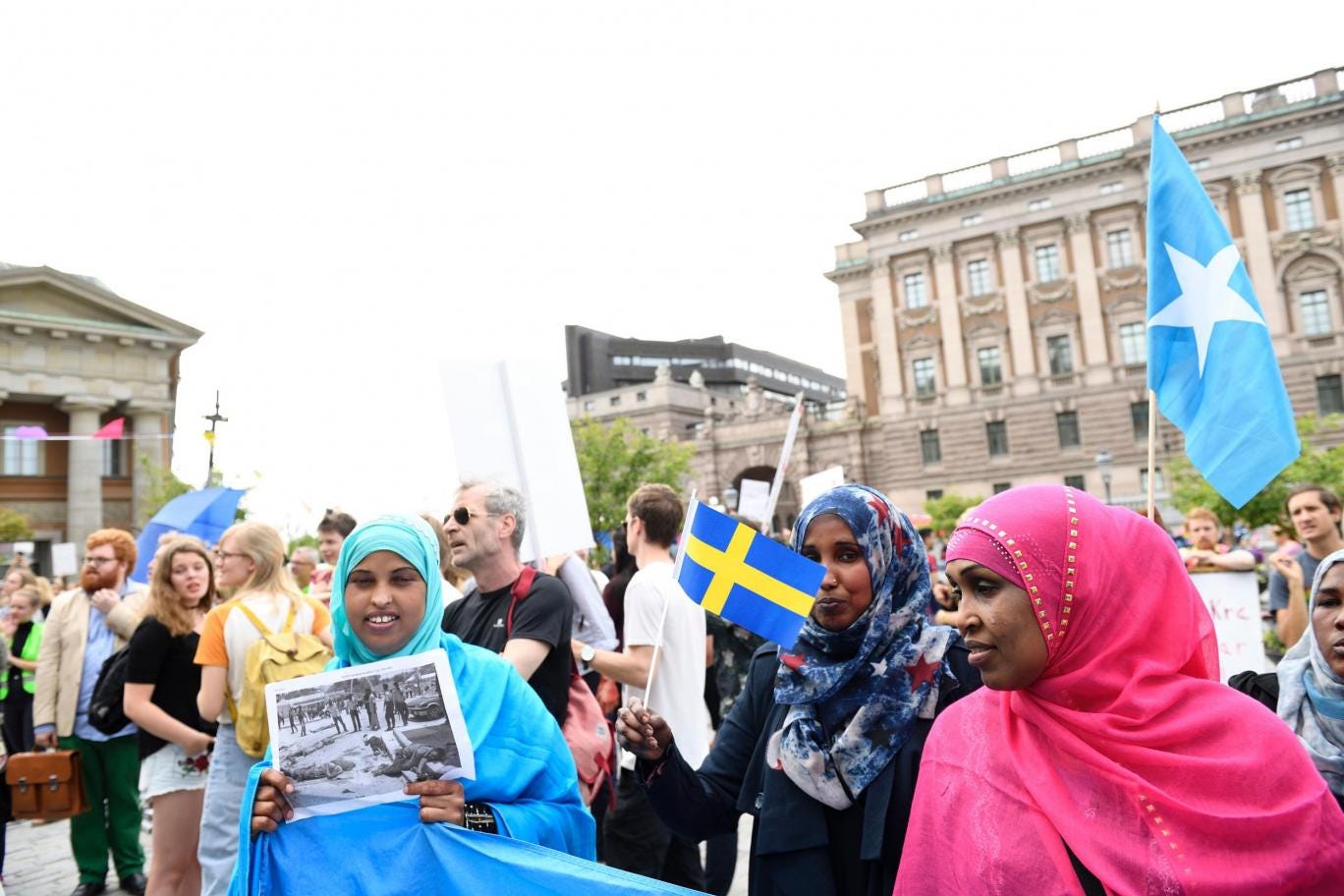
Sweden took in more refugees per capita than any other country in Europe in 2015.

Read Full Post »

Photo: The Genesis Center

I’ve been having the best time lately. I’m volunteering in English classes at three refugee agencies, assisting the classroom teachers. The nonprofits are all near one another in Providence.

Dorcas International is an official refugee resettlement agency. It offers a range of services not just for refugees but for other immigrants and for native-born people living in poverty. At Dorcas, I help a teacher work with students who have just arrived in the United States. Most of them know no English at all, and some never went to school in their own countries and are just learning to write.

We have students from Myanmar, the Dominican Republic and Cape Verde, among others, but they are not all refugees. In fact, the majority of families being resettled by the State Department in Providence right now are from Syria and the Congo.

I read in the paper today that 80 percent of the refugees that have entered the United States this year are children, but I work with adults.

The Genesis Center is not a government resettlement agency, but it works with refugees and other immigrants on English and on job skills. It has a great culinary program and places many people in jobs. It also has a day-care center. The students I work with at the Genesis Center are generally a bit farther along in English.

The Refugee Dream Center was more recently established than the other two. It was founded by Omar Bah, a refugee who had been a journalist in Gambia and who had to flee when his articles on human rights garnered him death threats. Bah’s nonprofit is small so far, but its focus on helping people after the four months or so that they receive government assistance is needed. At the Dream Center last week, I worked with a woman newly arrived from Haiti and another from Burundi who has lived in Providence about a decade.

Pretty much all the students act grateful for the help, and it’s a treat to see a face light up when the penny drops. In January, closer to home, I plan to take a training to co-lead small conversation groups.

Did I mention I’m having a lot of fun?

Read Full Post »

Photo: The Daily Star
A temporary refugee camp in the eastern Lebanese town of Marj near the border with Syria.

Tina Rosenberg has an interesting op-ed at the NY Times about how aid groups in Lebanon are making life easier both for themselves and for the refugees that have flooded the country.

“Consider Lebanon, a country of 4.5 million people that has taken in probably close to 1.5 million Syrians fleeing their civil war. …

“In 2004, 99 percent of the world’s humanitarian aid came in the form of commodities: sacks of grain, stacks of blankets, building materials. Last year, that number had fallen to about 94 percent, according to a committee financed by Britain’s Department for International Development to study how best to use cash in humanitarian aid.

“Cash is catching on. A decade ago, the United Nations World Food Program was trying out cash in a few pilot programs. Now cash makes up a quarter of the organization’s portfolio …

“Since it’s easier, safer and carries less risk of corruption to provide cash electronically instead of handing people envelopes of bills, mechanisms should exist for debit cards or cellphone banking. …

“It’s no problem in Lebanon, a middle-income country known for commerce. … Here’s how it works: Each needy Syrian refugee family gets a banking card. Family members use it to shop for food at the 450 participating stores and markets; a family of five gets about $135 per month. …

“Many humanitarian groups in Lebanon help with sanitation systems and other in-kind assistance. Many run schools, or provide skills or business training. The cash is intended to address (a little; it’s not really enough to live on) refugees’ most urgent problems: What’s for dinner? Where am I sleeping?

“ ‘There is nothing that could replace cash,’ said Alan Moseley, the Lebanon country director for the International Rescue Committee, a member of the Lebanon Cash Consortium. ‘If we provided shelter materials, clothing, food or direct rent subsidies, it would be more costly to deliver and people would be getting things they don’t necessarily need.’ ”

More.

Read Full Post »

Photo: Isabelle de Pommereau
Anja Reefschläger has taken Ahmad Madarati and other refugees under her wing since they arrived near her Berlin home last year.

The Christian Science Monitor always has great stories about good works around the globe, and this one on ordinary Germans who are volunteering to help refugees get settled is no exception.

Isabelle de Pommereau writes, “ ‘Frau Anja.’ Hearing this name for a Berlin volunteer who teaches refugees German – and has become a second mother to many of them – brings a smile to Ahmad Madarati’s long, sad face.

“Mr. Madarati, who fled war-torn Aleppo, Syria, and Anja Reefschläger met on a freezing November morning last year. …

“Today, Madarati works practically gratis at a youth center in Berlin, helping young people build furniture. And in a few weeks, he is set to move out of the so-called Treskowallee camp into a house. The house is next to Reefschläger’s, and she is the one who persuaded the owner to rent it out to Syrians.”

Ordinary Americans are also showing kindness and warm hearts, even when state government refuses to participate.

In Texas, for example, when the governor refused to sign on to the federal effort to resettle Syrians, ordinary Texans and nonprofits stepped up to the plate.

Jim Malewitz writes at the Texas Tribune, “Texas’ top elected officials have not exactly welcomed refugees over the past year. [In September] Gov. Greg Abbott followed through on his threat to end cooperation with the nation’s refugee resettlement program because federal officials refused to ‘unconditionally approve’ a Texas plan requiring extra vetting of applicants. Such a move will not keep refugees from coming here, but it eliminates the state government’s role.

“But everyday Texans seem to be more willing to help refugees from Syria and elsewhere start new lives in the Lone Star State. Nonprofits that resettle refugees say volunteer turnout has increased — in some cases dramatically — since Texas Republicans first suggested they threatened security.” More. See also an article in the Nonprofit Quarterly, here, for details on the critical role of nonprofits and volunteers in Texas at this point in time.

I have personal knowledge of the many volunteers reaching out to refugees in Providence via the Providence Granola Project (how about giving their yummy products as holiday gifts?), the Refugee Dream Center, Genesis Center, and Dorcas International. The Diocese of Providence is also at the forefront of service as an official resettlement agency, like Dorcas.

You know what else? I just heard of a woman in my town who is selling her house and moving to “wherever she’s needed.” She wants to use her years of language-teaching skills to help refugees.

[10/15/16 Update: Read about the outpouring of support for refugees in Lowell, Mass., here.]

Photo: Marjorie Kamys Cotera
A group gathered at Wooldridge Park in Austin on Nov. 22, 2015, to show support for refugees.

Read Full Post »

There are so many interesting cultures in the world! For example, when I was editor of a magazine about lower-income issues in New England, I heard for the first time about the Karen from Burma (Myanmar). Who? Soon after, I managed to acquire an article on Karen refugees in Waterbury, Connecticut, so I was able to learn something along with my readers.

Recently, I heard of another new-to-me minority, members of which are being resettled in Massachusetts. They are called Mandeans, and their pacifist religious beliefs had subjected them to persecution in Iraq and Iran for millennia.

Here is what Brian MacQuarrie writes about them at the Boston Globe.

“The Mandaeans have found safety and acceptance since they began arriving [in Worcester] in 2008, freely practicing a monotheistic religion that predates Christianity and Islam. But they still do not have a temple — a ‘mandi’ for baptisms, marriages, and birth and death rituals — and whether one is built could determine if they continue to call Worcester home.

” ‘Work is not the anchor, living in an apartment is not an anchor, the mandi is the anchor,’ said Wisam Breegi, a leader of the Mandaean community. …

” ‘It really is a culture that is in danger of disappearing,’ said Marianne Sarkis, an anthropology professor at Clark University. ‘If you don’t have a way of preserving the culture and traditions and even the language’ of Aramaic — what a temple helps provide — ‘it is not going to survive very long.’ …

“ ‘We really don’t have the expertise, the know-how, the connections,’ said Breegi, who also has founded a scientific firm that is developing a low-cost, disposable, neonatal incubator for use in developing countries.

“To help forge the religious connections, Breegi and Sarkis are preparing an application for a nonprofit organization to help raise money for the temple. Worcester Mayor Joseph Petty said in an interview he is willing to help the project where he can.

“ ‘They’re all doing what everyone else is trying to do — working hard and getting their kids a good education.’ …

” ‘It’ll just help make Worcester stronger in the long run,’ Petty said of his city’s embrace of Mandaeans and other immigrants. ‘You can’t build walls between people.’ ”

Worcester held a ceremony of welcome in April that “represented the first time — anywhere, at any time — that Mandaeans had been recognized as a valued, important minority group, Sarkis said.” Wow.

More here.

Photo: Craig F. Walker/Globe Staff
The Kalmashy family (left to right) Lilo, and her husband Mahdi and their daughters and Sura and Sahar, shared lunch at their home in Worcester.

Read Full Post »

I learned about Open Doors for Refugees from my friend Anne, who for many months helped me guest blog at the Providence Granola Project. I miss her so much. She died a couple weeks ago in a freak biking accident. From now on, whenever I post about refugees, I will think of Anne.

This refugee-outreach story comes from the Wisconsin State Journal. Samara Kalk Derby writes, “Raphael Al Rubaye left Iraq for Madison eight months ago with his wife and two young daughters and has found a welcoming community here.

“He served with the U.S. Army in Iraq for six years in the American-led war against al-Qaida and the Taliban. He was brought to this country by Lutheran Social Services and now works as a case manager for the organization, helping in the resettlement of other refugees.

“His life in Iraq was ‘fun, terrible, dangerous, scary, happy, worried, everything,’ he said. ‘Just like any life.’ …

“Al Rubaye and his daughters were among about 200 people who took part in a community celebration, picnic and fundraiser hosted by the local group Open Doors for Refugees held [August 7] at the Olin Park shelter. …

“Open Doors for Refugees, a group dedicated to supporting the resettlement of refugees in the Madison area and welcoming them into the community, was started by Israeli native Efrat Livny. …

“ ‘One of the best things that’s happened to us is that we’ve gotten to be friends with Syrian families, which as an Israeli has been a little touchy,’ Livny said about herself and husband, Ken Baun. ‘But, oh my God, it’s been incredible.’

“It all started when she got the book ‘Soup for Syria: Recipes to Celebrate our Shared Humanity,’ and began making soup for her monthly lunches at [a business and community space she founded]. She would dedicate the meal to the welfare of Syrian refugees.

“She soon realized she needed to do more and began bringing in speakers and holding discussion circles. During those discussions, Livny asked people about their feelings. ‘How can we sit back when this is happening?’ she said.” More here.

People certainly bond over food. That is one reason the Providence Granola Project got into food as a way to give some refugees US workforce skills. I mentioned several refugee-based food businesses in a June post I wrote for the Providence Granola Project here.

Photo: Samara Kalk Derby
Parachute game at Sunday picnic hosted by Open Doors for Refugees in Olin Park, Madison, Wisconsin.

Read Full Post »

Among all the sad aspects of the refugee crisis, children in refugee camps going without any education — sometimes for years — has to be one of the saddest.

10 million under the age of 8 are displaced

Fortunately, there are occasional rays of light, such as adult refugees deciding to start their own school. And here is a story from Mashable about a partnership between the International Rescue Committee and the makers of Sesame Street.

Matt Petronzio writes, “A new partnership between Sesame Workshop, the brand’s educational nonprofit, and global humanitarian aid organization International Rescue Committee (IRC) will allow the two groups to develop, distribute, and test educational resources and programs designed with young refugees in mind. …

“The first phase is to develop educational multimedia content that can reach children living in displaced or resettled communities through mobile devices, radio, TV and printed materials in engaging, enjoyable ways.

” ‘We really set out to find a partner that complements our offerings, and I think the IRC is ideal,’ said Sherrie Westin, executive vice president of global impact and philanthropy at Sesame Workshop. …

“Sesame Workshop and the IRC will adapt existing Sesame products and content for regions where the two organizations already have a presence working with young children and their families. …

“The partnership is aimed at the children who make up half of the record 60 million people currently displaced around the world, specifically the one-third of that population under the age of eight. In addition to a lack of education, these children also often deal with toxic stress and trauma.

” ‘We’ve seen time and time again, in the context of conflict and crisis, that those very young children don’t have a safety net to support them,’ Sarah Smith, senior director for education at the IRC, told Mashable. …

“Most recently [Sesame] launched Zari, the first local Muppet in Afghanistan, a country where many young children lack access to education, especially girls.

“Zari’s gender was a deliberate choice to promote girls’ empowerment — an example of tailoring curricular goals to the needs of a particular country. (According to Westin, recent research showed that fathers in Afghanistan changed their minds about sending their daughters to school after watching Baghch-e-Simsim, the local language version of Sesame Street.)”

More at Mashable.

Image: Vicky Leta/Mashable

Read Full Post »

« Newer Posts - Older Posts »