Feeds:
Posts
Comments

Posts Tagged ‘theater’

netter20symposium2020172028c2920thomas20jefferson20university20photo20services2028129

Photo: Thomas Jefferson University Photo Services
Medical professionals develop their empathetic side at a 2017 Netter Symposium in Philadelphia.

I’m back to writing the usual posts that link to interesting articles. This one is especially appropriate, given my recent experience as a hospital visitor. The article is about techniques for “teaching” empathy to medical people, but I have to say I think every worker in that hospital was born empathetic. From the security personnel and cleaners to the brain surgeon and night nurses, it was amazing to experience how kind everyone was, and I wonder if it’s just the culture of that hospital.

Be that as it may, there are initiatives everywhere to help medical professionals develop their empathy “gene.” An article at a “platform for theatremakers” called HowlRound is about using drama for that purpose.

“As theatre folk know well, sometimes the most meaningful creations are borne out of the fruit of circumstance. To wit, the Lantern Theater Company in Center City, Philadelphia, happens to be located around the corner from the Sidney Kimmel Medical College (SKMC) of Thomas Jefferson University. In 2012, Charles McMahon, artistic director of the Lantern, and Dr. Salvatore Mangione, pulmonologist and director of physical diagnosis and history of medicine at SKMC, started discussing a way to make the most of that physical proximity — and potentially change the course of modern medicine while they were at it.

“Together, along with artistic colleagues Craig Getting and Kittson O’Neill, they developed a curriculum for what became the Empathy Project. [Mangione] and the team believed that ‘in addition to preventing burnout, and giving [students] more comfort with empathy and ambiguity, it might give them a different brain and help them become a better physician.’ …

“Part of the program focuses on playwriting. This section asks students to not only learn the technical tools of dramatic storytelling, but also to make a personal investment in the work they are creating. It helps break students out of their comfort zones by encouraging them to write about a truth that goes unsaid in their community. …

“Many of the project’s exercises have roots in Meisner work, including improv technique to facilitate open listening and taking stock of one’s ‘baseline self.’ This combination of listening and self-awareness supplies the building blocks of empathy, asking students to consider themselves and each other with perhaps more generosity and less competitiveness. …

“Plays written by students for the Empathy Project have dealt with wide-ranging topics such as immigrant experience, class issues, what it feels like to be a Muslim in America, the recent death of a parent, ethics of patient privacy, and doctors confronting cadavers. O’Neill avows she has learned more about the Muslim American experience in her class at Jefferson than she has anywhere else in her life.

“Getting believes some of the most fundamental questions playwrights ask during their writing process can easily be applied to doctors working with patients. These include: What are the given circumstances of this person? Who is supporting them or not supporting them? How do you get your audience to feel the emotions you want them to feel? How do you structure the telling of information that is at the right pace and is clear? As a result, students taking part in the Empathy Project reported seeing their patients in the hospital the way a playwright would see them.”

More here.

Read Full Post »

Photo: BBC
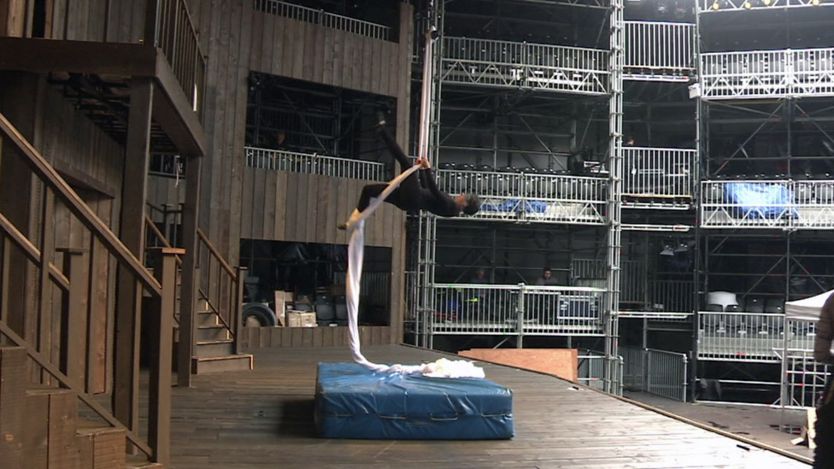
An aerial performer rehearses on stage at Shakespeare’s Rose, a pop-up theater in York, England.

You’ve heard of pop-up libraries, pop-up gift stores, and pop-up restaurants. Now here comes a pop-up Shakespeare theater in York, England.

Ian Youngs writes at the BBC, “Shakespeare’s Rose, which [opened in April] and has cost £3m, is Europe’s first ‘pop-up’ Shakespearean theatre. …

“The temporary theatre has been built in a car park in 28 days to a circular design, similar to those erected on Bankside in Shakespeare’s day.

“It will stage four of his plays with a cast including [TV actor] Alexander Vlahos, who will play Romeo in Romeo and Juliet, and Catesby in Richard III.

“As well as the audience members standing in the centre, a further 660 will watch from seats on three levels around the edge.

“Shakespeare and his contemporaries would recognise the design and ‘tricks’ like trapdoors and flying, which have hardly changed over the past 400 years, according to [producer James] Cundall.

” ‘They’d find everything they had in their theatre — they just probably wouldn’t recognise [Layher] scaffolding,’ he says. ‘Each length [of scaffolding] is probably about the same size as a standard oak beam, so that’s how Shakespeare’s oak became German scaffolding. …

“There was an actual Rose theatre in London in the Bard’s time, which was recreated for the 1999 film Shakespeare in Love. …

“Professor Judith Buchanan of the University of York, who has advised on the pop-up theatre, said: ‘Shakespeare’s Rose Theatre is not a historical reconstruction of the early modern Rose playhouse on Bankside, nor of any other early modern playhouse. It is an approximate and suggestive architectural allusion to the idea of the early modern playhouse.’

“The creators of the York theatre will hope that their venue doesn’t replicate some other aspects of the original Rose — which had to be closed occasionally due to riots or the plague, and which had one cast member who killed the other in a duel.”

Read more at the BBC, here, and at the Independent, here.

Read Full Post »

Photo: David Bedard
An example of the resurgence of indigenous theater is
Our Voices Will Be Heard, directed by Larissa FastHorse. It was performed at Perseverance Theatre in 2016 in Alaska. 

Another way that culture gets shared, revitalized, and preserved is through theatrical performances. Alaska and Hawaii, in particular, are seeing a resurgence of indigenous theater.

As Frances Madeson writes at American Theatre, “The pace at which producers of Hawaiian and Alaskan Native theatres are creating original offerings specific to their lands and peoples and mounting them on their mainstages ranges somewhere in the giddy spectrum between prestissimo and full-tilt boogie.

“ ‘We’re experiencing a Native arts revival right now,’ said Alaska Native playwright Vera Starbard, whose autobiographical advocacy play Our Voices Will be Heard was performed in Juneau, Anchorage, Hoonah, and Fairbanks. …

“Part of the exhilaration comes as a result of resources to match the rhetoric of support for Native theatre arts. In 2016 Starbard was granted $205,000 from the Andrew W. Mellon Foundation to sustain her while she creates three full-length Alaska Native plays over three years. …

“There is also an attitudinal shift by institutional gatekeepers toward inclusion of Native theatre artists, some of whom have been maintaining the vision for a very long time with minimal support.

“The first Hawaiian-language play presented at the Kennedy Theatre at the University of Hawai‘i at Mānoa was in February 2015, ‘in the theatre’s 51st season,’ said Tammy Haili’ōpua Baker, who wrote it. … She repeated for emphasis: ‘Half a century to get anything Hawaiian on that stage.’

“But now that the vessel’s been unstoppered, there’s a growing groundswell of audience demand for shows with Native-centric realities and expression.

“ ‘The success of Our Voices was completely community-driven,’ said Starbard. …

“Tlingit actor and playwright Frank Henry Kaash Katasse said he sees a category shift. ‘Indigenous stories are now seen as American stories.’ …

“Katasse teaches theatre in schools to Alaska Native kids, and encourages them to take acting seriously. ‘They didn’t even know this was a career option,’ he said.

“Indeed, to keep pace with demand, artistic directors Harry Wong III at Kumu Kahua Theatre and Eric Johnson at Honolulu Theatre for Youth (HTY) on Oahu, and Art Rotch of Perseverance Theatre in Juneau and Anchorage, are prioritizing both actor training and play development. …

“In Fairbanks, Alaska, [Allan Hayton, language revitalization program director at Doyon Foundation] pursues theatre as a vehicle for cultural and linguistic survival.

“ ‘We are restoring balance,’ Hayton said. ‘In indigenous tradition theatre is performed to achieve something for the people and balance for the world in the natural environment. Theatre is a healing art form in which we can address very serious and difficult issues safely, and offer a larger healing for society.’ …

“For Starbard, Alaska Native theatre artists literally standing on thousands of years of storytelling tradition have nothing to prove.

” ‘Our goal as Native artists and theatremakers is not to develop this “uncultured” audience so they can come in and understand what a Western theatre is like. I think that’s the attitude taken sometimes,’ she said, choosing her words with great care. ‘I’m proud of Native artists who are pushing back against this mindset. It’s not about how we can help our people adapt to the Western theatre, but how we can help Western theatre to be an even more dynamic and beautiful thing.’ ”

More here.

Read Full Post »

Photo: Paula Keller
Actor Luverne Seifert demonstrates techniques of Ten Thousand Things, which brings free, low-budget, high-quality theater to people who are not rich.

A new theater company trains actors to do high-quality, free performances for new, nontraditional audiences. Somehow I knew it would be based in Minneapolis, a hotbed of theatrical innovation in the late 1990s when I lived there.

Theresa J. Beckhusen reported the story at American Theatre.

” ‘If I was going to spend my life making theatre, I didn’t want to make art for rich people.’ This is how Michelle Hensley, artistic director of Ten Thousand Things (TTT), a theatre company in Minneapolis, kicked off a recent conference. …

“The gathering drew around 100 theatre makers from across the country to compare notes about working with the grass-roots theatrical model championed by Hensley’s company. Its motto could be fairly summed up as … art for not-rich people.

“For 30 years Ten Thousand Things has been touring productions to prisons, transitional housing, rehab centers, immigrant centers, shelters for survivors of domestic violence, and more — and all for free. …

“TTT productions are performed in the round, in whatever space their tour sites have available. … Actors mingle with audience members, interacting before, during, and after performances.

“The productions are spare: no lavish costumes, no fancy sets, no lights. Hensley puts a premium on story and language. …

“Many conference attendees shared stories … One incarcerated woman in particular was moved by a wedding scene in The Tempest because she’d missed all the weddings in her family. [Another told] how audience members drove from Tijuana to San Diego just to see a bilingual Twelfth Night. …

“Playwright Kira Obolensky led a session on choosing material that would work in the intimate settings pioneered by TTT. She began by posing a question … : What story would you tell if everyone was in the audience? … ‘I don’t think a lot of American playwrights and directors ask themselves this question.’ …

“Brad Delzer reported that he recently began employing TTT’s model with True North Theatre, his new theatre company in Carlisle, Pa. Sensing an opportunity to bring theatre to places that don’t typically see it, and to connect with the strong military community in the Carlisle area, Dezler toured Lisa Peterson and Denis O’Hare’s An Iliad to a soup kitchen, a men’s shelter, and the town’s Army Heritage Center, before holding two public performances. …

“He had been generally apprehensive about the whole thing, but had particularly fretted about how a six-minute list of wars from the last few centuries would go over. ‘It played really well, he said, noting the power that came from the moment. ‘It surprised us.’ ”

There’s more at American Theatre, here, where you can see how different TTT groups manage to fund free performances.

Read Full Post »


Photo: True Story Theater
An Arlington, Mass., theater troupe performs the stories of ordinary people.

Recently, John told me about an unusual improvisational theater group that will perform your story. Called True Story Theater, it is affiliated with the worldwide Playback Theatre movement, which seeks to right wrongs experienced by minorities and marginalized groups by putting their actual words into plays to build understanding.

From the website: “True Story Theater is a nonprofit theater company that offers 50-75 improvisational performances and workshops a year for community groups, businesses, and individuals mostly in the greater Boston area. We work with hospitals, universities, corporations, religious communities, with teen leaders, cancer survivors, activists, philanthropists, business leaders …

“Our mission is to build empathy and respect in community through honoring all of our true stories.

“In performances, volunteers from the audience are helped to share what’s important in their lives. On the spot, actors then portray the heart of what they heard using music, movement, and dialogue. From this simple interaction, people laugh, cry, share fresh insights, and bond. … True Story Theater offers audiences fresh perspectives, deeper connections, and a renewed appreciation for our common humanity.”

The troupe says it employs many dramatic styles but is especially indebted to the technique of Playback Theatre, which “was founded in 1975 by Jonathan Fox and Jo Salas in New Paltz, NY. …

“Globally, Playback is often used to reach disenfranchised people and to build understanding where conflict had driven people apart. A few examples:

“Southern India: Groups of Dalit people have used Playback Theatre to assert their rights. Western Australia: Playback has helped landowners and Aboriginal people find common ground. Burundi: Hutu and Tutsi actors work together in a Playback troupe in a country healing civil war.”

Watch samples from performances here.

True Story Theater is also available to draw people out at weddings and other such events.

Read Full Post »


Photo: Richard Anderson
After running Center Stage in Baltimore for seven years, Kwame Kwei-Armah returns to England to serve as the new artistic director of the Young Vic.

The London theater world learned recently that the Young Vic‘s new artistic director would be the man behind seven strong years at Baltimore’s Center Stage. He is not native to Baltimore but England, where he has been an actor, a director, and a playwright — a versatility that is expected to serve him well at the Young Vic.

In September, Georgia Snow wrote at The Stage, “Kwame Kwei-Armah is set to be announced as the new artistic director of the Young Vic. …

“Kwei-Armah is understood to have been linked to other artistic director jobs in the UK recently. His recent productions as a director have included One Night in Miami… at the Donmar Warehouse, and a musical about the life of Bob Marley, which he also wrote and which ran at Birmingham Repertory Theatre earlier this year.

“He is currently in rehearsals for an adaptation of Henrik Ibsen’s The Lady from the Sea, also at the Donmar Warehouse, which he directs. …

“His plays have included Bitter Herb, and Elmina’s Kitchen, which ran at the National Theatre in 2003 and was nominated for an Olivier Award. …

“In an interview with The Stage last year, Kwei-Armah also said he thought black representation in the UK has not come as far as the US, and that Brexit has resulted in Britain taking ‘a step backwards into a world of xenophobia.’ ”

Michael Billington at The Guardian adds, “It is significant that Kwei-Armah, born Ian Roberts in London, changed his name when he was 19 after tracing his family history through the slave trade back to its ancestral origins in Ghana. He became interested in the past through watching the TV series Roots and much of his work has been about the search for identity. It was certainly a theme in his first big hit as a playwright, Elmina’s Kitchen, which was seen at the National in 2003 and later became one of the first plays by a black British playwright to make it to the West End.”

More at The Stage, here, and at The Guardian, here.

Read Full Post »

093017-empty-stage

092917-Play-at-Old-Manse


093017-path-made-of-apples


When we lived in Minneapolis in the late 1990s, we would tell friends back in Massachusetts that we thought the Twin Cities theater scene was the best anywhere. They would say, “You mean the Guthrie?”

No, actually. We meant the many small, more-experimental theater groups that popped up everywhere.

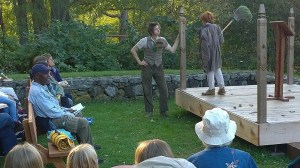
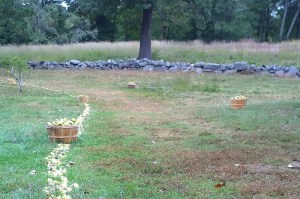
Friday we were introduced to new one, TigerLion, which performed an outdoor “walking” play about Henry David Thoreau and Ralph Waldo Emerson at the Old Manse. Above you see one of several stages and the warm-up team performing before the show. (Note also that the audience’s path to the next stage set is lined with apples.)

The highly physical acting style kept everyone from toddlers to adults entertained as did the whacky sound effects, wild locomotive and cabin-in-the-woods creations, and energetic choruses.

When the Royal Shakespeare Theater decided in the late 1970s that the best way to convey the uniqueness of Dickens was to recite chunks of his narration (as in their production of Nicholas Nickleby), I think they changed theater forever. The inventive TigerLion expands on the use of a chorus, at one point having it speak the conversation of the pantomiming protagonists — even the crunching of the apples they eat. (Really funny.)

The troupe wants audiences to delight in nature and save the planet from unchecked exploitation. From the website: “We celebrate human wisdom and the spirit of nature through creative works that awaken, inform, and delight. …

TigerLion Arts presents Nature, the mythic telling of Emerson and Thoreau’s mutual love affair with the natural world.  …

“A professional ensemble of actors takes the audience on a journey through the natural environment as scenes unfold around them. Bagpipes, ancient flutes, drums and rich choral arrangements are intricately woven into the experience. …

“This original work is collaboratively created with writer/actor Tyson Forbes, a direct descendant of Ralph Waldo Emerson.

“In today’s world, we are so estranged from our natural environment, and at TigerLion Arts, we feel that humankind must reconnect with nature in order to survive.  As oil spills into our oceans, as we race through our lives, as we look further and further outside ourselves for the answers, it is our hope that Nature can be a catalyst for our collective healing.”

More.

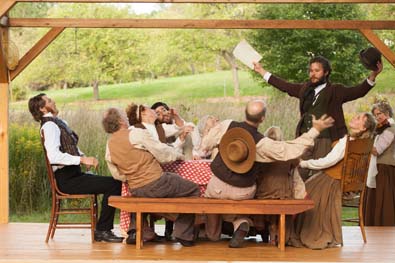
Photo: TigerLion
Energetic Minneapolis theater group recreating the interactions of Henry David Thoreau and Ralph Waldo Emerson.

201401

Read Full Post »


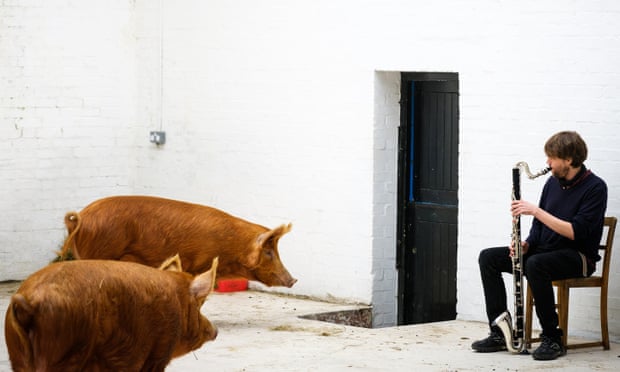
Photo: Ben Gilbert/Wellcome Collection
Art and science meet at performances for farm animals in England.

Today I have another of my offbeat stories for you. It’s about performing for farm animals and checking their reactions.

Lyn Gardner writes at the Guardian, “Almost 10 years ago, David Harradine made a show in a basement for the Brighton festival. It was called An Infinite Line and featured a horse that stood entirely unconcerned throughout the performance, barely blinking at what went on around him. He was an impressively large presence, a symbolic representation of the natural world, and clearly didn’t give a fig for the theatrical avant-garde.”

Harradine was looking for more reaction from animals in March as his company, Fevered Sleep, conducted “an experiment in which human artists perform for sheep, pigs and goats at a location in Peckham. …

“The show [was] part of the Wellcome Collection’s fascinating Making Nature exhibition, which aims to explore our relationship with the natural world and how we perceive animals. ‘We are starting from the point of view that perception is knowledge,’ says its curator, Honor Beddard, ‘but when you have an encounter with an animal, how do you know that you are not projecting something on to it?’ …

“For Harradine it’s definitely ‘the most bonkers project I’ve been involved in. But it’s fascinating too. The performances are being used to start a conversation.’

“As Harradine says, we prefer not to see animals as being just like us: complex, sentient beings, with emotional responses. To that end, the animals chosen to experience Fevered Sleep’s performance are all what Harradine, himself a vegan, describes as creatures that are mostly perceived as ‘meals in waiting.’ … ‘The purpose is not to suggest that people shouldn’t eat meat but to examine our relationship with animals – and the ethical and political responsibilities of humans towards them.’ ” More here.

Sounds like such fun to be part of a “bonkers” performance. I think we could all do with a little nutty creativity in our lives.

Read Full Post »

Have you ever run into one of those pay-it-forward situations — when a stranger does you a small favor and then you choose if you want to do the same for another person? I was in line to buy coffee at a Jamaica Plain shop a couple years ago when the person in front paid for me. Then I paid for the person behind me. Fun. I blogged about the phenomenon here and here. It can be about helping someone who has few resources, but not necessarily.

Here’s a recent example of the practice. It involves theater tickets.

“A theatre in Rome has taken the tradition of ‘suspended coffees’ — where a person buys an extra drink for someone less well-off — and applied it to tickets.

“The initiative [ran] for just over two weeks at the Teatro delle Muse, where people buying tickets for a variety show [purchased] an extra seat at a reduced price to leave at the box office for someone else … The aim is to use a small charitable gesture to make the theatre accessible to everyone. The comedy show, called ‘You Are Not Neapolitans,’ [started] on 16 February. …

“The ‘caffe sospeso’ tradition originates in Naples, the idea being that when ordering your coffee you also anonymously gift another to a stranger in need. The idea has now spread internationally, and in some places has been adapted to include pizza or other food items. In a nod to the original Neapolitan custom, the theatre’s donated tickets [came] with a steaming cup of coffee … courtesy of a local bar.”

More here. Il Messaggero reported the story, and the BBC passed it on.

I’d love to know if you have encountered this kind of thing. Panera Cares, for example, was a noble experiment begun during the economic downturn in 2010 to help the hungry, but I read that the some of the locations ran into trouble.

Photo: Google Maps
The initiative at Teatro delle Muse is called “Theatre and Coffee… on hold for you”

Read Full Post »

Here’s a great story from the Japan Times about a theater group for people over 60. Where do I sign up?

Nobuko Tanaka writes, “At the age of 91, Saitama resident Izumi Noguchi is speaking at his first press conference — at least as an actor anyway.

“ ‘When I saw an advert in April inviting anyone aged 60 or older to audition for a new project called 10,000 Gold Theater, I just felt like challenging myself to do something I’d never had a chance to try before,’ he says.

“Noguchi is the oldest person to join the 10,000 Gold Theater ensemble. …  ‘Gold Symphony, my dream, your dream’ [is] a staging on an unparalleled scale that features some 1,600 performers (not 10,000 as the name suggests) who are all volunteers and almost all amateurs …

“Arts promoter Taneo Kato came up with the idea [when] he was watching a performance of ‘Hamlet’ in which stage icon Yukio Ninagawa directed members of the Saitama Gold Theater and Saitama Next Theater — troupes made up of older and younger actors that he formed in 2006 and 2009, respectively, after becoming artistic director at Saitama Arts Theater in 2006.

“ ‘Out of the blue, midway through “Hamlet,” veteran enka singers the Komadori Sisters — who are actually twins — appeared and sang “I Want to be Happy One Day,” ’ Kato says, recalling how striking a moment it was to see the women, born in 1938, sing those words.” More here.

I wonder how big an issue memorization is for the performers. My friend Dorothy started a group of older amateur actors in Concord, but they do readings and don’t have to memorize. I have many memorized stories, Bible verses, and poems in my head and can trot them out at a moment’s notice. Not sure if I could acquire new ones to the same extent.

Photo: Maiko Miyagawa
Massive undertaking: Seiji Nozoe directs elderly actors during rehearsals for the play ‘Gold Symphony, my dream, your dream,’ performed in Chuo-ku, Saitama City, December 2016.

Read Full Post »

The world’s oldest working actor has died at age 101. And good for him to have worked at something he loved for so long!

Shaun Walker wrote recently at the Guardian, “Vladimir Zeldin, believed to have been the world’s oldest working actor, has died aged 101, after appearing for 71 years at the same Moscow theatre.

“The Russian actor appeared on stage as recently as [September], using a walking stick due to a broken hip, to appear in the play The Dance Teacher by the Spanish playwright Lope de Vega.

“He had appeared in the play more than 1,000 times, Tass reported. The theatre had planned for him to appear again next February, to mark his 102nd birthday. …

“Zeldin was born in 1915, when Tsar Nicholas II was on the Russian throne. He shot to fame when he appeared in the film They Met in Moscow, on which shooting began shortly before the Nazi invasion of the Soviet Union in 1941. …

“When the war finished, Zeldin joined Moscow’s Red Army Theatre, where he was part of the troupe from 1945 until his death. The theatre is now known as the Russian Army Theatre. Fellow actors at the theatre described him as full of energy until the very last.” More.

I think the actress who played 104-year-old Great-Great-Grandmaw in All the Way Home (the stage version of James Agee’s A Death in the Family) must have been nearly as old as Zeldin. I remember her voice came out as kind of a croak. But that may have been because she was acting.

Photo: Alexander Zemlianichenko Jr/AP  
Vladimir Zeldin on stage in Moscow.

Read Full Post »

Actor Finn Wittrock wrote recently at the New York Times about helping to start a mini Shakespeare company in the 1990s to entertain his parents and other theater professionals. He recalls with wonder his young self’s confidence of success.

“I was born in the Berkshires in Western Massachusetts. I lived there until I was 6, then moved to Evanston, Ill., and later to Los Angeles. But every summer for most of my youth, I would go back East with my brother, my mom and my dad, who most summers was acting or teaching for Shakespeare & Company. I would often be cast as a page or an altar boy in one of the professional productions.

“I went in lieu of a summer camp; I went to romp in the Berkshires, see old friends, get out of the city. But mostly I went for the Very Young Company.

“Starting at the age of 8 and until I was 16, my oldest friends and I would get together every summer: Rory, Reilly, Wolfe, and later my brother, Dylan, and Wolfe’s brother, Tiger (yes, their real names) would arrange five or six scenes from Shakespeare, rehearse them on our own time in the sun-drenched Berkshire afternoons and perform them for the adult company after one of their Mainstage shows. We began the company ourselves and it ended when we were no longer ‘very young.’

“For a kid, it was an epic undertaking; an outlet for pre- and post-adolescent energies. We were totally self-motivated; nobody told us to do it, which was in itself an incentive. We’d choose a scene based on our own criteria: Had the company done it before? Could we make fun of them for it? Could we put Reilly in a wig and have him play a girl? And, most important: Did it end in a sword fight? …

Sometimes I yearn to have the boldness of one who knows nothing, who jumps onstage for no other reason than because he is young and has a loud voice.”

Later in his essay, Wittrock recalls something the celebrated director Mike Nichols once said about his own early years: ” ‘Why was I so confident back then? I had no business being that confident.’ And yet he attributed most of his early success to that unreasonable confidence. …

“No one gave us permission to do the Very Young Company; no one ordered us to do it, and no one had to boost our confidence to do it. We just did it. We were just kids howling Shakespeare to the Berkshire trees, and our readiness was all.” More at the New York Times, here.

At one point in my  childhood, I, too, was confident. I thought, if my parents would only call the movie theater and set it up, four of us kids — the Gordons, one of my brothers, and I — would be a smashing success performing our version of “Snow White and Rose Red” before the feature. The grownups didn’t quite believe in it.

Some neighbors and I did perform an original play about a snowman for family members. One of the actors returned a copy of the pencil-scrawled script to me at my aunt’s funeral in 2002, decades later.

Photo: Lauren Lancaster for the NY Times
Finn Wittrock, right, and Rory Hammond, enacting the killing of Lady Macduff and her son in a mini-“Macbeth.” The young actors formed their own company more than 20 years ago to entertain their parents and other professionals at Shakespeare & Company in Lenox, Mass.

Read Full Post »

A musical based on a winning 1950s Mademoiselle college-contest story, Doris Betts’s “The Ugliest Pilgrim,” is playing at the Speakeasy Stage in Boston, and it’s pretty special. My husband and I saw it yesterday.

The Violet of the title is a young woman from North Carolina who has saved up enough money to take a bus to Tulsa, Oklahoma, to beseech a television faith healer to resurrect her face, disfigured by a hatchet accident in childhood.

In spite of being an ornery character, suspicious of ridicule, she is befriended on the bus by two soldiers and an old woman, none of whom believe in the faith healer.

The group splits up, and Violet makes it to the television studio. Having first accosted the faith healer, she enlists her own belief, her carefully chosen Bible verses, and her childhood memories and fears in a dreamlike growth process that resonates on many levels.

The production’s fugue of psychology, American beauty culture, race relations — and musical numbers suggestive of the regions Violet passes through — rises to a crescendo and resolves into a satisfying ending. The show has humorous moments, moving moments, moments of insight, and memorable songs.

One of the most stirring musical numbers, “Raise Me Up,” is performed at the television station by both charlatans and true believers. The professional actors are backed by a series of Boston-area Gospel choirs, filling in at different performances.

What a great idea! I knew when I bought tickets that, if nothing else, I’d like the local choirs. As it happens I liked it all.

Jeanine Tesori wrote the music. The book and lyrics were by Brian Crawley, direction by Paul Daigneault, musical direction by Matthew Stern, and choreography by David Connolly. An earlier version of the show played Off-Broadway in the late 1990s. Speakeasy is presenting the brand-new version as the Boston premier.

Check out the review by Boston Globe critic Don Aucoin, here.

Read Full Post »

Our 5-year-old grandson’s friend had been planning to attend an American Repertory Theater musical with her grandmother today at 10 a.m. We decided to go, too.

The show was The Pirate Princess and was loosely (very loosely) based on Shakespeare’s Twelfth Night. It was a hoot for me, and the young man in the photo seemed riveted. But whether he could make head or tail of the  convoluted plot, I have my doubts. It will be interesting to see down the road what he remembers — and whether he wants to see more plays.

The plot involves a brother and sister who get separated in a shipwreck (in this case, it’s thanks to a monster called the Kraken) and have separate adventures with characters who later mistake the sister dressed as a boy for the boy and vice versa. (I kept whispering in my grandson’s ear, “The pirate thinks he’s the girl that he thinks is a boy”; “The Queen thinks he’s his sister but doesn’t know his sister is a girl.” My grandson didn’t respond.)

There were songs, musical instruments, fancy costumes, pirates storming up lighted platforms in the middle of the audience, sword fights, and imaginative special effects. I especially like the jellyfish created by glowing umbrellas with streamers, carried along the aisles in the dark. The Kraken with his many legs was pretty great, too.

After the show, we had hot chocolate and cookies at the Darwin on Mt. Auburn Street. I’m not sure what our grandson will be able to tell his parents about the madcap entertainment he witnessed, but bits and pieces will likely emerge over time. I myself saw Peter Pan and Alice in Wonderland when I was four, but I didn’t become a theater nut until I was 10.

010216-hot-chocolater-after-theater

Read Full Post »

An experimental theater piece to test the Theory of Purposefully Divided Attention to Fend Off Meltdowns.
Cast: Grandma (G), Adult One (1), Adult Two (2), Adult Three (3), Small Child (Small)
Setting: Dinner table

G: Why is your hairdresser your hero?

1: She’s a real bootstrap entrepreneur. She’ll try anything.

G: Is that a blackberry in your popsicle?

Small: No, a blueberry.

2: Well, when you have kids, you can’t participate in every charity event or random partnership.

3: You have to prioritize, be strategic. Know when to say no.

1: But she has a great community reputation. She’s so upbeat.

G: I really think that’s a blackberry. Like Mrs. Rabbit’s in Peter Rabbit. Supporting everything in the community can add up.

1: It rolls up.

3: But you can waste a lot of time.

2: And energy.

G: People are grateful, though. If you’re strategic, you miss the kind of opportunities that you have no idea where they will lead. I like the way that popsicle drips right into the holder. It’s less messy.

Small: Do you want one?

G: I don’t want to take your last popsicle.

Small: We can make more.

G: Maybe after dinner.

Small: Let’s do it!

G: Careful — the juice is spilling. One and one and 50 make a million. It’s good to be open to serendipity if you possibly can.

2: There are only so many hours in the day.

3: Numerous small investments can’t get what one big investment would.

G: Do you want a napkin?

Small: I got a green popsicle at Whole Foods, but it dripped all over my dragon shirt. It was green.

G: There is nothing like a reputation for being upbeat and cooperative. I know where we can pick blackberries for the next batch of popsicles.

Small: But you have to add juice so it sticks together.

1: We now trade services. She does that with almost everyone. I feel like she could teach a class in entrepreneurship.

G: Teach one together, how about?

Small: Do you want a popsicle? Do you want one now?

G: Maybe after dinner. Look, that’s a raspberry. Or do you think it’s a strawberry?

Small: Do you want a popsicle now? I can go get it. We can make more later. Yes or no?

G: OK. Yes.

Small: Say, Please.

G: Yes, please.

Photo: Matthew Klein

Read Full Post »

« Newer Posts - Older Posts »