Feeds:
Posts
Comments

Posts Tagged ‘training’

Photo: Melanie Stetson Freeman/CSM.
More Than Words bookshop in Massachusetts uses 100% of its proceeds for training and educating young people ages 16 to 24 in professional skills and goal setting.

My husband and I first encountered the bookshop More Than Words on a movie night. We had been to dinner at one of the many cool restaurants in Waltham, Massachusetts, and were just walking around looking in shop windows until it was time for the movie.

Jacob Posner has written about it at the Christian Science Monitor.

“Jarris Charley says he didn’t believe in jobs when he was growing up on the line between Boston’s Roxbury and Dorchester neighborhoods. The people he knew who had legitimate jobs, including his mom, didn’t find much success. Everyone in his community lived check-to-check and paid rent. The drug dealers were the ones with money.

“ ‘So I was invested in the streets: drugs, guns, robberies. That’s just what I was caught up into at a young age,’ he says. He ended up in juvenile detention at age 15, and in prison for robbery at 23.

“Near the end of a five-year prison term, a second chance arrived. An old manager from a job-training program called More Than Words visited, and asked him, ‘Jarris, why don’t you just come back?’

“More Than Words is a bookstore, but one that does much more than sell bestsellers. The program serves young people ages 16 to 24 who face the highest barriers to building stable lives. Participants face homelessness, are in the foster care system, are out of school, or are involved in the legal system. It gives them job skills, but graduates like Mr. Charley say that the sense of belonging and acceptance – that they matter – is the most valuable thing they take from the program.

“ ‘I like to say we’re in the mattering business,’ says founder Jodi Rosenbaum.

“More Than Words’ support goes beyond job training. There’s a paid ‘on-ramp’ of six to 12 weeks in which the program helps with everything from housing and food costs to making sure participants have suitable work attire. Youth development managers offer support in a range of areas, including future employment, housing, transportation, financial planning, and navigating the legal system. After graduation, young people can access career services and bridge funding for tuition, rent, and child care so they can further their education and training.

“ ‘None of this works if that all doesn’t hang together, right? Like a job training program means nothing if you don’t know where you’re sleeping at night or if you have court the next day, and you don’t have people helping you plan and figure that out,’ says Ms. Rosenbaum.

“More Than Words has grown significantly in its two decades of existence. It started with a 150-square-foot office space where young people sold donated books online. Today, it operates three storefronts in the Boston area. It served around 318 young people last year, who sorted about 4.5 million donated books and earned over $3.8 million in net revenue. Almost all More Than Words graduates go on to earn a high school diploma or equivalent degree, according to the organization’s data. …

“ ‘A lot of people feel that they don’t have a lot going for them or they don’t have a lot of potential,’ says Mr. Charley. ‘We speak life into them.’ That was the case for him.

“For the past three years, he’s been mentoring young people at More Than Words. He works in career services, helping young people in the area that tripped him up the most: getting that first good job after graduating from the program.

“Ms. Rosenbaum founded More Than Words in 2004. She had worked as a public school teacher and for the child welfare system, and became disenchanted with government systems. … Ms. Rosenbaum found that the process of selling a book online had therapeutic value. It has clear steps leading toward a positive outcome: Pick up the book from where it was donated, find out how much it’s worth, package the book, ship it, and then watch money come in. …

“More Than Words Boston, where Mr. Charley works, is located on a street just off Interstate 93 in a postindustrial part of South Boston. … Inside, it’s tidy and spacious. In the front, wooden tables carry rattan cross-body bags and socks with giraffes and penguins. All the merchandise is made by businesses that address social issues as part of their mission. …

“[Mr. Charley] had attended Lexington Minuteman High School. He says there were limited spots at the vocational high school for people from his part of the city. Mr. Charley says he’s grateful for the experience, but felt like he was only appreciated for his athletic prowess. …

“ ‘You don’t think a Black person sees that?’ he adds.

“He left school near the end of his sophomore year after an event involving his cousin, he says. Arrest and juvenile detention followed. Then he found his way to More Than Words.

“ ‘He was the first white man I trusted,’ says Mr. Charley about one of his managers. He always asked when he didn’t understand part of Mr. Charley’s experience – instead of just spouting advice. …

“One of Mr. Charley’s goals is to help his mentees understand their behavior and, ultimately, figure out how to stop doing things that get them into trouble.

“Back when Chris Anderson joined More Than Words, around 2005, he worked directly with Ms. Rosenbaum. He was at a group home in Watertown when he first encountered her.

“ ‘Jodi just kind of walked in one time and we’re all sitting in the living room and she kind of just stood up and said, “Does anybody want a job?” ‘ he says.

“He found ‘a sense of belonging’ while helping Ms. Rosenbaum start her business. Participants were stubborn, got in trouble at school, and didn’t do what they were supposed to do. ‘No matter what, she just kept trying to realign you to get onto that path,’ he says. …

“Today, Mr. Anderson, now in his 30s, is a chief operations officer for a technology company, a father, and sits on the board of More Than Words. And he’s still close with Ms. Rosenbaum.”

More at the Monitor, here.

Read Full Post »

Photo: Neil Reid at the New Zealand Herald.
Former All Blacks coach Mike Cron integrated techniques from ballet and sumo wrestling into the team’s workouts.

Today, I share an article from New Zealand about using creative techniques in rugby training. Since I personally don’t know the first thing about rugby, please correct me if I use the terminology incorrectly.

Neil Reid has the story at the New Zeland Herald.

“Mike Cron has looked far and wide to make his [rugby] forward packs better – including adopting techniques from slender, tights-wearing ballet dancers and borderline-obese sumo wrestlers. Regarded by many as the rugby world’s leading scrum and forwards coach, the former police detective has never been afraid to look in less traditional places to get the best out of his players – and himself.

“In his upcoming autobiography – Coach – Lessons from an All Blacks Legend – the 70-year-old opens up on his 210-test tenure with the All Blacks, including Rugby World Cup triumphs in 2011 and 2015 – and his current role with the Wallabies.

“He writes about the All Blacks pack benefiting from techniques he observed in dancers at the Royal New Zealand Ballet and at a sumo wrestling gym in Japan.

“Cron spent time with both during a period when a variety of All Blacks – most notably front rowers – were battling a condition dubbed ‘turf toe’ involving pain at the base of the big toe when bent. Jumping, landing or pushing off when running could all exacerbate the sometimes career-ending ligament injury.

“In an interview with the Herald … Cron said his first travels in search of ways to prevent turf toe saw him visit NFL franchise the New York Giants. NFL athletes are susceptible to the condition from hard artificial turf surfaces.

“He was then allowed access to the Royal New Zealand Ballet as it prepared for a performance of The Mikado; including a meeting with the group’s Italian artistic director and talking to the dancers.

“ ‘At the end of training, we were invited up on stage,’ Cron told the Herald. ‘And I had two questions, one was about turf toe.’

“Cron was told ballet dancers were able to limit the risk of turf toe because of their landings. They had ways of landing that put less impact on the big toe. It was something Cron passed on to the All Blacks medical team and their lineout jumpers.

“Cron’s other question was to the Kiwi male lead of The Mikado production after he had watched him … lifting above the head’ of his dance partner.

Cron likened it to the process of forwards lifting a teammate in the air to snare an opposition kickoff. …

“ ‘He tells me about how you lock out and how you breathe, how you fill your belly up with the air and push your guts out and down, and I go … “same as powerlifters.” ‘ …

“Another nugget of knowledge was learned from spending time observing a sumo wrestling school in Japan. Cron spent several days there before returning to his base in Canterbury still contemplating what he’d seen, and wondering whether any of the lessons could be applied to rugby.

“Three months later, he reviewed video footage, and it clicked. ‘The last thing they do before they explode, these big guys, is with their toes . . . they hold the ground to get power and then release the power through into [their] opponent,’ Cron said.

‘I came back and started teaching that. With the sprigs in our boots, we push into the ground and hold the ground like a parrot in a bird cage.

“ ‘You get far more grip, far more purchase because power comes from the ground through your feet and through your body,’ …

“Cron said while top rugby players, ballet dancers and sumo wrestlers excel in very different arenas, they’re all still athletes who had insights others could learn from.

“ ‘If you go and see Cirque Soleil train, you will pick something up.’ ”

More at the New Zealand Herald, here.

Read Full Post »

Photo: Moriah Ratner for the Washington Post.
At the home of the Cosmetology & Barber apprenticeship program, four instructors teach incarcerated people on mannequins, No sharp blades allowed.

I’ve always been interested in prison programs that help the incarcerated learn skills that can help them find work on the outside and avoid recidivism. It seemed so stupid to lock people up for months or years and then dump them on the side of the road somewhere with not much more than a toothbrush to get on with life.

Today’s focus is on teaching cosmetology skills to people who might be interested in eventually pursuing a license. A license requires serious application, but sometimes the effort starts with a little encouragement.

Samantha Chery writes at the Washington Post, “When Chet Bennett accepted a job in 1998 to teach incarcerated people in D.C. how to style hair, he was ‘scared to death.’ A native Washingtonian and Howard University alum, Bennett had never even seen the inside of a jail before his first day of work. Now, the 56-year-old is glad he took the chance.

“He makes weekly visits to the jail’s hair-care room, a small salon on the fifth floor of the city’s Correctional Treatment Facility, complete with dryer chairs and four shampoo bowls. At the home of the Cosmetology & Barber apprenticeship program, four instructors teach incarcerated people on mannequins, and the student stylists comb, braid and loc the hair of fellow jail residents, relatives and other clients from outside the facility.

“Since Bennett founded the program, he’s won a Legacy of Service Award and graduated thousands of hairstylists, many of whom now work in salons or have their own studios. …

“Teaching jail residents comes with logistical challenges: They aren’t allowed to use shears or razor blades, paint nails, or dye hair due to the facility’s restrictions, and they don’t have enough time during their short sentences — which typically run a year or less — to finish their necessary training for licensing.

“People trying to complete the 1,500 training hours required to receive a cosmetology license have the option to transition from the jail salon to Bennett’s off-site beauty school, the Bennett Career Institute near Catholic University, after finishing their sentences.

“When Angelina Millner was jailed in 2005, in her mid-30s, the cosmetology program improved her styling technique and helped her find work after her release.

“Despite homelessness and other personal battles, she said, Millner was able to attend Bennett’s school in 2012 to get her license, and now does business as Mo’ Hair by Angelina. She recalled how gratifying it felt to return to the jail in 2020 — as a teacher instead of a resident: ‘I just had to stay on the straight and narrow ever since.’

“Bennett said he has learned it’s best to reserve judgment. He doesn’t look at his students’ records, hoping to give them a clean slate. … There’s ‘something that we’ve all done and have fallen short, but by grace and mercy, we were allowed to straighten our ways and continue to move on,’ he said. ‘It has meant so much for me to know that I can go into a facility and give people a second chance.’ ” More at the Post, here.

Some years ago, in one of the English as a Second Language classes where I volunteered, a student decided to go for a cosmetology license at a Rhode Island training school. It was a pretty serious commitment of time and money. It took her more than a year. Watching her, I learned it’s not something you can be casual about and still be successful.

Looking up Washington DC licensing, I found these details: you are required to be “at least 17 years old. Have a High School Diploma or GED. Have completed and been credited with 1,500 hours of fundamental training.”

One place describes its course thus: “The General Cosmetology Course at Bennett Career Institute is a comprehensive 1,500-clock-hour program designed to provide instruction in a wide range of cosmetology skills and techniques.

“Students will learn about sanitation and sterilization, decontamination, and infection control practices, as well as hair cutting, coloring, perms, and other chemical services. The curriculum also covers hair styling techniques and other occupational requirements such as manicures, pedicures, and facials. BCI’s General Cosmetology Curriculum is designed to meet the requirements of the District of Columbia Board of Barber and Cosmetology, preparing students for a cosmetology operator’s license. …

” Individuals who obtain a license can provide a variety of beauty services such as shampooing, cutting, coloring, styling hair, apply makeup, dress wigs, perform hair removal as well as provide nail and skin care services.” More here.

Once you have a license and keep it up-to-date, you may go into completely different kinds of jobs, but you always have that to fall back on.

Read Full Post »

Photo: United News/Popperfoto/Getty Images.
British novelist Barbara Pym is said to have been trained as a spy.

Barbara Pym had a unique style of novel writing, very homey and at the same time, full of intrigue. I went through an intense Barbara Pym phase back in the day and am not surprised to learn that her powerful ability to observe and interpret small details might have made her a good candidate for a different field. Both wartime censorship (ugh!) and spying.

In today’s article, we learn that Pym received special training as an “examiner” to find coded messages and secret writing in normal-seeming letters. And there was probably more.

Nadia Khomami writes at the Guardian, “It is an irony that she herself would have reveled in: Barbara Pym, the author who punctured the social strictures of 20th-century Britain, worked as a censor during the second world war.

“But research suggests that rather than just poring over the private letters that must have helped hone her talent, she may have also been working for [British spy agency] MI5.

“New work by Claire Smith published {in May] proposes that Pym’s time as an ‘examiner’ for the government and in the navy could be more than a poacher-turned-gamekeeper tale about a future satirist. …

“Smith said: ‘In one of her novels, she said being an examiner was really rather dull. But when I began to look closely at her, I discovered many oddities.’

“She believes that Pym’s keen eye for detail was utilized for coded messages and secret writing in otherwise normal-seeming correspondence, becoming one of a group of female examiners who received special training.

“Smith, who worked in the Foreign and Commonwealth Office for 27 years and is the only female diplomat to have negotiated with the Taliban, said: ‘They were the ones looking for the micro dots, the secret writing, the messages concealed in ordinary letters. And because Pym was a writer, she would have noted odd ways of constructing sentences. She’d have been extremely valuable.’

“Dame Jilly Cooper described Pym as the author who ‘brought me more happiness and gentle laughter than any other writer.’ But before she became feted for works such as Excellent Women and A Glass of Blessings, Pym spent the prewar era looking for a job in publishing.

“Instead she became a censor in 1941, ostensibly charged with checking private correspondence between Irish families in Britain and Ireland.

“ ‘I thought it very odd that an Oxford graduate who speaks German and is already writing should really only be looking at letters between Irish families,’ Smith said.

“Pym made several trips to Germany in the 1930s, and even had a relationship with a young Nazi officer.

“The research, British Naval Censorship in World War II: A Neglected Intelligence Function, is being published with the support of the Barbara Pym Society. It coincides with the commemoration of Pym’s home in Pimlico, London, with a blue plaque by English Heritage.

“Within Pym’s notebooks and diaries, which are housed in the University of Oxford’s Bodleian Library, Smith discovered that she had written about learning code when she was an examiner and how she even made a submission to MI5.

“Smith said: ‘If you’re just reading everybody’s letters to strike out forbidden parts, why would you be learning code?’

“And Pym’s time as a postal censor in the Women’s Royal Naval Service (nicknamed the Wrens) also holds key clues to a hidden past.

“She was fast-tracked for promotion and became a naval censor in Southampton when the admiralty was preparing for D-day, before seeing out the rest of the war in Naples.

“It was during her time on the south coast that the biggest oddity occurred, according to Smith. ‘In the second world war, MI5 used PO Box 500 as their address, and in correspondence they were often referred to as ‘Box 500.’ That’s quite different from the box numbers that naval personnel used.

“ ‘But on the back of one of her letters that was going outside the UK, Pym – in her own handwriting – wrote her initials, [naval land base] HMS Mastodon, and Box 500.’ …

“One final piece of the puzzle Smith stumbled upon was that after Pym died, her literary executor was ‘at great pains to say one piece of work, the comic spy thriller So Very Secret, wasn’t successful because Pym didn’t know any spies.’

“ ‘I thought: why mention that at all?’ Smith said.”

So it’s still conjecture. Seems likely, though. We know from the story of Jane Austen’s sister that literary executors can be extremely cautious about revealing anything. And Pym would have been good at spying.

I think anyone who’s a little bit paranoid, a little touchy about double meanings in the words of others could be good at finding hidden messages. What do you think? Any Pym fans here?

More at the Guardian, here.

Read Full Post »

Photo: Alfredo Sosa/CSM.
Police officers at a headquarters briefing before departing on assignment in Columbus, Ohio, Nov. 24, 2024.
Columbus is learning to deal with protest marches differently. And with more success.

As a country, the US is not exactly on the cutting edge when it comes to handling large protests. As Clifford Stott, professor of social psychology at Keele University in England and visiting professor at Ohio State, says, “Policing of crowds in America is about 20 years behind what it is in Europe.”

This is in spite of the fact that an American, Gene Sharp, practically wrote the book on peaceful protests. (See my post, here.) We seem to have an issue of learning, unlearning, and relearning.

In January, Simon Montlake wrote at the Christian Science Monitor about how the police in Columbus, Ohio, have been handling pro-Palestinian protests.

“At a pro-Palestinian street protest in Columbus, Ohio, last fall, demonstrators march to the rhythm of liberation chants, punctuated by occasional horns from passing cars. ‘Free, free Palestine,’ they cry, waving flags and banners.

“But mingling among the demonstrators are four uniformed police officers wearing powder-blue police vests emblazoned with ‘Columbus Police Dialogue.’ One of them is Sgt. Steve Dyer, the team leader of a special unit that talks with protesters rather than confronting them with riot gear.

“ ‘Their goal is to have their voices heard,’ Sergeant Dyer says. ‘We will walk and work with those who are there to peacefully protest.’ By walking with and talking to protesters, police hope to build legitimacy – a bridge of communication that could deescalate potential conflicts.

“This kind of policing stems from a more nuanced understanding of crowd dynamics, researchers say. It seeks to measure how officers’ words and deeds can steer participants toward peaceful self-expression.

“It appears the approach is working. Since October 2023, there have been more than 50 pro-Palestinian demonstrations with a total of about 13,000 protesters in Columbus. During this time, police made only three arrests, despite ‘significant public order challenges.’ …

“[At a recent event] Jineen Musa, a student leader wearing round, tortoiseshell glasses and a black hoodie, is holding a bullhorn to her lips. ‘Don’t talk to any cops, even the dialogue cops!’ she says. …

” ‘Some have already talked with officers who have radioed the information to Sgt. Steve Dyer, the dialogue unit’s team leader at the steps of the Statehouse.

“He learns they plan to march north behind a black pickup truck as they protest on one of the city’s main roads. Now Sergeant Dyer can alert the nine-officer bicycle patrol that will help direct traffic during the demonstration. The cruisers will follow the protesters. At the same time, the dialogue team will continue to mingle among the crowd.

“There are only a few units in the United States specially trained for this type of policing. Columbus police try to ensure that marchers are able to exercise their rights to free speech and assembly. At the same time, they use engagement and dialogue with an aim to maintain peace and order. …

“ ‘It’s been more of a one-way conversation in the past,’ says Robert Sagle, a deputy chief of police in Columbus who oversees the dialogue team. … Police officers are now trying to do more than issue warnings. Staying on the ground and walking with and talking to protesters, police hope to build legitimacy – a bridge of communication that could de-escalate potential conflicts. …

“As word has spread of what Columbus is doing, the department has begun to train police officers from other cities in crowd management. Last July, its dialogue officers worked outside the Republican National Convention in Milwaukee to help facilitate order and defuse tensions during protests. …

“Columbus is a case study into these kinds of reforms. Still, the violent responses of its police department during the racial justice protests of 2020 still hover over it. …

“As in many U.S. cities, the Columbus police were unprepared for the intensity and duration of the protests that followed. It was a destabilizing experience to try to maintain peace and order, many say, in a crowd directing its anger precisely at them. …

“ ‘The intensity of what happened in 2020 was nothing like anything I experienced as a police officer before,’ says Sgt. Kolin Straub, a Black officer who worked the front lines.

“Still, police responded aggressively, using rubber bullets, pepper spray, tear gas, and other violent tactics against protesters. … In July 2020, over 30 people filed a federal lawsuit against Columbus police, seeking damages for unnecessary brutality and violations of their constitutional rights. In December 2021, Columbus settled the lawsuit, paying out $5.75 million in damages. …

“In June 2021, Mayor Andrew Ginther, a Democrat who had clashed publicly with police leadership over the need for reform, appointed Elaine Bryant, a Black deputy chief from Detroit, to head the department.”

Read what happened next at the Monitor, here.

Read Full Post »

Photo: Zinara Rathnayake.
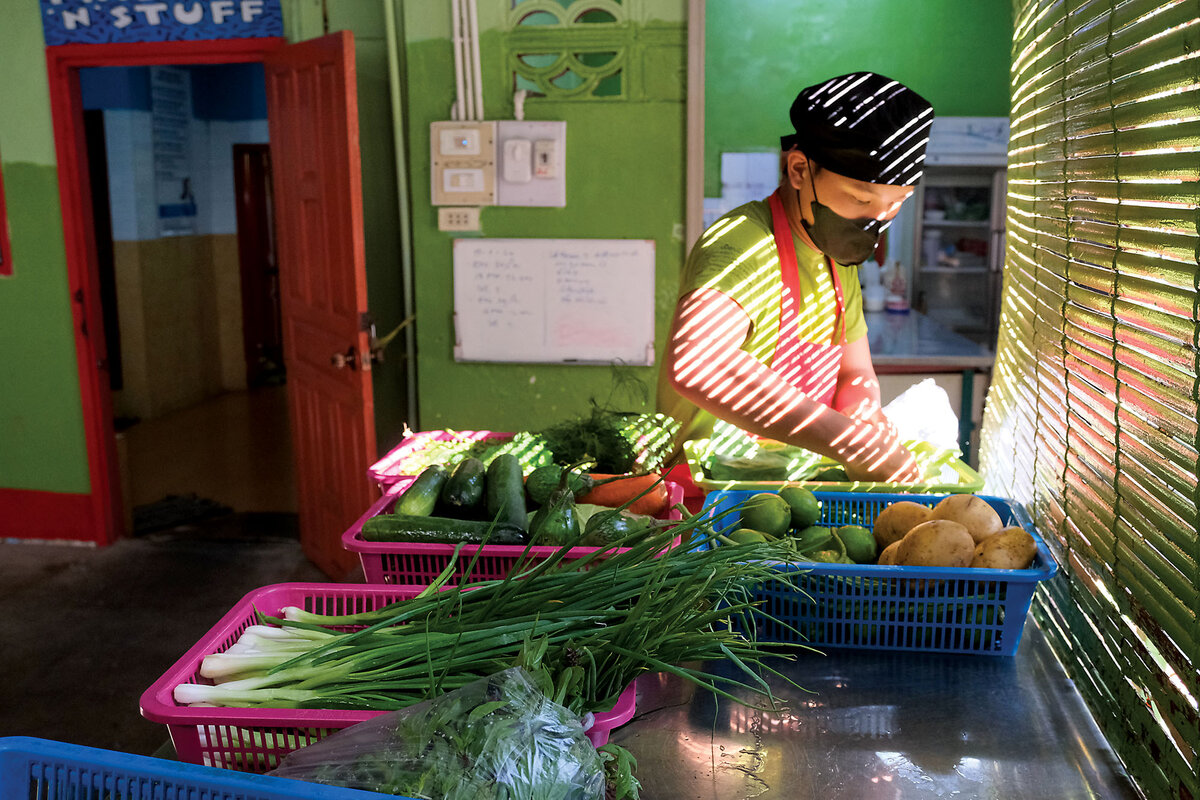
A student prepares vegetables before lunch begins at Mini-Makphet, a vocational restaurant in Vientiane, Laos.

I can’t read anything about Laos without thinking of the mystery series that Colin Cotterill wrote, which includes a plea for the poor of that country and for removing the explosive mines left by the US. Since today’s article is about training young restaurant workers in Laos, I’m particularly remembering the noodle shop in the mystery series, run by Daeng, the wife of investigator Dr. Siri Paiboun.

Zinara Rathnayake wrote the following story for the internationally focused Christian Science Monitor.

“Until about a year ago, Xue Xiong had never seen a town,” wrote Rathnayake. “She lived in a small village with a dirt road that turns muddy when it rains, making travel difficult. She dropped out of school early to help her parents farm rice and breed cattle to feed her 10-member family. 

“It was at Khaiphaen, a charming restaurant two hours away in Luang Prabang, that Ms. Xiong learned to dream. The Laotian fusion eatery trained her to prepare and serve food for the tourists who flock every day to the bustling city. 

“ ‘I want to save money and open my little Lao food stall, because tourists love Lao food,’ says Ms. Xiong, who is Hmong, one of Laos’ marginalized ethnic minorities. ‘Because I feel like I can do anything now.’

“Khaiphaen was opened by the Cambodia-based organization Friends-International and collaborates with the Lao government and other nonprofits to aid young people interested in culinary education as a path to more prosperous futures.

“Laos is one of Asia’s least-developed countries, and poor education and the lack of economic opportunities often force children and young people there to work in lower-paid, menial jobs under exploitative conditions. Many others are trafficked into factories or prostitution.

“At almost 10 a.m. on a chilly January morning, an hour before Khaiphaen opens for the day with plates of laab (spicy minced-meat salad) and beer-battered Mekong River fish, Ms. Xiong laughs as she watches her friend, another young woman, slice carrots. Ms. Xiong shows off her yellow T-shirt from Le Petit Prince, a nearby Korean cafe where she started working after Khaiphaen. She thinks the cafe’s owner is nice, her English is improving, and soon she will play the piano at the cafe, Ms. Xiong tells her friend.

“ ‘I see children tremble the first time they come to serve,’ says Khaiphaen’s restaurant manager, Anousin Phanthachith, ‘and then in a few years, you see them grow into entrepreneurs.’ He joined the team at Friends-International in 2014 when Khaiphaen was just a concept with a few dining tables, and he has never thought of leaving. ‘You feel fulfilled because you help many young people – especially children who come from remote, underprivileged communities, some of them with traumatic childhoods.’ 

“Nearly a third of Laos’ population lives in poverty, subsisting on less than $4 a day, according to 2022 figures from the World Bank. Children bear the brunt of it. Although Laos has made progress on child mortality, 43 out of every 1,000 children die before reaching age 5 – one of the highest child mortality rates in Southeast Asia (down from 154 in 1990). The government is pushing for primary education for all children, but the number of dropouts is high. 

“More than 130 students have graduated from Khaiphaen. Yet it is not a traditional cooking school, says Friends-International social worker Ae Thongkham. Besides waiting tables, students gain experience making noodle bowls with their teachers from scratch in the kitchen as well as preparing beverages. Mr. Thongkham adds that when students arrive from minority ethnic groups, many of them don’t speak Lao, the country’s official language. So at the social work center upstairs, students learn basic Lao and English, in addition to life skills such as managing their finances. 

“Students aren’t salaried but receive free training, accommodations, meals, transportation, and health care. After graduation, they are placed in hotels, cafes, and restaurants across Luang Prabang’s flourishing tourism industry.

“For Mr. Phanthachith, who left his village at age 18 and studied at a temple before working at the city’s restaurants, looking after his young students has always been the priority. ‘We always talk to our students even after they leave the program to make sure that they are in a safe workplace that benefits them and treats them well,’ he says.

“Khaiphaen is part of a series of vocational restaurants that Friends-International operates across Southeast Asia. Although some of the eateries shuttered during the coronavirus pandemic, Khaiphaen began delivering food to locals to stay afloat. In the capital, Vientiane, Khaiphaen’s sister restaurant Mini-Makphet turned into a soup kitchen, feeding underprivileged children and their mothers. Housed in a tin-roofed space with varnished wooden tables and chairs, Mini-Makphet is much more modest and mainly serves Vientiane residents.

“Ketsone Philaphandet, Friends-International’s country program director for Laos, is quick to highlight that Vientiane receives far fewer tourists compared with Luang Prabang. The quiet, industrial Lao capital serves only as a pit stop for many foreign travelers exploring the country’s far-flung karst mountain towns and vibrant cultural hubs. ‘So we keep our prices lower and food spicier,’ Ms. Philaphandet says, smiling.

“For many young people, Mini-Makphet is a social lifeline. Mala Thoj has worked at the restaurant for only two months but can already pour a latte with a little foam heart on top. ‘I feel happy here, because I have friends who support me,’ she says. She used to live with abusive relatives and was compelled to toil at a rubber estate. …

“Emi Weir, founder of the social enterprise Ma Té Sai, which sells handmade products crafted by Laotian women [notes] that although Khaiphaen lacks marketing to reach tourists who are ‘ready to spend more for a good cause,’ its program has excellent social work, training, and outreach initiatives.”

More at the Monitor, here. No firewall. You can learn a lot more about our world from the Monitor or The World, on radio, than you can from the Washington Post or the New York Times. Check them out.

Read Full Post »

Photo: Sophie Neiman.
Ms. Acogo spent several years on the street before receiving vocational training as a tailor from Hashtag Gulu in Uganda.

Recently, PRI’s The World broadcast a valuable but scary series on orphanages in Uganda, nearly all of which are bad. For children from impoverished or abusive homes, the alternative may be life on the streets.

In an issue last December, the Christian Science Monitor‘s Sophie Neiman wrote about how one city’s concerned citizens began helping street children reach for a better life.

“In the sticky evening,” she begins, “two boys in torn clothes dart between shop verandas and wrestle in the dust, trading jokes that quickly turn to insults. Onlookers grunt disapprovingly, angry at the noise. More groups of rowdy children will soon stream into the back alleyways of [the small city of Gulu] in northern Uganda, eking out a life in its underbelly.

“By day, the children pick through discarded plastic bottles trying to gather enough of them to sell. At night, they hang out in the shadows of dance clubs or sleep under pieces of cardboard between shop shelves that normally hold fruit.

“Steven Onek strolls over to the squabbling boys. Speaking in a calm and quiet voice, he breaks up their argument. A few minutes later, around another street corner, he comforts a teenager sporting a deep cut on his head, providing the boy with some money to see a doctor. 

“Such situations are commonplace for Mr. Onek, who is a program officer at Hashtag Gulu, a small organization supporting the city’s homeless children. For him, it is not so much a job as a calling.

‘Helping a child, one child out of the street, I feel like I have helped the whole nation,’ he says, smiling.

“The name Hashtag Gulu points to its history. Friends sharing on social media the problems they saw in their city decided to do more than that. At first, their efforts were all volunteer-based. The friends bought food for homeless children and comforted them when they could.

“ ‘If you were in our network, you were free to do anything, for any young person or child. You didn’t have to report to anyone,’ co-founder and director Michael Ojok said of Hashtag Gulu’s early days.

“Eventually the group grew into a fully registered community organization, as activists attempted to address the added problems caused by the coronavirus pandemic. Now, Hashtag Gulu reunites homeless children with their family members [if possible] and provides them with vocational skills. It is also a rare safe haven, running a free clinic as well as counseling and arts programs.

“Some of the children Hashtag Gulu works with are as young as seven, but its beneficiaries can be as old as 25. Most have nowhere else to go. Others have dropped out of school to make a living on the street, returning to their homes and families only rarely. 

“Gulu is a place accustomed to hardship. For some three decades, between the late 1980s and early 2000s, the city was the epicenter of an uprising against the government mounted by the Lord’s Resistance Army, notorious for forcibly recruiting some 20,000 child soldiers. A grim parade of boys and girls would flood into the city each night and sleep under its market stalls and in church yards, hoping to avoid capture by the rebels, before returning to their villages at dawn.

“Today, the children are often escaping family abuse or neglect, hoping to make it on their own. Mr. Dong, who asked to use a pseudonym, fled to the streets when he was six years old. His mother had died giving birth to him, and the women his father brought home with him were physically and emotionally abusive.

“Without parents to look out for him, he fell in with other children for safety. ‘I got a family outside of my family,’ he says. They helped each other find food; they also offered some protection in a community that viewed them as troublemakers, and from police officers quick to make arrests. …

“While collecting scrap metal a few years ago, a blade fell and cut Mr. Dong’s foot. He came to Hashtag Gulu for free medical treatment. After healing his injuries, workers provided him with piglets and agricultural training. Mr. Dong, now 16, lives with an aunt and continues to care for his pigs. …

“Hashtag Gulu also works with other local organizations to provide employment. At Taka Taka Plastics, which transforms waste into home goods, some 20 children who once lived on Gulu’s streets have been given jobs.

“Their Taka Taka earnings have enabled those young people to rent their own rooms, buy and cook their own food, and even start side businesses, says co-founder Paige Balcom, an American living in Gulu. 

“A municipal survey conducted two years ago estimated that there are some 2,000 children living rough in Gulu. So far, Hashtag Gulu has managed to reach about half of them with its programs. …

“Looking forward to the holiday is Ms. Acogo, also a pseudonym. Like Mr. Dong, she fled abuse at home, arriving on the streets in her early teens.

“ ‘We would go to night clubs, and there were men who would always support us. That is how we survived,’ she recalls quietly.

“Ms. Acogo became pregnant by one of those men. Hashtag Gulu helped her train as a tailor, and reconnected her with her grandmother. 

” ‘I didn’t know where to start from, how to raise this child,’ she recalls, holding her one-month-old baby. ‘Other women at home are now supporting me and guiding me into motherhood.’ “

More at the Monitor, here. No paywall. Subscriptions sought.

Read Full Post »

Photo: Trude Jonsson Stengel via Unsplash.
An artistic nose from Sweden. New research finds a connection between a healthy sense of smell and a healthy memory — meaning less dementia.

Back in the 1980s, we experimented with using a kerosene space heater for a cold room. The first time I smelled that burning kerosene, I was taken back to age 4 and the week my brother and I spent in a home that used kerosene heat. What about you? Can you think of memories triggered by a smell?

Nicola Davis reports at the Guardian, “Whether it is the waft of clove-studded oranges or the crisp fragrance of a fir tree, the festive season is filled with aromas that conjure Christmases past. Now researchers say our sense of smell, and its connection to our memory, could be used to help fight dementia.

“Our senses can worsen as a result of disease and old age. But while impairment to hearing or vision is quickly apparent, a decline in our sense of smell can be insidious, with months or even years passing before it becomes obvious.

“ ‘Although it can have other causes, losing your sense of smell can be an early sign of dementia,’ said Dr Leah Mursaleen, the head of research at Alzheimer’s Research UK, adding it was a potential indicator of damage in the olfactory region of the brain – that is, the part of the brain responsible for smell.

“That has led to researchers examining whether loss of smell could be used to diagnose conditions such as Alzheimer’s long before symptoms such as memory loss set in – an approach, experts say, that could allow patients access to drugs such as lecanemab early in the course of the disease, when they work best to slow cognitive decline.

“But just as research has suggested the use of hearing aids could reduce the risk of developing dementia, questions are being asked about whether bolstering our sense of smell could do the same. Could a declining sense of smell be a risk factor for cognitive decline, not just a symptom?

“ ‘Olfaction is intimately involved in many brain processes, and especially the emotional processing of stimuli,’ said Prof Thomas Hummel, of Technische Universität Dresden. Indeed, smells, memories and emotions are often tightly bound, with research revealing recollections triggered by scent tend to be rooted in our childhood. …

“Neurons involved in the olfactory system are also involved in other systems in the brain. Indeed, as Hummel and others note, some areas of the brain play a key role in cognitive and olfactory processes. As a result, if the sense of smell becomes dysfunctional, cognitive processing might also be affected.

A number of studies have found that exposure to certain odors can either boost or hinder cognition. …

Work by Hummel and colleagues has suggested smell training in older people can improve their verbal function and subjective well-being.

“More pertinent still, a small study published last year, by researchers in Korea, revealed that intensive smell training led to improvements in depression, attention, memory and language functions in 34 patients with dementia compared with 31 participants with dementia who did not retrieve such training. …

“Intensive scent training takes time and effort. In an attempt to solve this problem, Dr Michael Leon, professor emeritus at the University of California, Irvine, and his team have come up with a device called Memory Air that emits 40 different smells twice a night, while people are sleeping – an approach Leon says allows ‘universal compliance.’ The hope is that exposing people to more smells, even when they are asleep, could strengthen their olfactory abilities.

“The team is about to start a large trial with the gadget among older adults without dementia, building on a smaller study that suggested the approach could improve memory performance in such participants. ‘We will then start a large trial with Alzheimer’s patients using that device,’ said Leon.

“In another small study, Dr Alex Bahar-Fuchs, a clinical neuropsychologist at Deakin University, Australia, is looking at whether training cognitively healthy older adults to distinguish smells using a scent-matching memory game can help improve wider aspects of memory and cognition, compared with using a similar game based on matching pictures. The approach, he said, goes further than passive exposure to odors by setting cognitive tasks for participants.

” ‘We believe that the neuroplastic properties of the olfactory centers in the brain might make it more likely that improved performance on olfactory memory will generalize, or transfer, to memory functions more broadly,’ he said.

“Meanwhile, Prof Victoria Tischler, at the University of Surrey, is working to learn more about how our olfactory function changes as we age normally.

“As part of their work, the team hopes to produce olfactory training kits suitable for healthy older people, those with mild cognitive impairment, and those living with dementia in care homes.

“Tischler said it was important to cherish our most enigmatic sense. ‘I would advise the public to look after their sense of smell, much like they look after other aspects of their sensory health,’ such as their eyesight, she said.”

Well, I’m convinced. I’m now going around ripping orange peels and sniffing them, breathing in ground coffee, chocolate, Christmas tree needles.

More at the Guardian, here. No firewall; donations encouraged.

Read Full Post »

Photo: Pat Greenhouse/ Globe staff.
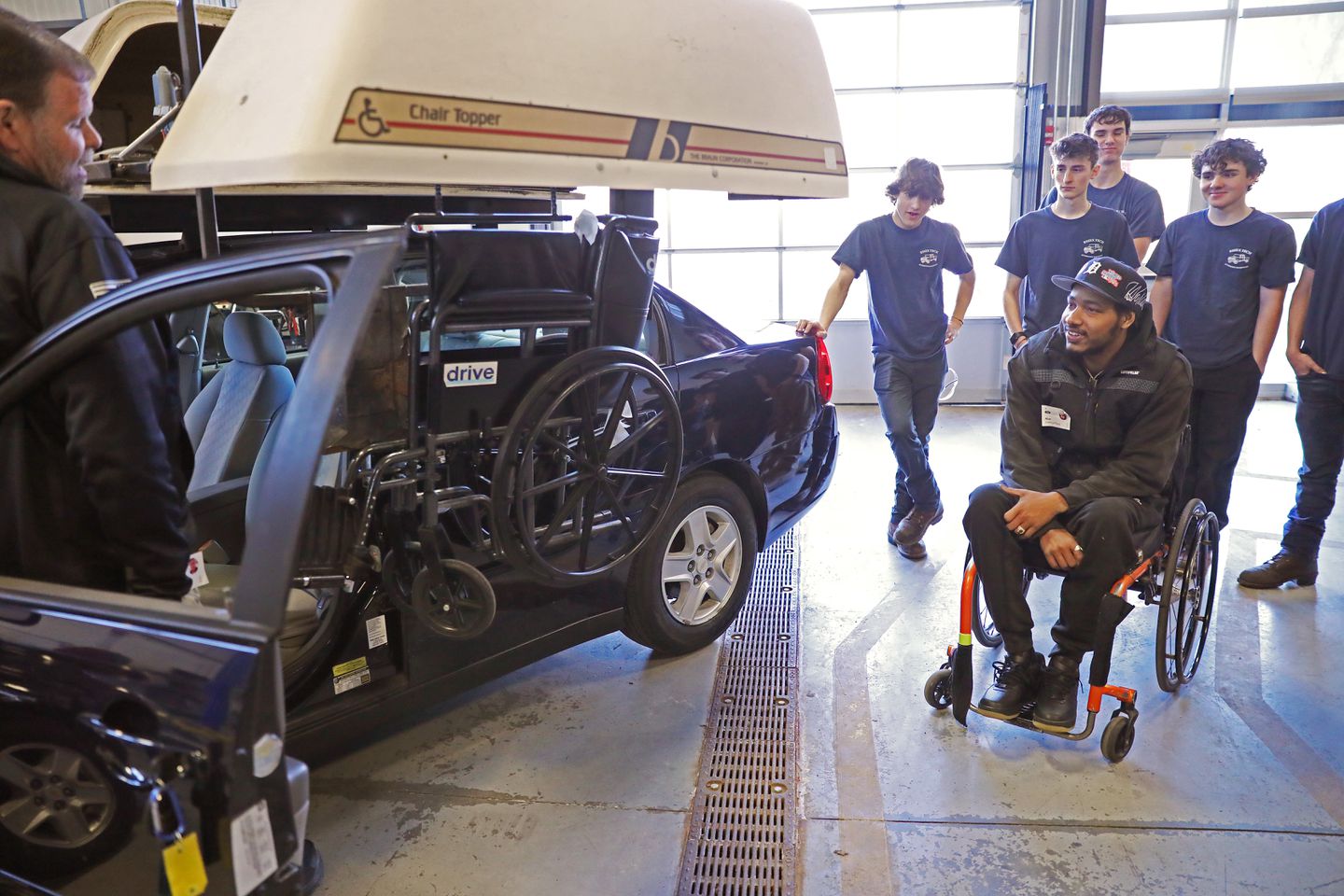
Donor Michael Solomon, left, demonstrates the use of the chair topper to store a folding wheelchair to car recipient Alan Mack of Quincy at Essex North Shore Agricultural & Technical School. It’s all in a day’s work for Second Chance Cars.

Dan Holin is a local nonprofit entrepreneur that I’ve worked with in connection with a couple different organizations. I met him in the early 2000s, when he was running the Jericho Road Project, and when he went to UTEC in Lowell, Mass., I wrote how he brought the joy of biking to teens who had been in trouble with the law, here.

Now the Boston Globe has caught up with Dan’s latest initiative, a longtime dream. He has really thought through all the pieces needed to make it work — the banks, the beneficiaries, the automotive high-school programs, the donors, etc.

Nancy Shohet West wrote, “Three years ago, Alan Mack was struggling to make ends meet as a laborer with the state Department of Recreation & Conservation when he was struck in the back by a bullet and left paralyzed. What followed was not only rigorous recuperation, but also a long stretch of being unemployed and homeless. …

“For a person in a wheelchair, the daily commute he had previously made by public transportation was nearly untenable: Typically an hour in duration and requiring several transfers from train to bus, not to mention relying on a system not known for its reliability even in the best of times.

“Fortunately, the social service organization that was helping Mack with his numerous challenges had one more idea for him: applying for a vehicle through Concord-based Second Chance Cars, which provides automobiles to low-income recipients who can demonstrate that owning a car would substantively help them to get a job, keep a current job, or advance within their field.

“Now Mack makes the 15-minute commute from home to work in his specially equipped car, which he said also will enable him to advance the music production business he recently started after entering an online bachelor’s degree program at Berklee College of Music. …

“Mack is one of about 70 beneficiaries to receive vehicles from Second Chance Cars, founded in 2019 by Concord resident Dan Holin. An Israeli-American citizen who served in the Israeli military and then pursued a career in nonprofit administration, Holin was motivated by several intersecting passions, including social outreach, cars, and entrepreneurship. He envisioned a nonprofit that would serve veterans and former prison inmates returning to society. His mission has since expanded to reach others, including legal immigrants and struggling families.

“Mentored by leaders of other nonprofits, Holin designed a business model whereby his organization provides donated cars to low-income workers for $900, paid for by the recipients in monthly installments of $75 over the course of a year.

“After talking with nearly 20 banks, Holin found two — City of Boston Credit Union and Metro Credit Union — willing to partner with Second Chance Cars by providing zero-interest loans along with free financial counseling to the recipients, with Holin serving as the guarantor. At the end of 12 months, the recipients have not only paid off the loans but also have improved their credit ratings.

“Stephanie Tetreault is the kind of person Holin envisioned helping. After battling a drug addiction and serving nearly 10 months in prison for larceny, she was determined to get her life back on track.

“Formerly living on the streets, by the fall of 2020 she had housing in Lowell and steady employment as a shift leader at Dunkin’, where she wanted to apply to be a manager. But that job required reliable transportation, and a car was something Tetreault had neither the cash nor the credit rating to obtain.

“Her case manager at Thrive Communities, which helps formerly incarcerated people transition back into society, told her about Holin’s organization.

” ‘I went through the application process and met with the board of directors of Second Chance Cars to tell them about my situation,’ recalled Tetreault, whose car was prepped at Greater Lawrence Technical School in Andover. ‘The whole process took just a few weeks, and then I had my car: a 2005 Toyota Prius. It’s been a blessing and a lifesaver.’

“Just as Tetreault hoped, Dunkin’ promoted her to a manager position, which she held for about 18 months. Empowered by her newfound independence, her ambitions grew.

“ ‘Because I had a car, I felt that I could pursue my larger goal of becoming an addiction counselor,’ Tetreault said. ‘I found a job in that field in May of 2022, and then enrolled in the addiction counseling certificate program at Middlesex Community College.’

“The benefits that Second Chance Cars provides reach more than just its recipients. The organization collaborates with five vocational high schools in Massachusetts — Essex Tech in Danvers, Greater Lawrence, Greater Lowell Technical in Tyngsborough, Minuteman High in Lexington, and Northeast Metropolitan Regional Vocational High in Wakefield — enlisting their automotive technology departments to fix any problems the donated cars might have before they are passed on to new owners.

“ ‘This is a great match for our program,’ said Jill Sawyer, director of Career, Technical and Agricultural Education at Essex Tech — more fully, Essex North Shore Agricultural & Technical School —whose automotive technology students worked on Mack’s car.

“ ‘Many of the cars our students work on belong to faculty members or people from the community who understandably need their vehicle repaired as quickly as possible.

‘With Second Chance Cars, we usually have a few weeks with a car, which gives the instructors more time to make it a learning experience.’

‘And then the students get to attend the reveal ceremony and learn about the person who is receiving the car, which is eye-opening for them.’

“ ‘It’s a win-win situation,’ agreed Donald Melanson, an auto tech instructor at Minuteman, whose students have worked on more than a dozen vehicles for Second Chance Cars. ‘A lot of the repairs the donated cars need are typical of those that the students will be doing once they get out in the trade. This is also giving them a chance to help the general public, and to see the kind of difference that they can make in someone’s life.’

“Josh Duquette found out about Second Chance Cars from a counselor at Veterans Inc., which provides services to veterans throughout New England. A divorced father of four living south of Boston, he couldn’t drive due to a combat-related disability after returning from a deployment in Kuwait and relied on a combination of ride-hailing services, public transportation, and favors from friends to get to his job as a special education paraprofessional in the North Attleborough school system.

“Once Duquette received medical clearance to begin driving again, Second Chance Cars found him a nine-year-old car with 115,000 miles on it. Students at Minuteman refurbished the interior, serviced the engine, and provided new parts. As a result of having his own transportation, Duquette was able to take a position teaching summer school in addition to his school year assignment.

“ ‘One of the biggest obstacles a lot of our veterans face in getting back to a meaningful lifestyle is transportation,’ said Bill Corcoran, a case manager with Veterans Inc. … ‘Second Chance Cars takes that barrier away, and it’s life-changing.’ ”

More at the Globe, here.

Read Full Post »

Photo: Jessica Rinaldi/Globe.
Apprentices learning how to plaster inside Forge, a trade school that helps students move right into a job.

The kinds of people I follow on social media are always saying that there is no shortage of labor right now, just a shortage of decent pay. So my next thought is, How do people qualify themselves for decent pay, especially young people who don’t go to college?

Investigating one approach, Scott Kirsner writes at the Boston Globe about a trade school that is hiring its graduates.

“In a building next to the Mass. Pike in Newton, two construction crews are at work. Enter the front door, labeled with a sheet of paper that says ‘Forge,’ and a crew is renovating a 1960s-era office space that will eventually house software developers, customer service staffers, and a finance department.

“But go through another door, and you’re in a high-ceilinged industrial space. Here, 10 apprentices are toting lumber, measuring walls, and hanging sheetrock. But this crew is part of a 12-week program that teaches the basics of construction and pays them $15 per hour as they learn.

“Founded in late 2020, Forge is a startup that runs a new kind of trade school but also seeks to employ the graduates. And the company has raised nearly $28 million, some of it from the Miami-based homebuilder Lennar Corp., to train more workers and expand to a second city, likely Tampa. Founder Mark Kasdorf says his goal is to employ 100,000 people in 10 years.

“Kasdorf thinks that can happen by creating a new kind of ‘on-ramp’ to the construction trades for so-called Generation Z workers just now entering their twenties.

“ ‘The types of employers in the trades today are incompatible with Gen Z, from big builders like Suffolk to the union to a 65-year-old operator of a plumbing general contracting company. They don’t like Gen Z, and Gen Z doesn’t like them.’ Kasdorf says nearly one-third of Forge’s graduates so far have been women. ‘They’ll tell you that there’s no on-ramps for them,’ he says. …

“Kasdorf sold a previous company, Intrepid Labs, to the consulting giant Accenture in 2017. … When Kasdorf left Accenture to start Forge, he raised money from Boston Seed Capital and was focusing on creating technology for ‘augmented reality’ glasses. … [But] he realized that ‘we’re running out of skilled tradespeople in the US,’ especially as an older generation begins to retire.

“The company changed its focus in February 2021, to ‘building a private trade school where we’re training the next generation of trades worker for America,’ he says, and surrounding them with technology like those augmented reality glasses. …

“One early student, Nick Claude, was managing a bar in Hingham when he heard about the opportunity from a customer who worked for Forge. Claude says he ‘had wanted to get into the trades. … He reached out to 30 or 40 tradespeople, but found ‘many weren’t willing to take on strangers they don’t know.’

“The 12-week program has students build their own workbench, and then they move on to working on simulated houses, learning how to frame a house, install roofing, and add flashing. They install tile and faux-wood flooring and learn to hang sheetrock, plaster walls, and add molding. Kasdorf says about 70 percent of the apprentices finish the program and move into paid positions with Forge, earning $21 an hour and health insurance. (Forge guarantees them 32 hours a week of work.)

“The company sends its alumni out on window replacement jobs, or one-day bathroom refits, typically subcontracting for a larger brand. … Forge also buys houses in the Boston area, dispatches crews to renovate them, and then flips them. The company seeks to buy $300,000 to $400,000 starter homes that it can resell for $600,000. He says that the worse shape a house is in, the better it is for Forge: ‘We want houses that need a lot of labor — it’s more training opportunities for our people.’ …

“Using technology is still part of the picture, Kasdorf says. Twice a day, at noon and 4 p.m., someone on each crew dons an augmented reality headset for a quality check. That allows a supervisor at the office in Newton to ‘see’ the work that has been done remotely, ask questions, and address any problems that have cropped up. …

“Forge has a long way to go to show that it can profitably train and employ thousands of tradespeople. (At present, the company has 90 employees.) But it is working on a major problem — there were more than 400,000 open jobs nationally in construction in September, according to the Bureau of Labor Statistics, and a recent article from McKinsey & Co. highlighted ‘a persistent labor shortfall’ in the sector that could become even worse in the wake of the Bipartisan Infrastructure Law, which will funnel billions into new transportation projects. …

“ ‘The demand is strong’ for people with skills in carpentry and other trades,” says Tom Fischer of the North Atlantic State’s Carpenters Training Fund, adding that he would never knock a training program just because it is small — every bit helps.

More at the Globe, here.

Read Full Post »

Art: Renoir.

When I was a child, I went through a period of wanting to be a ballet dancer. It was a thrill to have a small role in the Elysian Fields of Gluck’s Orpheus alongside grown-up ballerinas and opera singers. But as ballet lessons waned, other interests took their place.

Later, as a worrywort adult, when a dancer I knew kept getting injuries, I began to think of ballet as a dangerous sport. Today’s post celebrates a revolution in addressing ballet injuries.

From Nick Miller at the Age: “Is injury common among ballet dancers? Yes. But perhaps not for the reasons you might think. A study in Britain in 2014 found that professional dancers were far more likely to suffer injuries than rugby players: 80 per cent of dancers incur at least one injury a year that affects their ability to perform, compared to 20 per cent for rugby or football players.

“Muscles and joints were the most common sites for injury, according to the British Fit to Dance 2014 survey. Other studies found that over-use was the most common cause of injuries for female dancers while men were more susceptible to sudden, traumatic injuries. And they found that younger dancers were more likely to be injured than older ones. …

“[Matthew Wyon, professor of dance science at the University of Wolverhampton and one of dance science’s leading experts] believes it’s because of the way dancers train.

“ ‘None of their training causes them to get either stronger or fitter until right up close to a performance. Ballet dancers are technically unbelievable. They’ve got an economy of movement we never see in sport. But it means the dance no longer puts a stress on the body. They don’t have that physical adaptation. So, in fact, the better your dancer is, the less fit they are. Because dance doesn’t stress them any more.’

“On the face of it, the lifts and jumps that dancers perform seem to require extraordinary strength. But, behind the scenes, a lot is accomplished by perfect balance; by aligning bones and locking joints so that, rather than relying on muscles to hold your partner aloft, the weight transfers through your frame to the floor. …

“Evidence of their reliance on technique can also be found in dancers’ almost freakish ability to ignore fatigue when it matters.

“In one experiment, Wyon’s team made a dancer exercise until they were ‘absolutely dead on their feet’ and then perform a double pirouette on to arabesque (which is where they stand en pointe with one leg in the air behind). ‘And they could pull it off, even when they were having trouble doing the fatiguing dance in between. As soon as they were being watched, or having the data collected, they could pull it out. This is just a phenomenon and we’re trying to explain it – and it could be how they’re trained.’

“Technique, it seems, honed over hours of practice each day and since an early age, hides a multitude of flaws. Wyon has seen a male dancer ‘built like a stick insect’ who could lift any of the women in the company – purely through ability. ‘His technique was so good for doing it, beautifully. Once. But if you asked him to do it three times, he couldn’t. … They’re always training and dancing at close to their maximum.’ …

“The Australian Ballet is one of a group of pioneering dance companies around the world that have beefed up their in-house medical expertise and are leading the way in the search for better treatment, rehabilitation and – most importantly – injury prevention.

“Dr Sue Mayes is the director of artistic health at the ballet, where she’s worked since 1997 – at first in the littlest room in the building as the company’s first full-time touring physio, now leading a high-tech medical and physiotherapy operation. …

“ ‘We’re [always] going to see if we can do it non-surgically,’ says Mayes, ‘because a dancer loves that swan neck, that hyper-extended shape. If you lose even five degrees of that, it’s going to be obvious to the eye and harder to function with. So, we avoid surgery at any cost – we’ve done very few operations in the last 10 years.’

“For a year, [Benedicte Bemme, an injured dancer] had to run through a simple, repetitive exercise routine involving the movement method Pilates, little jumps, or jogging up and down a stairwell, designed to restore strength and function to her foot.

“It may sound simple, but in ballet it is a revolution. Rather than rushing dancers to hospital, they are experimenting with techniques to painstakingly rebuild the dancer from the inside out. Research published by Mayes and her team looks at each joint and each injury, and assesses what particular types, frequency and power of exercise are best to get a dancer back to the stage.”

Read more at the Age, here.

Read Full Post »

Photo: Genesis Center.
Culinary skills training session in Providence. The amazing Josh Riazi built the program into what it is today.

One of the two Providence agencies where I’ve been volunteering to help English teachers is the Genesis Center. In addition to providing English classes to immigrants, Genesis offers child care, many social services, and career programs. Perhaps the most renowned of its trainings is under the aegis of a gifted and highly motivated chef called Josh Riazi. I have tasted the food. It’s top of the line.

Alexa Gagosz wrote at the Boston Globe about plans for expanding the program.

“In the next few weeks, construction will be underway at the Providence Public Library. … Come 2022, a new restaurant run by the Genesis Center, known as CHOP (the Culinary Hub of Providence) will open as a hybrid retail store and workforce and economic development hub. The initiative, according to the Center’s chief executive Shannon Carroll, is a natural expansion of the Center’s longstanding culinary arts program that has been a pipeline to local restaurants for decades.

“But the key difference with this program, said Carroll, is that participants will get paid to learn and will experience a ‘real world’ environment as they develop their culinary skills. Students will have knife skills training, classes in safety and sanitation, proper use of equipment, culinary math, soft skills, and participating in food production for the CHOP commissary. Carroll said they will be able to complete their Servsafe certification and work on individualized goals related to their career and financial empowerment. …

Q: Who can become a student and how much does it cost?

“Carroll: Genesis Center (located in Providence’s West End neighborhood) serves families throughout the greater Providence area. … The training program would be no cost to the students and participants would receive an hourly wage as apprentices. This paid, on-the-job training allows us to reach students who cannot afford to spend several months on training with no income.

Q: How is the program funded?

Carroll: Our programs are funded through grants both for the buildout of the space and the training program. [Funders include Anonymous, Carter Family Foundation, Champlin Foundation, City of Providence, Egavian Foundation, Governor’s Workforce Board, Jacques Pepin Foundation, Ocean State Charities Trust, and Social Enterprise Greenhouse.]

Q: When and why did the Center decide to expand its culinary program?

Carroll: We have had many conversations over the years about expanding our culinary offerings to reflect the changes in the industry and the needs and wants of our students.

“When we toured the PPL renovations last year, before COVID, they mentioned wanting to open a cafe in the space. The location, timing, and synergy of missions between the PPL and Genesis Center just made sense to us. It was the perfect opportunity to explore taking our program to the next level.

Q: How does CHOP fit into the mission at the Genesis Center?

Carroll: Our mission is to provide the highest quality education, job training, and support services to people of diverse cultures so that they may achieve economic independence and participate fully in society.

“Many [of Genesis Center’s adult learners] hold full-time employment or multiple part-time jobs, but they struggle to support their families with very low-income levels. Most of them have children. They struggle with the same challenges faced by most low-income individuals — unstable housing, inconsistent resources for transportation, limited resources for child care and health care, and difficulty overcoming unexpected problems or emergencies. As members of racial, ethnic, cultural, and linguistic minority groups, they face additional barriers to education and employment. …

Q: How will the menu work at CHOP?

Carroll: It will reflect the diverse community we serve. We plan to incorporate feedback and recipes from our staff and students to provide lunch and to-go items to the downtown business community. … We hope it will serve as a community space to bring people together.”

More at the Globe, here, and at ConvergenceRI, here.

Read Full Post »

jeannetteandevon

Photo: Beautiful Day
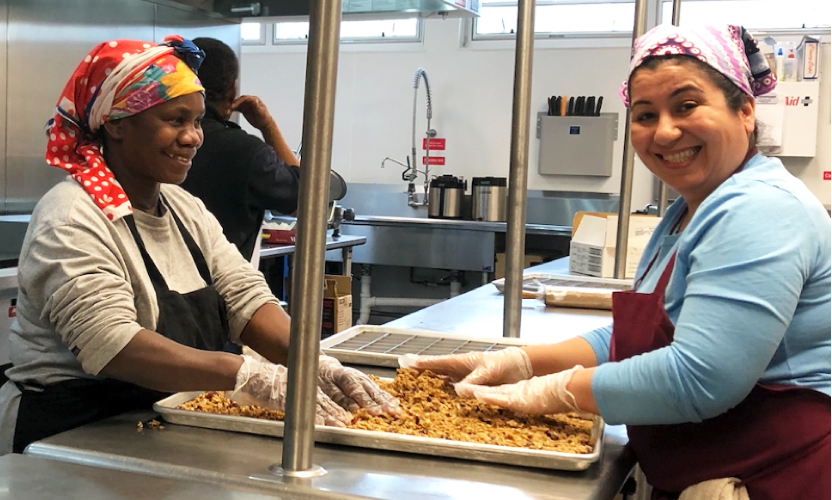
The photo above was taken before social distancing. But the nonprofit Beautiful Day has made Covid-19 adjustments like the rest of us and continues to train refugees in making delicious products.

It’s been a while since I wrote about the Rhode Island miracle called Beautiful Day (originally Providence Granola Project), and I want to update longtime blog readers while also letting newer readers know about this amazing initiative.

The nonprofit was founded in 2012 by Keith Cooper, who grew up among missionaries in foreign lands. It gives workplace training to refugees and supports itself not only by donations and grants but by selling the delicious products the trainees learn to make. I laid in a haul of my favorite granola at the beginning of the pandemic, and I must say it cheers me up every day.

On March 27, Keith wrote on his blog about the childhood that shaped him.

“I was born during a curfew. I grew up in a war zone. Over the last couple weeks I’ve been having flashback memories from my childhood. We lived in the central highlands of Vietnam, in a town called Kontum, not far from the border or Laos and Cambodia. We lived near a US military airport and compound which we always called MAC-V.

“So military conflict was part of the context for daily life. Just the way things were. My siblings and I had a bullet shell collection. My mom sometimes kept flowers in a brass mortar shell. My parents were linguists working with indigenous peoples who were in the process of being displaced by the war. There were visitors and stories, adults making decisions or talking in a certain tone of voice. There were sometimes flares and gunshots at night, the whir of Chinook and helicopter blades.

“When I was around 4 or 5 … my dad built built a cement-walled bunker under the house with steep steps going down from a wooden trapdoor. Some of my earliest memories, either real or imagined, came from that bunker.

“For some reason I remember the light down there as a beautiful emerald green. I remember a cylindrical kerosene heater with pretty blue flames. My dad had been in ROTC and part of a reserve unit, so he knew enough to make a guessing game of estimating the distance and counting down to the boom of mortars. For some reason, having a shaking boom correctly predicted for you by a voice you love counters any surge of fear….

“I know we can all feel the world getting a shaking these days. I suspect there will now be a break between a pre- and post-carona world and our pre- and post-carona lives. Yet my flashback memories remind me how significant the little things are. My mom pinning laundry. My puppy and a paper birthday hat. The bright scent of coffee blossoms or taste of ripe coffee cherries.

The fact that I remember these better than artillery booms reminds me to make room in my life these days for the small things.

“I’m painting the ceiling of my entryway a twilight blue and a woman at our local hardware store spent a half hour on the phone helping me choose the right finish. What a kind gift from a stranger. And we made a special trip to the store today for cake flour. Tomorrow my daughter and I will bake a lemon birthday cake for my sister. One of my daily joys now is going for a walk around dinner time. Never before have I seen so many apartment lights on or smelled so many wonderful things being cooked in our neighborhood. It has a completely different feel.

“Even in a great shaking there are joys.” More.

Earlier this month, Keith emailed supporters about how Beautiful Day is managing in the pandemic, which has coincided with moving into a new kitchen.

“Everything went as smoothly as could be expected given the new space, the new equipment, and the new routines. The trainees worked long hours making hundreds of [granola] bars and bags of Mochaccino Hazelnut, Ginger Muesli and Pistachio Cardamom granola. …

A big challenge has been to make sure that everyone maintains proper social distance while still having enough room to dance.

“That’s right, dance! The owners of the kitchen left us a big Bluetooth speaker along with a playlist of spirited tunes. When the trainees aren’t listening to music from their own countries, they are blasting top 40’s hits and bouncing around. The Bluetooth has been a big hit and has helped everyone stay productive and focused. Morale is high. …

“We have so much to learn from our trainees in times like these. Even in the midst of a pandemic, they remain upbeat and strong. And they are dancing.”

My past posts on Beautiful Day may be found in 2012, 2015, and 2018.

Buy something yummy for yourself or send a care package to a shut-in, here. You won’t regret it.

Read Full Post »

gvgge5aoc4i6viugdtzaidlqoy

Photo: Jonathan Wiggs/Globe Staff
Breaktime Café cofounders Tony Shu (left) and Connor Schoen hosting a kickoff launch party in Boston for a nonprofit that helps homeless youth learn job skills.

Not sure why so many recent posts have had a food angle. I’ve certainly been drawn to stories about food. In this article, a couple young guys who volunteered with homeless youth saw a way to help them move beyond homelessness with a bit of skills training and lots of moral support.

Back in December, as Max Jungreis wrote at the Boston Globe, the nonprofit was just getting set up.

Breaktime Cafe doesn’t look like much. It’s 1,500 square feet of typical office space on Portland Street, with gray carpeting, off-white walls, and tables shoved into corners. But by the time the cafe opens in the spring, its founders hope to transform the office into a resource for Boston’s homeless youth.

“The opening will mark a major expansion of a six-month pilot program founded last year by a pair of Harvard University undergraduates. It offered a handful of homeless youth on-the-job training as baristas, with the goal of bringing them into the workforce and out of homelessness. …

“The plan is to employ up to 15 homeless youth at a time. They’ll serve sandwiches, seasonal drinks, and coffee made from ethically sourced beans. That will be triple the number served in the pilot program, and a small but meaningful chunk of the estimated 325 people between the ages of 18 and 24 who were sleeping in Boston’s shelters and streets in January.

“Schoen said Breaktime has raised about $145,000, with much of the money coming from corporate sponsors and charitable trusts, such as Cambridge Trust and the Harnisch Foundation. He said the cafe also has attracted hundreds of individual donations through crowdfunding campaigns. Donated legal advice, accounting, and other services have helped defray costs. …

“Employees will earn $15 to $18 an hour. Aside from learning how to brew coffee, Schoen and Shu want to teach them financial literacy and professional skills, like writing a resume, personal budgeting, and interview techniques. Part of that will come through one-on-one mentorships with professionals from the cafe’s sponsors, many which are financial institutions like BlackRock and Eastern Bank.

“The cafe will occupy ground-floor space at 170 Portland St. Shu and Breaktime cofounder Connor Schoen, 21, are renting it from Community Work Services, the local branch of the national job-training nonprofit Fedcap, at a ‘very competitive rate,’ Schoen said. …

“The project dates to when Schoen and Shu met as volunteers at Y2Y Harvard Square, a homeless youth shelter run by Harvard students. Shu was inspired to volunteer by his mother, who as a young immigrant to Kansas from China often slept in her car.

‘I knew that it was my duty and my opportunity to use the skills and the resources that I have in front of me in order to pay it forward,’ Shu said. …

“[Schoen] learned that up to 40 percent of homeless adults identify as LGBTQ, according to one study.

“ ‘It just immediately became something I was really passionate about, and indignant about,’ Schoen said. ‘The fact that people are being kicked out of their homes for just coming out just doesn’t make any sense to me.’

“The two men realized that for many struggling young people trying to gain a foothold, there is a tricky period between the end of a work-training program and when they land a paying job.

“ ‘[Where] do they go after that to bridge them to the broader work force and sustainable careers?’ Shu said. ‘That’s what Breaktime does.’

“The business partners, who plan to run the cafe full time after graduating, impressed Brittany Butler, who runs the Harvard Kennedy School’s Social Innovation and Change Initiative, a student mentorship program that birthed Breaktime’s pilot. …

“Erica Grube-Grumt, 26, who graduated from the pilot program in March 2019 and now serves in the Navy — as well as on the new cafe’s advisory board — said it helped to build her self-confidence.

“ ‘A lot of people who are homeless, they feel unheard,’ Grube-Grumt said. ‘They feel like they’re in their own little corner on the street just begging for change, or begging for something to change. To finally be able to step on the pedestal and tell people what it’s like firsthand . . . can really make a provocative change.’ ”

More at the Globe, here.

You may also be interested to read about Land of a Thousand Hills in Lynn and Breaking Grounds (“changing lives one cup at a time”) in Peabody, doing similar work with young people and people with disabilities.

Read Full Post »

haleyhouse_video_still_final

Photo: Bank of America
Nonprofit Haley House uses food and community ties to provide job training and to revitalize neighborhoods. When it was closed 11 months for reflection, it was sorely missed in Dudley Square, now Nubian Square.

There’s a nonprofit gathering place in Boston’s Roxbury section where food and mission come together. But when persistent financial losses seemed to threaten its future, fans far and wide worried.

In December, Kay Lazar reported at the Boston Globe, “The little bakery that could is making a comeback.

“When Haley House Bakery Cafe in Roxbury, a bustling eatery and beloved community gathering place, closed its doors in January [2019], its executive director vowed it wasn’t goodbye. It was a timeout to figure out how to make the grand social experiment in Dudley Square financially sustainable. Since its opening in 2005, it never broke even.

“Now the cafe, known for providing job training for former prisoners and hosting community discussions, poetry slams, live music, and community dinners, is planning to reopen in mid-December. It will feature a new menu with an international flair (and some reimagined old favorites). …

“Pivotal to its sustainability, says Bing Broderick, the cafe’s executive director, is its new open-book approach. The restaurant’s financial information is being shared with workers, everyone from the cashier to the dishwasher, and each is being trained to be an efficiency expert. They’ll learn how seemingly little things, such as food waste or showing up late for work, affect the entire operation. Employees will have a say in menu pricing and taste-testing new dishes.

‘It’s very empowering if everyone understands how they can help the success of the business and lead to a better organization overall,’ Broderick said. …

“All food assembly will be moved to the kitchen to free up more space for its legendary live performances, as well as for private events, such as wedding receptions and corporate meetings that Broderick hopes will help them bridge the financial gap. …

“The meals will be bowl-based, with customers choosing a base of grits, home fries, mixed salad greens, or rice, with a pick of protein options — including vegetarian offerings — and a sauce topping. The new recipes will reflect the culturally diverse Dudley Square [now Nubian Square] area, including the bakery’s workers, with African- and Caribbean-influenced sauces and spices. …

“The process of redesigning the menu has featured some fascinating in-house discussions among the bakery’s international staff, [new general manager Misha Thomas] said.

“ ‘It’s been cool to get their thoughts,’ she said. ‘Everyone has an idea of how spicy things are supposed to be.’ …

“One thing that will not be changing is Haley House’s social mission. Founded in 1966 as a provider of food and shelter for the homeless in the South End, Haley House, the bakery’s nonprofit parent company, uses food and community ties to provide job training and help revitalize neighborhoods. … The meal and training programs went on hiatus after the bakery closed last winter, but Broderick said they will be bringing them back.

“Also returning will be cultural events in the evening, from jazz and history to poetry and movies, all offering a beacon in a community that has weathered some tough times and frustrating one-step-forward-two-steps-back revitalization efforts.

“ ‘The arts and cultural programming at the cafe was very much its identity and community ownership, too,’ Broderick said.”

More here.

Read Full Post »

Older Posts »