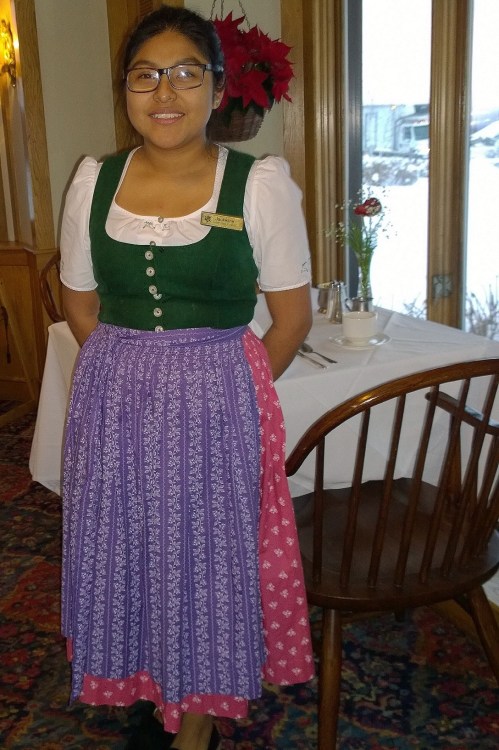
Dressing in Austrian dirndl at Trapp Family Lodge, Stowe, Vermont.
Nearly five years ago, when I was an editor, I solicited an article on Latino dairy workers from Daniel Baker at the University of Vermont. Dairy farms are practically synonymous with Vermont, where cows dot the mountainous landscape. The article summarized Dr. Baker’s research showing how essential immigrants were to the Vermont dairy industry’s survival. (Read the piece here.)
Of late, however, Vermont dairy farmers are anxious about their industry’s viability as walls both figurative and solid threaten the labor supply.
Visiting the state this week, I did note that there seemed to be a good supply of immigrants or former immigrants working in the hospitality industry at least.
I try not to ask people where they are “from” since friends in my Race in America group at the Fed have convinced me it’s a question that can make people feel unwelcome. But I was interested when someone whose way of speaking suggested Africa came to fix the hotel shower and when I noted the dirndl-garbed young lady above working the breakfast shift.
According to 2015 data from Migration Policy, Vermont has 2,619 residents born in Africa (9.3 % of the state’s foreign-born population in 2015), 8,199 born in Asia (29%), 9,113 born in Europe (32.3%), 3,038 born in Latin America (10.8%), 4, 875 born in North America, with small places like Greenland added to that mix (17.3%), and 403 born in Oceana (1.4%). By far the largest group is from Canada, which borders Vermont on the north. Vermont would be a more empty state than it is and nearly devoid of workers without all the foreign born.
If you’re interested in more, take a look at American Migration Council’s Vermont data, too. It’s here.












 Suzanne's Mom's Blog
