Feeds:
Posts
Comments

Posts Tagged ‘veteran’

Photo: Dina Litovsky.
Román Baca leads rehearsal on the deck of the Intrepid, the aircraft carrier turned museum on the Hudson River.

The wars that have been fought in my lifetime sometimes seem to have been necessary and inevitable. Most often, not. As the young people head off, I always think about how their lives will have been warped if they get back. It seems so wrong. And right now the services we’ve promised them are being slashed.

Fortunately, there are efforts at healing that forge ahead. One such program involves ballet.

Brian Seibert writes at the New York Times, “When Román Baca was serving as a Marine in Iraq in 2005, he didn’t tell many people what kind of work he had done before the war. He had tried that in boot camp, and it hadn’t gone well. So when his best friend in the platoon asked him why he seemed so interested in local dance practices, he hesitated before admitting the truth: He was a ballet dancer.

“Baca’s friend wasn’t bothered by the revelation. So Baca told him his crazy idea: to translate their wartime experiences into dance.

“Eventually, that crazy idea became Baca’s life. With his wife, Lisa Fitzgerald, he founded Exit12 Dance Company, which makes and performs works about military experience. What started as a way for Baca to deal with his trauma has expanded into a mission to help other veterans deal with theirs — through dance.

“In recent weeks, a group of veterans and family members of veterans, ranging in age and physical ability, has been gathering in the belly of the U.S.S. Intrepid, an aircraft carrier turned museum on the Hudson River. Using various improvisational exercises, they have been creating a dance work [to] perform on May 30 on the ship (on the flight deck, weather permitting). More important than that performance, though, is the process.

“Baca sees the workshops as a corrective for military training. ‘To make a person respond immediately to orders and commit acts of violence, military training changes your identity,’ he said. ‘It removes everything that defines a person’ — your clothing, your haircut — ‘and then it changes you through physical exercises, repetitive motion and powerful brain-body connections.’

“Baca, who has been leading these workshops since 2011, recalled a moment from one: Everett Cox, a Vietnam War veteran who had kept away from everything military for decades, responded to a prompt of action verbs by expertly stabbing and slashing with an invisible bayonet. His long-unused training was intact in muscle memory.

“Another time, Baca was choreographing a military exercise sequence and directed his dancers to yell ‘kill’ with every motion. When Fitzgerald questioned if that creative decision might have been a bit much, Baca explained that he was only being accurate: Coupling all actions with the word ‘kill’ was part of boot camp.

” ‘That’s absolutely needed when you are in uniform,’ he said. ‘But what do you do with that after you get home?’

“The workshops use physical exercises to help restore what Baca, borrowing a term from the philosopher Paul Ricoeur, called narrative identity. ‘You start to tell people who you are and parts of your story and then you listen to others do the same,’ he said.

“ ‘A lot of trauma survivors will say that you never fully heal,’ he added. But as evidence of how the process can work, he pointed to the experience of Cox, who returned from service in Vietnam feeling so guilty and ashamed that he did not consider himself a veteran. ‘I lost my mind in Vietnam’ is how Cox put it to me.

“For nearly 40 years, Cox, who took drugs and attempted suicide, tried to lock away what had happened. He was diagnosed as paranoid schizophrenic; one psychiatrist told him he was incurably insane. Then, in 2010, he attended a retreat for veterans at the Omega Institute, a holistic wellness center in the Hudson Valley. ‘It changed my life,’ he said. For the first time, he began to talk about his wartime experiences, and to write about them, and to cry. …

“ ‘If you’re holding a war in, it takes a lot of energy,’ he said. ‘And if you want to loosen that up, it also takes a lot of energy.’ ”

I so admire Baca, who against what seems to me like very long odds, keeps working hard to bring these damaged veterans back to life.

More at the Times, here.

Read Full Post »

Photo: Kyle Cummings/Randolph-Macon College.
Kayla Smith, left, and Hannah Winton help Andy Valero try on an Eisenhower jacket from the World War II era at his Virginia home.

Although in the US we tend to move national holidays to a Monday, Veterans Day is always November 11. This year the 11th just happens to land on a Monday. The holiday was established in commemoration of the Allies and Germany signing an armistice on Nov. 11, 1918, to end WW I. (One historian says this was unfortunately “a peace to end all peace” because the eventual agreement contained the seeds not only of WW II but of endless conflicts in the Middle East.)

In honor of Veterans Day, Cathy Free shared a WW II veteran story at the Washington Post.

“Kayla Smith was looking forward to taking a World War II history class in college two years ago when she learned on the first day of school that the class had been canceled with no explanation.

“ ‘I was so disappointed, because I’d really been looking forward to learning what the Greatest Generation went through,’ said Smith, 23, a history and archaeology major at Randolph-Macon College in Ashland, Va. …

“ ‘I started thinking, “There must be some World War II veterans who are still alive,” ‘ she said. …

“She enlisted the help of a friend, Hannah Winton, and the two of them began calling veterans organizations in central Virginia.

“ ‘We were told that most of the World War II veterans were gone, but we decided to keep looking,’ Smith said. …

“That year, she and Winton were at the Virginia State Fair when they noticed a woman running a booth with information about Veterans of Foreign Wars. The woman put them in touch with a veterans support group in Norfolk, and that’s how Smith and Winton met Andy Valero and Leo Dormon, who are 99 and 100, respectively.

“Valero, a U.S. Army veteran who survived the Battle of the Bulge, and Dormon, an aviator who served in the U.S. Navy, invited the college students to their homes in the Tidewater, Va., area to chat.

“ ‘Something unexpected happened,’ Winton said. ‘We enjoyed talking to them so much that we wanted to keep going back.’

“She and Smith now visit the men several times a month — often with freshly baked brownies — to talk or have lunch. They also accompany them to veterans events, funerals and World War II commemorations.

“ ‘I never thought that at 21, some of my best friends would be 99 and 100,’ Winton said. ‘You can read about war and study it, but these guys actually lived it. I feel honored to be their friend.’ …

“Dormon is recovering from a recent stroke, Winton said, which has given her a deeper appreciation for the visits she has had with him and Valero.

“ ‘We savor every minute, because you never know when it might be the last time you see them,’ she said. ‘When they are gone, their history goes with them.’

“She and Smith said they spent hours asking the two veterans about their war experiences and looking through photos. …

“ ‘I feel really bonded with Leo, and I love to listen to him,” Winton said. “Since his stroke, he has slower recall, but just being with him is important to me. We don’t always have to talk.’

“Dormon, who was a Navy flight instructor, flew more than 35 different aircraft and trained more than 300 pilots during World War II. He also flew during the Korean and Vietnam wars.

“ ‘I’m an aviation nerd, and he’s a fighter pilot with more than 10,000 flight hours,’ said Winton, who hopes to become a Navy pilot someday. ‘We took him and Andy to an air show in June, and Leo was thrilled to go up in one of the vintage planes.’ …

“Dormon said he always looks forward to spending time with Winton and Smith.

“ ‘Hannah and Kayla have been regular visitors, and I have been so thankful to see both,’ he told the Washington Post in a written statement. ‘Taking the time to visit an aging person takes courage and patience, and they’ve made my life much happier. Bless them both.’ …

“[In December 1944] ‘it was the worst winter in 25 years, and we had frozen fingers and trench foot,’ he said, referring to the painful condition that results from standing for a lengthy time in a cold and wet environment.

“Valero lost several of his close comrades in the battle.

“ ‘I didn’t talk about it for many years, but I felt comfortable talking about it with Kayla and Hannah,’ he said. ‘They’re very caring and they feel like family to me. They’re like angels who came out of nowhere.’ ”

More at the Post, here.

Read Full Post »

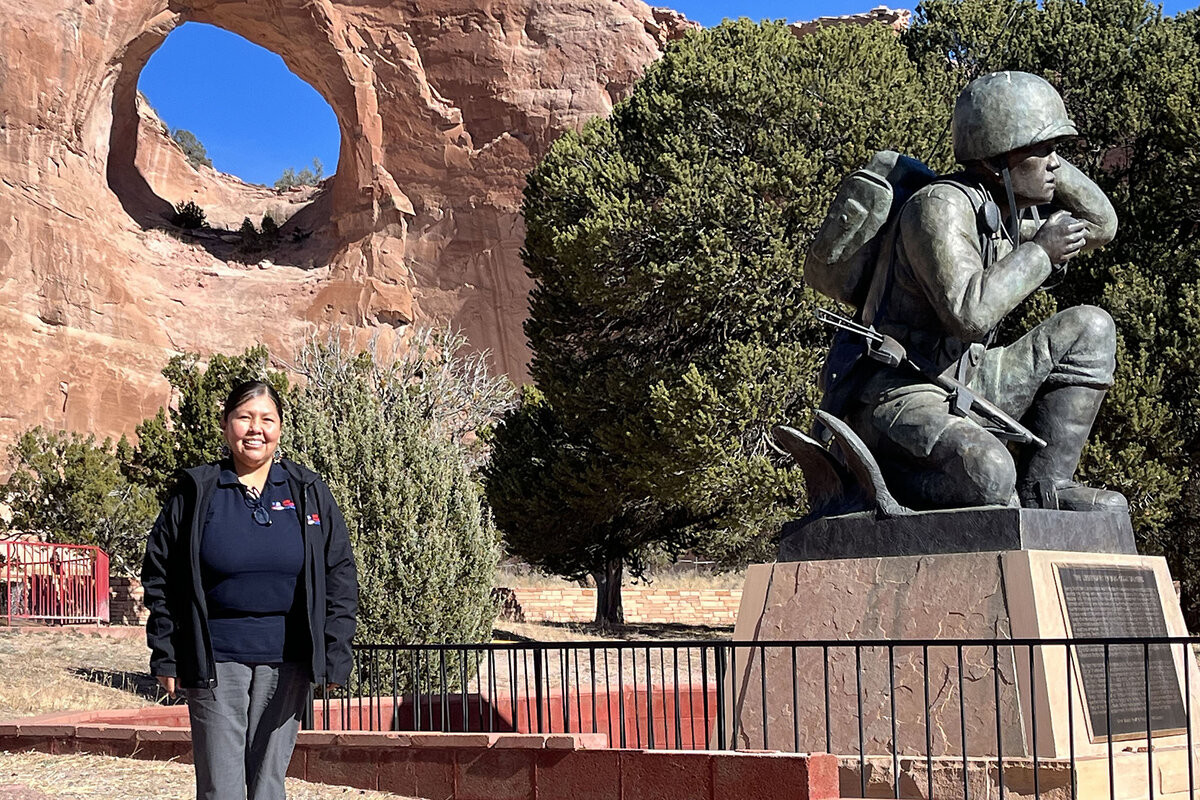
Photo: Anna Mulrine Grobe/The Christian Science Monitor.
US veteran Bernadine Tyler stands at a memorial to Navajo code talkers on the Navajo Nation, in Window Rock, Arizona.

On this Memorial Day, let’s take a look at the indigenous people who have served in our military.

Anna Mulrine Grobe  writes at the Christian Science Monitor, “In her work with U.S. military veterans here on the Navajo Nation, Bernadine Tyler routinely logs 1,200 miles a month driving across an area the size of West Virginia, over high windswept plains dotted with rust-red mesas.

“Roughly one-third of homes here on America’s largest reservation don’t have electricity or running water, so Ms. Tyler, herself a member of the Navajo Nation and an Army veteran, brings services directly to her fellow vets, most of whom are over the age of 65. 

“She points out the occasional gas station and folks walking on the dusty shoulders of pot-holed roads. There’s a bus, ‘but it’s very unreliable and only runs one route,’ says Ms. Tyler, program lead for the Diné Naazbaa Partnership (DNP), which serves the Navajo Nation and receives funding from the U.S. Department of Veterans Affairs. …

“For vets without transport or refrigerators, she carries bags of ice to fill the convenience store coolers that many use to chill their food and medications. She enlists volunteers, including her sons, to help haul water and chop wood for warmth in the winter. 

“The particular challenges of accessing this care came to light during the COVID-19 pandemic, when Native American veterans living in small multigenerational homes without running water on closed tribal lands died at significantly higher rates than other former service members. The VA subsequently pledged to better serve America’s Native American community. 

“In 2020, the VA created the first advisory committee for Native American veterans. It held its first meeting in 2022 and began issuing its recommendations last year. Though they aren’t binding, the suggestions of some committees have an acceptance rate of 90%, according to the agency. …

“With this year’s 2024 defense spending bill, lawmakers also granted the Native American Indian Veterans a congressional charter, making it the first-ever group dedicated to the interests of Indigenous people in the U.S. to get the status. It is a development that took the NAIV nearly 20 years of lobbying to achieve. With the charter, NAIV can testify before Congress and, ideally, more easily help the VA process benefits claims. 

“The hope is that these developments will not only improve care, but also foment faith that, even after decades of neglect, change is possible – particularly among the 57% of Native American veterans who say their top reason for joining the military was a desire to serve their country. 

“Native American veterans are among America’s most patriotic, says Adam Pritchard, a researcher at Syracuse University’s Institute for Veterans and Military Families. ‘It’s a very important step in the right direction to acknowledge their history of the service and their ongoing needs.’ 

“ ‘Our history has much mistrust,’ Ms. Tyler says. Good-faith efforts to fix a long-broken system and build it up, she adds, can help heal old wounds, too. 

“In 1943, Thomas Begay joined the U.S. Marines. He was 16 or 17 years old – he’s not sure which. … He wanted to be an aerial gunner, Mr. Begay told the recruiter. [The recruiter sent him] to become a code talker. While he and his fellow troops practiced the top-secret tribal language with a twist, their basic training was more ad hoc than the Marine norm. 

“ ‘They got us a rubber boat, and they just dumped us way out in the ocean and said … “Learn how to get to shore,” ‘ he recalled in a 2013 discussion cataloged by the National Archives.

“Months later, after landing at Iwo Jima in February 1945, Mr. Begay and his fellow code talkers were hailed as instrumental in taking the island – and later with helping to win the war. Their code was never broken. …

“Today, Mr. Begay is living in a house where bad plumbing has damaged the floors and ceiling. ‘It’s not safe for him,’ says Karen Shirley, community coordinator for DNP, which is helping him apply for VA grants to fix up his home, or get Mr. Begay a new one. 

“ ‘How can we not support this great warrior who helped save this country, and just get him the housing he needs?’ Ms. Tyler says.”

More at the Monitor, here. No paywall. Subscriptions are reasonable.

Read Full Post »

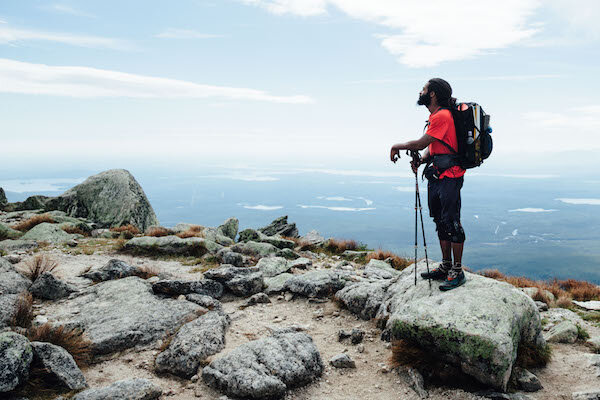
Photo: AkunaHikes.
“I learned that I was capable of living, I was capable of leading,” said the 41-year-old Army veteran who had struggled with post-traumatic stress disorder after Iraq.

I know that the Sound of Music is a little corny, but there is wisdom in the line “I go to the hills when my heart is lonely,” which Maria (soon to be Maria von Trapp) sings. Nature can be healing.

Andrea Sachs writes at the Washington Post about an Iraq war veteran and how the mountains healed him.

“Will Robinson was about 100 miles into his hike on the Pacific Crest Trail when the dark clouds started to lift. Not the ones high in the California sky, but the ones clustered in his head.

“ ‘I learned that I was capable of living, I was capable of leading. I was capable of inspiring and motivating people. That was something I had completely lost for a decade-plus,’ said the 41-year-old Army veteran who struggled with depression, anxiety and post-traumatic stress disorder after his medical discharge in 2003. …

“Since that first long-distance hike in 2016, his mileage has multiplied to more than 11,000 miles and counting. In 2019, he became the first Black American man to earn the Triple Crown of thru-hiking by completing the trifecta of legacy trails: the 2,650-mile PCT from California to Washington state, the 2,194-mile Appalachian Trail from Georgia to Maine and the 3,100-mile Continental Divide Trail from New Mexico to Montana. Two years later, ESPN declared Robinson ‘the trailblazing superstar of thru-hiking.’ He also received the 2022 George Mallory Award, which honors exceptional outdoor explorers. …

“Before the PCT, Robinson had never seriously hiked, though the military had prepared him for similarly tough challenges. ‘The closest thing I did to hiking was drill marching,’ said Robinson, who grew up on bases with his Army father. ‘It’s a lot different with a 100-pound pack and an M16, but it gave me a basis for hiking.’ In the armed forces, he powered through his pain, a practice he had to unlearn as a trekker. …

“After six months in Iraq and a stop in Germany for medical treatment, he returned to Louisiana, where he often felt too broken to leave the house, much less pursue outdoor activities. He underwent multiple surgeries and tried various therapy treatments and medications, to no avail. ‘After Iraq, I was disabled at 23,’ he said. A chance ‘encounter’ with celebrity long-haul hiker and Wild author Cheryl Strayed provided the jolt he needed to recharge his life.

“On that fateful day in March 2016, Robinson was in his room, ‘like always,’ when he glanced at the TV and saw Wild on the small screen. In the film version of Strayed’s best-selling memoir, he watched Reese Witherspoon lug her pack by a PCT trail marker, a scene that stirred up a memory from Iraq. During his downtime, Robinson would often pore over a PCT guidebook that someone had sent to the soldiers in a care package. ‘One day I’d love to do this,’ he said, reminiscing about that period in his life when he envisioned a future filled with adventure.

Without waiting for the closing credits, he jumped onto his computer and acquired a free long-distance permit, one of 5,657 issued that year.

“On April 2, he arrived in Southern California and embarked on a journey of personal discovery and recovery that resembled Strayed’s transformative quest two decades earlier. …

“In addition to the physical benefits of hiking in nature, medical experts extol its psychological virtuesStanford University-led research from 2015 determined that walking at least 90 minutes in a non-urbanized setting can help alleviate depression, lower stress and anxiety, and reduce rumination, the infinite loop of negative thoughts. A 2019 study called ‘Nature and mental health: An ecosystem service perspective’ also explored the wide-ranging rewards, such as a happier state of mind, more positive social interactions, a clearer sense of purpose and a sturdier grip on life’s demands. …

“Robinson did not initially set out to complete the entire PCT, which runs from the Mexican border to the Canadian border. His primary goal, he said, ‘was to try to see if I could find me again, regardless of how many miles it would take.’ With only a few weeks to prepare, he trained around Slidell, about 30 miles northeast of New Orleans. …

“Early in the hike, he found his trail family and earned his trail name, ‘Akuna,’ a riff on a Swahili phrase (and The Lion King refrain) that translates to ‘no worries.’ The nicknames are bestowed by other long-distance hikers or are given to oneself. They are often fanciful, silly or philosophical.

“About five miles in, he was resting on a rock, feeling sluggish, when a woman named ‘Cookie’ appeared at his side. She determined that he needed food and proceeded to stuff her namesake snack into his mouth. The pair forged a bond, along with ‘2Pie,’ a teacher from Ohio, and ‘Nothing Yet,’ a veteran who had tackled the AT [Arizona Trail] the previous year to quell his PTSD. The group hiked together for long stretches, a major breakthrough for Robinson, who for years had avoided social situations because of his fraught mental state.

“ ‘Being around people triggered panic and anxiety attacks, and I didn’t want any part of it. I just shut down,’ he said. ‘But on the trail, I ran into so many great individuals who were there for me. All they wanted was to be part of my adventure and help me accomplish my goal.’ …

“He said, ‘For me, every hike is like a therapy session in progress. I’m going through things in my head, working out problems. When I find a solution, I can zone out and be in peace.’ “

More at the Post, here, and at AkunaHikes, here.

Read Full Post »

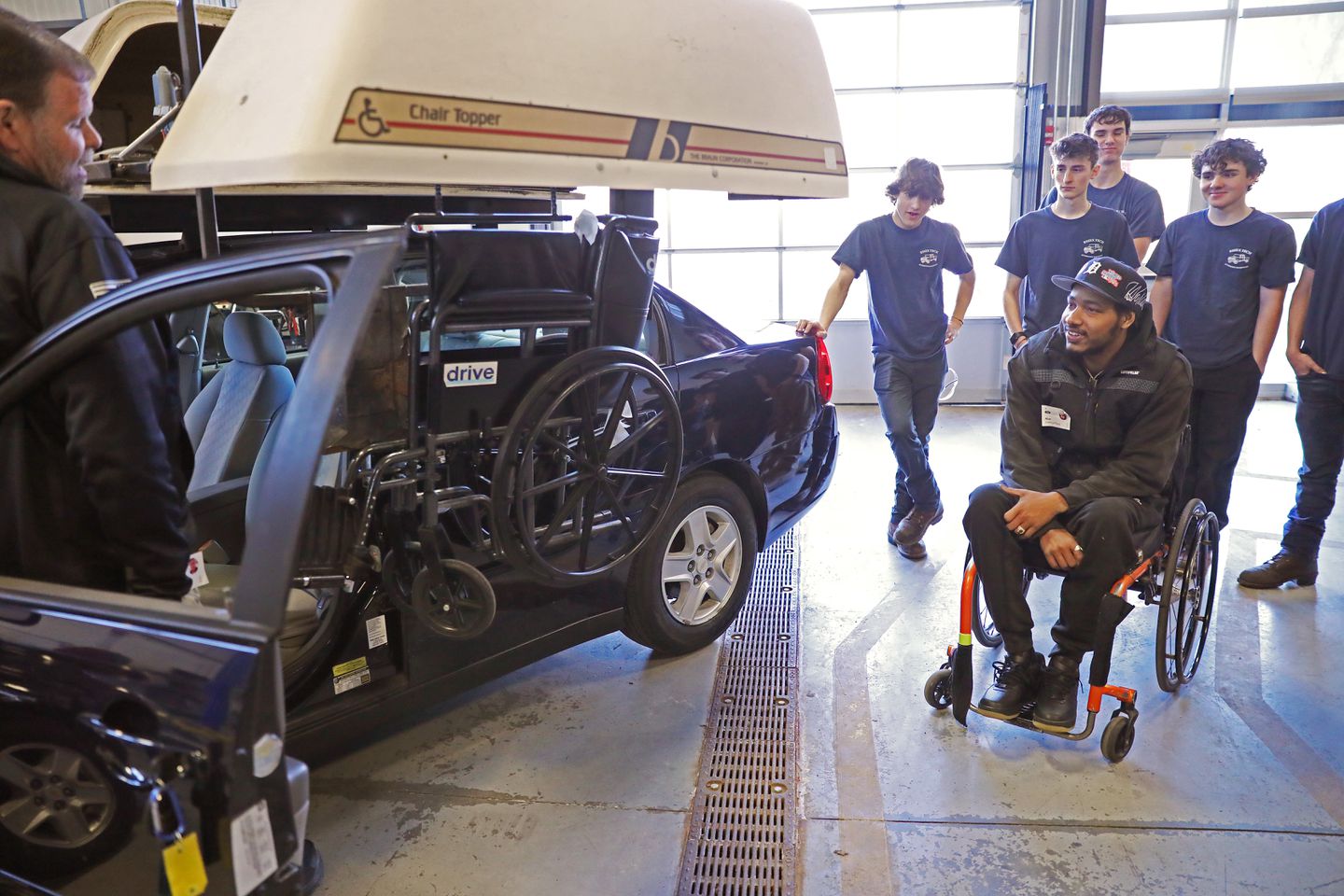
Photo: Pat Greenhouse/ Globe staff.
Donor Michael Solomon, left, demonstrates the use of the chair topper to store a folding wheelchair to car recipient Alan Mack of Quincy at Essex North Shore Agricultural & Technical School. It’s all in a day’s work for Second Chance Cars.

Dan Holin is a local nonprofit entrepreneur that I’ve worked with in connection with a couple different organizations. I met him in the early 2000s, when he was running the Jericho Road Project, and when he went to UTEC in Lowell, Mass., I wrote how he brought the joy of biking to teens who had been in trouble with the law, here.

Now the Boston Globe has caught up with Dan’s latest initiative, a longtime dream. He has really thought through all the pieces needed to make it work — the banks, the beneficiaries, the automotive high-school programs, the donors, etc.

Nancy Shohet West wrote, “Three years ago, Alan Mack was struggling to make ends meet as a laborer with the state Department of Recreation & Conservation when he was struck in the back by a bullet and left paralyzed. What followed was not only rigorous recuperation, but also a long stretch of being unemployed and homeless. …

“For a person in a wheelchair, the daily commute he had previously made by public transportation was nearly untenable: Typically an hour in duration and requiring several transfers from train to bus, not to mention relying on a system not known for its reliability even in the best of times.

“Fortunately, the social service organization that was helping Mack with his numerous challenges had one more idea for him: applying for a vehicle through Concord-based Second Chance Cars, which provides automobiles to low-income recipients who can demonstrate that owning a car would substantively help them to get a job, keep a current job, or advance within their field.

“Now Mack makes the 15-minute commute from home to work in his specially equipped car, which he said also will enable him to advance the music production business he recently started after entering an online bachelor’s degree program at Berklee College of Music. …

“Mack is one of about 70 beneficiaries to receive vehicles from Second Chance Cars, founded in 2019 by Concord resident Dan Holin. An Israeli-American citizen who served in the Israeli military and then pursued a career in nonprofit administration, Holin was motivated by several intersecting passions, including social outreach, cars, and entrepreneurship. He envisioned a nonprofit that would serve veterans and former prison inmates returning to society. His mission has since expanded to reach others, including legal immigrants and struggling families.

“Mentored by leaders of other nonprofits, Holin designed a business model whereby his organization provides donated cars to low-income workers for $900, paid for by the recipients in monthly installments of $75 over the course of a year.

“After talking with nearly 20 banks, Holin found two — City of Boston Credit Union and Metro Credit Union — willing to partner with Second Chance Cars by providing zero-interest loans along with free financial counseling to the recipients, with Holin serving as the guarantor. At the end of 12 months, the recipients have not only paid off the loans but also have improved their credit ratings.

“Stephanie Tetreault is the kind of person Holin envisioned helping. After battling a drug addiction and serving nearly 10 months in prison for larceny, she was determined to get her life back on track.

“Formerly living on the streets, by the fall of 2020 she had housing in Lowell and steady employment as a shift leader at Dunkin’, where she wanted to apply to be a manager. But that job required reliable transportation, and a car was something Tetreault had neither the cash nor the credit rating to obtain.

“Her case manager at Thrive Communities, which helps formerly incarcerated people transition back into society, told her about Holin’s organization.

” ‘I went through the application process and met with the board of directors of Second Chance Cars to tell them about my situation,’ recalled Tetreault, whose car was prepped at Greater Lawrence Technical School in Andover. ‘The whole process took just a few weeks, and then I had my car: a 2005 Toyota Prius. It’s been a blessing and a lifesaver.’

“Just as Tetreault hoped, Dunkin’ promoted her to a manager position, which she held for about 18 months. Empowered by her newfound independence, her ambitions grew.

“ ‘Because I had a car, I felt that I could pursue my larger goal of becoming an addiction counselor,’ Tetreault said. ‘I found a job in that field in May of 2022, and then enrolled in the addiction counseling certificate program at Middlesex Community College.’

“The benefits that Second Chance Cars provides reach more than just its recipients. The organization collaborates with five vocational high schools in Massachusetts — Essex Tech in Danvers, Greater Lawrence, Greater Lowell Technical in Tyngsborough, Minuteman High in Lexington, and Northeast Metropolitan Regional Vocational High in Wakefield — enlisting their automotive technology departments to fix any problems the donated cars might have before they are passed on to new owners.

“ ‘This is a great match for our program,’ said Jill Sawyer, director of Career, Technical and Agricultural Education at Essex Tech — more fully, Essex North Shore Agricultural & Technical School —whose automotive technology students worked on Mack’s car.

“ ‘Many of the cars our students work on belong to faculty members or people from the community who understandably need their vehicle repaired as quickly as possible.

‘With Second Chance Cars, we usually have a few weeks with a car, which gives the instructors more time to make it a learning experience.’

‘And then the students get to attend the reveal ceremony and learn about the person who is receiving the car, which is eye-opening for them.’

“ ‘It’s a win-win situation,’ agreed Donald Melanson, an auto tech instructor at Minuteman, whose students have worked on more than a dozen vehicles for Second Chance Cars. ‘A lot of the repairs the donated cars need are typical of those that the students will be doing once they get out in the trade. This is also giving them a chance to help the general public, and to see the kind of difference that they can make in someone’s life.’

“Josh Duquette found out about Second Chance Cars from a counselor at Veterans Inc., which provides services to veterans throughout New England. A divorced father of four living south of Boston, he couldn’t drive due to a combat-related disability after returning from a deployment in Kuwait and relied on a combination of ride-hailing services, public transportation, and favors from friends to get to his job as a special education paraprofessional in the North Attleborough school system.

“Once Duquette received medical clearance to begin driving again, Second Chance Cars found him a nine-year-old car with 115,000 miles on it. Students at Minuteman refurbished the interior, serviced the engine, and provided new parts. As a result of having his own transportation, Duquette was able to take a position teaching summer school in addition to his school year assignment.

“ ‘One of the biggest obstacles a lot of our veterans face in getting back to a meaningful lifestyle is transportation,’ said Bill Corcoran, a case manager with Veterans Inc. … ‘Second Chance Cars takes that barrier away, and it’s life-changing.’ ”

More at the Globe, here.

Read Full Post »

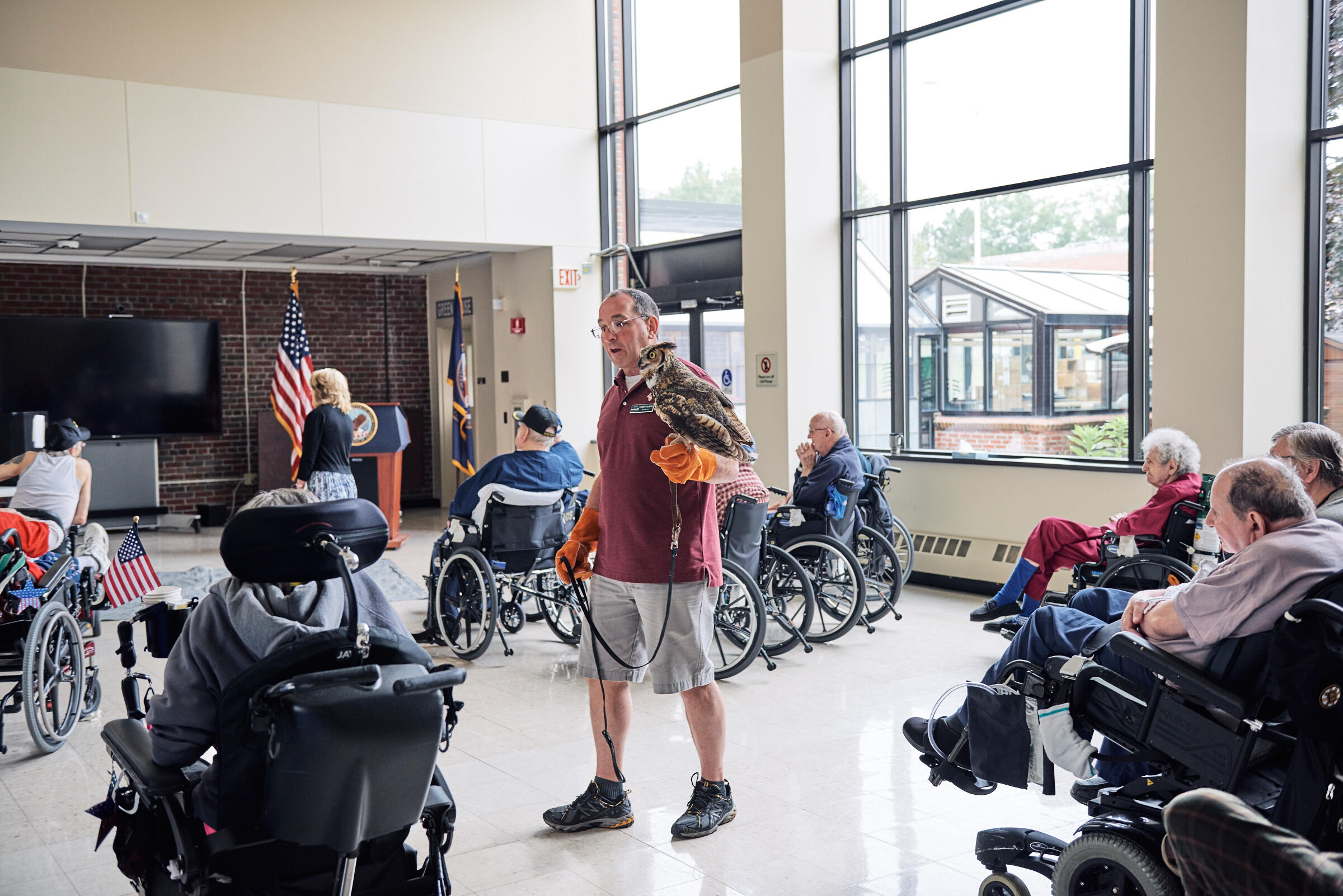
Photo: Tony Luong.
Robert Vallières brings a raptor when he speaks to veterans about how birds helped his recovery, like here at the Manchester VA Medical Center in New Hampshire. When asked the worth of this Great Horned Owl, he told the vet: “I can’t put a value on it.” 

Tomorrow, November 11, is Veterans Day, one of only two federal holidays that hasn’t been switched to a Monday. The other is July 4. I saw today’s story around this time last year and decided to save it for you.

Purbita Saha and Tony Luong wrote at Audubon magazine in 2017 about a former soldier who found solace in Nature and then used his insights to help other veterans.

“The first bird that saved Robert Vallières,” they report, “was a Black Hawk helicopter. It was October 1990, and the then 28-year-old Army soldier was serving in the Persian Gulf War. While riding in the back of a truck on a mission to fortify a foxhole in the remote Arabian Desert, a heavy beam slammed into him, sending him flying and causing severe head injuries and swelling in the brain. The chopper sped Vallières to a field hospital for emergency care. …

“After being honorably discharged, Vallières returned to Concord, New Hampshire. While he appeared to be on the mend, he continued to grapple with chest spasms and Gulf War Syndrome—the mysterious mix of symptoms, including headaches, exhaustion, and memory problems, that plagued up to a third of returning veterans. On top of that, he had lingering effects from a pre-deployment aneurysm, and was diagnosed with post-traumatic stress disorder. … The PTSD led to serious depression and horrific anger, he says. He was overwhelmed with trying to readapt to civilian life when he saw a newspaper ad for a birding trip in the White Mountains. Remembering his hikes with his nature-loving father, also a veteran, Vallières signed up immediately. Up on the slopes, as he scanned the leafy ledges for passerines, a Peregrine Falcon hurtled into view, seizing a Northern Flicker mid-air in a puff of feathers. He followed it back to a snag, where it tore the woodpecker apart, yellow shaft after yellow shaft. ‘I was glued,’ Vallières says. …

“Vallières credits that Peregrine with saving him from despair. The encounter sparked a full-fledged birding obsession that ultimately helped shape his philosophy on healing. He quickly signed on to monitor raptor nests with New Hampshire Audubon. The first site he claimed was Joe English Hill, near Concord, where he and his son Andrew would watch American Kestrels speed rodents to their begging chicks’ mouths. As his identification and observational skills deepened, his responsibilities multiplied. He began tracking breeding Peregrine Falcons and Bald Eagles, aiding in the recognition of an uptick in chicks that confirms the birds’ nationwide resurgence since the pesticide DDT was banned.

“Vallières finds strength and hope in their comeback. ‘They keep my defeats in perspective,’ he says. And, he discovered, while painkillers reduced his chronic pain, his ailments often temporarily vanished in the presence of birds. Besides taking his mind off the hurt, tracking wild birds also allowed Vallières to beat back depression and regain much of his physical strength. …

“He began rehabilitating raptors, first with Audubon, then with the local wildlife hospital Wings of Dawn, where he learned to train unreleasable birds as educational ambassadors.

Working with the feathered charges allowed him to pay forward the care and kindness he’d received from doctors, nurses, and therapists, he says. It also made him feel like less of a burden.

“Given the profoundly soothing effect raptors had on Vallières, he was motivated to share the experience. He brought other vets to the New Hampshire Audubon hawkwatch platform to take in thousands of Broad-wingeds during fall migration. He cowrote a memoir, Wounded Warriors, about his experiences in battle and birding. And he started bringing rehab birds to the New Hampshire Veterans Home and Manchester VA Medical Center. (Vallières is a patient at the latter, receiving therapy for his chronic pain, taking drawing lessons to relieve stress, and learning cognitive exercises to combat memory loss from a second aneurysm in 2012.)

“On the Friday before Memorial Day, Vallières made his rounds at both facilities. In the solarium of the medical center that morning he saluted each of the 15 seniors, many in wheelchairs and Vietnam and Korean War caps. Then he introduced a male Great Horned Owl that is permanently grounded due to a wing injury. Vallières walked around with the raptor on his arm, lifting it above the veterans’ heads so they could feel the rush of its beating feathers. The room buzzed with questions and anecdotes of pet cockatoos; placid faces broke into grins. With his audience transfixed, Vallières related his story. He showed them sketches he has drawn of being airlifted out of Kuwait, shared dark reflections of his struggle with PTSD, and explained the important role that birds have played in his recovery.”

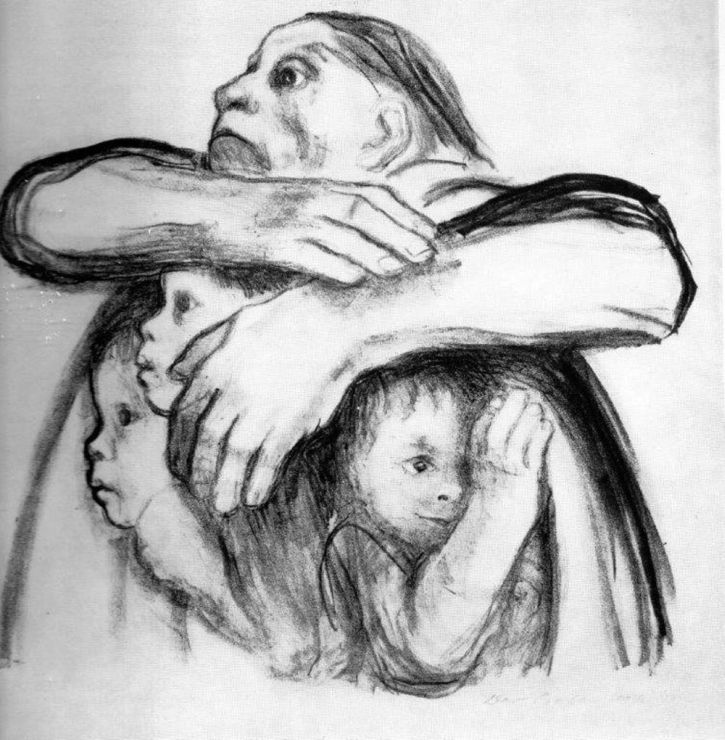
We owe so much to veterans, but you know as soon as a war starts that many, if not most, will be physically or mentally wounded or never come home. And the services to help them will be limited. All by itself, that’s a good reason not to go to war. Sometimes it’s necessary, of course, as the Ukrainians who take up arms today already know. Below is art that shows why they do it.

More at Audubon, here. No firewall. A description of the art is at WordPress, here.

Protecting the children: Kathe Kollwitz’s ‘Grieving Parents’ at Vladslo: ‘Seed Corn Must Not Be Ground.’

Read Full Post »

Photo: Sierra Sullivan via KCRA.
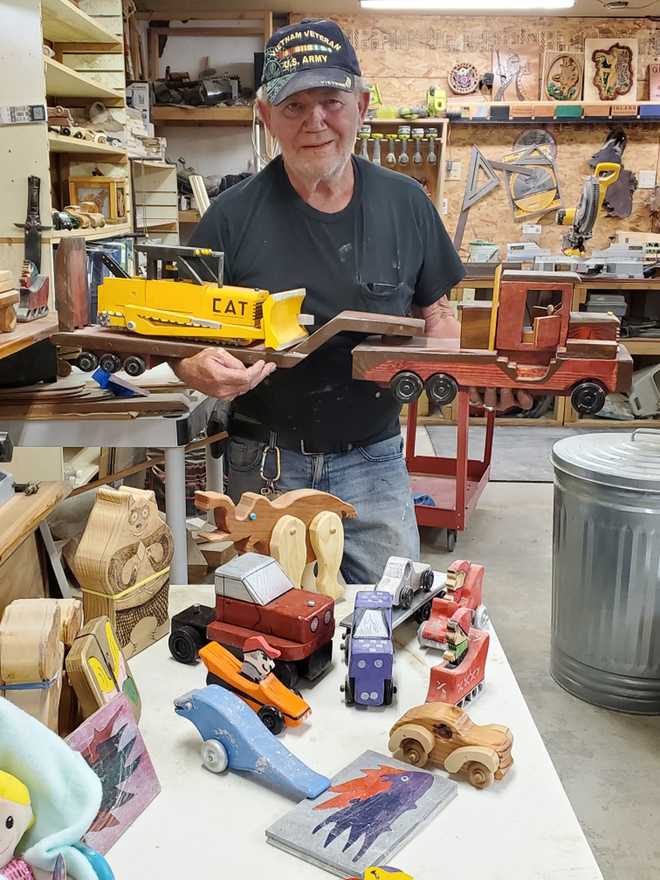
Mike Sullivan, 72, says his two older brothers were carpenters who made him toys when he was a child.

I saw this story of good works several places online and saved it for Christmas Day.

CNN’s Amy Chillag wrote, “A real-life Santa’s workshop is churning out toys in Desert Hot Springs, California. A 26-year Army veteran and his wife have spent most of the last decade making toys in a woodshop behind their house. It’s a labor of love that started as a hobby.

” ‘After retirement, I got bored and needed something to do,’ 72-year-old Mike Sullivan told CNN.

“The couple joined a woodworking club and one of their projects was to build toys for kids.

” ‘Christmas time, we had a chance to see the kids get the toys and see how much joy it was,’ said Sullivan.

“They were hooked. … Mike and Judy Sullivan spend nearly every day in the shop.

” ‘We’re both in good health and are able to be out here six to seven days a week for eight to 10 hours,’ Sullivan said. ‘It’s so much fun.’ …

“Mike buys the lumber, the drill bits and saws and makes the patterns — cutting and sanding away. Judy is quality control and decorator.

” ‘I run my hands over all the toys and feel for something that’s not supposed to be there — a loose wheel or splinter,’ said Judy. She also spray paints and decorates. …

“This year, their toys were especially needed with so many parents out of work due to the impact of the coronavirus pandemic on the economy.

“The Sullivans … are extra careful scheduling folks at intervals to come check out the toys. ‘We try to enforce safe distancing and masking,’ said Mike.

“This week, they’re delivering hundreds of toys to a kindergarten class, the Coachella Valley Rescue Mission and a church food pantry. They’ve mailed toys as far away as Indiana and Texas. Not only are the toys free, but the couple pays for the shipping although, they admit, that’s getting tough.

” ‘As long as I can afford it, I can send them where I can,’ he said. …

“The Sullivans’ toys will also be distributed to children during a drive-thru giveaway with social distancing, ‘making sure everyone is safe and happy and healthy.’ …

“The couple makes trains, cars, trucks, pull and push toys (little alligators, elephants), ducks you put on a string and pull along behind you. They also make educational toys: alphabet puzzles, jigsaw puzzles, stackers with different size blocks on a pole. …

“Judy Sullivan said they watch [their grandchildren and great-grandchildren] play with the toys and see what they like and don’t like about them. ‘If they drop a toy on the floor and break the head of a duck, we better reinforce that.’ …

“Mike says while he’s full of shrapnel from his service, that doesn’t slow him down in the toy factory. ‘You have to adapt and overcome.’

He refuses to charge for his toys. Maybe it’s because he knows what it’s like not to have much money.

” ‘My dad was a miner, we were considerably poor,’ said the retired Army first sergeant, who grew up in Montana.

“His older brothers were both carpenters and made toys for him when he was a child. ‘Most of the things I got were handmade toys. They were wonderful toys, I know how much I enjoyed them.’ … Those memories stick with him and he inherited their love of wood. ‘We do it for those who are less fortunate than we are now.’

“Their daughter says her parents spent $19,000 out of pocket last year on supplies (she does their taxes). …

“The hundreds of wheels and axles for the cars, trucks and trains are especially costly. With their kids’ encouragement, they started a GoFundMe to help.

“Mike hopes anyone who wants a Christmas present next year will reach out to him, and he’ll do his best to get it to them, wherever they are.”

More at CNN, here, and at the Washington Post, here.

Read Full Post »

davis_food9_liv

Photo: Jim Davis/Globe Staff
Marc Wallerce (left), owner of the Winthrop Marketplace, greets Jeffrey Carson of Mi-Amore as Carson picks up food for distribution to families that need it.

Wow, there are as many ways to get food to people who might otherwise go hungry as there are people who want to end hunger. It was only a couple weeks ago that I posted about a food initiative in Toronto. Here’s one in Massachusetts.

Alison Arnett writes at the Boston Globe, “In 2014, Jeffrey Carson heard an NPR piece about how much food was wasted in America despite ongoing hunger. It hit a nerve with Carson, who himself had grown up in a family dependent on food stamps and had just had his first child, and he determined that he wanted to do something about it. ‘I wanted my daughter to come up in volunteerism that was part of our life,’ he added, not just something ‘we volunteered for once a year.’

“So Carson and his wife, Suzanne, both veterans, began to work on creating a nonprofit in Winthrop where they live. The idea for Mi-Amore seemed ‘so simple,’ says Carson: Food was going to waste — in the United States it is estimated that as much as 30 percent to 40 percent of edible food is wasted each year — and yet there were people who went hungry. As military officers, both he and his wife were used to finding solutions to problems, Carson says.

“There were many snags along the way, but today Mi-Amore provides food for 40 elderly people, single-parent families, and recovering addicts in Winthrop. Unusual among food relief programs where recipients must go to a central soup kitchen or food aid office open only restricted hours, Mi-Amore’s eight volunteers, all Winthrop residents, pick up the donated food three times a week and deliver it to the homes of the recipients. Most families get at least one delivery of food a week. The program has a board of town residents, and donations of surplus food from the Winthrop Marketplace, several restaurants, assisted-living centers, and schools. …

“Half of the recipients are children. When asked about recovering addicts, Carson says that ‘recovering’ can be a loose term but is quick to recount what one board member, a school nurse, told him. ‘Having food in your refrigerator sometimes is the line between recovering or not,’ she said, adding that the stress of no food can push some over the edge.

“The beginnings of Mi-Amore, in its third year, weren’t smooth, Carson says. After he and his wife did the structural work to set up a nonprofit, he contacted restaurants and other businesses about donating food that might go to waste, surprised when he got refusals or no answers. But then, Carson said, he met two women, Amie Hanrahan of The Arbors Assisted Living Communities and Ann Vasquez of La Siena restaurant, who immediately ‘got it,’ Carson says. … From that beginning, the program started to gain momentum.”

I’m not really surprised that two former military officers have shown perseverance when faced with the challenges of launching something new. As Massachusetts Congressman Seth Moulton, a former Marine, has often said in the context of what sorts of people he’d like to see run for office, veterans are generally people who are motivated by public service more than personal gain.

Jeffrey and Suzanne Carson strike me as perfect examples of veterans motivated by public service.

More at the Boston Globe, here.

Read Full Post »

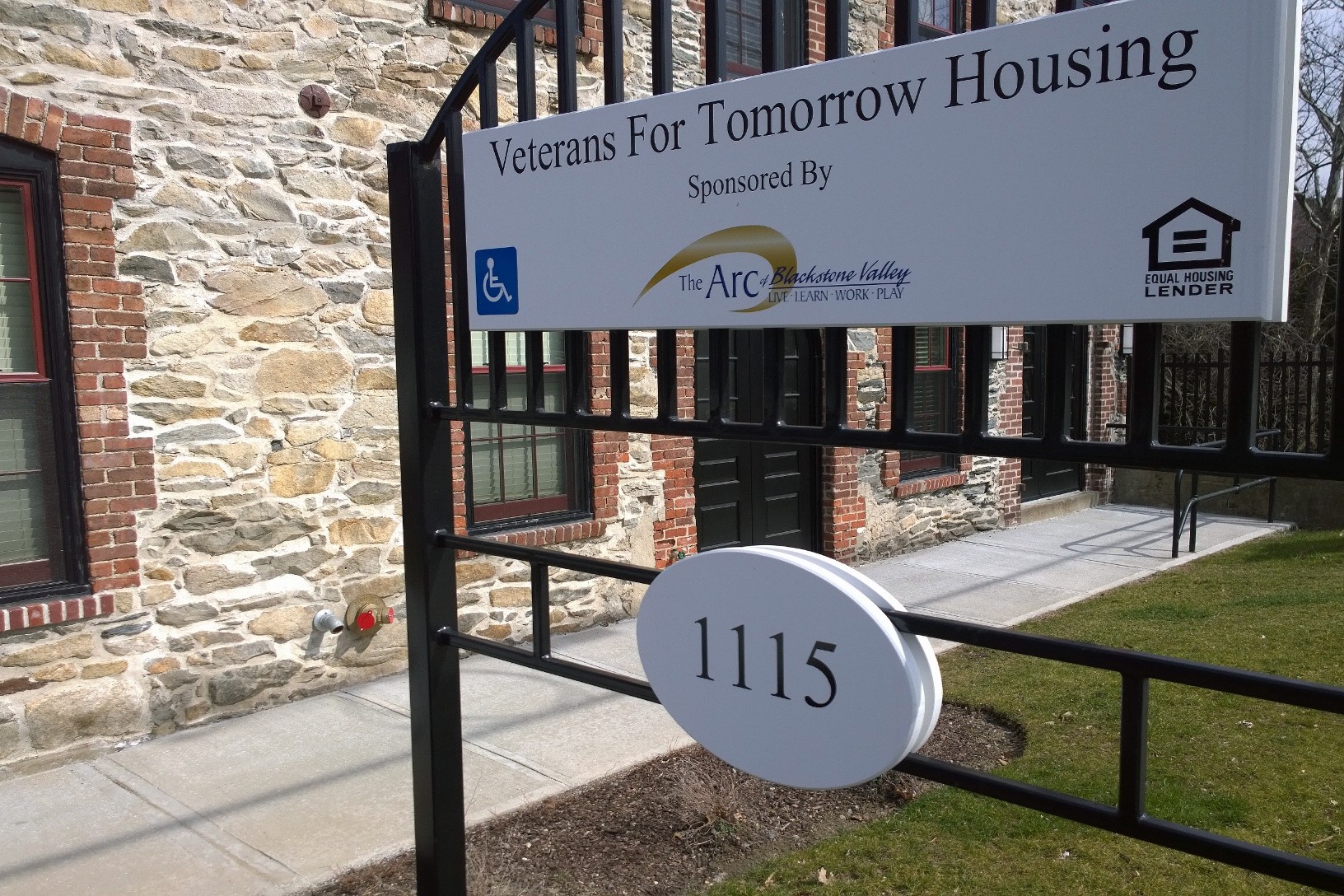
Sam Lubbers, a veteran, was homeless off and on for many years. Today he is living in an efficiency apartment in a renovated mill and enjoying the stability and hope that comes with housing. I interviewed him for the 2015 Rhode Island Housing annual report. (Check out the pdf. I was the first writer on most of the other interviews, too.)

When Sam moved into his new quarters, G. Wayne Miller at the Providence Journal filed this report on Rhode Island’s long-term goal.

“Since Rhode Island was selected a year ago as one of just five states to participate in the Zero: 2016 program — a national initiative spearheaded by the New York-based non-profit Community Solutions — 163 homeless veterans have been housed, according to the Rhode Island Coalition for the Homeless. …

” ‘It’s really all about the collaboration, communication and advocacy for these men and women,’ said David Gendreau, a veterans’ case manager for The Providence Center, a partner in Zero: 2016 and operator of a comprehensive housing program for veterans.”

The goal unfortunately remains elusive. Sam told me how his heart hurts because whenever he walks into the city, he sees homeless people he recognizes as former military through their boots, hats or other identification. He always speaks to them, maybe buying a sandwich or suggesting where to get help or temporary housing. “I have a hole in my heart for the homeless,” he told me.

Fortunately, in Rhode Island at least, the passage this week of Question 7, means more funding for housing for veterans and low- and moderate-income families in the state. So three cheers for a state that is being both practical and caring.

030716-vets-for-tomorrow-providence


Read Full Post »

I love thinking about sunlight and shadow. Dickens uses them a lot for Richard and Ada’s story in Bleak House — maybe my favorite book of all time.

“So young, so beautiful, so full of hope and promise, they went on lightly through the sunlight … So they passed away into the shadow, and were gone.”

Many of you know what the decades-long case of Jarndyce vs Jarndyce did to Richard and Ada’s bright hopes. I’ve come to think that it was not so much Richard’s fevered expectations of an inheritance that brought the most sorrow, but his need to fix blame. Blame is corrosive.

When I interviewed a formerly homeless Marine last week and he started telling me about how upset he was that something bad had just happened with his benefits, I was touched by how he kept reminding himself how to cope, saying, “I believe in fixing the problem — not the blame.” Words to live by.

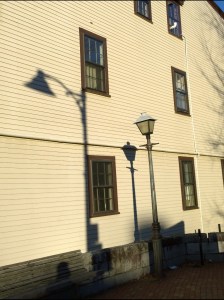
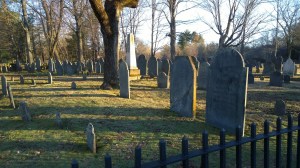
The first three photos were taken early Saturday morning, when the effects of sunlight and shadow were especially breathtaking. (I can never resist that old graveyard. You’ve seen it here in all weathers.)

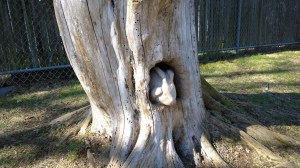
The next three were taken at the playground near John’s house. Every few months, new creatures appear on that tall tree stump. (You’ve seen previous creature photos, too, on this blog.)

031216-early-footpath-shadows

031216-lamppost-shadows


WP_20160312_06_42_36_Pro

031216-carved-eagles-arlington


031216-carved-woodpecker-arlington

031216-hidden-bunny

Read Full Post »

I’ve blogged before about programs that use theater for healing purposes and programs that use the arts specifically to help veterans.

Now Dana Ferguson writes at The Los Angeles Times about Shakespeare getting into the act and easing vets into the job world.

“Fifteen years ago former Pfc. and military police officer Jerry Whiteside had two masks tattooed on his left bicep, one smiling, one frowning. …

“Little did he know that more than a decade later, he would be symbolically reunited with the images imprinted on his skin.

“His journey began at the end of a 30-year struggle with drugs and alcohol, he said. Whiteside, a Chicago native turned Angeleno who had served in the Marine Corps from 1972 to ’76, sought help from the Veterans Administration in Los Angeles. He completed a detoxification program in 2011 and for this summer was referred to the Shakespeare Center of Los Angeles to do various jobs on the set of A Midsummer Night’s Dream.

“Whiteside, 61, and some 30 other veterans of the Afghanistan, Iraq, Vietnam and the Gulf wars assisted in building the set and working odd jobs with the production, which continues through July 28.

“Shakespeare Center artistic director Ben Donenberg said employing veterans stemmed from another of the company’s outreach programs, Will Power to Youth, which hires young Angelenos to study and perform Shakespeare plays. After seeing alumni of the program serving in the armed services and later seeking jobs at home, Donenberg said, the company decided to extend its employment program opportunity to veterans, starting last year. …

“One of the things we want to do as a company is to ease the transition to civilian life, and part of that is on the civilians; there’s only so much the veterans can do,” [Chris Anthony, associate artistic director at the Shakespeare Center] said. “The rest of us have to see them in a different light. It’s something we need to work on as civilians.” More.

Photo: Ricardo DeAratanha / Los Angeles Times
Military veteran Jerry Whiteside passes out programs before each Shakespeare Center performance.

Read Full Post »

Photograph: Julio Cortez/AP
Musician Julio Fernandez during a Voices of Valor music session at Montclair State University.

Today I am returning to the topic of veterans programs that help people overcome post-traumatic stress and reintegrate into civilian life. (Interesting how often these programs involve gardening or the arts — which we always knew were good for us!)

Samantha Henry at the Boston Globe has the story.

“During stressful times as a combat medic in Afghanistan, Mason Sullivan found solace in Vivaldi. New Jersey native Nairobi Cruz was comforted by country music, a genre she had never heard before joining the Army. For Jose Mercedes, it was an eclectic iPod mix that helped him cope with losing an arm during a tour of duty in Iraq.

“These three young veterans all say music played a crucial role in alleviating the stresses of active duty. Now, all three are enrolled in a program that hopes to use music to ease their reintegration into civilian life.

‘‘ ‘It’s a therapy session without the “sit down, lay down, and write notes,” ‘ Mercedes, 26, of Union City, said of the music program. ‘It’s different — it’s an alternative that’s way better.’

“The pilot program, called Voices of Valor, has veterans work as a group to synthesize their experiences into musical lyrics. Guided by musicians and a psychology mentor, they write and record a song, and then hold a CD release party. The program is currently underway at Montclair State University, where students participate through the school’s veteran affairs program.

“Developed by husband and wife team Brian Dallow and Rena Fruchter, it is open to veterans of any age and background. No musical experience is required.” More.

P.S. A word on the power of reddit. John posted my blog entry from yesterday in the Christmas category at reddit and it increased traffic to this site by a factor of 10 so far.

Read Full Post »

I have blogged before on the use of the arts to help veterans readjust to civilian life. Today I’d like to highlight an initiative started by veteran Drew Cameron and Drew Matott. It focuses on the art that interests them most — papermaking — and is their way of giving back and moving on.

“The Combat Paper Project utilizes art making workshops to assist veterans in reconciling and sharing their personal experiences as well as broadening the traditional narrative surrounding service and the military culture.

“Through papermaking workshops, veterans use their uniforms worn in combat to create cathartic works of art. The uniforms are cut up, beaten into a pulp and formed into sheets of paper. Veterans use the transformative process of papermaking to reclaim their uniform as art and begin to embrace their experiences in the military.

“The Combat Paper Project is based out of art studios throughout the United States and has traveled to Canada and the United Kingdom, providing veterans workshops, exhibitions, performances and artists’ talks.” More here.

Photograph: Combat Paper

Read Full Post »