Feeds:
Posts
Comments

Archive for the ‘Uncategorized’ Category

Photo: Sophie Hills/Christian Science Monitor.
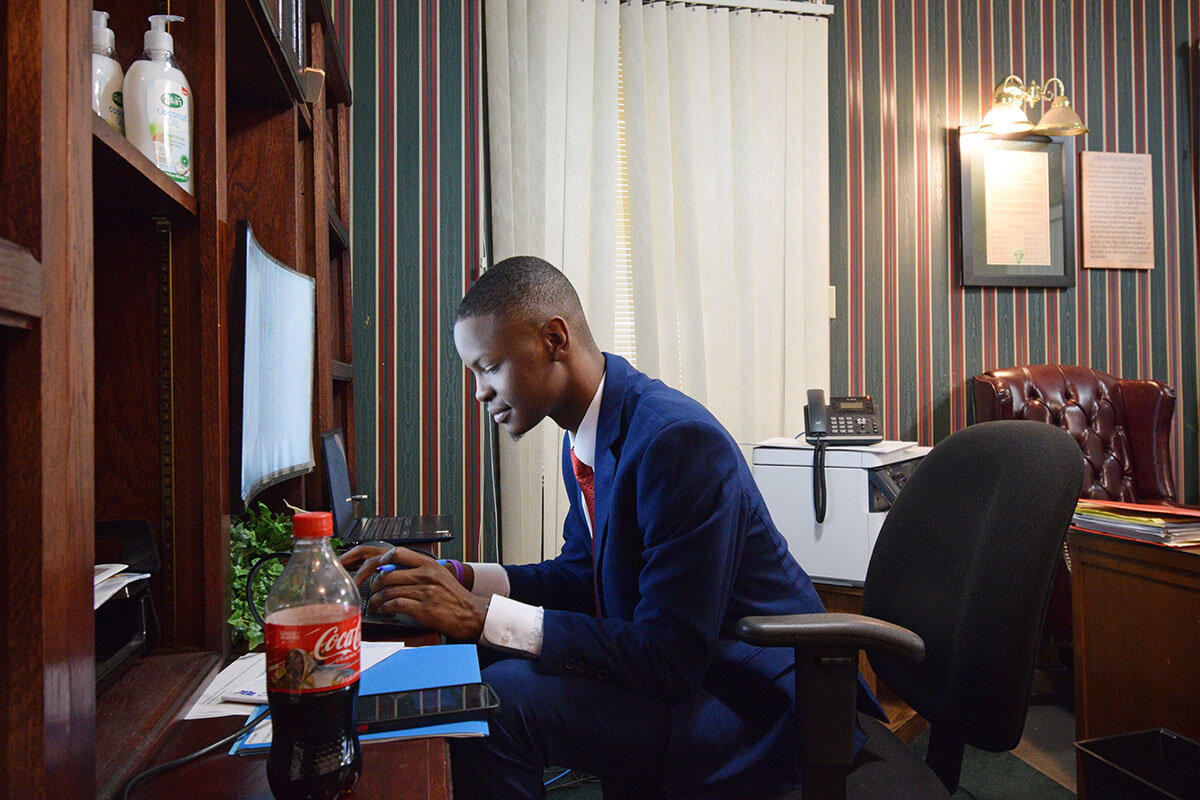
Mayor Jaylen Smith prepares for his first City Council meeting in Earle, Arkansas, on Jan. 24, 2023.

Have you noticed how many Gen Z people (born roughly 1997 to 2012) have been running for office? I think it’s a great sign of commitment to a better world — and probably disappointment with what older folks have done to the world.

Here is a teen who just became a mayor in Arkansas.

Sophie Hills reported in January at the Christian Science Monitor, “Many teenagers consider their wardrobes a statement of their identity. For 18-year-old Jaylen Smith, that means a suit instead of jeans and a backpack. Today, the new mayor of Earle, Arkansas, has dressed with special care: a navy two-piece suit, crisp white shirt, and brown dress boots. His tie is red. 

“Tonight, he will call the City Council to order for the first time as mayor. He’s also heading into Memphis – 30 miles away – to buy his own car, a Nissan Altima. …

“If he’s nervous about his big speech, it doesn’t show. … He works with his door open to the street, an invitation to his town. 

“Whether he’s in his office, on the road, or stopping at a parking lot to pick up chicken salad – and pause for a selfie with the guy selling it  – Mr. Smith is always on the phone. Dialing a number, he talks to a woman whose house just burned down. ‘Is there anything we can do for you?’ he asks. He listens to her response, nodding, and promises he’ll call the Red Cross. …

“Mr. Smith is the youngest Black mayor in the country, according to the U.S. Conference of Mayors. He won in a runoff election, pledging to staff police 24 hours a day, tear down derelict buildings, and bring back the supermarket that closed down a few years back. …

“Mr. Smith graduated from Earle High School in 2022. Instead of packing for college and leaving, he spent the rest of the year campaigning door to door and shadowing mayors around the state.

“Perhaps more notable than Mr. Smith’s age is his choice not to leave Earle. As he tells Christopher Conway, his former high school counselor, ‘I always wanted to change my community before moving on to my next phase of life,’ he says. …

“Earle, Arkansas, population 1,800, may seem frozen in time by a lack of money and a declining population. The sense of community buy-in and optimism is clear in the halls of the elementary and high schools, and the well-attended City Council meeting – with an agenda including reports from the police chief and the water and sanitation department, and a debate about zoning. 

“Tucked on the side of Highway 64, Earle boasts three dollar stores and two schools, and a small grocery store that’s been around since 1945. The number of abandoned buildings suggest that Earle has seen better days – that Mayor Smith is pledging to revive. 

“Earle rose out of the post-Civil War timber boom that gave life to so many other small towns dotted along Southern railroads. Today, the town is majority Black. But its painful history includes lynchings and a race riot over school conditions, not to mention its namesake, landowner Josiah Francis Earle, who was active in the Ku Klux Klan.

“Eugene Richards, a photographer, writer, and filmmaker, found himself in Earle in the late 1960s as a member of Volunteers in Service to America. At the time, Earle was separated into white and Black, he says, ‘divided by the classic railroad tracks.’

“Mr. Richards and several VISTA volunteers helped start a paper, Many Voices, which reported on Black political action and the Ku Klux Klan. He was friends with the Rev. Ezra Greer and his wife, Jackie Greer, civil rights activists who led a march protesting segregated schools in 1970. When the marchers were confronted by an angry white crowd, five Black marchers were wounded. … Mr. Richards says, ‘Time went on and things slowly changed.’

“Mr. Richards, who compiled photos and interviews for a 2020 book about the town, says that while the violence of segregation may be in the past, Earle faces new challenges. ‘There’s a weariness – the town is going down very fast,’ he says.

“As student government president for his last three years at Earle High School, Mr. Smith implemented tutoring programs and an advocacy committee for students with learning disabilities. He was also a student advocate for special education students, and dealt with his own learning disability while in school. Those activities taught him how to get resources from the state, he says. After a visit to Washington, D.C., for a mayoral conference, he’s optimistic about receiving more federal grants as well. …

“Between learning the ropes of public office and taking a college course online as he pursues his degree – one class at a time for now – Mr. Smith doesn’t have much free time.

“His phone rings again. This is the part of the job he doesn’t like: being pressured for favors. In this case, he stands his ground over the open clerk position. Every applicant has to turn in an application, he says firmly. …

“Off the phone, he runs down his goals as mayor. He wants to improve public safety, including fully staffing the police department, currently at two full-time and four part-time officers; set up public transportation; and tear down those abandoned houses.

“He’s already spoken with a local business that has agreed to help demolish houses, and he’s confident he’ll find resources to achieve the rest of his goals. ‘They’re there,’ he says. …

“While Mr. Smith, a Democrat, aspires to higher office, he says he isn’t focused on party politics. He attends local Democratic and Republican party meetings to ‘see how they both do,’ he says.

“Mr. Smith opens an envelope and a check falls out of the card inside. He dusts chip dust from his fingers and makes another call: ‘What do I need to do with checks that come in the mail?’

“ ‘I can’t accept money as an elected official,’ he explains after. ‘But I can donate it to the city.’

“Donald Russell, a retired truck driver, was skeptical when Mr. Smith announced his campaign. But after getting to know him, he has ‘high hopes.’ And Mr. Smith ‘has a lot of community support,’ he says. …

“Thirty minutes before the council meeting, Mr. Smith stands up, puts on his suit jacket, locks the door, and crosses the street to the council chamber. People trickle in after him – one asks to take a photo together. Every seat is full, and residents are standing at the back. Mr. Smith opens the meeting, occasionally leaning over to check next steps and procedure with his more experienced companions. Then he stands to deliver his speech, announcing his goals to fully staff all police shifts and institute a neighborhood watch program.

“He ends with a quote from the Bible to nods, murmurs of approval, and applause from the room: ‘Let us not weary in doing well, for a new season we shall reap.’ ”

More at the Monitor, here. No firewall.
Read Full Post »

Photo: Charukesi Ramadurai.
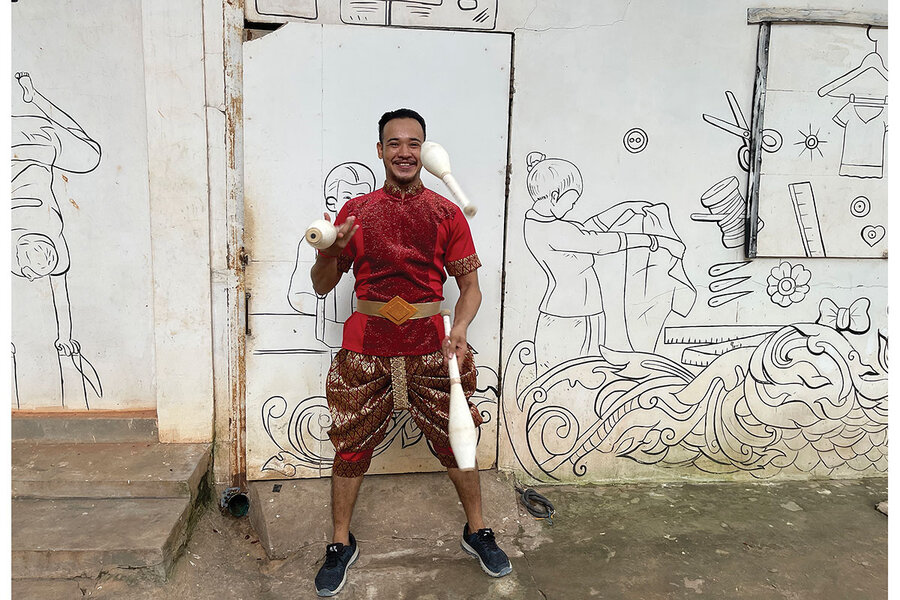
A juggler welcomes visitors as they start arriving for the evening show at Phare Circus. Like other performers, he is a student of the Phare Ponleu Selpak school in Battambang, Cambodia.

I don’t belong to the religion, but I’ve always liked Christian Science Monitor articles, and now I know why. The other day, one of the editors wrote that finding positive angles on painful realities is intentional.

The story today acknowledges the horror of the Khmer Rouge genocide and its impoverished aftermath but focuses on one of the ways people are healing.

Charukesi Ramadurai writes, “A short drive away from the famed Angkor Wat temple ruins in Siem Reap, Cambodia, another spectacle has been quietly attracting visitors for years. Every evening, under the big top at the Phare Circus, audiences watch mesmerized as acrobats and artists jump and somersault, dance and paint, execute midair flips and twist into pretzels. …

“Watching them smile under the spotlight, it is difficult to imagine that these confident young men and women come from impoverished or troubled families. Celebrating its 10th anniversary on Feb. 8, Phare Circus simultaneously provides young Cambodians with a livelihood and showcases the talents of students at Phare Ponleu Selpak, a not-for-profit arts school located in Battambang, Cambodia.

“Phare Ponleu Selpak – meaning ‘The Brightness of the Arts’ – was set up in 1994 by French art teacher Véronique Decrop, who practiced art therapy at refugee camps, and a small group of refugees who returned home from Thailand after the brutal Khmer Rouge regime ended in 1979. Apart from giving children a safe space away from crowded homes and dangerous streets, the school aims to revive arts that were decimated during the Cambodian genocide. …

“ ‘The Khmer Rouge left us with zero – 1,000 years of history of the Cambodian empire reduced to ash. More than 90% of the masters were killed or just disappeared,’ says musician and genocide survivor Arn Chorn-Pond, who founded Cambodian Living Arts, an organization that provides arts education scholarships.

“Preserving the arts ‘gives young Cambodians something to hold on to from their past,’ he says. ‘It also gives them an identity; it gives them confidence; it gives them the voice to tell their own stories to the world.’

“Tor Vutha, one of the co-founders, says the school was their way of paying it forward, or as he puts it, ‘transfer the knowledge from our heart to the community.’ He says that the organization started small and evolved along with the needs of locals. 

“ ‘Many children were suffering from war trauma and needed help,’ he recalls. ‘We had received art in the refugee camp and embodied its benefits, so we wanted to share the same with the children and youth to help them overcome their traumas and help the community rebuild.’ …

“Today, the school offers training in graphic design, animation, music, and other arts, and students are free to explore their interests. It takes in more than 1,000 children annually, many of whom have gone on to perform at Phare Circus.  …

“[Craig Dodge, director of sales and marketing at Phare Circus], who has been with Phare Circus from the beginning, remembers it starting back in 2013 with an ‘outdoor stage, plastic chairs, rain.’ It has since come a long way.

“In addition to the main circus tent, the Phare campus in Siem Reap hosts local musicians, food stalls, and a small crafts shop. Families are welcomed at the main gate by jugglers and acrobats, who give them a taste of what awaits inside. Phare Circus has produced 23 different shows over the past decade, with more than 5,000 performances in front of over a million spectators, including foreign tours in countries such as the United States, Australia, Japan, France, Italy, and Singapore.

“All shows are strongly rooted in Cambodian culture, from dances depicting rural life, to a juggling act that pokes fun at tourists, to acrobatic routines inspired by Cambodian mythology and folklore. …

“Wendell Johnson, an American retiree in Siem Reap, has been a regular visitor to Phare Circus since its first year of production. He says what keeps him coming back are ‘the smiles, the incredible athletic abilities, and the storylines’ that vividly connect Cambodia’s past to the present. He also praises the artists’ grit and determination, noting that he’s seen performers immediately redo failed stunts and succeed. 

“The Phare Circus performers train for several years at the school, building both their skills and self-esteem, before they’re eligible to work at the circus. Almost all come from large families with limited resources, and being at school keeps them away from hunger, drugs, abuse, and trafficking. The circus is also an opportunity to travel the world, and pays well. 

“The steady work has been particularly transformative for the handful of female performers, whom young girls back in Battambang look up to as inspirations. 

“Srey Chanrachana started training at Phare Ponleu Selpak in 2007 at the age of 11. Back then, her family of five depended on the irregular income of her taxi driver father.

“ ‘We used to live in a very small house where we would all sleep together, and our roof would always leak whenever there was rain,’ she recalls. Now they live in a larger, more comfortable home. 

“With her earnings, she has also enrolled in English and computer classes to further her education, and she says working at the circus has made her more confident.”

More at the Monitor, here. No firewall.
Read Full Post »

Photo: Victoria Onélien/Special to the Christian Science Monitor.
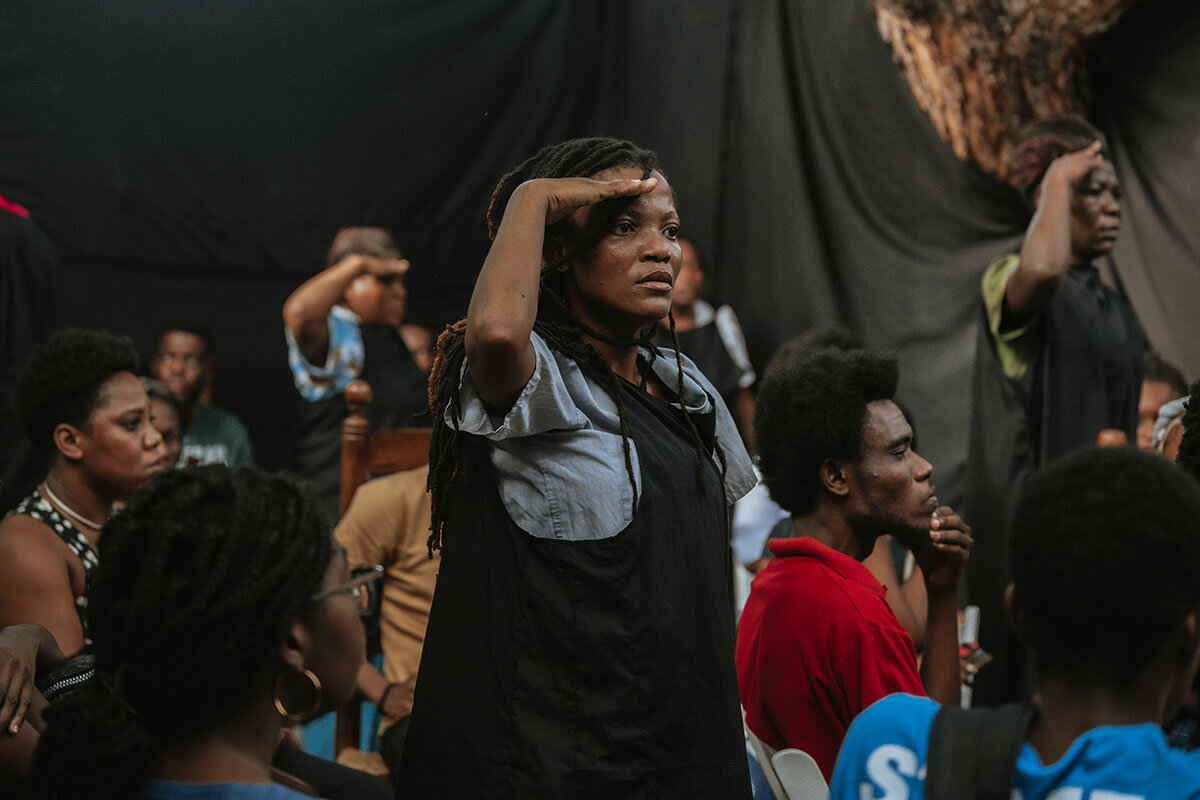
An immersive experience, “Dechouke Lanfè sou Latè” is performed within the audience and features formerly incarcerated women as well as actors to bring home the brutal reality of Haitian prisons. The Quatre Chemins theater festival took place in Port-au-Prince, Haiti, from Nov. 21 to Dec. 3, 2022.

Man, the resilience of the human spirit! Or maybe it’s stubbornness, not resilience. Doesn’t matter. Let us now praise whatever keeps people going in impossible circumstances. In Haiti. for example.

Websder Corneille reports at the Christian Science Monitor, “On a sunny afternoon, some 60 people gather in the small courtyard of Yanvalou Café, the unofficial home of Haiti’s theater scene. It’s the opening of the 19th annual Quatre Chemins (Four Paths) theater festival, but the fact that there’s a full house was never a given.

“For the past three years, Port-au-Prince, Haiti’s capital, has been overrun by criminal gangs. They’ve increasingly terrorized citizens, … blocking freedom of movement since the assassination of President Jovenel Moïse in July 2021. Many citizens have fled their homes in recent months, seeking safety elsewhere – in some cases camping out in public parks because their neighborhoods have become so dangerous.

“ ‘This city is scary these days,’ says Évens Dossous, an educator who came to see the reading of ‘Port-au-Prince et sa Douce Nuit (Port-au-Prince and Its Sweet Night),’ a new play by award-winning Haitian playwright Gaëlle Bien-Aimé. Before leaving home this afternoon, ‘I asked myself, “Is it really worth traveling? Will I be kidnapped?” ‘

“Art, and specifically theater, have a rich history of political resistance in Haiti. Although the unprecedented climate of insecurity has more to do with a vacuum of leadership – there have been no elections since 2016 – than with the overt oppression and censorship that citizens faced under dictatorships in the past, the crowd at Yanvalou today is a reminder that theater remains an act of defiance.

“ ‘You know, life can’t just be about insecurity,’ says Mr. Dossous.

“Colorful murals of well-known artists and thinkers cover the cement walls at Yanvalou, including singer Nina Simone, Haitian dancer Viviane Gauthier, and national anthropologist Jean Price-Mars. The audience at the opening in November makes its way from the courtyard into the restaurant, where chairs are set up facing two lecterns.

“The reading focuses on the lives of two young people, madly in love, in a home in Pacot, a wooded, formerly upscale neighborhood in the heart of Port-au-Prince. It underscores many real-life challenges, like the fragile state of the capital and the difficulty of leaving the house to get food, travel, or go to school or work. But it also dives into bigger questions, such as how to love – oneself and others – when a city is collapsing around you.

“ ‘Theater helps me ask questions about my life,’ says Ms. Bien-Aimé, the playwright, who was the second Haitian in a row to win the prestigious RFI Theatre prize, awarded to emerging Francophone artists. Theater ‘is a living art,’ she says.

“Since the assassination of President Moïse, armed gangs have taken control of some 70% of the capital. … Some 20,000 Haitians are facing starvation, according to the United Nations, the vast majority of whom are located in the capital.

“The insecurity, which includes using sexual violence as a weapon, has led to widespread displacement. Kidnappings increased by nearly 45% in Port-au-Prince in the second quarter of 2022, according to the National Network for the Defense of Human Rights, a Haitian nongovernmental organization. Many believe the gangs are protected by police, politicians, and business elite.

“ ‘The state has agreed to retreat so that armed groups can control the society,’ says Sabine Lamour, a Haitian sociologist at the State University of Haiti, citing research by Haiti’s leading human rights organization, the National Human Rights Defense Network. …

“Micaëlle Charles, the actor reading the lead role of Zily in today’s play, says a lot has changed in Haitian theater over the past three years. She and the entire team putting on today’s show take security precautions she never considered before, such as sleeping over at the rehearsal space. ‘This helps me to hold on, despite the problems in the country or any other problems life might throw my way,’ she says of her passion for the craft. …

“Using theater for social or political commentary isn’t unique to Haiti, but it has a long tradition here. Theater is ‘a weapon of mass awareness that gives the spectator the means to free themselves,’ wrote Félix Morisseau-Leroy in 1955. He was one of the nation’s first writers to create plays in Haitian Creole. Under the Duvalier regime, a father-son dictatorship that ruled Haiti for three decades starting in 1957, Mr. Morisseau-Leroy and others were targeted and exiled for their social commentary and what was perceived as anti-government messages in plays and literature.

“The Duvalier reign was characterized by violence and the suppression of free expression. One of Mr. Morisseau-Leroy’s most prominent works was his Haitian Creole translation of the Greek tragedy ‘Antigone.’ … It was an act of resistance for its message – and its use of the language of the masses. …

“Joubert Satyre, an expert on Haitian theater, told the Christian Science Monitor [that] theater in Haiti plays an important role in social and political struggles. He said, ‘It is this liberating and critical side of the theater that has made it, and that still makes it, suspect in the eyes of autocrats.’ 

“Not that the government is paying much attention to the arts in recent years, says Ms. Bien-Aimé. She’s firmly engaged in a ‘theater of protest,’ she says, but isn’t sure her artwork frightens the government as much as her outright activism. … ‘Today, the state doesn’t even go to the theater,’ she says.”

More at the Monitor, here. No firewall.

Meanwhile, in war-torn Ukraine, theater has gone into living rooms. See a New Yorker story about that.

Read Full Post »

Photo: Jim Weber/Santa Fe New Mexican/AP/File.
Fire rages along a ridgeline near the Taos County line as firefighters from all over the country converge on northern New Mexico to battle a fire on May 13, 2022.

An interesting experiment is taking place in New Mexico, where leaders are merging recovery efforts for children who were affected by recent wildfires and floods with recovery efforts for the environment.

At the Christian Science Monitor, Sarah Matusek has the story.

“Sara Villa watches her second grader, Aaron, focus on the task, his jacket hood raised against the November chill. He’s one of several dozen students on a school excursion at a New Mexico ranch. The Villas evacuated their nearby Holman home in the spring due to wildfire, then again in the summer due to floods. Because of water damage, the family went into debt purchasing a new mobile home, says Ms. Villa. Other scars are harder to see.

“Aaron gets ‘scared now when it rains,’ she says. ‘I just try to explain to him that he’s OK.’

“Aaron, shy, offers a snaggletooth smile. The ball in his mud-smeared palms is stuffed with seeds of native grasses. Students can plant these ‘seed bombs’ where they please, such as at home or here at Collins Lake Ranch, where about half of its 300 acres burned last spring in the state’s largest recorded wildfire.

“The activity is part of a school district experiment linking environmental recovery to that of students, whose families lost ranchland, income, freezers full of food, and safe drinking water. This school year, the rural Mora Independent School District (MISD) has tried several ways of harnessing lessons about such disasters to ‘promote the healing,’ says Superintendent Marvin MacAuley. …

“The district hired a second social worker to deal with an upswell of behavioral issues. MISD has also doubled down on logistical preparedness, which includes ongoing food distribution to local families and the drafting of school flood-response plans. …

“Not unlike the weather radio that Mr. MacAuley keeps on his desk, antenna raised at the ready, district staffers have had to broaden their attention to student needs that include not only academics but also resilience.

“ ‘I want them to recover. I want them to succeed,’ says the superintendent. …

“Family trees in Mora County intertwine with Indigenous, Spanish, and Mexican histories; some residents trace back ties to the land through nine generations. The district of around 400 students – most are Hispanic, and nearly all qualify for free or reduced-price lunches. …

“In April, prescribed burning in Santa Fe National Forest botched by the U.S. Forest Service grew into the largest wildfire in recorded New Mexico history. The blaze of over 340,000 acres was fueled by adverse conditions that the government says it underestimated. April set a record dry average for the state in terms of precipitation: five-hundredths of an inch that month. …

“As the fire blazed, Mr. MacAuley, a former wildland firefighter for the U.S. Forest Service, made the call to send students and staff home early. Evacuations followed. After a ‘chaotic’ two weeks, he says displaced teachers resumed lessons through a semblance of virtual learning. Though the district had begun using 1-to-1 computing during the pandemic, not all children evacuated with devices, let alone landed where they had access to Wi-Fi. …

“Summer flooding from thunderstorms was made worse by the wildfire. At the start of the fall semester, flooding cued two early dismissals and the sheltering of students late at school until the roads cleared. …

“Researchers are beginning to understand the impact of climate change on young people, including through self-reporting of ‘climate anxiety.’ In April 2021, a year before the New Mexico blaze, the National Association of School Psychologists adopted a resolution recognizing the importance of mitigating climate-related harms (like air pollution, extreme heat, and wildfire) to the learning and mental health of students. 

“MISD is now equipped with cots, food, and water in case of future needs to shelter students. And the district used American Rescue Plan Act education funding to hire the second social worker based on a spike in social-emotional needs, with a third contracted on an as-needed basis. …

“Senior Casey Benjamin is among those who helped, as a junior firefighter. Sixth grader Ana Crunk, daughter of the teacher, volunteered at an evacuation center in Peñasco.

“Though it was ‘scary’ to flee home, helping out ‘helped me feel better,’ says Ana, whose own family was evacuated for two weeks. …

“Mora’s expeditionary learning, first mentioned in a report by Searchlight New Mexico, is partially meant to address social-emotional needs. Sometimes called experiential or project-based learning, the hands-on learning approach was developed by educators in the 1990s.

“Since the fall semester, several expeditionary learning days, including the seed bomb outing, have taken place at Collins Lake Ranch, a nonprofit serving people with disabilities. In other lessons there, students learned to fly drones for aerial data collection and tested post-fire water quality, in partnership with the New Mexico Forest and Watershed Restoration Institute at New Mexico Highlands University. …

“The district has [also] launched its first team to enter the New Mexico Envirothon, a problem-solving competition that tests student knowledge of natural resources.”

More at the Monitor, here.

Read Full Post »

Sam Knowlton is an interesting guy who specializes in improvements to coffee growing — improvements that help both farmers and the environment.

According to his SoilSymbiotics website, he “offers a practical, principle based suite of consulting and education services to farmers and growers seeking to increase crop quality, yield and soil health.”

On Twitter, @samdknowlton recently posted a photo of a shady coffee farm with the words, “The typical coffee farm applies about 200 kg/ha of synthetic nitrogen (N) each year, an excessive amount. I worked with this farm to phase out synthetic N and cut a total of 195,000 kgs of annual applications. The trees are healthier, higher yielding, and the coffee tastes better.”

I went to Knowlton’s blog to learn more. In a typically intriguing post, he wrote, “To make it rain, plant more coffee trees.

“Coffee-growing regions are quickly becoming hotter and drier while at the same time losing substantial tree cover. Trees and forests create and maintain their ideal conditions by producing rainfall, and coffee excels as a crop of economic significance that thrives as part of a forest-like system. 

“Coffee farms cover 11 million hectares of ecologically sensitive land worldwide. Many of these farms are the last bastion of standing trees in landscapes that would otherwise be deforested and dehydrated. As part of an integrated agroforestry system, coffee trees are the key to preserving and expanding tree cover and maintaining and repairing regional water cycles.  

“Contrary to commodity crops like corn and soy, which are ecologically unfit for the fields where they’re planted, coffee is the ideal crop for most of the ecosystems where it grows. As an understory species, coffee trees prefer a shade story above them. They grow most vibrantly within a web of companion plants among their drooping branches adorned with waxy emerald leaves and bright red cherries. Coffee trees offer the unique possibility of planting a productive crop in a forest-like system of complimentary trees of multifunctional use like hardwoods, nitrogen fixers, fruits, and nuts. 

“Grown within an integrated agroforestry system, coffee farmers can produce abundant high-quality yields while simultaneously regenerating soil, water cycles, and overall ecosystem function. 

“The problem is most coffee farms are far from this ideal. The few successfully implementing integrated systems are relatively unknown compared to the standard coffee industry narratives dominated by pessimism and non-solutions. …

“In several coffee-growing countries, coffee trees represent a large share of the remaining tree cover. Between 1970 and 1990, approximately 50% of the shade trees associated with coffee farms in Latin America were lost. Globally, coffee farms have lost 20% of their shade trees since the mid-1990s, and countries like Costa Rica and Colombia lost between 50% and 60% of shade tree cover. This is a consequence of intensified production, where coffee trees grow in full sun and bare soil. The loss of shade is accompanied by the increased use of synthetic fertilizers and pesticides, further disturbing the ecology of these areas.  

“The textbook description of the water cycle presents the ocean as the primary source of condensed atmospheric moisture and ultimately falls as rain. Missing is the role of trees as veritable water fountains, pulling water up from the soil with their extensive root systems and releasing that moisture into the atmosphere through the microscopic pores of their leaves. This arboreal version of sweating is the process known as transpiration. A single tree can transpire hundreds of liters of water per day, and a forest, with its extensive, layered leaf surface area, can transpire an amount of moisture equal to or exceeding that of a large body of water. 

“Another step is required to turn the transpired water into rainfall, and trees are once again the benefactors making it all happen. 

“Trees transpire water into the atmosphere to produce precipitation and ice particles that take shape in the clouds. Not long ago, the prevailing belief was that small mineral particles served as the nuclei to catalyze ice particle formation. However, we now know that microbes, originating from the forests below, catalyze ice particle formation and trigger precipitation at higher temperatures than inert material like minerals. In other words, clouds don’t have to be as cold for ice nucleation, and rainfall can occur in a broader range of conditions.  

“Approximately 40% of precipitation over land originates from the evaporation and transpiration of water from plants. 

Simply put, trees create rainfall. In one of the more impressive feats of low-tech terraforming, Willie Smits reforested a 2,000-hectare area of clearcut Borneo forest using agroforestry and six years later documented a 12% increase in cloud cover with a 25% increase in rainfall

“Forests don’t simply grow in moist areas; they create and maintain the conditions in which they grow by producing rainfall and shortening the length of the dry season.  When trees are removed from the landscape, the rainy season becomes sporadic, and less water is available for evaporation and transpiration, effectively turning off the source of rainfall. 

“A key theme of the theory described above is the forest structure, not just individual trees. The action of trees seeding the rain through transpiration and microbial ice nucleation is the product of a more complex forest structure and greater leaf surface area — not monocrop tree plantations. 

“While coffee has been planted as a monocrop with increasing furor in the past few decades, it is one of the only crops of economic significance that grows as part of a system that mimics the natural forest structure and dynamics of its tropical environs. The benefits of growing coffee in an agroforestry system are vast.”

More at Sam Knowlton’s blog, here. Hat tip: John.

Read Full Post »

Photo: Mark Holley.
Archaeologists exploring Lake Michigan’s Grand Traverse Bay uncovered a rock with a possibly prehistoric carving of a mastodon and stones arranged in a Stonehenge-like manner.

There’s always more to discover right under our feet. Or in the case of today’s report, under our boats.

In November, Archaeology World reported on some recent discoveries in Lake Michigan.

“Archaeologists found something much more fascinating than they got credit for when searching under the waters of Lake Michigan for shipwrecks: they uncovered a rock with a prehistoric carving of a mastodon, as well as a collection of stones arranged in a Stonehenge-like manner.

“In modern archaeology, the use of remote sensing techniques is common: scientists regularly survey lakes and soil for hidden objects.

“Archaeologists uncovered sunken boats and cars and even a Civil War-era pier at a depth of around 40 feet into Lake Michigan’s Grand Traverse Bay, using sonar techniques to search for shipwrecks,  but among all these, they found this prehistoric surprise, which a trained eye can guess by looking at the sonar scans photos in this article.

” ‘When you see it in the water, you’re tempted to say this is absolutely real,’ said Mark Holley, a professor of underwater archaeology at Northwestern Michigan University College who made the discovery, during a news conference with photos of the boulder on display in 2007. ‘But that’s what we need the experts to come in and verify.’

“The boulder with the markings is 3.5 to 4 feet high and about 5 feet long. Photos show a surface with numerous fissures.

“Some may be natural while others appear of human origin, but those forming what could be the petroglyph stood out, Holley said.

“Viewed together, they suggest the outlines of a mastodon-like back, hump, head, trunk, tusk, triangular-shaped ear and parts of legs, he said.

“ ‘We couldn’t believe what we were looking at,’ said Greg MacMaster, president of the underwater preserve council.

“Specialists shown pictures of the boulder holding the mastodon markings have asked for more evidence before confirming the markings are an ancient petroglyph, said Holley.

“ ‘They want to actually see it,’ he said. Unfortunately, he added, ‘Experts in petroglyphs generally don’t dive, so we’re running into a little bit of a stumbling block there.’

“If found to be true, the wannabe petroglyph could be as much as 10,000 years old – coincident with the post-Ice Age presence of both humans and mastodons in the upper midwest.”

More at the Archaeology World, here.

Don’t you love archaeology? I love even the “discoveries” that turn out to be untrue — like the Cardiff Giant that my family visited often in Upstate New York when I was a child. Imagine the creativity and hard work that went into pulling off a hoax like that! Of course, I prefer hoaxes that have been found out, not the ones that are still fooling people.

Read Full Post »

Permission to Stay Warm

Photo: Henry Nicholls/Reuters.
Residents take shelter inside London’s Roehampton Library, Dec. 14, 2022. The library is being used as a “warm bank,” according to CSM, welcoming members of the community to spend time there in the winter months as an alternative to heating their homes amid increased energy costs.

After Russia invaded Ukraine a year ago, oil prices and heating costs went up for everyone. And rather than help people out, oil companies gave their windfall profits back to themselves. In the long run, that can only help to spur alternative energy development. But meanwhile, folks are just trying to keep warm.

Natasha Khullar Relph writes at the Christian Science Monitor, “String lights, boxes full of postcards to share a story, or a sign on the door that lists the top five David Bowie songs with the message, ‘Come in and argue’: There are many ways to make people happy to come out of the cold and into a public warm space, says Maff Potts. The key, he adds, is to make sure they feel welcome and not judged.

“ ‘What gets people in is that it’s not a church. It’s not a charity,’ says Mr. Potts, who founded Camerados, a social movement that’s been opening public living rooms in communities across the United Kingdom since 2015. ‘There’s no fixing, no answer. There’s just permission.’ …

“While the U.K. Health Security Agency is encouraging people to warm their homes to at least 18 degrees Celsius (64.4 F), more than 3 million low-income households cannot afford to heed this advice.

According to analysis by the Joseph Rowntree Foundation, around 710,000 households across the U.K. cannot pay for warm clothing, heating, and food, with approximately 2.5 million households – a fifth of all low-income households – going without both food and heating.

“And with power prices hitting record levels and energy costs double what they were last year, warm spaces have popped up all over the country. To avoid any potential stigma, they’re being presented as communal spaces where people can come to chat rather than charitable offerings of heat or food. While the main reason someone would go to a warm space or public living room is most likely to be warmth, it’s the camaraderie and conversation that keeps people there. …

“Britain’s poor people face the worst winter in living memory, tweeted former Prime Minister Gordon Brown in December. ‘A year ago we talked about people having to choose between heating and eating, now many can’t afford either,’ he wrote. Two-thirds of the country will be in fuel poverty come April, which includes 70% of pensioners [retirees] and 96% of single-parent families with two or more kids, he noted. …

“If you’re struggling to pay to heat your home, you only really have three options, says Matt Copeland, NEA’s head of policy: You could rack up debt with your energy supplier, ration your energy and use less than you need to stay warm, or simply turn off the heating, the impact of which can be significant. Research shows that more people die from cold homes than they do from alcohol’s short- and long-term effects, Parkinson’s disease, or traffic accidents.

“ ‘We know of households with prepayment meters who just can’t afford to top them up at all,’ says Mr. Copeland. ‘They’re going days, weeks, and sometimes months without access to energy.’ …

“Where the government is failing, communities are stepping up. ‘It is completely absurd that one of the 10 richest countries in the world can’t put a sufficient priority on things and make the right choices so that we have somewhere to keep people warm,’ says Mr. Potts of Camerados, whose public living rooms are now being used as templates for warm spaces around the country. After almost 30 years of working with people at the margins, Mr. Potts says he doesn’t have faith that the solution lies in the civil service. …

“An LGBTQ+ community space in Brighton. A bakery in North Yorkshire. A gaming cafe and ‘geek culture’ store in Ipswich. A vegetarian restaurant in Tunbridge Wells. A brewery in Devon. A former shoe store in Worcestershire. Warm spaces are popping up all around the country, in all manner of ways, in a community effort that started organically, from the grassroots, without a central organizer.

“In addition to community halls and churches, hotels, hairdressers, and cricket clubs are opening up their doors for anyone who needs some warmth, some company, and perhaps even a drink. Even legendary soccer club Manchester United has gotten in on the action and is offering Old Trafford, the club’s stadium, as a free warm hub, with its restaurant, the Red Café, opening its doors on Monday and Wednesday evenings ‘to help those facing difficult months ahead.’

“The Warm Welcome campaign, an organization that has encouraged thousands of faith groups, charities, and businesses to provide such public spaces, said they’d seen 80,000 people use their facilities during December’s cold snap. The campaign notes that there are now warm spaces in every town and city in the country, and lists over 3,200 venues on their website, which include spaces run by local authorities, charities, and businesses. …

“ ‘What we have in Brighton and Hove is a tremendous community-mindedness among residents. Despite the stark reality facing residents this winter, people have stuck together and they’ve really helped each other through some of the starkest problems,’ says Brighton and Hove City Council Leader Phélim Mac Cafferty, who notes there are more than 40 warm spaces available to the public across the city. …

“This nationwide response to the energy crisis is unique in how much of a community effort it is. The effort to create warm spaces was neither government- nor council-led, nor the work of any one particular organization. As the need became obvious, first volunteers, then organizations, and later local councils jumped in feet first.”

More at the Monitor, here. No firewall.

Read Full Post »

From “The Ants Go Marching” song, via Kylie Van Dam.

When I was young, I remember being horrified and fascinated to learn that hospitals sometimes use live maggots in wound care because of their precision.

Maggots clear away gangrene and leave healthy tissue. The UK National Health Service says, “They also help fight infection by releasing substances that kill bacteria and stimulate the healing process.” It’s called biosurgery.

Now researchers are finding that ants also have medical uses. Dino Grandoni has the story at the Washington Post.

“The ant oncologist will see you now.

Ants live in a world of odor. Some species are completely blind. Others rely so heavily on scent that ones that lose track of a pheromone trail march in a circle, until dying of exhaustion.

“Ants have such a refined sense of smell, in fact, that researchers are now training them to detect the scent of human cancer cells.

“A study published []in the journal Proceedings of the Royal Society B: Biological Sciences highlights a keen ant sense and underscores how someday we may use sharp-nosed animals — or, in the case of ants, sharp-antennaed — to detect tumors quickly and cheaply. That’s important because the sooner that cancer is found, the better the chances of recovery.

“ ‘The results are very promising,’ said Baptiste Piqueret, a postdoctoral fellow at the Max Planck Institute for Chemical Ecology in Germany who studies animal behavior and co-wrote the paper. He added, however: ‘It’s important to know that we are far from using them as a daily way to detect cancer.’

“Stretching out their pair of thin sensory appendages atop their heads, the insects detect and deploy chemical cues to do almost everything — find food, swarm prey, spot colony mates, protect young. This chemical communication helps ants construct complex societies of queens and workers that operate so in sync with scent that scientists dub some colonies ‘superorganisms.’

“For his study, Piqueret’s team grafted pieces of a human breast-cancer tumor onto mice and trained 35 ants to associate urine from the tumor-bearing rodents with sugar. Placed in a petri dish, the silky ants (Formica fusca) spent significantly more time near tubes with urine from the ‘sick’ mice compared with urine from healthy ones. …

“The way we diagnose cancer today — by drawing blood, taking biopsies and conducting colonoscopies — is often expensive and invasive. Animal behaviorists are imagining a world in which doctors one day tap species with keen senses to help spot tumors quickly and cheaply.

“Dogs can sniff out the presence of cancer in body odor, past research has shown. Mice can be trained to discriminate between healthy and tumor-bearing compatriots. Nematodes are attracted to certain organic compounds associated with cancer. Even the neurons of fruit flies fire in the presence of certain cancerous cells.

“But ants, Piqueret suggested, may have the edge over dogs and other animals that are time-consuming to train.

“Piqueret conducted the research while studying at the Université Sorbonne Paris Nord in France. During covid lockdowns, he brought silky ants into his apartment outside Paris to continue his experiments. He chose the species because it has a good memory, is easy to train and doesn’t bite (at least not hard). …

“Piqueret’s team plans to test ants’ ability to sniff out the markers of cancer in urine from actual patients. …

“If ants are ever used in cancer screening, Piqueret wants to make one thing clear: No, they will not need to crawl on you.

“ ‘There will be no direct contact between ants and patients,’ he said. ‘So even if people are afraid of insects, it’s fine.’ “

More at the Post, here. Interested in the wonders of ants? Follow this professor: @alexwild.

Read Full Post »

Photo: Nick BanKo/CNN.
No, it’s not a shark. A bystander captured video of dolphins in the Bronx River in January, the first time they had been seen in the once polluted river since 2017.

Whenever I start feeling that saving the environment is hopeless, I remind myself that the Erie River no longer catches fire.

Now I can also think about what has changed at a formerly filthy river in New York’s Bronx borough.

Cathy Free reports at the Washington Post, “Nick Banko paused during a bike ride in New York City’s Starlight Park on a Monday afternoon [in January] when he saw something unusual in the Bronx River.

“Two dorsal fins were circling in the water, not far from where he was standing. They briefly disappeared beneath the river’s surface, then popped up again.

“Banko said he couldn’t believe what he was seeing: dolphins.

“ ‘I told myself, “Hold on, let me go to the dock and get closer,” ‘ said Banko, 22. ‘When I did, it was like they almost sensed my presence. Both of them passed through the surface of the water, showing their fins once more.’

“Banko quickly took a video of the dolphins, then posted it on Instagram with an all caps caption [asking for information.] A few days later, the New York City Department of Parks and Recreation shared his encounter on Twitter, where it has been viewed more than 2 million times.

“ ‘It’s true — dolphins were spotted in the Bronx River this week!’ NYC Parks posted. ‘This is great news — it shows that the decades-long effort to restore the river as a healthy habitat is working.’ …

“A parks spokesperson wrote later in a statement. ‘Make sure that they’re comfortable during their visit by giving them space and not disturbing them.’

“Two days later, there was another sighting of two dolphins in Brooklyn, although no one is certain if they were the same pair. People immediately started sharing videos of them on social media. …

“ ‘There was no wildlife in the Atlantic Ocean off [Long Island] and N.J. when I was a kid,’ posted another Twitter user. ‘Now there are seals, dolphins and yes, sharks, not to mention osprey and other birds. Environmentalism has had enormous successes.’

“One person surmised that New York dolphins probably sound different from other dolphins. ‘FUN FACT: The dolphins communicate with each other using a series of clicks and whistles in a distinctly Bronx accent,’ he wrote. …

“Dolphins occasionally make an appearance to feed on Atlantic bunker fish in New York City’s waterways, according to wildlife experts. They have been more often seen in the New York Harbor, where the Hudson River meets the salt water from the Atlantic off the lower tip of Manhattan. Sightings as far north as the Bronx are less common.

“ ‘It’s not every day you see them, but we did have some sighted in 2017,’ said Adriana Caminero, an urban park ranger with NYC Parks, recalling when students in a youth development program snapped photos of a lone dolphin in the Bronx River. …

“In 2012, a bottlenose dolphin was spotted in the Hudson River near West 120th Street, and in 2013, a couple of dolphins were spotted swimming in the East River. New Yorkers have also seen a humpback whale in the Hudson, and a fisherman caught a shark there in 2015.

“Two days after Banko took a video of the dolphins in the Bronx, several people witnessed two dolphins swimming in Whale Creek, a tributary of Newtown Creek, near the Grand Street Bridge in Brooklyn, prompting the Newtown Creek Alliance to post a photo and short video of the marine mammals on Instagram.

“ ‘It’s a good sign to see dolphins in our waters — it’s a sign that the river is much more healthy now than in the past,’ Caminero said, noting that it took years of activism to clean up the Bronx River after decades of pollution and dumping.

“Most people think of the 23-mile waterway as a freshwater river, she said, but further south it’s more brackish as it becomes part of the Long Island Sound. The river is restocked with fish every year by NYC Parks, Caminero noted. …

“After the dolphins were spotted in Whale Creek, people worried they might be poisoned by toxins, oil and sewage in the water. The adjacent Newtown Creek is a Superfund site that won’t be cleaned up until 2032. …

“Both of the recent dolphin sightings are reminders of the importance of keeping waterways clean to increase wildlife activity, said Willis Elkins, executive director of the Newtown Creek Alliance.

“ ‘Despite the improvements in water quality around New York City in recent decades, we still have a long road ahead to clean up historic toxins and eliminate the billions of gallons of sewage overflow that pose real risk to humans and marine wildlife alike,’ he said.

“While big improvements have been made in the Bronx River, there is still work to be done, added Caminero.

“ ‘Here in New York City, it’s really important that we properly dispose of our litter, because even something small can be washed into our waterways,’ she said. ‘Fishing gear left behind can also be dangerous — fish and other animals can become entangled in fishing lines.’

“She encourages those who want to view wildlife in or out of the water in New York City to keep their distance from the creatures.”

Never doubt that the accumulated efforts of many individuals can make change. “One and two and 50 make a million,” you know.

More at the Post, here.

Read Full Post »

Photo: Teagan Ferraby/ Unsplash.
Making pasta from scratch.

This one is for my friend Sandra, who makes many Italian dishes the way her mother taught her. For example, she makes a labor-intensive pasta at Christmas in quantities that can feed a large extended family, including great great nephews.

Sydney Page writes at the Washington Post, “After all the food is served at this New York restaurant, customers clap for the grandmother who cooked it. It’s not scripted, but it happens every night.

“The Staten Island establishment, run by women known as ‘nonnas of the world,’ is as much a celebration of the people who toil in the kitchen as the places they hail from. …

“There are about a dozen women who cook regularly at Enoteca Maria, a casual 30-seat Italian eatery. Its menu is made and executed by a rotating group of international women, most of whom are matriarchs.

“The nonnas — the Italian word for grandmothers — include Maria Gialanella, 88. She has amassed such a following that some customers come only on nights they know she is in the kitchen. She even has her own Instagram page.

“Seeing strangers taste her culinary creations, she said, gives her immense pleasure and pride.

“ ‘Everybody likes it, so I’m very happy,’ said Gialanella, an Italian immigrant known for making ravioli by hand, rich ragus, soups and other family recipes she learned growing up near Naples.

“Gialanella, who moved to the United States in 1961 and worked as a seamstress, said that 10 years ago, her daughter heard about Enoteca Maria and encouraged her to become a cook there.

“ ‘It’s nice with the other nonnas,’ said Gialanella, who has six grandchildren. ‘I like every food.’

“Restaurant owner Joe Scaravella is a huge fan.

“ ‘She is not even 5 feet tall, but she’s a powerhouse,’ said Scaravella, who opened the eatery in 2007. ‘She goes around and does selfies. She spends the night hugging people.’

“Initially, you had to be an Italian grandmother like Gialanella to join the kitchen staff, but about nine years ago, Scaravella decided to broaden the cooking criteria.

” ‘They just have to be women that can bring their culture forward,’ he explained, adding that the cooks — all of whom are called ‘nonna’ by patrons, regardless of their background — range in age from 50 to 90, and possess a deep knowledge of their culture’s unique cuisine. While most are grandmothers, some are not. …

“In the beginning, the restaurant served only Italian fare — to reflect Scaravella’s roots. He opened the eatery after losing several family members, including his grandmother and his mother, both born in Italy, as well as his sister. They were all excellent cooks, he said. …

“At the time, Scaravella had spent more than 17 years working for the Metropolitan Transportation Authority and had no experience running a restaurant — let alone working in one.

“ ‘I had no idea what I was doing,’ he said. ‘No business plan or anything.’

“On a whim, he used the money his mother, Maria, had left behind to purchase a vacant storefront and decided to name his new restaurant after her. … Scaravella wanted his restaurant to serve the traditional Italian classics that he was desperately missing. It was the women in his family who dominated the kitchen.

“ ‘There were a lot of ladies at home that had all this information,’ said Scaravella. His mother and grandmother, for instance, knew ‘the secret to a good meat ball’ and ‘how to repurpose stale bread.’

“ ‘My whole life, I never wanted to go to an Italian restaurant, because it just never hit the spot,’ he continued. ‘These ladies, they’re the source. They are the vessels that carry this information forward.’

Given that his own matriarchs were gone, Scaravella embarked on a quest to find some nonnas who could prepare authentic, warming meals. …

“Before opening the restaurant, Scaravella put an advertisement in the local Italian American newspaper, seeking nonnas who could cook regional dishes from different parts of Italy. He was stunned by the response.

“ ‘I invited these ladies to my home. They showed up with plates of food,’ said Scaravella. ‘That was really the birthplace of the idea.’

“From there, he opened Enoteca Maria’s doors, staffing the kitchen with genuine nonnas who prepared everything from lasagna to chicken cacciatore. The concept, Scaravella said, was meant to mimic the experience of going to his nonna’s house for a meal.

“ ‘There’s a certain safeness when you go to your grandmother’s house, generally,’ he explained. ‘That is a strong memory and it’s very comforting, and I just really needed to be comforted.’

“The restaurant quickly took off. A few years later, Scaravella began inviting grandmothers from other cultures to cook their classics in his kitchen, and it got even busier.

“ ‘There are so many different people from so many different cultures,’ he said. ‘It just made sense to feature everybody’s grandmother.’ …

“Scaravella and the restaurant manager, Paola Vento, organize the weekly schedule and work with the nonnas to determine the menu. Typically, visiting nonnas are hired to cook at the restaurant about once a month, Scaravella said, though some come more often, and others come only once or twice a year.

“ ‘My favorite part of the job is getting to work with the grandmothers,’ said Vento, adding that the daily highlight is when customers clap for the visiting nonnas at the end of the evening. ‘You have to see the faces of the nonnas. They are so proud and so excited that they were able to share a part of their culture through food.’

“Many of the nonnas, Vento said, have become close friends. Although they speak different languages and come from different places, they have found ways to bond — mainly, through food.

“ ‘There’s a lot of love in the room,’ she said.

“To become a visiting nonna, there is one criteria: ‘They have to have a love for cooking, and that’s it,’ Vento said.

“While there is no required test, many prospective cooks attend a one-on-one free class offered at the restaurant called ‘nonnas in training.‘ …

“While Scaravella misses his own nonna, he said that his heart — and stomach — feel full again. What started as an effort to reconnect with his roots has allowed others to do the same.

“ ‘It’s hundreds of years of culture coming out of those fingertips,’ he said. ‘It’s beautiful stuff.’ ”

More at the Post, here. Can anyone share a picture of their grandmother in the kitchen? One of mine sold jellies, but I don’t have a photo.

Read Full Post »

Photo: Science Norway.
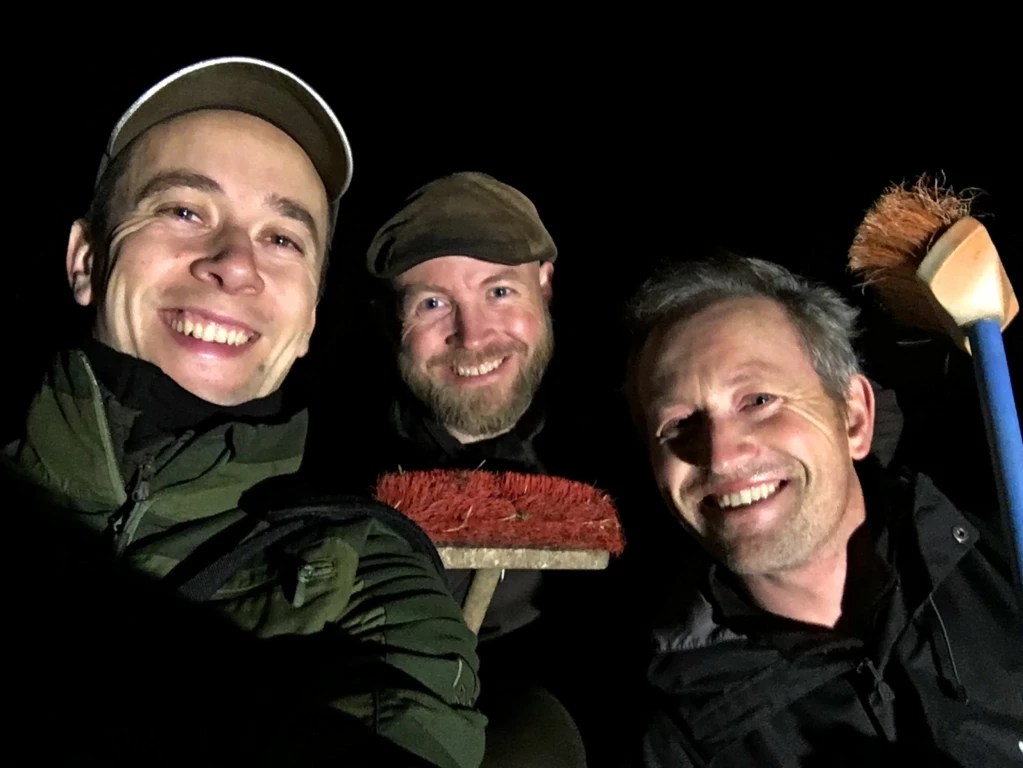
According to Science Norway, all it took was a smart hypothesis and a few brooms. Together, the three friends have discovered hundreds of previously unknown rock carving sites in the Østfold landscape in the last 3-4 years.

Some good buddies hang out in a bar together. Some go bowling together or maybe running. The buddies in today’s story hunt Bronze Age petroglyphs. At night.

Lisa Abend writes at the New York Times, “It was December and the first snow of the season was falling when the three friends set out on their weekly hunt through the fields of Ostfold, in southeastern Norway. … Tromping across the blanketed farmland, the men came to a low outcrop of rock, a few feet wide. With a child-size plastic broom, they brushed away the newly fallen snow from the stone to reveal the outline of a ship, its curved keel carved into the granite roughly 3,000 years ago.

“It was just one of more than 600 Bronze Age rock carvings, known as petroglyphs, that Magnus Tangen, Lars Ole Klavestad and Tormod Fjeld have discovered. Since making petroglyph hunting their collective hobby in 2016, the three enthusiasts have transformed knowledge about prehistoric art in Norway, more than doubling the number of carvings known in their home region. And although they are motivated, in part, by the pleasures of friendship and the outdoors, their findings have also lent serious weight to theories about the mysterious petroglyphs’ meaning.

“Rock carvings from the Bronze Age (which in Scandinavia began around 2,000 B.C.) are common in parts of Sweden and Norway. Regions in both countries have been declared UNESCO heritage sites because of the density and the diversity of the images, which include human figures, animals, geometric shapes and, frequently, ships. Yet because they are commonly cut into granite that is low to the ground and easily obscured by leaves or snow, they often go unnoticed.

“Petroglyphs are also easier to see when the sun is not overhead — a realization that has been one of the keys to the three friends’ success. Because the hunt for them is a hobby rather than a career — Tangen is an archaeologist working in a different field, Fjeld a graphic designer, and Klavestad a landscape architect and artist — they make time for it at night. …

“The thrill of the hunt has naturally led them to speculate on the carvings’ meaning. Because the petroglyphs tend to be more visible in the slanted rays of dusk, or with angled artificial lights, Tangen said he believed that their creators had made deliberate use of shadow and light in their work. Thanks to the sun’s changing angle, petroglyphs can look different depending on the hour of the day, or season, he explained. ‘I think the images have to do with the awakening of people’s minds to time,’ he said.

“That is in keeping with findings from professional archaeologists about rock art and stone monuments, in places like British Columbia and Scotland, whose features are visible only at certain times of year. There is also evidence for another one of Tangen’s theories: that some of the images were meant to be seen in flickering light, so that they appeared almost animated.

“Kristin Armstrong-Oma, a professor of archaeology at the University of Stavanger, said that ‘in excavations around some carvings, archaeologists have found signs of burning or charcoal.’ That suggested fire was being used, almost like a movie camera. ‘The living flames give the carvings a feeling of movement,’ she said.

“The petroglyph-hunting trio got their start in 2016, when Fjeld, the graphic designer, was walking his dog in the countryside and found a strange mark in a rock. He wondered if it was made by humans, or nature. Trying to identify it online, he came across a website with photos of petroglyphs, and contacted its owner, Tangen, who suggested Fjeld’s find could be a Bronze Age cup mark — a simple, round carving that is a common motif in prehistoric art.

“His interest piqued, Fjeld started paying better attention on his walks, and soon found a carving that was unmistakably made by human hands: an image of a ship. ‘That was very, very fun,’ Fjeld said. ‘So I started going on a regular basis.’

“Tangen, who had made similar discoveries while walking his own dog, joined him, and before long suggested that they invite Klavestad, a local enthusiast who had found his first carving when he was 10.

“ ‘We didn’t know each other, but I hadn’t met anyone else with so much passion for it,’ said Klavestad. ‘We are, all three, very dedicated.’ “

More at the Times, here.

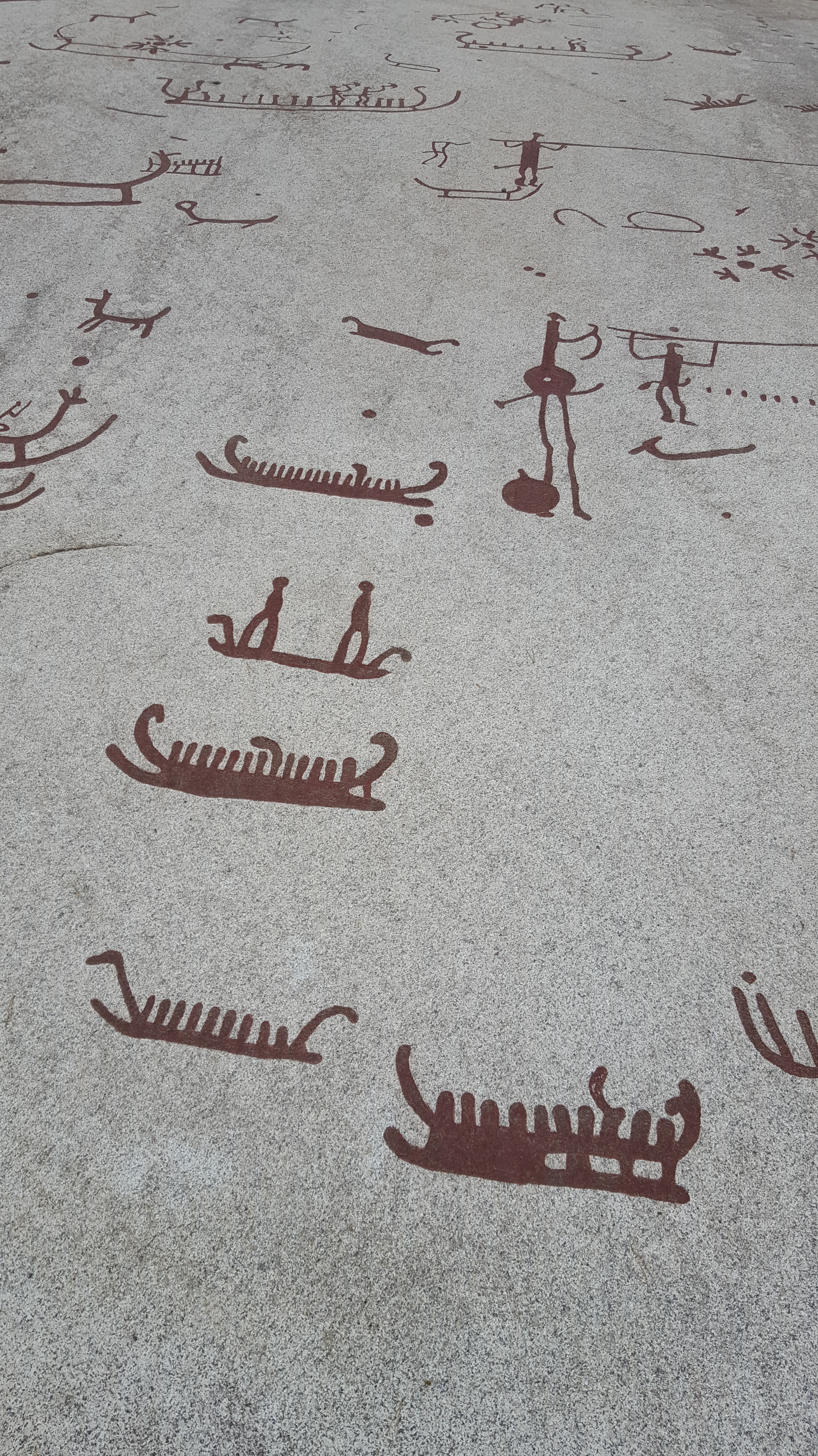
Petroglyphs I saw in 2017 at a UNESCO-protected World Heritage Site in Sweden. Some have been painted red to make them more visible for tourists, a practice which has drawn criticism.

060217-petroglyphs-by-Stuga40-Sweden

Read Full Post »

Photo: Dan Cook/Unsplash.
Ha ha ha ha ha.

Back in the 1990s, I had a stint as the editor of a publication called Minnesota Physician, where I interviewed a local physician who referred to himself as “the laugh doctor.” He convinced me that even forcing yourself to laugh can create endorphins in your body that are good for your health.

More recently, I saw research about this at the Washington Post. Daryl Austin has the story.

“My three young daughters like to watch pets doing silly things. Almost daily, they ask to see animal video clips on my phone and are quickly entertained. But once my 7-year-old lets out a belly laugh, the laughter floodgates are opened and her two sisters double over as well.

“This is just what science would predict.

“ ‘Laughter is a social phenomenon,’ says Sophie Scott, a neuroscientist at University College London who has studied laughter and other human reactions for more than two decades. Scott co-wrote a study showing how the brain responds to the sound of laughter by preparing one’s facial muscles to join in, laying the foundation for laughs to spread from person to person.

‘Contagious laughter demonstrates affection and affiliation,’ Scott says. ‘Even being in the presence of people you expect to be funny will prime laughter within you.’

“Scientists have yet to definitively find a funny bone, but they are revealing nuances about the laugh impulse. Laughter’s positive psychological and physiological responses include lessening depression and anxiety symptoms, increasing feelings of relaxationimproving cardiovascular healthreleasing endorphins that boost mood and even increasing tolerance for pain.

“Laughing has also been shown to lower stress levels. ‘Cortisol is a stress hormone that laughter lowers,’ says Scott, adding that anticipation of laughter also ‘drops your adrenaline’ and the body’s heightened fight-or-flight response. ‘All of these things contribute to you feeling better when you’ve been laughing,’ she says.

“Because humans are wired to mirror one another, laughs spread around a room just like yawns, says Lauri Nummenmaa, a brain researcher and professor at Aalto University School of Science in Finland whose work appears in a recent special issue on laughter in the journal Royal Society.

“ ‘We simply copy the behavior and laughter of others,’ Nummenmaa says. ‘Someone else’s act of laughing is first perceived when seen or heard, and this sensory information is then converted into the same area of the observers’ brain.’

“Studies also indicate that laughter can strengthen relationship connections. This happens, in part, because people naturally want to be around those who make them feel good the way laughing does. ‘We crave the company of the individuals who can give us such feelings,’ Nummenmaa says. …

“Contagious laughter isn’t necessarily a phenomenon unique to humans. Great apes, for instance, have been documented behaving similarly.

“ ‘Laughter is a play signal in humans and many other animals,’ says Disa Sauter, a social behavior professor at the University of Amsterdam. ‘It is used in rough-and-tumble play across species.’ …

“ ‘Vocal play signals frequently accompany other nonvocal behaviors, such as the play face in primates … or the play bow in dogs,’ according to a 2021 study in the journal Bioacoustics. The cues help differentiate threatening actions from play fighting and wrestling. …

“You can, of course, laugh alone, but the contagious nature of laughter means we’re more likely to laugh harder and longer in groups, as at a comedy club or in a movie theater.

“Psychologist Robert Provine showed that ‘you’re 30 times more likely to laugh with other people than you are on your own,’ Scott says. In his seminal book, Laughter: A Scientific Investigation, Provine wrote that the ‘contagious laugh response is immediate and involuntary, involving the most direct communication possible between people: brain to brain.’ …

“ ‘Laughter has many subtle rules that make adults highly attuned to when it’s socially appropriate,’ says Harry Witchel, a physiologist and neuroscientist at Brighton and Sussex Medical School in Brighton, England.

“There are circumstances, he notes, when people laugh at something that is not humorous: ‘Laughter is regularly linked to joy, relief, tickling, sudden incongruity, social discomfort, dominance, humiliating another and many other causes.’ …

“In Laughter, Provine described ‘laugh epidemics’ [like] the plague of laughter’ that befell numerous Central African schools starting in 1962: Contagious ‘laugh attacks’ among several groups of students lasted several hours to many days and continued until two schools had to close for extended periods of time. …

“Although scientists have uncovered much about laughter’s health benefits and its contagious element, there remain many unknowns, including how contagious laughter is learned in the first place.” More at the Post, here.

I wonder how blogger Laurie Graves — whose fictional characters can communicate through thoughts — reacts to the idea that “contagious laugh response [is] the most direct communication possible between people: brain to brain.” Might be something to use.

Contagious laugh response in Mongolia.

Read Full Post »

Photo: Deepa Bharath/AP.
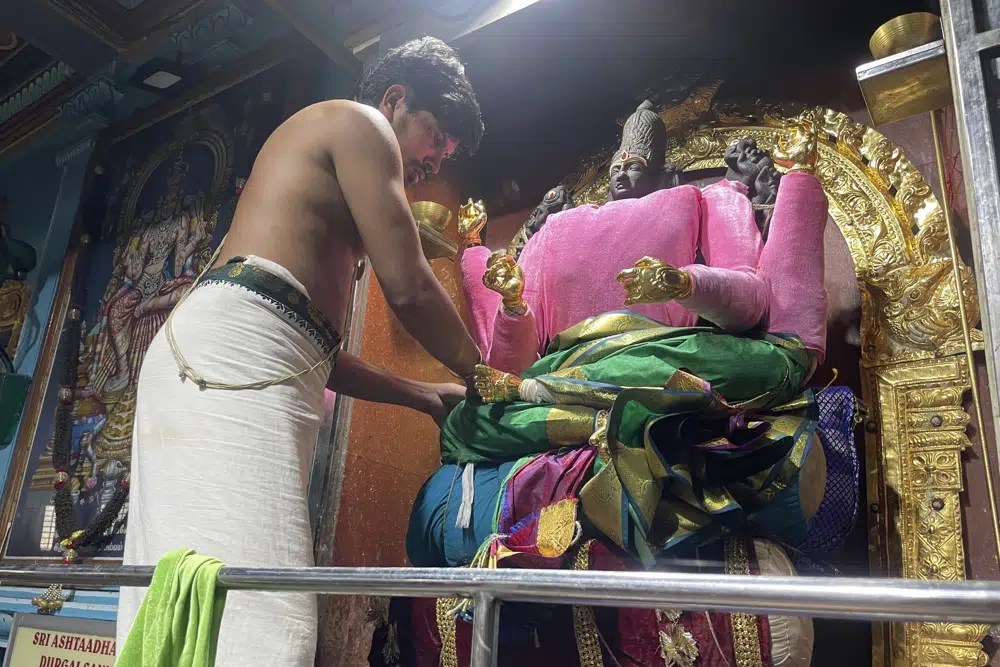
Deity decorator S. Goutham is seen at the altar of the goddess Durga at the Anantha Padmanabha Swamy Temple in Chennai, India, on Nov. 29, 2022. Goutham is a fifth-generation practitioner of this millennia-old spiritual art of decorating temple deities.

Isn’t it amazing how many kinds of jobs there are in the world? Today’s story from the Associated Press (AP) is about a young man whose family has had the job of decorating statues of local deities for five generations!

Deepa Bharath reports, “On a recent afternoon, 33-year-old S. Goutham was perched on a ladder at the altar of the goddess Durga at the Anantha Padmanabha Swamy Temple in Chennai, India. Goutham — his hand moving steadily — was pleating a green silk sari to adorn the deity. …

“A computer science graduate, Goutham quit his job nearly a decade ago to pursue his calling. He has since followed in the footsteps of his ancestors as a fifth-generation decorator of temple deities.

“In Hindu temples, idols are mostly made of materials such as black granite, white marble or five-metal alloys that have sacred significance. These deities are worshipped as physical, tangible representations of god (Brahman) who is believed to be infinite, omnipresent and beyond comprehension. Worship in a Hindu temple includes bathing these deities in milk, decorating them with colorful clothes, flowers, perfumes such as sandalwood, jewelry, and even weapons such as swords, clubs and tridents. Oil lamps are lit at the altar, and sacred chants and foods are offered to the gods.

Decorating the deities is a millennia-old practice that is described in the Hindu epic Ramayana, and Goutham has been learning the art since he was a toddler. He crafted his first formal decoration when he was 13. …

“Goutham said he became interested in decorating deities as a child because of his father.

“ ‘When you are little, your father is your hero,’ he said. ‘I wanted to be just like him.’ The first lesson Goutham got from his dad was about the weapons each god would hold. He heard stories about the power of each weapon and how gods would wield them.

“ ‘The personality of the deity and the story of the god or goddess could change depending on their weapons, the clothes they wear, the expression on their face or the position in which they are sitting or standing,’ he said. …

“There are rules about the types of materials that can be used on deities.

“ ‘The human body is made up of earth, water, fire, air and space, and everything you see naturally occurring on Earth is made of these elements,’ Goutham said. ‘To show this, we decorate deities using things that occur in nature and are a representation of these elements, like copper, cloth, coconut fibers and so on.’

“He says decorating a deity combines elements from art, dance and yoga, in terms of the hand gestures and postures the deities assume. Man-made materials such as plastic are prohibited. Goutham says he uses little pins to hold fabric together, but makes sure the pins don’t directly touch the idol. …

“[He] dreams of establishing an institution to train artists who can maintain the sacred tradition. While most deity decorators are men, he sees no reason why women cannot learn and practice it. ‘Everyone is equal under god,’ he said.

“Storytelling is an important part of what he does. One of his favorite installations depicts the friendship between Lord Krishna, an incarnation of Vishnu, and Kuchela.

“ ‘It shows Krishna washing the feet of Kuchela, a poor man, conveying the message that humility is a virtue — whether you are a human being or god,’ Goutham said.

“The term ‘idol worship’ may have negative connotations in some faiths. But for Hindus, deities — which are kept in temples, homes, shops and offices — serve as focal points ‘for to us channel our devotions, our actions and serve as a reminder of all the positive values that are associated with those deities,’ said Suhag Shukla, executive director of the Hindu American Foundation.

“Shukla says this form of worship is a way for her to connect with her ancestors. ‘As a second-generation Hindu American, I didn’t grow up with all these things around me where I could absorb through osmosis,’ she said. ‘But just knowing that I’m part of a tradition that has been passed down from generation to generation is personally powerful for me.’

“In U.S. Hindu temples, community members come together to help create the costumes for the deities, and it is an act of devotion, Shukla said.

“ ‘No one has to sit there and embroider a skirt or sari for a goddess, but they do it as a display of love,’ she said. ‘It’s humbling and empowering.’ ”

More at AP, here. No firewall.

Read Full Post »

Photo: Toronto Star.
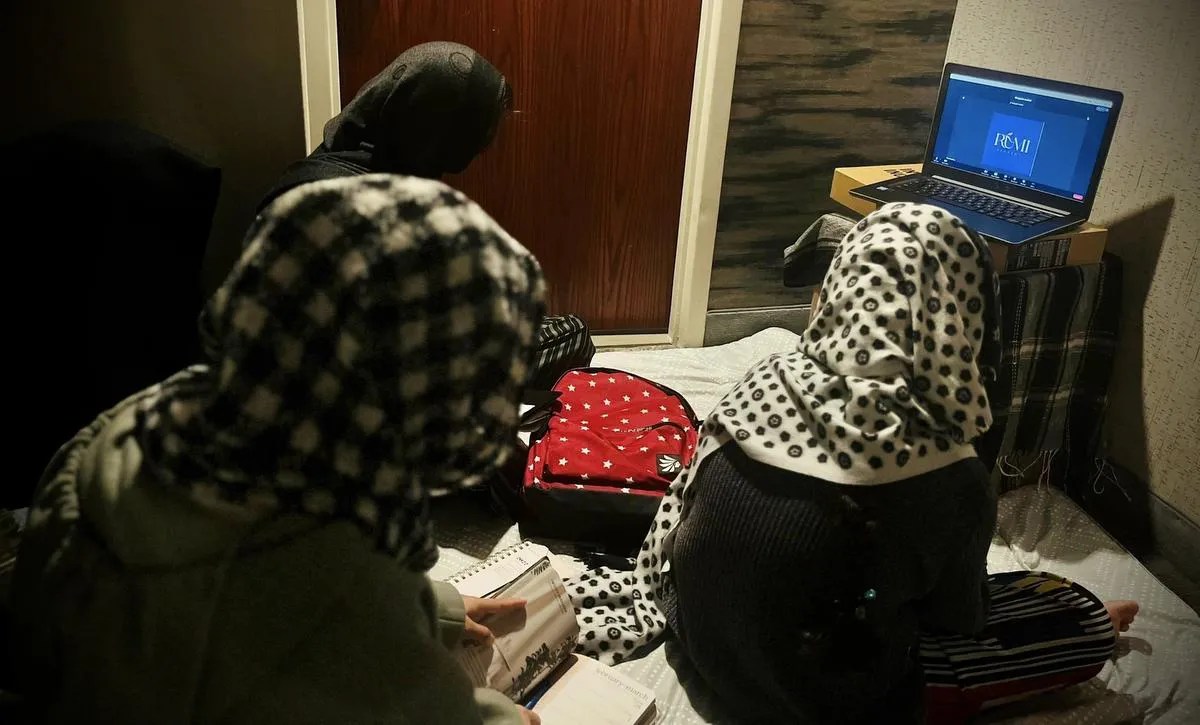
Banned from schools and sports, Afghan girls are turning to online education. Nonprofits around the world are acting on their belief that impoverished girls should have a better future than being forced into marriage for the “bride price.”

Readers will remember my young friend Shagufa, who escaped Afghanistan some years ago thanks to sports and education. Today, about to graduate from a master’s program at Brandeis University, she is moving on from the bleak life mapped out for her as the youngest of 11 in a crushingly poor family. Not so, the girls left behind.

Marjan Sadat writes at the Toronto Star, “Muzhdah Rahmani was a soccer-playing teenager with dreams of studying law before the Taliban took power.

“ ‘The first thing that the Taliban did was ban girls from school and women from sports,’ recalled the 18-year-old. ‘One of my sisters studied at university. Now she can’t. My other sister, who was in the 11th grade, is now not allowed to study. My older sister, she was a journalist, is banned from work — my dad is unwell, so she was the breadwinner.

“ ‘What kind of law and Sharia is this?’ Muzhdah said via WhatsApp, speaking in Persian from Kabul.

“Added her older sister, Morwarid: ‘The days are so hard for me and my sisters that I can’t count the minutes or I would lose my mind.’

“But the sisters have found something to help them through this moment.

“Rumi Academy offers girls and women online classes. Through it, Morwarid and Muzhdah have been studying English. …

“Anita is the founder and director of Rumi Academy. She asked that her last name and her location not be made public due to concerns for her safety. She said the academy started offering classes in 2020, due to COVID-19. It started in Afghanistan, and is now based in Turkey. …

“They are teaching international languages, in particular English ‘as lingua franca,’ as well as management, journalism, literary composition and psychology.

“There were 40 Afghan female students before the Taliban’s takeover back in mid-August 2021. Now there are 382 girls at Rumi Academy amid increasing Taliban restrictions on girls and women. They range in age from 13 to 25.

” ‘When I decided to participate in these classes, I didn’t even have the money to connect the internet,’ Morwarid said. ‘A woman from Canada sponsored me to take this course and I managed to start my studies online. In these dark days, these classes are a source of light for us.’

“Preeti Verpal, a registered nurse who lives in Kitchener [Canada], is one of the people who has financially supported education for Afghan girls, and one of two sponsors from Canada. She sponsored Morwarid.

“ ‘I cried when I read the news that Afghan girls won’t be allowed to continue studying,’ Verpal said via WhatsApp.

“For six months, the cost per student is $300 (U.S.), which goes to teachers, the academy says.

‘I have no connection to Afghanistan but as a woman and a mother, I cannot sit here comfortably in Canada and watch the entire Afghan female population suffer,’ Verpal said. ‘And the only thing they did wrong was what? Be born a female.’

“ ‘I want to sponsor because I believe every girl should have the same opportunities available to them as boys. When girls are educated they can change the world, they can become financially independent to support not only themselves but their families.’

“Shafiqa Khpalwak, a poet and humans rights defender, said the country is ‘an open prison for women and every other ordinary Afghan.’

“ ‘My sister is 15 years old and in Kabul and not allowed to go to school,’ she said via WhatsApp from Afghanistan. ‘My cousin, 16 years old, wanted to be a doctor and is now at home. Every day they ask me when their school will be reopened. … The world must take serious action to put pressure on the Taliban. Condemnation will not bring any tangible results. They are responsible for this mess; now, they can’t look away.’ ”

A word on Shagufa now. She has a good job lined up to start saving money toward her goals. She also assists the founder of Educate Girls Now, another nonprofit that, despite all the upheaval in Afghanistan, continues to educate girls there, help them get to college in Bangladesh, and keep them from being sold into early marriage.

More at the Star, here. See also Educate Girls Now.

Read Full Post »

Photo: Alex Halada/AFP via Getty Images.
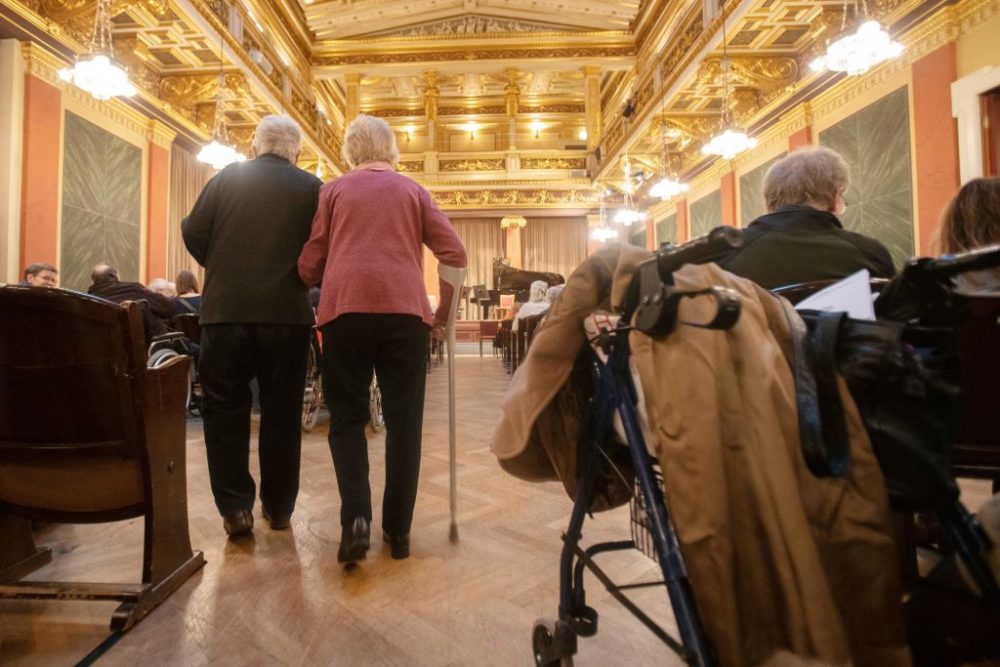
Elderly spectators arrive to attend a concert specifically tailored to people living with dementia at the Wiener Musikverein in Vienna on December 5, 2022.

Meghna Chakrabarti of WBUR’s On Point had a great show recently about enlightened dementia communities in the Netherlands and other parts of Europe.

I came away feeling that the reason we have little like this in the US is because of insurance. We are such a crazily litigious society, we can’t afford to take the slightest risk, even if it means an older person will have a happier aging experience.

Producer Paige Sutherland and host Meghna Chakrabarti shared highlights from the show at the WBUR website.

“Is there a better way to care for dementia patients? And what might that look like?

” ‘I think it really focuses on what’s the day-to-day life and looking at this balance between safety and freedom,’ Dr. Tia Powell [professor of psychiatry and bioethics at Albert Einstein College of Medicine] says.

“And that’s exactly what the Netherlands did when they opened up the first-ever ‘dementia village,’ where residents can live freely despite their memory loss.

” ‘Officially, it’s a nursing home, so we offer highly complex care, skilled nursing. But it does not look anything like a nursing home,’ [advisor at Be Advice] Iris Van Slooten says. …

“On the idea behind a ‘dementia village’

“Iris Van Slooten: It should be about the individual; it should be about the person living in that place and need to deal with dementia. And you want to continue your life even though you are dealing with dementia. And so you want to continue life like you did before and not be hospitalized. I always ask our visitors and the people we work with, would you want to live in a hospital for the rest of your life? And then always the answer, of course, is no.

“So then why did we do that to the people that were living with us? … You can continue with your life, you can stay a human being. And what makes you a human being, for instance, is that you can make your own choices every day. Like … what do I have on my sandwich? Or in what place do I want to be right now? Very, very simple choices we make every day but are taken away from people that live in a nursing home.

“On what the village looks like

“Iris Van Slooten: You will enter through a door and then you will enter the hallway. And that is a safe neighborhood where the outside of the homes are the barrier to the … broader surroundings. And we had a door because there were laws in place back when we designed … we had to keep people inside. But you will find 27 homes in a normal looking community. In a normal neighborhood. The homes look like normal Dutch homes with a normal living room, a kitchen, private bedrooms.

“And when residents also step out of the front door, … they are really outside. And there are many streets and many gardens they can explore. We have a restaurant, a pub, a theater, many club rooms, a supermarket. So, everything you will find in any neighborhood, in any community. So yeah, very normal, and especially on a sunny day and in spring and summer, of course, then you see a lot of people walking around, having conversations, meeting each other, grabbing a chair, enjoying a drink in a restaurant. It’s just life. …

“Every resident that lives there has severe dementia. So, you need to have an indication from the Dutch government saying you have severe dementia. … We have teams in the houses that support the household and really run the household. But we also have a quite extensive medical support team, including a specialist, elderly care, doctor, but also a psychiatrist, an official therapist, a social coach. …

“Say someone left their home, and they wanted to go to the village supermarket, but got lost or forgot the way. How do you help that person get to where they wanted to go?

“Iris Van Slooten: One thing we highly value in the Hogeweyk is having freedom and giving the freedom to these people and not restraining them. … They are free to walk around on their own. A lot of people can find their way because also people with severe dementia, they still have learning abilities, and the place is designed [so that it is] recognizable for them. …

“So also the staff in the restaurant, also the reception, also the technicians, also me when I’m there. … When I look out my office and I see somebody in the rain without a coat on, it might slip to the attention of a staff member in house. But then it’s also my job to go over there and find a jacket for that person. …

“On helping people maintain their independence and humanity in the ‘dementia village’

“Dr. Tia Powell: [As] a bioethicist, really all of our challenges can be summed up by the tension between maintaining freedom, which is part of what all human beings strive for, and safety. And this argument’s been going on forever for hundreds of years.

So I do think that many of the ways in which we provide care today in the U.S. for people with dementia do not focus on care, but they focus on other issues. You know, maintaining regulations, all kinds of other things.

“And we have forgotten about freedom and joy.”

A bit from the transcript on the sad US situation.

“Meghna Chakrabarti: Beth Ounsworth … was living a very rich life full of friends and music. As a member of her choir, she was independent in her own apartment in Philadelphia. And that started changing when Beth was about 69 years old. She began forgetting simple things like what day and time she had scheduled meetings, directions to common places. …

“And so her children finally took her to see a neurologist. And Beth was diagnosed with Alzheimer’s disease. Now, we spoke with her daughter, Meg Ounsworth Steere. Because Meg wanted to care for her mother, but with two young children at home, it just wasn’t possible. So they looked at assisted living centers near where Meg lived in Boston.

“Meg Ounsworth Steere: So she did go and visit a few assisted living centers with me. … We went to lunch, and she just looked around and she was like, Not me, not now. And I was like, okay, you know? And that’s when we had this conversation about she was like, I don’t want to be in a place where I’m just surrounded by old people. I want to be in a place where there are, you know, babies, too, and young families, and I can feel a part of a community. …

Chakrabarti: So Beth stayed in Philadelphia, but it wasn’t easy. Daughter Meg had to find full time aides to take Beth to all of her appointments and to help with all of her daily activities. Meanwhile, the disease progressed.

“Ounsworth Steere: It got to a point when I took her to the neurologist. He would give her a mini mental state exam and 30 is normal. My mom was testing at a four at that point. Partially because she has aphasia and so she doesn’t really understand words. And so he was like, you know, she’s not going to answer the questions that were like, do you know who the president is? …

“Chakrabarti: So the family decided it would be better for Beth to live in a memory care facility. And they found a good one near Boston. Beth moved in in 2018, and ever since then, Meg and the family have been paying about $100,000 out of pocket for the facility every year.

“Ounsworth Steere: What worries me is that I know I’m on the luckier side and it’s still not perfect. So I can’t quite fathom what it’s like when you have to go to a facility that can’t possibly retain the aides that they want. … Or where aides are just less engaged and involved, they’re just kind of physically there. Kind of like the first aides that I had, but not really assisting, you know, and engaging with and kind of trying to love the resident and then the people who can’t afford care at all. I just, I don’t know how that’s possible.

“Chakrabarti: Meg visits her mother often. Beth is nonverbal now, However, Meg gets to communicate with her in a different way: by singing.”

If you click on the arrow at WBUR, here, you can listen to the whole show. PS. I blogged about the Dutch dementia village in 2016, here!

Read Full Post »

« Newer Posts - Older Posts »