Feeds:
Posts
Comments

It is not really spring yet although a weird February tried to fool us with several warm days before handing us back to single-digit temperatures.

There is a period in New England when the weather teeters back and forth between winter and spring — and inevitably brings to mind the e.e. cummings poem “[In Just-].” It’s a happy poem reminding one that as long as there are springs, there will always be excited children running outdoors to play, hollering back at someone in the house, “I don’t need a coat — it’s hot!”

Here is the poem:

in Just-
spring when the world is mud-
luscious the little
lame balloonman

whistles far and wee

and eddieandbill come
running from marbles and
piracies and it’s
spring

when the world is puddle-wonderful

the queer
old balloonman whistles
far and wee
and bettyandisbel come dancing

from hop-scotch and jump-rope and

it’s
spring
and

the

goat-footed

balloonMan whistles
far
and
wee

 2017-sunrise
021217-tree-in-snow-Providence
021817-snow-melting-at-stream
022517-fungus-rock-lichen-woods
022117-thru-the-looking-glass
030217-vinca-rises-from-decay

Photo: Floyd Davidson
Genuine “Eskimo Kiss.” Iñupiat sharing a kunik at a Nalukataq festival in Barrow, Alaska.

For Asakiyume and others interested in inventive efforts to preserve the culture of marginalized groups, this New Yorker story may be of interest.

“Iñupiat people, a tribe native to Alaska, did not have a written language for much of their history,” reports the magazine’s Culture Desk. “Instead, for thousands of years, their culture was passed down orally, often in the form of stories that parents and grandparents would tell and entrust to their children.

“In recent years, those stories, and the lessons and values and history that they contain, have become harder to preserve, as the young people of the tribe, growing up in the modern world, have drifted further and further from traditional ways.

“[A new] video, which originally appeared on ‘The New Yorker Presents‘ (Amazon Originals) and is based on a story by Simon Parkin, is about a recent experiment in transmitting Iñupiat culture through a new medium: a video game … in which an Iñupiat child travels across the wilderness to find the source of the bitter blizzards that have been hitting his village.

“Before they began building the game, E-Line developers travelled up to Barrow, in northern Alaska, in the deep, dark cold of January, to meet with tribe members and to lay the groundwork for the project. The resulting game is called Never Alone. …

“Never Alone was created through a highly collaborative process: ‘We’ve had everybody from eighty-five-year-old elders who live most of the year in remote villages to kids in Barrow High School involved in the project,’ Amy Fredeen, the C.F.O. of E-Line, told Parkin. …

“As Clare Swan, who sits on the tribal council that had to approve the project, recalls, ‘We just said, “Shoot, of course it’s difficult.” Anything that’s worth it is.’ ”

More at the New Yorker, here.

I imagine that elders and students got a thrill out of this project in different ways. I would love to know to what extent their feelings overlapped. Did the elders care more about the preservation aspects and the children about making modern media?

All Dutch electric trains are now powered by wind energy, the national railway company NS has said.

“Since 1 January, 100% of our trains are running on wind energy,” said NS spokesman, Ton Boon. …

“We in fact reached our goal a year earlier than planned,” said Boon, adding that an increase in the number of wind farms across the country and off the coast of the Netherlands had helped NS achieve its aim.

“[Dutch electricity company Eneco] and NS said on a joint website that around 600,000 passengers daily are ‘the first in the world’ to travel thanks to wind energy. NS operates about 5,500 train trips a day.

“One windmill running for an hour can power a train for 120 miles, the companies said. They hope to reduce the energy used per passenger by a further 35% by 2020 compared with 2005.” More at the Guardian, here.

Meanwhile in London, researchers are looking into solar-powered trains.

As Michael Holder said in BusinessGreen, part of the Guardian Environment Network, “Imperial College London has partnered with the climate change charity 10:10 to investigate the use of track-side solar panels to power trains. …

“The renewable traction power project will see university researchers look at connecting solar panels directly to the lines that provide power to trains, a move that would bypass the electricity grid in order to more efficiently manage power demand from trains.” More.

I wonder what sounds solar- and wind-powered trains make. Can we still say choo-choo-choo and whoo-oo-OO with our grandchildren? And who will update Thomas the Train?

Photo: Geography Photos/UIG via Getty Images
Intercity train arriving at Leiden Central railway station, Netherlands.

Photo: Frasers Property
Fairwater, developed by Frasers Property, is the largest geothermal community in the southern hemisphere.

These days there’s a lot of talk about “sustainable” daily-living practices and “sustainable” business practices. But let’s be honest: some practices are more sustainable than others.

One monitoring organization that sets a high bar is the Green Building Council of Australia (GBCA).

Clarissa Sebag-Montefiore wrote recently at the Guardian about projects the council has approved: “In 2016, a new master-planned estate in [Blacktown, near Sydney] became the first residential community in New South Wales to be awarded a top, six-star Green Star community rating by the Green Building Council of Australia.

“Not only that, Fairwater, developed by Frasers Property, is the largest geothermal community in the southern hemisphere. Houses are cooled or heated by a refrigerant that pumps air underground then back to the surface, using less power than air-conditioning or heating and saving residents of a three-bedroom house $500 to $600 a year.

“ ‘There’s this avenue of mature trees with this massive lake and lovely terrace houses – yoga by the lake, cycling paths, all these people walking,’ says the GBCA chief executive, Romilly Madew. …

“Green-star buildings produce, on average, 62% fewer greenhouse gas emissions and use 51% less potable water and 66% less electricity than average buildings in Australia, according to GBCA’s 2013 report The Value of the Green Star.

“Since launching in 2003, hundreds of buildings around the country have been certified for the rating system and 120,000 people are now moving into Green Star communities. …

“The key is looking at the project holistically, says Madew. ‘It’s about going back to that old adage of community: people, walkability, liveability, places for the kids to play. [We want to] change the way people think about how they live.’

“Developers, ultimately, ‘are there to sell house and land packages – so they’re not going to be successful unless they’re building something people want to buy. Take “sustainability” out and ask what [buyers] want. They want something close to amenities – schools, public transport, shops and parks. And a home that is cheap to run.’ ” Read about other sustainable projects in Australia here.

Hat tip to ArtsJournal.com, a great source of stories.

Photo: Craig F. Walker/Globe Staff
From left, Army veteran Kevin Faherty speaking with Paul Connor, veteran services coordinator, and Middlesex County Sheriff Peter Koutoujian in January.

A sad fact of war is that those who serve too often come back suffering from emotional trauma or addiction.

Fortunately, there are understanding people who can help them move on. We just need more of them.

Kevin Cullen at the Boston Globe describes what one Massachusetts sheriff is doing to make veterans’ lives more hopeful.

“For the past year, with hardly any attention, Middlesex County Sheriff Peter Koutoujian and his staff have developed an innovative approach that is transforming lives for the better, lowering recidivism rates and raising the odds that those who have served their country can become more responsible, productive citizens.

“[Jan. 13] marked the first anniversary of the Housing Unit for Military Veterans at the Middlesex jail and house of correction, the first of its kind in New England, and really the only one quite like it nationwide. Its acronym is HUMV, or Humvee, an armored vehicle that once protected many of the younger vets in the unit. …

“Koutoujian tapped Paul Connor, an Army veteran, to run the unit. They got a waiver from the state, so that pre-trial prisoners and inmates already serving their sentences could be housed together. The HUMV is set up like a barracks, bunks lined up in the self-contained unit. …

“The men in the unit are broken down into squads, sharing chores and other duties, which builds camaraderie and accountability. …

“Connor’s veteran status makes a real connection with those in the unit. His decade of sobriety, meanwhile, makes him a role model. Like the vast majority of inmates in the general population, most of the vets in the HUMV have struggled with alcohol and substance abuse. …

“Amy Bonneau, a social worker from the Boston Vets Center, runs a support group at the HUMV.

” ‘For a lot of these guys, their underlying issues can be traced back to their service,’ she said. ‘If we don’t treat what got them here, they end up coming back. What we see is the camaraderie that this unit fosters makes them more willing to take the treatment seriously. It’s more than helping themselves. They don’t want to let down their brothers.’

“Connor, still a captain in the National Guard, puts it in terms that everybody in the unit understands.

“ ‘In boot camp, they break you down,’ he said. ‘A lot of these guys come in here broken. We are building them back up.’ ”

More here.

Photo: Addis Fortune
A passerby looks at what’s on sale at a sidewalk bookshop.

A love of reading appears to be growing in Ethiopia. According to Mahlet Workayehu at Addis Fortune and All Africa, “It is a common sight to have people carrying around books on the roads and selling them to people sitting in cars or people walking on the streets. …

” ‘Now people hanging out at bars and khat stores are buying books from us,’ says Addis, a book vendor.

“The cost of books in Addis, with the average price of a fiction novel book by a local author coming in around 80 Br [about $3.25], has increased in the past two years. …

“The people credited for expanding the readership of books in Addis are the mobile vendors. They walk around with books in their hands stacked all the way up to their neck, approaching any and everyone to buy a book of them. There are close to 1000 mobile vendors roaming the streets of Addis.

“Addis is a mobile vendor; he has been selling books for five years. Although he is not literate, Addis knows all the titles of the books he carries, whether it be in Amharic or English.” More here.

That bookseller’s lack of literacy really struck me. I work as a volunteer with adult refugees, some of whom never had any schooling and are eager to learn. Book vendor Addis is so near and yet so far from the joy of books.

(For fun, read Roger Duvoisin’s storybook Petunia, about the goose who thought she was wise because she carried around a book. I don’t accuse Ethiopian book vendors of being like Petunia, but I do wish someone could help them learn to read. Of all people, I imagine, they would most enjoy being literate.)

Photo: Luke Spencer
Inside the main concourse of the abandoned art deco Buffalo, New York, train station. 

It seems everyone loves old art deco buildings, but no one knows how to preserve them. At least that is the feeling I get listening to the endless discussions of the future of Providence’s Superman Building, so-called because it looks like the Daily Planet building from the 1950s television series.

Meanwhile, as Luke Spencer writes at Atlas Obscura, preservationists in Buffalo, New York, are holding out hope for an art deco “train station, lying forlorn and mostly forgotten … the old Buffalo Central Terminal.

“Opened in 1929 for the New York Central Railroad, the Buffalo Central Terminal was every bit as grand and opulent as Manhattan’s Grand Central Terminal, Philadelphia’s 30th Street station and Washington DC’s Union Station.

“These were the days when Buffalo was known as the Queen City, built on the strength of automobiles, livestock, steel, and other heavy industries prospering along the seam of the Erie Canal, connecting New York to the Great Lakes. Buffalo thrived to such an extent it was chosen to host the prestigious 1901 Pan American World’s Fair. At this point, Buffalo was the eighth-largest city in the United States. … In its heyday, Buffalo Central Terminal was servicing 200 trains a day.

“But the decline in Buffalo’s economic fortunes, and the rise of domestic airlines and automobiles, spelled the end of the grand Terminal. In the early hours of the morning of October 28, 1979, the last Lake Shore Limited train service heading west left Buffalo. The grand old Terminal was never used again.

“For decades, the building was left abandoned, silently falling apart, while the surrounding neighborhood similarly declined. But the spirit of the Nickel City is strong. No more so than in the recent efforts of the non-profit, Central Terminal Restoration Corporation (CTRC), which has been fighting to not only preserve the Terminal, but restore it to its original magnificence. …

“The building itself would need extensive repairs. Forty years of neglect have seen much of the original fixtures either stolen or stripped, particularly in the mid 1980s, when the Terminal was sold off in a foreclosure sale. …

“Perhaps the best chance for the Terminal’s rejuvenation lies with Canadian property developer Harry Stinson, who was named as the designated developer of the site by the City of Buffalo and the CTRC in 2016.” More at Atlas Obscura, here.

It’s a treat to see historic buildings saved and turned to new and profitable uses. Let’s keep tabs on this one.

Photo: Luke Spencer
Is this the prison staircase in the opening scene of Little Dorrit, by Charles Dickens? Oh, guess not.

Photo:

At my former magazine we focused on lower-income issues, which meant we sometimes published research on topics such as prison reform, the criminalization of addiction, and job programs for ex-offenders.

Recently, I saw an article that reminded me of those efforts. It’s about an unusual fine-dining restaurant in Cleveland.

Jenn Hall covers the story at Paste, “Though the numbers vary by state, roughly three-quarters of ex-convicts are rearrested within five years, and more than half of those return behind bars. Ask Brandon Chrostowski about it, and he’ll tell you that it’s more than a problem. It’s a civil-rights issue — and that’s why he decided to do something about it.

“For diners at Edwins Restaurant in Cleveland Shaker Square, fine French cuisine is an initial draw. The setting is nouvelle-chic, befitting a Francophile menu that garners praise. Bar service is sophisticated, with a wine list that runs deep. But the reason to return goes beyond the plate. In almost every position, both front and back of house, ex-offenders are training to launch new careers.

“It’s the only white-tablecloth restaurant of its kind in the U.S.

“The trainees are part of Edwins’ six-month Restaurant and Leadership Training Program, of which Chrostowski is founder and CEO. (Edwins is a portmanteau of ‘education’ and ‘wins.’) Covering everything from mother sauces to white-tablecloth service, the program aims not just to equip ex-offenders with skills, but also to power them with the confidence to apply them.

“It’s a program borne of careful planning. Chrostowski first had the idea in 2004, secured approval to operate as a 501 (c) (3) in 2008, and then spent six years perfecting the pedagogy before opening the restaurant’s doors in 2013. Now, 20,000 diners visit Edwins each year.

“But job prep and a fine French meal is just one part of the story. Ultimately, Edwins is a support network for those determined to challenge statistics. So while participants indeed learn a perfect braise, they also get help with everything from reinstating their driver’s license to securing medical care. It’s a humanizing approach to a sobering problem, and perhaps that’s why it’s working. The Edwins-alumni recidivism rate stands at just 1.2 percent. …

“Asked what drives him, he says it’s about paying forward a break he was given. Growing up in Detroit, Chrostowski had a legal run-in and was lucky to land probation instead of a prison sentence. That ‘aha’ moment primed him to take stock, find a mentor and launch a fine-dining career …

“Though he reads like an optimist (and is when it comes to a belief in transformation), Chrostowski sees himself as a pragmatist. Given the chance, he says, many ex-offenders have the capacity and strength to rebuild. They just need that all-critical chance.”

To read Hall’s interview with Chrostowski, click here.

Two Kansas philanthropists with ties to Chicago have chosen to benefit that city and its youth for 25 years to come with a gift extending eligibility for free admission.

Matt Masterson writes at Chicago Tonight, “Chicago teens won’t have to pay to visit the Art Institute again for quite a long time. [City] residents under the age of 18 will no longer be required to pay the $14 admission fee at the Loop museum thanks to a donation from a pair of Kansas donors.

“The gift comes courtesy of Glenn and Claire Swogger of the Redbud Foundation, a Topeka-based nonprofit … The Swoggers’ gift specifically allows Chicago teens between the ages of 14-18 to enter the museum at no cost. Guests under the age of 14 already receive free admission.

“Glenn Swogger began attending the University of Chicago on scholarship at age 16, according to Hicks, and though he has since moved away, he has maintained a strong connection to the city and wanted to provide a gift that would reflect the impact his teachers and education have had on him.

“Though the actual amount of the donation has not been released, Hicks said museum staff reviewed attendance projections with the Swoggers and believe the gift will cover every Chicago teen for the next 25 years. …

“The Art Institute already consults with a five-member teen council of volunteers who represent different schools and neighborhoods across the Chicago area. They meet weekly to advise and brainstorm with various departments within the museum about how to make the museum more engaging and meaningful for young people.”

More here.

Photo: Art Institute of Chicago
Whitney Young Magnet High School senior Rosario Barrera, right, and Kenwood Academy High School Junior Walela Greenlee, both members of the museum’s teen council, in the Art Institute of Chicago’s Modern Wing.

Jubilant Feet

foot_chart1_small

Photo: Wikimedia
People who practice reflexology believe that stimulating different zones of the foot improve the function of different organs of the body.

In tai chi, we’ve learned to get the circulation going in our feet by kneading so-called pressure points and massaging from sole to calf. Although I am not sure I buy into the ancient Chinese view that massaging different zones on the foot affect particular organs and improve overall health, I certainly think that stimulating the blood flow in feet is a good idea, especially if you have circulation issues.

Recently, I decided to try a local reflexology place and see if my feet felt happy afterward.

They did.

I had experienced this treatment only once before, in 2007, when my husband was working in Shanghai and I was visiting. Walking around the French Quarter, I came upon a sandwich board outside a storefront. It said “foot massage.” I thought, “Why not?” I was shown along a dark corridor lined with cubicles, not quite sure what I was getting into. In one cubicle, I sat back and took off my shoes and socks. I remember a window. A young woman who spoke no English got to work, first soaking my tired tourist feet. The massage involved her really pressing hard on the pressure points. We communicated with sign language and friendly smiles, and I think we each found the other rather exotic. My feet liked the experience.

My recent experience was both the same and different. The staff spoke a little more English, but not a lot more. The cubicles were dimly lit and comfortable. A bucket of hot water for the feet started off the relaxation process. Soft music played. At first it sounded Chinese, then morphed into “Danny Boy.” I think I dozed off. The pressure that the young woman applied to my feet was gentler than in Shanghai. Very nice. My husband summed it up with an apt quote: “Be jubilant my feet!”

You can read up on the theory behind reflexology at Wikipedia, here. Far be it from me to question ancient Chinese medicine, but whether or not different parts of your sole improve the functioning of kidneys, liver, digestion, etc., I’m pretty sure that, first, reflexology does no harm.

Art: Tomihiro Hoshino

For more than 30 years, a woman from Hokkaido, Japan, who stayed at our house while studying the local PTA has been sending me magnificent calendars.

The calendars are from a talented artist and former athlete whose paralysis led him to master holding a brush in his mouth. His name is Tomihiro Hoshino.

An article at AccessibleJapan reports, “Tomihiro Hoshino was an experienced 24-year-old gymnastics teacher with a real passion for the sport. An active mountain climber and gymnastics instructor, his life changed completely as he was demonstrating a double somersault technique to a group of junior high school students. Hoshino unfortunately injured his neck during the maneuver and since that day he has been completely paralyzed from the neck down.

“The accident was a serious blow to this extremely active person who was forced to lay motionless for nine years in a Gunma orthopedic Hospital where he was kept under heavy surveillance for respiratory problems and complications as a result of the injury. He and his family never gave up hope that his physical condition would stabilize and improve. Although it took nine years, and he came close to death many times, there was always hope for the future.

“Many say that this hope came two years after his accident. In 1972 one of the patients that had stayed in the same room as Tomihiro Hoshino was being transferred into a different hospital. He asked that the staff, as well as all of the people that stayed with him, to sign a card as a memento of his time in the hospital. Tomihiro couldn’t come up with a solution as to how he would be able to sign his name for the man but with the help of his mother he was able to hold a pen in his mouth and eventually sign Tomo. This would be the beginning of how Tomihiro would begin his career in writing and painting.

“The second event that produced real inspiration for Tomihiro Hoshino was a time that a friend brought him flowers and left them in the window. …

“He was moved to start expressing what they meant to him. He began to gradually draw flowers and eventually became an adept painter with his mouth. …

“Tomihiro Hoshino has successfully produced hundreds of pieces of artwork, many of his essays and poems have been published and his work is displayed in permanent exhibitions at the Tomihiro Hoshino Museum. …

“If you are interested in Tomihiro Hoshino’s works, you can purchase them on Amazon or visit his art gallery in Gunma, Japan.”

More at AccessibleJapan, here. Read about his museum here. Those who read Japanese may click here.

I feel lucky to have had this decades-long friendship with a woman in Hokkaido. Although we haven’t seen each other since the 1980s, her daughter, Mika, came to visit while living in New York. Mika helped decorate our Christmas tree that year. Nowadays, I never do the tree without thinking of her.

Image: Tomihiro Art Museum

Photo: Kate Holt for the Guardian
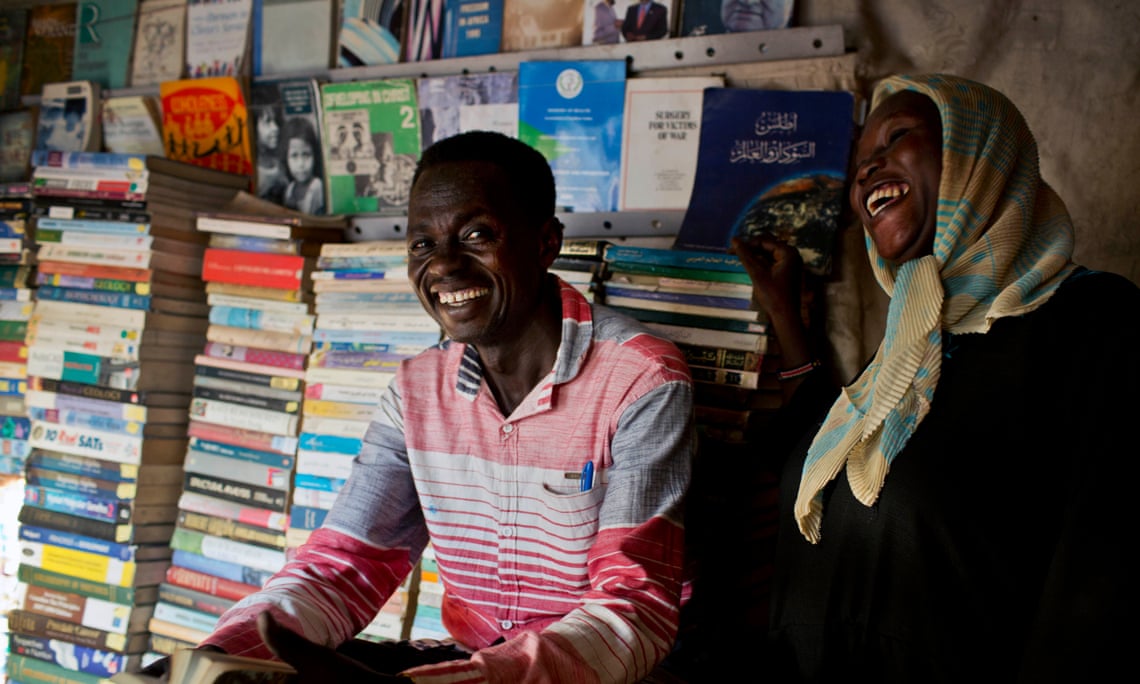
Juma’a Ali, 34, centre, a Christian from the Nuba mountains in Sudan, who fled to Malakal in South Sudan. Here, he is pictured in his bookshop in Malakal’s camp. 

Sometimes refugees take it upon themselves to improve life in the camps where they hope to live only temporarily. I have read in the past about adults who teach the children who are missing out on school. In fact, I once met a man who did that in a Nepalese camp in India. In this story, a refugee offers books.

Ben Quinn writes at the Guardian, “Juma’a Ali glances fondly at the ceiling-high stacks of titles in his makeshift bookshop, a collection that ranges from Virginia Woolf to Canadian Tax Law (1995 edition).

“Just over three years ago, carrying as many books as he could bring, he sought refuge in war-torn South Sudan following the persecution that he says he experienced as a Christian, across the border in Sudan’s Nuba mountains.

“The books were gathered along the way in Sudan and South Sudan. Most are second-hand copies from libraries in South Sudan and donations from abroad. He wasn’t a bookseller in his home country; he worked with his local church. …

“He sells the books at the camp for very small amounts of money, and is fiercely proud of his role as the bookseller of Malakal. His little shop stands as a source of education and distraction from the often unbearable conditions the camp’s residents live with on a daily basis. …

“Among the most sought-after titles by the more than 33,000 residents of the camp are the Bible and the Oxford English Dictionary, although collections of love poems also find takers. ‘Whenever there is conflict or war, people are reading books about politics and religion. When there is peace, there is also more love,’ says Ali…

“Some day, he says, he wants to leave the camp, adding: ‘Europe is a place I think about, but how to get there? It’s locked up and is closed off to us. I want to be positive and I hope for peace here some day. The problem is how to bring people together after so much has happened.’ ”

Although this story was published as recently at January 4, even more recent news about impending famine in South Sudan has me fearful for Ali and those he serves with his books. I will try to find a follow-up story.

More here.

The Poetry Project

Photo: Ted Roeder

I wonder if poetry is going to see an upsurge in our time. Better than any other form of communication, poetry can get to the heart of the matter, expressing important truths and feelings obliquely.

Recently I read about poets who gather annually on New Year’s Day in New York City to share their unique statements. The event is part of what is known as “The Poetry Project.”

“There are three things to consider when the New Year’s Day Poetry Marathon sweeps you into its gracefully uncouth embrace,” says the website, “what it is, what it was, and who you will be when it’s over. An untamed gathering of the heart’s secret, wild nobility — over 140 poets together revealing not just that a better life could exist, but that it already does, sexy and wise, rancorous and sweet, big hearted and mad as hell. …

“Since Anne Waldman gathered 31 poets at the very first marathon on January 2, 1974, countless forward-facing luminaries have thrown their voices into the cauldron — among them Eric Bogosian, William S. Burroughs, Spalding Gray, Jackson Mac Low, Ed Sanders, Pedro Pietri, Helen Adam, John Cage, Joe Ceravolo, John Giorno, Ted Berrigan, Yoko Ono, Amiri Baraka, Gordon Matta Clark, Jim Carroll, Bernadette Mayer, Alice Notley, Steve Cannon, Hannah Weiner, Kathy Acker, Arthur Russell, Gerard Malanga, Suzanne Vega, Allen Ginsberg, Patti Smith, and Philip Glass. The list grows every year …

“Whether you stay for a little while or for the long haul, whether you’re part of the standing room only experience at sunset or with the handful of diehards as the final poet reads her last word in the predawn sanctuary, you will be transformed for the year to come. Your presence helps launch a great flare into the otherwise impenetrable darkness of the 21st century night. …

“The Project receives many requests to perform in the Marathon, and we feel fortunate that so many people want to help us meet our fundraising goals. We only have about 150 spots and a seemingly unlimited artistic community to draw from. [Click here for] some basic information about our selection process. …

“Reading is just one way of participating in the event. There are volunteer opportunities (about 100 are needed) to help sell books, food and drink, assist in checking in readers, etc. It’s also an opportunity to meet or catch up with other writers/artists and support the Project’s mission. …

“For photo galleries of past New Year’s Day Marathons, please visit photographer Ted Roeder’s website.”

More about the annual event and how poems get selected, here.

Photo: Deborah Amos/NPR
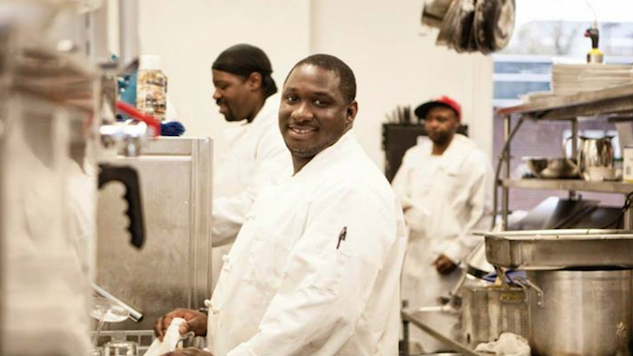
Elias Kasongo, from Congo, came as a refugee in 1994. Marc Schulman, president of Eli’s Cheesecake, hired him to wash cake pans and, over the years, promoted him to purchasing manager.

See what I mean? I can hardly keep up with all the stories of Americans who help refugees (and refugees who give back). I feel a kind of duty to let you know about them in case they aren’t part of your daily fare.

National Public Radio’s Deborah Amos reported this next story about refugees working in some surprising Chicago businesses.

“In Chicago,” she reports, “war refugees have a hand in the city’s most famous handmade cheesecake.

” ‘People who come as refugees have great skills,’ says Marc Schulman, the president of Eli’s Cheesecake, which has sold cheesecakes and other baked desserts since 1980. One-third of adult refugees arriving in the U.S. have college degrees, according to the Migration Policy Institute in Washington, D.C., a think tank that tracks the movement of people worldwide. And refugee employment is a successful model for finding skilled workers for a food business that has become high tech, says Schulman.

“A cheesecake at Eli’s is still based on the simple recipe of the founder, the late Eli Schulman, Schulman’s father, who served his famous confections to political leaders and Hollywood stars. Marc Schulman wears the Cartier watch that Frank Sinatra — a regular customer — sent his father in 1987. …

“The mixing and baking are computerized, so the 220 employees have to be highly skilled. Schulman recruits about 15 percent of the workforce from refugees resettled in Chicago. The employee list reflects the waves of flight from war-torn countries — Iraq, Bhutan, Kosovo, Congo, Myanmar.

“Elias Kasongo began working at the bakery in 1994 after fleeing unrest in the Democratic Republic of Congo. …

” ‘I’ve been here at Eli’s for the past 22 years. It’s my home; it’s a beautiful thing,’ says Kasongo, who is now a U.S. citizen. The job was all he had when he was starting his new life in America. Today, he’s a homeowner. …

“Schulman’s hiring strategy is used at other well-known companies in Chicago, including Tyson Foods and Trump International Hotel & Tower.

[!]

” ‘Every major hotel works with a refugee agency,’ says Sean Heraty, manager of workforce development at RefugeeOne. ‘Job retention is through the roof.’

“Employers have ‘awakened to the potential of refugees,’ says Kathleen Newland, at the Migration Policy Institute. That’s because they are hardworking and loyal and tend to stay on the job longer than American-born workers, she says.”

More here.

Refugee Boy Scouts

Photo: Thomas Peipert/AP
Leaders of this Colorado Boy Scout troop say the group helps refugee kids adjust to American culture while providing a safe place where they can be themselves.

It may be surprising, given the news that grabs our attention these days, but stories about ordinary people showing kindness to refugees are everywhere. I can hardly keep up. Consider this KidsPost about a Colorado Boy Scout troop published in the Washington Post January 2, 2017.

“Boy Scouts Jean Tuyishime and Moise Tuyikunde sit around a campfire under a canopy of stars in Colorado’s Rocky Mountains, joking and teasing each other as teenage brothers often do. Only 2½ years ago, they were a world away, living at a crowded camp in the central African nation of Rwanda (pronounced ru-WAHN-duh).

“The brothers were born in the Gihembe refugee camp after their parents fled violence in 1996 in what was then known as Zaire (zah-EER). They relocated with their family to the Denver area in 2014, and they gradually became a part of their new surroundings, learning to speak enough English to get by and signing up for a typical American experience — Boy Scouts.

“But the troop Jean, 15, and Moise, 12, joined is not like many others in the United States. Troop 1532 is composed almost entirely of refugees who hail from faraway places such as Burma, Rwanda and Nepal.

“At campouts, such traditional American food as hot dogs and trail burgers is replaced by fish head stew, fire-roasted corn and chatpate, a popular street snack in the Asian country of Nepal. Dessert, however, still includes s’mores. …

“Troop 1532, formed in 2014, could be a model for other Boy Scout groups looking to welcome young refugees. [Justin] Wilson and P.J. Parmar, a doctor who started the troop, say the kids’ backgrounds present challenges that other troops don’t face. Members come and go, which makes it hard to focus on earning merit badges and advancing in rank. …

“Many of the parents have little money and work long, odd hours, which makes it hard to plan meetings. Parmar said the scouts often can’t get to meetings, so he decided to gather only for camping trips. …

“Jean’s father, Jean Batacoka, a 37-year-old housekeeper with five children, says the efforts of Wilson and Parmar have helped his kids.

“ ‘What they do down there is not just leadership, because they learn discipline, how to behave, how to respect people who are older than them,’ he said through a translator. ‘I think it’s a really good thing for them, and I can see something is happening.’ ”

I have nothing but admiration for the men who organized this. Any scout troop requires a big commitment from adult leaders, as some readers of this blog know. The time and energy Troop 1532 leaders give to the unique challenges of refugee Scouts is especially remarkable.

More at the Washington Post, here.