A recent article by Mark Schrope in the NY Times Science section reads a bit like a murder mystery. It all started with a hunch and maybe a tingly feeling.
Grigory Kessel, a Syriac scholar from Philipps University in Marburg, Germany, was visiting a wealthy collector of rare scientific material in Baltimore when he was allowed to hold an ancient manuscript.
The pages, Schrope reports, “seemed oddly familiar. … Dr. Kessel realized that just three weeks earlier, in a library at Harvard University, he had seen a single orphaned page that was too similar to these pages to be coincidence.
“The manuscript he held contained a hidden translation of an ancient, influential medical text by Galen of Pergamon, a Greco-Roman physician and philosopher who died in 200 A.D. It was missing pages and Dr. Kessel was suddenly convinced one of them was in Boston.
“Dr. Kessel’s realization in February 2013 marked the beginning of a global hunt for the other lost leaves, a search that culminated in May with the digitization of the final rediscovered page in Paris. …
“In 2009, the Galen Palimpsest was lent to the Walters Art Museum for spectral imaging of its leaves by an independent group of specialists, which would reveal the erased Galen undertext. …
“The resulting images went online under a ‘creative commons’ license, meaning that anyone can use the material free for any noncommercial purpose. Once the images were online, William Noel, who was the curator of manuscripts and rare books at the museum, began organizing members of the tiny community of scholars who study Syriac scientific texts to study the new material.
“One of them was Dr. Kessel … By analyzing the page size, handwriting and other features, as well as the visible text, Dr. Kessel was able to determine that the Harvard leaf did indeed fill one of the gaps in the Galen Palimpsest. But six more were apparently missing. Dr. Kessel set out to find them.
“He began with a list of 10 libraries known to have ancient Syriac material, combing through online catalogs when available to look for clues such as the right dimensions or vague references to undertext. Sometimes, he traveled to the libraries himself. …
“It was not long before Dr. Kessel had good news. He found one missing page in a catalog from the Sacred and Imperial Monastery of the God-Trodden Mount of Sinai. It is known more commonly as St. Catherine’s in the Sinai Desert in Egypt, which has the world’s oldest continuously operating library.
“Another leaf turned up at the National Library of France in Paris. And at the Vatican’s vast library in Rome, he was able to identify the other three missing leaves, bringing the total to six.”
Read more here about the hunt, and learn what scholars hope to glean from the restored text.
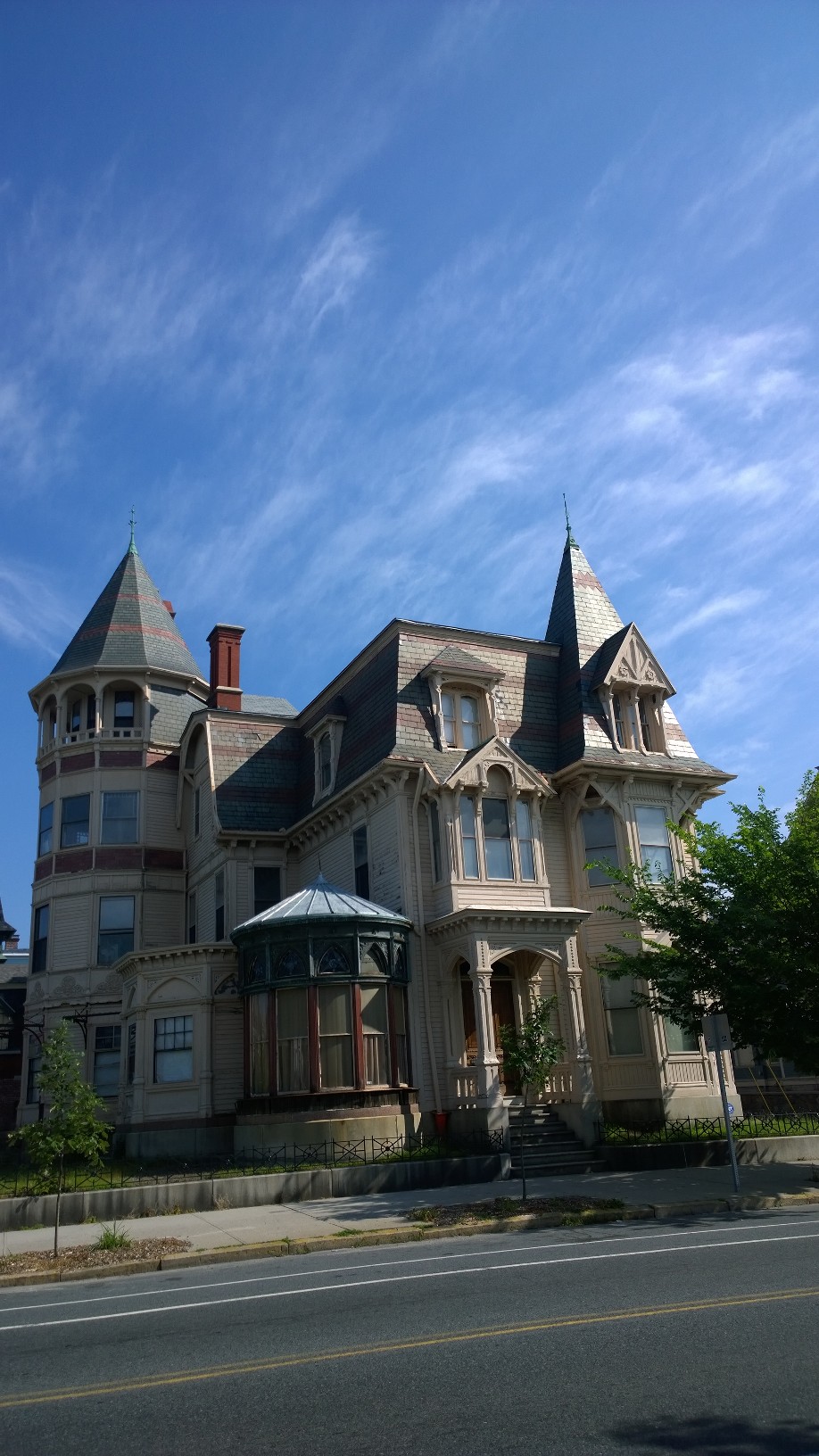
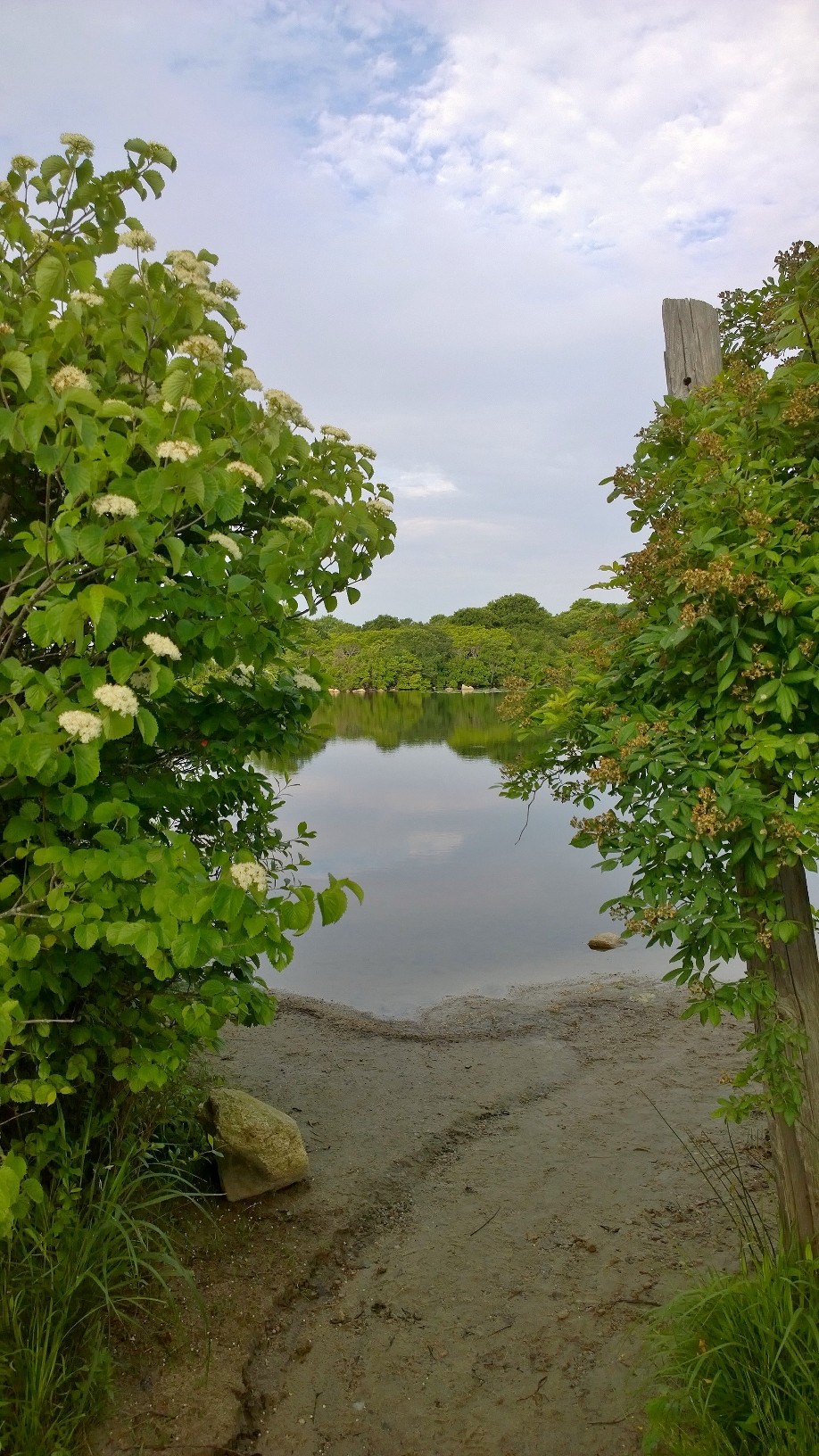
The little state with the big heart. Showing an intriguing old house in Providence, and island scenes in early morning and late afternoon.
This is the peaceful side of things, contrasting with the stories we just heard from an exhausted policeman we know who spent the last five days trying to control unruly 4th of July crowds, working from 5 a.m. to 11 p.m. “And we have only two cells to put them in,” he said in exasperation.
So hard to understand why, with all this beauty around them, people would do so much damage to themselves.
Calming down here as four grandchildren go to sleep. It was a day of running around, getting wet, and shrieking. Which explains why I personally have no still photos of the kids: they were never still. Fortunately, Suzanne caught this moment.
What I have is pictures of marching bands. The parade floats were mostly on the theme of Dr. Seuss, but the usual bars were also represented. The nature fund raiser Conserfest sent a good band out on a flatbed truck. The fire engines were loud.
It was John’s turn to be Boss of the Kitchen at diinertime. He made steaks and oversaw two sous chefs, who followed his meticulous directions for sauteed rosemary fingerling potatoes and kale with garlic. We tried to make a potential viral video of the baby watching fireworks, but she was a bit too laid back about it to become a YouTube sensation.
Some fourth graders in New York are experiencing a real archaeological dig: under the floor of the classroom closet.
Paul Lukus reports at the NY Times, “Bobby Scotto, a fourth grader at the Children’s Workshop School on 12th Street in the East Village, wants to be an archaeologist when he grows up, and he is already off to a good start. In the past few months he has excavated dozens of old coins, a toy watch and other artifacts, all from an unlikely dig site: his classroom’s closet.
“Bobby, an earnest 10-year-old with a mop of dark hair and saucerlike brown eyes, was bitten by the archaeology bug four or five months ago, when his class read a book about a migrant farmworker who found old coins in a field. Bobby decided he wanted to collect old coins of his own, and he had noticed a small gap between the floorboards in the closet. So he reached into that gap as far as he could and, voilà, out came a bunch of wheat pennies (minted from 1909 to 1958), a buffalo nickel and other treasures. …
“And so began an improbable exercise in hands-on archaeology that soon attracted all 21 students in the class. ‘There’s something about the degree of difficulty that’s just perfect,’ said the class’s teacher, Miriam Sicherman, 43, who has been teaching at the school for 15 years. ‘You can’t just reach in and grab something, but it is possible to get something. There’s just enough gratification.’ …
“Along the way, the students have also become adept at research (when they find something, they try to learn more about it on the web); cataloging (each object is logged on a sheet that Ms. Sicherman helped the students design); preservation (the artifacts are kept in plastic bags); and documentation (Ms. Sicherman posts photos of the artifacts on an Instagram account).” More here.
That’s a smart teacher, adapting to her students’ interests. I can imagine some long-ago teachers or some of today’s stressed-out teachers putting a stop to the exploration. Like the policemen in comic books who stop kids trying to salvage a quarter in a grate using chewing gum on the end of a stick. (Such stories of city life always intrigued me as a comic-reading child who grew up in the country.)
Photo: Todd Heisler/The New York Times Bobby Scotto, 10, left, a student at the Children’s Workshop School in the East Village, mining his classroom’s closet for treasures.
Kate Colby (for whose offer of a room to Suzanne and Erik when they were house hunting there can never be enough gratitude) is a poet.
She came to the rescue when Suzanne was starting Luna & Stella and was having trouble finding a writer to capture the more ethereal qualities of the birthstones.
“What you need,” I said, “is a poet.”
“I know a poet!” she cried. She remembered Kate used to write copy for a catalog.
Beyond such marketing endeavors, Kate publishes poetry, choreographs offbeat theater, and co-leads art/poetry walks. An example of the latter will occur soon.
As Eryn Carlson writes at the Boston Globe, Kate is collaborating with artist Todd Shalom to offer “Duly Noted,” a participatory walk incorporating techniques from poetry, sound, and performance, at deCordova Sculpture Park and Museum in Lincoln, Massachusetts, July 18, at 2 p.m. and 5 p.m.
Carlson comments, “Shalom and Colby know that the very nature of tours makes it easy to overlook the ways in which artworks and their settings inform one another. … The pair created the collaborative walk ‘Duly Noted,’ a poetic exchange between participants and the Lincoln museum’s site and surroundings.
“ ‘Reading the art is apt because it’s so framed by woods and walls and water, and all this history,’ said Colby, who grew up in Wayland and lives in Providence. …
“ ‘It’s all about reframing the site,’ said Shalom, a Brooklyn, N.Y.-based artist who founded Elastic City.”
At a performance in May, “participants evolved from visitors to artists and performers. Individuals gave one-word soliloquies atop a stump, announcing their visual discoveries, and, guided by a partner, wandered the grounds with eyes closed to pay special attention to the surrounding cacophony. …
“Shalom and Colby, who met while working on their master’s degrees in fine arts at California College of the Arts, planned ‘Duly Noted’ meticulously over the course of a year, visiting the deCordova several times to perfect the route, pacing, and segues. But a degree of uncertainty and room for spontaneity remained.”
This could be a fun activity on July 18 if you live in the area. The grounds of the museum offer breathtaking views and sculptures everywhere you turn. Add to that a participatory happening like this, and you have the ingredients for a memorable day.
David Wilkes has a great story at the Daily Mail about a self-contained garden that hasn’t had to be watered in decades.
“To look at this flourishing mass of plant life you’d think David Latimer was a green-fingered genius. Truth be told, however, his bottle garden – now almost in its 53rd year – hasn’t taken up much of his time. …
“For the last 40 years it has been completely sealed from the outside world. But the indoor variety of spiderworts (or Tradescantia, to give the plant species its scientific Latin name) within has thrived, filling its globular bottle home with healthy foliage.
“Yesterday Mr Latimer, 80, said: ‘It’s 6ft from a window so gets a bit of sunlight. It grows towards the light so it gets turned round every so often so it grows evenly. Otherwise, it’s the definition of low-maintenance. I’ve never pruned it, it just seems to have grown to the limits of the bottle.’
“The bottle garden has created its own miniature ecosystem. Despite being cut off from the outside world, because it is still absorbing light it can photosynthesise.”
Photo: BNPS.CO.UK Still going strong: Pensioner David Latimer from Cranleigh, Surrey, with his bottle garden that was first planted 53 years ago and has not been watered since 1972 — yet continues to thrive in its sealed environment.
The New York Times had a story not long ago about friendships between young people and old people in Cleveland. How does it happen? They live in the same retirement home.
John Hanc describes a home’s musical evening: “Janet Hall grimaces as she hits an off note on her violin, one of the few heard here at Judson Manor’s Friday afternoon recital, held in the chandeliered ballroom settings of the first-floor lounge of this residence for older people.
“As an audience of 56 mostly older adults watches expectantly, Ms. Hall, 78, quickly recovers from the miscue. She slides her bow across the strings of her violin, drawing out the sweet and sonorous notes of a Gabriel Fauré suite.
“Looking on and smiling is her accompanist on piano, Daniel Parvin, a 25-year-old doctoral candidate student at the Cleveland Institute of Music.
“Over a half-century apart in age, Ms. Hall and Mr. Parvin share some things in common besides this duet. A home, for one: Both are residents at Judson Manor, formerly a luxury hotel, built in 1923, in Cleveland’s University Circle section. A love of music, for another …
“Here at Judson, young and old play nicely together, part of an intergenerational program that has led to harmonious relationships beyond the concerts. … The artist-in-residence program provides furnished one-bedroom apartments to three graduate students from the Cleveland Institute of Music at no charge, for the duration of their studies. In exchange, the students perform regular concerts at Judson Manor. …
“The students were required to submit a résumé and an essay. ‘Basically, “Why I wouldn’t mind living in a senior residence,” ‘ says [Richard K.] Gardner, a committee member. …
“Experts say there is much to be learned from an intergenerational living program based around the arts like the Judson program. ‘We’ve heard people talking about doing something like this, but I’ve never seen it at this level, sustained and consistent,’ says Gay Hanna, executive director for the National Center for Creative Aging in Washington, a nonprofit organization designed to promote creative arts programs for older adults. ‘It’s a bellwether for the future.’ ”
Photo: Michael F. McElroy for The New York Times Tiffany Tieu, a violinist and student at the Cleveland Institute, talks with Peggy Kennell. “When I tell people I’m living in a retirement home, they think I’m joking,” Ms. Tieu says.
I was charmed by Sy Montgomery’s recent article in the Boston Globe on the intelligence of octopi (she says “octopuses”).
The author of The Soul of an Octopus: A Surprising Exploration into the Wonder of Consciousness, Montgomery describes getting to know a clever and apparently affectionate octopus called Octavia.
“Everyone wanted to pet Octavia,” she writes. “And no wonder. She was beautiful, graceful, and affectionate. The fact that she was boneless, slimy, and living in painfully cold, 47-degree water deterred none of us.
“What thrilled us — me, New England Aquarium volunteer Wilson Menashi, and four visitors from the environmental radio show Living on Earth was the surprising fact that Octavia, who clearly wanted to be petted, was a giant Pacific octopus.
“When her keeper, Bill Murphy, opened the top of her exhibit, Octavia recognized Menashi and me immediately; we’d been working with her for several weeks. Turning red with excitement, she flowed over toward us from the far side of her tank. When we put our hands in the water, her arms rose to meet ours, embracing us with dozens of her strong, sensitive, white suckers. Occasionally Wilson handed her a fish from the plastic bucket perched on the edge of her tank. …
“Then, as Menashi reached for another capelin to feed her, we realized the bucket of fish was gone. While no fewer than six people were watching, and three of us had our arms in her tank, Octavia had stolen the bucket right out from under us.
“ ‘Octopuses are phenomenally smart,’ Menashi says. And he should know: He has worked with them for 20 years, and is expert in keeping these intelligent invertebrates occupied. Otherwise, they become bored. Aquariums design elaborate escape-proof lids for their octopus tanks, and still they are often thwarted. Octopuses not infrequently slip out of their exhibits and turn up in other tanks to eat the inhabitants.
“Many aquariums give their octopuses Legos to dismantle, jars with lids to unscrew, and Mr. Potato Head to play with. Menashi, a retired inventor, designed a series of nesting Plexiglas cubes, each with a different lock, which Boston’s octopuses quickly learned to open to get at a tasty crab inside. And just this spring, New Zealand Sea Life aquarists teamed up with Sony engineers to teach a female octopus named Rambo to press the red shutter button on a waterproof camera to take photos of visitors, which the aquarium sells for $2 each to benefit its conservation programs. Rambo learned in three attempts.”
What a different perspective on the scary beast in the film 20,000 Leagues Under the Sea, which I saw as a child.
I’d love to copy the whole intriguing article, but I’m afraid that would not be “fair use.” So read it all here.
Photo: Tia Strombeck
Sy Montgomery pets Octavia, an octopus at the New England Aquarium in Boston.
Three cheers for quirky causes that, at a minimum, don’t do any harm and, at best, make a contribution to the world.
Simon Romero recently covered one such cause in the New York Times: “Shigeru Nakayama, the guardian of this ghost city in the Amazon rain forest, gazes at the Rio Negro, a vast blackwater tributary. From some angles, it looks less like a river than a sea, spurring him to remember Japan.
“ ‘Fukuoka got kind of cold during winter,’ said Mr. Nakayama, 66, who left the island of Kyushu in southern Japan with his parents and three brothers in the mid-1960s for a new life in Brazil. ‘We were farming people, trying to get ahead. Japan was reduced to ashes after the war. Life was still tough.’
“ ‘But Brazil was the land of our dreams,’ said Mr. Nakayama, squinting under the punishing midday sun as he leaned his wiry frame against one of the crumbling stone buildings of Airão Velho — a town so overgrown and forlorn it is now held in a labyrinthine embrace of tree roots and vines.”
He has made it his life’s work to “to care for the abandoned outpost. …
“ ‘I’m glad there’s someone taking care of Airão Velho,’ said Victor Leonardi, a historian of Amazonia at the University of Brasília who explored the ruins here in the 1990s. “It smelled of jaguar urine back then, but it was obviously a place of riches at one point, where people dined on porcelain from England and consumed Cognac from France.’ …
“ ‘Japan has turned into a new kind of prosperous country, and I guess that’s good for the people there,’ Mr. Nakayama said. ‘But that kind of life was never in the cards for me.’
“Mr. Nakayama acknowledged that shielding Airão Velho from the encroachment of the jungle was an uphill struggle. A glance around suggests that the strangler figs have the scales tipped in their favor. Amid the ruins, wasps hover; fire ants march; cicadas sing. …
“Nakayama feels the need to clean the graveyard, hacking away at the growth that threatens to devour the site once and for all. ‘For centuries, people lived and died in Airão Velho,’ he said. ‘They were the true pioneers, and I have to honor their memory by preserving this place. It is a matter of respect.’ ”
Early this month, my colleague Bo went to Tennessee with friends to see synchronous fireflies.
The one week of firefly watching is a real happening. Bo told me that, to get tickets, he went online twice at exactly 10 a.m. The first time he missed out. They go fast. He said that these special fireflies (which start flashing together and stop together) were long known in Southeast Asia but thought to exist nowhere in North America.
The way he heard it, one day a woman from Tennessee was chatting with a firefly expert somewhere in the South and happened to mention the behavior of some fireflies she loved to watch back home. And that was the first time the word got out to the scientific community that synchronous fireflies existed in North America. Now it’s practically Disney World out there — controlled, but crowded.
The Great Smoky Mountains National Park website posted this before the great annual event: “The firefly shuttle operating dates for 2015 will be June 2-9. Advance reservations of parking passes have sold out, however an additional 85 passes will be available for each day of the event. These 85 passes will go on sale online at 10:00 a.m. the day before the event and will be available until 3:30 p.m. on the day of the event or until the passes are all reserved. Passes can be purchased at www.recreation.gov or by calling (877) 444-6777.
“During the program operating dates, a parking pass is required for evening access to the Sugarlands parking lot and the firefly shuttle to the Elkmont viewing area. There is a limit of one parking pass per household per season. …
“Synchronous fireflies (Photinus carolinus) are one of at least 19 species of fireflies that live in Great Smoky Mountains National Park. They are the only species in America whose individuals can synchronize their flashing light patterns.
“Fireflies (also called lightning bugs) are beetles. They take from one to two years to mature from larvae, but will live as adults for only about 21 days. …
“Their light patterns are part of their mating display. Each species of firefly has a characteristic flash pattern that helps its male and female individuals recognize each other. … Peak flashing for synchronous fireflies in the park is normally within a two-week period in late May to mid-June.”
Personally, I’d be happy to see any kind of firefly at all. There used to be so many. They were like fairies. I’ve read that lawn chemicals are responsible for their decline. The video below covers both the science and the happening. See the fireflies flash.
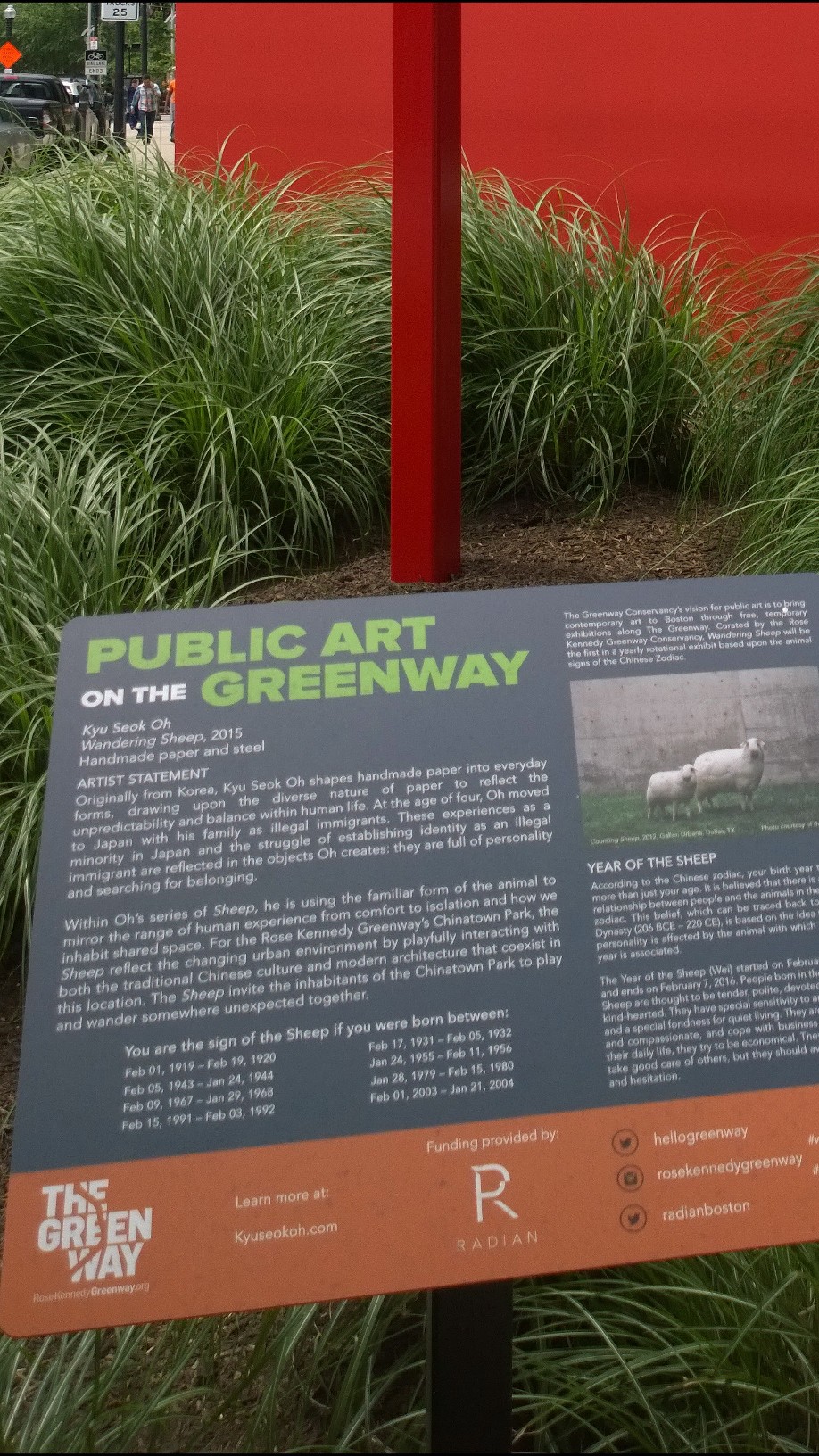
I was in Chinatown today at lunch and was charmed by several paper-and-steel sheep on the Greenway’s Red Gate. The Greenway website says, “Korean born, New York based artist Kyu Seok Oh has created Wandering Sheep at the Red Gate in Chinatown Park (corner of Essex St and Surface Road) This is the first of a series of exhibits based on the Chinese Zodiak calendar.” We are currently in the Year of the Ram (or the Goat, or the Sheep; I’m told the Chinese language doesn’t distinguish). I’m posting two pictures.
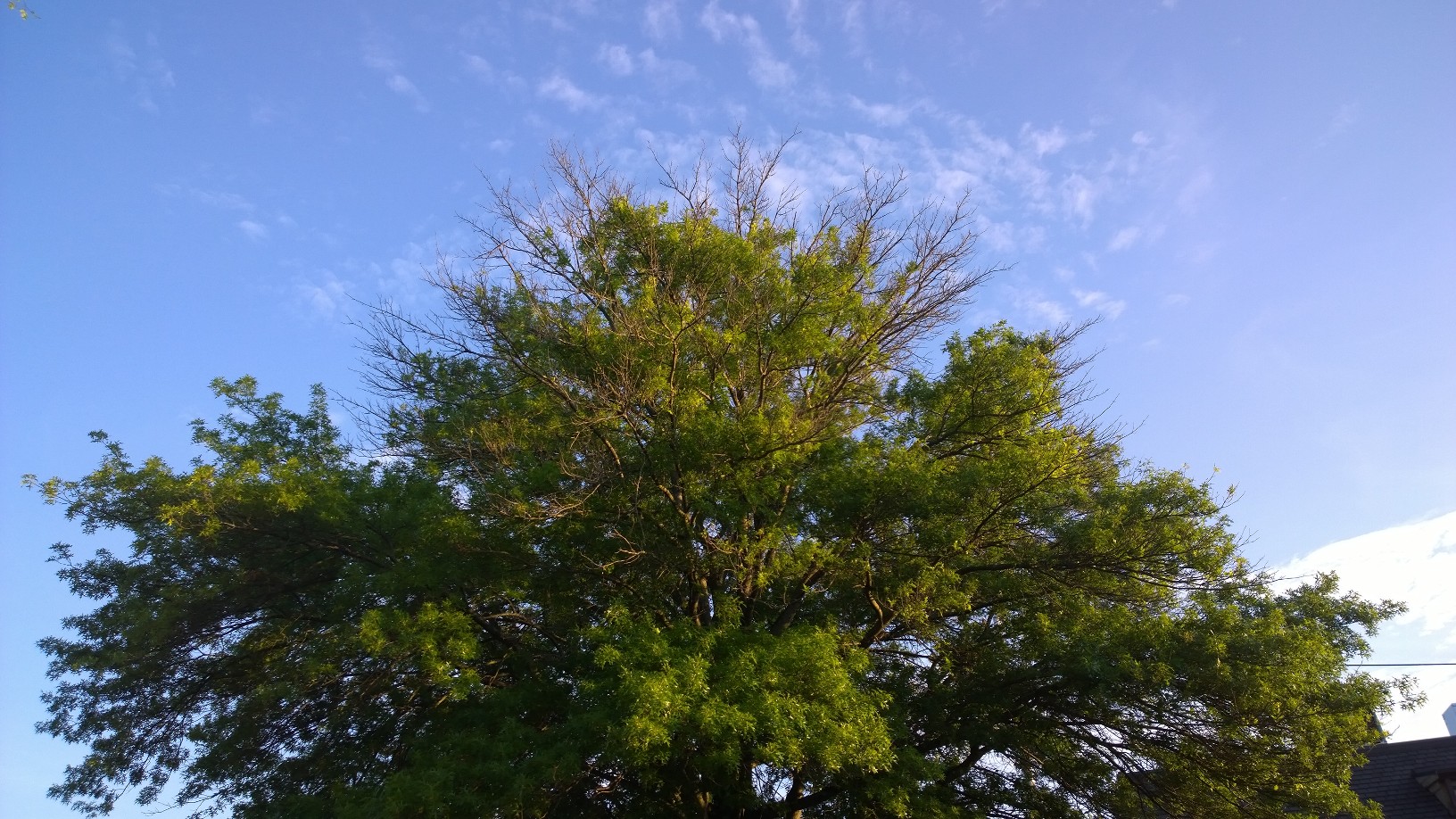
Also today, I have photos of a sunny treetop, another tree gripping the bank of the Assabet River, early morning light on a Fort Point warehouse, nasturtiums in sunshine, and the new look of the pizza place. John contributed the aspirational kite.
I learned from an article in the NY Times last month that Thomas Edison’s first voice recordings were for talking dolls. And until recently, no contemporary person dared listen to them.
Ron Cowen writes, “Though Robin and Joan Rolfs owned two rare talking dolls manufactured by Thomas Edison’s phonograph company in 1890, they did not dare play the wax cylinder records tucked inside each one.
“The Rolfses, longtime collectors of Edison phonographs, knew that if they turned the cranks on the dolls’ backs, the steel phonograph needle might damage or destroy the grooves of the hollow, ring-shaped cylinder. …
“Sound historians say the cylinders were the first entertainment records ever made, and the young girls hired to recite the rhymes were the world’s first recording artists.
“Year after year, the Rolfses asked experts if there might be a safe way to play the recordings. Then a government laboratory developed a method to play fragile records without touching them.
“The technique relies on a microscope to create images of the grooves in exquisite detail. A computer approximates — with great accuracy — the sounds that would have been created by a needle moving through those grooves.”
Artifacts: Collection of Robin and Joan Rolfs A government laboratory found a way to listen to recordings on fragile wax cylinders inside dolls made by Thomas Edison in 1890.
At the website This Is Colossal, Christopher Jobson writes about time-lapse videos of Joe Mangrum’s spontaneous sand paintings.
“Artist Joe Mangrum (previously) was just in Zuidlaren, Netherlands, where he was commissioned by the Doe Museum to create 8 temporary sand paintings over a period of 11 days. All of Mangrum’s paintings are spontaneous and evolve as he works, a grueling physical process that involves dozens of revolutions around the artwork as he adds new details and flourishes by pouring brightly colored sand. All eight artworks were photographed as he worked and turned into time-lapse videos, three of which are included here. The sand paintings will remain on view through October 30, 2015. You can follow more of Mangrum’s work on Facebook.”
Jobson wrote in a previous post about the work, “Since 2006 artist Joe Mangrum has taken to the streets of New York, Chicago, San Francisco and elsewhere armed with sacks of colored sand that he sprinkles by the handful to create sprawling temporary paintings. Each work is spontaneous in its design and evolves as Mangrum works, spending upwards of 6-8 hours hunched over the ground to complete each piece. The artist estimates he’s completed nearly 550 paintings over the last few years. A graduate of the Art Institute of Chicago, his paintings have appeared at The Corcoran Gallery, the Museum of Arts and Design in NYC, as well as The Asia Society. He also made a recent appearance on Sesame Street. ”
See the videos here. The sand paintings are like berserk mandalas; in the videos, they are alive.
Cambridge knows how to make artists feel welcome, even cherished. Recently the city had a poetry contest, and the winners are getting their poems embedded in the sidewalk.
Steve Annear writes at the Boston Globe, “Cambridge officials received hundreds of submissions from residents hoping to make their mark as literary legends through the city’s first-ever ‘Sidewalk Poetry’ contest this spring. In the end, only five scribes emerged victorious.
“In March, the city put out a call for poets to participate in the project. Winners were promised a permanent display space for their musings — the poems would be imprinted in the freshly poured concrete as Department of Public Works crews replaced sidewalk slabs cracked or damaged during the winter.
“The response was great, said Molly Akin, the Cambridge Arts Council’s marketing director. More than 300 submissions flooded in from writers ranging in age from 4 to 95, according to organizers.
“A special committee that included workers from the [Department of Public Works], representatives from the local libraries, members of the Arts Council, and Cambridge’s former Poet Populists helped select the finalists. …
“Below are the names of the winners, and their poems:
Rose Breslin Blake Children, look up
Cherish those clouds
Ride grey ponies over their hills
Feed the shiny fish
Boo the big bear
Chase the gloomy giant
Giggle with the geese
Sing with the lambs
Cherish those clouds; they cherish you
Rest on their pillows.
Benjamin Grimm I could not forget you if I tried.
I have tried.
Ty Muto Your blue-green glances
My heart skips double dutch beats
Caught in your rhythm
Carolyn Russell Stonewell Sun takes a bite of
mango as it sets.
Its last rays
run down my cheek.
Elissa Warner A Mother’s Wish
Little boys, little treasures
Shine like lights from above
My son, my only one
My wish for you is that you wake
One day when you are old
And feel raindrops on your cheek
Tears of joy from my heart
For you to keep
I’ve never managed to catch the herring run, but I’d like to see it with grandchildren sometime. The celebration for the Mystic River herring migration offers all sorts of extras, as I learned from the newsletter of the Mystic River Watershed Association, or MyRWA. (I’ve been receiving the newsletter since John’s stint on the board some years back.)
“The annual Herring Run and Paddle includes a 5K run/walk race, three paddling races (3, 9, and 12 miles), educational booths, children’s activities, and more. All events are held at the [Department of Conservation and Recreation] Blessing of the Bay Boathouse in Somerville.”
MyRWA reports, “The Mystic River Watershed supports two species of herring: Alewife (Alosa psuedoharenous) and Blueback Herring (Alosa aestivalis). Both species, collectively called river herring, are anadromous. This means they spend most of their lives at sea and return to rivers—like the Mystic—to spawn, or lay their eggs.
“In colonial times and earlier, herring in the Mystic River were extraordinarily abundant. But from the 1900’s until today a much smaller population of river herring is present. …
“According to the Herring Alliance some river herring runs on the Atlantic Coast have declined by 95% or more over the past 20 years. In 2006 the National Marine Fisheries Service designated river herring as a species of concern. Population decline may be associated with numerous factors including by-catch [catching them by accident when fishing for something else], habitat loss and degradation, water pollution, poaching, access to spawning habitat, and natural predators.”
Read more here. And remind me next May that I want to visit a fish ladder.




















 Suzanne's Mom's Blog